
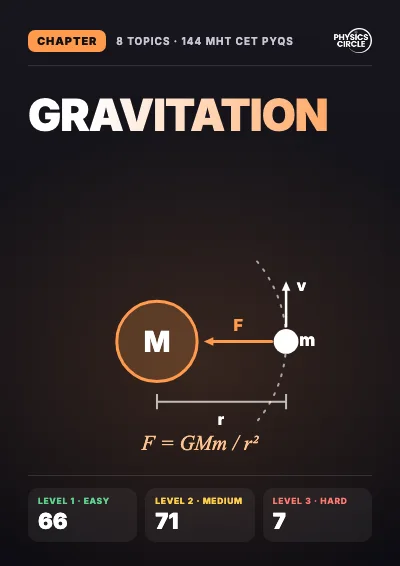
Gravitation Formula Book
48 formulas in 8 topics, in the same order as the PYQ topics.
Only formulas used in the solutions of 144 MHT CET PYQs (Level 1, 2, 3)Newton's Law of Gravitation
2 formulas · from 4 MHT CET PYQs
- Newton's law of gravitation
- Mass of a sphere of given density
Acceleration Due to Gravity
14 formulas · from 59 MHT CET PYQs
- Acceleration due to gravity at the surface
- g in terms of density
- g at height h
- g at small height (h much less than R)
- g at depth d
- Depth where g becomes g/n
- Height where g becomes g/n
- g on another planet
- Effect of Earth's rotation at latitude lambda
- g at the equator
- Rotation speed for weightlessness at the equator
- Weight at height and depth
- Pendulum period depends on g
- Frequency of a simple pendulum
🔒 For Vajra 2.0 Pro studentsTopic 1 is free. Log in with your Vajra 2.0 Pro number to see every formula.
Gravitational Field
3 formulas · from 6 MHT CET PYQs
- Gravitational field outside a sphere
- Gravitational field inside a solid sphere
- Neutral point between two masses
🔒 For Vajra 2.0 Pro studentsTopic 1 is free. Log in with your Vajra 2.0 Pro number to see every formula.
Gravitational Potential & Energy
3 formulas · from 5 MHT CET PYQs
- Gravitational potential of a point mass
- Potential at the neutral point between m and M
- Gain in PE when raised to height h
🔒 For Vajra 2.0 Pro studentsTopic 1 is free. Log in with your Vajra 2.0 Pro number to see every formula.
Escape Velocity
8 formulas · from 27 MHT CET PYQs
- Escape velocity
- Escape velocity in terms of density
- Escape velocity and planet's mass, radius
- Energy conservation from R to R0
- Max height for launch speed v = K v_e
- Max height for launch speed v
- Speed far away when launched faster than v_e
- Escape from a system of masses
🔒 For Vajra 2.0 Pro studentsTopic 1 is free. Log in with your Vajra 2.0 Pro number to see every formula.
Kepler's Laws & Planetary Motion
1 formulas · from 3 MHT CET PYQs
- Kepler's third law
🔒 For Vajra 2.0 Pro studentsTopic 1 is free. Log in with your Vajra 2.0 Pro number to see every formula.
Satellites - Orbital Velocity & Period
9 formulas · from 25 MHT CET PYQs
- Orbital velocity
- Gravity provides centripetal force
- Useful substitution
- Period of a satellite
- Period and orbit radius
- Radius of orbit from angular speed
- Satellite close to the surface: period and density
- Angular momentum of a satellite
- Binary system: two equal masses m, separation 2r
🔒 For Vajra 2.0 Pro studentsTopic 1 is free. Log in with your Vajra 2.0 Pro number to see every formula.
Satellite Energy & Weightlessness
8 formulas · from 15 MHT CET PYQs
- Kinetic energy of a satellite
- Potential energy of a satellite
- Total energy of a satellite
- Relation between K, U and E
- Energy on the Earth's surface (at rest)
- Energy to put a satellite in orbit of radius r
- Energy to lift a body to height h
- Weightlessness in an orbiting satellite
🔒 For Vajra 2.0 Pro studentsTopic 1 is free. Log in with your Vajra 2.0 Pro number to see every formula.