
Escape Velocity
Two planets and with equal mass have radii and , respectively, where . The escape speeds of and are and , respectively. Then is:
Show answer and solution
Answer: (d)
Loading the solution…
Home›Practice Hub›Chapters›Gravitation›Escape Velocity
Gravitation PYQs · MHT CET · JEE Main · NEET
 Gravitation · Lecture 4 · Escape Velocity & Orbital Velocity55:28All 10 Gravitation videos →
Escape Velocity
Two planets and with equal mass have radii and , respectively, where . The escape speeds of and are and , respectively. Then is:
Answer: (d)
Escape Velocity
The escape velocity from a spherical planet is . The escape velocity from another planet whose density and radius are of those of planet , is .
Answer: (d)
Escape Velocity
If earth has a mass nine times and radius twice to the planet P. Then ms will be the minimum velocity required by a rocket to pull out of gravitational force of P, where is escape velocity on earth. The value of is
Answer: (a)
Escape Velocity
A particle of mass is projected with a velocity () from the surface of the earth. The maximum height above the surface reached by the particle is ( = escape velocity, is radius of earth)
Answer: (c)
Escape Velocity
A body is projected vertically upwards from earth's surface. If its kinetic energy of projection is equal to half of its minimum value required to escape from the gravitational influence then the height up to which it rises is ( = radius of earth)
Answer: (c)
Escape Velocity
A body is projected vertically from earth's surface of radius R with velocity equal to half the escape velocity. The maximum height reached by the body is
Answer: (a)
Escape Velocity
A body of mass 'm' is raised to a height '' from the surface of the earth, where 'R' is the radius of the earth. Suppose it is released now. The speed with which it will strike the surface of the earth is nearly
[ = acceleration due to gravity]
Answer: (a)
Escape Velocity
If a body of mass 1 kg falls on the earth from infinity, it attains velocity (v) and kinetic energy (k) on reaching the surface of earth. The values of v and k respectively are __________. (Take radius of earth to be 6400 km and g = 9.8 m/s2)
Answer: (a)
Escape Velocity
The masses and radii of the earth and moon are , and , and respectively, Their centres are at a distance 'd' apart. The minimum speed with which body of mass 'm' should be projected from a distance from the centre of so as to escape to infinity is
Answer: (c)
Escape Velocity
The escape velocity of a satellite from the surface of earth does NOT depend on
Answer: (b)
Escape Velocity
Given below are two statements: one is labelled as Assertion A and the other is labelled as Reason
Assertion A: The kinetic energy needed to project a body of mass from earth surface to infinity is , where R is the radius of earth.
Reason R: The maximum potential energy of a body is zero when it is projected to infinity from earth surface.
In the light of the above statements, choose the correct answer from the options given below
Answer: (a)
Escape Velocity
Earth has mass 8 times and radius 2 times that of a planet. If the escape velocity from the earth is 11.2 km/s, the escape velocity in km/s from the planet will be:
Answer: (c)
Escape Velocity
A body is projected vertically from earth's surface with of escape velocity. The maximum height reached by the body is ( radius of earth)
Answer: (b)
Escape Velocity
An object is kept at rest at a distance of above the earth's surface where is earth's radius. The minimum speed with which it must be projected so that it does not return to earth is: (Assume mass of earth, Universal gravitational constant)
Answer: (c)
Escape Velocity
The radius of the planet is double that of the earth, but their average densities are same. and are the escape velocities of planet and earth respectively. If , the value of ' ' is
Answer: (c)
Escape Velocity
The escape velocity from earth surface is . The escape velocity from a planet having twice the radius and same mean density as earth is
Answer: (a)
Escape Velocity
The escape velocity for earth is . A planet having 9 times mass that of earth and radius, 16 times that of earth, has the escape velocity of:
Answer: (c)
Escape Velocity
To project a body of mass from earth's surface to infinity, the required kinetic energy is (assume, the radius of earth is acceleration due to gravity on the surface of earth):
Answer: (c)
Escape Velocity
The mass of the moon is times the mass of a planet and its diameter is times the diameter of a planet. If the escape velocity on the planet is , the escape velocity on the moon will be:
Answer: (d)
Escape Velocity
Escape velocity of a body from earth is . If the radius of a planet be one-third the radius of earth and mass be one-sixth that of earth, the escape velocity from the planet is:
Answer: (a)
Escape Velocity
The radius and mean density of the planet are four times as that of the earth. The ratio of escape velocity at the earth to the escape velocity at a planet is
Answer: (b)
Escape Velocity
A body is projected in vertically upward direction from the surface of the earth of radius ' ' into space with velocity ' ' . The maximum height from the surface of earth to which a body can reach is
Answer: (a)
Escape Velocity
A body starts from rest from a distance from the centre of the earth. The velocity acquired by the body when it reaches the surface of the earth will be ( radius of earth, mass of earth)
Answer: (b)
Escape Velocity
Earth has mass ' ' radius ' ' and for moon mass ' ' and radius ' '. Distance between their centres is ' '. A body of mass ' ' is placed on the line joining them at a distance from the centre of the earth. To project a mass ' ' to escape to infinity, the minimum speed required is
Answer: (d)
Escape Velocity
Given below are two statements:
Statement I: For a planet, if the ratio of mass of the planet to its radius increases, the escape velocity from the planet also increases.
Statement II: Escape velocity is independent of the radius of the planet.
In the light of above statements, choose the most appropriate answer form the options given below
Answer: (b)
Escape Velocity
A planet having mass and radius , where and are mass and radius of earth respectively, has escape velocity in given by:
(Given escape velocity on earth )
Answer: (c)
Escape Velocity
The ratio of escape velocity of a planet to the escape velocity of earth will be:-
Given: Mass of the planet is 16 times mass of earth and radius of the planet is 4 times the radius of earth.
Answer: (d)
Escape Velocity
Given below are two statements: one is labelled as Assertion and the other is labelled as Reason .
Assertion A: Earth has atmosphere whereas moon doesn't have any atmosphere. Reason R: The escape velocity on moon is very small as compared to that on earth. In the light of the above statements, choose the correct answer from the options given below:
Answer: (c)
Escape Velocity
If earth has a mass nine times and radius twice to that of a planet P. Then will be the minimum velocity required by a rocket to pull out of gravitational force of , where is escape velocity on earth. The value of is
Answer: (c)
Escape Velocity
The escape velocities of two planets and are in the ratio . If the ratio of their radii respectively is , then the ratio of acceleration due to gravity of planet A to the acceleration of gravity of planet B will be:
Answer: (c)
Escape Velocity
A body is projected vertically upwards from earth's surface of radius '' with velocity equal to of escape velocity. The maximum height reached by the body is
Answer: (a)
Escape Velocity
A body is projected vertically from earth's surface with velocity equal to half the escape velocity. The maximum height reached by the satellite is ( = radius of earth)
Answer: (c)
Escape Velocity
A body (mass ) starts its motion from rest from a point distant from the centre of the earth. The velocity acquired by the body when it reaches the surface of earth will be ( universal constant of gravitation, mass of earth, = radius of earth)
Answer: (b)
Escape Velocity
A body of mass '' kg starts falling from a distance 3R above earth's surface. When it reaches a distance '' above the surface of the earth of radius '' and Mass '', then its kinetic energy is
Answer: (d)
Escape Velocity
A body is released from a height equal to the radius of the earth. The velocity of the body when it strikes the surface of the earth will be
(Given acceleration due to gravity on the earth.)
Answer: (d)
Escape Velocity
An object is allowed to fall from a height above the earth, where is the radius of earth. Its velocity when it strikes the earth's surface, ignoring air resistance, will be
Answer: (b)
Escape Velocity
A space ship of mass is launched into a circular orbit close to the earth surface. The additional velocity to be imparted to the space ship in the orbit to overcome the gravitational pull will be (if and radius of earth ):
Answer: (d)
Escape Velocity
The escape velocity of a body on the earth surface is . If the same body is projected upward with velocity , the velocity of this body at infinite distance from the centre of the earth will be:
Answer: (d)
Escape Velocity
The escape velocity of a body on a planet 'A' is 12 kms. The escape velocity of the body on another planet 'B', whose density is four times and radius is half of the planet 'A', is:
Answer: (a)
Escape Velocity
A body of mass is projected with velocity in vertically upward direction from the surface of the earth into space. It is given that is escape velocity and . If air resistance is considered to be negligible, then the maximum height from the centre of earth, to which the body can go, will be: (R: radius of earth)
Answer: (b)
Escape Velocity
A body is projected vertically upwards from the surface of earth with a velocity equal to one third of escape velocity. The maximum height attained by the body will be:
(Take radius of earth and )
Answer: (a)
Escape Velocity
The masses and radii of the moon and the earth are and respectively. Their centres are at a distance apart. What should be the minimum speed with which a body of mass '' should be projected from a point midway between their centres, so as to escape to infinity?
Answer: (b)
Escape Velocity
The radius of a planet is twice the radius of the earth. Both have almost equal average mass densities. If '' and '' are escape velocities of the planet and the earth respectively, then
Answer: (c)
Escape Velocity
The mass of a planet is six times that of the earth. The radius of the planet is twice that of the earth. If the escape velocity from the earth is '', then the escape velocity from the planet is
Answer: (a)
Escape Velocity
The escape velocity from the Earth's surface is v. The escape velocity from the surface of another planet having a radius, four times that of Earth and same mass density is:
Answer: (a)
Escape Velocity
Given below are two statements: one is labelled as Assertion A and the other is labelled as Reason R.
Assertion A: The escape velocities of planet A and B are same. But A and B are of unequal mass. Reason R: The product of their mass and radius must be same. M1R1 = M2R2
In the light of the above statements, choose the most appropriate answer from the options given below:
Answer: (c)
Escape Velocity
The radius in kilometer to which the present radius of earth (R = 6400 km) to be compressed so that the escape velocity is increased 10 times is ___________.
Numerical answer type. Work it out, then open the answer.
Answer: 64
Escape Velocity
A particle of mass 'm' is projected with a velocity = kVe = (k < 1) from the surface of the earth. (Ve = escape velocity)
The maximum height above the surface reached by the particle is:
Answer: (a)
Escape Velocity
The initial velocity vi required to project a body vertically upward from the surface of the earth to reach a height of 10R, where R is the radius of the earth, may be described in terms of escape velocity ve such that . The value of x will be ____________.
Numerical answer type. Work it out, then open the answer.
Answer: 10
Escape Velocity
A particle of mass '' is kept at rest at a height from the surface of earth, where '' is radius of earth and '' is the mass of earth. The minimum speed with which it should be projected, so that it does not return back is ( acceleration due to gravity on the earth's surface)
Answer: (a)
Escape Velocity
A body is projected from earth's surface with thrice the escape velocity from the surface of the earth. What will be its velocity when it will escape the gravitational pull?
Answer: (c)
Escape Velocity
A body is projected vertically upwards from the surface of earth with a velocity sufficient enough to carry it to infinity. The time taken by it to reach height h is ___________ s.
Answer: (d)
Escape Velocity
The masses and radii of the earth and moon are (M1, R1) and (M2, R2) respectively. Their centres are at a distance 'r' apart. Find the minimum escape velocity for a particle of mass 'm' to be projected from the middle of these two masses:
Answer: (b)
Escape Velocity
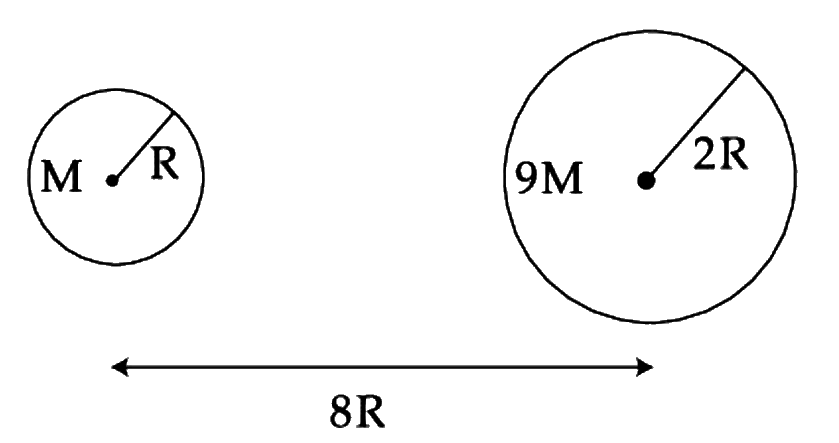
Suppose two planets (spherical in shape) in radii R and 2R, but mass M and 9M respectively have a centre to centre separation 8 R as shown in the figure. A satellite of mass 'm' is projected from the surface of the planet of mass 'M' directly towards the centre of the second planet. The minimum speed 'v' required for the satellite to reach the surface of the second planet is then the value of 'a' is ____________.
[Given: The two planets are fixed in their position]
Numerical answer type. Work it out, then open the answer.
Answer: 4
Escape Velocity
The escape velocity of a body from any planet, whose mass is six times the mass of earth and radius is twice the radius of earth will (v = escape velocity of a body from the earth's surface)
Answer: (d)
Escape Velocity
Planet A has mass M and radius R. Planet B has half the mass and half the radius of Planet A. If the escape velocities from the Planets A and B are vA and vB, respectively, then . The value of n is:
Answer: (c)
Escape Velocity
A body is moving in a low circular orbit about a planet of mass M and radius R. The radius of the orbit can be taken to be R itself. Then the ratio of the speed of this body in the orbit to the escape velocity from the planet is:
Answer: (d)
Escape Velocity
A body is thrown from the surface of the earth velocity . The maximum height above the earth's surface upto which it will reach is ( radius of earth, acceleration due to gravity)
Answer: (d)
Escape Velocity
An asteroid is moving directly towards the centre of the earth. When at a distance of 10R (R is the radius of the earth) from the earths centre, it has a speed of 12 km/s. Neglecting the effect of earths atmosphere, what will be the speed of the asteroid when it hits the surface of the earth (escape velocity from the earth is 11.2 km/s)? Give your answer to the nearest integer in kilometer/s _____.
Numerical answer type. Work it out, then open the answer.
Answer: 16
Escape Velocity
Earth has mass and radius . Moon has mass and radius . Distance between their centre is . A body of mass is placed on the line joining them at a distance from centre of the earth. To project the mass to escape to infinity, the minimum speed required is
Answer: (b)
Escape Velocity
Two planets have masses M and 16 M and their radii are and 2, respectively. The separation between the centres of the planets is 10. A body of mass m is fired from the surface of the larger planet towards the smaller planet along the line joining their centres. For the body to be able to reach at the surface of smaller planet, the minimum firing speed needed is:
Answer: (c)
Escape Velocity
A rocket has to be launched from earth in such a way that it never returns. If E is the minimum energy delivered by the rocket launcher, what should be the minimum energy that the launcher should have if the same rocket is to be launched from the surface of the moon? Assume that the density of the earth and the moon are equal and that the earth's volume is 64 times the volume of the moon :-
Answer: (b)
Escape Velocity
A body is projected vertically from the surface of the earth of radius ' ' with velocity equal to half of the escape velocity. The maximum height reached by the body is
Answer: (b)
Escape Velocity
A satellite is revolving in a circular orbit at a height h from the earth's surface, such that h < < R where R is the radius of the earth. Assuming that the effect of earth's atmosphere can be neglected the minimum increase in the speed required so that the satellite could escape from the gravitational field of earth is:
Answer: (a)
Escape Velocity
A satellite is moving with a constant speed v in circular orbit around the earth. An object of mass ‘m’ is ejected from the satellite such that it just escapes from the gravitational pull of the earth. At the time of ejection, the kinetic energy of the object is -
Answer: (a)
Escape Velocity
Two stars of masses 3 1031 kg each, and at distance 2 1011 m rotate in a plane about their common centre of mass O. A meteorite passes through O moving perpendicular to the star’s rotation plane. In order to escape from the gravitational field of this double star, the minimum speed that meteorite should have at O is - (Take Gravitational constant; G = 6.67 10–11 Nm2 kg–2)
Answer: (d)
Escape Velocity
The ratio of escape velocity at earth (ve) to the escape velocity at a planet (vp) whose radius and mean density are twice as that of earth is
Answer: (d)
Escape Velocity
A satellite is revolving in a circular orbit at a height from the earth's surface (radius of earth ). The minimum increase in its orbital velocity required, so that the satellite could escape from the earth's gravitational field, is close to: (Neglect the effect of atmosphere.)
Answer: (d)
Escape Velocity
A black hole is an object whose gravitational field is so strong that even light cannot escape from it. To what approximate radius would earth (mass = 5.98 1024 kg) have to be compressed to be a black hole?
Answer: (c)
Escape Velocity
The radius of a planet is twice the radius of earth. Both have almost equal average mass densities. VP and VE are escape velocities of the planet and the earth, respectively, then
Answer: (b)
Escape Velocity
A particle of mass 'm' is kept at rest at a height 3R from the surface of earth, where 'R' is radius of earth and 'M' is mass of earth. The minimum speed with which it should be projected, so that it does not return back, is
(g is acceleration due to gravity on the surface of earth)
Answer: (a)
Escape Velocity
If is escape velocity and is orbital velocity of a satellite for orbit close to the earth's surface, then these are related by
Answer: (d)
Escape Velocity
The mass of a spaceship is It is to be launched from the earth's surface out into free space. The value of and (radius of earth) are and respectively. The required energy for this work will be:
Answer: (d)
Escape Velocity
A particle of mass m is thrown upwards from the surface of the earth, with a velocity u. The mass and the radius of the earth are, respectively, M and R. G is gravitational constant and g is acceleration due to gravity on the surface of the earth. The minimum value of u so that the particle does not return back to earth, is
Answer: (b)
Escape Velocity
A planet in a distant solar system is times more massive than the earth and its radius is times smaller. Given that the escape velocity from the earth is the escape velocity from the surface of the planet would be
Answer: (c)
Escape Velocity
The earth is assumed to be a sphere of radius R. A platform is arranged at a height R from the surface of the earth. The escape velocity of a body from this platform is fv, where v is its escape velocity from the surface of the Earth. The value of f is
Answer: (c)
Escape Velocity
The escape velocity for a body projected vertically upwards from the surface of earth is If the body is projected at an angle of with the vertical, the escape velocity will be
Answer: (c)
Escape Velocity
The kinetic energy needed to project a body of mass from the earth surface (radius ) to infinity is
Answer: (c)
Escape Velocity
The escape velocity of a body depends upon mass as
Answer: (a)
Escape Velocity
With what velocity should a particle be projected so that its height becomes equal to radius of earth?
Answer: (a)
Escape Velocity
For a planet having mass equal to mass of the earth but radius is one fourth of radius of the earth. Then escape velocity for this planet will be
Answer: (b)
Escape Velocity
The escape velocity of a sphere of mass is given by ( = universal gravitational constant, = mass of earth and = radius of earth)
Answer: (b)
Escape Velocity
The escape velocity of a body on the surface of the earth is . If the earth's mass increases to twice its present value and radius of the earth becomes half, the escape velocity becomes
Answer: (a)
Escape Velocity
The escape velocity from earth is . If a body is to be projected in a direction making an angle to the vertical, then the escape velocity is
Answer: (b)
Escape Velocity
For a satellite escape velocity is . If the satellite is launched at an angle of with the vertical, then escape velocity will be
Answer: (a)
Escape Velocity
Escape speed from the Earth is close to . On another planet whose radius is half of the Earth's radius and whose mass density is four times that of the Earth, the escape speed in will be close to:
Answer: (a)
Step-by-step solution coming soon.
Escape Velocity
'Black hole' is a
Answer: (c)
Step-by-step solution coming soon.
Escape Velocity
Two spherical stars and have densities and , respectively. and have the same radius, and their masses and are related by . Due to an interaction process, star loses some of its mass, so that its radius is halved, while its spherical shape is retained, and its density remains . The entire mass lost by is deposited as a thick spherical shell on with the density of the shell being . If and are the escape velocities from and after the interaction process, the ratio . The value of is ________.
Numerical answer type. Work it out, then open the answer.
Answer: 2.2 to 2.4
Step-by-step solution coming soon.
Escape Velocity
A rocket is launched normal to the surface of the Earth, away from the sun, along the line joining the Sun and the Earth. The Sun is times heavier than the earth and is at a distance times larger than the radius of the Earth. The escape velocity from Earth's gravitational field is . The minimum initial velocity required for the rocket to be able to leave the sun-earth system is closest to (Ignore the rotation and revolution of the earth and the presence of any other planet)
Answer: (b)
Step-by-step solution coming soon.
Escape Velocity
A bullet is fired vertically upwards with velocity from the surface of a spherical planet. When it reaches its maximum height, its acceleration due to the planet's gravity is of its value at the surface of the planet. If the escape velocity from the planet is , then the value of is ________ (ignore energy loss due to atmosphere).
Numerical answer type. Work it out, then open the answer.
Answer: 2
Step-by-step solution coming soon.
Escape Velocity
Two bodies, each of mass , are kept fixed with a separation . A particle of mass is projected from the midpoint of the line joining their centres, perpendicular to the line. The gravitational constant is . The correct statement(s) is (are)
More than one option can be correct. Tap every correct option, then tap Check.
Answer: (b), (d)
Step-by-step solution coming soon.
Escape Velocity
Two spherical planets P and Q have the same uniform density , masses and , and surface areas and respectively. A spherical planet R also has uniform density and its mass is . The escape velocities from the planets P, Q and R are , and , respectively. Then
More than one option can be correct. Tap every correct option, then tap Check.
Answer: (b), (d)
Step-by-step solution coming soon.
Escape Velocity
Gravitational acceleration on the surface of a planet is , where is the gravitational acceleration on the surface of the earth. The average mass density of the planet is times that of the earth. If the escape speed on the surface of the earth is taken to be , the escape speed on the surface of the planet in will be ________.
Numerical answer type. Work it out, then open the answer.
Answer: 3
Step-by-step solution coming soon.
Escape Velocity
A space ship is launched into a circular orbit close to earth's surface. What additional velocity has now to be imparted to the spaceship in the orbit to overcome the gravitational pull? (Radius of earth , )
Answer: (a)
Step-by-step solution coming soon.
Escape Velocity
What is the maximum height attained by a body projected with a velocity equal to one-third of the escape velocity from the surface of the earth? (Radius of the earth )
Answer: (d)
Step-by-step solution coming soon.
Escape Velocity
The escape velocity from the earth is about . The escape velocity from a planet having twice the radius and the same mean density as the earth is
Answer: (a)
Step-by-step solution coming soon.
Escape Velocity
The condition for a uniform spherical mass of radius to be a black hole is : [ = gravitational constant and = acceleration due to gravity]
Answer: (c)
Step-by-step solution coming soon.
Escape Velocity
If escape velocity on earth surface is , then find the escape velocity on moon surface. If mass of moon is times of mass of earth and radius of moon is times radius of earth.
Answer: (a)
Step-by-step solution coming soon.
Escape Velocity
A rocket is intended to leave the Earth's gravitational field. The fuel in its main engine is a little less than the amount that is necessary and an auxiliary engine, (only capable of operating for a short time) has to be used as well. When is it best to switch on the auxiliary engine?
Answer: (a)
Step-by-step solution coming soon.
Escape Velocity
The escape velocity for the earth is . The mass of another planet is times the mass of the earth and its radius is times the radius of the earth. The escape velocity for the planet is
Answer: (b)
Step-by-step solution coming soon.
Escape Velocity
There are two planets and the ratio of the radii of the two planets is but the ratio of acceleration due to gravity of both planets is . What will be the ratio of their escape velocity?
Answer: (a)
Step-by-step solution coming soon.
Escape Velocity
If a body is thrown vertically upwards from a height of ( = radius of the earth) with a velocity equal to the escape velocity of a body from the surface of the earth, then the velocity of the body when it escapes from the gravitational influence of the earth is ( = acceleration due to gravity on the surface of the earth)
Answer: (c)
Step-by-step solution coming soon.
Escape Velocity
An object is projected from the surface of Earth with a kinetic energy twice that of escape energy from the surface of Earth. Its kinetic energy when it reaches far away from Earth is
Answer: (a)
Step-by-step solution coming soon.
Escape Velocity
Escape velocity when a body of mass is thrown vertically from the surface of the earth is , what will be the escape velocity of another body of mass thrown vertically?
Answer: (a)
Step-by-step solution coming soon.
Escape Velocity
A body is projected vertically upwards from the surface of the earth with a velocity equal to half the escape velocity. If is the radius of the earth, maximum height attained by the body from the surface of the earth is
Answer: (b)
Step-by-step solution coming soon.
Escape Velocity
A planet is times heavier than the moon and has a diameter times that of the moon. If the escape velocity on the planet is , then the escape velocity on the moon will be:
Answer: (d)
Step-by-step solution coming soon.
Escape Velocity
Two spherical planets and have the same uniform density , and masses and and surface areas and respectively. Another spherical planet also has the same uniform density , and its mass is . The escape velocities from these planets are related as
Answer: (a)
Step-by-step solution coming soon.
Escape Velocity
If the earth has a mass nine times and radius four times that of planet , the ratio of the maximum speed required by a rocket to pull out of the gravitational force of planet to that of the earth is
Answer: (a)
Step-by-step solution coming soon.
Escape Velocity
If the escape velocity on the earth's surface is , then find the escape velocity on the moon's surface. The mass of the moon is times the mass of the earth and the radius of the moon is times the radius of the earth.
Answer: (a)
Step-by-step solution coming soon.
Escape Velocity
The escape velocity of a projectile on the earth's surface is . A body is projected out with thrice this speed. The speed of the body far away from the earth will be
Answer: (b)
Step-by-step solution coming soon.
Escape Velocity
A satellite is orbiting close to the earth and has a kinetic energy . The minimum extra kinetic energy required for it to just overcome the gravitational pull of the earth is
Answer: (a)
Step-by-step solution coming soon.
Escape Velocity
A space station is at a height equal to the radius of the Earth. If is the escape velocity on the surface of the Earth, the same on the space station is ______ times .
Answer: (c)
Step-by-step solution coming soon.
Escape Velocity
If a body is thrown vertically upwards from a height of ( - radius of the earth) with a velocity equal to the escape velocity of a body from the surface of the earth, then the velocity of the body when it escapes from the gravitational influence of the earth is ( - acceleration due to gravity on the surface of the earth)
Answer: (c)
Step-by-step solution coming soon.
Escape Velocity
If a body is thrown vertically upwards from the surface of the earth with a speed equal to of the escape speed from the surface of the earth, then the ratio of the maximum height reached by the body and the radius of the earth is
Answer: (b)
Step-by-step solution coming soon.
Escape Velocity
The escape velocity of a body from a planet of mass and radius is . The escape velocity of the body from another planet having the same mass and diameter (in ) is
Answer: (a)
Step-by-step solution coming soon.
Escape Velocity
A mass of is to be compressed in the form of a solid sphere such that the escape velocity from its surface is . The radius of the sphere is (Universal gravitational constant )
Answer: (d)
Step-by-step solution coming soon.
Escape Velocity
A particle is projected from the surface of the earth with a velocity equal to twice the escape velocity. When the particle is very far from the earth, its speed would be
Answer: (c)
Step-by-step solution coming soon.
Escape Velocity
Maximum height reached by a rocket fired with a speed equal to of the escape speed from the surface of the earth is ( = radius of the earth)
Answer: (c)
Step-by-step solution coming soon.
Escape Velocity
A projectile is thrown straight upward from the earth's surface with an initial speed , where is a constant and is the escape speed. The projectile travels up to a height of from the earth's surface before it comes to rest. The value of the constant is (radius of the earth )
Answer: (a)
Step-by-step solution coming soon.
Escape Velocity
A comet at infinity starts moving towards the earth and passes the earth at a distance of from the center of the earth, where is the radius of the earth. If escape velocity of a body from the surface of earth is , then the maximum velocity of the comet is
Answer: (a)
Step-by-step solution coming soon.
Escape Velocity
The energy required to project a body of mass so that it escapes from the gravitational influence of the earth is
(Acceleration due to gravity on the surface of the earth and the radius of the earth )
Answer: (c)
Step-by-step solution coming soon.
Escape Velocity
If a body of mass is thrown vertically upwards from the surface of the earth with a velocity equal to times its escape velocity, then the maximum height reached by the body is
(Radius of the earth )
Answer: (b)
Step-by-step solution coming soon.
Escape Velocity
If two bodies A and B of masses and are thrown vertically upwards from the surface of the earth with velocities and respectively, then the ratio of maximum heights reached by the bodies A and B is
( – Radius of the earth)
Answer: (c)
Step-by-step solution coming soon.
Escape Velocity
A body is thrown vertically upwards from the surface of the earth with a velocity times the orbital velocity of a satellite near the surface of the earth. If the maximum height reached by the body is more than the radius of the earth, then the value of is
Answer: (c)
Step-by-step solution coming soon.
Escape Velocity
A meteor of mass having a speed at infinity reaches the surface of the Earth with a speed of ( is escape speed from the Earth's surface)
Answer: (d)
Step-by-step solution coming soon.
Escape Velocity
A body is projected from the Earth's surface with a speed times the escape speed (). The speed of the body when it escapes from the gravitational influence of the Earth is
Answer: (a)
Step-by-step solution coming soon.
Escape Velocity
If a body is projected vertically from the surface of the Earth with a speed of , then the maximum height reached by the body is
(Radius of the Earth and acceleration due to gravity )
Answer: (c)
Step-by-step solution coming soon.
Escape Velocity
The ratio of the radii of two planets is and the ratio of accelerations due to gravity on the planets is . Then the ratio of the escape velocities from the planets is
Answer: (c)
Step-by-step solution coming soon.
Escape Velocity
Let the escape speed of an object on the earth's surface be . The object is projected out with speed . The speed of the object far away from the earth will be
Answer: (a)
Step-by-step solution coming soon.
Escape Velocity
A rocket is fired vertically with a speed of from the earth's surface. How far from the earth does the rocket go before returning to the earth?
(Take, radius of earth and )
Answer: (b)
Step-by-step solution coming soon.
Escape Velocity
If the escape velocity on earth is , its value for a planet having double the radius and times the mass of earth is
Answer: (a)
Step-by-step solution coming soon.
Escape Velocity
A body of mass is thrown vertically upward with speed , where is the escape velocity of a body from earth surface. The final velocity of the body is
Answer: (d)
Step-by-step solution coming soon.
Escape Velocity
The ratio of accelerations due to gravity on the surfaces of two planets is and the ratio of their respective average densities is . What is the ratio of respective escape velocities from the surface of the planets?
Answer: (c)
Step-by-step solution coming soon.
Escape Velocity
What should be the closest approximate radius of a celestial body twice as massive as the sun so that the escape speed from the celestial body is equal to the speed of light? (The mass of sun is , speed of light is , and universal gravitational constant .)
Answer: (c)
Step-by-step solution coming soon.
Escape Velocity
A black hole is an object from which even light cannot escape. A star of mass M, collapsing due to gravity, becomes a black hole when its radius is R. At this stage, the density of the black hole depends on M as:
Answer: (d)
Step-by-step solution coming soon.
No questions match these filters.