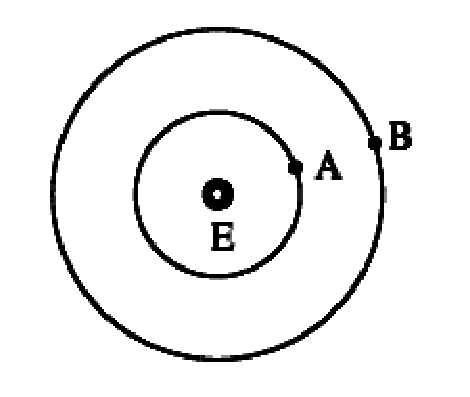
Two planets A and B are orbiting around the sun. The distances of the two planets A and B from the sun are rA and rB respectively. Also rB=225rA. If the orbital speed of the planet A is 'V' then the orbital speed of planet B will be
The distance of the two planets A and B from the sun are 'rA' and 'rB' respectively such that rB=100rA. The ratio of the speed of planet A to that of planet B is (both the planets are revolving around the sun)
A satellite is revolving around a planet in a circular orbit close to its surface. Let ρ be mean density and R be the radius of the planet; then the period of the satellite is
Statement I: A satellite is moving around earth in the orbit very close to the earth surface. The time period of revolution of satellite depends upon the density of earth.
Statement II: The time period of revolution of the satellite is T=2πgRe (for satellite very close to the earth surface), where Re radius of earth and g acceleration due to gravity. In the light of the above statements, choose the correct answer from the options given below:
The geostationary satellite is revolving round the earth of mean radius R. If g is the acceleration due to gravity at earth's surface, ω is the angular speed of rotation of earth about its own axis and r is the radius of orbit of a satellite, then the correct relation between r, ω, g and R is
If mean radius of earth is 'R', its angular velocity is 'ω' and acceleration due to gravity at the surface of the earth is 'g' then the cube of the radius of the orbit of geostationary satellite will be
A geostationary satellite is orbiting the earth at a height of 4R above the surface of the earth, where R is the radius of the earth. Another satellite is orbiting the earth at a height 1.5R from the surface of the earth with periodic time 'T' in hour. The value of 'T' in hour is
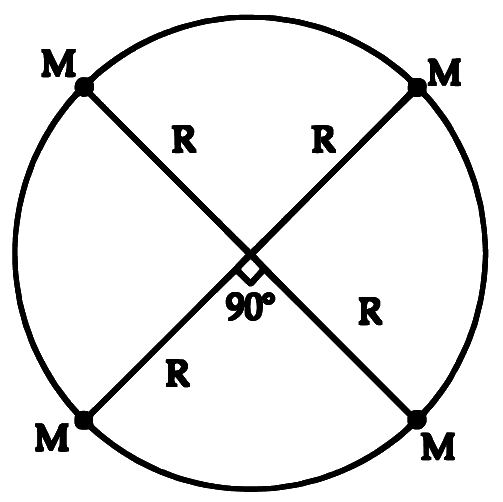
Four particles, each of mass M and equidistant from each other, move along a circle of radius R under the action of their gravitational attraction, the speed of each particle is
Two satellites P and Q go round a planet in circular orbits having radii ' 3R ' and ' R ' respectively. If the speed of satellite P is ' 2V ', the speed of the satellite Q will be
The radii of circular orbits of two satellites A and B of the earth are ' 4R ' and ' R ' respectively, where R is the radius of earth. If the speed of satellite B is 6 V, then the speed of satellite A will be
The time period of a satellite of earth is 24 hours. If the separation between the earth and the satellite is decreased to one fourth of the previous value then its new time period will become
If a satellite orbiting the Earth is 9 times closer to the Earth than the Moon, what is the time period of rotation of the satellite? Given rotational time period of Moon =27 days and gravitational attraction between the satellite and the moon is neglected.
A satellite is launched into a circular orbit of radius ' R ' around the earth. A second satellite is launched into an orbit of radius 1.03 R. The time period of revolution of the second satellite is larger than the first one approximately by
Two particles of equal mass ' m ' move in a circle of radius ' r ' under the action of their mutual gravitational attraction. The speed of each particle will be ( G= Universal gravitational constant)
Two planets, A and B are orbiting a common star in circular orbits of radii RA and RB, respectively, with RB=2RA. The planet B is 42 times more massive than planet A. The ratio (LALB) of angular momentum (LB) of planet B to that of planet A(LA) is closest to integer ________.
Numerical answer type. Work it out, then open the answer.
A satellite of mass 2M is revolving around earth in a circular orbit at a height of 3R from earth surface. The angular momentum of the satellite is MxGMR. The value of x is _________, where M and R are the mass and radius of earth, respectively. ( G is the gravitational constant)
Numerical answer type. Work it out, then open the answer.
The distance of the two planets A and B from the sun are rA and rB respectively. Also rB is equal to 100rA. If the orbital speed of the planet A is ' v ' then the orbital speed of the planet B is
A satellite is orbiting just above the surface of the planet of density ' ρ ' with periodic time ' T '. The quantity T2ρ is equal to ( G= universal gravitational constant)
A satellite is revolving around a planet in a circular orbit close to its surface. Let ' ρ ' be the mean density and ' R ' be the radius of the planet. Then the period of the satellite is ( G= universal constant of gravitation)
A small planet is revolving around a very massive star in a circular orbit of radius ' R ' with a period of revolution ' T '. If the gravitational force between the planet and the star were proportional to 'R−5/2', then 'T' would be proportional to
A light planet is revolving around a massive star in a circular orbit of radius R with a period of revolution T. If the force of attraction between planet and star is proportional to R−3/2 then choose the correct option:
A satellite revolving around a planet in stationary orbit has time period 6 hours. The mass of planet is one-fourth the mass of earth. The radius of orbit of the satellite is:
(Given = Radius of geo-stationary orbit for earth is 4.2×10⁴ km)
A satellite of mass ' m ' is revolving around the earth of mass ' M ' in an orbit of radius ' r ' with constant angular velocity ' ω '. The angular momentum of satellite is ( G= Universal constant of gravitation)
Assuming that the earth is revolving around the sun in circular orbit of radius R, the angular momentum is directly proportional to Rn. The value of ' n ' is
Two planets A and B having masses m1 and m2 move around the sun in circular orbits of r1 and r2 radii respectively. If angular momentum of A is L and that of B is 3L, the ratio of time period (TBTA) is:
A satellite moves in a stable circular orbit round the earth if (where VH,Vc and Ve are the horizontal velocity, critical velocity and escape velocity respectively)
Two satellites A and B move round the earth in the same orbit. The mass of A is twice the mass of B. The quantity which is same for the two satellites will be
Two satellites of masses m and 3m revolve around the earth in circular orbits of radii r & 3r respectively. The ratio of orbital speeds of the satellites respectively is
A satellite is orbiting just above the surface of the earth with period T. If d is the density of the earth and G is the universal constant of gravitation, the quantity Gd3π represents:
The time period of a satellite of earth is 24 hours. If the separation between the earth and the satellite is decreased to one fourth of the previous value, then its new time period will become.
The radius of the orbit of a geostationary satellite is (mean radius of earth is 'R', angular velocity about own axis is 'ω' and acceleration due to gravity on earth's surface is 'g')
Consider a light planet revolving around a massive star in a circular orbit of radius 'r' with time period 'T'. If the gravitational force of attraction between the planet and the star is proportional to r−27, then T2 is proportional to
Two identical particles each of mass ' m ' go round a circle of radius a under the action of their mutual gravitational attraction. The angular speed of each particle will be:
Two particles of equal mass 'm' move in a circle of radius 'r' under the action of their mutual gravitational attraction. The speed of each particle will be:
The orbital angular momentum of a satellite is L, when it is revolving in a circular orbit at height h from earth surface. If the distance of satellite from the earth centre is increased by eight times to its initial value, then the new angular momentum will be -
Two satellites S1 and S2 are revolving in circular orbits around a planet with radius R1 = 3200 km and R2 = 800 km respectively. The ratio of speed of satellite S1 to be speed of satellite S2 in their respective orbits would be x1 where x = ___________.
Numerical answer type. Work it out, then open the answer.
The time period of a satellite revolving around earth in a given orbit is 7 hours. If the radius of orbit is increased to three times its previous value, then approximate new time period of the satellite will be
The time period of a satellite of earth is 5 hours. If the separation between the earth and the satellite is increased to four times the previous value, the new time period of the satellite will be
Consider two satellites S1 and S2 with periods of revolution 1 hr. and 8 hr. respectively revolving around a planet in circular orbits. The ratio of angular velocity of satellite S1 to the angular velocity of satellite S2 is:
If the horizontal velocity given to a satellite is greater than critical velocity but less than the escape velocity at the height, then the satellite will
The orbital velocity of an artificial satellite in a circular orbit just above the earth's surface is 'V'. For the satellite orbiting at an altitude of half the earth's radius, the orbital velocity is
A satellite is launched into a circular orbit of radius R around earth, while a second satellite is launched into a circular orbit of radius 1.02 R. The percentage difference in the time periods of the two satellites is:
Two identical particles of mass 1 kg each go round a circle of radius R, under the action of their mutual gravitational attraction. The angular speed of each particle is:
Consider a binary star system of star A and star B with masses mA and mB revolving in a circular orbit of radii rA an rB, respectively. If TA and TB are the time period of star A and star B, respectively, Then:
A geostationary satellite is orbiting around an arbitrary planet 'P' at a height of 11R above the surface of 'P', R being the radius of 'P'. The time period of another satellite in hours at a height of 2R from the surface of 'P' is _________. 'P' has the time period of 24 hours.
Two satellites revolve around a planet in coplanar circular orbits in anticlockwise direction. Their period of revolutions are 1 hour and 8 hours respectively. The radius of the orbit of nearer satellite is 2 × 10³ km. The angular speed of the farther satellite as observed from the nearer satellite at the instant when both the satellites are closest is xπ rad h−1 where x is ____________.
Numerical answer type. Work it out, then open the answer.
Three point masses, each of mass 'm' are kept at the corners of an equilateral triangle of side 'L'. The system rotates about the centre of the triangle without any change in the separation of masses during rotation. The period of rotation is directly proportional to (cos30∘=23)
Four particles each of mass M, move along a circle of radius R under the action of their mutual gravitational attraction as shown in figure. The speed of each particle is:
Four identical particles of equal masses 1 kg made to move along the circumference of a circle of radius 1 m under the action of their own mutual gravitational attraction. The speed of each particle will be:
The mass density of a spherical galaxy varies as rK over a large distance ‘r’ from its centre. In that region, a small star is in a circular orbit of radius R. Then the period of revolution, T depends on R as:
A spaceship orbits around a planet at a height of 20 km from its surface. Assuming that only gravitational field of the planet acts on the spaceship, what will be the number of complete revolutions made by the spaceship in 24 hours around the planet?
[Given; Mass of planet = 8 × 10²² kg, Radius of planet = 2 × 10⁶ m, Gravitational constant G = 6.67 × 10⁻¹¹ Nm2 /kg2]
The time period of a geostationary satellite is 24 h, at a height 6RE (RE is radius of earth) from surface of earth. The time period of another satellite whose height is 2.5RE from surface will be,
A test particle is moving in a circular orbit in the gravitational field produced by a mass density ρ(r)=r2K. Identify the correct relation between the radius R of the particle's orbit and its period T
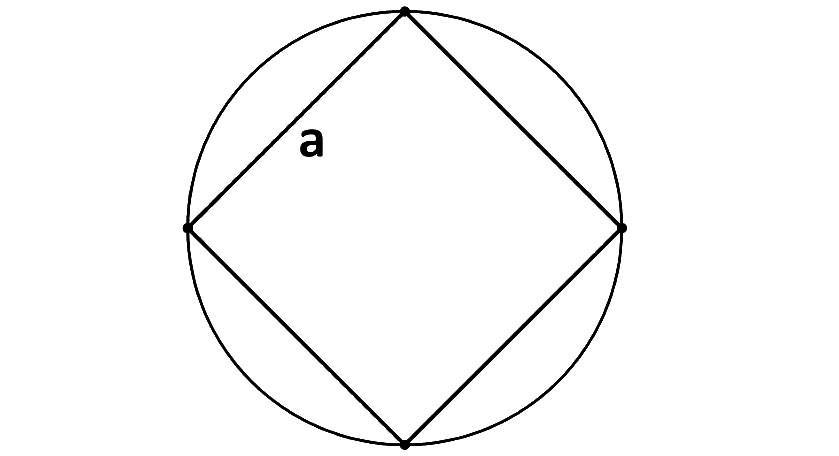
Four identical particles of mass M are located at the corners of a square of side 'a'. What should be their speed if each of them revolves under the influence of other's gravitational field in a circular orbit circumscribing the square?
A particle is moving with a uniform speed in a circular orbit of radius R in a central force inversely proportional to the nth power of R. If the period of rotation of the particle is T, then:
A remote-sensing satellite of earth revolves in a circular orbit at a height of 0.25 × 10⁶ m above the surface of earth. If earth's radius is 6.38 × 10⁶ m and g = 9.8 ms−2, then the orbital speed of the satellite is
A very long (length L) cylindrical galaxy is made of uniformly distributed mass and has radius R ( R < < L). A star outside the galaxy is orbiting the galaxy in a plane perpendicular to the galaxy and passing through its centre. If the time period of star is T and its distance from the galaxy's axis is r, then:
Four particles, each of mass M and equidistant from each other, move along a circle of radius R under the action of their mutual gravitational attraction. The speed of each particle is:
A geostationary satellite is orbiting the earth at a height of 5R above the surface of the earth, R being the radius of the earth. The time period of another satellite in hours at a height of 2R from the surface of the earth is
The radii of circular orbits of two satellites A and B of the earth, are 4R and R, respectively. If the speed of satellite A is 3V, then the speed of satellite B will be
Two satellites of earth, S1 and S2 are moving in the same orbit. The mass of S1 is four times the mass of S2. Which one of the following statements is true?
A satellite of mass m revolves around the earth of radius R at a height x from its surface. If g is the acceleration due to gravity on the surface of the earth, the orbital speed of the satellite is
Suppose the gravitational force varies inversely as the nth power of distance. Then the time period of a planet in circular orbit of radius R around the sun will be proportional to
The time period of satellite of earth is 5 hours. If the separation between the earth and the satellite is increased to 4 times the previous value, the new time period will become
If the gravitational force between two objects were proportional to 1/R (and not as 1/R2), where R is the distance between them, then a particle in a circular path (under such a force) would have its orbital speed v, proportional to
A satellite A of mass m is at a distance of r from the surface of the earth. Another satellite B of mass 2m is at a distance of 2r from the earth's centre. Their time periods are in the ratio of
The mean radius of earth is R, its angular speed on its own axis is ω and the acceleration due to gravity at earth's surface is g. What will be the radius of the orbit of a geostationary satellite?
If the gravitational force between two objects were proportional to 1/R (and not as 1/R2), where R is the distance between them, then a particle in a circular path (under such a force) would have its orbital speed v, proportional to
Directions: Each of the following items consists of two statements, one labelled as the Assertion (A) and the other as Reason (R). Examine the two statements carefully and select the answer using the codes given below. Assertion (A): Two artificial satellites having different masses and revolving around the Earth in the same circular orbit have same speed. Reason (R): The speed of a satellite is directly proportional to the radius of its orbit.
A geostationary satellite above the equator is orbiting around the earth at a fixed distance r1 from the center of the earth. A second satellite is orbiting in the equatorial plane in the opposite direction to the earth's rotation, at a distance r2 from the center of the earth, such that r1=1.21r2. The time period of the second satellite as measured from the geostationary satellite is p24 hours. The value of p is ________.
Numerical answer type. Work it out, then open the answer.
A particle of mass m is under the influence of the gravitational field of a body of mass M(≫m). The particle is moving in a circular orbit of radius r0 with time period T0 around the mass M. Then, the particle is subjected to an additional central force, corresponding to the potential energy Vc(r)=mα/r3, where α is a positive constant of suitable dimensions and r is the distance from the center of the orbit. If the particle moves in the same circular orbit of radius r0 in the combined gravitational potential due to M and Vc(r), but with a new time period T1, then (T12−T02)/T12 is given by [G is the gravitational constant.]
The distance between two stars of masses 3MS and 6MS is 9R. Here R is the mean distance between the centers of the Earth and the Sun, and MS is the mass of the Sun. The two stars orbit around their common center of mass in circular orbits with period nT, where T is the period of Earth's revolution around the Sun. The value of n is ________.
Numerical answer type. Work it out, then open the answer.
Consider a spherical gaseous cloud of mass density ρ(r) in free space where r is the radial distance from its center. The gaseous cloud is made of particles of equal mass m moving in circular orbits about the common center with the same kinetic energy K. The force acting on the particles is their mutual gravitational force. If ρ(r) is constant in time, the particle number density n(r)=ρ(r)/m is [G is universal gravitational constant]
A planet of mass M has two natural satellites with masses m1 and m2. The radii of their circular orbits are R1 and R2 respectively. Ignore the gravitational force between the satellites. Define v1,L1,K1 and T1 to be, respectively, the orbital speed, angular momentum, kinetic energy and time period of revolution of satellite 1; and v2,L2,K2 and T2 to be the corresponding quantities of satellite 2. Given m1/m2=2 and R1/R2=1/4, match the ratios in List-I to the numbers in List-II.
A binary star consists of two stars A (mass 2.2MS) and B (mass 11MS), where MS is the mass of the sun. They are separated by distance d and are rotating about their centre of mass, which is stationary. The ratio of the total angular momentum of the binary star to the angular momentum of star B about the centre of mass is ________.
Numerical answer type. Work it out, then open the answer.
A spherically symmetric gravitational system of particles has a mass density $ρ={ρ00for r≤Rfor r>R$ where ρ0 is a constant. A test mass can undergo circular motion under the influence of the gravitational field of particles. Its speed V as a function of distance r(0<r<∞) from the centre of the system is represented by
A system of binary stars of masses mA and mB are moving in circular orbits of radii rA and rB, respectively. If TA and TB are the time periods of masses mA and mB respectively, then
Two satellites A and B revolve round the same planet in coplanar circular orbits lying in the same plane. Their periods of revolutions are 1h and 8h, respectively. The radius of the orbit of A is 104km. The speed of B relative to A, when they are closest, in km/h is
A planet is revolving around the sun in a circular orbit with a radius r. The time period is T. If the force between the planet and star is proportional to r−3/2, then the square of time period is proportional to
Two satellites S1 and S2 are revolving round a planet in coplanar circular orbits of radii r1 and r2 in the same direction, respectively. Their respective periods of revolution are 1h and 8h. The radius of orbit of satellite S1 is equal to 104km. What will be their relative speed (in km/h) when they are closest?
Two satellites of earth, S1 and S2, are moving in the same orbit. The mass of S1 is four times the mass of S2. Which one of the following statements is true?
A satellite is moving around the earth with speed v in a circular orbit of radius r. If the orbit radius is decreased by 2%, its speed will increase by
If gravitational attraction between two point masses be given by F=Grnm1m2, then the period of a satellite in a circular orbit will be proportional to
A geostationary satellite revolves around the Earth in a circular orbit of radius 4R. Here, R is the radius of the Earth. Then, the time period of another satellite moving in a circular orbit of radius 2R is (T1 = time period of the geostationary satellite):
A satellite can be in a geostationary orbit around a planet if it is at a distance R from the centre of the planet. If the planet starts rotating about its axis with double the angular velocity, then to make the satellite geostationary, its orbital radius should be
An artificial satellite of mass m revolves around a planet in a circular orbit of radius R under the influence of an attractive central force given by F∝R−5/2. How does the orbital velocity (Ve) and time period (T) depend on the orbital radius (R)?
Two satellites A and B are revolving around the Earth in orbits of heights 1.25RE and 19.25RE from the surface of Earth respectively, where RE is the radius of the Earth. The ratio of the orbital speeds of the satellites A and B is
If the escape velocity of a body from the surface of the Earth is 11.2km s−1, then the orbital velocity of a satellite in an orbit which is at a height equal to the radius of the Earth is
An artificial satellite is revolving around a planet of radius R in a circular orbit of radius a. If the time period of revolution of the satellite T∝a3/2gxRy, then the values of x and y are respectively [g = acceleration due to gravity]
If the angular velocity of a planet about its axis is halved, the distance of the stationary satellite of this planet from the centre of the planet becomes 2n times the initial distance. Then, the value of n is
The time period of revolution of a satellite close to a planet's surface is 80min. The time period of another satellite, which is at a height of 3 times the radius of the planet from the surface, is
The time period of revolution of a satellite T around the earth depends on the radius of the circular orbit R, mass of the earth M and universal gravitational constant G. The expression for T, using dimensional analysis, is (K is the constant of proportionality)
Two satellites of masses m and 1.5m are revolving around the earth with different speeds in two circular orbits of heights RE and 2RE respectively, where RE is the radius of the earth. The ratio of the minimum and maximum gravitational forces on the earth due to the two satellites is
The orbital velocity of a body near the surface of a planet A is equal to the escape velocity of a body from the planet B. If the masses of planets A and B are the same, the ratio of their radii is
Statement (A): Two artificial satellites revolving in the same circular orbit have the same period of revolution. Statement (B): The orbital velocity is inversely proportional to the square root of the radius of the orbit. Statement (C): The escape velocity of a body is independent of the altitude of the point of projection.
A geostationary satellite is taken to a new orbit such that its distance from the centre of the earth is doubled. Then, find the time period of this satellite in the new orbit.
If the orbital speed of a body revolving in a circular path near the surface of the Earth is 8km s−1, then the orbital speed of a body revolving around the Earth in a circular orbit at height of 19,200km from the surface of Earth is (Radius of the Earth =6400km)
Two stars of masses M and 2M that are at a distance d apart, are revolving one around another. The angular velocity of the system of two stars is (G - Universal gravitational constant)
An earth's satellite near the surface of the earth takes about 90min per revolution. A satellite orbiting the moon also takes about 90min per revolution. Then which of the following is true? [where ρm is density of the moon and ρe is density of the earth.]
A planet of mass m is orbiting around a non-rotating star of mass αm (α≫1) with an orbital radius r. The star ejects mass λm (λ≪1) radially outwards in a spherically symmetric fashion. Neglecting any impact of ejected mass on the planet, the radius of new circular orbit of the planet is
Consider a universe with modified electrostatics where like charges attract and unlike charges repel. Three positively charged point particles with same charge to mass ratio α interact with each other through the electrostatic force. Total mass of the system is M. The system can move about its centre of mass with equal distances between all pairs of masses. When the masses are separated by a distance d, the angular frequency of the motion about the centre of the mass is
More than one option can be correct. Tap every correct option, then tap Check.
A certain quaternary star system consists of a central star of mass M and three smaller stars, each of mass m. The three smaller stars orbit the central star in the same circular orbit of radius r and have the same sense of revolution. They are positioned one-third of a revolution apart from one another in the orbit. The period of revolution of each smaller star is
A satellite GeoSAT is in a circular geostationary orbit of radius RG, above a point P on the equator. Another satellite ComSAT is in a lower circular orbit of radius 0.81RG. At 7 P.M on January 1, ComSAT is sighted directly above P. On which day among the following can ComSAT be sighted directly above P between 7 P.M. and 8 P.M.?