A body of mass m is taken from earth surface to a height h equal to twice the radius of earth, the increase in potential energy will be (g = acceleration due to gravity on earth's surface) (R - radius of earth)
A body of mass m is taken from the surface of earth to a height equal to twice the radius of earth (Re). The increase in potential energy will be ______.
( g is acceleration due to gravity at the surface of earth)
Two particles of masses m and M are placed a distance d apart. The gravitational potential at the position where the gravitational field due to them is zero is V. Then
Three masses 200 kg,300 kg and 400 kg are placed at the vertices of an equilateral triangle with sides 20 m. They are rearranged on the vertices of a bigger triangle of side 25 m and with the same centre. The work done in this process ______ J. (Gravitational constant G=6.7×10⁻¹¹ N m2/kg2)
The magnitude of gravitational potential energy of a body at a distance ' R ' from the centre of the earth is ' E '. Its weight at a distance ' 1.5 R ' from the centre of the earth is
The gravitational potential at a point above the surface of earth is −5.12×10⁷ J/kg and the acceleration due to gravity at that point is 6.4 m/s2. Assume that the mean radius of earth to be 6400 km. The height of this point above the earth's surface is:
Two bodies of mass m and 9m are placed at a distance R. The gravitational potential on the line joining the bodies where the gravitational field equals zero, will be (G= gravitational constant):
If the gravitational field in the space is given as (−r2K). Taking the reference point to be at r=2 cm with gravitational potential V=10 J/kg. Find the gravitational potential at r=3 cm in SI unit (Given, that K=6 J cm/kg)
A body of mass 'm' is raised through a height above the earth's surface so that the increase in potential energy is 5mgR. The height to which the body is raised is ( R= radius of earth, g= acceleration due to gravity)
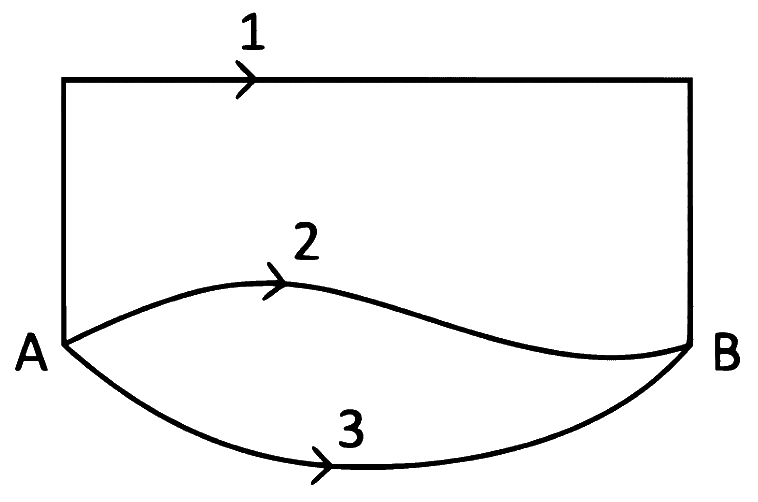
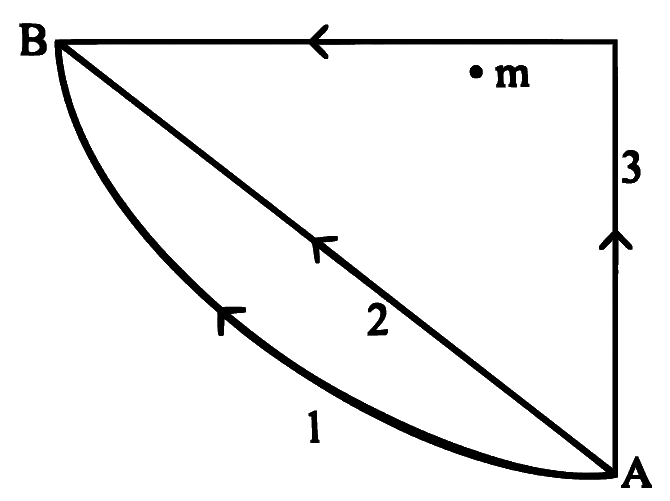
A gravitational field is present in a region and a mass is shifted from A to B through different paths as shown. If W1, W2 and W3 represent the work done by the gravitational force along the respective paths, then:
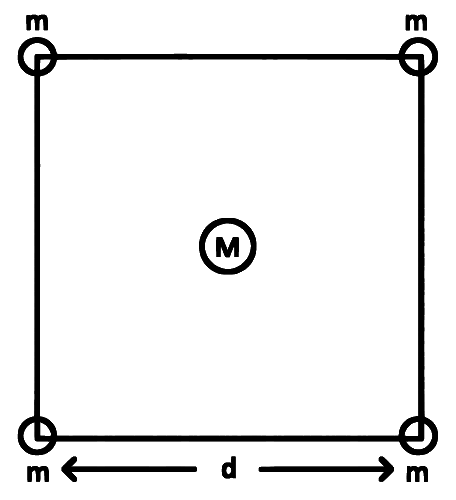
Four spheres each of mass m from a square of side d (as shown in figure). A fifth sphere of mass M is situated at the centre of square. The total gravitational potential energy of the system is:
An object of mass 1 kg is taken to a height from the surface of earth which is equal to three times the radius of earth. The gain in potential energy of the object will be [If, g=10 m s−2 and radius of earth =6400 km ]
Water falls from a 40 m high dam at the rate of 9 × 10⁴ kg per hour. Fifty percentage of gravitational potential energy can be converted into electrical energy. Using this hydroelectric energy number of 100 W lamps, that can be lit, is:
A mass of 50 kg is placed at the centre of a uniform spherical shell of mass 100 kg and radius 50 m. If the gravitational potential at a point, 25 m from the centre is V kg/m. The value of V is:
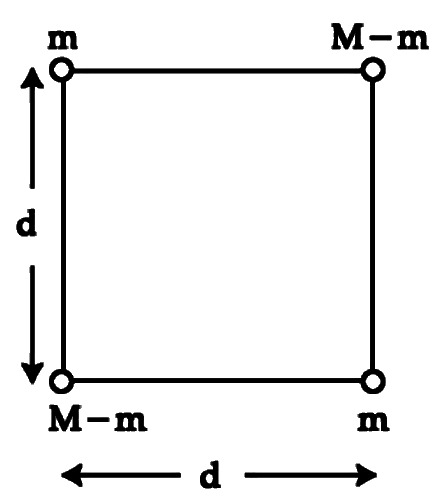
A body of mass (2M) splits into four masses (m, M − m, m, M − m}, which are rearranged to form a square as shown in the figure. The ratio of mM for which, the gravitational potential energy of the system becomes maximum is x: 1. The value of x is .............
Numerical answer type. Work it out, then open the answer.
If one wants to remove all the mass of the earth to infinity in order to break it up completely. The amount of energy that needs to be supplied will be 5xRGM2 where x is __________ (Round off to the Nearest Integer) (M is the mass of earth, R is the radius of earth, G is the gravitational constant)
Numerical answer type. Work it out, then open the answer.
On the x-axis and at a distance x from the origin, the gravitational field due a mass distribution is given by (x2+a2)3/2Ax in the x-direction. The magnitude of gravitational potential on the x-axis at a distance x, taking its value to be zero at infinity, is:
If W1,W2 and W3 represent the work done in moving a particle from A to B along three different paths 1,2 and 3 (as shown in fig) in the gravitational field of the point mass ' m '. Find the correct relation between ' W1 ', ' W2 ' and ' W3 '
Assuming that the gravitational potential energy of an object at infinity is zero, the change in potential energy (final − initial) of an object of mass m, when taken to a height h from the surface of earth (of radius R), is given by,
At what height from the surface of earth the gravitation potential and the value of g are −5.4 × 10⁷ J kg−1 and 6.0 m s−2 respectively? Take the radius of earth as 6400 km.
Which of the following most closely depicts the correct variation of the gravitation potential V(r) due to a large planet of radius R and uniform mass density? (figuresarenotdrawntoscale)
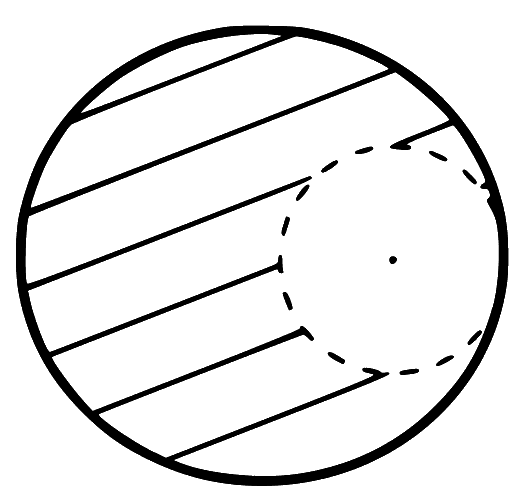
From a solid sphere of mass M and radius R, a spherical portion of radius R/2 is removed, as shown in the figure. Taking gravitational potential V=0 at r=∞, the potential at the center of the cavity thus formed is:
The gravitational field in a region is given byg=5 N/kgi^+12 N/kgj^. The change in the gravitational potential energy of a particle of mass 1 kg when it is taken from the origin to a point (7m, − 3m) is:
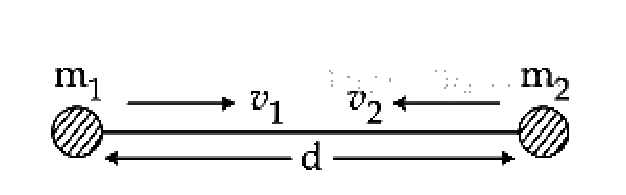
Two hypothetical planets of masses m1 and m2 are at rest when they are infinite distance apart. Because of the gravitational force they move towards each other along the line joining their centres. What is their speed when their separation is 'd'?
A body of mass 'm' is taken from the earth's surface to the height equal to twice the radius (R) of the earth. The change in potential energy of body will be
Infinite number of bodies, each of mass 2 kg are situated on x-axis at distance 1 m, 2 m, 4 m, 8 m,..., respectively, from the origin. The resulting gravitational potential due to this system at the origin will be
The gravitational field in a region is given by: E=(5 N/kg)i^+(12 N/kg)j^. If the potential at the origin is taken to be zero, then the ratio of the potential at the points (12 m, 0) and (0, 5 m) is:
A particle of mass M is situated at the centre of a spherical shell of same mass and radius a. The magnitude of the gravitational potential at a point situated at a/2 distance from the centre, will be:
Two bodies of masses m and 4m are placed at a distance r. The gravitational potential at a point on the line joining them where the gravitational field is zero is:
A particle of mass M is situated at the centre of a spherical shell of same mass and radius a. The magnitude of the gravitational potential at a point sutuated at a/2 distance from the centre, will be:
A particle of mass 10 g is kept on the surface of a uniform sphere of mass 100 kg and radius 10 cm. Find the work to be done against the gravitational force between them to take the particle far away from the sphere (you may take G=6.67×10⁻¹¹ N m2/kg2)
If g is the acceleration due to gravity on the earth's surface, the gain in the potential energy of an object of mass m raised from the surface of the earth to a height equal to the radius R of the earth is
A body of mass m is placed on earth's surface which is taken from earth surface to a height of h = 3R, then change in gravitational potential energy is
For an object in gravitational field, the gravitational potential is the same at two points A and B, but the gravitational field is not the same at these two points. Which one of the following statements is correct?
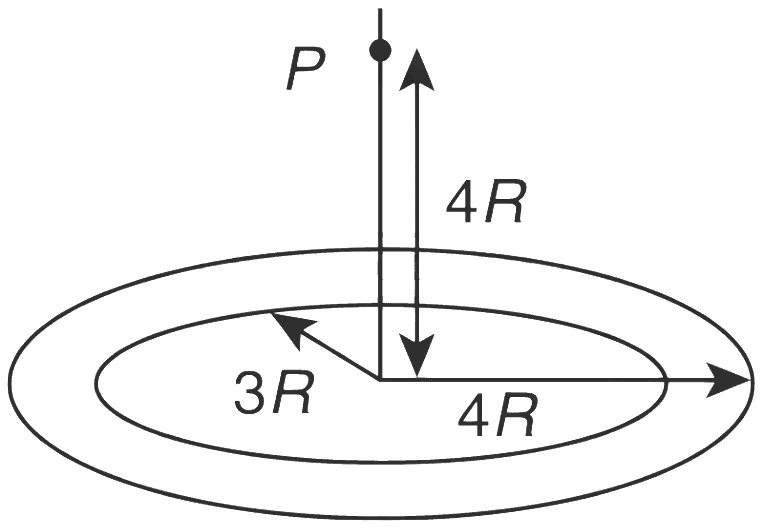
A thin uniform annular disc (see figure) of mass M has outer radius 4R and inner radius 3R. The work required to take a unit mass from point P on its axis to infinity is
A body of mass m rises to a height h=5R from the earth's surface where R is earth's radius. If g is acceleration due to gravity at earth's surface, the increase in potential energy will be
A particle of mass 10g is kept on the surface of a uniform sphere of mass 100kg and radius 10cm. Find the work to be done against the gravitational force between them, to take the particle far away from the sphere (you may take G=6.67×10⁻¹¹N m2/kg2)
Two bodies of masses m1 and m2 are initially at rest at infinite distance apart. They are then allowed to move towards each other under mutual gravitational attraction. Their relative velocity of approach at a separation distance r between them is
An asteroid of mass m is approaching earth, initially at a distance of 10Re with speed vi. It hits the earth with a speed vf (Re and Me are radius and mass of earth), then
A body of mass 2m is placed on earth's surface. Calculate the change in gravitational potential energy, if this body is taken from earth's surface to a height of h, where h=4R.
A body which is initially at rest at a height R above the surface of the Earth of radius R, falls freely towards the Earth. Its velocity on reaching the surface of the Earth is
From a solid sphere of mass M and radius R, a spherical portion of radius 2R is removed as shown in the figure. Taking gravitational potential V=0 at r=∞, the potential at the centre of the cavity thus formed is
The gravitational field in a region is given by E=5N kg−1i^+12N kg−1j^. The change in the gravitational potential energy of a particle of mass 1kg when it is taken from the origin to a point (5i^−5j^) is
A body is projected vertically upwards from the surface of earth with a velocity v to reach a height of 10R, where R is the radius of the earth. Then v is
A planet has double the mass of the earth and double the radius. The gravitational potential at the surface of the Earth is V and the magnitude of the gravitational field strength is g. The gravitational potential and gravitational field strength on the surface of the planet are
A mass m on the surface of the Earth is shifted to a target at a height equal to the radius of the Earth. If R is the radius and M is the mass of the Earth, then the work done in this process is
When 'g' is acceleration due to gravity on earth, the gain in potential energy of an object of mass m raised from the surface of earth to a height equal to the radius of earth 'R' is given by
An infinite number of objects each of 1kg mass are placed on the X-axis on both sides of x=0 at ±1m,±2m,±4m,±8m,… and so on. The magnitude of the resultant gravitational potential (in SI units) at x=0 is (G = universal gravitational constant)
The gravitational potential energy of a body on the surface of the earth is E. If the body is taken from the surface of the earth to a height equal to 150% of the radius of the earth, its gravitational potential energy is
A particle is kept on the surface of a uniform sphere of mass 1000kg and radius 1m. The work done per unit mass against the gravitational force between them is (G=6.67×10⁻¹¹N m2kg−2)
An object of mass m at a distance of 20R from the centre of a planet of mass M and radius R has an initial velocity u. The velocity with which the object hits the surface of the planet is (G - Universal gravitational constant)
The energy required to take a body from the surface of the earth to a height equal to the radius of the earth is W. The energy required to take this body from the surface of the earth to a height equal to twice the radius of the earth is
A body of mass m is at height R from the surface of the earth where R is the radius of the earth. If the body is taken from here to a height of 3R from the surface of the earth, the increase in the gravitational potential energy of the body is (g is acceleration due to gravity on the surface of the earth)
Four particles each of mass m are placed at four vertices of a rectangle having side length as 3l0 and 4l0. The potential energy of the system in l0Gm2 is
A planet is moving in an elliptical orbit around the sun. The work done on the planet by the gravitational force of the sun (i) is zero in no part of the motion. (ii) is zero in some parts of the orbit. (iii) is zero in one complete revolution. (iv) is zero in any small part of the orbit. Which of the following is true?
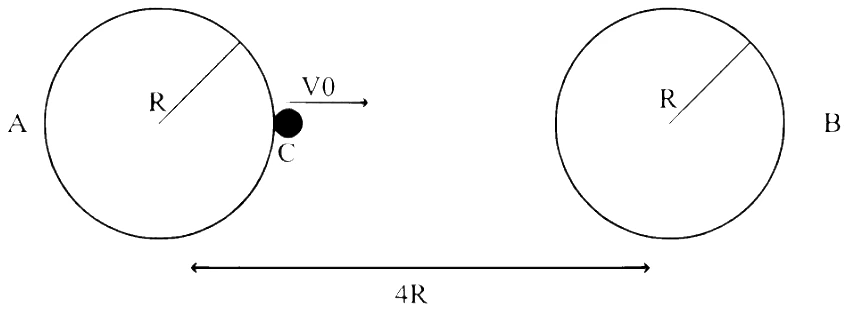
Two spherical bodies A and B each of mass M and radius R are located such that their centres are apart by a distance of 4R as shown in the figure. An object C of mass m is thrown from the surface of A directly towards the centre of B with a speed v0=2vmin, where vmin is the minimum speed needed for C to reach the surface of B. Given that G is the universal gravitational constant, how does the speed v(x) of C change as a function of its distance x from the centre of A?
Current mass of the Earth Me=6×1024kg Current radius of the Earth Re=6.4×10⁶m Universal gravitational constant G=6.67×10⁻¹¹kg−1m3s−2
A satellite in a circular orbit of radius 8 times the radius of the earth is completely stopped and then let go so that it falls radially towards the earth. A tunnel is built from the surface of the earth to its centre so that the satellite can pass through that tunnel without collision. Neglect the rotation of the earth and assume that the earth's gravity is the only relevant force. The speed of the satellite, in km s−1, on reaching the centre of the earth is closest to
Recent observations show that apart from the gravitational attraction, there is another force due to "dark energy" at large scales in the universe. This can be modelled in Newtonian physics by modifying the gravitational potential energy of a system of mass M and m separated by a distance r to include a universal repulsive force V=−rGMm−6Λmr2. Here Λ is a positive constant called the cosmological constant. A particle is slightly displaced away from the equilibrium point. Select the correct option.