
Satellite Energy & Weightlessness
The kinetic energy of a revolving satellite (mass ) at a height equal to thrice the radius of the earth () is ( = acceleration due to gravity)
Show answer and solution
Answer: (a)
Loading the solution…
Home›Practice Hub›Chapters›Gravitation›Satellite Energy & Weightlessness
Gravitation PYQs · MHT CET · JEE Main · NEET
Satellite Energy & Weightlessness
The kinetic energy of a revolving satellite (mass ) at a height equal to thrice the radius of the earth () is ( = acceleration due to gravity)
Answer: (a)
Satellite Energy & Weightlessness
The minimum energy required to launch a satellite of mass from the surface of a planet of mass and radius in a circular orbit at an altitude of is gravitational constant
Answer: (d)
Satellite Energy & Weightlessness
Initially a satellite of 100 kg is in a circular orbit of radius . This satellite can be moved to a circular orbit of radius by supplying of energy. The value of is ______. (Take Radius of Earth and )
Answer: (b)
Satellite Energy & Weightlessness
The total energy of a circularly orbiting satellite is
Answer: (b)
Satellite Energy & Weightlessness
A satellite of mass 1000 kg is launched to revolve around the earth in an orbit at a height of 270 km from the earth's surface. Kinetic energy of the satellite in this orbit is____________ . (Mass of earth , Radius of earth , Gravitational constant )
Numerical answer type. Work it out, then open the answer.
Answer: 3
Satellite Energy & Weightlessness
For a satellite moving in an orbit around the earth at height ' ' the ratio of kinetic energy to potential energy is
Answer: (b)
Satellite Energy & Weightlessness
Two satellites A and B having ratio of masses are revolving in circular orbits of radii ' ' and ' 4 r '. The ratio of total energy of satellites A to that of B is
Answer: (d)
Satellite Energy & Weightlessness
Match List I with List II:
(Where radius of planet orbit, radius of planet, mass of Sun, mass of planet)
Choose the correct answer from the options given below:
| LIST I | LIST II | ||
| A. | Kinetic energy of planet | I. | |
| B. | Gravitation Potential energy of sun-planet system | II. | |
| C. | Total mechanical energy of planet | III. | |
| D. | Escape energy at the surface of planet for unit mass object | IV. |
Answer: (a)
Satellite Energy & Weightlessness
The minimum energy required to launch a satellite of mass from the surface of a planet of mass and radius in a circular orbit at an altitude of is
Answer: (a)
Satellite Energy & Weightlessness
The gravitational potential energy required to raise a satellite of mass ' ' to height ' ' above the earth's surface is ' '. Let the energy required to put this satellite into the orbit at the same height be ' '. If and are the mass and radius of the earth respectively then is
Answer: (d)
Satellite Energy & Weightlessness
The minimum energy required to launch a satellite of mass from the surface of earth of mass and radius in a circular orbit at an altitude of from the surface of the earth is:
Answer: (a)
Satellite Energy & Weightlessness
A satellite of mass is revolving in circular orbit of radius . If energy is supplied to the satellite, it would revolve in a new circular orbit of radius
(use radius of earth)
Answer: (b)
Satellite Energy & Weightlessness
An astronaut takes a ball of mass from earth to space. He throws the ball into a circular orbit about earth at an altitude of . From earth's surface to the orbit, the change in total mechanical energy of the ball is . The value of is (take :
Answer: (b)
Satellite Energy & Weightlessness
For a satellite orbiting around the earth in a circular orbit, the ratio of potential energy to kinetic energy at same height is
Answer: (d)
Satellite Energy & Weightlessness
Given below are two statements:
Statement I: If be the total energy of a satellite moving around the earth, then its potential energy will be .
Statement II: The kinetic energy of a satellite revolving in an orbit is equal to the half the magnitude of total energy .
In the light of the above statements, choose the most appropriate answer from the options given below
Answer: (a)
Satellite Energy & Weightlessness
A seconds pendulum is placed in a space laboratory orbiting round the earth at a height '' from the earth's surface. The time period of the pendulum will be ( radius of earth)
Answer: (d)
Satellite Energy & Weightlessness
The ratio of energy required to raise a satellite to a height '' above the earth's surface to that required to put it into the orbit at the same height is ( radius of earth)
Answer: (a)
Satellite Energy & Weightlessness
Two satellites and , having masses in the ratio , are revolving in circular orbits of radii and respectively around the earth. The ratio of total mechanical energy of to is:
Answer: (b)
Satellite Energy & Weightlessness
Two satellites of same mass are launched in circular orbits at heights '' and '' above the surface of the earth. The ratio of their kinetic energies is ( radius of the earth)
Answer: (b)
Satellite Energy & Weightlessness
The ratio of energy required to raise a satellite of mass '' to height '' above the earth's surface to that required to put it into the orbit at same height is [ radius of earth]
Answer: (d)
Satellite Energy & Weightlessness
The ratio of energy required to raise a satellite of mass to a height above the earth's surface of that required to put it into the orbit at same height is [ radius of the earth]
Answer: (d)
Satellite Energy & Weightlessness
A satellite is moving in a low nearly circular orbit around the earth. Its radius is roughly equal to that of the earth’s radius Re. By firing rockets attached to it, its speed is instantaneously increased in the direction of its motion so that it become times larger. Due to this the farthest distance from the centre of the earth that the satellite reaches is R. Value of R is:
Answer: (b)
Satellite Energy & Weightlessness
A body A of mass m is moving in a circular orbit of radius R about a planet. Another body B of mass collides with A with a velocity which is half the instantaneous velocityof A. The collision is completely inelastic. Then, the combined body:
Answer: (a)
Satellite Energy & Weightlessness
A satellite of mass m is launched vertically upwards with an initial speed u from the surface of the earth. After it reaches height R (R = radius of the earth), it ejects a rocket of mass so that subsequently the satellite moves in a circular orbit. The kinetic energy of the rocket is (G is the gravitational constant; M is the mass of the earth):
Answer: (c)
Satellite Energy & Weightlessness
The kinetic energy of a revolving satellite (mass ) at a height equal to thrice the radius of the earth is
Answer: (a)
Satellite Energy & Weightlessness
Two satellites, A and B, have masses m and 2m respectively. A is in a circular orbit of radius R, and B is in a circular orbit of radius 2R around the earth. The ratio of their kinetic energies, TA/TB, is;
Answer: (d)
Satellite Energy & Weightlessness
What is the minimum energy required to launch a satellite of mass ' ' from the surface of the earth of mass ' ' and radius ' ' at an altitude ?
Answer: (b)
Satellite Energy & Weightlessness
The energy required to take a satellite to a height 'h' above Earth surface (radius of Earth = 6.4 103 km) is E1 and kinetic energy required for the satellite to be in a circular orbit at this height is E2. The value of h for which E1 and E2 are equal, is
Answer: (b)
Satellite Energy & Weightlessness
A satellite of mass M is in a circular orbit of radius R about the centre of the earth. A meteorite of the same mass, falling towards the earth, collides with the satellite completely inelastically. The speeds of the satellite and the meteorite are the same, just before the collision. The subsequent motion of the combined body will be:
Answer: (d)
Satellite Energy & Weightlessness
A body of mass m is moving in a circular orbit of radius R about a planet of mass M. At some instant, it splits into two equal masses. The first mass moves in a circular orbit of radius and the other mass, in a circular orbit of radius . The difference between the final and initial total energies is:
Answer: (d)
Satellite Energy & Weightlessness
A satellite of mass m is orbiting the earth (of radius R) at a height h from its surface. The total energy of the satellite in terms of g0, the value of acceleration due to gravity at the earth's surface, is
Answer: (b)
Satellite Energy & Weightlessness
An astronaut of mass m is working on a satellite orbiting the earth at a distance h from the earth’s surface. The radius of the earth is R, while its mass is M. The gravitational pull FG on the astronaut is:
Answer: (b)
Satellite Energy & Weightlessness
What is the minimum energy required to launch a satellite of mass from the surface of a planet of mass and radius in a circular orbit at an altitude of ?
Answer: (a)
Satellite Energy & Weightlessness
The additional kinetic energy to be provided to a satellite of mass m revolving around a planet of mass M, to transfer it from a circular orbit of radius R1 to another of radius R2(R2 > R1) is
Answer: (d)
Satellite Energy & Weightlessness
For a satellite moving in an orbit around the earth, the ratio of kinetic energy to potential energy is
Answer: (a)
Satellite Energy & Weightlessness
Energy required to move a body of mass from an orbit of radius to is
Answer: (d)
Satellite Energy & Weightlessness
Gravitational force is required for
Answer: (b)
Satellite Energy & Weightlessness
The satellite of mass is orbiting around the earth in a circular orbit with a velocity . What will be its total energy?
Answer: (d)
Satellite Energy & Weightlessness
An astronaut whose weight on the Earth is experiences weightlessness on International Space Station orbiting around the Earth. It means that
Answer: (b)
Step-by-step solution coming soon.
Satellite Energy & Weightlessness
A satellite is moving with a constant speed in a circular orbit about the earth. An object of mass is ejected from the satellite such that it just escapes from the gravitational pull of the earth. At the time of its ejection, the kinetic energy of the object is
Answer: (b)
Step-by-step solution coming soon.
Satellite Energy & Weightlessness
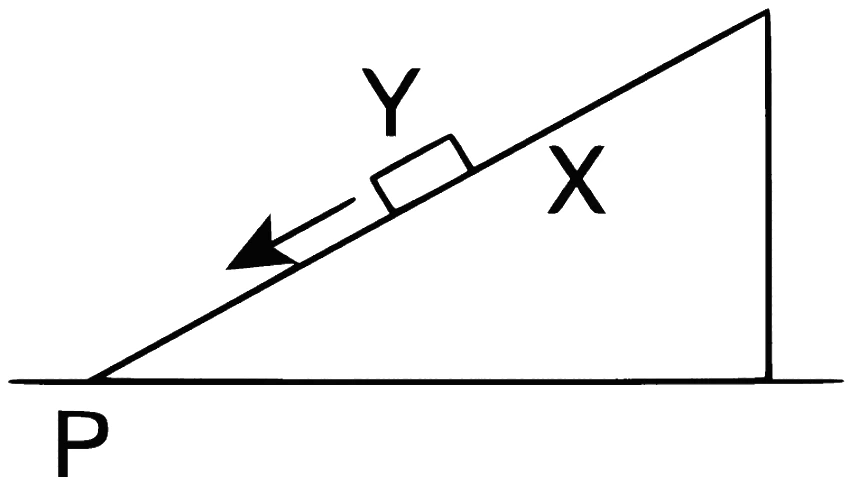
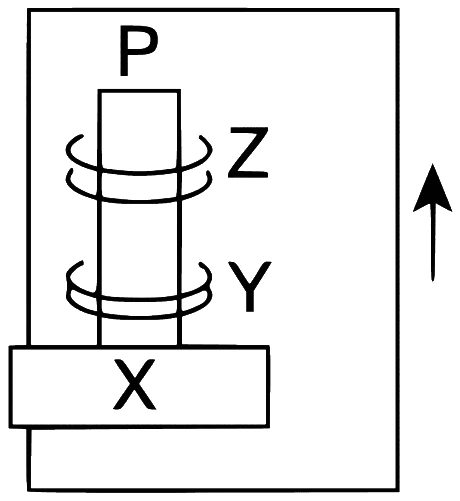
Column II shows five systems in which two objects are labelled as X and Y. Also in each case a point P is shown. Column I gives some statements about X and/or Y. Match these statements to the appropriate system(s) from Column II:
| Column I | Column II |
| (A) The force exerted by X on Y has a magnitude . | (P) Block Y of mass left on a fixed inclined plane X, slides on it with a constant velocity. |
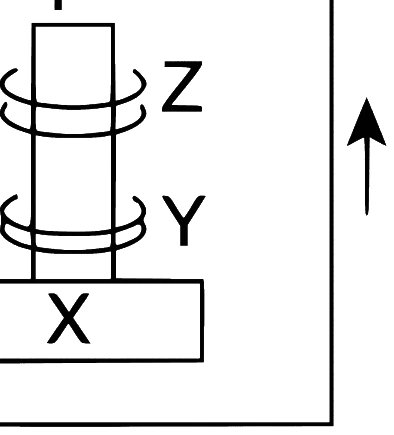
| (B) The gravitational potential energy of X is continuously increasing. | (Q) Two rings magnets Y and Z, each of mass , are kept in frictionless vertical plastic stand so that they repel each other. Y rests on the base X and Z hangs in air in equilibrium. P is the topmost point of the stand on the common axis of the two rings. The whole system is in a lift that is going up with a constant velocity. |
| (C) Mechanical energy of the system X + Y is continuously decreasing. | (R) A pulley Y of mass is fixed to a table through a clamp X. A block of mass hangs from a string that goes over the pulley and is fixed at point P of the table. The whole system is kept in a lift that is going down with a constant velocity. |
| (D) The torque of the weight of Y about point P is zero. | (S) A sphere Y of mass is put in a non-viscous liquid X kept in a container at rest. The sphere is released and it moves down in the liquid. |
| (T) A sphere Y of mass is falling with its terminal velocity in a viscous liquid X kept in a container. |
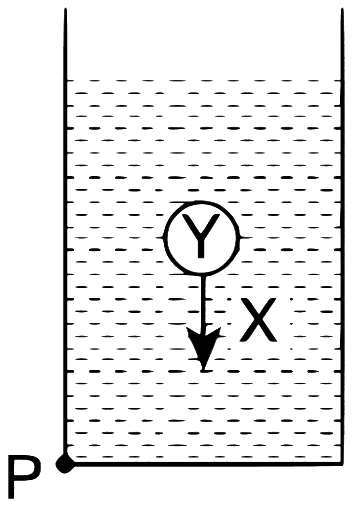
Answer: (b)
Step-by-step solution coming soon.
Satellite Energy & Weightlessness
STATEMENT - 1
An astronaut in an orbiting space station above the Earth experiences weightlessness.
and
STATEMENT - 2
An object moving around the Earth under the influence of Earth's gravitational force is in a state of 'free-fall'.
Answer: (a)
Step-by-step solution coming soon.
Satellite Energy & Weightlessness
A body is orbiting very close to the earth surface with kinetic energy . The energy required to completely escape from it is
Answer: (d)
Step-by-step solution coming soon.
Satellite Energy & Weightlessness
Assertion : An astronaut in an orbiting space station above the earth experience weightlessness.
Reason : An object moving around the earth under the influence of earth's gravitational force is in a state of 'free fall'.
Answer: (a)
Step-by-step solution coming soon.
Satellite Energy & Weightlessness
Assertion : A satellite moving in a circular orbit around the earth has a total energy , then its potential energy is .
Reason : Potential energy of the body at a point in a gravitational field of orbit is .
Answer: (d)
Step-by-step solution coming soon.
Satellite Energy & Weightlessness
An artificial satellite moving in a circular orbit around the earth has a total (kinetic + potential) energy . Its potential energy is
Answer: (c)
Step-by-step solution coming soon.
Satellite Energy & Weightlessness
A launching vehicle carrying an artificial satellite of mass is set for launch on the surface of the earth of mass and radius . If the satellite is intended to move in a circular orbit of radius , the minimum energy required to be spent by the launching vehicle on the satellite is (Gravitational constant )
Answer: (b)
Step-by-step solution coming soon.
Satellite Energy & Weightlessness
For a satellite moving in an orbit around the earth, the ratio of kinetic energy to potential energy is
Answer: (b)
Step-by-step solution coming soon.
Satellite Energy & Weightlessness
The radius of the orbit of a satellite of the earth is . Its kinetic energy is proportional to
Answer: (a)
Step-by-step solution coming soon.
Satellite Energy & Weightlessness
A skylab of mass is first launched from the surface of the earth in a circular orbit of radius (from the centre of the earth) and then it is shifted from this circular orbit to another circular orbit of radius . The minimum energy required to place the lab in the first orbit and to shift the lab from first orbit to the second orbit are
Answer: (b)
Step-by-step solution coming soon.
Satellite Energy & Weightlessness
A satellite is revolving around the earth in a circular orbit with kinetic energy of . The additional kinetic energy required for just escaping into the outer space is
Answer: (b)
Step-by-step solution coming soon.
Satellite Energy & Weightlessness
Energy required for moving a body of mass from a circular orbit of radius to a higher orbit of radius around the earth is
Answer: (b)
Step-by-step solution coming soon.
Satellite Energy & Weightlessness
A constant potential energy of a satellite is given as , where PE = potential energy and KE = kinetic energy. The value of will be
Answer: (b)
Step-by-step solution coming soon.
Satellite Energy & Weightlessness
The total energy of a satellite in a circular orbit at a distance from the centre of the Earth varies as [ is the radius of the Earth and is the height of the orbit from the Earth's surface]
Answer: (a)
Step-by-step solution coming soon.
Satellite Energy & Weightlessness
Work required to shift an artificial satellite from an orbit of radius '' to an orbit of radius '' is
Answer: (b)
Step-by-step solution coming soon.
Satellite Energy & Weightlessness
A artificial satellite is in an orbit of radius about the earth. The energy required to transfer it to an orbit of radius is (, )
Answer: (b)
Step-by-step solution coming soon.
Satellite Energy & Weightlessness
The potential energy of a satellite of mass revolving around the Earth at a height of from the surface of the Earth is ( = radius of Earth, = acceleration due to gravity)
Answer: (a)
Step-by-step solution coming soon.
Satellite Energy & Weightlessness
A satellite moving round the earth in a circular orbit has kinetic energy . Then, the minimum amount of energy to be added so that it escapes from the earth is
Answer: (b)
Step-by-step solution coming soon.
Satellite Energy & Weightlessness
If the time period of revolution of a satellite is , then its kinetic energy is proportional to
Answer: (d)
Step-by-step solution coming soon.
Satellite Energy & Weightlessness
The energy required to transfer a satellite of mass from an orbit of height from the surface of the earth to an orbit of height from the surface of the earth is
( - acceleration due to gravity on the surface of the earth and - radius of the earth)
Answer: (c)
Step-by-step solution coming soon.
Satellite Energy & Weightlessness
The percentage increase in the energy for an artificial satellite to shift it from an orbit of radius to an orbit of radius is
Answer: (c)
Step-by-step solution coming soon.
Satellite Energy & Weightlessness
A satellite of mass rotates round the earth in a circular orbit of radius . If the angular momentum of the satellite is , then its kinetic energy () and the total energy () of the satellite are
Answer: (b)
Step-by-step solution coming soon.
Satellite Energy & Weightlessness
A particle of mass is rotating in a circular orbit of radius under the action of gravity in the presence of another stationary particle of very large mass . Consider that the gravitational potential energy is zero at infinite separation. If the total energy of the rotating particle is , then which of the following expressions correctly represents the angular momentum of the particle?
Answer: (b)
Step-by-step solution coming soon.
No questions match these filters.