The density of a planet is three times that of earth and radius 2.5 times that of earth. If gp and ge represents acceleration due to gravity on planet and earth respectively then ratio gp to ge is
Time period of a simple pendulum is T1 when on the earth's surface and T2 when taken to a height '2R' above the earth's surface, where 'R' is the radius of the earth. The ratio T1:T2 is
The time taken by simple pendulum for one oscillation is T on earth's surface. Its time period becomes xT when taken to a height R (equal to earth's radius) above the earth's surface. The value of x is
The height in terms of radius of the earth (R), at which the acceleration due to gravity becomes 9g, where g is acceleration due to gravity on earth's surface, is
The lengths of seconds pendulums on the surface of the earth and at an altitude 'h' from the surface of the earth are ls and lh respectively. The radius of the earth is
If a capillary tube is immersed in water, rise of water in capillary is h1. When the whole arrangement is taken to a depth d in a mine, the water level rises to h2. The ratio h1h2 is (R=radius of earth)
The acceleration due to gravity at a height 'h' above the surface of earth is 'gh'. At the depth 90 km below the earth's surface the acceleration due to gravity is also 'gh'. The value of 'h' is
When one moves from a point 16 km below the earth's surface to a point 16 km above the earth's surface, the change in g is approximately α%. The value of α is ______.
The speed with which the earth would have to rotate about its axis so that a person on the equator would weigh 53th as much as at present is (g = gravitational acceleration, R = equatorial radius of the earth.)
Two planets A and B have densities ' ρ1 ', ' ρ2 ' and have radii ' r1 ', ' r2 ', respectively. The ratio of acceleration due to gravity on A to that of B is
Acceleration due to gravity on the surface of earth is ' g '. If the diameter of earth is reduced to one third of its original value and mass remains unchanged, then the acceleration due to gravity on the surface of the earth is ________ g.
Numerical answer type. Work it out, then open the answer.
Time period of a simple pendulum on earth's surface is ' T '. It time period becomes ' xT ' when taken to a height ' 2R ' above earth's surface. The value of x will be (R= radius of earth)
A body weighs 48 N on the surface of the earth. The gravitational force experienced by the body due to the earth at a height equal to one-third the radius of the earth from its surface is:
Water rises up to height ' x ' in a capillary tube immersed vertically in water. When the whole arrangement is taken to a depth ' d ' in a mine, the water level rises up to height Y. If R is the radius of the earth then the ratio Y:x is
The density of a new planet is twice that of earth. The acceleration due to gravity at the surface of the planet is equal to that at the surface of earth. If R is the radius of earth, then radius of the planet would be
The acceleration due to gravity at the surface of the planet is same as that at the surface of the earth, but the density of planet is thrice that of the earth. If 'R' is the radius of the earth, the radius of the planet will be
The acceleration due to gravity on the surface of earth is g. If the diameter of earth reduces to half of its original value and mass remains constant, then acceleration due to gravity on the surface of earth would be:
A simple pendulum has a periodic time ' T1 ' when it is on the surface of earth of radius ' R '. Its periodic time is ' T2 ' when it is taken to a height ' R ' above the earth's surface. The value of T1T2 is
Assuming the earth to be a sphere of uniform mass density, a body weighed 300 N on the surface of earth. How much it would weigh at R/4 depth under surface of earth?
The height ' h ' from the surface of the earth at which the value of ' g ' will be reduced by 64% than the value at surface of the earth is ( R= radius of the earth)
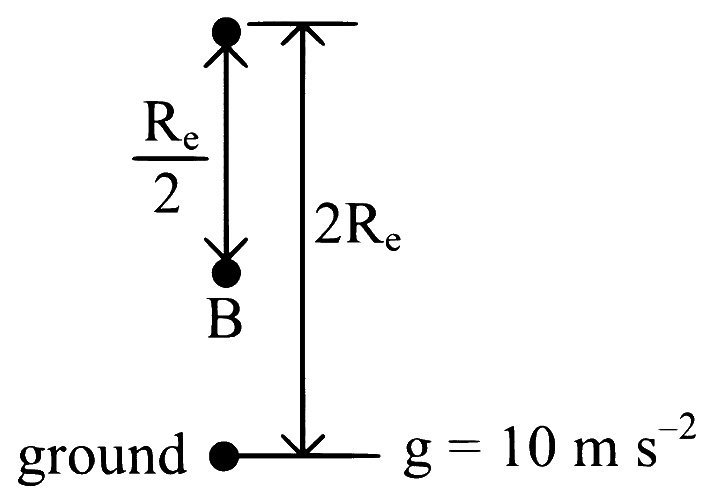
An object of mass 100 kg falls from point A to B as shown in figure. The change in its weight, corrected to the nearest integer is (RE is the radius of the earth)
If R is the radius of the earth and the acceleration due to gravity on the surface of earth is g=π2 m/s2, then the length of the second's pendulum at a height h=2R from the surface of earth will be:
A simple pendulum is placed at a place where its distance from the earth's surface is equal to the radius of the earth. If the length of the string is 4 m, then the time period of small oscillations will be __________ s. [take g=π2 m s−2]
Numerical answer type. Work it out, then open the answer.
A pendulum is oscillating with frequency ' n ' on the surface of earth. If it is taken to a depth 4R below the surface of earth, new frequency of oscillation of depth 4R is ( R= radius of earth)
The weights of an object are measured in a coal mine of depth ' h1 ', then at sea level of height ' h2 ' and lastly at the top of a mountain of height ' h3 ' as W1,W2 and W3 respectively. Which one of the following relations is correct? [h1≪R,h3≫h2=R,R= radius of the earth ]
The speed with which the earth would have to rotate about its axis so that a person on the equator would weigh 53 th as much as at present weight is ( g= gravitational acceleration, R= equatorial radius of the earth)
Consider a planet whose density is same as that of the earth but whose radius is three times the radius 'R' of the earth. The acceleration due to gravity 'gn' on the surface of planet is gn=x. g where g is acceleration due to gravity on surface of earth. The value of 'x' is
The radii of two planets 'A' and 'B' are 'R' and '4R' and their densities are ρ and ρ/3 respectively. The ratio of acceleration due to gravity at their surfaces (gA:gB) will be:
Time period of simple pendulum on earth's surface is 'T'. Its time period becomes 'xT' when taken to a height R (equal to earth's radius) above the earth's surface. Then the value of 'x' will be
The weight of a body on the surface of the earth is 100 N. The gravitational force on it when taken at a height, from the surface of earth, equal to one-fourth the radius of the earth is:
A body weight W, is projected vertically upwards from earth's surface to reach a height above the earth which is equal to nine times the radius of earth. The weight of the body at that height will be:
The weight of a body at the surface of earth is 18 N. The weight of the body at an altitude of 3200 km above the earth's surface is (given, radius of earth Re=6400 km):
A mine is located at depth R/3 below earth's surface. The acceleration due to gravity at that depth in mine is (R= radius of earth, g= acceleration due to gravity)
Assuming the earth to be a sphere of uniform mass density, the weight of a body at a depth d=2R from the surface of earth, if its weight on the surface of earth is 200 N, will be:
Statement I: Acceleration due to gravity is different at different places on the surface of earth. Statement II: Acceleration due to gravity increases as we go down below the earth's surface. In the light of the above statements, choose the correct answer from the options given below
Statement I: Rotation of the earth shows effect on the value of acceleration due to gravity (g) Statement II: The effect of rotation of the earth on the value of 'g' at the equator is minimum and that at the pole is maximum.
In the light of the above statements, choose the correct answer from the options given below
There is a second's pendulum on the surface of earth. It is taken to the surface of planet whose mass and radius are twice that of earth. The period of oscillation of second's pendulum on the planet will be
A simple pendulum is oscillating with frequency 'F' on the surface of the earth. It is taken to a depth 3R below the surface of earth. ( R= radius of earth). The frequency of oscillation at depth R/3 is
At a certain depth "d " below surface of earth, value of acceleration due to gravity becomes four times that of its value at a height 3R above earth surface. Where R is Radius of earth (Take R=6400 km ). The depth d is equal to
Earth is assumed to be a sphere of radius R. If 'gϕ' is value of effective acceleration due to gravity at latitude 30∘ and 'g' is the value at equator, then the value of ∣g−gϕ∣ is (ω is angular velocity of rotation of earth, cos30∘=23)
The radius of earth is 6400 km and acceleration due to gravity g=10 m s−2. For the weight of body of mass 5 kg to be zero on equator, rotational velocity of the earth must be (in rad/s)
Assume that the earth is a solid sphere of uniform density and a tunnel is dug along its diameter throughout the earth. It is found that when a particle is released in this tunnel, it executes a simple harmonic motion. The mass of the particle is 100 g. The time period of the motion of the particle will be (approximately)
The height of any point P above the surface of earth is equal to diameter of earth. The value of acceleration due to gravity at point P will be: (Given g = acceleration due to gravity at the surface of earth).
The length of a seconds pendulum at a height h = 2R from earth surface will be: (Given R = Radius of earth and acceleration due to gravity at the surface of earth, g = π2 ms−2)
An object is taken to a height above the surface of earth at a distance 45 R from the centre of the earth. Where radius of earth, R = 6400 km. The percentage decrease in the weight of the object will be:
If the acceleration due to gravity experienced by a point mass at a height h above the surface of earth is same as that of the acceleration due to gravity at a depth αh(h≪Re) from the earth surface. The value of α will be _________.
(use Re=6400 km)
Numerical answer type. Work it out, then open the answer.
Given below are two statements: One is labelled as Assertion A and the other is labelled as Reason R.
Assertion A: If we move from poles to equator, the direction of acceleration due to gravity of earth always points towards the center of earth without any variation in its magnitude. Reason R: At equator, the direction of acceleration due to the gravity is towards the center of earth. In the light of above statements, choose the correct answer from the options given below:
The depth 'd' below the surface of the earth where the value of acceleration due to gravity becomes (n1) times the value at the surface of the earth is (R= radius of the earth)
If RE be the radius of Earth, then the ratio between the acceleration due to gravity at a depth 'r' below and a height 'r' above the earth surface is: (Given: r < RE)
The length of the seconds pendulum is lm on earth. If the mass and diameter of the planet is 1.5 times that of the earth, the length of the seconds pendulum on the planet will be nearly
The mass of a spherical planet is 4 times the mass of the earth, but its radius (R) is same as that of the earth. How much work is done is lifting a body of mass 5 kg through a distance of 2 m on the planet? (g = 10 ms −2)
Consider a planet in some solar system which has a mass double the mass of earth and density equal to the average density of earth. If the weight of an object on earth is W, the weight of the same object on that planet will be:
For a body of mass 'm', the acceleration due to gravity at a distance 'R' from the surface of the earth is (4g). Its value at a distance (2R) from the surface of the earth is ( R= radius of the earth, g= acceleration due to gravity)
A pendulum is oscillating with frequency 'n' on the surface of the earth. It is taken to a depth 2R below the surface of earth. New frequency of oscillation at depth 2R is
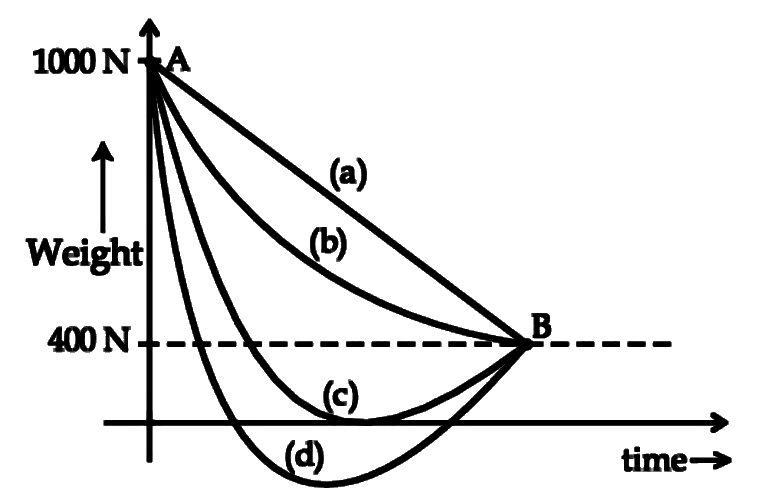
A person whose mass is 100 kg travels from Earth to Mars in a spaceship. Neglect all other objects in sky and take acceleration due to gravity on the surface of the Earth and Mars as 10 m/s2 and 4 m/s2 respectively. Identify from the below figures, the curve that fits best for the weight of the passenger as a function of time.
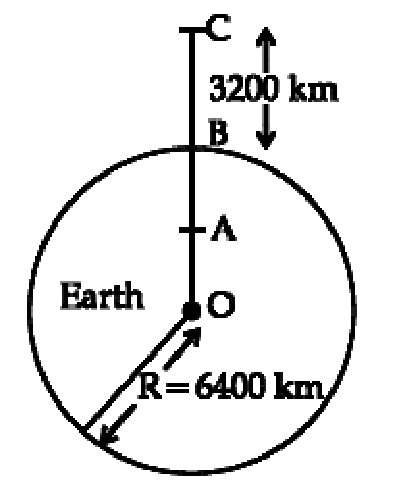
In the reported figure of earth, the value of acceleration due to gravity is same at point A and C but it is smaller than that of its value at point B (surface of the earth). The value of OA: AB will be x: y. The value of x is ________.
Numerical answer type. Work it out, then open the answer.
If the angular velocity of earth's spin is increased such that the bodies at the equator start floating, the duration of the day would be approximately: [Take g = 10 ms−2, the radius of earth, R = 6400 × 103 m, Take π = 3.14]
A body weights 49N on a spring balance at the north pole. What will be its weight recorded on the same weighing machine, if it is shifted to the equator?
[Use g=R2GM = 9.8 ms−2 and radius of earth, R = 6400 km.]
A body of mass 'M' and radius 'R', situated on the surface of the earth becomes weightless at its equator when the rotational kinetic energy of the earth reaches a critical value 'K'. The value of 'K' is given by [Assume the earth as a solid sphere, g = gravitational acceleration on the earth's surfacde]
The value of the acceleration due to gravity is g1 at a height h = 2R (R = radius of the earth) from the surface of the earth. It is again equal to g1 at a depth d below the surface of the earth. The ratio (Rd) equals:
A box weight 196 N on a spring balance at the north pole. Its weight recorded on the same balance if it is shifted to the equator is close to (Take g = 10 ms–2 at the north pole and the radius of the earth = 6400 km):
The height ‘h’ at which the weight of a body will be the same as that at the same depth ‘h’ from the surface of the earth is (Radius of the earth is R and effect of the rotation of the earth is neglected)
The acceleration due to gravity on the earth’s surface at the poles is g and angular velocity of the earth about the axis passing through the pole is ω. An object is weighed at the equator and at a height h above the poles by using a spring balance. If the weights are found to be same, then h is (h << R, where R is the radius of the earth)
The value of acceleration due to gravity at Earth's surface is 9.8 ms–2. The altitude above its surface at which the acceleration due to gravity decreases to 4.9 ms–2, is close to: (Radius of earth = 6.4 × 10⁶ m)
A hole is drilled half way to the centre of the earth. A body weighs 300 N on the surface of the earth. How much will, it weigh at the bottom of the hole?
A mass falls from a height 'h' and its time of fall 't' is recorded in terms of time period T of a simple pendulum. On the surface of earth it is found that t=2T. The entire set up is taken on the surface of another planet whose mass is half of that of earth and radius the same. Same experiment is repeated and corresponding times noted as t′ and T′.
The ratio of the weights of a body on the Earth’s surface to that on the surface of a planets is 9: 4. The mass of the planet is 91 th of that of the Earth. If 'R' is the radius of the Earth, what is the radius of the planet? (Take the planets to have the same mass density)
Consider a particle of mass m suspended by a string at the equator. Let R and M denote radius and mass of the earth. If ω is the angular velocity of rotation of the earth about its own axis, then the tension on the string will be (cos0∘=1)
If the mass of the Sun were ten times smaller and the universal gravitational constant were ten times larger in magnitude, which of the following is not correct?
If the Earth has no rotational motion, the weight of a person on the equator is W. Determine the speed with which the earth would have to rotate about its axis so that the person at the equator will weigh 43 W. Radius of the Earth is 6400 km and g=10 m/s2.
A spherical planet has a mass MP and diameter DP. A particle of mass m falling freely near the surface of this planet will experience an acceleration due to gravity, equal to
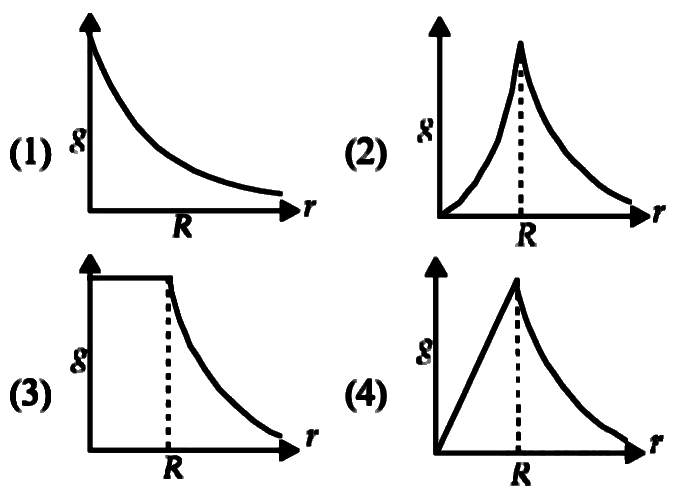
The dependence of acceleration due to gravity g on the distance r from the centre of the earth, assumed to be a sphere of radius R of uniform density is as shown in figures below
The height at which the acceleration due to gravity becomes 9g (where g= the acceleration due to gravity on the surface of the earth) in terms of R, the radius of the earth, is:
If gE and gM are the accelerations due to gravity on the surfaces of the earth and the moon respectively and if Millikan's oil drop experiment could be performed on the two surfaces, one will find the ratio
electronic charge on the earthelectronic charge on the moonto be
Imagine a new planet having the same density as that of earth but it is 3 times bigger than the earth in size. If the acceleration due to gravity on the surface of earth is g and that on the surface of the new planet is g', then
The change in the value of g at a height h above the surface of the earth is the same as at a depth d below the surface of earth. When both d and h are much smaller than the radius of earth, then which one of the following is correct?
The density of a newly discovered planet is twice that of earth. The acceleration due to gravity at the surface of the planet is equal to that at the surface of the earth. If the radius of the earth is R, the radius of the planet would be
The acceleration due to gravity on the planet A is 9 times the acceleration due to gravity on planet B. A man jumps to a height of 2 m on the surface of A. What is the height of jump by the same person on the planet B?
The acceleration due to gravity g and mean density of the earth ρ are related by which of the following relations? (where G is the gravitational constant and R is the radius of the earth.)
The radius of earth is about 6400 km and that of mars is 3200 km. The mass of the earth is about 10 times mass of mars. An object weighs 200 N on the surface of earth. Its weight on the surface of mars will be
A narrow tunnel passes through the centre of a planet of radius R and uniform mass density ρ. A particle is released into the tunnel. What is the angular frequency of oscillation of the particle equal to? (Symbols carry their usual meaning)
Suppose there are two planets, 1 and 2, having the same density but their radii are R1 and R2 respectively, where R1>R2. The accelerations due to gravity on the surface of these planets are related as
A planet has a mass M1 and radius R1. The value of acceleration due to gravity on its surface is g1. There is another planet 2, whose mass and radius both are two times that of the first planet. Which one of the following is the acceleration due to gravity on the surface of planet 2?
The acceleration due to gravity g for objects on or near the surface of earth is related to the universal gravitational constant G as (M is the mass of the earth and R is its radius):
Statement I : A body weighs less on a hill top than on earth's surface even though its mass remains unchanged. Statement II : The acceleration due to gravity of the earth decreases with height. Which one of the following is correct? (Choose the code that matches both statements.)
The radius of the Moon is about one-fourth that of the Earth and acceleration due to gravity on the Moon is about one-sixth that on the Earth. From this, we can conclude that the ratio of the mass of Earth to the mass of the Moon is about
Statement I: The acceleration due to gravity decreases with increase in height from the surface of the Earth. Statement II: The acceleration due to gravity is inversely proportional to the square of the distance from the centre of the Earth.
Planet A has double the radius than that of Planet B. If the mass of Planet A is 4 times heavier than the mass of Planet B, which of the following statements regarding weight of an object is correct?
A body attached to a spring balance weighs 10kg on the Earth. The body attached to the same spring balance is taken to a planet where gravity is half that of the Earth. The balance will read
Two satellites P and Q are moving in different circular orbits around the Earth (radius R). The heights of P and Q from the Earth surface are hP and hQ, respectively, where hP=R/3. The accelerations of P and Q due to Earth's gravity are gP and gQ, respectively. If gP/gQ=36/25, what is the value of hQ ?
A planet of radius R=101× (radius of Earth) has the same mass density as Earth. Scientists dig a well of depth 5R on it and lower a wire of the same length and of linear mass density 10−3kg m−1 into it. If the wire is not touching anywhere, the force applied at the top of the wire by a person holding it in place is (take the radius of Earth =6×10⁶m and the acceleration due to gravity of Earth is 10m s−2)
The weight of a body on the surface of the earth is 63N. What is the gravitational force on it due to the earth at a height equal to half the radius of the earth?
Consider a planet in some solar system which has a mass double the mass of the earth and density equal to the average density of the earth. An object weighing W on the earth will weigh
The reading of a spring balance corresponds to 100N while situated at the north pole and a body is kept on it. The weight recorded on the same scale if it is shifted to the equator, is (take g=10m/s2 and radius of the earth, R=6.4×10³m)
The maximum vertical distance through which a full dressed astronaut can jump on the earth is 0.5m. Estimate the maximum vertical distance through which he can jump on the moon, which has a mean density 32rd that of the earth and radius one quarter that of the earth.
The value of g at a particular point is 9.8ms−2. Suppose the earth suddenly shrinks uniformly to half its present size without losing any mass. The value of g at the same point (distance of the point from the centre of earth does not change) will now be
If the value of g at the surface of the earth is 9.8m/s2 then the value of g at a place 480km above the surface of the earth will be (radius of the earth is 6400km)
At what height above the surface of earth the value of acceleration due to gravity would be half of its value on the surface of earth? (Radius of the earth is 6400km)
Assertion : A tennis ball bounces higher on hills than in plains. Reason : Acceleration due to gravity on the hill is greater than that on the surface of earth.
The planets with radii R1 and R2 have densities ρ1,ρ2 respectively. Their atmospheric pressures are p1 and p2 respectively. Therefore, the ratio of masses of their atmospheres, neglecting variation of g within the limits of atmosphere is
A pendulum having a bob of mass m is hanging in a ship sailing along the equator from east to west. When the ship is stationary with respect to water, the tension in the string is T0. The difference between T0 and earth attraction on the bob, is
Change in acceleration due to gravity is the same up to a height h above the earth's surface and below it up to a depth x. Then the relation between x and h is (h and x≪Re)
The speed of earth's rotation about its axis is ω. Its speed is increased to x times to make the effective acceleration due to gravity equal to zero at the equator. Then x is
Imagine a new planet having the same density as that of the earth but it is 3 times bigger than the earth in size. If the acceleration due to gravity on the surface of the earth is g and that on the surface of the new planet is g′, then
The acceleration due to gravity at a height of (2−1)R from the surface of the Earth is (acceleration due to gravity on the surface of the Earth =10m s−2 and R is the radius of the Earth)
What will be the acceleration due to gravity at a depth d, where g is the acceleration due to gravity on the surface of the earth and R is the radius of the earth?
If the earth stops rotating about its axis, then what will be the change in the value of g at a place in the equatorial plane? (Radius of earth =6400km)
If the Earth is assumed to be a sphere of uniform mass density and its weight on the surface is 200N, then the weight of the body at a depth halfway to the Earth's centre will be
The height at which the acceleration due to gravity becomes 16g (where g = acceleration due to gravity on the surface of the earth) in terms of R is, if R is the radius of the earth.
Imagine a new planet having the same density as that of the earth, but it is two times bigger than the earth in size. If the acceleration due to gravity on the surface of the earth is g and that on the surface of the new planet is g′, then
The value of acceleration due to gravity at a height of 10km from the surface of the earth is x. At what depth inside the earth is the value of the acceleration due to gravity the same value x?
If the gravitational force acting on a body due to earth at a height equal to twice the radius of the earth is 30N, then the mass of the body is (acceleration due to gravity on the surface of the earth =10m s−2)
The weight of a body decreases by 1% when it is raised to a small height 'h' above the earth's surface. If the same body is taken to a depth 'h' in a mine, then its weight is
The acceleration due to gravity at a height of (2−1)R from the surface of the Earth is (Acceleration due to gravity on the surface of the Earth =10ms−2 and R is radius of the Earth)
The time period of a simple pendulum on the surface of the Earth is T. If the pendulum is taken to a height equal to half of the radius of the Earth, then its time period is
The acceleration due to gravity at a height of 6400km from the surface of the earth is 2.5m s−2. The acceleration due to gravity at a height of 12800km from the surface of the earth is (radius of the earth =6400km)
The value of acceleration due to gravity at a height of 4RE from the surface of the earth is (RE is the radius of the earth and the acceleration due to gravity on the surface of the earth =10m s−2)
The distance through which one has to dig the Earth from its surface, so as to reach the point where the acceleration due to gravity is reduced by 40% of that at the surface of the Earth, is (radius of Earth is 6400km)
The acceleration due to gravity at a height (1/20)th of the radius of the Earth above the Earth's surface is 9m s−2. Its value at an equal depth below the surface of the earth is
The ratio of the radii of a planet and the earth is 1:2, the ratio of their mean densities is 4:1. If the acceleration due to gravity on the surface of the earth is 9.8m s−2, then the acceleration due to gravity on the surface of the planet is
The graph correctly represents the variation of acceleration due to gravity (g) with radial distance from the centre of the earth (radius of the earth =Re) is
Acceleration due to gravity at a height H from the surface of a planet is the same as that at a depth of H below the surface. If R be the radius of the planet, then H vs. R graph for different planets will be,
An ideal gas of molar mass M is contained in a very tall vertical cylindrical column in the uniform gravitational field. Assuming the gas temperature to be T, the height at which the centre of gravity of the gas is located is (R = universal gas constant)
The acceleration due to earth's gravity on a point particle at a height h above the surface of the earth is denoted by go(h) and at a depth d below the surface of the earth is denoted by gi(d). Consider the earth to be a sphere of radius R with uniform mass density. Which of the following correctly represents the ratio gi(d)/go(d) ?
A certain planet named "Crypton" completes one rotation about its polar axis in time T. A probe placed at 60∘ latitude on the planet's surface reports weightlessness. The density of the planet (assumed to be a sphere of uniform density) is given by