
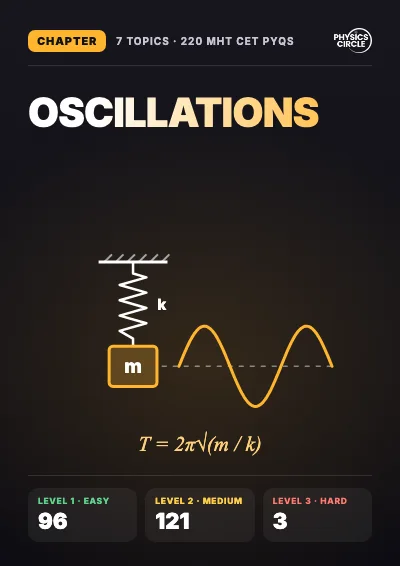
Oscillations Formula Book
65 formulas in 7 topics, in the same order as the PYQ topics.
Only formulas used in the solutions of 220 MHT CET PYQs (Level 1, 2, 3)Periodic Motion & SHM Basics
10 formulas · from 31 MHT CET PYQs
- Condition for SHM: restoring force and acceleration
- Differential equation of SHM
- If a = -bx, find omega and period
- Displacement equation of SHM
- Phase change in a time interval
- Sum of sine and cosine terms is one SHM
- Special case: equal sine and cosine terms
- Time from mean position to x = A/2
- Distance covered in one full oscillation
- Ball bouncing elastically from height h: period
Velocity & Acceleration in SHM
9 formulas · from 43 MHT CET PYQs
- Velocity at displacement x
- Maximum velocity (at mean position)
- Acceleration and its maximum (at extreme)
- Acceleration in terms of period
- Velocity for x = A sin(wt)
- Omega and amplitude from v_max and a_max
- Speeds u and v at two positions x1 and x2
- Where speed is half of maximum
- Body on vibrating platform just leaves it
🔒 For Vajra 2.0 Pro studentsTopic 1 is free. Log in with your Vajra 2.0 Pro number to see every formula.
Energy in SHM
10 formulas · from 42 MHT CET PYQs
- Total energy of SHM
- Potential and kinetic energy at displacement x
- Ratio of KE to PE at displacement x
- Position where KE = PE
- Energies at x = A/2
- Energy depends on amplitude and frequency
- PE and restoring force at the same x
- Energy variation with time for x = A sin(wt)
- Maximum restoring force
- Energies E1, E2 for x and y; energy for x + y
🔒 For Vajra 2.0 Pro studentsTopic 1 is free. Log in with your Vajra 2.0 Pro number to see every formula.
Simple Pendulum
13 formulas · from 43 MHT CET PYQs
- Period and angular frequency of simple pendulum
- Dependence on length
- Ratio of lengths from ratio of periods
- Pendulum of length (l1 - l2)
- Pendulum in a lift / accelerating frame
- New period when g changes
- Bob (density rho) oscillating in liquid (density sigma)
- Energy of pendulum with linear amplitude A
- Same amplitude: E vs L; same energy: A vs L
- Maximum speed of the bob
- Maximum string tension (at mean position)
- Speed at lowest point after release from angle theta
- Bob hung by two strings L, supports 2d apart
🔒 For Vajra 2.0 Pro studentsTopic 1 is free. Log in with your Vajra 2.0 Pro number to see every formula.
Spring Systems
14 formulas · from 49 MHT CET PYQs
- Period of spring-mass system
- Frequency of spring-mass system
- Dependence of period on mass and spring constant
- Springs in parallel
- Springs in series
- Cutting a spring: k is inversely proportional to length
- Spring cut in ratio n : 1, constant of the shorter part
- Period from static extension x
- Spring constant from force and extension
- Same mass on two springs joined in parallel
- Mass attached and released at natural length
- Maximum speed; same v_max gives A vs k
- Amplitude from speed at mean position
- Mass sticks to the oscillating block
🔒 For Vajra 2.0 Pro studentsTopic 1 is free. Log in with your Vajra 2.0 Pro number to see every formula.
Other SHM Systems
5 formulas · from 8 MHT CET PYQs
- Body in a tunnel through the Earth (any chord)
- Small ball rolling in a bowl of radius R
- Floating body of mass m, cross-section A
- Floating cube of side L, density d, liquid density rho
- Liquid of mass M oscillating in a U-tube
🔒 For Vajra 2.0 Pro studentsTopic 1 is free. Log in with your Vajra 2.0 Pro number to see every formula.
Damped, Forced Oscillations & Superposition
4 formulas · from 4 MHT CET PYQs
- Amplitude of damped oscillation
- Displacement of damped oscillator
- Angular frequency of damped oscillator
- Damping force and unit of damping constant
🔒 For Vajra 2.0 Pro studentsTopic 1 is free. Log in with your Vajra 2.0 Pro number to see every formula.