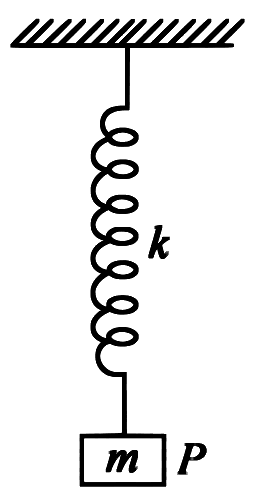
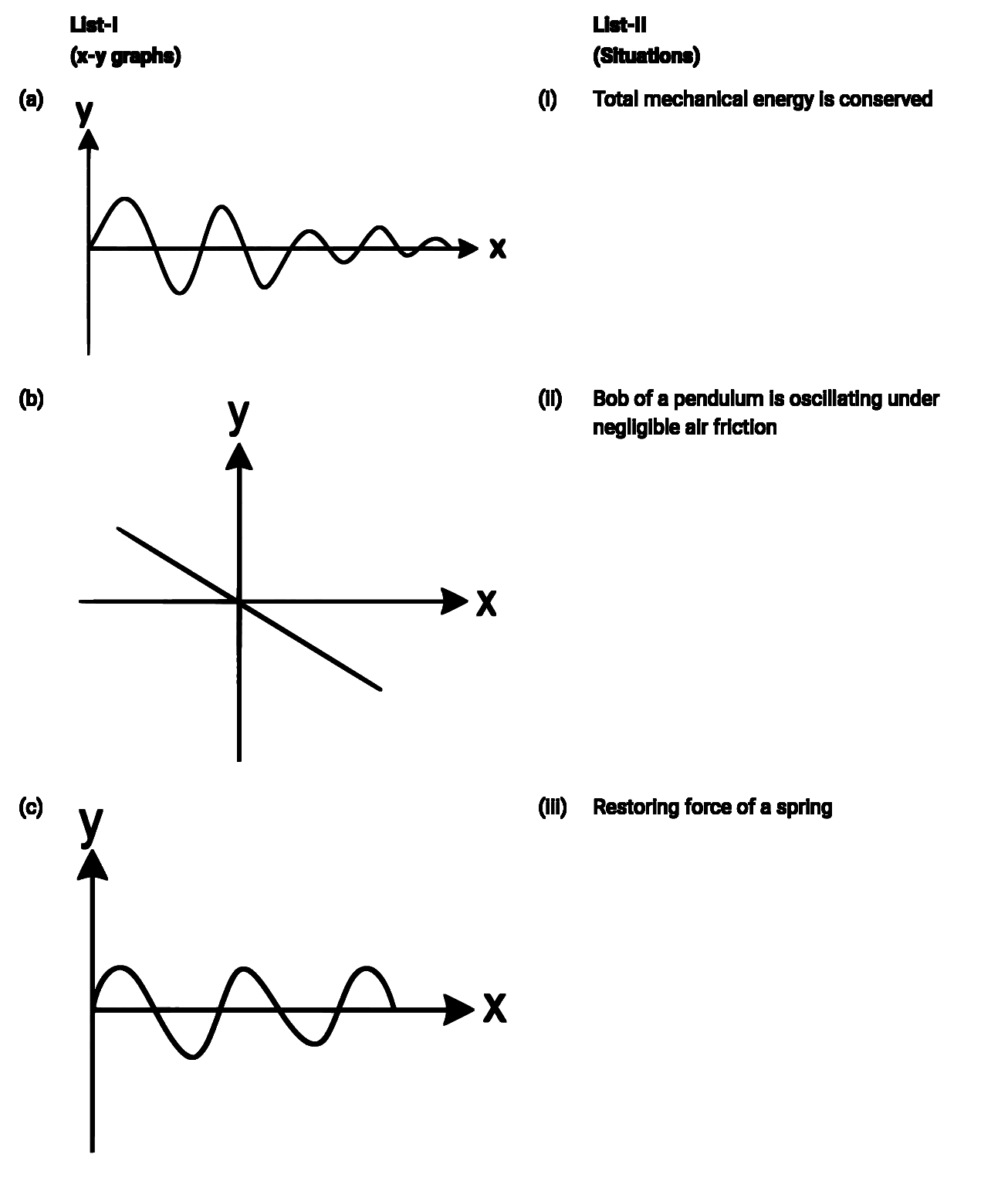
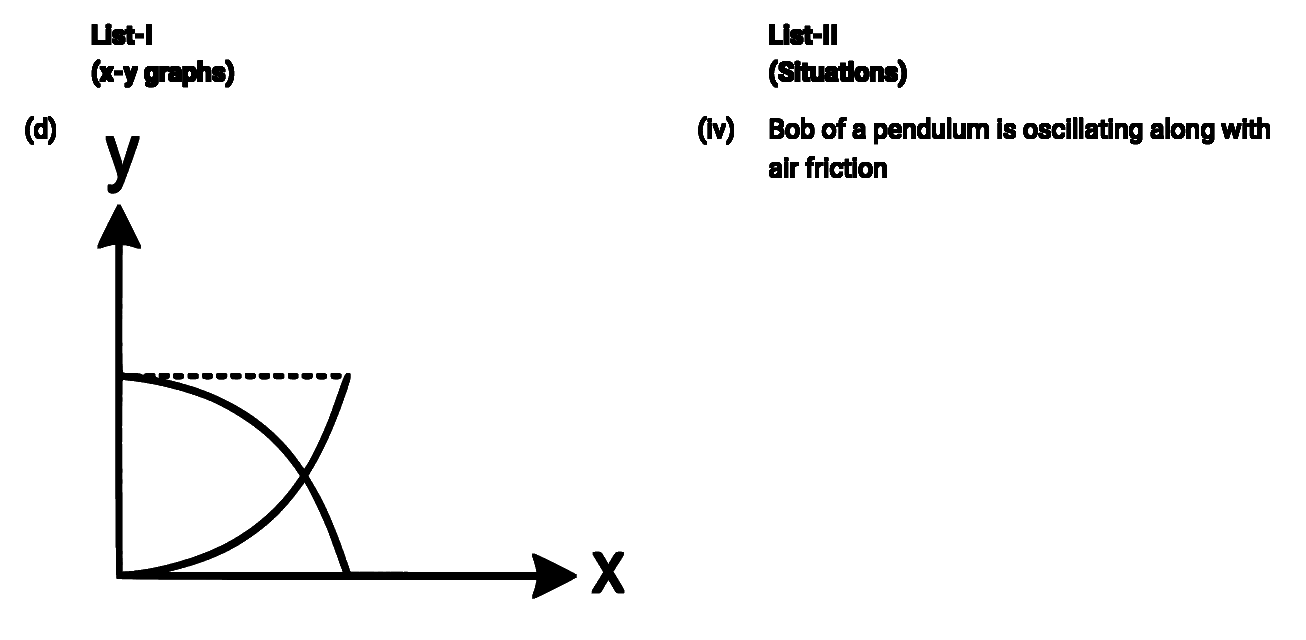
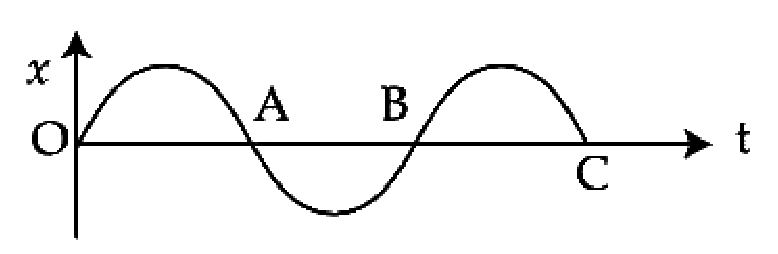
There is a body having mass m and performing SHM with amplitude 'a'. There is a restoring force F=−Kx, where x is the displacement. The total energy of the body depends upon which of the following?
For a particle executing S.H.M., the potential energy is n times the kinetic energy when its displacement from mean position is (322)A, where A is the amplitude of S.H.M. The value of n is
For a particle executing S.H.M., its potential energy is 8 times its kinetic energy at a certain displacement 'x' from the mean position. If 'A' is the amplitude of S.H.M., the value of 'x' is
For a particle P performing S.H.M., when displacement is 'x', potential energy and restoring force acting on it is denoted by 'E' and 'F' respectively. The relation between x, E and F is
A mass 0.4 kg performs S.H.M. with a frequency π16 Hz. At a certain displacement it has kinetic energy 2 J and potential energy 1.2 J. The amplitude of oscillation is
Maximum kinetic energy of a particle of mass 1 kg in S.H.M. is 8 J and the time period is 4 s. Maximum potential energy during the motion is 10 J. Then
A particle of mass 'm' is executing S.H.M. about the origin on x-axis with frequency πmKa, where K is a constant and a is the amplitude of S.H.M. If 'x' is the displacement of a particle at time 't', the potential energy of a particle will be
A block is fastened to a horizontal spring. The block is pulled to a distance x=10 cm from its equilibrium position (at x=0) on a frictionless surface from rest. The kinetic energy of the block at x=5 cm is 0.25 J. The spring constant of the spring is nearly (in Nm−1)
A particle starts oscillating simple harmonically from its equilibrium position with time period T. The ratio of kinetic energy to potential energy of the particle at time t=T/12 is
The displacement of a particle, executing simple harmonic motion with time period T, is expressed as x(t)=Asinωt, where A is the amplitude. The maximum value of potential energy of this oscillator is found at t=T/2β. The value of β is ______.
Numerical answer type. Work it out, then open the answer.
The kinetic energy of a simple harmonic oscillator is oscillating with angular frequency of 176 rad/s. The frequency of this simple harmonic oscillator is ______ Hz. [ take π=722 ]
A particle is executing S.H.M. of amplitude ' A '. When the potential energy of the particle is half of its maximum value during the oscillation, its displacement from the equilibrium position is
A particle is executing linear S.H.M. starting from mean position. The ratio of the kinetic energy to the potential energy of the particle at a point of half the amplitude is
A point particle of mass 200 gram is executing S.H.M. of amplitude 0.2 m. When the particle passes through the mean position, its kinetic energy is 16×10−3 J. The equation of motion of this particle is (Initial phase of oscillation =0∘)
An object of mass 0.2 kg executes simple harmonic oscillations along the x -axis with frequency of (π25)Hz. At the position x=0.04 m, the object has kinetic energy 1 J and potential energy 0.6 J. The amplitude of oscillation is
For a particle performing S.H.M.; the total energy is ' n ' times the kinetic energy, when the displacement of a particle from mean position is 23A, where A is the amplitude of S.H.M. The value of ' n ' is
A particle starts oscillating simple harmonically from its mean position with time period ' T '. At time t=6T, the ratio of the potential energy to kinetic energy of the particle is
A particle oscillates along the x-axis according to the law, x(t)=x0sin2(2t) where x0=1 m. The kinetic energy (K) of the particle as a function of x is correctly represented by the graph
In simple harmonic motion, the total mechanical energy of given system is E. If mass of oscillating particle P is doubled then the new energy of the system for same amplitude is:
When the displacement of a simple harmonic oscillator is one third of its amplitude, the ratio of total energy to the kinetic energy is 8x, where x= _________.
Numerical answer type. Work it out, then open the answer.
The kinetic energy of a particle, executing simple harmonic motion is 16 J when it is in mean position. If amplitude of motion is 25 cm and the mass of the particle is 5.12 kg, the period of oscillation is
An object of mass 0.2 kg executes simple harmonic motion along x axis with frequency of (π25)Hz. At the position x=0.04 m the object has kinetic energy 0.5 J and potential energy 0.4 J. The amplitude of oscillation is ________ cm.
Numerical answer type. Work it out, then open the answer.
In S.H.M. the displacement of a particle at an instant is Y=Acos30∘, where A=40 cm and kinetic energy is 200 J. If force constant is 1×10x N/m, then x will be (cos30∘=3/2)
For a body performing simple harmonic motion, its potential energy is Ex at displacement x and Ey at displacement y from mean position. The potential energy E0 at displacement (x+y) is
Starting from mean position, a body oscillates simple harmonically with a period ' T '. After what time will its kinetic energy be 75% of the total energy? (sin30∘=0.5)
A particle starts oscillating simple harmonically from its equilibrium position with time period ' T '. What is the ratio of potential energy to kinetic energy of the particle at time t=12T? (sin(6π)=21)
For a particle executing S.H.M., its potential energy is 8 times its kinetic energy at certain displacement 'x' from the mean position. If 'A' is the amplitude of S.H.M the value of 'x' is
A particle is vibrating in S.H.M. with an amplitude of 4 cm. At what displacement from the equilibrium position is its energy half potential and half kinetic?
A particle is executing simple harmonic motion (SHM). The ratio of potential energy and kinetic energy of the particle when its displacement is half of its amplitude will be
The maximum potential energy of a block executing simple harmonic motion is 25 J. A is amplitude of oscillation. At A/2, the kinetic energy of the block is
The amplitude of a particle executing SHM is 3 cm. The displacement at which its kinetic energy will be 25% more than the potential energy is: __________ cm
Numerical answer type. Work it out, then open the answer.
The variation of kinetic energy (KE) of a particle executing simple harmonic motion with the displacement (x) starting from mean position to extreme position (A) is given by
A body is executing a linear S.H.M. Its potential energies at the displacement 'x' and 'y' are 'E1' and 'E2' respectively. Its potential energy at displacement (x+y) will be
At a given point of time the value of displacement of a simple harmonic oscillator is given as y=Acos(30∘). If amplitude is 40 cm and kinetic energy at that time is 200 J, the value of force constant is 1.0×10x N m−1. The value of x is ____________.
Numerical answer type. Work it out, then open the answer.
The general displacement of a simple harmonic oscillator is x=Asinωt. Let T be its time period. The slope of its potential energy (U) - time (t) curve will be maximum when t=βT. The value of β is ______________.
Numerical answer type. Work it out, then open the answer.
A particle starts oscillating simple harmonically from its mean position with time period 'T'. At time t=12T, the ratio of the potential energy to kinetic energy of the particle is
(2) Average potential and kinetic energy over any given time interval are always equal. (3) Sum of the kinetic and potential energy at any point of time is constant.
(4) Average K.E. in one time period is equal to average potential energy in one time period. Choose the most appropriate option from the options given below:
A particle performing S.H.M. when displacement is 'x', the potential energy and restoring force acting on it are denoted by 'E' and 'F' respectively. The relation between x,E and F is
A body is performing S.H.M. of amplitude 'A'. The displacement of the body from a point where kinetic energy is maximum to a point where potential energy is maximum, is
A particle starts executing simple harmonic motion (SHM) of amplitude 'a' and total energy E. At any instant, its kinetic energy is 43E then its displacement 'y' is given by:
In a simple harmonic oscillation, what fraction of total mechanical energy is in the form of kinetic energy, when the particle is midway between mean and extreme position.
A mass 0.4 kg performs S.H.M. with a frequency π16 Hz. At a certain displacement it has kinetic energy 2 J and potential energy 1.2 J. The amplitude of oscillation is
A body is executing S.H.M. under the action of force having maximum magntude 50 N. When its energy is half kinetic and half potential; the magnitude of the force acting on the particle is
An object executes SHM along x-axis with amplitude 0.06 m. At certain distance 'x' metre from mean position, it has kinetic energy 10 J and potential energy 8 J. the distance 'x' will be
An object of mass 0.5 kg is executing simple harmonic motion. It amplitude is 5 cm and time period (T) is 0.2 s. What will be the potential energy of the object at an instant t=4T s starting from mean position. Assume that the initial phase of the oscillation is zero.
A particle of mass 1 kg is hanging from a spring of force constant 100 Nm−1. The mass is pulled slightly downward and released so that it executes free simple harmonic motion with time period T. The time when the kinetic energy and potential energy of the system will become equal, is xT. The value of x is _____________.
Numerical answer type. Work it out, then open the answer.
For a particle performing SHM when displacement is x, the potential energy and restoring force acting on it is denoted by E and F, respectively. The relation between x,E and F is
A particle is executing simple harmonic motion (SHM) of amplitude A, along the x-axis, about x = 0. When its potential Energy (PE) equals kinetic energy (KE), the position of the particle will be:
A particle undergoing simple harmonic motion has time dependent displacement given by x(t) = Asin 90πt. The ratio of kinetic to potential energy of this particle at t = 210 s will be:
A particle is executing simple harmonic motion with a time period T. At time t = 0, it is at its position of equilibrium. The kinetic energy – time graph of the particle will look like:
For a simple pendulum, a graph is plotted between its kinetic energy (KE) and potential energy (PE) against its displacement d. Which one of the following represents these correctly? (graphs are schematic and not drawn to scale)
The particle executing simple harmonic motion has a kinetic energy K0cos2ωt. The maximum values of the potential energy and the total energy are respectively
A particle of mass m executes simple harmonic motion with amplitude a and frequency v. The average kinetic energy during its motion from the position of equilibrium to the end is
Starting from the origin a body oscillates simple harmonically with a period of 2 s After what time will its kinetic energy be 75% of the total energy?
A body executes simple harmonic motion. The potential energy (P.E), the kinetic energy (K.E) and total energy (T.E) are measured as a function of displacement x. Which of the following statements is true?
A particle of mass m oscillates with simple harmonic motion between points x1 and x2, the equilibrium position being O. Its potential energy is plotted. It will be as given below in the graph
A loaded vertical spring executes S.H.M. with a time period of 4 sec. The difference between the kinetic energy and potential energy of this system varies with a period of
A body executes simple harmonic motion with an amplitude A. At what displacement from the mean position is the potential energy of the body is one fourth of its total energy?
For a simple pendulum in simple harmonic motion, which of the following statements is/are correct? 1. The kinetic energy is maximum at the mean position. 2. The potential energy is maximum at the mean position. 3. Acceleration is maximum at the mean position. Select the correct answer using the code given below:
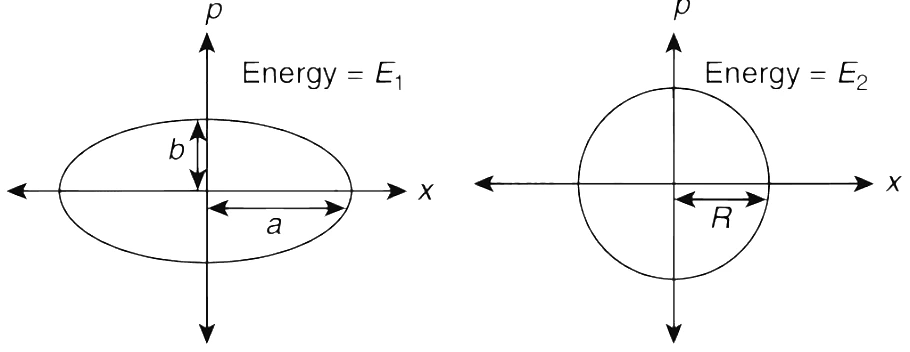
Two independent harmonic oscillators of equal masses are oscillating about the origin with angular frequencies ω1 and ω2 and have total energies E1 and E2, respectively. The variations of their momenta p with positions x are shown in the figures. If ba=n2 and Ra=n, then the correct equations is/are
More than one option can be correct. Tap every correct option, then tap Check.
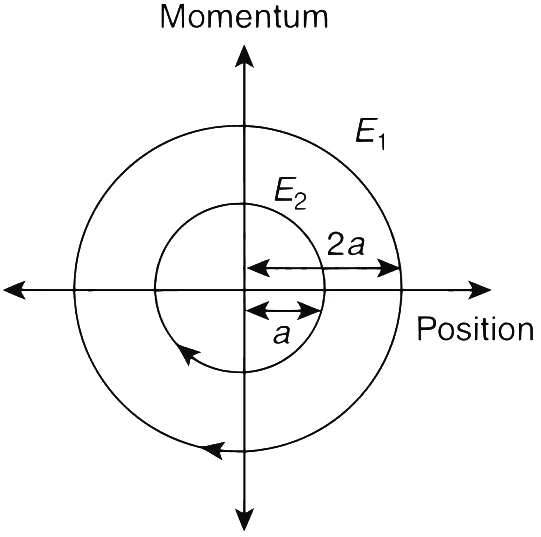
Phase space diagrams are useful tools in analyzing all kinds of dynamical problems. They are especially useful in studying the changes in motion as initial position and momentum are changed. Here we consider some simple dynamical systems in one-dimension. For such systems, phase space is a plane in which position is plotted along horizontal axis and momentum is plotted along vertical axis. The phase space diagram is x(t) vs. p(t) curve in this plane. The arrow on the curve indicates the time flow. For example, the phase space diagram for a particle moving with constant velocity is a straight line as shown in the figure. We use the sign convention in which position or momentum upwards (or to right) is positive and downwards (or to left) is negative.
The phase space diagram for simple harmonic motion is a circle centred at the origin. In the figure, the two circles represent the same oscillator but for different initial conditions, and E1 and E2 are the total mechanical energies respectively. Then
An object of mass 0.2kg executes simple harmonic oscillation along the x-axis with a frequency of (π25)Hz. At the position x=0.04, the object has kinetic energy of 0.5J and potential energy 0.4J. The amplitude of oscillations is ........ m.
Numerical answer type. Work it out, then open the answer.
A particle is executing linear simple harmonic motion of amplitude A. What fraction of the total energy is kinetic when the displacement is half the amplitude
A particle of mass m is executing oscillations about the origin on the x-axis. Its potential energy is U(x)=k[x]3, where k is a positive constant. If the amplitude of oscillation is a, then its time period T is
A particle doing SHM having amplitude 5cm, mass 0.5kg and angular frequency 5rad/s is at 1cm from mean position. Find potential energy and kinetic energy.
A particle of mass m is executing oscillation about the origin on X-axis. Its potential energy is V(x)=K∣x∣3. Where K is a positive constant. If the amplitude of oscillation is a, then its time period T is proportional to
A mass of 1kg is suspended from a spring of force constant 400N m−1, executing SHM total energy of the body is 2J, then maximum acceleration of the spring will be
The displacement of a particle executing SHM is given by y=5sin(4t+3π). If T is the time period and the mass of the particle is 2g, the kinetic energy of the particle when t=T/4 is given by
An object of mass 10g executes SHM along the x-axis with frequency (π10)Hz. At the point x=2cm the object has KE 1.2J and PE 0.4J. The amplitude of oscillation is
A particle executes a simple harmonic motion of amplitude A. The distance from the mean position at which its kinetic energy is equal to its potential energy is
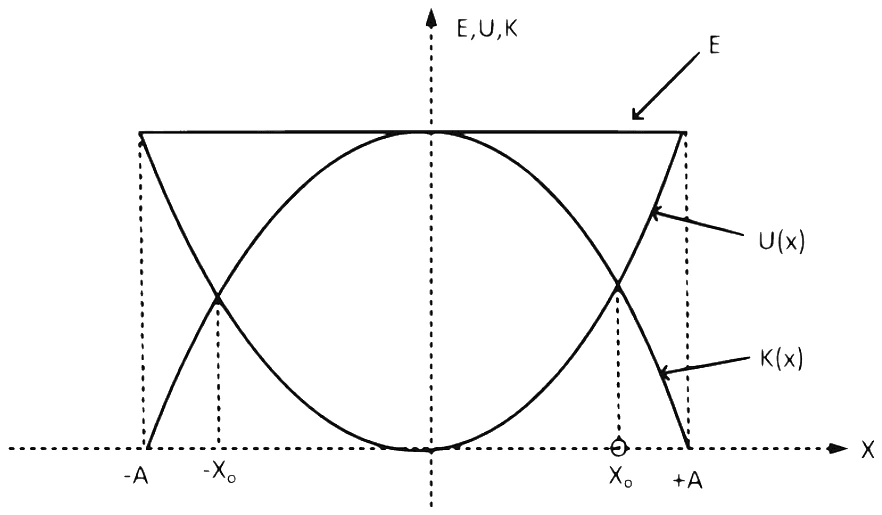
The variations of kinetic energy K(x), potential energy U(x) and total energy as a function of displacement of a particle in SHM is as shown in the figure. The value of ∣x0∣ is
The energy of a particle executing Simple Harmonic Motion (SHM) is given by E=Ax2+BV2. Here x is the displacement of the particle from mean position and V is its velocity at x and A and B are constants. The INCORRECT statement is
A particle is executing simple harmonic motion with an amplitude of 25cm. If the kinetic energy of the particle at the mean position is 5J, then the maximum force acting on the particle in its motion is
For a particle executing simple harmonic motion, the ratio of kinetic and potential energies at a point where the displacement is one half of the amplitude is
A particle is executing simple harmonic motion with amplitude A. The ratio of the kinetic energies of the particle when it is at displacements of 4A and 2A from the mean position is
A particle is executing simple harmonic motion starting from its mean position. If the time period of the particle is 1.5s, then the minimum time at which the ratio of the kinetic and total energies of the particle becomes 3:4 is
The kinetic energy of a particle executing simple harmonic motion at a displacement of 3cm from the mean position is 4mJ. If the amplitude of the particle is 5cm, then the maximum force acting on the particle is
The displacement of a particle of mass 2g executing simple harmonic motion is x=8cos(50t+12π)m, where t is time in second. The maximum kinetic energy of the particle is
A particle is executing simple harmonic motion with a time period of 3s. At a position where the displacement of the particle is 60% of its amplitude, the ratio of the kinetic and potential energies of the particle is
A body is executing simple harmonic motion. At a displacement x its potential energy is E1 and at a displacement y its potential energy is E2. The potential energy E at a displacement (x+y) is
The mass of a particle is 1kg and it is moving along the X-axis. The period of its oscillation is 2π. Its potential energy at a displacement of 0.2m is
An object of mass 3kg is executing simple harmonic motion with an amplitude π2m. If the kinetic energy of the object when it crosses the mean position is 6J, the time period of oscillation of the object is
A body is executing S.H.M. At a displacement x its potential energy is 9J and at a displacement y its potential energy is 16J. The potential energy at a displacement (x+y) is
A particle executing simple harmonic motion along a straight line with an amplitude A attains maximum potential energy when its displacement from the mean position equals
A block of mass 1kg is fastened to a spring of spring constant 100N m−1. The block is pulled to a distance x=10cm from its equilibrium position (x=0cm) on a frictionless surface, from rest at t=0. The kinetic energy and the potential energy of the block when it is 5cm away from the mean position is
The total energy of a particle executing simple harmonic motion with 2cm amplitude is 160mJ. The force acting on the particle at a point where the ratio of the potential and kinetic energies of the particle becomes 1:15 is
The amplitude of a particle executing simple harmonic motion is 6cm. The distance of the point from the mean position at which the ratio of the potential and kinetic energies of the particle becomes 4:5 is
A particle of mass 4mg is executing simple harmonic motion along X-axis with an angular frequency of 40rad s−1. If the potential energy of the particle is V(x)=a+bx2, where V(x) is in joule and x is in metre, then the value of b is
For a particle executing simple harmonic motion, the kinetic energy of the particle at a distance of 4cm from the mean position is 1/3 rd of the maximum kinetic energy. The amplitude of the motion is
A block is in simple harmonic motion (SHM) on the end of the spring with position given by x=5cos(ωt+4π)cm. If the total mechanical energy used is 100J to achieve maximum displacement, then the potential energy at time t=0 is
A body starting at t=0 from origin oscillates simple harmonically with a period of 4s. After what time will its kinetic energy be 75% of its total energy?
Consider a simple harmonic motion (SHM). Let K and U be kinetic energy and potential energy when the displacement in SHM is one-half (21) the amplitude.
A particle of mass m moves in one dimension under the action of a conservative force whose potential energy has the form of U(x)=−x2+β2αx where α and β are dimensional parameters. The angular frequency of the oscillation is proportional to
A particle of mass m that moves along the x-axis has potential energy V(x)=a+bx2, where a and b are positive constants. Its initial velocity is v0 at x=0. It will execute simple harmonic motion. Then
More than one option can be correct. Tap every correct option, then tap Check.

 Oscillations · Lecture 2 · Energy in SHM & Displacement PYQs55:55All 6 Oscillations videos →