
Spring Systems
The frequency of oscillation of a mass suspended by a spring is . If the length of the spring is cut to half, the same mass oscillates with frequency . The value of is ______.
Show answer and solution
Answer: (c)
Loading the solution…
Home›Practice Hub›Chapters›Oscillations›Spring Systems
Oscillations PYQs · MHT CET · JEE Main · NEET
 Oscillations · Lecture 3 · Simple Pendulum & Spring-Mass System1:13:44All 6 Oscillations videos →
Spring Systems
The frequency of oscillation of a mass suspended by a spring is . If the length of the spring is cut to half, the same mass oscillates with frequency . The value of is ______.
Answer: (c)
Spring Systems
A spring of force constant is cut into two pieces. If the ratio of their length is , then the force constant of smaller piece is .
Answer: (c)
Spring Systems
A spring of force constant N/m is loaded with a mass kg. The amplitude of oscillations is cm. When mass comes to equillibrium position, its velocity in m/s is
Answer: (b)
Spring Systems
A body of mass g is made to oscillate turn by turn on two different springs A and B. Spring A and B has force constant N/m and N/m respectively. If and are the period of oscillations of springs A and B respectively, then will be
Answer: (c)
Spring Systems
A spring force constant N/m is loaded with a mass kg. The amplitude of oscillations is cm. When mass comes to equilibrium position, its velocity is
Answer: (c)
Spring Systems
Two particles A and B of equal masses are suspended from two massless springs of spring constants and respectively. The maximum velocities of the particles during oscillations are equal. The ratio of the amplitude of 'B' to that of 'A' is
Answer: (b)
Spring Systems
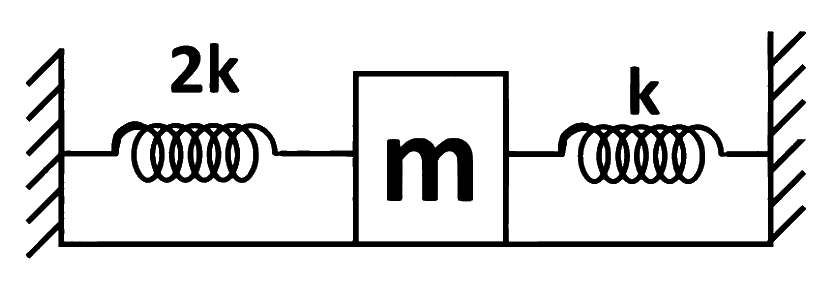
Two springs of force constants '' and '' are connected to a mass '' as shown. Mass is displaced slightly to one side and released. The frequency of oscillation of the two springs-mass system is
Answer: (d)
Spring Systems
A spring has length and force constant . It is cut into 2 springs of length and such that (=an integer). The force constant of the spring of length is
Answer: (a)
Spring Systems
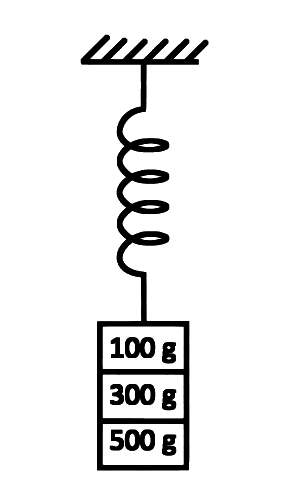
Three masses 100g, 300g and 500g are suspended at the end of a spring as shown in figure and are in equilibrium. When the 500 g mass is removed, the system oscillates with a period of 3 second. When the 300 g mass is also removed, it will oscillate with a period of
Answer: (b)
Spring Systems
A light spring is suspended with mass '' at its lower end and its upper end is fixed to a rigid support. The mass is pulled down a short distance and then released. The period of oscillation is T second. When a mass ' ' is added to '' and the system is made to oscillate the period is found to be T. The ratio is
Answer: (c)
Spring Systems
A spring executes S.H.M. with mass 10 kg attached to it. The force constant of spring is 10 N/m. If at any instant its velocity is 40 cm/s, the displacement at that instant is
(Amplitude of S.H.M. is 0.5 m)
Answer: (b)
Spring Systems
A mass is suspended from a vertical spring which is executing S.H.M. of frequency Hz. The spring is unstretched at the highest point of oscillation. Maximum speed of the mass is ( m/s)
Answer: (c)
Spring Systems
A spring produces extension by applying a force N. A body of mass suspended from spring oscillates vertically with period . The mass of the suspended body is (Neglect mass of spring)
Answer: (a)
Spring Systems
A spring stretches by 2 mm when it is loaded with a mass of 200 g. From equilibrium position the mass is further pulled down by 2 mm and released. The frequency associated with the system and maximum energy in the spring are ______ Hz and ______ J, respectively.
(Take )
Answer: (a)
Spring Systems
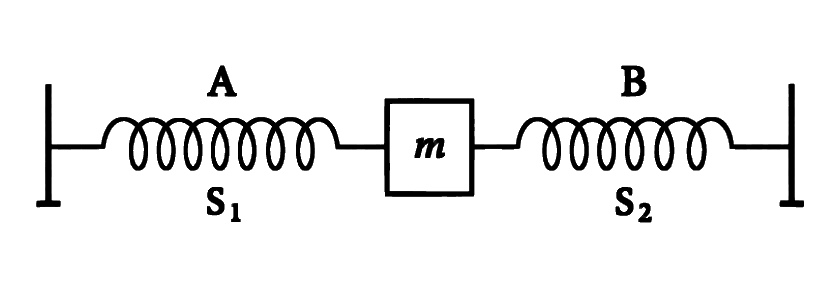
and are two identical springs. The frequency of oscillation of mass m is F. If one spring is removed, the frequency will become
Answer: (d)
Spring Systems
A body has time period under the action of one force and under the action of another force. The square of the time period when both the forces are acting in the same direction is
Answer: (d)
Spring Systems
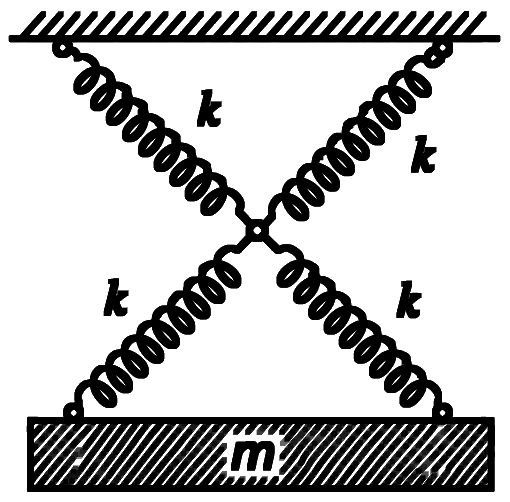
A simple harmonic oscillator having four identical springs (as shown in figure) has a time period . Another similar simple harmonic oscillator of the same mass but the four identical springs with spring constants has a time period , then is
Answer: (c)
Spring Systems
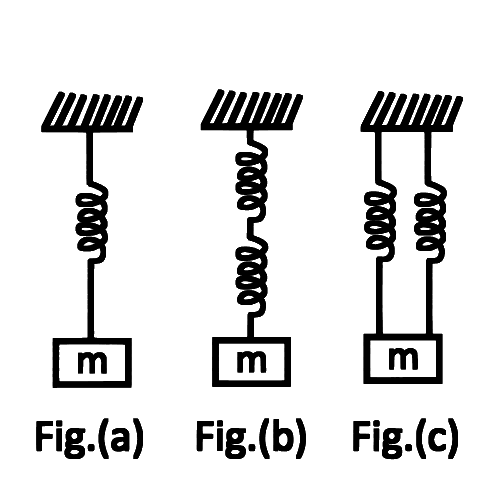
All the springs in fig (a), (b) and (c) are identical, each one having force constant K. Mass m is attached to each system. If and are the periodic time of oscillations of the three systems in fig (a), (b) and (c) respectively, then
Answer: (d)
Spring Systems
Two massless springs of spring constants and are connected one after the other forming a single chain, suspended vertically and a certain mass is attached to the free end. If and are their respective extensions and 'F' is their stretching force, the total extension produced is
Answer: (d)
Spring Systems
A horizontal spring executes S.H.M. with amplitude when mass is attached to it. When it passes through mean position another mass is placed on it. Both masses move together with amplitude . The ratio is
Answer: (b)
Spring Systems
A mass performs S.H.M. with amplitude A which is connected to horizontal spring. While mass passing through mean position, another mass () is placed on it so that both masses move together with amplitude . The ratio of is
Answer: (a)
Spring Systems
As shown in the figure, a spring is kept in a stretched position with some extension by holding the masses kg and kg with a separation more than spring natural length and are released. Assuming the horizontal surface to be frictionless, the angular frequency (in SI unit) of the system is:
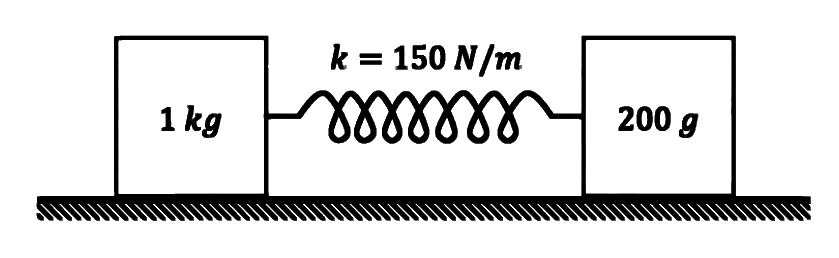
Answer: (c)
Spring Systems
If the period of a oscillation of mass ' m ' suspended from a spring is 2 s, then the period of suspended mass ' 4 m ' with the same spring will be
Answer: (d)
Spring Systems
Two identical point masses and , suspended from two separate massless springs of spring constants and , respectively, oscillate vertically. If their maximum speeds are the same, the ratio ( ) of the amplitude of mass to the amplitude of mass is
Answer: (b)
Spring Systems
Two bodies A and B of equal mass are suspended from two massless springs of spring constant k1 and k2, respectively. If the bodies oscillate vertically such that their amplitudes are equal, the ratio of the maximum velocity of A to the maximum velocity of B is
Answer: (b)
Spring Systems
A spring executes S.H.M. with mass 1 kg attached to it. The force constant of the spring is . If at any instant its velocity is , the displacement at that instant is (Amplitude of S.H.M. is 0.4 m)
Answer: (b)
Spring Systems
A mass is suspended from a spring of negligible mass. The spring is pulled a little and then released, so that mass executes S.H.M. of time period . If the mass is increased by , the periodic time becomes . The ratio
Answer: (c)
Spring Systems
A mass gram is suspended from a light spring. It is pulled in downward direction and released so that mass performs S.H.M. of period T. If mass is increased by Y gram, the period becomes . The ratio of is
Answer: (a)
Spring Systems
In an oscillating spring mass system, a spring is connected to a box filled with sand. As the box oscillates, sand leaks slowly out of the box vertically so that the average frequency and average amplitude of the system change with time . Which one of the following options schematically depicts these changes correctly?
Answer: (d)
Spring Systems
A block of mass 2 kg is attached to one end of a massless spring whose other end is fixed at a wall. The spring-mass system moves on a frictionless horizontal table. The spring's natural length is 2 m and spring constant is 200 N/m. The block is pushed such that the length of the spring becomes 1 m and then released. At distance x m (x < 2) from the wall, the speed of the block will be
Answer: (a)
Spring Systems
A vertical spring oscillates with period 6 second with mass is suspended from it. When the mass is at rest, the spring is stretched through a distance of (Take, acceleration due to gravity, )
Answer: (d)
Spring Systems
A mass suspended from a vertical spring performs S.H.M. of period 0.1 second. The spring is unstretched at the highest point of suspension. Maximum speed of the mass is (Gravitational acceleration )
Answer: (a)
Spring Systems
All the springs in fig. (a), (b) and (c) are identical, each having force constant K each. Mass m is attached to each system. If and are the time periods of oscillations of the three systems in fig. (a), (b) and (c) respectively, then
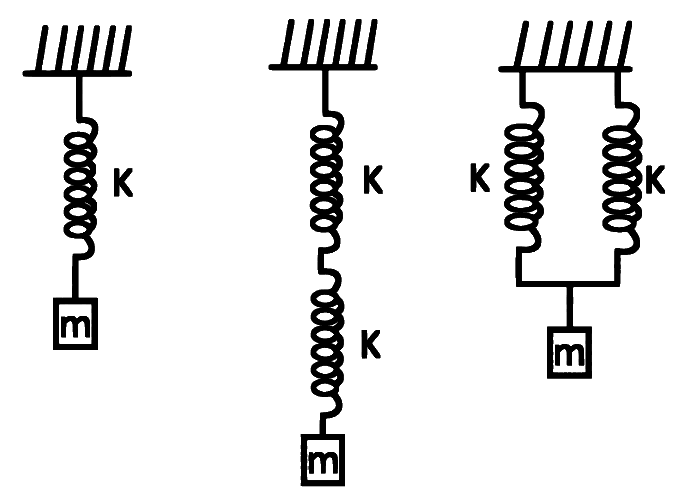
Answer: (d)
Spring Systems
As shown in the figure, and are identical springs with spring constant K each. The oscillation frequency of the mass ' ' is ' '. If the spring is removed, the oscillation frequency will become
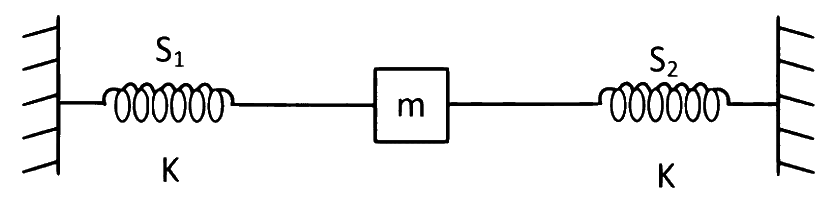
Answer: (c)
Spring Systems
A mass ' ' attached to a horizontal spring executes S.H.M. of amplitude . When the mass M passes through its mean position, then a smaller mass ' ' is placed over it and both of them move together with amplitude . The ratio is
Answer: (c)
Spring Systems
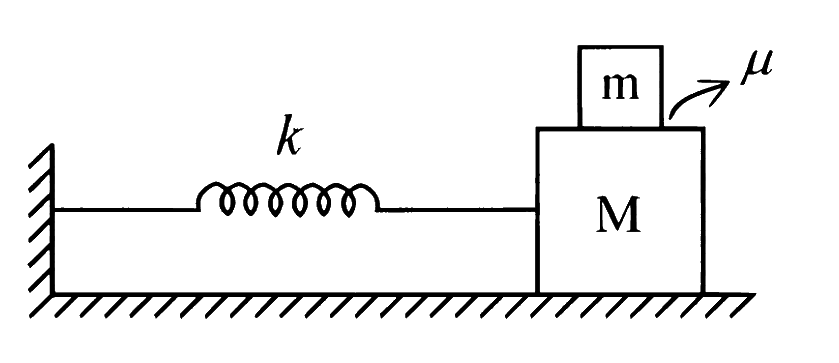
Two blocks of masses and , are placed on a frictionless table as shown in figure. A massless spring with spring constant k is attached with the lower block. If the system is slightly displaced and released, then ( coefficient of friction between the two blocks) A. The time period of small oscillation of the two blocks is
B. The acceleration of the blocks is ( displacement of the blocks from the mean position)
C. The magnitude of the frictional force on the upper block is
D. The maximum amplitude of the upper block, if it does not slip, is
E. Maximum frictional force can be .
Choose the correct answer from the options given below:
Answer: (c)
Spring Systems
A spring has a certain mass suspended from it and its period of vertical oscillations is . The spring is now cut into two equal halves and the same mass is suspended from one of the halves. The period of vertical oscillations is now . The ratio of is
Answer: (b)
Spring Systems
A mass is suspended from a spring of negligible mass and the system oscillates with a frequency . The frequency of oscillations if a mass is suspended from the same spring is . The value of is ________.
Numerical answer type. Work it out, then open the answer.
Answer: 3
Spring Systems
Two bodies A and B of equal mass are suspended from two separate massless springs of spring constants and respectively. The two bodies oscillate vertically such that their maximum velocities are equal. The ratio of the amplitude of to that of is
Answer: (c)
Spring Systems
A mass ' ' attached to a spring oscillates with a period of 3 second. If the mass is increased by 0.6 kg, the period increases by 3 second. The initial mass ' ' is equal to
Answer: (b)
Spring Systems
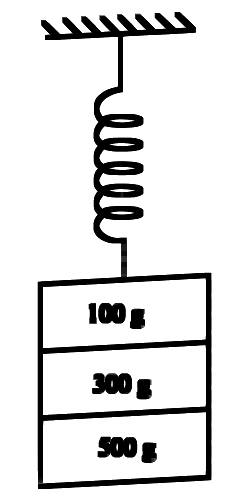
Three masses and 100 g are suspended at the end of spring as shown in figure and are in equilibrium. When the 500 g mass is removed, the system oscillates with a period of 3 second. When the 300 g mass is also removed it will oscillate with a period of
Answer: (b)
Spring Systems
Frequency of a particle performing S.H.M. is 10 Hz. The particle is suspended from a vertical spring. At the highest point of its oscillation the spring is unstretched. Maximum speed of the particle is
Answer: (b)
Spring Systems
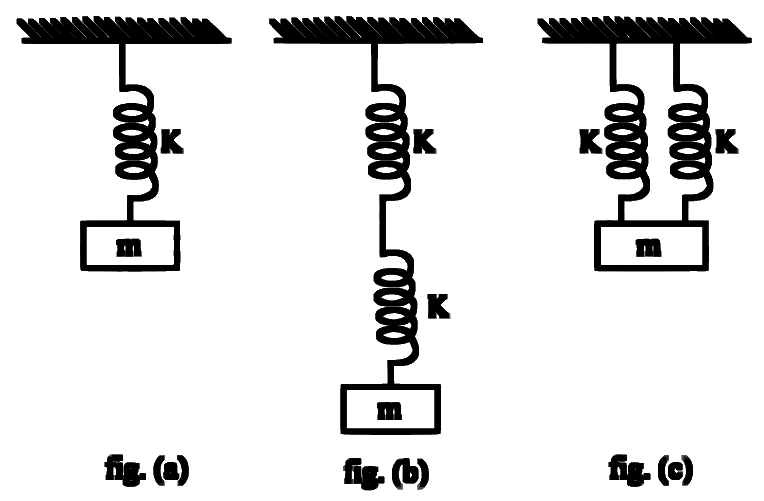
All the springs in fig. (a), (b) and (c) are identical, each having force constant K. Mass attached to each system is ' '. If and are the time periods of oscillations of the three systems respectively, then
Answer: (d)
Spring Systems
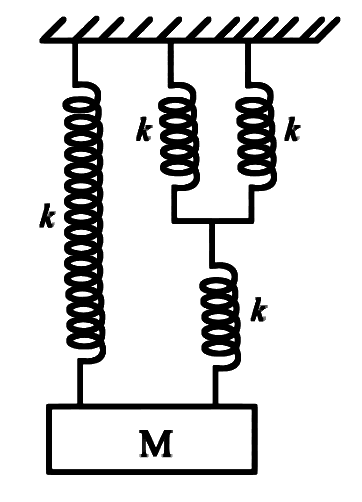
The time period of simple harmonic motion of mass in the given figure is , where the value of is _________.
Numerical answer type. Work it out, then open the answer.
Answer: 12
Spring Systems
A spring has a certain mass suspended from it and its period for vertical oscillations is ''. The spring is now cut in to two equal halves and the same mass is suspended from one of the halves. The period of vertical oscillations is now ' '. The ratio is
Answer: (b)
Spring Systems
For a simple harmonic motion in a mass spring system shown, the surface is frictionless. When the mass of the block is , the angular frequency is . When the mass block is the angular frequency is . The ratio is
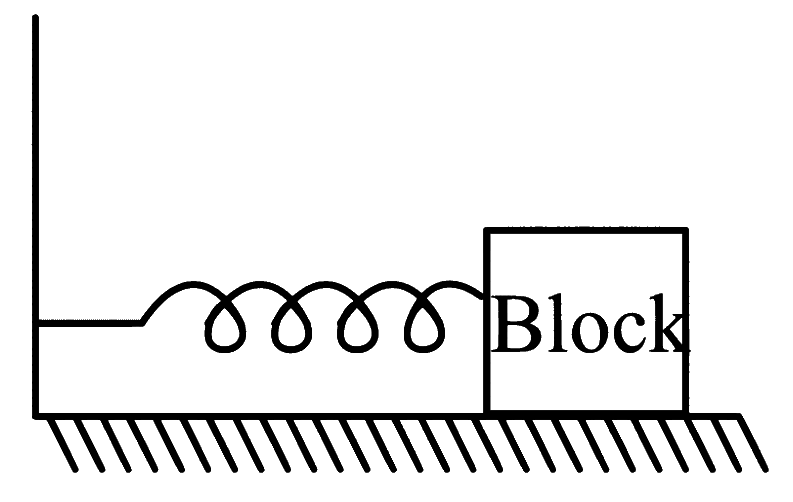
Answer: (a)
Spring Systems
Four massless springs whose force constants are and respectively are attached to a mass kept on a frictionless plane as shown in figure. If mass is displaced in horizontal direction then frequency of oscillating system is
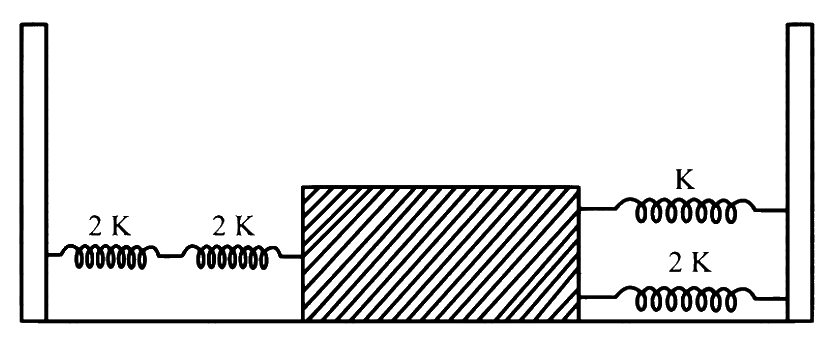
Answer: (b)
Spring Systems
A mass is attached to two springs as shown in figure. The spring constants of two springs are and . For the frictionless surface, the time period of oscillation of mass is:
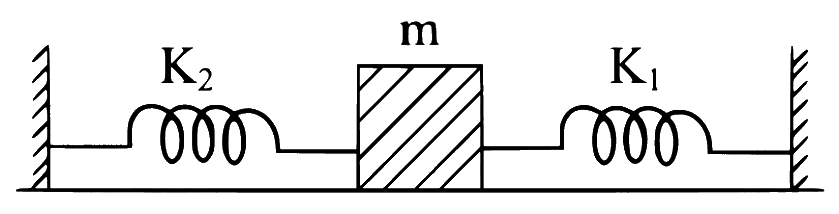
Answer: (a)
Spring Systems
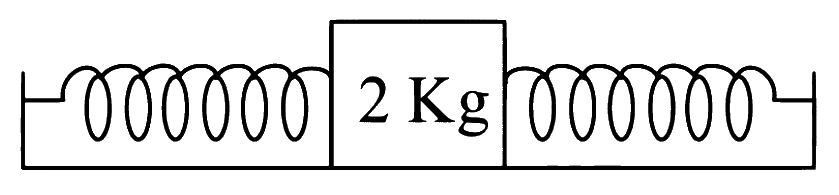
A block of mass 2 kg is attached with two identical springs of spring constant 20 N/m each. The block is placed on a frictionless surface and the ends of the springs are attached to rigid supports (see figure). When the mass is displaced from its equilibrium position, it executes a simple harmonic motion. The time period of oscillation is in SI unit. The value of is ____________.
Numerical answer type. Work it out, then open the answer.
Answer: 5
Spring Systems
A light spring is suspended with mass at its lower end and its upper end fixed to a rigid support. The mass is pulled down a short distance and then released. The period of oscillation is second. When a mass is added to and the system is made to oscillate, the period is found to be . The ratio is
Answer: (c)
Spring Systems
The upper end of the spring is fixed and a mass '' is attached to its lower end. When mass is slightly pulled down and released, it oscillates with time period 3 second. If mass '' is increased by , the time period becomes 5 second. The value of '' is (mass of spring is negligible)
Answer: (d)
Spring Systems
A mass m attached to free end of a spring executes SHM with a period of 1s. If the mass is increased by 3 kg the period of the oscillation increases by one second, the value of mass m is ___________ kg.
Numerical answer type. Work it out, then open the answer.
Answer: 1
Spring Systems
A mass is suspended from a light spring. An additional mass added extends the spring further by a distance . Now, the combined mass will oscillate on the spring with period
Answer: (b)
Spring Systems
A uniform circular disc of mass is held by two identical springs. When the disc is slightly pressed down and released, it executes S.H.M. of period 2 second. The force constant of each spring is (nearly) (Take )
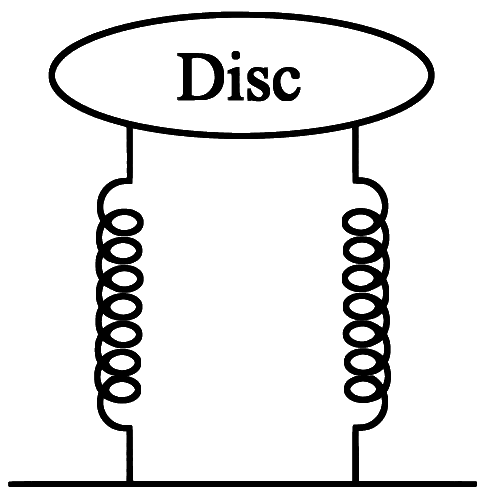
Answer: (c)
Spring Systems
Under the influence of force the body oscillates with a period and due to another force body oscillates with period . If both forces acts simultaneously, then the resultant period is (consider displacement is same in all three cases)
Answer: (b)
Spring Systems
In the figure given below, a block of mass placed on a frictionless table is connected with two springs having same spring constant . If the block is horizontally displaced through '' then the number of complete oscillations it will make in seconds will be _____________.
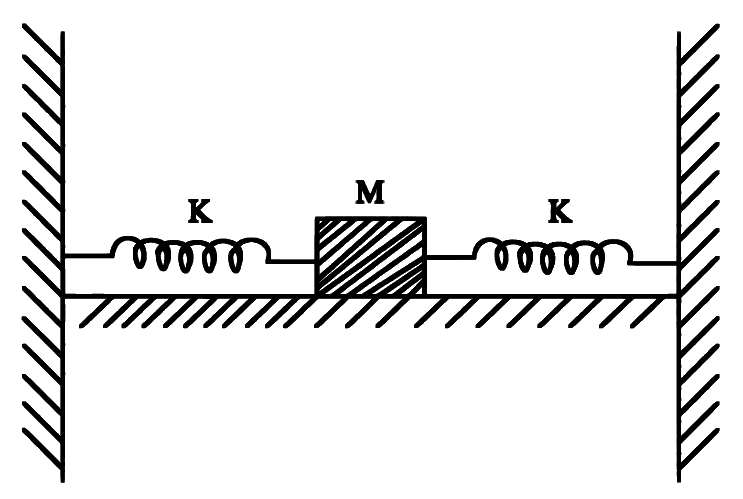
Numerical answer type. Work it out, then open the answer.
Answer: 20
Spring Systems
Two massless springs with spring constants 2 k and 9 k, carry 50 g and 100 g masses at their free ends. These two masses oscillate vertically such that their maximum velocities are equal. Then, the ratio of their respective amplitudes will be:
Answer: (b)
Spring Systems
As per given figures, two springs of spring constants and are connected to mass . If the period of oscillation in figure (a) is , then the period of oscillation in figure (b) will be . The value of is ___________.
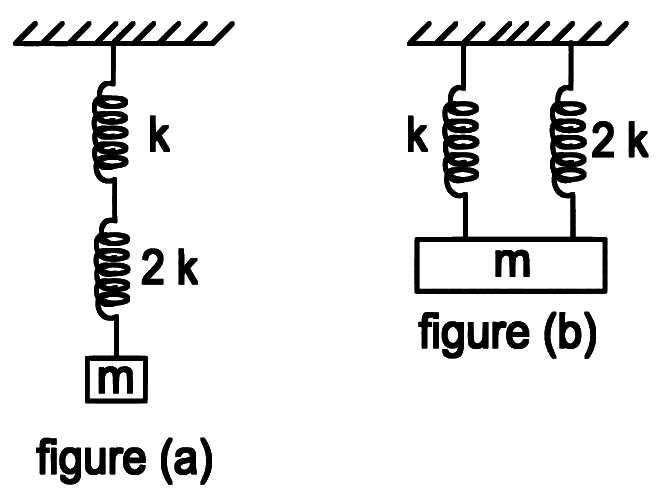
Numerical answer type. Work it out, then open the answer.
Answer: 2
Spring Systems
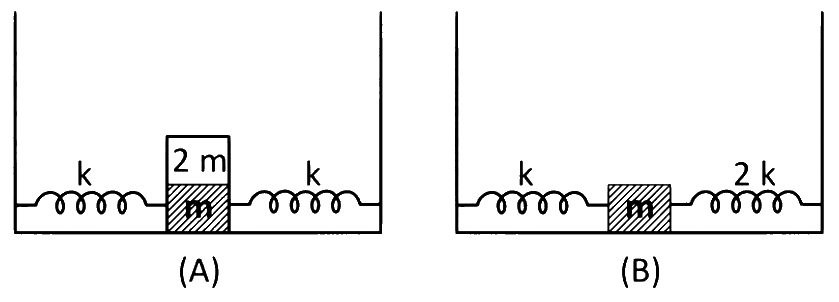
In figure , mass '' is fixed on mass ' ' which is attached to two springs of spring constant . In figure (B), mass '' is attached to two springs of spring constant '' and '. If mass '' in (A) and in (B) are displaced by distance ' horizontally and then released, then time period and corresponding to and (B) respectively follow the relation.
Answer: (a)
Spring Systems
A mass , attached to a horizontal spring, executes SHM with an amplitude . When this mass passes through its mean position, then a smaller mass of is placed over it and both masses move together with amplitude . If the ratio is , then the value of will be ___________.
Numerical answer type. Work it out, then open the answer.
Answer: 16
Spring Systems
A spring is stretched by 5 cm by a force 10 N. The time period of the oscillations when a mass of 2 kg is suspended by it is -
Answer: (a)
Spring Systems
Two particles A and B of equal masses are suspended from two massless springs of spring constants K1 and K2 respectively. If the maximum velocities during oscillations are equal, the ratio of the amplitude of A and B is
Answer: (d)
Spring Systems
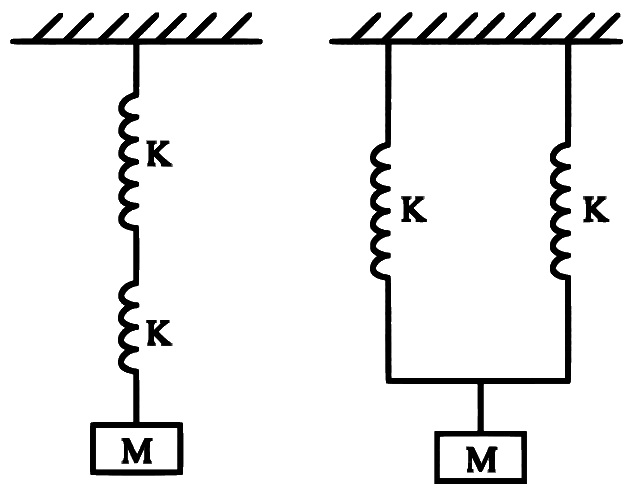
Two identical springs of constant '' are connected in series and parallel in shown in figure. A mass '' is suspended from them. The ratio of their frequencies is series to parallel combination will be
Answer: (a)
Spring Systems
If two similar springs each of spring constant K1 are joined in series, the new spring constant and time period would be changed by a factor:
Answer: (c)
Spring Systems
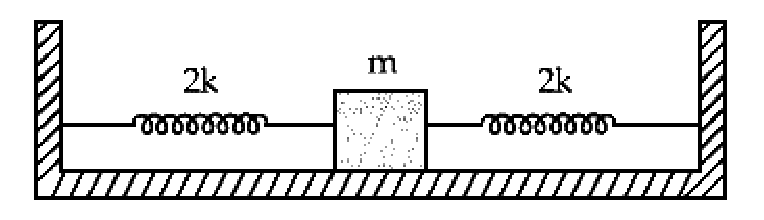
Two identical springs of spring constant '2k' are attached to a block of mass m and to fixed support (see figure). When the mass is displaced from equilibrium position on either side, it executes simple harmonic motion. The time period of oscillations of this system is:
Answer: (b)
Spring Systems
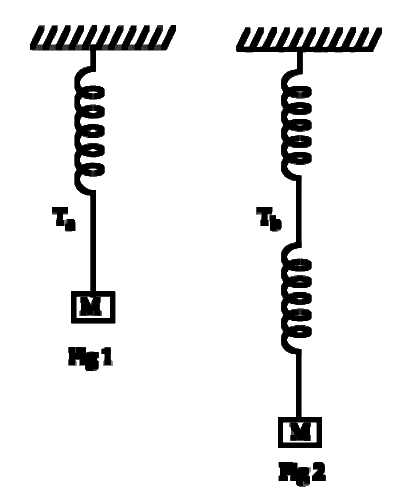
Consider two identical springs each of spring constant k and negligible mass compared to the mass M as shown. Fig. 1 shows one of them and Fig. 2 shows their series combination. The ratios of time period of oscillation of the two SHM is Tb/Ta = , where value of x is ___________. (Round off to the Nearest Integer)
Numerical answer type. Work it out, then open the answer.
Answer: 2
Spring Systems
A mass ' ' is suspended from a spring of negligible mass. A spring is pulled slightly in downward direction and released, mass performs S.H.M. of period ' '. If the mass is increased by '', the time period becomes ''. The ratio is
Answer: (c)
Spring Systems
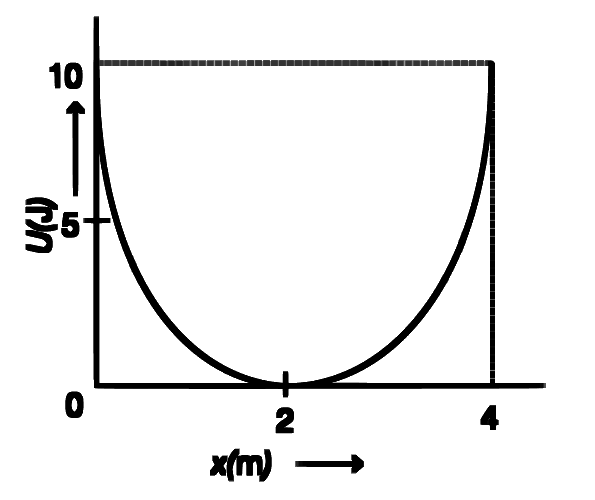
A mass of 5 kg is connected to a spring. The potential energy curve of the simple harmonic motion executed by the system is shown in the figure. A simple pendulum of length 4 m has the same period of oscillation as the spring system. What is the value of acceleration due to gravity on the planet where these experiments are performed?
Answer: (c)
Spring Systems
The motion of a mass on a spring, with spring constant K is as shown in figure.
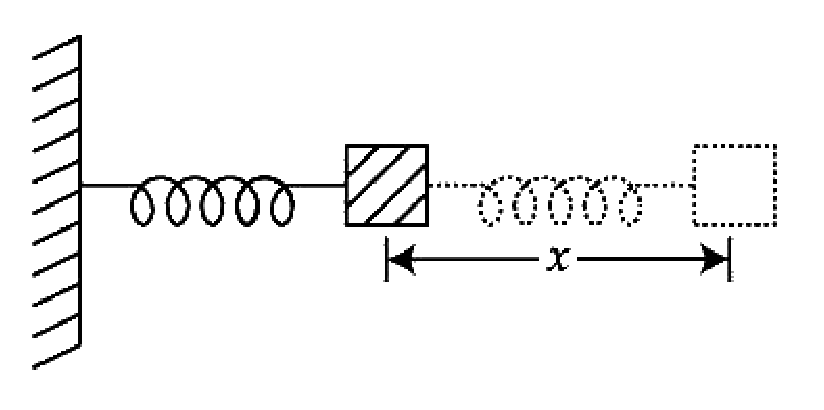
The equation of motion is given by
x(t) = A sint + B cost with
Suppose that at time t = 0, the position of mass is x(0) and velocity v(0), then its displacement can also be represented as x(t) = C cos(t ), where C and are:
Answer: (c)
Spring Systems
A particle is suspended from a vertical spring which is executing S.H.M. of frequency . The spring is unstretched at the highest point of oscillation. Maximum speed of the particle is
Answer: (a)
Spring Systems
A body executes SHM under the action of force '' with time period ' '. If the force is changed to '', it executes SHM with period ''. If both the forces ' ' and '' act simultaneously in the same direction on the body, its time period is
Answer: (d)
Spring Systems
A particle connected to the end of a spring executes S.H.M. with period ''. While the corresponding period for another spring is ''. If the period of oscillation with two springs in series is 'T', then
Answer: (a)
Spring Systems
A body performs S.H.M. under the action of force ' ' with period '' second. If the force is changed to '' it performs S.H.M. with period ' ' second. If both forces '' and '' act simultaneously in the same direction on the body, the period in second will be
Answer: (c)
Spring Systems
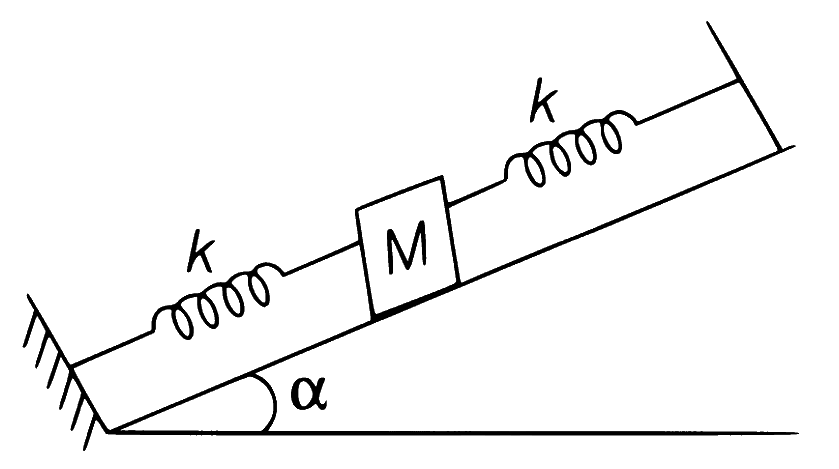
In the given figure, a body of mass M is held between two massless springs, on a smooth inclined plane. The free ends of the springs are attached to firm supports. If each spring has spring constant k, the frequency of oscillation of given body is:
Answer: (c)
Spring Systems
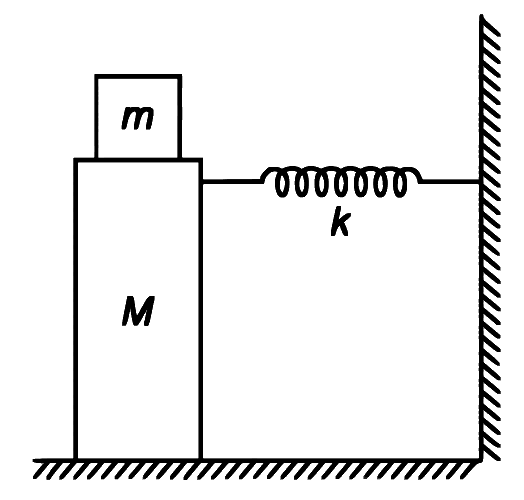
In the given figure, a mass M is attached to a horizontal spring which is fixed on one side to a rigid support. The spring constant of the spring is k. The mass oscillates on a frictionless surface with time period T and amplitude A. When the mass is in equilibrium position, as shown in the figure, another mass m is gently fixed upon it. The new amplitude of oscillations will be:
Answer: (d)
Spring Systems
In the reported figure, two bodies A and B of masses 200 g and 800 g are attached with the system of springs. Springs are kept in a stretched position with some extension when the system is released. The horizontal surface is assumed to be frictionless. The angular frequency will be ____________ rad/s when k = 20 N/m.

Numerical answer type. Work it out, then open the answer.
Answer: 10
Spring Systems
A body of mass 64 g is made to oscillate turn by turn on two different springs and . Spring and has force constant and respectively. If and are period of oscillations of springs and respectively, then will be
Answer: (c)
Spring Systems
A block of mass attached to one end of the vertical spring produces extension . If the block is pulled and released, the periodic time of oscillation is
Answer: (d)
Spring Systems
Two bodies and of equal mass are suspended from two separate massles springs of force constant and , respectively. The bodies oscillate vertically such that their maximum velocities are equal. The ratio of the amplitudes of body to that of body is
Answer: (a)
Spring Systems
A block of mass m attached to a massless spring is performing oscillatory motion of amplitude ‘A’ on a frictionless horizontal plane. If half of the mass of the block breaks off when it is passing through its equilibrium point, the amplitude of oscillation for the remaining system become fA. The value of f is:
Answer: (d)
Spring Systems
When a particle of mass m is attached to a vertical spring of spring constant k and released, its motion is described by
y(t) = y0 sin2 t, where 'y' is measured from the lower end of unstretched spring. Then is:
Answer: (d)
Spring Systems
A spring mass system (mass m, spring constant k and natural length ) rests in equilibrium on a horizontal disc. The free end of the spring is fixed at the centre of the disc. If the disc together with spring mass system, rotates about its axis with an angular velocity , (k ) the relative change in the length of the spring is best given by the option:
Answer: (b)
Spring Systems
A silver atom in a solid oscillates in simple harmonic motion in some direction with a frequency of 1012/sec. What is the force constant of the bonds connecting one atom with the other? (Mole wt. of silver = 108 and Avogadro number = 6.02 × 10²³ gm mole–1)
Answer: (c)
Spring Systems
An oscillator of mass M is at rest in its equilibrium position in a potential
V = k(x X)2. A particle of mass m comes from right with speed u and collides completely inelastically with M and sticks to it. This process repeats every time the oscillator crosses its equilibrium position. The amplitude of oscillations after 13 collisions is: (M = 10, m = 5, u = 1, k = 1)
Answer: (a)
Spring Systems
A 1 kg block attached to a spring vibrates with a frequency of 1 Hz on a frictionless horizontal table. Two springs identical to the original spring are attached in parallel to an 8 kg block placed on the same table. So, the frequency of vibration of the 8 kg block is:
Answer: (c)
Spring Systems
A spring of force constant k is cut into lengths of ratio 1: 2: 3. They are connected in series and the new force constant is K'. Then they are connected in parallel and force constant is k''. Then k': k'' is
Answer: (b)
Spring Systems
A body of mass m is attached to the lower end of a spring whose upper end is fixed. The spring has negligible mass. When the mass m is slightly pulled down and released, it oscillates with a time period of 3s. When the mass m is increased by 1 kg, the time period of oscillations becomes 5 s. The value of m in kg is
Answer: (d)
Spring Systems
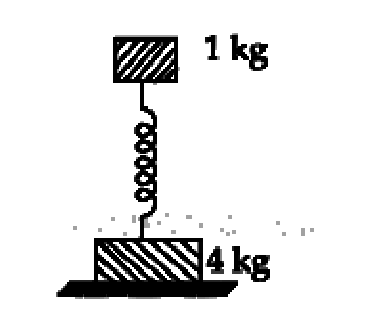
Two bodies of masses 1 kg and 4 kg are connected to a vertical spring, as shown in the figure. The smaller mass executes simple harmonic motion of angular frequency 25 rad /s, and amplitude 1.6 cm while the bigger mass remains stationary on the ground. The maximum force exerted by the system on the floor is (take g = 10 ms ______2).
Answer: (c)
Spring Systems
A mass attached to a horizontal spring, executes with amplitude When the mass passes through its mean position then a smaller mass is placed over it and both of them move together with amplitude The ratio of is:
Answer: (c)
Spring Systems
The period of oscillation of a mass M suspended from a spring of negligible mass is T. If along with it another mass M is also suspended, the period of oscillation will now be
Answer: (d)
Spring Systems
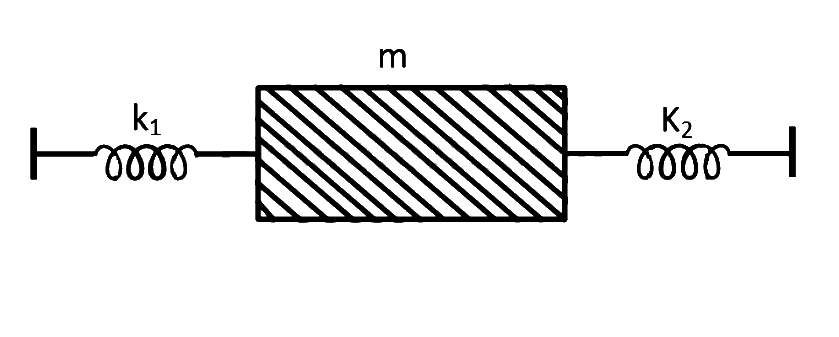
Two springs, of force constant and are connected to a mass as shown. The frequency of oscillation of the mass is If both and are made four times their original values, the frequency of oscillation becomes
Answer: (a)
Spring Systems
Two springs of spring constants k1 and k2 are joined in series. The effective spring constant of the combination is given by
Answer: (d)
Spring Systems
A particle at the end of a spring executes with a period . While the corresponding period for another spring is . If the period of oscillation with the two springs in series is then
Answer: (b)
Spring Systems
The time period of mass suspended from a spring is T. If the spring is cut into four equal parts and the same mass is suspended from one of the parts, then the new time period will be
Answer: (c)
Spring Systems
A mass is suspended from a spring of negligible mass. The spring is pulled a little and then released so that the mass executes of time period If the mass is increased by the time period becomes . Then the ratio of is
Answer: (c)
Spring Systems
Two particles and of equal masses are suspended from two massless springs of spring constant and , respectively. If the maximum velocities, during oscillation, are equal, the ratio of amplitude of and is
Answer: (c)
Spring Systems
If a spring has time period and is cut into equal parts, then the time period of each part will be
Answer: (b)
Spring Systems
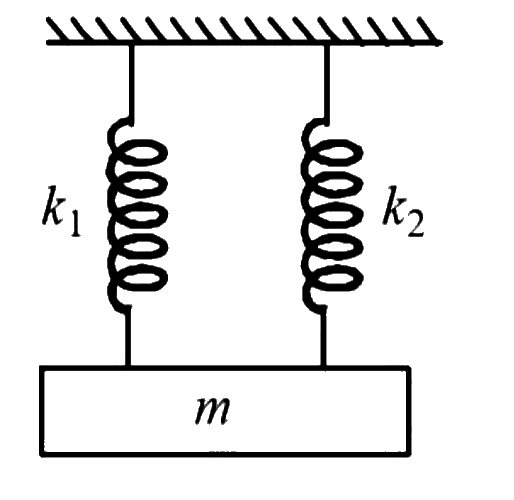
A mass is suspended separately by two different springs in (successive order then time periods is t1 and t2 respectively, If it is connected by both spring as shown in figure then time period is t0, the correct relation is
Answer: (b)
Spring Systems
A mass is vertically suspended from a spring of negligible mass; the system oscillates with a frequency . What will be the frequency of the system, if a mass is suspended from the same spring?
Answer: (c)
Spring Systems
A body of mass hangs from a spring and oscillates with a time period of seconds. If the ball is removed, the length of the spring will decrease by
Answer: (d)
Spring Systems
A mass is suspended from the two coupled springs connected in series. The force constant for springs are and . The time period of the suspended mass will be
Answer: (d)
Spring Systems
A spring can be used to determine the mass of an object in two ways: (i) by measuring the extension in the spring due to the object; and (ii) by measuring the oscillation period for the given mass. Which of these methods can be used in a space-station orbiting Earth?
Answer: (c)
Step-by-step solution coming soon.
Spring Systems
When a mass is hung on a spring, the spring stretched by . If the loaded spring is pulled downward a little and released, then the period of vibration of the system will be
Answer: (c)
Step-by-step solution coming soon.
Spring Systems
A spring has length and spring constant . It is cut into two pieces of lengths and such that . The force constant of the spring of length is
Answer: (d)
Step-by-step solution coming soon.
Spring Systems
Two particles, 1 and 2, each of mass , are connected by a massless spring, and are on a horizontal frictionless plane, as shown in the figure. Initially, the two particles, with their center of mass at , are oscillating with amplitude and angular frequency . Thus, their positions at time are given by and , respectively, where . Particle 3 of mass moves towards this system with speed , and undergoes instantaneous elastic collision with particle 2, at time . Finally, particles 1 and 2 acquire a center of mass speed and oscillate with amplitude and the same angular frequency .
If the collision occurs at time , the value of will be ______.
Numerical answer type. Work it out, then open the answer.
Answer: 0.75
Step-by-step solution coming soon.
Spring Systems
Two particles, 1 and 2, each of mass , are connected by a massless spring, and are on a horizontal frictionless plane, as shown in the figure. Initially, the two particles, with their center of mass at , are oscillating with amplitude and angular frequency . Thus, their positions at time are given by and , respectively, where . Particle 3 of mass moves towards this system with speed , and undergoes instantaneous elastic collision with particle 2, at time . Finally, particles 1 and 2 acquire a center of mass speed and oscillate with amplitude and the same angular frequency .
If the collision occurs at time , then the value of will be ______.
Numerical answer type. Work it out, then open the answer.
Answer: 4.25
Step-by-step solution coming soon.
Spring Systems
On a frictionless horizontal plane, a bob of mass is attached to a spring with natural length . The spring constant is when the length of the spring and is when . Initially the bob is released from . Assume that Hooke's law remains valid throughout the motion. If the time period of the full oscillation is , then the integer closest to is ________.
Numerical answer type. Work it out, then open the answer.
Answer: 6
Step-by-step solution coming soon.
Spring Systems
A block with mass is connected by a massless spring with stiffness constant to a rigid wall and moves without friction on a horizontal surface. The block oscillates with small amplitude about an equilibrium position . Consider two cases:
(i) when the block is at ; and
(ii) when the block is at .
In both cases, a particle with mass is softly placed on the block after which they stick on each other. Which of the following statement(s) is(are) true about the motion after the mass is placed on the mass ?
More than one option can be correct. Tap every correct option, then tap Check.
Answer: (a), (b), (d)
Step-by-step solution coming soon.
Spring Systems
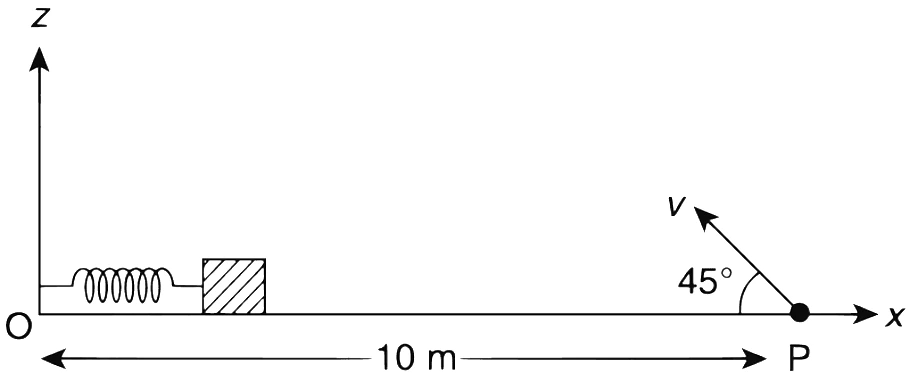
A small block is connected to one end of a massless spring of un-stretched length . The other end of the spring (see the figure) is fixed. The system lies on a horizontal frictionless surface. The block is stretched by and released from rest at . It then executes simple harmonic motion with angular frequency . Simultaneously, at , a small pebble is projected with speed from point at an angle of as shown in the figure. Point is at a horizontal distance of from . If the pebble hits the block at , the value of is (take )
Answer: (a)
Step-by-step solution coming soon.
Spring Systems
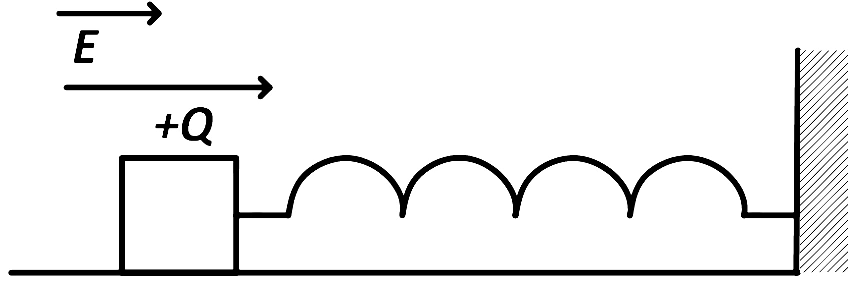
A wooden block performs SHM on a frictionless surface with frequency . The block carries a charge on its surface. If now a uniform electric field is switched on as shown, then the SHM of the block will be
Answer: (a)
Step-by-step solution coming soon.
Spring Systems
A mass is suspended from a wire of negligible mass. The length of the wire is and its cross-sectional area is . If the mass is pulled a little in the vertically downward direction and released, it performs simple harmonic motion of angular frequency . If the Young's modulus of the material of the wire is , the value of is
Numerical answer type. Work it out, then open the answer.
Answer: 4
Step-by-step solution coming soon.
Spring Systems
The mass shown in the figure below oscillates in simple harmonic motion with amplitude . The amplitude of the point is
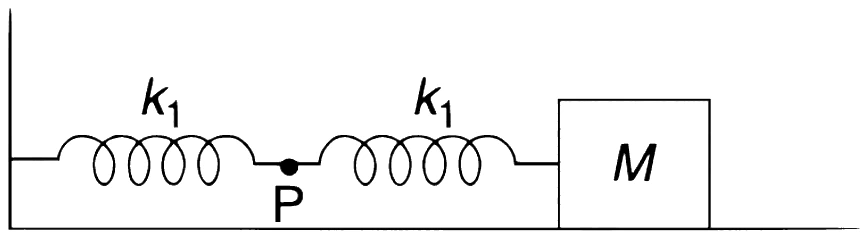
Answer: (d)
Step-by-step solution coming soon.
Spring Systems
A small body attached to one end of a vertically hanging spring is performing SHM about its mean position with angular frequency and amplitude . If at a height from the mean position, the body gets detached from the spring, calculate the value of so that the height attained by the mass is maximum. The body does not interact with the spring during its subsequent motion after detachment ()
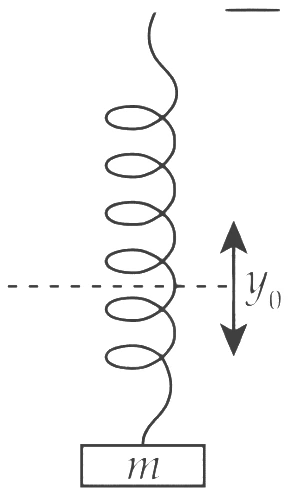
Answer: (a)
Step-by-step solution coming soon.
Spring Systems
Two bodies and of equal masses are suspended from two separate massless springs of spring constant and respectively. If the two bodies oscillate vertically such that their maximum velocities are equal, the ratio of the amplitude of vibration of to that of is
Answer: (d)
Step-by-step solution coming soon.
Spring Systems
Assertion : A spring of force constant is cut into two pieces having lengths in the ratio . The force constant of series combination of the two parts is .
Reason : The spring connected in series are represented by
Answer: (d)
Step-by-step solution coming soon.
Spring Systems
A load of mass falls from a height on the scale pan hung from a spring as shown. If the spring constant is and mass of the scale pan is zero and the mass does not bounce relative to the pan, then the amplitude of vibration is
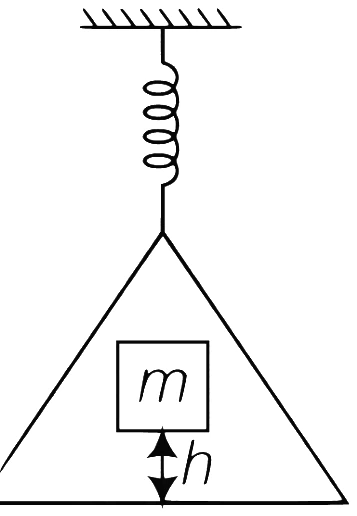
Answer: (b)
Step-by-step solution coming soon.
Spring Systems
As shown in figure a simple harmonic motion oscillator having identical four springs has time period
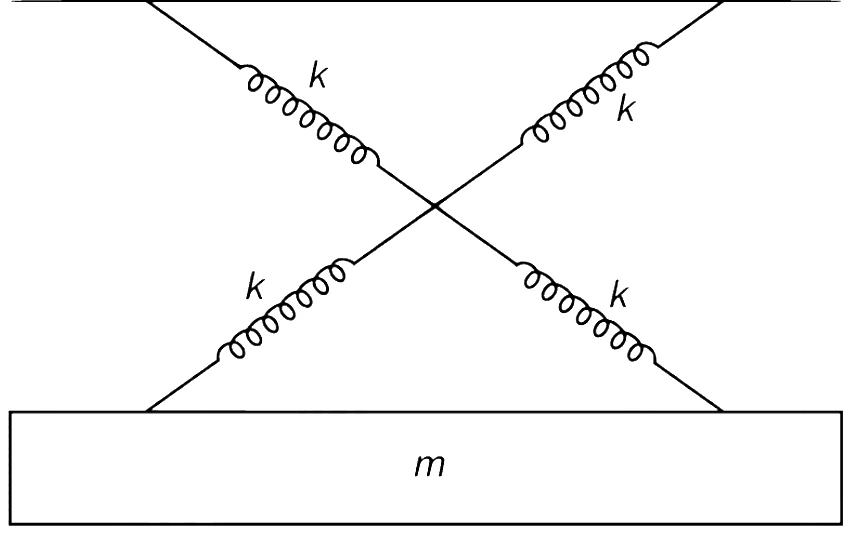
Answer: (c)
Step-by-step solution coming soon.
Spring Systems
A simple harmonic oscillator consists of a particle of mass and an ideal spring with spring constant . The particle oscillates with a time period . The spring is cut into two equal parts. If one part oscillates with the same particle, the time period will be
Answer: (c)
Step-by-step solution coming soon.
Spring Systems
Assertion : The periodic time of a hard spring is less as compared to that of a soft spring.
Reason : The periodic time depends upon the spring constant, and spring constant is large for hard spring.
Answer: (a)
Step-by-step solution coming soon.
Spring Systems
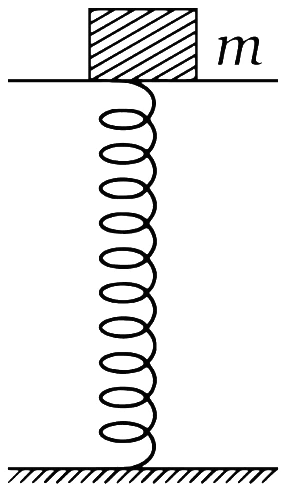
A mass of is put on a flat pan attached to a vertical spring fixed on the ground as shown in the figure. The mass of the spring and the pan is negligible. When pressed slightly and released the mass executes a simple harmonic motion. The spring constant is . What should be the minimum amplitude of the motion, so that the mass gets detached from the pan? (Take )
Answer: (b)
Step-by-step solution coming soon.
Spring Systems
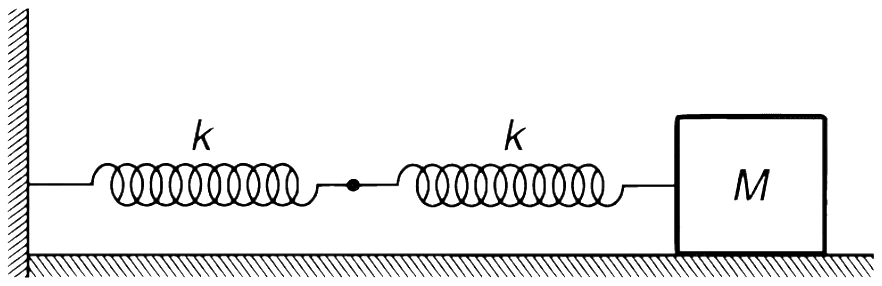
Two springs are connected to a block of mass placed on a frictionless surface as shown below. If both the springs have a spring constant , the frequency of oscillation of block is :
Answer: (b)
Step-by-step solution coming soon.
Spring Systems
A pan with a set of weights is attached to a light spring. The period of vertical oscillation is . When some additional weights are put in pan, then the period of oscillations increases by . The extension caused by the additional weight is
Answer: (c)
Step-by-step solution coming soon.
Spring Systems
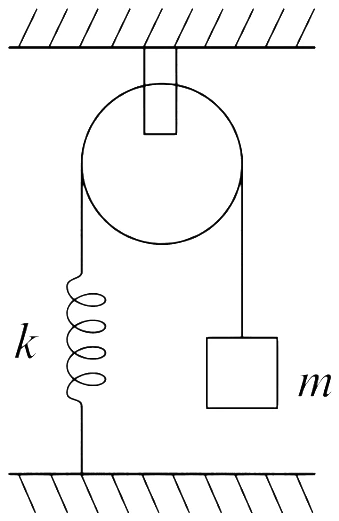
Figure shows spring + block + pulley system which are light. The time period of mass would be
Answer: (c)
Step-by-step solution coming soon.
Spring Systems
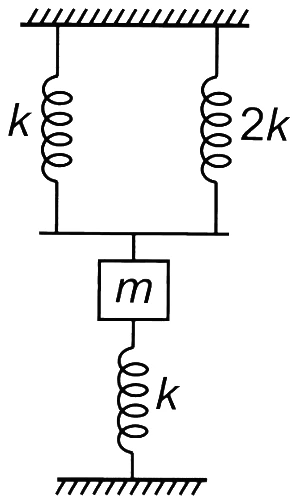
The frequency of oscillation of the spring mass system is
Answer: (a)
Step-by-step solution coming soon.
Spring Systems
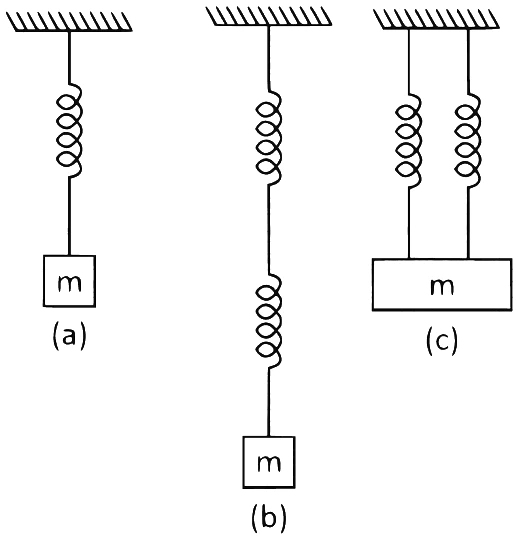
Five identical springs are used in the three configurations as shown in the figure. The time periods of vertical oscillations in configurations (a), (b) and (c) are in the ratio.
Answer: (a)
Step-by-step solution coming soon.
Spring Systems
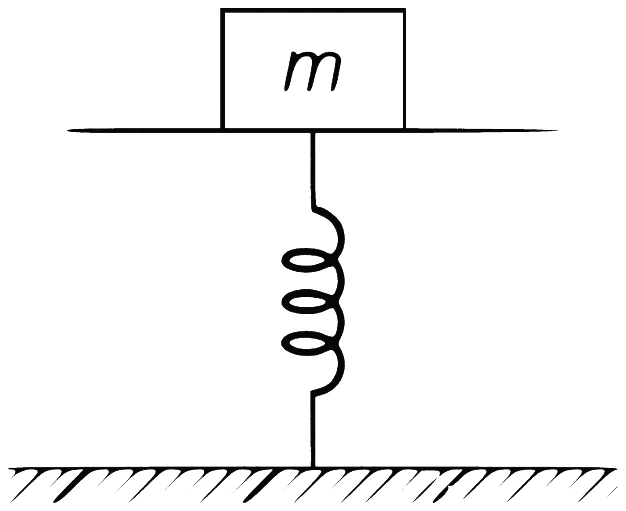
A tray of mass is supported by a spring as shown in the figure. When the tray is pressed down and released, it executes SHM with a period of . When a block of mass placed on the tray, the period of SHM changes to . The mass of the block is
Answer: (a)
Step-by-step solution coming soon.
Spring Systems
One end of a spring of force constant is fixed to a vertical wall and other to a body of mass resting on a smooth horizontal surface. There is another wall at a distance from the body. The spring is then compressed by and released. The time taken to strike the wall is
Answer: (c)
Step-by-step solution coming soon.
Spring Systems
The force constant of an interatomic bond, in a certain element, is . If the atom oscillates in SHM in a certain direction, what is its frequency? Given: mole weight of the given element is and Avogadro's number .
Answer: (c)
Step-by-step solution coming soon.
Spring Systems
The time period of oscillation of a mass suspended from a spring is . If the spring is cut into four equal parts and the same mass is suspended from one of the parts, the fractional change in time period is
Answer: (c)
Step-by-step solution coming soon.
Spring Systems
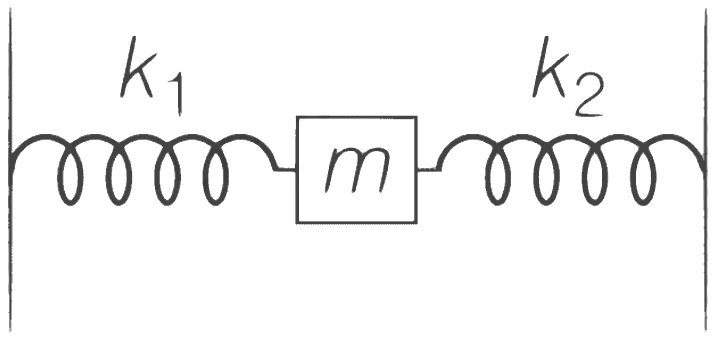
Two springs of force constant and are configured as the figure given below. The angular frequency of this configuration is
Answer: (b)
Step-by-step solution coming soon.
Spring Systems
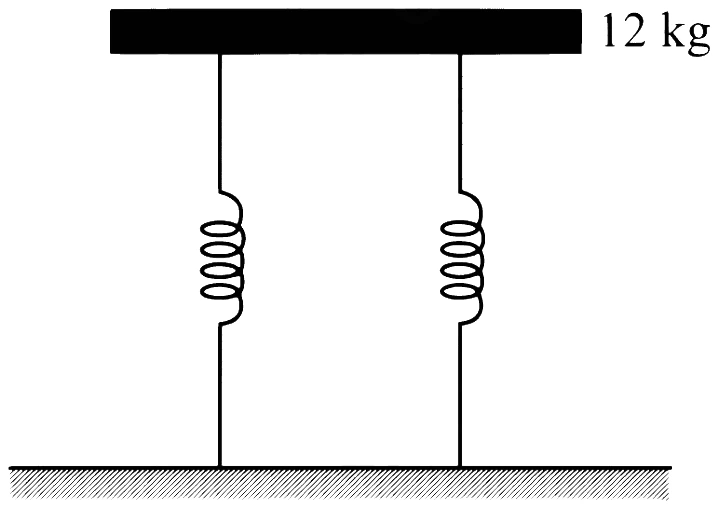
A tray of mass is supported by two identical springs as shown in figure. When the tray is pressed down slightly and then released, it executes SHM with a time period of . The spring constant of each spring is
Answer: (c)
Step-by-step solution coming soon.
Spring Systems
A body executes SHM under the influence of one force and has the time period of seconds. The same body executes SHM with a time period of seconds when under the influence of another force separately. When both forces act simultaneously and in the same direction, then the time period of the same body is
Answer: (d)
Step-by-step solution coming soon.
Spring Systems
In the arrangement shown, , , and . The potential energy stored in the system of springs in equilibrium is
[Assume springs mass is negligible and ]
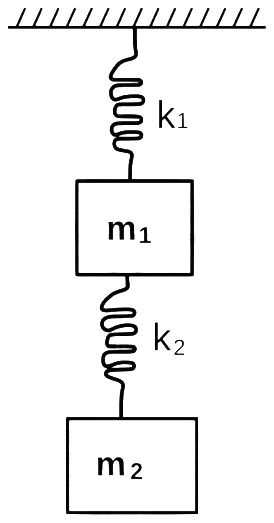
Answer: (b)
Step-by-step solution coming soon.
Spring Systems
The springs are connected to the blocks as shown in figures and . When the blocks are slightly displaced and released, they oscillate with time period and respectively. Then, the value of is
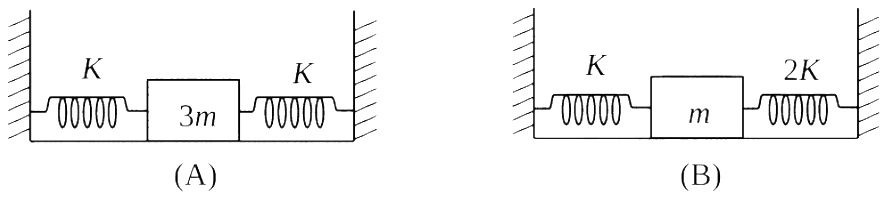
Answer: (a)
Step-by-step solution coming soon.
Spring Systems
A body of mass attached to a spring of force constant executes simple harmonic motion on a frictionless horizontal surface. The time period of oscillation is
Answer: (b)
Step-by-step solution coming soon.
Spring Systems
The angular frequency of a block of mass oscillating with the help of a spring of force constant is
Answer: (b)
Step-by-step solution coming soon.
Spring Systems
On a smooth inclined plane a block of mass is fixed to two rigid supports using two springs as shown in the figure. If each spring has spring constant , then the period of oscillation of the block is (Neglect the masses of the springs)
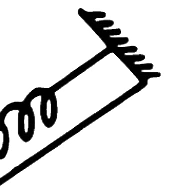
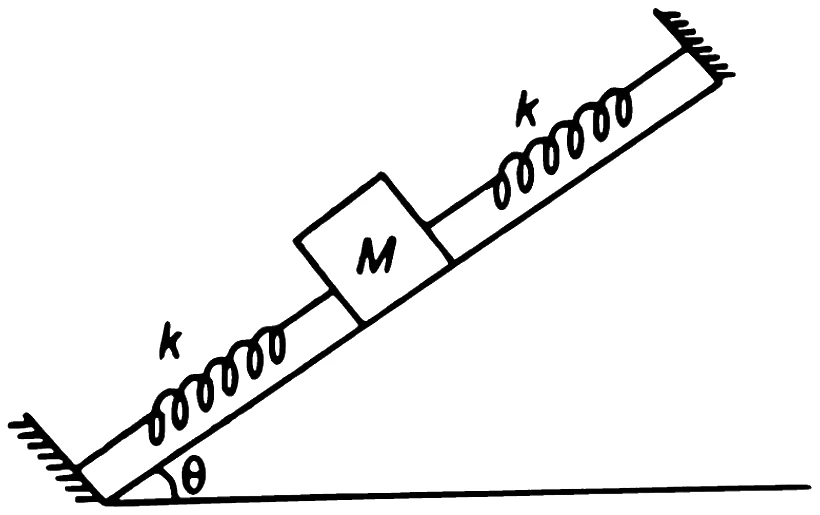
Answer: (a)
Step-by-step solution coming soon.
Spring Systems
A spring is stretched by when a mass of is suspended to it. The time period of the spring when mass is replaced with a mass of is suspended to it is
(Acceleration due to gravity )
Answer: (a)
Step-by-step solution coming soon.
Spring Systems
A body of mass is suspended from a spring of force constant . Another body of mass moving vertically upwards hits the suspended body with a velocity of and is embedded in it. The amplitude of motion is
Answer: (a)
Step-by-step solution coming soon.
Spring Systems
When the mass attached to a spring is increased from to , the time period of oscillation increases by . Then, the spring constant of the spring is
Answer: (d)
Step-by-step solution coming soon.
Spring Systems
A body of mass is attached to the lower end of a vertically suspended spring of force constant . If another body of mass moving vertically upward hits the suspended body with a velocity of and is embedded in it, then the frequency of the oscillation is
Answer: (b)
Step-by-step solution coming soon.
Spring Systems
When a mass is connected individually to the springs and , the oscillation frequencies are and . If the same mass is attached to the two springs as shown in the figure, the oscillation frequency would be
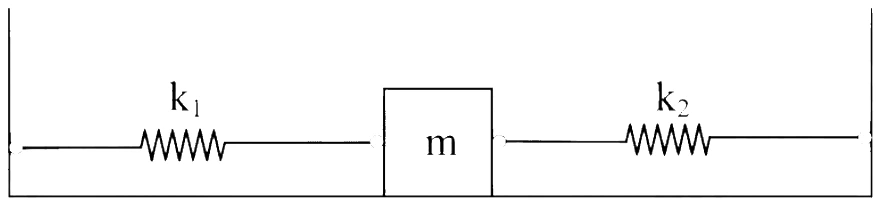
Answer: (b)
Step-by-step solution coming soon.
Spring Systems
As shown in the figure, two blocks of masses and are connected to a spring of force constant . The blocks are slightly displaced in opposite directions through distances , and released. If the system executes simple harmonic motion, then the frequency of oscillation of the system () is

Answer: (d)
Step-by-step solution coming soon.
Spring Systems
A mass , attached to a horizontal spring, executes simple harmonic motion with amplitude . When the mass passes through the mean position, a smaller mass is attached to it and both of them together execute simple harmonic motion with amplitude . Then, the value of is
Answer: (c)
Step-by-step solution coming soon.
Spring Systems
In a spring-block system as shown in the figure, if the spring constant , then the time period of oscillation is
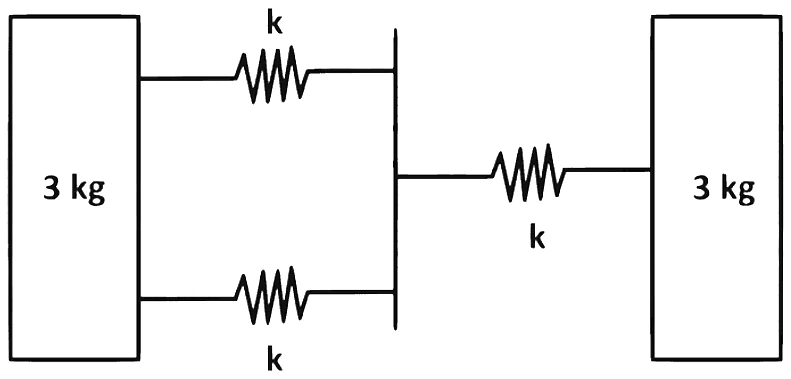
Answer: (a)
Step-by-step solution coming soon.
Spring Systems
A block is connected as shown in the figure. Spring constants of the two springs and are and respectively. The block is released from rest with the springs unstretched. The acceleration of the block in its lowest position is ()
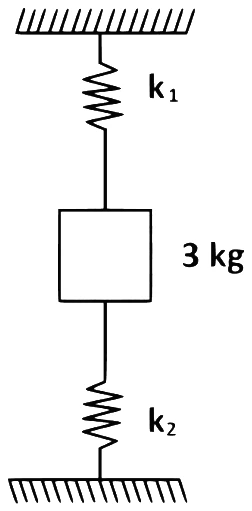
Answer: (a)
Step-by-step solution coming soon.
Spring Systems
When a body of mass is attached to a spring balance, the reading of the balance is . Instead of , if another body of mass is suspended from the spring balance and is made to oscillate vertically, the time period of oscillation is , then the value of is (acceleration due to gravity )
Answer: (a)
Step-by-step solution coming soon.
Spring Systems
As shown in the figure, a block of weight is connected to the top of a smooth inclined plane by a massless spring of constant . If the block is pulled slightly from its mean position and released, the period of oscillations is (acceleration due to gravity )
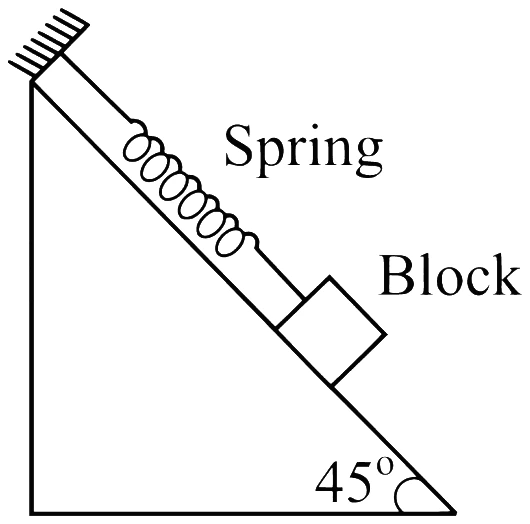
Answer: (d)
Step-by-step solution coming soon.
Spring Systems
The scale of a spring balance which can measure from to is long. If a body suspended from this balance oscillates with a time period , neglecting the mass of the spring, find the mass of the body suspended.
Answer: (a)
Step-by-step solution coming soon.
Spring Systems
A spring is stretched by when a mass of is suspended from it. The period of oscillations of the spring loaded by and put to oscillations is close to ()
Answer: (c)
Step-by-step solution coming soon.
Spring Systems
A heavy brass sphere is hung from a spring and it executes vertical vibrations with period . The sphere is now immersed in a non-viscous liquid with a density th that of brass. When set into vertical vibrations with the sphere remaining inside the liquid all the time, the time period will be
Answer: (d)
Step-by-step solution coming soon.
Spring Systems
A massless spring of length and spring constant oscillates with a time period when loaded with a mass . The spring is now cut into three equal parts and are connected in parallel. The frequency of oscillation of the combination when it is loaded with a mass is
Answer: (d)
Step-by-step solution coming soon.
Spring Systems
A clock is designed based on the oscillation of a spring-block system suspended vertically in the absence of air-resistance. Assume it shows the correct time when a spring of stiffness and block of mass are used. If the block is replaced by another block of mass , choose the correct option
Answer: (a)
Step-by-step solution coming soon.
Spring Systems
A force of stretches a vertical spring by . If it were to oscillate with a period of , then the mass that is to be suspended from the spring is
Answer: (b)
Step-by-step solution coming soon.
Spring Systems
Three masses , and are suspended at the end of a spring shown in figure and are in equilibrium. When the mass is removed, the system oscillates with a time period of . If mass is further removed, then it will oscillate with a period of
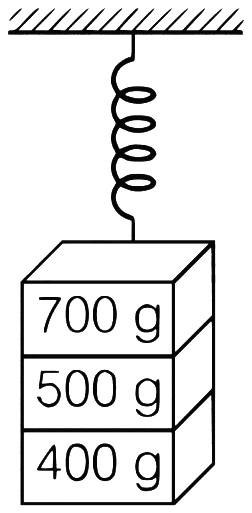
Answer: (b)
Step-by-step solution coming soon.
Spring Systems
A stiff spring having spring constant is attached to the floor vertically. A mass is placed on top of the spring. The block oscillates if it is pressed downward and released. Find the extension in the spring at which the block loses contact with spring. (Take, )
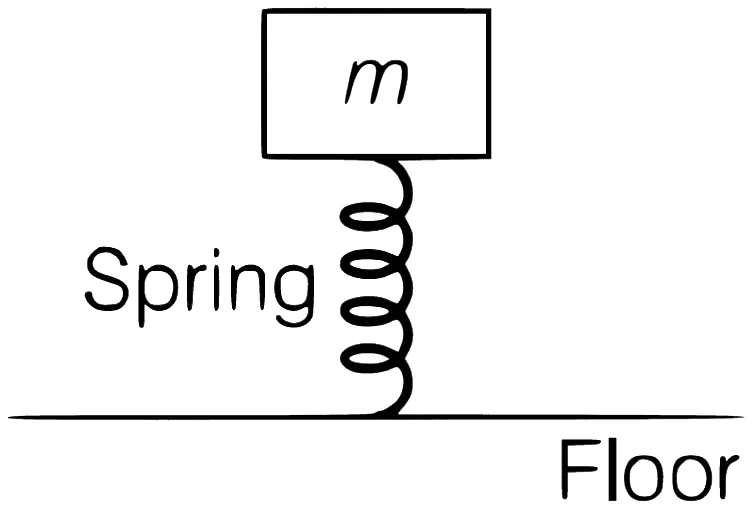
Answer: (a)
Step-by-step solution coming soon.
Spring Systems
Two springs are joined and attached to a mass of . The system is then suspended vertically from a rigid support. The spring constant of the two springs are and respectively. The period of vertical oscillations of the system will be
Answer: (b)
Step-by-step solution coming soon.
Spring Systems
A sphere and a cube of equal masses on a horizontal frictionless floor, are confined between two vertical walls, as shown in the figure. The cube is attached to the wall by a massless spring. At the equilibrium position of the spring, the sphere just touches the cube. The cube is moved towards the left by a small amount from its equilibrium position, compressing the spring and is released at . The system keeps returning to its initial configuration as that of with a time period . If all the collisions are elastic, which of the following statements is correct?
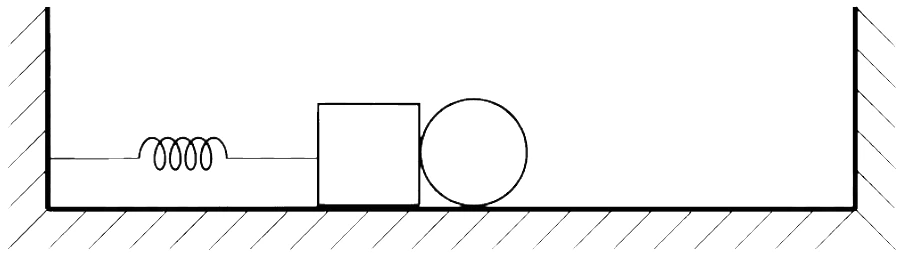
Answer: (d)
Step-by-step solution coming soon.
Spring Systems
A solid block on a frictionless surface is connected to two rigid supports on the left and right side by springs of spring constants and respectively as shown in the figure. The time spent by the block in a complete cycle of oscillation on the left and the right side of the equilibrium position are and , respectively. Which of the following is correct?
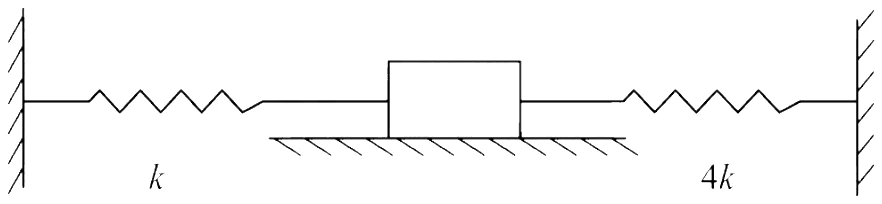
Answer: (c)
Step-by-step solution coming soon.
Spring Systems
Two point bodies of masses and are connected by a massless spring of spring constant and kept on a frictionless horizontal surface. The spring is extended by a small distance over its natural length at time and then released so that the masses execute simple harmonic motion. The maximum speed of the particle with mass is given by
Answer: (a)
Step-by-step solution coming soon.
Spring Systems
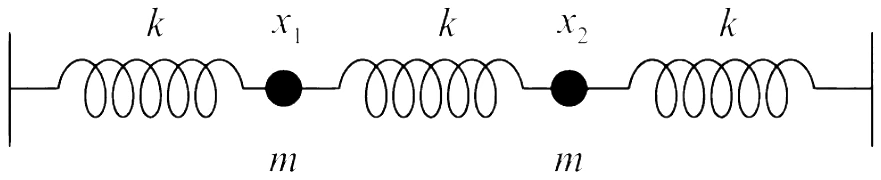
Consider two identical masses attached to 3 identical springs as shown in the figure. They can be set in motion in two different ways as follows:
(I) and
(II) and
Here and denote the displacements from the unstretched positions. Then the potential energy stored in the system is
Answer: (d)
Step-by-step solution coming soon.
Spring Systems
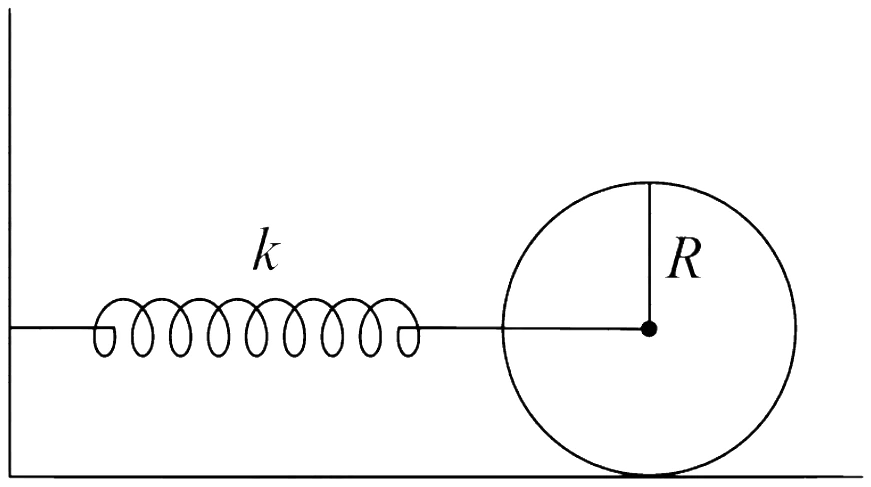
A disk of mass and radius is attached to a spring of constant as shown in the figure below. The disk rolls back and forth without slipping. The angular frequency of the motion of the disk is,
Answer: (b)
Step-by-step solution coming soon.
No questions match these filters.