Q1 MHT CET 2026 · 19 MAY · SHIFT 1 Easy ☆
Periodic Motion & SHM Basics
The differential equation of a particle performing S.H.M. is d 2 x d t 2 + 64 x = 0 \frac{d^2x}{dt^2} + 64x = 0 d t 2 d 2 x + 64 x = 0 x x x
(a) π 3 \frac{\pi}{3} 3 π (b) π 4 \frac{\pi}{4} 4 π (c) π 5 \frac{\pi}{5} 5 π (d) π 8 \frac{\pi}{8} 8 π Show answer and solution
Answer: (b)
Loading the solution…
Report a mistake Open question page Q2 MHT CET 2026 · 15 MAY · SHIFT 1 Easy ☆
Periodic Motion & SHM Basics
The period of S.H.M. of a particle is 12 12 12 t = 3 t = 3 t = 3 t = 4 t = 4 t = 4
(a) π 4 \frac{\pi}{4} 4 π (b) 3 π 5 \frac{3\pi}{5} 5 3 π (c) π 6 \frac{\pi}{6} 6 π (d) π 2 \frac{\pi}{2} 2 π Show answer and solution
Answer: (c)
Loading the solution…
Report a mistake Open question page Q3 MHT CET 2026 · 15 APR · SHIFT 2 Easy ☆
Periodic Motion & SHM Basics
The minimum phase difference between two simple harmonic motions is
(a) zero \text{zero} zero (b) π C 3 \frac{\pi^{C}}{3} 3 π C (c) π C 4 \frac{\pi^{C}}{4} 4 π C (d) π C 5 \frac{\pi^{C}}{5} 5 π C Show answer and solution
Answer: (a)
Loading the solution…
Report a mistake Open question page Q4 MHT CET 2026 · 11 APR · SHIFT 2 Easy ☆
Periodic Motion & SHM Basics
A mass attached to a spring performs S.H.M. whose displacement is x = 3 × 1 0 − 3 cos 2 π t x = 3 \times 10^{-3}\cos 2\pi t x = 3 × 1 0 − 3 cos 2 π t
(a) 1 1 1 (b) 1 2 \frac{1}{2} 2 1 (c) 1 4 \frac{1}{4} 4 1 (d) 1 8 \frac{1}{8} 8 1 Show answer and solution
Answer: (c)
Loading the solution…
Report a mistake Open question page Q5 MHT CET 2026 · 12 MAY · SHIFT 2 Medium ☆
Periodic Motion & SHM Basics
A ball released from height ( h ) (h) ( h ) g g g
(a) 1 2 π 2 h g \frac{1}{2\pi}\sqrt{\frac{2h}{g}} 2 π 1 g 2 h (b) 1 2 g 2 h \frac{1}{2}\sqrt{\frac{g}{2h}} 2 1 2 h g (c) 1 2 2 h g \frac{1}{2}\sqrt{\frac{2h}{g}} 2 1 g 2 h (d) 1 2 π g 2 h \frac{1}{2\pi}\sqrt{\frac{g}{2h}} 2 π 1 2 h g Show answer and solution
Answer: (b)
Loading the solution…
Report a mistake Open question page Q6 JEE Main 2026 · 5 APR · SHIFT 2 Medium ☆
Periodic Motion & SHM Basics
Match List - I with List - II.
Choose the correct answer from the options given below:
List - I List - II A. sin 2 ω t \sin^2 \omega t sin 2 ω t I. Periodic with time period T = π ω T = \frac{\pi}{\omega} T = ω π B. sin 3 ( 2 ω t ) \sin^3(2\omega t) sin 3 ( 2 ω t ) II. Periodic with time period T = 2 π ω T = \frac{2\pi}{\omega} T = ω 2 π C. sin ( ω t ) + cos ( π ω t ) \sin(\omega t) + \cos(\pi\omega t) sin ( ω t ) + cos ( πω t ) III. Periodic with time period T = π ω T = \frac{\pi}{\omega} T = ω π D. cos ω t + cos 2 ω t \cos \omega t + \cos 2\omega t cos ω t + cos 2 ω t IV. Non-periodic
(a) A-III, B-I, C-IV, D-II (b) A-II, B-I, C-III, D-IV (c) A-III, B-II, C-IV, D-I (d) A-II, B-I, C-IV, D-III Show answer and solution
Answer: (a)
Loading the solution…
Report a mistake Open question page Q7 MHT CET 2026 · 19 MAY · SHIFT 1 Medium ☆
Periodic Motion & SHM Basics
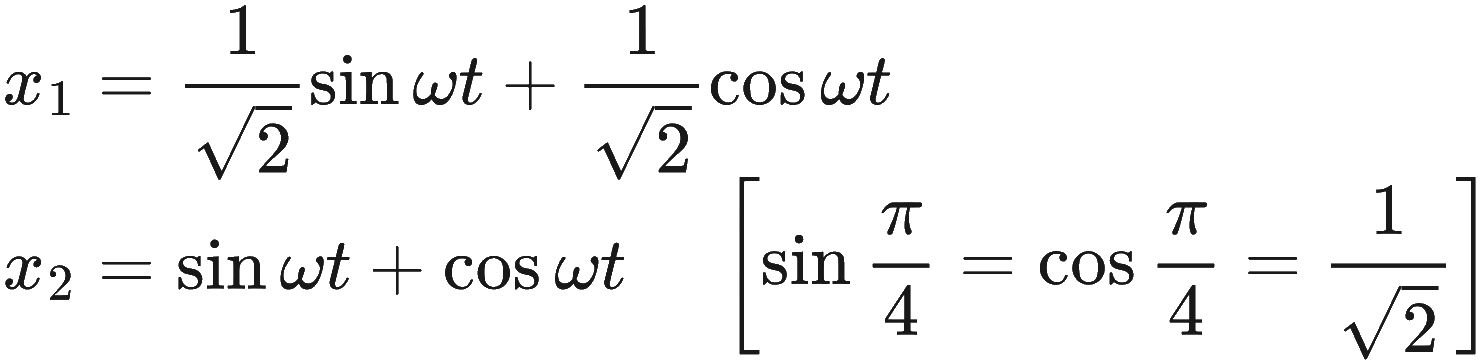
Two simple harmonic motions are represented as y 1 = 10 sin ω t y_1 = 10\sin \omega t y 1 = 10 sin ω t y 2 = 5 sin ω t + 5 cos ω t y_2 = 5\sin \omega t + 5\cos \omega t y 2 = 5 sin ω t + 5 cos ω t y 2 y_2 y 2 A 2 A_2 A 2 y 1 y_1 y 1 A 1 A_1 A 1
(a) 4 : 1 4 : 1 4 : 1 (b) 2 : 1 \sqrt{2} : 1 2 : 1 (c) 1 : 1 1 : 1 1 : 1 (d) 1 : 2 1 : \sqrt{2} 1 : 2 Show answer and solution
Answer: (d)
Loading the solution…
Report a mistake Open question page Q8 MHT CET 2026 · 20 APR · SHIFT 2 Medium ☆
Periodic Motion & SHM Basics
The displacement of a particle varies with time according to the relation
x = a sin ω t + b cos ω t x = a\sin \omega t + b\cos \omega t x = a sin ω t + b cos ω t
(a) The motion is simple harmonic motion with an amplitude a 2 + b 2 3 \sqrt[3]{a^2 + b^2} 3 a 2 + b 2 (b) The motion is simple harmonic motion with an amplitude a 2 + b 2 \sqrt{a^2 + b^2} a 2 + b 2 (c) The motion is periodic but not simple harmonic motion (d) The motion is simple harmonic with an amplitude ( a 2 + b 2 ) (a^2 + b^2) ( a 2 + b 2 ) Show answer and solution
Answer: (b)
Loading the solution…
Report a mistake Open question page Q9 MHT CET 2026 · 17 APR · SHIFT 2 Medium ☆
Periodic Motion & SHM Basics
The displacement of a particle performing linear S.H.M. is given by y = A cos [ π ( t + ϕ ) ] y = A\cos[\pi(t + \phi)] y = A cos [ π ( t + ϕ )] t = 0 t = 0 t = 0 y = 2 y = 2 y = 2 2 π 2\pi 2 π
(a) 1 2 \frac{1}{\sqrt{2}} 2 1 (b) 2 \sqrt{2} 2 (c) 2 2 2 (d) 2 2 2\sqrt{2} 2 2 Show answer and solution
Answer: (d)
Loading the solution…
Report a mistake Open question page Q10 MHT CET 2026 · 13 MAY · SHIFT 1 Medium ☆
Periodic Motion & SHM Basics
A particle oscillates simple harmonically along a straight line with period 8 8 8 8 2 8\sqrt{2} 8 2 2 n d 2^{nd} 2 n d ( sin 4 5 ∘ = 1 2 ) ( sin 9 0 ∘ = 1 ) \left(\sin 45^\circ = \frac{1}{\sqrt{2}}\right)\ (\sin 90^\circ = 1) ( sin 4 5 ∘ = 2 1 ) ( sin 9 0 ∘ = 1 )
(a) 2 \sqrt{2} 2 (b) 2 2 2 (c) ( 2 − 1 ) (\sqrt{2} - 1) ( 2 − 1 ) (d) 3 \sqrt{3} 3 Show answer and solution
Answer: (c)
Loading the solution…
Report a mistake Open question page Q11 MHT CET 2026 · 12 MAY · SHIFT 1 Medium ☆
Periodic Motion & SHM Basics
A particle performing S.H.M., has a period of 12 12 12 { cos ( π / 6 ) = 3 2 } \left\{\cos(\pi/6) = \frac{\sqrt{3}}{2}\right\} { cos ( π /6 ) = 2 3 }
(a) 3 2 \frac{\sqrt{3}}{2} 2 3 (b) 1 2 \frac{1}{2} 2 1 (c) 3 − 1 3 \frac{\sqrt{3} - 1}{\sqrt{3}} 3 3 − 1 (d) 1 3 − 1 \frac{1}{\sqrt{3} - 1} 3 − 1 1 Show answer and solution
Answer: (d)
Loading the solution…
Report a mistake Open question page Q12 MHT CET 2026 · 19 APR · SHIFT 1 Medium ☆
Periodic Motion & SHM Basics
A particle executes a simple harmonic motion with a periodic time 8 8 8 t = 0 t = 0 t = 0
(sin 4 5 ∘ = cos 4 5 ∘ = 1 2 , sin 9 0 ∘ = cos 0 ∘ = 1 \sin 45^\circ = \cos 45^\circ = \frac{1}{\sqrt{2}},\ \sin 90^\circ = \cos 0^\circ = 1 sin 4 5 ∘ = cos 4 5 ∘ = 2 1 , sin 9 0 ∘ = cos 0 ∘ = 1
(a) 1 2 \frac{1}{\sqrt{2}} 2 1 (b) 2 \sqrt{2} 2 (c) 2 − 1 \sqrt{2} - 1 2 − 1 (d) 1 2 − 1 \frac{1}{\sqrt{2} - 1} 2 − 1 1 Show answer and solution
Answer: (c)
Loading the solution…
Report a mistake Open question page Q13 MHT CET 2026 · 11 APR · SHIFT 1 Medium ☆
Periodic Motion & SHM Basics
A particle executes simple harmonic motion between x = − A x = -A x = − A x = + A x = +A x = + A x = 0 x = 0 x = 0 A 2 \frac{A}{2} 2 A 2 2 2 x = A 2 x = \frac{A}{2} x = 2 A
(a) 3 3 3 (b) 2 2 2 (c) 1.5 1.5 1.5 (d) 4 4 4 Show answer and solution
Answer: (d)
Loading the solution…
Report a mistake Open question page Q14 JEE Main 2026 · 6 APR · SHIFT 1 Medium ☆
Periodic Motion & SHM Basics
A particle is executing simple harmonic motion. Its amplitude is A A A x = A x = A x = A x = A 2 x = \frac{A}{\sqrt{2}} x = 2 A ______ sec.
Show answer and solution
Answer: (c)
Loading the solution…
Report a mistake Open question page Q15 JEE Main 2026 · 2 APR · SHIFT 2 Medium ☆
Periodic Motion & SHM Basics
The equation of motion of a particle is given by x = a sin ( 50 t + π / 3 ) x = a\sin(50t + \pi/3) x = a sin ( 50 t + π /3 ) t 1 t_1 t 1 t 2 t_2 t 2 t 1 t_1 t 1 t 2 t_2 t 2
(a) π 300 \frac{\pi}{300} 300 π , π 75 ,\ \frac{\pi}{75} , 75 π (b) π 75 \frac{\pi}{75} 75 π , π 300 ,\ \frac{\pi}{300} , 300 π (c) π 300 \frac{\pi}{300} 300 π , π 25 ,\ \frac{\pi}{25} , 25 π (d) π 50 \frac{\pi}{50} 50 π , π 100 ,\ \frac{\pi}{100} , 100 π Show answer and solution
Answer: (a)
Loading the solution…
Report a mistake Open question page Q16 JEE Main 2025 · 28 JAN · SHIFT 2 Easy ☆
Periodic Motion & SHM Basics
Given below are two statements. One is labelled as Assertion (A) and the other is labelled as Reason (R).
Assertion (A): Knowing initial position x 0 x_0 x 0 p 0 p_0 p 0 t t t ω \omega ω
Reason (R): The amplitude and phase can be expressed in terms of x 0 x_0 x 0 p 0 p_0 p 0
In the light of the above statements, choose the correct answer from the options given below:
(a) (A) is true but (R) is false (b) Both (A) and (R) are true but (R) is NOT the correct explanation of (A) (c) (A) is false but (R) is true (d) Both (A) and (R) are true and (R) is the correct explanation of (A) Show answer and solution
Answer: (d)
Loading the solution…
Report a mistake Open question page Q17 MHT CET 2025 · 20 APR · SHIFT 1 Easy ☆
Periodic Motion & SHM Basics
The period of S. H.M. of a particle is 16 second. The phase difference between the positions at t = 2 s t = 2\text{ s} t = 2 s t = 4 s t = 4\text{ s} t = 4 s
(a) π \pi π (b) π 2 \frac{\pi}{2} 2 π (c) π 4 \frac{\pi}{4} 4 π (d) π 8 \frac{\pi}{8} 8 π Show answer and solution
Answer: (c)
Loading the solution…
Report a mistake Open question page Q18 MHT CET 2025 · 25 APR · SHIFT 1 Easy ☆
Periodic Motion & SHM Basics
The displacement of particle in S.H.M. is x = A cos ( ω t + π / 6 ) x = A\cos(\omega t + \pi/6) x = A cos ( ω t + π /6 ) ( sin 9 0 ∘ = 1 ) (\sin 90^\circ = 1) ( sin 9 0 ∘ = 1 )
(a) π 3 ω s \frac{\pi}{3\omega}\text{ s} 3 ω π s (b) π 2 ω s \frac{\pi}{2\omega}\text{ s} 2 ω π s (c) π ω s \frac{\pi}{\omega}\text{ s} ω π s (d) π 4 ω s \frac{\pi}{4\omega}\text{ s} 4 ω π s Show answer and solution
Answer: (a)
Loading the solution…
Report a mistake Open question page Q19 MHT CET 2025 · 20 APR · SHIFT 2 Easy ☆
Periodic Motion & SHM Basics
A mass attached to a spring performs S.H.M. whose displacement is x = 3 × 1 0 − 3 cos 2 π t x = 3 \times 10^{-3}\cos 2\pi t x = 3 × 1 0 − 3 cos 2 π t
(a) 1 12 s \frac{1}{12}\text{ s} 12 1 s (b) 1 8 s \frac{1}{8}\text{ s} 8 1 s (c) 1 4 s \frac{1}{4}\text{ s} 4 1 s (d) 1 2 s \frac{1}{2}\text{ s} 2 1 s Show answer and solution
Answer: (c)
Loading the solution…
Report a mistake Open question page Q20 MHT CET 2025 · 23 APR · SHIFT 2 Medium ☆
Periodic Motion & SHM Basics
The motion of the particle is given by the equation x = A sin ω t + B cos ω t x = A\sin\omega t + B\cos\omega t x = A sin ω t + B cos ω t
The motion of the particle is
(a) simple harmonic with amplitude ( A + B ) (A + B) ( A + B ) (b) simple harmonic with amplitude ( A − B ) (A - B) ( A − B ) (c) simple harmonic with amplitude ( A 2 + B 2 ) 1 2 (A^2 + B^2)^{\frac{1}{2}} ( A 2 + B 2 ) 2 1 (d) not simple harmonic Show answer and solution
Answer: (c)
Loading the solution…
Report a mistake Open question page Q21 MHT CET 2025 · 25 APR · SHIFT 1 Medium ☆
Periodic Motion & SHM Basics
Two particles ' A A A B B B T T T 3 T 2 \frac{3T}{2} 2 3 T A A A
(a) π 3 \frac{\pi}{3} 3 π (b) π 6 \frac{\pi}{6} 6 π (c) 4 π 3 \frac{4\pi}{3} 3 4 π (d) π 4 \frac{\pi}{4} 4 π Show answer and solution
Answer: (c)
Loading the solution…
Report a mistake Open question page Q22 MHT CET 2025 · 22 APR · SHIFT 2 Medium ☆
Periodic Motion & SHM Basics
A particle performing linear S.H.M. has period 8 seconds. At time t = 0 t = 0 t = 0 1 1 1 2 2 2 ( cos 4 5 ∘ = 1 / 2 ) \left(\cos 45^\circ = 1/\sqrt{2}\right) ( cos 4 5 ∘ = 1/ 2 )
(a) 1 : ( 2 − 1 ) 1 : (\sqrt{2} - 1) 1 : ( 2 − 1 ) (b) 1 : 2 1 : 2 1 : 2 (c) 2 : 1 2 : 1 2 : 1 (d) 1 : ( 2 + 1 ) 1 : (\sqrt{2} + 1) 1 : ( 2 + 1 ) Show answer and solution
Answer: (a)
Loading the solution…
Report a mistake Open question page Q23 MHT CET 2025 · 20 APR · SHIFT 1 Medium ☆
Periodic Motion & SHM Basics
A particle oscillates in straight line simple harmonically with period 8 second and amplitude 4 2 m 4\sqrt{2}\text{ m} 4 2 m 1 1 1 2 2 2 ( sin 4 5 ∘ = 1 / 2 , sin π 2 = 1 ) \left(\sin 45^\circ = 1/\sqrt{2}, \sin\frac{\pi}{2} = 1\right) ( sin 4 5 ∘ = 1/ 2 , sin 2 π = 1 )
(a) 1 : 8 1 : 8 1 : 8 (b) 1 : 4 1 : 4 1 : 4 (c) 1 : 2 1 : 2 1 : 2 (d) 1 : ( 2 − 1 ) 1 : (\sqrt{2} - 1) 1 : ( 2 − 1 ) Show answer and solution
Answer: (d)
Loading the solution…
Report a mistake Open question page Q24 JEE Main 2025 · 24 JAN · SHIFT 1 Medium ☆
Periodic Motion & SHM Basics
A particle is executing simple harmonic motion with time period 2 s and amplitude 1 cm. If D and d are the total distance and displacement covered by the particle in 12.5 s, then D d \frac{D}{d} d D
(a) 10 10 10 (b) 16 5 \frac{16}{5} 5 16 (c) 25 25 25 (d) 15 4 \frac{15}{4} 4 15 Show answer and solution
Answer: (c)
Loading the solution…
Report a mistake Open question page Q25 MHT CET 2024 · 15 MAY · SHIFT 2 Easy ☆
Periodic Motion & SHM Basics
The motion of a particle is described by the equation a = − b x a = -bx a = − b x a a a
(a) 2 π b \frac{2\pi}{b} b 2 π (b) 2 π b \frac{2\pi}{\sqrt{b}} b 2 π (c) 2 π b 2\pi\sqrt{b} 2 π b (d) 2 π b 2\sqrt{\frac{\pi}{b}} 2 b π Show answer and solution
Answer: (b)
Loading the solution…
Report a mistake Open question page Q26 MHT CET 2024 · 3 MAY · SHIFT 2 Easy ☆
Periodic Motion & SHM Basics
When a particle in linear S.H.M. completes two oscillations, its phase increases by
(a) π rad \pi\text{ rad} π rad (b) 2 π rad 2\pi\text{ rad} 2 π rad (c) 3 π rad 3\pi\text{ rad} 3 π rad (d) 4 π rad 4\pi\text{ rad} 4 π rad Show answer and solution
Answer: (d)
Loading the solution…
Report a mistake Open question page Q27 NEET 2024 Easy ☆
Periodic Motion & SHM Basics
If x = 5 sin ( π t + π 3 ) m x = 5\sin\left(\pi t + \frac{\pi}{3}\right)\text{m} x = 5 sin ( π t + 3 π ) m
(a) 5 cm, 2 s (b) 5 m, 2 s (c) 5 cm, 1 s (d) 5 m, 1 s Show answer and solution
Answer: (b)
Loading the solution…
Report a mistake Open question page Q28 JEE Main 2024 · 9 APR · SHIFT 2 Medium ☆
Periodic Motion & SHM Basics
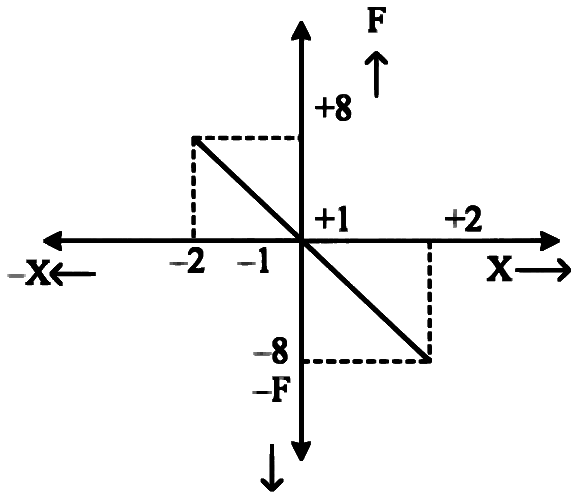
A particle of mass 0.50 kg 0.50\text{ kg} 0.50 kg F = − 50 ( N m − 1 ) x F = -50(\text{N m}^{-1})x F = − 50 ( N m − 1 ) x x 35 s \frac{x}{35}\text{ s} 35 x s x x x
(Given π = 22 7 \pi = \frac{22}{7} π = 7 22
Numerical answer type. Work it out, then open the answer.
Show answer and solution
Answer: 22
Loading the solution…
Report a mistake Open question page Q29 MHT CET 2024 · 2 MAY · SHIFT 2 Medium ☆
Periodic Motion & SHM Basics
The displacement of a particle performing S.H.M. is given by Y = A cos [ π ( t + ϕ ) ] Y = A\cos[\pi(t + \phi)] Y = A cos [ π ( t + ϕ )] t = 0 t = 0 t = 0 y = 2 cm y = 2\text{ cm} y = 2 cm 2 π cm/s 2\pi\text{ cm/s} 2 π cm/s A A A
(a) 2 (b) 2 \sqrt{2} 2 (c) 2 2 2\sqrt{2} 2 2 (d) 1 2 \frac{1}{\sqrt{2}} 2 1 Show answer and solution
Answer: (c)
Loading the solution…
Report a mistake Open question page Q30 JEE Main 2024 · 29 JAN · SHIFT 2 Medium ☆
Periodic Motion & SHM Basics
A simple harmonic oscillator has an amplitude A A A 6 π 6\pi 6 π x = x = x = x = 3 2 x = \frac{\sqrt{3}}{2} x = 2 3 π x s \frac{\pi}{x}\text{ s} x π s x = x = x =
Numerical answer type. Work it out, then open the answer.
Show answer and solution
Answer: 2
Loading the solution…
Report a mistake Open question page Q31 JEE Main 2023 · 15 APR · SHIFT 1 Easy ☆
Periodic Motion & SHM Basics
In a linear Simple Harmonic Motion (SHM)
(A) Restoring force is directly proportional to the displacement.
(B) The acceleration and displacement are opposite in direction.
(C) The velocity is maximum at mean position.
(D) The acceleration is minimum at extreme points.
Choose the correct answer from the options given below:
(a) (A), (B) and (D) only (b) (C) and (D) only (c) (A), (B) and (C) Only (d) (A), (C) and (D) only Show answer and solution
Answer: (c)
Loading the solution…
Report a mistake Open question page Q32 JEE Main 2023 · 8 APR · SHIFT 2 Easy ☆
Periodic Motion & SHM Basics
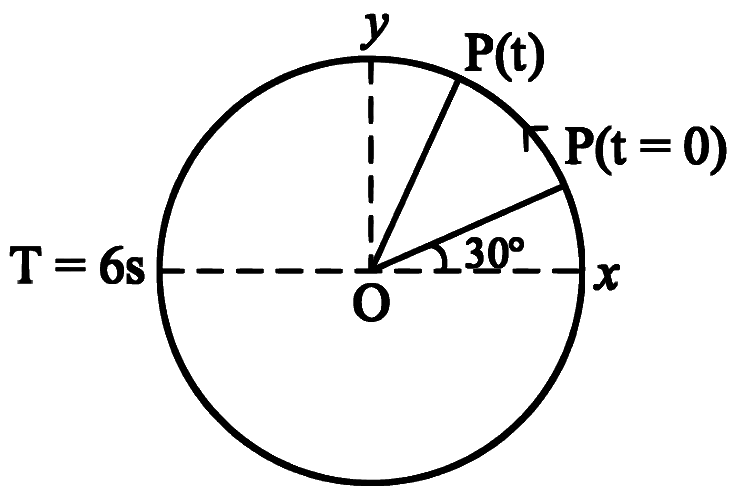
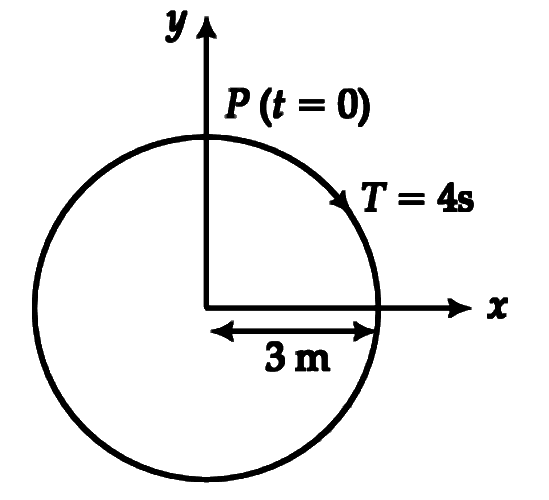
For particle P revolving round the centre O with radius of circular path r r r ω \omega ω x x x t t t
(a) x ( t ) = r cos ( ω t − π 6 ω ) x(t) = r\cos\left(\omega t - \frac{\pi}{6}\omega\right) x ( t ) = r cos ( ω t − 6 π ω ) (b) x ( t ) = r cos ( ω t ) x(t) = r\cos(\omega t) x ( t ) = r cos ( ω t ) (c) x ( t ) = r cos ( ω t + π 6 ) x(t) = r\cos\left(\omega t + \frac{\pi}{6}\right) x ( t ) = r cos ( ω t + 6 π ) (d) x ( t ) = r sin ( ω t + π 6 ) x(t) = r\sin\left(\omega t + \frac{\pi}{6}\right) x ( t ) = r sin ( ω t + 6 π ) Show answer and solution
Answer: (c)
Loading the solution…
Report a mistake Open question page Q33 JEE Main 2023 · 10 APR · SHIFT 2 Medium ☆
Periodic Motion & SHM Basics
For a periodic motion represented by the equation
y = sin ω t + cos ω t y = \sin \omega t + \cos \omega t y = sin ω t + cos ω t
the amplitude of the motion is
(a) 1 (b) 2 \sqrt{2} 2 (c) 0.5 (d) 2 Show answer and solution
Answer: (b)
Loading the solution…
Report a mistake Open question page Q34 MHT CET 2023 · 13 MAY · SHIFT 1 Medium ☆
Periodic Motion & SHM Basics
A body of mass 0.04 kg 0.04\text{ kg} 0.04 kg x = 0 x = 0 x = 0 F F F
(a) 2 π s 2\pi\text{ s} 2 π s (b) 0.2 π s 0.2\pi\text{ s} 0.2 π s (c) π s \pi\text{ s} π s (d) π 2 s \frac{\pi}{2}\text{ s} 2 π s Show answer and solution
Answer: (b)
Loading the solution…
Report a mistake Open question page Q35 MHT CET 2023 · 9 MAY · SHIFT 2 Medium ☆
Periodic Motion & SHM Basics
Two S.H.Ms. are represented by equations y 1 = 0.1 sin ( 100 π t + π 3 ) y_1 = 0.1\sin\left(100\pi t + \frac{\pi}{3}\right) y 1 = 0.1 sin ( 100 π t + 3 π ) y 2 = 0.1 cos ( 100 π t ) y_2 = 0.1\cos(100\pi t) y 2 = 0.1 cos ( 100 π t )
(a) π 3 \frac{\pi}{3} 3 π (b) − π 6 -\frac{\pi}{6} − 6 π (c) + π 6 +\frac{\pi}{6} + 6 π (d) − π 3 -\frac{\pi}{3} − 3 π Show answer and solution
Answer: (b)
Loading the solution…
Report a mistake Open question page Q36 JEE Main 2023 · 10 APR · SHIFT 1 Medium ☆
Periodic Motion & SHM Basics
A particle executes S.H.M. of amplitude A along x-axis. At t = 0, the position of the particle is x = A 2 x = \frac{A}{2} x = 2 A x = A sin ( ω t + δ ) x = A\sin(\omega t + \delta) x = A sin ( ω t + δ ) δ \delta δ
(a) π 2 \frac{\pi}{2} 2 π (b) π 3 \frac{\pi}{3} 3 π (c) π 4 \frac{\pi}{4} 4 π (d) π 6 \frac{\pi}{6} 6 π Show answer and solution
Answer: (d)
Loading the solution…
Report a mistake Open question page Q37 JEE Main 2023 · 25 JAN · SHIFT 2 Medium ☆
Periodic Motion & SHM Basics
A particle executes simple harmonic motion between x = − A x = -A x = − A x = + A x = +A x = + A x = 0 x = 0 x = 0 A 2 \frac{A}{2} 2 A x = A 2 x = \frac{A}{2} x = 2 A
(a) 4 s (b) 1.5 s (c) 3 s (d) 2 s Show answer and solution
Answer: (a)
Loading the solution…
Report a mistake Open question page Q38 MHT CET 2023 · 10 MAY · SHIFT 2 Medium ☆
Periodic Motion & SHM Basics
A simple harmonic progressive wave is represented by y = A sin ( 100 π t + 3 x ) y = A\sin(100\pi t + 3x) y = A sin ( 100 π t + 3 x ) π 3 \frac{\pi}{3} 3 π
(a) π 8 m \frac{\pi}{8}\text{ m} 8 π m (b) π 9 m \frac{\pi}{9}\text{ m} 9 π m (c) π 6 m \frac{\pi}{6}\text{ m} 6 π m (d) π 3 m \frac{\pi}{3}\text{ m} 3 π m Show answer and solution
Answer: (b)
Loading the solution…
Report a mistake Open question page Q39 NEET 2022 · PHASE 2 Easy ☆
Periodic Motion & SHM Basics
Identify the function which represents a non-periodic motion.
(a) sin ( ω t + π / 4 ) \sin(\omega t + \pi/4) sin ( ω t + π /4 ) (b) e − ω t e^{-\omega t} e − ω t (c) sin ω t \sin \omega t sin ω t (d) sin ω t + cos ω t \sin \omega t + \cos \omega t sin ω t + cos ω t Show answer and solution
Answer: (b)
Loading the solution…
Report a mistake Open question page Q40 JEE Main 2022 · 27 JUN · SHIFT 1 Easy ☆
Periodic Motion & SHM Basics
The displacement of simple harmonic oscillator after 3 seconds starting from its mean position is equal to half of its amplitude. The time period of harmonic motion is:
(a) 6 s (b) 8 s (c) 12 s (d) 36 s Show answer and solution
Answer: (d)
Loading the solution…
Report a mistake Open question page Q41 JEE Main 2022 · 28 JUL · SHIFT 2 Medium ☆
Periodic Motion & SHM Basics
The potential energy of a particle of mass 4 kg 4\text{ kg} 4 kg U = 4 ( 1 − cos 4 x ) U = 4(1 - \cos 4x) U = 4 ( 1 − cos 4 x ) ( sin θ ≃ θ ) (\sin\theta \simeq \theta) ( sin θ ≃ θ ) ( π K ) s \left(\frac{\pi}{K}\right)\text{ s} ( K π ) s K K K
Numerical answer type. Work it out, then open the answer.
Show answer and solution
Answer: 2
Loading the solution…
Report a mistake Open question page Q42 MHT CET 2022 · 11 AUG · SHIFT 2 Medium ☆
Periodic Motion & SHM Basics
The time taken by a particle executing simple harmonic motion of period 'T T T
(a) T 12 s \frac{T}{12}\text{ s} 12 T s (b) T 2 s \frac{T}{2}\text{ s} 2 T s (c) T 4 s \frac{T}{4}\text{ s} 4 T s (d) T 6 s \frac{T}{6}\text{ s} 6 T s Show answer and solution
Answer: (a)
Loading the solution…
Report a mistake Open question page Q43 JEE Main 2022 · 27 JUN · SHIFT 2 Medium ☆
Periodic Motion & SHM Basics
A particle executes simple harmonic motion. Its amplitude is 8 cm and time period is 6 s. The time it will take to travel from its position of maximum displacement to the point corresponding to half of its amplitude, is ___________ s.
Numerical answer type. Work it out, then open the answer.
Show answer and solution
Answer: 1
Loading the solution…
Report a mistake Open question page Q44 MHT CET 2022 · 11 AUG · SHIFT 2 Medium ☆
Periodic Motion & SHM Basics
In a medium, the phase difference between two particles separated by a distance 'x x x ( π 5 ) \left(\frac{\pi}{5}\right) ( 5 π ) 25 Hz 25\text{ Hz} 25 Hz 75 m/s 75\text{ m/s} 75 m/s x x x
(a) 0.4 m (b) 0.1 m (c) 0.2 m (d) 0.3 m Show answer and solution
Answer: (d)
Loading the solution…
Report a mistake Open question page Q45 JEE Main 2021 · 18 MAR · SHIFT 2 Easy ☆
Periodic Motion & SHM Basics
The function of time representing a simple harmonic motion with a period of π ω \frac{\pi}{\omega} ω π
(a) cos(ω \omega ω ω \omega ω ω \omega ω (b) sin2(ω \omega ω (c) sin(ω \omega ω ω \omega ω (d) 3cos ( π 4 − 2 ω t ) \left(\frac{\pi}{4} - 2\omega t\right) ( 4 π − 2 ω t ) Show answer and solution
Answer: (d)
Loading the solution…
Report a mistake Open question page Q46 JEE Main 2021 · 25 FEB · SHIFT 2 Easy ☆
Periodic Motion & SHM Basics
Y = A sin(ω \omega ω ϕ \phi ϕ Y = A 2 Y = \frac{A}{2} Y = 2 A ϕ \phi ϕ
(a) 5 π 6 \frac{5\pi}{6} 6 5 π (b) π 3 \frac{\pi}{3} 3 π (c) 2 π 3 \frac{2\pi}{3} 3 2 π (d) π 6 \frac{\pi}{6} 6 π Show answer and solution
Answer: (a)
Loading the solution…
Report a mistake Open question page Q47 JEE Main 2021 · 18 MAR · SHIFT 1 Easy ☆
Periodic Motion & SHM Basics
A particle performs simple harmonic motion with a period of 2 second. The time taken by the particle to cover a displacement equal to half of its amplitude from the mean position is 1 a \frac{1}{a} a 1
Numerical answer type. Work it out, then open the answer.
Show answer and solution
Answer: 6
Loading the solution…
Report a mistake Open question page Q48 MHT CET 2021 · 20 SEP · SHIFT 1 Medium ☆
Periodic Motion & SHM Basics
Two particles P P P Q Q Q 2 \sqrt{2} 2
[ sin − 1 ( 1 2 ) = cos − 1 ( 1 2 ) = π 4 ] \left[\sin^{-1}\left(\frac{1}{\sqrt{2}}\right) = \cos^{-1}\left(\frac{1}{\sqrt{2}}\right) = \frac{\pi}{4}\right] [ sin − 1 ( 2 1 ) = cos − 1 ( 2 1 ) = 4 π ]
(a) π 6 \frac{\pi}{6} 6 π (b) π 2 \frac{\pi}{2} 2 π (c) zero (d) π 3 \frac{\pi}{3} 3 π Show answer and solution
Answer: (b)
Loading the solution…
Report a mistake Open question page Q49 JEE Main 2021 · 25 FEB · SHIFT 2 Medium ☆
Periodic Motion & SHM Basics
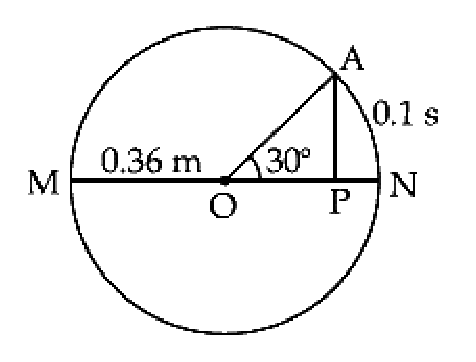
The point A moves with a uniform speed along the circumference of a circle of radius 0.36 m and covers 30∘ ^\circ ∘
(a) 9.87 N (b) 0.49 N (c) 50 N (d) 100 N Show answer and solution
Answer: (a)
Loading the solution…
Report a mistake Open question page Q50 JEE Main 2021 · 27 AUG · SHIFT 2 Medium ☆
Periodic Motion & SHM Basics
Two simple harmonic motion, are represented by the equations y 1 = 10 sin ( 3 π t + π 3 ) y 2 = 5 ( sin 3 π t + 3 cos 3 π t ) y_1 = 10\sin\left(3\pi t + \frac{\pi}{3}\right) \quad y_2 = 5(\sin 3\pi t + \sqrt{3}\cos 3\pi t) y 1 = 10 sin ( 3 π t + 3 π ) y 2 = 5 ( sin 3 π t + 3 cos 3 π t )
Numerical answer type. Work it out, then open the answer.
Show answer and solution
Answer: 1
Loading the solution…
Report a mistake Open question page Q51 JEE Main 2021 · 26 AUG · SHIFT 2 Medium ☆
Periodic Motion & SHM Basics
Two simple harmonic motions are represented by the equations
x 1 = 5 sin ( 2 π t + π 4 ) x_1 = 5\sin\left(2\pi t + \frac{\pi}{4}\right) x 1 = 5 sin ( 2 π t + 4 π ) x 2 = 5 2 ( sin 2 π t + cos 2 π t ) x_2 = 5\sqrt{2}(\sin 2\pi t + \cos 2\pi t) x 2 = 5 2 ( sin 2 π t + cos 2 π t )
Numerical answer type. Work it out, then open the answer.
Show answer and solution
Answer: 2
Loading the solution…
Report a mistake Open question page Q52 JEE Main 2021 · 27 JUL · SHIFT 2 Medium ☆
Periodic Motion & SHM Basics
A particle executes simple harmonic motion represented by displacement function as x(t) = A sin(ω \omega ω ϕ \phi ϕ
If the position and velocity of the particle at t = 0 s are 2 cm and 2ω \omega ω − 1 {}^{-1} − 1 x 2 x\sqrt{2} x 2
Numerical answer type. Work it out, then open the answer.
Show answer and solution
Answer: 2
Loading the solution…
Report a mistake Open question page Q53 JEE Main 2021 · 26 FEB · SHIFT 2 Medium ☆
Periodic Motion & SHM Basics
Time period of a simple pendulum is T. The time taken to complete 5 8 \frac{5}{8} 8 5 α β T \frac{\alpha}{\beta}T β α T α \alpha α
Numerical answer type. Work it out, then open the answer.
Show answer and solution
Answer: 7
Loading the solution…
Report a mistake Open question page Q54 MHT CET 2021 · 22 SEP · SHIFT 2 Medium ☆
Periodic Motion & SHM Basics
'n n n
(a) 2 n 2n 2 n (b) n 2 \frac{n}{2} 2 n (c) n 2 \frac{n}{\sqrt{2}} 2 n (d) 2 n \sqrt{2}n 2 n Show answer and solution
Answer: (b)
Loading the solution…
Report a mistake Open question page Q55 NEET 2020 · PHASE 2 Easy ☆
Periodic Motion & SHM Basics
Identify the function which represents a periodic motion.
(a) e − ω t e^{-\omega t} e − ω t (b) e ω t e^{\omega t} e ω t (c) log e ( ω t ) \log_e(\omega t) log e ( ω t ) (d) sin ω t + cos ω t \sin \omega t + \cos \omega t sin ω t + cos ω t Show answer and solution
Answer: (d)
Loading the solution…
Report a mistake Open question page Q56 MHT CET 2020 · 16 OCT · SHIFT 2 Medium ☆
Periodic Motion & SHM Basics
A particle performs simple harmonic motion with period of 3 s. The time taken by it to cover a distance equal to half the amplitude from mean position is [sin 3 0 ∘ = 0.5 \sin 30^\circ = 0.5 sin 3 0 ∘ = 0.5
(a) 1 4 s \frac{1}{4}\text{ s} 4 1 s (b) 3 2 s \frac{3}{2}\text{ s} 2 3 s (c) 3 4 s \frac{3}{4}\text{ s} 4 3 s (d) 1 2 s \frac{1}{2}\text{ s} 2 1 s Show answer and solution
Answer: (a)
Loading the solution…
Report a mistake Open question page Q57 NEET 2019 Easy ☆
Periodic Motion & SHM Basics
The radius of circle, the period of revolution, initial position and sense of revolution are indicated is the figure.
y- projection of the radius vector of rotating particle P is:
(a) y(t) = 4sin ( π t 2 ) \left(\frac{\pi t}{2}\right) ( 2 π t ) (b) y(t) = 3cos ( 3 π t 2 ) \left(\frac{3\pi t}{2}\right) ( 2 3 π t ) (c) y(t) = 3cos ( π t 2 ) \left(\frac{\pi t}{2}\right) ( 2 π t ) (d) y(t) = -3cos2π \pi π Show answer and solution
Answer: (c)
Loading the solution…
Report a mistake Open question page Q58 JEE Main 2019 · 12 JAN · SHIFT 2 Easy ☆
Periodic Motion & SHM Basics
A simple harmonic motion is represented by:
y = 5 (sin 3 π \pi π 3 \sqrt{3} 3 π \pi π
The amplitude and time period of the motion are:
(a) 10 cm, 3 2 \frac{3}{2} 2 3 (b) 5 cm, 2 3 \frac{2}{3} 3 2 (c) 5 cm, 3 2 \frac{3}{2} 2 3 (d) 10 cm, 2 3 \frac{2}{3} 3 2 Show answer and solution
Answer: (d)
Loading the solution…
Report a mistake Open question page Q59 MHT CET 2019 · 2 MAY · SHIFT 1 Easy ☆
Periodic Motion & SHM Basics
A particle executes the simple harmonic motion with an amplitude ' A A A
(a) A 2 \frac{A}{2} 2 A (b) A A A (c) 2 A 2A 2 A (d) 4 A 4A 4 A Show answer and solution
Answer: (d)
Loading the solution…
Report a mistake Open question page Q60 NEET 2019 Easy ☆
Periodic Motion & SHM Basics
The distance covered by a particle undergoing SHM in one time period is (amplitude = A A A
(a) 4 A 4A 4 A (b) Zero (c) A A A (d) 2 A 2A 2 A Show answer and solution
Answer: (a)
Loading the solution…
Report a mistake Open question page Q61 NEET 2019 Easy ☆
Periodic Motion & SHM Basics
Average velocity of a particle executing SHM in one complete vibration is:
(a) Aω \omega ω (b) A ω 2 2 \frac{A\omega^2}{2} 2 A ω 2 (c) A ω 2 \frac{A\omega}{2} 2 A ω (d) zero Show answer and solution
Answer: (d)
Loading the solution…
Report a mistake Open question page Q62 NEET 2019 Medium ☆
Periodic Motion & SHM Basics
The displacement of a particle executing simple harmonic motion is given by
y = A0 + A sinω \omega ω ω \omega ω
Then the amplitude of its oscillation is given by:
(a) A 2 + B 2 \sqrt{A^2 + B^2} A 2 + B 2 (b) A + B (c) A + A 2 + B 2 \sqrt{A^2 + B^2} A 2 + B 2 (d) A 0 2 + ( A + B ) 2 \sqrt{A_0^2 + (A + B)^2} A 0 2 + ( A + B ) 2 Show answer and solution
Answer: (a)
Loading the solution…
Report a mistake Open question page Q63 JEE Main 2018 · 16 APR · SHIFT 1 Difficult ☆
Periodic Motion & SHM Basics
A particle executes simple harmonic motion and is located at x = a, b and c at times t0, 2t0 and 3t0 respectively. The frequency of the oscillation is:
(a) 1 2 π t 0 cos − 1 ( a + c 2 b ) \frac{1}{2\pi t_0}\cos^{-1}\left(\frac{a+c}{2b}\right) 2 π t 0 1 cos − 1 ( 2 b a + c ) (b) 1 2 π t 0 cos − 1 ( a + b 2 c ) \frac{1}{2\pi t_0}\cos^{-1}\left(\frac{a+b}{2c}\right) 2 π t 0 1 cos − 1 ( 2 c a + b ) (c) 1 2 π t 0 cos − 1 ( 2 a + 3 c b ) \frac{1}{2\pi t_0}\cos^{-1}\left(\frac{2a+3c}{b}\right) 2 π t 0 1 cos − 1 ( b 2 a + 3 c ) (d) 1 2 π t 0 cos − 1 ( a + 2 b 3 c ) \frac{1}{2\pi t_0}\cos^{-1}\left(\frac{a+2b}{3c}\right) 2 π t 0 1 cos − 1 ( 3 c a + 2 b ) Show answer and solution
Answer: (a)
Loading the solution…
Report a mistake Open question page Q64 JEE Main 2016 · 9 APR · SHIFT 1 Medium ☆
Periodic Motion & SHM Basics
Two particles are performing simple harmonic motion in a straight line about the same equilibrium point. The amplitude and time period for both particles are same and equal to A and T, respectively. At time t = 0 one particle has displacement A while the other one has displacement − A 2 \frac{-A}{2} 2 − A
(a) T 6 \frac{T}{6} 6 T (b) 5 T 6 \frac{5T}{6} 6 5 T (c) T 3 \frac{T}{3} 3 T (d) T 4 \frac{T}{4} 4 T Show answer and solution
Answer: (a)
Loading the solution…
Report a mistake Open question page Q65 JEE Main 2014 · 12 APR · SHIFT 1 Easy ☆
Periodic Motion & SHM Basics
Which of the following expressions corresponds to simple harmonic motion along a straight line, where x is the displacement and a, b, c are positive constants?
(a) a + bx − - − (b) bx2 (c) a − - − (d) − - − Show answer and solution
Answer: (d)
Loading the solution…
Report a mistake Open question page Q66 JEE Main 2014 · 19 APR · SHIFT 1 Medium ☆
Periodic Motion & SHM Basics
A body is in simple harmonic motion with time period half second (T = 0.5 s) and amplitude one cm (A = 1 cm). Find the average velocity in the interval in which it moves from equilibrium position to half of its amplitude.
(a) 4 cm/s (b) 6 cm/s (c) 12 cm/s (d) 16 cm/s Show answer and solution
Answer: (c)
Loading the solution…
Report a mistake Open question page Q67 JEE Main 2014 Difficult ☆
Periodic Motion & SHM Basics
A particle moves with simple harmonic motion in a straight line. In first τ s , \tau s, τ s , a , a, a , τ s \tau s τ s 2 a , 2a, 2 a ,
(a) amplitude of motion is 3 a 3a 3 a (b) time period of oscillations is 8 τ 8\tau 8 τ (c) amplitude of motion is 4 a 4a 4 a (d) time period of oscillations is 6 τ 6\tau 6 τ Show answer and solution
Answer: (d)
Loading the solution…
Report a mistake Open question page Q68 NEET 2011 · AIPMT · PRELIMS Easy ☆
Periodic Motion & SHM Basics
Out of the following functions representing motion of a particle which represents SHM (1) y = sinω \omega ω − - − ω \omega ω
(2) y = sin3ω \omega ω
(3) y = 5cos ( 3 π 4 − 3 ω t ) \left(\frac{3\pi}{4} - 3\omega t\right) ( 4 3 π − 3 ω t )
(4) y = 1 + ω \omega ω ω \omega ω
(a) Only (1) (b) Only (4) does not represent SHM (c) Only (1) and (3) (d) Only (1) and (2) Show answer and solution
Answer: (c)
Loading the solution…
Report a mistake Open question page Q69 NEET 2011 · AIPMT · MAINS Medium ☆
Periodic Motion & SHM Basics
Two particles are oscillating along two close parallel straight lines side by side, with the same frequency and amplitudes. They pass each other, moving in opposite directions when their displacement is half of the amplitude. The mean positions of the two particles lie on a straight line perpendicular to the paths of the two particles. The phase difference is
(a) π 6 \frac{\pi}{6} 6 π (b) 0 (c) 2 π 3 \frac{2\pi}{3} 3 2 π (d) π \pi π Show answer and solution
Answer: (c)
Loading the solution…
Report a mistake Open question page Q70 JEE Main 2011 · AIEEE Difficult ☆
Periodic Motion & SHM Basics
Two particles are executing simple harmonic motion of the same amplitude A A A ω \omega ω x x x X 0 ( X 0 > A ) X_0\ (X_0 > A) X 0 ( X 0 > A ) ( X 0 + A ) , (X_0 + A), ( X 0 + A ) ,
(a) π 3 \frac{\pi}{3} 3 π (b) π 4 \frac{\pi}{4} 4 π (c) π 6 \frac{\pi}{6} 6 π (d) π 2 \frac{\pi}{2} 2 π Show answer and solution
Answer: (a)
Loading the solution…
Report a mistake Open question page Q71 NEET 2010 · AIPMT · PRELIMS Easy ☆
Periodic Motion & SHM Basics
The displacement of a particle along the x-axis is given by x = asin2ω \omega ω
(a) simple harmonic motion of frequency ω / π \omega/\pi ω / π (b) simple harmonic motion of frequency 3 ω / 2 π 3\omega/2\pi 3 ω /2 π (c) non simple harmonic motion (d) simple harmonic motion of frequency ω / 2 π \omega/2\pi ω /2 π Show answer and solution
Answer: (c)
Loading the solution…
Report a mistake Open question page Q72 NEET 2009 · AIPMT Easy ☆
Periodic Motion & SHM Basics
Which one of the following equations of motion represents simple harmonic motion? where k, k0, k1 and a are all positive.
(a) Acceleration = − - − (b) Acceleration = k(x + a) (c) Acceleration = − ω -\omega − ω (d) Acceleration = − - − Show answer and solution
Answer: (c)
Loading the solution…
Report a mistake Open question page Q73 JEE Main 2007 · AIEEE Easy ☆
Periodic Motion & SHM Basics
A point mass oscillates along the x x x x = x 0 cos ( ω t − π / 4 ) . x = x_0 \cos(\omega t - \pi/4). x = x 0 cos ( ω t − π /4 ) . a = A cos ( ω t + δ ) , a = A\cos(\omega t + \delta), a = A cos ( ω t + δ ) ,
(a) A = x 0 ω 2 , δ = 3 π / 4 A = x_0\omega^2,\ \delta = 3\pi/4 A = x 0 ω 2 , δ = 3 π /4 (b) A = x 0 , δ = − π / 4 A = x_0,\ \delta = -\pi/4 A = x 0 , δ = − π /4 (c) A = x 0 ω 2 , δ = π / 4 A = x_0\omega^2,\ \delta = \pi/4 A = x 0 ω 2 , δ = π /4 (d) A = x 0 ω 2 , δ = − π / 4 A = x_0\omega^2,\ \delta = -\pi/4 A = x 0 ω 2 , δ = − π /4 Show answer and solution
Answer: (a)
Loading the solution…
Report a mistake Open question page Q74 NEET 2007 · AIPMT Easy ☆
Periodic Motion & SHM Basics
A particle executes simple harmonic oscillation with an amplitude a a a
(a) T/8 (b) T/12 (c) T/2 (d) T/4 Show answer and solution
Answer: (b)
Loading the solution…
Report a mistake Open question page Q75 JEE Main 2007 · AIEEE Easy ☆
Periodic Motion & SHM Basics
The displacement of an object attached to a spring and executing simple harmonic motion is given by x = 2 × 1 0 − 2 cos π t x = 2 \times 10^{-2}\cos \pi t x = 2 × 1 0 − 2 cos π t
(a) 0.25 s 0.25\text{ s} 0.25 s (b) 0.5 s 0.5\text{ s} 0.5 s (c) 0.75 s 0.75\text{ s} 0.75 s (d) 0.125 s 0.125\text{ s} 0.125 s Show answer and solution
Answer: (b)
Loading the solution…
Report a mistake Open question page Q76 NEET 2005 · AIPMT Easy ☆
Periodic Motion & SHM Basics
The circular motion of a particle with constant speed is
(a) periodic but not simple harmonic (b) simple harmonic but not periodic (c) period and simple harmonic (d) neither periodic not simple harmonic. Show answer and solution
Answer: (a)
Loading the solution…
Report a mistake Open question page Q77 JEE Main 2005 · AIEEE Easy ☆
Periodic Motion & SHM Basics
If a simple harmonic motion is represented by d 2 x d t 2 + α x = 0. \frac{d^2x}{dt^2} + \alpha x = 0. d t 2 d 2 x + αx = 0.
(a) 2 π α \frac{2\pi}{\sqrt{\alpha}} α 2 π (b) 2 π α \frac{2\pi}{\alpha} α 2 π (c) 2 π α 2\pi\sqrt{\alpha} 2 π α (d) 2 π α 2\pi\alpha 2 π α Show answer and solution
Answer: (a)
Loading the solution…
Report a mistake Open question page Q78 JEE Main 2005 · AIEEE Medium ☆
Periodic Motion & SHM Basics
The function sin 2 ( ω t ) \sin^2(\omega t) sin 2 ( ω t )
(a) a periodic, but not S H M SHM S H M π ω \frac{\pi}{\omega} ω π (b) a periodic, but not S H M SHM S H M 2 π ω \frac{2\pi}{\omega} ω 2 π (c) a S H M SHM S H M π ω \frac{\pi}{\omega} ω π (d) a S H M SHM S H M 2 π ω \frac{2\pi}{\omega} ω 2 π Show answer and solution
Answer: (a)
Loading the solution…
Report a mistake Open question page Q79 JEE Main 2005 · AIEEE Medium ☆
Periodic Motion & SHM Basics
Two simple harmonic motions are represented by the equations y 1 = 0.1 sin ( 100 π t + π 3 ) y_1 = 0.1\sin\left(100\pi t + \frac{\pi}{3}\right) y 1 = 0.1 sin ( 100 π t + 3 π ) y 2 = 0.1 cos π t . y_2 = 0.1\cos \pi t. y 2 = 0.1 cos π t . 1 1 1 2 2 2
(a) π 3 \frac{\pi}{3} 3 π (b) − π 6 \frac{-\pi}{6} 6 − π (c) π 6 \frac{\pi}{6} 6 π (d) − π 3 \frac{-\pi}{3} 3 − π Show answer and solution
Answer: (b)
Loading the solution…
Report a mistake Open question page Q80 JEE Main 2003 · AIEEE Medium ☆
Periodic Motion & SHM Basics
The displacement of particle varies according to the relation
x = 4 ( cos π t + sin π t ) . x = 4(\cos \pi t + \sin \pi t). x = 4 ( cos π t + sin π t ) .
(a) − 4 -4 − 4 (b) 4 4 4 (c) 4 2 4\sqrt{2} 4 2 (d) 8 8 8 Show answer and solution
Answer: (c)
Loading the solution…
Report a mistake Open question page Q81 NEET 1994 · AIPMT Easy ☆
Periodic Motion & SHM Basics
A particle executes S.H.M. along x x x
(a) A cos ( k x ) A\cos(kx) A cos ( k x ) (b) A e − k x Ae^{-kx} A e − k x (c) A k x Akx A k x (d) − A k x -Akx − A k x Show answer and solution
Answer: (d)
Loading the solution…
Report a mistake Open question page Q82 NEET 1992 · AIPMT Easy ☆
Periodic Motion & SHM Basics
A simple harmonic oscillator has an amplitude A A A T T T x = A x = A x = A x = A / 2 x = A/2 x = A /2
(a) T / 6 T/6 T /6 (b) T / 4 T/4 T /4 (c) T / 3 T/3 T /3 (d) T / 2 T/2 T /2 Show answer and solution
Answer: (a)
Loading the solution…
Report a mistake Open question page Q83 NEET 1988 · AIPMT Easy ☆
Periodic Motion & SHM Basics
A particle executes S.H.M. along x x x
(a) A cos ( k x ) A\cos(kx) A cos ( k x ) (b) A e − k x Ae^{-kx} A e − k x (c) A k x Akx A k x (d) − A k x -Akx − A k x Show answer and solution
Answer: (d)
Loading the solution…
Report a mistake Open question page Q84 NDA 2021 Easy ☆
Periodic Motion & SHM Basics
Which one of the following statements is true for a simple harmonic oscillator?
(a) Force acting is directly proportional to the displacement from the mean position and is in same direction. (b) Force acting is directly proportional to the displacement from the mean position and is in opposite direction (c) Acceleration of the oscillator is constant (d) The velocity of the oscillator is not periodic Show answer
Answer: (b)
Step-by-step solution coming soon.
Report a mistake Q85 NDA 2018 Easy ☆
Periodic Motion & SHM Basics
If T T T not correct?
(a) The motion repeats after time T T T (b) T T T (c) The motion repeats itself after n T nT n T n n n (d) T T T Show answer
Answer: (a)
Step-by-step solution coming soon.
Report a mistake Q86 NDA 2018 Easy ☆
Periodic Motion & SHM Basics
Which one of the following is an example of the force of gravity of the earth acting on a vibrating pendulum bob?
(a) Applied force (b) Frictional force (c) Restoring force (d) Virtual force Show answer
Answer: (c)
Step-by-step solution coming soon.
Report a mistake Q87 NDA 2017 Easy ☆
Periodic Motion & SHM Basics
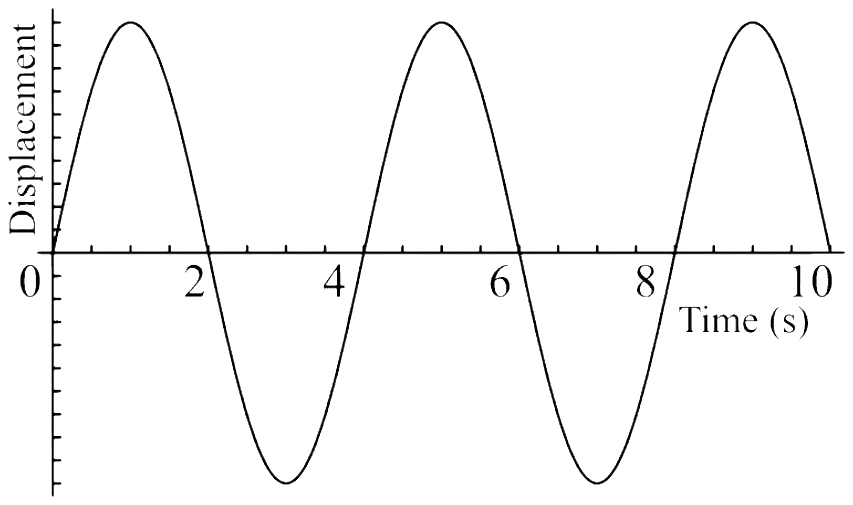
The following figure shows displacement versus time curve for a particle executing simple harmonic motion:
Which one of the following statements is correct?
(a) Phase of the oscillating particle is same at t = 1 s t = 1\,\text{s} t = 1 s t = 3 s t = 3\,\text{s} t = 3 s (b) Phase of the oscillating particle is same at t = 2 s t = 2\,\text{s} t = 2 s t = 8 s t = 8\,\text{s} t = 8 s (c) Phase of the oscillating particle is same at t = 3 s t = 3\,\text{s} t = 3 s t = 7 s t = 7\,\text{s} t = 7 s (d) Phase of the oscillating particle is same at t = 4 s t = 4\,\text{s} t = 4 s t = 10 s t = 10\,\text{s} t = 10 s Show answer
Answer: (c)
Step-by-step solution coming soon.
Report a mistake Q88 NDA 2017 Easy ☆
Periodic Motion & SHM Basics
Which one of the following is the correct relation between frequency f f f ω \omega ω
(a) f = π ω f = \pi\omega f = πω (b) ω = 2 π f \omega = 2\pi f ω = 2 π f (c) f = 2 ω / π f = 2\omega/\pi f = 2 ω / π (d) f = 2 π ω f = 2\pi\omega f = 2 πω Show answer
Answer: (b)
Step-by-step solution coming soon.
Report a mistake Q89 NDA 2016 Easy ☆
Periodic Motion & SHM Basics
Which one of the following four particles, whose displacement x x x a x a_x a x
(a) a x = + 3 x a_x = +3x a x = + 3 x (b) a x = + 3 x 2 a_x = +3x^2 a x = + 3 x 2 (c) a x = − 3 x 2 a_x = -3x^2 a x = − 3 x 2 (d) a x = − 3 x a_x = -3x a x = − 3 x Show answer
Answer: (d)
Step-by-step solution coming soon.
Report a mistake Q90 NDA 2013 Medium ☆
Periodic Motion & SHM Basics
The displacement of a particle is given by x = cos 2 ω t x = \cos^{2}\omega t x = cos 2 ω t
(a) simple harmonic (b) periodic but not simple harmonic (c) non-periodic (d) None of the above Show answer
Answer: (a)
Step-by-step solution coming soon.
Report a mistake Q91 NDA 2011 Medium ☆
Periodic Motion & SHM Basics
It is impossible for two oscillators, each executing simple harmonic motion, to remain in phase with each other if they have different
(a) time periods (b) amplitudes (c) spring constants (d) kinetic energy Show answer
Answer: (a)
Step-by-step solution coming soon.
Report a mistake Q92 NDA 2010 Easy ☆
Periodic Motion & SHM Basics
A particle oscillates in one dimension about the equilibrium position subject to a force F x ( x ) F_x(x) F x ( x ) U ( x ) U(x) U ( x ) k k k
(a) F x ( x ) = − k x 2 F_x(x) = -kx^2 F x ( x ) = − k x 2 (b) F x ( x ) = − k x F_x(x) = -kx F x ( x ) = − k x (c) U ( x ) = 1 2 k x U(x) = \tfrac{1}{2}kx U ( x ) = 2 1 k x (d) U ( x ) = 1 2 k 2 x U(x) = \tfrac{1}{2}k^2x U ( x ) = 2 1 k 2 x Show answer
Answer: (b)
Step-by-step solution coming soon.
Report a mistake Q93 NDA 2009 Easy ☆
Periodic Motion & SHM Basics
Which among the following is the necessary condition for simple harmonic motion?
(a) Constant period (b) Constant acceleration (c) Displacement and acceleration are proportional (d) Displacement and torque are proportional Show answer
Answer: (c)
Step-by-step solution coming soon.
Report a mistake Q94 JEE Advanced 2011 Medium ☆
Periodic Motion & SHM Basics
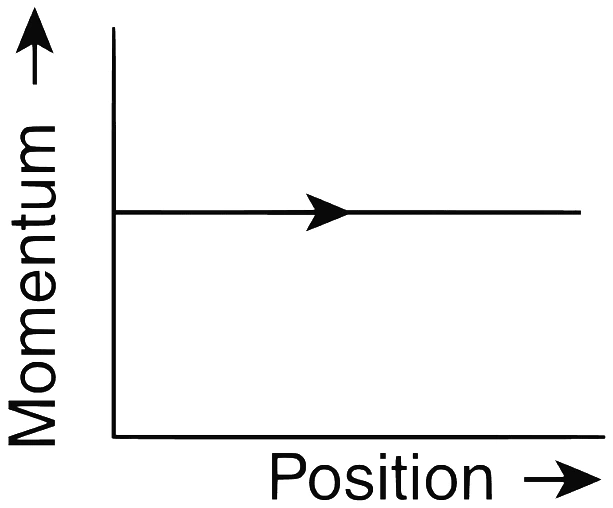
Phase space diagrams are useful tools in analyzing all kinds of dynamical problems. They are especially useful in studying the changes in motion as initial position and momentum are changed. Here we consider some simple dynamical systems in one-dimension. For such systems, phase space is a plane in which position is plotted along horizontal axis and momentum is plotted along vertical axis. The phase space diagram is x ( t ) x(t) x ( t ) p ( t ) p(t) p ( t )
The phase space diagram for a ball thrown vertically up from ground is
(a) Graph (A) (b) Graph (B) (c) Graph (C) (d) Graph (D) Show answer
Answer: (d)
Step-by-step solution coming soon.
Report a mistake Q95 JEE Advanced 2009 Easy ☆
Periodic Motion & SHM Basics
A student performed the experiment to measure the speed of sound in air using resonance air-column method. Two resonances in the air-column were obtained by lowering the water level. The resonance with the shorter air-column is the first resonance and that with the longer air-column is the second resonance. Then,
More than one option can be correct. Tap every correct option, then tap Check.
(a) the intensity of the sound heard at the first resonance was more than that at the second resonance. (b) the prongs of the tuning fork were kept in a horizontal plane above the resonance tube. (c) the amplitude of vibration of the ends of the prongs is typically around 1 cm 1\,\text{cm} 1 cm (d) the length of the air-column at the first resonance was somewhat shorter than 1 / 4 1/4 1/4 Show answer
Answer: (a), (d)
Step-by-step solution coming soon.
Report a mistake Q96 JEE Advanced 2006 Medium ☆
Periodic Motion & SHM Basics
Function x = A sin 2 ω t + B cos 2 ω t + C sin ω t cos ω t x = A\sin^2\omega t + B\cos^2\omega t + C\sin\omega t\cos\omega t x = A sin 2 ω t + B cos 2 ω t + C sin ω t cos ω t
More than one option can be correct. Tap every correct option, then tap Check.
(a) for any value of A A A B B B C C C C = 0 C = 0 C = 0 (b) if A = − B A = -B A = − B C = 2 B C = 2B C = 2 B = ∣ B 2 ∣ = |B\sqrt{2}| = ∣ B 2 ∣ (c) if A = B A = B A = B C = 0 C = 0 C = 0 (d) if A = B A = B A = B C = 2 B C = 2B C = 2 B = ∣ B ∣ = |B| = ∣ B ∣ Show answer
Answer: (a), (b), (d)
Step-by-step solution coming soon.
Report a mistake Q97 JEE Advanced 2001 Medium ☆
Periodic Motion & SHM Basics
A particle executes simple harmonic motion between x = − A x = -A x = − A x = + A x = +A x = + A 0 0 0 A 2 \dfrac{A}{2} 2 A T 1 T_1 T 1 A 2 \dfrac{A}{2} 2 A A A A T 2 T_2 T 2
(a) T 1 < T 2 T_1 < T_2 T 1 < T 2 (b) T 1 > T 2 T_1 > T_2 T 1 > T 2 (c) T 1 = T 2 T_1 = T_2 T 1 = T 2 (d) T 1 = 2 T 2 T_1 = 2T_2 T 1 = 2 T 2 Show answer
Answer: (a)
Step-by-step solution coming soon.
Report a mistake Q98 AIIMS 2016 Medium ☆
Periodic Motion & SHM Basics
Two simple harmonic motions are represented by the equations y 1 = 0.1 sin ( 100 π t + π 3 ) y_1 = 0.1\sin\left(100\pi t + \dfrac{\pi}{3}\right) y 1 = 0.1 sin ( 100 π t + 3 π ) y 2 = 0.1 cos π t y_2 = 0.1\cos \pi t y 2 = 0.1 cos π t t = 0 t = 0 t = 0
(a) − π 3 \dfrac{-\pi}{3} 3 − π (b) π 6 \dfrac{\pi}{6} 6 π (c) − π 6 \dfrac{-\pi}{6} 6 − π (d) π 3 \dfrac{\pi}{3} 3 π Show answer
Answer: (c)
Step-by-step solution coming soon.
Report a mistake Q99 AIIMS 2008 Medium ☆
Periodic Motion & SHM Basics
The function sin 2 ( ω t ) \sin^2(\omega t) sin 2 ( ω t )
(a) a periodic, but not simple harmonic motion with a period 2 π / ω 2\pi/\omega 2 π / ω (b) a periodic, but not simple harmonic motion with a period π / ω \pi/\omega π / ω (c) a simple harmonic motion with a period 2 π / ω 2\pi/\omega 2 π / ω (d) a simple harmonic motion with a period π / ω \pi/\omega π / ω Show answer
Answer: (b)
Step-by-step solution coming soon.
Report a mistake Q100 AIIMS 2007 Easy ☆
Periodic Motion & SHM Basics
The phase difference between the instantaneous velocity and acceleration of a particle executing simple harmonic motion is
(a) 0.5 π 0.5\pi 0.5 π (b) π \pi π (c) 0.707 π 0.707\pi 0.707 π (d) zero Show answer
Answer: (a)
Step-by-step solution coming soon.
Report a mistake Q101 AIIMS 2007 Medium ☆
Periodic Motion & SHM Basics
A particle executes simple harmonic oscillation with an amplitude a a a T T T
(a) T 4 \dfrac{T}{4} 4 T (b) T 8 \dfrac{T}{8} 8 T (c) T 12 \dfrac{T}{12} 12 T (d) T 2 \dfrac{T}{2} 2 T Show answer
Answer: (c)
Step-by-step solution coming soon.
Report a mistake Q102 AIIMS 2005 Easy ☆
Periodic Motion & SHM Basics
Which of the following functions represents a simple harmonic oscillation?
(a) sin ω t − cos ω t \sin\omega t - \cos\omega t sin ω t − cos ω t (b) sin 2 ω t \sin^2\omega t sin 2 ω t (c) sin ω t + sin 2 ω t \sin\omega t + \sin 2\omega t sin ω t + sin 2 ω t (d) sin ω t − sin 2 ω t \sin\omega t - \sin 2\omega t sin ω t − sin 2 ω t Show answer
Answer: (a)
Step-by-step solution coming soon.
Report a mistake Q103 JIPMER 2017 Medium ☆
Periodic Motion & SHM Basics
The x x x y y y x ( t ) = a cos ( p t ) x(t) = a\cos(pt) x ( t ) = a cos ( pt ) y ( t ) = b sin ( p t ) y(t) = b\sin(pt) y ( t ) = b sin ( pt ) a , b ( < a ) a, b\,(<a) a , b ( < a ) p p p t t t
(a) The path of the particle is an ellipse. (b) Velocity and acceleration of the particle are perpendicular to each other at t = π 2 p t = \dfrac{\pi}{2p} t = 2 p π (c) Acceleration of the particle is always directed towards a fixed point. (d) Distance travelled by the particle in time interval between t = 0 t = 0 t = 0 t = π 2 p t = \dfrac{\pi}{2p} t = 2 p π a a a Show answer
Answer: (d)
Step-by-step solution coming soon.
Report a mistake Q104 JIPMER 2017 Medium ☆
Periodic Motion & SHM Basics
The displacement of a particle along the x x x x = a sin 2 ω t x = a\sin^2\omega t x = a sin 2 ω t
(a) simple harmonic motion of frequency ω / π \omega/\pi ω / π (b) simple harmonic motion of frequency 3 ω / 2 π 3\omega/2\pi 3 ω /2 π (c) non simple harmonic motion (d) simple harmonic motion of frequency ω / 2 π \omega/2\pi ω /2 π Show answer
Answer: (a)
Step-by-step solution coming soon.
Report a mistake Q105 JIPMER 2007 Easy ☆
Periodic Motion & SHM Basics
The circular motion of a particle with constant speed is
(a) simple harmonic but not periodic (b) periodic and simple harmonic (c) neither periodic nor simple harmonic (d) periodic but not simple harmonic Show answer
Answer: (d)
Step-by-step solution coming soon.
Report a mistake Q106 BITSAT 2023 Medium ☆
Periodic Motion & SHM Basics
The x x x t t t t = 2 s t = 2\,\text{s} t = 2 s
(a) − π 2 8 m s − 2 -\dfrac{\pi^2}{8}\,\text{m s}^{-2} − 8 π 2 m s − 2 (b) π 2 16 m s − 2 \dfrac{\pi^2}{16}\,\text{m s}^{-2} 16 π 2 m s − 2 (c) − π 2 16 m s − 2 -\dfrac{\pi^2}{16}\,\text{m s}^{-2} − 16 π 2 m s − 2 (d) π 2 8 m s − 2 \dfrac{\pi^2}{8}\,\text{m s}^{-2} 8 π 2 m s − 2 Show answer
Answer: (c)
Step-by-step solution coming soon.
Report a mistake Q107 VITEEE 2019 Easy ☆
Periodic Motion & SHM Basics
If the differential equation for a simple harmonic motion is d 2 y d t 2 + 2 y = 0 \dfrac{d^2y}{dt^2} + 2y = 0 d t 2 d 2 y + 2 y = 0
(a) π 2 sec \pi\sqrt{2}\,\text{sec} π 2 sec (b) 2 s π sec \dfrac{\sqrt{2}\,s}{\pi}\,\text{sec} π 2 s sec (c) π 2 sec \dfrac{\pi}{\sqrt{2}}\,\text{sec} 2 π sec (d) 2 π sec 2\pi\,\text{sec} 2 π sec Show answer
Answer: (a)
Step-by-step solution coming soon.
Report a mistake Q108 COMEDK 2025 Medium ☆
Periodic Motion & SHM Basics
Two simple harmonic motions are represented by the equations y 1 = 0.5 sin [ 200 π t + π 3 ] y_1 = 0.5\sin\left[200\pi t + \dfrac{\pi}{3}\right] y 1 = 0.5 sin [ 200 π t + 3 π ] y 2 = 0.5 cos π t y_2 = 0.5\cos \pi t y 2 = 0.5 cos π t
(a) π 2 \dfrac{\pi}{2} 2 π (b) π 6 \dfrac{\pi}{6} 6 π (c) − π 6 \dfrac{-\pi}{6} 6 − π (d) − π 2 \dfrac{-\pi}{2} 2 − π Show answer
Answer: (c)
Step-by-step solution coming soon.
Report a mistake Q109 COMEDK 2023 Easy ☆
Periodic Motion & SHM Basics
The phase difference between displacement and velocity of a particle in simple harmonic motion is
(a) π \pi π (b) 3 π / 2 3\pi/2 3 π /2 (c) zero (d) π / 2 \pi/2 π /2 Show answer
Answer: (d)
Step-by-step solution coming soon.
Report a mistake Q110 COMEDK 2021 Easy ☆
Periodic Motion & SHM Basics
The function y = log ω t y = \log \omega t y = log ω t
(a) a periodic function (b) non-periodic function (c) oscillatory function (d) circulatory motion Show answer
Answer: (b)
Step-by-step solution coming soon.
Report a mistake Q111 KCET 2019 Medium ☆
Periodic Motion & SHM Basics
A piston is performing S.H.M. in the vertical direction with a frequency of 0.5 Hz 0.5\,\text{Hz} 0.5 Hz 10 kg 10\,\text{kg} 10 kg
(a) 1 m 1\,\text{m} 1 m (b) 0.5 m 0.5\,\text{m} 0.5 m (c) 1.5 m 1.5\,\text{m} 1.5 m (d) 0.1 m 0.1\,\text{m} 0.1 m Show answer
Answer: (a)
Step-by-step solution coming soon.
Report a mistake Q112 AP EAPCET 2025 Easy ☆
Periodic Motion & SHM Basics
If the function sin 2 ω t \sin^2\omega t sin 2 ω t t t t
(a) π ω s \sqrt{\dfrac{\pi}{\omega}}\,\text{s} ω π s (b) π ω s \dfrac{\pi}{\omega}\,\text{s} ω π s (c) 2 π ω s \dfrac{2\pi}{\omega}\,\text{s} ω 2 π s (d) 2 π ω s \sqrt{\dfrac{2\pi}{\omega}}\,\text{s} ω 2 π s Show answer
Answer: (b)
Step-by-step solution coming soon.
Report a mistake Q113 AP EAPCET 2025 Easy ☆
Periodic Motion & SHM Basics
If the displacement y y y y = 5 sin ( 3 π t ) + 5 3 cos ( 3 π t ) y = 5\sin(3\pi t) + 5\sqrt{3}\cos(3\pi t) y = 5 sin ( 3 π t ) + 5 3 cos ( 3 π t )
(a) 5 cm 5\,\text{cm} 5 cm (b) 5 ( 1 + 3 ) cm 5(1+\sqrt{3})\,\text{cm} 5 ( 1 + 3 ) cm (c) 5 3 cm 5\sqrt{3}\,\text{cm} 5 3 cm (d) 10 cm 10\,\text{cm} 10 cm Show answer
Answer: (d)
Step-by-step solution coming soon.
Report a mistake Q114 AP EAPCET 2024 Easy ☆
Periodic Motion & SHM Basics
Two simple harmonic motions are represented by y 1 = 5 [ sin 2 π t + 3 cos 2 π t ] y_1 = 5\left[\sin 2\pi t + \sqrt{3}\cos 2\pi t\right] y 1 = 5 [ sin 2 π t + 3 cos 2 π t ] y 2 = 5 sin [ 2 π t + π 4 ] y_2 = 5\sin\left[2\pi t + \dfrac{\pi}{4}\right] y 2 = 5 sin [ 2 π t + 4 π ]
(a) 1 : 1 1:1 1 : 1 (b) 2 : 1 2:1 2 : 1 (c) 1 : 3 1:3 1 : 3 (d) 3 : 1 \sqrt{3}:1 3 : 1 Show answer
Answer: (b)
Step-by-step solution coming soon.
Report a mistake Q115 AP EAPCET 2024 Medium ☆
Periodic Motion & SHM Basics
The relation between the force (F F F y y y 500 F + π 2 y = 0 500F + \pi^2 y = 0 500 F + π 2 y = 0 2 g 2\,\text{g} 2 g
(a) 8 s 8\,\text{s} 8 s (b) 6 s 6\,\text{s} 6 s (c) 2 s 2\,\text{s} 2 s (d) 4 s 4\,\text{s} 4 s Show answer
Answer: (c)
Step-by-step solution coming soon.
Report a mistake Q116 AP EAPCET 2024 Medium ☆
Periodic Motion & SHM Basics
The displacement of a particle executing simple harmonic motion is y = A sin ( 2 t + ϕ ) m y = A\sin(2t+\phi)\,\text{m} y = A sin ( 2 t + ϕ ) m t t t ϕ \phi ϕ t = 0 t=0 t = 0 2 m 2\,\text{m} 2 m 4 m s − 1 4\,\text{m s}^{-1} 4 m s − 1 ϕ = \phi = ϕ =
(a) 6 0 ∘ 60^\circ 6 0 ∘ (b) 3 0 ∘ 30^\circ 3 0 ∘ (c) 4 5 ∘ 45^\circ 4 5 ∘ (d) 9 0 ∘ 90^\circ 9 0 ∘ Show answer
Answer: (c)
Step-by-step solution coming soon.
Report a mistake Q117 AP EAPCET 2023 Easy ☆
Periodic Motion & SHM Basics
The amplitude of a wave, represented by the displacement equation y = 1 a sin ω t ± 1 b cos ω t y = \dfrac{1}{\sqrt{a}}\sin\omega t \pm \dfrac{1}{\sqrt{b}}\cos\omega t y = a 1 sin ω t ± b 1 cos ω t
(a) a + b a b \dfrac{a+b}{ab} ab a + b (b) a + b a b \dfrac{\sqrt{a}+\sqrt{b}}{ab} ab a + b (c) a ± b a b \dfrac{\sqrt{a}\pm\sqrt{b}}{ab} ab a ± b (d) a + b a b \sqrt{\dfrac{a+b}{ab}} ab a + b Show answer
Answer: (d)
Step-by-step solution coming soon.
Report a mistake Q118 AP EAPCET 2022 Easy ☆
Periodic Motion & SHM Basics
An object undergoing simple harmonic motion takes 0.5 s 0.5\,\text{s} 0.5 s
(a) π rad s − 1 \pi\,\text{rad s}^{-1} π rad s − 1 (b) 2 π rad s − 1 2\pi\,\text{rad s}^{-1} 2 π rad s − 1 (c) 3 π rad s − 1 3\pi\,\text{rad s}^{-1} 3 π rad s − 1 (d) π 2 rad s − 1 \dfrac{\pi}{2}\,\text{rad s}^{-1} 2 π rad s − 1 Show answer
Answer: (b)
Step-by-step solution coming soon.
Report a mistake Q119 AP EAPCET 2022 Medium ☆
Periodic Motion & SHM Basics
A particle is executing simple harmonic motion with an instantaneous displacement x = A sin 2 ( ω t − π 4 ) x = A\sin^2\left(\omega t - \dfrac{\pi}{4}\right) x = A sin 2 ( ω t − 4 π )
(a) 2 π ω \dfrac{2\pi}{\omega} ω 2 π (b) π ω \dfrac{\pi}{\omega} ω π (c) π 2 ω \dfrac{\pi}{2\omega} 2 ω π (d) ω 2 π \dfrac{\omega}{2\pi} 2 π ω Show answer
Answer: (b)
Step-by-step solution coming soon.
Report a mistake Q120 TS EAMCET 2026 Easy ☆
Periodic Motion & SHM Basics
A particle executes simple harmonic motion with an amplitude of 40 cm 40\,\text{cm} 40 cm 6 s 6\,\text{s} 6 s 20 cm 20\,\text{cm} 20 cm
(a) 0.5 s 0.5\,\text{s} 0.5 s (b) 1.5 s 1.5\,\text{s} 1.5 s (c) 3 s 3\,\text{s} 3 s (d) 2.5 s 2.5\,\text{s} 2.5 s Show answer
Answer: (a)
Step-by-step solution coming soon.
Report a mistake Q121 TS EAMCET 2026 Medium ☆
Periodic Motion & SHM Basics
Two particles A and B are executing simple harmonic motion with amplitudes 10 cm 10\,\text{cm} 10 cm 20 cm 20\,\text{cm} 20 cm 8 s 8\,\text{s} 8 s 12 s 12\,\text{s} 12 s 1 8 th \dfrac{1}{8}^{\text{th}} 8 1 th
(a) 1 : 2 1:2 1 : 2 (b) 1 : 1 1:1 1 : 1 (c) 3 : 4 3:4 3 : 4 (d) 2 : 3 2:3 2 : 3 Show answer
Answer: (d)
Step-by-step solution coming soon.
Report a mistake Q122 TS EAMCET 2023 Easy ☆
Periodic Motion & SHM Basics
The displacement of a particle executing simple harmonic motion is given by x = 2 cos ( t ) x = 2\cos(t) x = 2 cos ( t ) t t t
(a) π \pi π (b) 2 π 2\pi 2 π (c) 3 π 3\pi 3 π (d) 0.5 π 0.5\pi 0.5 π Show answer
Answer: (b)
Step-by-step solution coming soon.
Report a mistake Q123 IAT 2024 Medium ☆
Periodic Motion & SHM Basics
Consider the motion of a particle along the x x x x ( t ) = sin 2 ( ω t ) cos 3 ( ω t ) x(t) = \sin^2(\omega t)\cos^3(\omega t) x ( t ) = sin 2 ( ω t ) cos 3 ( ω t ) ω \omega ω
(a) 2 π ω \dfrac{2\pi}{\omega} ω 2 π (b) 2 π 3 ω \dfrac{2\pi}{3\omega} 3 ω 2 π (c) 2 π 5 ω \dfrac{2\pi}{5\omega} 5 ω 2 π (d) 2 π 15 ω \dfrac{2\pi}{15\omega} 15 ω 2 π Show answer
Answer: (a)
Step-by-step solution coming soon.
Report a mistake Q124 IAT 2022 Difficult ☆
Periodic Motion & SHM Basics
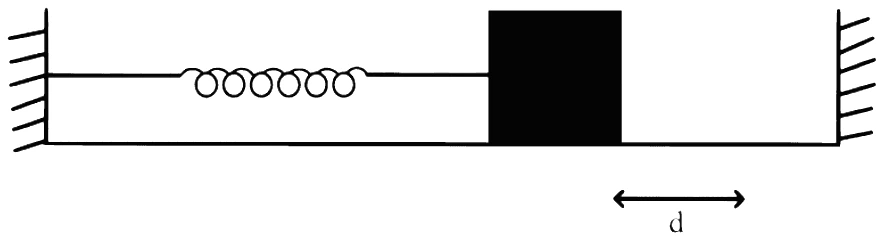
As shown in the figure a block is resting on a frictionless floor and is attached to the free end of a spring. The right edge of the block in equilibrium is at a distance d d d d / 2 d/2 d /2 T T T 2 d 2d 2 d T 0 T_0 T 0 T 0 / T T_0/T T 0 / T
(a) 1 / 4 1/4 1/4 (b) 1 1 1 (c) 3 / 4 3/4 3/4 (d) 2 / 3 2/3 2/3 Show answer
Answer: (d)
Step-by-step solution coming soon.
Report a mistake Q125 NEST 2024 Medium ☆
Periodic Motion & SHM Basics
A particle of unit mass is moving along x x x F = ( − 1 ) p k x n F = (-1)^p k x^n F = ( − 1 ) p k x n p p p n n n k k k
(a) a hyperbola when p = 1 p=1 p = 1 n = 2 n=2 n = 2 (b) an ellipse when p = 1 p=1 p = 1 n = 1 n=1 n = 1 (c) a parabola when p = 2 p=2 p = 2 n = 1 n=1 n = 1 (d) a circle when p = 0 p=0 p = 0 n = 2 n=2 n = 2 Show answer
Answer: (b)
Step-by-step solution coming soon.
Report a mistake Q126 NEST 2018 Medium ☆
Periodic Motion & SHM Basics
A particle performs simple harmonic motion. A large number of snapshots of its position are taken at random. A histogram of these positions will
(a) have a minimum around the mean position. (b) have a maximum around the mean position. (c) resemble a sinusoidal curve. (d) be almost flat. Show answer
Answer: (a)
Step-by-step solution coming soon.
Report a mistake
No questions match these filters.

 Oscillations · Lecture 1 · Linear SHM & Displacement Equation1:08:13All 6 Oscillations videos →