A particle executing simple harmonic motion starts from mean position with amplitude 'A' and periodic time 'T'. At what displacement is its speed one-fourth of the maximum speed?
The velocity of a particle executing simple harmonic motion along x-axis is described as v2=50−x2, where x represents displacement. If the time period of motion is 7x s, the value of x is ______.
Numerical answer type. Work it out, then open the answer.
Two particles performing simple harmonic motions of maximum accelerations, 1 m/s2 and 100 m/s2, have the same amplitudes. The ratio of their angular frequencies is
A body of mass 0.4 kg performs simple harmonic motion. It experiences a restoring force of 0.4 N when its displacement from the mean position is 4 cm. The force constant and magnitude of acceleration respectively are
A particle executes S.H.M. with time period 16 s. At time t=2 s, the particle crosses the mean position while at t=4 s, velocity is 4 m/s. The amplitude of motion (in m) is (sin45∘=21)
A particle executes linear S.H.M. with amplitude 4 cm. The magnitude of velocity and acceleration is equal when it is at 3 cm from mean position. Time period is
Consider a spring-mass simple harmonic oscillator in one dimension. The mass of the particle is m kg and the spring constant is k N m−1. At a given instant, the extension of the spring is x-meter and the speed of the particle is v m s−1. On the x−v plane, if the graph of v as a function of x is a circle, then the correct option is:
A simple pendulum starts oscillating simple harmonically from its mean position ( x=0) with amplitude ' a ' and periodic time ' T '. The magnitude of velocity of pendulum at x=2a is
A particle executes S.H.M. starting from the mean position. Its amplitude is ' a ' and its periodic time is ' T '. At a certain instant, its speed ' u ' is half that of maximum speed Vmax. The displacement of the particle at that instant is
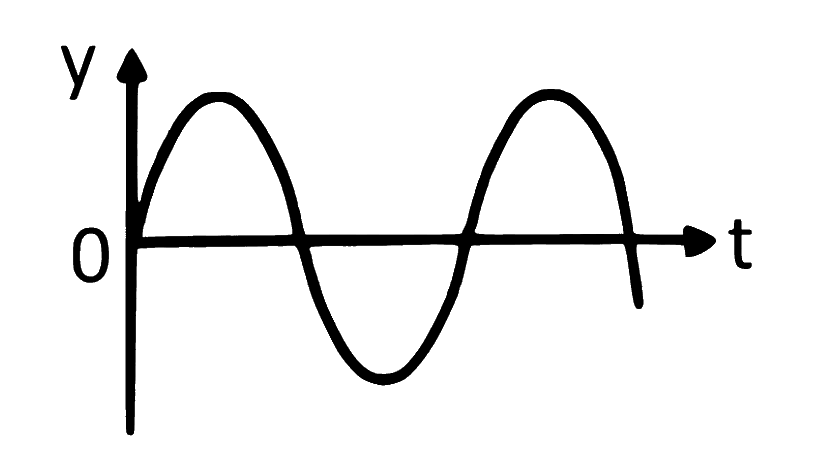
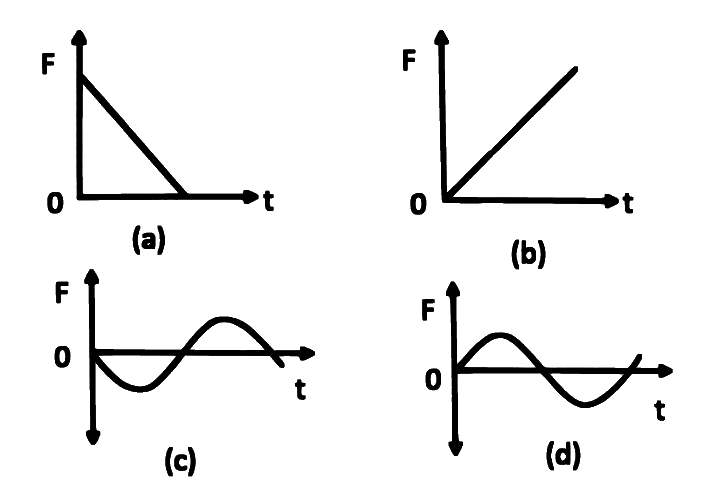
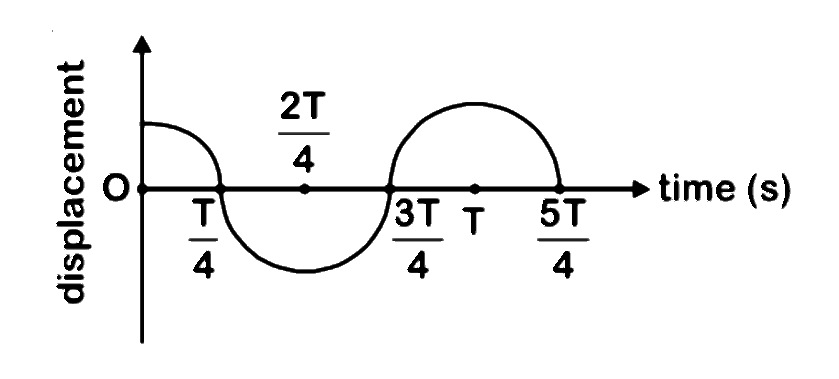
A particle is performing S.H.M. starting from extreme position. Graphical representation shows that between displacement and acceleration, there is a phase difference of
A particle executes a linear S.H.M. In two of its positions the velocities are V1,V2 and accelerations are a1 and a2 respectively (0<a1<a2). The distance between the positions is
For a particle executing S.H.M. having amplitude A, the speed of the particle is (31)rd of its maximum speed when the displacement from the mean position is
A particle is performing S.H.M. about its mean position with an amplitude ' a ' and periodic time ' T '. The speed of the particle when its displacement from mean position is 3a will be
A particle is performing S.H.M. with an amplitude 4 cm. At the mean position the velocity of the particle is 12 cm/s. When the speed of the particle becomes 6 cm/s, the distance of the particle from mean position is
The maximum velocity and maximum acceleration of a particle performing a linear S.H.M. is ' α ' and ' β ' respectively. Then the path length of the particle is
A particle performing S.H.M. starts from equilibrium position and its time period is 12 second. After 2 seconds its velocity is π m/s. Amplitude of the oscillation is
The velocity of particle executing S.H.M. varies with displacement (x) as 4V2=50−x2. The time period of oscillation is 7x second. The value of ' x ' is (Take π=722)
The displacement of a particle executing SHM is given by x=10sin(ωt+3π) m. The time period of motion is 3.14 s. The velocity of the particle at t=0 is _______ m/s.
Numerical answer type. Work it out, then open the answer.
A particle performs simple harmonic motion with amplitude A. Its speed is increased to three times at an instant when its displacement is 32A. The new amplitude of motion is 3nA. The value of n is ___________.
Numerical answer type. Work it out, then open the answer.
A particle executes simple harmonic motion with an amplitude of 4 cm. At the mean position, velocity of the particle is 10 cm/s. The distance of the particle from the mean position when its speed becomes 5 cm/s is α cm, where α= ________.
Numerical answer type. Work it out, then open the answer.
A particle performs linear S.H.M. When the displacement of the particle from mean position is 3 cm and 4 cm, corresponding velocities are 8 cm/s and 6 cm/s respectively. Its periodic time is
A particle is executing a linear simple harmonic motion. Let ' V1 ' and ' V2 ' are its speed at distance ' x1 ' and ' x2 ' from the equilibrium position. The amplitude of oscillation is
The position, velocity and acceleration of a particle executing simple harmonic motion are found to have magnitudes of 4 m,2 m s−1 and 16 m s−2 at a certain instant. The amplitude of the motion is x m where x is _________.
Numerical answer type. Work it out, then open the answer.
A horizontal platform with a small object placed on it executes a linear S.H.M. in the vertical direction. The amplitude of oscillation is 40 cm. What should be the least period of these oscillations, so that the object is not detached from the platform? [Take g=10 m/s2]
A particle performs linear S.H.M. At a particular instant, velocity of the particle is ' u ' and acceleration is ' α ' while at another instant, velocity is ' v ' and acceleration is ' β ' (0<α<β). The distance between the two positions is
A particle performs linear S.H.M. At a particular instant, velocity of the particle is ' u ' and acceleration is ' a1 ' while at another instant velocity is ' v ' and acceleration is ' a2 ' (0<a1<a2). The distance between the two positions is
The maximum velocity of a particle performing S.H.M. is 'V'. If the periodic time is made (31)rd and the amplitude is doubled, then the new maximum velocity of the particle will be
The velocity of a particle executing SHM varies with displacement (x) as 4v2=50−x2. The time period of oscillations is 7x s. The value of x is ___________. ( Take π=722)
Numerical answer type. Work it out, then open the answer.
A rectangular block of mass 5 kg attached to a horizontal spiral spring executes simple harmonic motion of amplitude 1 m and time period 3.14 s. The maximum force exerted by spring on block is _________ N
Numerical answer type. Work it out, then open the answer.
A particle of mass 250 g executes a simple harmonic motion under a periodic force F=(−25x) N. The particle attains a maximum speed of 4 m/s during its oscillation. The amplitude of the motion is ___________ cm.
Numerical answer type. Work it out, then open the answer.
A block of mass 'M' rests on a piston executing S.H.M. of period one second. The amplitude of oscillations, so that the mass is separated from the piston, is (acceleration due to gravity, g=10 m s−2,π2=10)
A particle executing SHM has its velocity 20 cm s−1 at mean position and acceleration of 25 cm s−2 at one of its extreme position. The amplitude of the particle will be ____ cm.
Numerical answer type. Work it out, then open the answer.
A body is performing simple harmonic with an amplitude of 10 cm. The velocity of the body was tripled by air jet when it is at 5 cm from its mean position. The new amplitude of vibration is x cm. The value of x is _____________.
Numerical answer type. Work it out, then open the answer.
A particle executing S.H.M starts from the mean position. Its amplitude is 'A' and time period 'T'. At what displacement its speed is one-fourth of the maximum speed?
A particle executes S.H.M. with amplitude 'a', and time period 'T'. The displacement of the particle when its speed is half of maximum speed is 2xa. The value of x is __________.
Numerical answer type. Work it out, then open the answer.
The displacement of a particle performing S.H.M. is given by x=5sin(3t+3), where x is in cm and t is in second. The maximum acceleration of the particle will be
A particle executes S.H.M. of period 32π second along a straight line 4 cm long. The displacement of the particle at which the velocity is numerically equal to the acceleration is
A particle performing linear S.H.M. of amplitude 0.1 m has displacement 0.02 m and acceleration 0.5 m/s2. The maximum velocity of the particle in m/s is
A particle is making simple harmonic motion along the X-axis. If at a distances x1 and x2 from the mean position the velocities of the particle are v1 and v2 respectively. The time period of its oscillation is given as:
A particle is performing a linear simple harmonic motion of amplitude ' A '. When it is midway between its mean and extreme position, the magnitudes of its velocity and acceleration are equal. What is the periodic time of the motion?
A particle executes simple harmonic motion with an amplitude of 5 cm. When the particle is at 4 cm from the mean position, the magnitude of its velocity in SI units is equal to that of its acceleration. Then, its periodic time in seconds is -
If ' x ', v ' and ' a ' denote the displacement, velocity and acceleration of a particle respectively executing SHM of periodic time T then which one of the following does not change with time?
A pendulum is hung from the roof of a sufficiently high building and is moving freely to and fro like a simple harmonic oscillator. The acceleration of the bob of the pendulum is 20 m s–2 at a distance of 5 m from the mean position. The time period of oscillation is
A particle executes linear simple harmonic motion with an amplitude of 3 cm. When the particle is at 2 cm from the mean position, the magnitude of its velocity is equal to that of its acceleration. Then its time period in second is
The ratio of maximum acceleration to maximum velocity in a simple harmonic motion is 10 s−1. At, t = 0 the displacement is 5 m. What is the maximum acceleration? The initial phase is 4π.
A particle performs simple harmonic motion with amplitude A. Its speed is trebled at the instant that it is at a distance 32A from equilibrium position. The new amplitude of the motion is:
In an engine the piston undergoes vertical simple harmonic motion with amplitude 7 cm. A washer rests on top of the piston and moves with it. The motor speed is slowly increased. The frequency of the piston at which the washer no longer stays in contact with the piston, is close to:
A particle is executing SHM along a straight line. Its velocities at distances x1 and x2 from the mean position are V1 and V2 respectively. Its time period is
A particle of mass m oscillates along x-axis according to equation x = asinωt. The nature of the graph between momentum and displacement of the particle is
A mass m=1.0 kg is put on a flat pan attached to a vertical spring fixed on the ground. The mass of the spring and the pan is negligible. When pressed slightly and released, the mass executes simple harmonic motion. The spring constant is 500 N/m. What is the amplitude A of the motion, so that the mass m tends to get detached from the pan? (Take g=10 m/s2 ). The spring is stiff enough so that it does not get distorted during the motion.
If x,v and a denote the displacement, the velocity and the acceleration of a particle executing simple harmonic motion of time period T, then, which of the following does not change with time?
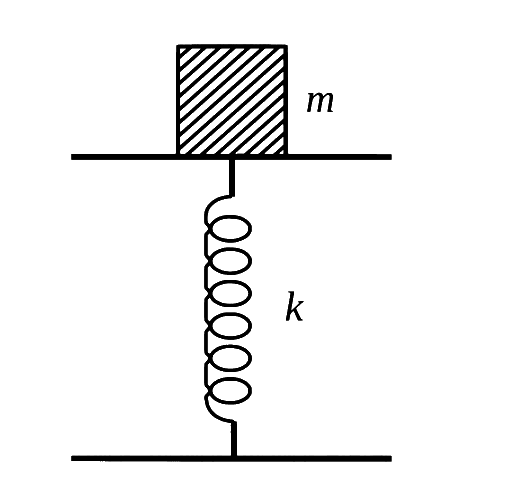
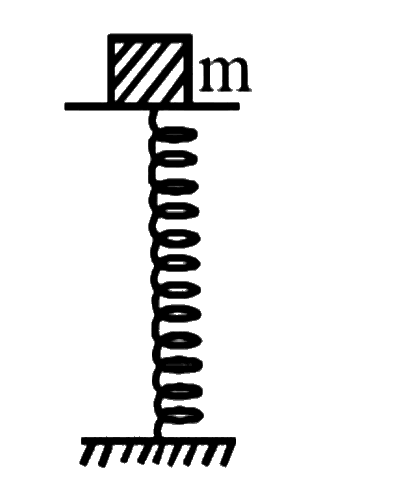
A mass of 2.0 kg is put on a flat pan attached to a vertical spring fixed on the ground as shown in the figure. The mass of the spring and the pan is negligible.
When pressed slightly and released the mass executes a simple harmonic motion. The spring constant is 200 N/m. What should be the minimum amplitude of the motion so that the mass gets detached from the pan (take g = 10 m/s2).
A coin is placed on a horizontal platform which undergoes vertical simple harmonic motion of angular frequency ω. The amplitude of oscillation is gradually increased. The coin will leave contact with the platform for the first time
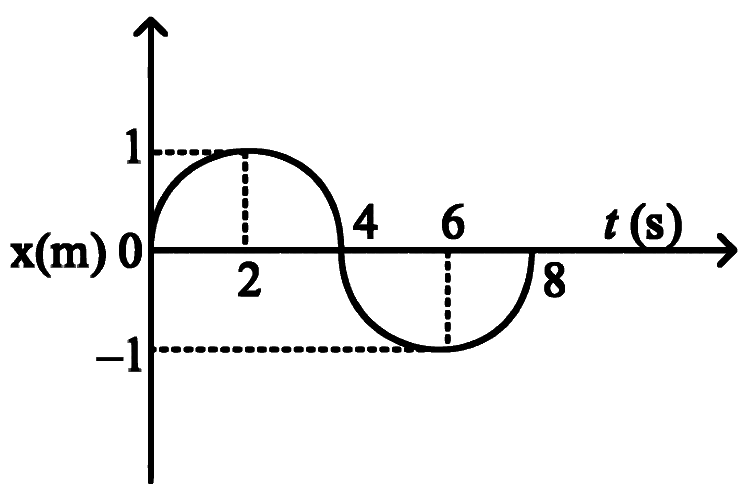
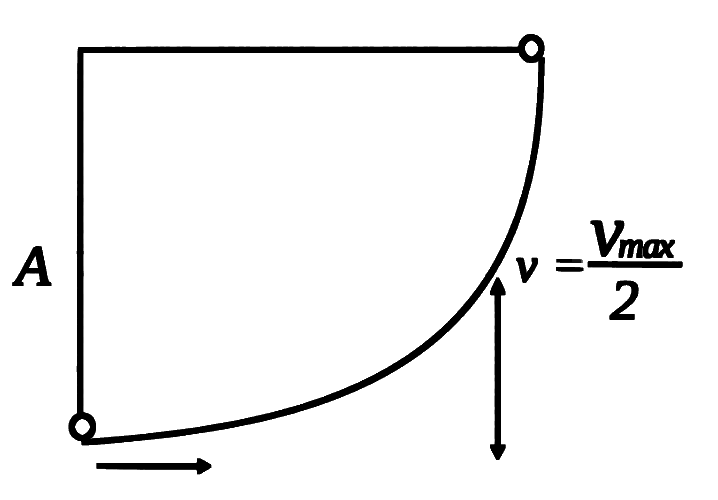
A particle starts with S.H.M. from the mean position as shown in the figure. Its amplitude is A and its time period is T. At one time, its speed is half that of the maximum speed. What is this displacement?
If a simple harmonic oscillator has got a displacement of 0.02 m and acceleration equal to 2.0 m/s2 at any time, the angular frequency of the oscillator is equal to
A body is executing simple harmonic motion. When the displacements from the mean position is 4 cm and 5 cm, the corresponding velocities of the body is 10 cm/sec and 8 cm/sec. Then the time period of the body is
A particle executes linear simple harmonic motion with amplitude of 2cm. When the particle is at 1cm from the mean position, the magnitudes of the velocity and the acceleration are equal. Then its time period (in seconds) is
A person sitting inside an elevator performs a weighing experiment with an object of mass 50kg. Suppose that the variation of the height y (in m) of the elevator, from the ground, with time t (in s) is given by y=8[1+sin(T2πt)], where T=40πs. Taking acceleration due to gravity, g=10m s−2, the maximum variation of the object's weight (in N) as observed in the experiment is ______.
Numerical answer type. Work it out, then open the answer.
The velocity vector v and displacement vector x of a particle executing SHM are related as dxvdv=−ω2x with the initial condition v=v0 at x=0. The velocity v, when displacement is x, is
A particle executes simple harmonic oscillation with an amplitude a. The period of oscillation is T. The minimum time taken by the particle to travel half of the amplitude from the equilibrium position is
A body is executing SHM. When its displacements from the mean position are 4cm and 5cm it has velocity 10cm s−1 and 8cm s−1 respectively. Its periodic time t is
A particle is performing simple harmonic motion. The equation of its motion is x=5sin(4t−6π), x being the displacement from the mean position. The velocity (in m s−1) of the particle at the instant when its displacement is 3 will be
A particle executes a linear SHM with an amplitude of 4cm. At the mean position the velocity of the particle is 10cm s−1. What is the displacement of the particle when its speed becomes 5cm s−1?
The displacement of a particle executing SHM is given by x=3sin[2πt+4π], where x is in metre and t is in seconds. The amplitude and maximum speed of the particles is
The equation of motion of a particle executing simple harmonic motion is given by X=2[1.2sin2t−1.6cos2t], where X is displacement in metre and t is time in second. The velocity of the particle at a time of 0.125πs is
If the minimum time taken by a particle executing simple harmonic motion to move from extreme position to a point at a displacement of 86.6% of the amplitude is T, then the minimum time taken by the particle to move from mean position to a point at a displacement of 86.6% of the amplitude is,
A particle is executing simple harmonic motion with time period T and amplitude A. The distance travelled by the particle in 12T time starting from rest is
A particle starting from the origin executes simple harmonic motion along x-axis. Its velocity at any instant t is given by vx=22cos(2πt)cm s−1. The total distance covered by the particle in time t=4.5s is
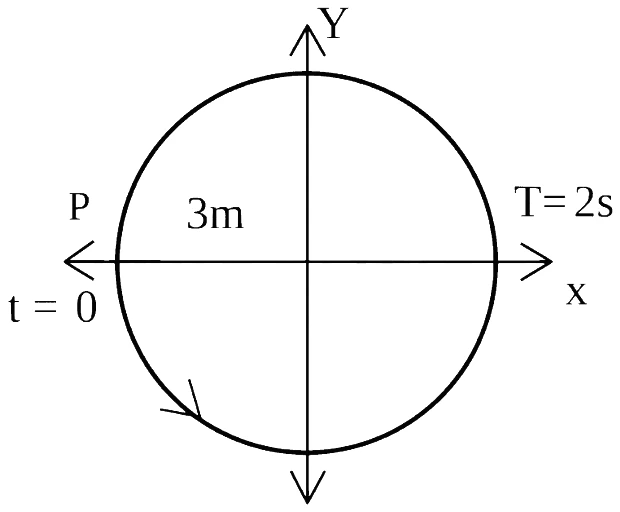
The figure corresponds to circular motion where the radius of the circle, the period of revolution, the initial position and sense of revolution (ie clockwise or anti-clockwise) are indicated. The corresponding simple harmonic motion of the x-projection of the radius vector of the revolving particle p is
If the displacement of a particle executing simple harmonic motion is given by x=0.5cos(125.6t), then the time period of oscillation of the particle is nearly (Here, x is displacement in metre and t is time in second)
If the maximum velocity and maximum acceleration of a particle executing simple harmonic motion are 5m s−1 and 10m s−2 respectively, then the time period of oscillation of the particle is
The equations for the displacements of two particles in simple harmonic motion are y1=0.1sin(100πt+3π) and y2=0.1cosπt respectively. The phase difference between the velocities of the two particles at a time t=0 is
A particle is executing simple harmonic motion with amplitude A. At a distance x from the mean position, when the particle is moving towards extreme position it receives a blow in the direction of motion which instantaneously doubles its velocity. The new amplitude of the particle is (Frequency is constant during the motion)
If the displacement x of a body in motion in terms of time t is given by x=Asin(ωt+θ), then the minimum time at which the displacement becomes maximum is
For a particle executing simple harmonic motion, match the following statements (conditions) from Column I to statements (shapes of graph) in Column II.
A particle is executing simple harmonic motion. If the minimum time taken by the particle to move from the extreme position to half of the amplitude is t1, and the minimum time taken by the particle to move from the mean position to half of the amplitude is t2, then
Under the action of force F=−75y, where F is in newton and y is in metres, an object of mass 3kg executes simple harmonic motion. If the velocity of the object at the mean position is 2.5m s−1, the maximum acceleration of the object is
For a particle executing simple harmonic motion, if the velocities at distances 6cm and 8cm from the mean position are 16πcm s−1 and 12πcm s−1 respectively, then the maximum acceleration of the particle (in cm s−2) is
A particle is executing simple harmonic motion. If the force acting on the particle at a position is 86.6% of the maximum force on it, then the ratio of its velocity at that point and its maximum velocity is
The force (F in newton) acting on a particle of mass 90g executing simple harmonic motion is given by F+0.04π2y=0, where y is displacement of the particle in metre. If the amplitude of the particle is π6m, then the maximum velocity of the particle is
A particle performs simple harmonic motion with a time period of 16s. At a time t=2s, the particle passes through the origin and at t=4s its velocity is 4m/s. The amplitude of the motion is
A particle is executing simple harmonic motion in one-dimension. If the amplitude of oscillations is 0.2cm and if its velocity at the mean position is 5m/s, then the angular frequency of the oscillation is
A body is oscillating in simple harmonic motion according to the equation x=6cos(2πt+3π)m. The magnitude of the acceleration (in m/s2) of the body at t=1s is
For a particle executing SHM, determine the ratio of average acceleration of the particle between extreme position and equilibrium position w.r.t. the maximum acceleration.
The variation of displacement with time of a simple harmonic motion (SHM) for a particle of mass m is represented by y=2sin(2πt+ϕ)cm. The maximum acceleration of the particle is
A particle is subjected to two simple harmonic motions in the same direction having equal amplitudes and equal frequency. If the resultant amplitude is equal to the amplitude of the individual motion, the phase difference (δ) between the two motion is
In case of a simple harmonic motion, if the velocity is plotted along the X-axis and the displacement (from the equilibrium position) is plotted along the Y-axis, the resultant curve happens to be an ellipse with the ratio minor axis (along Y)major axis (along X)=20π
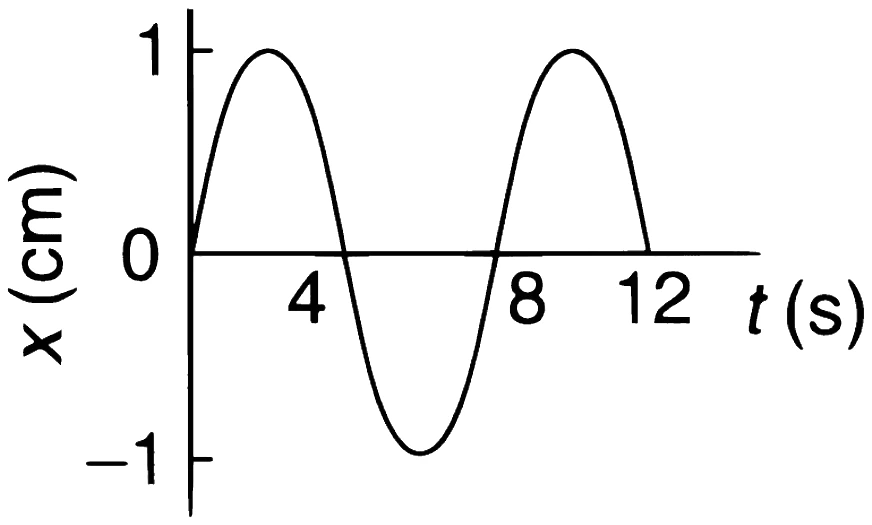
What is the frequency of the simple harmonic motion?
The velocity of a particle executing a simple harmonic motion is 13m s−1, when its distance from the equilibrium position (Q) is 3m and its velocity is 12m s−1, when it is 5m away from Q. The frequency of the simple harmonic motion is
A particle executes simple harmonic motion with time period T, amplitude A and maximum speed Vm. The particle is at the mean position when t=0. If y is the displacement from the mean position and v is the speed, then choose the correct statement(s) from the following in the time interval 0≤t≤T/4.
More than one option can be correct. Tap every correct option, then tap Check.

 Oscillations · Lecture 1 · Linear SHM & Displacement Equation1:08:13All 6 Oscillations videos →