
Electric Charge & Coulomb's Law
Two spherical hollow spheres of radii '' and '' are charged with same charge. Let '' and ' ' are their respective charge densities, then the ratio to is
Show answer and solution
Answer: (c)
Loading the solution…
Home›Practice Hub›Chapters›Electrostatics›Electric Charge & Coulomb's Law
Electrostatics PYQs · MHT CET · JEE Main · NEET
 Electrostatics · Lecture 1 · Electric Charge & Coulomb's Law1:36:55
 Electrostatics (Part 1) · Electric Charges, Coulomb’s Law & Electric Field1:00:18All 14 Electrostatics videos →
Electric Charge & Coulomb's Law
Two spherical hollow spheres of radii '' and '' are charged with same charge. Let '' and ' ' are their respective charge densities, then the ratio to is
Answer: (c)
Electric Charge & Coulomb's Law
Two point charges placed at a certain distance in air exert force on each other. Then the distance at which these charges will exert the same force in a medium of dielectric constant is
Answer: (c)
Electric Charge & Coulomb's Law
Two point charges and are '' distance apart. If one of the charges is doubled and the distance between them is halved. The magnitude of the force becomes 'n' times, where 'n' is
Answer: (c)
Electric Charge & Coulomb's Law
Two equal point charges exert a force F on each other when they are placed distance 'd' apart in air. When they are placed distance 'D' apart in a medium of dielectric constant K, they exert the same force. The distance D is equal to
Answer: (a)
Electric Charge & Coulomb's Law
If two charges and are separated with distance 'd' and placed in a medium of dielectric constant . What will be the equivalent distance between charges in air for the same electrostatic force?
Answer: (a)
Electric Charge & Coulomb's Law
Two point charges and are placed at points and respectively. Force on charge is ______ N. (Take SI Units)
Answer: (b)
Electric Charge & Coulomb's Law
A charge is placed at the centre of the line joining two equal charges . The system of the three charges will be in equilibrium if is equal to
Answer: (b)
Electric Charge & Coulomb's Law
Two point charges +e and +4e are kept at a distance 'd' units apart. Third point charge +q is placed between the two charges at a distance 'x' units from charge +e so as to be in equilibrium. The value of 'x' is
Answer: (a)
Electric Charge & Coulomb's Law
A point charge 'Q' is placed at the centre of the line joining two equal charges '+q' and '+q'. The value of 'Q' when the system is in equilibrium is
Answer: (d)
Electric Charge & Coulomb's Law
Two charged identical metal spheres A and B repel each other with a force N. Another identical uncharged sphere C is touched with A and then placed at the mid-point between A and B. Net force on C is N. The value of is
Answer: (d)
Electric Charge & Coulomb's Law
Charge of mass '' revolves around a stationary charge in a circular orbit of radius ''. The orbital periodic time of would be
Answer: (a)
Electric Charge & Coulomb's Law
Two point charges, and repel each other with a force of N. If a charge of is given to each of these charges, the force now is
Answer: (b)
Electric Charge & Coulomb's Law
Two point charges placed in air separated by distance exert a force on each other. Now the space between those charges is filled with dielectric constant . At distance between the charges, the same force is exerted as . Then
Answer: (d)
Electric Charge & Coulomb's Law
Three charges and are placed in a straight line of length at points at distance respectively. In order to make the net force on be zero, the value of should be
Answer: (b)
Electric Charge & Coulomb's Law
Two charged particles each having a charge '' and mass 'm' are kept at a distance 'd'. If they are in equilibrium under the gravitational force and the electric force between them, then the ratio (specific charge) of each particle is (- Universal gravitation constant, = permittivity of free space)
Answer: (c)
Electric Charge & Coulomb's Law
Two particles of charges and are placed as shown in figure. At what point away from on x-axis can a proton be placed placed so that it is in equilibrium?
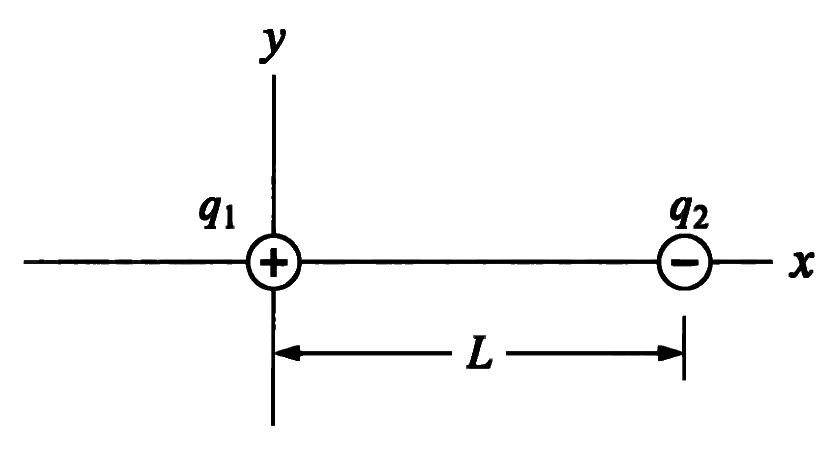
Answer: (a)
Electric Charge & Coulomb's Law
Two point charges and are ' ' distance apart. If one of the charges is doubled and distance between them is halved. The magnitude of force becomes times, where is
Answer: (c)
Electric Charge & Coulomb's Law
A positive ion and a negative ion has charges and , and masses and respectively. At an instant, the ions are separated by a certain distance . At that instant the ratio of the magnitudes of electrostatic force to gravitational force is , where the value of P is _________.
(Take and universal gravitational constant as )
Numerical answer type. Work it out, then open the answer.
Answer: b
Electric Charge & Coulomb's Law
Three equal charges are placed on the three corners of a square as shown below. If the magnitude of force between ' ' and ' ' is ' ' and that between ' ' and ' ' is , then the ratio of to is
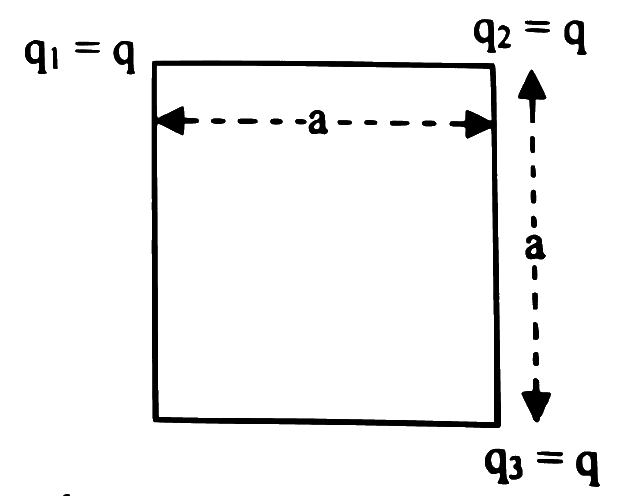
Answer: (c)
Electric Charge & Coulomb's Law
Two equally charged small balls placed at a fixed distance experience a force ' '. A similar uncharged ball after touching one of them is placed at the middle point between the two balls. the force experienced by this ball is
Answer: (b)
Electric Charge & Coulomb's Law
Two identical charged conducting spheres and have their centres separated by a certain distance. Charge on each sphere is and the force of repulsion between them is . A third identical uncharged conducting sphere is brought in contact with sphere first and then with and finally removed from both. New force of repulsion between spheres and (Radii of and are negligible compared to the distance of separation so that for calculating force between them they can be considered as point charges) is best given as:
Answer: (b)
Electric Charge & Coulomb's Law
A small uncharged conducting sphere is placed in contact with an identical sphere but having charge and then removed to a distance such that the force of repulsion between them is . The distance between them is (Take as in SI units)
Answer: (b)
Electric Charge & Coulomb's Law
Three charges ' ', ' ' and ' ' are placed in a straight line of length ' ' at points at distances and respectively. The value of Q in order to have the net force on +q to be zero, . The value of is
Answer: (b)
Electric Charge & Coulomb's Law
Two charges and placed as shown in figure. A proton is placed on x -axis away from . To remain proton in equilibrium, the distance between and proton is
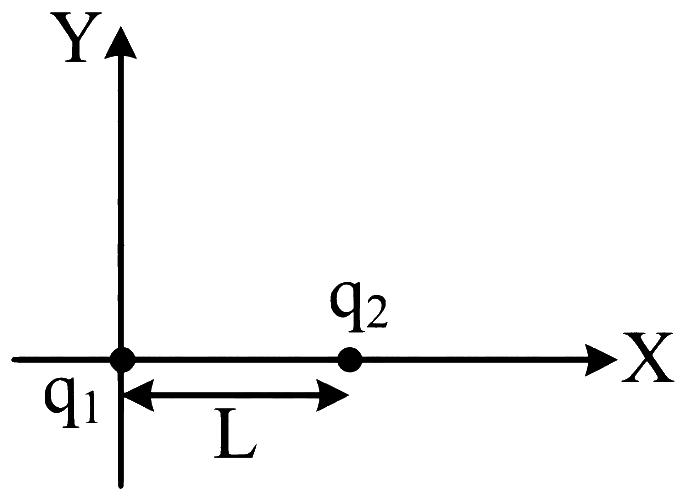
Answer: (a)
Electric Charge & Coulomb's Law
A metal cube of side is charged with . The surface charge density on the cube is
Answer: (d)
Electric Charge & Coulomb's Law
In hydrogen like system the ratio of coulombian force and gravitational force between an electron and a proton is in the order of:
Answer: (b)
Electric Charge & Coulomb's Law
Two equal point charges ' ' each exert a force ' ' on each other, when they are placed distance ' ' apart in air. When the same charges are placed distance ' ' apart in a medium of dielectric constant ' ', they exert the same force. The ratio of distance ' ' to ' ' is equal to
Answer: (a)
Electric Charge & Coulomb's Law
Force between two point charges and placed in vacuum at '' cm apart is . Force between them when placed in a medium having dielectric constant at '' apart will be:
Answer: (a)
Electric Charge & Coulomb's Law
Two point charges and repel each other with a force of is increased by and is decreased by . If they are kept at their original positions the change in the force of repulsion between them is
Answer: (d)
Electric Charge & Coulomb's Law
Two point charges and and are placed along a line separated by a distance I '. Force acting between them is F. If of charge from point is transferred to that at point B, the force between the charges now becomes
Answer: (c)
Electric Charge & Coulomb's Law
Two identical conducting spheres P and S with charge Q on each, repel each other with a force . A third identical uncharged conducting sphere is successively brought in contact with the two spheres. The new force of repulsion between and is:
Answer: (b)
Electric Charge & Coulomb's Law
A charge is placed at each of the diagonally opposite corners of a square. A charge -q is placed at each of the other diagonally opposite corners as shown. If the net electrical force on is zero, then is equal to
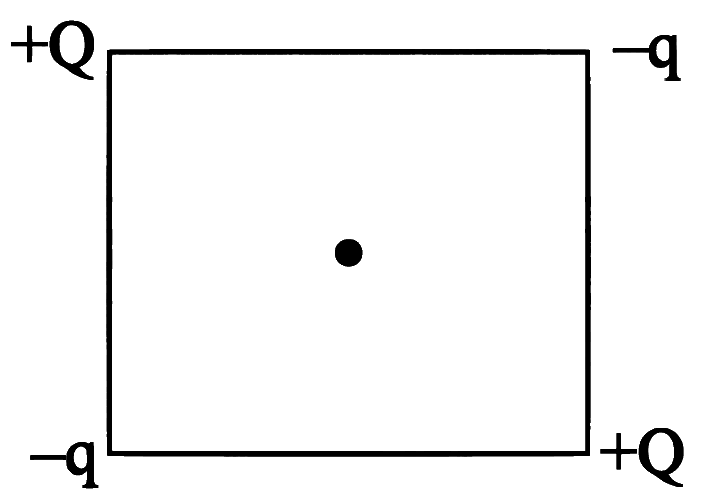
Answer: (d)
Electric Charge & Coulomb's Law
Charges and Q are placed along x -axis at positions and respectively. When the force on charge Q is zero, the value of is
Answer: (d)
Electric Charge & Coulomb's Law
Two identical charged spheres are suspended by strings of equal lengths. The strings make an angle with each other. When suspended in water the angle remains the same. If density of the material of the sphere is , the dielectric constant of water will be __________. (Take density of water )
Numerical answer type. Work it out, then open the answer.
Answer: 3
Electric Charge & Coulomb's Law
Two identical charged spheres are suspended by strings of equal lengths. The strings make an angle of with each other. When suspended in a liquid of density , the angle remains same. If density of material of the sphere is , the dielectric constant of the liquid is _______
Numerical answer type. Work it out, then open the answer.
Answer: 2
Electric Charge & Coulomb's Law
A thin metallic wire having cross sectional area of is used to make a ring of radius . A positive charge of is uniformly distributed over the ring, while another positive charge of 30 is kept at the centre of the ring. The tension in the ring is ______ ; provided that the ring does not get deformed (neglect the influence of gravity). (given, SI units)
Numerical answer type. Work it out, then open the answer.
Answer: 3
Electric Charge & Coulomb's Law
Select the correct statement from the following.
Answer: (c)
Electric Charge & Coulomb's Law
Two positively charged identical spheres separated by a distance 'd' exert some force (F) on each other when they are kept in air. If both the spheres are immersed in a liquid of dielectric constant 5, the force experienced by each is (All other parameters are unchanged.)
Answer: (d)
Electric Charge & Coulomb's Law
A charge is divided into two parts and placed at distance so that the repulsive force between them is maximum. The charges of the two parts are:
Answer: (b)
Electric Charge & Coulomb's Law
If two charges q and q are separated with distance 'd' and placed in a medium of dielectric constant K. What will be the equivalent distance between charges in air for the same electrostatic force?
Answer: (a)
Electric Charge & Coulomb's Law
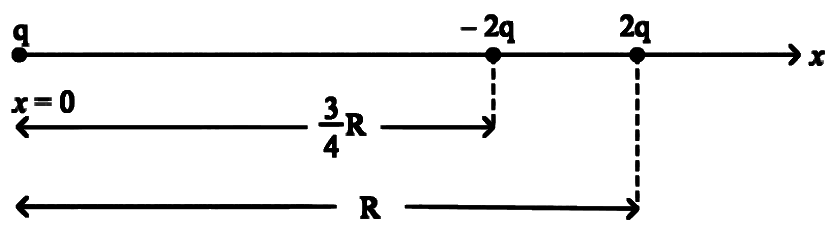
Three point charges and are placed on -axis at a distance and respectively from origin as shown. If and , the magnitude of net force experienced by the charge is ___________ N.
Numerical answer type. Work it out, then open the answer.
Answer: 5440
Electric Charge & Coulomb's Law
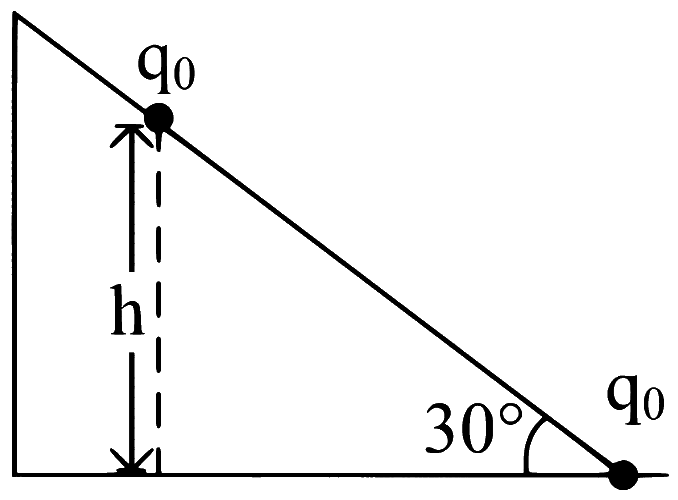
As shown in the figure, a configuration of two equal point charges is placed on an inclined plane. Mass of each point charge is . Assume that there is no friction between charge and plane. For the system of two point charges to be in equilibrium (at rest) the height .
The value of is ____________.
(Take )
Numerical answer type. Work it out, then open the answer.
Answer: 300
Electric Charge & Coulomb's Law
A point charge is placed at origin. Another point charge is placed at cm. Charge of proton is . The proton is placed on axis so that the electrostatic force on the proton is zero. In this situation, the position of the proton from the origin is ___________ cm.
Numerical answer type. Work it out, then open the answer.
Answer: 24
Electric Charge & Coulomb's Law
A charge of is to be divided into two. The distance between the two divided charges is constant. The magnitude of the divided charges so that the force between them is maximum, will be:
Answer: (b)
Electric Charge & Coulomb's Law
Three equal charges '', ' ' and '' are placed on the three corners of a square of side 'a'. If the force between and is '' and that between and is '', then the ratio of magnitudes is
Answer: (d)
Electric Charge & Coulomb's Law
Two identical metallic spheres and when placed at certain distance in air repel each other with a force of . Another identical uncharged sphere is first placed in contact with and then in contact with and finally placed at midpoint between spheres A and B. The force experienced by sphere C will be:
Answer: (b)
Electric Charge & Coulomb's Law
Three point charges of magnitude and are located at the vertices of a right angled triangle whose sides are and and point is the right angle corner. Charge at point experiences ____________ of electrostatic force due to the other two charges.
Numerical answer type. Work it out, then open the answer.
Answer: 17
Electric Charge & Coulomb's Law
Two identical charged particles each having a mass 10 g and charge 2.0 107C are placed on a horizontal table with a separation of L between them such that they stay in limiting equilibrium. If the coefficient of friction between each particle and the table is 0.25, find the value of L. [Use g = 10 ms]
Answer: (a)
Electric Charge & Coulomb's Law
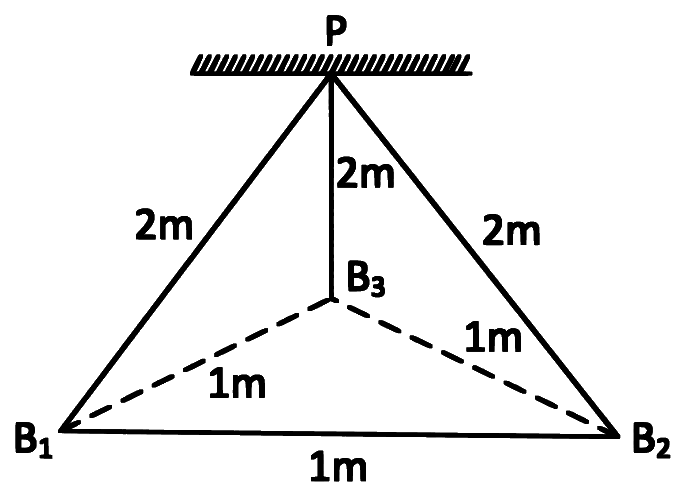
Three identical charged balls each of charge 2 C are suspended from a common point P by silk threads of 2 m each (as shown in figure). They form an equilateral triangle of side 1m. The ratio of net force on a charged ball to the force between any two charged balls will be:
Answer: (d)
Electric Charge & Coulomb's Law
Two positive ions, each carrying a charge 'q' are separated by a distance 'd'. If 'F' is the force of repulsion between the ions, the number of electrons from each ion will be ( = charge on = permittivity of free space)
Answer: (d)
Electric Charge & Coulomb's Law
When a piece of polythene is rubbed with wool, a negative charge of is developed on the polythene. The number of electrons transferred from wool to polythene is
Answer: (d)
Electric Charge & Coulomb's Law
'' is the force between the two identical charged particles placed at a distance '' from each other. If the distance between the charges is reduced to half the previous distance then force between them becomes
Answer: (b)
Electric Charge & Coulomb's Law
A certain charge Q is divided into two parts q and (Q q). How should the charges Q and q be divided so that q and (Q q) placed at a certain distance apart experience maximum electrostatic repulsion?
Answer: (a)
Electric Charge & Coulomb's Law
Three charges each of are placed at the corners of an equilateral triangle. If the repulsive force between any two charges is , then the net force on either charge will be []
Answer: (d)
Electric Charge & Coulomb's Law
A point charge is placed at the centre of the line joining two equal point charges and . The value of if the system of the charges is in equilibrium, is
Answer: (b)
Electric Charge & Coulomb's Law
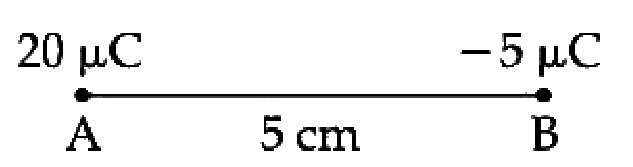
Two particles A and B having charges 20C and C respectively are held fixed with a separation of 5 cm. At what position a third charged particle should be placed so that it does not experience a net electric force?
Answer: (b)
Electric Charge & Coulomb's Law
Two point charges and repel each other with a force of . If a charge of is added to each of them, then force between them will become
Answer: (a)
Electric Charge & Coulomb's Law
Two identical conducting spheres with negligible volume have 2.1 nC and 0.1 nC charges, respectively. They are brought into contact and then separated by a distance of 0.5 m. The electrostatic force acting between the spheres is __________ 109 N.
[Given: SI unit]
Numerical answer type. Work it out, then open the answer.
Answer: 36
Electric Charge & Coulomb's Law
An infinite number of point charges, each carrying 1 C charge, are placed along the y-axis at y = 1 m, 2 m, 4 m, 8 m ...............
The total force on a 1C point charge, placed at the origin, is x 103 N.
The value of x, to the nearest integer, is __________. [Take Nm2/C2]
Numerical answer type. Work it out, then open the answer.
Answer: 12
Electric Charge & Coulomb's Law
Two identical tennis balls each having mass 'm' and charge 'q' are suspended from a fixed point by threads of length 'l'. What is the equilibrium separation when each thread makes a small angle '' with the vertical?
Answer: (b)
Electric Charge & Coulomb's Law
Two small spheres each of mass 10 mg are suspended from a point by threads 0.5 m long. They are equally charged and repel each other to a distance of 0.20 m. The charge on each of the sphere is C. The value of 'a' will be ___________. [Given g = 10 ms]
Numerical answer type. Work it out, then open the answer.
Answer: 20
Electric Charge & Coulomb's Law
The acceleration of an electron due to the mutual attraction between the electron and a proton when they are 1.6 Å apart is,
(Take )
Answer: (d)
Electric Charge & Coulomb's Law
In case of dimensions of electric field and electric dipole moment the power of mass is respectively,
Answer: (b)
Electric Charge & Coulomb's Law
Three charges + Q, q, + Q are placed respectively, at distance, 0, d/2 and d from the origin, on the x- axis. If the net force experienced by + Q, placed at x = 0, is zero, then value of q is:
Answer: (a)
Electric Charge & Coulomb's Law
Two point charges A and B, having charges +Q and – Q respectively, are placed at certain distance apart and force acting between them is F. If 25% charge of A is transferred to B, then force between the charges becomes:
Answer: (c)
Electric Charge & Coulomb's Law
Two identical conducting spheres A and B, carry equal charge. They are separated by a distance much larger than their diameters, and the force between them is F. A third identical conducting sphere, C, is uncharged. Sphere C is first touched to A, then to B, and then removed. As a result, the force between A and B would be equal to:
Answer: (c)
Electric Charge & Coulomb's Law
Suppose the charge of a proton and an electron differ slightly. One of them is e, the other is (e + e). If the net of electrostatic force and gravitational force between two hydrogen atoms placed at a distance d (musch greater than atomic size) apart is zero, then e is of the order of [Given: mass of hydrogen mh = 1.67 1027 kg]
Answer: (b)
Electric Charge & Coulomb's Law
Two identical charged spheres suspended from a common point by two massless strings of lengths , are initially at a distance d(d < < ) apart because of their mutual repulsion. The charges begin to leak from both the spheres at a constant rate. As a result, the spheres approach each other with a velocity v. Then v varies as a function of the distance x between the spheres, as
Answer: (a)
Electric Charge & Coulomb's Law
A charge q is placed at the centre of the line joining two equal charges Q. The system of the three charges will be in equilibrium if q is equal to
Answer: (a)
Electric Charge & Coulomb's Law
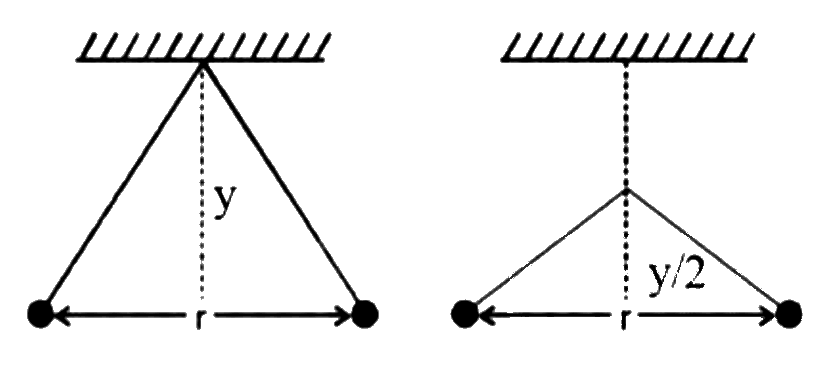
Two pith balls carrying equal charges are suspended from a common point by strings of equal length, the equilibrium separation between them is r. Now the strings are rigidly clamped at half the height. The equilibrium separation between the balls now becomes
Answer: (d)
Electric Charge & Coulomb's Law
Two small equal point charges of magnitude are suspended from a common point on the ceiling by insulating mass less strings of equal lengths. They come to equilibrium with each string making angle from the vertical. If the mass of each charge is , then the electrostatic potential at the centre of line joining them will be .
Answer: (c)
Electric Charge & Coulomb's Law
Two balls of same mass and carrying equal charge are hung from a fixed support by threads of length . At electrostatic equilibrium, assuming that angles made by each thread is small, the separation, x between the balls is proportional to:
Answer: (d)
Electric Charge & Coulomb's Law
Two identical charged spheres suspended from a common point by two massless strings of length are initially a distance apart because of their mutual repulsion. The charge begins to leak from both the spheres at a constant rate. As a result charges approach each other with a velocity . Then as a function of distance between them,
Answer: (d)
Electric Charge & Coulomb's Law
Two positive ions, each carrying a charge q, are separated by a distance d. If F is the force of repulsion between the ions, the number of electrons missing from each ion will be (e being the charge on an electron)
Answer: (c)
Electric Charge & Coulomb's Law
Two identical charged spheres are suspended by strings of equal lengths. The strings make an angle of with each other. When suspended in a liquid of density the angle remains the same. If density of the material of the sphere is the dielectric constant of the liquid is
Answer: (c)
Electric Charge & Coulomb's Law
A charge is placed at each of the opposite corners of a square. A charge is placed at each of the other two corners. If the net electrical force on is zero, then equals:
Answer: (d)
Electric Charge & Coulomb's Law
Two spherical conductors and having equal radii and carrying equal charges on them repel each other with a force when kept apart at some distance. A third spherical conductor having same radius as that of but uncharged is brought in contact with then brought in contact with and finally removed away from both. The new force of repulsion between and is
Answer: (d)
Electric Charge & Coulomb's Law
Four charges equal to - are placed at the four corners of a square and a charge is at its center. If the system is in equilibrium the value of is
Answer: (b)
Electric Charge & Coulomb's Law
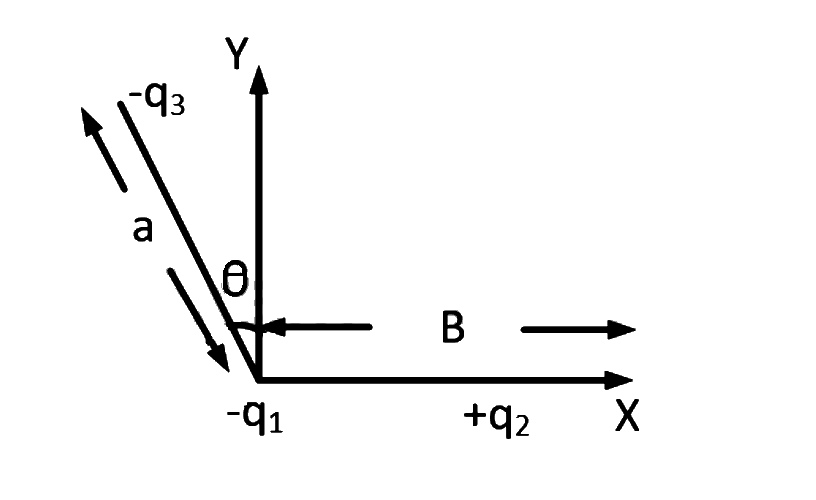
Three charges and are placed as shown in the figure. The -component of the force on is proportional to
Answer: (b)
Electric Charge & Coulomb's Law
If a charge is placed at the center of the line joining two equal charges such that the system is in equilibrium then the value of is
Answer: (d)
Electric Charge & Coulomb's Law
When air is replaced by a dielectric medium of constant , the maximum force of attraction between two charges, separated by a distance
Answer: (a)
Electric Charge & Coulomb's Law
A charge is placed at the centre of the line joining two exactly equal positive charges . The system of three charges will be in equilibrium, if is equal to
Answer: (c)
Electric Charge & Coulomb's Law
Point charges , and are kept on the -axis at point and respectively. Then
Answer: (c)
Electric Charge & Coulomb's Law
Two point charges of and are kept at a distance of . A third point charge of is kept between them such that the potential energy of the system is minimum. What is the magnitude of the electric field at the charge?
Answer: (a)
Step-by-step solution coming soon.
Electric Charge & Coulomb's Law
For a material under static conditions, which one among the following statements is correct?
Answer: (a)
Step-by-step solution coming soon.
Electric Charge & Coulomb's Law
Which one of the following is NOT a basic property of electric charge?
Answer: (d)
Step-by-step solution coming soon.
Electric Charge & Coulomb's Law
Which of the following statements correctly explains/explain the existence of a positive force between two electric charges?
1. Both the charges are positive.
2. Both the charges are negative.
3. Both the charges are oppositely charged.
Select the correct answer using the code given below.
Answer: (c)
Step-by-step solution coming soon.
Electric Charge & Coulomb's Law
Which one of the following can charge an insulator?
Answer: (b)
Step-by-step solution coming soon.
Electric Charge & Coulomb's Law
Suppose a rod is given a negative charge by rubbing it with wool. Which one of the following statements is correct in this case?
Answer: (d)
Step-by-step solution coming soon.
Electric Charge & Coulomb's Law
When you walk on a woolen carpet and bring your finger near the metallic handle of a door an electric shock is produced. This is because
Answer: (a)
Step-by-step solution coming soon.
Electric Charge & Coulomb's Law
When long dry hair is brushed the strands often move away from each other because while brushing
Answer: (b)
Step-by-step solution coming soon.
Electric Charge & Coulomb's Law
Two similarly charged bodies are kept apart in air. If the second body is shifted away from the first by another , their force of repulsion will be
Answer: (d)
Step-by-step solution coming soon.
Electric Charge & Coulomb's Law
A neutral (uncharged) metal ball is suspended using a non-magnetic string. A positively charged insulating rod is placed near the ball which is observed to be attracted to the rod. This is because
Answer: (c)
Step-by-step solution coming soon.
Electric Charge & Coulomb's Law
Two identical non-conducting solid spheres of same mass and charge are suspended in air from a common point by two non-conducting, massless strings of same length. At equilibrium, the angle between the strings is . The spheres are now immersed in a dielectric liquid of density and dielectric constant . If the angle between the strings remains the same after the immersion, then
More than one option can be correct. Tap every correct option, then tap Check.
Answer: (b), (c)
Step-by-step solution coming soon.
Electric Charge & Coulomb's Law
Four point charges, each of , are rigidly fixed at the four corners of a square planar soap film of side . The surface tension of the soap film is . The system of charges and planar film are in equilibrium, and , where is a constant. Then is ________.
Numerical answer type. Work it out, then open the answer.
Answer: 3
Step-by-step solution coming soon.
Electric Charge & Coulomb's Law
Assertion : Mass of a body decreases slightly when it is negatively charged.
Reason : Charging is due to transfer of electrons.
Answer: (d)
Step-by-step solution coming soon.
Electric Charge & Coulomb's Law
A particle having a charge is held fixed on a horizontal surface. A block of mass and having charge stays in equilibrium on the surface at a distance of from the first charge. The coefficient of friction between the surface and the block is . Find the range within which the charge on the block may lie
Answer: (a)
Step-by-step solution coming soon.
Electric Charge & Coulomb's Law
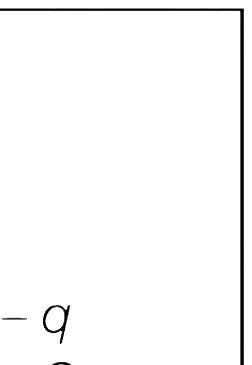
In the following diagrams, a particle with small charge is free to move up or down, but not sideways near a larger fixed charge . The small charge is in equilibrium because in the positions shown, the electrical upward force is equal to the weight of the particle. Which statement is true?
Answer: (c)
Step-by-step solution coming soon.
Electric Charge & Coulomb's Law
Three charged particles are collinear and are in equilibrium, then
Answer: (d)
Step-by-step solution coming soon.
Electric Charge & Coulomb's Law
A charge is divided into two parts of and . If the coulomb repulsion between them when they are separated is to be maximum, the ratio of should be
Answer: (a)
Step-by-step solution coming soon.
Electric Charge & Coulomb's Law
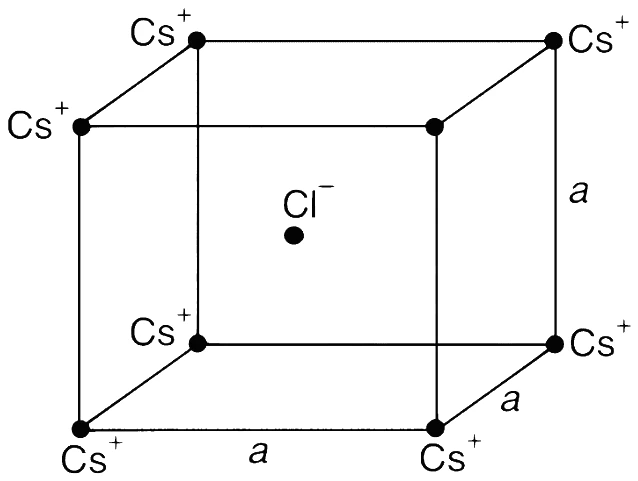
In the basic crystal structure, and ions are arranged in a bcc configuration as shown in the figure. The net electrostatic force exerted by the eight ions on the ion is :
Answer: (d)
Step-by-step solution coming soon.
Electric Charge & Coulomb's Law
The force of attraction between two charges and is . Find the distance of separation
Answer: (a)
Step-by-step solution coming soon.
Electric Charge & Coulomb's Law
If point charges and are at separation, then find electrostatic force between them
Answer: (b)
Step-by-step solution coming soon.
Electric Charge & Coulomb's Law
Two identical conducting balls and have positive charges and respectively. But . The balls are brought together so that they touch each other and then kept in their original positions. The force between them is
Answer: (b)
Step-by-step solution coming soon.
Electric Charge & Coulomb's Law
A certain charge is divided into two parts and . How the charge and must be related so that when and is placed at a certain distance apart experience maximum electrostatic repulsion?
Answer: (a)
Step-by-step solution coming soon.
Electric Charge & Coulomb's Law
The charges on two spheres are and respectively. They experience a force . If each of them is given an additional charge of , then the new force of attraction will be
Answer: (a)
Step-by-step solution coming soon.
Electric Charge & Coulomb's Law
Two small balls, each carrying a charge are suspended by equal insulator strings of length from the hook of a stand. This arrangement is carried in a satellite in space. The tension in each string will be
Answer: (b)
Step-by-step solution coming soon.
Electric Charge & Coulomb's Law
Three equal charges, each having a magnitude of , are placed at the three corners of a right angled triangle of sides , and . The force (in magnitude) on the charge at the right angled corner is
Answer: (d)
Step-by-step solution coming soon.
Electric Charge & Coulomb's Law
Two spherical conductors and having equal radii and carrying equal charges in them repel each other with a force when kept apart at some distance. A third spherical conductor having same radius as that of but uncharged, is brought in contact with , then brought in contact with and finally removed away from both. The new force of repulsion between and is
Answer: (d)
Step-by-step solution coming soon.
Electric Charge & Coulomb's Law
The ratio of electrostatic and gravitational forces acting between electron and proton separated by a distance , will be (Charge on electron , mass of electron , mass of proton , )
Answer: (a)
Step-by-step solution coming soon.
Electric Charge & Coulomb's Law
Four charges equal to are placed at the four corners of a square and a charge is at its centre. If the system is in equilibrium, then the value of is
Answer: (c)
Step-by-step solution coming soon.
Electric Charge & Coulomb's Law
Two small conducting spheres of equal radius have charges and respectively and placed at a distance from each other experience force . If they are brought in contact and separated to the same distance, they experience force . The ratio of to is
Answer: (c)
Step-by-step solution coming soon.
Electric Charge & Coulomb's Law
In given situation, force on charge is
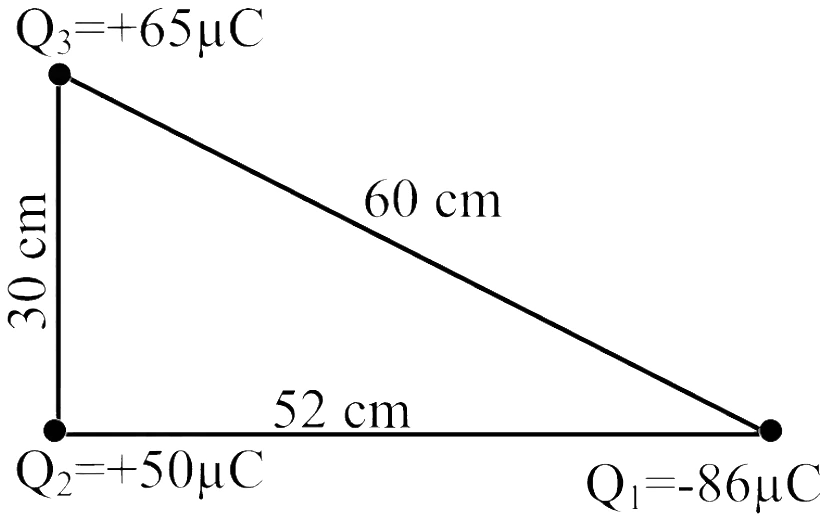
Answer: (d)
Step-by-step solution coming soon.
Electric Charge & Coulomb's Law
An electric charge does not have which of the following properties?
Answer: (d)
Step-by-step solution coming soon.
Electric Charge & Coulomb's Law
The net electric force on a charge of at the mid-point on the line joining two charges of magnitude and separated by the distance of , is
Answer: (c)
Step-by-step solution coming soon.
Electric Charge & Coulomb's Law
In a Millikan's oil drop experiment the charge on an oil drop is calculated to be . The number of excess electrons on the drop is
Answer: (b)
Step-by-step solution coming soon.
Electric Charge & Coulomb's Law
An infinite number of charge, each of charge are placed on the -axis with coordinates . If a charge of is kept at the origin, then what is the net force acting on charge?
Answer: (b)
Step-by-step solution coming soon.
Electric Charge & Coulomb's Law
In nature, the electric charge of any system is always equal to
Answer: (d)
Step-by-step solution coming soon.
Electric Charge & Coulomb's Law
Bodies are labelled as having charges , , , respectively.
Select the body having the correct charge.
[Given electronic charge ]
Answer: (d)
Step-by-step solution coming soon.
Electric Charge & Coulomb's Law
Two identical charged spheres are suspended by strings of equal lengths. The strings make an angle of with each other. When the system is immersed in a liquid of relative density , the angle between the strings remains unchanged. If the density of the material of the sphere is , what is the dielectric constant of the liquid?
Answer: (b)
Step-by-step solution coming soon.
Electric Charge & Coulomb's Law
A particle carrying a charge is moving in a circular path of radius around another particle having a charge with a frequency $
um$ of the charged particle is
Answer: (a)
Step-by-step solution coming soon.
Electric Charge & Coulomb's Law
Two identical conducting balls having positive charges and are separated by a distance . If they are made to touch each other and then separated to the same distance, the force between them will be
Answer: (d)
Step-by-step solution coming soon.
Electric Charge & Coulomb's Law
Two point charges and having charges and respectively are placed at a distance apart. Force acting between them is . If of charge of is transferred to , then the force between the charges becomes:
Answer: (c)
Step-by-step solution coming soon.
Electric Charge & Coulomb's Law
When electrons are removed from a neutral metal plate, the electric charge on it is
Answer: (b)
Step-by-step solution coming soon.
Electric Charge & Coulomb's Law
The force between two electric point charges at rest in air is . When the same arrangement is kept inside water, the force between them is . Which of the following statements is correct?
Answer: (d)
Step-by-step solution coming soon.
Electric Charge & Coulomb's Law
Charge on an electron is
Answer: (c)
Step-by-step solution coming soon.
Electric Charge & Coulomb's Law
Two charged spheres of and are kept at a certain distance. They are touched and kept again at the same distance. What is the ratio of force experienced before and after?
Answer: (b)
Step-by-step solution coming soon.
Electric Charge & Coulomb's Law
Insulators can be charged by which of the following process?
Answer: (c)
Step-by-step solution coming soon.
Electric Charge & Coulomb's Law
A charge of is divided into two charges and . These are kept at a separation of . The force on is maximum when
Answer: (a)
Step-by-step solution coming soon.
Electric Charge & Coulomb's Law
A body has a charge of . The number of excess electrons will be
Answer: (c)
Step-by-step solution coming soon.
Electric Charge & Coulomb's Law
A point charge of and another point charge of are kept apart in free space. The electrostatic force on due to is and the electrostatic force on due to is . Then
Answer: (b)
Step-by-step solution coming soon.
Electric Charge & Coulomb's Law
A positively charged glass rod is brought near an uncharged metal sphere, which is mounted on an insulated stand. If the glass rod is removed, the net charge on the metal sphere is
Answer: (b)
Step-by-step solution coming soon.
Electric Charge & Coulomb's Law
Four charges , , and are placed at the corners of a square respectively. The force on a unit positive charge kept at the centre is
Answer: (a)
Step-by-step solution coming soon.
Electric Charge & Coulomb's Law
Two protons are kept at a separation of . Let and be the nuclear force and the electrostatic force between them
Answer: (b)
Step-by-step solution coming soon.
Electric Charge & Coulomb's Law
A certain charge is divided at first into two parts and . Later the charges are placed at a certain distance. If the force of interaction between two charges is maximum then is
Answer: (c)
Step-by-step solution coming soon.
Electric Charge & Coulomb's Law
The force of repulsion between two identical positive charges when kept with a separation in air is . Half the gap between the two charges is filled by a dielectric slab of dielectric constant . Then, the new force of repulsion between those two charges becomes
Answer: (d)
Step-by-step solution coming soon.
Electric Charge & Coulomb's Law
Two spheres of electric charges and are placed at a distance apart. If they are allowed to touch each other, what is the new distance between them to get a repulsive force of same magnitude as before?
Answer: (c)
Step-by-step solution coming soon.
Electric Charge & Coulomb's Law
Two identical balls each of mass carry equal and opposite charge. They are suspended from a horizontal plate by silk threads each of length with a separation of between points of suspension. At equilibrium, if the distance between the balls is then, magnitude of charge on each ball is
(Acceleration due to gravity )
Answer: (a)
Step-by-step solution coming soon.
Electric Charge & Coulomb's Law
If two particles and of charges and respectively are separated by a distance of in air, then the magnitude of electrostatic force on particle due to particle is
Answer: (d)
Step-by-step solution coming soon.
Electric Charge & Coulomb's Law
A solid of mass has atoms. If one electron is removed from every one atom of of the atoms, then the charge gained by the solid is
Answer: (b)
Step-by-step solution coming soon.
Electric Charge & Coulomb's Law
The force between two conducting spheres of same radius having charges and separated by some distance in air is . If the spheres are connected by a conducting wire and after some time the wire is removed, then the magnitude of the force between the two conducting spheres is
Answer: (c)
Step-by-step solution coming soon.
Electric Charge & Coulomb's Law
The sum of two point positive charges separated by a distance of in air is . If the electrostatic force between the two charges is , then the difference between the two charges is
Answer: (a)
Step-by-step solution coming soon.
Electric Charge & Coulomb's Law
The force between two point charges kept with a separation of in air is . If a dielectric slab of constant , thickness and another dielectric slab of constant , thickness are introduced between the two charges, then the new force becomes
Answer: (a)
Step-by-step solution coming soon.
Electric Charge & Coulomb's Law
Two particles of equal mass and equal charge are separated by a distance of . They do not experience any force. The value of is (if is the universal gravitational constant and is the acceleration due to gravity)
Answer: (a)
Step-by-step solution coming soon.
Electric Charge & Coulomb's Law
Three point charges , and are placed along a straight line such that the charge lies at equidistant from the other two charges. The ratio of the net electrostatic force on charges and is
Answer: (d)
Step-by-step solution coming soon.
Electric Charge & Coulomb's Law
Two point charges and kept at certain distance repel each other with a force of . If each charge is given an additional charge of , the two charges
Answer: (a)
Step-by-step solution coming soon.
Electric Charge & Coulomb's Law
Electrostatic force between two identical charges placed in vacuum at distance of is . A slab of width and dielectric constant is inserted between these two charges, then the force between the charges is
Answer: (d)
Step-by-step solution coming soon.
Electric Charge & Coulomb's Law
In an isosceles right angled triangle ABC, the length of the two equal sides AB and AC is . If three charges , and are placed at the three vertices A, B and C of the triangle respectively, then the net electrostatic force acting on a particle of charge placed at the midpoint of the hypotenuse BC is
Answer: (d)
Step-by-step solution coming soon.
Electric Charge & Coulomb's Law
For any fixed distance, the electromagnetic force between two protons is times of the gravitational force between them. Then,
Answer: (d)
Step-by-step solution coming soon.
Electric Charge & Coulomb's Law
The electrostatic force between two charges kept in air is . If of the space between the charges is filled with a medium, then the electrostatic force between the charges becomes . The dielectric constant of the medium is
Answer: (c)
Step-by-step solution coming soon.
Electric Charge & Coulomb's Law
Four electric charges , , and are placed on -axis at distance , , and respectively. If the net force acting on the charge at origin is zero, then
Answer: (b)
Step-by-step solution coming soon.
Electric Charge & Coulomb's Law
Two positive point charges are separated by a distance of in air. If the sum of the two charges is and the electrostatic force between them is , then the bigger charge is
Answer: (c)
Step-by-step solution coming soon.
Electric Charge & Coulomb's Law
The ratio of relative strengths of the gravitational force and the electromagnetic force between two charged particles is
Answer: (c)
Step-by-step solution coming soon.
Electric Charge & Coulomb's Law
Two charges are and are separated by . The magnitude of force acting on another charge placed at the mid-point of the line joining the two charges will be (use, in SI unit)
Answer: (a)
Step-by-step solution coming soon.
Electric Charge & Coulomb's Law
Two charged particles of mass each are placed apart. If each of these possesses femto coulomb of charge, then the dominant force of interaction between them is
Answer: (a)
Step-by-step solution coming soon.
Electric Charge & Coulomb's Law
Two point charges and are placed a finite distance apart. It is desired to put a third charge in between these two charges, so that is in equilibrium. This is
Answer: (c)
Step-by-step solution coming soon.
Electric Charge & Coulomb's Law
Two pith balls, each carrying charge are hung from a hook by two strings. It is found that when each charge is tripled, angle between the strings doubles. What was the initial angle between the strings?
Answer: (b)
Step-by-step solution coming soon.
Electric Charge & Coulomb's Law
A charge of coulomb is divided into two charges and . These are kept at a separation of . The force on is maximum when
Answer: (a)
Step-by-step solution coming soon.
Electric Charge & Coulomb's Law
Consider two point charges and fixed on the - plane at and respectively. Another point charge having mass is released from rest at on the plane, as shown in the figure. The permittivity of free space is . What is the acceleration of the charge at the time of release?
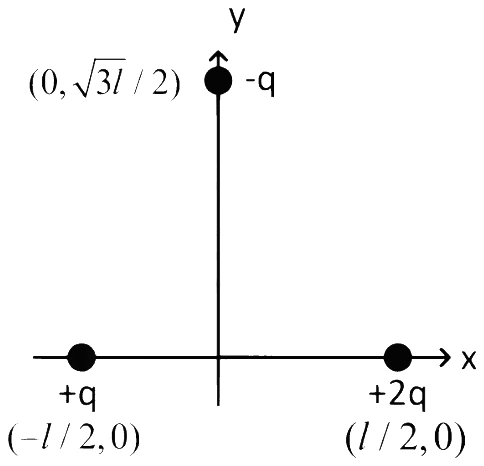
Answer: (c)
Step-by-step solution coming soon.
Electric Charge & Coulomb's Law
Particle with charge and particle with charge are fixed at positions and , respectively. The force on due to is , and that on due to is . Which of the following options is correct?
Answer: (b)
Step-by-step solution coming soon.
Electric Charge & Coulomb's Law
Magnitude of the electron charge
Mass of the proton
Permittivity of free space
Universal Gravitational constant
Two protons are separated by a distance of nanometer. The magnitudes of gravitational, electromagnetic and strong nuclear forces between them are denoted by , and respectively. Select the correct option.
Answer: (a)
Step-by-step solution coming soon.
Electric Charge & Coulomb's Law
The following property is common to both charge and mass:
Answer: (d)
Step-by-step solution coming soon.
Electric Charge & Coulomb's Law
Two positive equal charges are placed symmetrically about the origin on the -axis and kept fixed as shown. Another positive charge is placed at the origin. The charge can be displaced by a very small distance to along the -axis or to along the -axis. Then,
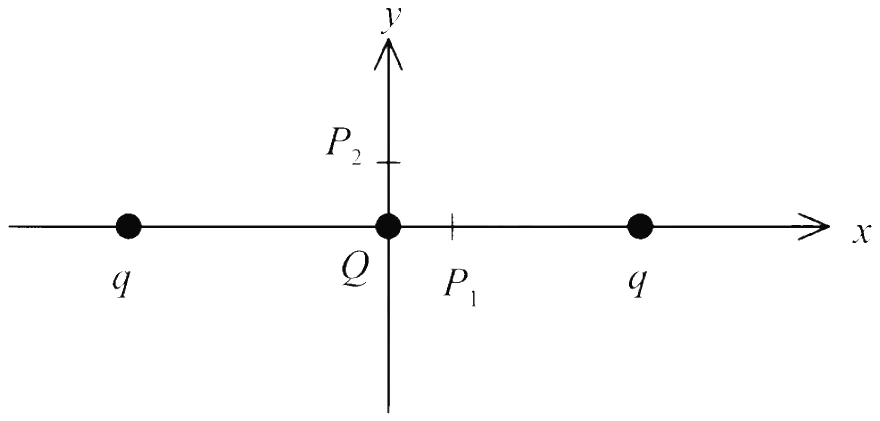
More than one option can be correct. Tap every correct option, then tap Check.
Answer: (a), (d)
Step-by-step solution coming soon.
Electric Charge & Coulomb's Law
Figure shows variation of Coulomb force () acting between two point charges with , being the separation between the two charges and . If is positive and least in magnitude, then the magnitudes of , and are such that
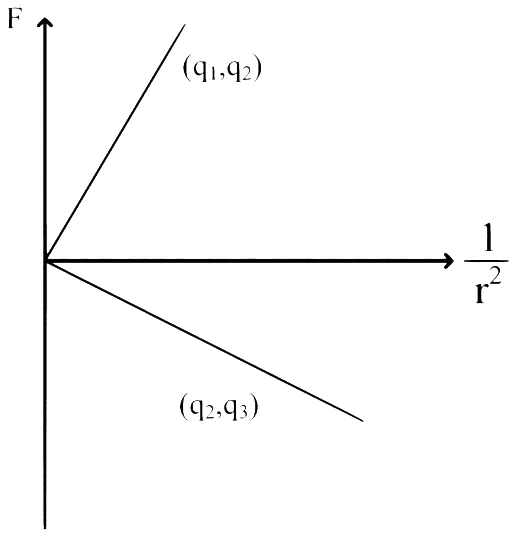
Answer: (a)
Step-by-step solution coming soon.
Electric Charge & Coulomb's Law
Beams of electrons and protons move parallel to each other in the same direction. They
Answer: (a)
Step-by-step solution coming soon.
Electric Charge & Coulomb's Law
A negatively charged object X is repelled by another charged object Y. However an object Z is attracted to object Y. Which of the following is the most possibility for the object Z?
Answer: (c)
Step-by-step solution coming soon.
Electric Charge & Coulomb's Law
In an experiment three microscopic latex spheres are sprayed into a chamber and became charged with charges , and respectively. All the three spheres came in contact simultaneously for a moment and got separated. Which one of the following are possible values for the final charge on the spheres?
Answer: (b)
Step-by-step solution coming soon.
Electric Charge & Coulomb's Law
An object has charge of and gains electrons. The net charge on the object becomes
Answer: (d)
Step-by-step solution coming soon.
Electric Charge & Coulomb's Law
Four objects , , and , each with charge are held fixed at four points of a square of side as shown in the figure. Objects and are on the midpoints of the sides of the square. The electrostatic force exerted by object on object is . Then the magnitude of the force exerted by object on is
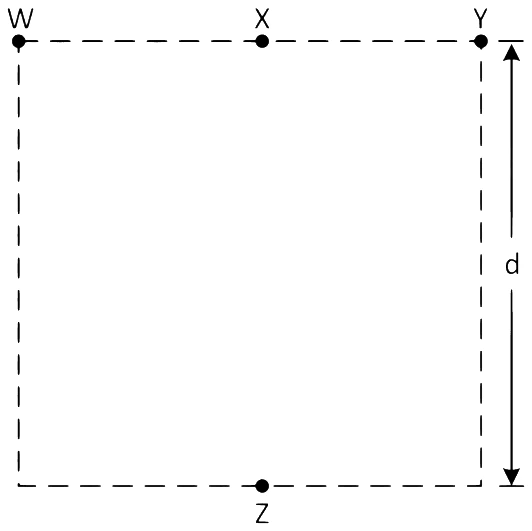
Answer: (b)
Step-by-step solution coming soon.
Electric Charge & Coulomb's Law
Three charges , and are placed as shown in figure. The magnitude of the net force on the charge at point is
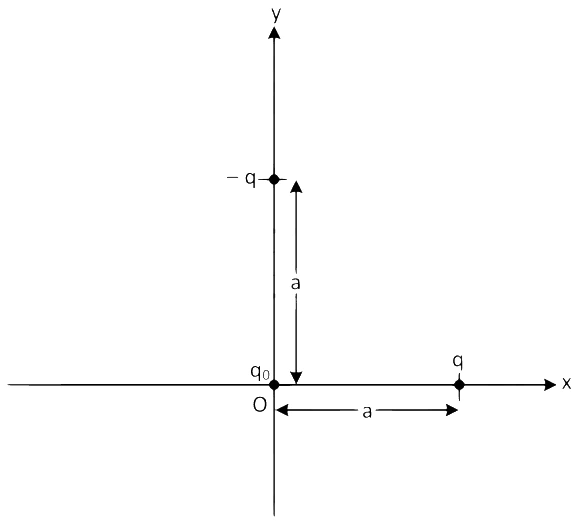
Answer: (c)
Step-by-step solution coming soon.
No questions match these filters.