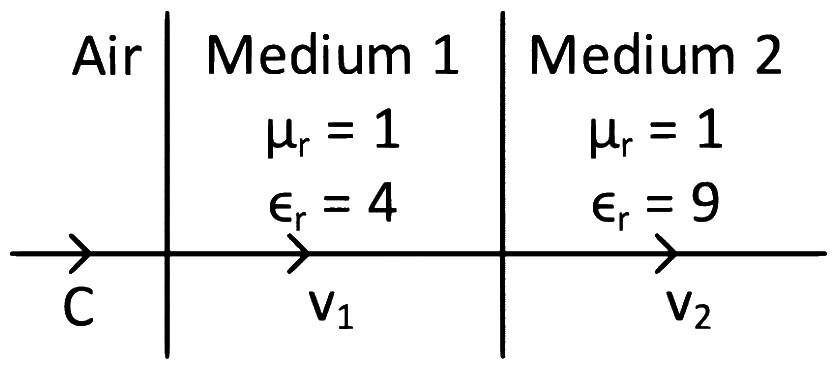
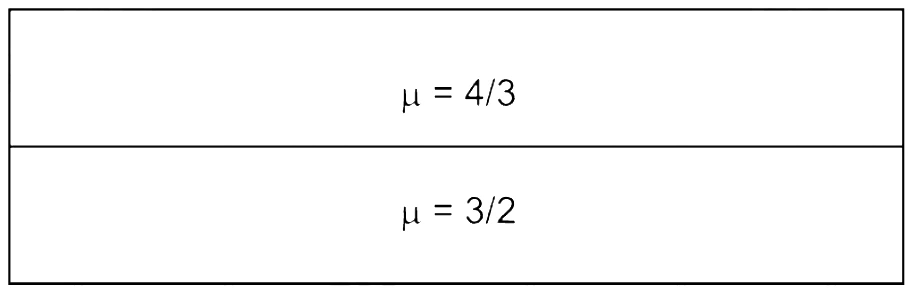
A ray of light travels from air to water to glass and again from glass to air. Refractive index of water with respect to air is 'x', glass with respect to water is 'y' and air with respect to glass is 'z'. Which one of the following is correct?
For the same angle of incidence, the angles of refraction in media A, B, C and D are 50∘,40∘,30∘ and 20∘ respectively. The speed of light is minimum in medium
How much water should be filled in a container of height 21 cm, so that it appears half filled to the observer when viewed from the top of the container? (μ=4/3)
A glass slab of thickness 6.0 cm is placed on the piece of paper on which an inkdot is marked. By how much distance would an inkdot appear to be raised? The velocity of light in glass is 2×10⁸ ms−1 and that in air is 3×10⁸ ms−1.
A ray of light passes from the vacuum into a medium of refractive index 'n'. If the angle of incidence is twice the angle of refraction, then the angle of incidence in terms of refractive index is
Three immiscible transparent liquids with refractive indices 23,34 and 56 are arranged one above the other. The depths of the liquids are 3 cm, 4 cm and 6 cm respectively. The apparent depth of the vessel is
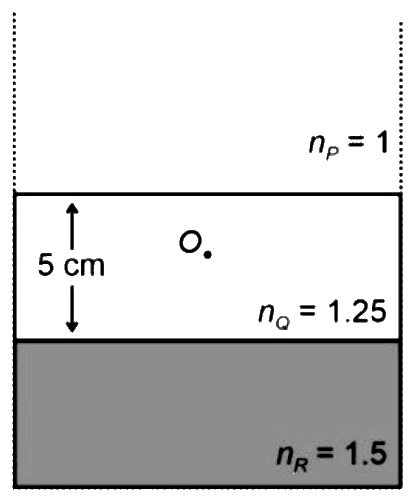
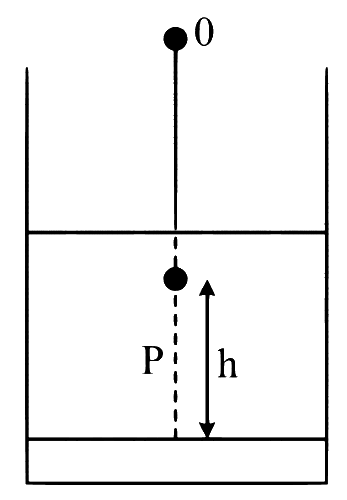
Consider three media P,Q and R with refractive indices 1,1.25, and 1.5 respectively. The medium Q having a thickness of 5 cm is placed between extended media P and R as shown in the figure. An object O is placed at the centre of medium Q. If viewed from medium P near the normal direction, the apparent depth of O is h1. For similar observation from medium R, the apparent depth is h2. The value of ∣h1−h2∣, in cm, is:
An unpolarised light is incident at an interface of two dielectric media having refractive indices of 2 (incident medium) and 23 (medium) respectively. To satisfy the condition that reflected and refracted rays are perpendicular to each other, the angle of incidence is ______
What is the lateral shift of a ray refracted through a parallel-sided glass slab of thickness ' h ' in terms of the angle of incidence ' i ' and angle of refraction ' r ', if the glass slab is placed in air medium?
Let the speed of light and the polarising angle for a given medium be ' V ' and ' ip ' respectively. The relation between them is: ( C= speed of light in vacuum)
A ray of light travelling through rarer medium is incident at a very small angle ' i ' on a glass slab and after refraction its velocity is reduced by 20%. The angle of deviation is
Three immiscible transparent liquids with refractive indices 3/2,4/3 and 6/5 are arranged one above the other in a container. The depths of the liquids are 3 cm,4 cm and 6 cm respectively. The apparent depth of the vessel is
A glass cube of length 21 cm has a small air bubble trapped inside. When viewed normally from the opposite face, its apparent distance is 6 cm. The refractive index of glass and the actual distance of the air bubble from the first surface respectively are
A container contains a liquid with refractive index of 1.2 up to a height of 60 cm and another liquid having refractive index 1.6 is added to height H above first liquid. If viewed from above, the apparent shift in the position of bottom of container is 40 cm. The value of H is ________ cm. (Consider liquids are immisible)
Numerical answer type. Work it out, then open the answer.
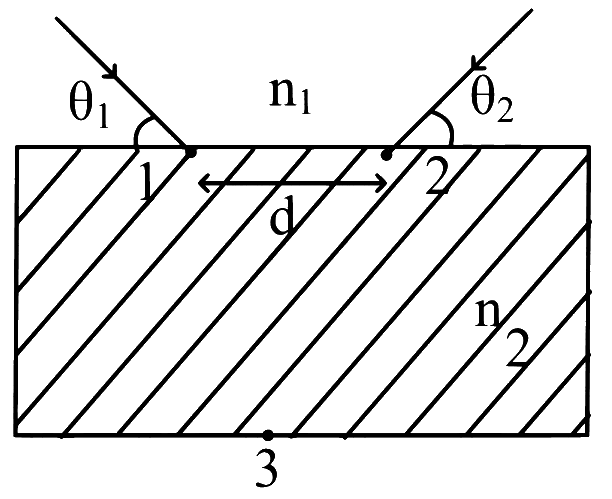
Two light beams fall on a transparent material block at point 1 and 2 with angle θ1 and θ2, respectively, as shown in figure. After refraction, the beams intersect at point 3 which is exactly on the interface at other end of the block. Given: the distance between 1 and 2, d=43 cm and θ1=θ2=cos−1(2n1n2). where refractive index of the block n2> refractive index of the outside medium n1, then the thickness of the block is ______ cm.
Numerical answer type. Work it out, then open the answer.
Optical path of a particular ray of light has travelled a distance of 3 cm in flint glass is same as that on travelling a distance ' x ' cm through another medium. The value of ' x ' is [refractive index of flint glass =1.6, refractive index of another medium =1.25]
A glass slab of thickness 4.8 cm is placed on the piece of paper on which an ink dot is marked. By how much distance would an ink dot appear to be raised? (The refractive index of glass =1.5)
Some water is filled in a container of height 30 cm. If it is to appear half filled to the observer when viewed from the top of the container, the height up to which water should be filled in it, is [Refractive index of water =34 ]
The angle of incidence is found to be twice the angle of refraction when ray of light passes from vacuum into a medium of refractive index ' μ '. The angle of incidence will be
A ray of light is incident on a medium of refractive index ' μ ' at an angle of incidence ' i '. On refraction in the medium ' δ ' is the angle of deviation. Then
When the same monochromatic ray of light travels through glass slab and through water, the number of waves in glass slab of thickness 5 cm is same as in water column of height 6 cm. If refractive index of glass is 1.56, then refractive index of water is
A ray of light travelling through a rarer medium is incident at very small angle ' i ' on a glass slab and after refraction its velocity is reduced by 25%. The angle of deviation is
A ray of light is incident normally on a glass slab to thickness 5 cm and refractive index 1.6. The time taken to travel by a ray from source of light to surface of slab is same as to travel through glass slab. The distance of source from the surface is
A vessel is filled with two different liquids which do not mix. One is 40 cm deep and has refractive index 1.6 and other is 30 cm deep and has refractive index 1.5. The apparent depth of vessel when viewed normally is
An ink mark is made on a piece of paper. A glass slab of thickness ' t ' is placed on it. The ink mark appears to be raised up through a distance ' x ' when viewed at nearly normal incidence. If the refractive index of material of glass slab is ' μ ' then thickness of glass slab ' t ' is given by
Three immiscible transparent liquids with uniform refractive indices 23,34 and 56 are arranged one on top of another. The depths of the liquids are 3 cm 4 cm and 6 cm respectively. The apparent depth of the vessel is
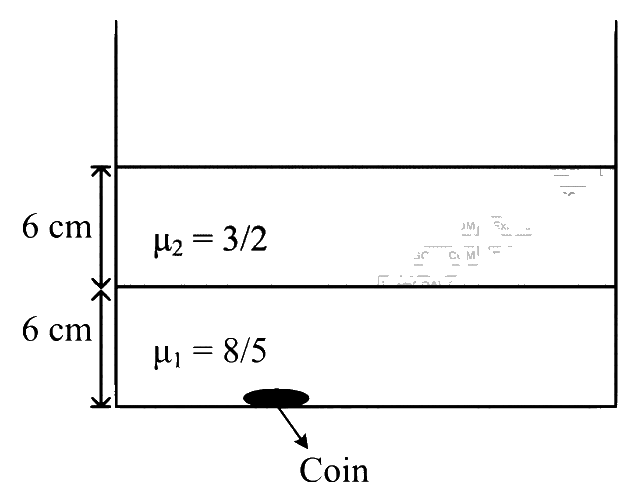
Two immiscible liquids of refractive indices 58 and 23 respectively are put in a beaker as shown in the figure. The height of each column is 6 cm. A coin is placed at the bottom of the beaker. For near normal vision, the apparent depth of the coin is 4α cm. The value of α is _________.
Numerical answer type. Work it out, then open the answer.
A plane mirror is placed at the bottom of a tank containing a liquid of refractive index ' μ ', ' p ' is a small object at a height ' h ' above the mirror. An observer ' O ' vertically above ' p ' outside the liquid sees ' p ' and the image in a mirror. The apparent distance between these two will be
ϵ0 and μ0 are the electric permittivity and magnetic permeability of free space respectively. If the corresponding quantities of a medium are 2ϵ0 and 1.5μ0 respectively, the refractive index of the medium will nearly be:
In an experiment of measuring the refractive index of a glass slab using travelling microscope in physics lab, a student measures real thickness of the glass slab as 5.25 mm and apparent thickness of the glass slab as 5.00 mm. Travelling microscope has 20 divisions in one cm on main scale and 50 divisions on vernier scale is equal to 49 divisions on main scale. The estimated uncertainty in the measurement of refractive index of the slab is 10x×10−3, where x is ___________
Numerical answer type. Work it out, then open the answer.
Given below are two statements: one is labelled as Assertion A and the other is labelled as Reason R
Assertion A: The phase difference of two light waves changes if they travel through different media having same thickness, but different indices of refraction.
Reason R: The wavelengths of waves are different in different media.
In the light of the above statements, choose the most appropriate answer from the options given below
A monochromatic light wave with wavelength λ1 and frequency ν1 in air enters another medium. If the angle of incidence and angle of refraction at the interface are 45∘ and 30∘ respectively, then the wavelength λ2 and frequency ν2 of the refracted wave are:
An ink mark is made on a piece of paper on which a glass slab of thickness 't' is placed. The ink mark appears to be raised up through a distance 'x' when viewed at nearly normal incidence. If the refractive index of the material of glass slab is 'μ' then the thickness of glass slab is given by
A transparent glass cube of length 24 cm has a small air bubble trapped inside. When seen normally through one surface from air outside, its apparent distance is 10 cm from the surface. When seen normally from opposite surface, its apparent distance is 6 cm. The distance of the air bubble from first surface is
A vessel of depth 'd' is half filled with oil of refractive index n1 and the other half is filled with water of refractive index n2. The apparent depth of this vessel when viewed from above will be-
An ice cube has a bubble inside. When viewed from one side the apparent distance of the bubble is 12 cm. When viewed from the opposite side, the apparent distance of the bubble is observed as 4 cm. If the side of the ice cube is 24 cm, the refractive index of the ice cube is
A microscope is focused on an object at the bottom of a bucket. If liquid with refractive index 35 is poured inside the bucket, then the microscope has to be raised by 30 cm to focus the object again. The height of the liquid in the bucket is:
A fish rising vertically upward with a uniform velocity of 8 ms−1, observes that a bird is diving vertically downward towards the fish with the velocity of 12 ms−1. If the refractive index of water is 34, then the actual velocity of the diving bird to pick the fish, will be __________ ms−1.
Numerical answer type. Work it out, then open the answer.
A pole is vertically submerged in swimming pool, such that it gives a length of shadow 2.15 m within water when sunlight is incident at angle of 30∘ with the surface of water. If swimming pool is filled to a height of 1.5 m, then the height of the pole above the water surface in centimeters is (nw=4/3) ____________.
Numerical answer type. Work it out, then open the answer.
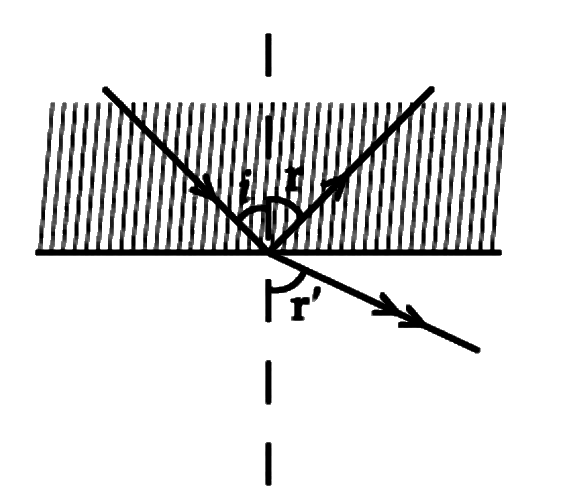
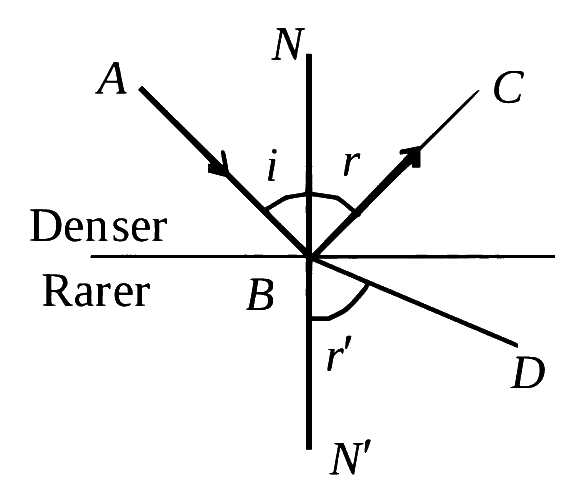
If a ray of light in denser medium strikes a rarer medium at angle of incidence i, the angles of reflection and refraction are r and r′ respectively. If the reflected and refracted rays are at right angles to each other, the critical angle for the given pair of media is
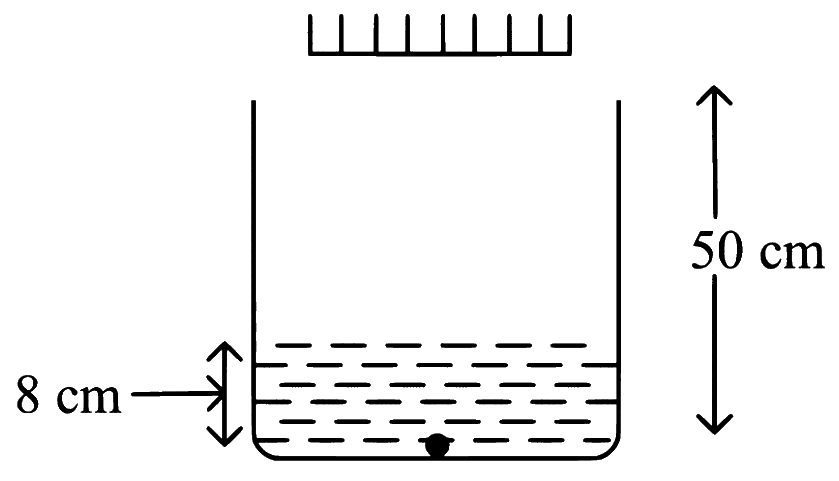
As shown in the figure, a plane mirror is fixed at a height of 50 cm from the bottom of tank containing water (μ=34). The height of water in the tank is 8 cm. A small bulb is placed at the bottom of the water tank. The distance of image of the bulb formed by mirror from the bottom of the tank is ___________ cm.
Numerical answer type. Work it out, then open the answer.
Light enters from air into a given medium at an angle of 45∘ with interface of the air-medium surface. After refraction, the light ray is deviated through an angle of 15∘ from its original direction. The refractive index of the medium is:
Consider a light ray travelling in air is incident into a medium of refractive index 2n. The incident angle is twice that of refracting angle. Then, the angle of incidence will be:
The X-Y plane be taken as the boundary between two transparent media M1 and M2.M1 in Z⩾0 has a refractive index of 2 and M2 with Z<0 has a refractive index of 3. A ray of light travelling in M1 along the direction given by the vector P=43i^−33j^−5k^, is incident on the plane of separation. The value of difference between the angle of incidence in M1 and the angle of refraction in M2 will be __________ degree.
Numerical answer type. Work it out, then open the answer.
Time taken by light to travel in two different materials A and B of refractive indices μA and μB of same thickness is t1 and t2 respectively. If t2−t1=5×10⁻¹⁰ s and the ratio of μA to μB is 1:2. Then, the thickness of material, in meter is: (Given vA and vB are velocities of light in A and B materials respectively.)
The difference of speed of light in the two media A and B (vA − vB) is 2.6 × 10⁷ m/s. If the refractive index of medium B is 1.47, then the ratio of refractive index of medium B to medium A is: (Given: speed of light in vacuum c = 3 × 10⁸ ms−1)
A ray of light is incident at an angle of incidence 60∘ on the glass slab of refractive index 3. After refraction, the light ray emerges out from other parallel faces and lateral shift between incident ray and emergent ray is 43 cm. The thickness of the glass slab is __________ cm.
Numerical answer type. Work it out, then open the answer.
A ring is placed at the bottom of a trough containing four immiscible liquids of refractive indices 1.0,2.0,3.0 and 4.0 poured one above the other of heights 10 cm,20 cm,30 cm, and 40 cm respectively. The apparent depth at which the ring appears, when seen from outside is __________ cm.
Numerical answer type. Work it out, then open the answer.
For an object placed at a distance 2.4 m from a lens, a sharp focused image is observed on a screen placed at a distance 12 cm from the lens. A glass plate of refractive index 1.5 and thickness 1 cm is introduced between lens and screen such that the glass plate plane faces parallel to the screen. By what distance should the object be shifted so that a sharp focused image is observed again on the screen?
A ray of light travels from air to water to glass and again from glass to air. Refractive index of water w.r.t. air is 'X', glass w.r.t. water is 'Y' and air w.r.t. glass is 'Z'. Which one of the following is correct?
White light consists of wavelengths from 480 nm to 672 nm. What will be the wavelength range when white light is passed through glass of refractive index 1.6?
A monochromatic ray of light travels through glass slab and water column. The number of waves in glass slab of thickness 4 cm is the same as in water column of height 5 cm. If refractive index of glass is 35 then refractive index of water is
A glass cube of length 24 cm has a small air bubble trapped inside. When viewed normally from one face it is 10 cm below the surface. When viewed normally from the opposite face, its apparent distance is 6 cm. The refractive index of glass is
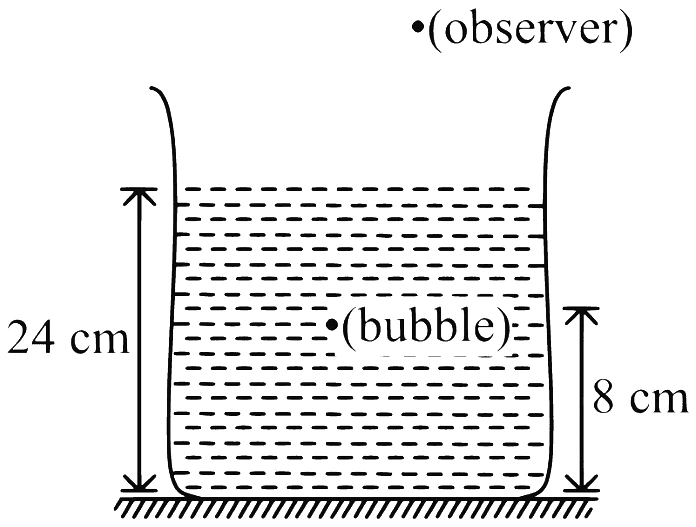
A glass tumbler having inner depth of 17.5 cm is kept on a table. A student starts pouring water (μ = 4/3) into it while looking at the surface of water from the above. When he feels that the tumbler is half filled, he stops pouring water. Up to what height, the tumbler is actually filled?
A ray of light travels from a denser medium to a rarer medium. The reflected and the refracted rays are perpendicular to each other. If 'r' and 'r1 ' are the angle of reflection and refraction respectively and 'C' is the critical angle, then the angle of incidence is
A ray of light passes from a denser medium to a rarer medium at an angle of incidence i. The reflected and refracted rays make an angle of 90∘ with each other. The angle of reflection and refraction are respectively r and r'. The critical angle is given by
A vessel of depth 2h is half filled with a liquid of refractive index 22 and the upper half with another liquid of refractive index 2. The liquids are immiscible. The apparent depth of the inner surface of the bottom of vessel will be:
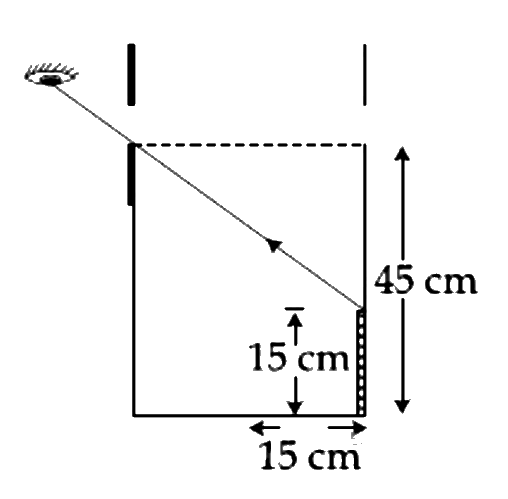
An observer can see through a small hole on the side of a jar (radius 15 cm) at a point at height of 15 cm from the bottom (see figure). The hole is at a height of 45 cm. When the jar is filled with a liquid up to a height of 30 cm the same observer can see the edge at the bottom of the jar. If the refractive index of the liquid is N/100, where N is an integer, the value of N is _____.
Numerical answer type. Work it out, then open the answer.
The refractive index of the material of crystal is 1.68 and that of castor oil is 1.2. When a ray of light passes from oil to glass, its velocity will change by a factor
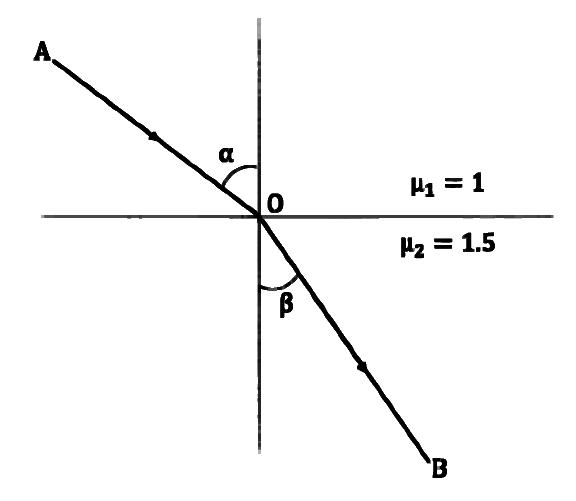
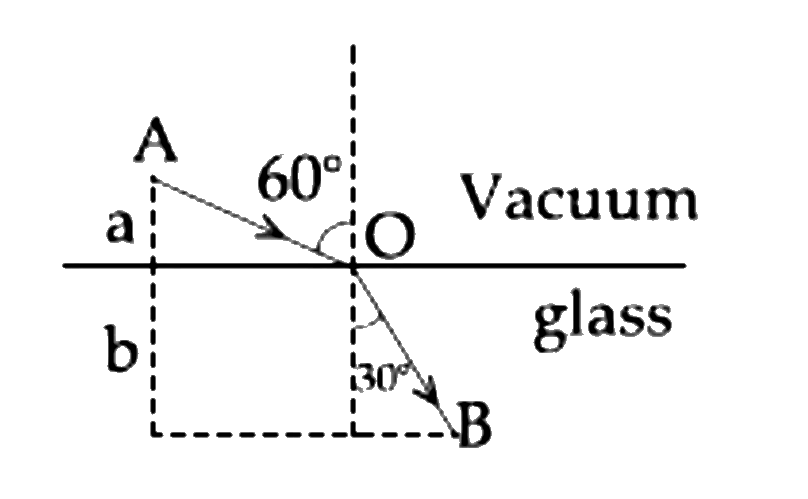
A ray of light AO in vacuum is incident on a glass slab at angle 60° and refracted at angle 30° along OB as shown in the figure. The optical path length of light ray from A to B is:
A convex lens is put 10 cm from a light source and it makes a sharp image on a screen, kept 10 cm from the lens. Now a glass block (refractive index 1.5) of 1.5 cm thickness is placed in contact with the light source. To get the sharp image again, the screen is shifted by a distance d. Then d is:
An air bubble in a glass slab with refractive index 1.5 (near normal incidence) is 5 cm deep when viewed from one surface and 3 cm deep when viewed from the opposite face. The thickness (in cm) of the slab is
A printed page is pressed by a glass of water. The refractive index of the glass and water is 1.5 and 1.33, respectively. If the thickness of the bottom of glass is 1 cm and depth of water is 5 cm, how much the page will appear to be shifted if viewed from the top?
An object 2.4 m in front of a lens forms a sharp image on a film 12 cm behind the lens. A glass plate 1 cm thick, of refractive index 1.50 is interposed between lens and film with its plane faces parallel to film. At what distance (from lens) should object shifted to be in sharp focus of film?
Let x-y plane be the boundary between two transparent media. Medium 1 in z≥0 has a refractive index of 2 and medium 2 with z<0 has a refractive index of 3. A ray of light in medium 1 given by the vector A=63i^+83j^−10k^ is incident on the plane of separation. The angle of refraction in medium 2 is:
An initially parallel cylindrical beam travels in a medium of refractive index μ(I)=μ0+μ2I, where μ0 and μ2 are positive constants and I is the intensity of the light beam. The intensity of the beam is decreasing with increasing radius.
An initially parallel cylindrical beam travels in a medium of refractive index μ(I)=μ0+μ2I, where μ0 and μ2 are positive constants and I is the intensity of the light beam. The intensity of the beam is decreasing with increasing radius.
A microscope is focussed on a mark on a piece of paper and then a slab of glass of thickness 3 cm and refractive index 1.5 is placed over the mark. How should the microscope be moved to get the mark in focus again?
A beam of light composed of red and green ray is incident obliquely at a point on the face of rectangular glass slab. When coming out on the opposite parallel face, the red green ray emerge from
An electromagnetic radiation of frequency n, wavelength λ, travelling with velocity v in air, enters a glass slab of refractive index μ. The frequency, wavelength and velocity of light in the glass slab will be respectively
Light travels through a glass plate of thickness t and having a refractive index μ. If c is the velocity of light in vacuum, the time taken by light to travel this thickness of glass is
A ray of light from a denser medium strikes a rare medium as shown in figure. The reflected and refracted rays make an angle of 90∘ with each other. The angles of reflection and refraction are r and r′. The critical angle would be
Green light wavelength 5460 Å is incident on an air-glass interface. If the refractive index of glass is 1.5, the wavelength of light in glass would be (c=3×10⁸ m s−1)
A fish is at a depth d in water of refractive index 34. If a transparent slab of refractive index 23 and thickness 2d is placed on the surface of water, then which one of the following is the apparent depth of the fish as observed by an observer in air?
Three parallel glass slabs of refractive indices 1.5, 3 and 1.5 respectively have widths 2mm, 1mm and 4mm. The combination is in air. Light is incident at the first slab at an angle of incidence π/3. What is the angle with respect to the normal at which the light will emerge from the final surface?
The refractive index of fused quartz is 1.46 and that of sapphire is 1.77. If vq is the speed of light in quartz and vs is the speed of light in sapphire, then which one of the following relations is correct?
The refractive indices of two media are denoted by n1 and n2, and the velocities of light in these two media are respectively v1 and v2. If n2/n1 is 1.5, which one of the following statements is correct?
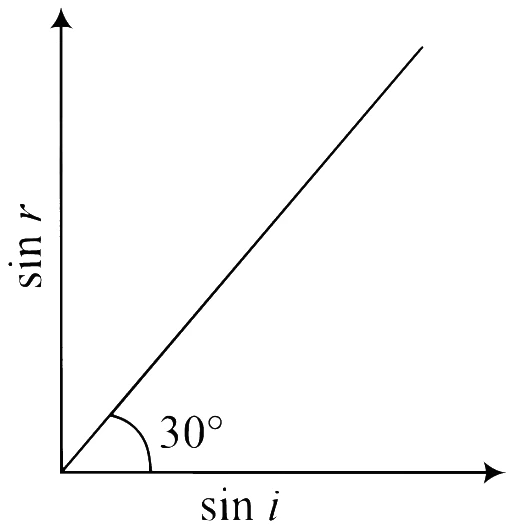
A ray of light travels from a medium of refractive index n1 to a medium of refractive index n2. If angle of incidence is i and angle of refraction is r, then sinrsini is equal to
Refractive index of an optical medium changes with 1. the nature of the medium. 2. the change in the angle of incidence of the ray. 3. colour of the incident ray. Select the correct answer using the code given below:
A one-rupee coin is placed at the bottom of a vessel. Water is then poured into the vessel such that the depth of water becomes 20cm. If water has refractive index 4/3, the coin would be seen at a depth of
A ray of light falls on a transparent glass plate. A part of it is reflected and a part is refracted. The reflected and refracted rays can be perpendicular to each other for
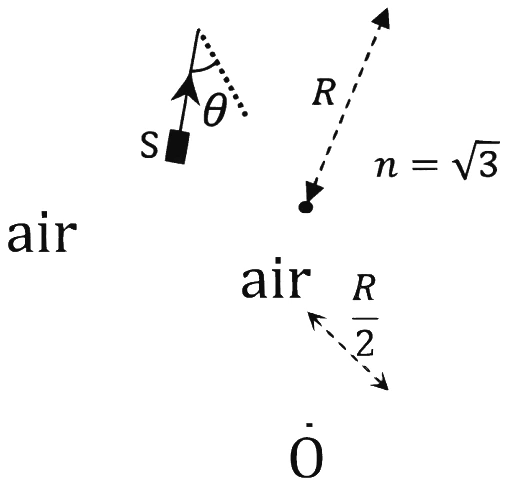
A solid glass sphere of refractive index n=3 and radius R contains a spherical air cavity of radius 2R, as shown in the figure. A very thin glass layer is present at the point O so that the air cavity (refractive index n=1) remains inside the glass sphere. An unpolarized, unidirectional and monochromatic light source S emits a light ray from a point inside the glass sphere towards the periphery of the glass sphere. If the light is reflected from the point O and is fully polarized, then the angle of incidence at the inner surface of the glass sphere is θ. The value of sinθ is ________.
Numerical answer type. Work it out, then open the answer.
A light ray is incident on the surface of a sphere of refractive index n at an angle of incidence θ0. The ray partially refracts into the sphere with angle of refraction ϕ0 and then partly reflects from the back surface. The reflected ray then emerges out of the sphere after a partial refraction. The total angle of deviation of the emergent ray with respect to the incident ray is α. Match the quantities mentioned in List-I with their values in List-II and choose the correct option.
List-I
List-II
(P) If n=2 and α=180∘, then all the possible values of θ0 will be
(1) 30∘ and 0∘
(Q) If n=3 and α=180∘, then all the possible values of θ0 will be
(2) 60∘ and 0∘
(R) If n=3 and α=180∘, then all the possible values of ϕ0 will be
(3) 45∘ and 0∘
(S) If n=2 and θ0=45∘, then all the possible values of α will be
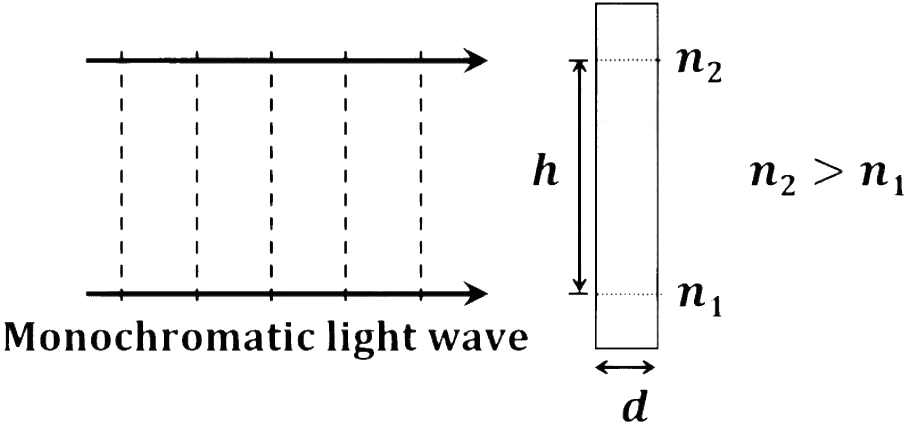
A monochromatic light wave is incident normally on a glass slab of thickness d, as shown in the figure. The refractive index of the slab increases linearly from n1 to n2 over the height h. Which of the following statement(s) is(are) true about the light wave emerging out of the slab?
More than one option can be correct. Tap every correct option, then tap Check.
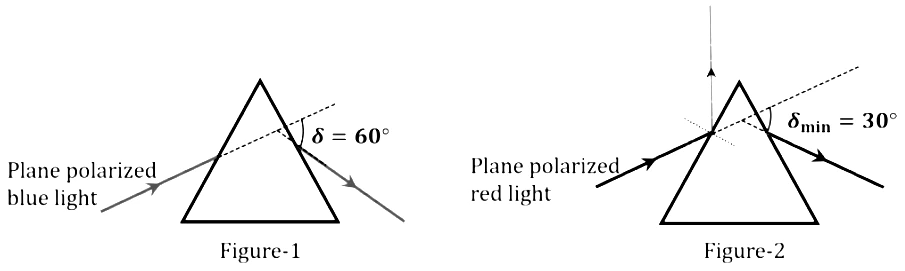
A plane polarized blue light ray is incident on a prism such that there is no reflection from the surface of the prism. The angle of deviation of the emergent ray is δ=60∘ (see Figure-1). The angle of minimum deviation for red light from the same prism is δmin=30∘ (see Figure-2). The refractive index of the prism material for blue light is 3. Which of the following statement(s) is(are) correct?
More than one option can be correct. Tap every correct option, then tap Check.
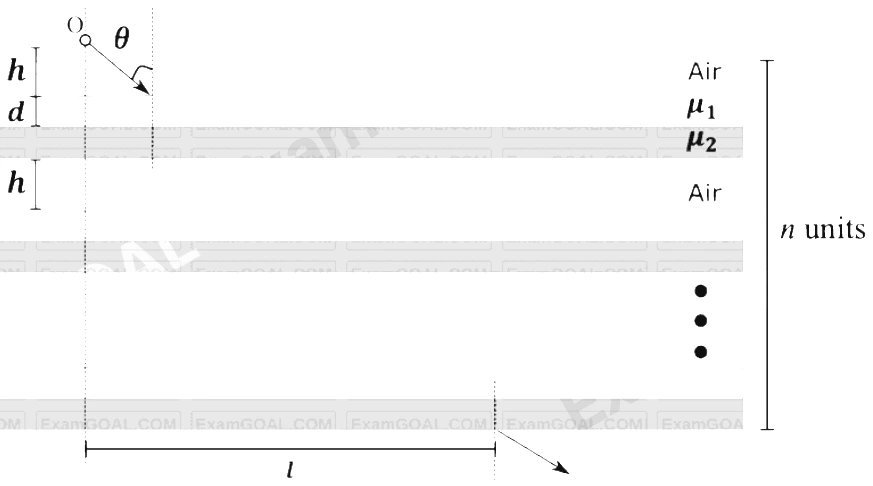
Consider a configuration of n identical units, each consisting of three layers. The first layer is a column of air of height h=31cm, and the second and third layers are of equal thickness d=23−1cm, and refractive indices μ1=23 and μ2=3, respectively. A light source O is placed on the top of the first unit, as shown in the figure. A ray of light from O is incident on the second layer of the first unit at an angle of θ=60∘ to the normal. For a specific value of n, the ray of light emerges from the bottom of the configuration at a distance l=38cm, as shown in the figure. The value of n is ______.
Numerical answer type. Work it out, then open the answer.
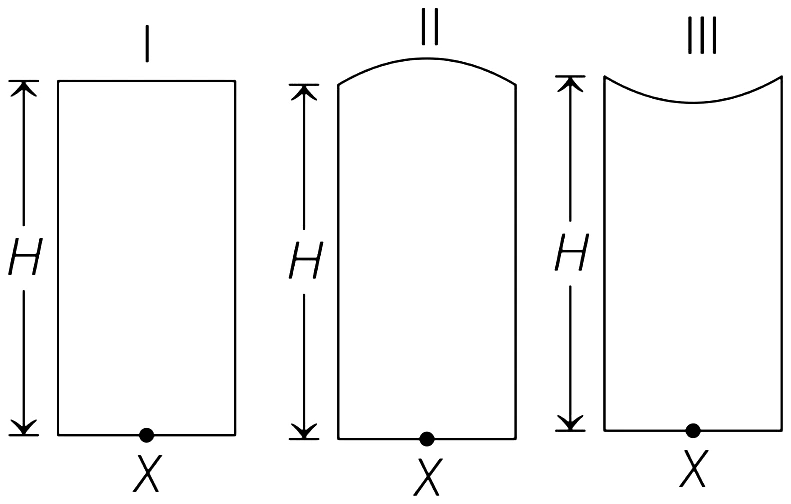
Three glass cylinders of equal height H=30cm and same refractive index n=1.5 are placed on a horizontal surface as shown in figure. Cylinder I has a flat top, cylinder II has a convex top and cylinder III has a concave top. The radii of curvature of the two curved tops are same (R=3m). If H1, H2 and H3 are the apparent depths of a point X on the bottom of the three cylinders, respectively, the correct statement(s) is/are
More than one option can be correct. Tap every correct option, then tap Check.
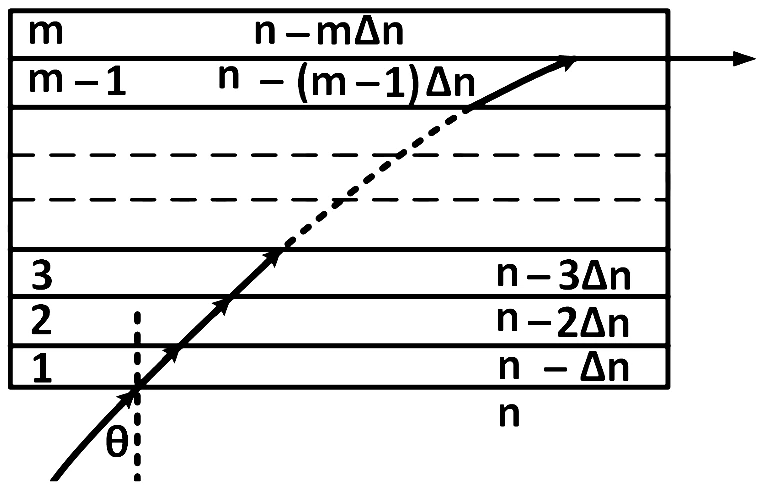
A monochromatic light is travelling in a medium of refractive index n=1.6. It enters a stack of glass layers from the bottom side at an angle θ=30∘. The interfaces of the glass layers are parallel to each other. The refractive indices of different glass layers are monotonically decreasing as nm=n−mΔn, where nm is the refractive index of the mth slab and Δn=0.1 (see the figure). The ray is refracted out parallel to the interface between the (m−1)th and mth slabs from the right side of the stack. What is the value of m?
Numerical answer type. Work it out, then open the answer.
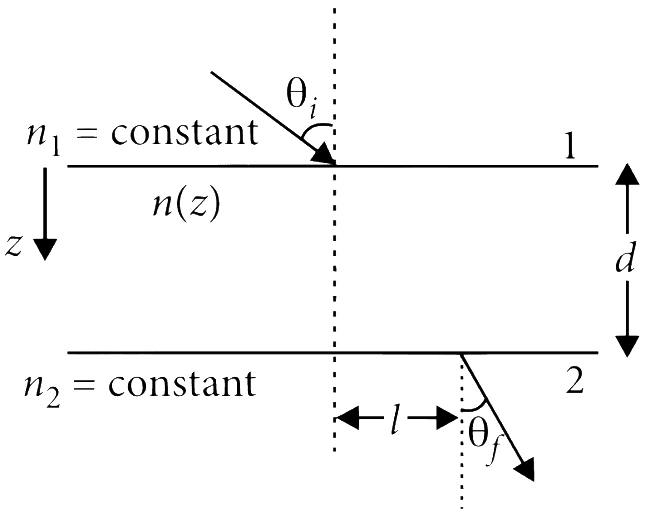
A transparent slab of thickness d has a refractive index n(z) that increases with z. Here, z is the vertical distance inside the slab, measured from the top. The slab is placed between two media with uniform refractive indices n1 and n2 (>n1), as shown in the figure. A ray of light is incident with angle θi from medium 1 and emerges in medium 2 with refraction angle θf with a lateral displacement l.
Which of the following statement(s) is (are) true?
More than one option can be correct. Tap every correct option, then tap Check.
Most materials have refractive index n>1. When a light ray from air enters a naturally occurring material, by Snell's law sinθ2sinθ1=n1n2, the refracted ray bends towards the normal, but it never emerges on the same side of the normal as the incident ray. According to electromagnetism, the refractive index of the medium is given by n=(vc)=±εrμr, where c is the speed of electromagnetic waves in vacuum, v its speed in the medium, and εr and μr are the relative permittivity and permeability of the medium, respectively.
In normal materials, both εr and μr are positive, implying positive n for the medium. When both εr and μr are negative, one must choose the negative root of n. Such negative refractive index materials can now be artificially prepared and are called meta-materials. They exhibit significantly different optical behaviour, without violating any physical laws. Since n is negative, it results in a change in the direction of propagation of the refracted light. However, similar to normal materials, the frequency of light remains unchanged upon refraction even in meta-materials.
Refer to the passage above. Choose the correct statement.
Most materials have refractive index n>1. When a light ray from air enters a naturally occurring material, by Snell's law sinθ2sinθ1=n1n2, the refracted ray bends towards the normal, but it never emerges on the same side of the normal as the incident ray. According to electromagnetism, the refractive index of the medium is given by n=(vc)=±εrμr, where c is the speed of electromagnetic waves in vacuum, v its speed in the medium, and εr and μr are the relative permittivity and permeability of the medium, respectively.
In normal materials, both εr and μr are positive, implying positive n for the medium. When both εr and μr are negative, one must choose the negative root of n. Such negative refractive index materials can now be artificially prepared and are called meta-materials. They exhibit significantly different optical behaviour, without violating any physical laws. Since n is negative, it results in a change in the direction of propagation of the refracted light. However, similar to normal materials, the frequency of light remains unchanged upon refraction even in meta-materials.
For light incident from air on a meta-material, the appropriate ray diagram is
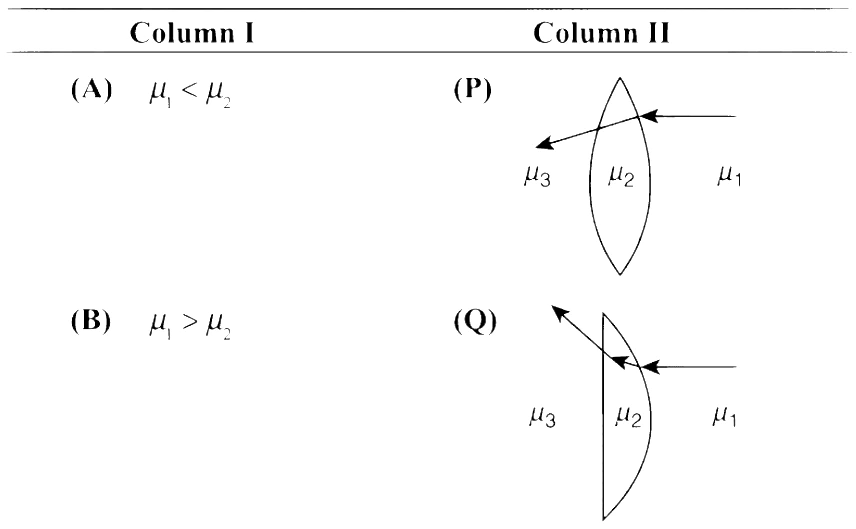
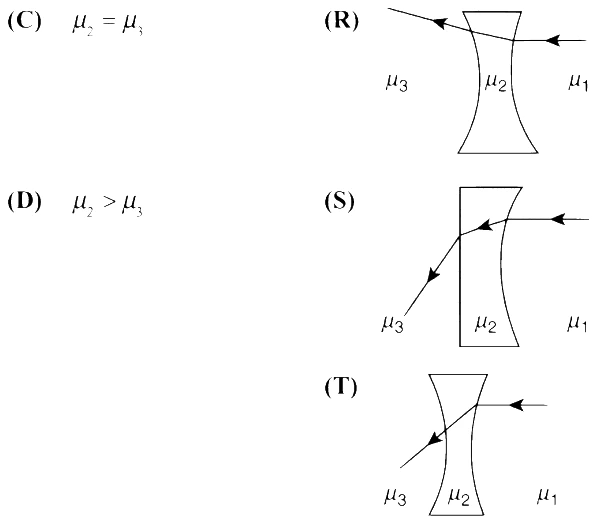
Two transparent media of refractive indices μ1 and μ3 have a solid lens shaped transparent material of refractive index μ2 between them as shown in figures in Column II. A ray traversing these media is also shown in the figures. In Column I different relationships between μ1,μ2 and μ3 are given. Match them to the ray diagram shown in Column II :
Column I
Column II
(A) μ1<μ2
(P) biconvex lens-shaped μ2 region with ray bending
(B) μ1>μ2
(Q) plano-convex μ2 region with ray bending
(C) μ2=μ3
(R) biconcave μ2 region with ray bending
(D) μ2>μ3
(S) plano-concave μ2 region with ray bending
(T) biconcave (waisted) μ2 region with ray bending
A ball is dropped from a height of 20m above the surface of water in a lake. The refractive index of water is 4/3. A fish inside the lake, in the line of fall of the ball, is looking at the ball. At an instant, when the ball is 12.8m above the water surface, the fish sees the speed of ball as (Take g=10m s−2)
A ray of light travelling in water is incident on its surface open to air. The angle of incidence is θ, which is less than the critical angle. Then there will be
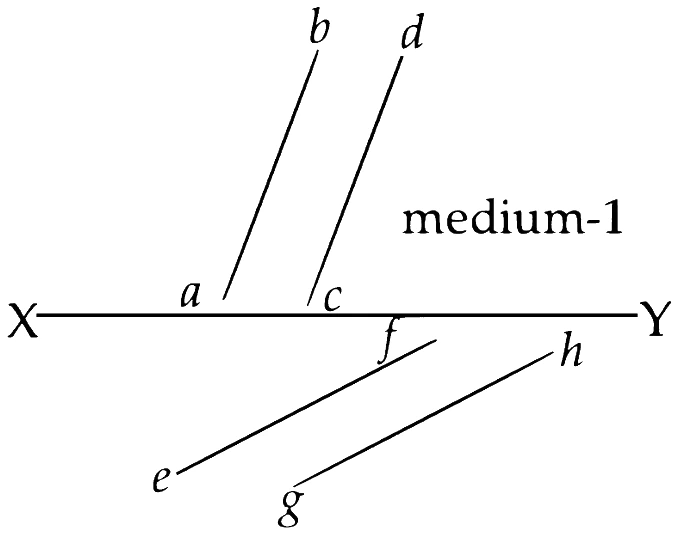
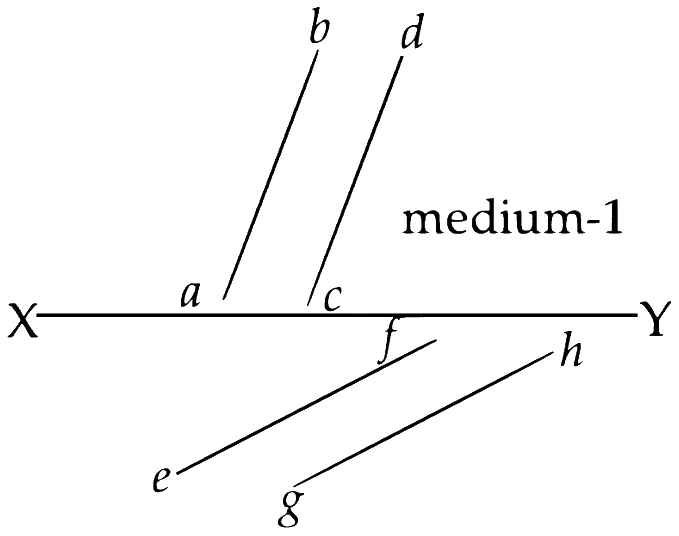
The figure shows surface XY separating two transparent media, medium-1 and medium-2. The lines ab and cd represent wavefronts of a light wave traveling in medium-1 and incident on XY. The lines ef and gh represent wavefronts of the light wave in medium-2 after refraction.
The figure shows surface XY separating two transparent media, medium-1 and medium-2. The lines ab and cd represent wavefronts of a light wave traveling in medium-1 and incident on XY. The lines ef and gh represent wavefronts of the light wave in medium-2 after refraction.
The phases of the light wave at c,d,e and f are ϕc,ϕd,ϕe and ϕf respectively. It is given that ϕc=ϕf.
If a ray of light in a denser medium strikes a rarer medium at an angle of incidence i, the angles of reflection and refraction are respectively r and r′. If the reflected and refracted rays are at right angles to each other, the critical angle for the given pair of media is
A ray of light is incident on the surface of a glass plate of thickness t. If the angle of incidence θ is small, the emerging ray would be displaced side ways by an amount [Take n = refractive index of glass]
The apparent depth of water in cylindrical water tank of diameter 2Rcm is reducing at the rate of xcm/min when water is being drained out at a constant rate. The amount of water drained in cc per minute is : (n1 = refractive index of air, n2 = refractive index of water)
If frequency (ν) of light is 5×10¹⁶Hz and speed of light in air is 3×10⁸m s−1. Find the ratio of wavelength of light in a medium of refractive index '2' to air.
A fish rising vertically to the surface of water in a lake uniformly at the rate of 2m s−1 observes a kingfisher diving vertically towards the water at a rate of 10m s−1. If refractive index of water n=34, what will be the actual velocity of the kingfisher
A vessel of depth t is half filled with a liquid having refractive index n1 and the other half is filled with water of having refractive index n2. The apparent depth of the vessel as viewed from top is
A vessel of height 2d is half filled with a liquid of refractive index 2 and the other half with a liquid of refractive index n (the given liquids are immiscible). Then, the apparent depth of the inner surface of the bottom of the vessel (neglecting the thickness of the bottom of the vessel) will be
A vessel is half filled with a liquid of refractive index μ. The other half of the vessel is filled with an immiscible liquid of refractive index 2μ. The apparent depth of the vessel is 50% of the actual depth. Then μ is
A light ray of wavelength 546nm is incident on an air-glass interface. If the speed of light in air is 3×10⁸m s−1. Then, wavelength of light ray in glass will be [Take, refractive index of glass, μ=1.5]
If an object of height 6cm is viewed through a liquid of refractive index 34 vertically at a depth of 10cm. Then what will be its apparent height and apparent distance from the surface of liquid.
A plane glass mirror of thickness 3cm of material of μ=23 is silvered on the back surface. When a point object is placed 9cm from the front surface of the mirror, then the position of the brightest image from the front surface is
A vessel of depth 2dcm is half filled with a liquid of refractive index μ1 and the upper half with a liquid of refractive index μ2. The apparent depth of the vessel seen perpendicularly is
Light travels with a speed of 2×10⁸m/s in crown glass of refractive index 1.5. What is the speed of light in dense flint glass of refractive index 1.8?
A glass slab of 16cm thickness has its bottom surface silvered. An air bubble is located inside the glass slab at a distance of 8cm from the top surface. The refractive index of glass is 1.6. Which of the following correctly represents the number of images seen by an observer looking vertically downwards from air onto the top surface? A. Only one image is seen at a depth of 5cm B. Multiple images are formed due to multiple reflections and refractions C. Only one image is seen at a depth of 16cm D. Two images are seen at depths 5cm and 15cm
In a container of height 21cm, certain transparent liquid is taken to a height of 12cm. When seen from above, it appears half filled. The refractive index of the liquid is
A ray of light travelling through a medium of refractive index 45 is incident on a glass of refractive index 23. Find the angle of refraction in the glass, if the angle of incidence at the given medium - glass interface is 30∘.
A fish in water (refractive index n) looks at a bird vertically above in the air. If y is the height of the bird and x is the depth of the fish from the surface, then the distance of the bird as estimated by the fish is
A plane glass mirror of thickness 3cm of material of μ=23 is silvered on the black surface. When a point object is placed 9cm from the front surface of the mirror, then the position of the brightest image from the front surface is
A ray of light passes from vacuum into a medium of refractive index n. If the angle of incidence is twice the angle of refraction, then the angle of incidence in terms of refractive index is
In determining the refractive index of a glass slab using a travelling microscope, the following readings are tabulated (a) Reading of travelling microscope for ink mark =5.123cm (b) Reading of travelling microscope for ink mark through glass slab =6.123cm (c) Reading of travelling microscope for chalk dust on glass slab =8.123cm From the data, the refractive index of a glass slab is
Consider a glass slab which is silvered at one side and the other side is transparent. Given the refractive index of the glass slab to be 1.5. If a ray of light is incident at an angle of 45∘ on the transparent side, then the deviation of the ray of light from its initial path, when it comes out of the slab is
A vessel of depth x is half filled with oil of refractive index μ1 and the other half is filled with water of refractive index μ2. The apparent depth of the vessel when viewed from above is
For the same angle of incidence, the angles of refraction of light ray in different media A,B,C are 35∘,25∘,15∘. If VA,VB,VC are velocities of light in A,B,C media respectively, then
A rectangular glass block of thickness 10cm and refractive index 1.5 is placed over a small coin. A beaker is filled with water of refractive index 34 to a height of 10cm and placed over glass block. The apparent depth of coin when viewed at near normal incidence
n transparent films, each of refractive index 1.5 with thickness 1cm,2cm,3cm,…ncm are placed one over the other. When a point object is seen normally through this combination, the object is found to be shifted by 5cm. Then the value of n is
Light enters from air into a given medium at an angle of 45∘ with interface of the air-medium. After refraction, the light ray is deviated through an angle of 15∘ from its original direction. The refractive index of the medium is
A needle is lying at the bottom of a water tank of height 12cm. The apparent depth of the needle measured by a microscope is 9cm. If the water is replaced by a liquid of refractive index of 1.5 of same height, the distance through which the microscope has to be moved to focus the needle again is
Light of wavelength 300nm in medium A enters into medium B through a plane surface. If the frequency of light is 5×10¹⁴Hz and the ratio of speed in medium A to that in medium B is 4/5, the absolute refractive index of medium B is
An empty tank has a concave mirror as its bottom. When sunlight falls normally on the mirror, it is focussed at a height of 32cm from the mirror. If the tank is filled with water upto a height of 20cm, then the sunlight focusses at (refractive index of water =34)
A convex lens focusses an object 20cm from it on a screen placed 5cm away from it. A glass plate (refractive index =7/5) of thickness 1.4cm is inserted between the lens and the screen. What is the distance of the object from the lens, so that its image is again focused on the screen?
A ray of light travelling in air is incident on one face of a parallel glass slab of thickness t and refractive index μ at an angle of incidence i. Total time spent by the ray inside the slab is
An electromagnetic wave, whose wave normal makes an angle of 45∘ with the vertical, is travelling in air and strikes a horizontal liquid surface. While travelling through the liquid, it gets deviated by 15∘. If the speed of electromagnetic wave in air is 3×10⁸m s−1, then the speed of electromagnetic wave in the liquid will be
There is a small air bubble at the centre of a solid glass sphere of radius r and refractive index μ. What will be the apparent distance of the bubble from the centre of the sphere, when viewed from outside?
A ray of light strikes a glass plate at an angle of 60∘. If the reflected and refracted rays are perpendicular to each other, the refractive index of glass is
Light travels through a glass plate of thickness t and having refractive index μ. If c be the velocity of light in vacuum, time taken by the light to travel through this thickness of glass is
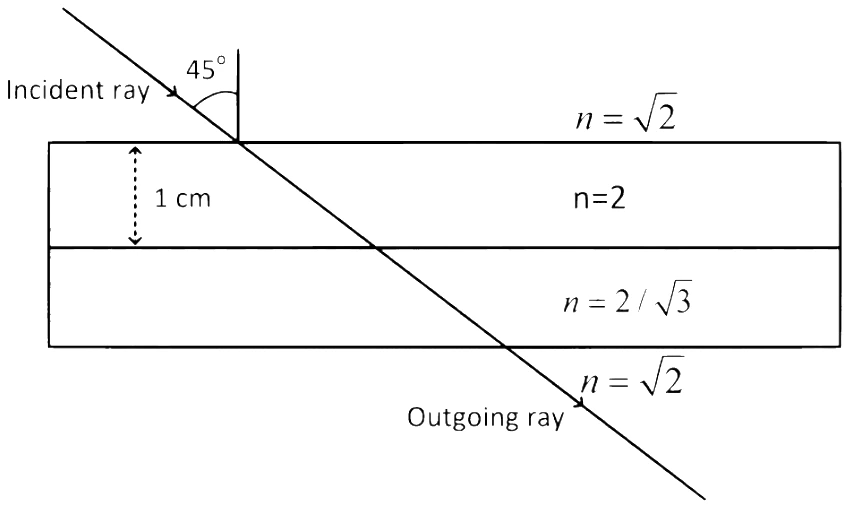
The refractive indices (n) of two transparent slabs are 2 and 2/3. They are attached together and placed in a third transparent medium of refractive index 2, as shown in the figure. The thickness of the upper slab is 1cm. A monochromatic light ray is incident on the upper slab at 45∘. What would be the thickness in cm of the lower slab such that the lateral shift of the ray after passing through both the slabs is zero?
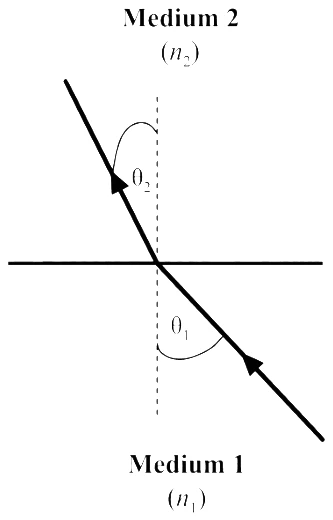
The figure shows a ray of light going from a medium of refractive index n1 to a medium of refractive index n2 such that θ1>θ2. Select the correct option.
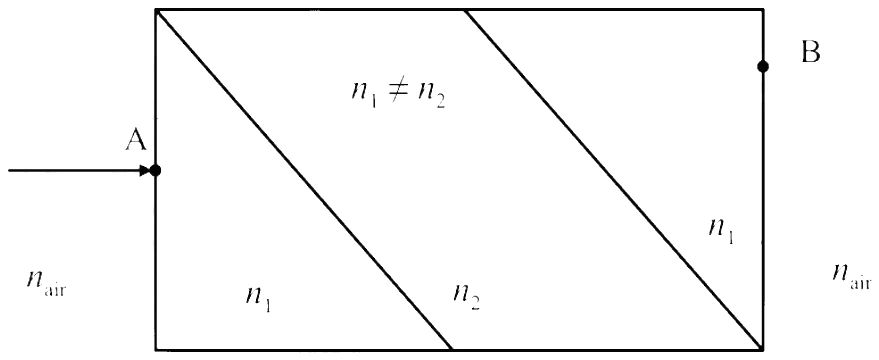
A ray of light is incident perpendicularly at point A on a rectangular medium with different refractive indices, n1 and n2, in a configuration as shown schematically in the figure. The angle that the emergent ray makes, with respect to normal at point B, is
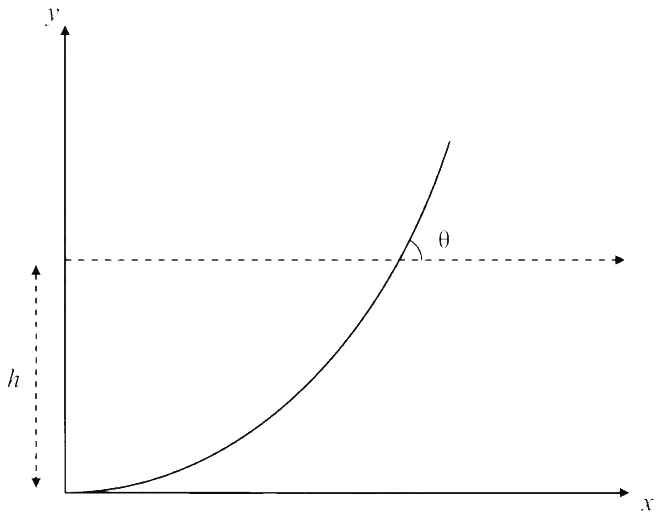
Consider an optical medium where refractive index varies linearly with height i.e. n(y)=n(0)+ky where k is a positive constant and y is the height above the ground level. Here positive number n(0) is the refractive index at the ground level. The refractive index at height y varies with temperature at that point as (n(y)−1)T(y)=constant. Consider a ray propagating (in a plane) in the medium which is horizontal at the ground level (i.e. at grazing angle) and makes an angle θ with horizontal at height h as shown in the figure. Use small angle approximation i.e. keep only terms up to and including quadratic order in all trigonometric functions. Select the correct option(s).
More than one option can be correct. Tap every correct option, then tap Check.
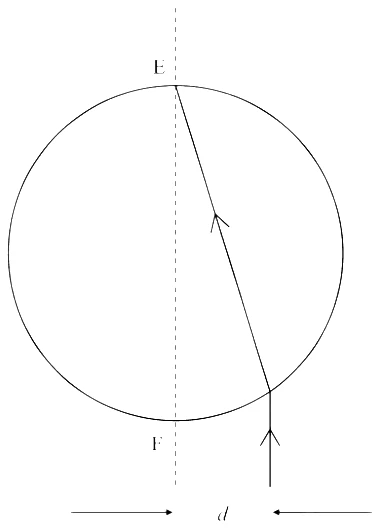
The figure represents the circular cross section of a transparent solid cylinder of radius R and refractive index 3 placed in air. A ray of light enters the cylinder parallel to the diameter FE and displaced from it by a distance d as shown. It emerges from the cylinder at the point E. Then d is
A beaker is filled with water (refractive index 34) up to a height H. A coin is placed at its bottom. The depth of the coin, when viewed along the near normal direction, will be
A ray of monochromatic light propagating in air, is incident on the surface of water. Which of the following will be the same for the reflected and refracted rays?