
Calorimetry, Latent Heat & Mechanical Equivalent of Heat
Which of the following best represents the temperature versus heat supplied graph for water, in the range of to ?
Show answer and solution
Answer: (c)
Loading the solution…
Home›Practice Hub›Chapters›Thermometry, Thermal Expansion and Calorimetry›Calorimetry, Latent Heat & Mechanical Equivalent of Heat
Thermometry, Thermal Expansion and Calorimetry PYQs · MHT CET · JEE Main · NEET
 Thermal Properties of Matter · Lecture 3 · Calorimetry & Specific Heat1:12:16All 3 Thermometry, Thermal Expansion and Calorimetry videos →
Calorimetry, Latent Heat & Mechanical Equivalent of Heat
Which of the following best represents the temperature versus heat supplied graph for water, in the range of to ?
Answer: (c)
Calorimetry, Latent Heat & Mechanical Equivalent of Heat
A lead bullet moving with velocity '' strikes a wall and stops. of its energy is converted into heat. If the increase in the temperature is , then the value of is
specific heat of lead mechanical equivalent of heat
Answer: (a)
Calorimetry, Latent Heat & Mechanical Equivalent of Heat
A gas based geyser heats water flowing at the rate of 5.0 litres per minute from to . The rate of consumption of the gas is .
(Take heat of combustion of gas , specific heat capacity of water )
Answer: (d)
Calorimetry, Latent Heat & Mechanical Equivalent of Heat
g of water of volume cm at C is converted into steam of same temperature under normal atmospheric pressure ( Pa). The volume of steam formed equals cm. If the latent heat of vaporisation of water is J/g, the change in internal energy is
Answer: (b)
Calorimetry, Latent Heat & Mechanical Equivalent of Heat
The heat extracted out of gram of water initially at to cool it down to is sufficient to evaporate gram of water also initially at . The value of (closest integer) is ______. (Take latent heat of water , specific heat capacity of water )
Numerical answer type. Work it out, then open the answer.
Answer: 922
Calorimetry, Latent Heat & Mechanical Equivalent of Heat
gram of ice at C is mixed with gram of water at C. The final temperature of the mixture will be [Latent heat of fusion of water = 80 cal/g]
Answer: (c)
Calorimetry, Latent Heat & Mechanical Equivalent of Heat
A piece of metal of 850 K is dropped into 1 kg of water at 300 K. If equilibrium temperature of water is 350 K then the heat capacity of the metal expressed in is Sp. heat of water
Answer: (a)
Calorimetry, Latent Heat & Mechanical Equivalent of Heat
g of ice at C is added to a vessel containing water at C. The mass of water and water equivalent of the vessel is g. Assuming that negligible heat is taken from the surroundings, the final temperature of the mixture will be
[ ice cal/g, water cal/g ]
Answer: (c)
Calorimetry, Latent Heat & Mechanical Equivalent of Heat
10 kg of ice at is added to 100 kg of water to lower its temperature from 25 . Consider no heat exchange to surroundings. The decrement to the temperature of water is . (specific heat of ice , specific heat of water , latent heat of fusion of ice )
Answer: (b)
Calorimetry, Latent Heat & Mechanical Equivalent of Heat
Density of water at and are and respectively. The increase in internal energy of 4 kg of water when it is heated from to is ______ J.
(specific heat capacity of water and 1 atmospheric pressure )
Answer: (a)
Calorimetry, Latent Heat & Mechanical Equivalent of Heat
Water falls from a height of 200 m into a pool. Calculate the rise in temperature of the water assuming no heat dissipation from the water in the pool.
(Take g = 10 m/s2, specific heat of water = 4200 J/(kg K))
Answer: (c)
Calorimetry, Latent Heat & Mechanical Equivalent of Heat
Match List - I with List - II.
List - I
(A) Heat capacity of body (I)
(B) Specific heat capacity of body (II)
(C) Latent heat (III)
(D) Thermal conductivity (IV)
Choose the correct answer from the options given below:
Answer: (d)
Calorimetry, Latent Heat & Mechanical Equivalent of Heat
A gun fires a lead bullet of temperature 300 K into a wooden block. The bullet having melting temperature of 600 K penetrates into the block and melts down. If the total heat required for the process is 625 J, then the mass of the bullet is _______ grams. (Latent heat of fusion of lead and specific heat capacity of lead
Answer: (d)
Calorimetry, Latent Heat & Mechanical Equivalent of Heat
An amount of ice of mass and temperature is transformed to vapour of temperature by applying heat. The total amount of work required for this conversion is, (Take, specific heat of ice , specific heat of water , specific heat of steam , Latent heat of ice and Latent heat of steam )
Answer: (b)
Calorimetry, Latent Heat & Mechanical Equivalent of Heat
A stationary object at and weighing 3.5 kg falls from a height of 2000 m on snow mountain at . If the temperature of the object just before hitting the snow is and the object comes to rest immediately then the quantity of ice that melts is (Acceleration due to gravity , Latent heat of ice )
Answer: (c)
Calorimetry, Latent Heat & Mechanical Equivalent of Heat
A block of ice at is slowly heated and converted to steam at . Which of the following curves represent the phenomenon qualitatively:
Answer: (a)
Calorimetry, Latent Heat & Mechanical Equivalent of Heat
A lead bullet moving with velocity ' ' strikes a wall and stops. If of its energy is converted into heat, then the increase in temperature is ( specific heat of lead)
Answer: (b)
Calorimetry, Latent Heat & Mechanical Equivalent of Heat
A water heater of power is used to heat water. The specific heat capacity of water is . The efficiency of heater is . Time required to heat of water from to is _________ s.
(Assume that the specific heat capacity of water remains constant over the temperature range of the water).
Numerical answer type. Work it out, then open the answer.
Answer: 300
Calorimetry, Latent Heat & Mechanical Equivalent of Heat
Heat energy of 184 kJ is given to ice of mass 600 g at . Specific heat of ice is and latent heat of ice is 336
A. Final temperature of system will be 0 C.
B. Final temperature of the system will be greater than 0C.
C. The final system will have a mixture of ice and water in the ratio of 5: 1.
D. The final system will have a mixture of ice and water in the ratio of 1: 5.
E. The final system will have water only.
Choose the correct answer from the options given below:
Answer: (d)
Calorimetry, Latent Heat & Mechanical Equivalent of Heat
A piece of metal at is dropped into water at . If the equilibrium temperature of water is then the heat capacity of the metal, expressed in is
Answer: (d)
Calorimetry, Latent Heat & Mechanical Equivalent of Heat
Heat given to a body, which raises its temperature by 1ºC is known as
Answer: (b)
Calorimetry, Latent Heat & Mechanical Equivalent of Heat
A 100 g of iron nail is hit by a 1.5 kg hammer striking at a velocity of 60 ms1. What will be the rise in the temperature of the nail if one fourth of energy of the hammer goes into heating the nail? [Specific heat capacity of iron = 0.42 Jg1 1]
Answer: (c)
Calorimetry, Latent Heat & Mechanical Equivalent of Heat
A geyser heats water flowing at a rate of 2.0 kg per minute from 30C to 70 C. If geyser operates on a gas burner, the rate of combustion of fuel will be ___________ g min1.
[Heat of combustion = 8 103 Jg1, Specific heat of water = 4.2 Jg1 1]
Numerical answer type. Work it out, then open the answer.
Answer: 42
Calorimetry, Latent Heat & Mechanical Equivalent of Heat
A lead bullet penetrates into a solid object and melts. Assuming that 40% of its kinetic energy is used to heat it, the initial speed of bullet is:
(Given: initial temperature of the bullet = 127C, Melting point of the bullet = 327C, Latent heat of fusion of lead = 2.5 104 J kg1, Specific heat capacity of lead = 125 J/kg K)
Answer: (b)
Calorimetry, Latent Heat & Mechanical Equivalent of Heat
A copper block of mass 5.0 kg is heated to a temperature of 500C and is placed on a large ice block. What is the maximum amount of ice that can melt? [Specific heat of copper: 0.39 J g1 1 and latent heat of fusion of water: 335 J g1]
Answer: (c)
Calorimetry, Latent Heat & Mechanical Equivalent of Heat
A block of ice of mass 120 g at temperature 0C is put in 300 g of water at 25 C. The x g of ice melts as the temperature of the water reaches 0 C. The value of x is _____________. [Use specific heat capacity of water = 4200 Jkg1, Latent heat of ice = 3.5 105 Jkg1]
Numerical answer type. Work it out, then open the answer.
Answer: 90
Calorimetry, Latent Heat & Mechanical Equivalent of Heat
The height of Victoria falls is 63 m. What is the difference in temperature of water at the top and at the bottom of fall?
[Given 1 cal = 4.2 J and specific heat of water = 1 cal g1 1]
Answer: (a)
Calorimetry, Latent Heat & Mechanical Equivalent of Heat
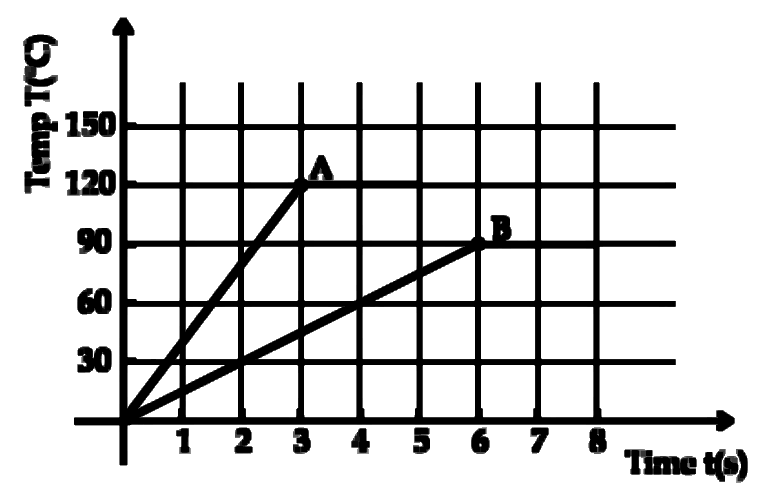
Two different metal bodies A and B of equal mass are heated at a uniform rate under similar conditions. The variation of temperature of the bodies is graphically represented as shown in the figure. The ratio of specific heat capacities is:
Answer: (b)
Calorimetry, Latent Heat & Mechanical Equivalent of Heat
The temperature of equal masses of three different liquids x, y and z are 10C, 20C and 30C respectively. The temperature of mixture when x is mixed with y is 16C and that when y is mixed with z is 26 C. The temperature of mixture when x and z are mixed will be:
Answer: (c)
Calorimetry, Latent Heat & Mechanical Equivalent of Heat
The quantities of heat required to raise the temperature of two solid copper spheres of radii r1 and r2 (r1 = 1.5r2) through 1 K are in the ratio:
Answer: (d)
Calorimetry, Latent Heat & Mechanical Equivalent of Heat
A bullet of mass 5 g, travelling with a speed of 210 m/s, strikes a fixed wooden target. One half of its kinetic energy is converted into heat in the bullet while the other half is converted into heat in the wood. The rise of temperature of the bullet if the specific heat of its material is 0.030 cal/(g –oC) (1 cal = 4.2 × 10⁷ ergs) close to:
Answer: (a)
Calorimetry, Latent Heat & Mechanical Equivalent of Heat
The specific heat of water
= 4200 J kg-1K-1 and the latent heat of
ice = 3.4 105 J kg–1. 100 grams of ice at
0oC is placed in 200 g of water at 25oC. The
amount of ice that will melt as the temperature
of water reaches 0oC is close to (in grams):
Answer: (b)
Calorimetry, Latent Heat & Mechanical Equivalent of Heat
A calorimeter of water equivalent 20 g contains 180 g of water at 25oC. ‘m’ grams of steam at 100oC is mixed in it till the temperature of the mixure is 31oC. The value of ‘m’ is close to: (Latent heat of water = 540 cal g–1, specific heat of water = 1 cal g–1oC–1)
Answer: (b)
Calorimetry, Latent Heat & Mechanical Equivalent of Heat
Three containers C1, C2 and C3 have water at different temperatures. The table below shows the final temperature T when different amounts of water (given in litres) are taken from each containers and mixed (assume no loss of heat during the process)
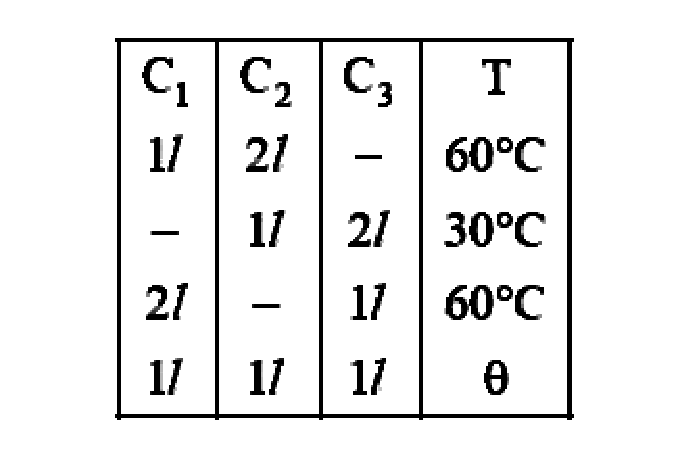
The value of (in °C to the nearest integer) is ..........
Numerical answer type. Work it out, then open the answer.
Answer: 50
Calorimetry, Latent Heat & Mechanical Equivalent of Heat
M grams of steam at 100oC is mixed with 200 g of ice at its melting point in a thermally insulated container. If it produced liquid water at 40oC [heat of vaporization of water is 540 cal/g and heat of fusion of ice is 80 cal/g] the value of M is ____
Numerical answer type. Work it out, then open the answer.
Answer: 40
Calorimetry, Latent Heat & Mechanical Equivalent of Heat
One kg of water, at 20oC, heated in an electric kettle whose heating element has a mean (temperature averaged) resistance of 20 . The rms voltage in the mains is 200 V. Ignoring heat loss from the kettle, time taken for water to evaporate fully, is close to: [Specific heat of water = 4200 J/(kgoC), Latent heat of water = 2260 kJ/kg]
Answer: (b)
Calorimetry, Latent Heat & Mechanical Equivalent of Heat
A massless spring (k = 800 N/m), attached with a mass (500 g) is completely immersed in 1 kg of water. The spring is stretched by 2 cm and released so that it starts vibrating. What would be the order of magnitude of the change in the temperature of water when the vibrations stop completely? (Assume that the water container and spring receive negligible heat and specific heat of mass = 400 J/kg K, specific heat of water = 4184 J/kg K)
Answer: (c)
Calorimetry, Latent Heat & Mechanical Equivalent of Heat
When M1 gram of ice at –10oC (specific heat = 0.5 cal g–1oC–1) is added to M2 gram of water at 50°C, finally no ice is left and the water is at 0°C. The value of latent heat of ice, in cal g–1 is:
Answer: (a)
Calorimetry, Latent Heat & Mechanical Equivalent of Heat
When 100 g of a liquid A at 100oC is added to 50 g of a liquid B at temperature 75oC, the temperature of the mixture becomes 90oC. The temperature of the mixture, if 100 g of liquid A at 100oC is added to 50 g of liquid B at 50oC, will be:
Answer: (d)
Calorimetry, Latent Heat & Mechanical Equivalent of Heat
A metal ball of mass 0.1 kg is heated upto 500oC and dropped into a vessel of heat capacity 800 JK–1 and containing 0.5 kg water. The initial temperature of water and vessel is 30oC. What is the approximate percentage increment in the temperature of the water? [Specific Heat Capacities of water and metal are, respectively, 4200 Jkg–1 K–1 and 400 Jkg–1 K–1]
Answer: (a)
Calorimetry, Latent Heat & Mechanical Equivalent of Heat
Ice at –20oC is added to 50 g of water at 40oC. When the temperature of the mixture reaches 0oC, it is found that 20 g of ice is still unmelted. The amount of ice added to the water was close to (Specific heat of water = 4.2J/g/oC Specific heat of Ice = 2.1J/g/oC Heat of fusion of water at 0oC= 334J/g)
Answer: (d)
Calorimetry, Latent Heat & Mechanical Equivalent of Heat
An unknown metal of mass 192 g heated to a temperature of 100oC was immersed into a brass calorimeter of mass 128 g containing 240 g of water at a temperature of 8.4oC. Calculate the specific heat of the unknown metal if water temperature stabilizes at 21.5oC. (Specific heat of brass is 394 J kg–1 K–1)
Answer: (d)
Calorimetry, Latent Heat & Mechanical Equivalent of Heat
A thermally insulated vessel contains 150g of water at 0°C. Then the air from the vessel is pumped out adiabatically. A fraction of water turns into ice and the rest evaporates at 0°C itself. The mass of evaporated water will be closest to: (Latent heat of vaporization of water = 2.10 × 10⁶ J kg–1 and Latent heat of Fusion of water = 3.36 × 10⁵ J kg–1)
Answer: (c)
Calorimetry, Latent Heat & Mechanical Equivalent of Heat
In an experiment, a sphere of aluminium of mass 0.20 kg is heated upto 150oC. Immediately, it is put into water of volume 150 cc at 27oC kept in a calorimeter of water equivalent to 0.025 kg. Final temperature of the system is 40oC. The specific heat of aluminium is: (take 4.2 Joule = 1 calorie)
Answer: (d)
Calorimetry, Latent Heat & Mechanical Equivalent of Heat
A copper ball of mass 100 gm is at a temperature T. It is dropped in a copper calorimeter of mass 100 gm, filled with 170 gm of water at room temperature. Subsequently, the temperature of the system is found to be 75oC. T is given by: (Given: room temperature = 30oC, specific heat of copper = 0.1 cal/gmoC)
Answer: (c)
Calorimetry, Latent Heat & Mechanical Equivalent of Heat
200 g water is heated from 40oC to 60oC. Ignoring the slight expansion of water, the change in its internal energy is close to (Given specific heat of water = 4184 J/kg/K):
Answer: (c)
Calorimetry, Latent Heat & Mechanical Equivalent of Heat
An experiment takes 10 minutes to raise the temperature of water in a container from 0oC to 100oC and another 55 minutes to convert it totally into steam by a heater supplying heat at a uniform rate. Neglecting the specific heat of the container and taking specific heat of water to be 1 cal/goC, the heat of vapourization according to this experiment will come out to be:
Answer: (c)
Calorimetry, Latent Heat & Mechanical Equivalent of Heat
Water of volume 2 L in a closed container is heated with a coil of 1 kW. While water is heated, the container loses energy at a rate of 160J/s. In how much time will the temperature of water rise from 27oC to 77oC? (Specific heat of water is 4.2 kJ/kg K and that of the container is negligible).
Answer: (a)
Calorimetry, Latent Heat & Mechanical Equivalent of Heat
Given that 1 g of water in liquid phase has volume 1 cm and in vapour phase 1671 cm at atmospheric pressure and the latent heat of vaporization of water is 2256 J/g; the change in the internal energy in joules for 1 g of water at 373 K when it changes from liquid phase to vapour phase at the same temperature is:
Answer: (c)
Calorimetry, Latent Heat & Mechanical Equivalent of Heat
500 g of water and 100 g of ice at 0°C are in a calorimeter whose water equivalent is 40 g. 10 g of steam at 100°C is added to it. Then water in the calorimeter is: (Latent heat of ice = 80 cal/g, Latent heat of steam = 540 cal/g)
Answer: (b)
Calorimetry, Latent Heat & Mechanical Equivalent of Heat
of water is heated from to . Ignoring the slight expansion of the water, the change in its internal energy is (specific heat of water is ):
Answer: (a)
Calorimetry, Latent Heat & Mechanical Equivalent of Heat
Time taken by a heater to heat one litre of water from to is
Answer: (a)
Calorimetry, Latent Heat & Mechanical Equivalent of Heat
Heat given to a body which raises its temperature by is
Answer: (b)
Calorimetry, Latent Heat & Mechanical Equivalent of Heat
If of steam is mixed with of ice, then the resultant temperature of the mixture is
Answer: (c)
Calorimetry, Latent Heat & Mechanical Equivalent of Heat
Thermal capacity of 40 g of aluminium () is
Answer: (d)
Calorimetry, Latent Heat & Mechanical Equivalent of Heat
10 gm of ice cubes at are released in a tumbler (water equivalent 55 g) at . Assuming that negligible heat is taken from the surroundings, the temperature of water in the tumbler becomes nearly ()
Answer: (b)
Calorimetry, Latent Heat & Mechanical Equivalent of Heat
An insulating container contains of water at . Steam at is passed through it, heating it up to . During this process, part of the steam also gets condensed, raising the mass of water to . If the specific heat of water is , then what is the value of the latent heat of steam?
Answer: (c)
Step-by-step solution coming soon.
Calorimetry, Latent Heat & Mechanical Equivalent of Heat
A piece of ice at is put into of water at temperature. The heat is exchanged only between the ice and the water. The final temperature of the mixture is in liquid phase. What is the value of in kg?
Answer: (c)
Step-by-step solution coming soon.
Calorimetry, Latent Heat & Mechanical Equivalent of Heat
A solid of mass has temperature-dependent specific heat as , where and are constants. The solid is heated from to . Which one of the following is the correct expression for quantity of heat () of the solid mass?
Answer: (d)
Step-by-step solution coming soon.
Calorimetry, Latent Heat & Mechanical Equivalent of Heat
The quantity of heat needed to change unit mass of a substance from liquid to vapour without changing the temperature, is called
Answer: (b)
Step-by-step solution coming soon.
Calorimetry, Latent Heat & Mechanical Equivalent of Heat
Condensation of water vapour into water is influenced by which of the following factor/factors?
1. Volume of air
2. Humidity
3. Temperature
Select the answer using the code given below:
Answer: (d)
Step-by-step solution coming soon.
Calorimetry, Latent Heat & Mechanical Equivalent of Heat
Which one of the following statements best defines the concept of heat?
Answer: (c)
Step-by-step solution coming soon.
Calorimetry, Latent Heat & Mechanical Equivalent of Heat
A pressure cooker cooks food faster by
Answer: (a)
Step-by-step solution coming soon.
Calorimetry, Latent Heat & Mechanical Equivalent of Heat
What is the mass of a material, whose specific heat capacity is for a rise in temperature from to , when heat received is ?
Answer: (d)
Step-by-step solution coming soon.
Calorimetry, Latent Heat & Mechanical Equivalent of Heat
The specific latent heat of vaporization of a substance is the quantity of heat needed to change unit mass from
Answer: (b)
Step-by-step solution coming soon.
Calorimetry, Latent Heat & Mechanical Equivalent of Heat
Evaporation from the surface of a given liquid takes place more rapidly when
Answer: (a)
Step-by-step solution coming soon.
Calorimetry, Latent Heat & Mechanical Equivalent of Heat
of ice at is mixed with of water at . The amount of heat required to raise the temperature of mixture to is
Answer: (c)
Step-by-step solution coming soon.
Calorimetry, Latent Heat & Mechanical Equivalent of Heat
Which one of the following statements is correct?
Answer: (a)
Step-by-step solution coming soon.
Calorimetry, Latent Heat & Mechanical Equivalent of Heat
Which of the following statements about latent heat for a given substance is/are correct?
1. It is fixed at a given temperature.
2. It depends upon the temperature and volume.
3. It is independent of temperature and volume.
4. It depends on the temperature but independent of volume.
Select the correct answer using the code given below:
Answer: (d)
Step-by-step solution coming soon.
Calorimetry, Latent Heat & Mechanical Equivalent of Heat
Which of the following statements about specific heat of a body is/are correct?
1. It depends upon mass and shape of the body
2. It is independent of mass and shape of the body
3. It depends only upon the temperature of the body
Select the correct answer using the code given below:
Answer: (d)
Step-by-step solution coming soon.
Calorimetry, Latent Heat & Mechanical Equivalent of Heat
Thermal capacity of a body depends on the
Answer: (a)
Step-by-step solution coming soon.
Calorimetry, Latent Heat & Mechanical Equivalent of Heat
Water boils at a lower temperature at high altitudes, because
Answer: (a)
Step-by-step solution coming soon.
Calorimetry, Latent Heat & Mechanical Equivalent of Heat
When pure water boils vigorously, the bubbles that rise to the surface are composed primarily of
Answer: (d)
Step-by-step solution coming soon.
Calorimetry, Latent Heat & Mechanical Equivalent of Heat
The amount of heat required to change a liquid to gaseous state without any change in temperature is known as
Answer: (c)
Step-by-step solution coming soon.
Calorimetry, Latent Heat & Mechanical Equivalent of Heat
Statement I : While putting clothes for drying up, we spread them out.
Statement II : The rate of evaporation increases with an increase in surface area.
Which one of the following is correct? (Choose the code that matches both statements.)
Answer: (a)
Step-by-step solution coming soon.
Calorimetry, Latent Heat & Mechanical Equivalent of Heat
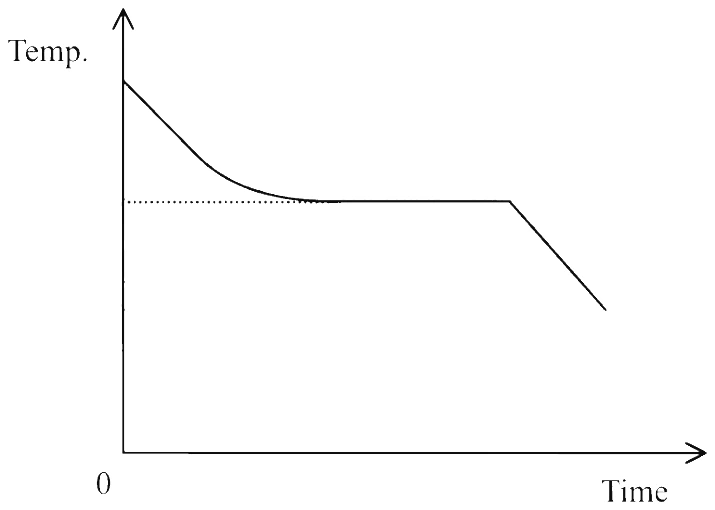
A solid is melted and allowed to cool and solidify again. The temperature is measured at equal intervals of time. The graph shows the change of temperature with time.
The part of the curve that is practically horizontal is due to
Answer: (a)
Step-by-step solution coming soon.
Calorimetry, Latent Heat & Mechanical Equivalent of Heat
Perspiration cools the body because
Answer: (b)
Step-by-step solution coming soon.
Calorimetry, Latent Heat & Mechanical Equivalent of Heat
Heat given to a body which raises its temperature by is known as
Answer: (b)
Step-by-step solution coming soon.
Calorimetry, Latent Heat & Mechanical Equivalent of Heat
The latest discovered state of matter is
Answer: (b)
Step-by-step solution coming soon.
Calorimetry, Latent Heat & Mechanical Equivalent of Heat
A pressure cooker works on the principle of
Answer: (a)
Step-by-step solution coming soon.
Calorimetry, Latent Heat & Mechanical Equivalent of Heat
A glass of water does not turn into ice as it reaches . It is because
Answer: (c)
Step-by-step solution coming soon.
Calorimetry, Latent Heat & Mechanical Equivalent of Heat
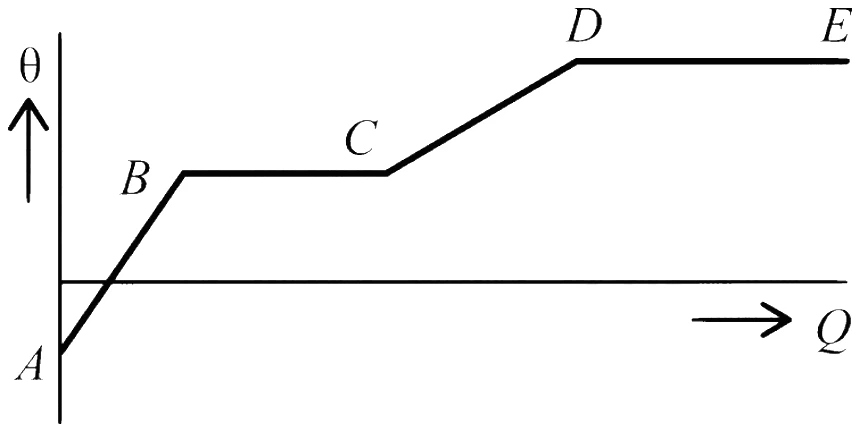
The graph given above indicates change in temperature () when heat () was given to a substance. Which among the following parts of the graph correctly depict the latent heat of the substance?
Answer: (b)
Step-by-step solution coming soon.
Calorimetry, Latent Heat & Mechanical Equivalent of Heat
Body of mass and another body of mass and of same material are kept in the same sunshine for some interval of time. If the rise in temperature is equal for both the bodies, then which one among the following in this regard is correct?
Answer: (a)
Step-by-step solution coming soon.
Calorimetry, Latent Heat & Mechanical Equivalent of Heat
In a pressure cooker cooking is faster because the increase in vapour pressure :
Answer: (d)
Step-by-step solution coming soon.
Calorimetry, Latent Heat & Mechanical Equivalent of Heat
A fan produces a feeling of comfort during hot weather, because
Answer: (d)
Step-by-step solution coming soon.
Calorimetry, Latent Heat & Mechanical Equivalent of Heat
of ice at is mixed with of steam at . After thermal equilibrium, the temperature of the mixture is
Answer: (d)
Step-by-step solution coming soon.
Calorimetry, Latent Heat & Mechanical Equivalent of Heat
Which one of the following is the amount of heat given up when of steam at is condensed and cooled to ?
Answer: (c)
Step-by-step solution coming soon.
Calorimetry, Latent Heat & Mechanical Equivalent of Heat
The specific heat capacity of a substance is temperature dependent and is given by the formula , where is a constant of suitable dimensions in SI units, and is the absolute temperature. If the heat required to raise the temperature of of the substance from to is , the value of is ______.
[Given: .]
Numerical answer type. Work it out, then open the answer.
Answer: 25000
Step-by-step solution coming soon.
Calorimetry, Latent Heat & Mechanical Equivalent of Heat
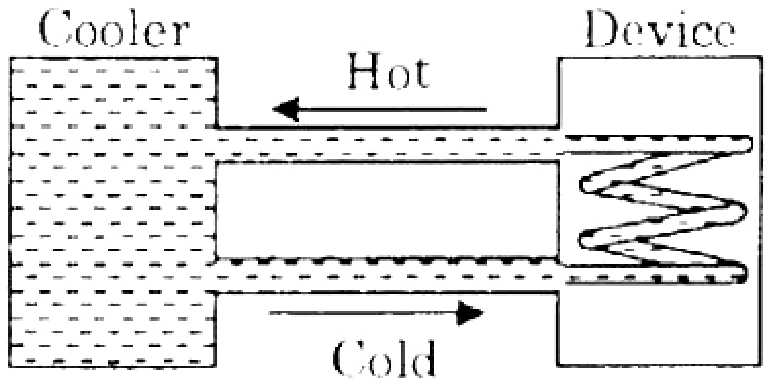
A water cooler of storage capacity litres can cool water at a constant rate of watts. In a closed circulation system (as shown schematically in the figure), the water from the cooler is used to cool an external device that generates constantly of heat (thermal load).
The temperature of water fed into the device cannot exceed and the entire stored litres of water is initially cooled to . The entire system is thermally insulated. The minimum value of (in watts) for which the device can be operated for hours is:
(Specific heat of water is and the density of water is )
Answer: (b)
Step-by-step solution coming soon.
Calorimetry, Latent Heat & Mechanical Equivalent of Heat
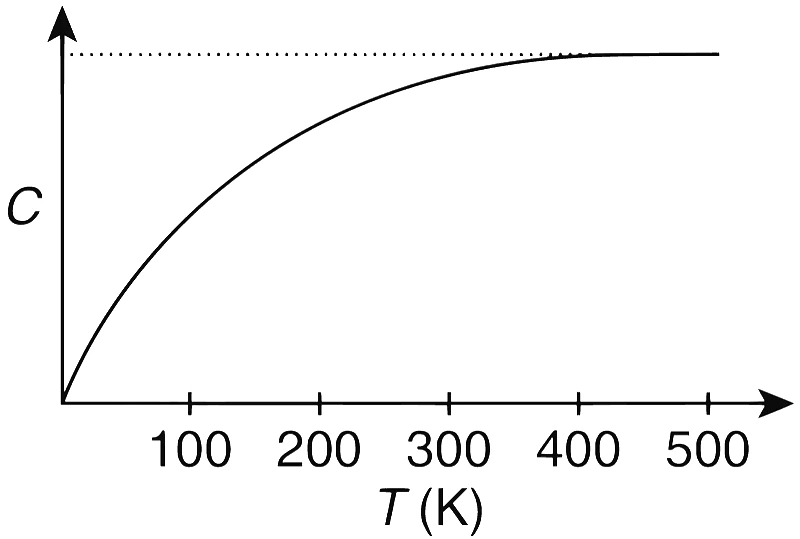
The figure below shows the variation of specific heat capacity () of a solid as a function of temperature (). The temperature is increased continuously from to at a constant rate. Ignoring any volume change, the following statement(s) is(are) correct to a reasonable approximation.
More than one option can be correct. Tap every correct option, then tap Check.
Answer: (a), (b), (c), (d)
Step-by-step solution coming soon.
Calorimetry, Latent Heat & Mechanical Equivalent of Heat
A piece of ice (heat capacity and latent heat ) of mass grams is at at atmospheric pressure. It is given of heat so that the ice starts melting. Finally when the ice-water mixture is in equilibrium, it is found that of ice has melted. Assuming there is no other heat exchange in the process, the value of is
Numerical answer type. Work it out, then open the answer.
Answer: 8
Step-by-step solution coming soon.
Calorimetry, Latent Heat & Mechanical Equivalent of Heat
In an insulated vessel, steam at and of ice at are mixed. Then, find the final temperature of the mixture.
Numerical answer type. Work it out, then open the answer.
Answer: 0
Step-by-step solution coming soon.
Calorimetry, Latent Heat & Mechanical Equivalent of Heat
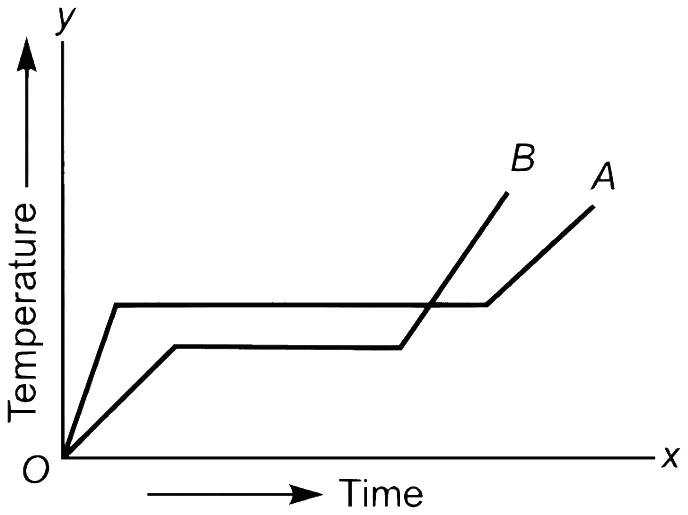
Equal masses of two liquids and contained in vessels of negligible heat capacity are supplied heat at the same rate. The temperature-time graphs for the two liquids are shown.
If represents specific heat and represents latent heat of liquid, then
Answer: (d)
Step-by-step solution coming soon.
Calorimetry, Latent Heat & Mechanical Equivalent of Heat
We have seen that a gamma-ray dose of is lethal to half the people exposed to it. If the equivalent energy were absorbed as heat, what rise in body temperature would result?
Answer: (b)
Step-by-step solution coming soon.
Calorimetry, Latent Heat & Mechanical Equivalent of Heat
Assertion : In pressure-temperature phase diagram of water, the slope of the melting curve is found to be negative.
Reason : Ice contracts on melting to water.
Answer: (a)
Step-by-step solution coming soon.
Calorimetry, Latent Heat & Mechanical Equivalent of Heat
Assertion : In a pressure cooker the water is brought to boil. The cooker is then removed from the stove. Now on removing the lid of the pressure cooker, the water starts boiling again.
Reason : The impurities in water bring down its boiling point.
Answer: (c)
Step-by-step solution coming soon.
Calorimetry, Latent Heat & Mechanical Equivalent of Heat
Assertion : The melting point of ice decreases with increase of pressure.
Reason : Ice contracts on melting.
Answer: (a)
Step-by-step solution coming soon.
Calorimetry, Latent Heat & Mechanical Equivalent of Heat
A lead bullet penetrates into a solid object and melts. Assuming that of its kinetic energy was used to heat it, the initial speed of the bullet is (the initial temperature of the bullet is and its melting point is . Latent heat of fusion of lead and specific heat capacity of lead )
Answer: (b)
Step-by-step solution coming soon.
Calorimetry, Latent Heat & Mechanical Equivalent of Heat
A lead ball at is dropped from a height of . The ball is heated due to the air resistance and it completely melts just before reaching the ground. The molten substance falls slowly on the ground. If the specific heat of lead and melting point of lead and suppose that any mechanical energy lost is used to heat the ball, then the latent heat of fusion of lead is
Answer: (a)
Step-by-step solution coming soon.
Calorimetry, Latent Heat & Mechanical Equivalent of Heat
ice at in insulator vessel, water of is mixed in it, then final temperature of the mixture is (neglect the heat loss)
Answer: (a)
Step-by-step solution coming soon.
Calorimetry, Latent Heat & Mechanical Equivalent of Heat
of water at is mixed with of water at . The final temperature of the mixture is
Answer: (a)
Step-by-step solution coming soon.
Calorimetry, Latent Heat & Mechanical Equivalent of Heat
The amount of work which can be obtained from of heat will be
Answer: (d)
Step-by-step solution coming soon.
Calorimetry, Latent Heat & Mechanical Equivalent of Heat
An electrically heated coil is immersed in a calorimeter containing of water at . The coil consumes energy at the rate of . The water equivalent of calorimeter and coil is . The temperature of water after is
Answer: (b)
Step-by-step solution coming soon.
Calorimetry, Latent Heat & Mechanical Equivalent of Heat
The temperature of equal masses of three different liquids , and are , and respectively. The temperature when and are mixed is and when and are mixed is . The temperature when and are mixed is
Answer: (c)
Step-by-step solution coming soon.
Calorimetry, Latent Heat & Mechanical Equivalent of Heat
A block of a certain material is heated to a temperature of and then placed on a large ice block. If of ice melts, find the mass of the block. Specific heat of the material is and heat of fusion of water is .
Answer: (b)
Step-by-step solution coming soon.
Calorimetry, Latent Heat & Mechanical Equivalent of Heat
Two bodies of specific heats and , having the same heat capacities are combined to form a single composite body. The specific heat capacity of the composite body is
Answer: (b)
Step-by-step solution coming soon.
Calorimetry, Latent Heat & Mechanical Equivalent of Heat
An iron piece of mass is kept inside a furnace for some time and then put in a calorimeter of water equivalent containing of water at . The steady state temperature attained by the mixture is . The temperature of the furnace is (Specific heat capacity of iron is )
Answer: (c)
Step-by-step solution coming soon.
Calorimetry, Latent Heat & Mechanical Equivalent of Heat
A one block of ice at falls from a height of and is found melting. The amount of ice melted due to fall, if energy is converted into heat is (Specific heat capacity of ice is , Latent heat of fusion of ice )
Answer: (c)
Step-by-step solution coming soon.
Calorimetry, Latent Heat & Mechanical Equivalent of Heat
A solid cube of mass at a temperature is heated at a constant rate. It becomes liquid at temperature and vapour at temperature . Let and be specific heats in its solid and liquid states respectively. If and are latent heats of fusion and vaporisation respectively, then the minimum heat energy supplied to the cube until it vaporises is
Answer: (c)
Step-by-step solution coming soon.
Calorimetry, Latent Heat & Mechanical Equivalent of Heat
of ice at is mixed with of water at . The final temperature of the mixture is [Take and ]
Answer: (b)
Step-by-step solution coming soon.
Calorimetry, Latent Heat & Mechanical Equivalent of Heat
The S.I. unit of specific heat capacity is
Answer: (d)
Step-by-step solution coming soon.
Calorimetry, Latent Heat & Mechanical Equivalent of Heat
Heat energy released by water of mass when it is cooled by is (specific heat capacity of water )
Answer: (a)
Step-by-step solution coming soon.
Calorimetry, Latent Heat & Mechanical Equivalent of Heat
A beaker contains of water. The heat capacity of the beaker is equal to that of of water. The initial temperature of water in the beaker is . If of hot water at is poured in it, the final temperature (neglecting radiation loss) will be nearest to
Answer: (b)
Step-by-step solution coming soon.
Calorimetry, Latent Heat & Mechanical Equivalent of Heat
A geyser heats water flowing at the rate of liters per minute from to . If the geyser operates on a gas burner and if its heat of combustion is , the rate of combustion of the fuel per minute is
Answer: (b)
Step-by-step solution coming soon.
Calorimetry, Latent Heat & Mechanical Equivalent of Heat
An earthen pitcher containing of water loses one gram of water per minute due to evaporation. If the water equivalent of the pitcher is , the time required to cool the water in the pitcher from to is (neglect radiation effect and take latent heat of vaporization )
Answer: (c)
Step-by-step solution coming soon.
Calorimetry, Latent Heat & Mechanical Equivalent of Heat
If some heat is given to a metal of mass , its temperature rises by . If the same heat is given to of water, the change in its temperature (in ) is (The ratio of specific heat capacities of metal and water is )
Answer: (b)
Step-by-step solution coming soon.
Calorimetry, Latent Heat & Mechanical Equivalent of Heat
A small quantity of water of mass at temperature is mixed with a large mass of ice which is at its melting point. If is the specific heat capacity of water and is the latent heat of fusion of ice, then the mass of ice melted is
Answer: (d)
Step-by-step solution coming soon.
Calorimetry, Latent Heat & Mechanical Equivalent of Heat
Water of mass in a closed vessel is at a temperature of . If the temperature of the water when heated for a time of minutes becomes , then the increase in the internal energy of the water is (specific heat capacity of water )
Answer: (d)
Step-by-step solution coming soon.
Calorimetry, Latent Heat & Mechanical Equivalent of Heat
An electric kettle takes current at . If the entire electric energy is converted into heat energy, then the time (in minutes) taken to increase the temperature of of water from to is
Answer: (c)
Step-by-step solution coming soon.
Calorimetry, Latent Heat & Mechanical Equivalent of Heat
The temperature of water of mass is raised from to by adding steam to it. The mass of the steam added is (latent heat of steam and specific heat capacity of water )
Answer: (b)
Step-by-step solution coming soon.
Calorimetry, Latent Heat & Mechanical Equivalent of Heat
Steam at is passed into of water at . The mass of water present in the mixture when the temperature of the water becomes is (latent heat of steam , specific heat capacity of water )
Answer: (a)
Step-by-step solution coming soon.
Calorimetry, Latent Heat & Mechanical Equivalent of Heat
A metal ball of mass at is dropped in of water at . If the resultant temperature is , then the ratio of specific heat of the metal to that of water is
Answer: (c)
Step-by-step solution coming soon.
Calorimetry, Latent Heat & Mechanical Equivalent of Heat
Match the following.
| Quantity | Dimensions | ||
| (a) | Thermal conductivity | (i) | |
| (b) | Boltzmann constant | (ii) | |
| (c) | Latent heat | (iii) | |
| (d) | Specific heat | (iv) |
Answer: (a)
Step-by-step solution coming soon.
Calorimetry, Latent Heat & Mechanical Equivalent of Heat
Water of mass at is mixed with of ice at . If the resultant temperature of the mixture is , then the value of is (specific heat capacity of ice , specific heat capacity of water and latent heat of fusion of ice )
Answer: (b)
Step-by-step solution coming soon.
Calorimetry, Latent Heat & Mechanical Equivalent of Heat
A metal block is made from mixture of of aluminium, of brass and of copper. The metal block is initially at . If the heat supplied to the metal block is , find the final temperature of the block if specific heats of aluminium, brass and copper are , and respectively
Answer: (d)
Step-by-step solution coming soon.
Calorimetry, Latent Heat & Mechanical Equivalent of Heat
In the given triple point curve as shown in figure, the curves , , represents
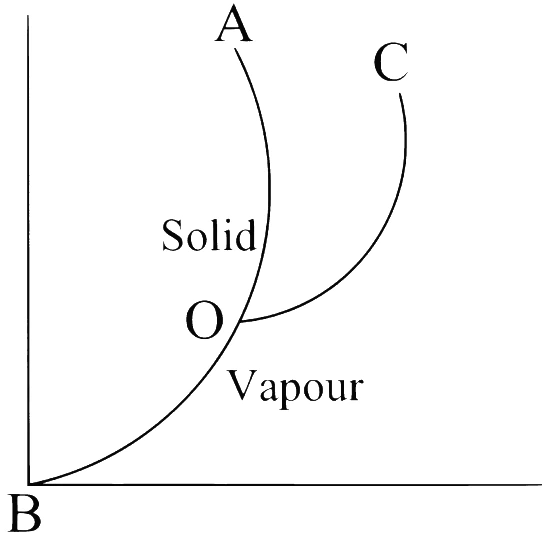
Answer: (b)
Step-by-step solution coming soon.
Calorimetry, Latent Heat & Mechanical Equivalent of Heat
The specific heat capacity of a copper block of mass is . If the mass of the copper block is doubled, the specific heat capacity will be
Answer: (c)
Step-by-step solution coming soon.
Calorimetry, Latent Heat & Mechanical Equivalent of Heat
A block of steel of mass slides down a rough inclined plane of inclination of at a constant speed. The temperature of the block as it slides through , assuming that the mechanical energy lost is used to increase the temperature of the block is nearly (Specific heat capacity of steel and Acceleration due to gravity )
Answer: (b)
Step-by-step solution coming soon.
Calorimetry, Latent Heat & Mechanical Equivalent of Heat
of ice at and of water at are mixed together in a calorimeter. The final temperature of the mixture is (Neglect heat capacity of the calorimeter, specific heat capacity of ice and latent heat of fusion of ice and specific heat capacity of water )
Answer: (d)
Step-by-step solution coming soon.
Calorimetry, Latent Heat & Mechanical Equivalent of Heat
Boiling water is changing into steam. The specific heat of boiling water is
Answer: (c)
Step-by-step solution coming soon.
Calorimetry, Latent Heat & Mechanical Equivalent of Heat
If is the heat required to convert of ice at a temperature of to water at a temperature of and is the heat required to convert of ice at a temperature of to water at a temperature of , then
(Latent heat of fusion of ice and specific heat capacity of water )
Answer: (a)
Step-by-step solution coming soon.
Calorimetry, Latent Heat & Mechanical Equivalent of Heat
Ice of mass at a temperature of is mixed with water of mass at a temperature of . The ratio of the masses of ice and water in the mixture in equilibrium is
(Latent heat of fusion of ice , specific heat capacities of water and ice are and respectively)
Answer: (b)
Step-by-step solution coming soon.
Calorimetry, Latent Heat & Mechanical Equivalent of Heat
Steam at a temperature of is passed into water of mass such that the temperature of the water increases from to . Then the total mass of the water at is
Answer: (b)
Step-by-step solution coming soon.
Calorimetry, Latent Heat & Mechanical Equivalent of Heat
Water of mass in a kettle of mass at an initial temperature of is heated by a heater of power . When the lid of the kettle is open, heat is lost at a constant rate of . If the specific heat capacity of the material of the kettle is half of the specific heat capacity of water, then the time required in minutes to increase the temperature of the water to with the lid of the kettle open is
(Specific heat capacity of water )
Answer: (b)
Step-by-step solution coming soon.
Calorimetry, Latent Heat & Mechanical Equivalent of Heat
The power of a refrigerator that can make of ice at from water at in one hour is
Answer: (b)
Step-by-step solution coming soon.
Calorimetry, Latent Heat & Mechanical Equivalent of Heat
The heat required to convert of ice at a temperature of to steam at is [specific heat capacity of ice , specific heat capacity of water , latent heat of fusion of ice and latent heat of steam ]
Answer: (b)
Step-by-step solution coming soon.
Calorimetry, Latent Heat & Mechanical Equivalent of Heat
Steam of mass at a temperature is mixed with water of mass at a temperature . The ratio of the masses of steam and water in equilibrium is (Latent heat of steam is and specific heat capacity of water is )
Answer: (a)
Step-by-step solution coming soon.
Calorimetry, Latent Heat & Mechanical Equivalent of Heat
of ice at temperature is mixed with of water at temperature. The resultant temperature is (specific heat capacity of water and latent heat of fusion of ice )
Answer: (c)
Step-by-step solution coming soon.
Calorimetry, Latent Heat & Mechanical Equivalent of Heat
When of ice at is mixed with of steam at , then the final mixture at thermal equilibrium contains
Answer: (b)
Step-by-step solution coming soon.
Calorimetry, Latent Heat & Mechanical Equivalent of Heat
The temperatures of equal masses of three different liquids , and are , and , respectively. The resultant temperature when liquids and are mixed is and when liquids and are mixed is . Then, the ratio of specific heat capacities of the liquids , and is
Answer: (b)
Step-by-step solution coming soon.
Calorimetry, Latent Heat & Mechanical Equivalent of Heat
If the ratio of densities of two substances is and the ratio of their specific heat capacities is , then the ratio of heat energies required per unit volume so that the two substances can have the same temperature rise is
Answer: (c)
Step-by-step solution coming soon.
Calorimetry, Latent Heat & Mechanical Equivalent of Heat
The heat energy required to convert of ice at into water at is (specific heat capacity of ice and latent heat of fusion of ice )
Answer: (a)
Step-by-step solution coming soon.
Calorimetry, Latent Heat & Mechanical Equivalent of Heat
The temperature of of water is to be raised from to by adding steam at to it. The mass of the steam required in this process is (latent heat of steam is )
Answer: (d)
Step-by-step solution coming soon.
Calorimetry, Latent Heat & Mechanical Equivalent of Heat
Steam at is added to water to increase its temperature from to . The total mass of the water at is (specific heat capacity of water and latent heat of steam )
Answer: (a)
Step-by-step solution coming soon.
Calorimetry, Latent Heat & Mechanical Equivalent of Heat
Two objects made of the same material have masses and and are at temperatures and respectively. When heat is supplied to the object of mass , its temperature rises to . If the same heat is supplied to the object of mass , its temperature rises to
Answer: (c)
Step-by-step solution coming soon.
Calorimetry, Latent Heat & Mechanical Equivalent of Heat
Statement I: A device in which heat measurement can be made is called calorimeter.
Statement II: Skating is possible on snow due to the formation of water below the skates. Water is formed due to the increase of temperature and ice melts.
Statement III: Two bodies at different temperature are mixed in a calorimeter. Total internal energy of the two bodies remains conserved.
Which of the following is correct?
Answer: (d)
Step-by-step solution coming soon.
Calorimetry, Latent Heat & Mechanical Equivalent of Heat
Which of the following statements is not true?
Answer: (c)
Step-by-step solution coming soon.
Calorimetry, Latent Heat & Mechanical Equivalent of Heat
of can change its temperature from to by absorbing of thermal energy. The molar specific heat of (in ) is
Answer: (a)
Step-by-step solution coming soon.
Calorimetry, Latent Heat & Mechanical Equivalent of Heat
Find the difference in temperature between the water at the top and the bottom of a high waterfall assuming of the energy of fall is spent in heating the water (use specific heat capacity of water and )
Answer: (c)
Step-by-step solution coming soon.
Calorimetry, Latent Heat & Mechanical Equivalent of Heat
A solution consists of ether and of water at . If the ether evaporates completely to freeze the water, then the mass of the ether in the solution is
Answer: (b)
Step-by-step solution coming soon.
Calorimetry, Latent Heat & Mechanical Equivalent of Heat
How much heat energy is supplied when of water at is brought to its boiling point? (Assume the specific heat of water )
Answer: (a)
Step-by-step solution coming soon.
Calorimetry, Latent Heat & Mechanical Equivalent of Heat
A solid of mass absorbs when its temperature is raised from to . The specific heat capacity of this solid in units of is
Answer: (a)
Step-by-step solution coming soon.
Calorimetry, Latent Heat & Mechanical Equivalent of Heat
Two substances and of same mass are heated at constant rate. The variation of temperature of the substances with time is shown in the figure. Choose the correct statement.
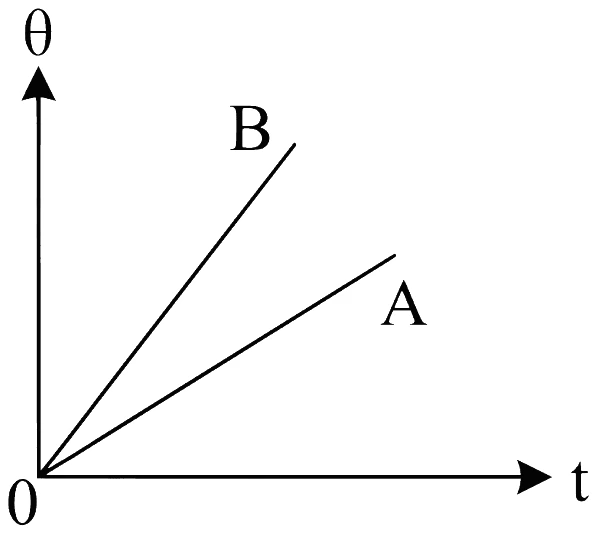
Answer: (a)
Step-by-step solution coming soon.
Calorimetry, Latent Heat & Mechanical Equivalent of Heat
of water at is added to of ice at . The final temperature of the mixture is
Answer: (b)
Step-by-step solution coming soon.
Calorimetry, Latent Heat & Mechanical Equivalent of Heat
When of boiling water at is added into a calorimeter containing of cold water at , temperature of the mixture becomes . Then, a metallic block of mass at is dipped into the mixture in the calorimeter. After reaching thermal equilibrium, the final temperature becomes . What is the specific heat of the metal in CGS unit?
Answer: (d)
Step-by-step solution coming soon.
Calorimetry, Latent Heat & Mechanical Equivalent of Heat
A metallic block of mass is dragged with a uniform velocity of on a horizontal table for . The coefficient of static friction between the block and the table is . What will be the maximum possible rise in temperature of the metal block, if the specific heat of the block is CGS unit? Assume and uniform rise in temperature throughout the whole block. [Ignore absorption of heat by the table]
Answer: (a)
Step-by-step solution coming soon.
Calorimetry, Latent Heat & Mechanical Equivalent of Heat
A horizontal fire hose with a nozzle of cross-sectional area delivers a cubic metre of water in . What will be the maximum possible increase in the temperature of water while it hits a rigid wall (neglecting the effect of gravity)?
Answer: (a)
Step-by-step solution coming soon.
Calorimetry, Latent Heat & Mechanical Equivalent of Heat
Two identical blocks of ice move in opposite directions with equal speed and collide with each other. What will be the minimum speed required to make both the blocks melt completely, if the initial temperatures of the blocks were each? (Specific heat of ice is and latent heat of fusion of ice is )
Answer: (a)
Step-by-step solution coming soon.
Calorimetry, Latent Heat & Mechanical Equivalent of Heat
The water equivalent of a calorimeter is and it contains of water at . Some amount of ice, initially at is dropped in it and half of the ice melts till equilibrium is reached. What was the initial amount of ice that was dropped (when specific heat of ice , specific heat of water and latent heat of melting of ice ) ?
Answer: (c)
Step-by-step solution coming soon.
Calorimetry, Latent Heat & Mechanical Equivalent of Heat
An experiment takes minutes to raise temperature of water from to and another minutes to convert it totally into steam by a stabilized heater. The latent heat of vaporization comes out to be
Answer: (c)
Step-by-step solution coming soon.
Calorimetry, Latent Heat & Mechanical Equivalent of Heat
A qualitative phase diagram of a substance is shown in the figure below. Choose the correct option from the following statements.
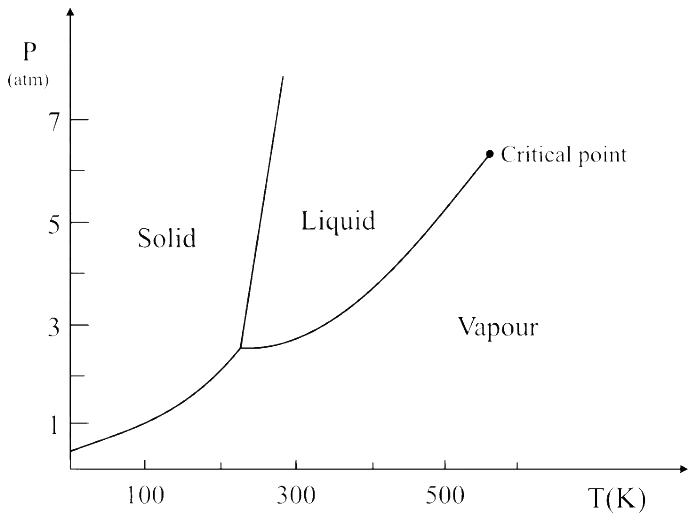
Answer: (a)
Step-by-step solution coming soon.
Calorimetry, Latent Heat & Mechanical Equivalent of Heat
Water and ice having equal masses are placed inside an insulated container. The initial temperatures of water and ice are and respectively. The equilibrium temperature of the system in degrees Celsius is close to (Note: take the specific heat of water ; latent heat of fusion )
Answer: (b)
Step-by-step solution coming soon.
Calorimetry, Latent Heat & Mechanical Equivalent of Heat
In a certain experiment, liquid helium at an initial temperature of is to be further cooled by bringing it into contact with a paramagnetic salt which is initially at temperature . The heat capacity of liquid helium is expressed as () and that of salt is expressed as (). Assume that the mixture is thermally and mechanically isolated and no work is done during the process. If the final temperature of the system is , the initial temperature of the salt is
Answer: (b)
Step-by-step solution coming soon.
Calorimetry, Latent Heat & Mechanical Equivalent of Heat
Two experiments P and Q are performed with water in various states of phases. Both experiments are performed at constant pressures. Heat is supplied to the systems at the same constant rate in both the experiments. The latent heat of fusion, vapourisation and sublimation of water are respectively , and . The phase diagram of water and the temperature-time schematic plots of the two experiments are depicted below (bold curve for P and dashed curve for Q). Then one can conclude that
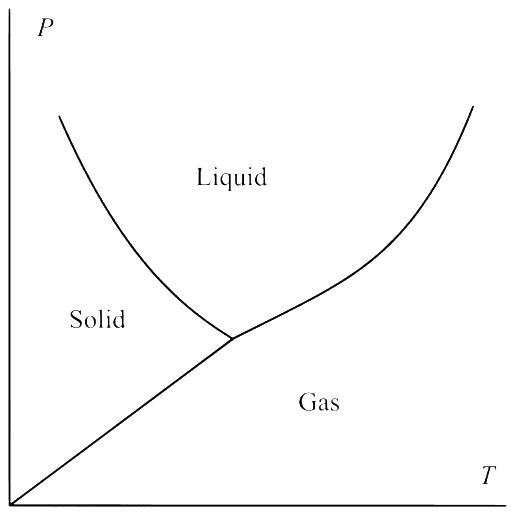
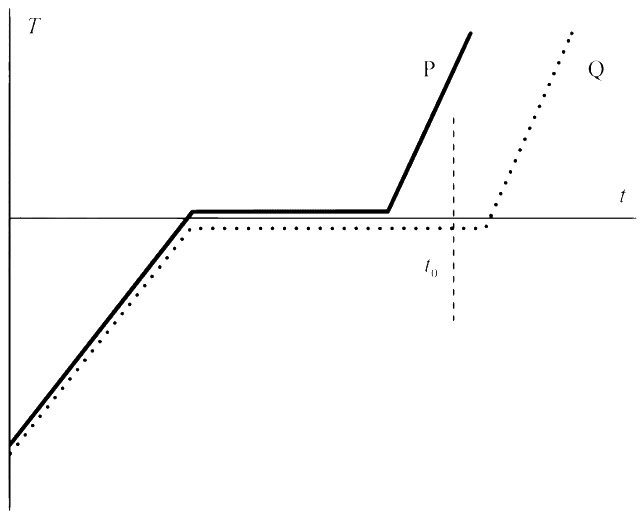
More than one option can be correct. Tap every correct option, then tap Check.
Answer: (a), (b), (c)
Step-by-step solution coming soon.
Calorimetry, Latent Heat & Mechanical Equivalent of Heat
In two experiments and , the container contains ice at and is kept in thermal contact with another container containing water at . The contents, however, are not allowed to mix. The variation of temperature with time in the two experiments is shown below. Choose the correct statement(s) from the following.
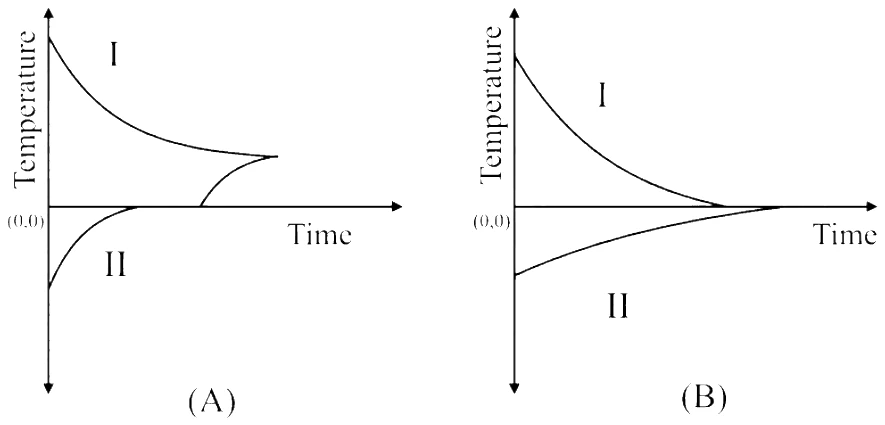
More than one option can be correct. Tap every correct option, then tap Check.
Answer: (a)
Step-by-step solution coming soon.
No questions match these filters.