Physics Circle home Student Login

Home›Practice Hub›Chapters›Work, Energy and Power›Conservation of Energy

Work, Energy and Power PYQs · MHT CET · JEE Main · NEET

Conservation of Energy

Read the theory for this topic →

Questions
97
MHT CET
9
JEE Main
30
NEET
5
Other exams
53
0 of 97 attempted

Q1JEE Main 2026 · 23 JAN · SHIFT 1Medium

Conservation of Energy

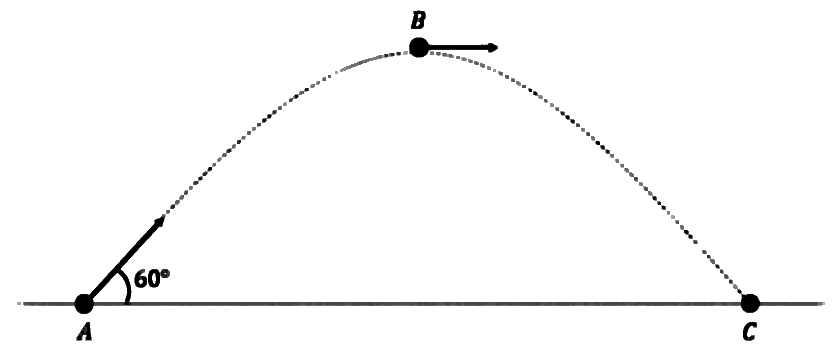
An object is projected with kinetic energy KK from a point AA at an angle 60∘60^\circ with the horizontal. The ratio of the difference in kinetic energies at points BB and CC to that at point AA (see figure), in the absence of air friction is:

Figure

Show answer and solution

Answer: (a)

Loading the solution…
Report a mistakeOpen question page
Q2JEE Main 2026 · 6 APR · SHIFT 2Medium

Conservation of Energy

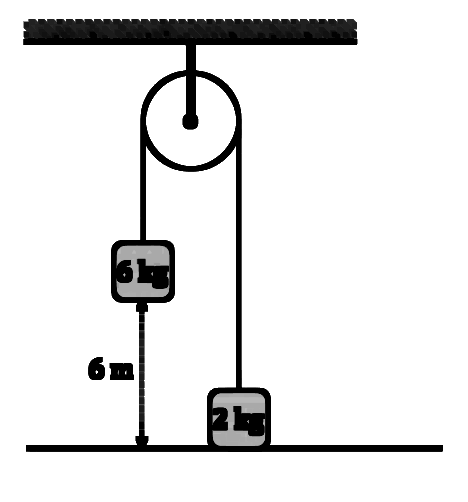
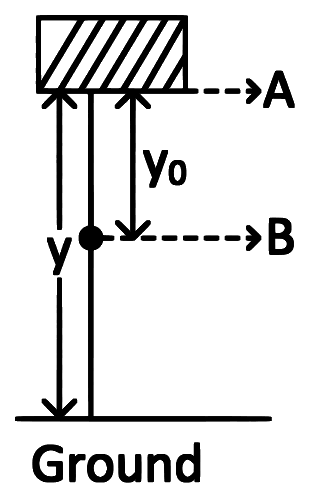
The velocity at which 6 kg mass (shown in figure) strikes the ground when it is released from a height of 6 m above the ground is ‾ m/s\underline{\qquad}\ \text{m/s}. Assume pulley is massless and string is light and inextensible. (Take g=10 m/s2\text{g} = 10\text{ m/s}^2)

Figure

Show answer and solution

Answer: (a)

Loading the solution…
Report a mistakeOpen question page
Q3MHT CET 2026 · 19 MAY · SHIFT 1Medium

Conservation of Energy

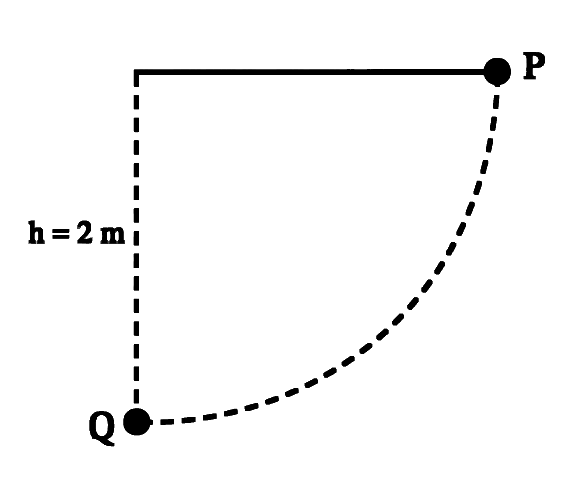
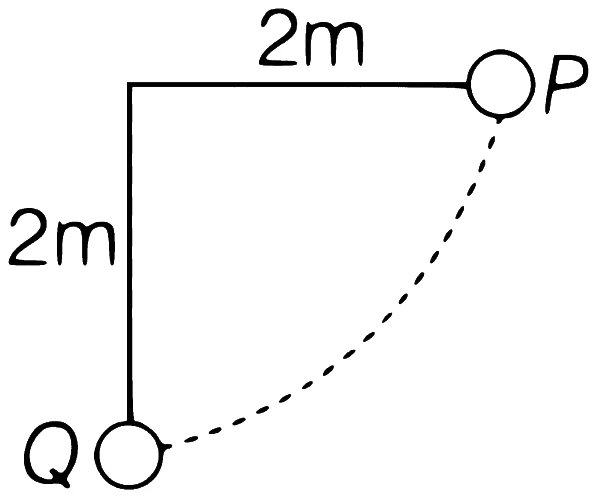
The bob of a simple pendulum of length 2m is kept at P. It is released and when it reaches Q, it losses 20% of its total energy due to air resistance. Its velocity at Q is [Take g=9.8g = 9.8 m/s2{}^{2} ]

Figure

Show answer and solution

Answer: (c)

Loading the solution…
Report a mistakeOpen question page
Q4JEE Main 2026 · 23 JAN · SHIFT 2Difficult

Conservation of Energy

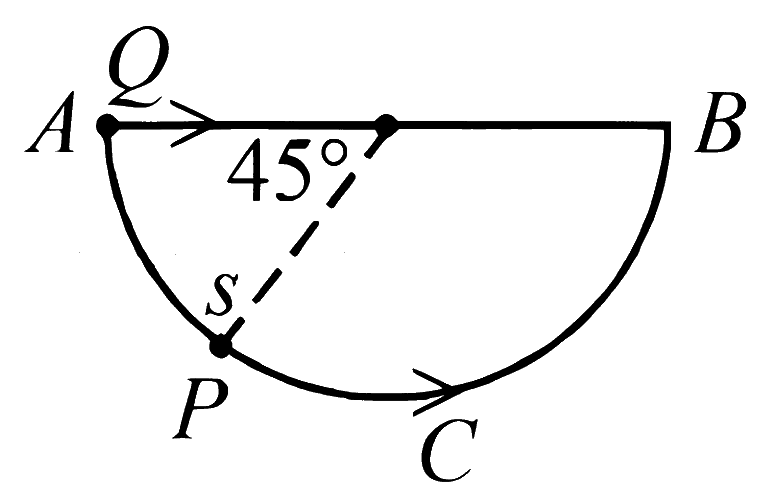
A bead PP sliding on a frictionless semi-circular string (ACB)(ACB) and it is at point SS at t=0t = 0 and at this instant the horizontal component of its velocity is vv. Another bead QQ of the same mass as PP is ejected from point AA at t=0t = 0 along the horizontal string ABAB, with the speed vv, friction between the beads and the respective strings may be neglected in both cases. Let tPt_P and tQt_Q be the respective times taken by beads PP and QQ to reach the point BB, then the relation between tPt_P and tQt_Q is

Figure

Show answer and solution

Answer: (a)

Loading the solution…
Report a mistakeOpen question page
Q5MHT CET 2025 · 19 APR · SHIFT 2Easy

Conservation of Energy

A stone is projected with kinetic energy E, making an angle θ\theta with the horizontal. When it reaches a highest point, its kinetic energy is

Show answer and solution

Answer: (c)

Loading the solution…
Report a mistakeOpen question page
Q6JEE Main 2025 · 23 JAN · SHIFT 2Easy

Conservation of Energy

A ball having kinetic energy KE, is projected at an angle of 60∘60^\circ from the horizontal. What will be the kinetic energy of ball at the highest point of its flight?

Show answer and solution

Answer: (c)

Loading the solution…
Report a mistakeOpen question page
Q7JEE Main 2025 · 3 APR · SHIFT 1Medium

Conservation of Energy

A particle is released from height SS above the surface of the earth. At certain height its kinetic energy is three times its potential energy. The height from the surface of the earth and the speed of the particle at that instant are respectively.

Show answer and solution

Answer: (c)

Loading the solution…
Report a mistakeOpen question page
Q8JEE Main 2025 · 28 JAN · SHIFT 1Difficult

Conservation of Energy

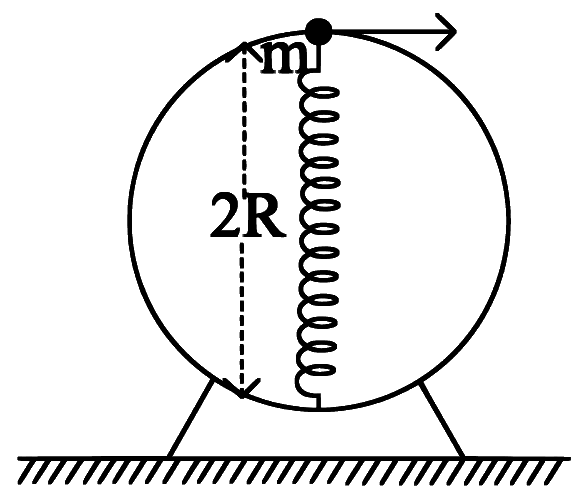
A bead of mass ' mm ' slides without friction on the wall of a vertical circular hoop of radius ' RR ' as shown in figure. The bead moves under the combined action of gravity and a massless spring (k) attached to the bottom of the hoop. The equilibrium length of the spring is ' RR '. If the bead is released from top of the hoop with (negligible) zero initial speed, velocity of bead, when the length of spring becomes ' RR ', would be (spring constant is ' kk ', gg is acceleration due to gravity)

Figure

Show answer and solution

Answer: (b)

Loading the solution…
Report a mistakeOpen question page
Q9JEE Main 2024 · 30 JAN · SHIFT 1Easy

Conservation of Energy

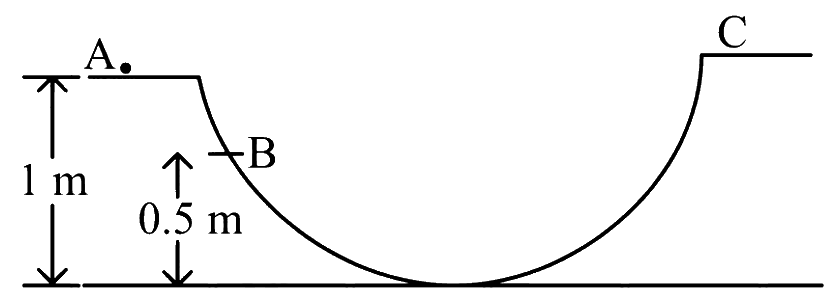
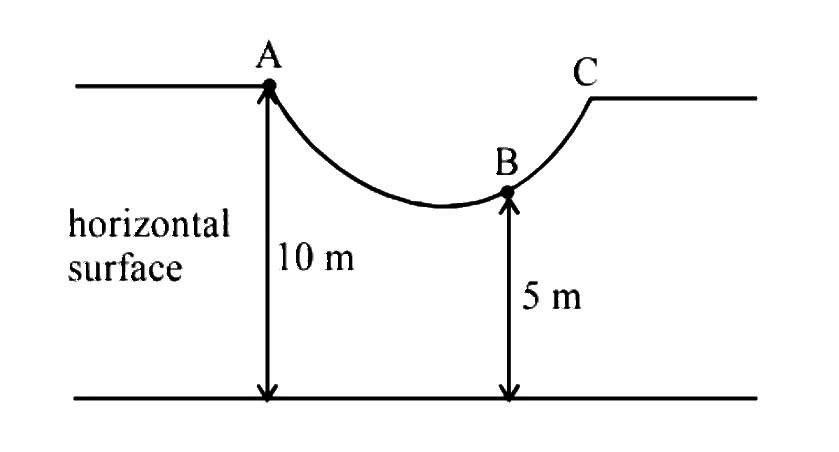
A particle is placed at the point AA of a frictionless track ABCABC as shown in figure. It is gently pushed towards right. The speed of the particle when it reaches the point B is:

(Take g=10 m/s2g = 10\text{ m/s}^2).

Figure

Show answer and solution

Answer: (c)

Loading the solution…
Report a mistakeOpen question page
Q10MHT CET 2024 · 3 MAY · SHIFT 1Medium

Conservation of Energy

A ball ' AA ' is projected vertically upwards with certain initial speed. Another ball 'B' of same mass is projected at an angle of 30∘30^\circ with vertical with the same initial speed. At the highest point, the ratio of potential energy of ball A to that of ball B will be

(sin⁡90∘=1,sin⁡60∘=cos⁡30∘=32,sin⁡30∘=cos⁡60∘=12)\left(\sin 90^\circ = 1, \sin 60^\circ = \cos 30^\circ = \frac{\sqrt{3}}{2}, \sin 30^\circ = \cos 60^\circ = \frac{1}{2}\right)

Show answer and solution

Answer: (a)

Loading the solution…
Report a mistakeOpen question page
Q11JEE Main 2024 · 4 APR · SHIFT 2Medium

Conservation of Energy

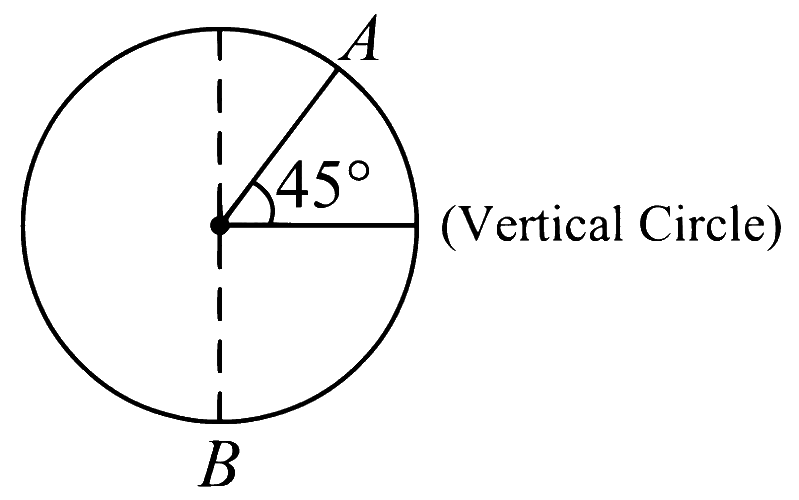
A body of m kgm\text{ kg} slides from rest along the curve of vertical circle from point AA to BB in frictionless path. The velocity of the body at BB is:

Figure

(given, R=14 m,g=10 m/s2R = 14\text{ m}, g = 10\text{ m/s}^2 and 2=1.4\sqrt{2} = 1.4)

Show answer and solution

Answer: (d)

Loading the solution…
Report a mistakeOpen question page
Q12MHT CET 2024 · 16 MAY · SHIFT 1Medium

Conservation of Energy

A simple pendulum of length L has mass m and it oscillates freely with amplitude A. At extreme position, its potential energy is ( g=\text{g} = acceleration due to gravity)

Show answer and solution

Answer: (d)

Loading the solution…
Report a mistakeOpen question page
Q13MHT CET 2024 · 15 MAY · SHIFT 2Medium

Conservation of Energy

If the work done in blowing a soap bubble of volume ' V ' is ' W ', then the work done in blowing a soap bubble of volume ' 2 V ' will be

Show answer and solution

Answer: (d)

Loading the solution…
Report a mistakeOpen question page
Q14MHT CET 2024 · 10 MAY · SHIFT 1Medium

Conservation of Energy

A lead bullet moving with velocity ' V ' strikes a wall and stops. If 75%75\% of its energy is converted into heat, then the increase in temperature is ( s=\text{s} = specific heat of lead, J=\text{J} = mechanical equivalent of heat)

Show answer and solution

Answer: (a)

Loading the solution…
Report a mistakeOpen question page
Q15MHT CET 2024 · 4 MAY · SHIFT 2Difficult

Conservation of Energy

A carpet of mass ' MM ' made of a material is rolled along its length in the form of a cylinder of radius ' RR ' and kept above the rough floor. If the carpet is unrolled without sliding to a radius ' R/2R/2 '. The change in potential energy is ( g=g = acceleration due to gravity)

Show answer and solution

Answer: (b)

Loading the solution…
Report a mistakeOpen question page
Q16JEE Main 2023 · 29 JAN · SHIFT 1Easy

Conservation of Energy

A stone is projected at angle 30∘30^\circ to the horizontal. The ratio of kinetic energy of the stone at point of projection to its kinetic energy at the highest point of flight will be -

Show answer and solution

Answer: (c)

Loading the solution…
Report a mistakeOpen question page
Q17JEE Main 2023 · 29 JAN · SHIFT 1Medium

Conservation of Energy

A 0.4 kg mass takes 8s to reach ground when dropped from a certain height 'P' above surface of earth. The loss of potential energy in the last second of fall is __________ J.

(Take g = 10 m/s2{}^{2})

Numerical answer type. Work it out, then open the answer.

Show answer and solution

Answer: 300

Loading the solution…
Report a mistakeOpen question page
Q18MHT CET 2023 · 9 MAY · SHIFT 1Medium

Conservation of Energy

A stone is projected vertically upwards with speed 'vv'. Another stone of same mass is projected at an angle of 60∘60^\circ with the vertical with the same speed 'vv'. The ratio of their potential energies at the highest points of their journey is [sin⁡30∘=cos⁡60∘=0.5,cos⁡30∘=sin⁡60∘=32]\left[\sin 30^\circ = \cos 60^\circ = 0.5, \cos 30^\circ = \sin 60^\circ = \frac{\sqrt{3}}{2}\right]

Show answer and solution

Answer: (a)

Loading the solution…
Report a mistakeOpen question page
Q19JEE Main 2023 · 10 APR · SHIFT 1Medium

Conservation of Energy

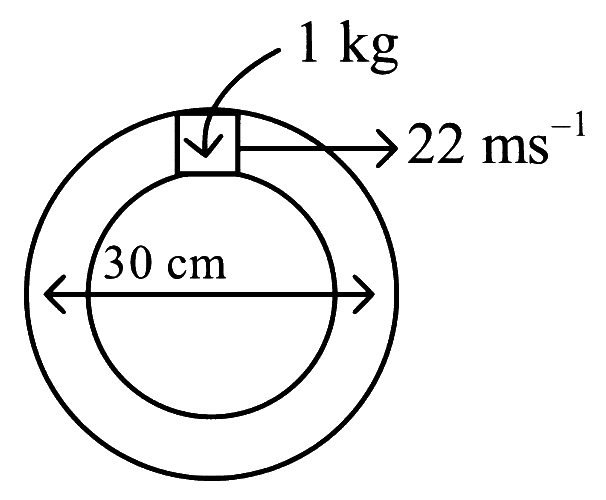
A closed circular tube of average radius 15 cm, whose inner walls are rough, is kept in vertical plane. A block of mass 1 kg just fits inside the tube. The speed of block is 22 m/s, when it is introduced at the top of tube. After completing five oscillations, the block stops at the bottom region of tube. The work done by the tube on the block is __________ J. (Given g = 10 m/s2{}^{2}).

Figure

Numerical answer type. Work it out, then open the answer.

Show answer and solution

Answer: 245

Loading the solution…
Report a mistakeOpen question page
Q20JEE Main 2022 · 29 JUL · SHIFT 1Easy

Conservation of Energy

A ball is projected with kinetic energy E, at an angle of 60∘60^\circ to the horizontal. The kinetic energy of this ball at the highest point of its flight will become:

Show answer and solution

Answer: (c)

Loading the solution…
Report a mistakeOpen question page
Q21JEE Main 2022 · 29 JUN · SHIFT 2Easy

Conservation of Energy

In the given figure, the block of mass m is dropped from the point 'A'. The expression for kinetic energy of block when it reaches point 'B' is

Figure

Show answer and solution

Answer: (d)

Loading the solution…
Report a mistakeOpen question page
Q22JEE Main 2021 · 18 MAR · SHIFT 1Easy

Conservation of Energy

As shown in the figure, a particle of mass 10 kg is placed at a point A. When the particle is slightly displaced to its right, it starts moving and reaches the point B. The speed of the particle at B is x m/s. (Take g = 10 m/s2)

The value of 'x' to the nearest integer is __________.

Figure

Numerical answer type. Work it out, then open the answer.

Show answer and solution

Answer: 10

Loading the solution…
Report a mistakeOpen question page
Q23NEET 2021Medium

Conservation of Energy

A particle is released from height S from the surface of the Earth. At a certain height its kinetic energy is three times its potential energy. The height from the surface of earth and the speed of the particle at that instant are respectively -

Show answer and solution

Answer: (a)

Loading the solution…
Report a mistakeOpen question page
Q24MHT CET 2021 · 24 SEP · SHIFT 1Medium

Conservation of Energy

A stone is projected vertically upwards with velocity 'V'. Another stone of same mass is projected at an angle of 60∘60^\circ with the vertical with the same speed (V)(\text{V}). The ratio of their potential energies at the highest points of their journey, is

[sin⁡30∘=cos⁡60∘=0.5,cos⁡30∘=sin⁡60∘=32]\left[\sin 30^\circ = \cos 60^\circ = 0.5, \cos 30^\circ = \sin 60^\circ = \frac{\sqrt{3}}{2}\right]

Show answer and solution

Answer: (b)

Loading the solution…
Report a mistakeOpen question page
Q25JEE Main 2021 · 25 JUL · SHIFT 1Medium

Conservation of Energy

A pendulum bob has a speed of 3 m/s at its lowest position. The pendulum is 50 cm long. The speed of bob, when the length makes an angle of 60 ∘{}^\circ to the vertical will be (g = 10 m/s2) ____________ m/s.

Numerical answer type. Work it out, then open the answer.

Show answer and solution

Answer: 2

Loading the solution…
Report a mistakeOpen question page
Q26JEE Main 2021 · 26 AUG · SHIFT 1Medium

Conservation of Energy

A uniform chain of length 3 meter and mass 3 kg overhangs a smooth table with 2 meter lying on the table. If k is the kinetic energy of the chain in joule as it completely slips off the table, then the value of k is .................. (Take g = 10 m/s2)

Numerical answer type. Work it out, then open the answer.

Show answer and solution

Answer: 40

Loading the solution…
Report a mistakeOpen question page
Q27JEE Main 2020 · 7 JAN · SHIFT 1Medium

Conservation of Energy

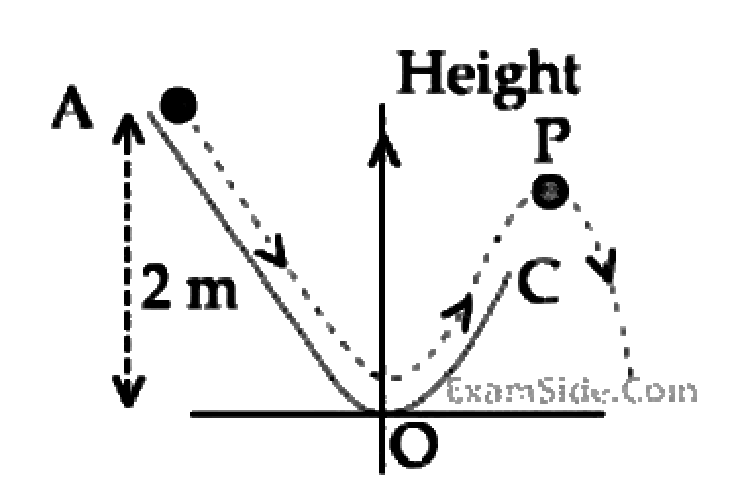
A particle (m = 1 kg) slides down a frictionless track (AOC) starting from rest at a point A (height 2 m). After reaching C, the particle continues to move freely in air as a projectile. When it reaches its highest point P (height 1 m), the kinetic energy of the particle (in J) is:

(Figure drawn is schematic and not to scale; take g = 10 ms-2)

Figure

Numerical answer type. Work it out, then open the answer.

Show answer and solution

Answer: 10

Loading the solution…
Report a mistakeOpen question page
Q28JEE Main 2020 · 2 SEP · SHIFT 1Medium

Conservation of Energy

Figure

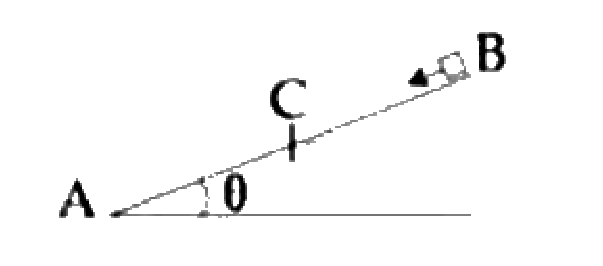
A small block starts slipping down from a point B on an inclined plane AB, which is making an angle θ\theta with the horizontal section BC is smooth and the remaining section CA is rough with a coefficient of friction μ\mu. It is found that the block comes to rest as it reaches the bottom (point A) of the inclined plane. If BC = 2AC, the coefficient of friction is given by μ\mu = ktan θ\theta. The value of k is _________.

Numerical answer type. Work it out, then open the answer.

Show answer and solution

Answer: 3

Loading the solution…
Report a mistakeOpen question page
Q29JEE Main 2020 · 3 SEP · SHIFT 2Difficult

Conservation of Energy

A block starts moving up an inclined plane of inclination 30° with an initial velocity of v0. It comes back to its initial position with velocity v02\frac{v_0}{2}. The value of the coefficient of kinetic friction between the block and the inclined plane is close to I1000\frac{I}{1000}. The nearest integer to I is____.

Numerical answer type. Work it out, then open the answer.

Show answer and solution

Answer: 346

Loading the solution…
Report a mistakeOpen question page
Q30JEE Main 2019 · 9 APR · SHIFT 1Easy

Conservation of Energy

A uniform cable of mass 'M' and length 'L' is placed on a horizontal surface such that its (1/n)th part is hanging below the edge of the surface. To lift the hanging part of the cable upto the surface, the work done should be:

Show answer and solution

Answer: (c)

Loading the solution…
Report a mistakeOpen question page
Q31JEE Main 2016Medium

Conservation of Energy

A person trying to lose weight by burning fat lifts a mass of 10 kg10\text{ kg} upto a height of 1 m 10001\text{ m}\ 1000 times. Assume that the potential energy lost each time he lowers the mass is dissipated. How much fat will he use up considering the work done only when the weight is lifted up? Fat supplies 3.8×10⁷ J3.8 \times 10^{7}\text{ J} of energy per kg\text{kg} which is converted to mechanical energy with a 20%20\% efficiency rate. Take g=9.8 ms−2g = 9.8\text{ ms}^{-2}:

Show answer and solution

Answer: (b)

Loading the solution…
Report a mistakeOpen question page
Q32JEE Main 2016Difficult

Conservation of Energy

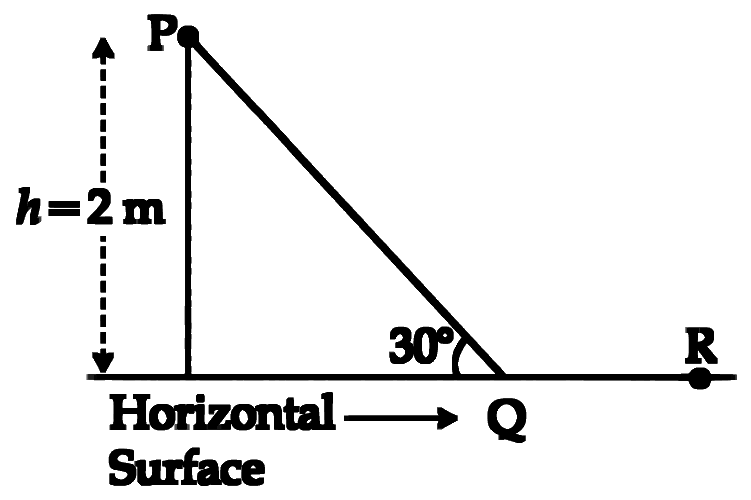
A point particle of mass m,m, moves along the uniformly rough track PQRPQR as shown in the figure. The coefficient of friction, between the particle and the rough track equals μ.\mu. The particle is released, from rest from the point PP and it comes to rest at point R.R. The energies, lost by the ball, over the parts, PQPQ and QRQR, of the track, are equal to each other, and no energy is lost when particle changes direction from PQPQ to QRQR.

The value of the coefficient of friction μ\mu and the distance x (=QR),x\ (= QR), are, respectively close to:

Figure

Show answer and solution

Answer: (a)

Loading the solution…
Report a mistakeOpen question page
Q33JEE Main 2014 · 11 APR · SHIFT 1Medium

Conservation of Energy

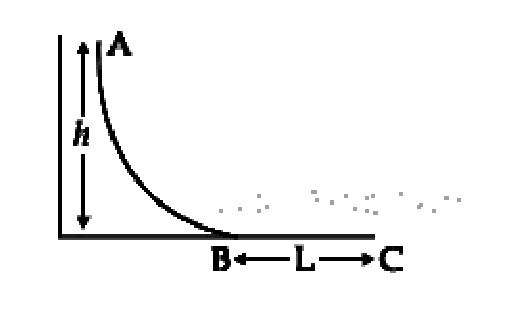
A small ball of mass m starts at a point A with speed vvo and moves along a frictionless track AB as shown. The track BC has coefficient of friction μ\mu. The ball comes to stop at C after travelling a distance L which is:

Figure

Show answer and solution

Answer: (b)

Loading the solution…
Report a mistakeOpen question page
Q34JEE Main 2014 · 11 APR · SHIFT 1Medium

Conservation of Energy

The average mass of rain drops is 3.0 ×\times 10−-5 kg and their average terminal velocity is 9 m/s. Calculate the energy transferred by rain to each square meter of the surface at a place which receives 100 cm of rain in a year.

Show answer and solution

Answer: (b)

Loading the solution…
Report a mistakeOpen question page
Q35JEE Main 2007 · AIEEEEasy

Conservation of Energy

A particle is projected at 60∘60^\circ to the horizontal with a kinetic energy K. The kinetic energy at the highest point is

Show answer and solution

Answer: (d)

Loading the solution…
Report a mistakeOpen question page
Q36JEE Main 2006 · AIEEEMedium

Conservation of Energy

A mass of M kgM\text{ kg} is suspended by a weightless string. The horizontal force that is required to displace it until the string makes an angle of 45∘45^\circ with the initial vertical direction is

Show answer and solution

Answer: (d)

Loading the solution…
Report a mistakeOpen question page
Q37JEE Main 2005 · AIEEEEasy

Conservation of Energy

A spherical ball of mass 20 kg20\text{ kg} is stationary at the top of a hill of height 100 m100\text{ m}. It rolls down a smooth surface to the ground, then climbs up another hill of height 30 m30\text{ m} and finally rolls down to a horizontal base at a height of 20 m20\text{ m} above the ground. The velocity attained by the ball is

Show answer and solution

Answer: (b)

Loading the solution…
Report a mistakeOpen question page
Q38JEE Main 2005 · AIEEEMedium

Conservation of Energy

The upper half of an inclined plane with inclination ϕ\phi is perfectly smooth while the lower half is rough. A body starting from rest at the top will again come to rest at the bottom if the coefficient of friction for the lower half is given by

Show answer and solution

Answer: (d)

Loading the solution…
Report a mistakeOpen question page
Q39NEET 2004 · AIPMTEasy

Conservation of Energy

A ball of mass 2 kg and another of mass 4 kg are dropped together from a 60 feet tall building. After a fall of 30 feet each towards earth, their respective kinetic energies will be in the ratio of

Show answer and solution

Answer: (c)

Loading the solution…
Report a mistakeOpen question page
Q40JEE Main 2004 · AIEEEEasy

Conservation of Energy

A uniform chain of length 2 m2\text{ m} is kept on a table such that a length of 60 cm60\text{ cm} hangs freely from the edge of the table. The total mass of the chain is 4 kg.4\text{ kg}. What is the work done in pulling the entire chain on the table?

Show answer and solution

Answer: (b)

Loading the solution…
Report a mistakeOpen question page
Q41JEE Main 2002 · AIEEEEasy

Conservation of Energy

A ball whose kinetic energy is E, is projected at an angle of 45∘45^\circ to the horizontal. The kinetic energy of the ball at the highest point of its flight will be

Show answer and solution

Answer: (c)

Loading the solution…
Report a mistakeOpen question page
Q42NEET 2001 · AIPMTEasy

Conservation of Energy

A particle is projected making an angle of 45° with horizontal having kinetic energy K. The kinetic energy at highest point will be

Show answer and solution

Answer: (b)

Loading the solution…
Report a mistakeOpen question page
Q43NEET 2001 · AIPMTEasy

Conservation of Energy

A child is sitting on a swing. Its minimum and maximum heights from the ground 0.75 m and 2 m respectively, its maximum speed will be

Show answer and solution

Answer: (b)

Loading the solution…
Report a mistakeOpen question page
Q44NEET 1997 · AIPMTEasy

Conservation of Energy

A particle is projected making an angle of 45∘45^\circ with horizontal having kinetic energy KK. The kinetic energy at highest point will be

Show answer and solution

Answer: (b)

Loading the solution…
Report a mistakeOpen question page
Q45NDA 2026Easy

Conservation of Energy

The bob of a simple pendulum is displaced from its mean position and then released from rest 0.20 m0.20\,\text{m} above its mean position. What is the speed of the bob as it passes through the mean position? (Take g=10 m s−2g = 10\,\text{m s}^{-2})

Show answer

Answer: (c)

Step-by-step solution coming soon.

Report a mistake
Q46NDA 2026Easy

Conservation of Energy

A tennis ball of mass 350 g350\,\text{g} is thrown vertically upwards at a speed of 4 m s−14\,\text{m s}^{-1}. If MM is the maximum gravitational potential energy of the ball and HH is the maximum height it reaches, then which one of the following is correct? (Take g=10 m s−2g = 10\,\text{m s}^{-2})

Show answer

Answer: (d)

Step-by-step solution coming soon.

Report a mistake
Q47NDA 2025Easy

Conservation of Energy

The energy is always conserved for a system which is

Show answer

Answer: (a)

Step-by-step solution coming soon.

Report a mistake
Q48NDA 2025Easy

Conservation of Energy

Suppose, a ball of mass MM is thrown upwards from a point AA and it reaches up to the highest point BB and returns back to point AA, which one among the following is correct?

Show answer

Answer: (a)

Step-by-step solution coming soon.

Report a mistake
Q49NDA 2024Easy

Conservation of Energy

There is a ball of mass 320 g320\,\text{g}. It has 625 J625\,\text{J} potential energy when released freely from a height. The speed with which it will hit the ground is

Show answer

Answer: (a)

Step-by-step solution coming soon.

Report a mistake
Q50NDA 2021Easy

Conservation of Energy

Fundamental laws of physics require

Show answer

Answer: (d)

Step-by-step solution coming soon.

Report a mistake
Q51NDA 2019Easy

Conservation of Energy

A rigid body of mass 2 kg2\,\text{kg} is dropped from a stationary balloon kept at a height of 50 m50\,\text{m} from the ground. The speed of the body when it just touches the ground and the total energy when it is dropped from the balloon are respectively (acceleration due to gravity =9.8 m s−2= 9.8\,\text{m s}^{-2})

Show answer

Answer: (d)

Step-by-step solution coming soon.

Report a mistake
Q52NDA 2019Easy

Conservation of Energy

The correct sequence of energy transfer that occurs when an apple falls to the ground is

Show answer

Answer: (c)

Step-by-step solution coming soon.

Report a mistake
Q53NDA 2017Easy

Conservation of Energy

Which one of the following statements about energy is correct?

Show answer

Answer: (c)

Step-by-step solution coming soon.

Report a mistake
Q54NDA 2016Easy

Conservation of Energy

A body has a free fall from a height of 20 m20\,\text{m}. After falling through a distance of 5 m5\,\text{m}, the body would

Show answer

Answer: (b)

Step-by-step solution coming soon.

Report a mistake
Q55NDA 2015Easy

Conservation of Energy

Which one among the following happens when a swing rises to a certain height from its rest position ?

Show answer

Answer: (b)

Step-by-step solution coming soon.

Report a mistake
Q56NDA 2011Easy

Conservation of Energy

Which one among the following is not a source of renewable energy?

Show answer

Answer: (c)

Step-by-step solution coming soon.

Report a mistake
Q57NDA 2010Easy

Conservation of Energy

A body is thrown vertically upwards and then falls back on the ground. Its potential energy is maximum

Show answer

Answer: (b)

Step-by-step solution coming soon.

Report a mistake
Q58JEE Advanced 2020Difficult

Conservation of Energy

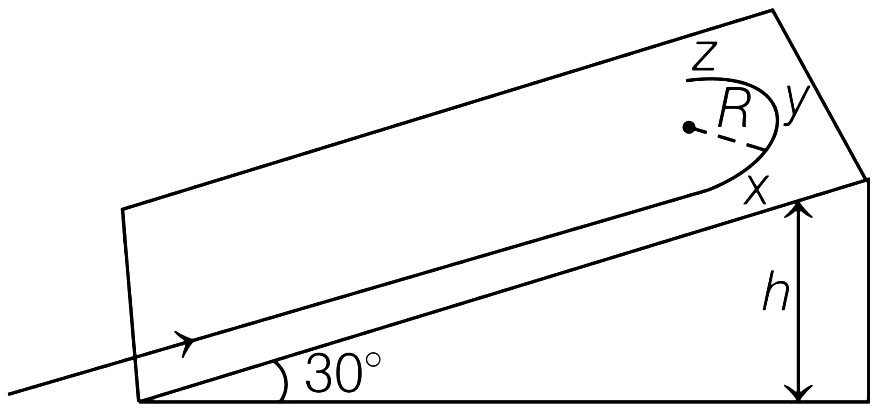
A student skates up a ramp that makes an angle 30∘30^\circ with the horizontal. He/she starts (as shown in the figure) at the bottom of the ramp with speed v0v_0 and wants to turn around over a semicircular path xyzxyz of radius RR during which he/she reaches a maximum height hh (at point yy) from the ground as shown in the figure. Assume that the energy loss is negligible and the force required for this turn at the highest point is provided by his/her weight only. Then (gg is the acceleration due to gravity)

Inclined ramp at 30 degrees with a semicircular turning path xyz of radius R, highest point y at height h above the ground

More than one option can be correct. Tap every correct option, then tap Check.

Show answer

Answer: (a), (d)

Step-by-step solution coming soon.

Report a mistake
Q59JEE Advanced 2014Medium

Conservation of Energy

A tennis ball is dropped on a horizontal smooth surface. It bounces back to its original position after hitting the surface. The force on the ball during the collision is proportional to the length of compression of the ball. Which one of the following sketches describes the variation of its kinetic energy KK with time tt most appropriately? The figures are only illustrative and not to the scale.

Show answer

Answer: (b)

Step-by-step solution coming soon.

Report a mistake
Q60JEE Advanced 2013Medium

Conservation of Energy

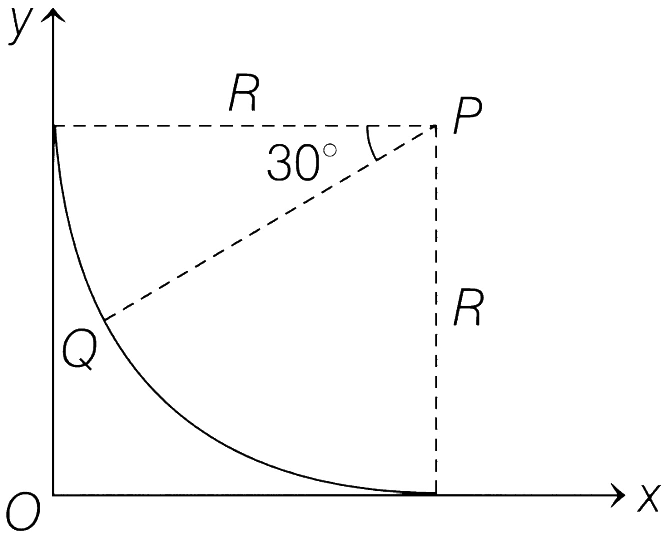
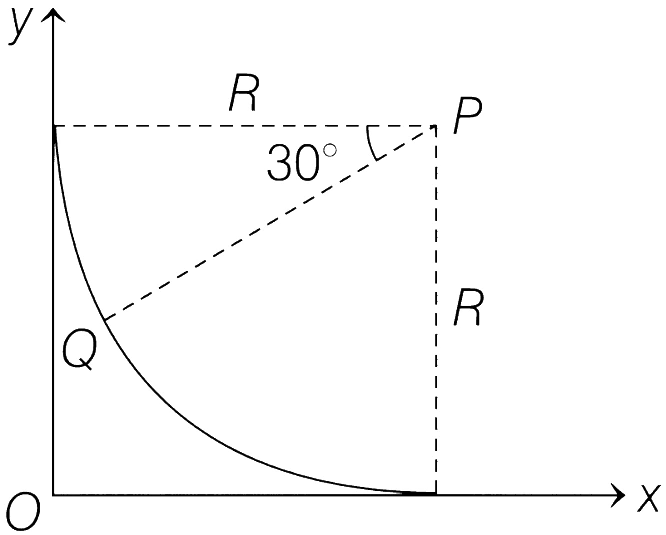
A small block of mass 1 kg1\,\text{kg} is released from rest at the top of a rough track. The track is a circular arc of radius 40 m40\,\text{m}. The block slides along the track without toppling and a frictional force acts on it in the direction opposite to the instantaneous velocity. The work done in overcoming the friction up to the point QQ, as shown in the figure below, is 150 J150\,\text{J}. (Take the acceleration due to gravity, g=10 m s−2g=10\,\text{m s}^{-2})
The speed of the block when it reaches the point QQ is

Quarter-circular track of radius R centred at P, from the top of the y-axis down to the x-axis; Q on the arc where radius PQ makes 30 degrees with the horizontal
Show answer

Answer: (b)

Step-by-step solution coming soon.

Report a mistake
Q61JEE Advanced 2013Medium

Conservation of Energy

A small block of mass 1 kg1\,\text{kg} is released from rest at the top of a rough track. The track is a circular arc of radius 40 m40\,\text{m}. The block slides along the track without toppling and a frictional force acts on it in the direction opposite to the instantaneous velocity. The work done in overcoming the friction up to the point QQ, as shown in the figure below, is 150 J150\,\text{J}. (Take the acceleration due to gravity, g=10 m s−2g=10\,\text{m s}^{-2})
The magnitude of the normal reaction that acts on the block at the point QQ is

Quarter-circular track of radius R centred at P, from the top of the y-axis down to the x-axis; Q on the arc where radius PQ makes 30 degrees with the horizontal
Show answer

Answer: (a)

Step-by-step solution coming soon.

Report a mistake
Q62JEE Advanced 2013Difficult

Conservation of Energy

A bob of mass mm, suspended by a string of length l1l_1, is given a minimum velocity required to complete a full circle in the vertical plane. At the highest point, it collides elastically with another bob of mass mm suspended by a string of length l2l_2, which is initially at rest. Both the strings are mass-less and inextensible. If the second bob, after collision, acquires the minimum speed required to complete a full circle in the vertical plane, the ratio l1l2\dfrac{l_1}{l_2} is

Numerical answer type. Work it out, then open the answer.

Show answer

Answer: 5

Step-by-step solution coming soon.

Report a mistake
Q63JEE Advanced 2008Medium

Conservation of Energy

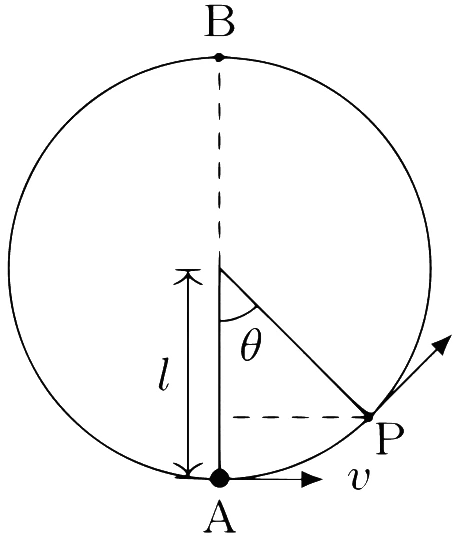
A bob of mass MM is suspended by a massless string of length LL. The horizontal velocity VV at position AA is just sufficient to make it reach the point BB. The angle θ\theta at which the speed of the bob is half of that at AA, satisfies,

Vertical circle of radius l: bob at lowest point A moving horizontally with speed v, point P at angle theta from the downward vertical, top point B
Show answer

Answer: (d)

Step-by-step solution coming soon.

Report a mistake
Q64JEE Advanced 1998Medium

Conservation of Energy

A stone tied to a string of length LL is whirled in a vertical circle with the other end of the string at the center. At a certain instant of time, the stone is at its lowest position, and has a speed uu. The magnitude of the change in its velocity as it reaches a position where the string is horizontal is

More than one option can be correct. Tap every correct option, then tap Check.

Show answer

Answer: (d)

Step-by-step solution coming soon.

Report a mistake
Q65JEE Advanced 1985Easy

Conservation of Energy

A uniform chain of length LL and mass MM is lying on a smooth table and one third of its length is hanging vertically down over the edge of the table. If gg is the acceleration due to gravity, the work required to pull the hanging part on to the table is

More than one option can be correct. Tap every correct option, then tap Check.

Show answer

Answer: (d)

Step-by-step solution coming soon.

Report a mistake
Q66AIIMS 2017Medium

Conservation of Energy

A person of weight 70 kg70\,\text{kg} wants to lose 7 kg7\,\text{kg} by going up and down 12 m12\,\text{m} high stairs. Assume he burns twice as much fat while going up as going down. If 1 kg1\,\text{kg} of fat is burnt on expending 9000 kcal9000\,\text{kcal}, how many times must he go up and down to reduce his 7 kg7\,\text{kg} weight? (Take g=10 m s−2g = 10\,\text{m s}^{-2})

Show answer

Answer: (d)

Step-by-step solution coming soon.

Report a mistake
Q67AIIMS 2015Easy

Conservation of Energy

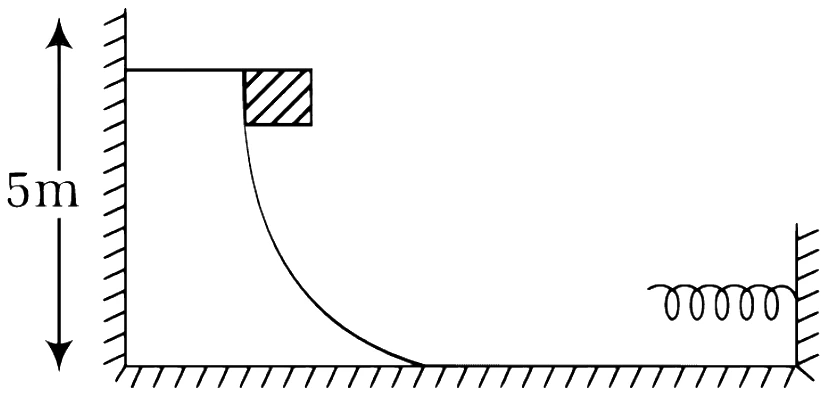
Consider the situation shown in the figure. A spring of spring constant 400 N m−1400\,\text{N m}^{-1} is attached at one end to a wedge fixed rigidly with the horizontal part. A 40 g40\,\text{g} mass is released from rest while situated at a height 5 cm5\,\text{cm} on the curved track. The minimum deformation in the spring is nearly equal to (take g=10 m s−2g = 10\,\text{m s}^{-2})

Block on a curved track 5 m high sliding down to a horizontal floor ending at a spring fixed to a wall
Show answer

Answer: (b)

Step-by-step solution coming soon.

Report a mistake
Q68AIIMS 2009Easy

Conservation of Energy

Assertion: Water at the foot of the water fall is always at different temperature from that at the top.
Reason: The potential energy of water at the top is converted into heat energy during falling.

Show answer

Answer: (a)

Step-by-step solution coming soon.

Report a mistake
Q69AIIMS 2007Easy

Conservation of Energy

A spherical ball of mass 20 kg20\,\text{kg} is stationary at the top of a hill of height 100 m100\,\text{m}. It rolls down a smooth surface to the ground, then climbs up another hill of height 30 m30\,\text{m} and finally rolls down to a horizontal base at a height of 20 m20\,\text{m} above the ground. The velocity attained by the ball is

Show answer

Answer: (a)

Step-by-step solution coming soon.

Report a mistake
Q70JIPMER 2019Medium

Conservation of Energy

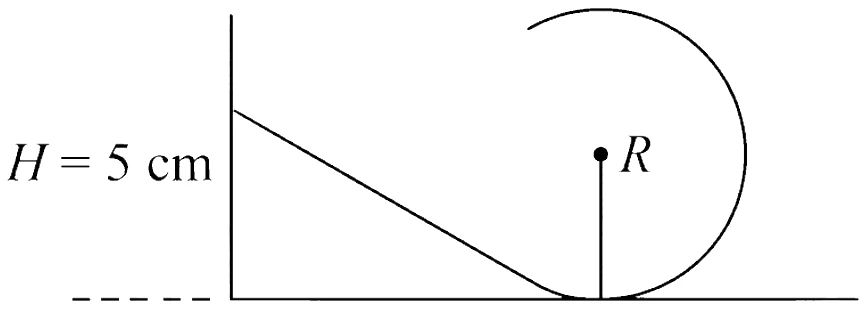
Find the maximum radius of the circle so that the block can complete the circular motion.

Block released from height H = 5 cm on a slope leading into a vertical circular loop of radius R
Show answer

Answer: (c)

Step-by-step solution coming soon.

Report a mistake
Q71JIPMER 2017Medium

Conservation of Energy

A skier starts from rest at point AA and slides down the hill without turning or braking. The friction coefficient is μ\mu. When he stops at point BB, his horizontal displacement is SS. What is the height difference between points AA and BB? (The velocity of the skier is small so that the additional pressure on the snow due to the curvature can be neglected. Neglect also the friction of air and the dependence of μ\mu on the velocity of the skier.)

Show answer

Answer: (a)

Step-by-step solution coming soon.

Report a mistake
Q72JIPMER 2014Easy

Conservation of Energy

A ball is released from a certain height. It loses 50%50\% of its kinetic energy on striking the ground. It will attain a height again

Show answer

Answer: (b)

Step-by-step solution coming soon.

Report a mistake
Q73JIPMER 2012Easy

Conservation of Energy

An object starts sliding on a frictionless inclined plane and from the same height another object starts falling freely.

Show answer

Answer: (a)

Step-by-step solution coming soon.

Report a mistake
Q74JIPMER 2008Easy

Conservation of Energy

If we throw a body upwards with a velocity of 4 m s−14\,\text{m s}^{-1}, at what height does its kinetic energy reduce to half of the initial value? (Take g=10 m s−2g=10\,\text{m s}^{-2})

Show answer

Answer: (d)

Step-by-step solution coming soon.

Report a mistake
Q75BITSAT 2021Easy

Conservation of Energy

The bob of a pendulum of length 2 m2\,\text{m} lies at PP, when it reaches QQ, it loses 10%10\% of its total energy due to air resistance. The velocity of bob at QQ is

Pendulum of length 2 m with bob P at the horizontal position and Q directly below the pivot, dotted arc between them
Show answer

Answer: (a)

Step-by-step solution coming soon.

Report a mistake
Q76BITSAT 2020Easy

Conservation of Energy

A ball of mass 0.5 kg0.5\,\text{kg} is thrown up with initial speed 16 m s−116\,\text{m s}^{-1} and reaches maximum height of 9 m9\,\text{m}. How much energy is dissipated by air drag acting on the ball during the ascent?

Show answer

Answer: (b)

Step-by-step solution coming soon.

Report a mistake
Q77VITEEE 2023Easy

Conservation of Energy

A ball is allowed to fall from a height of 10 m10\,\text{m}. If there is 30%30\% loss of energy due to impact, then after one impact the ball will go up to

Show answer

Answer: (d)

Step-by-step solution coming soon.

Report a mistake
Q78VITEEE 2022Easy

Conservation of Energy

A toy gun uses a spring of force constant kk. When charged before being triggered in the upward direction, the spring is compressed by a distance xx. If the mass of the shot is mm, on being triggered it will go up to a height of

Show answer

Answer: (c)

Step-by-step solution coming soon.

Report a mistake
Q79COMEDK 2026Medium

Conservation of Energy

A ball falls under gravity from a height of 10 m10\,\text{m} with an initial downward velocity uu. It loses two third of its energy in collision and then rises back to 5 m5\,\text{m}. The initial velocity uu is (g=10 m s−2g = 10\,\text{m s}^{-2})

Show answer

Answer: (a)

Step-by-step solution coming soon.

Report a mistake
Q80KCET 2023Medium

Conservation of Energy

A ball of mass 0.2 kg0.2\,\text{kg} is thrown vertically down from a height of 10 m10\,\text{m}. It collides with the floor and loses 50%50\% of its energy and then rises back to the same height. The value of its initial velocity is

Show answer

Answer: (b)

Step-by-step solution coming soon.

Report a mistake
Q81KCET 2022Easy

Conservation of Energy

A smooth chain of length 2 m2\,\text{m} is kept on a table such that its length of 60 cm60\,\text{cm} hangs freely from the edge of the table. The total mass of the chain is 4 kg4\,\text{kg}. The work done in pulling the entire chain onto the table is (Take g=10 m s−2g=10\,\text{m s}^{-2})

Show answer

Answer: (b)

Step-by-step solution coming soon.

Report a mistake
Q82AP EAPCET 2026Easy

Conservation of Energy

A body of mass 2 kg2\,\text{kg} is thrown vertically upwards from the ground level with kinetic energy of 240 J240\,\text{J}. The kinetic energy of the body will become half at a height of (g=10 m s−2g = 10\,\text{m s}^{-2})

Show answer

Answer: (c)

Step-by-step solution coming soon.

Report a mistake
Q83AP EAPCET 2026Medium

Conservation of Energy

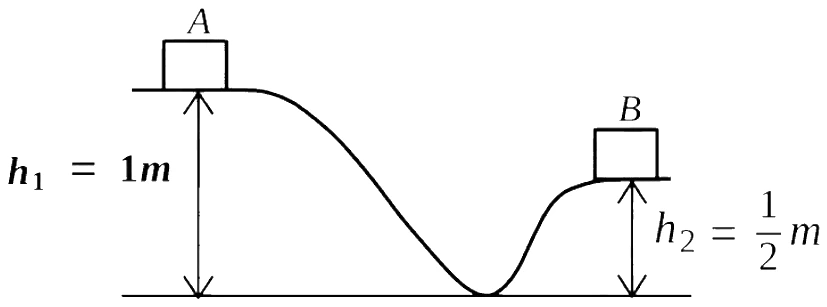
As shown in the figure, a particle slides on a frictionless track which terminates in a straight horizontal section BB. If the particle starts slipping from AA, then the horizontal distance to be covered by the particle before it hits the ground after crossing BB is

Frictionless track: start A at height h1 = 1 m, horizontal end B at height h2 = 1/2 m above the ground
Show answer

Answer: (b)

Step-by-step solution coming soon.

Report a mistake
Q84AP EAPCET 2026Medium

Conservation of Energy

If the ratio of the potential and kinetic energies of a body of mass 3 kg3\,\text{kg} thrown vertically upwards at a height of 40 m40\,\text{m} is 2:32:3, then the kinetic energy of the body at a height of 65 m65\,\text{m} is (Acceleration due to gravity =10 m s−2= 10\,\text{m s}^{-2})

Show answer

Answer: (b)

Step-by-step solution coming soon.

Report a mistake
Q85AP EAPCET 2025Easy

Conservation of Energy

A body is projected at an angle of 60∘60^\circ with the horizontal. If the initial kinetic energy of the body is XX, then its kinetic energy at the highest point is

Show answer

Answer: (d)

Step-by-step solution coming soon.

Report a mistake
Q86AP EAPCET 2025Medium

Conservation of Energy

A body is projected vertically upwards with a velocity of 20 m s−120\,\text{m s}^{-1}. If the potential energy of the body at a height of 5 m5\,\text{m} from the ground is 100 J100\,\text{J}, then the kinetic energy of the body at a height of 10 m10\,\text{m} from the ground is (Acceleration due to gravity =10 m s−2= 10\,\text{m s}^{-2})

Show answer

Answer: (a)

Step-by-step solution coming soon.

Report a mistake
Q87AP EAPCET 2025Medium

Conservation of Energy

The bob of a simple pendulum of length 200 cm200\,\text{cm} is released from horizontal position. If 10%10\% of its initial energy is lost due to air resistance, then the speed of bob at the mean position is (Acceleration due to gravity =10 m s−2= 10\,\text{m s}^{-2})

Show answer

Answer: (a)

Step-by-step solution coming soon.

Report a mistake
Q88AP EAPCET 2024Medium

Conservation of Energy

A body thrown vertically upwards from the ground reaches a maximum height HH. The ratio of the velocities of the body at heights 3H4\dfrac{3H}{4} and 8H9\dfrac{8H}{9} from the ground is

Show answer

Answer: (c)

Step-by-step solution coming soon.

Report a mistake
Q89AP EAPCET 2024Medium

Conservation of Energy

A machine with efficiency 23\dfrac{2}{3} used 12 J12\,\text{J} of energy in lifting 2 kg2\,\text{kg} block through certain height and it is allowed to fall through the same. The velocity while it reaches the ground is

Show answer

Answer: (c)

Step-by-step solution coming soon.

Report a mistake
Q90AP EAPCET 2024Medium

Conservation of Energy

Two bodies AA and BB of masses 2m2m and mm are projected vertically upwards from the ground with velocities uu and 2u2u respectively. The ratio of the kinetic energy of body AA and the potential energy of body BB at height equal to half of the maximum height reached by body AA is

Show answer

Answer: (d)

Step-by-step solution coming soon.

Report a mistake
Q91AP EAPCET 2022Medium

Conservation of Energy

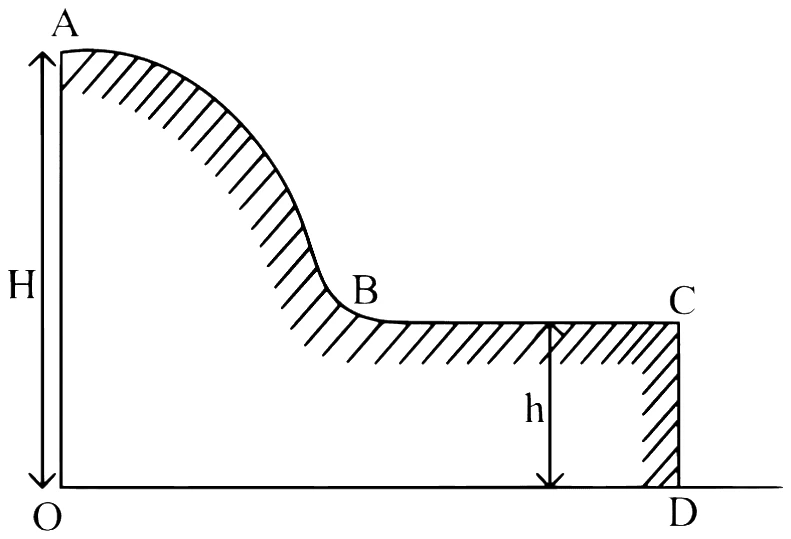
A small disc of mass mm slides down with initial velocity zero from the top (AA) of a smooth hill of height HH having a horizontal portion (BCBC) as shown in the figure. If the height of the horizontal portion of the hill is hh, then the maximum horizontal distance covered by the disc from the point DD is

Smooth hill from top A at height H down curve to horizontal ledge BC at height h above ground, ending at vertical edge CD
Show answer

Answer: (c)

Step-by-step solution coming soon.

Report a mistake
Q92AP EAPCET 2021Easy

Conservation of Energy

The range of a projectile is 100 m100\,\text{m}. Its kinetic energy will be maximum after covering a distance of

Show answer

Answer: (d)

Step-by-step solution coming soon.

Report a mistake
Q93TS EAMCET 2026Medium

Conservation of Energy

The time taken by a body projected vertically upwards from the ground to reach 75%75\% of the maximum height it can reach is 2 s2\,\text{s}. The ratio of the kinetic energy of the body at a time t=2 st = 2\,\text{s} and the potential energy of the body at a time t=3 st = 3\,\text{s} is (Acceleration due to gravity =10 m s−2= 10\,\text{m s}^{-2})

Show answer

Answer: (b)

Step-by-step solution coming soon.

Report a mistake
Q94TS EAMCET 2024Easy

Conservation of Energy

A body thrown vertically upwards from the ground reaches a maximum height hh. The ratio of the kinetic and potential energies of the body at a height of 40%40\% of hh from the ground is

Show answer

Answer: (b)

Step-by-step solution coming soon.

Report a mistake
Q95TS EAMCET 2020Medium

Conservation of Energy

A ball of mass m=1 kgm = 1\,\text{kg} is thrown from the top of a building with initial velocity v=(20 m s−1)i^+(24 m s−1)j^\mathbf{v} = (20\,\text{m s}^{-1})\hat{i} + (24\,\text{m s}^{-1})\hat{j} at time t=0t = 0. The change in the potential energy of the ball between t=0t = 0 and t=6 st = 6\,\text{s}, if the ball does not hit the ground, is (assume g=10 m s−2g = 10\,\text{m s}^{-2})

Show answer

Answer: (b)

Step-by-step solution coming soon.

Report a mistake
Q96IAT 2025Medium

Conservation of Energy

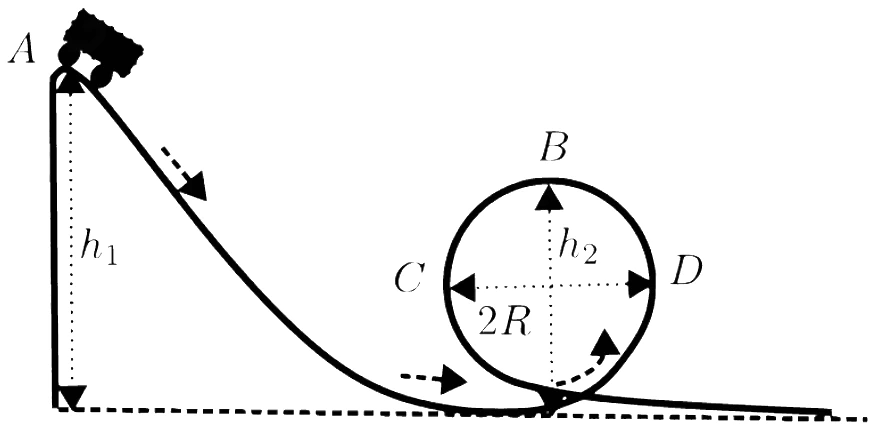
A cart of mass MM is released from AA, the highest point of a frictionless track, as shown in the figure. The cart travels along the track and enters the semicircular arc DBCDBC of radius RR. The heights of the points AA and BB are h1h_1 and h2h_2 from the ground, respectively. Which of the following quantities does not play any role in ensuring that the cart does not leave the track?

Frictionless track from A at height h1 descending into a vertical loop of radius R, with B at top at height h2 and C, D at sides
Show answer

Answer: (a)

Step-by-step solution coming soon.

Report a mistake
Q97IAT 2018Medium

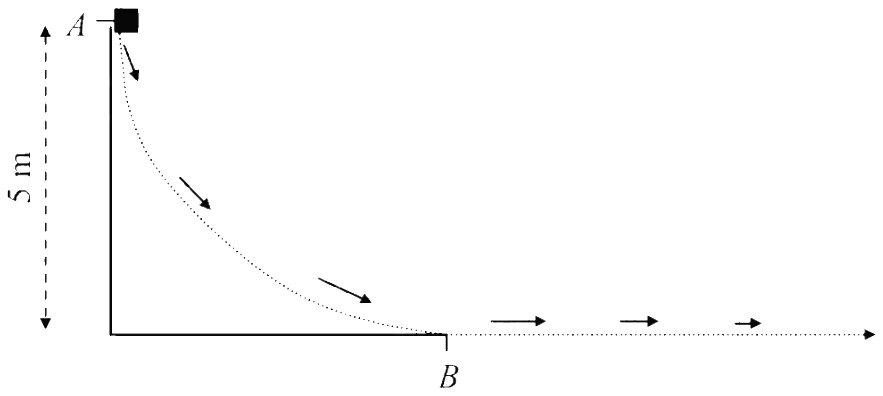
Conservation of Energy

An object of mass 100 g100\,\text{g} is sliding under gravity from point A to point B on a frictionless slide from a height of 5 m5\,\text{m}, as shown in the figure. After what distance will the object stop on the following flat track beyond point B if the coefficient of kinetic friction between the flat track and the object is 0.50.5?

Block at A, 5 m above a curved frictionless slide ending at B on a horizontal flat track extending to the right
Show answer

Answer: (c)

Step-by-step solution coming soon.

Report a mistake