
Physics Circle home Student Login

Home›Study material›Formula Book›Ray Optics

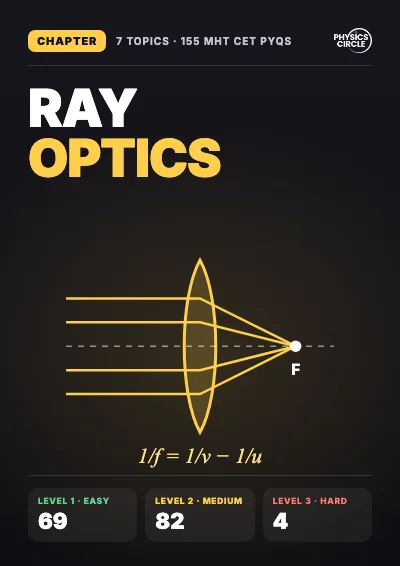
Ray Optics Formula Book

51 formulas in 7 topics, in the same order as the PYQ topics.

Only formulas used in the solutions of 155 MHT CET PYQs (Level 1, 2, 3)
01

Reflection & Mirrors

4 formulas · from 5 MHT CET PYQs

Practise these PYQs ›
02

Refraction, Glass Slab & Apparent Depth

15 formulas · from 34 MHT CET PYQs

Practise these PYQs ›
  • Snell's law (refractive index)n=sin⁡isin⁡rn = \dfrac{\sin i}{\sin r}
  • Refractive index from speed and wavelengthμ=cv=λ0λ\mu = \dfrac{c}{v} = \dfrac{\lambda_0}{\lambda}
  • Speeds in two mediav1v2=μ2μ1\dfrac{v_1}{v_2} = \dfrac{\mu_2}{\mu_1}
  • Relative refractive indices around a loopanw⋅wng⋅gna=1{}^a n_w \cdot {}^w n_g \cdot {}^g n_a = 1
  • Small angles: Snell's law and deviationi=μr,δ=i−ri = \mu r,\qquad \delta = i - r
  • When angle of incidence is twice angle of refractioni=2r  ⇒  μ=sin⁡2rsin⁡r=2cos⁡ri = 2r \;\Rightarrow\; \mu = \dfrac{\sin 2r}{\sin r} = 2\cos r
  • Brewster's law (polarising angle)tan⁡ip=μ=cv\tan i_p = \mu = \dfrac{c}{v}
  • Apparent depthhapp=hμh_{app} = \dfrac{h}{\mu}
  • Apparent depth for several layersD=∑tkμkD = \sum \dfrac{t_k}{\mu_k}
  • Normal shift by a slab of thickness tx=t(1−1μ)=t μ−1μx = t\left(1 - \dfrac{1}{\mu}\right) = t\,\dfrac{\mu - 1}{\mu}
  • Slab thickness from the shiftt=μxμ−1t = \dfrac{\mu x}{\mu - 1}
  • Optical path (equal time in two media)μgtg=μwtw\mu_g t_g = \mu_w t_w
  • Time to cross a slabtslab=tv=μtct_{slab} = \dfrac{t}{v} = \dfrac{\mu t}{c}
  • Number of waves in a slabN=tλ0/μ=μtλ0N = \dfrac{t}{\lambda_0/\mu} = \dfrac{\mu t}{\lambda_0}
  • Reflected and refracted rays perpendicularr+r′=90∘  ⇒  tan⁡i=1μ  (denser to rarer)r + r' = 90^\circ \;\Rightarrow\; \tan i = \dfrac{1}{\mu}\ \ (\text{denser to rarer})

🔒 For Vajra 2.0 Pro studentsTopic 1 is free. Log in with your Vajra 2.0 Pro number to see every formula.

03

Total Internal Reflection

5 formulas · from 20 MHT CET PYQs

Practise these PYQs ›
  • Critical anglesin⁡C=1μ=vc\sin C = \dfrac{1}{\mu} = \dfrac{v}{c}
  • Critical angle between two mediasin⁡C=μrarerμdenser=vdenservrarer\sin C = \dfrac{\mu_{rarer}}{\mu_{denser}} = \dfrac{v_{denser}}{v_{rarer}}
  • Snell's law at the critical angleμgsin⁡i1=μwsin⁡r=μasin⁡90∘\mu_g\sin i_1 = \mu_w\sin r = \mu_a\sin 90^\circ
  • Refractive index from critical angleμ=1sin⁡C\mu = \dfrac{1}{\sin C}
  • Refractive index from times of traveln=cvn = \dfrac{c}{v}

🔒 For Vajra 2.0 Pro studentsTopic 1 is free. Log in with your Vajra 2.0 Pro number to see every formula.

04

Spherical Surfaces & Thin Lenses

11 formulas · from 30 MHT CET PYQs

Practise these PYQs ›
  • Refraction at a spherical surface (from air)μv−1u=μ−1R\dfrac{\mu}{v} - \dfrac{1}{u} = \dfrac{\mu - 1}{R}
  • Lens formula1v−1u=1f\dfrac{1}{v} - \dfrac{1}{u} = \dfrac{1}{f}
  • Magnification by a lensm=vum = \dfrac{v}{u}
  • Power of a lensP=1fP = \dfrac{1}{f}
  • Lens maker's formula1f=(μlμm−1)(1R1−1R2)\dfrac{1}{f} = \left(\dfrac{\mu_l}{\mu_m} - 1\right)\left(\dfrac{1}{R_1} - \dfrac{1}{R_2}\right)
  • Lens in a liquid: change of focal lengthflfa=μ−1μμl−1\dfrac{f_l}{f_a} = \dfrac{\mu - 1}{\dfrac{\mu}{\mu_l} - 1}
  • Lens in a liquid: change of powerPlPa=μμl−1μ−1\dfrac{P_l}{P_a} = \dfrac{\dfrac{\mu}{\mu_l} - 1}{\mu - 1}
  • Lens becomes invisible (no power)μm=μl  ⇒  1f=0\mu_m = \mu_l \;\Rightarrow\; \dfrac{1}{f} = 0
  • Real image n times the object (convex lens)u=−vn  ⇒  v=f(n+1)u = -\dfrac{v}{n} \;\Rightarrow\; v = f(n + 1)
  • Image same size as object∣u∣=v=2f|u| = v = 2f
  • Minimum object-image distance for a real imageDmin=2f+2f=4fD_{min} = 2f + 2f = 4f

🔒 For Vajra 2.0 Pro studentsTopic 1 is free. Log in with your Vajra 2.0 Pro number to see every formula.

05

Combination of Lenses

4 formulas · from 16 MHT CET PYQs

Practise these PYQs ›
  • Lenses in contactP=P1+P2,1F=1f1+1f2P = P_1 + P_2,\qquad \dfrac{1}{F} = \dfrac{1}{f_1} + \dfrac{1}{f_2}
  • Lenses separated by distance dP=P1+P2−dP1P2P = P_1 + P_2 - dP_1P_2
  • Plano-convex and plano-concave lenses joinedP1=n1−1R,P2=−n2−1R,P=n1−n2RP_1 = \dfrac{n_1 - 1}{R},\quad P_2 = -\dfrac{n_2 - 1}{R},\quad P = \dfrac{n_1 - n_2}{R}
  • Equal convex and concave lenses in contactf1=+f, f2=−f  ⇒  P=0f_1 = +f,\ f_2 = -f \;\Rightarrow\; P = 0

🔒 For Vajra 2.0 Pro studentsTopic 1 is free. Log in with your Vajra 2.0 Pro number to see every formula.

06

Prism, Dispersion & Scattering

8 formulas · from 32 MHT CET PYQs

Practise these PYQs ›
  • Prism formula (minimum deviation)μ=sin⁡(A+δm2)sin⁡A2\mu = \dfrac{\sin\left(\dfrac{A + \delta_m}{2}\right)}{\sin\dfrac{A}{2}}
  • At minimum deviationi=e,r1=r2=A2,δm=2i−Ai = e,\qquad r_1 = r_2 = \dfrac{A}{2},\qquad \delta_m = 2i - A
  • Deviation by a thin prismδ=(μ−1)A\delta = (\mu - 1)A
  • Thin prism in a mediumδ=(ngnmedium−1)A\delta = \left(\dfrac{n_g}{n_{medium}} - 1\right)A
  • Normal emergence or incidence (r2 = 0)r2=0⇒r1=A,sin⁡i=μsin⁡Ar_2 = 0 \Rightarrow r_1 = A,\qquad \sin i = \mu\sin A
  • Normal emergence, small anglesi=μAi = \mu A
  • Snell's law at the two facessin⁡i=μsin⁡r1,μsin⁡r2=sin⁡e\sin i = \mu\sin r_1,\qquad \mu\sin r_2 = \sin e
  • Dispersive powerω=δv−δrδmean,δmean≈δv+δr2\omega = \dfrac{\delta_v - \delta_r}{\delta_{mean}},\qquad \delta_{mean} \approx \dfrac{\delta_v + \delta_r}{2}

🔒 For Vajra 2.0 Pro studentsTopic 1 is free. Log in with your Vajra 2.0 Pro number to see every formula.

07

Optical Instruments & the Eye

4 formulas · from 18 MHT CET PYQs

Practise these PYQs ›
  • Simple microscope, image at near pointM=1+DfM = 1 + \dfrac{D}{f}
  • Compound microscopeM=vouo⋅Dfe,vo=L−feM = \dfrac{v_o}{u_o}\cdot\dfrac{D}{f_e},\qquad v_o = L - f_e
  • Astronomical telescope, normal adjustmentM=fofe,L=fo+feM = \dfrac{f_o}{f_e},\qquad L = f_o + f_e
  • Resolving power of a telescopeRP=D1.22λ∝DRP = \dfrac{D}{1.22\lambda} \propto D

🔒 For Vajra 2.0 Pro studentsTopic 1 is free. Log in with your Vajra 2.0 Pro number to see every formula.