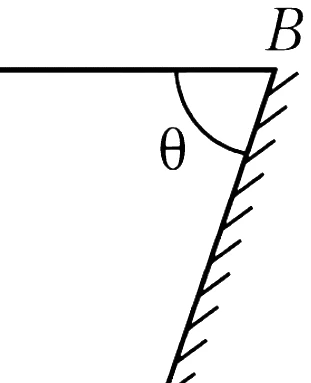
Consider light travelling from a medium A to medium B separated by a plane interface. If the light undergoes total internal reflection during its travel from medium A to B and the speed of light in media A and B are 2.4×10⁸ m/s and 2.7×10⁸ m/s, respectively, then the value of critical angle is:
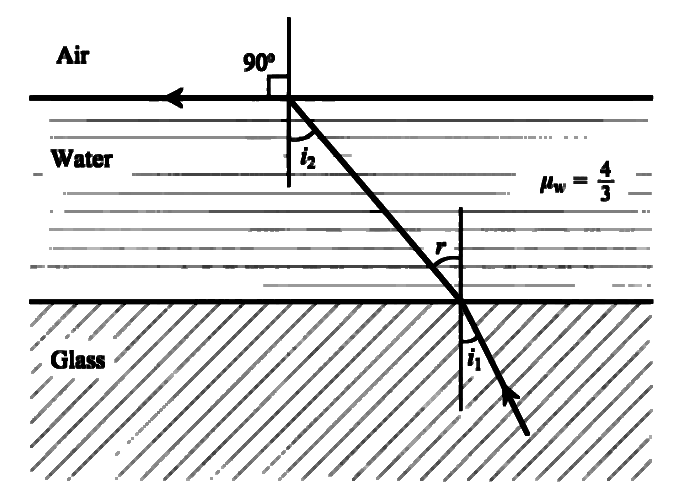
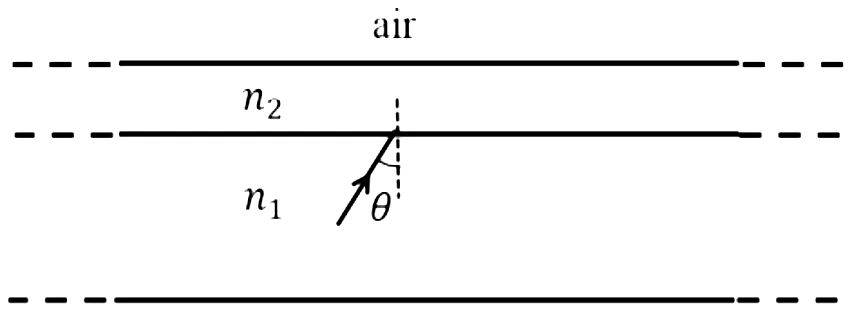
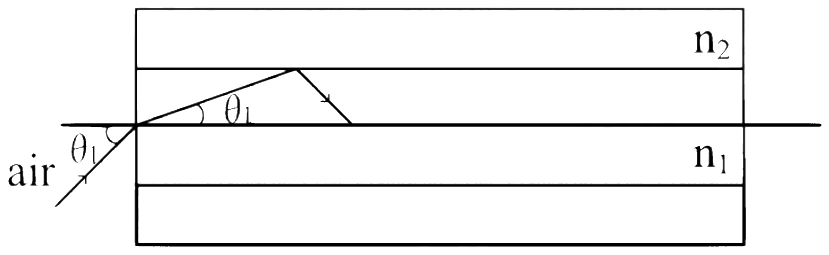
A ray of light is incident at a glass-water interface at an angle (i1), it emerges finally parallel to the surface of water, then the value of the refractive index of glass (μg) is
{μw= refractive index of water =4/3,sin(90)∘=1,cos(90)∘=0}
A ray of light takes time 't' to travel a distance 'd' in air and it travels a distance '4d', in time 'T' in a certain medium. If T=8t, the critical angle for the pair of media is
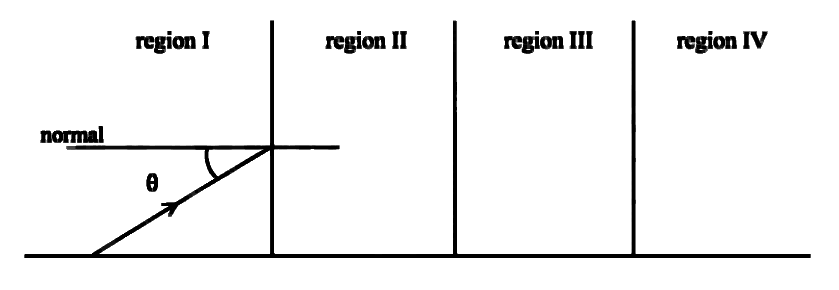
A beam of light is travelling from region I to region IV. The refractive indices in regions I, II, III and IV are n,2n,3n and 4n respectively. The angle of incidence for which the beam just misses entering region IV is [sin90∘=1]
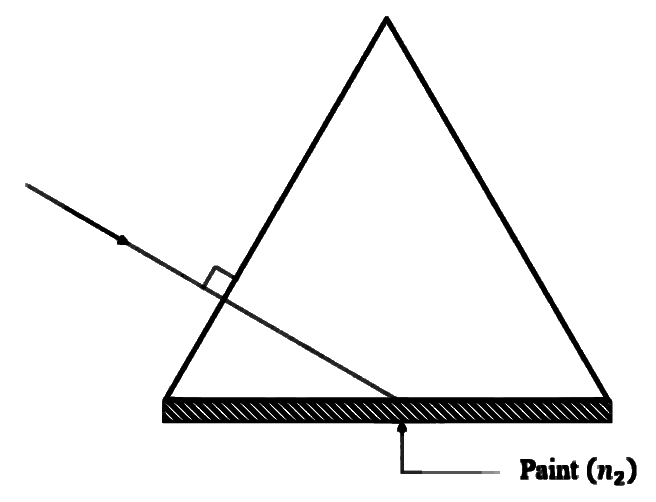
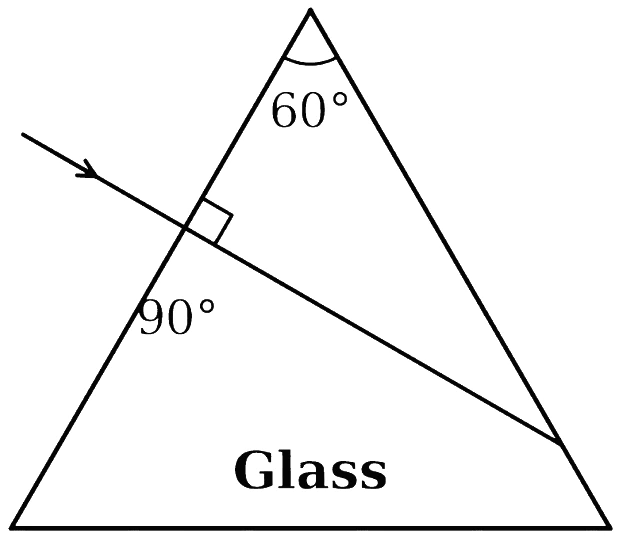
One side of an equilateral prism is painted by a transparent material of refractive index n2. The refractive index of prism is 1.6. The minimum value of n2 required for total internal reflection from painted face is ________.
Q8JEE Main 2026 · 23 JAN · SHIFT 2 (One or more correct)Medium
Total Internal Reflection
A prism of angle 75∘ and refractive index 3 is coated with thin film of refractive index 1.5 only at the back exit surface. To have total internal reflection at the back exit surface the incident angle must be ______
At the interface between two materials having refractive indices n1 and n2, the critical angle for reflection of an em wave is θ1C. The n2 material is replaced by another material having refractive index n3 such that the critical angle at the interface between n1 and n3 materials is θ2C. If n3>n2>n1;n3n2=52 and sinθ2C−sinθ1C=21, then θ1C is:
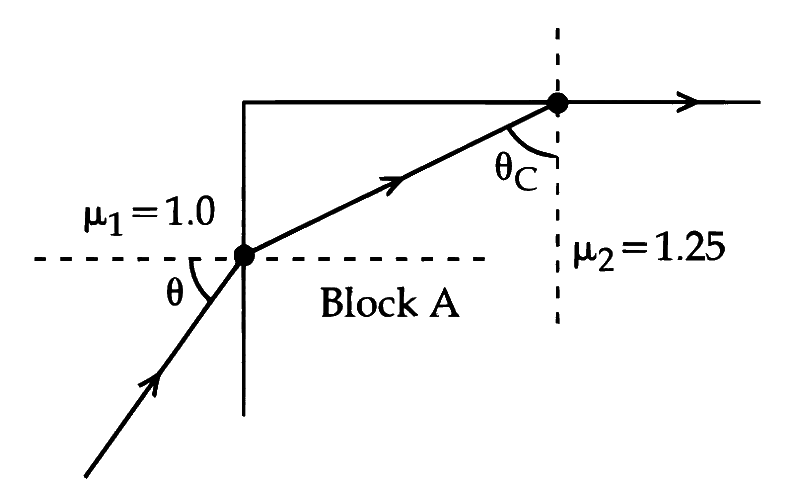
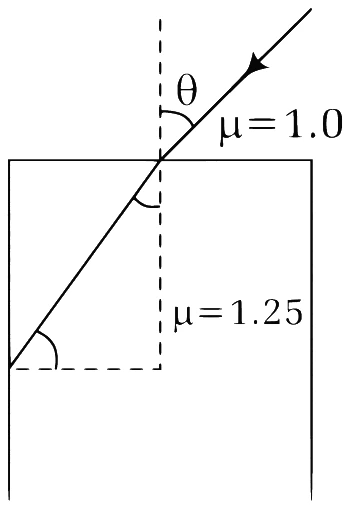
A transparent block A having refractive index μ=1.25 is surrounded by another medium of refractive index μ=1.0 as shown in the figure. A light ray is incident on the flat face of the block with incident angle θ as shown in the figure. What is the maximum value of θ for which light suffers total internal reflection at the top surface of the block?
Velocity of light in diamond is (125)th times that in air. Velocity of light in water is (43)th times that in air. The angle of incidence of ray of light travelling from water to diamond is (angle of refraction (r)=30∘)[ Given →sin30∘=21]
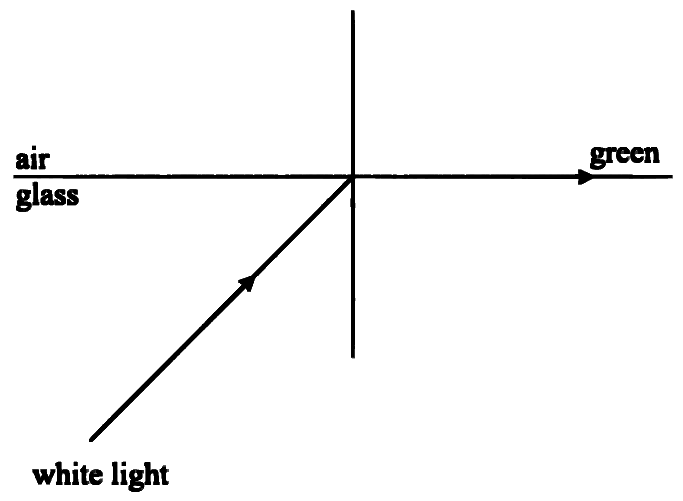
White light is incident on the interface of glass and air as shown in figure. If green light is just totally internally reflected, then reflected rays inside the glass contain
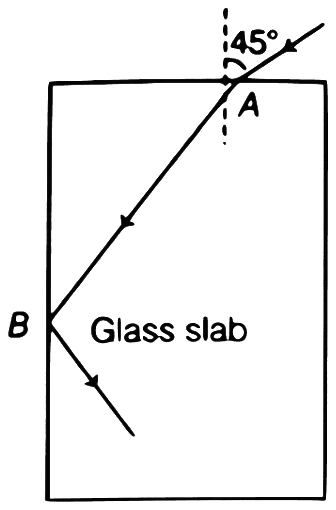
A light ray is incident on a glass slab of thickness 43 cm and refractive index 2 The angle of incidence is equal to the critical angle for the glass slab with air. The lateral displacement of ray after passing through glass slab is ______ cm.
(Given sin15∘=0.25)
Numerical answer type. Work it out, then open the answer.
A ray of light is incident from air on a glass plate having thickness 3 cm and refractive index 2. The angle of incidence of a ray is equal to the critical angle for glass-air interface. The lateral displacement of the ray when it passes through the plate is ____________ × 10 −2 cm. (given sin15∘=0.26)
Numerical answer type. Work it out, then open the answer.
The speed of light in two media M1 and M2 are 1.5×10⁸ m/s and 2×10⁸ m/s respectively. If the light undergoes total internal reflection, the critical angle between the two media is
Two transparent media A and B are separated by a plane boundary. The speed of light in those media are 1.5 × 10⁸ m/s and 2.0 × 10⁸ m/s, respectively. The critical angle for a ray of light for these two media is
The speed of light in media 'A' and 'B' are 2.0×1010 cm/s and 1.5×1010 cm/s respectively. A ray of light enters from the medium B to A at an incident angle 'θ'. If the ray suffers total internal reflection, then
A light wave travelling linearly in a medium of dielectric constant 4, is incident on the horizontal interface separating medium with air. The angle of incidence for which the total intensity of incident wave will be reflected back into the same medium will be:
A small bulb is placed at the bottom of a tank containing water to a depth of 7 m. The refractive index of water is 34. The area of the surface of water through which light from the bulb can emerge out is xπ m2. The value of x is __________.
Numerical answer type. Work it out, then open the answer.
The critical angle for light going from medium A into medium B is θ. The speed of light in the medium A is VA. What is the speed of light in the medium B?
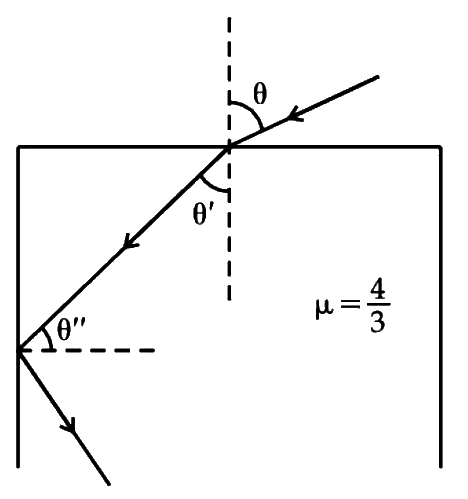
A ray of light entering from air into a denser medium of refractive index 34, as shown in figure. The light ray suffers total internal reflection at the adjacent surface as shown. The maximum value of angle θ should be equal to:
A ray of laser of a wavelength 630 nm is incident at an angle of 30∘ at the diamond-air interface. It is going from diamond to air. The refractive index of diamond is 2.42 and that of air is 1. Choose the correct option.
A glass slab has refractive index 'μ' with respect to air and the critical angle for a ray of light in going from glass to glass to air is 'θ' If a ray of light is incident from air on the glass with angle of incidence 'θ', then the corresponding angle of refraction is
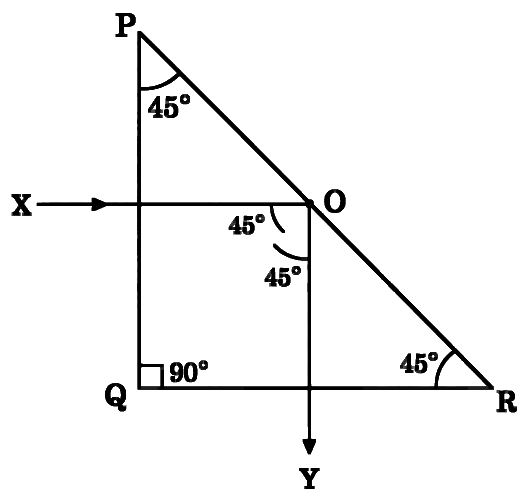
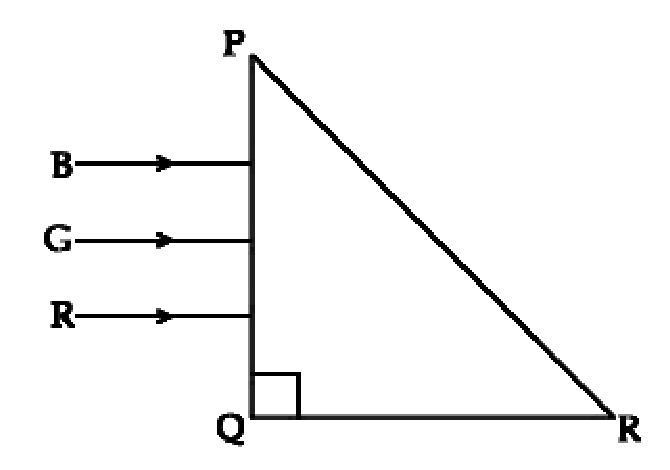
Three rays of light, namely red (R), green (G) and blue (B) are incident on the face PQ of a right angled prism PQR as shown in the figure.
The refractive indices of the material of the prism for red, green and blue wavelength are 1.27, 1.42 and 1.49 respectively. The colour of the ray(s) emerging out of the face PR is:
A ray of light travelling through glass of refractive index 2 is incident on glass-air boundary at an angle of incidence 45∘. If refractive index of air is 1, then the angle of refraction will be [sin45∘=21,sin90∘=1]
The critical angle of a medium for a specific wavelength, if the medium has relative permittivity 3 and relative permeability 34 for this wavelength, will be:
There is a small source of light at some depth below the surface of water (refractive index = 34) in a tank of large cross sectional surface area. Neglecting any reflection from the bottom and absorption by water, percentage of light that emerges out of surface is (nearly): [Use the fact that surface area of a spherical cap of height h and radius of curvature r is 2πrh]:
A light ray enters a solid glass sphere of refractive index μ=3 at an angle of incidence 60°. The ray is both reflected and refracted at the farther surface of the sphere. The angle (in degrees) between the reflected and refracted rays at this surface is ________.
Numerical answer type. Work it out, then open the answer.
The critical angle for light going from medium ' x′ to medium ' y ' is ' θ '. The speed of light in medium ' x ' is ' vx '. The speed of light in medium ' y ' is
In total internal reflection when the angle of incidence is equal to the critical angle for the pair of media in contact, what will be angle of refraction?
Glass has refractive index μ with respect to air and the critical angle for a ray of light going from glass to air is θ. If a ray of light is incident from air on the glass with angle of incidence θ, corresponding angle of refraction is
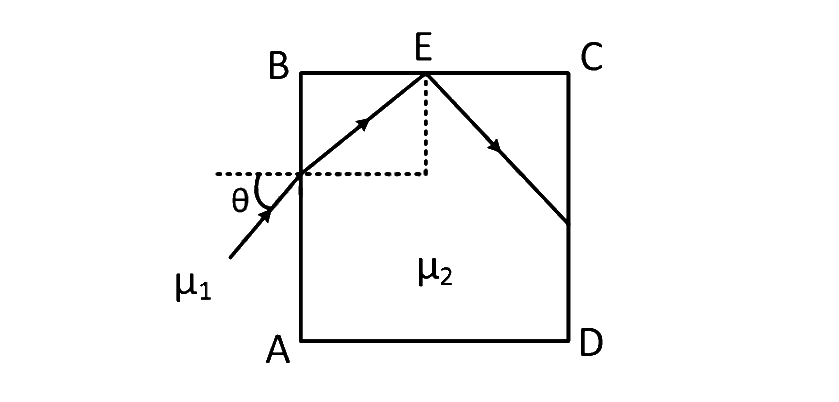
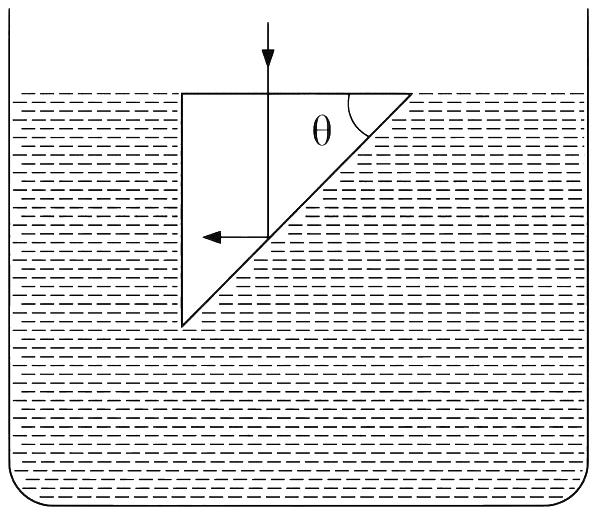
A transparent cube of side, made of a material of refractive index μ2, is immersed in a liquid of refractive index μ1(μ1 < μ2). A ray is incident on the face AB at an angle θ(shown in the figure). Total internal reflection takes place at point E on the face BC.
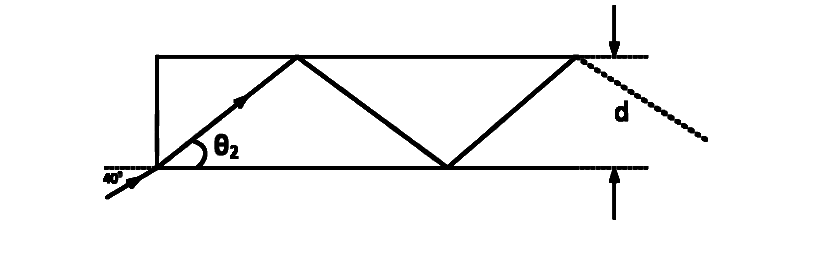
In figure, the optical fiber is l = 2m long and has a diameter of d = 20 μm. If a ray of light is incident on one end of the fiber at angle θ1 = 40°, the number of reflection it makes before emerging from the other end is close to: (refractive index of fibre is 1.31 and sin 40° = 0.64)
Let the refractive index of a denser medium with respect to a rarer medium be n12 and its critical angle be θC. At an angle of incidence A when light is travelling from denser medium to rarer medium, a part of the light is reflected and the rest is refracted and the angle between reflected and refracted rays is 90°. Angle A is given by:
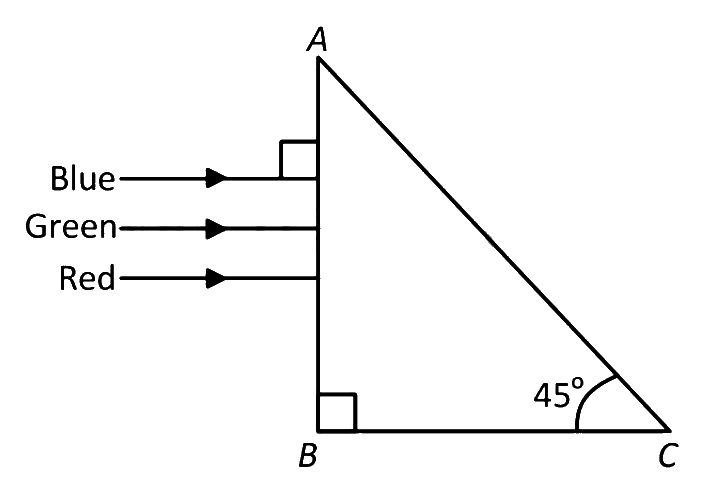
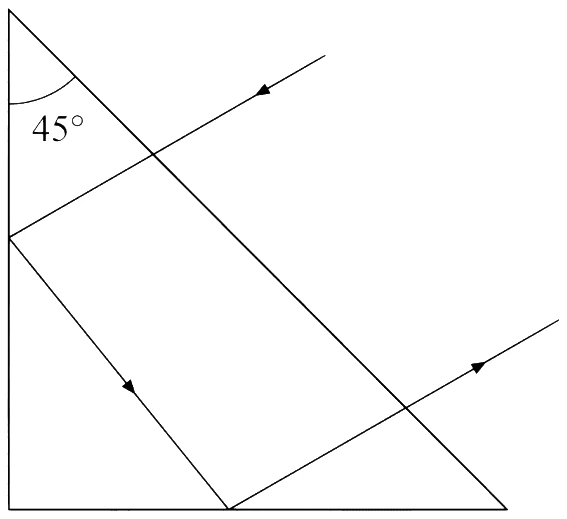
A beam of light consisting of red, green and blue colours is incident on a right angled prism. The refractive index of the material of the prism for the above red, green and blue wavelengths are 1.39, 1.44 and 1.47 respectively.
A diver looking up through the water sees the outside world contained in a circular horizon. The refractive index of water is 34 and the diver's eyes are 15 cm below the surface of water. Then the radius of the circle is:
Light is incident from a medium into air at two possible angles of incidence (A) 20° and (B) 40°. In the medium light travels 3.0 cm in 0.2 ns. The ray will:
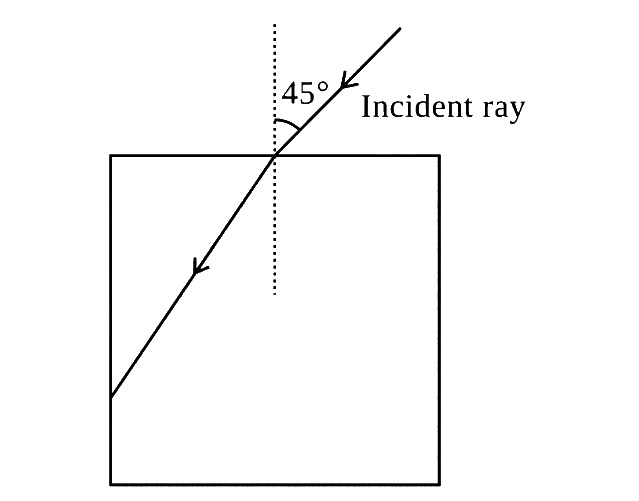
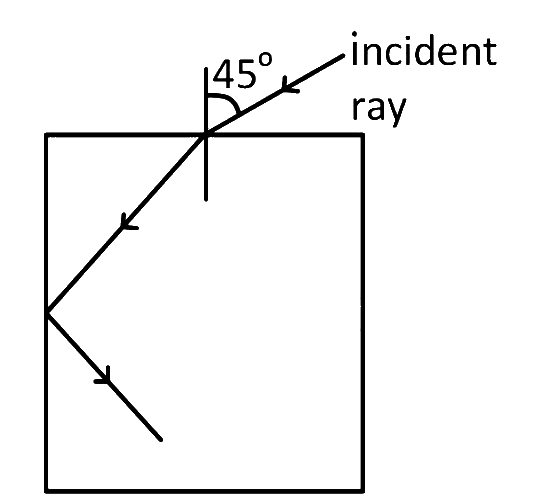
A light ray falls on a square glass slab as shown in the diagram. The index of refraction of the glass, if total internal reflection is to occur at the vertical face, is equal to:
The speed of light in media M1 and M2 are 1.5 × 10⁸ m/s and 2.0 × 10⁸ m/s respectively. A ray of light enters from medium M1 to M2 at an incidence angle i. If the ray suffers total internal reflection, the value of i is
A ray of light travelling in a transparent medium of refractive index μ, falls on a surface separating the medium from air at an angle of incidence of 45°. For which of the following value of μ the ray can undergo total internal reflection?
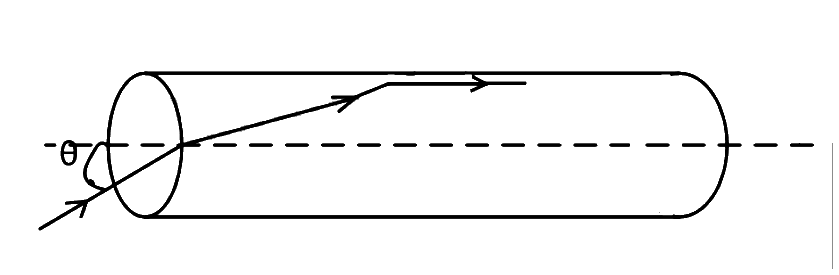
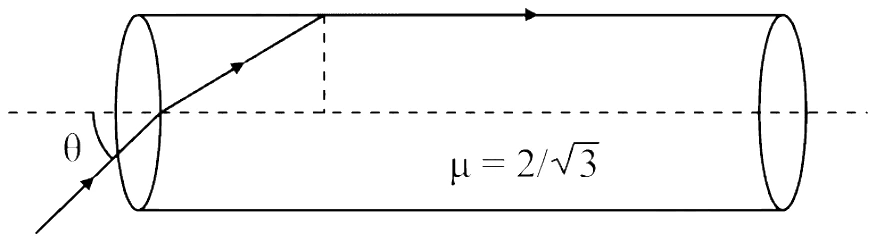
A transparent solid cylindrical rod has a refractive index of 32. It is surrounded by air. A light ray is incident at the mid-point of one end of the rod as shown in the figure.
The incident angle θ for which the light ray grazes along the wall of the rod is:
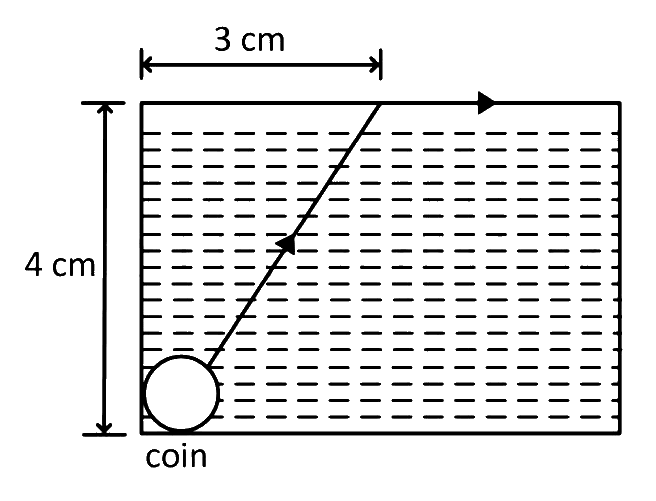
A small coin is resting on the bottom of a beaker filled with liquid. A ray of light from the coin travels upto the surface of the liquid and moves along its surface. How fast is the light travelling in the liquid?
A fish looking up through the water sees the outside world contained in a circular horizon. If the refractive index of water is 34 and the fish is 12 cm below the surface, the radius of this circle in cm is
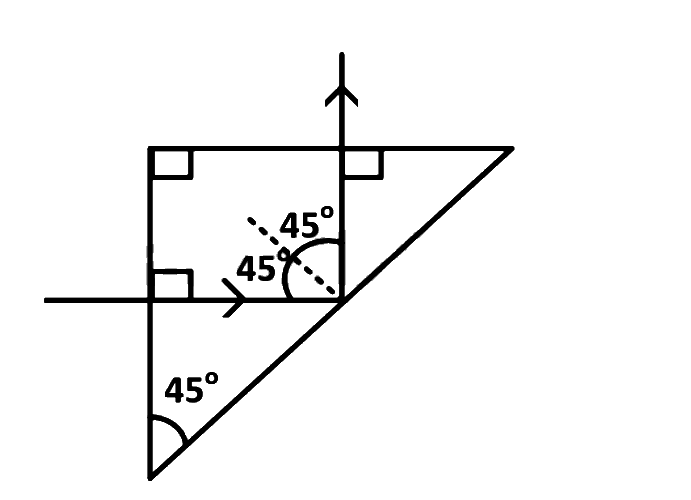
A light ray is incident perpendicularly to one face of a 90∘ prism and is totally internally reflected at the glass-air interface. If the angle of reflection is 45∘, we conclude that the refractive index n
A disc is placed on a surface of pond which has refractive index 5/3. A source of light is placed 4 m below the surface of liquid. The minimum radius of disc needed so that light is not coming out is,
Light enters at an angle of incidence in a transparent rod of refractive index n. For what value of the refractive index of the material of the rod the light once entered into it will not leave it through its lateral face whatsoever be the value of angle of incidence?
A small source of light is 4 m below the surface of water of refractive index 5/3. In order to cut off all the light, coming out of water surface, minimum diameter of the disc placed on the surface of water is
A glass slab of refractive index 1.5 is cut in the shape of a parallelepiped ABCD as shown in the figure. Surface BC is polished to form a perfect reflector. Light is incident at surface AB from inside at an angle π/3. Which one of the following is the correct angle ABC (θ) such that the reflected light retraces its path?
A light ray is falling on a face of an equilateral glass prism as shown in the figure. Which one of the following diagrams correctly shows the complete path of the ray through the glass prism?
Statement I : Diamond is very bright. Statement II : Diamond has very low refractive index. Which one of the following is correct? (Choose the code that matches both statements.)
Light travels in optical fibre irrespective of its shape because it is a device by which signals can be transferred from one location to another. It is based on the phenomenon of:
A wide slab consisting of two media of refractive indices n1 and n2 is placed in air as shown in the figure. A ray of light is incident from medium n1 to n2 at an angle θ, where sinθ is slightly larger than 1/n1. Take refractive index of air as 1. Which of the following statement(s) is(are) correct?
More than one option can be correct. Tap every correct option, then tap Check.
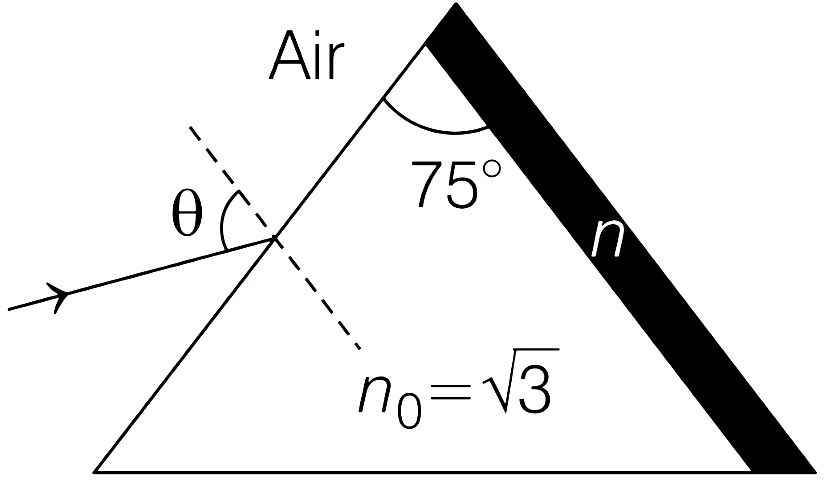
A monochromatic light is incident from air on a refracting surface of a prism of angle 75∘ and refractive index n0=3. The other refracting surface of the prism is coated by a thin film of material of refractive index n as shown in figure. The light suffers total internal reflection at the coated prism surface for an incidence angle of θ≤60∘. The value of n2 is ______.
Numerical answer type. Work it out, then open the answer.
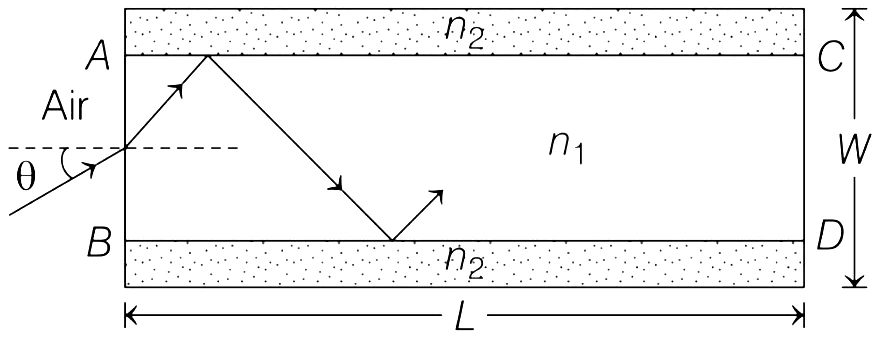
A planar structure of length L and width W is made of two different optical media of refractive indices n1=1.5 and n2=1.44 as shown in figure. If L≫W, a ray entering from end AB will emerge from end CD only if the total internal reflection condition is met inside the structure. For L=9.6m, if the incident angle θ is varied, the maximum time taken by a ray to exit the plane CD is t×10−9s, where t is ______. [Speed of light, c=3×10⁸m s−1]
Numerical answer type. Work it out, then open the answer.
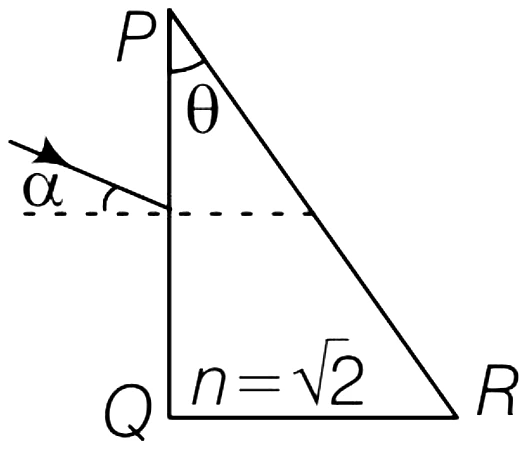
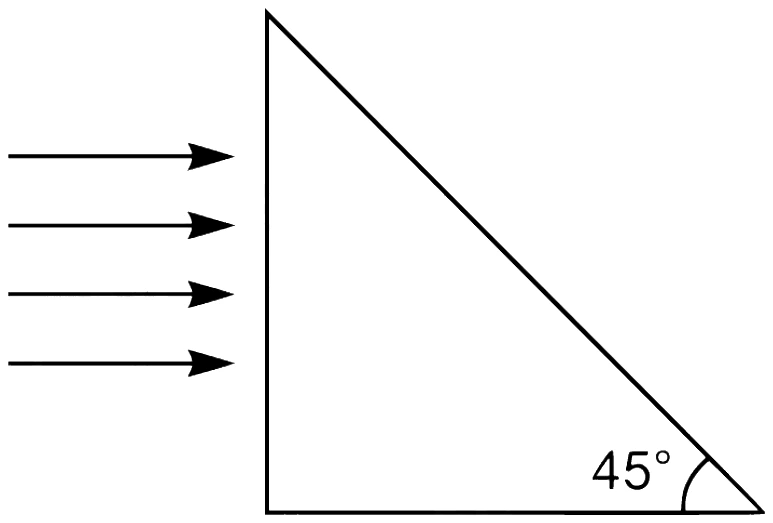
A parallel beam of light is incident from air at an angle α on the side PQ of a right angled triangular prism of refractive index n=2. Light undergoes total internal reflection in the prism at the face PR when α has a minimum value of 45∘. The angle θ of the prism is :
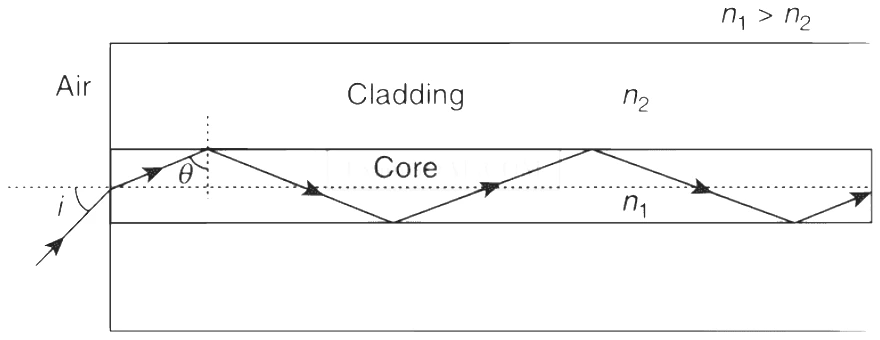
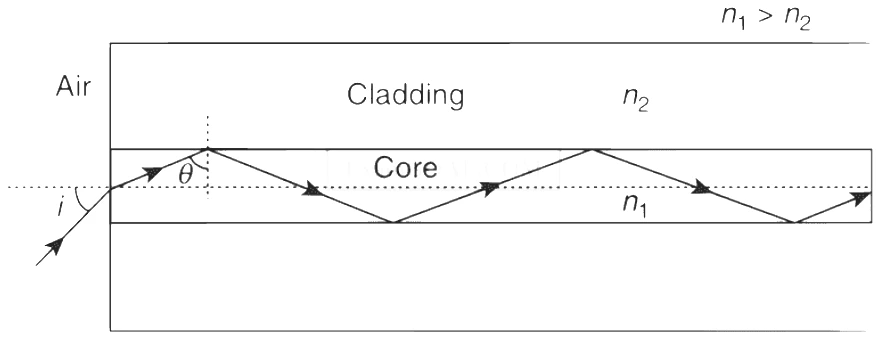
Light guidance in an optical fibre can be understood by considering a structure comprising of thin solid glass cylinder of refractive index n1 surrounded by a medium of lower refractive index n2. The light guidance in the structure takes place due to successive total internal reflections at the interface of the media n1 and n2 as shown in the figure. All rays with the angle of incidence i less than a particular value im are confined in the medium of refractive index n1. The numerical aperture (NA) of the structure is defined as sinim.
If two structures of same cross-sectional area, but different numeral apertures NA1 and NA2 (NA2<NA1) are joined longitudinally, the numerical aperture of the combined structure is
More than one option can be correct. Tap every correct option, then tap Check.
Light guidance in an optical fibre can be understood by considering a structure comprising of thin solid glass cylinder of refractive index n1 surrounded by a medium of lower refractive index n2. The light guidance in the structure takes place due to successive total internal reflections at the interface of the media n1 and n2 as shown in the figure. All rays with the angle of incidence i less than a particular value im are confined in the medium of refractive index n1. The numerical aperture (NA) of the structure is defined as sinim.
For two structures namely S1 with n1=445 and n2=23, and S2 with n1=58 and n2=57 and taking the refractive index of water to be 34 and that to air to be 1, the correct options is/are :
More than one option can be correct. Tap every correct option, then tap Check.
A point source S is placed at the bottom of a transparent block of height 10mm and refractive index 2.72. It is immersed in a lower refractive index liquid as shown in the below figure. It is found that the light emerging from the block to the liquid forms a circular bright spot of diameter 11.54mm on the top of the block. The refractive index of the liquid is
A right-angled prism of refractive index μ1 is placed in a rectangular block of refractive index μ2, which is surrounded by a medium of refractive index μ3, as shown in the figure. A ray of light e enters the rectangular block at normal incidence. Depending upon the relationships between μ1, μ2 and μ3, it takes one of the four possible paths 'ef', 'eg', 'eh' or 'ei'. Match the paths in List I with conditions of refractive indices in List II and select the correct answer using the codes given below the lists:
A large glass slab (μ=5/3) of thickness 8cm is placed over a point source of light on a plane surface. It is seen that light emerges out of the top surface of the slab from a circular area of radius Rcm. What is the value of R?
Numerical answer type. Work it out, then open the answer.
A ray OP of monochromatic light is incident on the face AB of prism ABCD near vertex B at an incident angle of 60∘ (see figure). If the refractive index of the material of the prism is 3, which of the following is(are) correct?
More than one option can be correct. Tap every correct option, then tap Check.
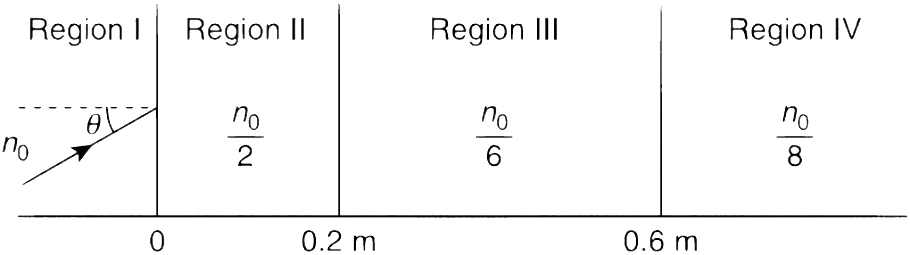
A light beam is travelling from Region I to Region IV (Refer figure). The refractive index in Regions I, II, III and IV are n0,2n0,6n0 and 8n0, respectively. The angle of incidence θ for which the beam just misses entering Region IV is
A ray of light travelling in water is incident on its surface open to air. The angle of incidence is θ, which is less than the critical angle. Then there will be,
Consider the ray diagram for the refraction given below. The maximum value of angle θ for which the light suffers total internal reflection at the vertical surface, is
Assertion : Endoscopy involves use of optical fibres to study internal organs. Reason : Optical fibres are based on phenomenon of total internal reflection.
A beam of light consisting of red, green and blue colours is incident on a right angled prism as shown in figure. The refractive indices of the material of prism for red, green and blue colours, respectively are 1.33,1.44,1.47. The prism will
A fish looking up through the water sees the outside world, contained in a circular horizon. If the refractive index of water is 34 and the fish is 12cm below the water surface, the radius of this circle in cm is
Assertion : In optical fibre, the diameter of the core is kept small. Reason : This smaller diameter of the core ensures that the fibre should have incident angle more than the critical angle required for total internal reflection.
What should be the maximum acceptance angle at the air-core interface of an optical fibre if n1 and n2 are the refractive indices of the core and the cladding, respectively ?
A point source of light is placed 4m below the surface of water of refractive index 5/3. The minimum diameter of a disc which should be placed over the source on the surface of water to cut-off all light coming out of water is
A fish looking up through the water sees the outside world contained in a circular horizon. If the refractive index of water is 4/3 and the fish is 12cm below the surface, the radius of this circle (in cm) is
A fish, looking up through the water, sees the outside world contained in a circular horizon. If the refractive index of water is 4/3 and the fish is 12cm below the surface of water, the radius of the circle in centimetre is
The critical angle for a typical glass air interface is 42∘. If a ray of light falls normally on one of the faces of the prism of angle 45∘. The emergent ray will:
If a clear liquid has a refractive index of 1.45 and a transparent solid has a refractive index of 2.9, then for total internal reflection to occur at the interface between the two media; which of the following is correct? A. The ray must travel from transparent solid to liquid at an angle of 15∘ B. The ray must travel from liquid to transparent solid at an angle of 45∘ C. The ray must travel from transparent solid to liquid at an angle of 30∘ D. The ray must travel from liquid to transparent solid at an angle of 60∘
A ray of light is travelling from glass of refractive index 23 to water of refractive index 34. What is the minimum angle of incidence for which no light enters in to the water?
Two light rays A and B travel from a medium into air at angles of incidence 15 degrees and 42 degrees respectively. In the medium, light travels 3cm in 0.2ns. Will there be total internal reflection? If so, which ray?
Light enters at an angle of incidence i in a transparent rod of refractive index n. The least value of n for which the light once entered into it will not leave it through its lateral face whatsoever be the value of the angle of incidence is
The critical angle for a monochromatic light going from medium A to medium B is θ. If the speed of light in medium A is V, then the speed of light in medium B is
A glass slab has a critical angle of 30∘ when placed in air. What will be the critical angle when it is placed in a liquid of refractive index 6/5? (sin53∘=54)
A light ray falls on a rectangular glass slab as shown in the figure. If total internal reflection occurs at the vertical face of the slab at point B, the refractive index of glass is
A ray of light travels from an optically denser to rare medium. The critical angle for the media is C. The maximum possible deviation of the ray will be
The angle of a prism made of a material of refractive index 2 is 90∘. The angle of incidence for a light ray on the first face of the prism such that the light ray suffers total internal reflection at the second face is
A light ray travels from a medium with refractive index n1 to another medium of refractive index n2. If n1=2 and n2=3, then find the critical angle.
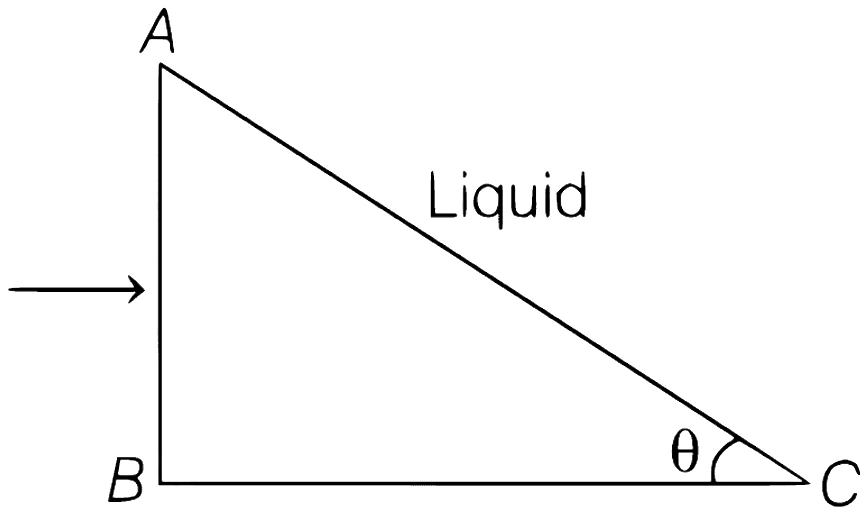
Consider a glass prism immersed in a liquid as shown below. The refractive index of glass and liquid is 1.5 and 1.2, respectively. A ray of light enters the prism perpendicular to the face AB. The largest value of angle θ is, if the ray is totally reflected at the face AC, then
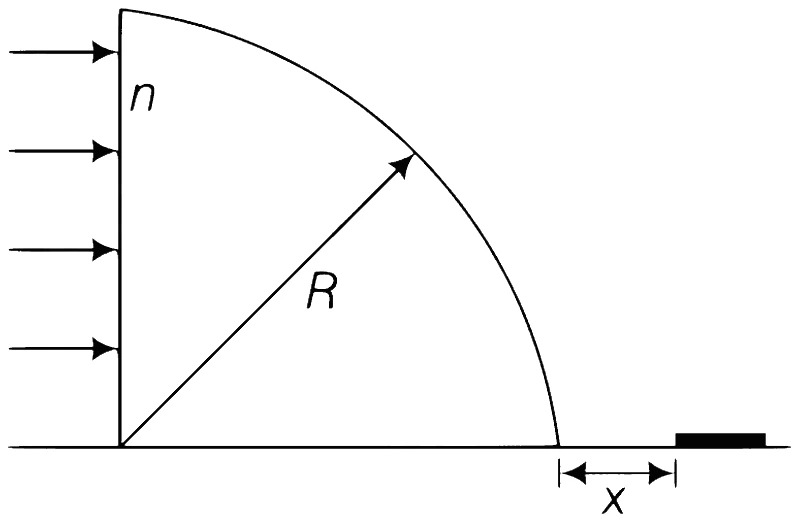
A parallel beam of light is incident on a glass prism in the shape of a quarter cylinder of radius R=0.05m and refractive index n=1.5, placed on a horizontal table as shown in the figure. Beyond the cylinder, a patch of light is found whose nearest distance x from the cylinder is
A point source of light is kept at a depth of h in water of refractive index 4/3. The radius of the circle at the surface of water through which light emits is
What is the maximum angle of incidence θi in the figure for which the ray would satisfy the condition for total internal reflection at the boundary of media of refractive indices n1 and n2, where n1>n2 ?
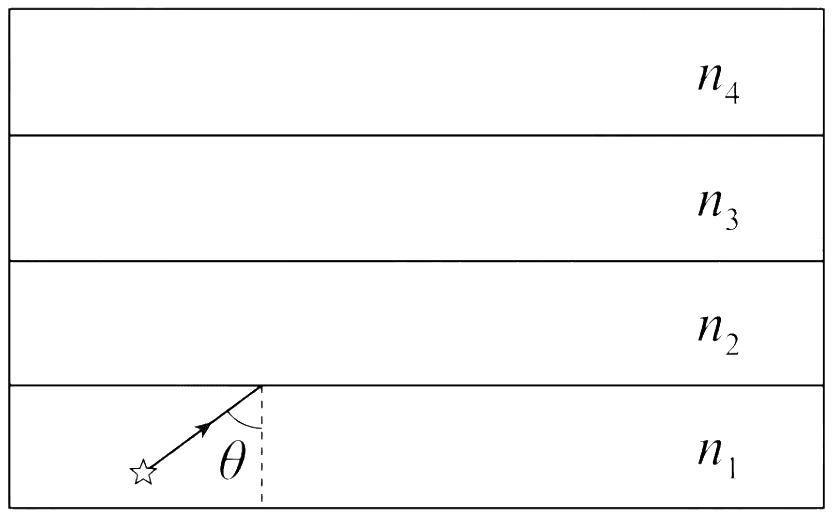
Four long glass plates with refractive indices n1>n2>n3>n4 are stacked in parallel as shown in the figure. A light ray, traveling in the first plate, is incident on the second plate at an angle θ. This ray passes through second and third plates but does not enter the fourth plate. Then, the minimum value of θ is
A powerful point light source is placed at the bottom of a large pool containing water. The depth of the pool is 5m and the refractive index of the water is 1.33. The area (in m2) illuminated as viewed from the top is closest to