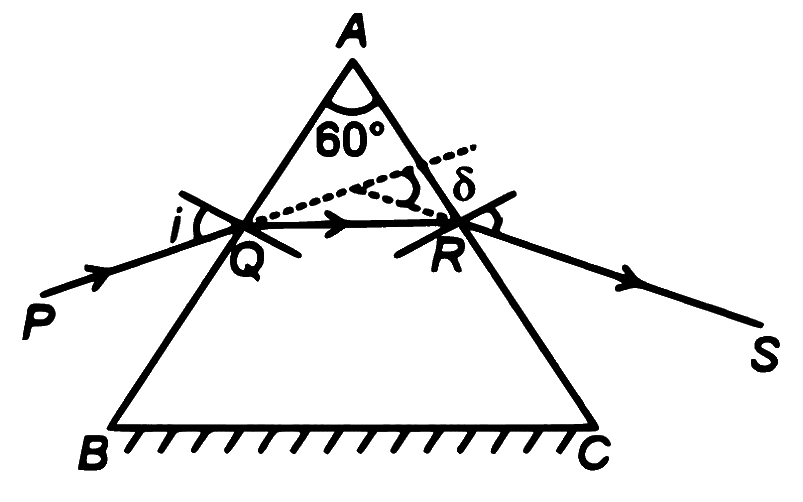
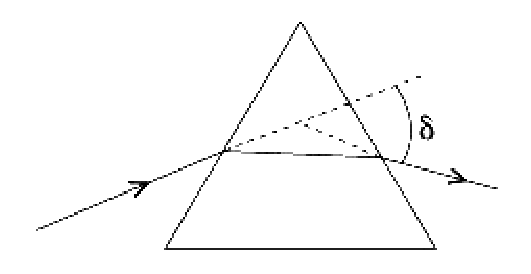
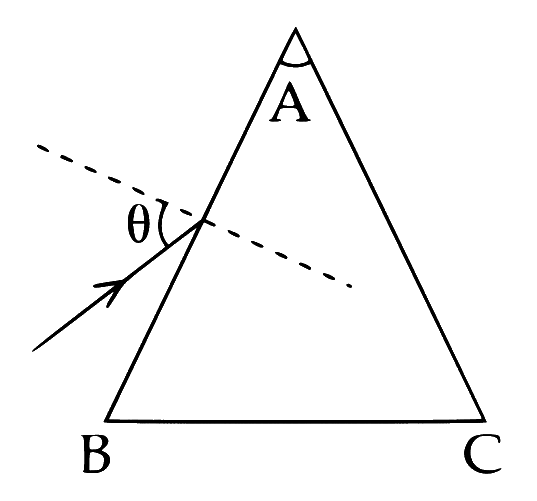
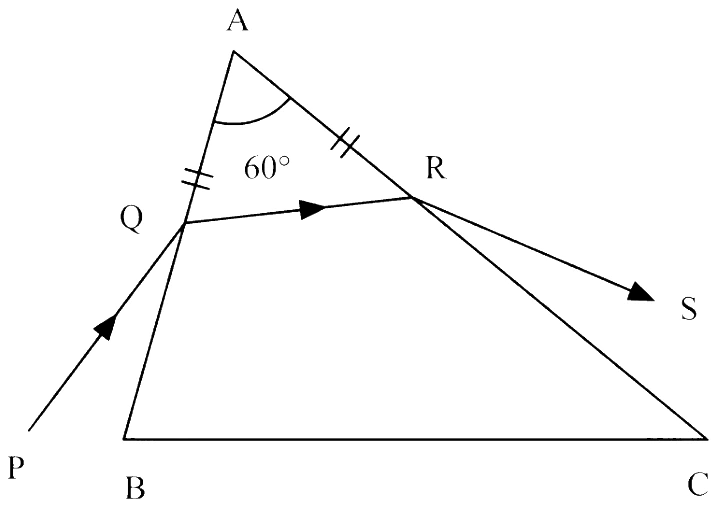
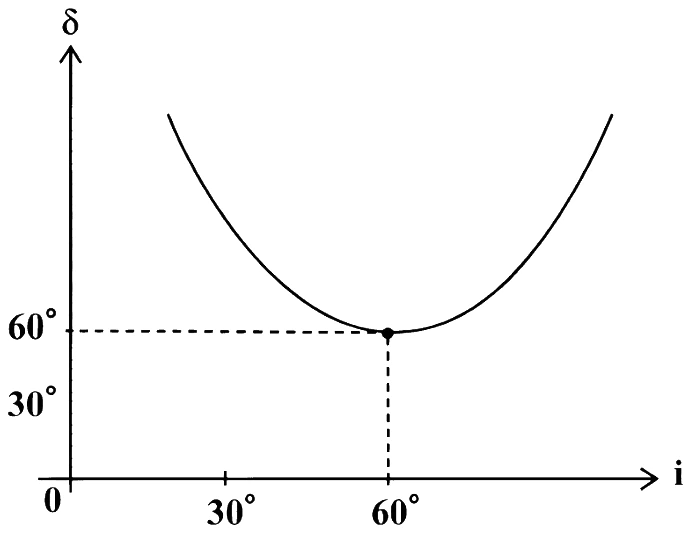
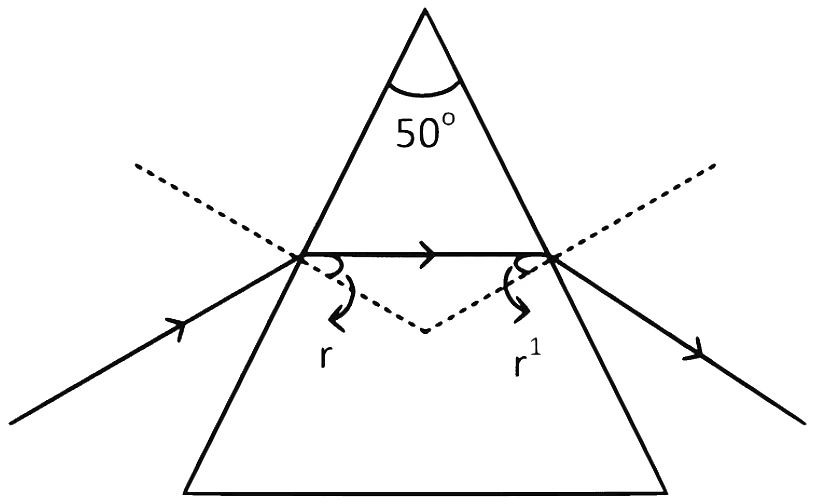
A ray of monochromatic light is passing through an equilateral prism (ABC) as shown in the figure. The refracted ray (QR) is parallel to its base (BC) and the angle of incidence (i) is 50∘. Then the angle of deviation (δ) is:
When a beam of white light is allowed to pass through convex lens parallel to principle axis, the different colors of light converge at different point on the principle axis after refraction. This is called
A thin prism in air produces the angle of minimum deviation δ. If the prism is immersed in water, the angle of minimum deviation for the same ray is (refractive index of water is 4/3 and that of glass prism is 3/2)
A ray of light incident on one face of an equilateral glass prism having refractive index 2, produces the emergent ray which just grazes along the adjacent face. The value of angle of incidence is (sin90∘=1)(sin30∘=21)(sin45∘=21)
Consider an equilateral prism (refractive index 2 ). A ray of light is incident on its one surface at a certain angle i. If the emergent ray is found to graze along the other surface then the angle of refraction at the incident surface is close to ______
The prism has refracting angle A. The second refracting surface of the prism is silvered. Light ray falling on first refracting surface with angle of incidence 2A, reaches the second surface and returns back through same path due to reflection at the silvered surface. The refractive index of the material of prism is
An achromatic convergent doublet of two lenses in contact has a power of +2D. The convex lens has power +5D. What is the ratio of the dispersive powers of the convergent and divergent lenses?
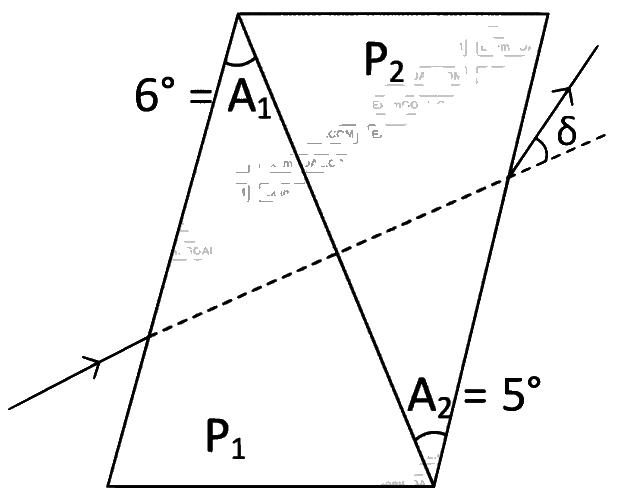
A thin prism with angle 5∘ of refractive index 1.72 is combined with another prism of refractive index 1.9 to produce dispersion without deviation. The angle of second prism is ______.
The exit surface of a prism with refractive index n is coated with a material having refractive index 2n. When this prism is set for minimum angle of deviation, it exactly meets the condition of critical angle. The prism angle is ______.
The refractive index of the material of a glass prism is 3. The angle of minimum deviation is equal to the angle of the prism. What is the angle of the prism?
A ray of light suffers minimum deviation when incident on a prism having angle of the prism equal to 60∘. The refractive index of the prism material is 2. The angle of incidence (in degrees) is__________
Numerical answer type. Work it out, then open the answer.
A monochromatic ray of light is incident normally on a thin prism of refracting angle A. The ray is deviated through an angle (1.15)∘ in passing through the prism. The ray reflected internally from the second face emerges from the first face making an angle of (6.3)∘ with the incident ray. The refractive index of the prism is
For a thin prism, δ1 is the angle of deviation produced, when prism is placed in air. When the prism is immersed in water, the angle of deviation produced is δ2. Given aμg=23 and aμw=34. The ratio δ2:δ1 is
A ray of light is incident on first face of an equilateral glass prism at an angle of incidence ' I '. The emergent ray just grazes along the adjacent face. The refractive index of the the prism is 2. The value of angle of incidence at first face is (sin45∘=21,sin90∘=1)
An achromatic convergent doublet of two lenses in contact has a power +2 D. The convex lens has power +5 D. The ratio of the dispersive powers of the convergent and divergent lenses is (in magnitude)
A thin prism P1 with angle 4∘ made of glass having refractive index 1.54, is combined with another thin prism P2 made of glass having refractive index 1.72 to get dispersion without deviation. The angle of the prism P2 in degrees is
Statement I: When the white light passed through a prism, the red light bends lesser than yellow and violet.
Statement II: The refractive indices are different for different wavelengths in dispersive medium. In the light of the above statements, choose the correct answer from the options given below:
A ray of light is incident at 60∘ on one face of a prism of angle 30∘ and the emergent ray makes 30∘ with the incident ray. The refractive index of the prism is (sin30∘=0.5,sin60∘=3/2)
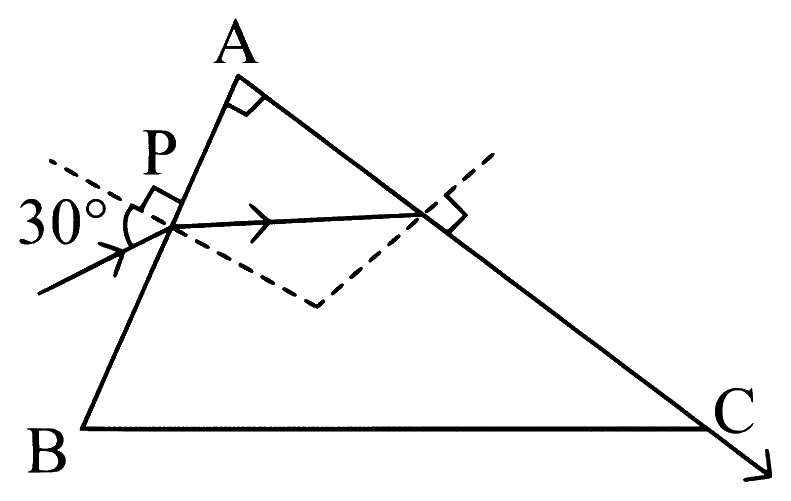
A light ray enters through a right angled prism at point P with the angle of incidence 30∘ as shown in figure. It travels through the prism parallel to its base BC and emerges along the face AC. The refractive index of the prism is:
The refractive index of prism is μ=3 and the ratio of the angle of minimum deviation to the angle of prism is one. The value of angle of prism is _________∘.
Numerical answer type. Work it out, then open the answer.
A glass prism ' A ' deviates the red and blue rays through 10∘ and 12∘ respectively. A second prism ' B ' deviates them through 8∘ and 10∘ respectively. The ratio of their dispersive powers is (A to B)
When a monochromatic ray of light is passed through an equilateral glass prism, it is found that the refracted ray in glass is parallel to the base of the prism. If 'i' and 'e' denote the angles of incidence and emergence respectively, then
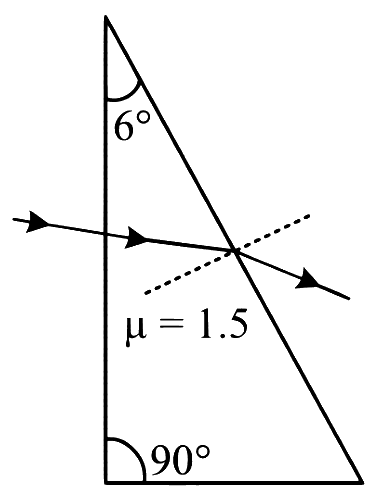
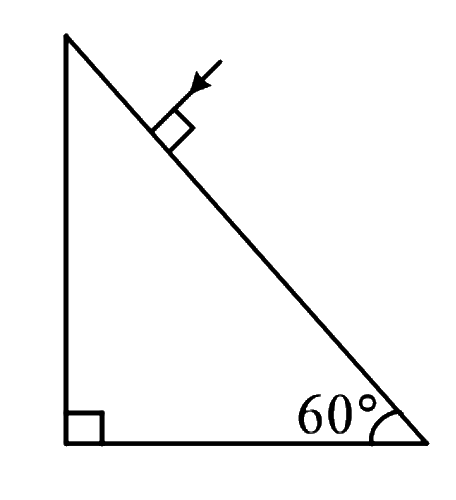
A horizontal ray of light is incident on the right angled prism with prism angle 6∘. If the refractive index of the material of the prism is 1.5, then the angle of emergence will be:
When a beam of white light is allowed to pass through convex lens parallel to principal axis, the different colours of light converge at different points on the principal axis after refraction. This is called:
A ray of light passes through an equilateral prism such that the angle of incidence (i) is equal to angle of emergence (e). The angle of emergence is equal to (43) th the angle of prism. The angle of deviation is
The angle of deviation produced by a thin prism when placed in air is 'δ1' and that when immersed in water is 'δ2 '. The refractive index of glass and water are 23 and 34 respectively. The ratio δ1:δ2 is
A ray of light is incident at an angle of incidence 'i' on one surface of a prism of small angle A and emerges normally from the other surface. If the refractive index of the material of the prism is 'μ', then the angle of incidence is equal to
The refractive index of a transparent liquid filled in an equilateral hollow prism is 2. The angle of minimum deviation for the liquid will be ___________ ∘.
Numerical answer type. Work it out, then open the answer.
The prism has refracting angle 'A'. The second refracting surface of the prism is silvered. Light ray falling on first refracting surface with angle of incidence '2A', reaches the second surface and returns back through the same path due to reflection at the silvered surface. The refractive index of the material of the prism is
The angle of prism is A and one of its refracting surface is silvered. Light rays falling at an angle of incidence '2A' on the first surface return back through the same path after suffering reflection at the silvered surface. The refractive index of the material of the prism is
A glass prism deviates the red and violet rays through 9∘ and 11∘ respectively. A second prism of equal angle deviates them through 11∘ and 13∘ respectively. The ratio of dispersive power of second prism to first prism is
A thin prism P1 with an angle 6∘ and made of glass of refractive index 1.54 is combined with another prism P2 made from glass of refractive index 1.72 to produce dispersion without average deviation. The angle of prism P2 is
A thin prism of angle 6∘ and refractive index for yellow light (nY)1.5 is combined with another prism of angle 5∘ and nY=1.55. The combination produces no dispersion. The net average deviation (δ) produced by the combination is (x1)∘. The value of x is ____________.
Numerical answer type. Work it out, then open the answer.
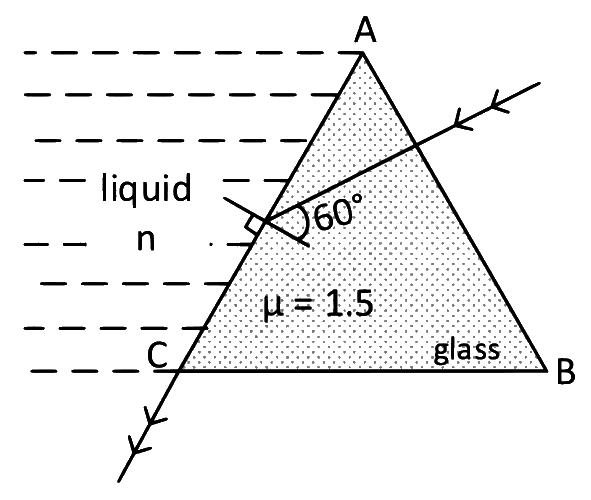
In the given figure, the face AC of the equilateral prism is immersed in a liquid of refractive index 'n'. For incident angle 60∘ at the side AC, the refracted light beam just grazes along face AC. The refractive index of the liquid n=4x. The value of x is ____________.
(Given refractive index of glass =1.5)
Numerical answer type. Work it out, then open the answer.
A prism of refractive index μ and angle of prism A is placed in the position of minimum angle of deviation. If minimum angle of deviation is also A, then the value of A in terms of refractive index is
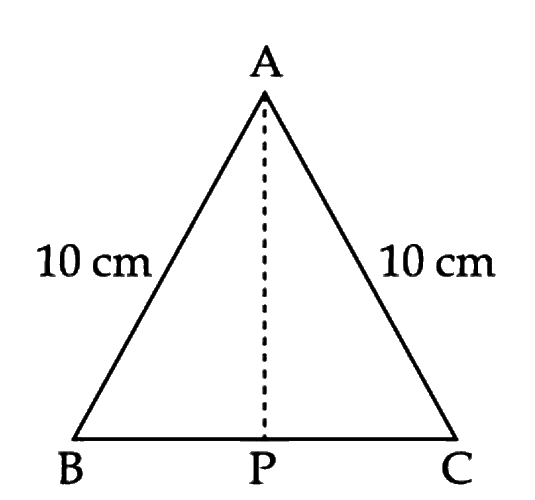
Cross-section view of a prism is the equilateral triangle ABC in the figure. The minimum deviation is observed using this prism when the angle of incidence is equal to the prism angle. The time taken by light to travel from P (midpoint of BC) to A is ______________ × 10−10 s. (Given, speed of light in vacuum = 3 × 10⁸ m/s and cos30∘=23)
Numerical answer type. Work it out, then open the answer.
A ray of light is incident at an angle 'I' on one face of thin prism. The ray emerges normally from the other face. Refractive index of the glass prism is 'n' and angle of prism is 'A'. The value of 'I' is
A ray of light passing through a prism (μ=3) suffers minimum deviation. It is found that the angle of incidence is double the angle of refraction within the prism. Then, the angle of prism is _____________ (in degrees).
Numerical answer type. Work it out, then open the answer.
A ray of light is incident on one face of an equilateral glass prism having refractive index 2. It produces the emergent ray which just. grazes along the adjacent face. The value of angle of incidence is (sin45∘=cos45∘=21)
A deviation of 2∘ is produced in the yellow ray when prism of crown and flint glass are achromatically combined. Taking dispersive powers of crown and flint glass as 0.02 and 0.03 respectively and refractive index for yellow light for these glasses are 1.5 and 1.6 respectively. The refracting angles for crown glass prism will be ____________∘ (in degree). (Round off to the Nearest Integer)
Numerical answer type. Work it out, then open the answer.
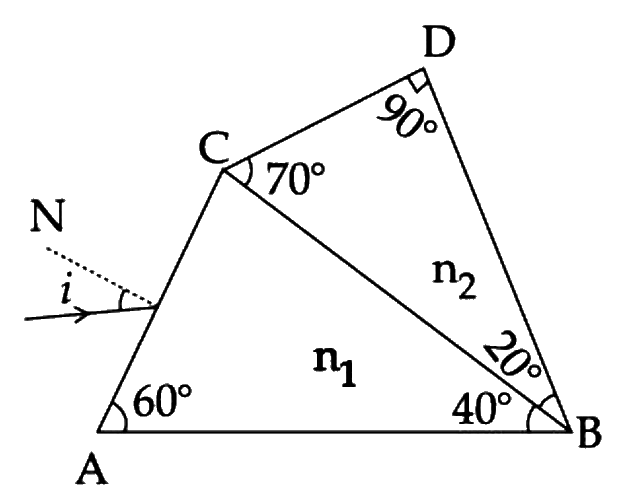
A prism of refractive index n1 and another prism of refractive index n2 are stuck together (as shown in the figure). n1 and n2 depend on λ, the wavelength of light, according to the relation n1=1.2+λ210.8×10⁻¹⁴ and n2=1.45+λ21.8×10⁻¹⁴
The wavelength for which rays incident at any angle on the interface BC pass through without bending at that interface will be _____________ nm.
Numerical answer type. Work it out, then open the answer.
A ray is incident at an angle of incidence i on one surface of a small angle prism (with angle of prism A) and emerges normally from the opposite surface. If the refractive index of the material of the prism is μ, then the angle of incidence is nearly equal to:
A ray of light is incident at an angle i on one face of a thin angled prism. The ray emerges normally from the other face. Refractive index of the glass prism is n and angle of prism is A. The value of i is
A ray of light is incident at an angle i on one face of prism of small angle A and emerges normally from the other surface. μ is the refractive index of the material of the prism. The angle of incidence is
A monochromatic light is incident at a certain angle on an equilateral triangular prism and suffers minimum deviation. If the refractive index of the material of the prism is 3, then the angle of incidence is:
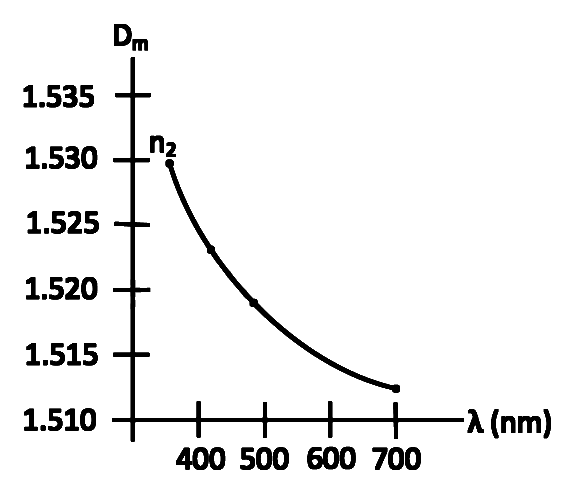
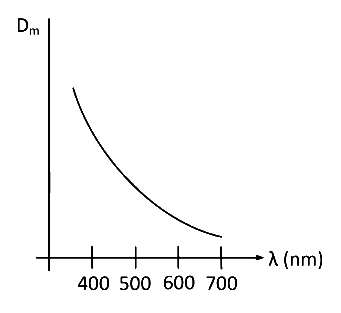
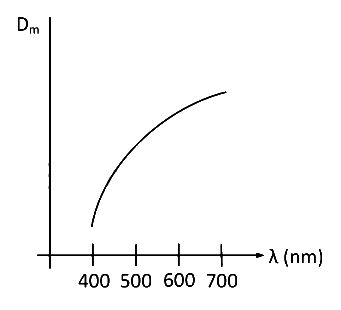
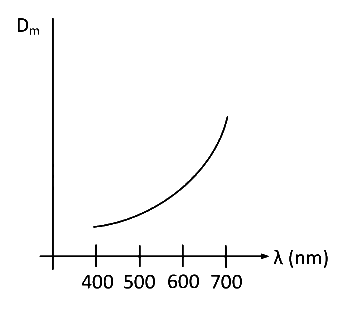
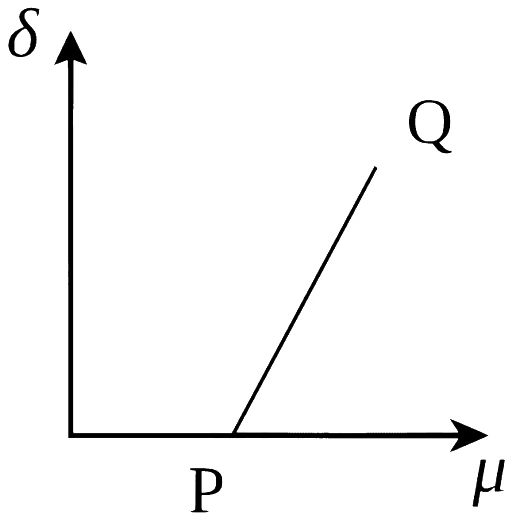
The variation of refractive index of a crown glass thin prism with wavelength of the incident light is shown. Which of the following graphs is the correct one, if Dm is the angle of minimum deviation?
(A)
(B)
(C)
Numerical answer type. Work it out, then open the answer.
A ray of light is incident at an angle of 60° on one face of a prism of angle 30°. The emergent ray of light makes an angle of 30° with incident ray. The angle made by the emergent ray with second face of prism will be:
The refractive index of the material of a prism is 2 and the angle of the prism is 30°. One of the two refracting surfaces of the prism is made a mirror inwards, by silver coating. A beam of monochromatic light entering the prism from the other face will retrace its path (after reflection from the silvered surface) if its angle of incidence on the prism is
A thin prism having refracting angle 10° is made of glass of refractive infex 1.42. This prism is combined with another thin prism of glass of refractive index 1.7. This combination producess dispersion without deviation. The refracting angle of second prism should be
The angle of incidence for a ray of light at a refracting surface of a prism is 45°. The angle of prism is 60°. If the ray suffers minimum deviation through the prism, the angle of minimum deviation and refractive index of the material of the prism respectively, are
In an experiment for determination of refractive index of glass of a prism by i−δ plot, it was found that a ray incident at angle 35∘, suffers a deviation of 40∘ and that it emerges at angle 79∘ In that case which of the following is closest to the maximum possible value of the refractive index?
Monochromatic light is incident on a glass prism of angle A. If the refractive index of the material of the prism is μ, a ray, incident at an angle θ. on the face AB would get transmitted through the face AC of the prism provided:
The angle of a prism is A. One of its refracting surfaces is silvered. Light rays falling at an angle of incidence 2 A on the first surface returns back through the same path after suffering reflection at the silvered surface.
A ray of light is incident at an angle of incidence i, on one face of a prism of angle A (assumed to be small) and emerges normally from the opposite face. If the refractive index of the prism is μ. the angle of incidence i, is nearly equal to
A thin prism of angle 15° made of glass of refractive index μ1 = 1.5 is combined with another prism of glass of refractive index μ2 = 1.75. The combination of the prisms produces dispersion without deviation. The angle of the second prism should be
A ray of light is incident on a 60° prism at the minimum deviation position. The angle of refraction at the first face (i.e., incident face) of the prism is
The refractive index of a glass is 1.520 for red light and 1.525 for blue light. Let D1 and D2 be angles of minimum deviation for red and blue light respectively in a prism of this glass. Then,
The refractive index of the material of a prism is 2 and its refracting angle is 30°. One of the refracting surfaces of the prism is made a mirror inwards. A beam of monochromatic light entering the prism from the other face with retrace its path after reflection from the mirrored surface if its angle of incidence on the prism is
If fV and fR are the focal lengths of a convex lens for violet and red light respectively and FV and FR are the focal lengths of a concave lens for violet and red light respectively, then we must have
There is a prism with refractive index equal to 2 and the refractive angle equal to 30∘. One of the refractive surface of the prism is polished. A beam of monochromatic light will retrace its path if its angle of incidence over the refracting surface of the prism is
A ray of light is incident at an angle of incidence i, on one face of a prism of angle A (assumed to be small) and emerges normally from the opposite face. If the refractive index of the prism is μ, the angle of incidence i, is nearly equal to
Which of the following statements with regard to the phenomenon of the primary rainbow formation by water droplets is/are correct? 1. It involves refraction and one internal reflection of sunlight. 2. It involves refraction of sunlight only. 3. It is formed as the inner bow. 4. It may involve more than one internal reflection as well as refraction of sunlight. Select the answer using the code given below:
The streaming of light beams coming from the Sun through trees is said to have suggested that light travels in straight line. The particles on the path of light beams are visible to us because
A glass prism splits white light into different colours. This phenomenon is called dispersion of light by prism. Which one of the following statements is correct?
A beam of polychromatic light passes through a thin prism of prism angle 6∘. The refractive index of the material of the prism varies with wavelength (λ) as n(λ)=αλ+λ2β, where α=3μm−1 and β=0.096μm2. If λmin is the wavelength at which the angle of minimum deviation Dm is smallest, then the correct value of Dm at λmin is :
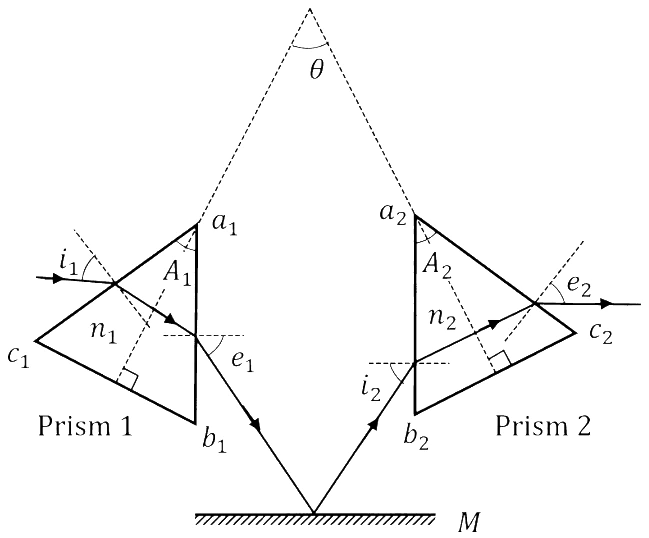
Consider two isosceles prisms 1 and 2 with prism angles A1 and A2 and refractive indices n1 and n2, respectively, as shown in the figure. The faces a1b1 and a2b2 are parallel to each other and perpendicular to the mirror M. If a ray of light is incident on the face a1c1 and emerges from the face a2c2, then the correct statement(s) is/are :
More than one option can be correct. Tap every correct option, then tap Check.
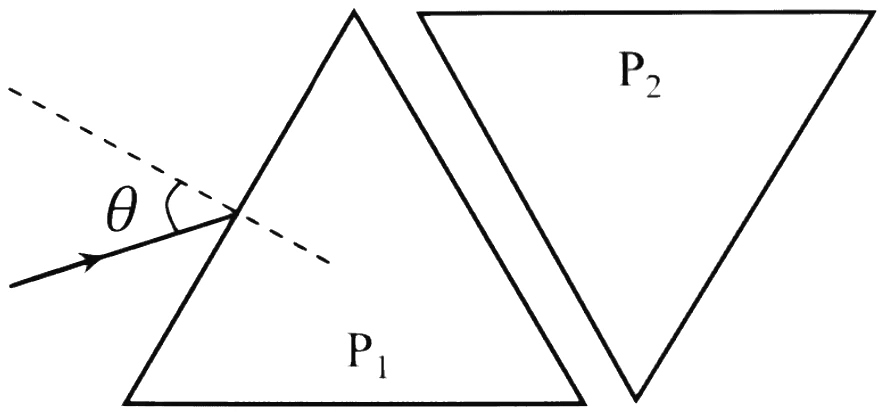
Two equilateral-triangular prisms P1 and P2 are kept with their sides parallel to each other, in vacuum, as shown in the figure. A light ray enters prism P1 at an angle of incidence θ such that the outgoing ray undergoes minimum deviation in prism P2. If the respective refractive indices of P1 and P2 are 23 and 3, then θ=sin−1[23sin(βπ)], where the value of β is ________.
Numerical answer type. Work it out, then open the answer.
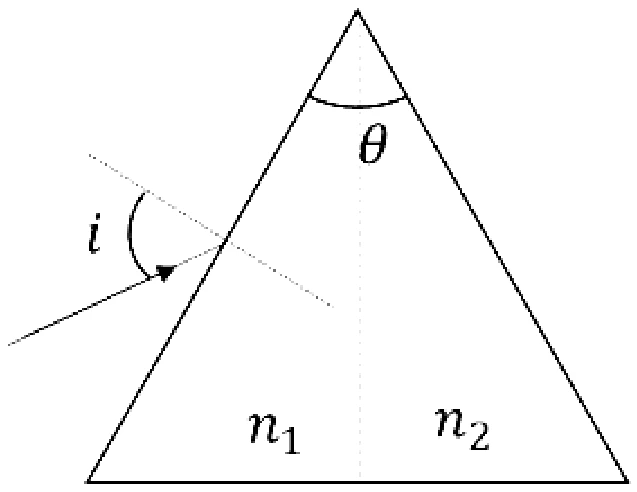
For a prism of prism angle θ=60∘, the refractive indices of the left half and the right half are, respectively, n1 and n2 (n2≥n1) as shown in the figure. The angle of incidence i is chosen such that the incident light rays will have minimum deviation if n1=n2=n=1.5. For the case of unequal refractive indices, n1=n and n2=n+Δn (where Δn≪n), the angle of emergence e=i+Δe. Which of the following statement(s) is(are) correct?
More than one option can be correct. Tap every correct option, then tap Check.
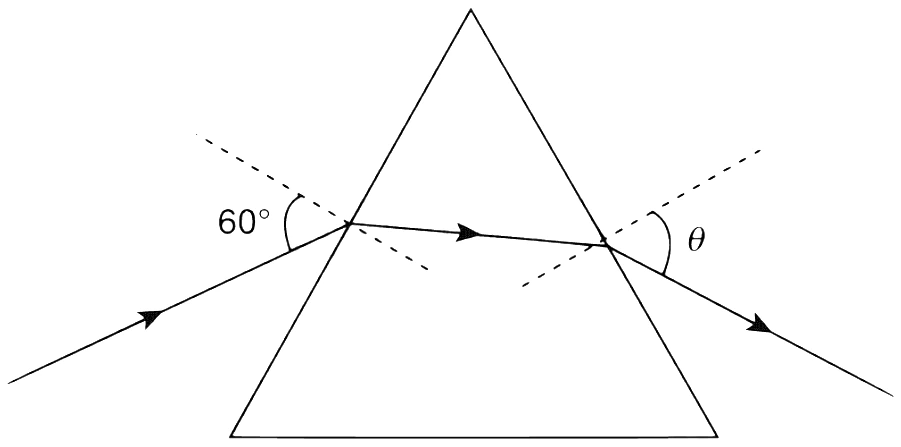
A monochromatic beam of light is incident at 60∘ on one face of an equilateral prism of refractive index n and emerges from the opposite face making an angle θ(n) with the normal (see figure). For n=3 the value of θ is 60∘ and dndθ=m. The value of m is
Numerical answer type. Work it out, then open the answer.
Two beams of red and violet colours are made to pass separately through a prism (angle of the prism is 60∘). In the position of minimum deviation, the angle of refraction will be :
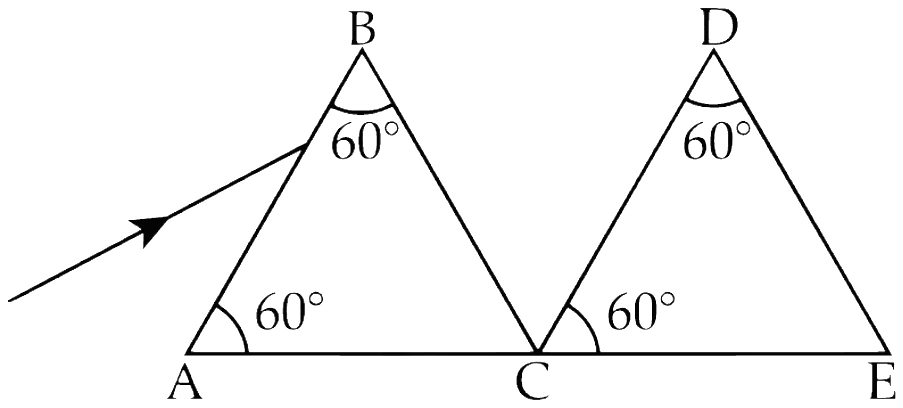
Two identical prisms of refractive index 3 are kept as shown in the figure. A light ray strikes the first prism at face AB. Find
(A) the angle of incidence so that the emergent ray from the first prism has minimum deviation; (B) through what angle, the prism DCE should be rotated about C so that the final emergent ray also has minimum deviation?
A thin prism P1 of angle 4∘ and refractive index 1.54 is combined with another prism P2 of refractive index 1.72 produce dispersion without deviation, the angle of P2 is
Assertion : Angle of deviation depends on the angle of prism. Reason : For thin prism δ=(μ−1)A Where δ = angle of deviation, μ = refractive index, A = angle of prism
Assertion : Critical angle of light passing from glass to air is minimum for violet colour. Reason : The wavelength of violet light is greater than the light of other colours.
Assertion : The focal length of lens does not change, when red light is replaced by blue light. Reason : The focal length of lens does not depend on colour of light used.
A prism is made up of material of refractive index 3. The angle of prism is A. If the angle of minimum deviation is equal to the angle of the prism, then the value of A is
A thin prism P1 of angle 4∘ and refractive index 1.54 is combined with another thin prism P2 of refractive index 1.72 to produce dispersion without deviation. The angle of P2 is
The dispersive powers of glasses of lenses used in an achromatic pair are in the ratio 5:3. If the focal length of the concave lens is 15cm, then the nature and focal length of the other lens would be
Assertion : There is no dispersion of light refracted through a rectangular glass slab. Reason : Dispersion of light is the phenomenon of splitting of a beam of white light into its constituent colours.
A prism of crown glass with refracting angle of 5∘ and mean refractive index =1.51 is combined with a flint glass prism of refractive index =1.65 to produce no deviation. Find the angle of flint glass.
A beam of light composed of red and green rays is incident obliquely at a point on the face of a rectangular glass slab. When coming out on the opposite parallel face, the red and green rays emerge from
A prism of a certain angle deviates the red and blue rays by 8∘ and 12∘, respectively. Another prism of the same angle deviates the red and blue rays by 10∘ and 14∘, respectively. The prisms are small angled and made of different materials. The dispersive power of the materials of the prisms are in the ratio
The refractive index of glass is 1.520 for red light and 1.525 for blue light. Let D1 and D2 be angles of minimum deviation for red and blue light respectively in a prism of this glass. then,
An achromatic convergent doublet of two lenses in contact has a power of +5D. The power of converging lens is +6D. The ratio of the dispersive power of the convergent and divergent lenses is
The focal length of thin convex lens for red and blue rays are 100cm and 98.01cm, respectively. There, the dispersive power of the material of the lens is
A ray PQ incident on the refracting face BA is refracted in the prism BAC as shown in the figure and emerges from the other refracting face AC as RS such that AQ=AR. If the angle of prism A=60∘ and the refractive index of the material of prism is 3, then the angle of deviation of the ray is
When sunlight is scattered by atmospheric atoms and molecules the amount of scattering of light of wavelength 880nm is A. Then, the amount of scattering of light of wavelength 330nm is approximately
The ratio of the angle of deviation produced by a thin prism, when it is placed in air to the angle of deviation produced when it is immersed in water of refractive index 34 is:
For a 30∘ prism when a ray of light is incident at an angle 60∘ on one of its faces, the emergent ray passes normal to the other surface. Then the refractive index of the prism is:
When angle of incidence on one face of the equilateral glass prism is 3/4th of the angle of prism, the ray of light undergoes minimum deviation. If the velocity of light in vacuum is c then the velocity of light in the glass is :
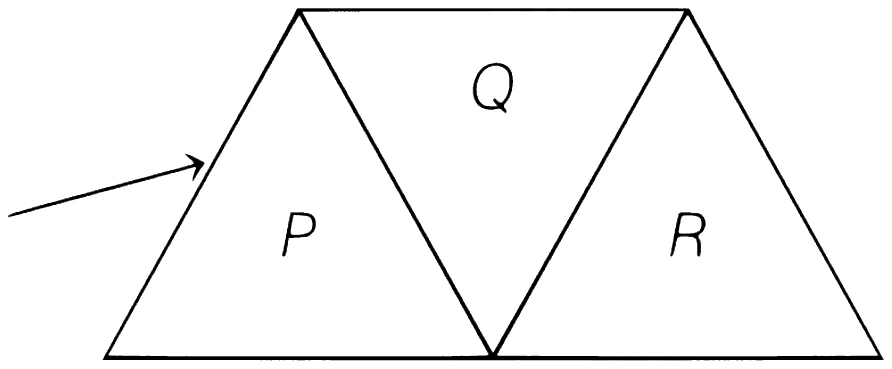
A ray of light suffers minimum deviation in equilateral prism P. Additional prisms Q and R of identical shape and of same material as that of P are now combined as shown in figure. The ray will now suffer
If r and r1 denotes the angles inside the prism having angle of prism 50∘ considering that during interval of time from t=0 to t=t, r varies with time as r=10∘+t2. During the time r1 will vary with time as
A ray of light passes through an equilateral glass prism in such a manner that the angle of incidence is equal to the angle of emergence and each of these angles is equal to 43 of the angle of the prism. The angle of deviation is
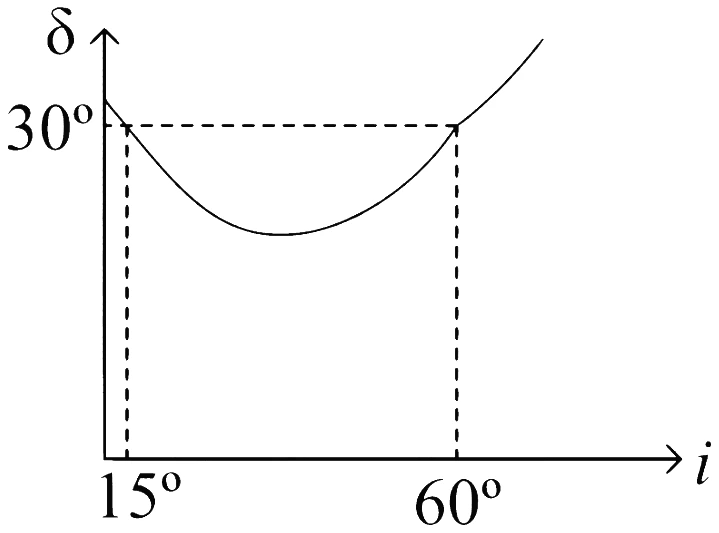
A certain prism is found to produce a minimum deviation of 38∘. It produce a deviation of 44∘ when the angle of incidence is either 42∘ or 62∘. What is the angle of incidence when it is undergoing minimum deviation?
According to Rayleigh, when sunlight travels through atmosphere, the amount of scattering is proportional to nth power of wavelength of light. Then, the value of n is
A light ray incidents on an equilateral prism made of material of refractive index 3. Inside the prism, if the light ray moves parallel to the base of the prism, then the angle of incidence of the light ray is
A ray of light incidents at an angle of 60∘ on the first face of a prism. The angle of the prism is 30∘ and its second face is silvered. If the light ray inside the prism retraces its path after reflection from the second face, then the refractive index of the material of the prism is
The minimum deviation produced by a hollow prism filled with a certain liquid is found to be 30∘. The light ray is also, found to be refracted at an angle of 30∘. Then, the refractive index of the liquid is
Assertion (A) The focal length of lens does not change when red light is replaced by blue light. Reason (R) The focal length of lens does not depend on colour of light used.
If the angles of minimum deviation when a prism of angle 80∘ is placed separately in air and in a liquid are 40∘ and 10∘ respectively, then the refractive index of the liquid is
The ratio of the speeds of light in a prism P and in vacuum is 1:3 and the angle of minimum deviation is 60∘. In another prism Q of same angle of prism, if the angle of minimum deviation is 30∘, then the refractive index of the material of the prism Q is
A ray of light incidents at an angle of 9.3∘ on one face of a small angle prism of refracting angle 6∘. If the ray of light emerges normally from the second face, the refractive index of the material of the prism is
If the angle of minimum deviation produced by an equilateral prism is equal to the angle of the prism, then the refractive index of the material of the prism is nearly
If a ray of light passes through an equilateral prism such that the angle of incidence and the angle of emergence are both equal to 70% of the angle of the prism, then the angle of minimum deviation is
A small angled prism is made of a material of refractive index 23. The ratio of the angles of minimum deviations when the prism is placed in air and in water of refractive index 34 is
The angles of incidence and emergence of a light ray passing through a prism of angle A are i and e respectively. The total deviation produced by the prism is
A thin prism of angle 6∘ made of glass of refractive index 1.5 is combined with another prism made of refractive index 1.75 to produce dispersion without deviation. Then, the angle of the second prism is
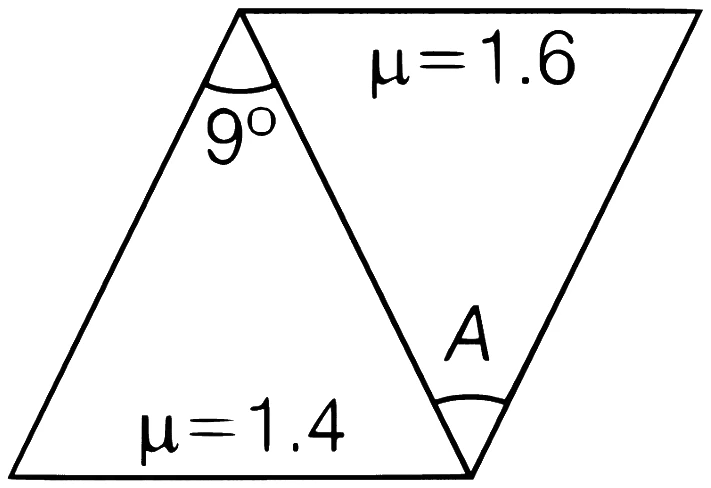
A thin glass prism of angle 9∘ with refractive index 1.4 is combined with another glass prism of refractive index 1.6 as shown in the figure. The combination of the prism provides dispersion without deviation. Determine the angle (A) of the second prism.
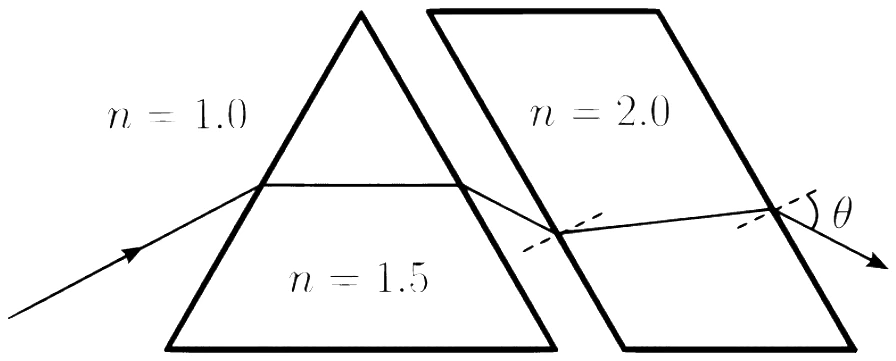
Consider an equilateral prism of refractive index 1.5 and a parallelepiped block of refractive index 2.0 arranged as shown in the figure such that their adjacent faces are parallel. A light ray enters the prism from air at an angle of incidence such that the ray travels through the prism parallel to its base. What is the angle of emergence θ?
A beam of monochromatic light is incident on one face of a prism of angle 75∘. If the angle of incidence is 60∘ and the refractive index of the prism is 3, then the correct option about the emergence of the beam from the opposite face is
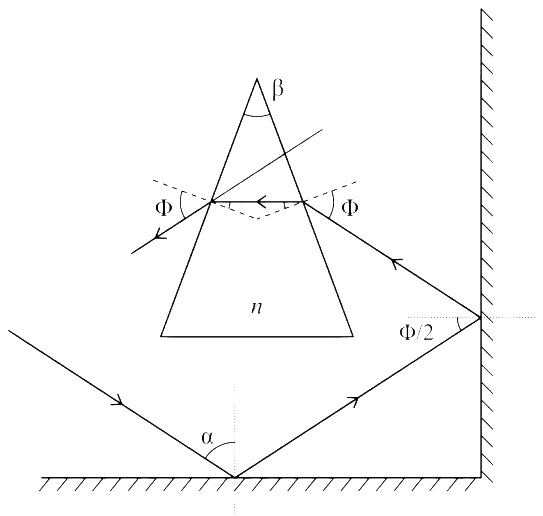
A glass prism, of angle β, is placed in front of two mutually perpendicular mirrors, as shown in the figure below. The refractive index of the material of the prism is (taking nair=1),
For a concave mirror of radius of curvature R, a ray parallel to the axis but far from it (i.e. not satisfying the paraxial ray approximation) on reflection intersects the axis at F′. If the distance between the pole of the mirror and the point F′ is denoted by f′ then