Physics Circle home Student Login

Home›Practice Hub›Chapters›Ray Optics›Spherical Surfaces & Thin Lenses

Ray Optics PYQs · MHT CET · JEE Main · NEET

Spherical Surfaces & Thin Lenses

Read the theory for this topic →

Questions
217
MHT CET
30
JEE Main
64
NEET
18
Other exams
105
0 of 217 attempted

Q1JEE Main 2026 · 4 APR · SHIFT 2Easy

Spherical Surfaces & Thin Lenses

A convex lens is made from glass material having refractive index of 1.4 with same radius of curvature on both sides. The ratio of its focal length and radius of curvature is ______.

Show answer and solution

Answer: (d)

Loading the solution…
Report a mistakeOpen question page
Q2MHT CET 2026 · 12 MAY · SHIFT 2Easy

Spherical Surfaces & Thin Lenses

A convex lens of focal length FF produces a real image ′n′'n' times the size of the object. The image distance is

Show answer and solution

Answer: (d)

Loading the solution…
Report a mistakeOpen question page
Q3NEET 2026Easy

Spherical Surfaces & Thin Lenses

In a concave lens, a ray of light emanating from the object parallel to the principal axis of the lens after refraction:

Show answer and solution

Answer: (b)

Loading the solution…
Report a mistakeOpen question page
Q4NEET 2026 · RE-NEETEasy

Spherical Surfaces & Thin Lenses

Which of the following measurements require 'index correction'?

Show answer and solution

Answer: (d)

Loading the solution…
Report a mistakeOpen question page
Q5JEE Main 2026 · 6 APR · SHIFT 1Medium

Spherical Surfaces & Thin Lenses

A spherical interface lens of radius RR separates two media of refractive indices 1 and 1.4 respectively as shown in the figure below. A point source is placed at a distance of 4R4R in front of spherical interface. The magnitude of the magnification of point source image is ______.

Figure

Show answer and solution

Answer: (a)

Loading the solution…
Report a mistakeOpen question page
Q6JEE Main 2026 · 22 JAN · SHIFT 1Medium

Spherical Surfaces & Thin Lenses

A parallel beam of light travelling in air (refractive index 1.0) is incident on a convex spherical glass surface of radius of curvature 50 cm. Refractive index of glass is 1.5. The rays converge to a point at a distance x cmx\text{ cm} from the centre of the curvature of the spherical surface. The value of xx is ______ cm.

Numerical answer type. Work it out, then open the answer.

Show answer and solution

Answer: 100

Loading the solution…
Report a mistakeOpen question page
Q7MHT CET 2026 · 19 MAY · SHIFT 1Medium

Spherical Surfaces & Thin Lenses

The radii of curvature of both the surfaces of a convex lens are equal. One of the surfaces is made plane by grinding. The new focal length and power of the lens, respectively, are

Show answer and solution

Answer: (c)

Loading the solution…
Report a mistakeOpen question page
Q8MHT CET 2026 · 15 MAY · SHIFT 2Medium

Spherical Surfaces & Thin Lenses

A biconvex lens has radius of curvature of both the surfaces same as 16\frac{1}{6} cm. If this lens is replaced by another convex lens having different radii of curvature on both sides without change in lens power then possible combination of R1R_1 and R2R_2 is (R1≠R2R_1 \neq R_2)

Show answer and solution

Answer: (b)

Loading the solution…
Report a mistakeOpen question page
Q9JEE Main 2026 · 28 JAN · SHIFT 1Medium

Spherical Surfaces & Thin Lenses

The magnitudes of power of a biconvex lens (refractive index 1.5) and that of a plano-concave lens (refractive index =1.7= 1.7) are same. If the curvature of planoconcave lens exactly matches with the curvature of back surface of the biconvex lens, then ratio of radius of curvature of front and back surface of the biconvex lens is ______

Show answer and solution

Answer: (b)

Loading the solution…
Report a mistakeOpen question page
Q10JEE Main 2026 · 2 APR · SHIFT 2Medium

Spherical Surfaces & Thin Lenses

If sunlight is focused on a paper using convex lens, it starts burning the paper in shortest time when the lens is kept at 30 cm above the paper. If the radius of curvature of the lens is 60 cm then the refractive index of the lens material is α10\frac{\alpha}{10}. The value of α\alpha is ________.

Numerical answer type. Work it out, then open the answer.

Show answer and solution

Answer: 20

Loading the solution…
Report a mistakeOpen question page
Q11MHT CET 2026 · 20 MAY · SHIFT 1Medium

Spherical Surfaces & Thin Lenses

The focal length of a glass convex lens in air is faf_a and that in water is fwf_w. The refractive index from air to glass is 32\frac{3}{2} and that from air to water is 43\frac{4}{3}. The ratio fa:fwf_a : f_w is

Show answer and solution

Answer: (c)

Loading the solution…
Report a mistakeOpen question page
Q12MHT CET 2026 · 18 APR · SHIFT 2Medium

Spherical Surfaces & Thin Lenses

Refractive index of a glass convex lens is 1.51.5. The radius of curvature of each of the two surfaces of the lens is 40 cm. The ratio of the power of the lens when immersed in a liquid of refractive index 1.251.25 to that when placed in air is

Show answer and solution

Answer: (b)

Loading the solution…
Report a mistakeOpen question page
Q13MHT CET 2026 · 17 APR · SHIFT 1Medium

Spherical Surfaces & Thin Lenses

A lens of refractive index 'μ\mu' has focal length 'ff'. When the lens is immersed in a liquid of refractive index 'μ0\mu_0', its focal length becomes 'f0f_0'. Then 'f0f_0' is given by

Show answer and solution

Answer: (d)

Loading the solution…
Report a mistakeOpen question page
Q14MHT CET 2026 · 16 APR · SHIFT 2Medium

Spherical Surfaces & Thin Lenses

A convex lens having refractive index 1.6 has focal length 12 cm, when it is in air. The focal length of that lens when placed in water is (refractive index of water = 1.28)

Show answer and solution

Answer: (b)

Loading the solution…
Report a mistakeOpen question page
Q15JEE Main 2026 · 28 JAN · SHIFT 1Medium

Spherical Surfaces & Thin Lenses

A convex lens of refractive index 1.5 and focal length f=18 cmf = 18\text{ cm} is immersed in water. The difference in focal lengths of the given lens when it is in water and in air is α×f\alpha \times f. The value of α\alpha is ______.

(refractive index of water =4/3= 4/3)

Numerical answer type. Work it out, then open the answer.

Show answer and solution

Answer: 3

Loading the solution…
Report a mistakeOpen question page
Q16JEE Main 2026 · 2 APR · SHIFT 1Medium

Spherical Surfaces & Thin Lenses

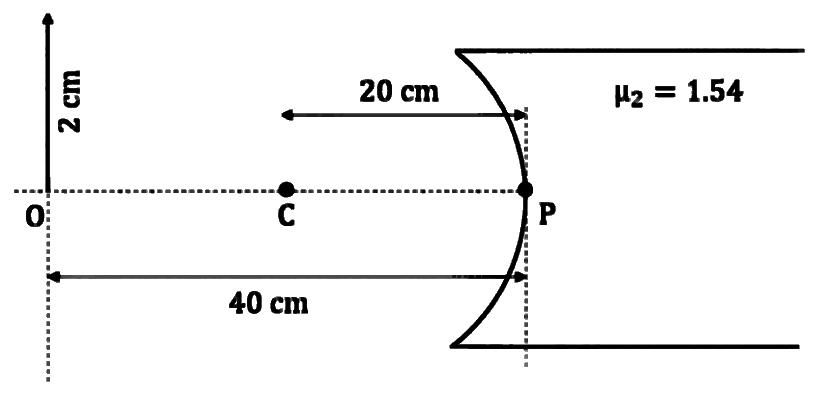
Refer the figure given below. μ1\mu_1 and μ2\mu_2 are refractive indices of air and lens material. The height of image will be _______ cm.

Figure

Show answer and solution

Answer: (a)

Loading the solution…
Report a mistakeOpen question page
Q17JEE Main 2026 · 24 JAN · SHIFT 2Medium

Spherical Surfaces & Thin Lenses

Five persons P1,P2,P3,P4P_1, P_2, P_3, P_4 and P5P_5 recorded object distance (u)(u) and image distance (v) using same convex lens having power +5 D as (25,96),(30,62),(35,37),(45,35)(25, 96), (30, 62), (35, 37), (45, 35) and (50,32)(50, 32) respectively. Identify correct statement

Show answer and solution

Answer: (c)

Loading the solution…
Report a mistakeOpen question page
Q18JEE Main 2026 · 23 JAN · SHIFT 2Medium

Spherical Surfaces & Thin Lenses

The size of the images of an object, formed by a thin lens are equal when the object is placed at two different positions 8 cm and 24 cm from the lens. The focal length of the lens is ______ cm.

Numerical answer type. Work it out, then open the answer.

Show answer and solution

Answer: 16

Loading the solution…
Report a mistakeOpen question page
Q19JEE Main 2025 · 3 APR · SHIFT 1Easy

Spherical Surfaces & Thin Lenses

The radii of curvature for a thin convex lens are 10 cm and 15 cm respectively. The focal length of the lens is 12 cm. The refractive index of the lens material is

Show answer and solution

Answer: (c)

Loading the solution…
Report a mistakeOpen question page
Q20JEE Main 2025 · 7 APR · SHIFT 1Easy

Spherical Surfaces & Thin Lenses

A lens having refractive index 1.6 has focal length of 12 cm, when it is in air. Find the focal length of the lens when it is placed in water. (Take refractive index of water as 1.28)

Show answer and solution

Answer: (c)

Loading the solution…
Report a mistakeOpen question page
Q21JEE Main 2025 · 29 JAN · SHIFT 2Easy

Spherical Surfaces & Thin Lenses

A convex lens made of glass (refractive index = 1.5) has focal length 24 cm in air. When it is totally immersed in water (refractive index = 1.33), its focal length changes to

Show answer and solution

Answer: (a)

Loading the solution…
Report a mistakeOpen question page
Q22MHT CET 2025 · 19 APR · SHIFT 2Easy

Spherical Surfaces & Thin Lenses

A convex lens of focal length 13 m\frac{1}{3}\text{ m} forms a real, inverted image twice the size of the object. The distance of the object from the lens is

Show answer and solution

Answer: (a)

Loading the solution…
Report a mistakeOpen question page
Q23JEE Main 2025 · 24 JAN · SHIFT 1Easy

Spherical Surfaces & Thin Lenses

What is the relative decrease in focal length of a lens for an increase in optical power by 0.1 D from 2.5D? ['D' stands for dioptre]

Show answer and solution

Answer: (a)

Loading the solution…
Report a mistakeOpen question page
Q24JEE Main 2025 · 2 APR · SHIFT 1Medium

Spherical Surfaces & Thin Lenses

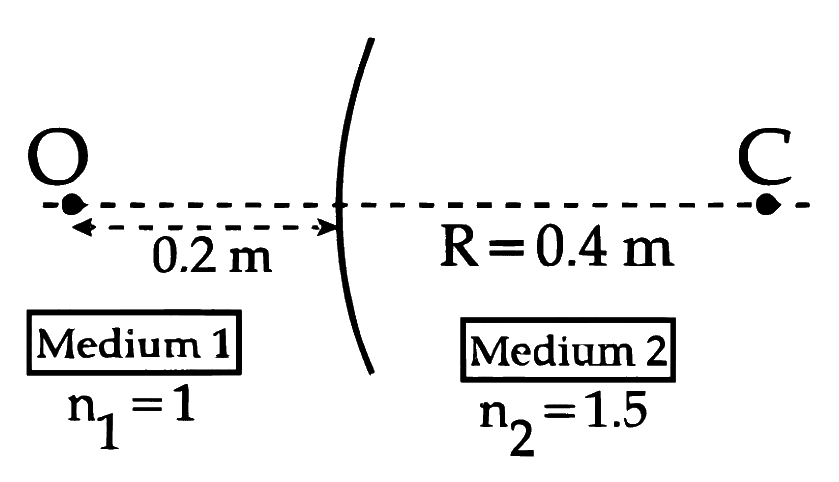
Figure

A spherical surface separates two media of refractive indices 1 and 1.5 as shown in figure. Distance of the image of an object ' O ', is:

( C is the center of curvature of the spherical surface and R is the radius of curvature)

Show answer and solution

Answer: (c)

Loading the solution…
Report a mistakeOpen question page
Q25JEE Main 2025 · 28 JAN · SHIFT 2Medium

Spherical Surfaces & Thin Lenses

In a long glass tube, mixture of two liquids A and B with refractive indices 1.3 and 1.4 respectively, forms a convex refractive meniscus towards A. If an object placed at 13 cm from the vertex of the meniscus in A forms an image with a magnification of −2-2, then the radius of curvature of meniscus is:

Show answer and solution

Answer: (a)

Loading the solution…
Report a mistakeOpen question page
Q26JEE Main 2025 · 23 JAN · SHIFT 1Medium

Spherical Surfaces & Thin Lenses

A spherical surface of radius of curvature RR, separates air from glass (refractive index =1.5= 1.5 ). The centre of curvature is in the glass medium. A point object ' OO ' placed in air on the optic axis of the surface, so that its real image is formed at 'I' inside glass. The line OI intersects the spherical surface at PP and PO=PIPO = PI. The distance POPO equals to

Show answer and solution

Answer: (a)

Loading the solution…
Report a mistakeOpen question page
Q27JEE Main 2025 · 3 APR · SHIFT 2Medium

Spherical Surfaces & Thin Lenses

Light from a point source in air falls on a spherical glass surface (refractive index, μ=1.5\mu = 1.5 and radius of curvature =50 cm= 50\text{ cm} ). The image is formed at a distance of 200 cm from the glass surface inside the glass. The magnitude of distance of the light source from the glass surface is ___________m.

Numerical answer type. Work it out, then open the answer.

Show answer and solution

Answer: 4

Loading the solution…
Report a mistakeOpen question page
Q28JEE Main 2025 · 2 APR · SHIFT 2Medium

Spherical Surfaces & Thin Lenses

A bi-convex lens has radius of curvature of both the surfaces same as 1/6 cm1/6\text{ cm}. If this lens is required to be replaced by another convex lens having different radii of curvatures on both sides (R1≠R2)(R_1 \neq R_2), without any change in lens power then possible combination of R1R_1 and R2R_2 is:

Show answer and solution

Answer: (b)

Loading the solution…
Report a mistakeOpen question page
Q29MHT CET 2025 · 26 APR · SHIFT 2Medium

Spherical Surfaces & Thin Lenses

Refractive index of a glass convex lens is 1.5. The radius of curvature of each of the two surfaces of the lens is 40 cm. The ratio of the power of the lens when immersed in a liquid of refractive index 1.25 to that when placed in air is

Show answer and solution

Answer: (c)

Loading the solution…
Report a mistakeOpen question page
Q30MHT CET 2025 · 23 APR · SHIFT 2Medium

Spherical Surfaces & Thin Lenses

A convex lens of refractive index 1.5 has power 3D. It is placed in a liquid of refractive index 2. The new power of the lens is

Show answer and solution

Answer: (c)

Loading the solution…
Report a mistakeOpen question page
Q31MHT CET 2025 · 22 APR · SHIFT 2Medium

Spherical Surfaces & Thin Lenses

A concave lens (refractive index =1.5= 1.5) has both surfaces of same radius of curvature R. If it is immersed in a liquid of refractive index 1.75 it will act as a

Show answer and solution

Answer: (c)

Loading the solution…
Report a mistakeOpen question page
Q32JEE Main 2025 · 24 JAN · SHIFT 1Medium

Spherical Surfaces & Thin Lenses

A plano-convex lens having radius of curvature of first surface 2 cm exhibits focal length of f1f_1 in air. Another plano-convex lens with first surface radius of curvature 3 cm has focal length of f2f_2 when it is immersed in a liquid of refractive index 1.2. If both the lenses are made of same glass of refractive index 1.5, the ratio of f1f_1 and f2f_2 will be

Show answer and solution

Answer: (b)

Loading the solution…
Report a mistakeOpen question page
Q33JEE Main 2025 · 24 JAN · SHIFT 2Medium

Spherical Surfaces & Thin Lenses

A photograph of a landscape is captured by a drone camera at a height of 18 km. The size of the camera film is 2 cm×2 cm2\text{ cm} \times 2\text{ cm} and the area of the landscape photographed is 400 km2400\text{ km}^{2}. The focal length of the lens in the drone camera is:

Show answer and solution

Answer: (d)

Loading the solution…
Report a mistakeOpen question page
Q34JEE Main 2025 · 29 JAN · SHIFT 1Medium

Spherical Surfaces & Thin Lenses

Let u and v be the distances of the object and the image from a lens of focal length f. The correct graphical representation of u and v for a convex lens when |u| > f, is

Show answer and solution

Answer: (d)

Loading the solution…
Report a mistakeOpen question page
Q35JEE Main 2025 · 29 JAN · SHIFT 2Difficult

Spherical Surfaces & Thin Lenses

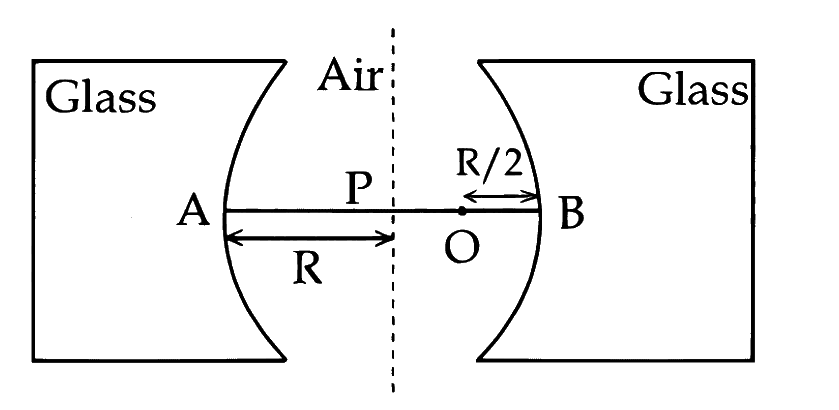
Figure

Two concave refracting surfaces of equal radii of curvature and refractive index 1.5 face each other in air as shown in figure. A point object O is placed midway, between P and B. The separation between the images of O, formed by each refracting surface is:

Show answer and solution

Answer: (b)

Loading the solution…
Report a mistakeOpen question page
Q36JEE Main 2025 · 28 JAN · SHIFT 1Difficult

Spherical Surfaces & Thin Lenses

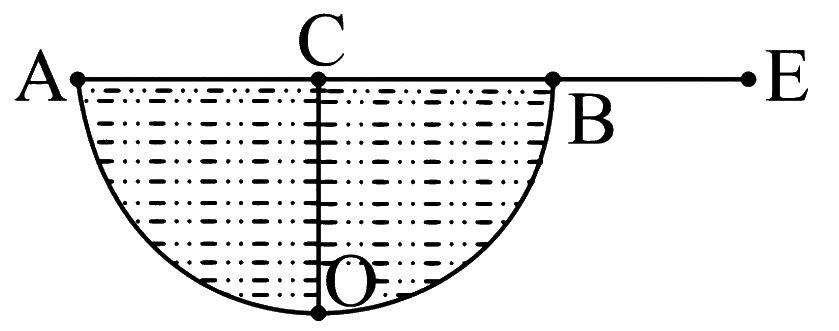
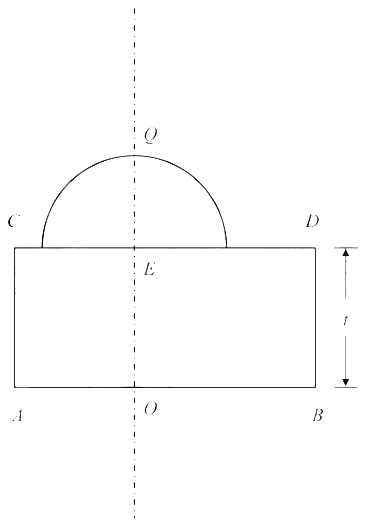
A hemispherical vessel is completely filled with a liquid of refractive index μ\mu. A small coin is kept at the lowest point (O)(\text{O}) of the vessel as shown in figure. The minimum value of the refractive index of the liquid so that a person can see the coin from point E (at the level of the vessel) is _________.

Figure

Show answer and solution

Answer: (d)

Loading the solution…
Report a mistakeOpen question page
Q37JEE Main 2025 · 2 APR · SHIFT 1Difficult

Spherical Surfaces & Thin Lenses

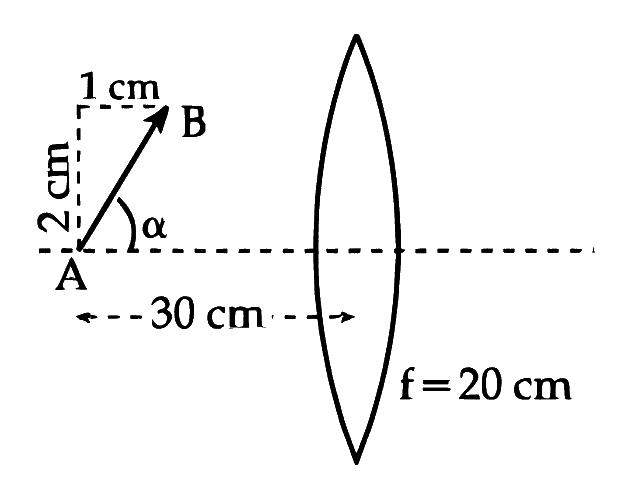
A slanted object ABAB is placed on one side of convex lens as shown in the diagram. The image is formed on the opposite side. Angle made by the image with principal axis is:

Figure

Show answer and solution

Answer: (c)

Loading the solution…
Report a mistakeOpen question page
Q38JEE Main 2024 · 6 APR · SHIFT 2Easy

Spherical Surfaces & Thin Lenses

For the thin convex lens, the radii of curvature are at 15 cm15\text{ cm} and 30 cm30\text{ cm} respectively. The focal length of the lens is 20 cm20\text{ cm}. The refractive index of the material is:

Show answer and solution

Answer: (b)

Loading the solution…
Report a mistakeOpen question page
Q39JEE Main 2024 · 29 JAN · SHIFT 1Easy

Spherical Surfaces & Thin Lenses

A biconvex lens of refractive index 1.5 has a focal length of 20 cm20\text{ cm} in air. Its focal length when immersed in a liquid of refractive index 1.6 will be:

Show answer and solution

Answer: (d)

Loading the solution…
Report a mistakeOpen question page
Q40MHT CET 2024 · 3 MAY · SHIFT 1Easy

Spherical Surfaces & Thin Lenses

A convex lens of focal length ' ff ' mm forms a real, inverted image twice in size of the object. The object distance from the lens in metre is

Show answer and solution

Answer: (d)

Loading the solution…
Report a mistakeOpen question page
Q41JEE Main 2024 · 9 APR · SHIFT 1Easy

Spherical Surfaces & Thin Lenses

Given below are two statements:

Statement (I): When an object is placed at the centre of curvature of a concave lens, image is formed at the centre of curvature of the lens on the other side.

Statement (II): Concave lens always forms a virtual and erect image.

In the light of the above statements, choose the correct answer from the options given below:

Show answer and solution

Answer: (a)

Loading the solution…
Report a mistakeOpen question page
Q42JEE Main 2024 · 30 JAN · SHIFT 1Easy

Spherical Surfaces & Thin Lenses

The distance between object and its two times magnified real image as produced by a convex lens is 45 cm45\text{ cm}. The focal length of the lens used is _______ cm.

Numerical answer type. Work it out, then open the answer.

Show answer and solution

Answer: 10

Loading the solution…
Report a mistakeOpen question page
Q43JEE Main 2024 · 31 JAN · SHIFT 2Medium

Spherical Surfaces & Thin Lenses

Light from a point source in air falls on a convex curved surface of radius 20 cm20\text{ cm} and refractive index 1.5. If the source is located at 100 cm100\text{ cm} from the convex surface, the image will be formed at ________ cm\text{cm} from the object.

Numerical answer type. Work it out, then open the answer.

Show answer and solution

Answer: 200

Loading the solution…
Report a mistakeOpen question page
Q44MHT CET 2024 · 4 MAY · SHIFT 2Medium

Spherical Surfaces & Thin Lenses

A convex lens of refractive index 32\frac{3}{2} has a power 2.5. If it is placed in a liquid of refractive index 2, the new power of the lens is

Show answer and solution

Answer: (d)

Loading the solution…
Report a mistakeOpen question page
Q45MHT CET 2024 · 3 MAY · SHIFT 2Medium

Spherical Surfaces & Thin Lenses

A convex lens of focal length ' ff ' produces a real image whose size is ' nn ' times the size of an object. The distance of the object from the lens is

Show answer and solution

Answer: (d)

Loading the solution…
Report a mistakeOpen question page
Q46JEE Main 2024 · 1 FEB · SHIFT 1Medium

Spherical Surfaces & Thin Lenses

The distance between object and its 3 times magnified virtual image as produced by a convex lens is 20 cm20\text{ cm}. The focal length of the lens used is __________ cm\text{cm}.

Numerical answer type. Work it out, then open the answer.

Show answer and solution

Answer: 15

Loading the solution…
Report a mistakeOpen question page
Q47JEE Main 2024 · 30 JAN · SHIFT 2Medium

Spherical Surfaces & Thin Lenses

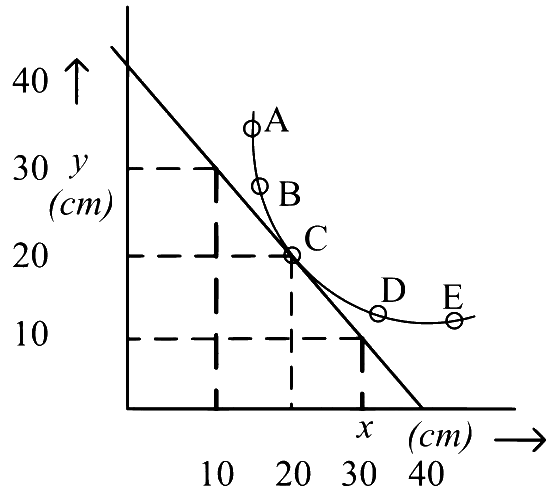
In an experiment to measure the focal length (f)(f) of a convex lens, the magnitude of object distance (x)(x) and the image distance (y)(y) are measured with reference to the focal point of the lens. The y-xy\text{-}x plot is shown in figure.

The focal length of the lens is ________ cm\text{cm}.

Figure

Numerical answer type. Work it out, then open the answer.

Show answer and solution

Answer: 20

Loading the solution…
Report a mistakeOpen question page
Q48MHT CET 2024 · 9 MAY · SHIFT 1Difficult

Spherical Surfaces & Thin Lenses

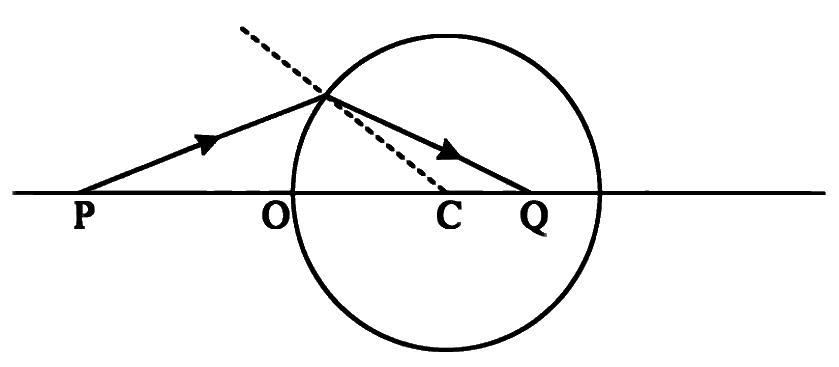
A point object kept at P in front of a glass sphere of radius ' RR ' has its image formed at QQ such that PO=QO\text{PO} = \text{QO}. The refractive index of material of glass sphere is 1.4. The distance PO is equal to

Figure

Show answer and solution

Answer: (d)

Loading the solution…
Report a mistakeOpen question page
Q49JEE Main 2024 · 27 JAN · SHIFT 1Difficult

Spherical Surfaces & Thin Lenses

A convex lens of focal length 40 cm40\text{ cm} forms an image of an extended source of light on a photoelectric cell. A current I is produced. The lens is replaced by another convex lens having the same diameter but focal length 20 cm20\text{ cm}. The photoelectric current now is:

Show answer and solution

Answer: (d)

Loading the solution…
Report a mistakeOpen question page
Q50MHT CET 2023 · 10 MAY · SHIFT 1Easy

Spherical Surfaces & Thin Lenses

A double convex air bubble in water behaves as

Show answer and solution

Answer: (b)

Loading the solution…
Report a mistakeOpen question page
Q51JEE Main 2023 · 24 JAN · SHIFT 2Easy

Spherical Surfaces & Thin Lenses

A convex lens of refractive index 1.5 and focal length 18cm in air is immersed in water. The change in focal length of the lens will be ___________ cm.

(Given refractive index of water =43= \frac{4}{3})

Numerical answer type. Work it out, then open the answer.

Show answer and solution

Answer: 54

Loading the solution…
Report a mistakeOpen question page
Q52MHT CET 2023 · 11 MAY · SHIFT 1Easy

Spherical Surfaces & Thin Lenses

The size of the real image produced by a convex lens of focal length FF is 'mm' times the size of the object. The image distance from the lens is

Show answer and solution

Answer: (c)

Loading the solution…
Report a mistakeOpen question page
Q53MHT CET 2023 · 12 MAY · SHIFT 1Easy

Spherical Surfaces & Thin Lenses

Converging or diverging ability of a lens or mirror is called

Show answer and solution

Answer: (a)

Loading the solution…
Report a mistakeOpen question page
Q54MHT CET 2023 · 13 MAY · SHIFT 1Medium

Spherical Surfaces & Thin Lenses

A spherical surface of radius of curvature 'RR' separates air from glass of refractive index 1.5. The centre of curvature is in the glass. A point object PP placed in air forms a real image QQ in the glass. The line PQPQ cuts the surface at point 'OO' and PO=OQ=xPO = OQ = x. Hence the distance 'xx' is equal to

Show answer and solution

Answer: (d)

Loading the solution…
Report a mistakeOpen question page
Q55JEE Main 2023 · 8 APR · SHIFT 2Medium

Spherical Surfaces & Thin Lenses

Two transparent media having refractive indices 1.0 and 1.5 are separated by a spherical refracting surface of radius of curvature 30 cm30\text{ cm}. The centre of curvature of surface is towards denser medium and a point object is placed on the principal axis in rarer medium at a distance of 15 cm15\text{ cm} from the pole of the surface. The distance of image from the pole of the surface is ____________ cm\text{cm}.

Numerical answer type. Work it out, then open the answer.

Show answer and solution

Answer: 30

Loading the solution…
Report a mistakeOpen question page
Q56MHT CET 2023 · 13 MAY · SHIFT 2Medium

Spherical Surfaces & Thin Lenses

The radii of curvature of both the surfaces of a convex lens of focal length ff and power PP are equal. One of the surfaces is made by plane grinding. The new focal length and focal power of the lens is

Show answer and solution

Answer: (d)

Loading the solution…
Report a mistakeOpen question page
Q57MHT CET 2023 · 14 MAY · SHIFT 2Medium

Spherical Surfaces & Thin Lenses

Refractive index of a glass convex lens is 1.5. The radius of curvature of each of the two surfaces of the lens is 20 cm20\text{ cm}. The ratio of the power of the lens when immersed in a liquid of refractive index 1.25 to that when placed in air is

Show answer and solution

Answer: (b)

Loading the solution…
Report a mistakeOpen question page
Q58JEE Main 2023 · 11 APR · SHIFT 1Medium

Spherical Surfaces & Thin Lenses

The radius of curvature of each surface of a convex lens having refractive index 1.8 is 20 cm20\text{ cm}. The lens is now immersed in a liquid of refractive index 1.5. The ratio of power of lens in air to its power in the liquid will be x:1x : 1. The value of xx is _________.

Numerical answer type. Work it out, then open the answer.

Show answer and solution

Answer: 4

Loading the solution…
Report a mistakeOpen question page
Q59NEET 2023Medium

Spherical Surfaces & Thin Lenses

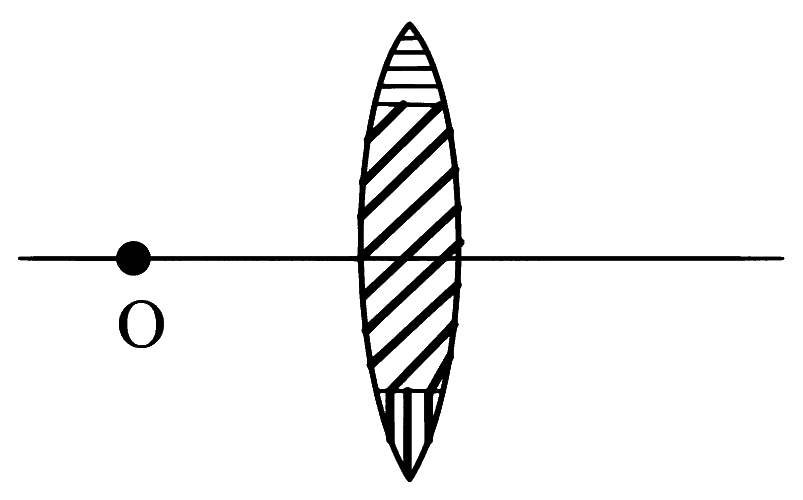
A lens is made up of 3 different transparent media as shown in figure. A point object O is placed on its axis beyond 2f2f. How many real images will be obtained on the other side?

Figure

Show answer and solution

Answer: (d)

Loading the solution…
Report a mistakeOpen question page
Q60NEET 2023Medium

Spherical Surfaces & Thin Lenses

An object is mounted on a wall. Its image of equal size is to be obtained on a parallel wall with the help of a convex lens placed between these walls. The lens is kept at distance x in front of the second wall. The required focal length of the lens will be:

Show answer and solution

Answer: (c)

Loading the solution…
Report a mistakeOpen question page
Q61JEE Main 2023 · 6 APR · SHIFT 2Medium

Spherical Surfaces & Thin Lenses

A 2 meter long scale with least count of 0.2 cm0.2\text{ cm} is used to measure the locations of objects on an optical bench. While measuring the focal length of a convex lens, the object pin and the convex lens are placed at 80 cm80\text{ cm} mark and 1 m1\text{ m} mark, respectively. The image of the object pin on the other side of lens coincides with image pin that is kept at 180 cm180\text{ cm} mark. The %\% error in the estimation of focal length is:

Show answer and solution

Answer: (a)

Loading the solution…
Report a mistakeOpen question page
Q62NEET 2022 · PHASE 1Easy

Spherical Surfaces & Thin Lenses

A biconvex lens has radii of curvature, 20 cm each. If the refractive index of the material of the lens is 1.5, the power of the lens is

Show answer and solution

Answer: (c)

Loading the solution…
Report a mistakeOpen question page
Q63JEE Main 2022 · 29 JUN · SHIFT 1Medium

Spherical Surfaces & Thin Lenses

A parallel beam of light is allowed to fall on a transparent spherical globe of diameter 30 cm and refractive index 1.5. The distance from the centre of the globe at which the beam of light can converge is _____________ mm.

Numerical answer type. Work it out, then open the answer.

Show answer and solution

Answer: 225

Loading the solution…
Report a mistakeOpen question page
Q64JEE Main 2022 · 28 JUL · SHIFT 2Medium

Spherical Surfaces & Thin Lenses

The power of a lens (biconvex) is 1.25 m−11.25\text{ m}^{-1} in particular medium. Refractive index of the lens is 1.5 and radii of curvature are 20 cm20\text{ cm} and 40 cm40\text{ cm} respectively. The refractive index of surrounding medium:

Show answer and solution

Answer: (b)

Loading the solution…
Report a mistakeOpen question page
Q65MHT CET 2022 · 11 AUG · SHIFT 2Medium

Spherical Surfaces & Thin Lenses

The minimum distance between an object and its real image formed by a convex lens of focal length 'f' is

Show answer and solution

Answer: (b)

Loading the solution…
Report a mistakeOpen question page
Q66JEE Main 2022 · 28 JUL · SHIFT 2Medium

Spherical Surfaces & Thin Lenses

In an experiment with a convex lens, The plot of the image distance (v′)(v') against the object distance (u′)u') measured from the focus gives a curve v′u′=225v'u' = 225. If all the distances are measured in cm\text{cm}. The magnitude of the focal length of the lens is ___________ cm.

Numerical answer type. Work it out, then open the answer.

Show answer and solution

Answer: 15

Loading the solution…
Report a mistakeOpen question page
Q67JEE Main 2022 · 26 JUL · SHIFT 1Medium

Spherical Surfaces & Thin Lenses

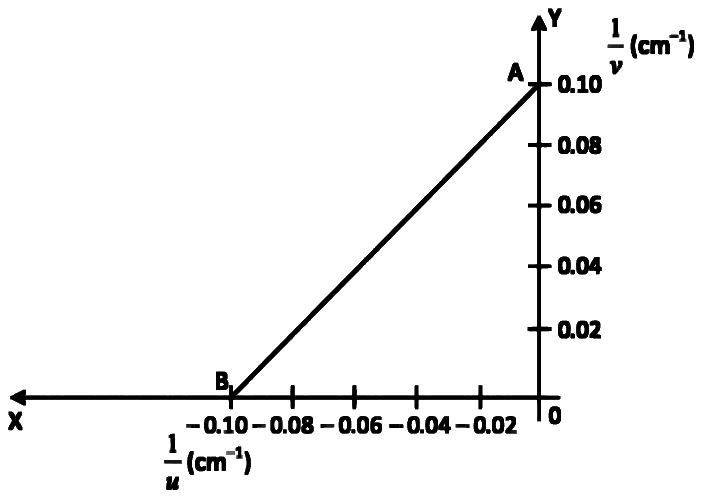
The graph between 1u\frac{1}{u} and 1v\frac{1}{v} for a thin convex lens in order to determine its focal length is plotted as shown in the figure. The refractive index of lens is 1.51.5 and its both the surfaces have same radius of curvature RR. The value of RR will be ____________ cm.\text{cm.} (where u=u = object distance, v=v = image distance)

Figure

Numerical answer type. Work it out, then open the answer.

Show answer and solution

Answer: 10

Loading the solution…
Report a mistakeOpen question page
Q68MHT CET 2021 · 21 SEP · SHIFT 2Easy

Spherical Surfaces & Thin Lenses

A convex lens is dipped in a liquid whose refractive index is equal to refractive index of lens material. Then its focal length will

Show answer and solution

Answer: (c)

Loading the solution…
Report a mistakeOpen question page
Q69JEE Main 2021 · 16 MAR · SHIFT 2Easy

Spherical Surfaces & Thin Lenses

The refractive index of a converging lens is 1.4. What will be the focal length of this lens if it is placed in a medium of same refractive index? Assume the radii of curvature of the faces of lens are R1 and R2 respectively.

Show answer and solution

Answer: (b)

Loading the solution…
Report a mistakeOpen question page
Q70MHT CET 2021 · 20 SEP · SHIFT 2Easy

Spherical Surfaces & Thin Lenses

A convex lens of focal length ff is used to form an image whose size is one fourth that of size of the object. Then the object distance is

Show answer and solution

Answer: (b)

Loading the solution…
Report a mistakeOpen question page
Q71MHT CET 2021 · 20 SEP · SHIFT 1Easy

Spherical Surfaces & Thin Lenses

A convex lens of focal length 'F' produces a real image 'n' times the size of the object. The image distance is

Show answer and solution

Answer: (a)

Loading the solution…
Report a mistakeOpen question page
Q72JEE Main 2021 · 31 AUG · SHIFT 1Easy

Spherical Surfaces & Thin Lenses

An object is placed at the focus of concave lens having focal length f. What is the magnification and distance of the image from the optical centre of the lens?

Show answer and solution

Answer: (c)

Loading the solution…
Report a mistakeOpen question page
Q73JEE Main 2021 · 25 FEB · SHIFT 1Easy

Spherical Surfaces & Thin Lenses

The same size images are formed by a convex lens when the object is placed at 20 cm or at 10 cm from the lens. The focal length of convex lens is __________ cm.

Numerical answer type. Work it out, then open the answer.

Show answer and solution

Answer: 15

Loading the solution…
Report a mistakeOpen question page
Q74JEE Main 2021 · 20 JUL · SHIFT 1Medium

Spherical Surfaces & Thin Lenses

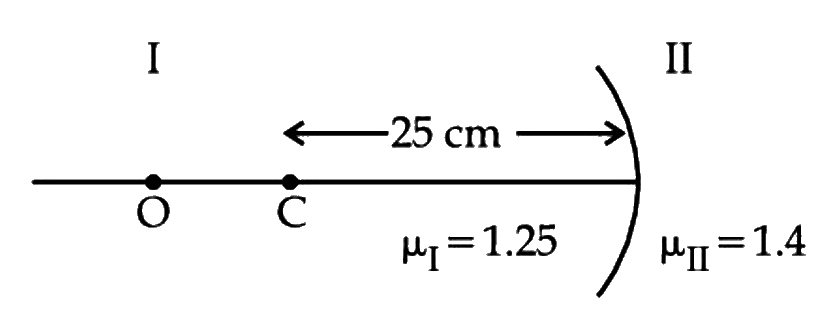
Region I and II are separated by a spherical surface of radius 25 cm. An object is kept in region I at a distance of 40 cm from the surface. The distance of the image from the surface is:

Figure

Show answer and solution

Answer: (d)

Loading the solution…
Report a mistakeOpen question page
Q75JEE Main 2021 · 17 MAR · SHIFT 2Medium

Spherical Surfaces & Thin Lenses

The image of an object placed in air formed by a convex refracting surface is at a distance of 10 m behind the surface. The image is real and is at 23\frac{2}{3}rd of the distance of the object from the surface. The wavelength of light inside the surface is 23\frac{2}{3} times the wavelength in air. The radius of the curved surface is x13\frac{x}{13} m. The value of 'x' is ___________.

Numerical answer type. Work it out, then open the answer.

Show answer and solution

Answer: 30

Loading the solution…
Report a mistakeOpen question page
Q76MHT CET 2021 · 24 SEP · SHIFT 1Medium

Spherical Surfaces & Thin Lenses

The radii of curvature of both the surfaces of a convex lens of focal length 'ff' and focal power 'PP' are equal. One of the surfaces is made plane by grinding. The new focal length and focal power of the lens is respectively

Show answer and solution

Answer: (b)

Loading the solution…
Report a mistakeOpen question page
Q77MHT CET 2021 · 22 SEP · SHIFT 1Medium

Spherical Surfaces & Thin Lenses

A biconvex lens (R1=R2=30 cm)(R_1 = R_2 = 30\text{ cm}) has focal length equal to the focal length of concave mirror. The radius of curvature of concave mirror is [Refractive index of material of lens =1.6= 1.6 ]

Show answer and solution

Answer: (c)

Loading the solution…
Report a mistakeOpen question page
Q78JEE Main 2021 · 17 MAR · SHIFT 1Medium

Spherical Surfaces & Thin Lenses

The thickness at the centre of a plano-convex lens is 3 mm and the diameter is 6 cm. If the speed of light in the material of the lens is 2 ×\times 108 ms−1{}^{-1}, the focal length of the lens is ____________.

Show answer and solution

Answer: (b)

Loading the solution…
Report a mistakeOpen question page
Q79MHT CET 2021 · 20 SEP · SHIFT 2Medium

Spherical Surfaces & Thin Lenses

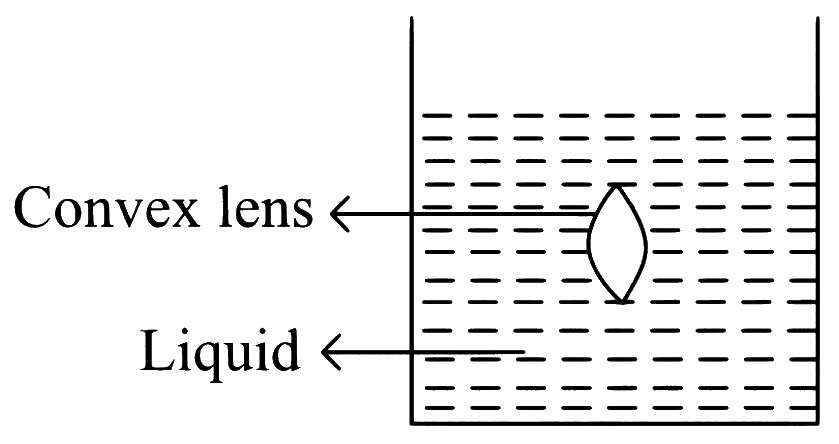
Inside a vessel filled with liquid a converging lens is placed as shown in figure. The lens has focal length 15 cm15\text{ cm} when in air and has refractive index 32\frac{3}{2}. If the liquid has refractive index 95\frac{9}{5}, the focal length of lens in liquid is

Figure

Show answer and solution

Answer: (d)

Loading the solution…
Report a mistakeOpen question page
Q80MHT CET 2021 · 22 SEP · SHIFT 2Medium

Spherical Surfaces & Thin Lenses

An object is located on a wall, its image of equal size is to be obtained on a parallel wall with the help of a convex lens. The lens is placed at a distance 'dd' in front of the second wall. The required focal length of the lens is

Show answer and solution

Answer: (d)

Loading the solution…
Report a mistakeOpen question page
Q81MHT CET 2021 · 21 SEP · SHIFT 1Difficult

Spherical Surfaces & Thin Lenses

A particle executes linear S.H.M. The mean position of oscillation is at the principal axis of a convex lens of focal length 8 cm8\text{ cm}. the mean position of oscillation is at 14 cm from the lens with amplitude 1 cm. The amplitude of oscillating image of the particle is nearly

Show answer and solution

Answer: (c)

Loading the solution…
Report a mistakeOpen question page
Q82NEET 2020 · PHASE 2Easy

Spherical Surfaces & Thin Lenses

The power of a biconvex lens is 10 dioptre and the radius of curvature of each surface is 10 cm. Then the refractive index of the material of the lens is,

Show answer and solution

Answer: (a)

Loading the solution…
Report a mistakeOpen question page
Q83NEET 2020 · PHASE 2Easy

Spherical Surfaces & Thin Lenses

A plano-convex lens of unknown material and unknown focal length is given. With the help of a spherometer we can measure the,

Show answer and solution

Answer: (c)

Loading the solution…
Report a mistakeOpen question page
Q84JEE Main 2020 · 8 JAN · SHIFT 1Medium

Spherical Surfaces & Thin Lenses

A point object in air is in front of the curved surface of a plano-convex lens. The radius of curvature of the curved surface is 30 cm and the refractive index of the lens material is 1.5, then the focal length of the lens (in cm) is ______.

Numerical answer type. Work it out, then open the answer.

Show answer and solution

Answer: 60

Loading the solution…
Report a mistakeOpen question page
Q85JEE Main 2020 · 6 SEP · SHIFT 2Medium

Spherical Surfaces & Thin Lenses

A double convex lens has power P and same radii of curvature R of both the surfaces. The radius of curvature of a surface of a plano-convex lens made of the same material with power 1.5 P is:

Show answer and solution

Answer: (a)

Loading the solution…
Report a mistakeOpen question page
Q86JEE Main 2020 · 7 JAN · SHIFT 2Medium

Spherical Surfaces & Thin Lenses

A thin lens made of glass (refractive index = 1.5) of focal length f = 16 cm is immersed in a liquid of refractive index 1.42. If its focal length in liquid is f1, then the ratio f1f\frac{f_1}{f} is closest to the integer:

Show answer and solution

Answer: (c)

Loading the solution…
Report a mistakeOpen question page
Q87JEE Main 2020 · 5 SEP · SHIFT 1Medium

Spherical Surfaces & Thin Lenses

For a concave lens of focal length f, the relation between object and image distances u and v, respectively, from its pole can best be represented by (u = v is the reference line):

Show answer and solution

Answer: (d)

Loading the solution…
Report a mistakeOpen question page
Q88JEE Main 2020 · 4 SEP · SHIFT 2Medium

Spherical Surfaces & Thin Lenses

The distance between an object and a screen is 100 cm. A lens can produce real image of the object on the screen for two different positions between the screen and the object. The distance between these two positions is 40 cm. If the power of the lens is close to (N100)D\left( \frac{N}{100} \right) D where N is an integer, the value of N is _________.

Numerical answer type. Work it out, then open the answer.

Show answer and solution

Answer: 476

Loading the solution…
Report a mistakeOpen question page
Q89JEE Main 2019 · 10 JAN · SHIFT 2Medium

Spherical Surfaces & Thin Lenses

The eye can be regarded as a single refracting surface. The radius of curvature of this surface is equal to that of cornea (7.8 mm). This surface separateds two media of refractive indices 1 and 1.34. Calculate the distance from the refracting surface at which a parallel beam of light will come to focus -

Show answer and solution

Answer: (b)

Loading the solution…
Report a mistakeOpen question page
Q90NEET 2019Medium

Spherical Surfaces & Thin Lenses

A double convex lens has focal length 25 cm. The radius of curvature of one of the surfaces is double of the other. Find the radii if the refractive index of the material of the lens is 1.5.

Show answer and solution

Answer: (d)

Loading the solution…
Report a mistakeOpen question page
Q91JEE Main 2019 · 12 JAN · SHIFT 2Medium

Spherical Surfaces & Thin Lenses

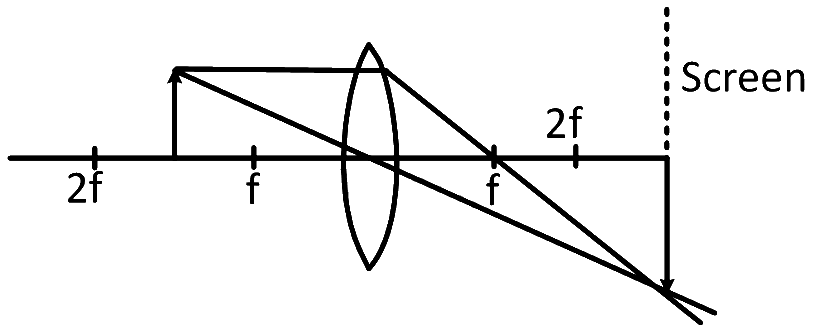
Formation of real image using a biconvex lens is shown below:

Figure

If the whole set up is immersed in water without disturbing the object and the screen positions, what will one observe on the screen?

Show answer and solution

Answer: (a)

Loading the solution…
Report a mistakeOpen question page
Q92JEE Main 2019 · 9 APR · SHIFT 2Medium

Spherical Surfaces & Thin Lenses

A convex lens of focal length 20 cm produces images of the same magnification 2 when an object is kept at two distances x1 and x2 (x1 > x2) from the lens. The ratio of x1 and x2 is :-

Show answer and solution

Answer: (a)

Loading the solution…
Report a mistakeOpen question page
Q93JEE Main 2019 · 11 JAN · SHIFT 1Medium

Spherical Surfaces & Thin Lenses

An object is at a distance of 20 m from a convex lens of focal length 0.3 m. The lens forms an image of the object. If the object moves away from the lens at a speed of 5 m/s, the speed and direction of the image will be:

Show answer and solution

Answer: (a)

Loading the solution…
Report a mistakeOpen question page
Q94JEE Main 2019 · 10 APR · SHIFT 2Medium

Spherical Surfaces & Thin Lenses

The graph shows how the magnification m produced by a thin lens varies with image distance v. What is the focal length of the lens used?

Figure

Show answer and solution

Answer: (d)

Loading the solution…
Report a mistakeOpen question page
Q95JEE Main 2014 · 12 APR · SHIFT 1Medium

Spherical Surfaces & Thin Lenses

The refractive index of the material of a concave lens is μ\mu. It is immersed in a medium of refractive index μ\mu1. A parallel beam of light is incident on the lens. The path of the emergent rays when μ\mu1 > μ\mu is:

Show answer and solution

Answer: (a)

Loading the solution…
Report a mistakeOpen question page
Q96JEE Main 2014Medium

Spherical Surfaces & Thin Lenses

A thin convex lens made from crown glass (μ=32)\left(\mu = \frac{3}{2}\right) has focal length ff. When it is measured in two different liquids having refractive indices 43\frac{4}{3} and 53,\frac{5}{3}, it has the focal lengths f1f_1 and f2f_2 respectively. The correct relation between the focal lengths is:

Show answer and solution

Answer: (b)

Loading the solution…
Report a mistakeOpen question page
Q97JEE Main 2014 · 11 APR · SHIFT 1Medium

Spherical Surfaces & Thin Lenses

An object is located in a fixed position in front of a screen, Sharp image is obtained on the screen for two positions of a thin lens separated by 10 cm. The size of the images in two situations are in the ratio 3: 2. What is the distance between the screen and the object?

Show answer and solution

Answer: (d)

Loading the solution…
Report a mistakeOpen question page
Q98JEE Main 2013Medium

Spherical Surfaces & Thin Lenses

Diameter of a plano-convex lens is 6 cm6\text{ cm} and thickness at the center is 3 mm3\text{ mm}. If speed of light in material of lens is 2×10⁸ m/s,2 \times 10^{8}\text{ m/s}, the focal length of the lens is

Show answer and solution

Answer: (c)

Loading the solution…
Report a mistakeOpen question page
Q99JEE Main 2013 · 22 APR · SHIFT 1Medium

Spherical Surfaces & Thin Lenses

The image of an illuminated square is obtained on a screen with the help of a converging lens. The distance of the square from the lens is 40 cm. The area of the image is 9 times that of the square. The focal length of the lens is:

Show answer and solution

Answer: (d)

Loading the solution…
Report a mistakeOpen question page
Q100NEET 2012 · AIPMT · PRELIMSEasy

Spherical Surfaces & Thin Lenses

When a biconvex lens of glass having refractive index 1.47 is dipped in a liquid, it acts as a plane sheet of glass. This implies that the liquid must have refractive index

Show answer and solution

Answer: (a)

Loading the solution…
Report a mistakeOpen question page
Q101NEET 2011 · AIPMT · MAINSMedium

Spherical Surfaces & Thin Lenses

A converging beam of rays is incident on a diverging lens. Having passed through the lens the rays intersect at a point 15 cm from the lens on the opposite side. If the lens is removed the point where the rays meet will move 5 cm closer to the lens. The focal length of the lens is

Show answer and solution

Answer: (d)

Loading the solution…
Report a mistakeOpen question page
Q102NEET 2011 · AIPMT · PRELIMSMedium

Spherical Surfaces & Thin Lenses

A biconvex lens has a radius of curvature of magnitude 20 cm. Which one of the following options best describes the image formed of an object of height 2 cm placed 30 cm from the lens?

Show answer and solution

Answer: (c)

Loading the solution…
Report a mistakeOpen question page
Q103NEET 2010 · AIPMT · PRELIMSMedium

Spherical Surfaces & Thin Lenses

A lens having focal length f and aperture of diameter d forms an image of intensity I. Aperture of diameter d2\frac{d}{2} in central region of lens is covered by a black paper. Focal length of lens and intensity of image now will be respectively

Show answer and solution

Answer: (c)

Loading the solution…
Report a mistakeOpen question page
Q104JEE Main 2009 · AIEEEMedium

Spherical Surfaces & Thin Lenses

In an optics experiment, with the position of the object fixed, a student varies the position of a convex lens and for each position, the screen is adjusted to get a clear image of the object. A graph between the object distance uu and the image distance v,v, from the lens, is plotted using the same scale for the two axes. A straight line passing through the origin and making an angle of 45∘45^\circ with the xx-axis meets the experimental curve at P.P. The coordinates of PP will be:

Show answer and solution

Answer: (d)

Loading the solution…
Report a mistakeOpen question page
Q105NEET 2008 · AIPMTMedium

Spherical Surfaces & Thin Lenses

A boy is trying to start a fire by focusing sunlight on a piece of paper using an equiconvex lens of focal length 10 cm. The diameter of the sun is 1.39 ×\times 109 m and its mean distance from the earth is 1.5 ×\times 1011 m. What is the diameter of the sun's image on the paper?

Show answer and solution

Answer: (c)

Loading the solution…
Report a mistakeOpen question page
Q106JEE Main 2008 · AIEEEMedium

Spherical Surfaces & Thin Lenses

A student measures the focal length of a convex lens by putting an object pin at a distance ′u′'u' from the lens and measuring the distance ′v′'v' of the image pin. The graph between ′u′'u' and ′v′'v' plotted by the student should look like

Show answer and solution

Answer: (c)

Loading the solution…
Report a mistakeOpen question page
Q107JEE Main 2005 · AIEEEEasy

Spherical Surfaces & Thin Lenses

A thin glass (refractive index 1.51.5) lens has optical power of −5 D-5\ D in air. Its optical power in a liquid medium with refractive index 1.61.6 will be

Show answer and solution

Answer: (b)

Loading the solution…
Report a mistakeOpen question page
Q108NEET 2003 · AIPMTEasy

Spherical Surfaces & Thin Lenses

A convex lens is dipped in a liquid whose refractive index is equal to the refractive index of the lens. Then its focal length will

Show answer and solution

Answer: (b)

Loading the solution…
Report a mistakeOpen question page
Q109NEET 2002 · AIPMTMedium

Spherical Surfaces & Thin Lenses

A bulb is located on a wall. Its image is to be obtained on a parallel wall with the help of convex lens. The lens is placed at a distance d ahead of second wall, then required focal length will be

Show answer and solution

Answer: (b)

Loading the solution…
Report a mistakeOpen question page
Q110NEET 1999 · AIPMTEasy

Spherical Surfaces & Thin Lenses

A plano-convex lens is made of material of refractive index 1.6. The radius of curvature of the curved surface is 60 cm60\text{ cm}. The focal length of the lens is

Show answer and solution

Answer: (b)

Loading the solution…
Report a mistakeOpen question page
Q111NEET 1995 · AIPMTMedium

Spherical Surfaces & Thin Lenses

A lens is placed between a source of light and a wall. It forms images of area A1A_1 and A2A_2 on the wall, for its two different positions. The area of the source of light is

Show answer and solution

Answer: (c)

Loading the solution…
Report a mistakeOpen question page
Q112NEET 1988 · AIPMTEasy

Spherical Surfaces & Thin Lenses

Focal length of a convex lens of refractive index 1.5 is 2 cm. Focal length of lens when immersed in a liquid of refractive index of 1.25 will be

Show answer and solution

Answer: (c)

Loading the solution…
Report a mistakeOpen question page
Q113NDA 2026Medium

Spherical Surfaces & Thin Lenses

A biconvex lens is made of a material of refractive index 22 such that the ratio of the radii of curvature of its two faces is 1:21:2. A point source in air is placed on the principal axis of this lens at a distance uu from the lens. Which one of the following is correct if the image is formed exactly at the same distance as that of the point source? (where RR is the radius of curvature of the first face)

Show answer

Answer: (d)

Step-by-step solution coming soon.

Report a mistake
Q114NDA 2025Easy

Spherical Surfaces & Thin Lenses

The focal length of a concave lens is 0.5 m0.5\,\text{m}. The power of the lens is

Show answer

Answer: (d)

Step-by-step solution coming soon.

Report a mistake
Q115NDA 2022Medium

Spherical Surfaces & Thin Lenses

What is the magnification produced by a concave lens of focal length 10 cm10\,\text{cm}, when an image is formed at a distance of 5 cm5\,\text{cm} from the lens?

Show answer

Answer: (c)

Step-by-step solution coming soon.

Report a mistake
Q116NDA 2021Easy

Spherical Surfaces & Thin Lenses

Power of a lens of focal length 25 cm25\,\text{cm} is

Show answer

Answer: (c)

Step-by-step solution coming soon.

Report a mistake
Q117NDA 2020Easy

Spherical Surfaces & Thin Lenses

A lens has a power of +2.0+2.0 dioptre. Which one of the following statements about the lens is true?

Show answer

Answer: (c)

Step-by-step solution coming soon.

Report a mistake
Q118NDA 2019Easy

Spherical Surfaces & Thin Lenses

Which one of the following statements regarding lenses is not correct?

Show answer

Answer: (b)

Step-by-step solution coming soon.

Report a mistake
Q119NDA 2018Easy

Spherical Surfaces & Thin Lenses

If the focal length of a convex lens is 50 cm50\,\text{cm}, which one of the following is its power?

Show answer

Answer: (a)

Step-by-step solution coming soon.

Report a mistake
Q120NDA 2017Easy

Spherical Surfaces & Thin Lenses

The radii of curvature of the faces of a double convex lens are 10 cm10\,\text{cm} and 20 cm20\,\text{cm}. The refractive index of the glass is 1.51.5. What is the power of this lens (in units of dioptre)?

Show answer

Answer: (a)

Step-by-step solution coming soon.

Report a mistake
Q121NDA 2016Easy

Spherical Surfaces & Thin Lenses

A pencil is placed upright at a distance of 10 cm10\,\text{cm} from a convex lens of focal length 15 cm15\,\text{cm}. The nature of the image of the pencil will be

Show answer

Answer: (d)

Step-by-step solution coming soon.

Report a mistake
Q122NDA 2015Easy

Spherical Surfaces & Thin Lenses

Which one of the following statements is not correct?

Show answer

Answer: (b)

Step-by-step solution coming soon.

Report a mistake
Q123NDA 2015Medium

Spherical Surfaces & Thin Lenses

An object is placed 10 cm10\,\text{cm} in front of a convex lens of focal length 15 cm15\,\text{cm}. The image produced will be

Show answer

Answer: (b)

Step-by-step solution coming soon.

Report a mistake
Q124NDA 2014Easy

Spherical Surfaces & Thin Lenses

In optical instruments, the lenses are used to form image by the phenomenon of

Show answer

Answer: (b)

Step-by-step solution coming soon.

Report a mistake
Q125NDA 2014Easy

Spherical Surfaces & Thin Lenses

While looking at an image formed by a convex lens (one half of the lens is covered with a black paper), which one of the following will happen to the image?

Show answer

Answer: (b)

Step-by-step solution coming soon.

Report a mistake
Q126NDA 2013Easy

Spherical Surfaces & Thin Lenses

An optician prescribes a power =−0.5= -0.5 dioptre. The corresponding lens must be a

Show answer

Answer: (c)

Step-by-step solution coming soon.

Report a mistake
Q127NDA 2012Easy

Spherical Surfaces & Thin Lenses

If the focal length of the biconvex lens is 25 cm25\,\text{cm}, then the power of the lens will be

Show answer

Answer: (a)

Step-by-step solution coming soon.

Report a mistake
Q128NDA 2011Easy

Spherical Surfaces & Thin Lenses

A spherical air bubble is embedded in a piece of glass. For a ray of light passing through the bubble, it behaves like a :

Show answer

Answer: (b)

Step-by-step solution coming soon.

Report a mistake
Q129NDA 2010Easy

Spherical Surfaces & Thin Lenses

Which one of the following four glass lenses is a diverging lens?

Show answer

Answer: (a)

Step-by-step solution coming soon.

Report a mistake
Q130NDA 2009Medium

Spherical Surfaces & Thin Lenses

An object is placed at a distance of 12 cm12\,\text{cm} from a convex lens on its principal axis and a virtual image of certain size is formed. If the object is moved further 8 cm8\,\text{cm} away from the lens, a real image of the same size as that of the virtual image is formed. Which one of the following is the focal length of the lens?

Show answer

Answer: (b)

Step-by-step solution coming soon.

Report a mistake
Q131JEE Advanced 2026Medium

Spherical Surfaces & Thin Lenses

A double convex lens made of glass of refractive index 1.51.5 and radii of curvature of the curved surfaces 20 cm20\,\text{cm} each is immersed in a liquid of refractive index nLn_L. The correct plot showing the variation of the power, in the units of diopter (D)(D), as a function of nLn_L is :

Show answer

Answer: (a)

Step-by-step solution coming soon.

Report a mistake
Q132JEE Advanced 2024Difficult

Spherical Surfaces & Thin Lenses

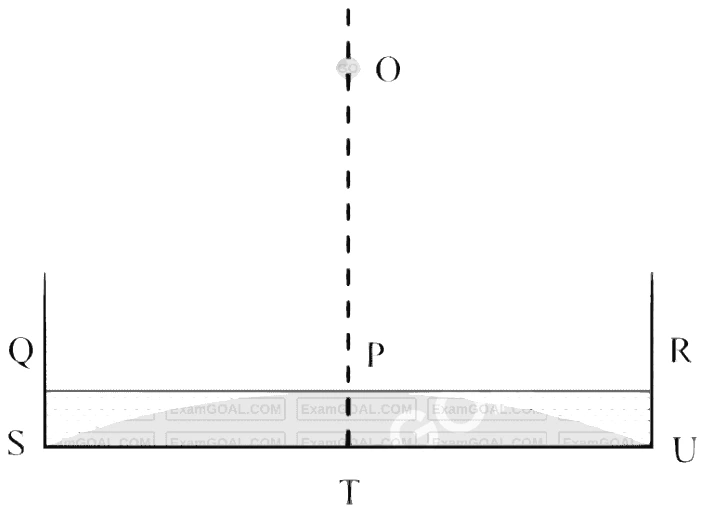
A glass beaker has a solid, plano-convex base of refractive index 1.601.60, as shown in the figure. The radius of curvature of the convex surface (SPUSPU) is 9 cm9\,\text{cm}, while the planar surface (STUSTU) acts as a mirror. This beaker is filled with a liquid of refractive index nn up to the level QPRQPR. If the image of a point object OO at a height of hh (OTOT in the figure) is formed onto itself, then, which of the following option(s) is(are) correct?

Beaker with plano-convex glass base (silvered flat bottom STU), liquid up to QPR, object O above on axis at height h from T

More than one option can be correct. Tap every correct option, then tap Check.

Show answer

Answer: (a), (b)

Step-by-step solution coming soon.

Report a mistake
Q133JEE Advanced 2022Difficult

Spherical Surfaces & Thin Lenses

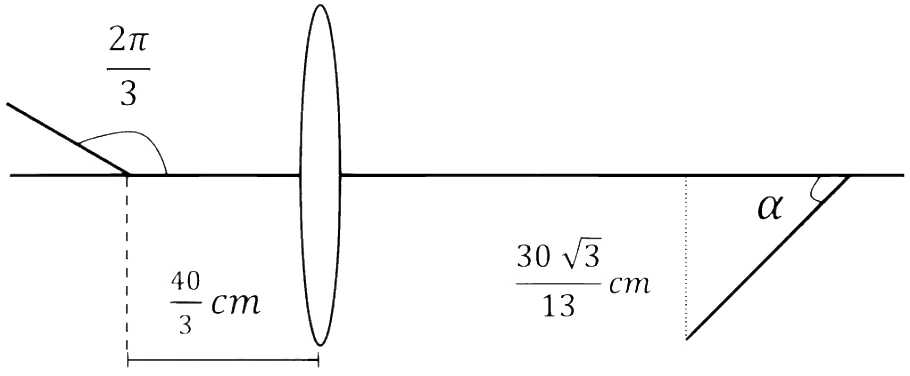
A rod of length 2 cm2\,\text{cm} makes an angle 2π3\dfrac{2\pi}{3} rad with the principal axis of a thin convex lens. The lens has a focal length of 10 cm10\,\text{cm} and is placed at a distance of 403 cm\dfrac{40}{3}\,\text{cm} from the object as shown in the figure. The height of the image is 30313 cm\dfrac{30\sqrt{3}}{13}\,\text{cm} and the angle made by it with respect to the principal axis is α\alpha rad. The value of α\alpha is πn\dfrac{\pi}{n} rad, where nn is ______.

Rod inclined at 2π/3 to the axis at 40/3 cm from a convex lens; its image has height 30√3/13 cm and makes angle α with the axis

Numerical answer type. Work it out, then open the answer.

Show answer

Answer: 5.95 to 6.05

Step-by-step solution coming soon.

Report a mistake
Q134JEE Advanced 2020Difficult

Spherical Surfaces & Thin Lenses

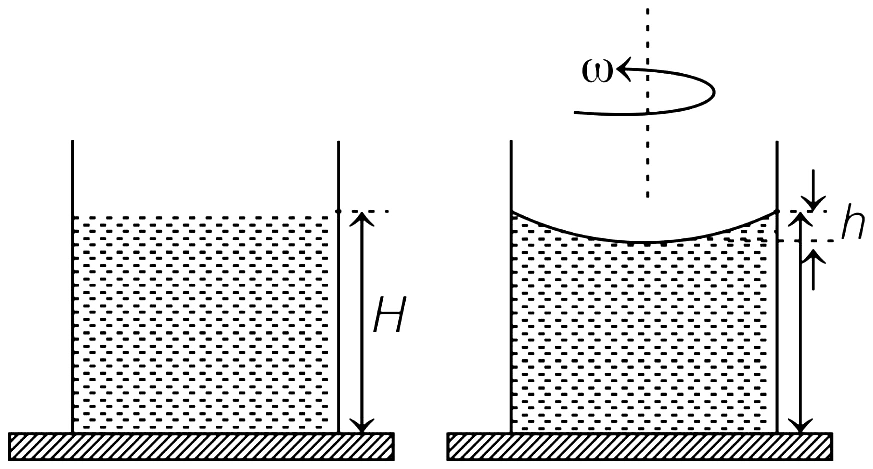
A beaker of radius rr is filled with water (refractive index 43\dfrac{4}{3}) up to a height HH as shown in the figure on the left. The beaker is kept on a horizontal table rotating with angular speed ω\omega. This makes the water surface curved so that the difference in the height of water level at the center and at the circumference of the beaker is hh (h≪Hh \ll H, h≪rh \ll r), as shown in the figure on the right. Take this surface to be approximately spherical with a radius of curvature RR. Which of the following is/are correct? (gg is the acceleration due to gravity)

Beaker of water depth H at rest (left) and rotating with angular speed omega, water surface curved with height difference h (right)

More than one option can be correct. Tap every correct option, then tap Check.

Show answer

Answer: (a), (d)

Step-by-step solution coming soon.

Report a mistake
Q135JEE Advanced 2019Difficult

Spherical Surfaces & Thin Lenses

A thin convex lens is made of two materials with refractive indices n1n_1 and n2n_2, as shown in the figure. The radius of curvature of the left and right spherical surfaces are equal. ff is the focal length of the lens when n1=n2=nn_1 = n_2 = n. The focal length is f+Δff + \Delta f when n1=nn_1 = n and n2=n+Δnn_2 = n + \Delta n.

Assuming Δn≪(n−1)\Delta n \ll (n - 1) and 1<n<21 < n < 2, the correct statement(s) is/are

Biconvex lens split by a vertical dashed line into left half of index n1 and right half of index n2

More than one option can be correct. Tap every correct option, then tap Check.

Show answer

Answer: (a), (b), (d)

Step-by-step solution coming soon.

Report a mistake
Q136JEE Advanced 2018Medium

Spherical Surfaces & Thin Lenses

Sunlight of intensity 1.3 kW m−21.3\,\text{kW m}^{-2} is incident normally on a thin convex lens of focal length 20 cm20\,\text{cm}. Ignore the energy loss of light due to the lens and assume that the lens aperture size is much smaller than its focal length. The average intensity of light, in kW m−2\text{kW m}^{-2}, at a distance 22 cm22\,\text{cm} from the lens on the other side is ______.

Numerical answer type. Work it out, then open the answer.

Show answer

Answer: 130

Step-by-step solution coming soon.

Report a mistake
Q137JEE Advanced 2016Difficult

Spherical Surfaces & Thin Lenses

A plano-convex lens is made of material of refractive index nn. When a small object is placed 30 cm30\,\text{cm} away in front of the curved surface of the lens, an image of double the size of the object is produced. Due to reflection from the convex surface of the lens, another faint image is observed at a distance of 10 cm10\,\text{cm} away from the lens. Which of the following statement(s) is(are) true?

More than one option can be correct. Tap every correct option, then tap Check.

Show answer

Answer: (a), (d)

Step-by-step solution coming soon.

Report a mistake
Q138JEE Advanced 2015Medium

Spherical Surfaces & Thin Lenses

Two identical glass rods S1S_1 and S2S_2 (refractive index =1.5= 1.5) have one convex end of radius of curvature 10 cm10\,\text{cm}. They are placed with the curved surfaces at a distance dd as shown in the figure, with their axes (shown by the dashed line) aligned. When a point source of light PP is placed inside rod S1S_1 on its axis at a distance of 50 cm50\,\text{cm} from the curved face, the light rays emanating from it are found to be parallel to the axis inside S2S_2. The distance dd is

Two glass rods S1 and S2 with curved ends facing each other, separation d, point source P at 50 cm inside S1
Show answer

Answer: (b)

Step-by-step solution coming soon.

Report a mistake
Q139JEE Advanced 2014Difficult

Spherical Surfaces & Thin Lenses

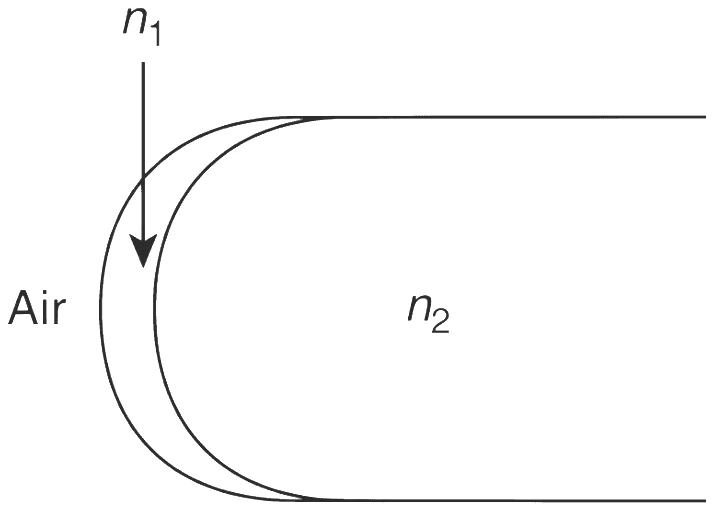
A transparent thin film of uniform thickness and refractive index n1=1.4n_1 = 1.4 is coated on the convex spherical surface of radius RR at one end of a long solid glass cylinder of refractive index n2=1.5n_2 = 1.5, as shown in the figure. Rays of light parallel to the axis of the cylinder traversing through the film from air to glass get focused at distance f1f_1 from the film, while rays of light traversing from glass to air get focused at distance f2f_2 from the film. Then

Glass cylinder with convex spherical end of radius R coated with thin film of index n1, air on the left

More than one option can be correct. Tap every correct option, then tap Check.

Show answer

Answer: (a), (c)

Step-by-step solution coming soon.

Report a mistake
Q140JEE Advanced 2013Medium

Spherical Surfaces & Thin Lenses

The image of an object, formed by a plano-convex lens at a distance of 8 m8\,\text{m} behind the lens, is real and is one-third the size of the object. The wavelength of light inside the lens is 23\dfrac{2}{3} times the wavelength in free space. The radius of the curved surface of the lens is

Show answer

Answer: (c)

Step-by-step solution coming soon.

Report a mistake
Q141JEE Advanced 2012Medium

Spherical Surfaces & Thin Lenses

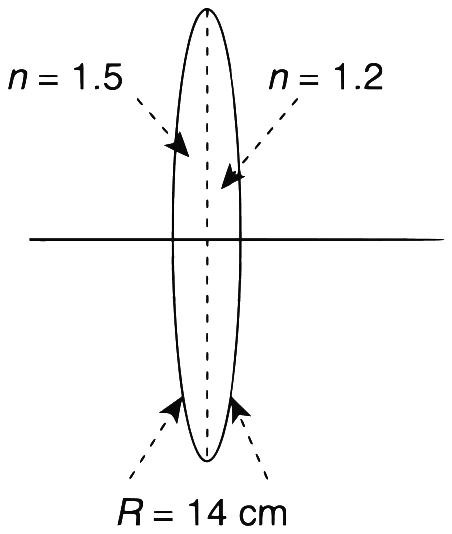
A biconvex lens is formed with two planoconvex lenses as shown in the figure. Refractive index nn of the first lens is 1.51.5 and that of the second lens is 1.21.2. Both curved surface are of the same radius of curvature R=14 cmR=14\,\text{cm}. For this biconvex lens, for an object distance of 40 cm40\,\text{cm}, the image distance will be

Biconvex lens formed from two planoconvex halves of index 1.5 and 1.2, radius 14 cm
Show answer

Answer: (b)

Step-by-step solution coming soon.

Report a mistake
Q142JEE Advanced 2011Medium

Spherical Surfaces & Thin Lenses

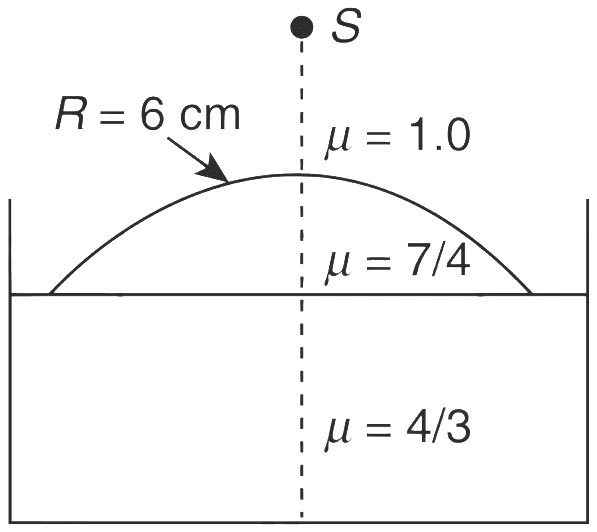
Water (with refractive index =43= \dfrac{4}{3}) in a tank is 18 cm18\,\text{cm} deep. Oil of refractive index 74\dfrac{7}{4} lies on water making a convex surface of radius of curvature R=6 cmR = 6\,\text{cm} as shown. Consider oil to act as a thin lens. An object SS is placed 24 cm24\,\text{cm} above water surface. The location of its image is at x cmx\,\text{cm} above the bottom of the tank. Then xx is ______.

Tank of water (index 4/3) with a convex oil layer (index 7/4, R = 6 cm) on top; point object S 24 cm above the surface

Numerical answer type. Work it out, then open the answer.

Show answer

Answer: 2

Step-by-step solution coming soon.

Report a mistake
Q143JEE Advanced 2010Easy

Spherical Surfaces & Thin Lenses

The focal length of a thin biconvex lens is 20 cm20\,\text{cm}. When an object is moved from a distance of 25 cm25\,\text{cm} in front of it to 50 cm50\,\text{cm}, the magnification of its image changes from m25m_{25} to m50m_{50}. The ratio m25m50\dfrac{m_{25}}{m_{50}} is ______.

Numerical answer type. Work it out, then open the answer.

Show answer

Answer: 6

Step-by-step solution coming soon.

Report a mistake
Q144JEE Advanced 2006Medium

Spherical Surfaces & Thin Lenses

A biconvex lens of focal length ff forms a circular image of sun of radius rr in focal plane. Then

Show answer

Answer: (b)

Step-by-step solution coming soon.

Report a mistake
Q145JEE Advanced 2006Medium

Spherical Surfaces & Thin Lenses

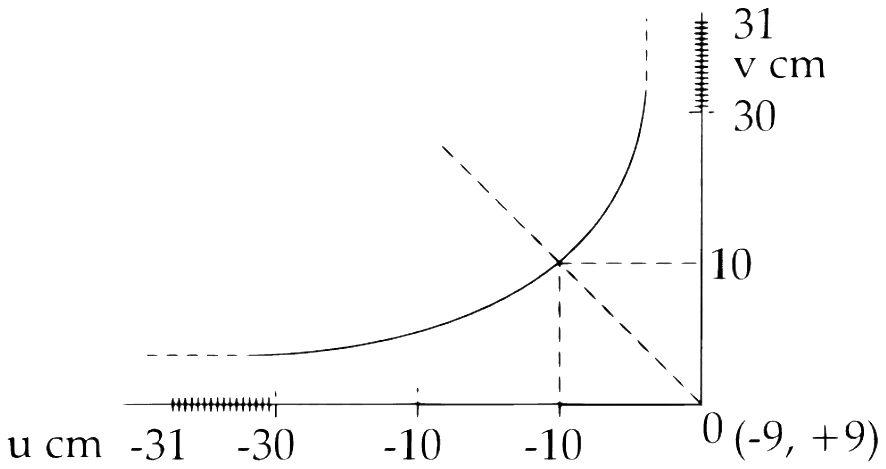
Graph of position of image versus position of point object from a convex lens is shown. Then, the focal length of the lens is

Graph of image position v versus object position u for a convex lens, hyperbola passing through (-10, 10) with asymptotes near -9 and +9
Show answer

Answer: (c)

Step-by-step solution coming soon.

Report a mistake
Q146AIIMS 2019Medium

Spherical Surfaces & Thin Lenses

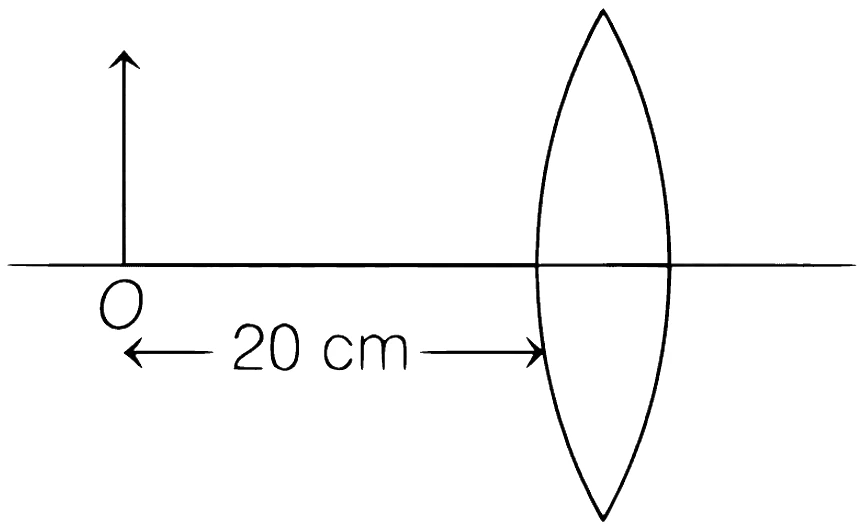
Calculate the focal length of given lens if the magnification is −0.5-0.5. The object OO is at a distance of 20 cm20\,\text{cm} from the lens.

Upright object O on the principal axis at 20 cm from a biconvex lens
Show answer

Answer: (a)

Step-by-step solution coming soon.

Report a mistake
Q147AIIMS 2017Easy

Spherical Surfaces & Thin Lenses

A lens of refractive index μ\mu is put in a liquid of refractive index μ′\mu'. If the focal length of lens in air is ff, then its focal length in liquid will be

Show answer

Answer: (a)

Step-by-step solution coming soon.

Report a mistake
Q148AIIMS 2016Easy

Spherical Surfaces & Thin Lenses

What is the refraction index of the material of a plano-convex lens, if the radius of curvature of the convex surface is 10 cm10\,\text{cm} and focal length of the lens is 30 cm30\,\text{cm}?

Show answer

Answer: (c)

Step-by-step solution coming soon.

Report a mistake
Q149AIIMS 2012Easy

Spherical Surfaces & Thin Lenses

A thin convex lens of refractive index 1.51.5 has 20 cm20\,\text{cm} focal length in air. If the lens is completely immersed in a liquid of refractive index 1.61.6, its focal length will be

Show answer

Answer: (a)

Step-by-step solution coming soon.

Report a mistake
Q150AIIMS 2008Easy

Spherical Surfaces & Thin Lenses

Assertion : A concave mirror and convex lens both have the same focal length in air. When they are submerged in water, they will have same focal length.
Reason : The refractive index of water is smaller than the refractive index of air.

Show answer

Answer: (d)

Step-by-step solution coming soon.

Report a mistake
Q151AIIMS 2006Easy

Spherical Surfaces & Thin Lenses

A wire mesh consisting of very small squares is viewed at a distance of 8 cm8\,\text{cm} through a magnifying converging lens of focal length 10 cm10\,\text{cm}, kept close to the eye. The magnification produced by the lens is :

Show answer

Answer: (a)

Step-by-step solution coming soon.

Report a mistake
Q152AIIMS 2006Easy

Spherical Surfaces & Thin Lenses

A lens is made of flint glass (refractive index =1.5= 1.5). When the lens is immersed in a liquid of refractive index 1.251.25, the focal length :

Show answer

Answer: (b)

Step-by-step solution coming soon.

Report a mistake
Q153JIPMER 2017Medium

Spherical Surfaces & Thin Lenses

A thin symmetrical double convex lens of refractive index μ2=1.5\mu_2 = 1.5 is placed between a medium of refractive index μ1=1.4\mu_1 = 1.4 to the left and another medium of refractive index μ3=1.6\mu_3 = 1.6 to the right. Then, the system behaves as

Show answer

Answer: (c)

Step-by-step solution coming soon.

Report a mistake
Q154JIPMER 2016Medium

Spherical Surfaces & Thin Lenses

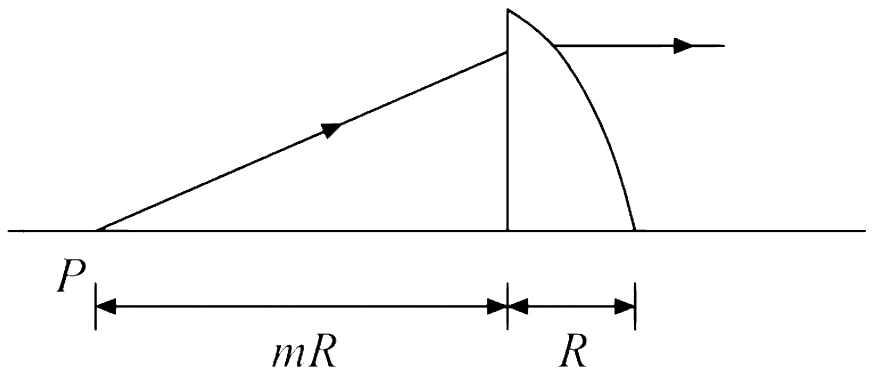
A quarter cylinder of radius RR and refractive index 1.51.5 is placed on a table. A point object PP is kept at a distance of mRmR from it as shown in figure. For what value of mm for which a ray from PP will emerge parallel to the table?

Quarter cylinder of radius R on a table, point object P at distance mR from its flat face; ray emerges horizontally from the curved surface
Show answer

Answer: (c)

Step-by-step solution coming soon.

Report a mistake
Q155JIPMER 2011Medium

Spherical Surfaces & Thin Lenses

For a given lens, the magnification was found to be twice as large as when the object was 0.15 m0.15\,\text{m} distant from it as when the distance was 0.2 m0.2\,\text{m}. The focal length of the lens is

Show answer

Answer: (c)

Step-by-step solution coming soon.

Report a mistake
Q156JIPMER 2006Easy

Spherical Surfaces & Thin Lenses

A lens acts as converging in air and diverging when immersed in water. Then, refractive index of lens is :

Show answer

Answer: (b)

Step-by-step solution coming soon.

Report a mistake
Q157JIPMER 2006Easy

Spherical Surfaces & Thin Lenses

A convex lens forms a full image of the object on a screen. If half of the lens is covered with an opaque object, then :

Show answer

Answer: (d)

Step-by-step solution coming soon.

Report a mistake
Q158JIPMER 2005Easy

Spherical Surfaces & Thin Lenses

The radius of the convex surface of planoconvex lens is 20 cm20\,\text{cm} and the refractive index of the material of the lens is 1.51.5. The focal length is

Show answer

Answer: (d)

Step-by-step solution coming soon.

Report a mistake
Q159BITSAT 2022Easy

Spherical Surfaces & Thin Lenses

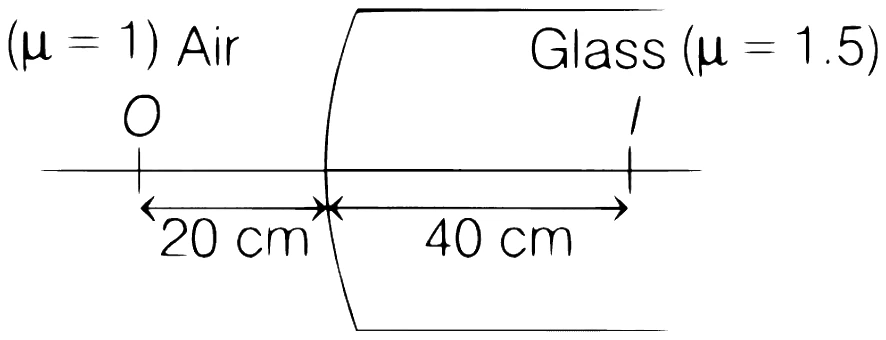
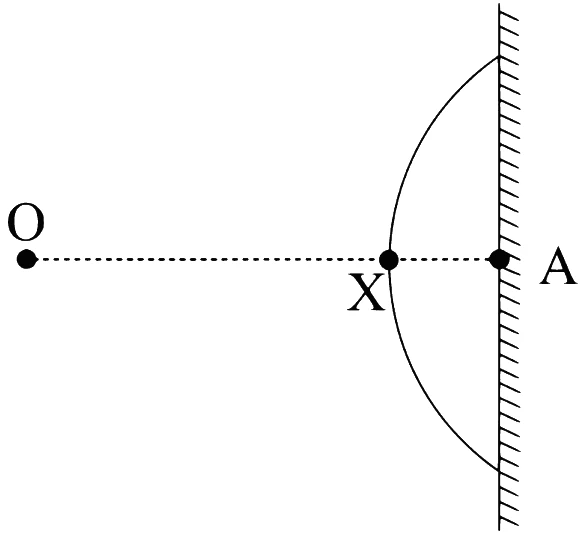
A mosquito OO is sitting infront of a glass rod having spherical end of radius of curvature 40 cm40\,\text{cm}. The image would be formed at

Mosquito O in air 20 cm from the curved end (radius 40 cm) of a glass rod of index 1.5; image position I marked 40 cm inside the rod
Show answer

Answer: (a)

Step-by-step solution coming soon.

Report a mistake
Q160BITSAT 2020Medium

Spherical Surfaces & Thin Lenses

A thin equi-convex lens is made of glass of refractive index 1.51.5 and its focal length is 0.2 m0.2\,\text{m}. If it acts as a concave lens of focal length 0.5 m0.5\,\text{m} when dipped in a liquid, the refractive index of the liquid is

Show answer

Answer: (b)

Step-by-step solution coming soon.

Report a mistake
Q161VITEEE 2021Easy

Spherical Surfaces & Thin Lenses

When an object is placed 40 cm40\,\text{cm} from a diverging lens, its virtual image is formed 20 cm20\,\text{cm} from the lens. The focal length and power of lens are

Show answer

Answer: (c)

Step-by-step solution coming soon.

Report a mistake
Q162VITEEE 2018Easy

Spherical Surfaces & Thin Lenses

Which of the following is the correct lens formula?

Show answer

Answer: (a)

Step-by-step solution coming soon.

Report a mistake
Q163VITEEE 2013Medium

Spherical Surfaces & Thin Lenses

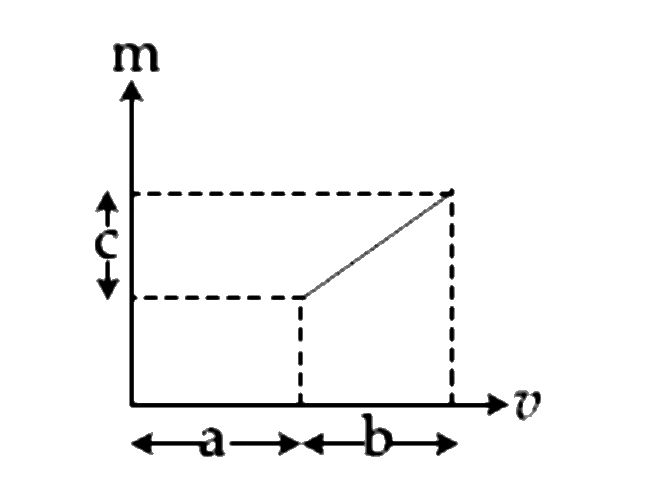
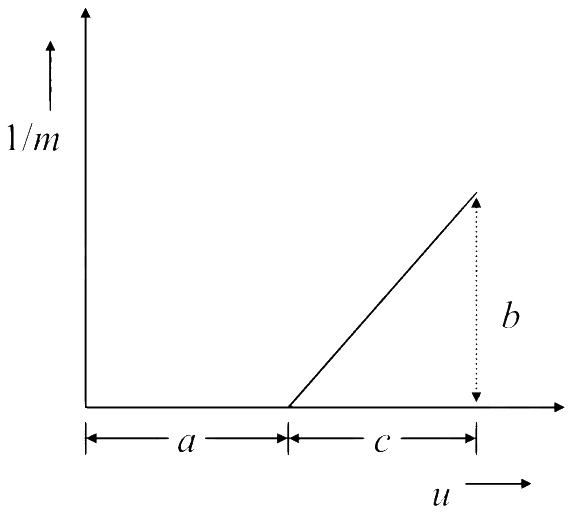
A student plots a graph between inverse of magnification 1/m1/m produced by a convex thin lens and the object distance uu as shown in figure. What was the focal length of the lens used?

Graph of 1/m against u: straight line starting on the u axis at distance a, rising by b over horizontal run c
Show answer

Answer: (c)

Step-by-step solution coming soon.

Report a mistake
Q164VITEEE 2010Medium

Spherical Surfaces & Thin Lenses

The power of a thin convex lens (ang=1.5{}_a n_g = 1.5) is 5.0 D5.0\,\text{D}. When it is placed in a liquid of refractive index anl{}_a n_l, then it behaves as a concave lens of focal length 100 cm100\,\text{cm}. The refractive index of the liquid anl{}_a n_l will be

Show answer

Answer: (a)

Step-by-step solution coming soon.

Report a mistake
Q165COMEDK 2026Medium

Spherical Surfaces & Thin Lenses

An object placed 40 cm40\,\text{cm} in front of a thin convex lens is moved to 60 cm60\,\text{cm} from the lens. If the focal length of the lens is 30 cm30\,\text{cm} the ratio of magnification of the image at the initial position to the final position is:

Show answer

Answer: (d)

Step-by-step solution coming soon.

Report a mistake
Q166COMEDK 2025Easy

Spherical Surfaces & Thin Lenses

One surface of a lens is convex and the other is concave. If the radii of curvatures are RR and rr respectively, the lens will be convex if

Show answer

Answer: (b)

Step-by-step solution coming soon.

Report a mistake
Q167COMEDK 2025Medium

Spherical Surfaces & Thin Lenses

An object of height hh is placed midway between ff and 2f2f in front of a biconvex lens. A real inverted image is captured on a screen placed a little beyond 2f2f on the other side of the lens. If the whole arrangement is immersed in water without disturbing the object, lens and the screen positions, then the new image formed will be

Show answer

Answer: (a)

Step-by-step solution coming soon.

Report a mistake
Q168COMEDK 2025Medium

Spherical Surfaces & Thin Lenses

A convex lens forms a real image of an object with magnification m1m_1. The lens is moved towards the object to obtain another real image of magnification m2m_2. The image distance is increased by xx. The focal length of the lens is

Show answer

Answer: (c)

Step-by-step solution coming soon.

Report a mistake
Q169COMEDK 2024Easy

Spherical Surfaces & Thin Lenses

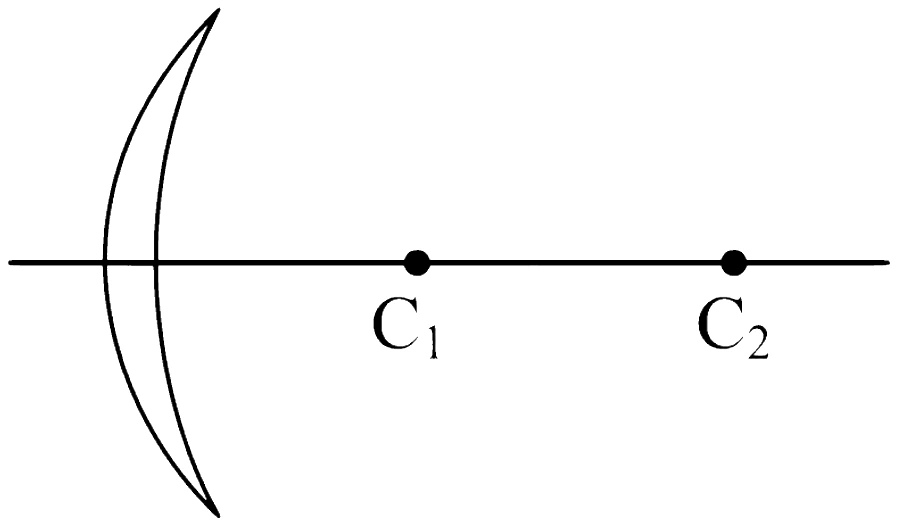
Figure below shows a lens of refractive index, μ=1.4\mu=1.4. C1C_1 and C2C_2 are the centres of curvature of the two faces of the lens of radii of curvature 4 cm4\,\text{cm} and 8 cm8\,\text{cm} respectively. The lens behaves as a

Meniscus lens with centres of curvature C1 and C2 marked on the principal axis, radii 4 cm and 8 cm
Show answer

Answer: (b)

Step-by-step solution coming soon.

Report a mistake
Q170COMEDK 2024Easy

Spherical Surfaces & Thin Lenses

When a biconvex lens of glass of refractive index 1.51.5 is dipped in a liquid, it acts like a plane sheet of glass. This means the refractive index of the liquid is

Show answer

Answer: (c)

Step-by-step solution coming soon.

Report a mistake
Q171COMEDK 2024Medium

Spherical Surfaces & Thin Lenses

An object is placed at a distance of 12 cm12\,\text{cm} from a convex lens on its principal axis and a virtual image of certain size is formed. If the object is moved 4 cm4\,\text{cm} away from the lens, a real image of the same size as that of the virtual image is formed. The focal length of the lens in cm\text{cm} is

Show answer

Answer: (b)

Step-by-step solution coming soon.

Report a mistake
Q172COMEDK 2022Medium

Spherical Surfaces & Thin Lenses

A point object is placed on the optic axis of a convex lens of focal length ff at a distance of 2f2f to the left of it. The diameter of the lens is dd. An eye is placed at a distance of 3f3f to the right of the lens and a distance hh below the optic axis. The maximum value of hh to see the image is

Show answer

Answer: (d)

Step-by-step solution coming soon.

Report a mistake
Q173KCET 2024Easy

Spherical Surfaces & Thin Lenses

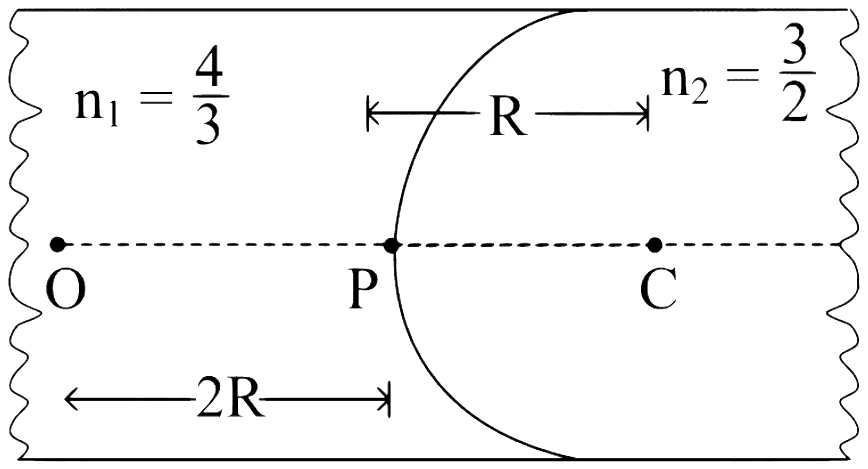
A luminous point object OO is placed at a distance 2R2R from the spherical boundary separating two transparent media of refractive indices n1n_1 and n2n_2 as shown, where RR is the radius of curvature of the spherical surface. If n1=43n_1 = \dfrac{4}{3}, n2=32n_2 = \dfrac{3}{2} and R=10 cmR = 10\,\text{cm}, the image is obtained at a distance from PP equal to

Spherical boundary with pole P and centre C between media n1=4/3 (left) and n2=3/2 (right); object O at 2R left of P
Show answer

Answer: (a)

Step-by-step solution coming soon.

Report a mistake
Q174KCET 2023Medium

Spherical Surfaces & Thin Lenses

An equiconvex lens made of glass of refractive index 32\dfrac{3}{2} has focal length ff in air. It is completely immersed in water of refractive index 43\dfrac{4}{3}. The percentage change in the focal length is

Show answer

Answer: (d)

Step-by-step solution coming soon.

Report a mistake
Q175KCET 2023Medium

Spherical Surfaces & Thin Lenses

A point object is moving at a constant speed of 1 m s−11\,\text{m s}^{-1} along the principal axis of a convex lens of focal length 10 cm10\,\text{cm}. The speed of the image is also 1 m s−11\,\text{m s}^{-1}, when the object is at ............. cm from the optical centre of the lens.

Show answer

Answer: (c)

Step-by-step solution coming soon.

Report a mistake
Q176KCET 2022Easy

Spherical Surfaces & Thin Lenses

The power of a equi-concave lens is −4.5 D-4.5\,\text{D} and is made of a material of refractive index 1.61.6, the radii of curvature of the lens is

Show answer

Answer: (d)

Step-by-step solution coming soon.

Report a mistake
Q177KCET 2022Medium

Spherical Surfaces & Thin Lenses

A convex lens of focal length ff is placed somewhere in between an object and a screen. The distance between the object and the screen is xx. If the numerical value of the magnification produced by the lens is mm, then the focal length of the lens is

Show answer

Answer: (d)

Step-by-step solution coming soon.

Report a mistake
Q178KCET 2021Medium

Spherical Surfaces & Thin Lenses

If the refractive index from air to glass is 32\dfrac{3}{2} and that from air to water is 43\dfrac{4}{3}, then the ratio of focal lengths of a glass lens in water and in air is

Show answer

Answer: (d)

Step-by-step solution coming soon.

Report a mistake
Q179KCET 2020Easy

Spherical Surfaces & Thin Lenses

An object approaches a convergent lens from the left of the lens with a uniform speed 5 m/s5\,\text{m/s} and stops at the focus, the image

Show answer

Answer: (c)

Step-by-step solution coming soon.

Report a mistake
Q180KCET 2018Easy

Spherical Surfaces & Thin Lenses

A candle placed 25 cm25\,\text{cm} from a lens forms an image on a screen placed 75 cm75\,\text{cm} on the other side of the lens. The focal length and type of the lens should be

Show answer

Answer: (a)

Step-by-step solution coming soon.

Report a mistake
Q181AP EAPCET 2026Easy

Spherical Surfaces & Thin Lenses

An object is placed at 10 cm10\,\text{cm} from a lens and a real image is formed with magnification of 0.50.5. The lens is

Show answer

Answer: (b)

Step-by-step solution coming soon.

Report a mistake
Q182AP EAPCET 2026Medium

Spherical Surfaces & Thin Lenses

A convex lens of refractive index 32\dfrac{3}{2} has a power of 5 D5\,\text{D}. If it is placed in a liquid of refractive index 22, the new power of the lens is

Show answer

Answer: (d)

Step-by-step solution coming soon.

Report a mistake
Q183AP EAPCET 2026Medium

Spherical Surfaces & Thin Lenses

A convex lens forms a real image 4 cm4\,\text{cm} long on a screen. When the lens is shifted to a new position without disturbing the object, again a real image is formed on the screen which is 16 cm16\,\text{cm} tall. The length of the object must be

Show answer

Answer: (b)

Step-by-step solution coming soon.

Report a mistake
Q184AP EAPCET 2026Medium

Spherical Surfaces & Thin Lenses

A convex lens forms a real image and a virtual image of same size of an object placed separately at distances u1u_1 and u2u_2 respectively from the lens. Then the focal length of the lens is

Show answer

Answer: (b)

Step-by-step solution coming soon.

Report a mistake
Q185AP EAPCET 2025Medium

Spherical Surfaces & Thin Lenses

The ratio of the focal lengths of a convex lens when kept in air and when immersed in a liquid is 1:21:2. If the refractive index of the material of the lens is 1.51.5, then the refractive index of the liquid is

Show answer

Answer: (a)

Step-by-step solution coming soon.

Report a mistake
Q186AP EAPCET 2025Medium

Spherical Surfaces & Thin Lenses

Images of same size are formed by a convex lens when an object is placed either at 20 cm20\,\text{cm} or 10 cm10\,\text{cm} distance from the lens. The focal length of the lens is

Show answer

Answer: (d)

Step-by-step solution coming soon.

Report a mistake
Q187AP EAPCET 2024Medium

Spherical Surfaces & Thin Lenses

When a convex lens is immersed in two different liquids of refractive indices 1.251.25 and 1.51.5, the ratio of the focal lengths of the lens is 5:165:16. The refractive index of the material of the lens is

Show answer

Answer: (c)

Step-by-step solution coming soon.

Report a mistake
Q188AP EAPCET 2024Medium

Spherical Surfaces & Thin Lenses

When a convex lens is immersed in a liquid of refractive index equal to 80%80\% of the refractive index of the material of the lens. The focal length of the lens increases by 100%100\%. The refractive index of the liquid is

Show answer

Answer: (b)

Step-by-step solution coming soon.

Report a mistake
Q189AP EAPCET 2024Medium

Spherical Surfaces & Thin Lenses

The focal length of a thin converging lens in air is 20 cm20\,\text{cm}. When the lens is immersed in a liquid, it behaves like a concave lens of power 1 D1\,\text{D}. If the refractive index of the material of the lens is 1.51.5, the refractive index of the liquid is

Show answer

Answer: (a)

Step-by-step solution coming soon.

Report a mistake
Q190AP EAPCET 2022Easy

Spherical Surfaces & Thin Lenses

The radii of curvature of a double convex lens are 4 cm4\,\text{cm} and 8 cm8\,\text{cm}. If the refractive index of the material of the lens is 1.51.5, the focal length of the lens is nearly.

Show answer

Answer: (d)

Step-by-step solution coming soon.

Report a mistake
Q191TS EAMCET 2026Medium

Spherical Surfaces & Thin Lenses

When an object is placed at a distance of 40 cm40\,\text{cm} from a convex lens, a real image is formed at a distance VV from the lens. If the convex lens is replaced with a concave lens of same focal length, then the change in the position of the image is

Show answer

Answer: (d)

Step-by-step solution coming soon.

Report a mistake
Q192TS EAMCET 2026Medium

Spherical Surfaces & Thin Lenses

When a thin convex lens is immersed in a liquid of refractive index 1.21.2, the focal length of the lens becomes 48 cm48\,\text{cm}. If the ratio of the radii of the curvature of the lens is 2:32:3 and the refractive index of the material of the lens is 1.51.5, then the radii of curvature of the lens are

Show answer

Answer: (a)

Step-by-step solution coming soon.

Report a mistake
Q193TS EAMCET 2025Easy

Spherical Surfaces & Thin Lenses

A convex lens of radii of curvature 6 cm6\,\text{cm} and 12 cm12\,\text{cm} is immersed in a liquid of refractive index 1.31.3. If the refractive index of the material of the lens is 1.51.5, then the focal length of the lens when immersed in the liquid is

Show answer

Answer: (c)

Step-by-step solution coming soon.

Report a mistake
Q194TS EAMCET 2024Easy

Spherical Surfaces & Thin Lenses

When the object and the screen are 90 cm90\,\text{cm} apart, it is observed that a clear image is formed on the screen when a convex lens is placed at two positions separated by 30 cm30\,\text{cm} between the object and the screen. The focal length of the lens is

Show answer

Answer: (b)

Step-by-step solution coming soon.

Report a mistake
Q195TS EAMCET 2024Medium

Spherical Surfaces & Thin Lenses

The power of a thin convex lens placed in air is +4 D+4\,\text{D}. The refractive index of the material of the convex lens is 32\dfrac{3}{2}. If this convex lens is immersed in a liquid of refractive index 53\dfrac{5}{3}, then

Show answer

Answer: (c)

Step-by-step solution coming soon.

Report a mistake
Q196TS EAMCET 2024Medium

Spherical Surfaces & Thin Lenses

When an object of height 12 cm12\,\text{cm} is placed at a distance from a convex lens, an image of height 18 cm18\,\text{cm} is formed on a screen. Without changing the positions of the object and the screen, if the lens is moved towards the screen, another clear image is formed on the screen. The height of this image is

Show answer

Answer: (c)

Step-by-step solution coming soon.

Report a mistake
Q197TS EAMCET 2024Medium

Spherical Surfaces & Thin Lenses

A thin plano-convex lens of focal length 73.5 cm73.5\,\text{cm} has a circular aperture of diameter 8.4 cm8.4\,\text{cm}. If the refractive index of the material of the lens is 53\dfrac{5}{3}, then the thickness of the lens is nearly

Show answer

Answer: (c)

Step-by-step solution coming soon.

Report a mistake
Q198TS EAMCET 2023Easy

Spherical Surfaces & Thin Lenses

A convex lens forms a real image of a point object placed on its principal axis. If the upper half of the lens is painted black, then

Show answer

Answer: (c)

Step-by-step solution coming soon.

Report a mistake
Q199TS EAMCET 2022Easy

Spherical Surfaces & Thin Lenses

What is the refractive index of the material of a double convex lens having radii of curvature of 5 cm5\,\text{cm} and 10 cm10\,\text{cm} and focal length of 203 cm\dfrac{20}{3}\,\text{cm}

Show answer

Answer: (a)

Step-by-step solution coming soon.

Report a mistake
Q200TS EAMCET 2022Medium

Spherical Surfaces & Thin Lenses

A convex lens of focal length 25 cm25\,\text{cm} and made of glass with refractive index 1.51.5 is immersed in water. The absolute change in focal length of the glass is [use refractive index of water =4/3= 4/3]

Show answer

Answer: (c)

Step-by-step solution coming soon.

Report a mistake
Q201TS EAMCET 2022Medium

Spherical Surfaces & Thin Lenses

A spherical glass is attached to a rigid wall as shown in the figure. An observer located at point OO is looking at a point AA on the wall. The refractive index of the glass is 1.51.5 and that of air is 1.01.0. The distances are OA=8 cmOA = 8\,\text{cm}, XA=3 cmXA = 3\,\text{cm}. If the radius of curvature of spherical glass surface is R=5 cmR = 5\,\text{cm}, then the apparent distance of AA from observer OO is

Observer O, curved glass surface vertex X, and point A on a wall; OA = 8 cm, XA = 3 cm, spherical cap bulging towards O
Show answer

Answer: (d)

Step-by-step solution coming soon.

Report a mistake
Q202TS EAMCET 2022Medium

Spherical Surfaces & Thin Lenses

A lens is made of glass having an index of refraction 1.51.5. One side of the lens is flat and the other side is convex with a radius RR. If an object is placed 60 cm60\,\text{cm} towards the convex side of the lens, the image is formed at 120 cm120\,\text{cm} on the other side of the lens. The value of RR is

Plano-convex lens with convex face towards the object; object 60 cm to the left, image 120 cm to the right
Show answer

Answer: (a)

Step-by-step solution coming soon.

Report a mistake
Q203TS EAMCET 2020Easy

Spherical Surfaces & Thin Lenses

A small object is placed in the air, at a distance 45 cm45\,\text{cm} from a convex refracting surface of radius of curvature 15 cm15\,\text{cm}. If the surface separates air from glass of refractive index 1.51.5, then the position of image is

Show answer

Answer: (d)

Step-by-step solution coming soon.

Report a mistake
Q204TS EAMCET 2020Easy

Spherical Surfaces & Thin Lenses

If the image of an object is at the focal point ff to the right side of a convex lens, the position of the object on the left of the lens is at

Show answer

Answer: (d)

Step-by-step solution coming soon.

Report a mistake
Q205TS EAMCET 2020Medium

Spherical Surfaces & Thin Lenses

The magnifications produced by a convex lens for two position of an object are 44 and 33, respectively. If the distance of separation between the two positions of the object is 2 cm2\,\text{cm}, then the focal length of the lens is

Show answer

Answer: (d)

Step-by-step solution coming soon.

Report a mistake
Q206WB JEE 2024Difficult

Spherical Surfaces & Thin Lenses

When a convex lens is placed above an empty tank, the image of a mark at the bottom of the tank, which is 45 cm45\,\text{cm} from the lens is formed 36 cm36\,\text{cm} above the lens. When a liquid is poured in the tank to a depth of 40 cm40\,\text{cm}, the distance of the image of the mark above the lens is 48 cm48\,\text{cm}. The refractive index of the liquid is

Show answer

Answer: (d)

Step-by-step solution coming soon.

Report a mistake
Q207WB JEE 2020Medium

Spherical Surfaces & Thin Lenses

A thin convex lens is placed just above an empty vessel of depth 80 cm80\,\text{cm}. The image of a coin kept at the bottom of the vessel is thus formed 20 cm20\,\text{cm} above the lens. If now water is poured in the vessel up to a height of 64 cm64\,\text{cm}, what will be the approximate new position of the image? Assume that refractive index of water is 4/34/3.

Show answer

Answer: (a)

Step-by-step solution coming soon.

Report a mistake
Q208WB JEE 2019Medium

Spherical Surfaces & Thin Lenses

A point object is placed on the axis of a thin convex lens of focal length 0.05 m0.05\,\text{m} at a distance of 0.2 m0.2\,\text{m} from the lens and its image is formed on the axis. If the object is now made to oscillate along the axis with a small amplitude of A cmA\,\text{cm}, then what is the amplitude of oscillation of the image? [you may assume, 11+x≈1−x\dfrac{1}{1+x} \approx 1 - x, where x≪1x \ll 1]

Show answer

Answer: (d)

Step-by-step solution coming soon.

Report a mistake
Q209IAT 2023Difficult

Spherical Surfaces & Thin Lenses

An object is placed in front of a convex lens. A real inverted image of double its size is formed. When the object is moved closer to the lens by a distance dd, the image shifts away from the lens by a distance 8d8d from its previous position. What is the magnitude of the magnification in the final setup?

Show answer

Answer: (b)

Step-by-step solution coming soon.

Report a mistake
Q210IAT 2022Medium

Spherical Surfaces & Thin Lenses

A thin lens made of material of refractive index nln_l forms the image at the position II of a point object held at OO on the central axis of the lens, as is shown in the ray diagram below. Consider that the refractive index of the medium is nmn_m and nl>nmn_l > n_m for the figure given. Where does the image form when nl<nmn_l < n_m ?

Show answer

Answer: (b)

Step-by-step solution coming soon.

Report a mistake
Q211NEST 2026Medium

Spherical Surfaces & Thin Lenses

A spherical glass bottle having negligible wall thickness is placed in air. When the bottle is completely filled with water, its focal length is ff. If the water is replaced by another transparent liquid of higher refractive index, then the focal length changes to f′f'. Then the correct option is

Show answer

Answer: (a)

Step-by-step solution coming soon.

Report a mistake
Q212NEST 2024Medium

Spherical Surfaces & Thin Lenses

The minimum distance, in cm\text{cm}, between an object and its real image through a convex lens of focal length 10 cm10\,\text{cm} is

Show answer

Answer: (d)

Step-by-step solution coming soon.

Report a mistake
Q213NEST 2024Difficult

Spherical Surfaces & Thin Lenses

Consider a linear object of height hh placed in front of a convex lens of focal length ff which gives rise to an image of height h1=4.00 cmh_1=4.00\,\text{cm} on the screen placed at a distance l=10.00 cml=10.00\,\text{cm} from the object. Then the lens is shifted towards the screen by a distance d=6.00 cmd=6.00\,\text{cm} and again an image of height h2=9.00 cmh_2=9.00\,\text{cm} is observed on the same screen. The ratio of the height to the focal length h/fh/f is

Show answer

Answer: (b)

Step-by-step solution coming soon.

Report a mistake
Q214NEST 2023Difficult

Spherical Surfaces & Thin Lenses

A transparent glass slab of thickness t=0.50 cmt=0.50\,\text{cm} is placed with its face ABAB on a horizontal table. A hemispherical water drop of radius R=0.33 cmR=0.33\,\text{cm} condenses on the glass slab as shown in figure. The refractive indices of the slab and the water drop are respectively 1.501.50 and 1.331.33. The image of the object at OO on the face ABAB is viewed after refraction from the drop. Taking OEQOEQ as the optical axis, the distance (cm\text{cm}) of the image from the point QQ is

Glass slab ABCD with hemispherical water drop CDQ on top, point E on the top face, O on the bottom face AB, slab thickness t
Show answer

Answer: (a)

Step-by-step solution coming soon.

Report a mistake
Q215NEST 2018Medium

Spherical Surfaces & Thin Lenses

The distance between an object and a screen is 18 cm18\,\text{cm}. A lens of focal length 4 cm4\,\text{cm} is placed between them so that the image of the object is formed on the screen. Then

Show answer

Answer: (b)

Step-by-step solution coming soon.

Report a mistake
Q216NEST 2016Medium

Spherical Surfaces & Thin Lenses

Refractive index of water w.r.t. air, aμw=43{}_a\mu_w=\dfrac{4}{3}.
A fish is 10.0 cm10.0\,\text{cm} from the front surface of a spherical fish bowl of radius 20.0 cm20.0\,\text{cm}, as shown in the figure. The walls of the bowl are thin, and their effects can be neglected. As observed from the point P (see figure), the fish is at a distance of

Fish in spherical water-filled bowl, 10 cm from the front surface, observer point P on the axis to the left
Show answer

Answer: (b)

Step-by-step solution coming soon.

Report a mistake
Q217NEST 2007Medium

Spherical Surfaces & Thin Lenses

An illuminated object is fixed at one end of an optical bench of length LL and a screen is fixed at the other end of the bench. A convex lens is to be used to obtain the image of the object on the screen. The maximum value of the focal length of the lens that can be used (without changing the object and screen positions) for the purpose is:

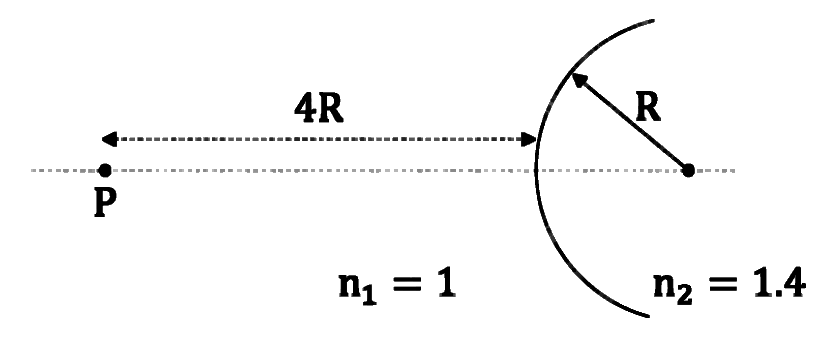
Show answer

Answer: (d)

Step-by-step solution coming soon.

Report a mistake