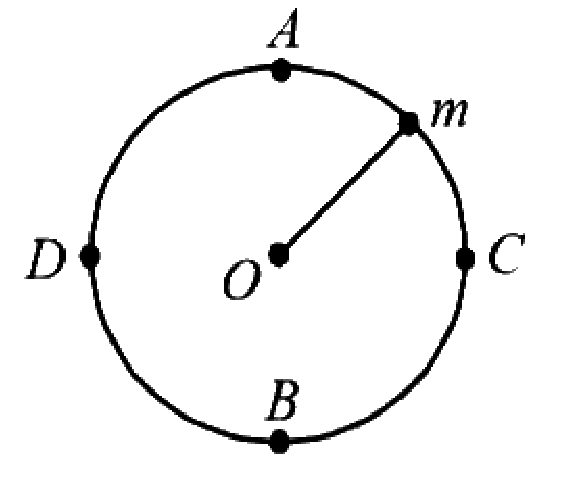
A wheel is rotating at 600 rpm about its axis of rotation. When the power is cut off, it comes to rest in half a minute. Its angular retardation expressed in rad/s2 is (retardation is uniform)
The angular speed of a flywheel is increased from 600 rpm to 1200 rpm in 10 s. The number of revolutions completed by the flywheel during this time is:
A disc of radius 0.4 m and mass 1 kg rotates about an axis passing through its centre and perpendicular to its plane. The angular acceleration is 10 rad/s2. The tangential force applied to the rim of the disc is
A wheel initially at rest is subjected to a uniform angular acceleration about its axis. In the first 2 s it rotates through an angle θ1 and in the next 2 s it rotates through an angle θ2. The ratio θ1θ2 is ______.
A disc of mass 100 kg and radius 1m is rotating at 300 r.p.m. The torque required to rotate the disc in opposite direction with same speed in time 50 second is
A solid sphere of radius 4 cm and mass 5 kg is rotating (rotation axis is passing through the centre of the sphere) with an angular velocity of 1200 rpm. It is brought to rest in 10 s by applying a constant torque. The torque applied and the number of rotations it made before it comes to rest are ______ and ______ respectively.
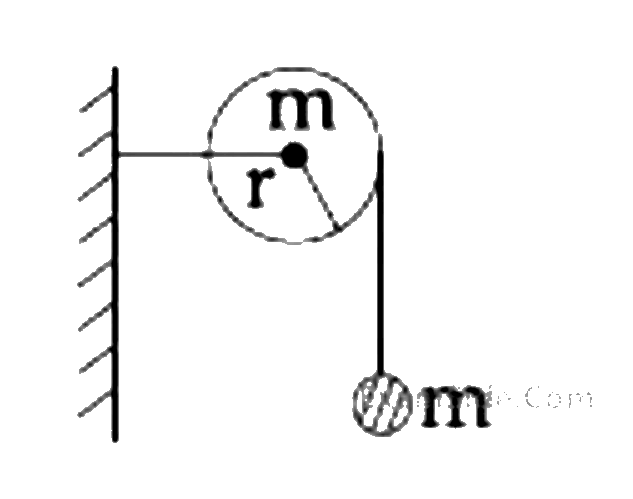
A fly wheel having mass 3 kg and radius 5 m is free to rotate about a horizontal axis. A string having negligible mass is wound around the wheel and the loose end of the string is connected to 3 kg mass. The mass is kept at rest initially and released. Kinetic energy of the wheel when the mass descends by 3 m is ________ J. (g=10 m/s2)
Numerical answer type. Work it out, then open the answer.
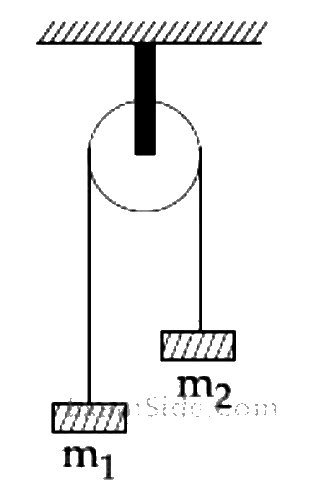
Two masses m and 2 m are connected by a light string going over a pulley (disc) of mass 30 m with radius r=0.1 m. The pulley is mounted in a vertical plane and it is free to rotate about its axis. The 2 m mass is released from rest and its speed when it has descended through a height of 3.6 m is m/s. (Assume string does not slip and g=10 m/s2)
Numerical answer type. Work it out, then open the answer.
Two masses 400 g and 350 g are suspended from the ends of a light string passing over a heavy pulley of radius 2 cm. When released from rest the heavier mass is observed to fall 81 cm in 9 s. The rotational inertia of the pulley is kg⋅m2⋅(g=9.8 m/s2)
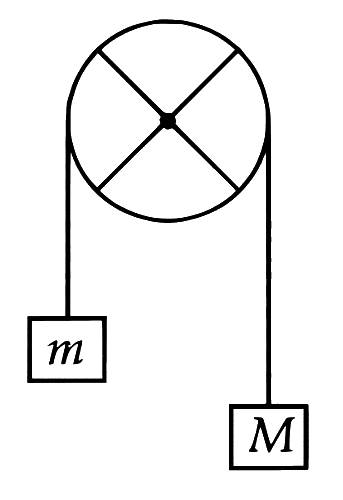
The pulley shown in figure is made using a thin rim and two rods of length equal to diameter of the rim. The rim and each rod have a mass of M. Two blocks of mass of M and m are attached to two ends of a light string passing over the pulley, which is hinged to rotate freely in vertical plane about its center. The magnitudes of the acceleration experienced by the blocks is ________ (assume no slipping of string on pulley).
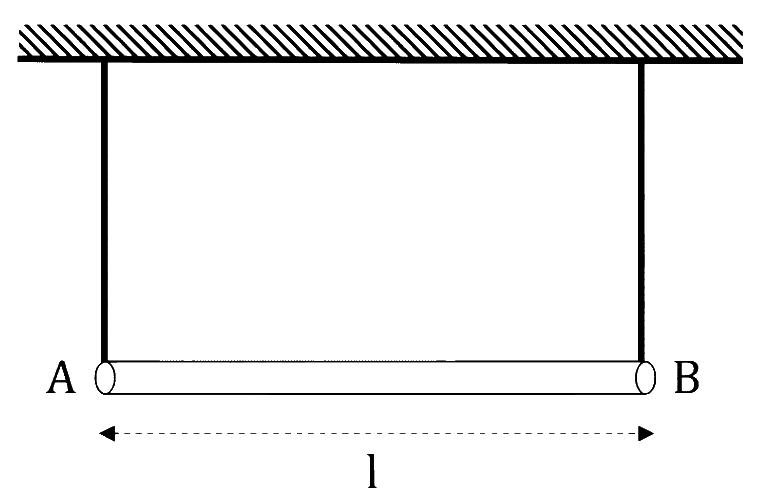
A uniform rod of mass m and length l is suspended by means of two identical inextensible light strings as shown in figure. Tension in one string immediately after the other string is cut, is .(g acceleration due to gravity)
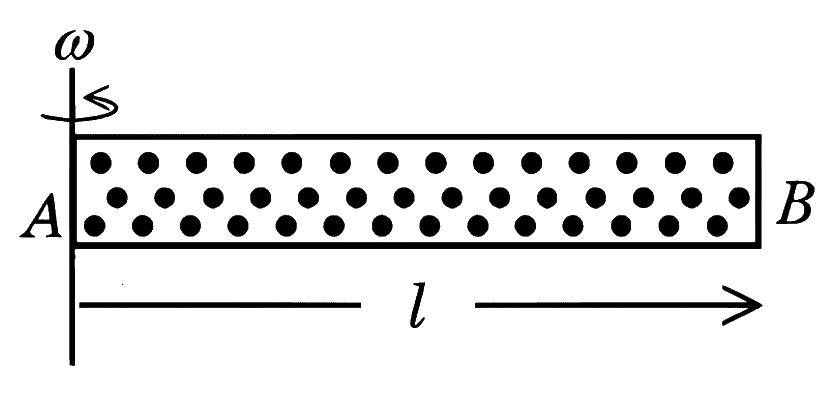
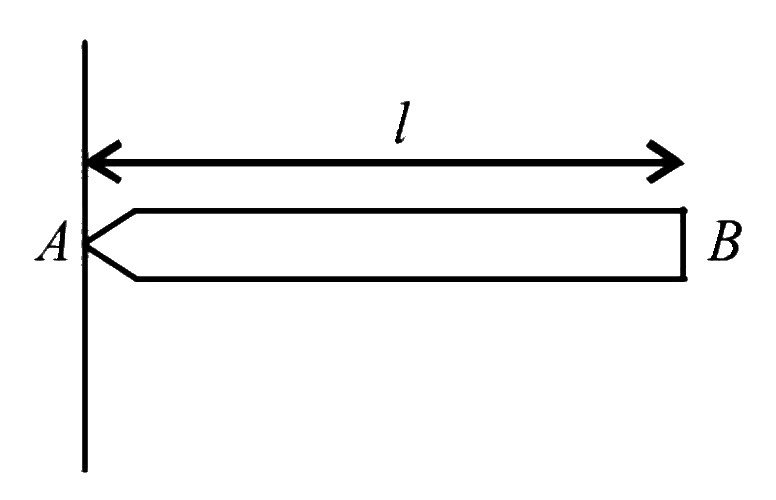
A cylindrical tube AB of length l, closed at both ends contains an ideal gas of 1 mol having molecular weight M. The tube is rotated in a horizontal plane with constant angular velocity ω about an axis perpendicular to AB and passing through the edge at end A, as shown in the figure. If PA and PB are the pressures at A and B respectively, then (Consider the temperature is same at all points in the tube)
A rigid body rotates about a fixed axis with variable angular velocity (α−βt) at time t, where α and β are constants. The angle through which it rotates before it comes to rest is
A disc of mass 25 kg and radius 0.2 m is rotating at 240 r.p.m. A retarding torque brings it to rest in 20 second. If the torque is due to a force applied tangentially on the rim of the disc then the magnitude of the force is
A circular disk of radius R meter and mass M kg is rotating around the axis perpendicular to the disk. An external torque is applied to the disk such that θ(t)=5t2−8t, where θ(t) is the angular position of the rotating disc as a function of time t. How much power is delivered by the applied torque, when t=2 s?
A thin solid disk of 1 kg is rotating along its diameter axis at the speed of 1800 rpm. By applying an external torque of 25π N m for 40 s, the speed increases to 2100 rpm. The diameter of the disk is ___________ m.
Numerical answer type. Work it out, then open the answer.
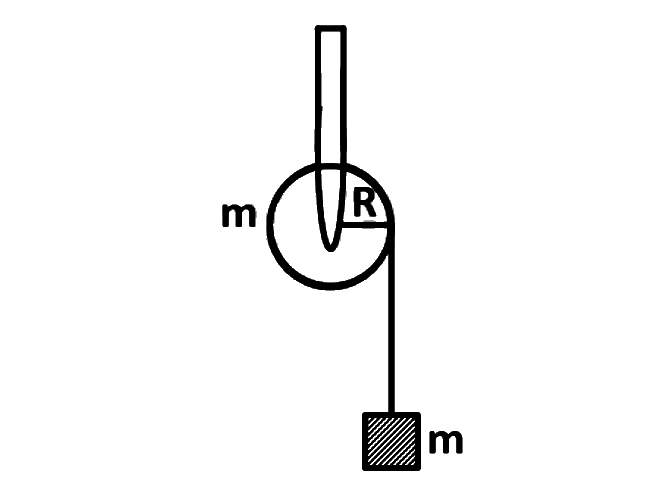
A bob of mass ' m ' is tied by a massless string whose other end is wound on a flywheel (disc) of radius ' R ' and mass ' m '. When released from the rest, the bob starts falling vertically downwards. If the bob has covered a vertical distance ' h ', then angular speed of wheel will be (There is no slipping between string and wheel, g - acceleration due to gravity)
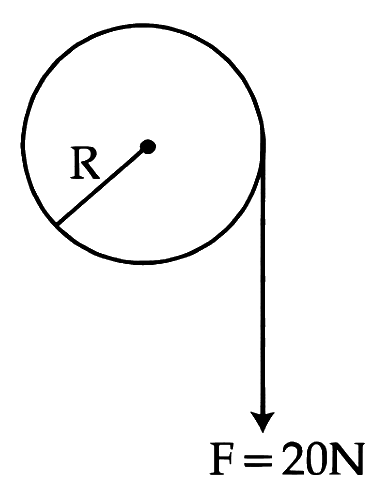
A cord of negligible mass is wound around the rim of a wheel supported by spokes with negligible mass. The mass of wheel is 10 kg and radius is 10 cm and it can freely rotate without any friction. Initially the wheel is at rest. If a steady pull of 20 N is applied on the cord, the angular velocity of the wheel, after the cord is unwound by 1 m, would be:
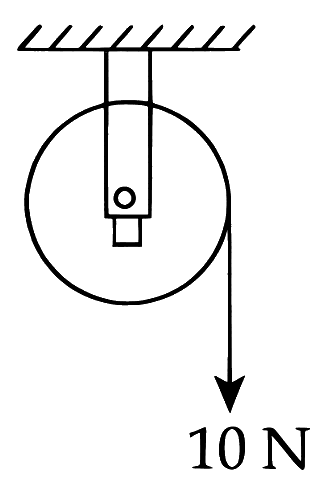
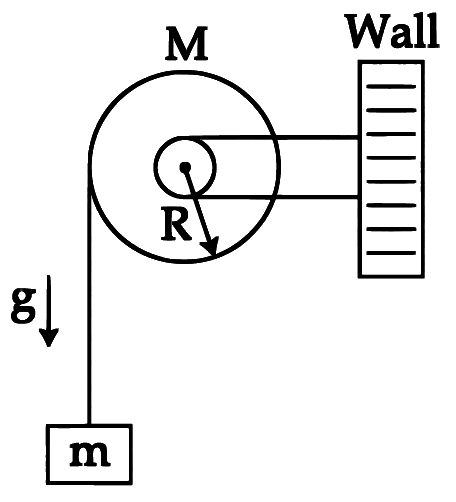
A wheel of radius 0.2 m rotates freely about its center when a string that is wrapped over its rim is pulled by force of 10 N as shown in figure. The established torque produces an angular acceleration of 2 rad/s2. Moment of intertia of the wheel is___________ kg m2. (Acceleration due to gravity =10 m/s2)
Numerical answer type. Work it out, then open the answer.
A bob is whirled in a horizontal plane by means of a string with an initial speed of ω rpm. The tension in the string is T. If speed becomes 2ω while keeping the same radius, the tension in the string becomes:
A constant torque of 100 N m turns a wheel of moment of inertia 300 kg m2 about an axis passing through its centre. Starting from rest, its angular velocity after 3 s is :-
A light rope is wound around a hollow cylinder of mass 5 kg and radius 70 cm. The rope is pulled with a force of 52.5 N. The angular acceleration of the cylinder will be _________ rad s−2.
Numerical answer type. Work it out, then open the answer.
A disc has mass M and radius R. How much tangential force should be applied to the rim of the disc, so as to rotate with angular velocity 'ω' in time t?
The angular speed of a fly wheel moving with uniform angular acceleration changes from 1200 rpm to 3120 rpm in 16 seconds. The angular acceleration in rad/s2 is
A fly wheel is accelerated uniformly from rest and rotates through 5 rad in the first second. The angle rotated by the fly wheel in the next second, will be:
A ball is spun with angular acceleration α = 6t2 − 2t where t is in second and α is in rads−2. At t = 0, the ball has angular velocity of 10 rads−1 and angular position of 4 rad. The most appropriate expression for the angular position of the ball is:
A fly wheel of mass 10 kg and radius 50 cm is rotating at a rate of 360 rpm. Assuming mass to be concentrated at the rim, the constant retarding torque required to stop the rotation of wheel in 6 rotations will be xπ N m. The value of x is ________
Numerical answer type. Work it out, then open the answer.
A disc of mass 1 kg and radius R is free to rotate about a horizontal axis passing through its centre and perpendicular to the plane of disc. A body of same mass as that of disc is fixed at the highest point of the disc. Now the system is released, when the body comes to the lowest position, its angular speed will be 43Rx rad s−1 where x= ____________. (g=10 m s−2)
Numerical answer type. Work it out, then open the answer.
A pulley of radius 1.5 m is rotated about its axis by a force F=(12t−3t2)N applied tangentially (while t is measured in seconds). If moment of inertia of the pulley about its axis of rotation is 4.5 kg m2, the number of rotations made by the pulley before its direction of motion is reversed, will be πK. The value of K is ___________.
Numerical answer type. Work it out, then open the answer.
A uniform disc with mass M = 4 kg and radius R = 10 cm is mounted on a fixed horizontal axle as shown in figure. A block with mass m = 2 kg hangs from a massless cord that is wrapped around the rim of the disc. During the fall of the block, the cord does not slip and there is no friction at the axle. The tension in the cord is ____________ N.
(Take g = 10 ms−2)
Numerical answer type. Work it out, then open the answer.
One end of a massless spring of spring constant k and natural length l0 is fixed while the other end is connected to a small object of mass m lying on a frictionless table. The spring remains horizontal on the table. If the object is made to rotate at an angular velocity ω about an axis passing through fixed end, then the elongation of the spring will be:
A body rotating with an angular speed of 600 rpm is uniformly accelerated to 1800 rpm in 10 sec. The number of rotations made in the process is ___________.
Numerical answer type. Work it out, then open the answer.
The angular speed of truck wheel is increased from 900 rpm to 2460 rpm in 26 seconds. The number of revolutions by the truck engine during this time is _____________. (Assuming the acceleration to be uniform).
Numerical answer type. Work it out, then open the answer.
A disc of radius 0.4 metre and mass 1 kg rotates about an axis passing through its centre and perpendicular to its plane. The angular acceleration is 10 rad s−2. The tangential force applied to the rim of the disc is
A disc of radius 0.4 m and mass one kg rotates about an axis passing through its centre and perpendicular to its plane. The angular acceleration of the disc is 10 rad/s2. The tangential force applied to the rim of the disc is
A solid disc of radius 20 cm and mass 10 kg is rotating with an angular velocity of 600 rpm, about an axis normal to its circular plane and passing through its centre of mass. The retarding torque required to bring the disc at rest in 10 s is ____________ π× 10−1 Nm.
Numerical answer type. Work it out, then open the answer.
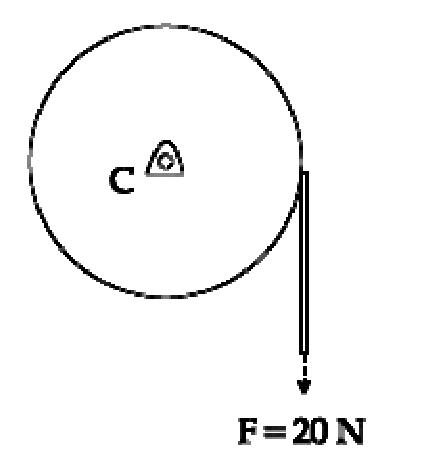
Consider a 20 kg uniform circular disk of radius 0.2 m. It is pin supported at its center and is at rest initially. The disk is acted upon by a constant force F = 20 N through a massless string wrapped around its periphery as shown in the figure.
Suppose the disk makes n number of revolutions to attain an angular speed of 50 rad s−1. The value of n, to the nearest integer, is __________.
[Given: In one complete revolution, the disk rotates by 6.28 rad]
Numerical answer type. Work it out, then open the answer.
A cord is wound round the circumference of wheel of radius r. The axis of the wheel is horizontal and the moment of inertia about it is I. A weight mg is attached to the cord at the end. The weight falls from rest. After falling through a distance 'h', the square of angular velocity of wheel will be:
A rope is wound around a solid cylinder of mass 1 kg and radius 0.4 m. What is the angular acceleration of cylinder, if the rope is pulled with a force of 25 N? (Cylinder is rotating about its own axis.)
A uniformly thick wheel with moment of inertia I and radius R is free to rotate about its centre of mass (see fig). A massless string is wrapped over its rim and two blocks of masses m1 and m2 (m1 > m2) are attached to the ends of the string. The system is released from rest. The angular speed of the wheel when m1 descents by a distance h is:
As shown in the figure, a bob of mass m is tied by a massless string whose other end portion is wound on a fly wheel (disc) of radius r and mass m. When released from rest the bob starts falling vertically. When it has covered a distance of h, the angular speed of the wheel will be:
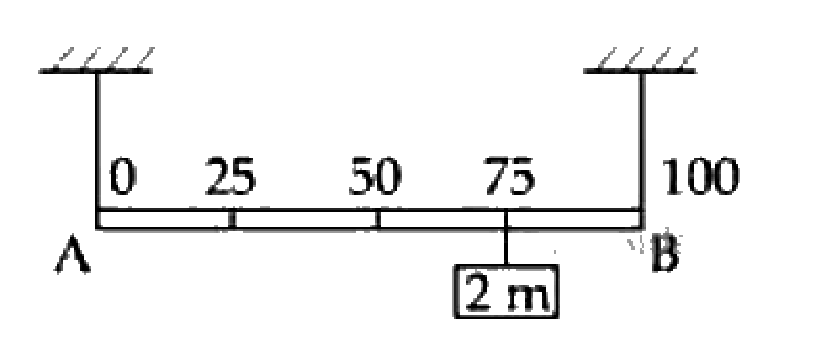
Shown in the figure is rigid and uniform one meter long rod AB held in horizontal position by two strings tied to its ends and attached to the ceiling. The rod is of mass ‘m’ and has another weight of mass 2 m hung at a distance of 75 cm from A. The tension in the string at A is:
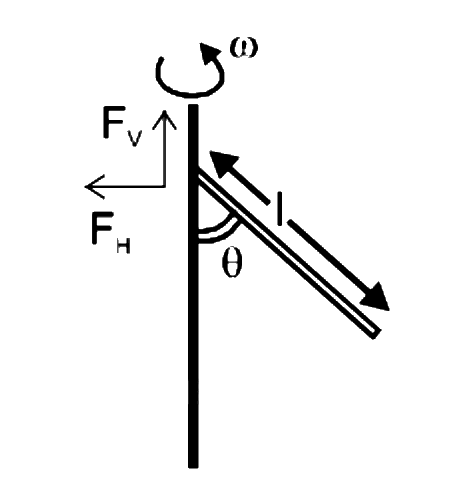
A uniform rod of length ‘l’ is pivoted at one of its ends on a vertical shaft of negligible radius. When the shaft rotates at angular speed ω the rod makes an angle θ with it (see figure). To find θ equate the rate of change of angular momentum (direction going into the paper) 12ml2ω2sinθcosθ about the centre of mass (CM) to the torque provided by the horizontal and vertical forces FH and FV about the CM. The value of θ is then such that:
A rigid body is rotating with angular velocity ' ω ' about an axis of rotation. Let v ' be the linear velocity of particle which is at perpendicular distance ' r ' from the axis of rotation. Then the relation v=rω ' implies that
Two particles A and B are moving in uniform circular motion in concentric circles of radii rA and rB with speed vA and vB respecitively. Their time period of rotation is the same. The ratio of angular speed of A to that of B will be:
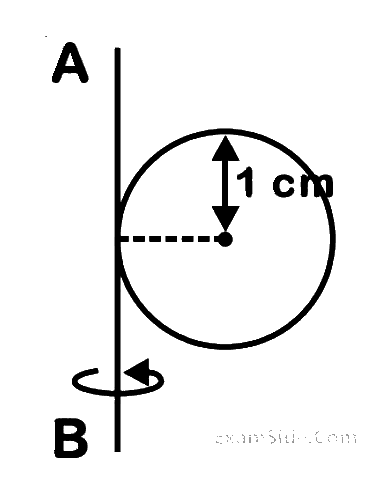
A metal coin of mass 5 g and radius 1 cm is fixed to a thin stick AB of negligible mass as shown in the figure. The system is initially at rest. The constant torque, that will make the system rotate about AB at 25 rotations per second in 5s, is close to:
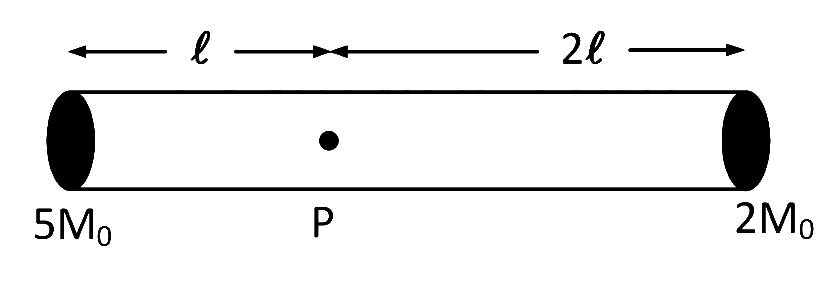
A rigid massless rod of length 3l has two masses attached at each end as shown in the figure. The rod is pivoted at point P on the horizontal axis (see figure). When released from initial horizontal position, its instantaneous angular acceleration will be -
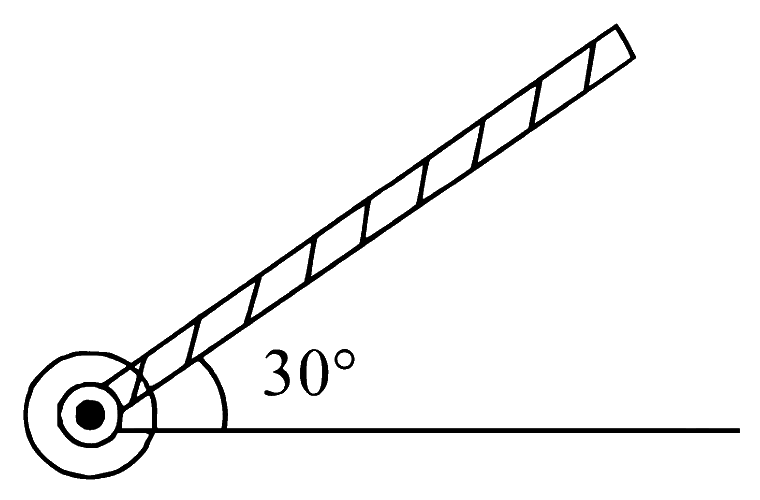
A rod of length 50 cm is pivoted at one end. It is raised such that it makes an angle of 30° from the horizontal as shown and released from rest. Its angular speed when it passes through the horizontal (in rad s−1) will be (g = 10 ms−2)
A stationary horizontal disc is free to rotate about its axis. When a torque is applied on it, its kinetic energy as a function of θ, where θ is the angle by which it has rotated, is given as kθ2. If its moment of inertia is I then the angular acceleration of the disc is:
To mop-clean a floor, a cleaning machine presses a circular mop of radius R vertically down with a total force F and rotates it with a constant angular speed about its axis. If the force F is distributed uniformly over the mop and if coefficient of friction between the mop and the floor is μ, the torque, applied by the machine on the mop is -
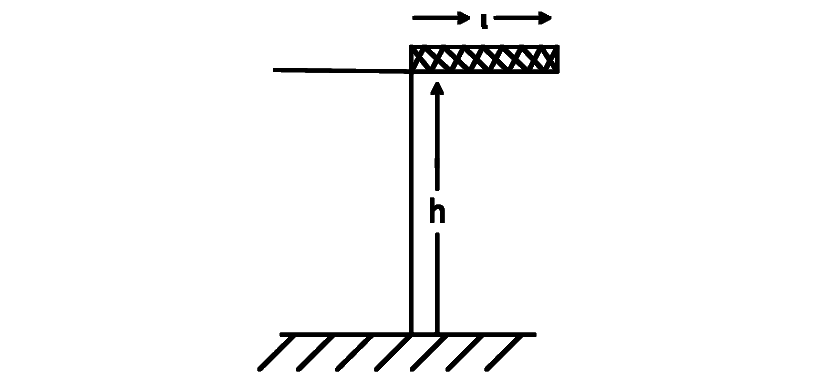
A rectangular solid box of length 0.3 m is held horizontally, with one of its sides on the edge of a platform of height 5m. When released, it slips off the table in a very short time t = 0.01s, remaining essentially horizontal. The angle by which it would rotate when it hits the ground will be (in radians) close to :-
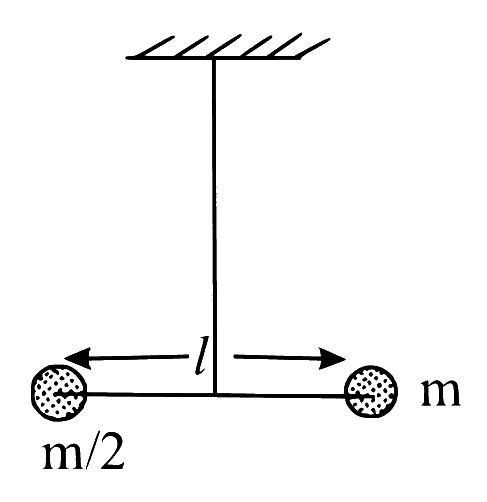
Two masses m and 2m are connected at the two ends of a massless rigid rod of length l. The rod is suspended by a thin wire of torsional constant k, at the centre of mass of the rod-mass system(see figure). Because of torsional constant k, the restoring torque is τ = kθ for angular displacement θ. If the rod is rotated by θ0 and released, the tension in it when it passes through its mean position will be:
A uniform rod of length ℓ is being rotated in a horizontal plane with a constant angular speed about an axis passing through one of its ends. If the tension generated in the rod due to rotation is T(x) at a distance x from the axis, then which of the following graphs depicts it most closely?
A rope is wound around a hollow cylinder of mass 3 kg and radius 40 cm. What is the angular acceleration of the cylinder if the rope is pulled with a force of 30 N?
A uniform disc of radius R and mass M is free to rotate only about its axis. A string is wrapped over its rim and a body of mass m is tied to the free end of the string as shown in the figure. The body is released from rest. Then the acceleration of the body is:
A uniform circular disc of radius 50 cm at rest is free to turn about an axis which is perpendicular to its plane and passes through its centre. It is subjected to a torque which produces a constant angular acceleration of 2.0 rad s−2. Its net acceleration in m s−2 at the end of 2.0 s is approximately
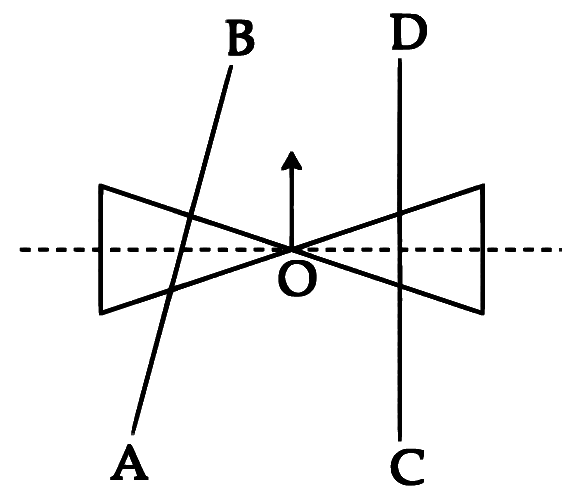
A roller is made by joining together two cones at their vertices O. It is kept on two rails AB and CD, which are placed asymmetrically (see figure), with its axis perpendicular to CD and its center O at the center of line joining AB and CD (see figure). It is given a light push so that it starts rolling with its center O moving parallel to CD in the direction shown. As it moves, the roller will tend to:
A particle of mass 2 kg is on a smooth horizontal table and moves in a circular path of radius 0.6 m. The height of the table from the ground is 0.8 m. If the angular speed of the particle is 12 rad s−1, the magnitude of its angular momentum about a point on the ground right under the center of the circle is:
A solid cylinder of mass 50 kg and radius 0.5 m is free to rotate about the horizontal axis. A massless string is wound round the cylinder with one end attached to it and other hanging freely. Tension in the string required to produce an angular acceleration of 2 revolutions s−2 is
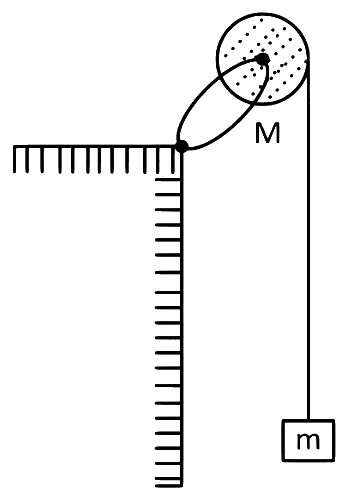
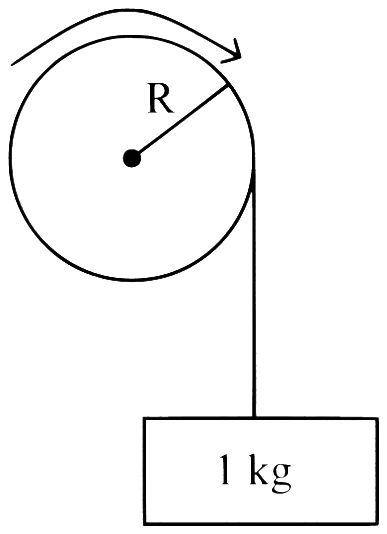
A mass ′m′ is supported by a massless string wound around a uniform hollow cylinder of mass m and radius R. If the string does not slip on the cylinder, with what acceleration will the mass fall on release?
A car of mass m is moving on a level circular track of radius R. If μs represents the static friction between the road and tyres of the car, the maximum speed of the car in circular motion is given by
A mass m hangs with the help of a string wrapped around a pulley on a frictionless bearing. The pulley has mass m and radius R. Assuming pulley to be a perfect uniform circular disc, the acceleration of the mass m, if the string does not slip on the pulley, is:
A pulley of radius 2 m is rotated about its axis by a force F=(20t−5t2) newton (where t is measured in seconds) applied tangentially. If the moment of inertia of the pulley about its axis of rotation is 10 kg-m2 the number of rotation made by the pulley before its direction of motion is reversed, is:
A thin horizontal circular disc is rotating about a vertical axis passing through its center. An insect is at rest at a point near the rim of the disc. The insect now moves along a diameter of the disc to reach its other end. During the journey of the insect, the angular speed of the disc.
A gramophone record is revolving with an angular velocity ω. A coin is placed at a distance r from the centre of the record. The static coefficient of friction is μ. The coin will revolve with the record if
A wheel has angular acceleration of 3.0 rad/sec2 and an initial angular speed of 2.00 rad/sec. In a time of 2 sec it has rotated through an angle (in radian) of
A uniform rod AB of length l and mass m is free to rotate about point A. The rod is released from rest in the horizontal position. Given that the moment of inertia of the rod about A is ml2/3, the initial angular acceleration of the rod will be
A uniform rod AB of length l and mass m is free to rotate about point A. The rod is released from rest in the horizontal position. Given that the moment of inertia of the rod about A is ml2/3, the initial angular acceleration of the rod will be
A tube of length L is filled completely with an incompressible liquid of mass M and closed at both the ends. The tube is then rotated in a horizontal plane about one of its ends with a uniform angular velocity ω. The force exerted by the liquid at the other end is
A wheel having moment of inertia 2 kg m2 about its vertical axis, rotates at the rate of 60 rpm about this axis. The torque which can stop the wheel's rotation in one minute would be
A stone is tied to a string of length l and is whirled in a vertical circle with the other end of the string as the centre. At a certain instant of time, the stone is at its lowest position and has a speed u. The magnitude of the change in velocity as it reaches a position where the string is horizontal (g being acceleration due to gravity) is
As shown in the figure at point O a mass is performing vertical circular motion. The average velocity of the particle is increased, then at which point will the string break
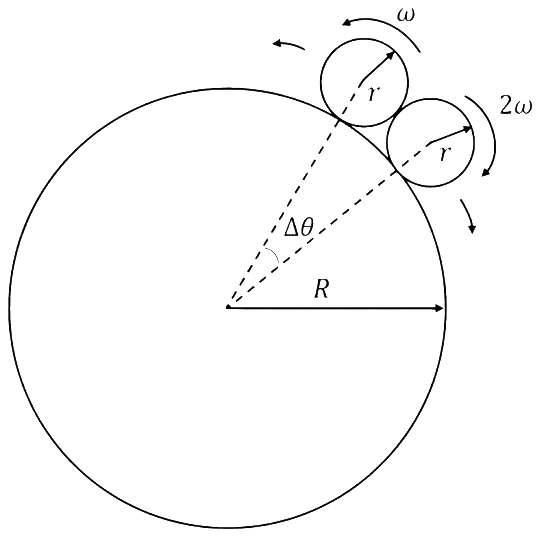
Consider a large disk of radius R and two smaller disks, each of radius r=R/50, lying on its circumference, as shown in the figure. The smaller disks are initially in contact with each other, with an angular separation Δθ between their centers. They are made to roll without slipping in opposite directions, with constant angular velocities ω and 2ω while the large disk is held stationary. The time τ at which the smaller disks are again in contact is: [Use sin(Δθ)=Δθ and ignore gravity.]
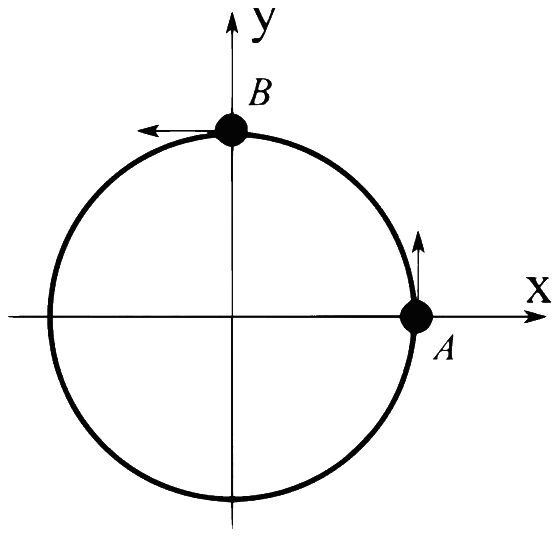
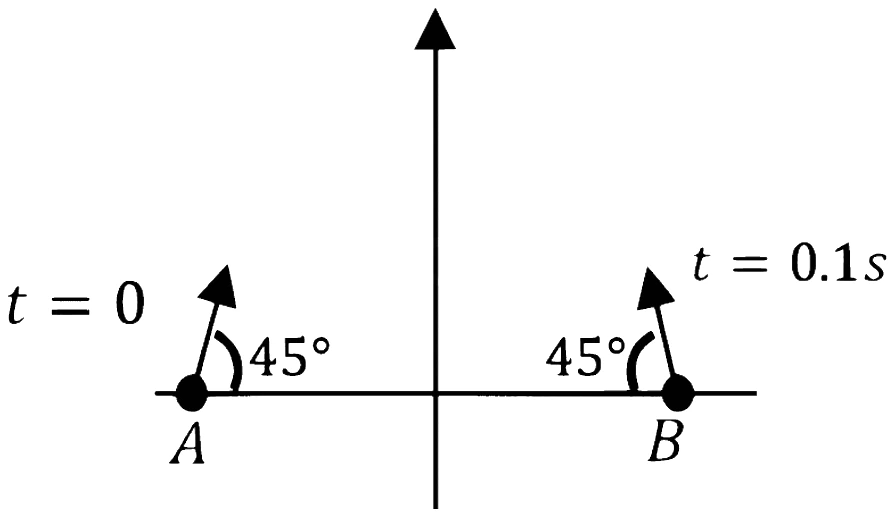
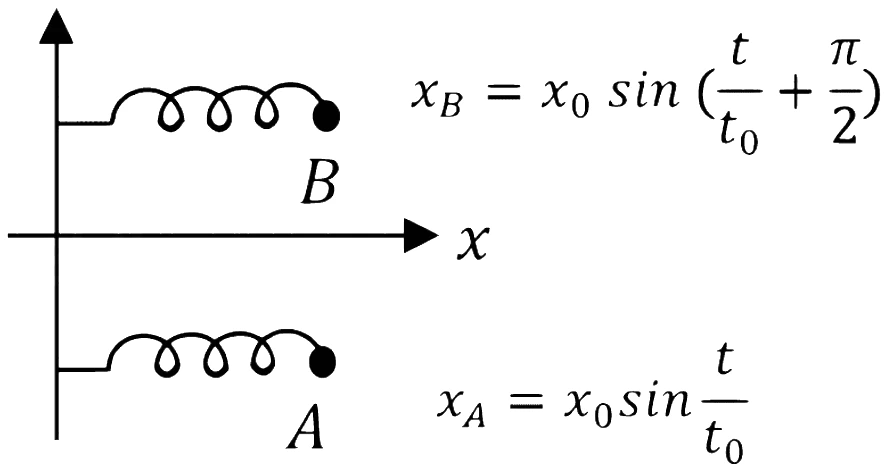
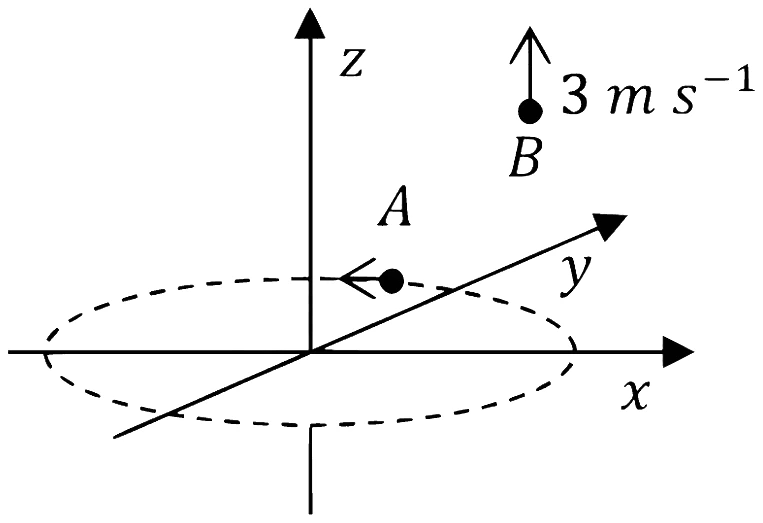
List I describes four systems, each with two particles A and B in relative motion as shown in figures. List II gives possible magnitudes of their relative velocities (in m s−1) at time t=3πs.\n\n| List-I | List-II |\n|---|---|\n| (I) A and B are moving on a horizontal circle of radius 1,textm with uniform angular speed omega=1,textrads−1. The initial angular positions of A and B at time t=0 are theta=0 and theta=dfracpi2, respectively. | (P) dfracsqrt3+12 |\n| (II) Projectiles A and B are fired (in the same vertical plane) at t=0 and t=0.1,texts respectively, with the same speed v=dfrac5pisqrt2,textms−1 and at 45∘ from the horizontal plane. The initial separation between A and B is large enough so that they do not collide. (g=10,textms−2) | (Q) dfracsqrt3−1sqrt2 |\n| (III) Two harmonic oscillators A and B moving in the x direction according to xA=x0sindfractt0 and xB=x0sinleft(dfractt0+dfracpi2right) respectively, starting from t=0. Take x0=1,textm, t0=1,texts. | (R) sqrt10 |\n| (IV) Particle A is rotating in a horizontal circular path of radius 1,textm on the xy plane, with constant angular speed omega=1,textrads−1. Particle B is moving up at a constant speed 3,textms−1 in the vertical direction as shown in the figure. (Ignore gravity.) | (S) sqrt2 |\n| | (T) sqrt25pi2+1 | Which one of the following options is correct?
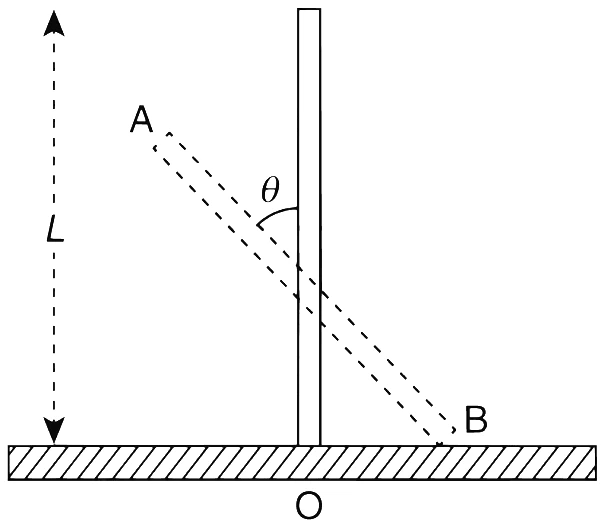
A thin and uniform rod of mass M and length L is held vertical on a floor with large friction. The rod is released from rest so that it falls by rotating about its contact-point with the floor without slipping. Which of the following statement(s) is/are correct, when the rod makes an angle 60∘ with vertical? [g is the acceleration due to gravity]
More than one option can be correct. Tap every correct option, then tap Check.
Two vectors A and B are defined as A=ai^ and B=a(cosωti^+sinωtj^), where a is a constant and ω=π/6rad s−1. If ∣A+B∣=3∣A−B∣ at time t=τ for the first time, the value of τ, in second, is
Numerical answer type. Work it out, then open the answer.
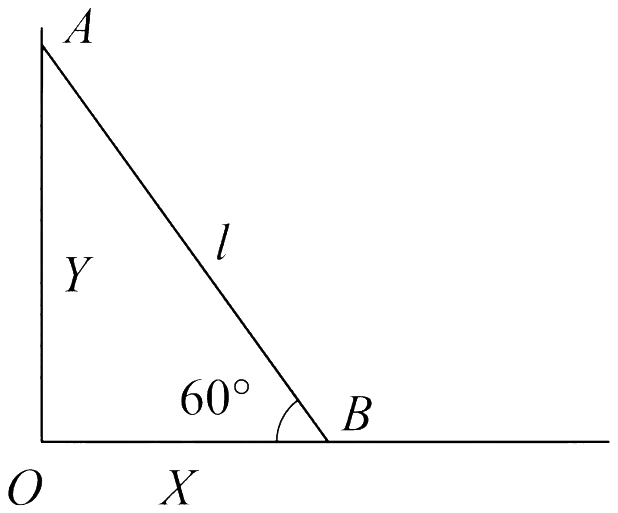
A rigid uniform bar AB of length L is slipping from its vertical position on a frictionless floor (as shown in the figure). At some instant of time, the angle made by the bar with the vertical is θ. Which of the following statements about its motion is/are correct?
More than one option can be correct. Tap every correct option, then tap Check.
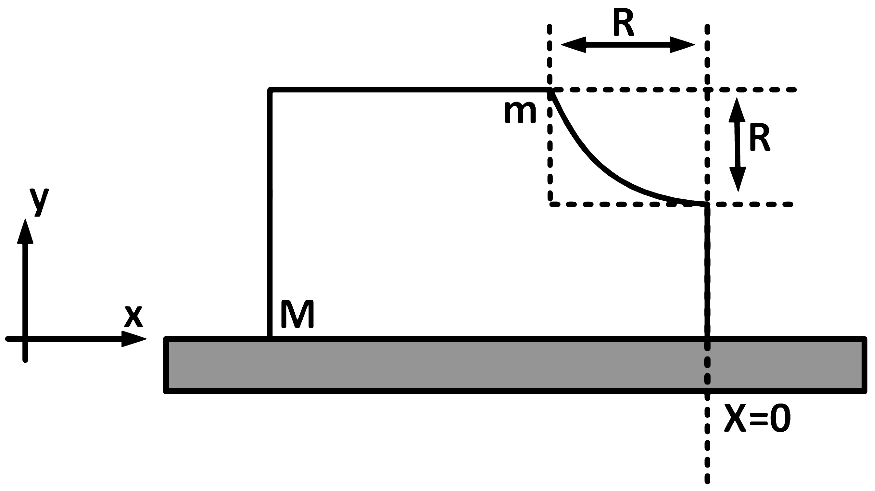
A block of mass M has a circular cut with a frictionless surface as shown. The block rests on the horizontal frictionless surface of a fixed table. Initially the right edge of the block is at x=0, in a co-ordinate system fixed to the table. A point mass m is released from rest at the topmost point of the path as shown and it slides down.
When the mass loses contact with the block, its position is x and the velocity is v. At that instant, which of the following options is/are correct?
More than one option can be correct. Tap every correct option, then tap Check.
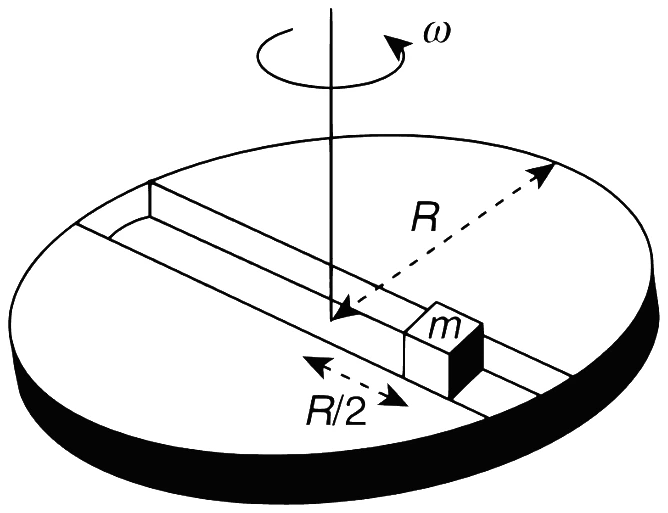
A frame of reference that is accelerated with respect to an inertial frame of reference is called a non-inertial frame of reference. A coordinate system fixed on a circular disc rotating about a fixed axis with a constant angular velocity ω is an example of a non-inertial frame of reference. The relationship between the force Frot experienced by a particle of mass m moving on the rotating disc and the force Fin experienced by the particle in an inertial frame of reference is,\n\nvecFrot=vecFin+2m(vecvrottimesvecomega)+m(vecomegatimesvecr)timesvecomega,\n\nwhere, vrot is the velocity of the particle in the rotating frame of reference and r is the position vector of the particle with respect to the centre of the disc. Now, consider a smooth slot along a diameter of a disc of radius R rotating counter-clockwise with a constant angular speed omega about its vertical axis through its centre. We assign a coordinate system with the origin at the centre of the disc, the X-axis along the slot, the Y-axis perpendicular to the slot and the Z-axis along the rotation axis (vecomega=omegahatk). A small block of mass m is gently placed in the slot at vecr=(R/2)hati at t=0 and is constrained to move only along the slot. The distance r of the block at time t is
A frame of reference that is accelerated with respect to an inertial frame of reference is called a non-inertial frame of reference. A coordinate system fixed on a circular disc rotating about a fixed axis with a constant angular velocity ω is an example of a non-inertial frame of reference. The relationship between the force Frot experienced by a particle of mass m moving on the rotating disc and the force Fin experienced by the particle in an inertial frame of reference is
Frot=Fin+2m(vrot×ω)+m(ω×r)×ω,
where vrot is the velocity of the particle in the rotating frame of reference and r is the position vector of the particle with respect to the centre of the disc.
Now, consider a smooth slot along a diameter of a disc of radius R rotating counter-clockwise with a constant angular speed ω about its vertical axis through its centre. We assign a coordinate system with the origin at the centre of the disc, the X-axis along the slot, the Y-axis perpendicular to the slot and the Z-axis along the rotation axis (ω=ωk^). A small block of mass m is gently placed in the slot at r=(R/2)i^ at t=0 and is constrained to move only along the slot.
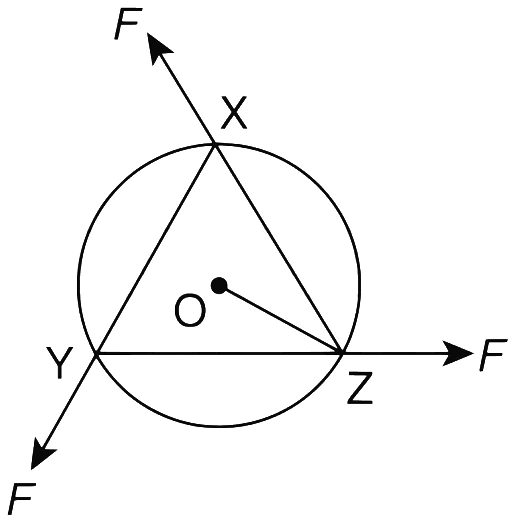
A uniform circular disc of mass 1.5kg and radius 0.5m is initially at rest on a horizontal frictionless surface. Three forces of equal magnitude F=0.5N are applied simultaneously along the three sides of an equilateral triangle XYZ with its vertices on the perimeter of the disc (see figure). One second after applying the forces, the angular speed of the disc in rad s−1 is
Numerical answer type. Work it out, then open the answer.
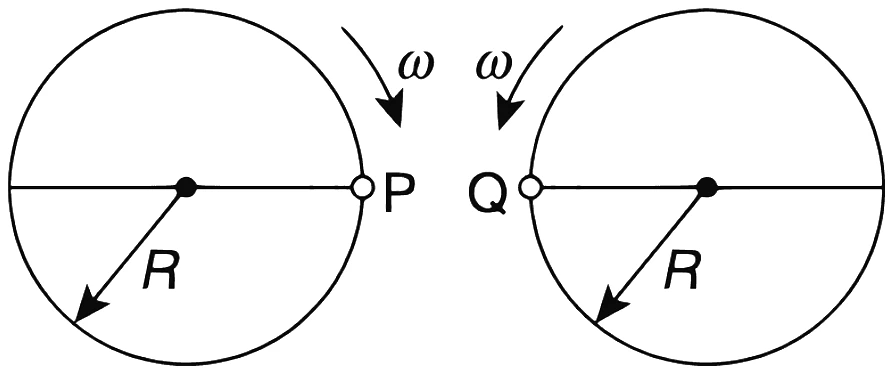
Two identical discs of same radius R are rotating about their axes in opposite directions with the same constant angular speed ω. The discs are in the same horizontal plane. At time t=0, the points P and Q are facing each other as shown in the figure. The relative speed between the two points P and Q is vr. In one time period (T) of rotation of the discs, vr as a function of time is best represented by
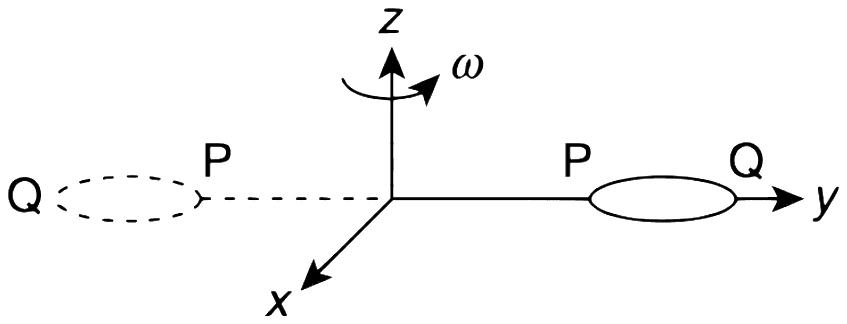
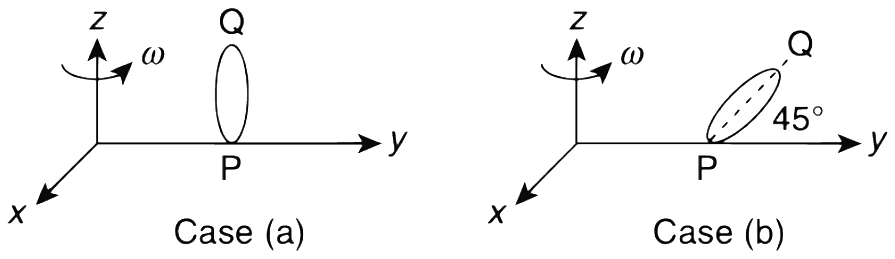
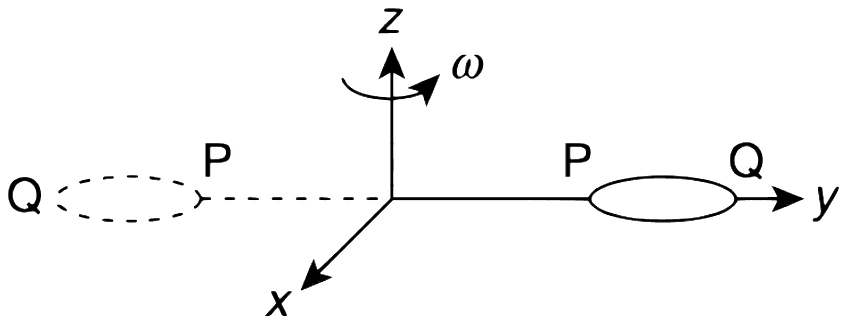
The general motion of a rigid body can be considered to be a combination of (i) a motion of its centre of mass about an axis, and (ii) its motion about an instantaneous axis passing through the centre of mass. These axes need not be stationary. Consider, for example, a thin uniform disc welded (rigidly fixed) horizontally at its rim to a massless stick, as shown in the figure. When the disc-stick system is rotated about the origin on a horizontal frictionless plane with angular speed ω, the motion at any instant can be taken as a combination of (i) a rotation of the centre of mass of the disc about the z-axis, and (ii) a rotation of the disc through an instantaneous vertical axis passing through its centre of mass (as seen from the changed orientation of points P and Q). Both these motions have the same angular speed ω in this case.
Now consider two similar systems as shown in the figure.
Case (a): The disc with its face vertical and parallel to the x-z plane.
Case (b): The disc with its face making an angle of 45∘ with the xy-plane and its horizontal diameter parallel to the x-axis.
In both the cases, the disc is welded at point P, and the systems are rotated with constant angular speed ω about the z-axis.
Which of the following statements about the instantaneous axis (passing through the centre of mass) is correct?
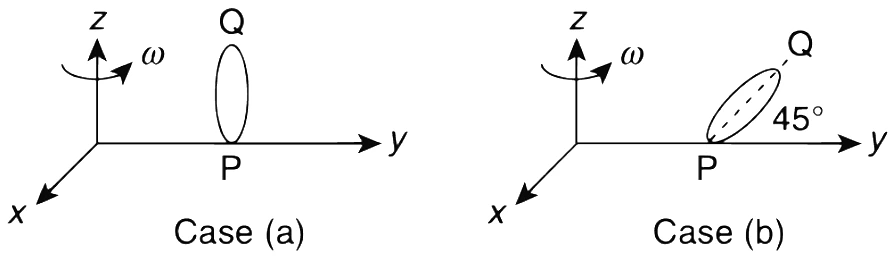
The general motion of a rigid body can be considered to be a combination of (i) a motion of its centre of mass about an axis, and (ii) its motion about an instantaneous axis passing through the centre of mass. These axes need not be stationary. Consider, for example, a thin uniform disc welded (rigidly fixed) horizontally at its rim to a massless stick, as shown in the figure. When the disc-stick system is rotated about the origin on a horizontal frictionless plane with angular speed ω, the motion at any instant can be taken as a combination of (i) a rotation of the centre of mass of the disc about the z-axis, and (ii) a rotation of the disc through an instantaneous vertical axis passing through its centre of mass (as seen from the changed orientation of points P and Q). Both these motions have the same angular speed ω in this case.
Now consider two similar systems as shown in the figure.
Case (a): The disc with its face vertical and parallel to the x-z plane.
Case (b): The disc with its face making an angle of 45∘ with the xy-plane and its horizontal diameter parallel to the x-axis.
In both the cases, the disc is welded at point P, and the systems are rotated with constant angular speed ω about the z-axis.
Which of the following statements regarding the angular speed about the instantaneous axis (passing through the centre of mass) is correct?
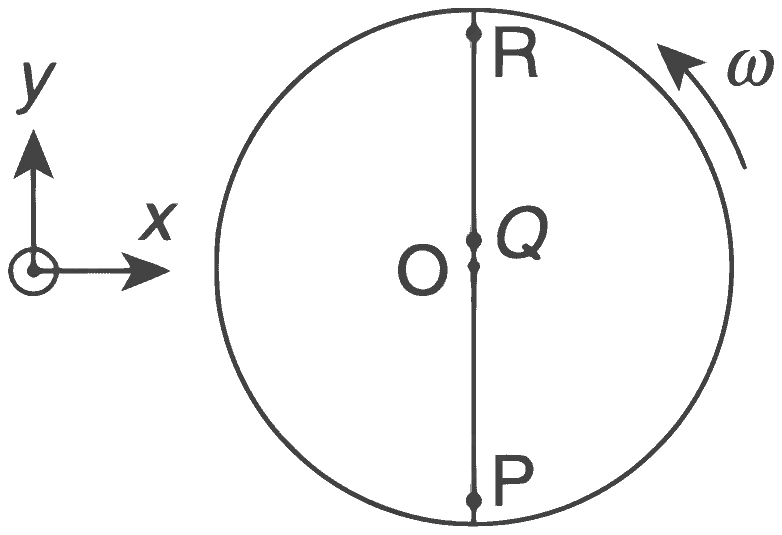
Consider a disc rotating in the horizontal plane with a constant angular speed ω about its centre O. The disc has a shaded region on one side of the diameter and an unshaded region on the other side as shown in the figure. When the disc is in the orientation as shown, two pebbles P and Q are simultaneously projected at an angle towards R. The velocity of projection is in the y-z plane and is same for both pebbles with respect to the disc. Assume that (i) they land back on the disc before the disc has completed 81 rotation, (ii) their range is less than half the disc radius, and (iii) ω remains constant throughout. Then
A rod PQ of length l is moving with its ends remaining in contact with a frictionless wall and floor. If at the instant shown the velocity of end B is 2m s−1 towards negative direction of x, the speed of end A will be
When a ceiling fan is switched on, it makes 10 revolutions in the first 3s. Assuming a uniform angular acceleration, how many rotations will it make in the next 3s?
A wheel of radius 0.4m can rotate freely about its axis as shown in the figure. A string is wrapped over its rim and a mass of 4kg is hung. An angular acceleration of 8rad s−2 is produced in it due to the torque. Then, moment of inertia of the wheel is (g=10m s−2)
A wheel has angular acceleration of 3.0rad s−2 and an initial angular speed of 2.00rad s−1. In a time of 2s it has rotated through an angle (in radian) of
A rigid body rotates about a fixed axis with variable angular velocity equal to α−βt, at the time t, where α,β are constants. The angle through which it rotates before it stops is
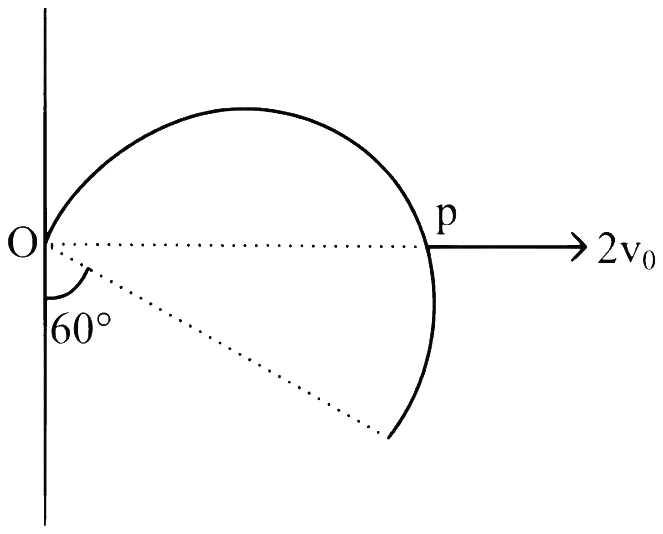
A thin but rigid semicircular wire frame of radius r is hinged at O and can rotate in its own vertical plane. A smooth peg P starts from O and moves horizontally with constant speed 2v0 lifting the frame upward as shown in figure. Find the angular velocity ω of the frame when its diameter makes an angle of 60∘ with vertical.
The wheel of a car, accelerated uniformly from rest, rotates through 5 radians during the first second. The angle (in radians) rotated during the next second is
A rod of length l is held vertically stationary with its lower end located at a point P, on the horizontal plane. When the rod is released to topple about P, the velocity of the upper end of the rod with which it hits the ground is
A wheel of radius 0.4m can rotate freely about its axis. A string is wrapped over its rim and a mass of 4kg is hung. An angular acceleration of 8rad s−2 is produced in it due to the torque. Then, moment of inertia of the wheel is (g=10m s−2)
A particle starts rotating from rest. The instantaneous angular displacement is θ=3t3−t2, where θ is in radian and t in s. The angular velocity at t=1s is
Four masses each 2kg are placed at the corners A,B,C,D of a massless square frame. 40kg mass is at the centre O of a square frame of side 0.2m. It is to be rotated about an axis passing through the centre O and perpendicular to the plane of the frame. Calculate the torque in N m required to produce an angular acceleration of 2πrad s−2.
Applying a constant torque the speed of a flywheel is increased from 1800rpm to 2400rpm in 10 seconds. The number of revolutions made by the flywheel during this time is:
A record player is spinning at an angular velocity of 45rpm just before it is turned off. It then decelerates at a constant rate of 0.8rad s−2. The angular displacement is
An object of mass 1kg is allowed to hang tangentially from the rim of the wheel of radius R. When released from the rest, the block falls vertically through 4m height in 2 seconds. The moment of inertia is 1kg m2. The radius of the wheel R is
Two fly wheels are connected by a non-slipping belt as shown in the figure. I1=4kg m2, r1=20cm, I2=20kg m2 and r2=30cm. A torque of 10N m is applied on the smaller wheel. Then match the entries of column I with appropriate entries of column II.
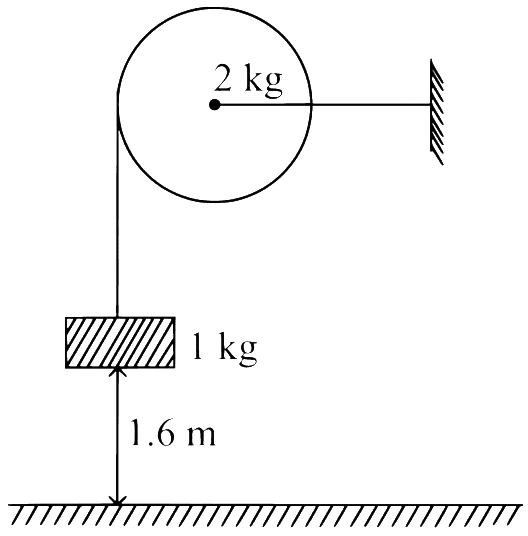
A body of mass 1kg is suspended by a weightless string which passes over a frictionless pulley of mass 2kg as shown in the figure. The mass is released from a height of 1.6m from the ground. With what velocity does it strike the ground?
A torque T produces angular acceleration α in a circular disc. If the radius of the disc is doubled keeping the mass constant, the angular acceleration becomes
A circular disc of diameter 0.8m and mass 4kg is rolling on a smooth horizontal plane. If a torque of 2.56N m is acting on the disc, then its angular acceleration is
A flywheel is rotating at a rate of 150rev/min. If it slows at a constant retardation of πrad s−2, then the time required for the wheel to come to rest is
A wheel of radius 0.5m and a moment of inertia of 10kg m2 is rotating freely at an angular speed of 70rev min−1. The wheel can be stopped in 5.0s by pressing a wet cloth against the rim and exerting a radially inward force of 88N. The coefficient of kinetic friction between the wheel and wet cloth is
An object of mass 2kg is hanging from a rope that is wrapped around a pulley of radius 25cm. The mass of the pulley is 2kg. Find the acceleration of the object. (Assume the pulley to be a solid disc, g=10m s−2)
A simple pendulum of length l is displaced, so that its taught string is horizontal and then released. A uniform bar pivoted at one end is simultaneously released from its horizontal position. If their motions are synchronous, what is the length of the bar?
More than one option can be correct. Tap every correct option, then tap Check.
A circular disk of mass M and radius R is rotating clockwise with a uniform angular velocity ω about an axis passing through the centre, normal to the disk. At time t=0, a torque T is applied along the same axis to oppose the rotation of the disk. What is the angular displacement θ (measured from t=0 in the clockwise direction) that the disk attains before it starts rotating counterclockwise?
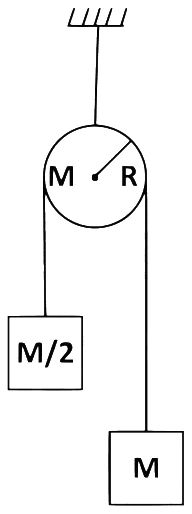
An inextensible cord of negligible mass passes over the rim of a solid disc of mass M and radius R. The disc is free to rotate about an axis passing through the centre perpendicular to the plane of the screen, as shown in the figure. Two blocks of masses M and M/2 are attached to the two free ends of the cord. Assume that there is no slipping of the cord on the disc. The acceleration due to gravity is g. What is the value of the angular acceleration of the disc?
A rigid body is rotating with a constant angular speed of 3rad s−1 about a fixed axis passing through the points A and B with coordinates (0,−1,1) and (1,1,3) respectively. Assuming all quantities in S.I. units, the instantaneous speed of the point P of the body with coordinates (4,6,7) is
A disk shaped coin is tossed up in the air with the 'Head' side on the top. The initial centre of mass velocity of the coin is 6.8m s−1 in the vertical direction. In addition, the disk is rotating about the horizontal axis with angular velocity 6πrad s−1. Assume the motion in air is torque-free. Find the number of completed flips the disk will perform before it hits the ground under the action of gravity.
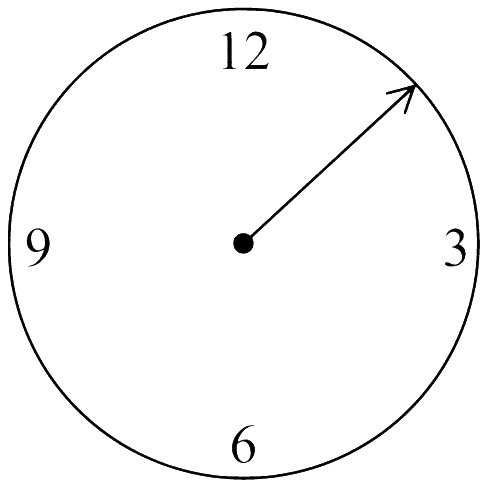
A wall clock is transparent and can be viewed both from front and rear. The front view is depicted in the figure (only the second hand is shown). The positive z-direction (+k) is out of the plane of the paper. The second hand when viewed from the rear moves in