Q1 MHT CET 2026 · 14 MAY · SHIFT 2 Easy ☆
Intrinsic & Extrinsic Semiconductors
In an intrinsic semiconductor, at any ordinary temperature, the correct relation between the number of electrons per unit volume (n e n_e n e n h n_h n h
(a) n e = n h n_e = n_h n e = n h (b) n e > n h n_e > n_h n e > n h (c) n e < n h n_e < n_h n e < n h (d) n e = n h = 0 n_e = n_h = 0 n e = n h = 0 Show answer and solution
Answer: (a)
Loading the solution…
Report a mistake Open question page Q2 MHT CET 2026 · 18 APR · SHIFT 2 Easy ☆
Intrinsic & Extrinsic Semiconductors
For intrinsic semiconductor, if n h n_h n h n e n_e n e
(a) n h < n e n_h < n_e n h < n e (b) n h > n e n_h > n_e n h > n e (c) n h = n e n_h = n_e n h = n e (d) n h ≠ n e n_h \neq n_e n h = n e Show answer and solution
Answer: (c)
Loading the solution…
Report a mistake Open question page Q3 MHT CET 2026 · 11 APR · SHIFT 1 Easy ☆
Intrinsic & Extrinsic Semiconductors
When the conductivity of a semiconductor is only due to breaking of covalent bonds, the semiconductor is called
(a) extrinsic. (b) intrinsic. (c) p-type. (d) n-type. Show answer and solution
Answer: (b)
Loading the solution…
Report a mistake Open question page Q4 MHT CET 2026 · 19 MAY · SHIFT 2 Easy ☆
Intrinsic & Extrinsic Semiconductors
In the energy band diagram of a p-type semiconductor, the "Acceptor Energy Level" is located
(a) exactly in the middle of the forbidden gap (b) inside the conduction band (c) just below the conduction band (d) just above the valence band Show answer and solution
Answer: (d)
Loading the solution…
Report a mistake Open question page Q5 MHT CET 2026 · 15 MAY · SHIFT 2 Easy ☆
Intrinsic & Extrinsic Semiconductors
At room temperature, a p-type semiconductor has
(a) large number of holes and few electrons (b) large number of free electrons and few holes (c) equal number of free electrons and holes (d) no electrons or holes Show answer and solution
Answer: (a)
Loading the solution…
Report a mistake Open question page Q6 MHT CET 2026 · 20 APR · SHIFT 1 Easy ☆
Intrinsic & Extrinsic Semiconductors
In the band structure of n-type semiconductor, the free electrons donated by impurity atoms occupy energy levels in
(a) the conduction band. (b) the valence band. (c) the band gap and are close to conduction band. (d) the band gap and are close to valence band. Show answer and solution
Answer: (c)
Loading the solution…
Report a mistake Open question page Q7 MHT CET 2026 · 19 APR · SHIFT 1 Easy ☆
Intrinsic & Extrinsic Semiconductors
In n-type semiconductor
A) pentavalent impurity are dopants and holes are majority carriers.
B) trivalent impurity are dopants and electrons are minority carriers.
C) pentavalent impurity are dopants and electrons are majority carriers.
D) trivalent impurity are dopants and holes are majority carriers.
Show answer and solution
Answer: (b)
Loading the solution…
Report a mistake Open question page Q8 MHT CET 2026 · 16 APR · SHIFT 1 Easy ☆
Intrinsic & Extrinsic Semiconductors
When a small amount of impurity atoms are added to a semiconductor then generally its resistivity
(a) increases (b) decreases (c) does not change (d) may increase or decrease depending upon the percentage of doping Show answer and solution
Answer: (b)
Loading the solution…
Report a mistake Open question page Q9 MHT CET 2026 · 12 MAY · SHIFT 2 Easy ☆
Intrinsic & Extrinsic Semiconductors
Pure silicon crystal at 300 300 300 2 × 1 0 16 2 \times 10^{16} 2 × 1 0 16 3 {}^{3} 3 4 × 1 0 22 4 \times 10^{22} 4 × 1 0 22 3 {}^{3} 3
(a) 5 × 1 0 9 / m 3 5 \times 10^{9}/\text{m}^{3} 5 × 1 0 9 / m 3 (b) 1 0 10 / m 3 10^{10}/\text{m}^{3} 1 0 10 / m 3 (c) 8 × 1 0 10 / m 3 8 \times 10^{10}/\text{m}^{3} 8 × 1 0 10 / m 3 (d) 1 0 9 / m 3 10^{9}/\text{m}^{3} 1 0 9 / m 3 Show answer and solution
Answer: (b)
Loading the solution…
Report a mistake Open question page Q10 MHT CET 2026 · 13 APR · SHIFT 2 Easy ☆
Intrinsic & Extrinsic Semiconductors
A pure silicon crystal at temperature 300 300 300 n i n_i n i 1 0 16 10^{16} 1 0 16 3 {}^{3} 3 1 0 21 10^{21} 1 0 21 n e n_e n e
(a) 1 0 19 10^{19} 1 0 19 3 {}^{3} 3 (b) 1 0 21 10^{21} 1 0 21 3 {}^{3} 3 (c) 1 0 5 10^{5} 1 0 5 3 {}^{3} 3 (d) 1 0 11 10^{11} 1 0 11 3 {}^{3} 3 Show answer and solution
Answer: (d)
Loading the solution…
Report a mistake Open question page Q11 MHT CET 2026 · 19 MAY · SHIFT 1 Medium ☆
Intrinsic & Extrinsic Semiconductors
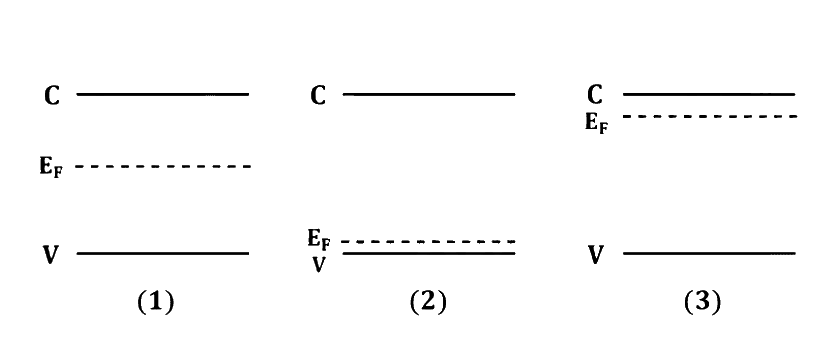
The band diagrams of three semiconductors p, n and intrinsic are given in the figures (1), (2) and (3). C and V are the conduction and valence bands and E F E_F E F
(a) intrinsic, n and p (b) p, intrinsic and n (c) intrinsic, p and n (d) n, intrinsic and p Show answer and solution
Answer: (b)
Loading the solution…
Report a mistake Open question page Q12 MHT CET 2025 · 23 APR · SHIFT 1 Easy ☆
Intrinsic & Extrinsic Semiconductors
Which of the following statements is TRUE for n-type semiconductor?
(a) Holes are majority carriers and trivalent atoms are dopants. (b) Electrons are majority carriers and trivalent atoms are dopants. (c) Holes are minority carriers and pentavalent atoms are dopants. (d) Electrons are minority carriers and pentavalent atoms are dopants. Show answer and solution
Answer: (c)
Loading the solution…
Report a mistake Open question page Q13 MHT CET 2025 · 22 APR · SHIFT 2 Easy ☆
Intrinsic & Extrinsic Semiconductors
In n-type semiconductor, free electrons donated by the impurity atoms occupy energy levels in
(a) the conduction band. (b) the valence band. (c) the band gap and are close to the conduction band. (d) the band gap and are close to the valence band. Show answer and solution
Answer: (c)
Loading the solution…
Report a mistake Open question page Q14 MHT CET 2025 · 22 APR · SHIFT 1 Easy ☆
Intrinsic & Extrinsic Semiconductors
In a pure silicon crystal electron-hole concentration is 1 0 16 10^{16} 1 0 16 m 3 \text{m}^{3} m 3 1 0 21 10^{21} 1 0 21 m 3 \text{m}^{3} m 3
(a) 1 0 5 10^{5} 1 0 5 (b) 1 0 11 10^{11} 1 0 11 (c) 1 0 19 10^{19} 1 0 19 (d) 1 0 21 10^{21} 1 0 21 Show answer and solution
Answer: (b)
Loading the solution…
Report a mistake Open question page Q15 MHT CET 2025 · 25 APR · SHIFT 2 Easy ☆
Intrinsic & Extrinsic Semiconductors
A piece of semiconductor is connected in series in an electric circuit. On increasing the temperature, the current in the circuit will
(a) decrease. (b) remain unchanged. (c) increase. (d) stop flowing. Show answer and solution
Answer: (c)
Loading the solution…
Report a mistake Open question page Q16 MHT CET 2025 · 23 APR · SHIFT 2 Easy ☆
Intrinsic & Extrinsic Semiconductors
By increasing the temperature, the specific resistance of a conductor and a semiconductor respectively
(a) increases, increases. (b) decreases, decreases. (c) increases, decreases. (d) decreases, increases. Show answer and solution
Answer: (c)
Loading the solution…
Report a mistake Open question page Q17 MHT CET 2025 · 21 APR · SHIFT 1 Easy ☆
Intrinsic & Extrinsic Semiconductors
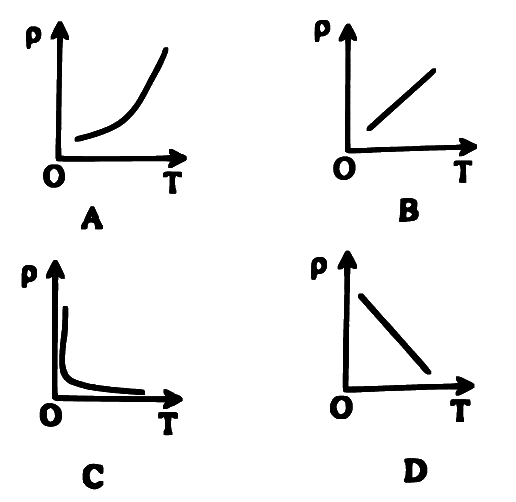
Which graph shows correctly the temperature (T). dependence of resistivity ( ρ ) (\rho) ( ρ )
Show answer and solution
Answer: (a)
Loading the solution…
Report a mistake Open question page Q18 JEE Main 2025 · 4 APR · SHIFT 2 Medium ☆
Intrinsic & Extrinsic Semiconductors
Consider a n-type semiconductor in which n e n_e n e n h n_h n h
(A) Holes are minority carriers
(B) The dopant is a pentavalent atom
(C) n e n h ≠ n i 2 n_e n_h \neq n_i^2 n e n h = n i 2
(where n i n_i n i n e n h ⩾ n i 2 n_e n_h \geqslant n_i^2 n e n h ⩾ n i 2
(E) The holes are not generated due to the donors
Choose the correct answer from the options given below:
(a) (A), (B), (E) only (b) (A), (C), (E) only (c) (A), (B), (C) only (d) (A), (C), (D) only Show answer and solution
Answer: (a)
Loading the solution…
Report a mistake Open question page Q19 MHT CET 2024 · 16 MAY · SHIFT 2 Easy ☆
Intrinsic & Extrinsic Semiconductors
When a small amount of impurity atoms are added to semiconductor, then generally its resistivity
(a) may increase or decrease depending upon the percentage of doping. (b) increases. (c) decreases. (d) does not change. Show answer and solution
Answer: (c)
Loading the solution…
Report a mistake Open question page Q20 MHT CET 2024 · 15 MAY · SHIFT 1 Easy ☆
Intrinsic & Extrinsic Semiconductors
In an extrinsic n-type semiconductor, the free electrons donated by the impurity atoms occupy energy levels in
(a) the conduction band. (b) the valance band. (c) the band gap and are close to conduction band. (d) the band gap and are close to valance band. Show answer and solution
Answer: (c)
Loading the solution…
Report a mistake Open question page Q21 MHT CET 2024 · 3 MAY · SHIFT 2 Easy ☆
Intrinsic & Extrinsic Semiconductors
Which one of the following statements is true? A p-type semiconductor is doped with
(a) trivalent impurity and electrons are majority carriers. (b) pentavalent impurity and electrons are minority carriers. (c) pentavalent impurity and holes are minority carriers. (d) trivalent impurity and holes are majority carriers. Show answer and solution
Answer: (d)
Loading the solution…
Report a mistake Open question page Q22 MHT CET 2024 · 11 MAY · SHIFT 1 Easy ☆
Intrinsic & Extrinsic Semiconductors
If ' n e n_e n e n h n_h n h
(a) n e ≫ n h n_e \gg n_h n e ≫ n h (b) n e ≪ n h n_e \ll n_h n e ≪ n h (c) n e ⩽ n h n_e \leqslant n_h n e ⩽ n h (d) n e = n h n_e = n_h n e = n h Show answer and solution
Answer: (a)
Loading the solution…
Report a mistake Open question page Q23 JEE Main 2024 · 6 APR · SHIFT 2 Medium ☆
Intrinsic & Extrinsic Semiconductors
The acceptor level of a p-type semiconductor is 6 eV 6\text{ eV} 6 eV h c = 1242 eV nm hc = 1242\text{ eV nm} h c = 1242 eV nm
(a) 407 nm (b) 103.5 nm (c) 414 nm (d) 207 nm Show answer and solution
Answer: (d)
Loading the solution…
Report a mistake Open question page Q24 JEE Main 2024 · 1 FEB · SHIFT 2 Difficult ☆
Intrinsic & Extrinsic Semiconductors
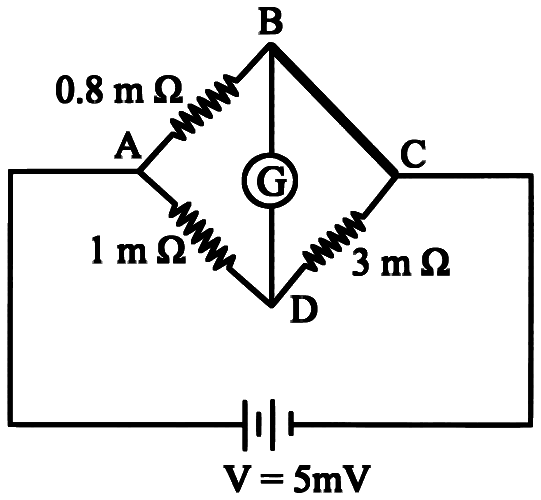
To measure the temperature coefficient of resistivity α \alpha α 2 5 ∘ C 25^\circ\text{C} 2 5 ∘ C 3 m Ω 3\text{ m}\Omega 3 m Ω BC \text{BC} BC 2 ∘ C/s 2^\circ\text{C/s} 2 ∘ C/s G \text{G} G 10 s 10\text{ s} 10 s α \alpha α
(a) − 1 × 1 0 − 2 ∘ C − 1 -1 \times 10^{-2}\ {}^\circ\text{C}^{-1} − 1 × 1 0 − 2 ∘ C − 1 (b) − 2 × 1 0 − 2 ∘ C − 1 -2 \times 10^{-2}\ {}^\circ\text{C}^{-1} − 2 × 1 0 − 2 ∘ C − 1 (c) − 2.5 × 1 0 − 2 ∘ C − 1 -2.5 \times 10^{-2}\ {}^\circ\text{C}^{-1} − 2.5 × 1 0 − 2 ∘ C − 1 (d) − 1.5 × 1 0 − 2 ∘ C − 1 -1.5 \times 10^{-2}\ {}^\circ\text{C}^{-1} − 1.5 × 1 0 − 2 ∘ C − 1 Show answer and solution
Answer: (a)
Loading the solution…
Report a mistake Open question page Q25 MHT CET 2023 · 14 MAY · SHIFT 2 Easy ☆
Intrinsic & Extrinsic Semiconductors
When the conductivity of a semiconductor is only due to the breaking of the covalent bonds, the semiconductor is called
(a) donor (b) intrinsic (c) acceptor (d) extrinsic Show answer and solution
Answer: (b)
Loading the solution…
Report a mistake Open question page Q26 MHT CET 2023 · 9 MAY · SHIFT 1 Easy ☆
Intrinsic & Extrinsic Semiconductors
For an intrinsic semiconductor ( n h (n_h ( n h n e n_e n e
(a) n h < n e n_h < n_e n h < n e (b) n h = n e n_h = n_e n h = n e (c) n h = n e 2 n_h = \frac{n_e}{2} n h = 2 n e (d) n h > n e n_h > n_e n h > n e Show answer and solution
Answer: (b)
Loading the solution…
Report a mistake Open question page Q27 MHT CET 2023 · 13 MAY · SHIFT 2 Easy ☆
Intrinsic & Extrinsic Semiconductors
Doping of a semiconductor (with small impurity atoms) generally changes the resistivity as follows.
(a) Decreases (b) Does not change (c) May increase or decrease depending on the dopant (d) Increase Show answer and solution
Answer: (a)
Loading the solution…
Report a mistake Open question page Q28 NEET 2023 Easy ☆
Intrinsic & Extrinsic Semiconductors
A p-type extrinsic semiconductor is obtained when Germanium is doped with:
(a) Antimony (b) Phosphorous (c) Arsenic (d) Boron Show answer and solution
Answer: (d)
Loading the solution…
Report a mistake Open question page Q29 JEE Main 2023 · 6 APR · SHIFT 1 Easy ☆
Intrinsic & Extrinsic Semiconductors
The resistivity ( ρ ) (\rho) ( ρ )
Show answer and solution
Answer: (d)
Loading the solution…
Report a mistake Open question page Q30 JEE Main 2023 · 31 JAN · SHIFT 1 Easy ☆
Intrinsic & Extrinsic Semiconductors
The effect of increase in temperature on the number of electrons in conduction band (n e n_e n e
(a) n e n_e n e (b) Both n e n_e n e (c) n e n_e n e (d) Both n e n_e n e Show answer and solution
Answer: (c)
Loading the solution…
Report a mistake Open question page Q31 JEE Main 2023 · 1 FEB · SHIFT 1 Medium ☆
Intrinsic & Extrinsic Semiconductors
Match List I with List II:
Choose the correct answer from the options given below:
List I List II A. Intrinsic semiconductor I. Fermi-level near the valence band B. n-type semiconductor II. Fermi-level in the middle of valence and conduction band. C. p-type semiconductor III. Fermi-level near the conduction band D. Metals IV. Fermi-level inside the conduction band
(a) A-III, B-I, C-II, D-IV (b) A-II, B-I, C-III, D-IV (c) A-I, B-II, C-III, D-IV (d) A-II, B-III, C-I, D-IV Show answer and solution
Answer: (d)
Loading the solution…
Report a mistake Open question page Q32 MHT CET 2023 · 10 MAY · SHIFT 2 Medium ☆
Intrinsic & Extrinsic Semiconductors
A pure Si \text{Si} Si 4 × 1 0 28 4 \times 10^{28} 4 × 1 0 28 m 3 \text{m}^{3} m 3
(a) 4 × 1 0 34 m − 3 4 \times 10^{34}\text{ m}^{-3} 4 × 1 0 34 m − 3 (b) 4 × 1 0 28 m − 3 4 \times 10^{28}\text{ m}^{-3} 4 × 1 0 28 m − 3 (c) 4 × 1 0 22 m − 3 4 \times 10^{22}\text{ m}^{-3} 4 × 1 0 22 m − 3 (d) 4 × 1 0 20 m − 3 4 \times 10^{20}\text{ m}^{-3} 4 × 1 0 20 m − 3 Show answer and solution
Answer: (c)
Loading the solution…
Report a mistake Open question page Q33 NEET 2022 · PHASE 1 Easy ☆
Intrinsic & Extrinsic Semiconductors
As the temperature increases, the electrical resistance
(a) Increases for both conductors and semiconductors (b) Decreases for both conductors and semiconductors (c) Increases for conductors but decreases for semiconductors (d) Decreases for conductors but increases for semiconductors Show answer and solution
Answer: (c)
Loading the solution…
Report a mistake Open question page Q34 JEE Main 2021 · 26 AUG · SHIFT 1 Easy ☆
Intrinsic & Extrinsic Semiconductors
Statement I: By doping silicon semiconductor with pentavalent material, the electrons density increases.
Statement II: The n-type semiconductor has net negative charge.
In the light of the above statements, choose the most appropriate answer from the options given below:
(a) Statement - I is true but Statement - II is false. (b) Statement - I is false but Statement - II is true. (c) Both Statement I and Statement II are true. (d) Both Statement I and Statement II are false. Show answer and solution
Answer: (a)
Loading the solution…
Report a mistake Open question page Q35 MHT CET 2021 · 21 SEP · SHIFT 1 Easy ☆
Intrinsic & Extrinsic Semiconductors
In a pure silicon, number of electrons and holes per unit volume are 1.6 × 1 0 16 m − 3 1.6 \times 10^{16}\text{ m}^{-3} 1.6 × 1 0 16 m − 3 4 × 1 0 22 m − 3 4 \times 10^{22}\text{ m}^{-3} 4 × 1 0 22 m − 3
(a) 6.4 × 1 0 − 9 m − 3 6.4 \times 10^{-9}\text{ m}^{-3} 6.4 × 1 0 − 9 m − 3 (b) 6.4 × 1 0 9 m − 3 6.4 \times 10^{9}\text{ m}^{-3} 6.4 × 1 0 9 m − 3 (c) 6.4 × 1 0 − 10 m − 3 6.4 \times 10^{-10}\text{ m}^{-3} 6.4 × 1 0 − 10 m − 3 (d) 6.4 × 1 0 10 m − 3 6.4 \times 10^{10}\text{ m}^{-3} 6.4 × 1 0 10 m − 3 Show answer and solution
Answer: (b)
Loading the solution…
Report a mistake Open question page Q36 JEE Main 2021 · 25 JUL · SHIFT 2 Easy ☆
Intrinsic & Extrinsic Semiconductors
In a semiconductor, the number density of intrinsic charge carries at 27∘ ^\circ ∘ × \times × × \times × × \times ×
Numerical answer type. Work it out, then open the answer.
Show answer and solution
Answer: 5
Loading the solution…
Report a mistake Open question page Q37 MHT CET 2021 · 23 SEP · SHIFT 2 Easy ☆
Intrinsic & Extrinsic Semiconductors
When the temperature of a semiconductor is increased, its resistance and electric conductivity respectively.
(a) increases and decreases (b) decreases and decreases (c) increases and increases (d) decreases and increases Show answer and solution
Answer: (d)
Loading the solution…
Report a mistake Open question page Q38 JEE Main 2021 · 25 FEB · SHIFT 2 Medium ☆
Intrinsic & Extrinsic Semiconductors
For extrinsic semiconductors; when doping level is increased;
(a) Fermi-level of both p-type and n-type semiconductors will go upward for T > TFK and downward for T < TFK, where TF is Fermi temperature. (b) Fermi-level of p-type semiconductor will go upward and Fermi-level of n-type semiconductors will go downward (c) Fermi-level of p and n-type semiconductors will not be affected. (d) Fermi-level of p-type semiconductors will go downward and Fermi-level of n-type semiconductor will go upward. Show answer and solution
Answer: (d)
Loading the solution…
Report a mistake Open question page Q39 NEET 2021 Medium ☆
Intrinsic & Extrinsic Semiconductors
The electron concentration in an n-type semiconductor is the same as hole concentration in a p-type semiconductor. An external field (electric) is applied across each of them. Compare the currents in them.
(a) No current will flow in p-type, current will only flow in n-type (b) Current in n-type = current in p-type (c) current in p-type > current in n-type (d) current in n-type > current in p-type Show answer and solution
Answer: (d)
Loading the solution…
Report a mistake Open question page Q40 MHT CET 2021 · 20 SEP · SHIFT 1 Medium ☆
Intrinsic & Extrinsic Semiconductors
Silicon and copper are cooled from 300 K to 100 K, the specific resistance (resistivity)
(a) increases in both copper and silicon (b) decreases in both copper and silicon (c) decreases in copper and increases in silicon (d) increases in copper and decreases in silicon Show answer and solution
Answer: (c)
Loading the solution…
Report a mistake Open question page Q41 MHT CET 2020 · 19 OCT · SHIFT 2 Easy ☆
Intrinsic & Extrinsic Semiconductors
In an intrinsic semiconductor, at an ordinary temperature, the correct relation between the number of electrons per unit volume n e n_e n e n h n_h n h
(a) n e = n h n_e = n_h n e = n h (b) n e > n h n_e > n_h n e > n h (c) n e < n h n_e < n_h n e < n h (d) n e = n h = 0 n_e = n_h = 0 n e = n h = 0 Show answer and solution
Answer: (a)
Loading the solution…
Report a mistake Open question page Q42 MHT CET 2020 · 16 OCT · SHIFT 1 Easy ☆
Intrinsic & Extrinsic Semiconductors
When a small amount of impurity atoms are added to a semiconductor, then generally its resistivity
(a) may increase or decrease depending upon the percentage of doping (b) increases (c) decreases (d) does not change Show answer and solution
Answer: (c)
Loading the solution…
Report a mistake Open question page Q43 NEET 2020 · PHASE 2 Easy ☆
Intrinsic & Extrinsic Semiconductors
An intrinsic semiconductor is converted into n n n
(a) Germanium (b) Phosphorous (c) Aluminium (d) Silver Show answer and solution
Answer: (b)
Loading the solution…
Report a mistake Open question page Q44 MHT CET 2020 · 16 OCT · SHIFT 2 Easy ☆
Intrinsic & Extrinsic Semiconductors
At absolute zero temperature, pure silicon behaves as
(a) non-metal (b) insulator (c) metal (d) extrinsic semiconductor Show answer and solution
Answer: (b)
Loading the solution…
Report a mistake Open question page Q45 NEET 2019 Easy ☆
Intrinsic & Extrinsic Semiconductors
For a p-type semiconductor, which of the following statements is true?
(a) Holes are the majority carriers and trivalent atoms are the dopants. (b) Holes are the majority carriers and pentavalent atoms are the dopants. (c) Electrons are the majority carriers and pentavalent atoms are the dopants (d) Electrons are the majority carriers and trivalent atoms are the dopants. Show answer and solution
Answer: (a)
Loading the solution…
Report a mistake Open question page Q46 JEE Main 2019 · 9 JAN · SHIFT 1 Medium ☆
Intrinsic & Extrinsic Semiconductors
Mobility of electrons in a semiconductor is defined as the ratio of their drift velocity to the applied electric field. If, for an n-type semiconductor, the density of electrons is 1019 m− 3 {}^{-3} − 3
(a) 2 Ω 2\ \Omega 2 Ω (b) 4 Ω \Omega Ω (c) 0.4 Ω \Omega Ω (d) 0.2 Ω \Omega Ω Show answer and solution
Answer: (c)
Loading the solution…
Report a mistake Open question page Q47 JEE Main 2017 · 8 APR · SHIFT 1 Medium ☆
Intrinsic & Extrinsic Semiconductors
What is the conductivity of a semiconductor sample having electron concentration of 5 × 1 0 18 m − 3 , 5 \times 10^{18}\text{ m}^{-3}, 5 × 1 0 18 m − 3 , 5 × 1 0 19 m − 3 , 5 \times 10^{19}\text{ m}^{-3}, 5 × 1 0 19 m − 3 , − 1 {}^{-1} − 1 − 1 {}^{-1} − 1 − 1 {}^{-1} − 1
(Take charge of electron as 1.6 × \times × − - −
(a) 1.68 (Ω \Omega Ω − 1 {}^{-1} − 1 (b) 1.83 (Ω \Omega Ω − 1 {}^{-1} − 1 (c) 0.59 (Ω \Omega Ω − 1 {}^{-1} − 1 (d) 1.20 (Ω \Omega Ω − 1 {}^{-1} − 1 Show answer and solution
Answer: (a)
Loading the solution…
Report a mistake Open question page Q48 JEE Main 2016 Difficult ☆
Intrinsic & Extrinsic Semiconductors
The temperature dependence of resistance of Cu \text{Cu} Cu Si \text{Si} Si 300 − 400 K , 300 - 400\text{ K}, 300 − 400 K ,
(a) Linear increases for Cu , \text{Cu}, Cu , Si . \text{Si}. Si . (b) Linear decrease for Cu , \text{Cu}, Cu , Si \text{Si} Si (c) Linear increase for Cu , \text{Cu}, Cu , Si . \text{Si}. Si . (d) Linear increase for Cu , \text{Cu}, Cu , Si \text{Si} Si Show answer and solution
Answer: (a)
Loading the solution…
Report a mistake Open question page Q49 NEET 2013 Easy ☆
Intrinsic & Extrinsic Semiconductors
In a n-type semiconductor, which of the following statements is true?
(a) Holes are minority carriers and pentavalent atoms are dopants. (b) Holes are majority carriers and trivalent atoms are dopants. (c) Electrons are majority carriers and trivalent atoms are dopants. (d) Electrons are minority carriers and pentavalent atoms are dopants. Show answer and solution
Answer: (a)
Loading the solution…
Report a mistake Open question page Q50 NEET 2011 · AIPMT · PRELIMS Easy ☆
Intrinsic & Extrinsic Semiconductors
If a small amount of antimony is added to germanium crystal
(a) it becomes a p-type semiconductor (b) the antimony becomes an acceptor atom (c) there will be more free electrons than holes in the semiconductor (d) its resistance is increased Show answer and solution
Answer: (c)
Loading the solution…
Report a mistake Open question page Q51 NEET 2011 · AIPMT · MAINS Easy ☆
Intrinsic & Extrinsic Semiconductors
Pure Si at 500 K has equal number of electron (ne) and hole (nh) concentrations of 1.5 × \times × − 3 {}^{-3} − 3 × \times × − 3 {}^{-3} − 3
(a) p-type having electron concentration ne = 5 × \times × − 3 {}^{-3} − 3 (b) n-type with electron concentration ne = 5 × \times × − 3 {}^{-3} − 3 (c) p-type with electron concentration ne = 2.5 × \times × − 3 {}^{-3} − 3 (d) n-type with electron concentration ne = 2.5 × \times × − 3 {}^{-3} − 3 Show answer and solution
Answer: (a)
Loading the solution…
Report a mistake Open question page Q52 NEET 2010 · AIPMT · PRELIMS Easy ☆
Intrinsic & Extrinsic Semiconductors
Which one of the following statement is false?
(a) Pure Si doped with trivalent impurities gives a p-type semiconductor. (b) Majority carries in a n-type semiconductor are holes. (c) Minority carries in a p-type semiconductor are electrons. (d) The resistance of intrinisic semiconductor decreases with increase of temperature. Show answer and solution
Answer: (b)
Loading the solution…
Report a mistake Open question page Q53 NEET 2007 · AIPMT Medium ☆
Intrinsic & Extrinsic Semiconductors
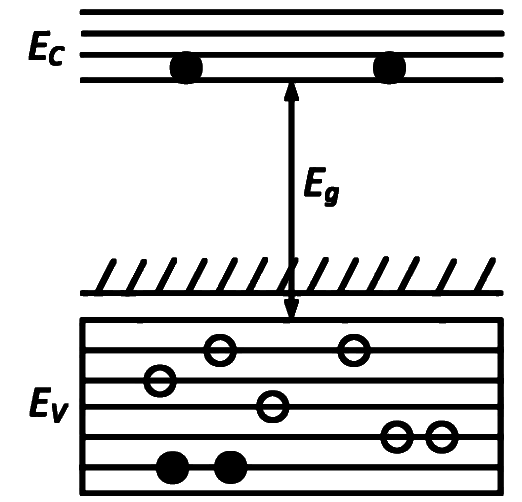
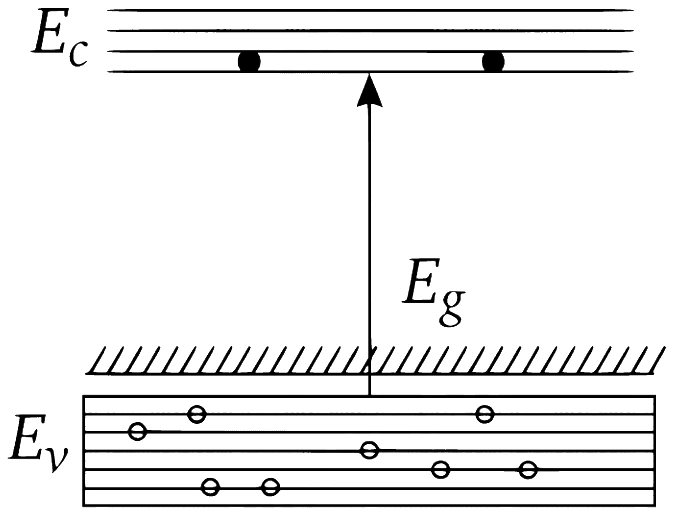
In the energy band diagram of a material shown below, the open circles and filled circles denote holes and electrons respectively. The material is
(a) an insulator (b) a metal (c) an n-type semiconductor (d) a p-type semiconductor. Show answer and solution
Answer: (d)
Loading the solution…
Report a mistake Open question page Q54 JEE Main 2006 · AIEEE Medium ☆
Intrinsic & Extrinsic Semiconductors
If the ratio of the concentration of electrons to that of holes in a semiconductor is 7 5 \frac{7}{5} 5 7 7 4 , \frac{7}{4}, 4 7 ,
(a) 5 8 \frac{5}{8} 8 5 (b) 4 5 \frac{4}{5} 5 4 (c) 5 4 \frac{5}{4} 4 5 (d) 4 7 \frac{4}{7} 7 4 Show answer and solution
Answer: (c)
Loading the solution…
Report a mistake Open question page Q55 JEE Main 2004 · AIEEE Easy ☆
Intrinsic & Extrinsic Semiconductors
A piece of copper and another of germanium are cooled from room temperature to 77 K , 77\text{ K}, 77 K ,
(a) copper increases and germanium decreases (b) each of them decreases (c) each of them increases (d) copper decreases and germanium increases Show answer and solution
Answer: (d)
Loading the solution…
Report a mistake Open question page Q56 JEE Main 2003 · AIEEE Easy ☆
Intrinsic & Extrinsic Semiconductors
A strip of copper and another of germanium are cooled from room temperature to 80 K . 80\text{ K}. 80 K .
(a) each of these decreases (b) copper strip increases and that of germanium decreases (c) copper strip decreases and that of germanium increases (d) each of these increases Show answer and solution
Answer: (c)
Loading the solution…
Report a mistake Open question page Q57 JEE Main 2003 · AIEEE Medium ☆
Intrinsic & Extrinsic Semiconductors
The difference in the variation of resistance with temperature in a metal and a semiconductor arises essentially due to the difference in the
(a) crystal structure (b) variation of the number of charge carriers with temperature (c) type of bonding (d) variation of scattering mechanism with temperature Show answer and solution
Answer: (b)
Loading the solution…
Report a mistake Open question page Q58 JEE Main 2002 · AIEEE Easy ☆
Intrinsic & Extrinsic Semiconductors
At absolute zero, Si acts as
(a) non-metal (b) metal (c) insulator (d) none of these Show answer and solution
Answer: (c)
Loading the solution…
Report a mistake Open question page Q59 JEE Main 2002 · AIEEE Easy ☆
Intrinsic & Extrinsic Semiconductors
By increasing the temperature, the specific resistance of a conductor and a semiconductor
(a) increases for both (b) decreases for both (c) increases, decreases (d) decreases, increases Show answer and solution
Answer: (c)
Loading the solution…
Report a mistake Open question page Q60 NEET 1999 · AIPMT Easy ☆
Intrinsic & Extrinsic Semiconductors
Which of the following when added as an impurity into silicon produces n n n
Show answer and solution
Answer: (a)
Loading the solution…
Report a mistake Open question page Q61 NEET 1999 · AIPMT Easy ☆
Intrinsic & Extrinsic Semiconductors
In a junction diode, the holes are due to
(a) protons (b) extra electrons (c) neutrons (d) missing electrons Show answer and solution
Answer: (d)
Loading the solution…
Report a mistake Open question page Q62 NEET 1999 · AIPMT Easy ☆
Intrinsic & Extrinsic Semiconductors
In p p p
(a) holes (b) electrons (c) protons (d) neutrons Show answer and solution
Answer: (a)
Loading the solution…
Report a mistake Open question page Q63 NEET 1997 · AIPMT Easy ☆
Intrinsic & Extrinsic Semiconductors
To obtain a p-type germanium semiconductor, it must be doped with
(a) indium (b) phosphorus (c) arsenic (d) antimony Show answer and solution
Answer: (a)
Loading the solution…
Report a mistake Open question page Q64 NEET 1996 · AIPMT Easy ☆
Intrinsic & Extrinsic Semiconductors
When arsenic is added as an impurity to silicon, the resulting material is
(a) n-type conductor (b) n-type semiconductor (c) p-type semiconductor (d) none of these Show answer and solution
Answer: (b)
Loading the solution…
Report a mistake Open question page Q65 NEET 1992 · AIPMT Easy ☆
Intrinsic & Extrinsic Semiconductors
A piece of copper and other of germanium are cooled from the room temperature to 80 K 80\text{ K} 80 K
(a) resistance of each will increase (b) resistance of copper will decrease (c) the resistance of copper will increase while that of germanium will decrease (d) the resistance of copper will decrease while that of germanium will increase Show answer and solution
Answer: (d)
Loading the solution…
Report a mistake Open question page Q66 NEET 1989 · AIPMT Medium ☆
Intrinsic & Extrinsic Semiconductors
When n type semiconductor is heated
(a) number of electrons increases while that of holes decreases (b) number of holes increases while that of electrons decreases (c) number of electrons and holes remain same (d) number of electrons and holes increases equally Show answer and solution
Answer: (d)
Loading the solution…
Report a mistake Open question page Q67 NEET 1988 · AIPMT Easy ☆
Intrinsic & Extrinsic Semiconductors
At absolute zero, Si acts as
(a) non metal (b) metal (c) insulator (d) none of these Show answer and solution
Answer: (c)
Loading the solution…
Report a mistake Open question page Q68 NDA 2017 Easy ☆
Intrinsic & Extrinsic Semiconductors
The majority charge carriers in a p-type semiconductor are
(a) free electrons (b) conduction electrons (c) ions (d) holes Show answer
Answer: (d)
Step-by-step solution coming soon.
Report a mistake Q69 AIIMS 2017 Medium ☆
Intrinsic & Extrinsic Semiconductors
A specimen of silicon is to be made P P P 5 × 1 0 7 5 \times 10^{7} 5 × 1 0 7 5 × 1 0 22 atom m − 3 5 \times 10^{22}\,\text{atom m}^{-3} 5 × 1 0 22 atom m − 3 cm 3 \text{cm}^3 cm 3
(a) 2.5 × 1 0 30 2.5 \times 10^{30} 2.5 × 1 0 30 (b) 1.0 × 1 0 13 1.0 \times 10^{13} 1.0 × 1 0 13 (c) 1.0 × 1 0 15 1.0 \times 10^{15} 1.0 × 1 0 15 (d) 2.5 × 1 0 36 2.5 \times 10^{36} 2.5 × 1 0 36 Show answer
Answer: (c)
Step-by-step solution coming soon.
Report a mistake Q70 AIIMS 2016 Medium ☆
Intrinsic & Extrinsic Semiconductors
A semiconductor has an electron concentration of 8 × 1 0 13 per cm 3 8 \times 10^{13}\,\text{per cm}^3 8 × 1 0 13 per cm 3 5 × 1 0 12 per cm 3 5 \times 10^{12}\,\text{per cm}^3 5 × 1 0 12 per cm 3 25000 cm 2 V − 1 s − 1 25000\,\text{cm}^2\text{V}^{-1}\text{s}^{-1} 25000 cm 2 V − 1 s − 1 100 cm 2 V − 1 s − 1 100\,\text{cm}^2\text{V}^{-1}\text{s}^{-1} 100 cm 2 V − 1 s − 1
(a) the semiconductor is n n n (b) the conductivity is 320 m mho cm − 1 320\,\text{m mho cm}^{-1} 320 m mho cm − 1 (c) Both (a) and (b) (d) None of the above Show answer
Answer: (c)
Step-by-step solution coming soon.
Report a mistake Q71 AIIMS 2015 Medium ☆
Intrinsic & Extrinsic Semiconductors
A semiconductor having electron and hole mobilities μ n \mu_n μ n μ p \mu_p μ p n i n_i n i P P P
(a) n i μ n μ p n_i\sqrt{\dfrac{\mu_n}{\mu_p}} n i μ p μ n (b) n h μ n μ p n_h\sqrt{\dfrac{\mu_n}{\mu_p}} n h μ p μ n (c) n i μ p μ n n_i\sqrt{\dfrac{\mu_p}{\mu_n}} n i μ n μ p (d) n h μ p μ n n_h\sqrt{\dfrac{\mu_p}{\mu_n}} n h μ n μ p Show answer
Answer: (a)
Step-by-step solution coming soon.
Report a mistake Q72 AIIMS 2014 Easy ☆
Intrinsic & Extrinsic Semiconductors
If μ e \mu_e μ e μ h \mu_h μ h E E E τ \tau τ
(a) n i e ( μ e + μ h ) E n_i e(\mu_e + \mu_h)E n i e ( μ e + μ h ) E (b) n i e ( μ e − μ h ) E n_i e(\mu_e - \mu_h)E n i e ( μ e − μ h ) E (c) n i e ( μ e + μ h ) E \dfrac{n_i e(\mu_e + \mu_h)}{E} E n i e ( μ e + μ h ) (d) E n i e ( μ e + μ n ) \dfrac{E}{n_i e(\mu_e + \mu_n)} n i e ( μ e + μ n ) E Show answer
Answer: (a)
Step-by-step solution coming soon.
Report a mistake Q73 AIIMS 2013 Easy ☆
Intrinsic & Extrinsic Semiconductors
To obtain a p p p
(a) arsenic (b) antimony (c) indium (d) phosphorous Show answer
Answer: (c)
Step-by-step solution coming soon.
Report a mistake Q74 AIIMS 2007 Easy ☆
Intrinsic & Extrinsic Semiconductors
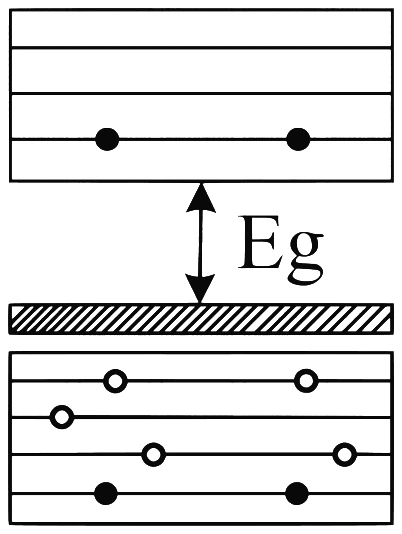
In the energy band diagram of a material shown below, the open circles and filled circles denote holes and electrons respectively. The material is a/an
(a) p-type semiconductor (b) insulator (c) metal (d) n-type semiconductor Show answer
Answer: (a)
Step-by-step solution coming soon.
Report a mistake Q75 AIIMS 2005 Easy ☆
Intrinsic & Extrinsic Semiconductors
In a semiconducting material the mobilities of electrons and holes are μ e \mu_e μ e μ h \mu_h μ h
(a) μ e > μ h \mu_e > \mu_h μ e > μ h (b) μ e < μ h \mu_e < \mu_h μ e < μ h (c) μ e = μ h \mu_e = \mu_h μ e = μ h (d) μ e < 0 ; μ h > 0 \mu_e < 0;\ \mu_h > 0 μ e < 0 ; μ h > 0 Show answer
Answer: (a)
Step-by-step solution coming soon.
Report a mistake Q76 AIIMS 2005 Easy ☆
Intrinsic & Extrinsic Semiconductors
Assertion: The number of electrons in a p p p
(a) If both Assertion and Reason are true and the Reason is the correct explanation of the Assertion (b) If both Assertion and Reason are true but the Reason is not the correct explanation of the Assertion (c) If Assertion is true but Reason is false (d) If both Assertion and Reason are false Show answer
Answer: (a)
Step-by-step solution coming soon.
Report a mistake Q77 AIIMS 2004 Medium ☆
Intrinsic & Extrinsic Semiconductors
A Ge specimen is doped with Al. The concentration of acceptor atoms is ∼ 1 0 21 atoms m − 3 \sim 10^{21}\,\text{atoms m}^{-3} ∼ 1 0 21 atoms m − 3 ∼ 1 0 19 m − 3 \sim 10^{19}\,\text{m}^{-3} ∼ 1 0 19 m − 3
(a) 1 0 17 m − 3 10^{17}\,\text{m}^{-3} 1 0 17 m − 3 (b) 1 0 15 m − 3 10^{15}\,\text{m}^{-3} 1 0 15 m − 3 (c) 1 0 4 m − 3 10^{4}\,\text{m}^{-3} 1 0 4 m − 3 (d) 1 0 2 m − 3 10^{2}\,\text{m}^{-3} 1 0 2 m − 3 Show answer
Answer: (a)
Step-by-step solution coming soon.
Report a mistake Q78 JIPMER 2004 Easy ☆
Intrinsic & Extrinsic Semiconductors
In junction diode, the holes are because of
(a) missing electrons (b) extra electrons (c) protons (d) neutrons Show answer
Answer: (a)
Step-by-step solution coming soon.
Report a mistake Q79 BITSAT 2025 Easy ☆
Intrinsic & Extrinsic Semiconductors
The temperature (T T T ρ \rho ρ
(a) Graph (A) (b) Graph (B) (c) Graph (C) (d) Graph (D) Show answer
Answer: (c)
Step-by-step solution coming soon.
Report a mistake Q80 VITEEE 2024 Medium ☆
Intrinsic & Extrinsic Semiconductors
A germanium crystal is doped with arsenic atoms and indium atoms simultaneously. Number of arsenic atoms used = 5 × 1 0 22 = 5\times 10^{22} = 5 × 1 0 22 m 3 \text{m}^3 m 3 = 5 × 1 0 20 = 5\times 10^{20} = 5 × 1 0 20 m 3 \text{m}^3 m 3
(a) p-n junction (b) p-type semiconductor (c) n n n (d) Depends on number of germanium atoms in given sample. Show answer
Answer: (c)
Step-by-step solution coming soon.
Report a mistake Q81 VITEEE 2015 Easy ☆
Intrinsic & Extrinsic Semiconductors
An n n n
(a) neutral (b) positively charged (c) negatively charged (d) negatively or positively charged depending on the amount of impurity added Show answer
Answer: (a)
Step-by-step solution coming soon.
Report a mistake Q82 VITEEE 2013 Medium ☆
Intrinsic & Extrinsic Semiconductors
Mobilities of electrons and holes in a sample of intrinsic germanium at room temperature are 0.36 m 2 V − 1 s − 1 0.36\,\text{m}^2\,\text{V}^{-1}\,\text{s}^{-1} 0.36 m 2 V − 1 s − 1 0.17 m 2 V − 1 s − 1 0.17\,\text{m}^2\,\text{V}^{-1}\,\text{s}^{-1} 0.17 m 2 V − 1 s − 1 2.5 × 1 0 19 m − 3 2.5 \times 10^{19}\,\text{m}^{-3} 2.5 × 1 0 19 m − 3
(a) 4.24 S m − 1 4.24\,\text{S m}^{-1} 4.24 S m − 1 (b) 2.12 S m − 1 2.12\,\text{S m}^{-1} 2.12 S m − 1 (c) 1.09 S m − 1 1.09\,\text{S m}^{-1} 1.09 S m − 1 (d) 0.47 S m − 1 0.47\,\text{S m}^{-1} 0.47 S m − 1 Show answer
Answer: (b)
Step-by-step solution coming soon.
Report a mistake Q83 VITEEE 2010 Medium ☆
Intrinsic & Extrinsic Semiconductors
A potential difference of 2 V 2\,\text{V} 2 V 1 cm 2 1\,\text{cm}^2 1 cm 2 0.5 mm 0.5\,\text{mm} 0.5 mm 2 × 1 0 19 m − 3 2 \times 10^{19}\,\text{m}^{-3} 2 × 1 0 19 m − 3 0.36 m 2 V − 1 s − 1 0.36\,\text{m}^2\,\text{V}^{-1}\,\text{s}^{-1} 0.36 m 2 V − 1 s − 1 0.14 m 2 V − 1 s − 1 0.14\,\text{m}^2\,\text{V}^{-1}\,\text{s}^{-1} 0.14 m 2 V − 1 s − 1
(a) 0.25 A 0.25\,\text{A} 0.25 A (b) 0.45 A 0.45\,\text{A} 0.45 A (c) 0.56 A 0.56\,\text{A} 0.56 A (d) 0.64 A 0.64\,\text{A} 0.64 A Show answer
Answer: (d)
Step-by-step solution coming soon.
Report a mistake Q84 VITEEE 2006 Easy ☆
Intrinsic & Extrinsic Semiconductors
In a P-type semiconductor, the acceptor impurity produces an energy level
(a) just below the valence band (b) just above the conduction band (c) just below the conduction band (d) just above the valence band Show answer
Answer: (d)
Step-by-step solution coming soon.
Report a mistake Q85 VITEEE 2006 Easy ☆
Intrinsic & Extrinsic Semiconductors
When the conductivity of a semiconductor is only due to the breaking up of the covalent bonds, the semiconductor is known as
(a) donor (b) extrinsic (c) intrinsic (d) acceptor Show answer
Answer: (c)
Step-by-step solution coming soon.
Report a mistake Q86 COMEDK 2026 Medium ☆
Intrinsic & Extrinsic Semiconductors
A silicon sample is doped simultaneously with donor impurity phosphorus at a concentration of N D = 3 × 1 0 22 m − 3 N_D = 3 \times 10^{22}\,\text{m}^{-3} N D = 3 × 1 0 22 m − 3 N A = 2.8 × 1 0 22 m − 3 N_A = 2.8 \times 10^{22}\,\text{m}^{-3} N A = 2.8 × 1 0 22 m − 3 n i = 1.5 × 1 0 16 m − 3 n_i = 1.5 \times 10^{16}\,\text{m}^{-3} n i = 1.5 × 1 0 16 m − 3
(a) 1.125 × 1 0 10 m − 3 1.125 \times 10^{10}\,\text{m}^{-3} 1.125 × 1 0 10 m − 3 (b) 1.125 × 1 0 11 m − 3 1.125 \times 10^{11}\,\text{m}^{-3} 1.125 × 1 0 11 m − 3 (c) 2.125 × 1 0 10 m − 3 2.125 \times 10^{10}\,\text{m}^{-3} 2.125 × 1 0 10 m − 3 (d) 2.125 × 1 0 11 m − 3 2.125 \times 10^{11}\,\text{m}^{-3} 2.125 × 1 0 11 m − 3 Show answer
Answer: (b)
Step-by-step solution coming soon.
Report a mistake Q87 COMEDK 2025 Easy ☆
Intrinsic & Extrinsic Semiconductors
An intrinsic semiconductor has equal concentrations of hole and electron equal to 4 × 1 0 8 m − 3 4 \times 10^{8}\,\text{m}^{-3} 4 × 1 0 8 m − 3 8 × 1 0 10 m − 3 8 \times 10^{10}\,\text{m}^{-3} 8 × 1 0 10 m − 3
(a) 4 × 1 0 8 m − 3 4 \times 10^{8}\,\text{m}^{-3} 4 × 1 0 8 m − 3 (b) 2 × 1 0 8 m − 3 2 \times 10^{8}\,\text{m}^{-3} 2 × 1 0 8 m − 3 (c) 2 × 1 0 6 m − 3 2 \times 10^{6}\,\text{m}^{-3} 2 × 1 0 6 m − 3 (d) 4 × 1 0 10 m − 3 4 \times 10^{10}\,\text{m}^{-3} 4 × 1 0 10 m − 3 Show answer
Answer: (c)
Step-by-step solution coming soon.
Report a mistake Q88 COMEDK 2025 Easy ☆
Intrinsic & Extrinsic Semiconductors
In the energy band diagram of a material shown below, open circles and filled circles denote holes and electrons respectively. The material is a
(a) metal (b) insulator (c) n-type semiconductor (d) p-type semiconductor Show answer
Answer: (d)
Step-by-step solution coming soon.
Report a mistake Q89 COMEDK 2024 Easy ☆
Intrinsic & Extrinsic Semiconductors
The conductivity of a semiconductor increases with increase in temperature because
Show answer
Answer: (b)
Step-by-step solution coming soon.
Report a mistake Q90 COMEDK 2024 Easy ☆
Intrinsic & Extrinsic Semiconductors
The mobility of the charge carriers increases with
(a) The average collision time (b) Increase in the mass of the charge (c) Increase in the electric field (d) Decrease in the charge of the mobile carriers Show answer
Answer: (a)
Step-by-step solution coming soon.
Report a mistake Q91 COMEDK 2024 Easy ☆
Intrinsic & Extrinsic Semiconductors
In intrinsic semiconductors at room temperature, the number of electrons and holes are
(a) zero (b) infinity (c) unequal (d) equal Show answer
Answer: (d)
Step-by-step solution coming soon.
Report a mistake Q92 COMEDK 2024 Medium ☆
Intrinsic & Extrinsic Semiconductors
In a given semiconductor, the ratio of the number density of electrons to the number density of holes is 2 : 1 2:1 2 : 1 1 7 \dfrac{1}{7} 7 1
(a) 2 3 \dfrac{2}{3} 3 2 (b) 3 1 \dfrac{3}{1} 1 3 (c) 3 2 \dfrac{3}{2} 2 3 (d) 1 3 \dfrac{1}{3} 3 1 Show answer
Answer: (d)
Step-by-step solution coming soon.
Report a mistake Q93 KCET 2026 Easy ☆
Intrinsic & Extrinsic Semiconductors
An n-type and p-type semiconductor can be obtained by respectively doping pure silicon with
(a) Arsenic and Phosphorous respectively (b) Indium and Aluminium respectively (c) Phosphorous and Indium respectively (d) Aluminium and Boron respectively Show answer
Answer: (c)
Step-by-step solution coming soon.
Report a mistake Q94 KCET 2026 Medium ☆
Intrinsic & Extrinsic Semiconductors
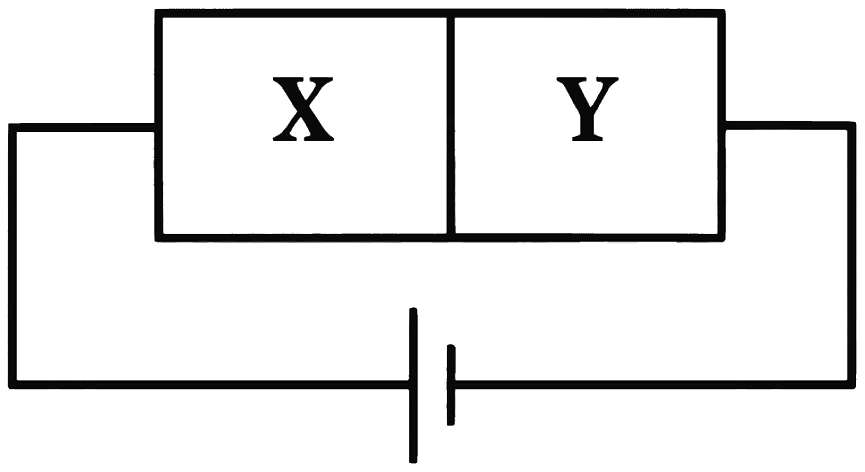
A wafer of pure germanium crystal has two parts X and Y. The end X is obtained by doping with arsenic and Y with indium. It is connected to a battery as shown in the figure. Which of the following statements is correct?
(a) X is p-type, Y is n-type and the junction is forward biased (b) X is n-type, Y is p-type and the junction is forward biased (c) X is p-type, Y is n-type and the junction is reverse biased (d) X is n-type, Y is p-type and the junction is reverse biased Show answer
Answer: (d)
Step-by-step solution coming soon.
Report a mistake Q95 KCET 2025 Easy ☆
Intrinsic & Extrinsic Semiconductors
Which of the following statements is correct for an n-type semiconductor?
(a) The donor energy level lies closely above the top of the valence band (b) The donor energy level lies at the half way mark of forbidden energy gap (c) The donor energy level does not exist (d) The donor energy level lies just below the bottom of the conduction band Show answer
Answer: (d)
Step-by-step solution coming soon.
Report a mistake Q96 KCET 2020 Easy ☆
Intrinsic & Extrinsic Semiconductors
A positive hole in a semiconductor is
(a) an anti-particle of electron (b) a vacancy created when an electron leaves a covalent bond (c) absence of free electrons (d) an artificially created particle Show answer
Answer: (b)
Step-by-step solution coming soon.
Report a mistake Q97 KCET 2019 Easy ☆
Intrinsic & Extrinsic Semiconductors
The conductivity of semiconductor increases with increase in temperature because
(a) number density of charge carriers increases (b) relaxation time increases (c) both number density of charge carriers and relaxation time increases (d) number density of current carriers increases, relaxation time decreases but effect of decrease in relaxation time is much less than increase in number density Show answer
Answer: (d)
Step-by-step solution coming soon.
Report a mistake Q98 KCET 2018 Medium ☆
Intrinsic & Extrinsic Semiconductors
The density of electron-hole pair in a pure germanium is 3 × 1 0 16 m − 3 3 \times 10^{16}\,\text{m}^{-3} 3 × 1 0 16 m − 3 4.5 × 1 0 22 m − 3 4.5 \times 10^{22}\,\text{m}^{-3} 4.5 × 1 0 22 m − 3 m − 3 \text{m}^{-3} m − 3
(a) 1 × 1 0 10 1 \times 10^{10} 1 × 1 0 10 (b) 2 × 1 0 10 2 \times 10^{10} 2 × 1 0 10 (c) 0.5 × 1 0 10 0.5 \times 10^{10} 0.5 × 1 0 10 (d) 4 × 1 0 10 4 \times 10^{10} 4 × 1 0 10 Show answer
Answer: (b)
Step-by-step solution coming soon.
Report a mistake Q99 AP EAPCET 2025 Easy ☆
Intrinsic & Extrinsic Semiconductors
At absolute zero temperature, an intrinsic semiconductor behaves as
(a) conductor (b) superconductor (c) insulator (d) intrinsic semiconductor Show answer
Answer: (c)
Step-by-step solution coming soon.
Report a mistake Q100 AP EAPCET 2024 Easy ☆
Intrinsic & Extrinsic Semiconductors
Pure silicon at 300 K 300\,\text{K} 300 K 1.5 × 1 0 16 m − 3 1.5 \times 10^{16}\,\text{m}^{-3} 1.5 × 1 0 16 m − 3 3 × 1 0 22 m − 3 3 \times 10^{22}\,\text{m}^{-3} 3 × 1 0 22 m − 3
(a) 0.75 × 1 0 9 m − 3 0.75 \times 10^{9}\,\text{m}^{-3} 0.75 × 1 0 9 m − 3 (b) 750 m − 3 750\,\text{m}^{-3} 750 m − 3 (c) 75 m − 3 75\,\text{m}^{-3} 75 m − 3 (d) 7.5 × 1 0 9 m − 3 7.5 \times 10^{9}\,\text{m}^{-3} 7.5 × 1 0 9 m − 3 Show answer
Answer: (d)
Step-by-step solution coming soon.
Report a mistake Q101 AP EAPCET 2024 Easy ☆
Intrinsic & Extrinsic Semiconductors
If n e n_e n e n h n_h n h n i n_i n i
(a) n i = n e n h n_i = \sqrt{\dfrac{n_e}{n_h}} n i = n h n e (b) n = n n n n n = \dfrac{n_n}{n_n} n = n n n n (c) n i = n e n h n_i = \sqrt{n_e n_h} n i = n e n h (d) n i = n e + n h n_i = n_e + n_h n i = n e + n h Show answer
Answer: (c)
Step-by-step solution coming soon.
Report a mistake Q102 AP EAPCET 2023 Easy ☆
Intrinsic & Extrinsic Semiconductors
When the temperature of a semiconductor increases, then
(a) number of free electrons only increase (b) number of holes only increase (c) both number of free electrons and number of holes increase (d) both number of free electrons and number of holes decrease Show answer
Answer: (c)
Step-by-step solution coming soon.
Report a mistake Q103 AP EAPCET 2022 Easy ☆
Intrinsic & Extrinsic Semiconductors
Consider the statements In a semiconductor0 K 0\,\text{K} 0 K
(a) B, C, D are true but A is false. (b) A, B, C are true but D is false. (c) A, C, D are true but B is false. (d) A, B, C and D are all true. Show answer
Answer: (c)
Step-by-step solution coming soon.
Report a mistake Q104 TS EAMCET 2026 Easy ☆
Intrinsic & Extrinsic Semiconductors
The electron and hole concentrations in a semiconductor are 5 × 1 0 18 m − 3 5 \times 10^{18}\,\text{m}^{-3} 5 × 1 0 18 m − 3 8 × 1 0 19 m − 3 8 \times 10^{19}\,\text{m}^{-3} 8 × 1 0 19 m − 3 0.24 m 2 V − 1 s − 1 0.24\,\text{m}^2\,\text{V}^{-1}\,\text{s}^{-1} 0.24 m 2 V − 1 s − 1 0.01 m 2 V − 1 s − 1 0.01\,\text{m}^2\,\text{V}^{-1}\,\text{s}^{-1} 0.01 m 2 V − 1 s − 1
(a) 0.48 S m − 1 0.48\,\text{S m}^{-1} 0.48 S m − 1 (b) 0.16 S m − 1 0.16\,\text{S m}^{-1} 0.16 S m − 1 (c) 0.32 S m − 1 0.32\,\text{S m}^{-1} 0.32 S m − 1 (d) 0.64 S m − 1 0.64\,\text{S m}^{-1} 0.64 S m − 1 Show answer
Answer: (c)
Step-by-step solution coming soon.
Report a mistake Q105 TS EAMCET 2024 Easy ☆
Intrinsic & Extrinsic Semiconductors
In an n n n n n n
(a) negative (b) positive (c) neutral (d) depends on the dopant Show answer
Answer: (c)
Step-by-step solution coming soon.
Report a mistake Q106 TS EAMCET 2024 Easy ☆
Intrinsic & Extrinsic Semiconductors
The concentration of electrons in an intrinsic semiconductor is 6 × 1 0 15 m − 3 6 \times 10^{15}\,\text{m}^{-3} 6 × 1 0 15 m − 3 4 × 1 0 22 m − 3 4 \times 10^{22}\,\text{m}^{-3} 4 × 1 0 22 m − 3
(a) 18 × 1 0 − 8 m − 3 18 \times 10^{-8}\,\text{m}^{-3} 18 × 1 0 − 8 m − 3 (b) 1.5 × 1 0 − 7 m − 3 1.5 \times 10^{-7}\,\text{m}^{-3} 1.5 × 1 0 − 7 m − 3 (c) 9 × 1 0 8 m − 3 9 \times 10^{8}\,\text{m}^{-3} 9 × 1 0 8 m − 3 (d) 2 3 × 1 0 7 m − 3 \dfrac{2}{3} \times 10^{7}\,\text{m}^{-3} 3 2 × 1 0 7 m − 3 Show answer
Answer: (c)
Step-by-step solution coming soon.
Report a mistake Q107 TS EAMCET 2023 Easy ☆
Intrinsic & Extrinsic Semiconductors
When an n n n
(a) number of electrons increases while that of holes decreases (b) number of holes increases while that of electrons decreases (c) number of holes and electrons do not change (d) number of holes and electrons increases equally Show answer
Answer: (d)
Step-by-step solution coming soon.
Report a mistake Q108 TS EAMCET 2023 Easy ☆
Intrinsic & Extrinsic Semiconductors
When a semiconductor is doped with donor impurity
(a) the hole concentration decreases and electron concentration increases (b) the hole concentration increases and electron concentration decreases (c) both hole concentration and electron concentration increase (d) both hole concentration and electron concentration decrease Show answer
Answer: (a)
Step-by-step solution coming soon.
Report a mistake Q109 TS EAMCET 2023 Medium ☆
Intrinsic & Extrinsic Semiconductors
If the ratio of electron and hole currents in a semiconductor is 7 / 4 7/4 7/4 5 / 4 5/4 5/4
(a) 5 : 7 5:7 5 : 7 (b) 7 : 5 7:5 7 : 5 (c) 5 : 9 5:9 5 : 9 (d) 9 : 5 9:5 9 : 5 Show answer
Answer: (b)
Step-by-step solution coming soon.
Report a mistake Q110 TS EAMCET 2022 Easy ☆
Intrinsic & Extrinsic Semiconductors
In a p p p
(a) Holes are majority carriers and trivalent atoms are the dopants. (b) Electrons are minority carriers and pentavalent atoms are the dopants. (c) Electrons are majority carriers and trivalent atoms are the dopants. (d) Holes are minority carriers and pentavalent atoms are the dopants. Show answer
Answer: (a)
Step-by-step solution coming soon.
Report a mistake Q111 TS EAMCET 2020 Easy ☆
Intrinsic & Extrinsic Semiconductors
A semiconductor is doped with phosphorous atoms as impurity. The impurity levels created in the semiconductor are close to the
(a) top of the valence band (b) bottom of the conduction band (c) bottom of the valence band (d) top of the conduction band Show answer
Answer: (b)
Step-by-step solution coming soon.
Report a mistake Q112 IAT 2023 Medium ☆
Intrinsic & Extrinsic Semiconductors
The intrinsic electron and hole concentrations of a Si-based intrinsic semiconductor are n e ( 0 ) n_e^{(0)} n e ( 0 ) n h ( 0 ) n_h^{(0)} n h ( 0 ) n e n_e n e n h n_h n h
(a) n e = n h n_e = n_h n e = n h (b) n e > n e ( 0 ) n_e > n_e^{(0)} n e > n e ( 0 ) (c) n h > n h ( 0 ) n_h > n_h^{(0)} n h > n h ( 0 ) (d) n e ( 0 ) n_e^{(0)} n e ( 0 ) n h ( 0 ) n_h^{(0)} n h ( 0 ) Show answer
Answer: (c)
Step-by-step solution coming soon.
Report a mistake Q113 CBSE Class 12 2024 Medium ☆
Intrinsic & Extrinsic Semiconductors
A pure Si crystal having 5 × 1 0 28 atoms m − 3 5 \times 10^{28}\,\text{atoms m}^{-3} 5 × 1 0 28 atoms m − 3 4.5 × 1 0 9 m − 3 4.5 \times 10^{9}\,\text{m}^{-3} 4.5 × 1 0 9 m − 3 m − 3 \text{m}^{-3} m − 3
(a) 1.2 × 1 0 15 1.2 \times 10^{15} 1.2 × 1 0 15 (b) 1.5 × 1 0 16 1.5 \times 10^{16} 1.5 × 1 0 16 (c) 3.0 × 1 0 15 3.0 \times 10^{15} 3.0 × 1 0 15 (d) 2.0 × 1 0 16 2.0 \times 10^{16} 2.0 × 1 0 16 Show answer
Answer: (b)
Step-by-step solution coming soon.
Report a mistake Q114 CBSE Class 12 2023 Easy ☆
Intrinsic & Extrinsic Semiconductors
In an extrinsic semiconductor, the number density of holes is 4 × 1 0 20 m − 3 4 \times 10^{20}\,\text{m}^{-3} 4 × 1 0 20 m − 3 1.2 × 1 0 15 m − 3 1.2 \times 10^{15}\,\text{m}^{-3} 1.2 × 1 0 15 m − 3
(a) 1.8 × 1 0 9 m − 3 1.8 \times 10^{9}\,\text{m}^{-3} 1.8 × 1 0 9 m − 3 (b) 2.4 × 1 0 10 m − 3 2.4 \times 10^{10}\,\text{m}^{-3} 2.4 × 1 0 10 m − 3 (c) 3.6 × 1 0 9 m − 3 3.6 \times 10^{9}\,\text{m}^{-3} 3.6 × 1 0 9 m − 3 (d) 3.2 × 1 0 10 m − 3 3.2 \times 10^{10}\,\text{m}^{-3} 3.2 × 1 0 10 m − 3 Show answer
Answer: (c)
Step-by-step solution coming soon.
Report a mistake Q115 CBSE Class 12 2023 Easy ☆
Intrinsic & Extrinsic Semiconductors
Pieces of copper and of silicon are initially at room temperature. Both are heated to temperature T T T
(a) both increases. (b) both decreases. (c) copper increases and silicon decreases. (d) copper decreases and silicon increases. Show answer
Answer: (d)
Step-by-step solution coming soon.
Report a mistake Q116 CBSE Class 12 2023 Easy ☆
Intrinsic & Extrinsic Semiconductors
Assertion (A): The resistance of an intrinsic semiconductor decreases with increase in its temperature.
(a) Both Assertion (A) and Reason (R) are true and (R) is the correct explanation of (A). (b) Both Assertion (A) and Reason (R) are true and (R) is NOT the correct explanation of (A). (c) Assertion (A) is true and Reason (R) is false. (d) Assertion (A) is false and Reason (R) is also false. Show answer
Answer: (a)
Step-by-step solution coming soon.
Report a mistake Q117 CBSE Class 12 2021 Easy ☆
Intrinsic & Extrinsic Semiconductors
Which of the following has negative temperature coefficient of resistivity?
(a) metal (b) metal and semiconductor (c) semiconductor (d) metal and alloy Show answer
Answer: (c)
Step-by-step solution coming soon.
Report a mistake
No questions match these filters.