A body of mass 1kg begins to move under the action of a time dependent force F=(ti^+3t2j^) N where i^ and j^ are the unit vectors along x and y axis. The power developed by the above force at time t=2 s will be (in watt)
A body of mass 2 kg begins to move under the influence of time dependent force F=(2ti^+6t2j^) N, where i^ and j^ are unit vectors along x and y -axis respectively. The power produced by the force at t=2 s is ______ W.
Numerical answer type. Work it out, then open the answer.
A body of mass 4 kg is placed on a plane at a point P having coordinates (3,4) m. Under the action of forceF=(2i^+3j^) N, it moves to a new point Q having coordinates (6,10) m in 4 sec. The average power and instantaneous power at the end of 4 sec are in the ratio of:
A body of mass 1 kg begins to move under the action of a time dependent force F=(ti^+2t2j^) N, where i^ and j^ are unit vectors along x and y axis. The power developed by above force at time t=3 second will be
A sand dropper drops sand of mass m(t) on a conveyer belt at a rate proportional to the square root of speed (v) of the belt, i.e., dtdm∝v. If P is the power delivered to run the belt at constant speed then which of the following relationship is true?
A body of mass 1 kg starts from rest and moves with uniform acceleration. In 2 seconds, its velocity is 10 m/s. The power exerted on the body in one second is
At any instant of time t, the displacement of any particle is given by 2t−1 (SI unit) under the influence of force of 5 N. The value of instantaneous power is (in SI unit):
The power (P) is supplied to a rotating body having moment of inertia ' I ' and angular acceleration ' α '. Its instantaneous angular velocity ' ω ' is
A body of mass 2 kg begins to move under the action of a time dependent force given by F=(6ti^+6t2j^)N. The power developed by the force at the time t is given by:
A particle moves with a velocity (5i^−3j^+6k^) m s−1 horizontally under the action of constant force (10i^+10j^+20k^) N. The instantaneous power supplied to the particle is:
The ratio of powers of two motors is x+13x, that are capable of raising 300 kg water in 5 minutes and 50 kg water in 2 minutes respectively from a well of 100 m deep. The value of x will be
A block of mass 5 kg starting from rest is pulled up on a smooth inclined plane making an angle of 30∘ with horizontal with an effective acceleration of 1 m s−2. The power delivered by the pulling force at t=10 s from the start is ___________ W.
[use g=10 m s−2 ]
(calculate the nearest integer value)
Numerical answer type. Work it out, then open the answer.
A body of mass 1kg begins to move under the action of a time dependent force F=(ti^+3t2j^) N, where i^ and j^ are the unit vectors along x and y axis. The power developed by above force, at the time t = 2s, will be ____________ W.
Numerical answer type. Work it out, then open the answer.
If the maximum load carried by an elevator is 1400 kg ( 600 kg - Passengers + 800 kg - elevator), which is moving up with a uniform speed of 3 m s−1 and the frictional force acting on it is 2000 N, then the maximum power used by the motor is __________ kW(g=10 m/s2)
Numerical answer type. Work it out, then open the answer.
A body of mass 2 kg is initially at rest. It starts moving unidirectionally under the influence of a source of constant power P. Its displacement in 4 s is 31α2P m. The value of α will be ______.
Numerical answer type. Work it out, then open the answer.
An electric lift with a maximum load of 2000 kg (lift + passengers) is moving up with a constant speed of 1.5 ms−1. The frictional force opposing the motion is 3000 N. The minimum power delivered by the motor to the lift in watts is: (g = 10 ms−2)
Sand is being dropped from a stationary dropper at a rate of 0.5 kg s−1 on a conveyor belt moving with a velocity of 5 m s−1. The power needed to keep the belt moving with the same velocity will be:
Water falls from a height of 60m at the rate of 15 kg/s to operate a turbine. The losses due to frictional force are 10% of the input energy. How much power is generated by the turbine? (g = 10 m/s2)
A body at rest is moved along a horizontal straight line by a machine delivering a constant power. The distance moved by the body in time 't' is proportional to:
A constant power delivering machine has towed a box, which was initially at rest, along a horizontal straight line. The distance moved by the box in time 't' is proportional to :-
A car of mass 'm' moving with velocity 'u' on a straight road in a straight line, doubles its velocity in time t. The power delivered by the engine of a car for doubling the velocity is
An automobile of mass 'm' accelerates starting from origin and initially at rest, while the engine supplies constant power P. The position is given as a function of time by:
A particle is moving unidirectionally on a horizontal plane under the action of a constant power supplying energy source. The displacement (s) - time (t) graph that describes the motion of the particle is (graphs are drawn schematically and are not to scale):
An elevator in a building can carry a maximum of 10 persons, with the average mass of each person being 68 kg. The mass of the elevator itself is 920 kg and it moves with a constant speed of 3 m/s. The frictional force opposing the motion is 6000 N. If the elevator is moving up with its full capacity, the power delivered by the motor to the elevator (g = 10 m/s2) must be at least:
A 60 HP electric motor lifts an elevator having a maximum total load capacity of 2000 kg. If the frictional force on the elevator is 4000 N, the speed of the elevator at full load is close to: (1 HP = 746 W, g = 10 ms-2)
A body of mass 2 kg is driven by an engine delivering a constant power of 1 J/s. The body starts from rest and moves in a straight line. After 9 seconds, the body has moved a distance (in m) _______.
Numerical answer type. Work it out, then open the answer.
A body of mass 1 kg begins to move under the action of a time dependent force F=(2ti^+3t2j^)N, where i^ and j^ are unit vectors along x and y axis. What power will be developed by the force at the time t?
A car of weight W is on an inclined road that rises by 100 m over a distance of 1 km and applies a constant frictional force 20W on the car. While moving uphill on the road at a speed of 10 ms−1, the car needs power P. If it needs power 2P while moving downhill at speed v then value of v is:
The heart of a man pumps 5 litres of blood through the arteries per minute at a pressure of 150 mm of mercury. If the density of mercury be 13.6 × 10³ kg/m3 and g = 10 m/s2 then the power (in watt) is
A particle of mass m is driven by a machine that delivers a constant power k watts. If the particle starts from rest the force on the particle at time t is
One coolie takes 1 minute to raise a suitcase through a height of 2 m but the second coolie takes 30 s to raise the same suitcase to the same height. The powers of two coolies are in the ratio
A wind-powered generator converts wind energy into electrical energy. Assume that the generator converts a fixed fraction of the wind energy intercepted by its blades into electrical energy. For wind speed v, the electrical power output will be most likely proportional to
A 70 kg man leaps vertically into the air from a crouching position. To take the leap the man pushes the ground with a constant force F to raise himself. The center of gravity rises by 0.5 m before he leaps. After the leap the c.g. rises by another 1 m. The maximum power delivered by the muscles is: (Take g = 10 ms−2)
A car of mass m starts from rest and accelerates so that the instantaneous power delivered to the car has a constant magnitude P0. The instantaneous velocity of this car is proportional to
A body projected vertically from the earth reaches a height equal to earth's radius before returning to the earth. The power exerted by the gravitational force is greatest
An engine pumps water through a hose pipe. Water passes through the pipe and leaves it with a velocity of 2 m/s. The mass per unit length of water in the pipe is 100 kg/m. What is the power of the engine?
An engine pumps water continuously through a hose. Water leaves the hose with a velocity v and m is the mass per unit length of the water jet. What is the rate at which kinetic energy is imparted to water?
Water falls from a height of 60 m at the rate of 15 kg/s to operate a turbine. The losses due to frictional forces are 10% of energy. How much power is generated by the turbine? (g = 10 m/s2)
A body of mass m is accelerated uniformly from rest to a speed v in a time T. The instantaneous power delivered to the body as a function of time is given by
A body of mass ’m’, accelerates uniformly from rest to ’v1’ in time T. The instantaneous power delivered to the body as a function of time is given by
A constant power machine pulls a block on a smooth horizontal surface. Which one of the following correctly describes the relation between speed of the block (v) and time (t)?
A particle of mass 0.2kg is moving in one dimension under a force that delivers a constant power 0.5W to the particle. If the initial speed (in m s−1) of the particle is zero, the speed (in m s−1) after 5s is
Numerical answer type. Work it out, then open the answer.
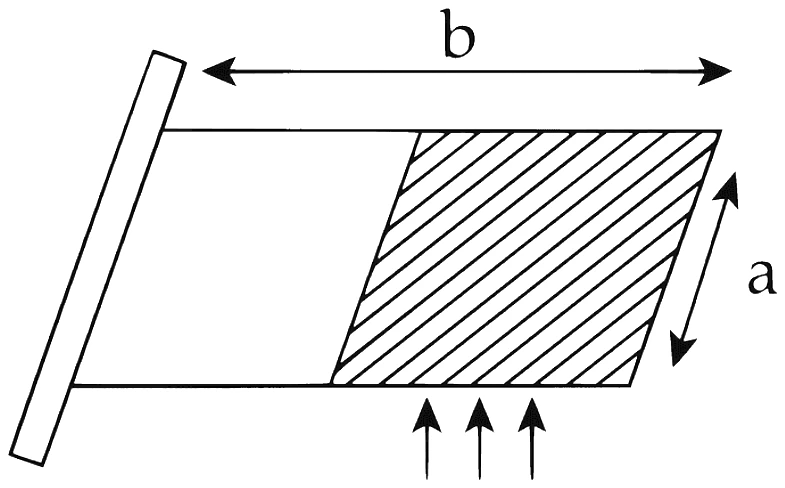
There is a rectangular plate of mass Mkg of dimensions (a×b). The plate is held in horizontal position by striking n small balls each of mass m per unit area per unit time. These are striking in the shaded half region of the plate. The balls are colliding elastically with velocity v. What is v? It is given n=100, M=3kg, m=0.01kg, b=2m, a=1m, g=10m s−2
Numerical answer type. Work it out, then open the answer.
A wind-powered generator converts wind energy into electrical energy. Assume that the generator converts a fixed fraction of the wind energy intercepted by its blades into electrical energy. For wind speed v, the electrical power output will be proportional to
A particle of mass m is moving in a circular path of constant radius r such that its centripetal acceleration ac is varying with time t as ac=k2rt2 where k is a constant. The power delivered to the particle by the force acting on it is:
A force of 1000N is required to lift a hook and 10000N is required to lift a load slowly. Find the power required to lift the hook with the load at speed v=0.5m s−1.
An engine pumps up 100kg of water through a height of 10m in 5s. Given that the efficiency of the engine is 60% and g=10m s−2, the power of this engine is
A pendulum of mass 1kg and length l=1m is released from rest at angle θ=60∘. The power delivered by all the forces acting on the bob at angle θ=30∘ will be (Take g=10m s−2)
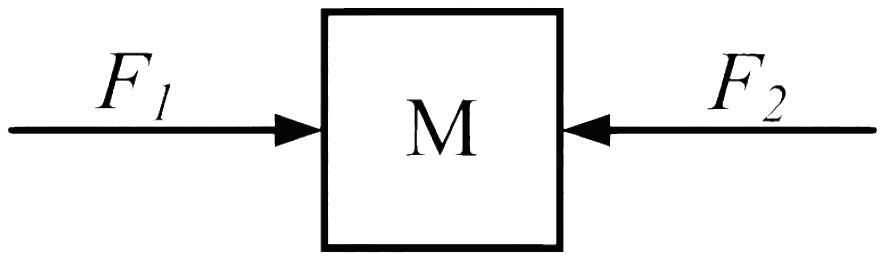
A body of mass M is moving with a uniform speed of 10m s−1 on frictionless surface under the influence of two forces F1 and F2. The net power of the system is
An installation consisting of an electric motor driving a water pump lifts 75L of water per second to a height of 4.7m. If the motor consumes a power of 5kW, then the efficiency of the installation is
A motor of power P0 is used to deliver water at a certain rate through a given horizontal pipe. To increase the rate of flow of water through the same pipe n times, the power of the motor is increased to P1. The ratio of P1 to P0 is
An electric motor raises a mass of 1.5kg, a distance of 1.128m in time of 4.79s. Calculate the power to an appropriate significant figures. (take g=9.81m s−2)
When water falls from a height of 80m at the rate of 20kg s−1 to operate a turbine the losses due to frictional force are 20% of input energy. How much power is generated by the turbine?
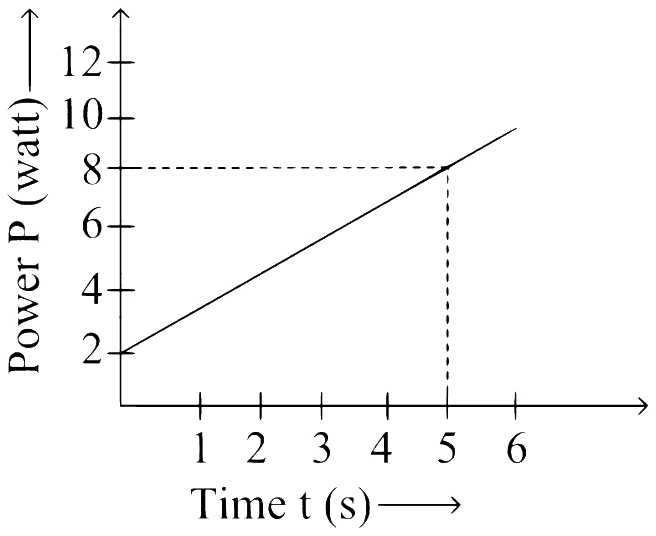
A particle of mass 500g is at rest. It is free to move along a straight line. The power delivered to the particle varies with time according to the following graph. The momentum of the particle at t=5s is
A motor pump lifts 6 tonnes of water from a well of depth 25m to the first floor of height 35m from the ground floor in 20 minutes. The power of the pump (in kW) is [g=10m s−2]
The blades of a wind mill sweep out a circle of area A=2m2. The wind is flowing at velocity V=6m s−1 perpendicular to the circle and the density of air is 1.2kg m−3. Then the power of the mill is
A motor of efficiency 80% lifts water from a tank and delivers it from the end of a pipe which is 3.2m vertically above the level from which water is drawn. If the cross-sectional area of the pipe is 12cm2 and water leaves the end of the pipe at a speed of 6m s−1, then the power of the motor is (acceleration due to gravity =10m s−2)
A motor can pump 7560kg of water per hour from a well of depth 100m. If the efficiency of the pump is 70%, then the power of the pump is (Acceleration due to gravity =10m s−2)
A body of mass M is moving with a uniform speed v on a frictionless horizontal surface under the influence of two forces F1 and F2 as shown in the figure. The net power of the system is
A circular well of diameter 2m has water up to the ground level. If the bottom of the well is at a depth of 14m, the time taken in seconds to empty the well using a 1.4kW motor is (Acceleration due to gravity =10m s−2)
A crane of efficiency 80% is used to lift 8000kg of coal from a mine of depth 108m. If the time taken by the crane to lift the coal is one hour, then the power of the crane (in kW) is (Acceleration due to gravity =10m s−2)
A train of mass 106kg is moving at a constant speed of 108km h−1. If the frictional force acting on it is 0.5N per 100kg, then the power of the train is
A body is moving along a straight line under the influence of a constant power source. If the relation between the displacement (s) of the body and time (t) is s∝tx, then x=
The power required for an engine to maintain a constant speed of 50m s−1 for a train of mass 3×10⁶kg on rough rails is (The coefficient of kinetic friction between the rails and wheels of the train is 0.05 and acceleration due to gravity =10m s−2)
A particle of mass m at rest on a rough horizontal surface with a coefficient of friction μ is given a velocity u. The average power imparted by friction before it stops is
A block of mass 50kg is pulled with a constant speed of 4m s−1 across a horizontal floor by an applied force of 500N directed 30∘ above the horizontal. The rate at which the force does work on the block in watt is
A bead of mass 400g is moving along a straight line under a force that delivers a constant power 1.2W to the bead. If the bead is initially at rest, the speed it attains after 6s in m s−1 is
Water is falling on the blades of a turbine from a height of 25m and 3×10³kg of water pours on the blade per minute. If the whole of energy is transferred to the turbine, then power delivered is
The power P (in watt) acting on a body of mass 2kg is given by 4.5P=8t2+14t+9, where t is time in second. If the body starts from rest at t=0, then the velocity of the body at time t=3s is
A body of mass 0.5kg is supplied with a power P (in watt) which varies with time t (in second) as P=3t2+3. If the velocity of the body at time t=0 is zero, then the velocity of the body at time t=3s is
A boat of mass 1000kg goes from rest to speed 20.0m s−1 in 5.0s. The water exerts a constant drag force and the acceleration of the boat is constant. If the average power required by the boat is 45000W, then the magnitude of the drag force is
A pump on the ground floor of a building can pump up water to fill a tank of volume 36m3 in 30min. If the tank is 50m above the ground, and the electric power consumed by the pump is 40kW, the efficiency of the pump is (use g=10m s−2 and density of water =1000kg m−3)
A block of mass m placed on a rough horizontal plane is pulled by a constant power P. The coefficient of friction between the block and the surface is μ. The maximum velocity of the block will be
Consider an engine that absorbs 130cal of heat from a hot reservoir and delivers 30cal heat to a cold reservoir in each cycle. The engine also consumes 2J energy in each cycle to overcome friction. If the engine works at 90 cycles per minute, what will be the maximum power delivered to the load? [Assume the thermal equivalent of heat is 4.2J cal−1]
A body starts from rest, under the action of an engine working at a constant power and moves along a straight line. The displacement s is given as a function of time (t) as
The engine in a sports car provides constant power to all the four wheels over a range 0 to 120 kilometers per hour (kmph). The car accelerates from 0 to 45 kmph in 1.50s. The time the car takes to accelerate from 0 to 90 kmph is
A shaft is rotating at a speed of 4000 revolutions per minute. If the power expended in driving the shaft is 12kW, the magnitude of the driving torque is: