A particle moves from position 3i^+2j^−6k^ to 14i^+13j^+9k^ due to uniform force of (4i^+j^+3k^) N. If displacement is in metre then work done will be
A 1 kg block subjected to two simultaneous forces (2i^+3j^+4k^) N and (3i^−j^−2k^) N is moved a distance of 25 m along (3i^−4j^) direction. The work done in this process is ______ J.
Numerical answer type. Work it out, then open the answer.
A mass of 1 kg is kept on an inclined plane with 30∘ inclination with respect to horizontal plane and it is at rest initially. Then the whole assembly is moved up with constant velocity of 4 m/s. The work done by the frictional force in time 2 s is ______ J. (Take g=10 m/s2)
A particle is displaced from point P(3 m,4 m,5 m) to a point Q(2 m,3 m,4 m) under a constant force F=(3i^+4j^+5k^) N. The work done by the force in this process is
A force F=2i^+bj^+k^ is applied on a particle and it undergoes a displacement i^−2j^−k^. What will be the value of b, if work done on the particle is zero.
A block of mass 25 kg is pulled along a horizontal surface by a force at an angle 45∘ with the horizontal. The friction coefficient between the block and the surface is 0.25. The block travels at a uniform velocity. The work done by the applied force during a displacement of 5 m of the block is:
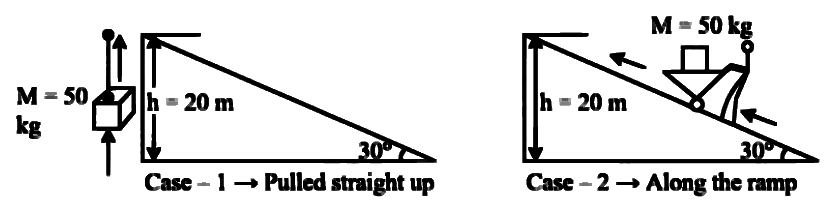
A body of mass 50 kg is lifted to a height of 20 m from the ground in the two different ways as shown in the figures. The ratio of work done against the gravity in both the respective cases, will be:
A block of mass 100 kg slides over a distance of 10 m on a horizontal surface. If the co-efficient of friction between the surfaces is 0.4, then the work done against friction (in J) is:
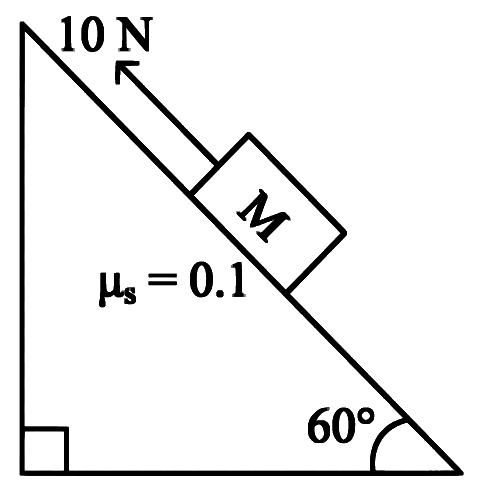
A block of mass 1 kg is pushed up a surface inclined to horizontal at an angle of 60∘ by a force of 10 N parallel to the inclined surface as shown in figure. When the block is pushed up by 10 m along inclined surface, the work done against frictional force is:
A small particle moves to position 5i^−2j^+k^ from its initial position 2i^+3j^−4k^ under the action of force 5i^+2j^+7k^ N. The value of work done will be __________ J.
Numerical answer type. Work it out, then open the answer.
To maintain a speed of 80 km/h by a bus of mass 500 kg on a plane rough road for 4 km distance, the work done by the engine of the bus will be ____________ kJ. [The coefficient of friction between tyre of bus and road is 0.04.]
Numerical answer type. Work it out, then open the answer.
Two persons A and B perform same amount of work in moving a body through a certain distance d with application of forces acting at angle 45∘ and 60∘ with the direction of displacement respectively. The ratio of force applied by person A to the force applied by person B is x1. The value of x is .....................
Numerical answer type. Work it out, then open the answer.
A porter lifts a heavy suitcase of mass 80 kg and at the destination lowers it down by a distance of 80 cm with a constant velocity. Calculate the work done by the porter in lowering the suitcase. (take g = 9.8 ms−2)
A force (F)=−5i^−7j^+3k^ acting on a particle causes a displacement (s)=3i^−2j^+ak^ in its own direction. If the work done is 14 J, then the value of ' a ' is
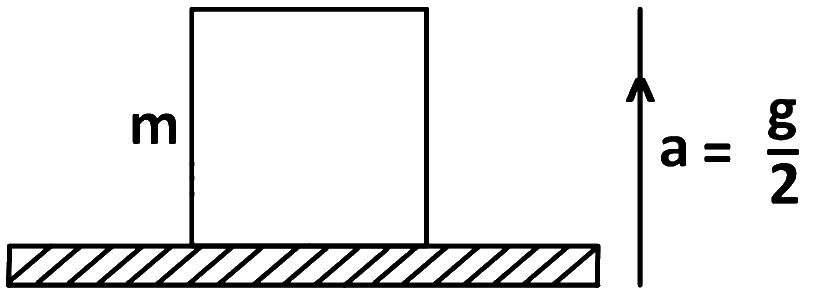
A block of mass m is kept on a platform which starts from rest with constant acceleration g/2 upward, as shown in figure. Work done by normal reaction on block in time t is -
A uniform force of (3i^+j^) newton acts on a particle of mass 2 kg. Hence the particle is displaced from position (2i^+k^) metre to position (4i^+3j^−k^) metre. The work done by the force on the particle is
A particle of mass 100 g is thrown vertically upwards with a speed of 5 m/s. The work done by the force of gravity during the time the particle goes up is
A force F=(5i+3j+2k) N is applied over a particle which displaces it from its origin to the point r=(2i−j) m The work done on the particle in joules is
A particle is acted upon by a force of constant magnitude which is always perpendicular to the velocity of the particle, the motion of the particles takes place in a plane. It follows that
A body moves a distance of 10 m along a straight line under the action of a 5 N force. If the work done is 25 J, then angle between the force and direction of motion of the body is
A man applies a force of 20N on an object at an angle of 60∘ from the horizontal. If the object moves by 20m in the horizontal direction, then the work done by the force on the object is
A block of mass 10kg slides down a rough slope which is inclined at an angle of 45∘ to the horizontal. The coefficient of sliding friction is 0.30. When the block has slide 5m, the work done on the block by the force of friction is nearly
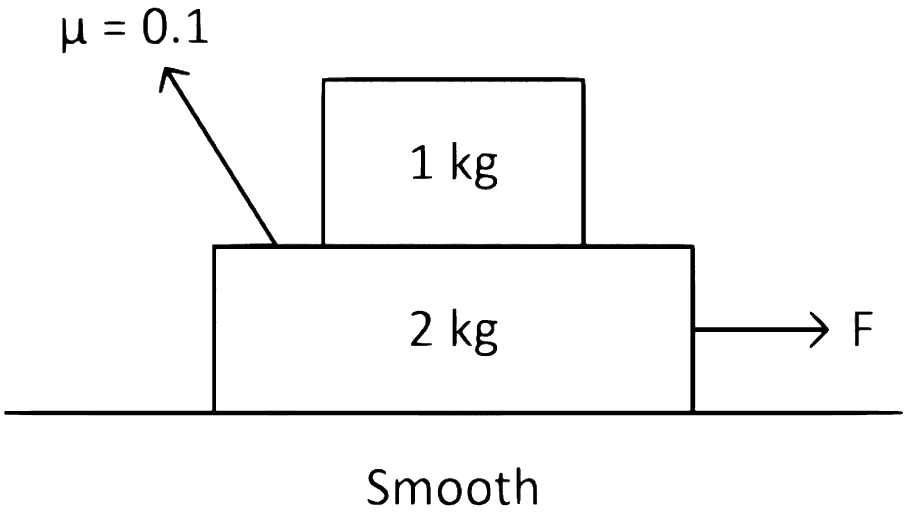
A force of F=0.5N is applied on lower block as shown in figure. The work done by lower block on upper block for a displacement of 3m of the upper block with respect to ground is (Take g=10m s−2)
If a constant force of (2i^+3j^+4k^)N acting on a body of mass 5kg displaces it from (3i^−4k^)m to (2i^+2j^+3k^)m, then the work done by the force on the body is
A force of (4i^+2j^+k^)N acting on a particle of mass 2kg displaces the particle from a position of (2i^+2j^+k^)m to a position of (4i^+3j^+2k^)m. The work done by the force on the particle in joules is
A body of mass 2kg is moving with a constant acceleration of (2i^+3j^−k^)m s−2. If the displacement made by the body is (3i^−j^+2k^)m, then the work done is
A constant force of (8i^−2j^+6k^)N acting on a body of mass 2kg displaces the body from (2i^+3j^−4k^)m to (4i^−3j^+6k^)m. The work done in the process is
An elevator of mass 500kg is ascending upwards with a constant acceleration a=2m s−2. What is the work done by the tension in the elevator cable during its climb by 12m? (Take g=10m s−2)