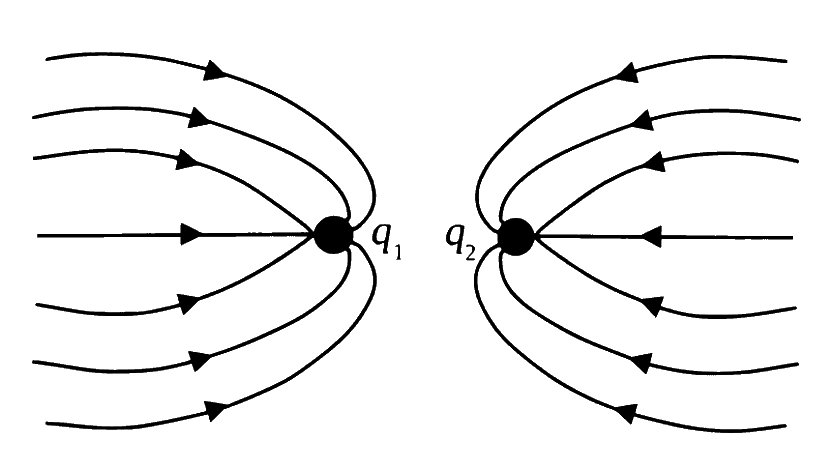
B. The electric field lines point radially outward when charge is greater than zero. C. The Gauss - Law is valid only for inverse-square force.
D. The work done in moving a charged particle in a static electric field around a closed path is zero. E. The motion of a particle under Coulomb's force must take place in a plane.
Choose the correct answer from the options given below:
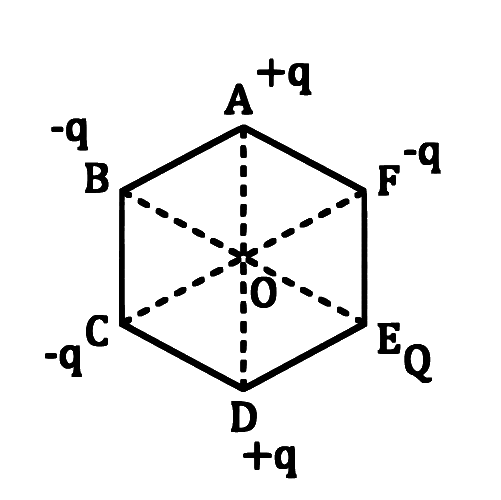
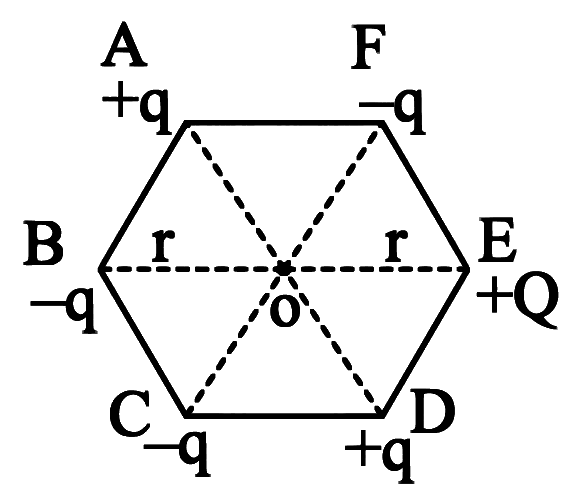
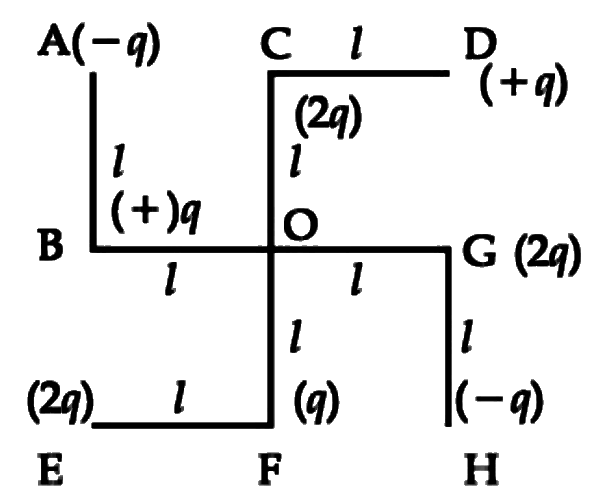
The point charges +q,−q,−q,+q,+Q and −q are placed at the vertices of a regular hexagon ABCDEF as shown in the figure.
The electric field at the centre of the hexagon 'O' due to the five charges at A, B, C, D and F is thrice the electric field at centre 'O' due to charge +Q at E alone. The value of Q is
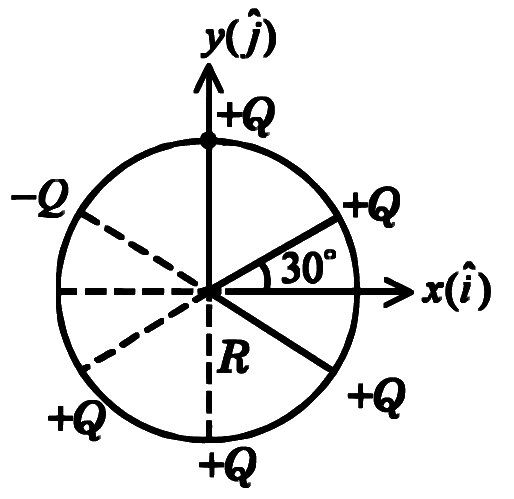
Six point charges are kept 60∘ apart from each other on the circumference of a circle of radius R as shown in figure. The net electric field at the center of the circle is ______.
A thin half ring of radius 35 cm is uniformly charged with a total charge of Q coulomb. If the magnitude of the electric field at centre of the half ring is 100 V/m, then the value of Q is ______ nC. (ϵ0=8.85×10⁻¹² C2/N m2 and π=3.14)
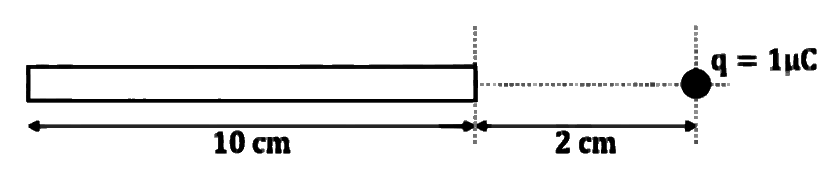
A point charge q=1μC is located at a distance 2 cm from one end of a thin insulating wire of length 10 cm having a charge Q=24μC, distributed uniformly along its length, as shown in figure. Force between q and wire is ______ N.
(Use: 4πϵ01=9×10⁹ N m2/C2)
Numerical answer type. Work it out, then open the answer.
A point charge +q is placed at the origin. A second point charge +9q is placed at (d,0,0) in Cartesian coordinate system. The point in between them where the electric field vanishes is:
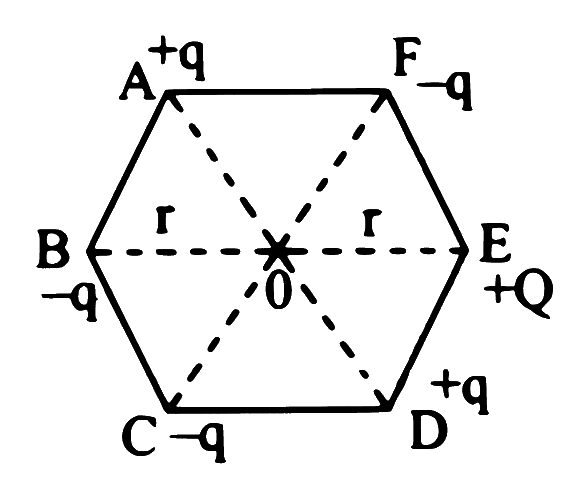
The point charges +q,−q,−q,+q,+Q and -q are placed at the vertices of a regular hexagon ABCDEF as shown in figure. The electric field at the centre of hexagon ' O ' due to the five charges at A,B,C,D and F is twice the electric field at centre ' O ' due to charge +Q at E alone. The value of Q is
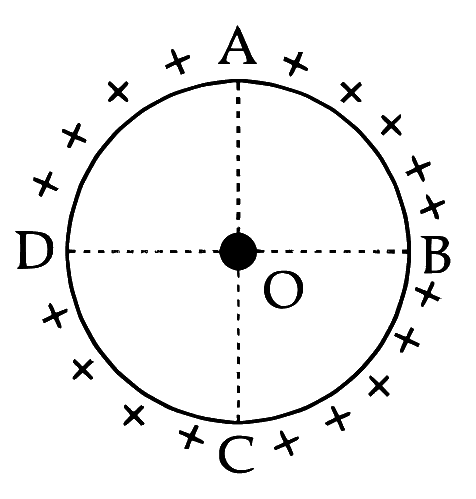
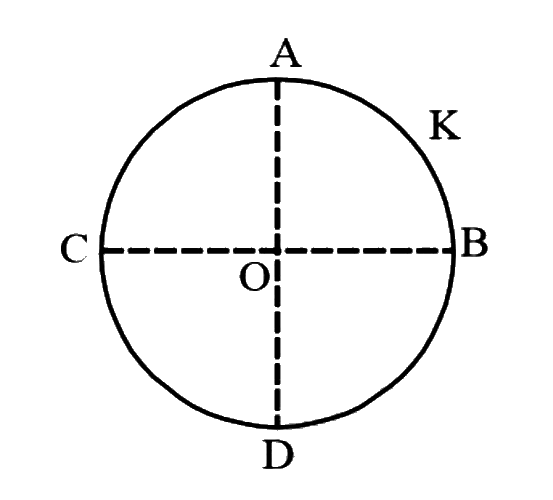
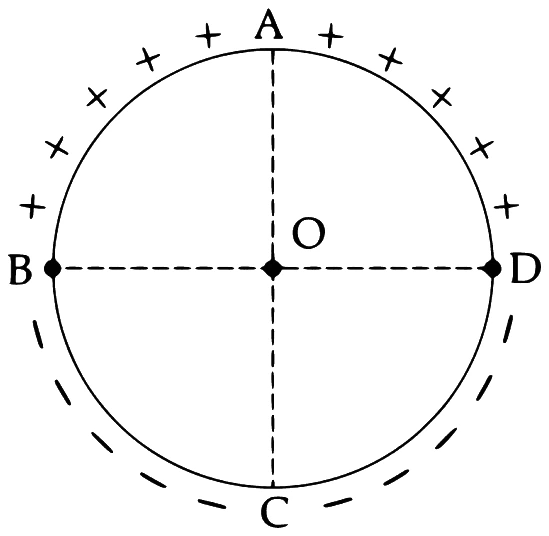
A metallic ring is uniformly charged as shown in figure. AC and BD are two mutually perpendicular diameters. Electric field due to arc AB at ' O ' is ' E ' in magnitude. What would be the magnitude of electric field at ' O ' due to arc ABC?
Consider a circular loop that is uniformly charged and has a radius a2. Find the position along the positive z-axis of the cartesian coordinate system where the electric field is maximum if the ring was assumed to be placed in xy plane at the origin:
A sphere ' A ' of radius ' R ' has a charge ' Q ' on it. The field at point B outside the sphere is ' E '. Now another sphere of radius ' 2R ' having a charge ' −2Q ' is placed at B. The total field at the point midway between A and B due to both the spheres is
The point charges +q,−q,−q,+q,+Q and -q are placed at the vertices of a regular hexagon ABCDEF as shown in figure. The electric field at the centre of hexagon ' O ' due to the five charges at A,B,C,D and F is thrice the electric field at centre ' O ' due to charge +Q at E alone. The value of Q is
Two point charges +8q and −2q are located at x=0 and x=L respectively. The location of a point on the x-axis from the origin, at which the net electric field due to these two point charges is zero is
Two point charges +8q and −2q are located at X=0 (origin) and X=L respectively. The net electric field due to these two charges is zero at point P on X-axis. The location of point P from the origin is
Two point charges +10 q and -4 q are located at x=0 and x=L respectively. What is the location of a point on the x-axis from the origin, which the net electric field due to these two point charges is zero?( r= required distance)
Two equal positive point charges are separated by a distance 2a. The distance of a point from the centre of the line joining two charges on the equatorial line (perpendicular bisector) at which force experienced by a test charge q0 becomes maximum is xa. The value of x is __________.
Numerical answer type. Work it out, then open the answer.
A point charge of 10 μC is placed at the origin. At what location on the X-axis should a point charge of 40 μC be placed so that the net electric field is zero at x=2cm on the X-axis?
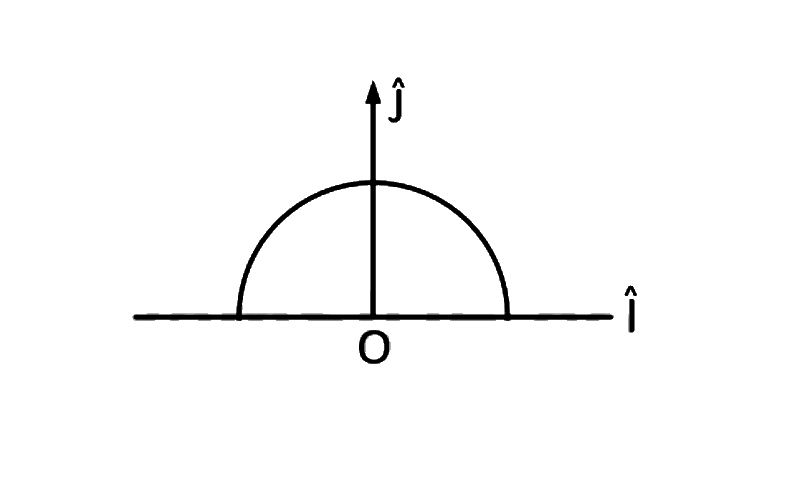
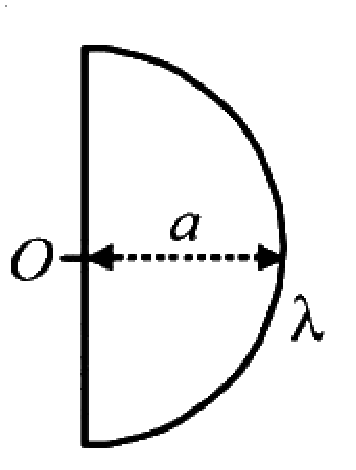
A uniformly charged semicircular arc of radius 'r' has linear charge density 'λ'. The electric field at its centre is ( ε0= permittivity of free space)
Two point charges A and B of magnitude +8 × 10⁻⁶ C and −8 × 10⁻⁶ C respectively are placed at a distance d apart. The electric field at the middle point O between the charges is 6.4 × 10⁴ NC−1. The distance 'd' between the point charges A and B is:
Two point charges Q each are placed at a distance d apart. A third point charge q is placed at a distance x from mid-point on the perpendicular bisector. The value of x at which charge q will experience the maximum Coulomb's force is:
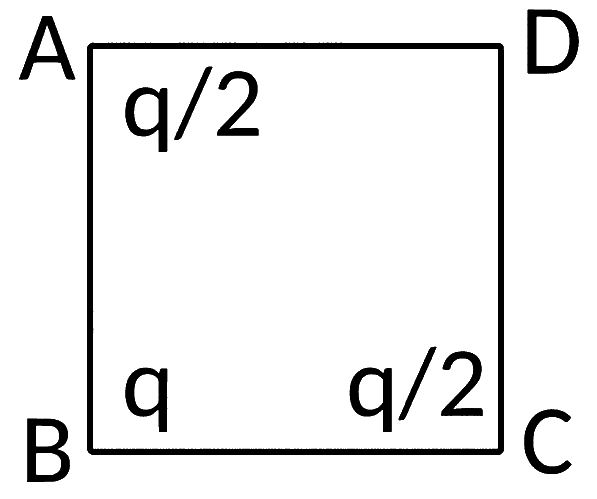
The three charges q/2, q and q/2 are placed at the corners A, B and C of a square of side 'a' as shown in figure. The magnitude of electric field (E) at the corner D of the square, is:
Statement I: A point charge is brought in an electric field. The value of electric field at a point near to the charge may increase if the charge is positive.
Statement II: An electric dipole is placed in a non-uniform electric field. The net electric force on the dipole will not be zero.
Choose the correct answer from the options given below:
A charge q is uniformly distributed along the length L of a rod. It is then bent in the shape of a semicircle. The magnitude of electric field at the centre of semicircle will be:
In hydrogen atom an electron revolves around a proton (in nucleus) at a distance 'r' m. the intensity of electric field due to the proton at distance 'r' is 5×10¹¹ NC−1, the magnitude of force between the electron and proton is [charge on electron =1.6×10⁻¹⁹ C]
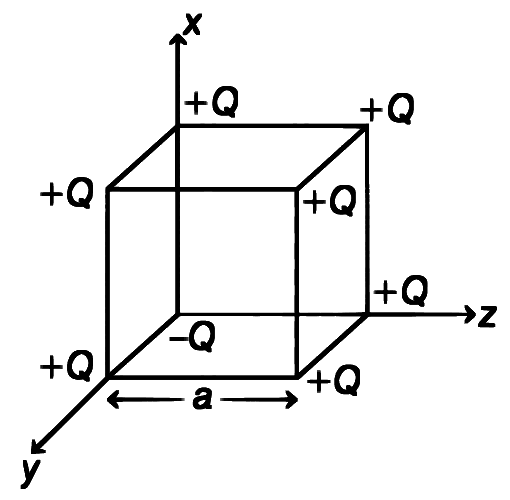
A cube of side 'a' has point charges +Q located at each of its vertices except at the origin where the charge is − Q. The electric field at the centre of cube is:
A uniformly charged semicircular arc of radius 'r' has linear charge density (λ). What is the electric field at its centre? ( ε0= permittivity of free space)
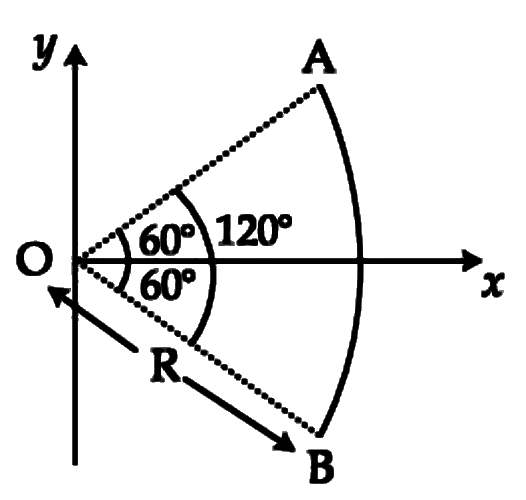
Figure shows a rod AB, which is bent in a 120∘ circular arc of radius R. A charge (−Q) is uniformly distributed over rod AB. What is the electric field Eat the centre of curvature O?
A uniformly charged disc of radius R having surface charge density σ is placed in the xy plane with its center at the origin. Find the electric field intensity along the z-axis at a distance Z from origin :-
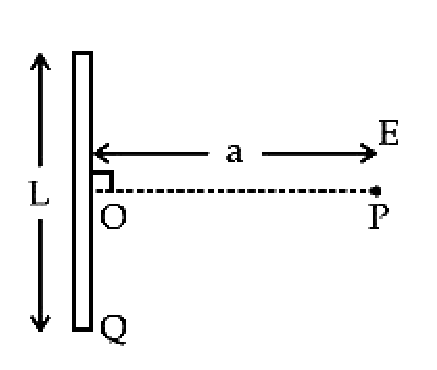
Find the electric field at point P (as shown in figure) on the perpendicular bisector of a uniformly charged thin wire of length L carrying a charge Q. The distance of the point P from the centre of the wire is a = 23L.
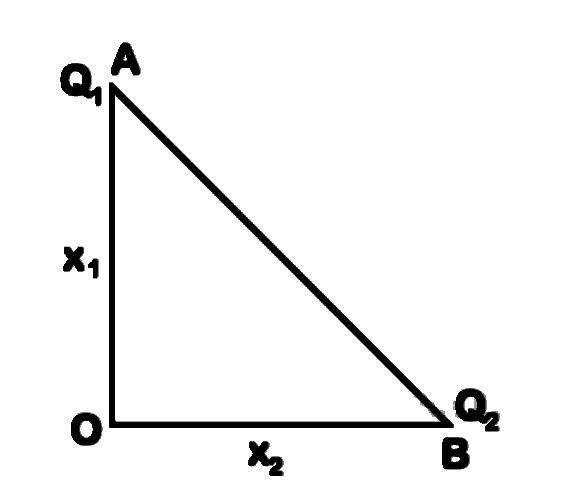
Charges Q1 and Q2 are at points A and B of a right angle triangle OAB (see figure). The resultant electric field at point O is perpendicular to the hypotenuse, then
Ten charges are placed on the circumference of a circle of radius R with constant angular separation between successive charges. Alternate charges 1, 3, 5, 7, 9 have charge (+q) each, while 2, 4, 6, 8, 10 have charge (–q) each. The potential V and the electric field E at the centre of the circle are respectively.
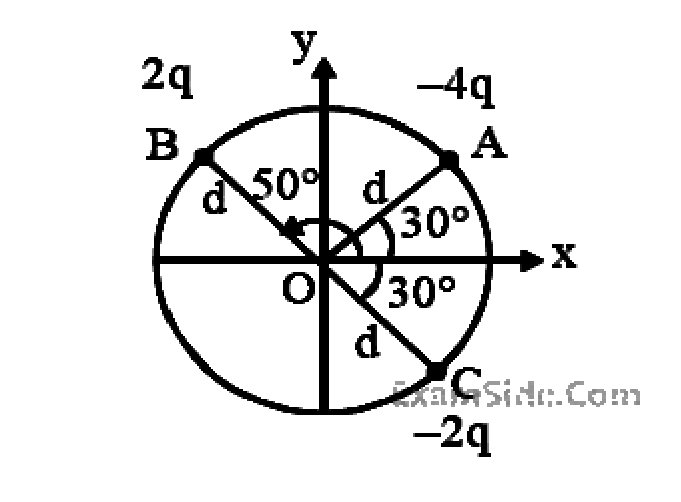
Three charged particles A, B and C with charges –4q, 2q and –2q are present on the circumference of a circle of radius d. The charged particles A, C and centre O of the circle form an equilateral triangle as shown in figure. Electric field at O along x-direction is:
Two point charges q1 (10μC) and q2(− 25 μC) are placed on the x-axis at x = 1 m and x = 4 m respectively. The electric field (in V/m) at a point y = 3 m on y-axis is,
For a uniformly charged ring of radius R, the electric field on its axis has the largest magnitude at a distance h from its center. Then value of h is:
Four point charges –q, +q, +q and –q are placed on y-axis at y = –2d, y = –d, y = +d and y = +2d, respectively. The magnitude of the electric field E at a point on the x-axis at x = D, with D >> d, will behave as :-
A long cylindrical shell carries positive surface charge σ in the upper half and negative surface charge - σ in the lower half. The electric field lines around the cylinder will look like figure given in: (figures are schematic and not drawn to scale)
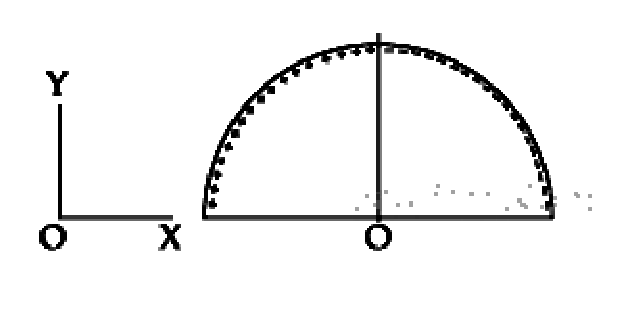
A wire, of length L(=20 cm), is bent into a semi-circular arc. If the two equal halves, of the arc, were each to be uniformly charged with charges ±Q, [ ∣Q∣ = 103 ε0 Coulomb where ε0 is the permittivity (in SI units) of free space ] the net electric field at the center O of the semi-circular arc would be:
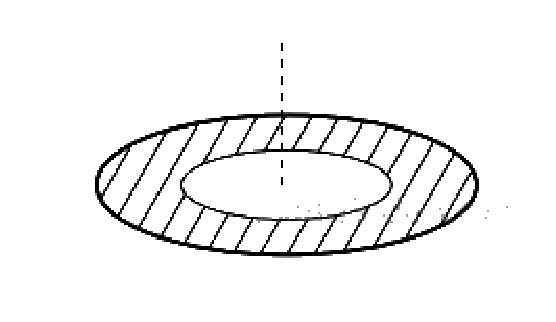
A thin disc of radius b = 2a has a concentric hole of radius 'a' in it (see figure). It carries uniform surface charge 'σ' on it. If the electric field on its axis at height 'h' (h < < a) from its centre is given as 'Ch' then value of 'C' is:
The surface charge density of a thin charged disc of radius R is σ. The value of the electric field at the centre of the disc is 2ϵ0σ. With respect to the field at the centre, the electric field along the axis at a distance R from the centre of the disc:
(This question contains Statement-1 and Statement-2. Of the four choices given after the statements, choose the one that best describes the two statements.)
Statement-1: For a charged particle moving from point P to point Q, the net work done by an electrostatic field on the particle is independent of the path connecting point P to point Q. Statement-2: The net work done by a conservative force on an object moving along a closed loop is zero.
A thin conducting ring of radius R is given a charge +Q. The electric field at the centre O of the ring due to the charge on the part AKB of the ring is E. The electric field at the centre due to the charge on the part ACDB of the ring is
Three point charges +q, − 2q and + q are placed at points (x = 0, y = a, z = 0), (x = 0, y = 0, z = 0) and (x = a, y = 0, z = 0) respectively. The magnitude and direction of the electric dipole moment vector of this charge assembly are
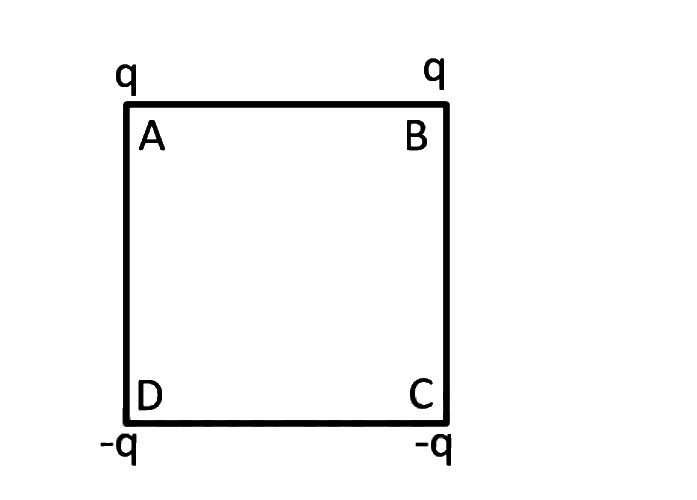
Charges are placed on the vertices of a square as shown. Let Ebe the electric field and V the potential at the center. If the charges on A and B are interchanged with those on D and C respectively, then
Two point charges +8q and −2q are located at x=0 and x=L respectively. The location of a point on the x axis at which the net electric field due to these two point charges is zero is
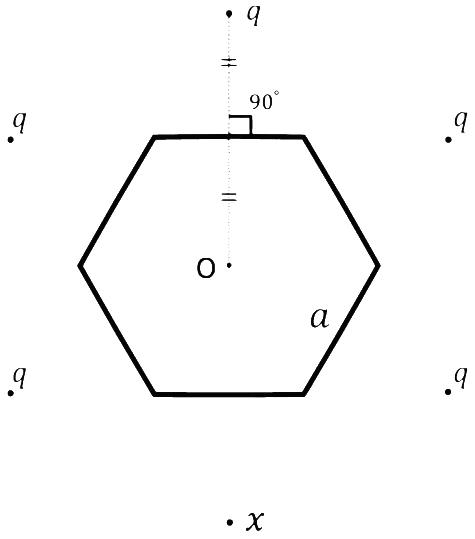
Six charges are placed around a regular hexagon of side length a as shown in the figure. Five of them have charge q, and the remaining one has charge x. The perpendicular from each charge to the nearest hexagon side passes through the center O of the hexagon and is bisected by the side.
Which of the following statement(s) is(are) correct in SI units?
More than one option can be correct. Tap every correct option, then tap Check.
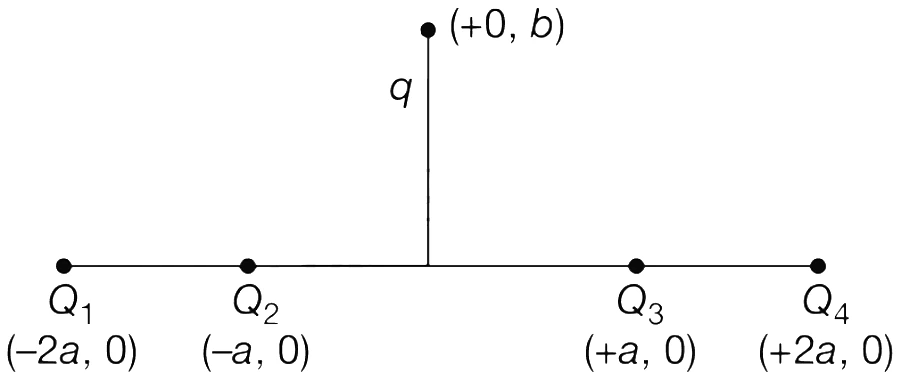
Four charges Q1, Q2, Q3 and Q4 of same magnitude are fixed along the x axis at x=−2a,−a,+a and +2a, respectively. A positive charge q is placed on the positive y axis at a distance b>0. Four options of the signs of these charges are given in List I. The direction of the forces on the charge q is given in List II. Match List I with List II and select the correct answer using the code given below the lists.
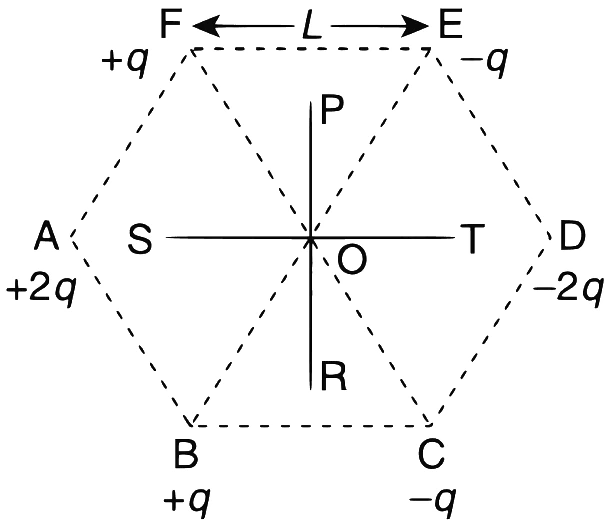
Six point charges are kept at the vertices of a regular hexagon of side L and center O, as shown in the figure. Given that K=4πε01L2q, which of the following statement(s) is (are) correct ?
More than one option can be correct. Tap every correct option, then tap Check.
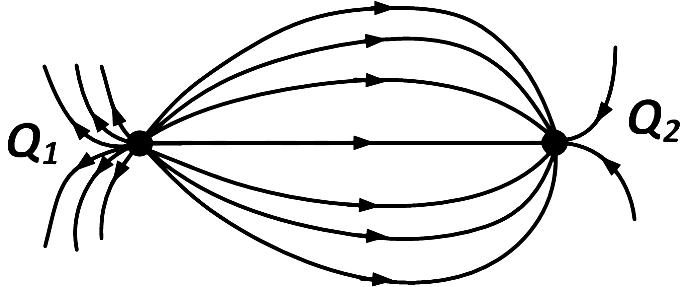
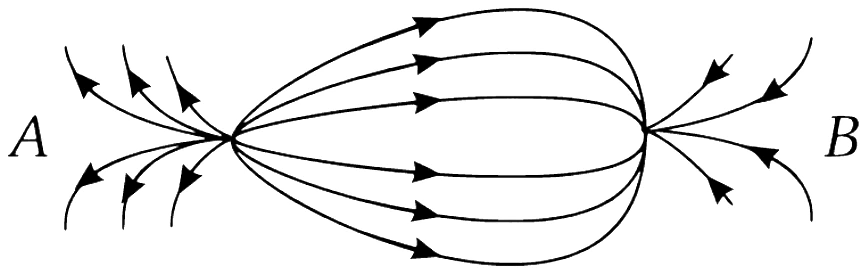
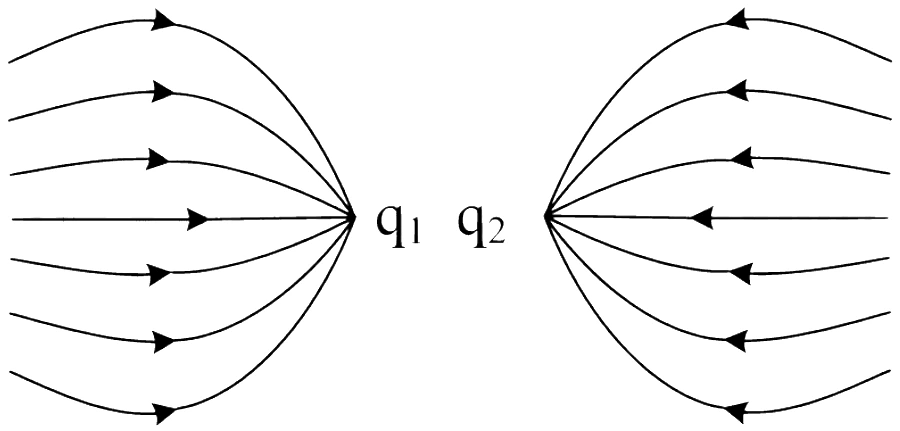
A few electric field lines for a system of two charges Q1 and Q2 fixed at two different points on the x-axis are shown in the figure. These lines suggest that
More than one option can be correct. Tap every correct option, then tap Check.
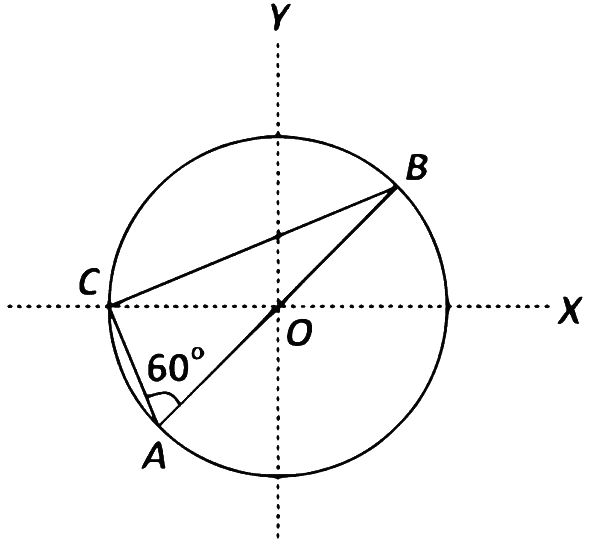
Consider a system of three charges 3q, 3q and −32q placed at points A, B and C, respectively, as shown in the figure. Take O to be the centre of the circle of radius R and angle CAB=60∘.
A positively charged ball hangs from a silk thread. We put a positive test charge q0 at a point and measure F/q0, then it can be predicted that the electric field strength E
Three charges, each of +4μC, are placed at the corners A, B, C of a square ABCD of side 1m. What is the magnitude (in N C−1) of electric field at the centre O of the square towards point D?
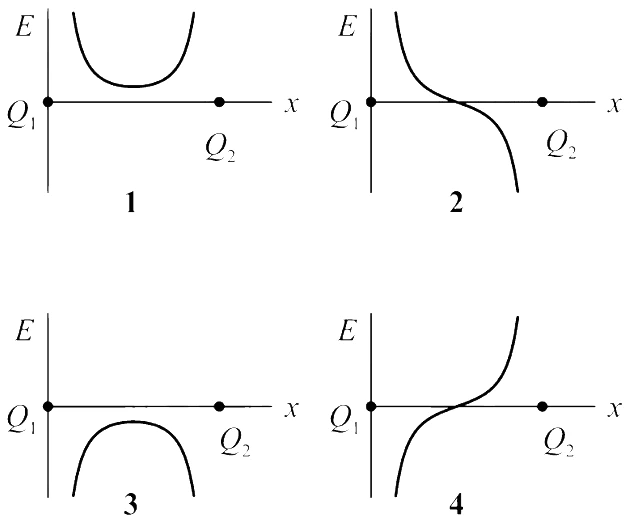
Two point like charges Q1 and Q2 whose strength are equal in absolute value are placed at a certain distance from each other. Assuming the field strength to be positive in the positive direction of x-axis the signs of the charges Q1 and Q2 for the graphs (field strength versus distance) shown in Figures 1,2,3 and 4 are
Two point charges 4μC and −2μC are separated by a distance of 1m in air. Then the distance of the point on the line joining the charges, where the resultant electric field is zero, is (in metre)
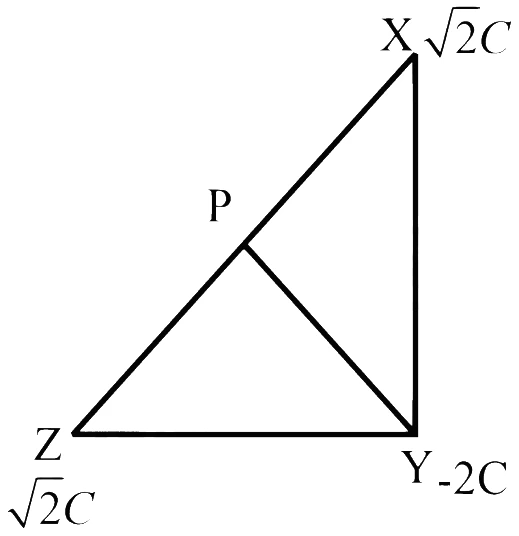
Point charges 2C, 2C and −2C are placed at the three vertices of a right-angled triangle in air, as shown in the figure below. What is the electric field at a point P on the hypotenuse that is equidistant from all three charges. Given distances XP=YP=ZP=0.5m.
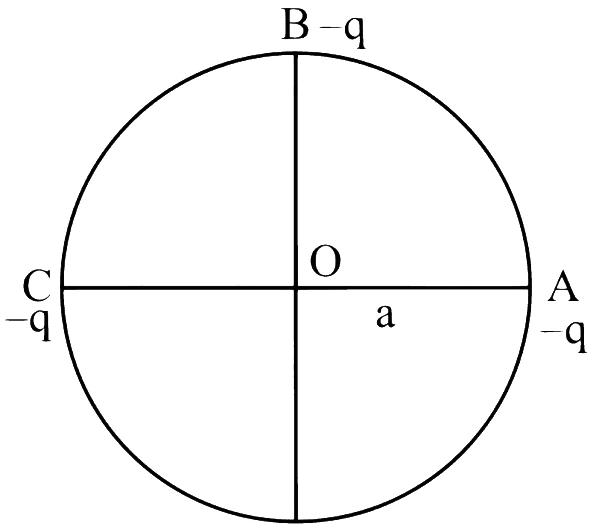
3 point charges each of −q are placed on the circumference of a circle of diameter 2a at A, B and C respectively as shown in figure. The electric field at O is
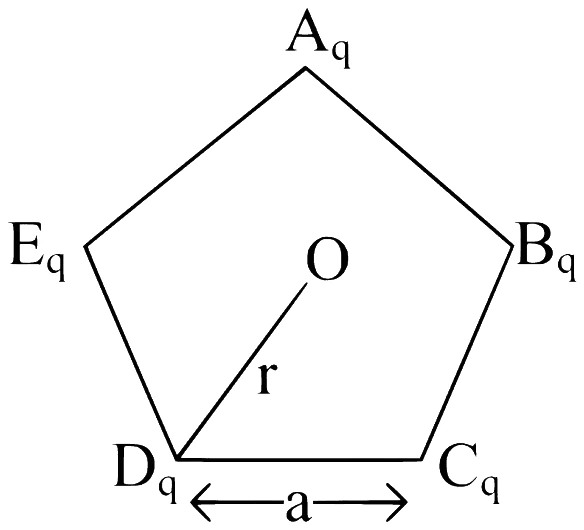
Five charges, q each are placed at the corners of a regular pentagon of side a as shown in figure. First, charge from A is removed with other charges intact, then charge at A is replaced with an equal opposite charge. The ratio of magnitudes of electric fields at O, without charge at A and that with equal and opposite charge at A is
Electric field at a distance r from an infinitely long uniformly charged straight conductor, having linear charge density λ is E1. Another uniformly charged conductor having same linear charge density λ is bent into a semicircle of radius r. The electric field at its centre is E2. Then
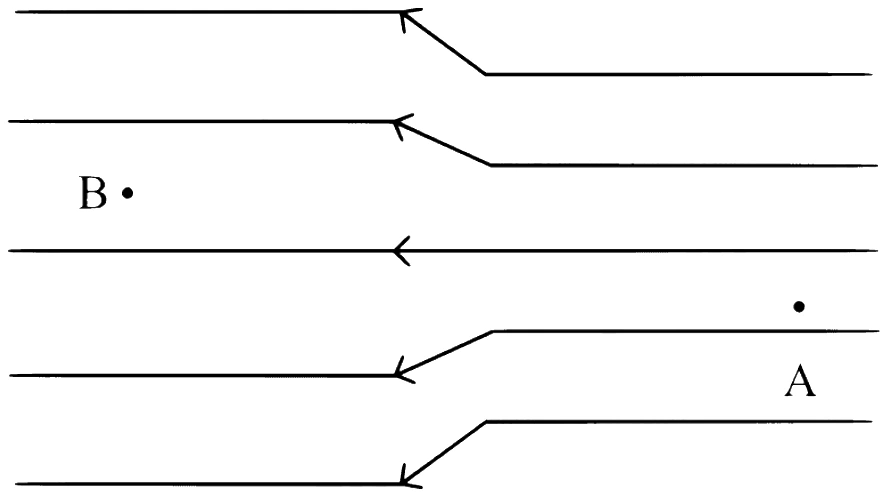
The electric field lines on the left have twice the separation on those on the right as shown in figure. If the magnitude of the field at A is 40V m−1, what is the force on 20μC charge kept at B?
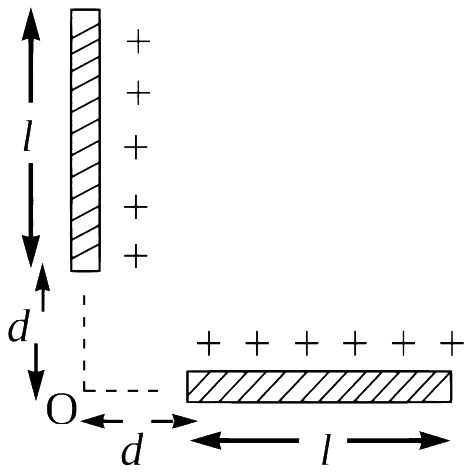
Two similar rods of length l=1m carrying equal charges (q)=10−8C are placed as shown in figure. The electric field at point 'O' approximately is, if d=0.25m
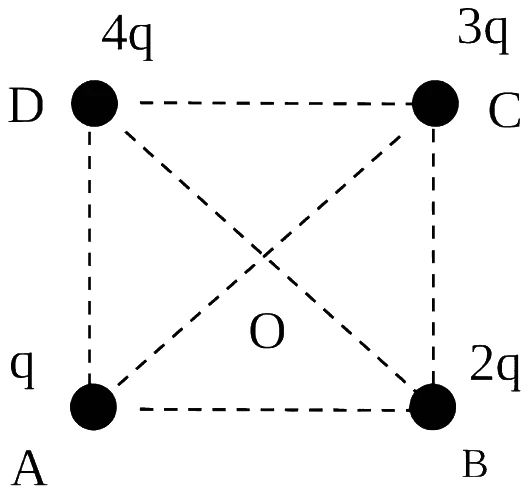
Charges q, 2q, 3q and 4q are placed at the corners A, B, C and D of a square as shown in the figure. The direction of electric field at the centre 'O' of the square is along
Which statement(s) among the following are incorrect? (i) A negative test charge experiences a force opposite to the direction of the field. (ii) The tangent drawn to a line of force represents the direction of electric field. (iii) The electric field lines never intersect. (iv) The electric field lines form a closed loop.
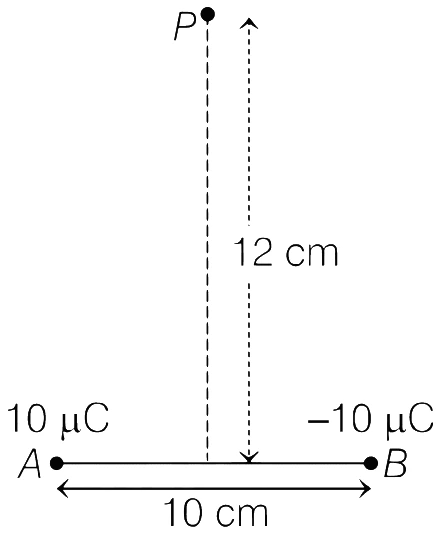
Two charges 10μC and −10μC are placed at points A and B separated by a distance of 10cm. Find the electric field at a point P on the perpendicular bisector of AB, at a distance of 12cm from its mid-point.
At a distance of 20cm from the centre of a charged conducting sphere of radius 10cm, the electric field due to the sphere is 9000N C−1. If an electric charge of 3μC is placed at a distance of 30cm from the centre of the sphere, then the electrostatic force acting on the charge is
Two point charges of magnitudes −8μC and +32μC are separated by a distance of 15cm in air. The position of the point from −8μC charge at which the resultant electric field becomes zero is
A clock dial has point charges −q,−2q,−3q,…,−12q at the positions of the corresponding numbers on the dial respectively. The time at which the hour's hand points the direction of the net electric field at the centre of the dial is (Assume clock hands do not influence the net electric field)
In a regular polygon of 10 sides, each corner is at a distance R from the centre. Identical charges are placed at 9 corners. At the centre, the magnitude of electric field is E and the potential is V. The ratio EV is
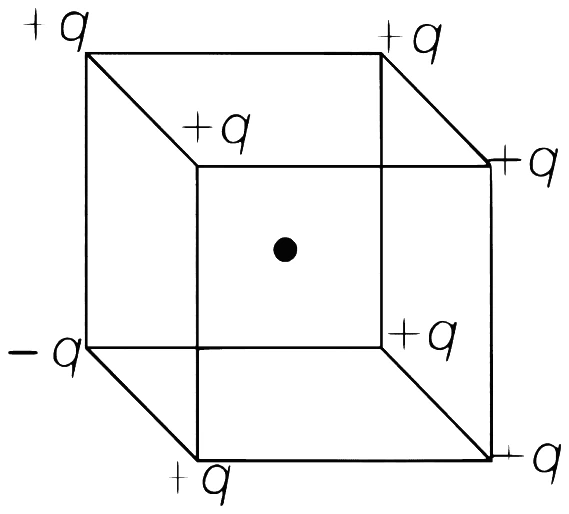
A cube of side L has point charges +q located at its seven vertices and −q at remaining one vertex. The electric field at its centre is found to be ∣E∣=α(4πε0L2q). The magnitude of constant α is
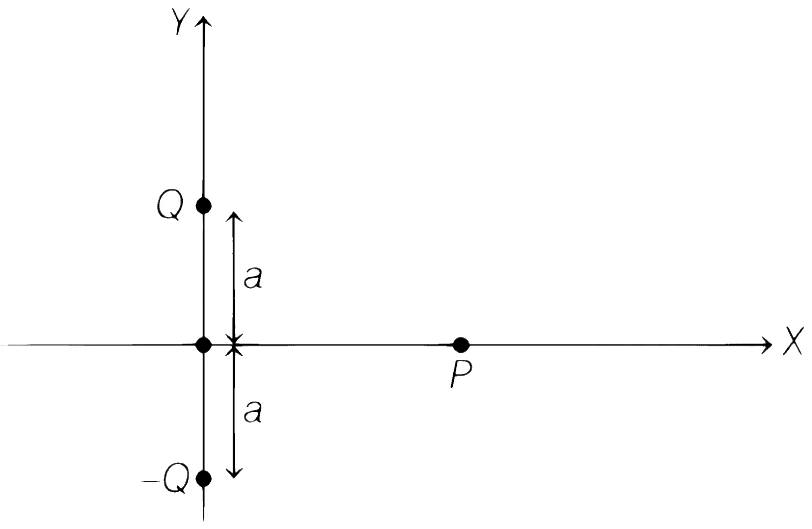
Three point charges q, −2q and q are placed along the x axis at x=−a,0 and a respectively. As a→0 and q→∞ while qa2=Q remains finite, the electric field at a point P, at a distance x(x≫a) from x=0 is E=4πε0xβαQi^. Then
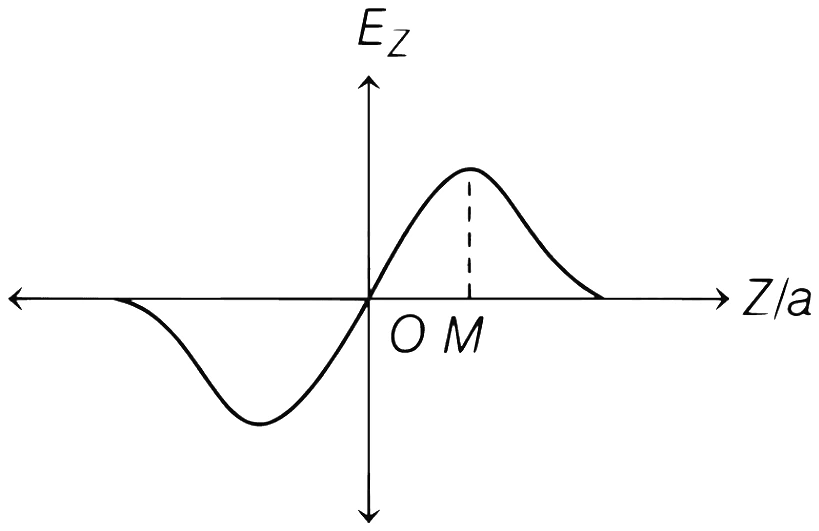
The variation of electric field along the Z-axis due to a uniformly charged circular ring of radius a in XY-plane is as shown in the figure. The value of coordinate M (in units of a) will be
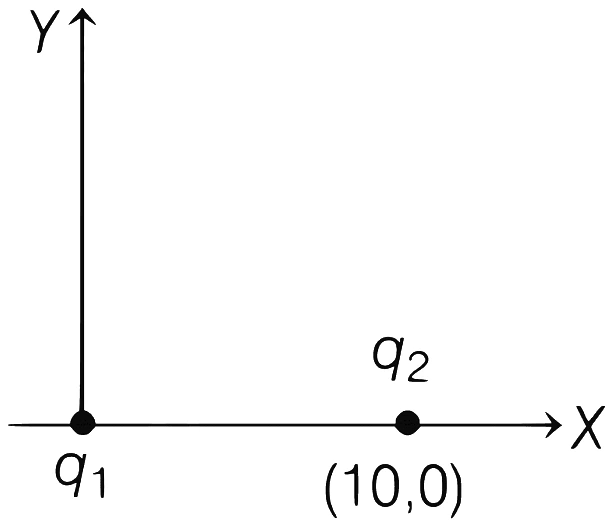
As shown in the figure, a point charge q1=+1×10⁻⁶C is placed at the origin in xy-plane and another point charge q2=+3×10⁻⁶C is placed at the coordinate (10,0). In that case, which of the following graph(s) shows most correctly the electric field vector Ex in x-direction?
Eleven equal point charges, all of them having a charge +Q, are placed at all the hour positions of a circular clock of radius r, except at the 10 h position. What is the electric field strength at the centre of the clock?
Four equal charges of value +Q are placed at any four vertices of a regular hexagon of side a. By suitably choosing the vertices, what can be maximum possible magnitude of electric field at the centre of the hexagon?
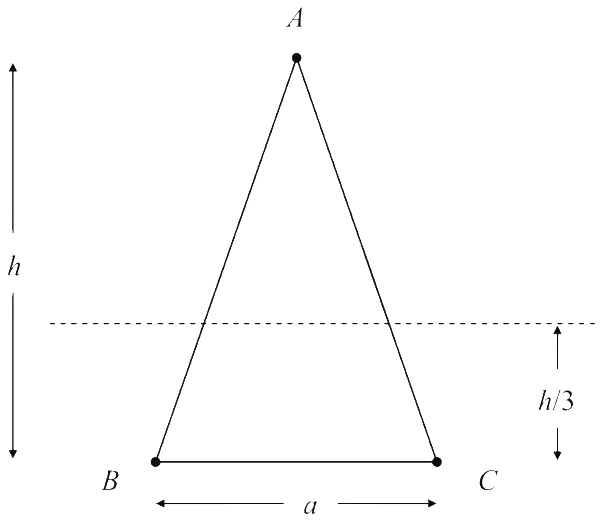
Two equal positive charges q are placed at the vertices B and C of an isosceles triangle of base a and height h=33a/2, as shown in the adjacent figure. When a charge q′ is placed at A, it is found that at a point inside the triangle, the net electric field due to the three charges vanishes. If this point is at a height h/3, then what is q′?
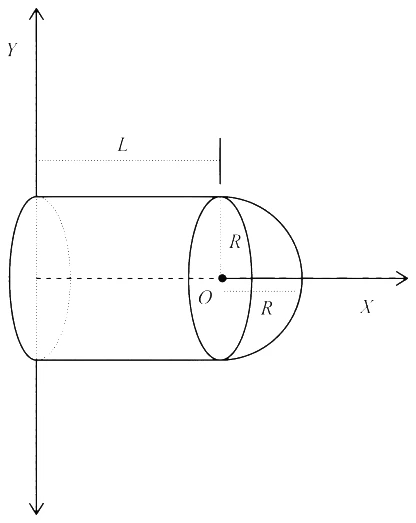
A hollow thin-walled glass tube of length L, is open at one end while the other end is closed by a hollow thin-walled glass hemisphere of radius R. The axis of the tube is along the x−axis with the open end at the origin, as shown in the figure. A net positive charge Q is distributed uniformly over the entire surface with surface charge density σ. The magnitude of the electric field at O due to the hemisphere is σ/4ϵ0. Choose the correct statement(s).
More than one option can be correct. Tap every correct option, then tap Check.
Consider a set of 12 equal charges (+q each), arranged to form two concentric regular hexagons in the xy-plane, centred at origin. The edges of the two hexagons have lengths a and 2a respectively. They are arranged in such a way that two vertices of each one of them are on the y-axis. Suppose that the charges from the vertices at (0,2a) and (0,−a) are removed. Then, the magnitude of the electric field produced by the resulting configuration at the origin is
A ring of radius R is uniformly charged with linear charge density λ. A unit test charge of opposite sign is released from rest at a height h>2R from the centre of the ring. The test charge moves along the axis. Ignore the effect of gravity. Then
More than one option can be correct. Tap every correct option, then tap Check.
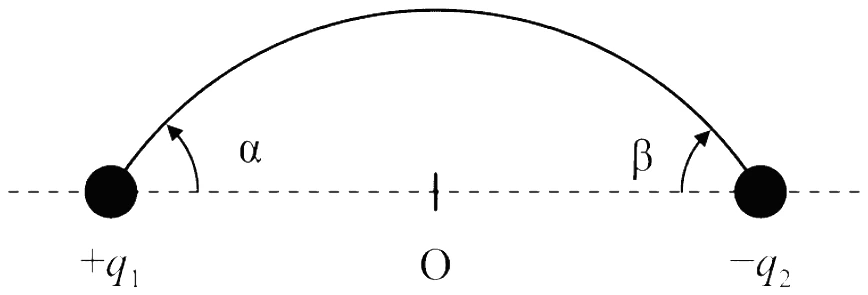
An electrostatic field line leaves at an angle α from point charge q1, and connects with point charge −q2 at an angle β (q1 and q2 are positive), as shown schematically in the figure. We have q1=2q2 and α=60∘. Then,
More than one option can be correct. Tap every correct option, then tap Check.
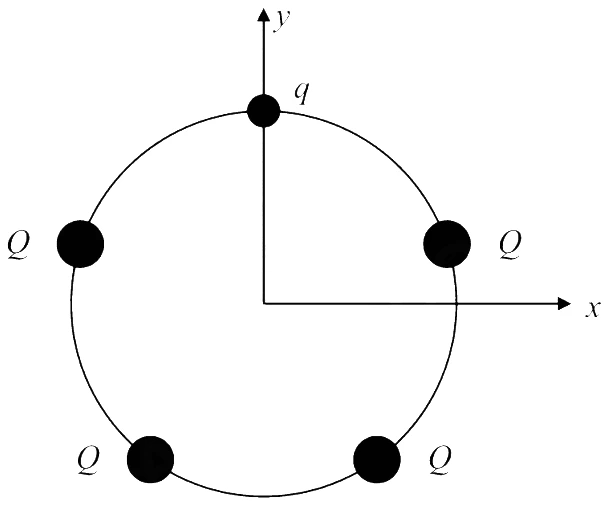
A circular loop of radius a, centered at origin has five positive charges equally spaced on it. All charges have a magnitude Q, except the one at (0,a) which has a magnitude q, as shown in the figure. The electric field at the origin will be
Assertion (A): Equal amount of positive and negative charges are distributed uniformly on two halves of a thin circular ring as shown in figure. The resultant electric field at the centre O of the ring is along OC. Reason (R): It is so because the net potential at O is not zero.
The magnitude of the electric field due to a point charge object at a distance of 4.0m is 9CN. From the same charged object the electric field of magnitude 16CN will be at a distance of