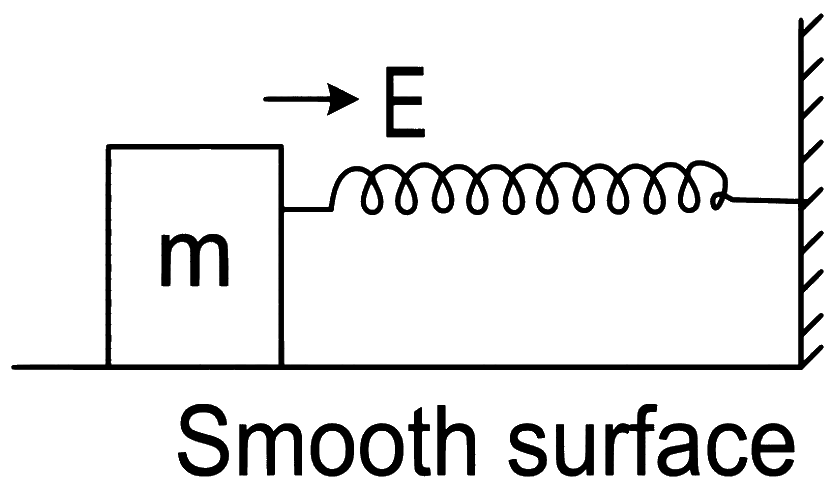
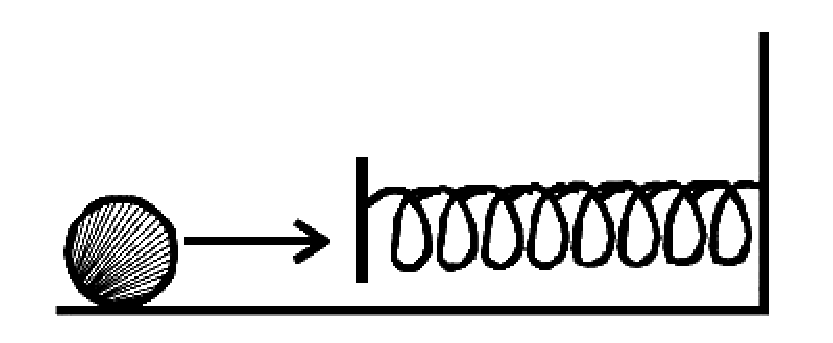
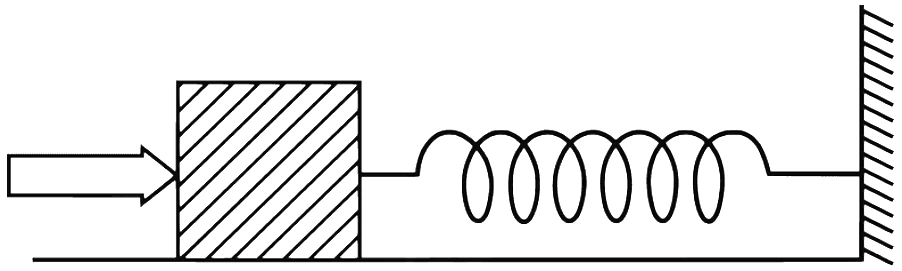
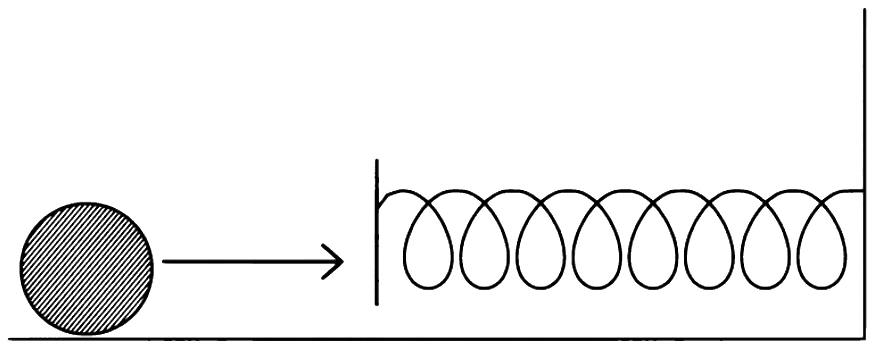
A block of mass 'm' moving on a frictionless horizontal surface collides with a spring of spring constant 'K' and compresses it through a distance 'x'. The maximum momentum of the block after collision is
The spring is initially in unstretched condition. It is first stretched by a length 'x' and the work done is W1. Then again it is stretched by further length 'x' when the work done is W2. The value of W2 is given by
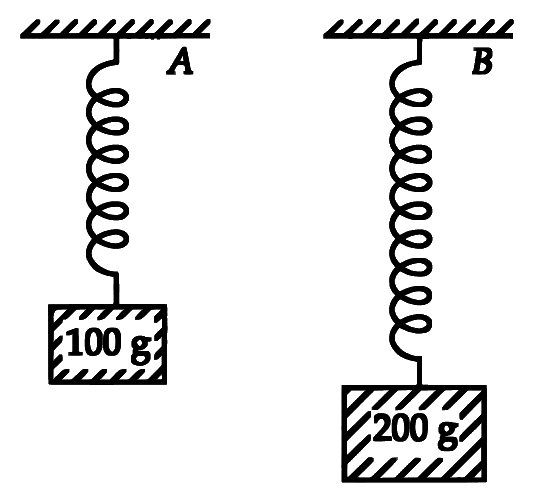
Two blocks with masses 100 g and 200 g are attached to the ends of springs A and B as shown in figure. The energy stored in A is E. The energy stored in B, when spring constants kA,kB of A and B, respectively satisfy the relation 4kA=3kB, is:
A sphere of mass 50 gram is placed on a vertical spring. It is compressed by 0.4 m using a force 10 N. When the spring is released the sphere will reach to a height of (g=10 m/s2)
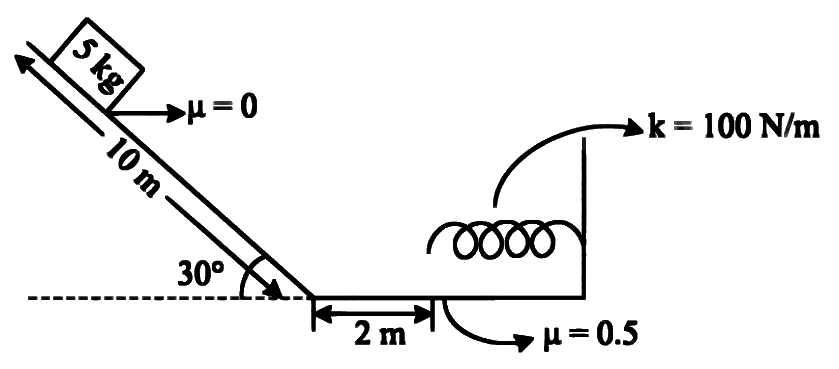
A block is simply released from the top of an inclined plane as shown in the figure above. The maximum compression in the spring when the block hits the spring is:
A block is fastened to a horizontal spring. The block is pulled to a distance x=10 cm from its equilibrium position (at x=0) on a frictionless surface from rest. The energy of the block at x=5 cm is 0.25 J. The spring constant of the spring is ___________ Nm−1
Numerical answer type. Work it out, then open the answer.
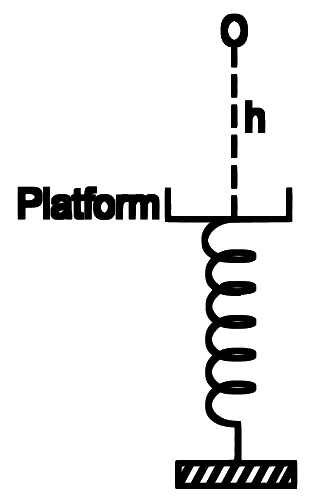
A ball of mass 'm' is dropped from a height 's' on a horizontal platform fixed at the top of a vertical spring. The platform is depressed by a distance 'h'. The spring constant is ( g= acceleration due to gravity)
As per the given figure, two blocks each of mass 250 g are connected to a spring of spring constant 2 Nm−1. If both are given velocity v in opposite directions, then maximum elongation of the spring is:
A block of mass 'm' (as shown in figure) moving with kinetic energy E compresses a spring through a distance 25 cm when its speed is halved. The value of spring constant of used spring will be nE Nm−1 for n= _________.
Numerical answer type. Work it out, then open the answer.
A 0.5 kg block moving at a speed of 12 ms−1 compresses a spring through a distance 30 cm when its speed is halved. The spring constant of the spring will be _______________ Nm−1.
Numerical answer type. Work it out, then open the answer.
A ball of mass 100 g is dropped from a height h = 10 cm on a platform fixed at the top of a vertical spring (as shown in figure). The ball stays on the platform and the platform is depressed by a distance 2h. The spring constant is _____________ Nm−1.
(Use g = 10 ms−2)
Numerical answer type. Work it out, then open the answer.
A ball of mass 4 kg, moving with a velocity of 10 ms−1, collides with a spring of length 8 m and force constant 100 Nm−1. The length of the compressed spring is x m. The value of x, to the nearest integer, is ____________.
Numerical answer type. Work it out, then open the answer.
A sphere of mass 25 gram is placed on a vertical spring. It is compressed by 0.2 m using a force 5 N. When the spring is released, the sphere will reach a height of (g=10 m/s2)
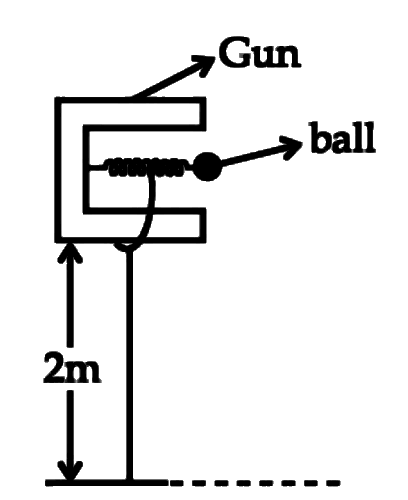
In a spring gun having spring constant 100 N/m a small ball 'B' of mass 100 g is put in its barrel (as shown in figure) by compressing the spring through 0.05 m. There should be a box placed at a distance 'd' on the ground so that the ball falls in it. If the ball leaves the gun horizontally at a height of 2 m above the ground. The value of d is _________ m. (g = 10 m/s2).
Numerical answer type. Work it out, then open the answer.
An engine is attached to a wagon through a shock absorber of length 1.5 m. The system with a total mass of 40,000 kg is moving with a speed of 72 kmh−1 when the brakes are applied to bring it to rest. In the process of the system being brought to rest, the spring of the shock absorber gets compressed by 1.0 m. If 90% of energy of the wagon is lost due to friction, the spring constant is ____________ × 105 N/m.
Numerical answer type. Work it out, then open the answer.
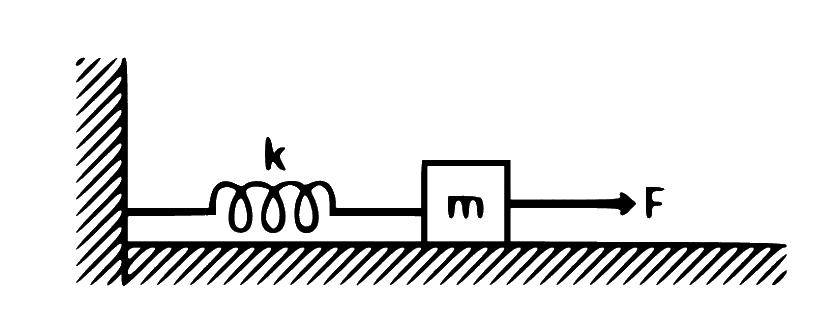
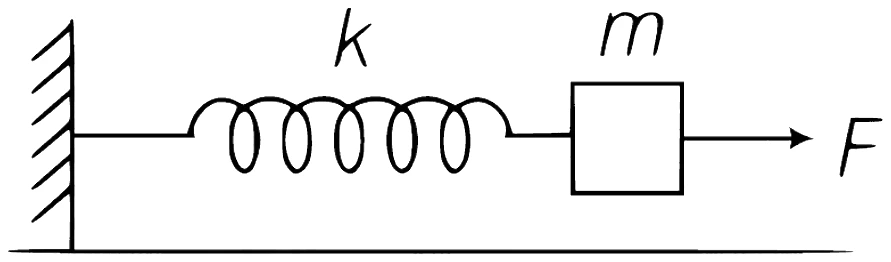
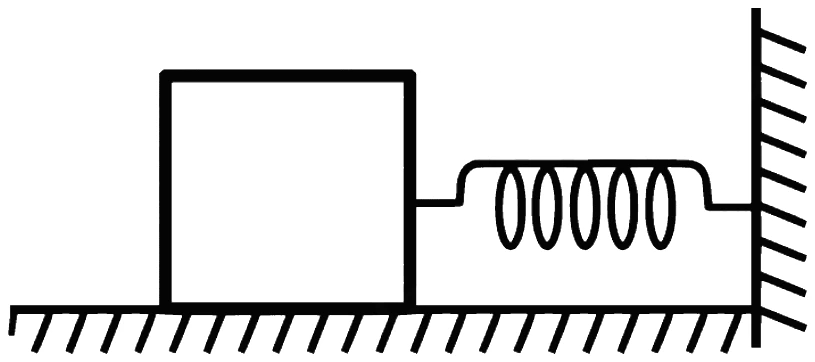
A block of mass m, lying on a smooth horizontal surface, is attached to a spring (of negligible mass) of spring constant k. The other end of the spring is fixed, as shown in the figure. The block is initially at rest in its equilibrium position. If now the block is pulled with a constant force F, the maximum speed of the block is:
Two similar springs P and Q have spring constants KP and KQ, such that KP > KQ. They are stretched first by the same amount (case a), then by the same force (case b). The work done by the springs WP and WQ are related as, in case (a) and case (b) respectively
A block of mass m = 0.1 kg is connected to a spring of unknown spring constant k. It is compressed to a distance x from its equilibrium position and released from rest.
After approaching half the distance (2x) from equilibrium position, it hits another block and comes to rest momentarily, while the other block moves with a velocity 3 ms−1. The total initial energy of the spring is:
A spring of unstretched length l has a mass m with one end fixed to a rigid support. Assuming spring to be made of a uniform wire, the kinetic energy possessed by it if its free end is pulled with uniform velocity v is:
Two springs of force constants 300 N/m (Spring A) and 400 N/m (Spring B) are joined together in series. The combination is compressed by 8.75 cm. The ratio of energy stored in A and B is EBEA. Then EBEA is equal to:
This question has Statement 1 and Statement 2. Of the four choices given after the Statements, choose the one that best describes the two Statements.
If two springs S1 and S2 of force constants k1 and k2, respectively, are stretched by the same force, it is found that more work is done on spring S1 than on spring S2.
STATEMENT 1: If stretched by the same amount, work done on S1 is more than that on S2 STATEMENT 2: k1<k2
A solid cylinder of mass 3 kg is rolling on a horizontal surface with velocity 4 m s−1. It collides with a horizontal spring of force constant 200 N m−1. The maximum compression produced in the spring will be
A block of mass M is attached to the lower end of a vertical spring. The spring is hung from a ceiling and has force constant value k. The mass is released from rest with the spring initially unstretched. The maximum extension produced in the length of the spring will be
A 2 kg block slides on a horizontal floor with a speed of 4 m/s. It strikes an uncompressed spring and compresses it till the block is motionless. The kinetic friction force is 15 N and spring constant is 10,000 N/m. The spring compresses by
A vertical spring with force constant k is fixed on a table. A ball of mass m at a height h above the free upper end of the spring falls vertically on the spring so that the spring is compressed by a distance d. The net work done in the process is
A mass of 0.5 kg moving with a speed of 1.5 m/s on horizontal smooth surface, collides with a nearly weightless spring of force constant k = 50 N/m. The maximum compression of the spring would be
A spring of spring constant 5×10³ N/m is stretched initially by 5 cm from the unstretched position. Then the work required to stretch it further by another 5 cm is
Two springs A and B having spring constant KA and KB (KA = 2KB) are stretched by applying force of equal magnitude. If energy stored in spring A is EA then energy stored in B will be
A mass is attached to a spring that hangs vertically. The extension produced in the spring is 6cm on Earth. The acceleration due to gravity on the surface of the Moon is one-sixth of its value on the surface of the Earth. The extension of the spring on the Moon would be:
A block of mass 0.18kg is attached to a spring of force-constant 2N m−1. The coefficient of friction between the block and the floor is 0.1. Initially the block is at rest and the spring is un-stretched. An impulse is given to the block as shown in the figure. The block slides a distance of 0.06m and comes to rest for the first time. The initial velocity of the block in m s−1 is V=N/10. Then N is
Numerical answer type. Work it out, then open the answer.
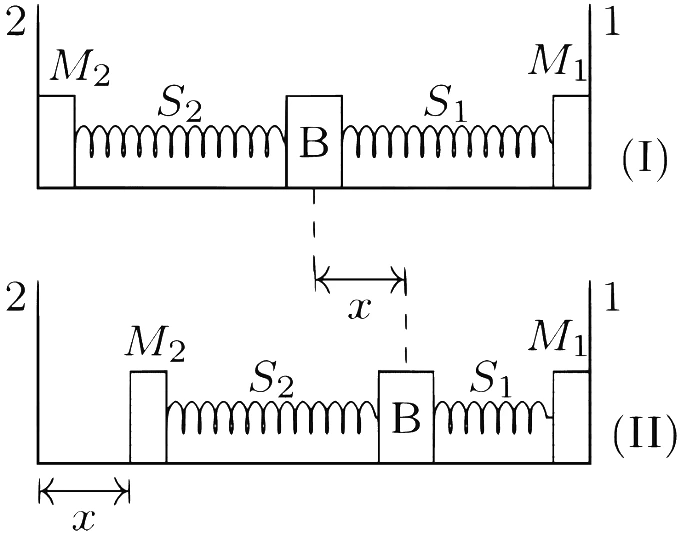
A block (B) is attached to two unstretched springs S1 and S2 with spring constants k and 4k respectively (see figure I). The other ends are attached to identical supports M1 and M2 not attached to the walls. The springs and supports have negligible mass. There is no friction anywhere. The block is displaced towards wall 1 by a small distance x (figure II) and released. The block returns and moves a maximum distance y towards wall 2. Displacements x and y are measured with respect to the equilibrium position of the block B. The ratio xy is:
An ideal spring with spring-constant k is hung from the ceiling and a block of mass M is attached to its lower end. The mass is released with the spring initially unstretched. Then the maximum extension in the spring is
A spring of force-constant k is cut into two pieces such that one piece is double the length of the other. Then the long piece will have a force-constant of
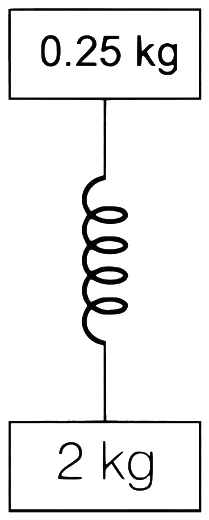
A 0.25kg block rests on top of a vertical spring whose lower end is attached to a 2kg block lying on the floor. Initially the spring is in its natural length and the 0.25kg block is released. Find the maximum force exerted by the system on the floor.
The figure shows a mass m on a frictionless surface. It is connected to a rigid wall by a massless spring of constant k. Initially, the spring is at its natural position. If a force of constant magnitude F starts acting on the block towards the right, then the speed of the block when the deformation in the spring is x will be
A vertical spring with force constant k is fixed on a table. A ball of mass m at a height h above the free upper end of the spring falls vertically on the spring, so that the spring is compressed by a distance d. The net work done in the process is
Two wires are stretched through the same distance. The force constant of the second wire is half that of the first wire. The ratio of work done to stretch the first wire and the second wire will be
A ball of mass 2kg moving with velocity 3m s−1 collides with a spring of natural length 2m and force constant 144N m−1. What will be the length of the compressed spring?
A string of length L and force constant k is stretched to obtain extension l. It is further stretched to obtain extension l1. The work done in second stretching is
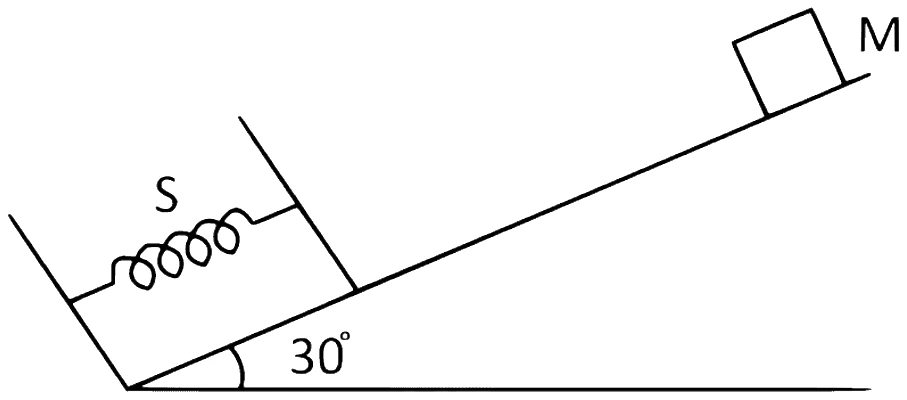
An ideal massless spring S can be compressed 1m by a force of 100N in equilibrium. The same spring is placed at the bottom of a frictionless inclined plane inclined at 30∘ to the horizontal. A 10kg block M is released from rest at the top of the incline and is brought to rest momentarily after compressing the spring by 2m. If g=10m s−2, what is the speed of mass just before it touches the spring?
A mass of 0.5kg moving with a speed of 1.5m s−1 on a horizontal smooth surface, collides with a nearly weightless spring of force constant k=50N m−1. The maximum compression of the spring would be
A block of mass 1.5kg moves along the floor of a hall with a speed of 5m s−1. It strikes an uncompressed spring and compresses it till the block becomes motionless. If the force constant of the spring is 10000N m−1 and the spring is compressed by 5cm, calculate the effective force of kinetic friction.
A massless spring with a spring constant k is fixed at its upper end. A block of mass M is attached to the lower end of the spring and released from rest in its unstretched position. The maximum elongation of the spring is
Two blocks each of mass m are connected to a spring of spring constant K. If both are given velocity V in opposite directions as shown in the figure, then the maximum elongation of the spring is
A block of mass 0.18kg is attached to a spring of constant 2N m−1 as shown in the figure. The coefficient of friction between the block and the horizontal surface is 0.1. Initially the block is at rest and the spring is unstretched. When an impulse is given to the block, it slides through a distance 0.06m and stops. The velocity of the block just after the impulse is given to it is (Take g=10m s−2)
A spring of spring constant 200N m−1 is initially stretched by 10cm from the unstretched position. The work to be done to stretch the spring further by another 10cm is
A spring of spring constant 5×10³N m−1 is stretched initially by 10cm from unstretched position. The work required to stretch it further by another 10cm is
A car of mass 1000kg having a velocity of 10m s−1 collides with a horizontally mounted spring. If the spring constant is 4000N m−1, then the maximum compression of the spring is
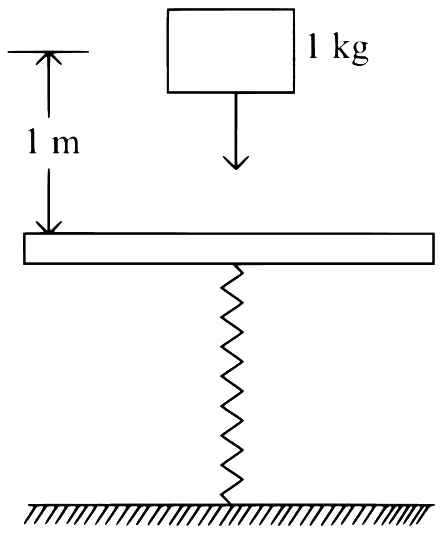
A mass of 1kg falls from a height of 1m and lands on a massless platform supported by a spring having spring constant 15N m−1 as shown in the figure. The maximum compression of the spring is (acceleration due to gravity =10m s−2)
A block kept on a frictionless horizontal surface is connected to one end of a horizontal spring of constant 100N m−1 whose other end is fixed to a rigid vertical wall. Initially the block is at its equilibrium position. The block is pulled to a distance of 8cm and released. The kinetic energy of the block when it is a distance of 3cm from the mean position is
Acceleration due to gravity on Earth g=10.0m s−2. A mass of 1kg is dropped from a height of 2m on a horizontal spring board. The vertical spring supporting the board has a spring constant of 87.5N/m. The maximum distance by which the mass compresses the spring is close to