Q1 MHT CET 2026 · 19 MAY · SHIFT 1 Easy ☆
SHM: velocity and acceleration
The differential equation of a particle performing S.H.M. is d 2 x d t 2 + 64 x = 0 \frac{d^2x}{dt^2} + 64x = 0 d t 2 d 2 x + 64 x = 0 x x x
(a) π 3 \frac{\pi}{3} 3 π (b) π 4 \frac{\pi}{4} 4 π (c) π 5 \frac{\pi}{5} 5 π (d) π 8 \frac{\pi}{8} 8 π Show answer and solution
Answer: (b)
Loading the solution…
Report a mistake Open question page Q2 MHT CET 2023 · 14 MAY · SHIFT 1 Easy ☆
SHM: velocity and acceleration
The displacement of a particle executing S.H.M. is x = a sin ( ω t − ϕ ) x = a\sin(\omega t - \phi) x = a sin ( ω t − ϕ ) t = ϕ ω t = \frac{\phi}{\omega} t = ω ϕ ( cos 0 ∘ = 1 ) (\cos 0^\circ = 1) ( cos 0 ∘ = 1 )
(a) ω cos ϕ \omega\cos\phi ω cos ϕ (b) a ω a\omega aω (c) ω cos 2 ϕ \omega\cos 2\phi ω cos 2 ϕ (d) − a ω cos 2 ϕ -a\omega\cos 2\phi − aω cos 2 ϕ Show answer and solution
Answer: (b)
Loading the solution…
Report a mistake Open question page Q3 MHT CET 2026 · 17 APR · SHIFT 2 Medium ☆
SHM: velocity and acceleration
The displacement of a particle performing linear S.H.M. is given by y = A cos [ π ( t + ϕ ) ] y = A\cos[\pi(t + \phi)] y = A cos [ π ( t + ϕ )] t = 0 t = 0 t = 0 y = 2 y = 2 y = 2 2 π 2\pi 2 π
(a) 1 2 \frac{1}{\sqrt{2}} 2 1 (b) 2 \sqrt{2} 2 (c) 2 2 2 (d) 2 2 2\sqrt{2} 2 2 Show answer and solution
Answer: (d)
Loading the solution…
Report a mistake Open question page Q4 MHT CET 2024 · 2 MAY · SHIFT 2 Medium ☆
SHM: velocity and acceleration
The displacement of a particle performing S.H.M. is given by Y = A cos [ π ( t + ϕ ) ] Y = A\cos[\pi(t + \phi)] Y = A cos [ π ( t + ϕ )] t = 0 t = 0 t = 0 y = 2 cm y = 2\text{ cm} y = 2 cm 2 π cm/s 2\pi\text{ cm/s} 2 π cm/s A A A
(a) 2 (b) 2 \sqrt{2} 2 (c) 2 2 2\sqrt{2} 2 2 (d) 1 2 \frac{1}{\sqrt{2}} 2 1 Show answer and solution
Answer: (c)
Loading the solution…
Report a mistake Open question page Q5 MHT CET 2024 · 11 MAY · SHIFT 1 Medium ☆
SHM: velocity and acceleration
A particle performing S.H.M. starts from equilibrium position and its time period is 12 second. After 2 seconds its velocity is π m/s \pi\text{ m/s} π m/s
[ sin 3 0 ∘ = cos 6 0 ∘ = 0.5 , sin 6 0 ∘ = cos 3 0 ∘ = 3 / 2 ] \left[\sin 30^\circ = \cos 60^\circ = 0.5,\ \sin 60^\circ = \cos 30^\circ = \sqrt{3}/2\right] [ sin 3 0 ∘ = cos 6 0 ∘ = 0.5 , sin 6 0 ∘ = cos 3 0 ∘ = 3 /2 ]
(a) 6 m (b) 12 m (c) 12 3 m 12\sqrt{3}\text{ m} 12 3 m (d) 6 3 m 6\sqrt{3}\text{ m} 6 3 m Show answer and solution
Answer: (b)
Loading the solution…
Report a mistake Open question page Q6 MHT CET 2026 · 14 MAY · SHIFT 2 Difficult ☆
SHM: velocity and acceleration
A particle executes S.H.M. with time period 16 16 16 t = 2 t = 2 t = 2 t = 4 t = 4 t = 4 4 4 4 ( sin 4 5 ∘ = 1 2 ) \left(\sin 45^\circ = \frac{1}{\sqrt{2}}\right) ( sin 4 5 ∘ = 2 1 )
(a) 2 π \sqrt{2}\pi 2 π (b) 16 2 π 16\sqrt{2}\pi 16 2 π (c) 24 2 π 24\sqrt{2}\pi 24 2 π (d) 32 2 / π 32\sqrt{2}/\pi 32 2 / π Show answer and solution
Answer: (d)
Loading the solution…
Report a mistake Open question page Q7 MHT CET 2025 · 25 APR · SHIFT 1 Medium ☆
SHM: velocity and acceleration
The displacement of particle in S.H.M. is x = A cos ( ω t + π / 6 ) x = A\cos(\omega t + \pi/6) x = A cos ( ω t + π /6 ) ( sin 9 0 ∘ = 1 ) (\sin 90^\circ = 1) ( sin 9 0 ∘ = 1 )
(a) π 3 ω s \frac{\pi}{3\omega}\text{ s} 3 ω π s (b) π 2 ω s \frac{\pi}{2\omega}\text{ s} 2 ω π s (c) π ω s \frac{\pi}{\omega}\text{ s} ω π s (d) π 4 ω s \frac{\pi}{4\omega}\text{ s} 4 ω π s Show answer and solution
Answer: (a)
Loading the solution…
Report a mistake Open question page Q8 MHT CET 2026 · 11 APR · SHIFT 2 Easy ☆
SHM: velocity and acceleration
A mass attached to a spring performs S.H.M. whose displacement is x = 3 × 1 0 − 3 cos 2 π t x = 3 \times 10^{-3}\cos 2\pi t x = 3 × 1 0 − 3 cos 2 π t
(a) 1 1 1 (b) 1 2 \frac{1}{2} 2 1 (c) 1 4 \frac{1}{4} 4 1 (d) 1 8 \frac{1}{8} 8 1 Show answer and solution
Answer: (c)
Loading the solution…
Report a mistake Open question page Q9 MHT CET 2025 · 20 APR · SHIFT 2 Easy ☆
SHM: velocity and acceleration
A mass attached to a spring performs S.H.M. whose displacement is x = 3 × 1 0 − 3 cos 2 π t x = 3 \times 10^{-3}\cos 2\pi t x = 3 × 1 0 − 3 cos 2 π t
(a) 1 12 s \frac{1}{12}\text{ s} 12 1 s (b) 1 8 s \frac{1}{8}\text{ s} 8 1 s (c) 1 4 s \frac{1}{4}\text{ s} 4 1 s (d) 1 2 s \frac{1}{2}\text{ s} 2 1 s Show answer and solution
Answer: (c)
Loading the solution…
Report a mistake Open question page Q10 MHT CET 2021 · 24 SEP · SHIFT 2 Easy ☆
SHM: velocity and acceleration
The displacement of a particle performing S.H.M. is given by x = 5 sin ( 3 t + 3 ) x = 5\sin(3t + 3) x = 5 sin ( 3 t + 3 ) x x x cm \text{cm} cm t t t
(a) 15 cm s − 2 15\text{ cm s}^{-2} 15 cm s − 2 (b) 30 cm s − 2 30\text{ cm s}^{-2} 30 cm s − 2 (c) 45 cm s − 2 45\text{ cm s}^{-2} 45 cm s − 2 (d) 90 cm s − 2 90\text{ cm s}^{-2} 90 cm s − 2 Show answer and solution
Answer: (c)
Loading the solution…
Report a mistake Open question page Q11 MHT CET 2023 · 9 MAY · SHIFT 2 Medium ☆
SHM: velocity and acceleration
Two S.H.Ms. are represented by equations y 1 = 0.1 sin ( 100 π t + π 3 ) y_1 = 0.1\sin\left(100\pi t + \frac{\pi}{3}\right) y 1 = 0.1 sin ( 100 π t + 3 π ) y 2 = 0.1 cos ( 100 π t ) y_2 = 0.1\cos(100\pi t) y 2 = 0.1 cos ( 100 π t )
(a) π 3 \frac{\pi}{3} 3 π (b) − π 6 -\frac{\pi}{6} − 6 π (c) + π 6 +\frac{\pi}{6} + 6 π (d) − π 3 -\frac{\pi}{3} − 3 π Show answer and solution
Answer: (b)
Loading the solution…
Report a mistake Open question page Q12 NEET 2023 Easy ☆
SHM: velocity and acceleration
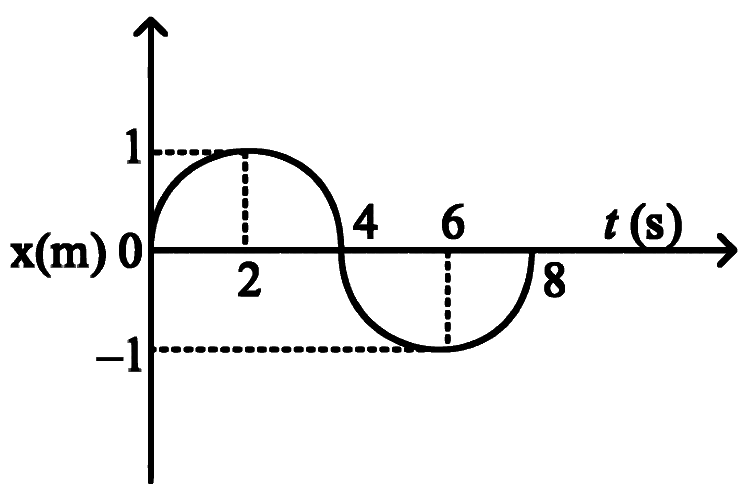
The x - t x\text{-}t x - t t = 2 s t = 2\text{ s} t = 2 s
(a) − π 2 8 m s − 2 -\frac{\pi^2}{8}\text{ m s}^{-2} − 8 π 2 m s − 2 (b) π 2 16 m s − 2 \frac{\pi^2}{16}\text{ m s}^{-2} 16 π 2 m s − 2 (c) − π 2 16 m s − 2 -\frac{\pi^2}{16}\text{ m s}^{-2} − 16 π 2 m s − 2 (d) π 2 8 m s − 2 \frac{\pi^2}{8}\text{ m s}^{-2} 8 π 2 m s − 2 Show answer and solution
Answer: (c)
Loading the solution…
Report a mistake Open question page Q13 NEET 2014 · AIPMT Easy ☆
SHM: velocity and acceleration
The oscillation of a body on a smooth horizontal surface is represented by the equation, X = A cos( ω t ) (\omega t) ( ω t )
where X = displacement at time t
ω \omega ω
Which one of the following graphs shows correctly the variation of a with t?
Here a = acceleration at time t
T = time period
Show answer and solution
Answer: (c)
Loading the solution…
Report a mistake Open question page Q14 NEET 2013 Medium ☆
SHM: velocity and acceleration
A particle of mass m oscillates along x-axis according to equation x = asinω \omega ω
(a) Circle (b) Hyperbola (c) Ellipse (d) Straight line passing through origin Show answer and solution
Answer: (c)
Loading the solution…
Report a mistake Open question page Q15 NEET 2007 · AIPMT Easy ☆
SHM: velocity and acceleration
The phase difference between the instantaneous velocity and acceleration of a particle executing simple harmonic motion is
(a) π \pi π (b) 0.707 π \pi π (c) zero (d) 0.5 π \pi π Show answer and solution
Answer: (d)
Loading the solution…
Report a mistake Open question page Q16 JEE Main 2026 · 2 APR · SHIFT 2 Medium ☆
SHM: velocity and acceleration
The equation of motion of a particle is given by x = a sin ( 50 t + π / 3 ) x = a\sin(50t + \pi/3) x = a sin ( 50 t + π /3 ) t 1 t_1 t 1 t 2 t_2 t 2 t 1 t_1 t 1 t 2 t_2 t 2
(a) π 300 \frac{\pi}{300} 300 π , π 75 ,\ \frac{\pi}{75} , 75 π (b) π 75 \frac{\pi}{75} 75 π , π 300 ,\ \frac{\pi}{300} , 300 π (c) π 300 \frac{\pi}{300} 300 π , π 25 ,\ \frac{\pi}{25} , 25 π (d) π 50 \frac{\pi}{50} 50 π , π 100 ,\ \frac{\pi}{100} , 100 π Show answer and solution
Answer: (a)
Loading the solution…
Report a mistake Open question page Q17 JEE Main 2025 · 24 JAN · SHIFT 2 Medium ☆
SHM: velocity and acceleration
A particle oscillates along the x x x x ( t ) = x 0 sin 2 ( t 2 ) x(t) = x_0\sin^2\left(\frac{t}{2}\right) x ( t ) = x 0 sin 2 ( 2 t ) x 0 = 1 m x_0 = 1\text{ m} x 0 = 1 m ( K ) (K) ( K ) x x x
Show answer and solution
Answer: (d)
Loading the solution…
Report a mistake Open question page Q18 JEE Main 2023 · 30 JAN · SHIFT 1 Medium ☆
SHM: velocity and acceleration
The general displacement of a simple harmonic oscillator is x = A sin ω t x = A\sin\omega t x = A sin ω t t = T β t = \frac{T}{\beta} t = β T β \beta β
Numerical answer type. Work it out, then open the answer.
Show answer and solution
Answer: 8
Loading the solution…
Report a mistake Open question page Q19 JEE Main 2022 · 27 JUN · SHIFT 2 Easy ☆
SHM: velocity and acceleration
The equation of a particle executing simple harmonic motion is given by x = sin π ( t + 1 3 ) m x = \sin\pi\left(t + \frac{1}{3}\right)\text{ m} x = sin π ( t + 3 1 ) m
(Given: π \pi π
(a) 0 cm s− 1 {}^{-1} − 1 (b) 157 cm s− 1 {}^{-1} − 1 (c) 272 cm s− 1 {}^{-1} − 1 (d) 314 cm s− 1 {}^{-1} − 1 Show answer and solution
Answer: (b)
Loading the solution…
Report a mistake Open question page Q20 JEE Main 2021 · 27 JUL · SHIFT 2 Easy ☆
SHM: velocity and acceleration
A particle executes simple harmonic motion represented by displacement function as x(t) = A sin(ω \omega ω ϕ \phi ϕ
If the position and velocity of the particle at t = 0 s are 2 cm and 2ω \omega ω − 1 {}^{-1} − 1 x 2 x\sqrt{2} x 2
Numerical answer type. Work it out, then open the answer.
Show answer and solution
Answer: 2
Loading the solution…
Report a mistake Open question page Q21 JEE Main 2021 · 22 JUL · SHIFT 2 Medium ☆
SHM: velocity and acceleration
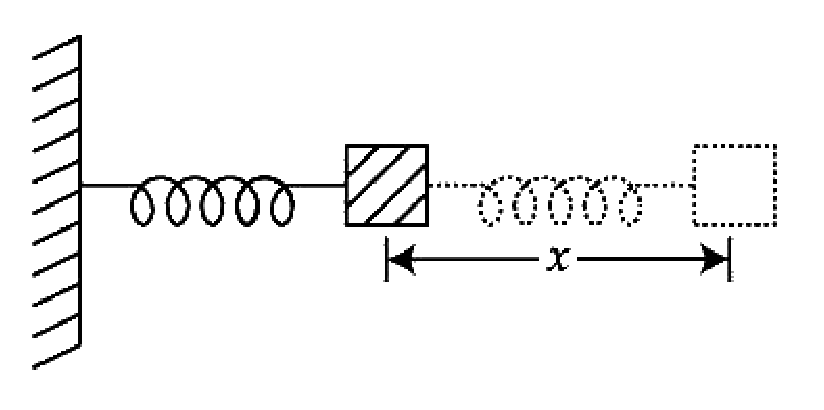
The motion of a mass on a spring, with spring constant K is as shown in figure.
The equation of motion is given by
x(t) = A sinω \omega ω ω \omega ω ω = K m \omega = \sqrt{\frac{K}{m}} ω = m K
Suppose that at time t = 0, the position of mass is x(0) and velocity v(0), then its displacement can also be represented as x(t) = C cos(ω \omega ω − ϕ -\phi − ϕ ϕ \phi ϕ
(a) C = 2 v ( 0 ) 2 ω 2 + x ( 0 ) 2 , ϕ = tan − 1 ( x ( 0 ) ω 2 v ( 0 ) ) C = \sqrt{\frac{2v(0)^2}{\omega^2}+x(0)^2},\ \phi = \tan^{-1}\left(\frac{x(0)\omega}{2v(0)}\right) C = ω 2 2 v ( 0 ) 2 + x ( 0 ) 2 , ϕ = tan − 1 ( 2 v ( 0 ) x ( 0 ) ω ) (b) C = v ( 0 ) 2 ω 2 + x ( 0 ) 2 , ϕ = tan − 1 ( x ( 0 ) ω v ( 0 ) ) C = \sqrt{\frac{v(0)^2}{\omega^2}+x(0)^2},\ \phi = \tan^{-1}\left(\frac{x(0)\omega}{v(0)}\right) C = ω 2 v ( 0 ) 2 + x ( 0 ) 2 , ϕ = tan − 1 ( v ( 0 ) x ( 0 ) ω ) (c) C = v ( 0 ) 2 ω 2 + x ( 0 ) 2 , ϕ = tan − 1 ( v ( 0 ) x ( 0 ) ω ) C = \sqrt{\frac{v(0)^2}{\omega^2}+x(0)^2},\ \phi = \tan^{-1}\left(\frac{v(0)}{x(0)\omega}\right) C = ω 2 v ( 0 ) 2 + x ( 0 ) 2 , ϕ = tan − 1 ( x ( 0 ) ω v ( 0 ) ) (d) C = 2 v ( 0 ) 2 ω 2 + x ( 0 ) 2 , ϕ = tan − 1 ( v ( 0 ) x ( 0 ) ω ) C = \sqrt{\frac{2v(0)^2}{\omega^2}+x(0)^2},\ \phi = \tan^{-1}\left(\frac{v(0)}{x(0)\omega}\right) C = ω 2 2 v ( 0 ) 2 + x ( 0 ) 2 , ϕ = tan − 1 ( x ( 0 ) ω v ( 0 ) ) Show answer and solution
Answer: (c)
Loading the solution…
Report a mistake Open question page Q22 JEE Main 2015 · 10 APR · SHIFT 1 Difficult Old syllabus ☆
SHM: velocity and acceleration
A simple harmonic oscillator of angular frequency 2 rad s− 1 {}^{-1} − 1
(a) sint + 1 2 \frac{1}{2} 2 1 (b) sint + 1 2 \frac{1}{2} 2 1 (c) cost − 1 2 -\frac{1}{2} − 2 1 (d) sint − 1 2 -\frac{1}{2} − 2 1 Show answer and solution
Answer: (d)
Loading the solution…
Report a mistake Open question page Q23 JEE Main 2007 · AIEEE Easy ☆
SHM: velocity and acceleration
A point mass oscillates along the x x x x = x 0 cos ( ω t − π / 4 ) . x = x_0 \cos(\omega t - \pi/4). x = x 0 cos ( ω t − π /4 ) . a = A cos ( ω t + δ ) , a = A\cos(\omega t + \delta), a = A cos ( ω t + δ ) ,
(a) A = x 0 ω 2 , δ = 3 π / 4 A = x_0\omega^2,\ \delta = 3\pi/4 A = x 0 ω 2 , δ = 3 π /4 (b) A = x 0 , δ = − π / 4 A = x_0,\ \delta = -\pi/4 A = x 0 , δ = − π /4 (c) A = x 0 ω 2 , δ = π / 4 A = x_0\omega^2,\ \delta = \pi/4 A = x 0 ω 2 , δ = π /4 (d) A = x 0 ω 2 , δ = − π / 4 A = x_0\omega^2,\ \delta = -\pi/4 A = x 0 ω 2 , δ = − π /4 Show answer and solution
Answer: (a)
Loading the solution…
Report a mistake Open question page Q24 JEE Main 2007 · AIEEE Easy ☆
SHM: velocity and acceleration
The displacement of an object attached to a spring and executing simple harmonic motion is given by x = 2 × 1 0 − 2 cos π t x = 2 \times 10^{-2}\cos \pi t x = 2 × 1 0 − 2 cos π t
(a) 0.25 s 0.25\text{ s} 0.25 s (b) 0.5 s 0.5\text{ s} 0.5 s (c) 0.75 s 0.75\text{ s} 0.75 s (d) 0.125 s 0.125\text{ s} 0.125 s Show answer and solution
Answer: (b)
Loading the solution…
Report a mistake Open question page Q25 JEE Main 2005 · AIEEE Easy ☆
SHM: velocity and acceleration
If a simple harmonic motion is represented by d 2 x d t 2 + α x = 0. \frac{d^2x}{dt^2} + \alpha x = 0. d t 2 d 2 x + αx = 0.
(a) 2 π α \frac{2\pi}{\sqrt{\alpha}} α 2 π (b) 2 π α \frac{2\pi}{\alpha} α 2 π (c) 2 π α 2\pi\sqrt{\alpha} 2 π α (d) 2 π α 2\pi\alpha 2 π α Show answer and solution
Answer: (a)
Loading the solution…
Report a mistake Open question page Q26 MHT CET 2026 · 19 APR · SHIFT 2 Easy ☆
Wave: particle velocity
The equation of a progressive wave is given by y = 6 cos ( 100 t − 4 x ) y = 6\cos(100t - 4x) y = 6 cos ( 100 t − 4 x ) y y y μ \mu μ x x x t t t
(a) 1.5 × 1 0 − 5 1.5 \times 10^{-5} 1.5 × 1 0 − 5 (b) 2.0 × 1 0 − 6 2.0 \times 10^{-6} 2.0 × 1 0 − 6 (c) 2.4 × 1 0 − 5 2.4 \times 10^{-5} 2.4 × 1 0 − 5 (d) 2.8 × 1 0 − 6 2.8 \times 10^{-6} 2.8 × 1 0 − 6 Show answer and solution
Answer: (c)
Loading the solution…
Report a mistake Open question page Q27 MHT CET 2025 · 22 APR · SHIFT 1 Easy ☆
Wave: particle velocity
The equation of wave is y = 60 sin ( 1200 t − 6 x ) y = 60\sin(1200t - 6x) y = 60 sin ( 1200 t − 6 x ) y y y t t t x x x
(a) 36 (b) 3.6 × 1 0 − 5 3.6 \times 10^{-5} 3.6 × 1 0 − 5 (c) 3.6 × 1 0 − 4 3.6 \times 10^{-4} 3.6 × 1 0 − 4 (d) 3.6 × 1 0 − 6 3.6 \times 10^{-6} 3.6 × 1 0 − 6 Show answer and solution
Answer: (c)
Loading the solution…
Report a mistake Open question page Q28 MHT CET 2023 · 13 MAY · SHIFT 2 Easy ☆
Wave: particle velocity
The equation of a progressive wave is Y = a sin 2 π ( n t − x 5 ) Y = a\sin 2\pi\left(nt - \frac{x}{5}\right) Y = a sin 2 π ( n t − 5 x )
(a) π a 5 \frac{\pi a}{5} 5 πa (b) 2 π a 5 \frac{2\pi a}{5} 5 2 πa (c) 3 π a 5 \frac{3\pi a}{5} 5 3 πa (d) 4 π a 5 \frac{4\pi a}{5} 5 4 πa Show answer and solution
Answer: (b)
Loading the solution…
Report a mistake Open question page Q29 MHT CET 2023 · 11 MAY · SHIFT 2 Medium ☆
Wave: particle velocity
A transverse wave in a medium is given by y = A sin 2 ( ω t − k x ) y = A\sin 2(\omega t - kx) y = A sin 2 ( ω t − k x ) A A A
(a) 2 λ π \frac{2\lambda}{\pi} π 2 λ (b) λ π \frac{\lambda}{\pi} π λ (c) λ 2 π \frac{\lambda}{2\pi} 2 π λ (d) λ 4 π \frac{\lambda}{4\pi} 4 π λ Show answer and solution
Answer: (d)
Loading the solution…
Report a mistake Open question page Q30 MHT CET 2023 · 9 MAY · SHIFT 2 Medium ☆
Wave: particle velocity
The equation of simple harmonic progressive wave is given by y = a sin 2 π ( b t − c x ) y = a\sin 2\pi(bt - cx) y = a sin 2 π ( b t − c x ) c = c = c =
(a) 2 π a 2\pi a 2 πa (b) 1 4 π a \frac{1}{4\pi a} 4 πa 1 (c) 1 2 π a \frac{1}{2\pi a} 2 πa 1 (d) 4 π a 4\pi a 4 πa Show answer and solution
Answer: (b)
Loading the solution…
Report a mistake Open question page Q31 MHT CET 2019 · 2 MAY · SHIFT 1 Medium ☆
Wave: particle velocity
The equation of simple harmonic progressive wave is given by Y = a sin 2 π ( b t − c x ) Y = a\sin 2\pi(bt - cx) Y = a sin 2 π ( b t − c x )
(a) c = π a c = \pi a c = πa (b) c = 1 2 π a c = \frac{1}{2\pi a} c = 2 πa 1 (c) c = 1 π a c = \frac{1}{\pi a} c = πa 1 (d) c = 2 π a c = 2\pi a c = 2 πa Show answer and solution
Answer: (c)
Loading the solution…
Report a mistake Open question page Q32 MHT CET 2026 · 12 MAY · SHIFT 1 Medium ☆
Wave: particle velocity
A simple harmonic progressive wave is given by the equation y = a sin 2 π ( n t − x λ ) y = a\sin 2\pi\left(nt - \frac{x}{\lambda}\right) y = a sin 2 π ( n t − λ x ) 1 6 × \frac{1}{6} \times 6 1 × λ \lambda λ { a = \{a = { a = n = n = n = t = t = t = y = y = y = x = x = x = } \} }
(a) π a 2 \frac{\pi a}{2} 2 πa (b) π a 3 \frac{\pi a}{3} 3 πa (c) 3 π a 2 \frac{3\pi a}{2} 2 3 πa (d) 2 π a 3 \frac{2\pi a}{3} 3 2 πa Show answer and solution
Answer: (b)
Loading the solution…
Report a mistake Open question page Q33 MHT CET 2021 · 21 SEP · SHIFT 1 Medium ☆
Wave: particle velocity
A simple harmonic progressive wave is given by Y = Y 0 sin 2 π ( n t − x λ ) Y = Y_0\sin 2\pi\left(nt - \frac{x}{\lambda}\right) Y = Y 0 sin 2 π ( n t − λ x ) ( 1 8 ) \left(\frac{1}{8}\right) ( 8 1 )
(a) π Y 0 2 \frac{\pi Y_0}{2} 2 π Y 0 (b) π Y 0 4 \frac{\pi Y_0}{4} 4 π Y 0 (c) π Y 0 8 \frac{\pi Y_0}{8} 8 π Y 0 (d) π Y 0 16 \frac{\pi Y_0}{16} 16 π Y 0 Show answer and solution
Answer: (b)
Loading the solution…
Report a mistake Open question page Q34 MHT CET 2024 · 15 MAY · SHIFT 2 Medium ☆
Wave: particle velocity
A wave is given by Y = 3 sin 2 π ( t 0.04 − x 0.01 ) Y = 3\sin 2\pi\left(\frac{t}{0.04} - \frac{x}{0.01}\right) Y = 3 sin 2 π ( 0.04 t − 0.01 x ) ( π 2 = 10 ) (\pi^2 = 10) ( π 2 = 10 )
(a) 100 Hz , 4.7 × 1 0 4 cm/s 2 100\text{ Hz}, 4.7 \times 10^{4}\text{ cm/s}^2 100 Hz , 4.7 × 1 0 4 cm/s 2 (b) 50 Hz , 7.5 × 1 0 3 cm/s 2 50\text{ Hz}, 7.5 \times 10^{3}\text{ cm/s}^2 50 Hz , 7.5 × 1 0 3 cm/s 2 (c) 25 Hz , 4.7 × 1 0 4 cm/s 2 25\text{ Hz}, 4.7 \times 10^{4}\text{ cm/s}^2 25 Hz , 4.7 × 1 0 4 cm/s 2 (d) 25 Hz , 7.5 × 1 0 4 cm/s 2 25\text{ Hz}, 7.5 \times 10^{4}\text{ cm/s}^2 25 Hz , 7.5 × 1 0 4 cm/s 2 Show answer and solution
Answer: (d)
Loading the solution…
Report a mistake Open question page Q35 MHT CET 2026 · 12 MAY · SHIFT 2 Medium ☆
Wave: particle velocity
The equation of a wave travelling on a string is Y = sin ( 20 π x + 10 π t ) Y = \sin(20\pi x + 10\pi t) Y = sin ( 20 π x + 10 π t ) x x x t t t
(a) 2.5 2.5 2.5 (b) 5 5 5 (c) 20 20 20 (d) 10 10 10 Show answer and solution
Answer: (b)
Loading the solution…
Report a mistake Open question page Q36 JEE Main 2022 · 26 JUL · SHIFT 2 Easy ☆
Wave: particle velocity
A transverse wave is represented by y = 2 sin ( ω t − k x ) cm y = 2\sin(\omega t - kx)\text{ cm} y = 2 sin ( ω t − k x ) cm cm \text{cm} cm
(a) 4π \pi π (b) 2π \pi π (c) π \pi π (d) 2 Show answer and solution
Answer: (a)
Loading the solution…
Report a mistake Open question page
No questions match these filters.