Physics Circle home Student Login

Home›PYQ Workbook›Basic Maths 2: Differentiation & Integration›Integration: Area Under a Graph

Basic Maths 2: Differentiation & Integration PYQs · MHT CET · JEE Main · NEET

Integration: Area Under a Graph

Read the theory for this topic →

Questions
116
MHT CET
20
JEE Main
80
NEET
16
0 of 116 attempted

Q1MHT CET 2024 · 2 MAY · SHIFT 1Easy

Slope and area of motion graphs

The acceleration of a moving body can be found from

Show answer and solution

Answer: (c)

Loading the solution…
Report a mistakeOpen question page
Q2MHT CET 2024 · 9 MAY · SHIFT 1Easy

Slope and area of motion graphs

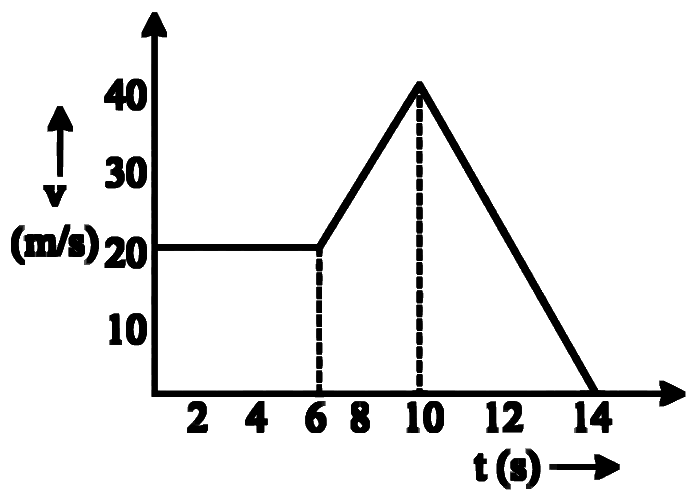
A velocity - time graph of a body is shown below. The distance covered by the body from 6 second to 9 second is

Figure

Show answer and solution

Answer: (c)

Loading the solution…
Report a mistakeOpen question page
Q3MHT CET 2024 · 11 MAY · SHIFT 1Medium

Slope and area of motion graphs

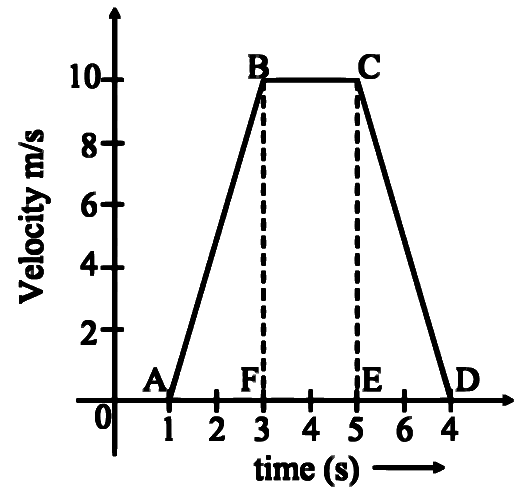
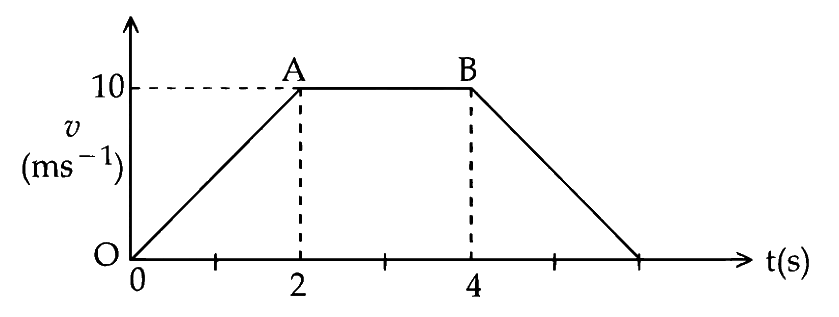
For the velocity-time graph shown in the figure below, the distance covered by the body in last two second of its motion is ' S1S_1 '. What is the ratio of ' S1S_1 ' to the total distance covered by it

Figure

Show answer and solution

Answer: (b)

Loading the solution…
Report a mistakeOpen question page
Q4MHT CET 2026 · 13 APR · SHIFT 2Medium

Slope and area of motion graphs

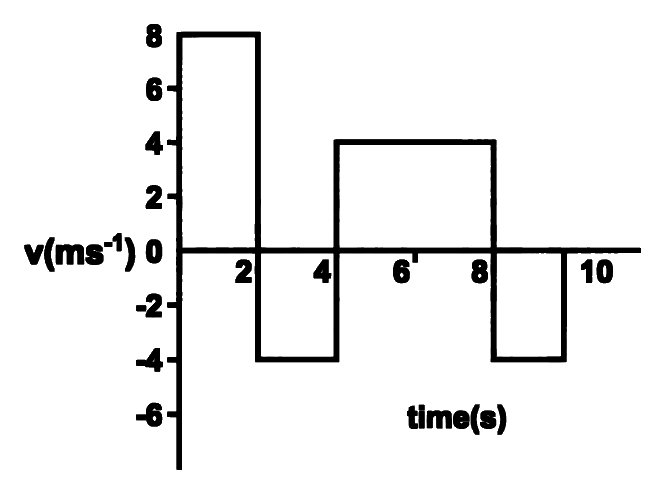
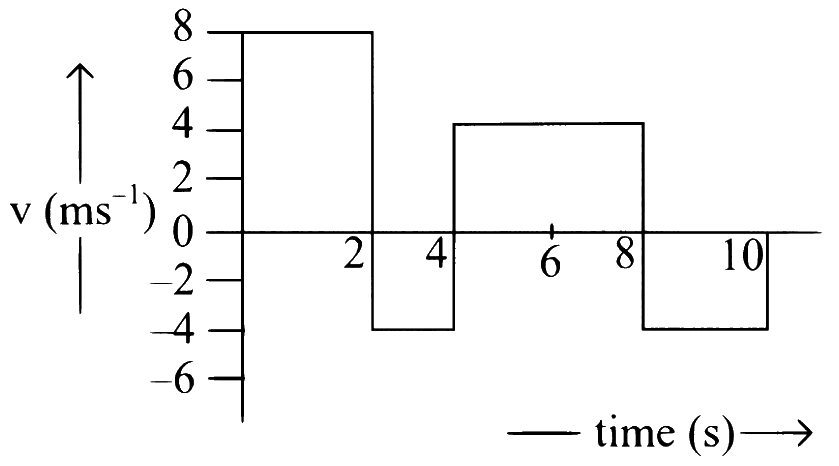
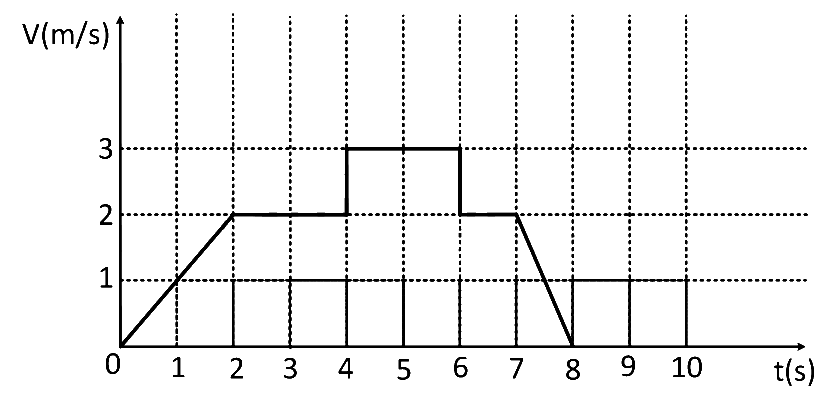
The velocity time graph of a body moving in a straight line is shown in a figure. The ratio of displacement to distance travelled by the body in time 00 to 1010 s is

Figure

Show answer and solution

Answer: (d)

Loading the solution…
Report a mistakeOpen question page
Q5MHT CET 2025 · 21 APR · SHIFT 1Medium

Slope and area of motion graphs

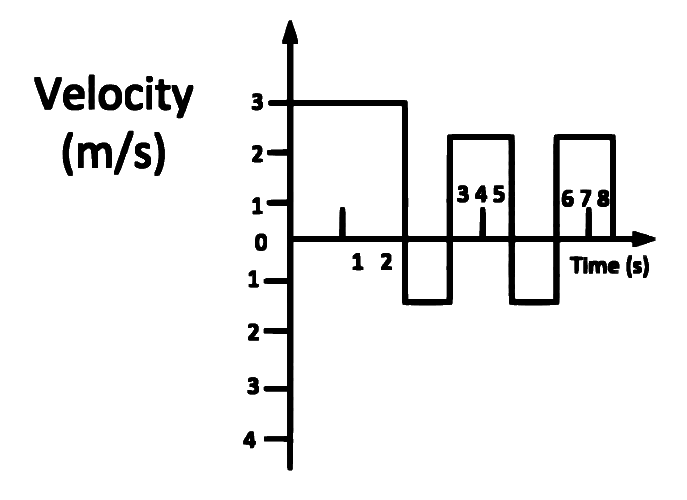
The velocity time graph of a body moving in a straight line is shown in figure. The ratio of displacement to distance travelled by the body in time 0 to 8 s is

Figure

Show answer and solution

Answer: (c)

Loading the solution…
Report a mistakeOpen question page
Q6MHT CET 2025 · 23 APR · SHIFT 1Medium

Slope and area of motion graphs

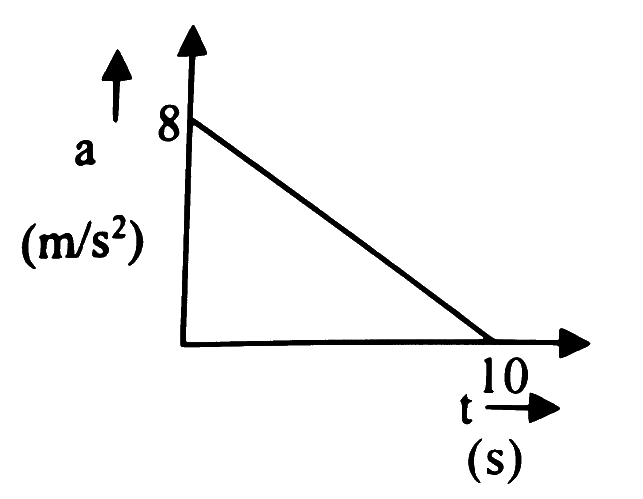
The acceleration (a) - time (T) graph for the body starting from rest is given below. The maximum speed of the body is

Figure

Show answer and solution

Answer: (a)

Loading the solution…
Report a mistakeOpen question page
Q7MHT CET 2025 · 19 APR · SHIFT 2Medium

Slope and area of motion graphs

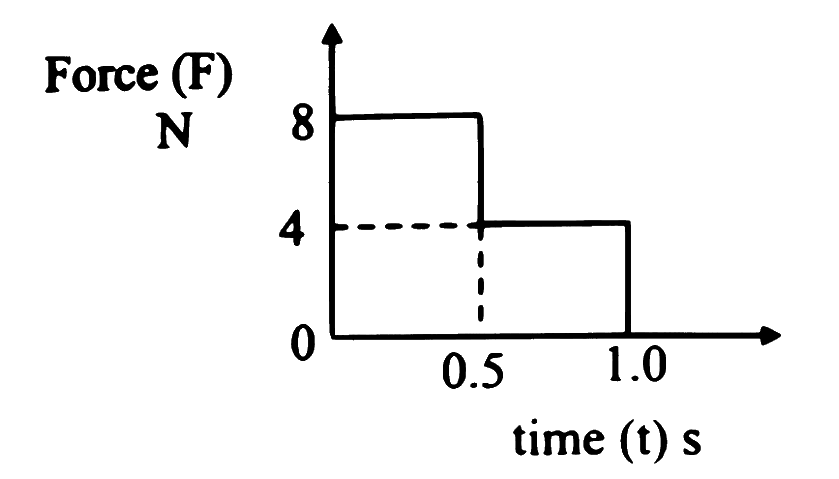
Force is applied to a body of mass 3 kg at rest on a frictionless horizontal surface as shown in the force against time (F-t) graph. The speed of the body after 1 s is

Figure

Show answer and solution

Answer: (d)

Loading the solution…
Report a mistakeOpen question page
Q8NEET 2024Easy

Slope and area of motion graphs

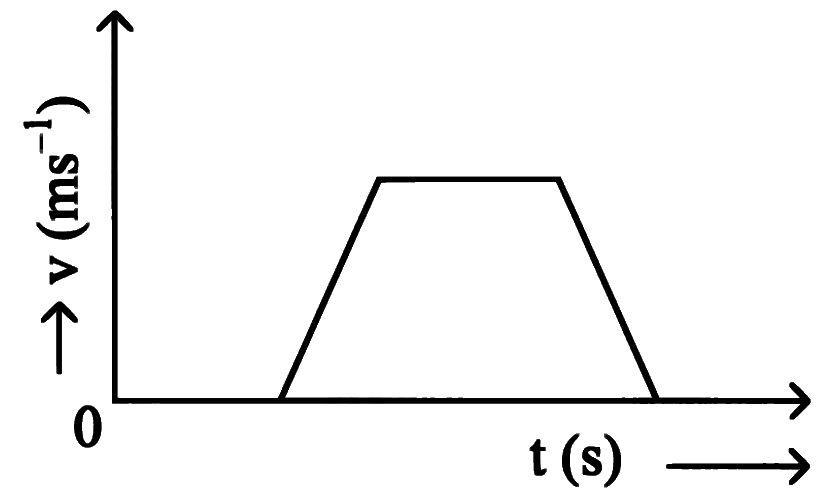
The velocity (v)−(v)- time (t)(t) plot of the motion of a body is shown below:

Figure

The acceleration (a)−(a)- time (t)(t) graph that best suits this motion is:

Show answer and solution

Answer: (c)

Loading the solution…
Report a mistakeOpen question page
Q9NEET 1994 · AIPMTEasy

Slope and area of motion graphs

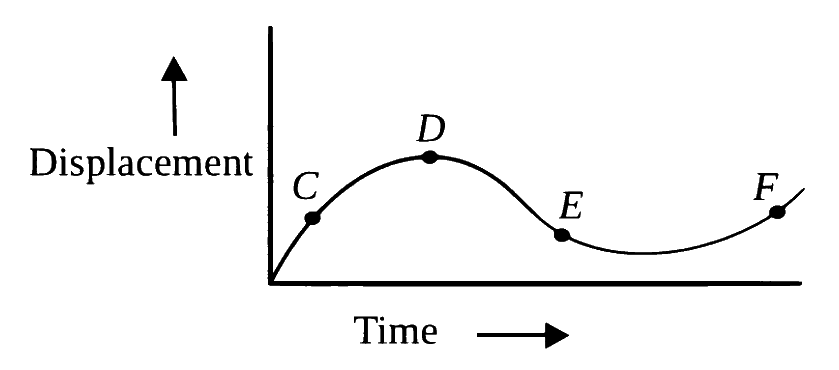
The displacement-time graph of a moving particle is shown below. The instantaneous velocity of the particle is negative at the point

Figure

Show answer and solution

Answer: (a)

Loading the solution…
Report a mistakeOpen question page
Q10JEE Main 2026 · 5 APR · SHIFT 2Easy

Slope and area of motion graphs

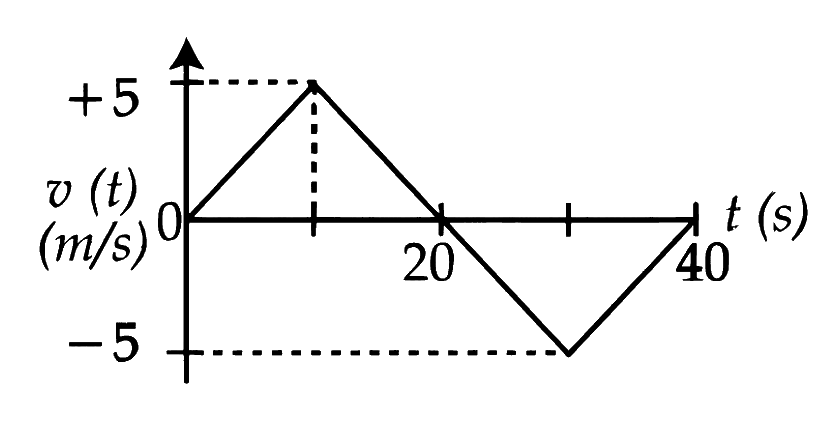
The velocity (v)(v) versus time (t)(t) plot of a particle is shown in the figure, for a time interval of 40 s. The total distance travelled by the particle and the average velocity during this period are, respectively

______.

Figure

Show answer and solution

Answer: (c)

Loading the solution…
Report a mistakeOpen question page
Q11JEE Main 2026 · 24 JAN · SHIFT 2Medium

Slope and area of motion graphs

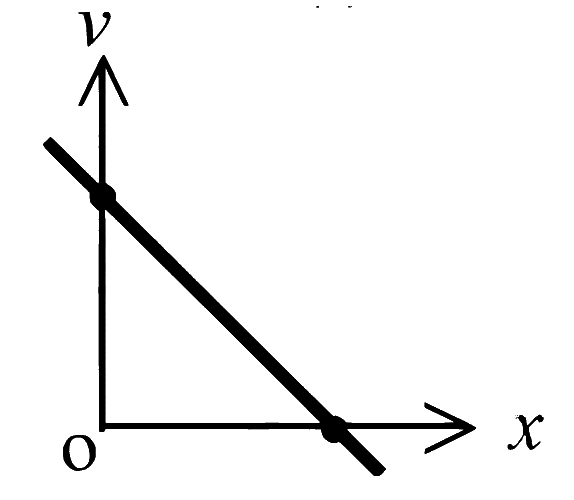
The velocity (v)(v) - Distance (x)(x) graph is shown in figure. Which graph represents acceleration(a) versus distance ( xx) variation of this system?

Figure

Show answer and solution

Answer: (d)

Loading the solution…
Report a mistakeOpen question page
Q12JEE Main 2025 · 28 JAN · SHIFT 2Easy

Slope and area of motion graphs

The velocity-time graph of an object moving along a straight line is shown in the figure. What is the distance covered by the object between t=0t = 0 to t=4 st = 4\text{ s}?

Figure

Show answer and solution

Answer: (b)

Loading the solution…
Report a mistakeOpen question page
Q13JEE Main 2025 · 23 JAN · SHIFT 1Easy

Slope and area of motion graphs

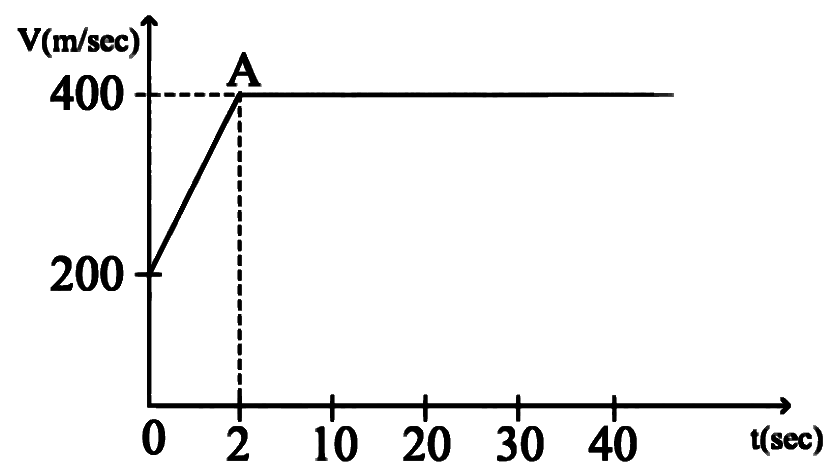
The motion of an airplane is represented by velocity-time graph as shown below. The distance covered by airplane in the first 30.5 second is ̱_______ km.

Figure

Show answer and solution

Answer: (a)

Loading the solution…
Report a mistakeOpen question page
Q14JEE Main 2023 · 11 APR · SHIFT 1Medium

Slope and area of motion graphs

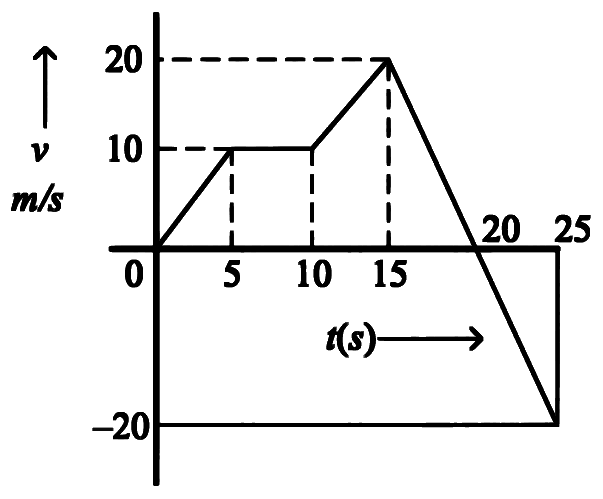
From the v−tv - t graph shown, the ratio of distance to displacement in 25 s25\text{ s} of motion is:

Figure

Show answer and solution

Answer: (d)

Loading the solution…
Report a mistakeOpen question page
Q15JEE Main 2023 · 24 JAN · SHIFT 2Medium

Slope and area of motion graphs

The velocity time graph of a body moving in a straight line is shown in the figure.

Figure

The ratio of displacement to distance travelled by the body in time 0 to 10s is:

Show answer and solution

Answer: (b)

Loading the solution…
Report a mistakeOpen question page
Q16JEE Main 2023 · 8 APR · SHIFT 2Easy

Slope and area of motion graphs

Given below are two statements

Statement I: Area under velocity- time graph gives the distance travelled by the body in a given time. Statement II: Area under acceleration- time graph is equal to the change in velocity in the given time.

In the light of given statements, choose the correct answer from the options given below.

Show answer and solution

Answer: (c)

Loading the solution…
Report a mistakeOpen question page
Q17JEE Main 2021 · 24 FEB · SHIFT 1Easy

Slope and area of motion graphs

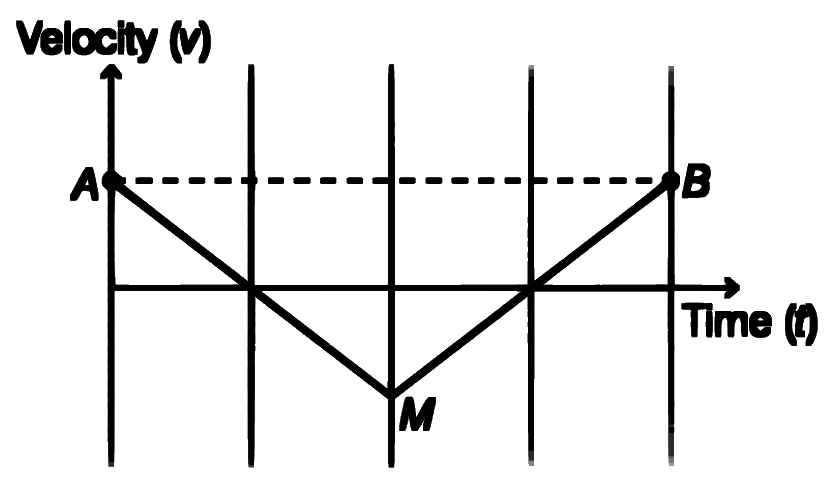
If the velocity-time graph has the shape AMB, what would be the shape of the corresponding acceleration-time graph?

Figure

Show answer and solution

Answer: (c)

Loading the solution…
Report a mistakeOpen question page
Q18JEE Main 2021 · 18 MAR · SHIFT 2Medium

Slope and area of motion graphs

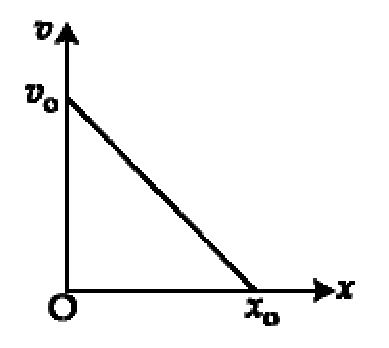
The velocity −- displacement graph of a particle is shown in the figure.

Figure

The acceleration −- displacement graph of the same particle is represented by:

Show answer and solution

Answer: (a)

Loading the solution…
Report a mistakeOpen question page
Q19JEE Main 2020 · 4 SEP · SHIFT 2Easy

Slope and area of motion graphs

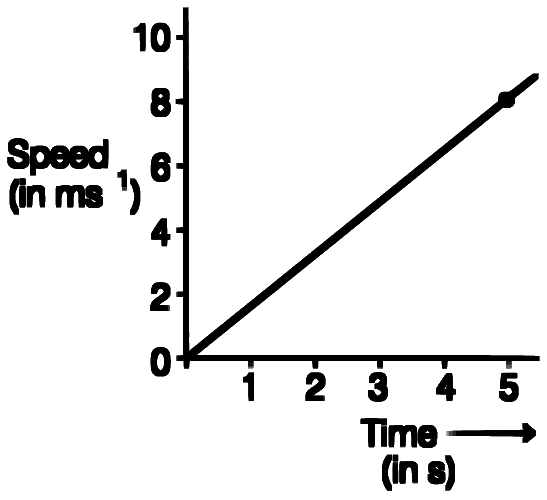
The speed versus time graph for a particle is shown in the figure. The distance travelled (in m) by the particle during the time interval t = 0 to t = 5 s will be________.

Figure

Numerical answer type. Work it out, then open the answer.

Show answer and solution

Answer: 20

Loading the solution…
Report a mistakeOpen question page
Q20JEE Main 2020 · 5 SEP · SHIFT 2Medium

Slope and area of motion graphs

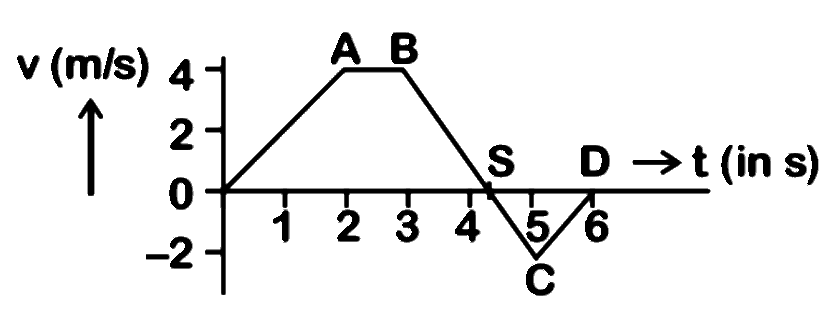
The velocity (v) and time (t) graph of a body in a straight line motion is shown in the figure. The point S is at 4.333 seconds. The total distance covered by the body in 6 s is:

Figure

Show answer and solution

Answer: (d)

Loading the solution…
Report a mistakeOpen question page
Q21JEE Main 2019 · 10 JAN · SHIFT 2Easy

Slope and area of motion graphs

A particle starts from the origin at time t = 0 and moves along the positive x-axis. The graph of velocity with respect to time is shown in figure. What is the position of the particle at time t = 5s?

Figure

Show answer and solution

Answer: (b)

Loading the solution…
Report a mistakeOpen question page
Q22JEE Main 2018 · 15 APR · SHIFT 1Medium

Slope and area of motion graphs

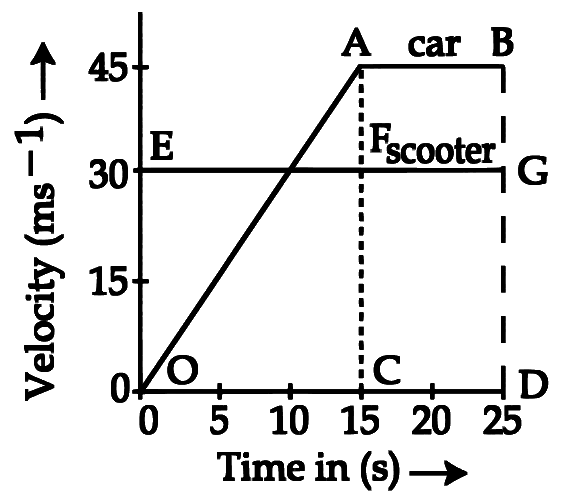
The velocity-time graphs of a car and a scooter are shown in the figure. (i) The difference between the distance travelled by the car and the scooter in 15 s15\text{ s} and (ii) the time at which the car will catch up with the scooter are, respectively.

Figure

Show answer and solution

Answer: (a)

Loading the solution…
Report a mistakeOpen question page
Q23JEE Main 2018Medium

Slope and area of motion graphs

All the graphs below are intended to represent the same motion. One of them does it incorrectly. Pick it up.

Show answer and solution

Answer: (c)

Loading the solution…
Report a mistakeOpen question page
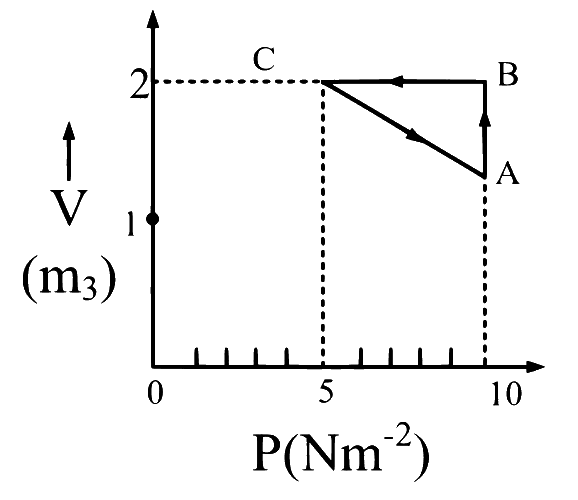
Q24MHT CET 2025 · 20 APR · SHIFT 1Medium

Area of a P–V graph = work

The work done by a gas as it is taken in a cyclic process (shown in graph) is

Figure

Show answer and solution

Answer: (d)

Loading the solution…
Report a mistakeOpen question page
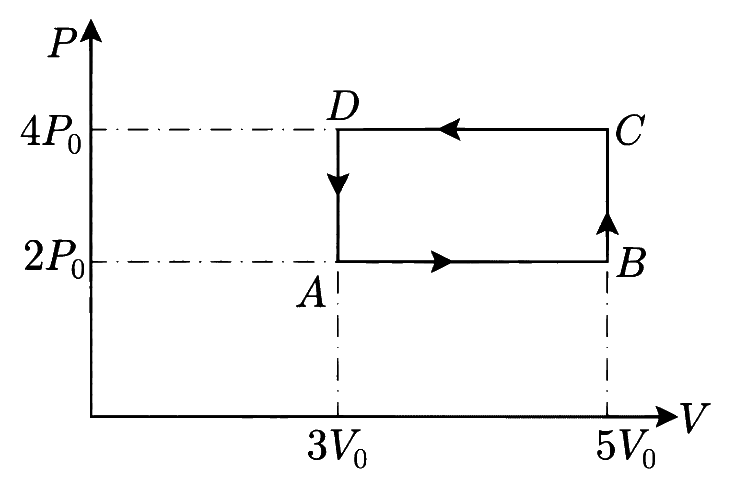
Q25MHT CET 2026 · 11 APR · SHIFT 1Medium

Area of a P–V graph = work

An ideal gas undergoes cyclic process ABCDA as shown in given p-V diagram. What is the magnitude of amount of work done by the gas?

Figure

Show answer and solution

Answer: (b)

Loading the solution…
Report a mistakeOpen question page
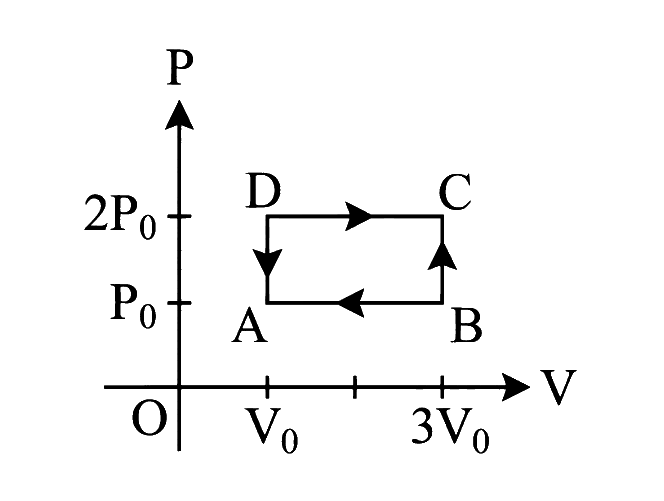
Q26MHT CET 2026 · 18 APR · SHIFT 2Medium

Area of a P–V graph = work

An ideal monoatomic gas is taken around the cycle ABCDA as shown in the P.V diagram. The work done during the cycle is

Figure

Show answer and solution

Answer: (c)

Loading the solution…
Report a mistakeOpen question page
Q27MHT CET 2025 · 26 APR · SHIFT 2Difficult

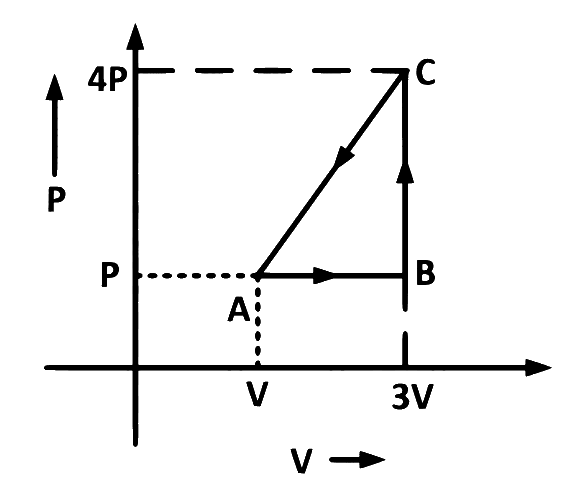
Area of a P–V graph = work

An ideal gas taken through a process ABCA as shown in figure. If the net heat supplied to gas in the cycle is 5 J, then the work done by the gas in process from C to A is

Figure

Show answer and solution

Answer: (a)

Loading the solution…
Report a mistakeOpen question page
Q28MHT CET 2025 · 20 APR · SHIFT 2Easy

Area means total

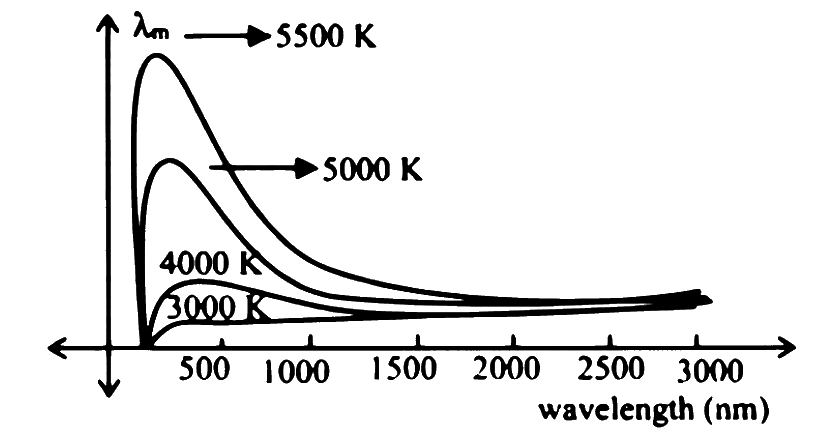
The following graph represents the radiant power versus wavelength of the black body. The area under the curve represents

Figure

Show answer and solution

Answer: (d)

Loading the solution…
Report a mistakeOpen question page
Q29NEET 2019Medium

Area means total

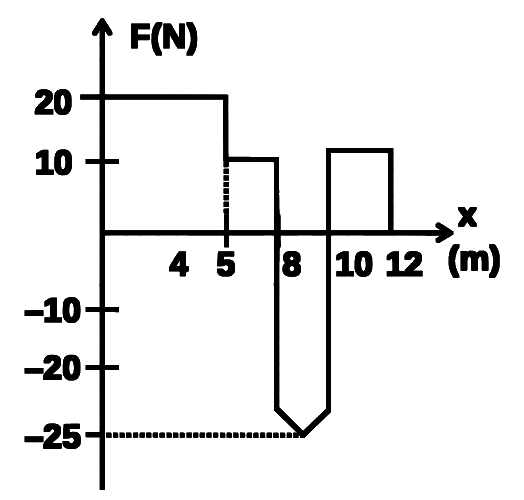
An object of mass 500 g, initially at rest, is acted upon by a variable force whose X-component varies with X in the manner shown. The velocities of the object at the points X = 8 m and X = 12 m, would have the respective values of (nearly)

Figure

Show answer and solution

Answer: (d)

Loading the solution…
Report a mistakeOpen question page
Q30NEET 2012 · AIPMT · MAINSEasy

Area means total

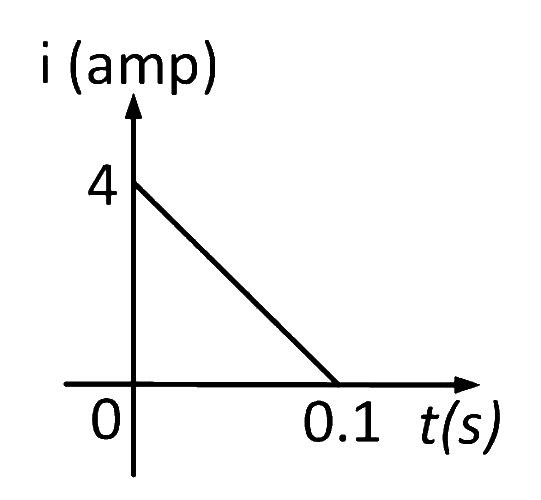
In a coil of resistance 10 Ω\Omega, the induced current developed by changing magnetic flux through it, is shown in figure as a function of time. The magnitude of change in flux through the coil in weber is

Figure

Show answer and solution

Answer: (b)

Loading the solution…
Report a mistakeOpen question page
Q31NEET 2011 · AIPMT · PRELIMSEasy

Area means total

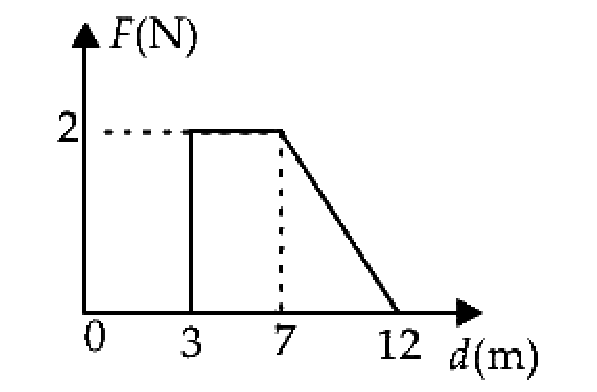
Force F on a particle moving in a straight line varies with distance d as shown in figure.

Figure

The work done on the particle during its displacement of 12 m is

Show answer and solution

Answer: (d)

Loading the solution…
Report a mistakeOpen question page
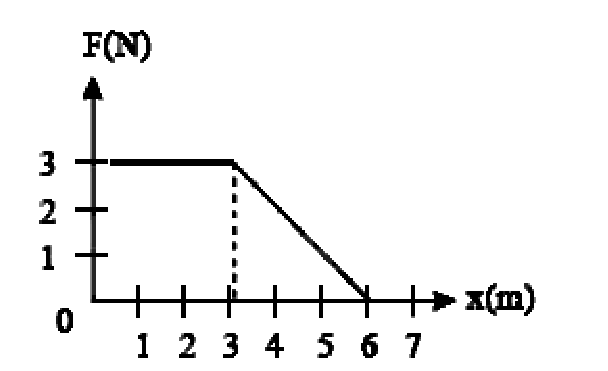
Q32NEET 2005 · AIPMTEasy

Area means total

A force F acting

Figure

on an object varies with distance x as shown here. The force is in N and x in m. The work done by the force in moving the object from x = 0 to x = 6 m is

Show answer and solution

Answer: (b)

Loading the solution…
Report a mistakeOpen question page
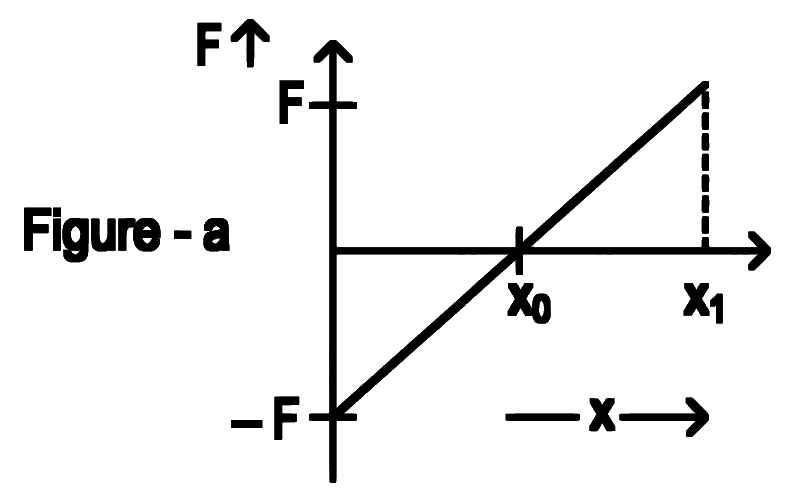
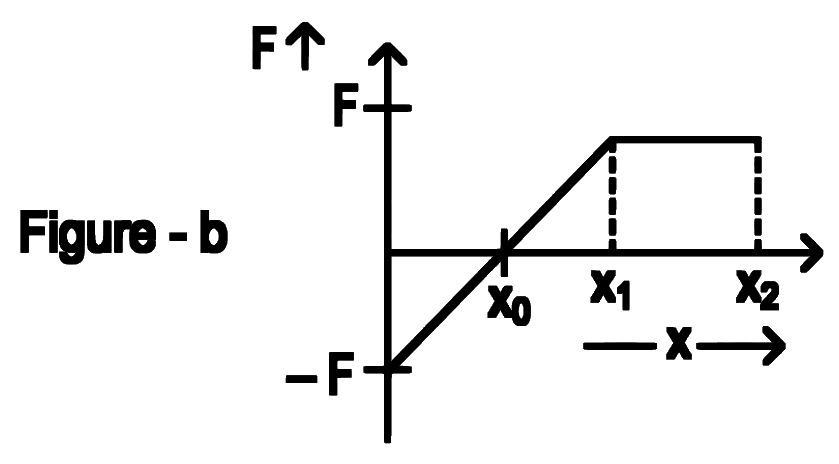
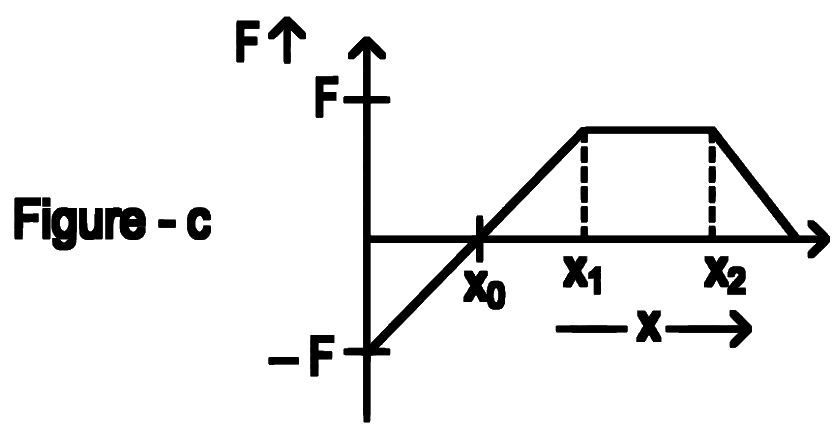
Q33JEE Main 2022 · 26 JUN · SHIFT 2Medium

Area means total

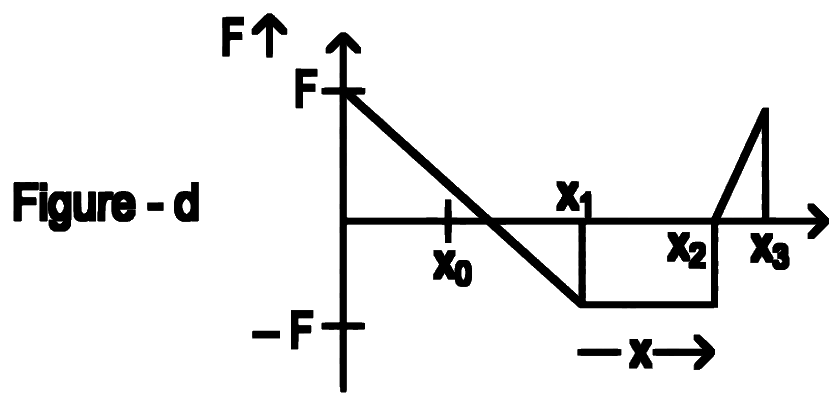
Arrange the four graphs in descending order of total work done; where W1, W2, W3 and W4 are the work done corresponding to figure a, b, c and d respectively.

FigureFigure
FigureFigure
Show answer and solution

Answer: (a)

Loading the solution…
Report a mistakeOpen question page
Q34JEE Main 2019 · 8 APR · SHIFT 1Easy

Area means total

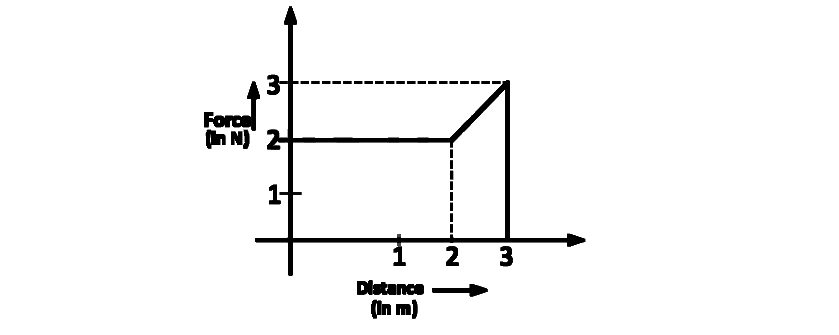
A particle moves in one dimension from rest under the influence of a force that varies with the distance travelled by the particle as shown in the figure. The kinetic energy of the particle after it has travelled 3m is:

Figure

Show answer and solution

Answer: (a)

Loading the solution…
Report a mistakeOpen question page
Q35MHT CET 2020 · 19 OCT · SHIFT 2Easy

Work by a variable force

A metal rod has length, cross-sectional area and Young's modulus as L,AL, A and YY, respectively. If the elongation in the rod produced is ℓ\ell, then work done is proportional to

Show answer and solution

Answer: (d)

Loading the solution…
Report a mistakeOpen question page
Q36MHT CET 2019 · 2 MAY · SHIFT 2Easy

Work by a variable force

A wire of length ' LL ' and area of cross section ' AA ' is made of material of Young's modulus ' YY. It is stretched by an amount ' xx '. The work done in stretching the wire is

Show answer and solution

Answer: (a)

Loading the solution…
Report a mistakeOpen question page
Q37NEET 2026 · RE-NEETMedium

Work by a variable force

A particle of mass MM moves along a horizontal xx axis from x=0x = 0 to x=Lx = L. The coefficient of kinetic friction varies as a function of xx as μk(x)=μ0−αx\mu_k(x) = \mu_0 - \alpha x, where μ0,α\mu_0, \alpha are constants of appropriate dimensions, so that μk(L)=0\mu_k(L) = 0. The total work done by the frictional force during the motion is nμ0MgLn\mu_0 MgL, where gg is the acceleration due to gravity. The value of nn is:

Show answer and solution

Answer: (a)

Loading the solution…
Report a mistakeOpen question page
Q38NEET 2015 · AIPMT · CANCELLED PAPEREasy

Work by a variable force

A block of mass 10 kg, moving in x direction with a constant speed of 10 m s−1{}^{-1}, is subjected to a retarding force F = 0.1x J/m during its travel from x = 20 m to 30 m. Its final KE will be

Show answer and solution

Answer: (c)

Loading the solution…
Report a mistakeOpen question page
Q39NEET 1994 · AIPMTEasy

Work by a variable force

A position dependent force, F=(7−2x+3x2) NF = (7 - 2x + 3x^2)\text{ N} acts on a small body of mass 2 kg2\text{ kg} and displaces it from x=0x = 0 to x=5 mx = 5\text{ m}. The work done in joule is

Show answer and solution

Answer: (a)

Loading the solution…
Report a mistakeOpen question page
Q40NEET 1992 · AIPMTEasy

Work by a variable force

A position dependent force, F=(7−2x+3x2) NF = (7 - 2x + 3x^2)\text{ N} acts on a small body of mass 2 kg2\text{ kg} and displaces it from x=0x = 0 to x=5 mx = 5\text{ m}. The work done in joule is

Show answer and solution

Answer: (a)

Loading the solution…
Report a mistakeOpen question page
Q41JEE Main 2025 · 24 JAN · SHIFT 1Easy

Work by a variable force

A force F=α+βx2F = \alpha + \beta x^2 acts on an object in the x -direction. The work done by the force is 5 J when the object is displaced by 1 m. If the constant α=1 N\alpha = 1\text{ N} then β\beta will be

Show answer and solution

Answer: (c)

Loading the solution…
Report a mistakeOpen question page
Q42JEE Main 2023 · 15 APR · SHIFT 1Easy

Work by a variable force

A block of mass 10 kg10\text{ kg} is moving along xx-axis under the action of force F=5x NF = 5x\text{ N}. The work done by the force in moving the block from x=2 mx = 2\text{ m} to 4 m4\text{ m} will be __________ J.

Numerical answer type. Work it out, then open the answer.

Show answer and solution

Answer: 30

Loading the solution…
Report a mistakeOpen question page
Q43JEE Main 2022 · 28 JUN · SHIFT 2Medium

Work by a variable force

A block of mass 2 kg moving on a horizontal surface with speed of 4 ms−1{}^{-1} enters a rough surface ranging from x = 0.5 m to x = 1.5 m. The retarding force in this range of rough surface is related to distance by F = −- kx where k = 12 Nm−1{}^{-1}. The speed of the block as it just crosses the rough surface will be:

Show answer and solution

Answer: (c)

Loading the solution…
Report a mistakeOpen question page
Q44JEE Main 2014Easy

Work by a variable force

When a rubber-band is stretched by a distance xx, it exerts restoring force of magnitude F=ax+bx2F = ax + bx^2 where aa and bb are constants. The work done in stretching the unstretched rubber-band by LL is:

Show answer and solution

Answer: (c)

Loading the solution…
Report a mistakeOpen question page
Q45JEE Main 2004 · AIEEEEasy

Work by a variable force

A particle moves in a straight line with retardation proportional to its displacement. Its loss of kinetic energy for any displacement xx is proportional to

Show answer and solution

Answer: (c)

Loading the solution…
Report a mistakeOpen question page
Q46MHT CET 2026 · 16 APR · SHIFT 2Difficult

Motion from a(t), v(t) or F(t)

A body of mass 1kg begins to move under the action of a time dependent force F⃗=(ti^+3t2j^)\vec{F} = (t\hat{i} + 3t^2\hat{j}) N where i^\hat{i} and j^\hat{j} are the unit vectors along x and y axis. The power developed by the above force at time t=2t = 2 s will be (in watt)

Show answer and solution

Answer: (a)

Loading the solution…
Report a mistakeOpen question page
Q47MHT CET 2025 · 22 APR · SHIFT 1Difficult

Motion from a(t), v(t) or F(t)

A body of mass 1 kg begins to move under the action of a time dependent force F⃗=(ti^+2t2j^) N\vec{F} = \left(t\hat{i} + 2t^2\hat{j}\right)\text{ N}, where i^\hat{i} and j^\hat{j} are unit vectors along xx and yy axis. The power developed by above force at time t=3t = 3 second will be

Show answer and solution

Answer: (a)

Loading the solution…
Report a mistakeOpen question page
Q48MHT CET 2026 · 19 MAY · SHIFT 2Difficult

Motion from a(t), v(t) or F(t)

A body is moved along a straight line by a machine delivering constant power. The distance moved by the body in time tt is proportional to

Show answer and solution

Answer: (c)

Loading the solution…
Report a mistakeOpen question page
Q49NEET 2016 · PHASE 1Medium

Motion from a(t), v(t) or F(t)

A body of mass 1 kg begins to move under the action of a time dependent force F⃗=(2ti^+3t2j^)N,\vec{F} = \left(2t\hat{i} + 3t^2\hat{j}\right)N, where i^\hat{i} and j^\hat{j} are unit vectors along x and y axis. What power will be developed by the force at the time t?

Show answer and solution

Answer: (b)

Loading the solution…
Report a mistakeOpen question page
Q50NEET 2002 · AIPMTMedium

Motion from a(t), v(t) or F(t)

An object of mass 3 kg is at rest. Now a force of F⃗\vec{F}= 6t2 i^\hat{i} + 4t j^\hat{j} is applied on the object then velocity of object at t = 3 sec. is

Show answer and solution

Answer: (b)

Loading the solution…
Report a mistakeOpen question page
Q51NEET 1995 · AIPMTMedium

Motion from a(t), v(t) or F(t)

The acceleration of a particle is increasing linearly with time tt as btbt. The particle starts from origin with an initial velocity v0v_0. The distance travelled by the particle in time tt will be

Show answer and solution

Answer: (c)

Loading the solution…
Report a mistakeOpen question page
Q52JEE Main 2026 · 21 JAN · SHIFT 1Medium

Motion from a(t), v(t) or F(t)

A 4 kg mass moves under the influence of a force F⃗=(4t3i^−3tj^) N\vec{F} = \left(4t^3\hat{i} - 3t\hat{j}\right)\text{ N} where tt is the time in second. If mass starts from origin at t=0t = 0, the velocity and position after t=2 st = 2\text{ s} will be:

Show answer and solution

Answer: (c)

Loading the solution…
Report a mistakeOpen question page
Q53JEE Main 2026 · 5 APR · SHIFT 2Medium

Motion from a(t), v(t) or F(t)

A particle of charge qq and mass mm is projected from origin with an initial velocity v⃗=(v02x^+v02y^)\vec{v} = \left(\frac{v_0}{\sqrt{2}}\hat{x} + \frac{v_0}{\sqrt{2}}\hat{y}\right). There exists a uniform magnetic field B⃗=B0z^\vec{B} = B_0\hat{z} and a space varying electric field E⃗=E0e−λxx^\vec{E} = E_0 e^{-\lambda x}\hat{x} within the region 0⩽x⩽L0 \leqslant x \leqslant L. After travelling a distance such that xx-coordinate has changed from x=0x = 0 to x=Lx = L, the change in the kinetic energy is ______.

Show answer and solution

Answer: (a)

Loading the solution…
Report a mistakeOpen question page
Q54JEE Main 2026 · 4 APR · SHIFT 1Medium

Motion from a(t), v(t) or F(t)

A body of mass 2 kg begins to move under the influence of time dependent force F⃗=(2ti^+6t2j^) N\vec{F} = \left(2t\hat{i} + 6t^2\hat{j}\right)\text{ N}, where i^\hat{i} and j^\hat{j} are unit vectors along xx and y -axis respectively. The power produced by the force at t=2 st = 2\text{ s} is ______ W.

Numerical answer type. Work it out, then open the answer.

Show answer and solution

Answer: 200

Loading the solution…
Report a mistakeOpen question page
Q55JEE Main 2025 · 29 JAN · SHIFT 2Difficult

Motion from a(t), v(t) or F(t)

Two cars P and Q are moving on a road in the same direction. Acceleration of car P increases linearly with time whereas car Q moves with a constant acceleration. Both cars cross each other at time t = 0, for the first time. The maximum possible number of crossing(s) (including the crossing at t = 0) is ________.

Numerical answer type. Work it out, then open the answer.

Show answer and solution

Answer: 3

Loading the solution…
Report a mistakeOpen question page
Q56JEE Main 2025 · 7 APR · SHIFT 1Medium

Motion from a(t), v(t) or F(t)

An object of mass 1000 g experiences a time dependent force F⃗=(2ti^+3t2j^)N\vec{F} = \left(2t\hat{i} + 3t^2\hat{j}\right)N. The power generated by the force at time tt is:

Show answer and solution

Answer: (c)

Loading the solution…
Report a mistakeOpen question page
Q57JEE Main 2024 · 31 JAN · SHIFT 2Medium

Motion from a(t), v(t) or F(t)

A body of mass 2 kg2\text{ kg} begins to move under the action of a time dependent force given by F⃗=(6ti^+6t2j^)N\vec{F} = \left(6t\hat{i} + 6t^2\hat{j}\right)N. The power developed by the force at the time tt is given by:

Show answer and solution

Answer: (d)

Loading the solution…
Report a mistakeOpen question page
Q58JEE Main 2023 · 25 JAN · SHIFT 1Medium

Motion from a(t), v(t) or F(t)

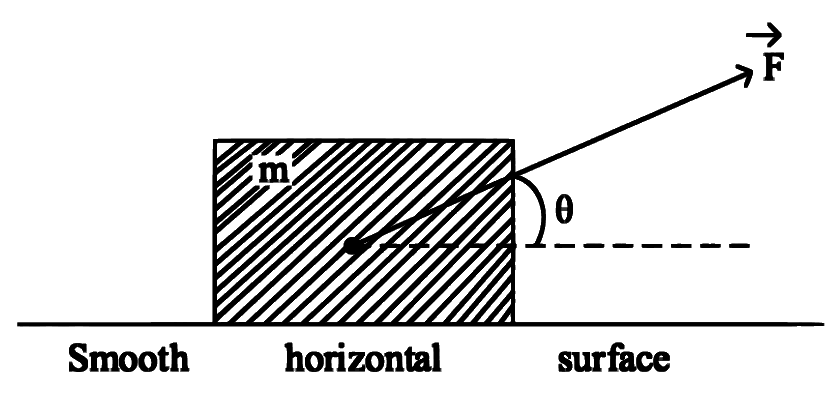
An object of mass 'm' initially at rest on a smooth horizontal plane starts moving under the action of force F = 2N. In the process of its linear motion, the angle θ\theta (as shown in figure) between the direction of force and horizontal varies as θ=kx\theta = kx, where k is a constant and xx is the distance covered by the object from its initial position. The expression of kinetic energy of the object will be E=nksin⁡θE = \frac{n}{k}\sin\theta. The value of n is ___________.

Figure

Numerical answer type. Work it out, then open the answer.

Show answer and solution

Answer: 2

Loading the solution…
Report a mistakeOpen question page
Q59JEE Main 2023 · 24 JAN · SHIFT 2Medium

Motion from a(t), v(t) or F(t)

A body of mass 1kg begins to move under the action of a time dependent force F⃗=(ti^+3t2j^)\vec{F} = \left(t\hat{i} + 3t^2\hat{j}\right) N, where i^\hat{i} and j^\hat{j} are the unit vectors along xx and yy axis. The power developed by above force, at the time t = 2s, will be ____________ W.

Numerical answer type. Work it out, then open the answer.

Show answer and solution

Answer: 100

Loading the solution…
Report a mistakeOpen question page
Q60JEE Main 2022 · 28 JUN · SHIFT 2Medium

Motion from a(t), v(t) or F(t)

A ball is spun with angular acceleration α\alpha = 6t2 −- 2t where t is in second and α\alpha is in rads−2{}^{-2}. At t = 0, the ball has angular velocity of 10 rads−1{}^{-1} and angular position of 4 rad. The most appropriate expression for the angular position of the ball is:

Show answer and solution

Answer: (b)

Loading the solution…
Report a mistakeOpen question page
Q61JEE Main 2022 · 27 JUL · SHIFT 1Difficult

Motion from a(t), v(t) or F(t)

A pulley of radius 1.5 m1.5\text{ m} is rotated about its axis by a force F=(12t−3t2)NF = \left(12t - 3t^{2}\right)N applied tangentially (while t is measured in seconds). If moment of inertia of the pulley about its axis of rotation is 4.5 kg m24.5\text{ kg m}^{2}, the number of rotations made by the pulley before its direction of motion is reversed, will be Kπ\frac{K}{\pi}. The value of K is ___________.

Numerical answer type. Work it out, then open the answer.

Show answer and solution

Answer: 18

Loading the solution…
Report a mistakeOpen question page
Q62JEE Main 2021 · 27 JUL · SHIFT 2Medium

Motion from a(t), v(t) or F(t)

A particle of mass M originally at rest is subjected to a force whose direction is constant but magnitude varies with time according to the relation

F=F0[1−(t−TT)2]F = F_0\left[1 - \left(\frac{t-T}{T}\right)^{2}\right]

Where F0 and T are constants. The force acts only for the time interval 2T. The velocity v of the particle after time 2T is:

Show answer and solution

Answer: (c)

Loading the solution…
Report a mistakeOpen question page
Q63JEE Main 2021 · 25 JUL · SHIFT 2Easy

Motion from a(t), v(t) or F(t)

The instantaneous velocity of a particle moving in a straight line is given as V=αt+βt2V = \alpha t + \beta t^2, where α\alpha and β\beta are constants. The distance travelled by the particle between 1s and 2s is:

Show answer and solution

Answer: (b)

Loading the solution…
Report a mistakeOpen question page
Q64JEE Main 2021 · 17 MAR · SHIFT 2Easy

Motion from a(t), v(t) or F(t)

The velocity of a particle is v = v0 + gt + Ft2. Its position is x = 0 at t = 0; then its displacement after time (t = 1) is:

Show answer and solution

Answer: (b)

Loading the solution…
Report a mistakeOpen question page
Q65JEE Main 2021 · 27 JUL · SHIFT 2Medium

Motion from a(t), v(t) or F(t)

An automobile of mass 'm' accelerates starting from origin and initially at rest, while the engine supplies constant power P. The position is given as a function of time by:

Show answer and solution

Answer: (d)

Loading the solution…
Report a mistakeOpen question page
Q66JEE Main 2020 · 3 SEP · SHIFT 2Medium

Motion from a(t), v(t) or F(t)

A particle is moving unidirectionally on a horizontal plane under the action of a constant power supplying energy source. The displacement (s) - time (t) graph that describes the motion of the particle is (graphs are drawn schematically and are not to scale):

Show answer and solution

Answer: (b)

Loading the solution…
Report a mistakeOpen question page
Q67JEE Main 2019 · 10 APR · SHIFT 1Difficult

Motion from a(t), v(t) or F(t)

A ball is thrown upward with an initial velocity V0 from the surface of the earth. The motion of the ball is affected by a drag force equal to mγ\gammau2 (where m is mass of the ball, u is its instantaneous velocity and γ\gamma is a constant). Time taken by the ball to rise to its zenith is:

Show answer and solution

Answer: (a)

Loading the solution…
Report a mistakeOpen question page
Q68JEE Main 2019 · 12 APR · SHIFT 2Medium

Motion from a(t), v(t) or F(t)

A particle is moving with speed v = bx\sqrt{x} along positive x-axis. Calculate the speed of the particle at time t = τ\tau(assume that the particle is at origin t = 0)

Show answer and solution

Answer: (c)

Loading the solution…
Report a mistakeOpen question page
Q69JEE Main 2016 · 10 APR · SHIFT 1Difficult

Motion from a(t), v(t) or F(t)

A particle of mass m is acted upon by a force F given by the empirical law F = Rt2v(t)\frac{R}{t^2}v(t) If this law is to be tested experimentally by observing the motion starting from rest, the best way is to plot:

Show answer and solution

Answer: (d)

Loading the solution…
Report a mistakeOpen question page
Q70JEE Main 2012 · AIEEEMedium

Motion from a(t), v(t) or F(t)

A particle of mass mm is at rest at the origin at time t=0t = 0 It is subjected to a force F(t)=F0e−btF(t) = F_0e^{-bt} in the xx direction. Its speed v(t)v(t) is depicted by which of the following curves?

Show answer and solution

Answer: (b)

Loading the solution…
Report a mistakeOpen question page
Q71JEE Main 2011 · AIEEEMedium

Motion from a(t), v(t) or F(t)

An object, moving with a speed of 6.25 m/s, is decelerated at a rate given by:

dvdt=−2.5v\frac{dv}{dt} = -2.5\sqrt{v} where v is the instantaneous speed. The time taken by the object, to come to rest, would be:

Show answer and solution

Answer: (a)

Loading the solution…
Report a mistakeOpen question page
Q72JEE Main 2011 · AIEEEDifficult

Motion from a(t), v(t) or F(t)

A pulley of radius 2 m2\text{ m} is rotated about its axis by a force F=(20t−5t2)F = \left(20t - 5t^{2}\right) newton (where tt is measured in seconds) applied tangentially. If the moment of inertia of the pulley about its axis of rotation is 10 kg-m210\text{ kg-m}^{2} the number of rotation made by the pulley before its direction of motion is reversed, is:

Show answer and solution

Answer: (a)

Loading the solution…
Report a mistakeOpen question page
Q73JEE Main 2007 · AIEEEEasy

Motion from a(t), v(t) or F(t)

The velocity of a particle is v = v0 + gt + ft2. If its position is x = 0 at t = 0, then its displacement after unit time (t = 1) is

Show answer and solution

Answer: (c)

Loading the solution…
Report a mistakeOpen question page
Q74JEE Main 2006 · AIEEEMedium

Motion from a(t), v(t) or F(t)

A particle located at x = 0 at time t = 0, starts moving along the positive x-direction with a velocity 'v' that varies as v=αxv = \alpha\sqrt{x}. The displacement of the particle varies with time as

Show answer and solution

Answer: (a)

Loading the solution…
Report a mistakeOpen question page
Q75JEE Main 2003 · AIEEEMedium

Motion from a(t), v(t) or F(t)

A body is moved along a straight line by a machine delivering a constant power. The distance moved by the body in time ’t’\text{'}t\text{'} is proportional to

Show answer and solution

Answer: (b)

Loading the solution…
Report a mistakeOpen question page
Q76MHT CET 2025 · 22 APR · SHIFT 1Easy

Totals over time: charge, rms, heat

The total charge induced in a conducting loop when it is moved in a uniform magnetic field depends on

Show answer and solution

Answer: (c)

Loading the solution…
Report a mistakeOpen question page
Q77MHT CET 2021 · 23 SEP · SHIFT 2Easy

Totals over time: charge, rms, heat

A conducting loop of resistance 'R' is moved to magnetic field, the total induced charge depends upon

Show answer and solution

Answer: (c)

Loading the solution…
Report a mistakeOpen question page
Q78NEET 2016 · PHASE 1Medium

Totals over time: charge, rms, heat

The charge flowing through a resistance R varies with time t as Q = at −- bt2, where aa and bb are positive constants. The total heat produced in R is

Show answer and solution

Answer: (c)

Loading the solution…
Report a mistakeOpen question page
Q79NEET 2004 · AIPMTEasy

Totals over time: charge, rms, heat

The magnetic flux through a circuit of resistance R changes by an amount Δϕ\Delta\phi in a time Δ\Deltat. Then the total quantity of electric charge Q that passes any point in the circuit during the time Δ\Deltat is represented by

Show answer and solution

Answer: (b)

Loading the solution…
Report a mistakeOpen question page
Q80NEET 1992 · AIPMTEasy

Totals over time: charge, rms, heat

The total charge, induced in a conducting loop when it is moved in magnetic field depend on

Show answer and solution

Answer: (c)

Loading the solution…
Report a mistakeOpen question page
Q81JEE Main 2026 · 28 JAN · SHIFT 1Medium

Totals over time: charge, rms, heat

The electric current in the circuit is given as i=io(t/T)i = i_o (t/T). The r.m.s current for the period t=0t = 0 to t=Tt = T is ______.

Show answer and solution

Answer: (b)

Loading the solution…
Report a mistakeOpen question page
Q82JEE Main 2025 · 4 APR · SHIFT 1Easy

Totals over time: charge, rms, heat

Current passing through a wire as function of time is given as I(t)=0.02t+0.01 AI(t) = 0.02t + 0.01\text{ A}. The charge that will flow through the wire from t=1 st = 1\text{ s} to t=2 st = 2\text{ s} is

Show answer and solution

Answer: (d)

Loading the solution…
Report a mistakeOpen question page
Q83JEE Main 2024 · 29 JAN · SHIFT 1Easy

Totals over time: charge, rms, heat

The electric current through a wire varies with time as I=I0+βtI = I_0 + \beta t, where I0=20 AI_0 = 20\text{ A} and β=3 A/s\beta = 3\text{ A/s}. The amount of electric charge crossed through a section of the wire in 20 s20\text{ s} is:

Show answer and solution

Answer: (c)

Loading the solution…
Report a mistakeOpen question page
Q84JEE Main 2024 · 1 FEB · SHIFT 1Easy

Totals over time: charge, rms, heat

The current in a conductor is expressed as I=3t2+4t3I = 3t^{2} + 4t^{3}, where II is in Ampere and tt is in second. The amount of electric charge that flows through a section of the conductor during t=1 st = 1\text{ s} to t=2 st = 2\text{ s} is __________ C.

Numerical answer type. Work it out, then open the answer.

Show answer and solution

Answer: 22

Loading the solution…
Report a mistakeOpen question page
Q85JEE Main 2022 · 26 JUL · SHIFT 2Medium

Totals over time: charge, rms, heat

In a coil of resistance 8 Ω8\ \Omega, the magnetic flux due to an external magnetic field varies with time as ϕ=23(9−t2)\phi = \frac{2}{3}\left(9-t^{2}\right). The value of total heat produced in the coil, till the flux becomes zero, will be _____________ J\text{J}.

Numerical answer type. Work it out, then open the answer.

Show answer and solution

Answer: 2

Loading the solution…
Report a mistakeOpen question page
Q86JEE Main 2020 · 8 JAN · SHIFT 2Medium

Totals over time: charge, rms, heat

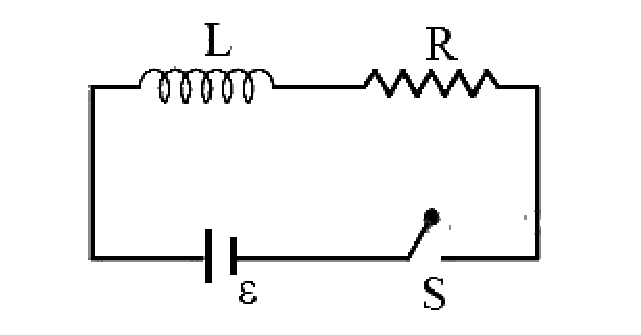
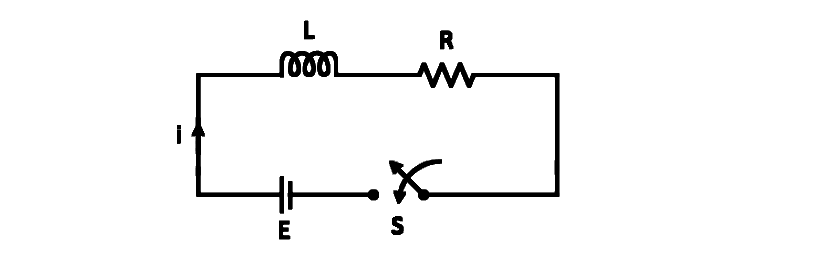
A shown in the figure, a battery of emf ε\varepsilon is connected to an inductor L and resistance R in series. The switch is closed at t = 0. The total charge that flows from the battery, between t = 0 and t = tc (tc is the time constant of the circuit) is:

Figure

Show answer and solution

Answer: (a)

Loading the solution…
Report a mistakeOpen question page
Q87JEE Main 2019 · 12 APR · SHIFT 2Medium

Totals over time: charge, rms, heat

Consider the LR circuit shown in the figure. If the switch S is closed at t = 0 then the amount of charge that passes through the battery between t = 0 and t = LR\frac{L}{R} is:

Figure

Show answer and solution

Answer: (b)

Loading the solution…
Report a mistakeOpen question page
Q88JEE Main 2019 · 9 JAN · SHIFT 1Medium

Totals over time: charge, rms, heat

A conducting circular loop made of a thin wire, has area 3.5 ×\times 10−-3 m2 and resistance 10 Ω\Omega. It is placed perpendicular to a time dependent magnetic field B(t) = (0.4T)sin(50π\pit). The field is uniform in space. Then the net charge flowing through the loop during t = 0 s and t = 10 ms is close to:

Show answer and solution

Answer: (a)

Loading the solution…
Report a mistakeOpen question page
Q89JEE Main 2016 · 10 APR · SHIFT 1Difficult

Totals over time: charge, rms, heat

The resistance of an electrical toaster has a temperature dependence given by R(T) = R0 [1 + α\alpha(T − T0)] in its range of operation. At T0 = 300 K, R = 100 Ω\Omega and at T = 500 K, R = 120 Ω\Omega. The toaster is connected to a voltage source at 200 V and its temperature is raised at a constant rate from 300 to 500 K in 30 s. The total work done in raising the temperature is:

Show answer and solution

Answer: (c)

Loading the solution…
Report a mistakeOpen question page
Q90JEE Main 2016 · 10 APR · SHIFT 1Difficult

Totals over time: charge, rms, heat

A conducting metal circular-wire-loop of radius r is placed perpendicular to a magnetic field which varies with time as

B = B0e−tτ\frac{-t}{\tau}, where B0 and τ\tau are constants, at time t = 0. If the resistance of the loop is R then the heat generated in the loop after a long time (t →∞\to \infty) is:

Show answer and solution

Answer: (b)

Loading the solution…
Report a mistakeOpen question page
Q91JEE Main 2015Difficult

Totals over time: charge, rms, heat

Consider a spherical shell of radius RR at temperature TT. The black body radiation inside it can be considered as an ideal gas of photons with internal energy per unit volume u=UV∝T4u = \frac{U}{V} \propto T^{4} and pressure p=13(UV)p = \frac{1}{3}\left(\frac{U}{V}\right). If the shell now undergoes an adiabatic expansion the relation between TT and RR is:

Show answer and solution

Answer: (a)

Loading the solution…
Report a mistakeOpen question page
Q92JEE Main 2014 · 19 APR · SHIFT 1Difficult

Totals over time: charge, rms, heat

A black coloured solid sphere of radius R and mass M is inside a cavity with vacuum inside. The walls of the cavity are maintained at a temperature T0. The initial temperature of the sphere is 3T0. If the specific heat of the material of the sphere varies as α\alphaT3 per unit mass with the temperature T of the sphere, where α\alpha is a constant, then the time taken for the sphere to cool down to temperature 2T0 will be (σ\sigma is Stefan Boltzmann constant)

Show answer and solution

Answer: (c)

Loading the solution…
Report a mistakeOpen question page
Q93JEE Main 2014 · 11 APR · SHIFT 1DifficultOld syllabus

Totals over time: charge, rms, heat

A radioactive nuclei with decay constant 0.5/s is being produced at a constant rate of 100 nuclei/s. If at t = 0 there were no nuclei, the time when there are 50 nuclei is:

Show answer and solution

Answer: (b)

Loading the solution…
Report a mistakeOpen question page
Q94MHT CET 2023 · 10 MAY · SHIFT 2Medium

Potential and field by integration

Assume that an electric field E⃗=30x2i^\vec{E} = 30x^{2}\hat{i} exists in space. If 'V0V_0' is the potential at the origin and 'VAV_A' is the potential at x=2 mx = 2\text{ m}, then the potential difference (VA−V0)(V_A - V_0) is

Show answer and solution

Answer: (a)

Loading the solution…
Report a mistakeOpen question page
Q95JEE Main 2025 · 28 JAN · SHIFT 1Difficult

Potential and field by integration

Three infinitely long wires with linear charge density λ\lambda are placed along the x-axis,y-axisx\text{-axis}, y\text{-axis} and z-z\text{-} axis respectively. Which of the following denotes an equipotential surface?

Show answer and solution

Answer: (a)

Loading the solution…
Report a mistakeOpen question page
Q96JEE Main 2022 · 29 JUL · SHIFT 1Medium

Potential and field by integration

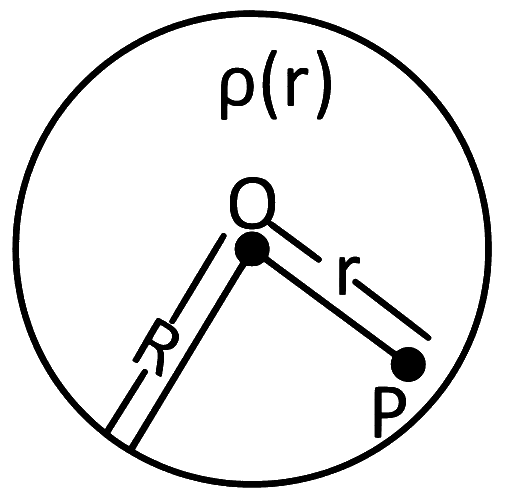
A spherically symmetric charge distribution is considered with charge density varying as ρ(r)=ρ0(34−rR)\rho(r) = \rho_0\left(\frac{3}{4} - \frac{r}{R}\right) for r≤Rr \leq R

zero for r>Rr > R

Where, r (r<R)r\,(r < R) is the distance from the centre O (as shown in figure). The electric field at point P will be:

Figure

Show answer and solution

Answer: (c)

Loading the solution…
Report a mistakeOpen question page
Q97JEE Main 2020 · 4 SEP · SHIFT 1Medium

Potential and field by integration

On the x-axis and at a distance x from the origin, the gravitational field due a mass distribution is given by Ax(x2+a2)3/2\frac{Ax}{(x^2+a^2)^{3/2}} in the x-direction. The magnitude of gravitational potential on the x-axis at a distance x, taking its value to be zero at infinity, is:

Show answer and solution

Answer: (c)

Loading the solution…
Report a mistakeOpen question page
Q98JEE Main 2020 · 2 SEP · SHIFT 1Medium

Potential and field by integration

The mass density of a spherical galaxy varies as Kr\frac{K}{r} over a large distance ‘r’ from its centre. In that region, a small star is in a circular orbit of radius R. Then the period of revolution, T depends on R as:

Show answer and solution

Answer: (a)

Loading the solution…
Report a mistakeOpen question page
Q99JEE Main 2019 · 8 APR · SHIFT 2Medium

Potential and field by integration

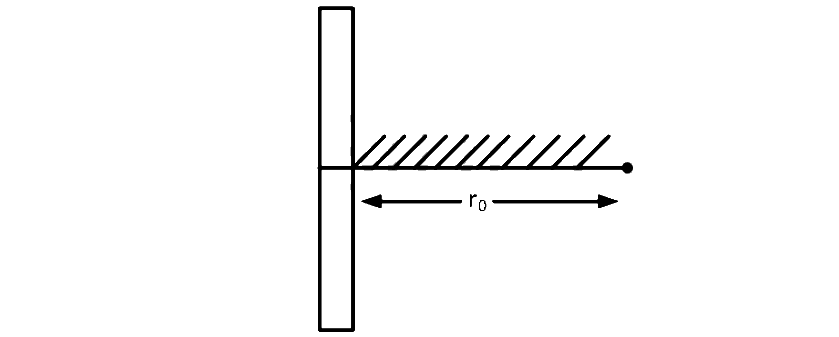
A positive point charge is released from rest at a distance r0 from a positive line charge with uniform density. The speed (v) of the point charge, as a function of instantaneous distance r from line charge, is proportional to :-

Figure

Show answer and solution

Answer: (d)

Loading the solution…
Report a mistakeOpen question page
Q100JEE Main 2017 · 9 APR · SHIFT 1Medium

Potential and field by integration

The mass density of a spherical body is given by

ρ\rho (r) = kr\frac{k}{r} for r ≤\le R and ρ\rho (r) = 0 for r > R,

where r is the distance from the centre.

The correct graph that describes qualitatively the acceleration, a, of a test particle as a function of r is:

Show answer and solution

Answer: (b)

Loading the solution…
Report a mistakeOpen question page
Q101JEE Main 2010 · AIEEEMedium

Potential and field by integration

Let there be a spherically symmetric charge distribution with charge density varying as ρ(r)=ρ0(54−rR)\rho(r) = \rho_0\left(\frac{5}{4} - \frac{r}{R}\right) upto r=R,r = R, and ρ(r)=0\rho(r) = 0 for r>R,r > R, where rr is the distance from the origin. The electric field at a distance r (r<R)r\ (r < R) from the origin is given by

Show answer and solution

Answer: (a)

Loading the solution…
Report a mistakeOpen question page
Q102JEE Main 2026 · 22 JAN · SHIFT 1Difficult

Non-uniform bodies: mass, centre of mass, R, C

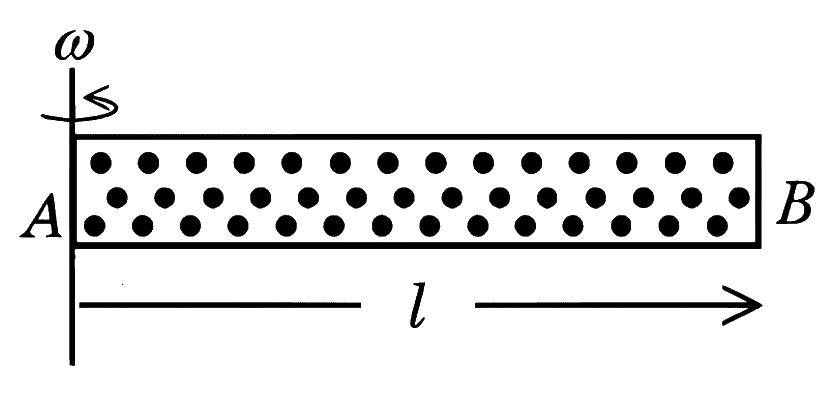
A cylindrical tube ABAB of length ll, closed at both ends contains an ideal gas of 1 mol having molecular weight MM. The tube is rotated in a horizontal plane with constant angular velocity ω\omega about an axis perpendicular to ABAB and passing through the edge at end AA, as shown in the figure. If PAP_A and PBP_B are the pressures at AA and BB respectively, then (Consider the temperature is same at all points in the tube)

Figure

Show answer and solution

Answer: (c)

Loading the solution…
Report a mistakeOpen question page
Q103JEE Main 2025 · 28 JAN · SHIFT 1Medium

Non-uniform bodies: mass, centre of mass, R, C

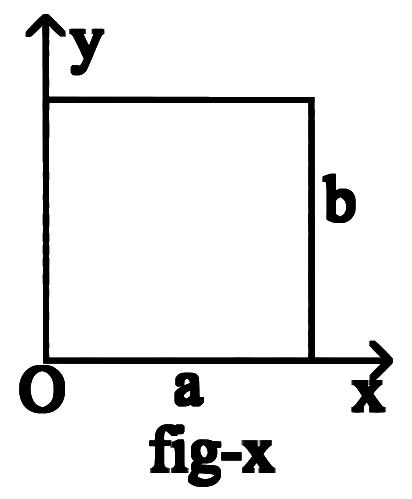
The center of mass of a thin rectangular plate (fig - x) with sides of length aa and bb, whose mass per unit area (σ)(\sigma) varies as σ=σ0xab\sigma = \frac{\sigma_0 x}{ab} (where σ0\sigma_0 is a constant), would be __________.

Figure

Show answer and solution

Answer: (b)

Loading the solution…
Report a mistakeOpen question page
Q104JEE Main 2022 · 28 JUL · SHIFT 2Medium

Non-uniform bodies: mass, centre of mass, R, C

The distance of centre of mass from end A of a one dimensional rod (AB) having mass density ρ=ρ0(1−x2L2) kg/m\rho = \rho_0\left(1 - \frac{x^2}{L^2}\right)\text{ kg/m} and length L (in meter) is 3Lα m\frac{3L}{\alpha}\text{ m}. The value of α\alpha is ___________. (where x is the distance from end A)

Numerical answer type. Work it out, then open the answer.

Show answer and solution

Answer: 8

Loading the solution…
Report a mistakeOpen question page
Q105JEE Main 2021 · 25 JUL · SHIFT 1Difficult

Non-uniform bodies: mass, centre of mass, R, C

A parallel plate capacitor with plate area 'A' and distance of separation 'd' is filled with a dielectric. What is the capacity of the capacitor when permittivity of the dielectric varies as: ε(x)=ε0+kx\varepsilon(x) = \varepsilon_0 + kx, for (0<x≤d2)\left(0 < x \le \frac{d}{2}\right)

ε(x)=ε0+k(d−x)\varepsilon(x) = \varepsilon_0 + k(d-x), for (d2≤x≤d)\left(\frac{d}{2} \le x \le d\right)

Show answer and solution

Answer: (b)

Loading the solution…
Report a mistakeOpen question page
Q106JEE Main 2020 · 7 JAN · SHIFT 1Difficult

Non-uniform bodies: mass, centre of mass, R, C

Figure

A parallel plate capacitor has plates of area A separated by distance 'd' between them. It is filled with a dielectric which has a dielectric constant that varies as k(x) = K(1 + α\alphax) where 'x' is the distance measured from one of the plates. If (ad) << 1, the total capacitance of the system is best given by the expression:

Show answer and solution

Answer: (b)

Loading the solution…
Report a mistakeOpen question page
Q107JEE Main 2020 · 9 JAN · SHIFT 2Medium

Non-uniform bodies: mass, centre of mass, R, C

A rod of length L has non-uniform linear mass

density given by ρ\rho(x) = a+b(xL)2a + b\left(\frac{x}{L}\right)^2, where a

and b are constants and 0 ≤\leq x ≤\leq L. The value

of x for the centre of mass of the rod is at:

Show answer and solution

Answer: (c)

Loading the solution…
Report a mistakeOpen question page
Q108JEE Main 2020 · 6 SEP · SHIFT 2Medium

Non-uniform bodies: mass, centre of mass, R, C

The linear mass density of a thin rod AB of length L varies from A to B as

λ(x)=λ0(1+xL)\lambda(x) = \lambda_0\left(1+\frac{x}{L}\right), where x is the distance from A. If M is the mass of the rod then its moment of inertia about an axis passing through A and perpendicular to the rod is:

Show answer and solution

Answer: (c)

Loading the solution…
Report a mistakeOpen question page
Q109JEE Main 2019 · 12 JAN · SHIFT 1Medium

Non-uniform bodies: mass, centre of mass, R, C

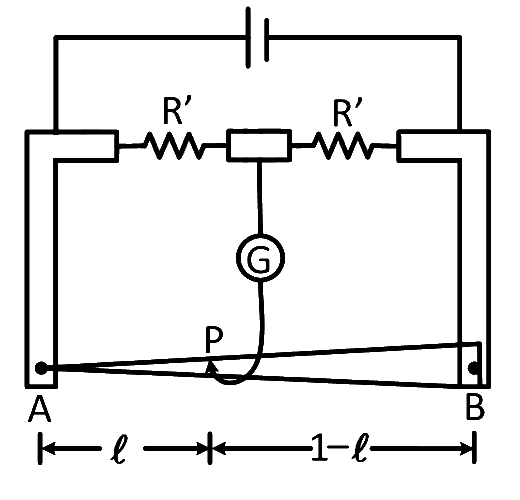
In a meter bridge, the wire of length 1 m has a non-uniform cross-section such that, the variation dRdℓ\frac{dR}{d\ell} of its resistance R with length ℓ\ell is dRdℓ∝1ℓ\frac{dR}{d\ell} \propto \frac{1}{\sqrt{\ell}}. Two equal resistances are connected as shown in the figure. The galvanometer has zero deflection when the jockey is at point P. What is the length AP?

Figure

Show answer and solution

Answer: (b)

Loading the solution…
Report a mistakeOpen question page
Q110JEE Main 2019 · 8 APR · SHIFT 1Difficult

Non-uniform bodies: mass, centre of mass, R, C

A thin circular plate of mass M and radius R has its density varying as ρ\rho(r) = ρ\rho0r with ρ\rho0 as constant and r is the distance from its centre. The moment of Inertia of the circular plate about an axis perpendicular to the plate and passing through its edge is I = aMR2. The value of the coefficient a is:

Show answer and solution

Answer: (c)

Loading the solution…
Report a mistakeOpen question page
Q111JEE Main 2019 · 12 APR · SHIFT 1Medium

Non-uniform bodies: mass, centre of mass, R, C

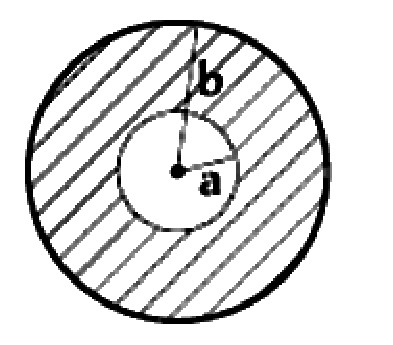
A circular disc of radius b has a hole of radius a at its centre (see figure). If the mass per unit area of the disc varies as (σ0r)\left(\frac{\sigma_0}{r}\right), then the radius of gyration of the disc about its axis passing through the centre is:

Figure

Show answer and solution

Answer: (c)

Loading the solution…
Report a mistakeOpen question page
Q112JEE Main 2019 · 12 APR · SHIFT 1Medium

Non-uniform bodies: mass, centre of mass, R, C

A uniform rod of length ℓ\ell is being rotated in a horizontal plane with a constant angular speed about an axis passing through one of its ends. If the tension generated in the rod due to rotation is T(x) at a distance x from the axis, then which of the following graphs depicts it most closely?

Show answer and solution

Answer: (b)

Loading the solution…
Report a mistakeOpen question page
Q113JEE Main 2015 · 11 APR · SHIFT 1Medium

Non-uniform bodies: mass, centre of mass, R, C

A uniform thin rod AB of length L has linear mass density μ\mu (x) = a + bxL,\frac{bx}{L}, where x is measured from A. If the CM of the rod lies at a distance of (712L)\left(\frac{7}{12}L\right) from A, then a and b are related as:

Show answer and solution

Answer: (c)

Loading the solution…
Report a mistakeOpen question page
Q114JEE Main 2014 · 19 APR · SHIFT 1Medium

Non-uniform bodies: mass, centre of mass, R, C

The gap between the plates of a parallel plate capacitor of area A and distance between plates d, is filled with a dielectric whose permittivity varies linearly from ϵ\epsilon1 at one plate to ϵ\epsilon2 at the other. The capacitance of capacitor is:

Show answer and solution

Answer: (d)

Loading the solution…
Report a mistakeOpen question page
Q115JEE Main 2014 · 12 APR · SHIFT 1Medium

Non-uniform bodies: mass, centre of mass, R, C

The space between the plates of a parallel plate capacitor is filled with a 'dielectric' whose 'dielectric constant' varies with distance as per the relation:

K(x) = K0 + λ\lambdax (λ\lambda = a constant)

The capacitance C, of this capacitor, would be related to its 'vacuum' capacitance C0 as per relation:

Show answer and solution

Answer: (c)

Loading the solution…
Report a mistakeOpen question page
Q116JEE Main 2008 · AIEEEMedium

Non-uniform bodies: mass, centre of mass, R, C

A thin rod of length ′L′'L' is lying along the xx-axis with its ends at x=0x = 0 and x=Lx = L. Its linear density (mass/length) varies with xx as k(xL)n,k\left(\frac{x}{L}\right)^n, where nn can be zero or any positive number. If the position XCMX_{CM} of the center of mass of the rod is plotted against ′n′,'n', which of the following graphs best approximates the dependence of XCMX_{CM} on nn?
Show answer and solution

Answer: (a)

Loading the solution…
Report a mistakeOpen question page