The magnetic flux through a loop of resistance 10Ω varying according to the relation ϕ=6t2+7t+1, where ϕ is in milliweber, time is in second at time t=1 s the induced e.m.f. is
A coil of resistance 400Ω is placed in a magnetic field. If the magnetic flux ' ϕ ' ( Wb) linked with the coil varies with time ' t ' ( s) is ϕ=50t2+4, the current in the coil at t=2 s will be
A coil of resistance 250Ω is placed in a magnetic field. If the magnetic flux (ϕ) linked with the coil varies with time t(s) as ϕ=50t2+7. The current in the coil at t=4 s is
the magnetic flux (in weber) in a closed circuit of resistance 20Ω varies with time t second according to equation ϕ=5t2−6t+9. The magnitude of induced current at t=0.2 second is
A rectangular wire loop of resistance 1.5Ω placed in a region of uniform magnetic field of magnitude 0.3 T directed normal to the loop. If the area of the loop decreases at a rate of 0.05 m2/s in this magnetic field, the heat produced in it is x×10−6 W. The value of x is
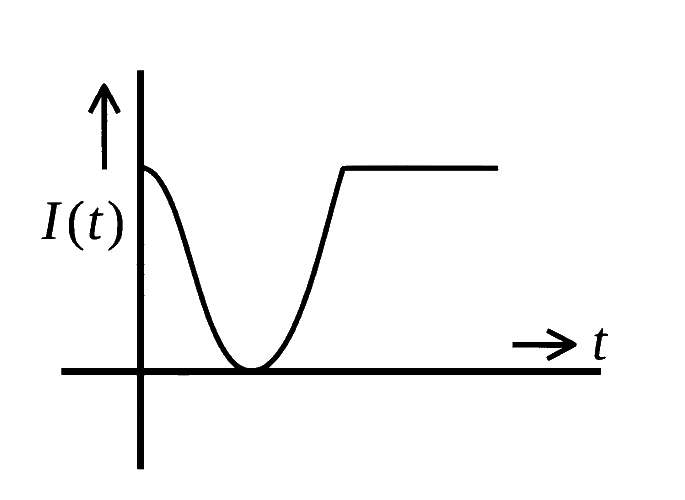
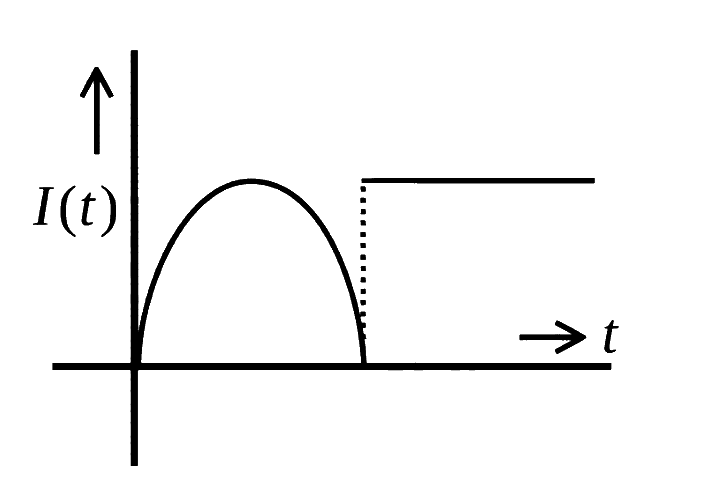
A conducting loop of finite resistance lies on the x−y plane. There is a constant magnetic field in the z direction. The area of the loop varies with time t, as A=A0(1+sint) in appropriate units. The figure that correctly indicates the qualitative behaviour of the power P dissipated in the loop as a function of time is:
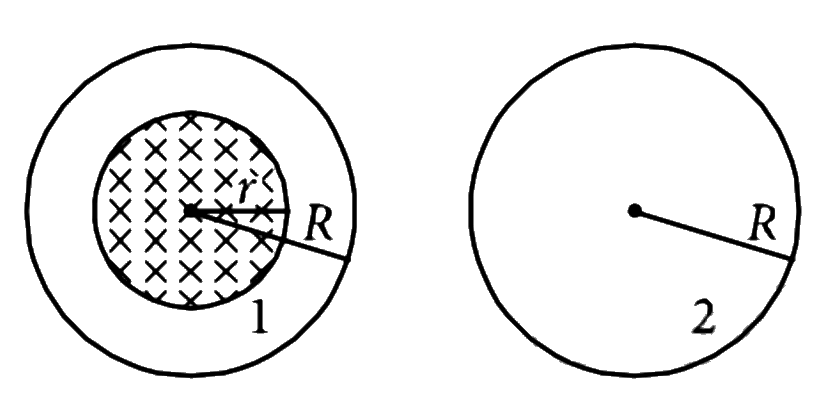
A uniform magnetic field is restricted within a region of radius r. The magnetic field changes with time at a rate dtdB. Loop 1 of radius R > r encloses the region r and loop 2 of radius R is outside the region of magnetic field as shown in the figure. Then the e.m.f. generated is
The primary and secondary coils of a transformer have 50 and 1500 turns respectively. If the magnetic flux ϕ linked with the primary coil is given by ϕ=ϕ0 + 4t, where ϕ is webers, t is time in seconds and ϕ0 is a constant, the output voltage across the secondary coil is
A square loop of side 2 cm is placed in a time varying magnetic field with magnitude as B=0.4sin(300t) Tesla. The normal to the plane of loop makes an angle of 60∘ with the field. The maximum induced emf produced in the loop is ______ mV.
A conducting circular loop of area 1.0 m2 is placed perpendicular to a magnetic field which varies as B=sin(100t) Tesla. If the resistance of the loop is 100Ω, then the average thermal energy dissipated in the loop in one period is ______ J.
A circular loop of radius 20 cm and resistance 2Ω is placed in a time varying magnetic field B=(2t2+2t+3)T. At t=0, for the plane of the loop being perpendicular to the magnetic field and, the induced current in the loop at t=3 s is 50α A. The value of α is ______. (Take π=22/7)
Numerical answer type. Work it out, then open the answer.
Suppose a long solenoid of 100 cm length, radius 2 cm having 500 turns per unit length, carries a current I=10sin(ωt) A, where ω=1000 rad/s. A circular conducting loop (B) of radius 1 cm coaxially slided through the solenoid at a speed v=1 cm/s. The r.m.s. current through the loop when the coil B is inserted 10 cm inside the solenoid is 2αμA. The value of α is ______. [Resistance of the loop =10Ω ]
The magnetic flux ϕ (in weber) linked with a closed circuit of resistance 8Ω varies with time (in seconds) as ϕ=5t2−36t+1. The induced current in the circuit at t=2 s is __________ A.
Numerical answer type. Work it out, then open the answer.
A rectangular loop of sides 12 cm and 5 cm, with its sides parallel to the x-axis and y-axis respectively, moves with a velocity of 5 cm/s in the positive x axis direction, in a space containing a variable magnetic field in the positive z direction. The field has a gradient of 10−3 T/cm along the negative x direction and it is decreasing with time at the rate of 10−3 T/s. If the resistance of the loop is 6 mΩ, the power dissipated by the loop as heat is __________ ×10−9 W.
Numerical answer type. Work it out, then open the answer.
A conducting circular loop is placed in a uniform magnetic field of 0.4 T with its plane perpendicular to the field. Somehow, the radius of the loop starts expanding at a constant rate of 1 mm/s. The magnitude of induced emf in the loop at an instant when the radius of the loop is 2 cm will be ___________ μV.
Numerical answer type. Work it out, then open the answer.
A certain elastic conducting material is stretched into a circular loop. It is placed with its plane perpendicular to a uniform magnetic field B = 0.8 T. When released the radius of the loop starts shrinking at a constant rate of 2 cms −1. The induced emf in the loop at an instant when the radius of the loop is 10 cm will be __________ mV.
Numerical answer type. Work it out, then open the answer.
A square loop of side 2.0 cm is placed inside a long solenoid that has 50 turns per centimetre and carries a sinusoidally varying current of amplitude 2.5 A and angular frequency 700 rad s−1. The central axes of the loop and solenoid coincide. The amplitude of the emf induced in the loop is x×10−4 V. The value of x is __________.
(Take, π=722)
Numerical answer type. Work it out, then open the answer.
The magnetic flux through a coil perpendicular to its plane is varying according to the relation ϕ=(5t3+4t2+2t−5) Weber. If the resistance of the coil is 5 ohm, then the induced current through the coil at t = 2 s will be,
Magnetic flux (in weber) in a closed circuit of resistance 20 Ω varies with time t(s) at ϕ = 8t2 − 9t + 5. The magnitude of the induced current at t = 0.25 s will be ____________ mA.
Numerical answer type. Work it out, then open the answer.
A conducting circular loop is placed in X−Y plane in presence of magnetic field B=(3t3j^+3t2k^) in SI unit. If the radius of the loop is 1 m, the induced emf in the loop, at time, t=2 s is nπ V. The value of n is ___________.
Numerical answer type. Work it out, then open the answer.
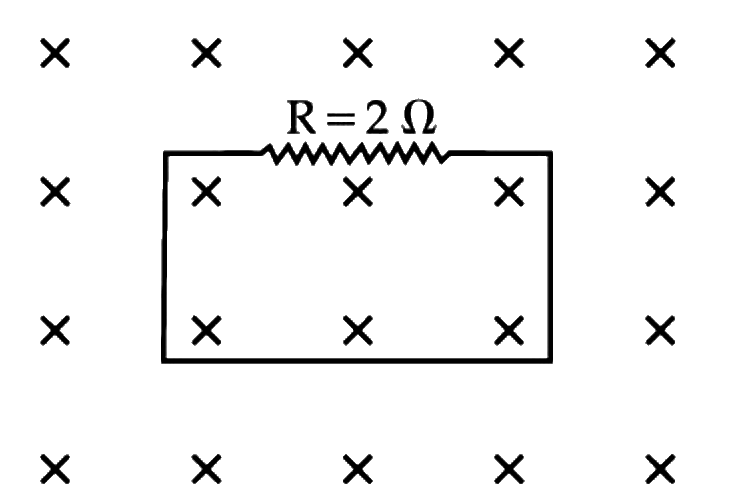
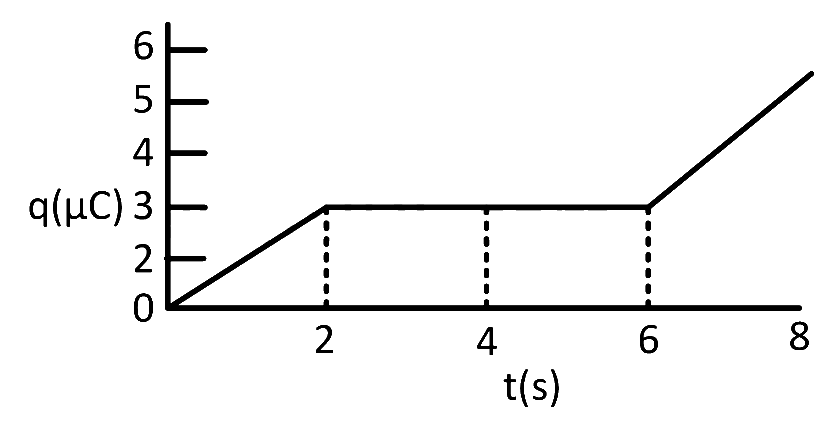
In the given figure the magnetic flux through the loop increases according to the relation ϕB(t) = 10t2 + 20t, where ϕB is in milliwebers and t is in seconds.
The magnitude of current through R = 2Ω resistor at t = 5 s is ___________ mA.
Numerical answer type. Work it out, then open the answer.
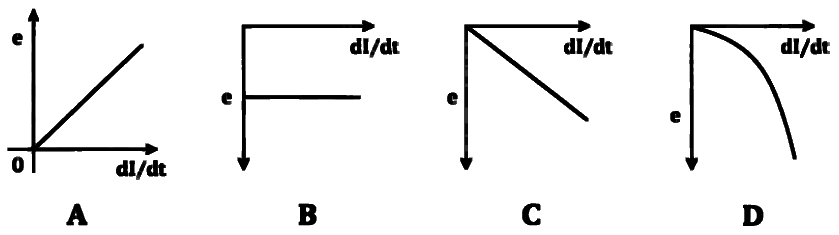
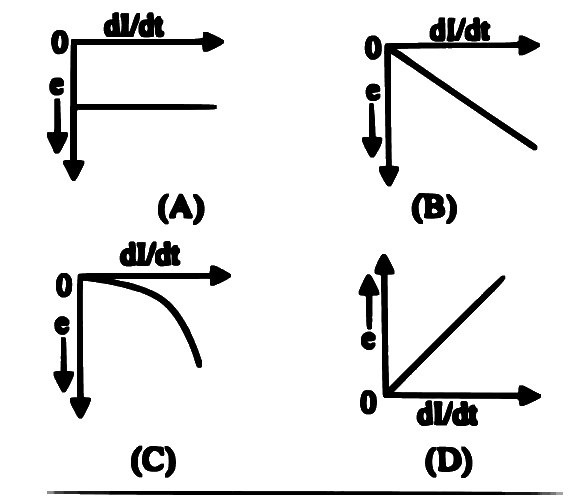
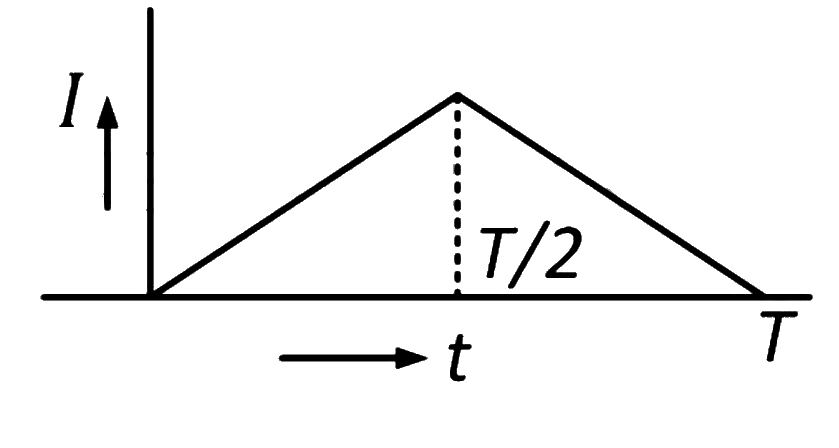
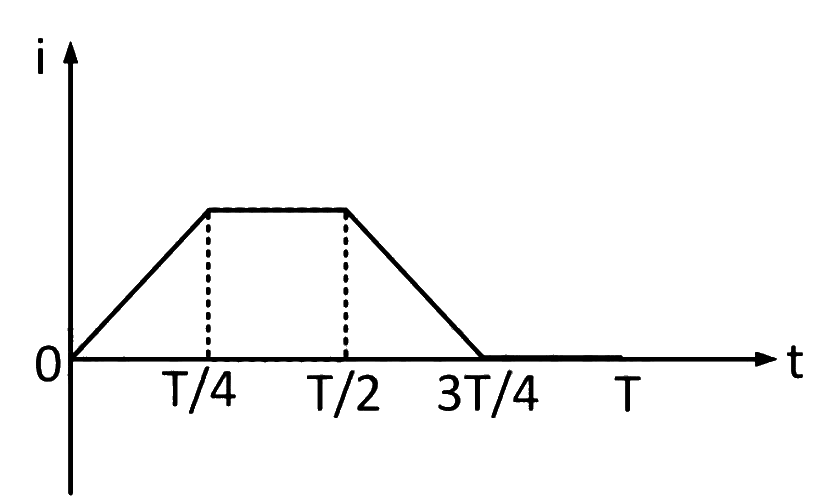
The current flowing through an inductor of self-inductance L is continuously increasing at constant rate. The variation of induced e.m.f. (e) versus time t is shown graphically by
The current flowing through the inductor of self inductance 'L' is continuously increasing at constant rate. The variation of induced e.m.f. (e) versus dtdI is shown graphically by figure
The current flowing through an inductor of selfinductance L is continuously increasing at constant rate. The variation of induced e.m.f. (e) verses dI/dt is shown graphically by figure
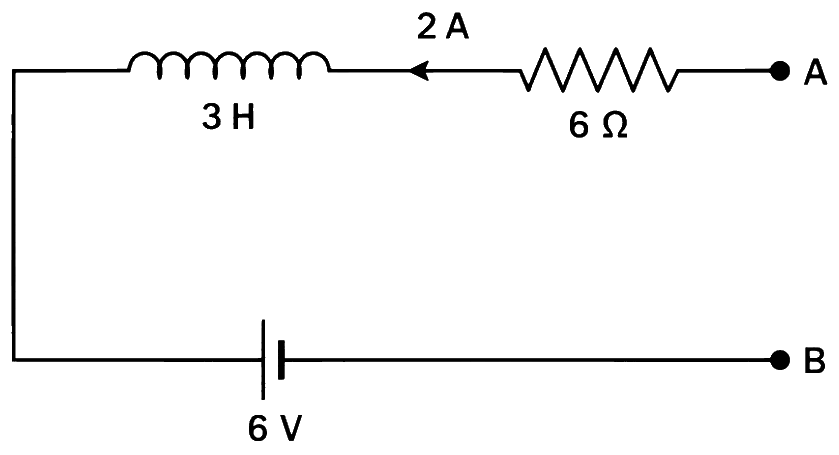
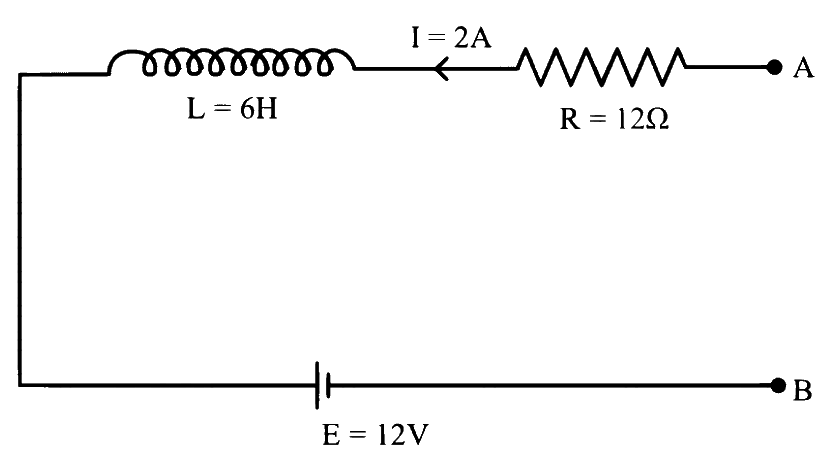
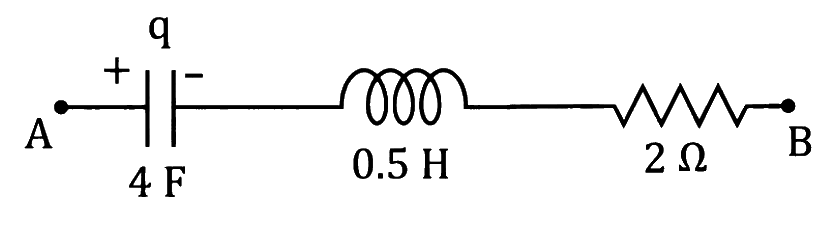
In the part of an a.c. circuit as shown, the resistance R=0.2Ω. At a certain instant (VA−VB)=0.5 V,I=0.5 A and ΔtΔI=8 A/s. The inductance of the coil is
Two different coils have self-inductance 3L and L. The current in both the coils is increased at the same constant rate. At certain instant of time, the power given to the two coils is same. At that time there was current and voltage induced in the two coils. At the same instant, the ratio of energy stored in the first coil to that in the second coil is
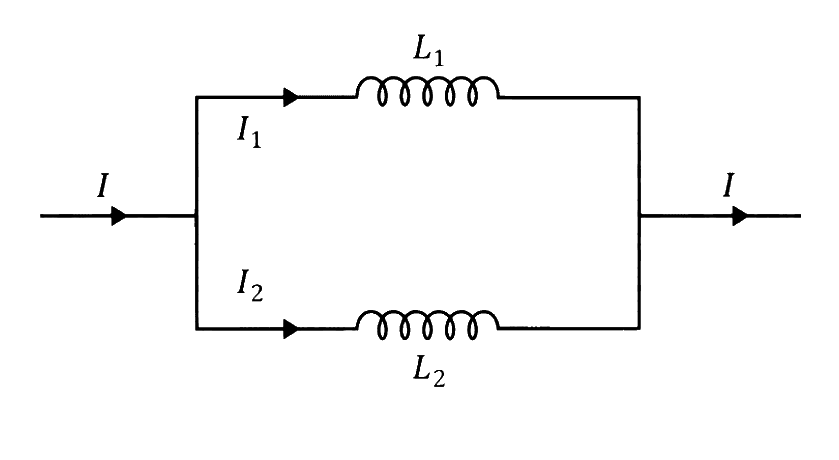
Two inductors, L1 and L2 are connected in parallel and a time varying current flows as shown in the figure. The ratio of currents I1I2 at any time, it is
Two inductors, L1 and L2, are connected in parallel and time-varying current flows the combination. If I1 and I2 are the currents passing through the inductor L1 and L2 respectively, the ratio I1I2 is
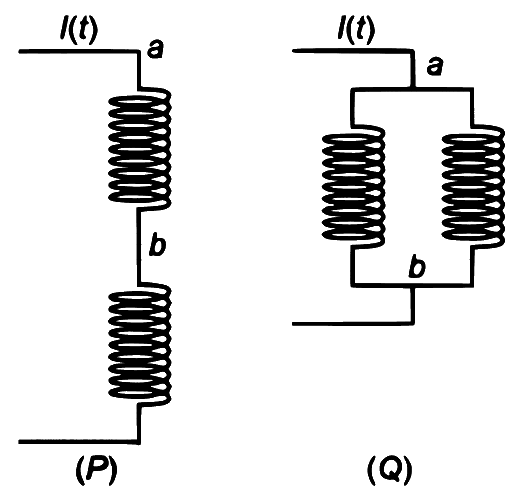
Two identical inductors are connected in two different configurations P and Q, where a time varying current I(t) is flowing, as shown in the figure. The induced emf between points a and b for configuration P is EP and that for configuration Q is EQ. The ratio EP/EQ is:
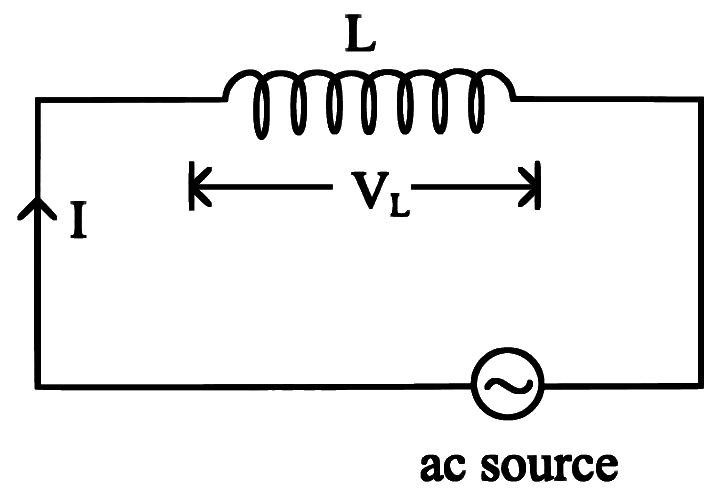
In the circuit shown below, the inductance L is connected to an ac source. The current flowing in the circuit is I=I0sinωt. The voltage drop (VL) across L is
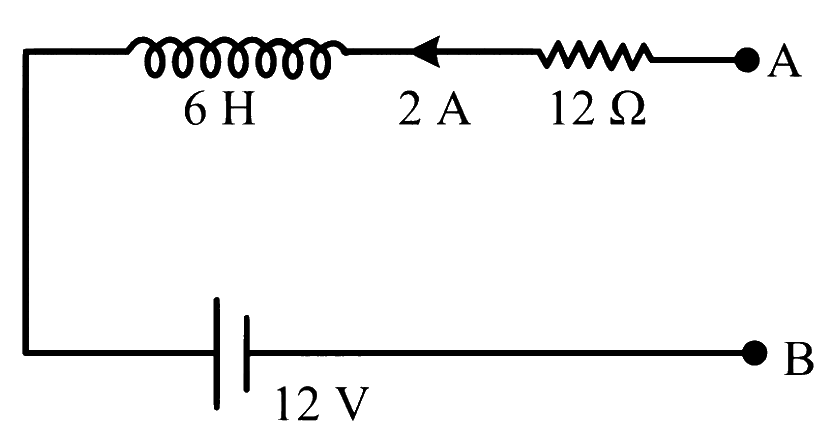
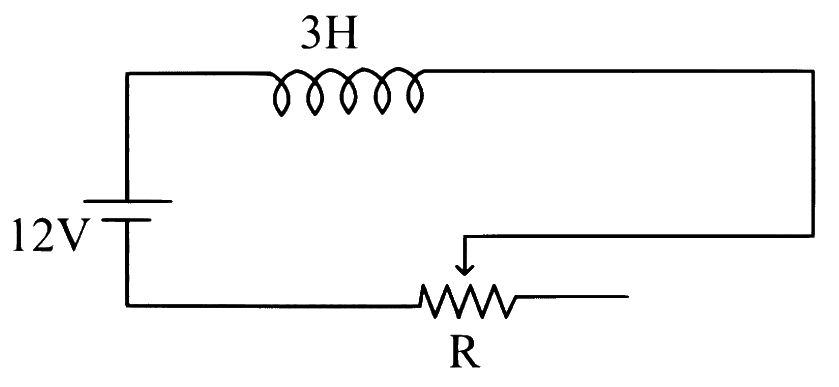
In the given circuit the sliding contact is pulled outwards such that electric current in the circuit changes at the rate of 8 A/s. At an instant when R is 12Ω, the value of the current in the circuit will be ________ A.
Numerical answer type. Work it out, then open the answer.
The current in an inductor is given by I=(3t+8) where t is in second. The magnitude of induced emf produced in the inductor is 12 mV. The self-inductance of the inductor _________ mH.
Numerical answer type. Work it out, then open the answer.
Two coils have a mutual inductance of 0.01 H. The current in the first coil changes according to equation, I=5sin200πt. The maximum value of emf induced in the second coil is
Two coils have a mutual inductance 0.003 H. The current changes in the first coil according to equation I=I0sinωt, where I0=8 A and ω=100π rad s−1. The maximum value of e.m.f. in the second coil is
Two coils have a mutual inductance 5×10⁻³ H. The current changes in the first coil according to the equation I1=I0sinωt where I0=10 A and ω=100π rad/s. What is the value of the maximum e.m.f. in the coil?
Two coils have a mutual inductance of 0.005 H. The current changes in the first coil according to equation I=I0sinωt, where I0=10 A and ω=60π rad s−1. The maximum values of e.m.f. in the second coil in volt will be
Two coils have a mutual inductance of 0.004 H. The current changes in the first coil according to equation I=I0sinωt, where I0=10 A and ω=50π rad s−1. The maximum value of e.m.f. in the second coil in volt is
Two coils A and B have mutual inductance 0.008 H. The current changes in the coil A, according to the equation I=Imsinωt, where Im=5 A and ω=200π rad s−1. The maximum value of the e.m.f. induced in the coil B in volt is
Two coils P and S have a mutual inductance of (π) mH. The secondary coil S has resistance 4Ω and self inductance (60/π) mH. If the current in the primary is Ip=12sin(50πt), then the maximum value of the current induced in coil S is [Take π2=10]
Two coils have a mutual inductance of 0.005 H. The current changes in the first coil according to equation I=I0sinωt, where I0=10 A and ω=100π rad/s. The maximum value of emf in the second coil is
Two coils have mutual inductance 0.002 H. The current changes in the first coil according to the relation i=i0sinωt, where i0=5 A and ω=50π rad/s. The maximum value of emf in the second coil is απ V. The value of α is _______.
Numerical answer type. Work it out, then open the answer.
A long solenoid of radius R carries a time (t) - dependent current
I(t)=I0t(1 - t). A ring of radius 2R is placed coaxially near its middle. During the time interval 0 ≤ t ≤ 1, the induced current (IR) and the induced EMF(VR) in the ring change as:
A very long solenoid of radius R is carrying current I(t) = kte–at(k > 0), as a function of time (t ≥ 0). counter clockwise current is taken to be positive. A circular conducting coil of radius 2R is placed in the equatorial plane of the solenoid and concentric with the solenoid. The current induced in the outer coil is correctly depicted, as a function of time, by :-
A small circular loop of wire of radius a is located at the centre of a much larger circular wire loop of radius b. The two loops are in the same plane. The outer loop of radius b carries an alternating current I = Io cos (ωt). The emf induced in the smaller inner loop is nearly:
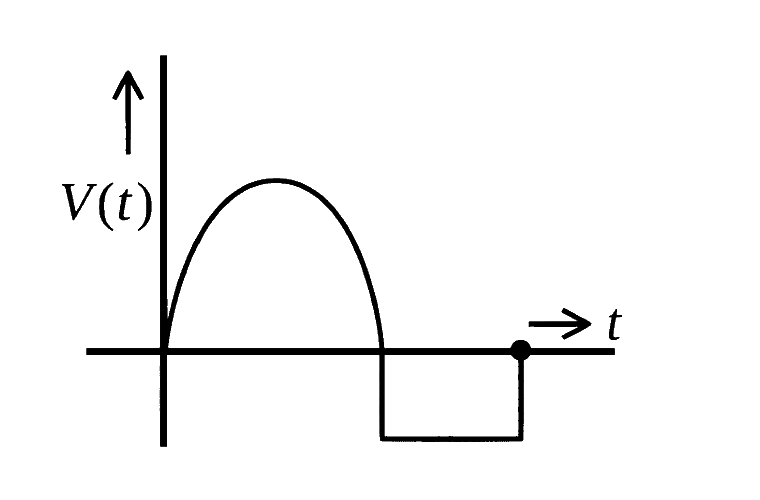
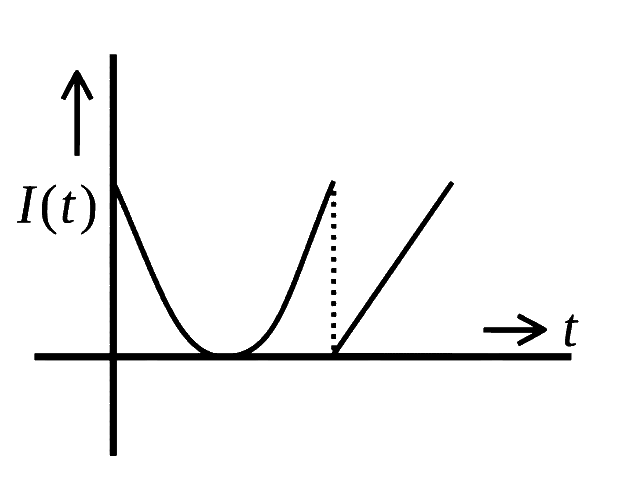
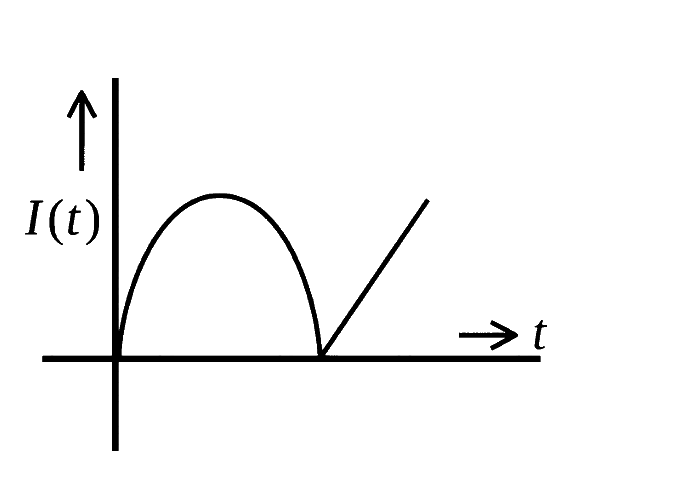
Two coils, X and Y, are kept in close vicinity of each other. When a varying current, I(t), flows through coil X, the induced emf (V(t)) in coil Y, varies in the manner shown here. The variation of I(t), with time, can then be represented by the graph labelled as graph:
A capacitor of capacity 5μF is charged by a battery of e.m.f. 10 V. At an instant, the potential difference across the capacitor is 4 V and the time rate of change of potential difference across the capacitor is 0.6 V/s. Then the time rate at which energy is stored in the capacitor at that instant is
To produce an instantaneous displacement current of 2 mA in the space between the parallel plates of a capacitor of capacitance 4μF, the rate of change of applied variable potential difference (dtdV) must be :-
A displacement current of 4.0 A can be set up in the space between two parallel plates of 6μF capacitor. The rate of change of potential difference across the plates of the capacitor is nearly α×106 V/s. The value of α is ______.
A parallel plate capacitor consisting of two circular plates of radius 10 cm is being charged by a constant current of 0.15 A. If the rate of change of potential difference between the plates is 7×10⁸ V/s then the integer value of the distance between the parallel plates is ( Take, ϵ0=9×10⁻¹²mF,π=722) ____________ μm.
Numerical answer type. Work it out, then open the answer.
A time varying potential difference is applied between the plates of a parallel plate capacitor of capacitance 2.5μF. The dielectric constant of the medium between the capacitor plates is 1. It produces an instantaneous displacement current of 0.25 mA in the intervening space between the capacitor plates, the magnitude of the rate of change of the potential difference will be _________ Vs−1.
Numerical answer type. Work it out, then open the answer.
Seawater at a frequency f = 9 × 10² Hz, has permittivity ε = 80ε0 and resistivity ρ = 0.25 Ωm. Imagine a parallel plate capacitor is immersed in seawater and is driven by an alternating voltage source V(t) = V0 sin(2πft). Then the conduction current density becomes 10x times the displacement current density after time t = 8001 s. The value of x is _____________. (Given: 4πε01=9×10⁹ Nm2C−2)
Numerical answer type. Work it out, then open the answer.
To establish an instantaneous current of 2 A through a 1μF capacitor; the potential difference across the capacitor plates should be changed at the rate of:
For a particle P performing S.H.M., when displacement is 'x', potential energy and restoring force acting on it is denoted by 'E' and 'F' respectively. The relation between x, E and F is
A particle performing S.H.M. when displacement is 'x', the potential energy and restoring force acting on it are denoted by 'E' and 'F' respectively. The relation between x,E and F is
The potential energy of a particle in a force field is U=r2A−rB where A and B are positive constants and r is the distance of particle from the centre of the field. For stable equilibrium, the distance of the particle is
The potential energy between two atoms, in a molecule, is given by U(x)=x12a−x6b where a and b are positive constants and x is the distance between the atoms. The atom is in stable equilibrium, when
The electrostatic potential in a charged spherical region of radius r varies as V=ar3+b, where a and b are constants. The total charge in the sphere of unit radius is α×πaϵ0. The value of α is ______. (permittivity of vacuum is ϵ0)
The potential energy function (in J) of a particle in a region of space is given as U=(2x2+3y3+2z). Here x,y and z are in meter. The magnitude of x-component of force (in N) acting on the particle at point P(1,2,3) m is:
A small particle of mass m moves in such a way that its potential energy U=21mω2r2 where ω is constant and r is the distance of the particle from origin. Assuming Bohr's quantization of momentum and circular orbit, the radius of nth orbit will be proportional to,
For a charged spherical ball, electrostatic potential inside the ball varies with r as V=2ar2+b. Here, a and b are constant and r is the distance from the center. The volume charge density inside the ball is −λaε. The value of λ is ____________.
ε = permittivity of the medium
Numerical answer type. Work it out, then open the answer.
The potential energy of a particle of mass 4 kg in motion along the x-axis is given by U=4(1−cos4x) J. The time period of the particle for small oscillation (sinθ≃θ) is (Kπ) s. The value of K is _________.
Numerical answer type. Work it out, then open the answer.
Potential energy as a function of r is given by U=r10A−r5B, where r is the interatomic distance, A and B are positive constants. The equilibrium distance between the two atoms will be:
A particle of mass m moves in a circular orbit under the central potential field, U(r)=−rC, where C is a positive constant. The correct radius − velocity graph of the particle's motion is:
The electrostatic potential inside a charged spherical ball is given by ϕ=ar2+b where r is the distance from the center and a,b are constants. Then the charge density inside the ball is:
The potential energy function for the force between two atoms in a diatomic molecule is approximately given by U(x)=x12a−x6b, where a and b are constants and x is the distance between the atoms. If the dissociation energy of the molecule is