Physics Circle home Student Login

Home›PYQ Workbook›Basic Maths 2: Differentiation & Integration›Differentiation and Motion

Basic Maths 2: Differentiation & Integration PYQs · MHT CET · JEE Main · NEET

Differentiation and Motion

Read the theory for this topic →

Questions
101
MHT CET
12
JEE Main
69
NEET
20
0 of 101 attempted

Q1MHT CET 2023 · 14 MAY · SHIFT 2Easy

Velocity and acceleration from x(t)

The position 'xx' of a particle varies with a time as x=at2−bt3x = at^2 - bt^3 where 'aa' and 'bb' are constants. The acceleration of the particle will be zero at

Show answer and solution

Answer: (c)

Loading the solution…
Report a mistakeOpen question page
Q2MHT CET 2024 · 11 MAY · SHIFT 2Easy

Velocity and acceleration from x(t)

Two cars start from a point at the same time in a straight line and their positions are represented by x1(t)=at+bt2x_1(t) = at + bt^2 and x2(t)=Ft−t2x_2(t) = Ft - t^2. At what time do the cars have the same velocity?

Show answer and solution

Answer: (d)

Loading the solution…
Report a mistakeOpen question page
Q3MHT CET 2023 · 11 MAY · SHIFT 2Easy

Velocity and acceleration from x(t)

Two cars A and B start from a point at the same time in a straight line and their positions are represented by RA(t)=R_A(t) = at +bt2+bt^2 and RB(t)=xt−t2R_B(t) = xt - t^2. At what time do the cars have same velocity?

Show answer and solution

Answer: (a)

Loading the solution…
Report a mistakeOpen question page
Q4MHT CET 2025 · 21 APR · SHIFT 1Difficult

Velocity and acceleration from x(t)

A simple pendulum has time period ' T1T_1 '. The point of suspension is now moved upward according to equation y=kt2y = kt^{2} where k=1 m/s2k = 1\text{ m/s}^{2}. If new time period is ' T2T_2 ' then T12/T22T_1^{2}/T_2^{2} will be ( g=10 m/s2g = 10\text{ m/s}^{2})

Show answer and solution

Answer: (c)

Loading the solution…
Report a mistakeOpen question page
Q5NEET 2026 · RE-NEETMedium

Velocity and acceleration from x(t)

Consider a particle moving along a straight line, whose position as a function of time is given by s(t)=αt2−βt+γs(t) = \alpha t^2 - \beta t + \gamma, where α=1 ms−2,β=6 ms−1\alpha = 1\text{ ms}^{-2}, \beta = 6\text{ ms}^{-1} and γ=5 m\gamma = 5\text{ m}. The average speed of the particle, in ms−1\text{ms}^{-1} from t=0t = 0 to t=6 st = 6\text{ s} is:

Show answer and solution

Answer: (d)

Loading the solution…
Report a mistakeOpen question page
Q6NEET 2025Medium

Velocity and acceleration from x(t)

In some appropriate units, time (t)(t) and position (x)(x) relation of a moving particle is given by t=x2+xt = x^2 + x. The acceleration of the particle is

Show answer and solution

Answer: (d)

Loading the solution…
Report a mistakeOpen question page
Q7NEET 2024Easy

Velocity and acceleration from x(t)

A particle is moving along xx-axis with its position (x) varying with time (t)(t) as x=αt4+βt2+γt+δx = \alpha t^4 + \beta t^2 + \gamma t + \delta. The ratio of its initial velocity to its initial acceleration, respectively, is:

Show answer and solution

Answer: (d)

Loading the solution…
Report a mistakeOpen question page
Q8NEET 2024Easy

Velocity and acceleration from x(t)

At any instant of time tt, the displacement of any particle is given by 2t−12t - 1 (SI\text{SI} unit) under the influence of force of 5 N5\text{ N}. The value of instantaneous power is (in SI\text{SI} unit):

Show answer and solution

Answer: (a)

Loading the solution…
Report a mistakeOpen question page
Q9NEET 2015 · AIPMT · CANCELLED PAPERMedium

Velocity and acceleration from x(t)

A particle of unit mass undergoes one-dimensional motion such that its velocity varies according to v(x)=βx−2nv(x) = \beta x^{-2n}, where β\beta and n are constants and x is the position of the particle. The acceleration of the particle as a function of x, is given by

Show answer and solution

Answer: (d)

Loading the solution…
Report a mistakeOpen question page
Q10NEET 2005 · AIPMTMedium

Velocity and acceleration from x(t)

The displacement x of a particle varies with time t as x = ae−α-\alphat + beβ\betat, where a, b, α\alpha and β\beta are positive constants. The velocity of the particle will

Show answer and solution

Answer: (d)

Loading the solution…
Report a mistakeOpen question page
Q11NEET 2000 · AIPMTEasy

Velocity and acceleration from x(t)

Motion of a particle is given by equation s = (3t3 + 7t2 + 14t + 8) m. The value of acceleration of the particle at t = 1 sec is

Show answer and solution

Answer: (b)

Loading the solution…
Report a mistakeOpen question page
Q12NEET 1998 · AIPMTMedium

Velocity and acceleration from x(t)

A force acts on a 3.0 g3.0\text{ g} particle in such a way that the position of the particle as a function of time is given by x=3t−4t2+t3x = 3t - 4t^2 + t^3, where xx is in metre and tt in second. The work done during the first 4 s4\text{ s} is

Show answer and solution

Answer: (d)

Loading the solution…
Report a mistakeOpen question page
Q13NEET 1997 · AIPMTEasy

Velocity and acceleration from x(t)

The position xx of a particle varies with time (tt) as x=at2−bt3x = at^2 - bt^3. The acceleration will be zero at time tt is equal to

Show answer and solution

Answer: (a)

Loading the solution…
Report a mistakeOpen question page
Q14NEET 1994 · AIPMTEasy

Velocity and acceleration from x(t)

A particle moves along a straight line such that its displacement at any time tt is given by s=(t3−6t2+3t+4)s = (t^3 - 6t^2 + 3t + 4) metres. The velocity when the acceleration is zero is

Show answer and solution

Answer: (c)

Loading the solution…
Report a mistakeOpen question page
Q15JEE Main 2026 · 28 JAN · SHIFT 2Medium

Velocity and acceleration from x(t)

A particle starts moving from time t=0t = 0 and its coordinate is given as x(t)=4t3−3tx(t) = 4t^3 - 3t A. The particle returns to its original position (origin) 0.866 units later

B. The particle is 1 unit away from origin at its turning point

C. Acceleration of the particle is non-negative

D. The particle is 0.5 units away from origin at its turning point

E. Particle never turns back as acceleration is non-negative

Choose the correct answer from the options given below:

Show answer and solution

Answer: (b)

Loading the solution…
Report a mistakeOpen question page
Q16JEE Main 2026 · 2 APR · SHIFT 1Medium

Velocity and acceleration from x(t)

The position of an object having mass 0.1 kg as a function of time tt is given as

r⃗=(10t2i^+5t3j^)\vec{r} = \left(10t^{2}\hat{i} + 5t^{3}\hat{j}\right) m. At t=1t = 1 s, which of the following statements are correct? A. The linear momentum p⃗=(2i^+1.5j^)\vec{p} = \left(2\hat{i} + 1.5\hat{j}\right) kg·m/s.

B. The force acting on the object F⃗=(2i^+3j^)\vec{F} = \left(2\hat{i} + 3\hat{j}\right) N.

C. The angular momentum of the object about its origin L⃗=15k^\vec{L} = 15\hat{k} J·s.

D. The torque acting on the object about its origin τ⃗=20k^\vec{\tau} = 20\hat{k} N·m.

Choose the correct answer from the options given below:

Show answer and solution

Answer: (d)

Loading the solution…
Report a mistakeOpen question page
Q17JEE Main 2026 · 21 JAN · SHIFT 2Easy

Velocity and acceleration from x(t)

A body of mass 2 kg is moving along x-direction such that its displacement as function of time is given by x(t)=αt2+βt+γx(t) = \alpha t^2 + \beta t + \gamma m, where α=1 m/s2,β=1 m/s\alpha = 1\text{ m/s}^2, \beta = 1\text{ m/s} and γ=1 m\gamma = 1\text{ m}. The work done on the body during the time interval t=2 st = 2\text{ s} to t=3 st = 3\text{ s}, is ________ J.

Show answer and solution

Answer: (b)

Loading the solution…
Report a mistakeOpen question page
Q18JEE Main 2025 · 3 APR · SHIFT 2Easy

Velocity and acceleration from x(t)

A particle moves along the xx-axis and has its displacement xx varying with time t according to the equation:

x=c0(t2−2)+c(t−2)2x = c_0\left(t^2 - 2\right) + c(t - 2)^2

where c0c_0 and c are constants of appropriate dimensions.

Then, which of the following statements is correct?

Show answer and solution

Answer: (a)

Loading the solution…
Report a mistakeOpen question page
Q19JEE Main 2024 · 29 JAN · SHIFT 2Easy

Velocity and acceleration from x(t)

A particle is moving in a straight line. The variation of position 'xx' as a function of time 'tt' is given as x=(t3−6t2+20t+15) mx = \left(t^3 - 6t^2 + 20t + 15\right)\text{ m}. The velocity of the body when its acceleration becomes zero is:

Show answer and solution

Answer: (c)

Loading the solution…
Report a mistakeOpen question page
Q20JEE Main 2024 · 1 FEB · SHIFT 1Easy

Velocity and acceleration from x(t)

A particle is moving in one dimension (along xx axis) under the action of a variable force. Its initial position was 16 m16\text{ m} right of origin. The variation of its position (x)(x) with time (t)(t) is given as x=−3t3+18t2+16tx = -3t^3 + 18t^2 + 16t, where xx is in m\text{m} and tt is in s\text{s}.

The velocity of the particle when its acceleration becomes zero is _________ m/s\text{m/s}.

Numerical answer type. Work it out, then open the answer.

Show answer and solution

Answer: 52

Loading the solution…
Report a mistakeOpen question page
Q21JEE Main 2024 · 31 JAN · SHIFT 1Medium

Velocity and acceleration from x(t)

The relation between time 'tt' and distance 'xx' is t=αx2+βxt = \alpha x^2 + \beta x, where α\alpha and β\beta are constants. The relation between acceleration (a)(a) and velocity (v)(v) is:

Show answer and solution

Answer: (c)

Loading the solution…
Report a mistakeOpen question page
Q22JEE Main 2024 · 6 APR · SHIFT 2Medium

Velocity and acceleration from x(t)

A particle moves in a straight line so that its displacement xx at any time tt is given by x2=1+t2x^2 = 1 + t^2. Its acceleration at any time tt is x−nx^{-n} where n=n = _________.

Numerical answer type. Work it out, then open the answer.

Show answer and solution

Answer: 3

Loading the solution…
Report a mistakeOpen question page
Q23JEE Main 2024 · 1 FEB · SHIFT 2Medium

Velocity and acceleration from x(t)

A particle initially at rest starts moving from reference point x=0x = 0 along xx-axis, with velocity vv that varies as v=4x m/sv = 4\sqrt{x}\text{ m/s}. The acceleration of the particle is __________ ms−2\text{ms}^{-2}.

Numerical answer type. Work it out, then open the answer.

Show answer and solution

Answer: 8

Loading the solution…
Report a mistakeOpen question page
Q24JEE Main 2023 · 15 APR · SHIFT 1Easy

Velocity and acceleration from x(t)

The position vector of a particle related to time tt is given by

r⃗=(10ti^+15t2j^+7k^) m\vec{r} = \left(10t\hat{i} + 15t^2\hat{j} + 7\hat{k}\right)\text{ m}

The direction of net force experienced by the particle is:

Show answer and solution

Answer: (b)

Loading the solution…
Report a mistakeOpen question page
Q25JEE Main 2023 · 11 APR · SHIFT 2Medium

Velocity and acceleration from x(t)

A body of mass 500 g500\text{ g} moves along xx-axis such that its velocity varies with displacement xx according to the relation v=10x m/sv = 10\sqrt{x}\text{ m/s} the force acting on the body is:-

Show answer and solution

Answer: (c)

Loading the solution…
Report a mistakeOpen question page
Q26JEE Main 2023 · 8 APR · SHIFT 1Easy

Velocity and acceleration from x(t)

At any instant the velocity of a particle of mass 500 g500\text{ g} is (2ti^+3t2j^) m s−1\left(2t\hat{i} + 3t^2\hat{j}\right)\text{ m s}^{-1}. If the force acting on the particle at t=1 st = 1\text{ s} is (i^+xj^) N(\hat{i} + x\hat{j})\text{ N}. Then the value of xx will be:

Show answer and solution

Answer: (d)

Loading the solution…
Report a mistakeOpen question page
Q27JEE Main 2023 · 15 APR · SHIFT 1Easy

Velocity and acceleration from x(t)

The position of a particle related to time is given by x=(5t2−4t+5) mx = \left(5t^2 - 4t + 5\right)\text{ m}. The magnitude of velocity of the particle at t=2 st = 2\text{ s} will be:

Show answer and solution

Answer: (b)

Loading the solution…
Report a mistakeOpen question page
Q28JEE Main 2023 · 13 APR · SHIFT 2Easy

Velocity and acceleration from x(t)

The distance travelled by an object in time tt is given by s=(2.5)t2s = (2.5)t^2. The instantaneous speed of the object at t=5 st = 5\text{ s} will be:

Show answer and solution

Answer: (d)

Loading the solution…
Report a mistakeOpen question page
Q29JEE Main 2023 · 25 JAN · SHIFT 2Easy

Velocity and acceleration from x(t)

The distance travelled by a particle is related to time t as x=4t2x = 4t^2. The velocity of the particle at t=5s is :-

Show answer and solution

Answer: (d)

Loading the solution…
Report a mistakeOpen question page
Q30JEE Main 2022 · 28 JUN · SHIFT 1Medium

Velocity and acceleration from x(t)

A particle of mass m is moving in a circular path of constant radius r such that its centripetal acceleration (a) is varying with time t as a = k2rt2, where k is a constant. The power delivered to the particle by the force acting on it is given as

Show answer and solution

Answer: (c)

Loading the solution…
Report a mistakeOpen question page
Q31JEE Main 2022 · 25 JUN · SHIFT 2Easy

Velocity and acceleration from x(t)

Two buses P and Q start from a point at the same time and move in a straight line and their positions are represented by XP(t)=αt+βt2X_P(t) = \alpha t + \beta t^2 and XQ(t)=ft−t2X_Q(t) = ft - t^2. At what time, both the buses have same velocity?

Show answer and solution

Answer: (d)

Loading the solution…
Report a mistakeOpen question page
Q32JEE Main 2022 · 29 JUL · SHIFT 1Easy

Velocity and acceleration from x(t)

If t=x+4t = \sqrt{x} + 4, then (dxdt)t=4\left(\frac{dx}{dt}\right)_{t=4} is:

Show answer and solution

Answer: (b)

Loading the solution…
Report a mistakeOpen question page
Q33JEE Main 2022 · 28 JUL · SHIFT 2Easy

Velocity and acceleration from x(t)

At time t=0t = 0 a particle starts travelling from a height 7z^ cm7\hat{z}\text{ cm} in a plane keeping z coordinate constant. At any instant of time its position along the x^\hat{x} and y^\hat{y} directions are defined as 3t3t and 5t35t^{3} respectively. At t = 1s acceleration of the particle will be

Show answer and solution

Answer: (b)

Loading the solution…
Report a mistakeOpen question page
Q34JEE Main 2021 · 25 JUL · SHIFT 1Medium

Velocity and acceleration from x(t)

A particle of mass 'm' is moving in time 't' on a trajectory given by

r⃗=10αt2i^+5β(t−5)j^\vec{r} = 10\alpha t^{2}\hat{i} + 5\beta(t - 5)\hat{j}

Where α\alpha and β\beta are dimensional constants.

The angular momentum of the particle becomes the same as it was for t = 0 at time t = ____________ seconds.

Numerical answer type. Work it out, then open the answer.

Show answer and solution

Answer: 10

Loading the solution…
Report a mistakeOpen question page
Q35JEE Main 2020 · 9 JAN · SHIFT 1Medium

Velocity and acceleration from x(t)

The distance x covered by a particle in one dimensional motion varies with time t as x2 = at2 + 2bt + c. If the acceleration of the particle depends on x as x–n, where n is an integer, the value of n is __________

Numerical answer type. Work it out, then open the answer.

Show answer and solution

Answer: 3

Loading the solution…
Report a mistakeOpen question page
Q36JEE Main 2019 · 9 APR · SHIFT 2Medium

Velocity and acceleration from x(t)

The position of a particle as a function of time t, is given by

x(t) = at + bt2 – ct3

where a, b and c are constants. When the particle attains zero acceleration, then its velocity will be:

Show answer and solution

Answer: (c)

Loading the solution…
Report a mistakeOpen question page
Q37JEE Main 2019 · 10 APR · SHIFT 1Medium

Velocity and acceleration from x(t)

A particle of mass m is moving along a trajectory given by

x = x0 + a cosω\omega1t

y = y0 + b sinω\omega2t

The torque, acting on the particle about the origin, at t = 0 is:

Show answer and solution

Answer: (b)

Loading the solution…
Report a mistakeOpen question page
Q38JEE Main 2019 · 10 APR · SHIFT 2Medium

Velocity and acceleration from x(t)

The time dependence of the position of a particle of mass m = 2 is given byr⃗(t)=2ti^−3t2j^\vec{r}(t) = 2t\hat{i} - 3t^{2}\hat{j}. Its angular momentum, with respect to the origin, at time t = 2 is

Show answer and solution

Answer: (b)

Loading the solution…
Report a mistakeOpen question page
Q39JEE Main 2019 · 9 JAN · SHIFT 2Easy

Velocity and acceleration from x(t)

A force acts on a 2 kg object so that its position is given as a function of time as x = 3t2 + 5. What is the work done by this force in first 5 seconds?

Show answer and solution

Answer: (d)

Loading the solution…
Report a mistakeOpen question page
Q40JEE Main 2018 · 16 APR · SHIFT 1Medium

Velocity and acceleration from x(t)

A body of mass m starts moving from rest along x-axis so that its velocity varies as v=asv = a\sqrt{s} where a is a constant and s is the distance covered by the body. The total work done by all the forces acting on the body in the first t seconds after the start of the motion is:

Show answer and solution

Answer: (a)

Loading the solution…
Report a mistakeOpen question page
Q41JEE Main 2013 · 23 APR · SHIFT 1Medium

Velocity and acceleration from x(t)

A particle of mass 2 kg is moving such that at time t, its position, in meter, is given by r⃗(t)=5i^−2t2j^\vec{r}(t) = 5\hat{i} - 2t^{2}\hat{j}. The angular momentum of the particle at t=2st = 2s about the origin in kg m22 s−1-1 is:

Show answer and solution

Answer: (a)

Loading the solution…
Report a mistakeOpen question page
Q42JEE Main 2010 · AIEEEMedium

Velocity and acceleration from x(t)

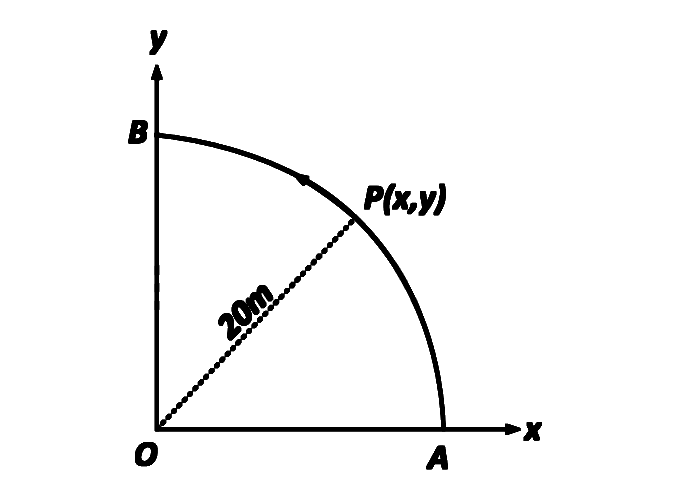
A point PP moves in counter-clockwise direction on a circular path as shown in the figure. The movement of PP is such that it sweeps out a length s=t3+5,s = t^3 + 5, where ss is in metres and tt is in seconds. The radius of the path is 20 m.20\text{ m}. The acceleration of ′P′'P' when t=2 st = 2\text{ s} is nearly.

Figure

Show answer and solution

Answer: (d)

Loading the solution…
Report a mistakeOpen question page
Q43NEET 2015 · AIPMTMedium

Maxima and minima

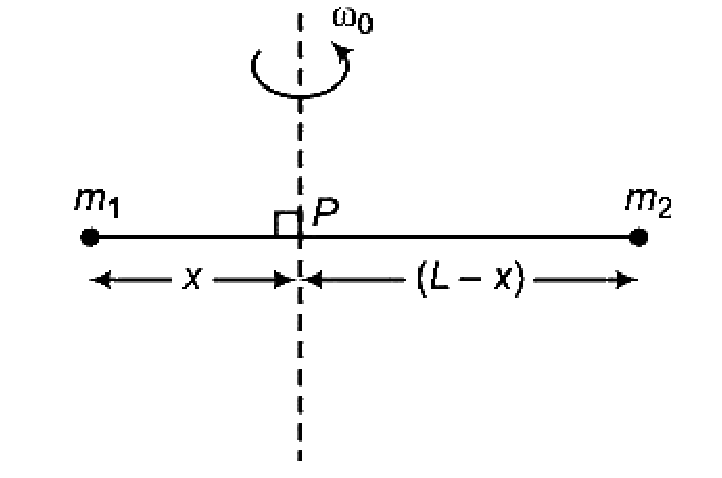
Point masses m1 and m2 are placed at the opposite ends of a rigid rod of length L, and negligible mass. The rod is to be set rotating about an axis perpendicular to it. The position of point P on this rod through which the axis should pass so that the work required to set the rod rotating with angular velocity ω\omega0 is minimum, is given by

Figure

Show answer and solution

Answer: (b)

Loading the solution…
Report a mistakeOpen question page
Q44JEE Main 2023 · 30 JAN · SHIFT 1Medium

Maxima and minima

The charge flowing in a conductor changes with time as Q(t)=αt−βt2+γt3Q(t) = \alpha t - \beta t^{2} + \gamma t^{3}. Where α,β\alpha, \beta and γ\gamma are constants. Minimum value of current is:

Show answer and solution

Answer: (c)

Loading the solution…
Report a mistakeOpen question page
Q45JEE Main 2023 · 13 APR · SHIFT 2Easy

Maxima and minima

A 10 μC10\ \mu\text{C} charge is divided into two parts and placed at 1 cm1\text{ cm} distance so that the repulsive force between them is maximum. The charges of the two parts are:

Show answer and solution

Answer: (b)

Loading the solution…
Report a mistakeOpen question page
Q46JEE Main 2023 · 8 APR · SHIFT 2Easy

Maxima and minima

The trajectory of projectile, projected from the ground is given by y=x−x220y = x - \frac{x^{2}}{20}. Where xx and yy are measured in meter. The maximum height attained by the projectile will be.

Show answer and solution

Answer: (b)

Loading the solution…
Report a mistakeOpen question page
Q47JEE Main 2022 · 27 JUN · SHIFT 2Medium

Maxima and minima

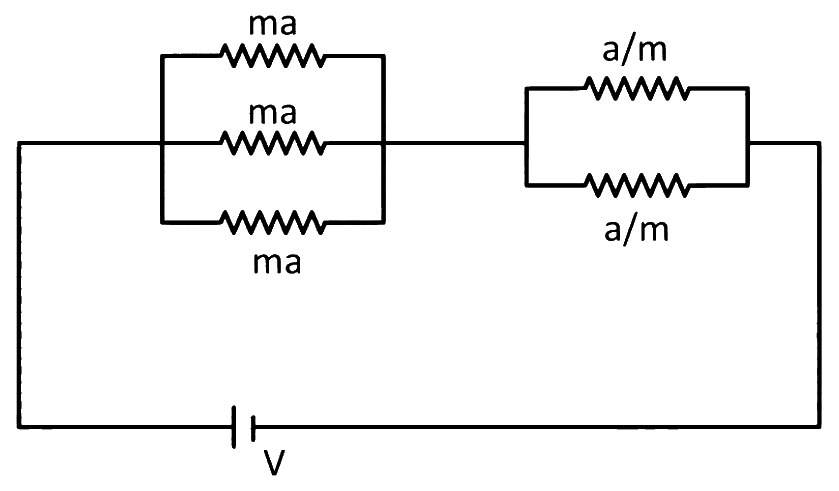
In the given circuit 'a' is an arbitrary constant. The value of m for which the equivalent circuit resistance is minimum, will be x2\sqrt{\frac{x}{2}}. The value of x is __________.

Figure

Numerical answer type. Work it out, then open the answer.

Show answer and solution

Answer: 3

Loading the solution…
Report a mistakeOpen question page
Q48JEE Main 2022 · 27 JUL · SHIFT 2Easy

Maxima and minima

A charge of 4 μC4\ \mu\text{C} is to be divided into two. The distance between the two divided charges is constant. The magnitude of the divided charges so that the force between them is maximum, will be:

Show answer and solution

Answer: (b)

Loading the solution…
Report a mistakeOpen question page
Q49JEE Main 2021 · 26 AUG · SHIFT 2DifficultOld syllabus

Maxima and minima

At time t = 0, a material is composed of two radioactive atoms A and B, where NA(0) = 2NB(0). The decay constant of both kind of radioactive atoms is λ\lambda. However, A disintegrates to B and B disintegrates to C. Which of the following figures represents the evolution of NB(t) / NB(0) with respect to time t?

[NA (0) = No. of A atoms at t = 0

NB (0) = No. of B atoms at t = 0]

Show answer and solution

Answer: (c)

Loading the solution…
Report a mistakeOpen question page
Q50JEE Main 2021 · 31 AUG · SHIFT 1Difficult

Maxima and minima

For an ideal gas the instantaneous change in pressure 'p' with volume 'v' is given by the equation dpdv=−ap\frac{dp}{dv} = -ap. If p = p0 at v =0 is the given boundary condition, then the maximum temperature one mole of gas can attain is: (Here R is the gas constant)

Show answer and solution

Answer: (a)

Loading the solution…
Report a mistakeOpen question page
Q51JEE Main 2020 · 3 SEP · SHIFT 2Difficult

Maxima and minima

The mass density of a planet of radius R varies with the distance r from its centre as ρ\rho(r) = ρ0(1\rho_0 (1 −r2R2)- \frac{r^2}{R^2}).

Then the gravitational field is maximum at:

Show answer and solution

Answer: (d)

Loading the solution…
Report a mistakeOpen question page
Q52JEE Main 2018 · 15 APR · SHIFT 2Medium

Maxima and minima

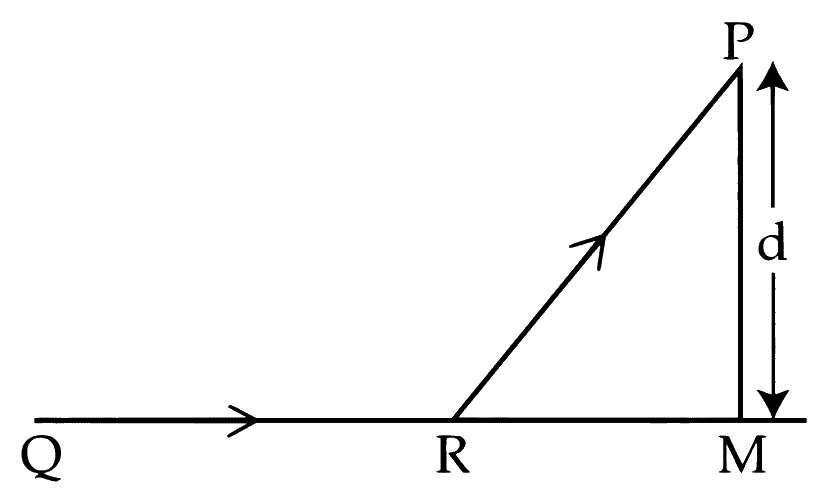
A man in a car at location Q on a straight highway is moving with speed vv. He decides to reach a point P in a field at a distance d from the highway (point M) as shown in the figure. Speed of the car in the field is half to that on the highway. What should be the distance RM, so that the time taken to reach P is minimum?

Figure

Show answer and solution

Answer: (d)

Loading the solution…
Report a mistakeOpen question page
Q53JEE Main 2017Difficult

Maxima and minima

The moment of inertia of a uniform cylinder of length ll and radius R about its perpendicular bisector is II. What is the ratio lR\frac{l}{R} such that the moment of inertia is minimum?

Show answer and solution

Answer: (b)

Loading the solution…
Report a mistakeOpen question page
Q54JEE Main 2016 · 9 APR · SHIFT 1Medium

Maxima and minima

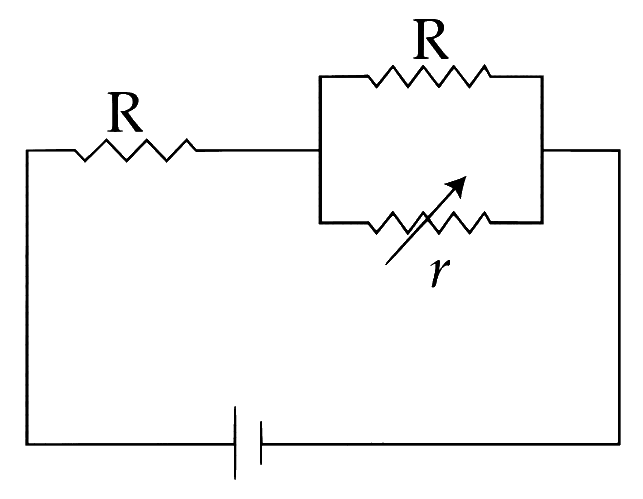
Figure

In the circuit shown, the resistance r is a variable resistance. If for r = fR, the heat generation in r is maximum then the value of f is:

Show answer and solution

Answer: (b)

Loading the solution…
Report a mistakeOpen question page
Q55JEE Main 2013 · 22 APR · SHIFT 1Medium

Maxima and minima

A body starts from rest on a long inclined plane of slope 45°. The coefficient of friction between the body and the plane varies as μ=0.3x\mu = 0.3x, where x is distance travelled down the plane. The body will have maximum speed (for g=10g = 10 m/s2{}^{2}) when xx =

Show answer and solution

Answer: (d)

Loading the solution…
Report a mistakeOpen question page
Q56JEE Main 2013 · 25 APR · SHIFT 1Difficult

Maxima and minima

The maximum range of a bullet fired from a toy pistol mounted on a car at rest is R0=40R_0 = 40 m. What will be the acute angle of inclination of the pistol for maximum range when the car is moving in the direction of firing with uniform velocity v=20v = 20 m/s on a horizontal surface? (g=10g = 10 m/s2^{2})

Show answer and solution

Answer: (b)

Loading the solution…
Report a mistakeOpen question page
Q57JEE Main 2006 · AIEEEMedium

Maxima and minima

The potential energy of a 1 kg1\text{ kg} particle free to move along the xx-axis is given by V(x)=(x44−x22) JV(x) = \left(\frac{x^4}{4} - \frac{x^2}{2}\right)\text{ J}. The total mechanical energy of the particle is 2 J.2\text{ J}. Then, the maximum speed (in m/s\text{m/s}) is

Show answer and solution

Answer: (a)

Loading the solution…
Report a mistakeOpen question page
Q58JEE Main 2004 · AIEEEMedium

Maxima and minima

The thermo emf\text{emf} of a thermocouple varies with temperature θ\theta of the hot junction as E=aθ+bθ2E = a\theta + b\theta^2 in volts where the ratio a/ba/b is 700∘C.700^\circ\text{C}. If the cold junction is kept at 0∘C,0^\circ\text{C}, then the neutral temperature is

Show answer and solution

Answer: (d)

Loading the solution…
Report a mistakeOpen question page
Q59MHT CET 2025 · 22 APR · SHIFT 2Medium

Speed in 2D and angular velocity

At any time ' tt ', the co-ordinates of moving particle are x=at2x = at^2 and y=bt2y = bt^2. The speed of the particle is

Show answer and solution

Answer: (a)

Loading the solution…
Report a mistakeOpen question page
Q60MHT CET 2024 · 16 MAY · SHIFT 1Medium

Speed in 2D and angular velocity

The co-ordinates of a moving particle at any time ' tt ' are given by x=αt3x = \alpha t^3 and y=βt3y = \beta t^3 where α\alpha and β\beta are constants. The speed of the particle at time ' tt ' is given by

Show answer and solution

Answer: (d)

Loading the solution…
Report a mistakeOpen question page
Q61MHT CET 2021 · 22 SEP · SHIFT 1Easy

Speed in 2D and angular velocity

The angular displacement of body performing circular motion is given by θ=5sin⁡πt6\theta = 5\sin\frac{\pi t}{6}. The angular velocity of the body at t=3t = 3 second will be [sin⁡π2=1,cos⁡π2=0]\left[\sin\frac{\pi}{2} = 1, \cos\frac{\pi}{2} = 0\right]

Show answer and solution

Answer: (d)

Loading the solution…
Report a mistakeOpen question page
Q62MHT CET 2026 · 11 APR · SHIFT 1Medium

Speed in 2D and angular velocity

The position vector of a particle is r⃗=acos⁡ωt i^+asin⁡ωt j^\vec{r} = a\cos\omega t\,\hat{i} + a\sin\omega t\,\hat{j}. Calculate the angle between its position vector and the velocity vector.

(cos⁡0=1,cos⁡90=0,cos⁡60=0.5,sin⁡30=0.5,sin⁡0=0\cos 0 = 1, \cos 90 = 0, \cos 60 = 0.5, \sin 30 = 0.5, \sin 0 = 0)

Show answer and solution

Answer: (c)

Loading the solution…
Report a mistakeOpen question page
Q63NEET 2023Easy

Speed in 2D and angular velocity

The position of a particle is given by

r⃗(t)=4ti^+2t2j^+5k^\vec{r}(t) = 4t\hat{i} + 2t^2\hat{j} + 5\hat{k}

where tt is in seconds and rr in metre. Find the magnitude and direction of velocity v(t)v(t), at t=1 st = 1\text{ s}, with respect to xx-axis

Show answer and solution

Answer: (a)

Loading the solution…
Report a mistakeOpen question page
Q64NEET 2017Easy

Speed in 2D and angular velocity

The x and y coordinates of the particle at any time are x = 5t −- 2t2 and y = 10t respectively, where x and y are in metres and t in seconds. The acceleration of the particle at t = 2 s is

Show answer and solution

Answer: (b)

Loading the solution…
Report a mistakeOpen question page
Q65NEET 2016 · PHASE 1Easy

Speed in 2D and angular velocity

A particle moves so that its position vector is given by r⃗=cos⁡ωt x^+sin⁡ωt y^,\vec{r} = \cos \omega t\, \hat{x} + \sin \omega t\, \hat{y}, where ω\omega is a constant. Which of the following is true?

Show answer and solution

Answer: (a)

Loading the solution…
Report a mistakeOpen question page
Q66NEET 2015 · AIPMTMedium

Speed in 2D and angular velocity

The position vector of a particle R⃗\vec{R}as a function of time is given by R⃗\vec{R} = 4sin(2πt)i^\pi t)\hat{i} + 4cos(2πt)j^\pi t)\hat{j}. Where R is in meters, t is in seconds and i^\hat{i} and j^\hat{j} denote unit vectors along x-and y-directions, respectively. Which one of the following statements is wrong for the motion of particle?

Show answer and solution

Answer: (a)

Loading the solution…
Report a mistakeOpen question page
Q67NEET 2011 · AIPMT · PRELIMSEasy

Speed in 2D and angular velocity

The instantaneous angular position of a point on a rotating wheel is given by the equation θ(t)=2t3−6t2\theta(t) = 2t^3 - 6t^2

The torque on the wheel becomes zero at

Show answer and solution

Answer: (a)

Loading the solution…
Report a mistakeOpen question page
Q68NEET 1995 · AIPMTEasy

Speed in 2D and angular velocity

The position vector of a particle is r⃗=(acos⁡ωt)i^+(asin⁡ωt)j^\vec{r} = (a \cos \omega t)\hat{i} + (a \sin \omega t)\hat{j}. The velocity of the particle is

Show answer and solution

Answer: (d)

Loading the solution…
Report a mistakeOpen question page
Q69JEE Main 2026 · 2 APR · SHIFT 1Easy

Speed in 2D and angular velocity

A particle is rotating in a circular path and at any instant its motion can be described as θ=5t440−t33\theta = \frac{5t^4}{40} - \frac{t^3}{3}.

The angular acceleration of the particle after 10 seconds is _________ rad/s2.

Show answer and solution

Answer: (c)

Loading the solution…
Report a mistakeOpen question page
Q70JEE Main 2026 · 4 APR · SHIFT 2Easy

Speed in 2D and angular velocity

If xx and yy coordinates of a projectile as a function of time (t)(t) are given as 24t24t and 43.6t−4.9t243.6t - 4.9t^{2}, respectively, then the angle (in degrees) made by the projectile with horizontal when t=2 st = 2\text{ s} is ______.

Show answer and solution

Answer: (b)

Loading the solution…
Report a mistakeOpen question page
Q71JEE Main 2025 · 24 JAN · SHIFT 2Easy

Speed in 2D and angular velocity

The position vector of a moving body at any instant of time is given asr⃗=(5t2i^−5tj^) m\vec{r} = \left(5t^{2}\hat{i} - 5t\hat{j}\right)\text{ m}. The magnitude and direction of velocity at t=2 st = 2\text{ s} is,

Show answer and solution

Answer: (a)

Loading the solution…
Report a mistakeOpen question page
Q72JEE Main 2025 · 23 JAN · SHIFT 2Medium

Speed in 2D and angular velocity

A circular disk of radius R meter and mass M kg is rotating around the axis perpendicular to the disk. An external torque is applied to the disk such that θ(t)=5t2−8t\theta(t) = 5t^2 - 8t, where θ(t)\theta(t) is the angular position of the rotating disc as a function of time tt. How much power is delivered by the applied torque, when t=2 st = 2\text{ s}?

Show answer and solution

Answer: (a)

Loading the solution…
Report a mistakeOpen question page
Q73JEE Main 2025 · 4 APR · SHIFT 1Easy

Speed in 2D and angular velocity

If L⃗\vec{L} and P⃗\vec{P} represent the angular momentum and linear momentum respectively of a particle of mass ' mm ' having position vector as r⃗=a(i^cos⁡ωt+j^sin⁡ωt)\vec{r} = a\left(\hat{i}\cos\omega t + \hat{j}\sin\omega t\right). The direction of force is

Show answer and solution

Answer: (c)

Loading the solution…
Report a mistakeOpen question page
Q74JEE Main 2025 · 22 JAN · SHIFT 1Difficult

Speed in 2D and angular velocity

The position vectors of two 1 kg particles, (A) and (B), are given by

r⃗A=(α1t2i^+α2tj^+α3tk^) m\vec{r}_A = \left(\alpha_1 t^2\hat{i} + \alpha_2 t\hat{j} + \alpha_3 t\hat{k}\right)\text{ m} andr⃗B=(β1ti^+β2t2j^+β3tk^) m\vec{r}_B = \left(\beta_1 t\hat{i} + \beta_2 t^2\hat{j} + \beta_3 t\hat{k}\right)\text{ m}, respectively;

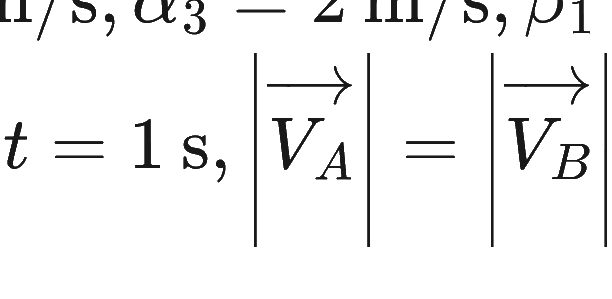
(α1=1 m/s2,α2=3n m/s,α3=2 m/s,β1=2 m/s,β2=−1 m/s2,β3=4p m/s)\left(\alpha_1 = 1\text{ m/s}^2, \alpha_2 = 3n\text{ m/s}, \alpha_3 = 2\text{ m/s}, \beta_1 = 2\text{ m/s}, \beta_2 = -1\text{ m/s}^2, \beta_3 = 4p\text{ m/s}\right), where t is time, n and pp are constants. At Figure and velocities V⃗A\vec{V}_A and V⃗B\vec{V}_B of the particles are orthogonal to each other. At t=1 st = 1\text{ s}, the magnitude of angular momentum of particle (A) with respect to the position of particle (B) is L kg m2 s−1\sqrt{L}\text{ kg m}^{2}\text{ s}^{-1}. The value of L is _________.

Numerical answer type. Work it out, then open the answer.

Show answer and solution

Answer: 90

Loading the solution…
Report a mistakeOpen question page
Q75JEE Main 2024 · 27 JAN · SHIFT 1Easy

Speed in 2D and angular velocity

Position of an ant (S\text{S} in metres) moving in Y-Z\text{Y-Z} plane is given by S=2t2j^+5k^S = 2t^{2}\hat{j} + 5\hat{k} (where tt is in second). The magnitude and direction of velocity of the ant at t=1 st = 1\text{ s} will be:

Show answer and solution

Answer: (d)

Loading the solution…
Report a mistakeOpen question page
Q76JEE Main 2024 · 4 APR · SHIFT 1Medium

Speed in 2D and angular velocity

The co-ordinates of a particle moving in x-yx\text{-}y plane are given by: x=2+4t, y=3t+8t2x = 2 + 4t,\ y = 3t + 8t^{2}. The motion of the particle is:

Show answer and solution

Answer: (d)

Loading the solution…
Report a mistakeOpen question page
Q77JEE Main 2020 · 8 JAN · SHIFT 2Easy

Speed in 2D and angular velocity

A particle moves such that its position vectorr⃗(t)=cos⁡ωt i^+sin⁡ωt j^\vec{r}(t) = \cos \omega t\, \hat{i} + \sin \omega t\, \hat{j} where ω\omega is a constant and t is time. Then which of the following statements is true for the velocityv⃗(t)\vec{v}(t) and accelerationa⃗(t)\vec{a}(t) of the particle:

Show answer and solution

Answer: (c)

Loading the solution…
Report a mistakeOpen question page
Q78JEE Main 2020 · 8 JAN · SHIFT 1Medium

Speed in 2D and angular velocity

A particle is moving along the x-axis with its coordinate with the time 't' given be x(t) = 10 + 8t – 3t2. Another particle is moving the y-axis with its coordinate as a function of time given by y(t) = 5 – 8t3.

At t = 1s, the speed of the second particle as measured in the frame of the first particle is given as v\sqrt{v}. Then v (in m/s) is ______.

Numerical answer type. Work it out, then open the answer.

Show answer and solution

Answer: 580

Loading the solution…
Report a mistakeOpen question page
Q79JEE Main 2019 · 9 APR · SHIFT 2Easy

Speed in 2D and angular velocity

The position vector of a particle changes with time according to the relation

r⃗(t)=15t2i^+(4−20t2)j^\vec{r}(t) = 15t^2\hat{i} + (4 - 20t^2)\hat{j}

What is the magnitude of the acceleration at t = 1?

Show answer and solution

Answer: (a)

Loading the solution…
Report a mistakeOpen question page
Q80JEE Main 2003 · AIEEEEasy

Speed in 2D and angular velocity

The co-ordinates of a moving particle at any time 't' are given by x = α\alphat3 and y = βt3. The speed of the particle at time 't' is given by

Show answer and solution

Answer: (b)

Loading the solution…
Report a mistakeOpen question page
Q81MHT CET 2026 · 15 MAY · SHIFT 1Medium

Other rates of change

An electron of mass mm and charge ee initially at rest gets accelerated by a constant electric field EE. The rate of change of de-Broglie wavelength of the electron at time tt is

(hh = Planck's constant)

Show answer and solution

Answer: (a)

Loading the solution…
Report a mistakeOpen question page
Q82MHT CET 2025 · 25 APR · SHIFT 2Medium

Other rates of change

An electron of mass ' mm ' and charge ' ee ' initially at rest gets accelerated by a constant electric field ' E '. The rate of change of de-Broglie wavelength of the electron at time ' tt ' is

(Ignore relativistic effect)( h=h = Planck's constant)

Show answer and solution

Answer: (a)

Loading the solution…
Report a mistakeOpen question page
Q83MHT CET 2024 · 11 MAY · SHIFT 1Medium

Other rates of change

If 'T' is the half life of a radioactive substance then its instantaneous rate of change of activity is proportional to

Show answer and solution

Answer: (b)

Loading the solution…
Report a mistakeOpen question page
Q84MHT CET 2024 · 4 MAY · SHIFT 1Medium

Other rates of change

The surface of water in a water tank of cross section area 750 cm2750\text{ cm}^2 on the top of a house is ' hh ' m\text{m} above the tap level. The speed of water coming out through the tap of cross section area 500 mm2500\text{ mm}^2 is 30 cm/s30\text{ cm/s}. At that instant dhdt\frac{dh}{dt} is x×10−3 m/sx \times 10^{-3}\text{ m/s}. The value of ' xx ' will be

Show answer and solution

Answer: (a)

Loading the solution…
Report a mistakeOpen question page
Q85NEET 2025Difficult

Other rates of change

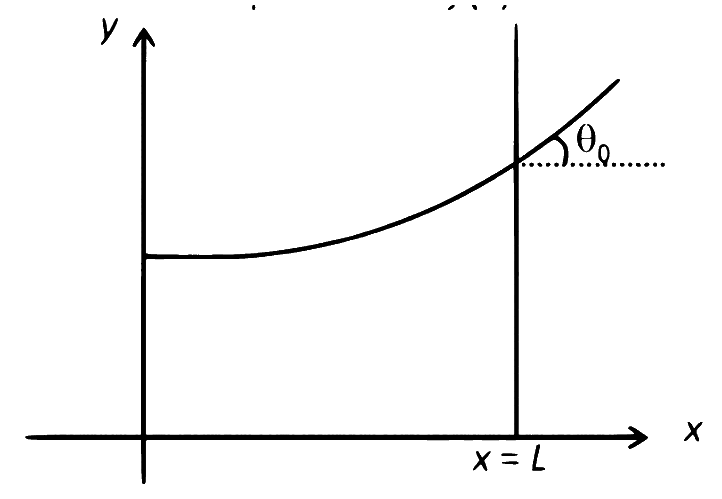
Consider a water tank shown in the figure. It has one wall at x=Lx = L and can be taken to be very wide in the zz direction. When filled with a liquid of surface tension SS and density ρ\rho, the liquid surface makes angle θ0 (θ0≪1)\theta_0\ (\theta_0 \ll 1) with the xx-axis at x=Lx = L. If y(x)y(x) is the height of the surface then the equation for y(x)y(x) is:

Figure

(take θ(x)=sin⁡θ(x)=tan⁡θ(x)=dydx,g\theta(x) = \sin\theta(x) = \tan\theta(x) = \frac{dy}{dx}, g is the acceleration due to gravity)

Show answer and solution

Answer: (d)

Loading the solution…
Report a mistakeOpen question page
Q86NEET 2019Medium

Other rates of change

A deep rectangular pond of surface area AA, containing water (density = ρ\rho), specific heat capacity = ss), is located in a region where the outside air temperature is at a steady value of −26∘C-26^\circ\text{C}. The thickness of the frozen ice layer in this pond, at a certain instant is xx.

Taking the thermal conductivity of ice as KK, and its specific latent heat of fusion as LL, the rate of increase of the thickness of ice layer, at this instant, would be given by

Show answer and solution

Answer: (d)

Loading the solution…
Report a mistakeOpen question page
Q87NEET 2016 · PHASE 1Difficult

Other rates of change

Two identical charged spheres suspended from a common point by two massless strings of lengths ll, are initially at a distance d(d < < ll) apart because of their mutual repulsion. The charges begin to leak from both the spheres at a constant rate. As a result, the spheres approach each other with a velocity v. Then v varies as a function of the distance x between the spheres, as

Show answer and solution

Answer: (a)

Loading the solution…
Report a mistakeOpen question page
Q88JEE Main 2026 · 4 APR · SHIFT 1Medium

Other rates of change

A parallel plate air capacitor is connected to a battery. The plates are pulled apart at uniform speed vv. If xx is the separation between the plates at any instant, then the time rate of change of electrostatic energy of the capacitor is proportional to xαx^{\alpha}, where α\alpha is ______.

Show answer and solution

Answer: (a)

Loading the solution…
Report a mistakeOpen question page
Q89JEE Main 2026 · 5 APR · SHIFT 2Medium

Other rates of change

An ideal gas at pressure PP and temperature TT is expanding such that PT3=PT^3 = constant. The coefficient of volume expansion of the gas is ______.

Show answer and solution

Answer: (c)

Loading the solution…
Report a mistakeOpen question page
Q90JEE Main 2025 · 8 APR · SHIFT 2Medium

Other rates of change

An electron is released from rest near an infinite non-conducting sheet of uniform charge density '−σ-\sigma'. The rate of change of de-Broglie wave length associated with the electron varies inversely as nth power of time. The numerical value of n is _____.

Numerical answer type. Work it out, then open the answer.

Show answer and solution

Answer: 2

Loading the solution…
Report a mistakeOpen question page
Q91JEE Main 2025 · 4 APR · SHIFT 1Medium

Other rates of change

Which of the following are correct expression for torque acting on a body?

A. τ⃗=r⃗×L⃗\vec{\tau} = \vec{r} \times \vec{L}

B. τ⃗=ddt(r⃗×p⃗)\vec{\tau} = \frac{d}{dt}(\vec{r} \times \vec{p})

C. τ⃗=r⃗×dp⃗dt\vec{\tau} = \vec{r} \times \frac{d\vec{p}}{dt}

D. τ⃗=Iα⃗\vec{\tau} = I\vec{\alpha}

E. τ⃗=r⃗×F⃗\vec{\tau} = \vec{r} \times \vec{F}

( r⃗=\vec{r} = position vector; p⃗=\vec{p} = linear momentum; L⃗=\vec{L} = angular momentum; α⃗=\vec{\alpha} = angular acceleration; I=I = moment of inertia; F⃗=\vec{F} = force; t=t = time)

Choose the correct answer from the options given below:

Show answer and solution

Answer: (c)

Loading the solution…
Report a mistakeOpen question page
Q92JEE Main 2025 · 29 JAN · SHIFT 2Medium

Other rates of change

A sand dropper drops sand of mass m(t) on a conveyer belt at a rate proportional to the square root of speed (v) of the belt, i.e., dmdt∝v\frac{dm}{dt} \propto \sqrt{v}. If P is the power delivered to run the belt at constant speed then which of the following relationship is true?

Show answer and solution

Answer: (d)

Loading the solution…
Report a mistakeOpen question page
Q93JEE Main 2024 · 30 JAN · SHIFT 2Medium

Other rates of change

A block of mass mm is placed on a surface having vertical cross-section given by y=x2/4y = x^2/4. If coefficient of friction is 0.5, the maximum height above the ground at which block can be placed without slipping is:

Show answer and solution

Answer: (d)

Loading the solution…
Report a mistakeOpen question page
Q94JEE Main 2023 · 1 FEB · SHIFT 2Easy

Other rates of change

The surface of water in a water tank of cross section area 750 cm2750\text{ cm}^2 on the top of a house is h mh\text{ m} above the tap level. The speed of water coming out through the tap of cross section area 500 mm2500\text{ mm}^2 is 30 cm/s30\text{ cm/s}. At that instant, dhdt\frac{dh}{dt} is x×10−3 m/sx \times 10^{-3}\text{ m/s}. The value of xx will be ____________.

Numerical answer type. Work it out, then open the answer.

Show answer and solution

Answer: 2

Loading the solution…
Report a mistakeOpen question page
Q95JEE Main 2023 · 30 JAN · SHIFT 1Medium

Other rates of change

The pressure (P)(P) and temperature (T)T) relationship of an ideal gas obeys the equation PT2=PT^{2} = constant. The volume expansion coefficient of the gas will be:

Show answer and solution

Answer: (d)

Loading the solution…
Report a mistakeOpen question page
Q96JEE Main 2021 · 24 FEB · SHIFT 1Medium

Other rates of change

An inclined plane is bent in such a way that the vertical cross-section is given by y=x24y = \frac{x^2}{4} where y is in vertical and x in horizontal direction. If the upper surface of this curved plane is rough with coefficient of friction μ\mu = 0.5, the maximum height in cm at which a stationary block will not slip downward is _________ cm.

Numerical answer type. Work it out, then open the answer.

Show answer and solution

Answer: 25

Loading the solution…
Report a mistakeOpen question page
Q97JEE Main 2021 · 27 JUL · SHIFT 1EasyOld syllabus

Other rates of change

If 'f' denotes the ratio of the number of nuclei decayed (Nd) to the number of nuclei at t = 0 (N0) then for a collection of radioactive nuclei, the rate of change of 'f' with respect to time is given as: [λ\lambda is the radioactive decay constant]

Show answer and solution

Answer: (c)

Loading the solution…
Report a mistakeOpen question page
Q98JEE Main 2020 · 9 JAN · SHIFT 2Medium

Other rates of change

An electron of mass m and magnitude of charge |e| initially at rest gets accelerated by a constant electric field E. The rate of change of de-Broglie wavelength of this electron at time t ignoring relativistic effects is:

Show answer and solution

Answer: (c)

Loading the solution…
Report a mistakeOpen question page
Q99JEE Main 2019 · 9 APR · SHIFT 1Medium

Other rates of change

A stationary horizontal disc is free to rotate about its axis. When a torque is applied on it, its kinetic energy as a function of θ\theta, where θ\theta is the angle by which it has rotated, is given as kθ\theta2. If its moment of inertia is I then the angular acceleration of the disc is:

Show answer and solution

Answer: (d)

Loading the solution…
Report a mistakeOpen question page
Q100JEE Main 2014Medium

Other rates of change

A block of mass mm is placed on a surface with a vertical cross section given by y=x36.y = \frac{x^3}{6}. If the coefficient of friction is 0.5,0.5, the maximum height above the ground at which the block can be placed without slipping is:

Show answer and solution

Answer: (a)

Loading the solution…
Report a mistakeOpen question page
Q101JEE Main 2011 · AIEEEDifficult

Other rates of change

Two identical charged spheres suspended from a common point by two massless strings of length ll are initially a distance d (d<<l)d\,(d << l) apart because of their mutual repulsion. The charge begins to leak from both the spheres at a constant rate. As a result charges approach each other with a velocity vv. Then as a function of distance xx between them,

Show answer and solution

Answer: (d)

Loading the solution…
Report a mistakeOpen question page