
One quantity raised to a power
Error in the measurement of radius of the sphere is . The error in the calculated value of its volume is
Show answer and solution
Answer: (c)
Loading the solution…
Home›PYQ Workbook›Basic Maths 2: Differentiation & Integration›Small Changes and Errors
Basic Maths 2: Differentiation & Integration PYQs · MHT CET · JEE Main · NEET
One quantity raised to a power
Error in the measurement of radius of the sphere is . The error in the calculated value of its volume is
Answer: (c)
One quantity raised to a power
If the error in the measurement of volume of the sphere is then the error in the measurement of its surface area will be
Answer: (c)
One quantity raised to a power
A cuboid has volume , where is the length of one side. When the length is measured by a meter scale of least count mm, the relative percentage error in the measurement of its volume is . Then the relative percentage error in measurement of its length and the value of the length is
Answer: (b)
One quantity raised to a power
If the error in the measurement of radius of a sphere is 2%, then the error in the determination of volume of the sphere will be
Answer: (d)
One quantity raised to a power
The percentage error in the calculated volume of a sphere, if there is error in its diameter measurement, is ______.
Answer: (c)
One quantity raised to a power
Given below are two statements: one is labelled as Assertion and the other is labelled as Reason
Assertion A: A spherical body of radius having a particular density is falling through a liquid of constant density. The percentage error in the calculation of its terminal velocity is . Reason R: The terminal velocity of the spherical body falling through the liquid is inversely proportional to its radius.
In the light of the above statements, choose the correct answer from the options given below
Answer: (b)
One quantity raised to a power
For an adiabatic expansion of an ideal gas, the fractional change in its pressure is equal to (where is the ratio of specific heats):
Answer: (c)
One quantity raised to a power
If the length of the pendulum in pendulum clock increases by 0.1%, then the error in time per day is:
Answer: (c)
One quantity raised to a power
The radius of a sphere is measured to be (7.50 0.85) cm. Suppose the percentage error in its volume is x.
The value of x, to the nearest integer, is __________.
Numerical answer type. Work it out, then open the answer.
Answer: 34
One quantity raised to a power
A solid sphere of radius r made of a soft material of bulk modulus K is surrounded by a liquid in a cylindrical container. A massless piston of area a floats on the surface of the liquid, covering entire cross section of cylindrical container. When a mass m is placed on the surface of the piston to compress the liquid, the fractional decrement in the radius of the sphere, is:
Answer: (d)
One quantity raised to a power
The relative error in the determination of the surface area of sphere is . Then the relative error in the determination of its volume is:
Answer: (a)
One quantity raised to a power
A simple pendulum made of a bob of mass m and a metallic wire of negligible mass has time period 2 s at T=0oC. If the temperature of the wire is increased and the corresponding change in its time period is plotted against its temperature, the resulting graph is a line of slope S. If the coefficient of linear expansion of metal is then the value of S is:
Answer: (a)
Products, quotients and powers
A physical quantity A can be determined by measuring parameters and E using the relation . If the maximum errors in the measurement are and then maximum error in the value of A is
Answer: (c)
Products, quotients and powers
The percentage error in the measurement of mass and speed are and respectively. The maximum error in the estimation of kinetic energy is
Answer: (b)
Products, quotients and powers
The percentage error in the measurement of mass and speed of a particular body is and respectively. The percentage error in the measurement of kinetic energy is
Answer: (c)
Products, quotients and powers
The percentage error in the measurement of mass of a body and its speed are and respectively. The percentage error in the measurement of its momentum and kinetic energy are respectively
Answer: (b)
Products, quotients and powers
The resistance of a conductor is where voltage V and current A. The error in the calculation of is
Answer: (b)
Products, quotients and powers
The voltage across a lamp is volt and the current passing through it is ampere. The power consumed in watt will be (using percentage error)
Answer: (a)
Products, quotients and powers
A force 'F' is applied on a square plate of side 'L'. If the percentage error in determining 'L' is 3% and that in 'F' is 2% then the percentage error in determining the pressure is
Answer: (d)
Products, quotients and powers
A force F is applied on a square plate of side L. If the percentage error in determining F is and that in L is , then the percentage error in determining the pressure is
Answer: (a)
Products, quotients and powers
The pressure on a square plate is measured by measuring the force acting on the plate and length of the sides of the plate. The maximum error in the measurement of force and length are respectively and , the percentage error in the measurement of pressure is
Answer: (d)
Products, quotients and powers
The error in the measurement of length and mass of a cube is 3% and 4% respectively. The error in the measurement of its density will be
Answer: (a)
Products, quotients and powers
The error in the measurement of length and mass of a cube is and respectively. The error in the measurement of density will be
Answer: (b)
Products, quotients and powers
The density of a cube is measured by measuring its mass and length of its sides. The \% error in the measurement of mass and length are and respectively. The percentage error in the measurement of density is
Answer: (b)
Products, quotients and powers
The maximum error in the measurement of the density and mass of the uniform cube are 8% and 2% respectively. Hence, the maximum error in the measurement of length will be
Answer: (b)
Products, quotients and powers
The formula for the physical quantity is and the percentage error in the determination of physical quantities are and respectively. The percentage error in the measurement of P is
Answer: (d)
Products, quotients and powers
In an experiment four quantities and s are measured with percentage and respectively. Quantity ' ' is calculated as follows
, the percentage error in ' A ' is
Answer: (a)
Products, quotients and powers
A physical quantity is related to four other quantities and as . The percentage error in the measurement of and are and respectively. The percentage error in the measurement of will be
Answer: (d)
Products, quotients and powers
A physical quantity ' X ' is related to four measurable quantities ' ', ' ', ' ' and ' ' as . The percentage error in the measurement of 'a', 'b', 'c' and 'd' are and respectively. The percentage error in measurement of quantity ' X ' is
Answer: (c)
Products, quotients and powers
A physical quantity is related as . Relative errors in the quantities and are 2%, 1%, 3% and 4% respectively. Relative error in will be
Answer: (b)
Products, quotients and powers
A quantity is formulated and are independent parameters which have fractional errors of and respectively in measurement. The maximum fractional error of is
Answer: (b)
Products, quotients and powers
A quantity P is related as where X,Y,Z are independent parameters which have fractional errors of and respectively in measurement. The maximum fractional error in P is
Answer: (a)
Products, quotients and powers
In a certain system, the quantities A and B are measured as and respectively. Let and . The correct order of % error in and is
Answer: (c)
Products, quotients and powers
A physical quantity is related to four observations and as follows:
The percentage errors of measurement in and are , and respectively. The percentage error in the quantity is
Answer: (a)
Products, quotients and powers
A metal wire has mass , radius and length . The maximum possible percentage error in the measurement of density will nearly be:
Answer: (b)
Products, quotients and powers
The percentage error in the measurement of g is: (Given that cm, s)
Answer: (d)
Products, quotients and powers
In an experiment, the percentage of error occurred in the measurement of physical quantities A, B, C and D are 1%, 2 %, 3 % and 4 % respectively. Then the maximum percentage of error in the measurement X, where
X = , will be:
Answer: (a)
Products, quotients and powers
If an experiment four quantities a, b, c and d are measured with percentage error 1%, 2%, 3% and 4% respectively.
Quantity P is calculated as follows P % error in P is
Answer: (c)
Products, quotients and powers
A student measures the distance traversed in free fall of a body, initially at rest, in a given time. He uses this data to estimate g, the acceleration due to gravity. If the maximum percentage errors in measurement of the distance and the time are e1 and e2 respectively, the percentage error in the estimation of g is
Answer: (b)
Products, quotients and powers
The density of a cube is measured by measuring its mass and length of its sides. If the maximum error in the measurement of mass and lengths are 3% and 2% respectively, the maximum error in the measurement of density would be
Answer: (d)
Products, quotients and powers
Percentage errors in the measurement of mass and speed are 2% and 3% respectively. The error in the estimate of kinetic energy obtained by measuring mass and speed will be
Answer: (a)
Products, quotients and powers
A certain body weighs 22.42 g and has a measured volume of 4.7 cc. The possible error in the measurement of mass and volume are 0.01 g and 0.1 cc. Then maximum error in the density will be
Answer: (b)
Products, quotients and powers
The density of a uniform cylinder is determined by measuring its mass , length and diameter . The measured values of and are and , respectively. Calculated percentage fractional error in is ______.
Answer: (b)
Products, quotients and powers
A spherical body of radius and density falls freely through a viscous liquid having density and viscosity and attains a terminal velocity . Estimated maximum error in the quantity is: (Ignore errors associated with and , gravitational acceleration)
Answer: (c)
Products, quotients and powers
The maximum percentage error in the measurement of density of a wire is
[Given, mass of wire
radius of wire
length of wire
Answer: (c)
Products, quotients and powers
A quantity Q is formulated as . X, Y, and Z are independent parameters which have fractional errors of 0.1, 0.2, and 0.5, respectively in measurement. The maximum fractional error of Q is
Answer: (c)
Products, quotients and powers
The energy of a system is given as , where t is the time and . The errors in the measurement of and are and , respectively. At , maximum percentage error in the energy is:
Answer: (a)
Products, quotients and powers
A physical quantity C is related to four other quantities and s as follows
The percentage errors in the measurement of and s are and , respectively. The percentage error in the measurement of will be__________%
Numerical answer type. Work it out, then open the answer.
Answer: 15
Products, quotients and powers
A physical quantity is related to four observables as follows:
where, and , then the percentage error in Q is , where _________.
Numerical answer type. Work it out, then open the answer.
Answer: 7700
Products, quotients and powers
The radius , length and resistance of a metal wire was measured in the laboratory as
The percentage error in resistivity of the material of the wire is:
Answer: (d)
Products, quotients and powers
If the percentage errors in measuring the length and the diameter of a wire are each. The percentage error in measuring its resistance will be:
Answer: (d)
Products, quotients and powers
A physical quantity is found to depend on quantities by the relation . The percentage error in and are and respectively. Then, the percentage error in is:
Answer: (b)
Products, quotients and powers
The resistance where and , the percentage error in the measurement of is:
Answer: (d)
Products, quotients and powers
To find the spring constant of a spring experimentally, a student commits positive error in the measurement of time and negative error in measurement of mass. The percentage error in determining value of is:
Answer: (a)
Products, quotients and powers
In an experiment to measure focal length () of convex lens, the least counts of the measuring scales for the position of object (u) and for the position of image (v) are and , respectively. The error in the measurement of the focal length of the convex lens will be:
Answer: (c)
Products, quotients and powers
Two resistances are given as and . The percentage error in the measurement of equivalent resistance when they are connected in parallel is -
Answer: (c)
Products, quotients and powers
A cylindrical wire of mass has length and radius . The maximum error in its density will be:
Answer: (c)
Products, quotients and powers
A physical quantity P is given as
The percentage error in the measurement of a, b, c and d are 1%, 2%, 3% and 4% respectively. The percentage error in the measurement of quantity P will be
Answer: (b)
Products, quotients and powers
In an experiment to determine the Young's modulus of wire of a length exactly , the extension in the length of the wire is measured as with an uncertainty of when a load of is applied. The diameter of the wire is measured as with an uncertainty of . The error in the measurement of Young's modulus is found to be . The value of is _________________. take )
Numerical answer type. Work it out, then open the answer.
Answer: 2
Products, quotients and powers
A silver wire has a mass (0.6 0.006) g, radius (0.5 0.005) mm and length (4 0.04) cm. The maximum percentage error in the measurement of its density will be:
Answer: (a)
Products, quotients and powers
If , then the relative error in Z will be:
Answer: (c)
Products, quotients and powers
A torque meter is calibrated to reference standards of mass, length and time each with accuracy. After calibration, the measured torque with this torque meter will have net accuracy of:
Answer: (b)
Products, quotients and powers
The maximum error in the measurement of resistance, current and time for which current flows in an electrical circuit are and respectively. The maximum percentage error in the detection of the dissipated heat will be:
Answer: (d)
Products, quotients and powers
For , where 'a' is a constant. If percentage error in measurement of 'x' and 'y' are 4% and 12% respectively, then the percentage error for 'z' will be _______________%.
Numerical answer type. Work it out, then open the answer.
Answer: 18
Products, quotients and powers
A physical quantity 'y' is represented by the formula
If the percentage errors found in y, m, r, l and g are 18, 1, 0.5, 4 and p respectively, then find the value of x and p.
Answer: (c)
Products, quotients and powers
The resistance R = , where V = (50 2)V and I = (20 0.2)A. The percentage error in R is 'x'%. The value of 'x' to the nearest integer is _________.
Numerical answer type. Work it out, then open the answer.
Answer: 5
Products, quotients and powers
The acceleration due to gravity is found upto an accuracy of 4% on a planet. The energy supplied to a simple pendulum of known mass 'm' to undertake oscillations of time period T is being estimated. If time period is measured to an accuracy of 3%, the accuracy to which E is known is ..............%
Numerical answer type. Work it out, then open the answer.
Answer: 14
Products, quotients and powers
A physical quantity z depends on four observables
a, b, c and d, as z = . The percentages of error in the measurement of a, b, c and d are 2%, 1.5%, 4% and 2.5% respectively. The percentage of error in z is:
Answer: (b)
Products, quotients and powers
The density of a solid metal sphere is determined by measuring its mass and its diameter. The maximum error in the density of the sphere is %. If the relative errors in measuring the mass and the diameter are 6.0% and 1.5% respectively, the value of x is_______.
Numerical answer type. Work it out, then open the answer.
Answer: 1050
Products, quotients and powers
The relative uncertainty in the period of a satellite orbiting around the earth is 10-2. If the relative uncertainty in the radius of the orbit is negligible, the relative uncertainty in the mass of the earth is:
Answer: (b)
Products, quotients and powers
The density of a material in the shape of a cube is determined by measuring three sides of the cube and its mass. If the relative errors in measuring the mass and length are respectively 1.5% and 1%, the maximum error in determining the density is:
Answer: (d)
Products, quotients and powers
A physical quantity P is described by the relation
P = a b2 c3 d
If the relative errors in the measurement of a, b, c and d respectively, are 2%, 1%, 3% and 5%, then the relative error in P will be:
Answer: (c)
Products, quotients and powers
Resistance of a given wire is obtained by measuring the current flowing in it and the voltage difference applied across it. If the percentage errors in the measurement of the current and the voltage difference are 3% each, then error in the value of resistance of the wire is
Answer: (a)
Errors from readings
A wire has mass g, radius mm and length cm. The percentage error in the measurement of its density is
Answer: (c)
Errors from readings
A wire has mass gram, radius cm and length cm. The maximum percentage error in the measurement of density is
Answer: (c)
Errors from readings
A wire has mass gram, radius mm and length cm. The maximum error in the measurement of density is
Answer: (a)
Errors from readings
A wire has a mass gram, radius and length . The maximum percentage error in the measurement of its density is
Answer: (c)
Errors from readings
The length of rod is measured by meter scale having least count cm and diameter is measured by vernier callipers having least count cm. Length of rod is cm and radius cm. The percentage error in the calculated value of the volume is
Answer: (b)
Errors from readings
The length of a cylinder is measured with a meter rod having least count cm. Its diameter is measured with vernier calipers having least count cm. Length of cylinder is cm and radius is cm. Find the percentage error in the calculated value of the volume.
Answer: (c)
Errors from readings
A particular physical quantity is given by and the measured value of 'a' is unit with unit accuracy. The value of 'b' is unit with unit accuracy. The % error in is nearly
Answer: (b)
Errors from readings
The period of oscillation of a simple pendulum is where is about cm and has mm accuracy. The period is about s. The time of oscillations is measured by a stopwatch of least count s. The percentage error in '' is (gravitation acceleration)
Answer: (c)
Errors from readings
The period of oscillating simple pendulum is where length ' ' is 100 cm with error 1 mm. Period is 2 second. The time of 100 oscillations is measured by a stopwatch of least count 0.1s. The percentage error in gravitational acceleration ' g ' is
Answer: (a)
Errors from readings
The period of oscillation of a simple pendulum is given by where is about cm and is known to have cm accuracy. The period is about s. The time of oscillations is measured by a stop watch of least count s. The percentage error in is nearly
Answer: (b)
Errors from readings
The period of oscillation of a simple pendulum is . Measured value of 'L' is 10 cm known to 1 mm accuracy and time for 100 oscillations is 50 second, using a watch of 1 second resolution. The percentage error in the measurement of 'g' is
Answer: (c)
Errors from readings
Time intervals measured by a clock give the following readings:
1.25 s, 1.24 s, 1.27 s, 1.21 s and 1.28 s
What is the percentage relative error of the observations?
Answer: (a)
Errors from readings
To compare EMF of two cells using potentiometer the balancing lengths obtained are 200 cm and 150 cm. The least count of scale is 1 cm. The percentage error in the ratio of EMFs is ______
Answer: (c)
Errors from readings
Four persons measure the length of a rod as and 18.25 cm. The relative error in the measurement of average length of the rod is:
Answer: (c)
Errors from readings
In an experiment the values of two spring constants were measured as and . If these springs are connected in parallel, then the percentage error in equivalent spring constant is:
Answer: (c)
Errors from readings
In an experiment to determine the resistance of a given wire using Ohm's law, the voltmeter and ammeter readings are noted as 10 V and 5 A, respectively. The least counts of voltmeter and ammeter are 500 mV and 200 mA, respectively. The estimated error in the resistance measurement is
Answer: (d)
Errors from readings
The diameter of a wire measured by a screw gauge of least count 0.001 cm is 0.08 cm. The length measured by a scale of least count 0.1 cm is 150 cm. When a weight of 100 N is applied to the wire, the extension in length is 0.5 cm, measured by a micrometer of least count 0.001 cm. The error in the measured Young’s modulus is . The value of is ________.
(Ignore the contribution of the load to Young’s modulus error calculation)
Answer: (b)
Errors from readings
The time period of a simple harmonic oscillator is . Measured value of mass of the object is 10 g with an accuracy of 10 mg and time for 50 oscillations of the spring is found to be 60 s using a watch of 2 s resolution. Percentage error in determination of spring constant is ________%.
Answer: (d)
Errors from readings
A tiny metallic rectangular sheet has length and breadth of 5 mm and 2.5 mm, respectively. Using a specially designed screw gauge which has pitch of 0.75 mm and 15 divisions in the circular scale, you are asked to find the area of the sheet. In this measurement, the maximum fractional error will be where is _______.
Numerical answer type. Work it out, then open the answer.
Answer: 3
Errors from readings
Young's modulus is determined by the equation given by where is the mass and is the extension of wire used in the experiment. Now error in Young modules is estimated by taking data from plot in graph paper. The smallest scale divisions are and along load axis and extension axis respectively. If the value of and are and respectively then percentage error of is:
Answer: (a)
Errors from readings
The measured value of the length of a simple pendulum is with accuracy. The time for 50 oscillations was measured to be 40 seconds with 1 second resolution. From these measurements, the accuracy in the measurement of acceleration due to gravity is . The value of is:
Answer: (a)
Errors from readings
In an experiment for estimating the value of focal length of converging mirror, image of an object placed at from the pole of the mirror is formed at distance from the pole of the mirror. These distances are measured with a modified scale in which there are 20 small divisions in . The value of error in measurement of focal length of the mirror is . The value of is __________.
Numerical answer type. Work it out, then open the answer.
Answer: 32
Errors from readings
In an experiment of measuring the refractive index of a glass slab using travelling microscope in physics lab, a student measures real thickness of the glass slab as 5.25 mm and apparent thickness of the glass slab as 5.00 mm. Travelling microscope has 20 divisions in one cm on main scale and 50 divisions on vernier scale is equal to 49 divisions on main scale. The estimated uncertainty in the measurement of refractive index of the slab is , where is ___________
Numerical answer type. Work it out, then open the answer.
Answer: 41
Errors from readings
In an experiment to find acceleration due to gravity (g) using simple pendulum, time period of is measured from time of 100 oscillation with a watch of resolution. If measured value of length is known to accuracy, The accuracy in the determination of is found to be . The value of is ___________.
Numerical answer type. Work it out, then open the answer.
Answer: 5
Errors from readings
A student in the laboratory measures thickness of a wire using screw gauge. The readings are 1.22 mm, 1.23 mm, 1.19 mm and 1.20 mm. The percentage error is . The value of x is ____________.
Numerical answer type. Work it out, then open the answer.
Answer: 150
Errors from readings
A student determined Young's Modulus of elasticity using the formula . The value of g is taken to be 9.8 m/s2, without any significant error, his observations are as follows.
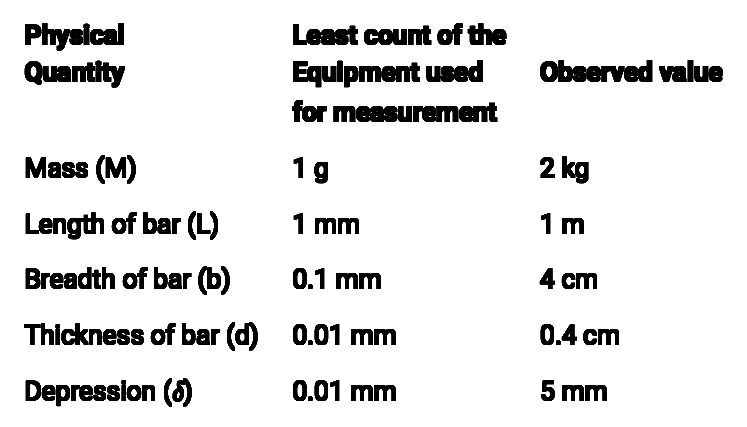
Then the fractional error in the measurement of Y is:
Answer: (b)
Errors from readings
Three students S1, S2 and S3 perform an experiment for determining the acceleration due to gravity (g) using a simple pendulum. They use different lengths of pendulum and record time for different number of oscillations. The observations are as shown in the table.
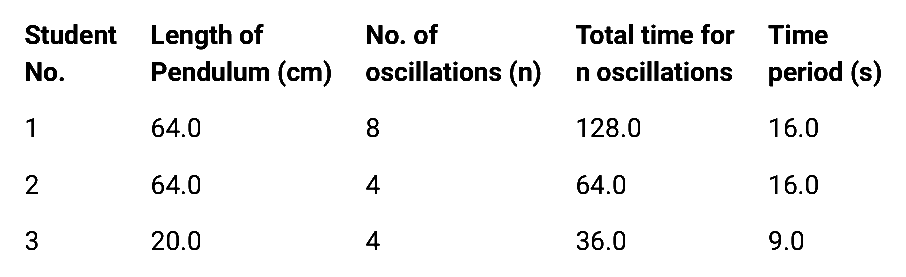
(Least count of length = 0.1 cm and Least count for time = 0.1 s)
If E1, E2 and E3 are the percentage errors in 'g' for students 1, 2 and 3 respectively, then the minimum percentage error is obtained by student no. ______________.
Numerical answer type. Work it out, then open the answer.
Answer: 1
Errors from readings
In the experiment of Ohm's law, a potential difference of 5.0 V is applied across the end of a conductor of length 10.0 cm and diameter of 5.00 mm. The measured current in the conductor is 2.00 A. The maximum permissible percentage error in the resistivity of the conductor is:
Answer: (a)
Errors from readings
The time period of a simple pendulum is given by . The measured value of the length of pendulum is 10 cm known to a 1mm accuracy. The time for 200 oscillations of the pendulum is found to be 100 second using a clock of 1s resolution. The percentage accuracy in the determination of 'g' using this pendulum is 'x'. The value of 'x' to be nearest integer is :-
Answer: (b)
Errors from readings
In order to determine the Young's Modulus of a wire of radius 0.2 cm (measured using a scale of least count = 0.001 cm) and length 1m (measured using a scale of least count = 1 mm), a weight of mass 1 kg (measured using a scale of least count = 1 g) was hanged to get the elongation of 0.5 cm (measured using a scale of least count 0.001 cm). What will be the fractional error in the value of Young's Modulus determined by this experiment?
Answer: (c)
Errors from readings
The period of oscillation of a simple pendulum is . Measured value of 'L' is 1.0 m from meter scale having a minimum division of 1 mm and time of one complete oscillation is 1.95 s measured from stopwatch of 0.01 s resolution. The percentage error in the determination of 'g' will be:
Answer: (c)
Errors from readings
A simple pendulum is being used to determine the value of gravitational acceleration g at a certain place. The length of the pendulum is 25.0 cm and a stop watch with 1s resolution measures the time taken for 40 oscillations to be 50 s. The accuracy in g is:
Answer: (a)
Errors from readings
In a simple pendulum experiment for determination of acceleration due to gravity (g), time taken for 20 oscillations is measured by using a watch of 1 second least count. The mean value of time taken comes out to be 30 s. The length of pendulum is measured by using a meter scale of least count 1 mm and the value obtained is 55.0 cm. The percentage error in the determination of g is close to :-
Answer: (d)
Errors from readings
The following observations were taken for determining surface tension T of water by capillary method:
diameter of capillary, D = 1.25 10-2 m
rise of water, h = 1.45 10-2m
Using g = 9.80 m/s2 and the simplified relation T = , the possible error in surface tension is closest to:
Answer: (c)
Errors from readings
A thin 1 m long rod has a radius of 5 mm. A force of 50 kN is applied at one end to determine its Young’s modulus. Assume that the force is exactly known. If the least count in the measurement of all lengths is 0.01 mm, which of the following statements is false?
Answer: (c)
Errors from readings
The period of oscillation of a simple pendulum is . Measured value of L is 20.0 cm known to 1 mm accuracy and time for 100 oscillations of the pendulum is found to be 90 s using wrist watch of 1 s resolution. The accuracy in the determination of g is:
Answer: (d)
Errors from readings
The current voltage relation of diode is given by where the applied voltage is in volts and the temperature is in degree kelvin. If a student makes an error measuring while measuring the current of at what will be the error in the value of current in ?
Answer: (a)
Errors from readings
An experiment is performed to obtain the value of acceleration due to gravity g by using a simple pendulum of length L. In this experiment time for 100 oscillations is measured by using a watch of 1 second least count and the value is 90.0 seconds. The length L is measured by using a meter scale of least count 1 mm and the value is 20.0 cm. The error in the determination of g would be:
Answer: (b)
No questions match these filters.