Q1 JEE Main 2026 · 2 APR · SHIFT 2 Easy ☆
Nature of EM Waves & Wave Equation
An electromagnetic wave travels in free space along the x-direction. At a particular point in space and time, B ⃗ = 2 × 1 0 − 7 j ^ \vec{B} = 2\times 10^{-7}\hat{j} B = 2 × 1 0 − 7 j ^ E ⃗ \vec{E} E
(a) 60 k ^ 60\,\hat{k} 60 k ^ (b) − 60 k ^ -60\,\hat{k} − 60 k ^ (c) 30 k ^ 30\,\hat{k} 30 k ^ (d) − 600 k ^ -600\,\hat{k} − 600 k ^ Show answer and solution
Answer: (b)
Loading the solution…
Report a mistake Open question page Q2 JEE Main 2026 · 6 APR · SHIFT 2 Medium ☆
Nature of EM Waves & Wave Equation
For an electromagnetic wave propagating through vacuum, k ⃗ , E ⃗ \vec{k}, \vec{E} k , E ω \omega ω
(a) E ⃗ × k ⃗ ω \frac{\vec{E}\times\vec{k}}{\omega} ω E × k (b) k ⃗ × E ⃗ ω \frac{\vec{k}\times\vec{E}}{\omega} ω k × E (c) ω ( E ⃗ × k ⃗ ) \omega(\vec{E}\times\vec{k}) ω ( E × k ) (d) ω ( k ⃗ × E ⃗ ) \omega(\vec{k}\times\vec{E}) ω ( k × E ) Show answer and solution
Answer: (b)
Loading the solution…
Report a mistake Open question page Q3 JEE Main 2026 · 4 APR · SHIFT 2 Medium ☆
Nature of EM Waves & Wave Equation
A magnetic field vector in an electromagnetic wave is represented by B ⃗ = B 0 sin ( 2 π ν t − 2 π x λ ) j ^ \vec{B} = B_0\sin\left(2\pi\nu t - \frac{2\pi x}{\lambda}\right)\hat{j} B = B 0 sin ( 2 π ν t − λ 2 π x ) j ^ ______ .
(a) E ⃗ = − ν λ B 0 sin ( 2 π ν t − 2 π x λ ) k ^ \vec{E} = -\nu\lambda B_0\sin\left(2\pi\nu t - \frac{2\pi x}{\lambda}\right)\hat{k} E = − ν λ B 0 sin ( 2 π ν t − λ 2 π x ) k ^ (b) E ⃗ = − ν λ B 0 sin ( 2 π ν t − 2 π x λ ) i ^ \vec{E} = -\nu\lambda B_0\sin\left(2\pi\nu t - \frac{2\pi x}{\lambda}\right)\hat{i} E = − ν λ B 0 sin ( 2 π ν t − λ 2 π x ) i ^ (c) E ⃗ = ν λ B 0 sin ( 2 π ν t − 2 π x λ ) k ^ \vec{E} = \nu\lambda B_0\sin\left(2\pi\nu t - \frac{2\pi x}{\lambda}\right)\hat{k} E = ν λ B 0 sin ( 2 π ν t − λ 2 π x ) k ^ (d) E ⃗ = ν λ B 0 sin ( 2 π ν t − 2 π x λ ) i ^ \vec{E} = \nu\lambda B_0\sin\left(2\pi\nu t - \frac{2\pi x}{\lambda}\right)\hat{i} E = ν λ B 0 sin ( 2 π ν t − λ 2 π x ) i ^ Show answer and solution
Answer: (a)
Loading the solution…
Report a mistake Open question page Q4 JEE Main 2026 · 28 JAN · SHIFT 2 Medium ☆
Nature of EM Waves & Wave Equation
A plane electromagnetic wave is moving in free space with velocity c = 3 × 1 0 8 c = 3\times 10^{8} c = 3 × 1 0 8 E ⃗ = 54 sin ( k z − ω t ) j ^ \vec{E} = 54\sin(kz - \omega t)\,\hat{j} E = 54 sin ( k z − ω t ) j ^ j ^ \hat{j} j ^ B ⃗ \vec{B} B
(a) − 1.8 × 1 0 − 7 sin ( k z − ω t ) i ^ -1.8\times 10^{-7}\sin(kz - \omega t)\,\hat{i} − 1.8 × 1 0 − 7 sin ( k z − ω t ) i ^ (b) + 1.8 × 1 0 − 7 sin ( k z − ω t ) i ^ +1.8\times 10^{-7}\sin(kz - \omega t)\,\hat{i} + 1.8 × 1 0 − 7 sin ( k z − ω t ) i ^ (c) 1.4 × 1 0 − 7 sin ( k z − ω t ) k ^ 1.4\times 10^{-7}\sin(kz - \omega t)\,\hat{k} 1.4 × 1 0 − 7 sin ( k z − ω t ) k ^ (d) 1.4 × 1 0 − 7 sin ( k z − ω t ) i ^ 1.4\times 10^{-7}\sin(kz - \omega t)\,\hat{i} 1.4 × 1 0 − 7 sin ( k z − ω t ) i ^ Show answer and solution
Answer: (a)
Loading the solution…
Report a mistake Open question page Q5 JEE Main 2026 · 21 JAN · SHIFT 1 Medium ☆
Nature of EM Waves & Wave Equation
The electric field in a plane electromagnetic wave is given by:
E y = 69 sin [ 0.6 × 1 0 3 x − 1.8 × 1 0 11 t ] V/m. E_y = 69\sin\left[0.6\times 10^{3}x - 1.8\times 10^{11}t\right]\text{ V/m.} E y = 69 sin [ 0.6 × 1 0 3 x − 1.8 × 1 0 11 t ] V/m.
The expression for magnetic field associated with this electromagnetic wave is ______ T.
(a) B z = 2.3 × 1 0 − 7 sin [ 0.6 × 1 0 3 x − 1.8 × 1 0 11 t ] B_z = 2.3\times 10^{-7}\sin\left[0.6\times 10^{3}x - 1.8\times 10^{11}t\right] B z = 2.3 × 1 0 − 7 sin [ 0.6 × 1 0 3 x − 1.8 × 1 0 11 t ] (b) B z = 2.3 × 1 0 − 7 sin [ 0.6 × 1 0 3 x + 1.8 × 1 0 11 t ] B_z = 2.3\times 10^{-7}\sin\left[0.6\times 10^{3}x + 1.8\times 10^{11}t\right] B z = 2.3 × 1 0 − 7 sin [ 0.6 × 1 0 3 x + 1.8 × 1 0 11 t ] (c) B y = 2.3 × 1 0 − 7 sin [ 0.6 × 1 0 3 x − 1.8 × 1 0 11 t ] B_y = 2.3\times 10^{-7}\sin\left[0.6\times 10^{3}x - 1.8\times 10^{11}t\right] B y = 2.3 × 1 0 − 7 sin [ 0.6 × 1 0 3 x − 1.8 × 1 0 11 t ] (d) B y = 69 sin [ 0.6 × 1 0 3 x + 1.8 × 1 0 11 t ] B_y = 69\sin\left[0.6\times 10^{3}x + 1.8\times 10^{11}t\right] B y = 69 sin [ 0.6 × 1 0 3 x + 1.8 × 1 0 11 t ] Show answer and solution
Answer: (a)
Loading the solution…
Report a mistake Open question page Q6 JEE Main 2026 · 2 APR · SHIFT 1 Medium ☆
Nature of EM Waves & Wave Equation
An electromagnetic wave travelling in x-direction is described by field equation
E y = 300 sin ω ( t − x c ) E_y = 300 \sin \omega \left(t - \frac{x}{c}\right) E y = 300 sin ω ( t − c x )
If the electron is restricted to move in y-direction only with speed of 1.5 × 1 0 6 1.5 \times 10^{6} 1.5 × 1 0 6
Show answer and solution
Answer: (a)
Loading the solution…
Report a mistake Open question page Q7 JEE Main 2025 · 29 JAN · SHIFT 2 Easy ☆
Nature of EM Waves & Wave Equation
A plane electromagnetic wave propagates along the + x direction in free space. The components of the electric field, E ⃗ \vec{E} E B ⃗ \vec{B} B
(a) E x , B y E_x, B_y E x , B y (b) E y , B x E_y, B_x E y , B x (c) E y , B z E_y, B_z E y , B z (d) E z , B y E_z, B_y E z , B y Show answer and solution
Answer: (c)
Loading the solution…
Report a mistake Open question page Q8 NEET 2025 Easy ☆
Nature of EM Waves & Wave Equation
The electric field in a plane electromagnetic wave is given by E z = 60 cos ( 5 x + 1.5 × 1 0 9 t ) V/m E_z = 60\cos\left(5x + 1.5\times 10^{9}t\right)\text{ V/m} E z = 60 cos ( 5 x + 1.5 × 1 0 9 t ) V/m
(a) B z = 60 cos ( 5 x + 1.5 × 1 0 9 t ) T B_z = 60\cos\left(5x + 1.5\times 10^{9}t\right)\text{ T} B z = 60 cos ( 5 x + 1.5 × 1 0 9 t ) T (b) B y = 60 sin ( 5 x + 1.5 × 1 0 9 t ) T B_y = 60\sin\left(5x + 1.5\times 10^{9}t\right)\text{ T} B y = 60 sin ( 5 x + 1.5 × 1 0 9 t ) T (c) B y = 2 × 1 0 − 7 cos ( 5 x + 1.5 × 1 0 9 t ) T B_y = 2\times 10^{-7}\cos\left(5x + 1.5\times 10^{9}t\right)\text{ T} B y = 2 × 1 0 − 7 cos ( 5 x + 1.5 × 1 0 9 t ) T (d) B x = 2 × 1 0 − 7 cos ( 5 x + 1.5 × 1 0 9 t ) T B_x = 2\times 10^{-7}\cos\left(5x + 1.5\times 10^{9}t\right)\text{ T} B x = 2 × 1 0 − 7 cos ( 5 x + 1.5 × 1 0 9 t ) T Show answer and solution
Answer: (c)
Loading the solution…
Report a mistake Open question page Q9 JEE Main 2025 · 23 JAN · SHIFT 2 Medium ☆
Nature of EM Waves & Wave Equation
A plane electromagnetic wave of frequency 20 MHz travels in free space along the + x +x + x E y = 9.3 V m − 1 E_y = 9.3\text{ V m}^{-1} E y = 9.3 V m − 1
(a) B z = 1.55 × 1 0 − 8 T B_z = 1.55\times 10^{-8}\text{ T} B z = 1.55 × 1 0 − 8 T (b) B z = 6.2 × 1 0 − 8 T B_z = 6.2\times 10^{-8}\text{ T} B z = 6.2 × 1 0 − 8 T (c) B z = 3.1 × 1 0 − 8 T B_z = 3.1\times 10^{-8}\text{ T} B z = 3.1 × 1 0 − 8 T (d) B z = 9.3 × 1 0 − 8 T B_z = 9.3\times 10^{-8}\text{ T} B z = 9.3 × 1 0 − 8 T Show answer and solution
Answer: (c)
Loading the solution…
Report a mistake Open question page Q10 JEE Main 2025 · 28 JAN · SHIFT 2 Medium ☆
Nature of EM Waves & Wave Equation
The magnetic field of an E.M. wave is given by B ⃗ = ( 3 2 i ^ + 1 2 j ^ ) 30 sin [ ω ( t − z c ) ] \vec{B} = \left(\frac{\sqrt{3}}{2}\hat{i} + \frac{1}{2}\hat{j}\right)30\sin\left[\omega\left(t - \frac{z}{c}\right)\right] B = ( 2 3 i ^ + 2 1 j ^ ) 30 sin [ ω ( t − c z ) ]
(a) E ⃗ = ( 1 2 i ^ + 3 2 j ^ ) 30 c sin [ ω ( t + z c ) ] \vec{E} = \left(\frac{1}{2}\hat{i} + \frac{\sqrt{3}}{2}\hat{j}\right)30c\sin\left[\omega\left(t + \frac{z}{c}\right)\right] E = ( 2 1 i ^ + 2 3 j ^ ) 30 c sin [ ω ( t + c z ) ] (b) E ⃗ = ( 1 2 i ^ − 3 2 j ^ ) 30 c sin [ ω ( t − z c ) ] \vec{E} = \left(\frac{1}{2}\hat{i} - \frac{\sqrt{3}}{2}\hat{j}\right)30c\sin\left[\omega\left(t - \frac{z}{c}\right)\right] E = ( 2 1 i ^ − 2 3 j ^ ) 30 c sin [ ω ( t − c z ) ] (c) E ⃗ = ( 3 2 i ^ − 1 2 j ^ ) 30 c sin [ ω ( t + z c ) ] \vec{E} = \left(\frac{\sqrt{3}}{2}\hat{i} - \frac{1}{2}\hat{j}\right)30c\sin\left[\omega\left(t + \frac{z}{c}\right)\right] E = ( 2 3 i ^ − 2 1 j ^ ) 30 c sin [ ω ( t + c z ) ] (d) E ⃗ = ( 3 4 i ^ + 1 4 j ^ ) 30 c cos [ ω ( t − z c ) ] \vec{E} = \left(\frac{3}{4}\hat{i} + \frac{1}{4}\hat{j}\right)30c\cos\left[\omega\left(t - \frac{z}{c}\right)\right] E = ( 4 3 i ^ + 4 1 j ^ ) 30 c cos [ ω ( t − c z ) ] Show answer and solution
Answer: (b)
Loading the solution…
Report a mistake Open question page Q11 JEE Main 2025 · 23 JAN · SHIFT 1 Medium ☆
Nature of EM Waves & Wave Equation
The electric field of an electromagnetic wave in free space is
E ⃗ = 57 cos [ 7.5 × 1 0 6 t − 5 × 1 0 − 3 ( 3 x + 4 y ) ] ( 4 i ^ − 3 j ^ ) N/C \vec{E} = 57\cos\left[7.5\times 10^{6}t - 5\times 10^{-3}(3x + 4y)\right](4\hat{i} - 3\hat{j})\text{ N/C} E = 57 cos [ 7.5 × 1 0 6 t − 5 × 1 0 − 3 ( 3 x + 4 y ) ] ( 4 i ^ − 3 j ^ ) N/C
(a) B ⃗ = 57 3 × 1 0 8 cos [ 7.5 × 1 0 6 t − 5 × 1 0 − 3 ( 3 x + 4 y ) ] ( k ^ ) \vec{B} = \frac{57}{3\times 10^{8}}\cos\left[7.5\times 10^{6}t - 5\times 10^{-3}(3x + 4y)\right](\hat{k}) B = 3 × 1 0 8 57 cos [ 7.5 × 1 0 6 t − 5 × 1 0 − 3 ( 3 x + 4 y ) ] ( k ^ ) (b) B ⃗ = 57 3 × 1 0 8 cos [ 7.5 × 1 0 6 t − 5 × 1 0 − 3 ( 3 x + 4 y ) ] ( 5 k ^ ) \vec{B} = \frac{57}{3\times 10^{8}}\cos\left[7.5\times 10^{6}t - 5\times 10^{-3}(3x + 4y)\right](5\hat{k}) B = 3 × 1 0 8 57 cos [ 7.5 × 1 0 6 t − 5 × 1 0 − 3 ( 3 x + 4 y ) ] ( 5 k ^ ) (c) B ⃗ = − 57 3 × 1 0 8 cos [ 7.5 × 1 0 6 t − 5 × 1 0 − 3 ( 3 x + 4 y ) ] ( k ^ ) \vec{B} = -\frac{57}{3\times 10^{8}}\cos\left[7.5\times 10^{6}t - 5\times 10^{-3}(3x + 4y)\right](\hat{k}) B = − 3 × 1 0 8 57 cos [ 7.5 × 1 0 6 t − 5 × 1 0 − 3 ( 3 x + 4 y ) ] ( k ^ ) (d) B ⃗ = − 57 3 × 1 0 8 cos [ 7.5 × 1 0 6 t − 5 × 1 0 − 3 ( 3 x + 4 y ) ] ( 5 k ^ ) \vec{B} = -\frac{57}{3\times 10^{8}}\cos\left[7.5\times 10^{6}t - 5\times 10^{-3}(3x + 4y)\right](5\hat{k}) B = − 3 × 1 0 8 57 cos [ 7.5 × 1 0 6 t − 5 × 1 0 − 3 ( 3 x + 4 y ) ] ( 5 k ^ ) Show answer and solution
Answer: (d)
Loading the solution…
Report a mistake Open question page Q12 NEET 2024 Easy ☆
Nature of EM Waves & Wave Equation
The property which is not of an electromagnetic wave travelling in free space is that:
(a) They are transverse in nature (b) The energy density in electric field is equal to energy density in magnetic field (c) They travel with a speed equal to 1 μ 0 ε 0 \frac{1}{\sqrt{\mu_0\varepsilon_0}} μ 0 ε 0 1 (d) They originate from charges moving with uniform speed Show answer and solution
Answer: (d)
Loading the solution…
Report a mistake Open question page Q13 JEE Main 2024 · 1 FEB · SHIFT 2 Easy ☆
Nature of EM Waves & Wave Equation
If frequency of electromagnetic wave is 60 MHz 60\text{ MHz} 60 MHz z z z m \text{m} m
Show answer and solution
Answer: (b)
Loading the solution…
Report a mistake Open question page Q14 JEE Main 2024 · 29 JAN · SHIFT 2 Easy ☆
Nature of EM Waves & Wave Equation
A plane electromagnetic wave of frequency 35 MHz 35\text{ MHz} 35 MHz x x x E ⃗ = 9.6 j ^ V/m \vec{E} = 9.6\hat{j}\text{ V/m} E = 9.6 j ^ V/m
(a) 9.6 j ^ T 9.6\hat{j}\text{ T} 9.6 j ^ T (b) 3.2 × 1 0 − 8 i ^ T 3.2\times 10^{-8}\hat{i}\text{ T} 3.2 × 1 0 − 8 i ^ T (c) 9.6 × 1 0 − 8 k ^ T 9.6\times 10^{-8}\hat{k}\text{ T} 9.6 × 1 0 − 8 k ^ T (d) 3.2 × 1 0 − 8 k ^ T 3.2\times 10^{-8}\hat{k}\text{ T} 3.2 × 1 0 − 8 k ^ T Show answer and solution
Answer: (d)
Loading the solution…
Report a mistake Open question page Q15 JEE Main 2024 · 9 APR · SHIFT 2 Medium ☆
Nature of EM Waves & Wave Equation
The magnetic field in a plane electromagnetic wave is
B y = ( 3.5 × 1 0 − 7 ) sin ( 1.5 × 1 0 3 x + 0.5 × 1 0 11 t ) T B_y = \left(3.5\times 10^{-7}\right)\sin\left(1.5\times 10^{3}x + 0.5\times 10^{11}t\right)\text{ T} B y = ( 3.5 × 1 0 − 7 ) sin ( 1.5 × 1 0 3 x + 0.5 × 1 0 11 t ) T
(a) E z = 105 sin ( 1.5 × 1 0 3 x + 0.5 × 1 0 11 t ) V m − 1 E_z = 105\sin\left(1.5\times 10^{3}x + 0.5\times 10^{11}t\right)\text{ V m}^{-1} E z = 105 sin ( 1.5 × 1 0 3 x + 0.5 × 1 0 11 t ) V m − 1 (b) E y = 10.5 sin ( 1.5 × 1 0 3 x + 0.5 × 1 0 11 t ) V m − 1 E_y = 10.5\sin\left(1.5\times 10^{3}x + 0.5\times 10^{11}t\right)\text{ V m}^{-1} E y = 10.5 sin ( 1.5 × 1 0 3 x + 0.5 × 1 0 11 t ) V m − 1 (c) E y = 1.17 sin ( 1.5 × 1 0 3 x + 0.5 × 1 0 11 t ) V m − 1 E_y = 1.17\sin\left(1.5\times 10^{3}x + 0.5\times 10^{11}t\right)\text{ V m}^{-1} E y = 1.17 sin ( 1.5 × 1 0 3 x + 0.5 × 1 0 11 t ) V m − 1 (d) E z = 1.17 sin ( 1.5 × 1 0 3 x + 0.5 × 1 0 11 t ) V m − 1 E_z = 1.17\sin\left(1.5\times 10^{3}x + 0.5\times 10^{11}t\right)\text{ V m}^{-1} E z = 1.17 sin ( 1.5 × 1 0 3 x + 0.5 × 1 0 11 t ) V m − 1 Show answer and solution
Answer: (a)
Loading the solution…
Report a mistake Open question page Q16 JEE Main 2024 · 9 APR · SHIFT 1 Medium ☆
Nature of EM Waves & Wave Equation
A plane EM wave is propagating along x x x 4 mm 4\text{ mm} 4 mm y y y 60 V m − 1 60\text{ V m}^{-1} 60 V m − 1
(a) B z = 2 × 1 0 − 7 sin [ π 2 ( x − 3 × 1 0 8 t ) ] k ^ T B_z = 2\times 10^{-7}\sin\left[\frac{\pi}{2}\left(x - 3\times 10^{8}t\right)\right]\hat{k}\text{ T} B z = 2 × 1 0 − 7 sin [ 2 π ( x − 3 × 1 0 8 t ) ] k ^ T (b) B z = 2 × 1 0 − 7 sin [ π 2 × 1 0 3 ( x − 3 × 1 0 8 t ) ] k ^ T B_z = 2\times 10^{-7}\sin\left[\frac{\pi}{2}\times 10^{3}\left(x - 3\times 10^{8}t\right)\right]\hat{k}\text{ T} B z = 2 × 1 0 − 7 sin [ 2 π × 1 0 3 ( x − 3 × 1 0 8 t ) ] k ^ T (c) B z = 60 sin [ π 2 ( x − 3 × 1 0 8 t ) ] k ^ T B_z = 60\sin\left[\frac{\pi}{2}\left(x - 3\times 10^{8}t\right)\right]\hat{k}\text{ T} B z = 60 sin [ 2 π ( x − 3 × 1 0 8 t ) ] k ^ T (d) B x = 60 sin [ π 2 ( x − 3 × 1 0 8 t ) ] i ^ T B_x = 60\sin\left[\frac{\pi}{2}\left(x - 3\times 10^{8}t\right)\right]\hat{i}\text{ T} B x = 60 sin [ 2 π ( x − 3 × 1 0 8 t ) ] i ^ T Show answer and solution
Answer: (b)
Loading the solution…
Report a mistake Open question page Q17 JEE Main 2024 · 4 APR · SHIFT 1 Medium ☆
Nature of EM Waves & Wave Equation
The electric field in an electromagnetic wave is given by E ⃗ = i ^ 40 cos ω ( t − z / c ) NC − 1 \vec{E} = \hat{i}\,40\cos\omega(t - z/c)\text{ NC}^{-1} E = i ^ 40 cos ω ( t − z / c ) NC − 1
(a) B ⃗ = j ^ 40 c cos ω ( t − z / c ) \vec{B} = \hat{j}\frac{40}{c}\cos\omega(t - z/c) B = j ^ c 40 cos ω ( t − z / c ) (b) B ⃗ = i ^ 40 c cos ω ( t − z / c ) \vec{B} = \hat{i}\frac{40}{c}\cos\omega(t - z/c) B = i ^ c 40 cos ω ( t − z / c ) (c) B ⃗ = j ^ 40 cos ω ( t − z / c ) \vec{B} = \hat{j}\,40\cos\omega(t - z/c) B = j ^ 40 cos ω ( t − z / c ) (d) B ⃗ = k ^ 40 c cos ω ( t − z / c ) \vec{B} = \hat{k}\frac{40}{c}\cos\omega(t - z/c) B = k ^ c 40 cos ω ( t − z / c ) Show answer and solution
Answer: (a)
Loading the solution…
Report a mistake Open question page Q18 JEE Main 2024 · 30 JAN · SHIFT 1 Medium ☆
Nature of EM Waves & Wave Equation
The electric field of an electromagnetic wave in free space is represented as E ⃗ = E 0 cos ( ω t − k z ) i ^ \vec{E} = E_0\cos(\omega t - kz)\hat{i} E = E 0 cos ( ω t − k z ) i ^
(a) B ⃗ = E 0 C cos ( ω t + k z ) j ^ \vec{B} = E_0 C\cos(\omega t + kz)\hat{j} B = E 0 C cos ( ω t + k z ) j ^ (b) B ⃗ = E 0 C cos ( ω t − k z ) j ^ \vec{B} = \frac{E_0}{C}\cos(\omega t - kz)\hat{j} B = C E 0 cos ( ω t − k z ) j ^ (c) B ⃗ = E 0 C cos ( ω t − k z ) j ^ \vec{B} = E_0 C\cos(\omega t - kz)\hat{j} B = E 0 C cos ( ω t − k z ) j ^ (d) B ⃗ = E 0 C cos ( ω t + k z ) j ^ \vec{B} = \frac{E_0}{C}\cos(\omega t + kz)\hat{j} B = C E 0 cos ( ω t + k z ) j ^ Show answer and solution
Answer: (b)
Loading the solution…
Report a mistake Open question page Q19 MHT CET 2023 · 13 MAY · SHIFT 1 Easy ☆
Nature of EM Waves & Wave Equation
Select the 'WRONG' statement out of the following.
(a) Electromagnetic waves do not require any medium for their propagation. (b) Electromagnetic waves can travel through vacuum with speed of light (c) Material medium is necessary for propagation of electromagnetic waves. (d) Electromagnetic waves are transverse in nature. Show answer and solution
Answer: (c)
Loading the solution…
Report a mistake Open question page Q20 JEE Main 2023 · 29 JAN · SHIFT 2 Easy ☆
Nature of EM Waves & Wave Equation
Given below are two statements:
Statement I: Electromagnetic waves are not deflected by electric and magnetic field. Statement II: The amplitude of electric field and the magnetic field in electromagnetic waves are related to each other as E 0 = μ 0 ε 0 B 0 E_0 = \sqrt{\frac{\mu_0}{\varepsilon_0}}\,B_0 E 0 = ε 0 μ 0 B 0
In the light of the above statements, choose the correct answer from the options given below:
(a) Both Statement I and Statement II are true (b) Statement I is true and Statement II is false (c) Both Statement I and Statement II are false (d) Statement I is false but Statement II is true Show answer and solution
Answer: (b)
Loading the solution…
Report a mistake Open question page Q21 JEE Main 2023 · 13 APR · SHIFT 2 Easy ☆
Nature of EM Waves & Wave Equation
In an electromagnetic wave, at an instant and at particular position, the electric field is along the negative z z z x x x
(a) at 4 5 ∘ 45^\circ 4 5 ∘ (b) positive y y y (c) negative y y y (d) positive z-axis Show answer and solution
Answer: (c)
Loading the solution…
Report a mistake Open question page Q22 JEE Main 2023 · 25 JAN · SHIFT 1 Easy ☆
Nature of EM Waves & Wave Equation
An electromagnetic wave is transporting energy in the negative z z z y y y
(a) Negative direction of y y y (b) Positive direction of z z z (c) Positive direction of x x x (d) Negative direction x x x Show answer and solution
Answer: (c)
Loading the solution…
Report a mistake Open question page Q23 JEE Main 2023 · 24 JAN · SHIFT 1 Easy ☆
Nature of EM Waves & Wave Equation
If E ⃗ \vec{E} E K ⃗ \vec{K} K
(ω \omega ω
(a) 1 ω ( K ⃗ × E ⃗ ) \frac{1}{\omega}\left(\vec{K}\times\vec{E}\right) ω 1 ( K × E ) (b) K ⃗ × E ⃗ \vec{K}\times\vec{E} K × E (c) ω ( K ⃗ × E ⃗ ) \omega\left(\vec{K}\times\vec{E}\right) ω ( K × E ) (d) ω ( E ⃗ × K ⃗ ) \omega\left(\vec{E}\times\vec{K}\right) ω ( E × K ) Show answer and solution
Answer: (a)
Loading the solution…
Report a mistake Open question page Q24 NEET 2023 Easy ☆
Nature of EM Waves & Wave Equation
In a plane electromagnetic wave travelling in free space, the electric field component oscillates sinusoidally at a frequency of 2.0 × 1 0 10 Hz 2.0\times 10^{10}\text{ Hz} 2.0 × 1 0 10 Hz 48 V m − 1 48\text{ V m}^{-1} 48 V m − 1 = 3 × 1 0 8 m s − 1 = 3\times 10^{8}\text{ m s}^{-1} = 3 × 1 0 8 m s − 1
(a) 1.6 × 1 0 − 8 T 1.6\times 10^{-8}\text{ T} 1.6 × 1 0 − 8 T (b) 1.6 × 1 0 − 7 T 1.6\times 10^{-7}\text{ T} 1.6 × 1 0 − 7 T (c) 1.6 × 1 0 − 6 T 1.6\times 10^{-6}\text{ T} 1.6 × 1 0 − 6 T (d) 1.6 × 1 0 − 9 T 1.6\times 10^{-9}\text{ T} 1.6 × 1 0 − 9 T Show answer and solution
Answer: (b)
Loading the solution…
Report a mistake Open question page Q25 JEE Main 2023 · 11 APR · SHIFT 2 Easy ☆
Nature of EM Waves & Wave Equation
A plane electromagnetic wave of frequency 20 MHz 20\text{ MHz} 20 MHz x x x E ⃗ = 6.6 j ^ V/m \vec{E} = 6.6\hat{j}\text{ V/m} E = 6.6 j ^ V/m B ⃗ \vec{B} B
(a) − 2.2 × 1 0 − 8 i ^ T -2.2\times 10^{-8}\hat{i}\text{ T} − 2.2 × 1 0 − 8 i ^ T (b) 2.2 × 1 0 − 8 i ^ T 2.2\times 10^{-8}\hat{i}\text{ T} 2.2 × 1 0 − 8 i ^ T (c) 2.2 × 1 0 − 8 k ^ T 2.2\times 10^{-8}\hat{k}\text{ T} 2.2 × 1 0 − 8 k ^ T (d) − 2.2 × 1 0 − 8 k ^ T -2.2\times 10^{-8}\hat{k}\text{ T} − 2.2 × 1 0 − 8 k ^ T Show answer and solution
Answer: (c)
Loading the solution…
Report a mistake Open question page Q26 JEE Main 2023 · 10 APR · SHIFT 2 Easy ☆
Nature of EM Waves & Wave Equation
The amplitude of magnetic field in an electromagnetic wave propagating along y-axis is 6.0 × 1 0 − 7 T 6.0\times 10^{-7}\text{ T} 6.0 × 1 0 − 7 T
(a) 6.0 × 1 0 − 7 V m − 1 6.0\times 10^{-7}\text{ V m}^{-1} 6.0 × 1 0 − 7 V m − 1 (b) 5 × 1 0 14 V m − 1 5\times 10^{14}\text{ V m}^{-1} 5 × 1 0 14 V m − 1 (c) 180 V m − 1 180\text{ V m}^{-1} 180 V m − 1 (d) 2 × 1 0 15 V m − 1 2\times 10^{15}\text{ V m}^{-1} 2 × 1 0 15 V m − 1 Show answer and solution
Answer: (c)
Loading the solution…
Report a mistake Open question page Q27 JEE Main 2023 · 24 JAN · SHIFT 2 Easy ☆
Nature of EM Waves & Wave Equation
The electric field and magnetic field components of an electromagnetic wave going through vacuum is described by
E x = E 0 sin ( k z − ω t ) E_x = E_0\sin(kz - \omega t) E x = E 0 sin ( k z − ω t )
B y = B 0 sin ( k z − ω t ) B_y = B_0\sin(kz - \omega t) B y = B 0 sin ( k z − ω t )
Then the correct relation between E0 {}_0 0 0 {}_0 0
(a) E 0 B 0 = ω k E_0 B_0 = \omega k E 0 B 0 = ωk (b) E 0 = k B 0 E_0 = k B_0 E 0 = k B 0 (c) k E 0 = ω B 0 k E_0 = \omega B_0 k E 0 = ω B 0 (d) ω E 0 = k B 0 \omega E_0 = k B_0 ω E 0 = k B 0 Show answer and solution
Answer: (c)
Loading the solution…
Report a mistake Open question page Q28 MHT CET 2023 · 9 MAY · SHIFT 2 Easy ☆
Nature of EM Waves & Wave Equation
A charge 'q q q v v v
(a) q ( v ⃗ × B ⃗ ) q(\vec{v}\times\vec{B}) q ( v × B ) (b) q ( B ⃗ × v ⃗ ) q(\vec{B}\times\vec{v}) q ( B × v ) (c) q ( E ⃗ × v ⃗ ) q(\vec{E}\times\vec{v}) q ( E × v ) (d) q E ⃗ + q ( v ⃗ × B ⃗ ) q\vec{E} + q(\vec{v}\times\vec{B}) q E + q ( v × B ) Show answer and solution
Answer: (d)
Loading the solution…
Report a mistake Open question page Q29 NEET 2022 · PHASE 2 Easy ☆
Nature of EM Waves & Wave Equation
The ratio of the magnitude of the magnetic field and electric field intensity of a plane electromagnetic wave in free space of permeability μ 0 \mu_0 μ 0 ε 0 \varepsilon_0 ε 0
(a) μ 0 ε 0 c \frac{\sqrt{\mu_0\varepsilon_0}}{c} c μ 0 ε 0 (b) c (c) 1 c \frac{1}{c} c 1 (d) c μ 0 ε 0 \frac{c}{\sqrt{\mu_0\varepsilon_0}} μ 0 ε 0 c Show answer and solution
Answer: (c)
Loading the solution…
Report a mistake Open question page Q30 JEE Main 2022 · 30 JUL · SHIFT 2 Easy ☆
Nature of EM Waves & Wave Equation
A plane electromagnetic wave propagating in free space has amplitude of electric field of 900 N C 900\ \frac{\text{N}}{\text{C}} 900 C N
(a) 9 μ T 9\ \mu\text{T} 9 μ T (b) 27 μ T 27\ \mu\text{T} 27 μ T (c) 3 μ T 3\ \mu\text{T} 3 μ T (d) 270 GT 270\text{ GT} 270 GT Show answer and solution
Answer: (c)
Loading the solution…
Report a mistake Open question page Q31 JEE Main 2022 · 26 JUL · SHIFT 2 Easy ☆
Nature of EM Waves & Wave Equation
The oscillating magnetic field in a plane electromagnetic wave is given by
B y = 5 × 1 0 − 6 sin 1000 π ( 5 x − 4 × 1 0 8 t ) T B_y = 5\times 10^{-6}\sin 1000\pi\left(5x - 4\times 10^{8}t\right)\text{ T} B y = 5 × 1 0 − 6 sin 1000 π ( 5 x − 4 × 1 0 8 t ) T
(a) 15 × 1 0 2 V m − 1 15\times 10^{2}\text{ V m}^{-1} 15 × 1 0 2 V m − 1 (b) 5 × 1 0 − 6 V m − 1 5\times 10^{-6}\text{ V m}^{-1} 5 × 1 0 − 6 V m − 1 (c) 16 × 1 0 12 V m − 1 16\times 10^{12}\text{ V m}^{-1} 16 × 1 0 12 V m − 1 (d) 4 × 1 0 2 V m − 1 4\times 10^{2}\text{ V m}^{-1} 4 × 1 0 2 V m − 1 Show answer and solution
Answer: (d)
Loading the solution…
Report a mistake Open question page Q32 JEE Main 2022 · 25 JUL · SHIFT 2 Easy ☆
Nature of EM Waves & Wave Equation
Light wave travelling in air along x-direction is given by E y = 540 sin π × 1 0 4 ( x − c t ) V m − 1 E_y = 540\sin\pi\times 10^{4}(x - ct)\text{ V m}^{-1} E y = 540 sin π × 1 0 4 ( x − c t ) V m − 1 × \times × − 1 {}^{-1} − 1
(a) 18 × \times × − - − (b) 54 × \times × − - − (c) 54 × \times × − - − (d) 18 × \times × − - − Show answer and solution
Answer: (a)
Loading the solution…
Report a mistake Open question page Q33 JEE Main 2022 · 30 JUN · SHIFT 1 Easy ☆
Nature of EM Waves & Wave Equation
An expression for oscillating electric field in a plane electromagnetic wave is given as Ez = 300 sin(5π × \pi\times π × − - − π × \pi\times π × − 1 {}^{-1} − 1
Then, the value of magnetic field amplitude will be:
(Given: speed of light in Vacuum c = 3 × \times × − 1 {}^{-1} − 1
(a) 1 × \times × − - − (b) 5 × \times × − - − (c) 18 × \times × (d) 21 × \times × Show answer and solution
Answer: (b)
Loading the solution…
Report a mistake Open question page Q34 JEE Main 2022 · 27 JUL · SHIFT 2 Medium ☆
Nature of EM Waves & Wave Equation
Identify the correct statements from the following descriptions of various properties of electromagnetic waves.
(A) In a plane electromagnetic wave electric field and magnetic field must be perpendicular to each other and direction of propagation of wave should be along electric field or magnetic field. (B) The energy in electromagnetic wave is divided equally between electric and magnetic fields. (C) Both electric field and magnetic field are parallel to each other and perpendicular to the direction of propagation of wave.
(D) The electric field, magnetic field and direction of propagation of wave must be perpendicular to each other.
(E) The ratio of amplitude of magnetic field to the amplitude of electric field is equal to speed of light.
Choose the most appropriate answer from the options given below:
(a) (D) only (b) (B) and (D) only (c) (B), (C) and (E) only (d) (A), (B) and (E) only Show answer and solution
Answer: (b)
Loading the solution…
Report a mistake Open question page Q35 JEE Main 2022 · 26 JUL · SHIFT 1 Medium ☆
Nature of EM Waves & Wave Equation
The magnetic field of a plane electromagnetic wave is given by:
B ⃗ = 2 × 1 0 − 8 sin ( 0.5 × 1 0 3 x + 1.5 × 1 0 11 t ) j ^ T \vec{B} = 2\times 10^{-8}\sin\left(0.5\times 10^{3}x + 1.5\times 10^{11}t\right)\hat{j}\text{ T} B = 2 × 1 0 − 8 sin ( 0.5 × 1 0 3 x + 1.5 × 1 0 11 t ) j ^ T
The amplitude of the electric field would be:
(a) 6 V m − 1 6\text{ V m}^{-1} 6 V m − 1 x x x (b) 3 V m − 1 3\text{ V m}^{-1} 3 V m − 1 z z z (c) 6 V m − 1 6\text{ V m}^{-1} 6 V m − 1 z z z (d) 2 × 1 0 − 8 V m − 1 2\times 10^{-8}\text{ V m}^{-1} 2 × 1 0 − 8 V m − 1 z z z Show answer and solution
Answer: (c)
Loading the solution…
Report a mistake Open question page Q36 JEE Main 2022 · 26 JUN · SHIFT 1 Medium ☆
Nature of EM Waves & Wave Equation
If Electric field intensity of a uniform plane electromagnetic wave is given as
E = − 301.6 sin ( k z − ω t ) a ^ x + 452.4 sin ( k z − ω t ) a ^ y V m E = -301.6\sin(kz - \omega t)\hat{a}_x + 452.4\sin(kz - \omega t)\hat{a}_y\,\frac{\text{V}}{\text{m}} E = − 301.6 sin ( k z − ω t ) a ^ x + 452.4 sin ( k z − ω t ) a ^ y m V − 1 {}^{-1} − 1
[Given: Speed of light in vacuum c = 3 × 1 0 8 c = 3\times 10^{8} c = 3 × 1 0 8 − 1 {}^{-1} − 1 μ 0 = 4 π × 1 0 − 7 \mu_0 = 4\pi\times 10^{-7} μ 0 = 4 π × 1 0 − 7 − 2 {}^{-2} − 2
(a) + 0.8 sin ( k z − ω t ) a ^ y + 0.8 sin ( k z − ω t ) a ^ x +0.8\sin(kz - \omega t)\hat{a}_y + 0.8\sin(kz - \omega t)\hat{a}_x + 0.8 sin ( k z − ω t ) a ^ y + 0.8 sin ( k z − ω t ) a ^ x (b) + 1.0 × 1 0 − 6 sin ( k z − ω t ) a ^ y + 1.5 × 1 0 − 6 sin ( k z − ω t ) a ^ x +1.0\times 10^{-6}\sin(kz - \omega t)\hat{a}_y + 1.5\times 10^{-6}\sin(kz - \omega t)\hat{a}_x + 1.0 × 1 0 − 6 sin ( k z − ω t ) a ^ y + 1.5 × 1 0 − 6 sin ( k z − ω t ) a ^ x (c) − 0.8 sin ( k z − ω t ) a ^ y − 1.2 sin ( k z − ω t ) a ^ x -0.8\sin(kz - \omega t)\hat{a}_y - 1.2\sin(kz - \omega t)\hat{a}_x − 0.8 sin ( k z − ω t ) a ^ y − 1.2 sin ( k z − ω t ) a ^ x (d) − 1.0 × 1 0 − 6 sin ( k z − ω t ) a ^ y − 1.5 × 1 0 − 6 sin ( k z − ω t ) a ^ x -1.0\times 10^{-6}\sin(kz - \omega t)\hat{a}_y - 1.5\times 10^{-6}\sin(kz - \omega t)\hat{a}_x − 1.0 × 1 0 − 6 sin ( k z − ω t ) a ^ y − 1.5 × 1 0 − 6 sin ( k z − ω t ) a ^ x Show answer and solution
Answer: (c)
Loading the solution…
Report a mistake Open question page Q37 NEET 2022 · PHASE 2 Medium ☆
Nature of EM Waves & Wave Equation
The magnetic field of a plane electromagnetic wave is given by
B ⃗ = 3 × 1 0 − 8 cos ( 1.6 × 1 0 3 x + 48 × 1 0 10 t ) j ^ \vec{B} = 3\times 10^{-8}\cos(1.6\times 10^{3}x + 48\times 10^{10}t)\hat{j} B = 3 × 1 0 − 8 cos ( 1.6 × 1 0 3 x + 48 × 1 0 10 t ) j ^
(a) 9 cos ( 1.6 × 1 0 3 x + 48 × 1 0 10 t ) k ^ 9\cos(1.6\times 10^{3}x + 48\times 10^{10}t)\hat{k} 9 cos ( 1.6 × 1 0 3 x + 48 × 1 0 10 t ) k ^ (b) 3 × 1 0 − 8 cos ( 1.6 × 1 0 3 x + 48 × 1 0 10 t ) i ^ 3\times 10^{-8}\cos(1.6\times 10^{3}x + 48\times 10^{10}t)\hat{i} 3 × 1 0 − 8 cos ( 1.6 × 1 0 3 x + 48 × 1 0 10 t ) i ^ (c) 3 × 1 0 − 8 sin ( 1.6 × 1 0 3 x + 48 × 1 0 10 t ) i ^ 3\times 10^{-8}\sin(1.6\times 10^{3}x + 48\times 10^{10}t)\hat{i} 3 × 1 0 − 8 sin ( 1.6 × 1 0 3 x + 48 × 1 0 10 t ) i ^ (d) 9 sin ( 1.6 × 1 0 3 x − 48 × 1 0 10 t ) k ^ 9\sin(1.6\times 10^{3}x - 48\times 10^{10}t)\hat{k} 9 sin ( 1.6 × 1 0 3 x − 48 × 1 0 10 t ) k ^ Show answer and solution
Answer: (a)
Loading the solution…
Report a mistake Open question page Q38 JEE Main 2022 · 28 JUN · SHIFT 2 Medium ☆
Nature of EM Waves & Wave Equation
An EM wave propagating in x-direction has a wavelength of 8 mm. The electric field vibrating y- direction has maximum magnitude of 60 Vm− 1 {}^{-1} − 1
(a) E y = 60 sin [ π 4 × 1 0 3 ( x − 3 × 1 0 8 t ) ] j ^ V m − 1 B z = 2 sin [ π 4 × 1 0 3 ( x − 3 × 1 0 8 t ) ] k ^ T E_y = 60\sin\left[\frac{\pi}{4}\times 10^{3}(x - 3\times 10^{8}t)\right]\hat{j}\text{ V m}^{-1}\quad B_z = 2\sin\left[\frac{\pi}{4}\times 10^{3}(x - 3\times 10^{8}t)\right]\hat{k}\text{ T} E y = 60 sin [ 4 π × 1 0 3 ( x − 3 × 1 0 8 t ) ] j ^ V m − 1 B z = 2 sin [ 4 π × 1 0 3 ( x − 3 × 1 0 8 t ) ] k ^ T (b) E y = 60 sin [ π 4 × 1 0 3 ( x − 3 × 1 0 8 t ) ] j ^ V m − 1 B z = 2 × 1 0 − 7 sin [ π 4 × 1 0 3 ( x − 3 × 1 0 8 t ) ] k ^ T E_y = 60\sin\left[\frac{\pi}{4}\times 10^{3}(x - 3\times 10^{8}t)\right]\hat{j}\text{ V m}^{-1}\quad B_z = 2\times 10^{-7}\sin\left[\frac{\pi}{4}\times 10^{3}(x - 3\times 10^{8}t)\right]\hat{k}\text{ T} E y = 60 sin [ 4 π × 1 0 3 ( x − 3 × 1 0 8 t ) ] j ^ V m − 1 B z = 2 × 1 0 − 7 sin [ 4 π × 1 0 3 ( x − 3 × 1 0 8 t ) ] k ^ T (c) E y = 2 × 1 0 − 7 sin [ π 4 × 1 0 3 ( x − 3 × 1 0 8 t ) ] j ^ V m − 1 B z = 60 sin [ π 4 × 1 0 3 ( x − 3 × 1 0 8 t ) ] k ^ T E_y = 2\times 10^{-7}\sin\left[\frac{\pi}{4}\times 10^{3}(x - 3\times 10^{8}t)\right]\hat{j}\text{ V m}^{-1}\quad B_z = 60\sin\left[\frac{\pi}{4}\times 10^{3}(x - 3\times 10^{8}t)\right]\hat{k}\text{ T} E y = 2 × 1 0 − 7 sin [ 4 π × 1 0 3 ( x − 3 × 1 0 8 t ) ] j ^ V m − 1 B z = 60 sin [ 4 π × 1 0 3 ( x − 3 × 1 0 8 t ) ] k ^ T (d) E y = 2 × 1 0 − 7 sin [ π 4 × 1 0 4 ( x − 4 × 1 0 8 t ) ] j ^ V m − 1 B z = 60 sin [ π 4 × 1 0 4 ( x − 4 × 1 0 8 t ) ] k ^ T E_y = 2\times 10^{-7}\sin\left[\frac{\pi}{4}\times 10^{4}(x - 4\times 10^{8}t)\right]\hat{j}\text{ V m}^{-1}\quad B_z = 60\sin\left[\frac{\pi}{4}\times 10^{4}(x - 4\times 10^{8}t)\right]\hat{k}\text{ T} E y = 2 × 1 0 − 7 sin [ 4 π × 1 0 4 ( x − 4 × 1 0 8 t ) ] j ^ V m − 1 B z = 60 sin [ 4 π × 1 0 4 ( x − 4 × 1 0 8 t ) ] k ^ T Show answer and solution
Answer: (b)
Loading the solution…
Report a mistake Open question page Q39 JEE Main 2022 · 27 JUL · SHIFT 1 Medium ☆
Nature of EM Waves & Wave Equation
A beam of light travelling along X X X E y = 900 sin ω ( t − x / c ) E_y = 900 \sin \omega (t - x/c) E y = 900 sin ω ( t − x / c ) q q q Y Y Y 3 × 1 0 7 ms − 1 3 \times 10^{7}\text{ ms}^{-1} 3 × 1 0 7 ms − 1
(Given speed of light = 3 × 1 0 8 ms − 1 = 3 \times 10^{8}\text{ ms}^{-1} = 3 × 1 0 8 ms − 1
(a) 1: 1 (b) 1: 10 (c) 10: 1 (d) 1: 2 Show answer and solution
Answer: (c)
Loading the solution…
Report a mistake Open question page Q40 NEET 2021 Easy ☆
Nature of EM Waves & Wave Equation
For a plane electromagnetic wave propagating in x-direction, which one of the following combination gives the correct possible directions for electric field (E) and magnetic field (B) respectively?
(a) − j ^ + k ^ , − j ^ + k ^ -\hat{j}+\hat{k},\ -\hat{j}+\hat{k} − j ^ + k ^ , − j ^ + k ^ (b) j ^ + k ^ , j ^ + k ^ \hat{j}+\hat{k},\ \hat{j}+\hat{k} j ^ + k ^ , j ^ + k ^ (c) − j ^ + k ^ , − j ^ − k ^ -\hat{j}+\hat{k},\ -\hat{j}-\hat{k} − j ^ + k ^ , − j ^ − k ^ (d) j ^ + k ^ , − j ^ − k ^ \hat{j}+\hat{k},\ -\hat{j}-\hat{k} j ^ + k ^ , − j ^ − k ^ Show answer and solution
Answer: (c)
Loading the solution…
Report a mistake Open question page Q41 JEE Main 2021 · 20 JUL · SHIFT 2 Easy ☆
Nature of EM Waves & Wave Equation
In an electromagnetic wave the electric field vector and magnetic field vector are given as E ⃗ = E 0 i ^ \vec{E} = E_0\hat{i} E = E 0 i ^ B ⃗ = B 0 k ^ \vec{B} = B_0\hat{k} B = B 0 k ^
(a) ( k ^ ) \left(\hat{k}\right) ( k ^ ) (b) j ^ \hat{j} j ^ (c) ( − k ^ ) \left(-\hat{k}\right) ( − k ^ ) (d) ( − j ^ ) \left(-\hat{j}\right) ( − j ^ ) Show answer and solution
Answer: (d)
Loading the solution…
Report a mistake Open question page Q42 JEE Main 2021 · 18 MAR · SHIFT 2 Easy ☆
Nature of EM Waves & Wave Equation
A plane electromagnetic wave propagating along y-direction can have the following pair of electric field ( E ⃗ ) \left(\vec{E}\right) ( E ) ( B ⃗ ) \left(\vec{B}\right) ( B )
(a) Ex, Bz or Ez, Bx (b) Ex, By or Ey, Bx (c) Ey, By or Ez, Bz (d) Ey, Bx or Ex, By Show answer and solution
Answer: (a)
Loading the solution…
Report a mistake Open question page Q43 JEE Main 2021 · 18 MAR · SHIFT 1 Easy ☆
Nature of EM Waves & Wave Equation
A plane electromagnetic wave of frequency 100 MHz is travelling in vacuum along the x-direction. At a particular point in space and time, B ⃗ = 2.0 × 1 0 − 8 k ^ T \vec{B} = 2.0\times 10^{-8}\hat{k}\text{ T} B = 2.0 × 1 0 − 8 k ^ T k ^ \hat{k} k ^ E ⃗ \vec{E} E
(a) 0.6 j ^ \hat{j} j ^ (b) 6.0 k ^ \hat{k} k ^ (c) 6.0 j ^ \hat{j} j ^ (d) 0.6 k ^ \hat{k} k ^ Show answer and solution
Answer: (c)
Loading the solution…
Report a mistake Open question page Q44 JEE Main 2021 · 16 MAR · SHIFT 1 Easy ☆
Nature of EM Waves & Wave Equation
A plane electromagnetic wave of frequency 500 MHz is travelling in vacuum along y-direction. At a particular point in space and time,
B ⃗ \vec{B} B × \times × − - − z ^ \hat{z} z ^
(speed of light = 3 × \times × − 1 {}^{-1} − 1
x ^ y ^ z ^ \hat{x}\ \hat{y}\ \hat{z} x ^ y ^ z ^
(a) 2.6 x ^ \hat{x} x ^ (b) − - − x ^ \hat{x} x ^ (c) 24 x ^ \hat{x} x ^ (d) − - − y ^ \hat{y} y ^ Show answer and solution
Answer: (b)
Loading the solution…
Report a mistake Open question page Q45 JEE Main 2021 · 27 AUG · SHIFT 2 Easy ☆
Nature of EM Waves & Wave Equation
A plane electromagnetic wave with frequency of 30 MHz travels in free space. At particular point in space and time, electric field is 6 V/m. The magnetic field at this point will be x × \times × − - −
Numerical answer type. Work it out, then open the answer.
Show answer and solution
Answer: 2
Loading the solution…
Report a mistake Open question page Q46 JEE Main 2021 · 26 AUG · SHIFT 2 Medium ☆
Nature of EM Waves & Wave Equation
A light beam is described by E = 800 sin ω ( t − x c ) E = 800 \sin \omega \left(t - \frac{x}{c}\right) E = 800 sin ω ( t − c x ) × \times × − 1 {}^{-1} − 1
(a) 1.28 × \times × − - − (b) 1.28 × \times × − - − (c) 12.8 × \times × − - − (d) 12.8 × \times × − - − Show answer and solution
Answer: (d)
Loading the solution…
Report a mistake Open question page Q47 JEE Main 2021 · 25 JUL · SHIFT 1 Difficult ☆
Nature of EM Waves & Wave Equation
A linearly polarized electromagnetic wave in vacuum
E = 3.1 cos [ ( 1.8 ) z − ( 5.4 × 1 0 6 ) t ] i ^ N/C E = 3.1 \cos\left[(1.8)z - (5.4 \times 10^{6})t\right] \hat{i}\text{ N/C} E = 3.1 cos [ ( 1.8 ) z − ( 5.4 × 1 0 6 ) t ] i ^ N/C
is incident normally on a perfectly reflecting wall at z = a. Choose the correct option
(a) The wavelength is 5.4 m (b) The frequency of electromagnetic wave is 54 × \times × (c) The transmitted wave will be 3.1 cos [ ( 1.8 ) z − ( 5.4 × 1 0 6 ) t ] i ^ N/C 3.1 \cos\left[(1.8)z - (5.4 \times 10^{6})t\right] \hat{i}\text{ N/C} 3.1 cos [ ( 1.8 ) z − ( 5.4 × 1 0 6 ) t ] i ^ N/C (d) The reflected wave will be 3.1 cos [ ( 1.8 ) z + ( 5.4 × 1 0 6 ) t ] i ^ N/C 3.1 \cos\left[(1.8)z + (5.4 \times 10^{6})t\right] \hat{i}\text{ N/C} 3.1 cos [ ( 1.8 ) z + ( 5.4 × 1 0 6 ) t ] i ^ N/C Show answer and solution
Answer: (d)
Loading the solution…
Report a mistake Open question page Q48 JEE Main 2021 · 31 AUG · SHIFT 2 Difficult ☆
Nature of EM Waves & Wave Equation
The magnetic field vector of an electromagnetic wave is given by B = B 0 i ^ + j ^ 2 cos ( k z − ω t ) B = B_0 \frac{\hat{i} + \hat{j}}{\sqrt{2}} \cos(kz - \omega t) B = B 0 2 i ^ + j ^ cos ( k z − ω t ) i ^ , j ^ \hat{i}, \hat{j} i ^ , j ^ π \pi π π \pi π ( 0 , 0 , π k ) \left(0, 0, \frac{\pi}{k}\right) ( 0 , 0 , k π ) ( 0 , 0 , 3 π k ) \left(0, 0, \frac{3\pi}{k}\right) ( 0 , 0 , k 3 π ) i ^ \hat{i} i ^
(a) 2 2 : 1 2\sqrt{2} : 1 2 2 : 1 (b) 1 : 2 1 : \sqrt{2} 1 : 2 (c) 2: 1 (d) 2 : 1 \sqrt{2} : 1 2 : 1 Show answer and solution
Answer: (c)
Loading the solution…
Report a mistake Open question page Q49 JEE Main 2020 · 2 SEP · SHIFT 2 Easy ☆
Nature of EM Waves & Wave Equation
In a plane electromagnetic wave, the directions of electric field and magnetic field are represented by k ^ \hat{k} k ^ 2 i ^ − 2 j ^ 2\hat{i}-2\hat{j} 2 i ^ − 2 j ^
(a) 1 5 ( i ^ + 2 j ^ ) \frac{1}{\sqrt{5}}\left(\hat{i}+2\hat{j}\right) 5 1 ( i ^ + 2 j ^ ) (b) 1 5 ( 2 i ^ + j ^ ) \frac{1}{\sqrt{5}}\left(2\hat{i}+\hat{j}\right) 5 1 ( 2 i ^ + j ^ ) (c) 1 2 ( i ^ + j ^ ) \frac{1}{\sqrt{2}}\left(\hat{i}+\hat{j}\right) 2 1 ( i ^ + j ^ ) (d) 1 2 ( j ^ + k ^ ) \frac{1}{\sqrt{2}}\left(\hat{j}+\hat{k}\right) 2 1 ( j ^ + k ^ ) Show answer and solution
Answer: (c)
Loading the solution…
Report a mistake Open question page Q50 NEET 2020 · PHASE 2 Easy ☆
Nature of EM Waves & Wave Equation
The magnetic field in a plane electromagnetic wave is given by,
B y = 2 × 1 0 − 7 sin ( π × 1 0 3 x + 3 π × 1 0 11 t ) T B_y = 2\times 10^{-7}\sin(\pi\times 10^{3}x + 3\pi\times 10^{11}t)\text{ T} B y = 2 × 1 0 − 7 sin ( π × 1 0 3 x + 3 π × 1 0 11 t ) T
Calculate the wavelength.
(a) π × 1 0 − 3 m \pi\times 10^{-3}\text{ m} π × 1 0 − 3 m (b) π × 1 0 3 m \pi\times 10^{3}\text{ m} π × 1 0 3 m (c) 2 × 1 0 − 3 m 2\times 10^{-3}\text{ m} 2 × 1 0 − 3 m (d) 2 × 1 0 3 m 2\times 10^{3}\text{ m} 2 × 1 0 3 m Show answer and solution
Answer: (c)
Loading the solution…
Report a mistake Open question page Q51 JEE Main 2020 · 6 SEP · SHIFT 2 Medium ☆
Nature of EM Waves & Wave Equation
For a plane electromagnetic wave, the magnetic field at a point x and time t is
B ⃗ ( x , t ) = [ 1.2 × 1 0 − 7 sin ( 0.5 × 1 0 3 x + 1.5 × 1 0 11 t ) k ^ ] \vec{B}(x,t) = \left[1.2\times 10^{-7}\sin\left(0.5\times 10^{3}x + 1.5\times 10^{11}t\right)\hat{k}\right] B ( x , t ) = [ 1.2 × 1 0 − 7 sin ( 0.5 × 1 0 3 x + 1.5 × 1 0 11 t ) k ^ ]
The instantaneous electric field E ⃗ \vec{E} E B ⃗ \vec{B} B
(speed of light c = 3 × 10⁸ ms–1)
(a) E ⃗ ( x , t ) = [ 36 sin ( 1 × 1 0 3 x + 1.5 × 1 0 11 t ) i ^ ] V m \vec{E}(x,t) = \left[36\sin\left(1\times 10^{3}x + 1.5\times 10^{11}t\right)\hat{i}\right]\frac{\text{V}}{\text{m}} E ( x , t ) = [ 36 sin ( 1 × 1 0 3 x + 1.5 × 1 0 11 t ) i ^ ] m V (b) E ⃗ ( x , t ) = [ 36 sin ( 0.5 × 1 0 3 x + 1.5 × 1 0 11 t ) k ^ ] V m \vec{E}(x,t) = \left[36\sin\left(0.5\times 10^{3}x + 1.5\times 10^{11}t\right)\hat{k}\right]\frac{\text{V}}{\text{m}} E ( x , t ) = [ 36 sin ( 0.5 × 1 0 3 x + 1.5 × 1 0 11 t ) k ^ ] m V (c) E ⃗ ( x , t ) = [ 36 sin ( 1 × 1 0 3 x + 0.5 × 1 0 11 t ) j ^ ] V m \vec{E}(x,t) = \left[36\sin\left(1\times 10^{3}x + 0.5\times 10^{11}t\right)\hat{j}\right]\frac{\text{V}}{\text{m}} E ( x , t ) = [ 36 sin ( 1 × 1 0 3 x + 0.5 × 1 0 11 t ) j ^ ] m V (d) E ⃗ ( x , t ) = [ − 36 sin ( 0.5 × 1 0 3 x + 1.5 × 1 0 11 t ) j ^ ] V m \vec{E}(x,t) = \left[-36\sin\left(0.5\times 10^{3}x + 1.5\times 10^{11}t\right)\hat{j}\right]\frac{\text{V}}{\text{m}} E ( x , t ) = [ − 36 sin ( 0.5 × 1 0 3 x + 1.5 × 1 0 11 t ) j ^ ] m V Show answer and solution
Answer: (d)
Loading the solution…
Report a mistake Open question page Q52 JEE Main 2020 · 4 SEP · SHIFT 2 Medium ☆
Nature of EM Waves & Wave Equation
The electric field of a plane electromagnetic wave is given by
E ⃗ = E 0 ( x ^ + y ^ ) sin ( k z − ω t ) \vec{E} = E_0\left(\hat{x} + \hat{y}\right)\sin(kz - \omega t) E = E 0 ( x ^ + y ^ ) sin ( k z − ω t )
Its magnetic field will be given by:
(a) E 0 c ( x ^ + y ^ ) sin ( k z − ω t ) \frac{E_0}{c}\left(\hat{x} + \hat{y}\right)\sin(kz - \omega t) c E 0 ( x ^ + y ^ ) sin ( k z − ω t ) (b) E 0 c ( x ^ − y ^ ) sin ( k z − ω t ) \frac{E_0}{c}\left(\hat{x} - \hat{y}\right)\sin(kz - \omega t) c E 0 ( x ^ − y ^ ) sin ( k z − ω t ) (c) E 0 c ( x ^ − y ^ ) cos ( k z − ω t ) \frac{E_0}{c}\left(\hat{x} - \hat{y}\right)\cos(kz - \omega t) c E 0 ( x ^ − y ^ ) cos ( k z − ω t ) (d) E 0 c ( − x ^ + y ^ ) sin ( k z − ω t ) \frac{E_0}{c}\left(-\hat{x} + \hat{y}\right)\sin(kz - \omega t) c E 0 ( − x ^ + y ^ ) sin ( k z − ω t ) Show answer and solution
Answer: (d)
Loading the solution…
Report a mistake Open question page Q53 JEE Main 2020 · 3 SEP · SHIFT 2 Medium ☆
Nature of EM Waves & Wave Equation
The electric field of a plane electromagnetic wave propagating along the x direction in vacuum is E ⃗ = E 0 j ^ cos ( ω t − k x ) \vec{E} = E_0\hat{j}\cos(\omega t - kx) E = E 0 j ^ cos ( ω t − k x )
The magnetic field B ⃗ \vec{B} B
(a) B ⃗ = E 0 μ 0 ε 0 cos ( k x ) j ^ \vec{B} = \frac{E_0}{\sqrt{\mu_0\varepsilon_0}}\cos(kx)\hat{j} B = μ 0 ε 0 E 0 cos ( k x ) j ^ (b) B ⃗ = E 0 μ 0 ε 0 cos ( k x ) k ^ \vec{B} = \frac{E_0}{\sqrt{\mu_0\varepsilon_0}}\cos(kx)\hat{k} B = μ 0 ε 0 E 0 cos ( k x ) k ^ (c) B ⃗ = E 0 μ 0 ε 0 cos ( k x ) k ^ \vec{B} = E_0\sqrt{\mu_0\varepsilon_0}\cos(kx)\hat{k} B = E 0 μ 0 ε 0 cos ( k x ) k ^ (d) B ⃗ = E 0 μ 0 ε 0 cos ( k x ) j ^ \vec{B} = E_0\sqrt{\mu_0\varepsilon_0}\cos(kx)\hat{j} B = E 0 μ 0 ε 0 cos ( k x ) j ^ Show answer and solution
Answer: (c)
Loading the solution…
Report a mistake Open question page Q54 JEE Main 2020 · 3 SEP · SHIFT 1 Medium ☆
Nature of EM Waves & Wave Equation
The magnetic field of a plane electromagnetic wave is
B ⃗ = 3 × 1 0 − 8 sin [ 200 π ( y + c t ) ] i ^ \vec{B} = 3\times 10^{-8}\sin\left[200\pi(y + ct)\right]\hat{i} B = 3 × 1 0 − 8 sin [ 200 π ( y + c t ) ] i ^
where c = 3 × \times ×
(a) E ⃗ = − 1 0 − 6 sin [ 200 π ( y + c t ) ] k ^ \vec{E} = -10^{-6}\sin\left[200\pi(y + ct)\right]\hat{k} E = − 1 0 − 6 sin [ 200 π ( y + c t ) ] k ^ (b) E ⃗ = − 9 sin [ 200 π ( y + c t ) ] k ^ \vec{E} = -9\sin\left[200\pi(y + ct)\right]\hat{k} E = − 9 sin [ 200 π ( y + c t ) ] k ^ (c) E ⃗ = 9 sin [ 200 π ( y + c t ) ] k ^ \vec{E} = 9\sin\left[200\pi(y + ct)\right]\hat{k} E = 9 sin [ 200 π ( y + c t ) ] k ^ (d) E ⃗ = 3 × 1 0 − 8 sin [ 200 π ( y + c t ) ] k ^ \vec{E} = 3\times 10^{-8}\sin\left[200\pi(y + ct)\right]\hat{k} E = 3 × 1 0 − 8 sin [ 200 π ( y + c t ) ] k ^ Show answer and solution
Answer: (b)
Loading the solution…
Report a mistake Open question page Q55 JEE Main 2020 · 8 JAN · SHIFT 2 Medium ☆
Nature of EM Waves & Wave Equation
A plane electromagnetic wave of frequency 25 GHz is propagating in vacuum along the z-direction. At a particular point in space and time, the magnetic field is given by B ⃗ = 5 × 1 0 − 8 j ^ T \vec{B} = 5\times 10^{-8}\hat{j}\text{ T} B = 5 × 1 0 − 8 j ^ T E ⃗ \vec{E} E
(a) 15 i ^ \hat{i} i ^ (b) -15 i ^ \hat{i} i ^ (c) 1.66 × 10⁻¹⁶ i ^ \hat{i} i ^ (d) -1.66 × 10⁻¹⁶ i ^ \hat{i} i ^ Show answer and solution
Answer: (a)
Loading the solution…
Report a mistake Open question page Q56 JEE Main 2020 · 7 JAN · SHIFT 1 Medium ☆
Nature of EM Waves & Wave Equation
If the magnetic field in a plane electromagnetic wave is given by
B ⃗ \vec{B} B × \times × × \times × × \times × j ^ \hat{j} j ^
(a) E ⃗ \vec{E} E × \times × × \times × k ^ \hat{k} k ^ (b) E ⃗ \vec{E} E × \times × × \times × k ^ \hat{k} k ^ (c) E ⃗ \vec{E} E × \times × × \times × × \times × i ^ \hat{i} i ^ (d) E ⃗ \vec{E} E × \times × × \times × × \times × j ^ \hat{j} j ^ Show answer and solution
Answer: (a)
Loading the solution…
Report a mistake Open question page Q57 JEE Main 2020 · 5 SEP · SHIFT 1 Medium ☆
Nature of EM Waves & Wave Equation
An electron is constrained to move along the y-axis with a speed of 0.1 c (c is the speed of light) in the presence of electromagnetic wave, whose electric field is
E ⃗ = 30 j ^ sin ( 1.5 × 1 0 7 t − 5 × 1 0 − 2 x ) \vec{E} = 30\hat{j} \sin\left(1.5 \times 10^{7} t - 5 \times 10^{-2} x\right) E = 30 j ^ sin ( 1.5 × 1 0 7 t − 5 × 1 0 − 2 x )
The maximum magnetic force experienced by the electron will be:
(given c = 3 × \times × × \times ×
(a) 4.8 × \times × (b) 2.4 × \times × (c) 3.2 × \times × (d) 1.6 × \times × Show answer and solution
Answer: (a)
Loading the solution…
Report a mistake Open question page Q58 JEE Main 2020 · 9 JAN · SHIFT 2 Difficult ☆
Nature of EM Waves & Wave Equation
A plane electromagnetic wave is propagating along the direction i ^ + j ^ 2 \frac{\hat{i} + \hat{j}}{\sqrt{2}} 2 i ^ + j ^ k ^ \hat{k} k ^
(a) B 0 i ^ − j ^ 2 cos ( ω t − k i ^ + j ^ 2 ) B_0 \frac{\hat{i} - \hat{j}}{\sqrt{2}} \cos\left(\omega t - k\frac{\hat{i} + \hat{j}}{\sqrt{2}}\right) B 0 2 i ^ − j ^ cos ( ω t − k 2 i ^ + j ^ ) (b) B 0 i ^ + j ^ 2 cos ( ω t − k i ^ + j ^ 2 ) B_0 \frac{\hat{i} + \hat{j}}{\sqrt{2}} \cos\left(\omega t - k\frac{\hat{i} + \hat{j}}{\sqrt{2}}\right) B 0 2 i ^ + j ^ cos ( ω t − k 2 i ^ + j ^ ) (c) B 0 j ^ − i ^ 2 cos ( ω t + k i ^ + j ^ 2 ) B_0 \frac{\hat{j} - \hat{i}}{\sqrt{2}} \cos\left(\omega t + k\frac{\hat{i} + \hat{j}}{\sqrt{2}}\right) B 0 2 j ^ − i ^ cos ( ω t + k 2 i ^ + j ^ ) (d) B 0 k ^ cos ( ω t − k i ^ + j ^ 2 ) B_0 \hat{k} \cos\left(\omega t - k\frac{\hat{i} + \hat{j}}{\sqrt{2}}\right) B 0 k ^ cos ( ω t − k 2 i ^ + j ^ ) Show answer and solution
Answer: (a)
Loading the solution…
Report a mistake Open question page Q59 JEE Main 2020 · 9 JAN · SHIFT 1 Difficult ☆
Nature of EM Waves & Wave Equation
The electric fields of two plane electromagnetic plane waves in vacuum are given by
At t = 0, a particle of charge q is at origin with
a velocityv ⃗ = 0.8 c j ^ \vec{v} = 0.8c\hat{j} v = 0.8 c j ^
(a) E 0 q ( 0.8 i ^ − j ^ + 0.4 k ^ ) E_0 q \left(0.8\hat{i} - \hat{j} + 0.4\hat{k}\right) E 0 q ( 0.8 i ^ − j ^ + 0.4 k ^ ) (b) E 0 q ( − 0.8 i ^ + j ^ + k ^ ) E_0 q \left(-0.8\hat{i} + \hat{j} + \hat{k}\right) E 0 q ( − 0.8 i ^ + j ^ + k ^ ) (c) E 0 q ( 0.8 i ^ + j ^ + 0.2 k ^ ) E_0 q \left(0.8\hat{i} + \hat{j} + 0.2\hat{k}\right) E 0 q ( 0.8 i ^ + j ^ + 0.2 k ^ ) (d) E 0 q ( 0.4 i ^ − 3 j ^ + 0.8 k ^ ) E_0 q \left(0.4\hat{i} - 3\hat{j} + 0.8\hat{k}\right) E 0 q ( 0.4 i ^ − 3 j ^ + 0.8 k ^ ) Show answer and solution
Answer: (c)
Loading the solution…
Report a mistake Open question page Q60 JEE Main 2020 · 7 JAN · SHIFT 2 Difficult ☆
Nature of EM Waves & Wave Equation
The electric field of a plane electromagnetic wave is given by
E ⃗ = E 0 i ^ + j ^ 2 cos ( k z + ω t ) \vec{E} = E_0 \frac{\hat{i} + \hat{j}}{\sqrt{2}} \cos(kz + \omega t) E = E 0 2 i ^ + j ^ cos ( k z + ω t )
At t = 0, a positively charged particle is at the point (x, y, z) = ( 0 , 0 , π k ) \left(0, 0, \frac{\pi}{k}\right) ( 0 , 0 , k π )
If its instantaneous velocity at (t = 0) is v 0 k ^ v_0 \hat{k} v 0 k ^
(a) parallel to k ^ \hat{k} k ^ (b) parallel to i ^ + j ^ 2 \frac{\hat{i} + \hat{j}}{\sqrt{2}} 2 i ^ + j ^ (c) antiparallel to i ^ + j ^ 2 \frac{\hat{i} + \hat{j}}{\sqrt{2}} 2 i ^ + j ^ (d) zero Show answer and solution
Answer: (c)
Loading the solution…
Report a mistake Open question page Q61 JEE Main 2019 · 12 APR · SHIFT 1 Easy ☆
Nature of EM Waves & Wave Equation
An electromagnetic wave is represented by the electric field E ⃗ = E 0 n ^ sin [ ω t + ( 6 y − 8 z ) ] \vec{E} = E_0\hat{n}\sin\left[\omega t + (6y - 8z)\right] E = E 0 n ^ sin [ ω t + ( 6 y − 8 z ) ] i ^ , j ^ , k ^ \hat{i}, \hat{j}, \hat{k} i ^ , j ^ , k ^ s ^ \hat{s} s ^
(a) s ^ = 3 i ^ − 4 j ^ 5 \hat{s} = \frac{3\hat{i}-4\hat{j}}{5} s ^ = 5 3 i ^ − 4 j ^ (b) s ^ = − 4 k ^ + 3 j ^ 5 \hat{s} = \frac{-4\hat{k}+3\hat{j}}{5} s ^ = 5 − 4 k ^ + 3 j ^ (c) s ^ = ( − 3 j ^ + 4 k ^ 5 ) \hat{s} = \left(\frac{-3\hat{j}+4\hat{k}}{5}\right) s ^ = ( 5 − 3 j ^ + 4 k ^ ) (d) s ^ = 4 j ^ − 3 k ^ 5 \hat{s} = \frac{4\hat{j}-3\hat{k}}{5} s ^ = 5 4 j ^ − 3 k ^ Show answer and solution
Answer: (c)
Loading the solution…
Report a mistake Open question page Q62 JEE Main 2019 · 8 APR · SHIFT 1 Easy ☆
Nature of EM Waves & Wave Equation
A plane electromagnetic wave travels in free space along the x-direction. The electric field component of the wave at a particular point of space and time is E = 6 V m–1 along y-direction. Its corresponding magnetic field component, B would be:
(a) 2 × 10⁻⁸ T along y-direction (b) 6 × 10⁻⁸ T along z-direction (c) 2 × 10⁻⁸ T along z-direction (d) 6 × 10⁻⁸ T along x-direction Show answer and solution
Answer: (c)
Loading the solution…
Report a mistake Open question page Q63 JEE Main 2019 · 10 JAN · SHIFT 1 Easy ☆
Nature of EM Waves & Wave Equation
If the magnetic field of a plane electromagnetic wave is given by (the speed of light = 3 × 10⁸ m/s) B = 100 × 10–6 sin [ 2 π × 2 × 1 0 15 ( t − x c ) ] \left[2\pi\times 2\times 10^{15}\left(t - \frac{x}{c}\right)\right] [ 2 π × 2 × 1 0 15 ( t − c x ) ]
(a) 4.5 × \times × (b) 4 × \times × (c) 6 × \times × (d) 3 × \times × Show answer and solution
Answer: (d)
Loading the solution…
Report a mistake Open question page Q64 JEE Main 2019 · 9 JAN · SHIFT 1 Easy ☆
Nature of EM Waves & Wave Equation
A plane electromagnetic wave of frequency 50 MHz travels in free space along the positive x- direction. At a particular point in space and time, E ⃗ = 6.3 j ^ V/m \vec{E} = 6.3\hat{j}\text{ V/m} E = 6.3 j ^ V/m B ⃗ \vec{B} B
(a) 18.9 × \times × − - − k ^ \hat{k} k ^ (b) 2.1 × \times × − - − k ^ \hat{k} k ^ (c) 6.3 × \times × − - − k ^ \hat{k} k ^ (d) 18.9 × \times × k ^ \hat{k} k ^ Show answer and solution
Answer: (b)
Loading the solution…
Report a mistake Open question page Q65 JEE Main 2019 · 12 APR · SHIFT 2 Medium ☆
Nature of EM Waves & Wave Equation
A plane electromagnetic wave having a frequency v = 23.9 GHz propagates along the positive z- direction in free space. The peak value of the Electric Field is 60 V/m. Which among the following is the acceptable magnetic field component in the electromagnetic wave?
(a) B ⃗ \vec{B} B j ^ \hat{j} j ^ (b) B ⃗ \vec{B} B k ^ \hat{k} k ^ (c) B ⃗ \vec{B} B i ^ \hat{i} i ^ (d) B ⃗ \vec{B} B i ^ \hat{i} i ^ Show answer and solution
Answer: (d)
Loading the solution…
Report a mistake Open question page Q66 JEE Main 2019 · 10 APR · SHIFT 1 Medium ☆
Nature of EM Waves & Wave Equation
The electric field of a plane electromagnetic wave is given by
E ⃗ = E 0 i ^ cos ( k z ) cos ( ω t ) \vec{E} = E_0 \hat{i} \cos(kz) \cos(\omega t) E = E 0 i ^ cos ( k z ) cos ( ω t )
The corresponding magnetic field B ⃗ \vec{B} B
(a) B ⃗ = E 0 C j ^ sin ( k z ) sin ( ω t ) \vec{B} = \frac{E_0}{C} \hat{j} \sin(kz) \sin(\omega t) B = C E 0 j ^ sin ( k z ) sin ( ω t ) (b) B ⃗ = E 0 C j ^ sin ( k z ) cos ( ω t ) \vec{B} = \frac{E_0}{C} \hat{j} \sin(kz) \cos(\omega t) B = C E 0 j ^ sin ( k z ) cos ( ω t ) (c) B ⃗ = E 0 C j ^ cos ( k z ) sin ( ω t ) \vec{B} = \frac{E_0}{C} \hat{j} \cos(kz) \sin(\omega t) B = C E 0 j ^ cos ( k z ) sin ( ω t ) (d) B ⃗ = E 0 C k ^ sin ( k z ) cos ( ω t ) \vec{B} = \frac{E_0}{C} \hat{k} \sin(kz) \cos(\omega t) B = C E 0 k ^ sin ( k z ) cos ( ω t ) Show answer and solution
Answer: (a)
Loading the solution…
Report a mistake Open question page Q67 JEE Main 2019 · 8 APR · SHIFT 2 Medium ☆
Nature of EM Waves & Wave Equation
The magnetic field of an electromagnetic wave is given by :-
B ⃗ = 1.6 × 1 0 − 6 cos ( 2 × 1 0 7 z + 6 × 1 0 15 t ) ( 2 i ^ + j ^ ) Wb m 2 \vec{B} = 1.6 \times 10^{-6} \cos\left(2 \times 10^{7} z + 6 \times 10^{15} t\right) \left(2\hat{i} + \hat{j}\right) \frac{\text{Wb}}{\text{m}^2} B = 1.6 × 1 0 − 6 cos ( 2 × 1 0 7 z + 6 × 1 0 15 t ) ( 2 i ^ + j ^ ) m 2 Wb
The associated electric field will be :-
(a) E ⃗ = 4.8 × 1 0 2 cos ( 2 × 1 0 7 z − 6 × 1 0 15 t ) ( − 2 i ^ + j ^ ) V m \vec{E} = 4.8 \times 10^{2} \cos\left(2 \times 10^{7} z - 6 \times 10^{15} t\right) \left(-2\hat{i} + \hat{j}\right) \frac{\text{V}}{\text{m}} E = 4.8 × 1 0 2 cos ( 2 × 1 0 7 z − 6 × 1 0 15 t ) ( − 2 i ^ + j ^ ) m V (b) E ⃗ = 4.8 × 1 0 2 cos ( 2 × 1 0 7 z − 6 × 1 0 15 t ) ( 2 i ^ + j ^ ) V m \vec{E} = 4.8 \times 10^{2} \cos\left(2 \times 10^{7} z - 6 \times 10^{15} t\right) \left(2\hat{i} + \hat{j}\right) \frac{\text{V}}{\text{m}} E = 4.8 × 1 0 2 cos ( 2 × 1 0 7 z − 6 × 1 0 15 t ) ( 2 i ^ + j ^ ) m V (c) E ⃗ = 4.8 × 1 0 2 cos ( 2 × 1 0 7 z + 6 × 1 0 15 t ) ( i ^ − 2 j ^ ) V m \vec{E} = 4.8 \times 10^{2} \cos\left(2 \times 10^{7} z + 6 \times 10^{15} t\right) \left(\hat{i} - 2\hat{j}\right) \frac{\text{V}}{\text{m}} E = 4.8 × 1 0 2 cos ( 2 × 1 0 7 z + 6 × 1 0 15 t ) ( i ^ − 2 j ^ ) m V (d) E ⃗ = 4.8 × 1 0 2 cos ( 2 × 1 0 7 z + 6 × 1 0 15 t ) ( − i ^ + 2 j ^ ) V m \vec{E} = 4.8 \times 10^{2} \cos\left(2 \times 10^{7} z + 6 \times 10^{15} t\right) \left(-\hat{i} + 2\hat{j}\right) \frac{\text{V}}{\text{m}} E = 4.8 × 1 0 2 cos ( 2 × 1 0 7 z + 6 × 1 0 15 t ) ( − i ^ + 2 j ^ ) m V Show answer and solution
Answer: (c)
Loading the solution…
Report a mistake Open question page Q68 JEE Main 2019 · 10 JAN · SHIFT 2 Difficult ☆
Nature of EM Waves & Wave Equation
The electric field of a plane polarized electromagnetic wave in free space at time t = 0 is given by an expression E ⃗ ( x , y ) = 10 j ^ cos [ ( 6 x + 8 z ) ] . \vec{E}(x, y) = 10\hat{j} \cos[(6x + 8z)]. E ( x , y ) = 10 j ^ cos [( 6 x + 8 z )] . B ⃗ \vec{B} B − - −
(a) 1 c ( 6 k ^ + 8 i ^ ) cos [ ( 6 x + 8 z − 10 c t ) ] \frac{1}{c}\left(6\hat{k} + 8\hat{i}\right) \cos[(6x + 8z - 10ct)] c 1 ( 6 k ^ + 8 i ^ ) cos [( 6 x + 8 z − 10 c t )] (b) 1 c ( 6 k ^ − 8 i ^ ) cos [ ( 6 x + 8 z − 10 c t ) ] \frac{1}{c}\left(6\hat{k} - 8\hat{i}\right) \cos[(6x + 8z - 10ct)] c 1 ( 6 k ^ − 8 i ^ ) cos [( 6 x + 8 z − 10 c t )] (c) 1 c ( 6 k ^ + 8 i ^ ) cos [ ( 6 x − 8 z + 10 c t ) ] \frac{1}{c}\left(6\hat{k} + 8\hat{i}\right) \cos[(6x - 8z + 10ct)] c 1 ( 6 k ^ + 8 i ^ ) cos [( 6 x − 8 z + 10 c t )] (d) 1 c ( 6 k ^ − 8 i ^ ) cos [ ( 6 x − 8 z + 10 c t ) ] \frac{1}{c}\left(6\hat{k} - 8\hat{i}\right) \cos[(6x - 8z + 10ct)] c 1 ( 6 k ^ − 8 i ^ ) cos [( 6 x − 8 z + 10 c t )] Show answer and solution
Answer: (b)
Loading the solution…
Report a mistake Open question page Q69 JEE Main 2019 · 9 APR · SHIFT 1 Difficult ☆
Nature of EM Waves & Wave Equation
The magnetic field of a plane electromagnetic wave is given by:
B ⃗ = B 0 i ^ [ cos ( k z − ω t ) ] + B 0 j ^ cos ( k z + ω t ) \vec{B} = B_0 \hat{i} [\cos(kz - \omega t)] + B_0 \hat{j} \cos(kz + \omega t) B = B 0 i ^ [ cos ( k z − ω t )] + B 0 j ^ cos ( k z + ω t )
B0 = 3 × 10⁻⁵ T and B1 = 2 × 10⁻⁶ T.
The rms value of the force experienced by a stationary charge Q = 10–4 C at z = 0 is closest to:
(a) 0.6 N (b) 0.9 N (c) 3 × 10⁻² N (d) 0.1 N Show answer and solution
Answer: (a)
Loading the solution…
Report a mistake Open question page Q70 NEET 2018 Easy ☆
Nature of EM Waves & Wave Equation
An EM wave is propagating in a medium with a velocityv ⃗ = v i ^ \vec{v} = v\hat{i} v = v i ^
(a) –z direction (b) +z direction (c) –y direction (d) –x direction Show answer and solution
Answer: (b)
Loading the solution…
Report a mistake Open question page Q71 JEE Main 2018 · 16 APR · SHIFT 1 Difficult ☆
Nature of EM Waves & Wave Equation
A plane electromagnetic wave of wavelength λ \lambda λ
Show answer and solution
Answer: (a)
Loading the solution…
Report a mistake Open question page Q72 JEE Main 2018 · 15 APR · SHIFT 1 Difficult ☆
Nature of EM Waves & Wave Equation
A monochromatic beam of light has a frequency ν = 3 2 π × 1 0 12 Hz \nu = \frac{3}{2\pi} \times 10^{12}\text{ Hz} ν = 2 π 3 × 1 0 12 Hz i ^ + j ^ 2 . \frac{\hat{i} + \hat{j}}{\sqrt{2}}. 2 i ^ + j ^ .
It is polarized along the k ^ \hat{k} k ^
Show answer and solution
Answer: (a)
Loading the solution…
Report a mistake Open question page Q73 JEE Main 2018 · 15 APR · SHIFT 2 Difficult ☆
Nature of EM Waves & Wave Equation
A plane polarized monochromatic EM wave is traveling in vacuum along z direction such that at t = t1 it is found that the electric field is zero at a spatial point z1. The next zero that occurs in its neighbourhood is at z2. The frequency of the electromagnetic wave is:
(a) 3 × 1 0 8 ∣ z 2 − z 1 ∣ \frac{3 \times 10^{8}}{|z_2 - z_1|} ∣ z 2 − z 1 ∣ 3 × 1 0 8 (b) 1.5 × 1 0 8 ∣ z 2 − z 1 ∣ \frac{1.5 \times 10^{8}}{|z_2 - z_1|} ∣ z 2 − z 1 ∣ 1.5 × 1 0 8 (c) 6 × 1 0 8 ∣ z 2 − z 1 ∣ \frac{6 \times 10^{8}}{|z_2 - z_1|} ∣ z 2 − z 1 ∣ 6 × 1 0 8 (d) 1 t 1 + ∣ z 2 − z 1 ∣ 3 × 1 0 8 \frac{1}{t_1 + \frac{|z_2 - z_1|}{3 \times 10^{8}}} t 1 + 3 × 1 0 8 ∣ z 2 − z 1 ∣ 1 Show answer and solution
Answer: (b)
Loading the solution…
Report a mistake Open question page Q74 NEET 2017 Medium ☆
Nature of EM Waves & Wave Equation
In an electromagnetic wave in free space that root mean square value of the electric field is Erms = 6 V m− 1 {}^{-1} − 1
(a) 2.83 × \times × − - − (b) 0.70 × \times × − - − (c) 4.23 × \times × − - − (d) 1.41 × \times × − - − Show answer and solution
Answer: (a)
Loading the solution…
Report a mistake Open question page Q75 JEE Main 2017 · 8 APR · SHIFT 1 Medium ☆
Nature of EM Waves & Wave Equation
Magnetic field in a plane electromagnetic wave is given by
B ⃗ \vec{B} B ω \omega ω j ^ T \hat{j}\,\text{T} j ^ T
Expression for corresponding electric field will be:
Where c is speed of light.
(a) E ⃗ \vec{E} E ω \omega ω k ^ \hat{k} k ^ (b) E ⃗ = B 0 c \vec{E} = \frac{B_0}{c} E = c B 0 ω \omega ω k ^ \hat{k} k ^ (c) E ⃗ = − \vec{E} = - E = − ω \omega ω k ^ \hat{k} k ^ (d) E ⃗ \vec{E} E − ω -\omega − ω k ^ \hat{k} k ^ Show answer and solution
Answer: (a)
Loading the solution…
Report a mistake Open question page Q76 JEE Main 2017 · 9 APR · SHIFT 1 Difficult ☆
Nature of EM Waves & Wave Equation
The electric field component of a monochromatic radiation is given by
E ⃗ \vec{E} E i ^ \hat{i} i ^ ω \omega ω
Its magnetic field B ⃗ \vec{B} B
(a) 2 E 0 c j ^ \frac{2E_0}{c} \hat{j} c 2 E 0 j ^ ω \omega ω (b) − 2 E 0 c j ^ -\frac{2E_0}{c} \hat{j} − c 2 E 0 j ^ ω \omega ω (c) 2 E 0 c j ^ \frac{2E_0}{c} \hat{j} c 2 E 0 j ^ ω \omega ω (d) 2 E 0 c j ^ \frac{2E_0}{c} \hat{j} c 2 E 0 j ^ ω \omega ω Show answer and solution
Answer: (c)
Loading the solution…
Report a mistake Open question page Q77 JEE Main 2016 · 10 APR · SHIFT 1 Medium ☆
Nature of EM Waves & Wave Equation
Consider an electromagnetic wave propagating in vacuum. Choose the correct statement:
(a) For an electromagnetic wave propagating in +x direction the electric field is E ⃗ = 1 2 E y z ( x , t ) ( y ^ − z ^ ) \vec{E} = \frac{1}{\sqrt{2}}E_{yz}(x,t)\left(\hat{y} - \hat{z}\right) E = 2 1 E yz ( x , t ) ( y ^ − z ^ ) B ⃗ = 1 2 B y z ( x , t ) ( y ^ + z ^ ) \vec{B} = \frac{1}{\sqrt{2}}B_{yz}(x,t)\left(\hat{y} + \hat{z}\right) B = 2 1 B yz ( x , t ) ( y ^ + z ^ ) (b) For an electromagnetic wave propagating in +x direction the electric field is E ⃗ = 1 2 E y z ( y , z , t ) ( y ^ + z ^ ) \vec{E} = \frac{1}{\sqrt{2}}E_{yz}(y,z,t)\left(\hat{y} + \hat{z}\right) E = 2 1 E yz ( y , z , t ) ( y ^ + z ^ ) B ⃗ = 1 2 B y z ( y , z , t ) ( y ^ + z ^ ) \vec{B} = \frac{1}{\sqrt{2}}B_{yz}(y,z,t)\left(\hat{y} + \hat{z}\right) B = 2 1 B yz ( y , z , t ) ( y ^ + z ^ ) (c) For an electromagnetic wave propagating in + y direction the electric field is E ⃗ = 1 2 E y z ( x , t ) y ^ \vec{E} = \frac{1}{\sqrt{2}}E_{yz}(x,t)\hat{y} E = 2 1 E yz ( x , t ) y ^ B ⃗ = 1 2 B y z ( x , t ) z ^ \vec{B} = \frac{1}{\sqrt{2}}B_{yz}(x,t)\hat{z} B = 2 1 B yz ( x , t ) z ^ (d) For an electromagnetic wave propagating in + y direction the electric field is E ⃗ = 1 2 E y z ( x , t ) z ^ \vec{E} = \frac{1}{\sqrt{2}}E_{yz}(x,t)\hat{z} E = 2 1 E yz ( x , t ) z ^ B ⃗ = 1 2 B z ( x , t ) y ^ \vec{B} = \frac{1}{\sqrt{2}}B_{z}(x,t)\hat{y} B = 2 1 B z ( x , t ) y ^ Show answer and solution
Answer: (a)
Loading the solution…
Report a mistake Open question page Q78 JEE Main 2015 · 11 APR · SHIFT 1 Easy ☆
Nature of EM Waves & Wave Equation
For plane electromagnetic waves propagating in the z direction, which one of the following combination gives the correct possible direction for E ⃗ \vec{E} E B ⃗ \vec{B} B
(a) ( i ^ + 2 j ^ ) \left(\hat{i}+2\hat{j}\right) ( i ^ + 2 j ^ ) ( 2 i ^ − j ^ ) \left(2\hat{i}-\hat{j}\right) ( 2 i ^ − j ^ ) (b) ( − 2 i ^ − 3 j ^ ) \left(-2\hat{i}-3\hat{j}\right) ( − 2 i ^ − 3 j ^ ) ( 3 i ^ − 2 j ^ ) \left(3\hat{i}-2\hat{j}\right) ( 3 i ^ − 2 j ^ ) (c) ( 2 i ^ + 3 j ^ ) \left(2\hat{i}+3\hat{j}\right) ( 2 i ^ + 3 j ^ ) ( i ^ + 2 j ^ ) \left(\hat{i}+2\hat{j}\right) ( i ^ + 2 j ^ ) (d) ( 3 i ^ + 4 j ^ ) \left(3\hat{i}+4\hat{j}\right) ( 3 i ^ + 4 j ^ ) ( 4 i ^ − 3 j ^ ) \left(4\hat{i}-3\hat{j}\right) ( 4 i ^ − 3 j ^ ) Show answer and solution
Answer: (b)
Loading the solution…
Report a mistake Open question page Q79 JEE Main 2015 · 10 APR · SHIFT 1 Medium ☆
Nature of EM Waves & Wave Equation
An electromagnetic wave travelling in the x-direction has frequency of 2 × \times × − 1 {}^{-1} − 1
(a) B ⃗ \vec{B} B × \times × − - − j ^ \hat{j} j ^ π \pi π × \times × − - − − - − × \times × (b) B ⃗ \vec{B} B × \times × − - − k ^ \hat{k} k ^ π \pi π × \times × − - − − - − × \times × (c) B ⃗ \vec{B} B × \times × − - − i ^ \hat{i} i ^ π \pi π × \times × − - − − - − × \times × (d) B ⃗ \vec{B} B × \times × − - − j ^ \hat{j} j ^ × \times × − - − − - − × \times × Show answer and solution
Answer: (b)
Loading the solution…
Report a mistake Open question page Q80 JEE Main 2013 · 23 APR · SHIFT 1 Easy ☆
Nature of EM Waves & Wave Equation
Select the correct statement from the following:
(a) Electromagnetic waves cannot travel in vacuum. (b) Electromagnetic waves are longitudinal waves. (c) Electromagnetic waves are produced by charges moving with uniform velocity. (d) Electromagnetic waves carry both energy and momentum as they propagate through space. Show answer and solution
Answer: (d)
Loading the solution…
Report a mistake Open question page Q81 JEE Main 2013 Easy ☆
Nature of EM Waves & Wave Equation
The magnetic field in a travelling electromagnetic wave has a peak value of 20 nT 20\text{ nT} 20 nT
(a) 3 V/m 3\text{ V/m} 3 V/m (b) 6 V/m 6\text{ V/m} 6 V/m (c) 9 V/m 9\text{ V/m} 9 V/m (d) 12 V/m 12\text{ V/m} 12 V/m Show answer and solution
Answer: (b)
Loading the solution…
Report a mistake Open question page Q82 JEE Main 2012 · AIEEE Easy ☆
Nature of EM Waves & Wave Equation
An electromagnetic wave in vacuum has the electric and magnetic field E ⃗ \vec{E} E B ⃗ \vec{B} B X ⃗ \vec{X} X k ⃗ \vec{k} k
(a) X ⃗ ∥ B ⃗ \vec{X}\parallel\vec{B} X ∥ B X ⃗ ∥ B ⃗ × E ⃗ \vec{X}\parallel\vec{B}\times\vec{E} X ∥ B × E (b) X ⃗ ∥ E ⃗ \vec{X}\parallel\vec{E} X ∥ E k ⃗ ∥ E ⃗ × B ⃗ \vec{k}\parallel\vec{E}\times\vec{B} k ∥ E × B (c) X ⃗ ∥ B ⃗ \vec{X}\parallel\vec{B} X ∥ B k ⃗ ∥ E ⃗ × B ⃗ \vec{k}\parallel\vec{E}\times\vec{B} k ∥ E × B (d) X ⃗ ∥ E ⃗ \vec{X}\parallel\vec{E} X ∥ E k ⃗ ∥ B ⃗ × E ⃗ \vec{k}\parallel\vec{B}\times\vec{E} k ∥ B × E Show answer and solution
Answer: (b)
Loading the solution…
Report a mistake Open question page Q83 NEET 2012 · AIPMT · PRELIMS Easy ☆
Nature of EM Waves & Wave Equation
The electric field associated with an em wave in vacuum is given by
E = i ^ \hat{i} i ^ − - − × \times ×
(a) 2 m− 1 {}^{-1} − 1 (b) 0.5 m− 1 {}^{-1} − 1 (c) 6 m− 1 {}^{-1} − 1 (d) 3 m− 1 {}^{-1} − 1 Show answer and solution
Answer: (a)
Loading the solution…
Report a mistake Open question page Q84 NEET 2012 · AIPMT · MAINS Easy ☆
Nature of EM Waves & Wave Equation
The ratio of amplitude of magnetic field to the amplitude of electric field for an electromagnetic wave propagatting in vacuum is equal to
(a) the speed of light in vacuum (b) reciprocal of speed of light in vacuum (c) the ratio of magnetic permeability to the electric susceptibility of vacuum (d) unity Show answer and solution
Answer: (b)
Loading the solution…
Report a mistake Open question page Q85 NEET 2011 · AIPMT · PRELIMS Easy ☆
Nature of EM Waves & Wave Equation
The electric and the magnetic field, associated with an e.m. wave, propagating along the +z-axis, can be represented by
(a) [ E ⃗ = E 0 i ^ , B ⃗ = B 0 j ^ ] \left[\vec{E} = E_0\hat{i},\ \vec{B} = B_0\hat{j}\right] [ E = E 0 i ^ , B = B 0 j ^ ] (b) [ E ⃗ = E 0 k ^ , B ⃗ = B 0 i ^ ] \left[\vec{E} = E_0\hat{k},\ \vec{B} = B_0\hat{i}\right] [ E = E 0 k ^ , B = B 0 i ^ ] (c) [ E ⃗ = E 0 j ^ , B ⃗ = B 0 i ^ ] \left[\vec{E} = E_0\hat{j},\ \vec{B} = B_0\hat{i}\right] [ E = E 0 j ^ , B = B 0 i ^ ] (d) [ E ⃗ = E 0 j ^ , B ⃗ = B 0 k ^ ] \left[\vec{E} = E_0\hat{j},\ \vec{B} = B_0\hat{k}\right] [ E = E 0 j ^ , B = B 0 k ^ ] Show answer and solution
Answer: (a)
Loading the solution…
Report a mistake Open question page Q86 NEET 2010 · AIPMT · PRELIMS Easy ☆
Nature of EM Waves & Wave Equation
Which of the following statements is false for the properties of electromagnetic waves?
(a) Both electric and magnetic field vectors attain the maxima and minima at the same place and same time. (b) The energy in electromagnetic wave is divided equally between electric and magnetic vectors. (c) Both electric and magnetic field vectors are parallel to each other and perpendicular to the direction of propagation of wave. (d) These waves do not require any material medium for propagation. Show answer and solution
Answer: (c)
Loading the solution…
Report a mistake Open question page Q87 NEET 2010 · AIPMT · MAINS Medium ☆
Nature of EM Waves & Wave Equation
The electric field of an electromagnetic wave in free space is given by E ⃗ = 10 cos ( 1 0 7 t + k x ) j ^ V/m , \vec{E} = 10\cos(10^{7}t + kx)\hat{j}\text{ V/m}, E = 10 cos ( 1 0 7 t + k x ) j ^ V/m ,
(1) the wavelength λ \lambda λ
(2) the wave number k is 0.33 rad/m.
(3) the wave amplitude is 10 V/m.
(4) the wave is propagating along +x direction.
Which one of the following pairs of statements is correct?
(a) (3) and (4) (b) (1) and (2) (c) (2) and (3) (d) (1) and (3) Show answer and solution
Answer: (d)
Loading the solution…
Report a mistake Open question page Q88 NEET 2009 · AIPMT Medium ☆
Nature of EM Waves & Wave Equation
The electric field part of an electromagnetic wave in a medium is represented by Ex = 0; E y = 2.5 N C cos [ ( 2 π × 1 0 6 rad s ) t − ( π × 1 0 − 2 rad m ) x ] ; E_y = 2.5\frac{\text{N}}{\text{C}}\cos\left[\left(2\pi\times 10^{6}\frac{\text{rad}}{\text{s}}\right)t - \left(\pi\times 10^{-2}\frac{\text{rad}}{\text{m}}\right)x\right]; E y = 2.5 C N cos [ ( 2 π × 1 0 6 s rad ) t − ( π × 1 0 − 2 m rad ) x ] ;
Ez = 0. The wave is
(a) moving along x direction with frequency 106 Hz and wavelength 100 m. (b) moving along x direction with frequency 106 Hz and wavelength 200 m. (c) moving along − - − (d) moving along y direction with frequency 2 π × 1 0 6 Hz 2\pi\times 10^{6}\text{ Hz} 2 π × 1 0 6 Hz Show answer and solution
Answer: (b)
Loading the solution…
Report a mistake Open question page Q89 NEET 2007 · AIPMT Easy ☆
Nature of EM Waves & Wave Equation
The electric and magnetic field of an electromagnetic wave are
(a) in opposite phase and perpendicular to each other (b) in opposite phase and parallel to each other (c) in phase and perpendicular to each other (d) in phase and parallel to each other. Show answer and solution
Answer: (c)
Loading the solution…
Report a mistake Open question page Q90 JEE Main 2002 · AIEEE Easy ☆
Nature of EM Waves & Wave Equation
Electromagnetic waves are transverse in nature is evident by
(a) polarization (b) interference (c) reflection (d) diffraction Show answer and solution
Answer: (a)
Loading the solution…
Report a mistake Open question page Q91 NEET 2002 · AIPMT Easy ☆
Nature of EM Waves & Wave Equation
The velocity of electromagnetic wave is parallel to
(a) B ⃗ × E ⃗ \vec{B}\times\vec{E} B × E (b) E ⃗ × B ⃗ \vec{E}\times\vec{B} E × B (c) E ⃗ \vec{E} E (d) B ⃗ \vec{B} B Show answer and solution
Answer: (b)
Loading the solution…
Report a mistake Open question page Q92 NEET 1999 · AIPMT Easy ☆
Nature of EM Waves & Wave Equation
The wavelength of light of frequency 100 Hz 100\text{ Hz} 100 Hz
(a) 2 × 1 0 6 m 2\times 10^{6}\text{ m} 2 × 1 0 6 m (b) 3 × 1 0 6 m 3\times 10^{6}\text{ m} 3 × 1 0 6 m (c) 4 × 1 0 6 m 4\times 10^{6}\text{ m} 4 × 1 0 6 m (d) 5 × 1 0 6 m 5\times 10^{6}\text{ m} 5 × 1 0 6 m Show answer and solution
Answer: (b)
Loading the solution…
Report a mistake Open question page Q93 NEET 1994 · AIPMT Easy ☆
Nature of EM Waves & Wave Equation
The electric and magnetic field of an electromagnetic wave are
(a) in opposite phase and perpendicular to each other (b) in opposite phase and parallel to each other (c) in phase and perpendicular to each other (d) in phase and parallel to each other Show answer and solution
Answer: (c)
Loading the solution…
Report a mistake Open question page Q94 NDA 2026 Easy ☆
Nature of EM Waves & Wave Equation
With respect to electromagnetic waves, the human eye is sensitive to
(a) both electric and magnetic fields (b) electric field only (c) magnetic field only (d) infrared part of the electromagnetic spectrum Show answer
Answer: (b)
Step-by-step solution coming soon.
Report a mistake Q95 NDA 2019 Easy ☆
Nature of EM Waves & Wave Equation
Which of the following are the characteristics of electromagnetic waves? 1. They are elastic waves. 2. They can also move in vacuum. 3. They have electric and magnetic components which are mutually perpendicular. 4. They move with a speed equal to 3 lakh meters per second. Select the correct answer using the code given below:
(a) 1, 2, 3 and 4 (b) 1, 2 and 4 only (c) 2 and 3 only (d) 3 and 4 only Show answer
Answer: (c)
Step-by-step solution coming soon.
Report a mistake Q96 NDA 2018 Easy ☆
Nature of EM Waves & Wave Equation
Which of the following statements about electromagnetic waves, sound waves and water waves is/are correct?
(a) 1, 2 and 3 (b) 2 and 4 (c) 1 and 3 only (d) 1 only Show answer
Answer: (a)
Step-by-step solution coming soon.
Report a mistake Q97 NDA 2014 Easy ☆
Nature of EM Waves & Wave Equation
(a) electro-mechanical waves (b) electro-magnetic waves (c) electro-optical waves (d) magneto-optical waves Show answer
Answer: (b)
Step-by-step solution coming soon.
Report a mistake Q98 NDA 2009 Easy ☆
Nature of EM Waves & Wave Equation
In vacuum, the speed of light
(a) depends on its wavelength (b) depends on its frequency (c) depends on its intensity (d) neither depends on its wavelength, frequency nor intensity Show answer
Answer: (d)
Step-by-step solution coming soon.
Report a mistake Q99 JEE Advanced 2026 Difficult ☆
Nature of EM Waves & Wave Equation
The electric field associated with an electromagnetic wave travelling in vacuum is given by E 0 sin ( 3 y + 4 z + ω t ) i ^ E_0\sin(3y+4z+\omega t)\,\hat{i} E 0 sin ( 3 y + 4 z + ω t ) i ^ ω \omega ω c = 3 × 1 0 8 m s − 1 c=3\times10^{8}\,\text{m s}^{-1} c = 3 × 1 0 8 m s − 1
More than one option can be correct. Tap every correct option, then tap Check.
(a) The wave is travelling in − 1 5 ( 3 j ^ + 4 k ^ ) -\dfrac{1}{5}(3\hat{j}+4\hat{k}) − 5 1 ( 3 j ^ + 4 k ^ ) (b) The magnitude of the wave vector is 0.5 m − 1 0.5\,\text{m}^{-1} 0.5 m − 1 (c) The value of ω \omega ω 1.5 × 1 0 9 rad s − 1 1.5\times10^{9}\,\text{rad s}^{-1} 1.5 × 1 0 9 rad s − 1 (d) The magnetic field associated with this wave is given by E 0 c sin ( 3 y + 4 z + ω t ) ( 4 j ^ − 3 k ^ ) \dfrac{E_0}{c}\sin(3y+4z+\omega t)(4\hat{j}-3\hat{k}) c E 0 sin ( 3 y + 4 z + ω t ) ( 4 j ^ − 3 k ^ ) Show answer
Answer: (a), (c)
Step-by-step solution coming soon.
Report a mistake Q100 JEE Advanced 2023 Difficult ☆
Nature of EM Waves & Wave Equation
The electric field associated with an electromagnetic wave propagating in a dielectric medium is given by E ⃗ = 30 ( 2 x ^ + y ^ ) sin [ 2 π ( 5 × 1 0 14 t − 1 0 7 3 z ) ] V m − 1 \vec{E}=30(2\hat{x}+\hat{y})\sin\left[2\pi\left(5\times10^{14}t-\dfrac{10^{7}}{3}z\right)\right]\,\text{V m}^{-1} E = 30 ( 2 x ^ + y ^ ) sin [ 2 π ( 5 × 1 0 14 t − 3 1 0 7 z ) ] V m − 1 c = 3 × 1 0 8 m s − 1 c=3\times10^{8}\,\text{m s}^{-1} c = 3 × 1 0 8 m s − 1
More than one option can be correct. Tap every correct option, then tap Check.
(a) B x = − 2 × 1 0 − 7 sin [ 2 π ( 5 × 1 0 14 t − 1 0 7 3 z ) ] Wb m − 2 B_x=-2\times10^{-7}\sin\left[2\pi\left(5\times10^{14}t-\dfrac{10^{7}}{3}z\right)\right]\,\text{Wb m}^{-2} B x = − 2 × 1 0 − 7 sin [ 2 π ( 5 × 1 0 14 t − 3 1 0 7 z ) ] Wb m − 2 (b) B y = 2 × 1 0 − 7 sin [ 2 π ( 5 × 1 0 14 t − 1 0 7 3 z ) ] Wb m − 2 B_y=2\times10^{-7}\sin\left[2\pi\left(5\times10^{14}t-\dfrac{10^{7}}{3}z\right)\right]\,\text{Wb m}^{-2} B y = 2 × 1 0 − 7 sin [ 2 π ( 5 × 1 0 14 t − 3 1 0 7 z ) ] Wb m − 2 (c) The wave is polarized in the x y xy x y 3 0 ∘ 30^\circ 3 0 ∘ x x x (d) The refractive index of the medium is 2 2 2 Show answer
Answer: (a), (d)
Step-by-step solution coming soon.
Report a mistake Q101 JEE Advanced 2018 Medium ☆
Nature of EM Waves & Wave Equation
In electromagnetic theory, the electric and magnetic phenomena are related to each other. Therefore, the dimensions of electric and magnetic quantities must also be related to each other. In the questions below, [ E ] [E] [ E ] [ B ] [B] [ B ] [ ε 0 ] [\varepsilon_0] [ ε 0 ] [ μ 0 ] [\mu_0] [ μ 0 ] [ L ] [L] [ L ] [ T ] [T] [ T ]
The relation between [ E ] [E] [ E ] [ B ] [B] [ B ]
(a) [ E ] = [ B ] [ L ] [ T ] [E]=[B][L][T] [ E ] = [ B ] [ L ] [ T ] (b) [ E ] = [ B ] [ L ] − 1 [ T ] [E]=[B][L]^{-1}[T] [ E ] = [ B ] [ L ] − 1 [ T ] (c) [ E ] = [ B ] [ L ] [ T ] − 1 [E]=[B][L][T]^{-1} [ E ] = [ B ] [ L ] [ T ] − 1 (d) [ E ] = [ B ] [ L ] − 1 [ T ] − 1 [E]=[B][L]^{-1}[T]^{-1} [ E ] = [ B ] [ L ] − 1 [ T ] − 1 Show answer
Answer: (c)
Step-by-step solution coming soon.
Report a mistake Q102 AIIMS 2009 Easy ☆
Nature of EM Waves & Wave Equation
The oscillating electric and magnetic vectors of an electromagnetic wave are oriented along
(a) the same direction but have a phase difference of 9 0 ∘ 90^\circ 9 0 ∘ (b) the same direction and are in same phase (c) mutually perpendicular directions and are in same phase (d) mutually perpendicular directions but has a phase difference of 9 0 ∘ 90^\circ 9 0 ∘ Show answer
Answer: (c)
Step-by-step solution coming soon.
Report a mistake Q103 JIPMER 2016 Medium ☆
Nature of EM Waves & Wave Equation
A beam of light travelling along X X X E Y = 600 V m sin ω ( t − x c ) E_Y=600\,\dfrac{\text{V}}{\text{m}}\sin\omega\left(t-\dfrac{x}{c}\right) E Y = 600 m V sin ω ( t − c x ) q = 2 e q=2e q = 2 e Y Y Y 3 × 1 0 8 m s − 1 3\times10^{8}\,\text{m s}^{-1} 3 × 1 0 8 m s − 1
(a) 19.2 × 1 0 − 17 N 19.2\times10^{-17}\,\text{N} 19.2 × 1 0 − 17 N (b) 1.92 × 1 0 − 17 N 1.92\times10^{-17}\,\text{N} 1.92 × 1 0 − 17 N (c) 0.192 N 0.192\,\text{N} 0.192 N (d) None of these Show answer
Answer: (a)
Step-by-step solution coming soon.
Report a mistake Q104 JIPMER 2014 Easy ☆
Nature of EM Waves & Wave Equation
An observer is approaching with velocity v v v c c c
(a) c − v c-v c − v (b) c c c (c) c + v c+v c + v (d) 1 − v 2 / c 2 \sqrt{1-v^2/c^2} 1 − v 2 / c 2 Show answer
Answer: (b)
Step-by-step solution coming soon.
Report a mistake Q105 BITSAT 2026 Easy ☆
Nature of EM Waves & Wave Equation
The electric field component of an electromagnetic wave in vacuum is given by E = 50 sin ( 1 0 7 t − k x ) V m − 1 E = 50 \sin\left(10^{7}t - kx\right)\,\text{V m}^{-1} E = 50 sin ( 1 0 7 t − k x ) V m − 1 c = 3 × 1 0 8 m s − 1 c = 3 \times 10^{8}\,\text{m s}^{-1} c = 3 × 1 0 8 m s − 1
(a) 1.67 × 1 0 − 7 T 1.67 \times 10^{-7}\,\text{T} 1.67 × 1 0 − 7 T (b) 1.5 × 1 0 7 T 1.5 \times 10^{7}\,\text{T} 1.5 × 1 0 7 T (c) 5 × 1 0 − 8 T 5 \times 10^{-8}\,\text{T} 5 × 1 0 − 8 T (d) 3 × 1 0 − 6 T 3 \times 10^{-6}\,\text{T} 3 × 1 0 − 6 T Show answer
Answer: (a)
Step-by-step solution coming soon.
Report a mistake Q106 BITSAT 2023 Easy ☆
Nature of EM Waves & Wave Equation
The electric and the magnetic field associated with an E.M. wave, propagating along the Z Z Z
(a) E = E 0 i ^ , B = B 0 j ^ \mathbf{E} = E_0\hat{i},\ \mathbf{B} = B_0\hat{j} E = E 0 i ^ , B = B 0 j ^ (b) E = E 0 k ^ , B = B 0 i ^ \mathbf{E} = E_0\hat{k},\ \mathbf{B} = B_0\hat{i} E = E 0 k ^ , B = B 0 i ^ (c) E = E 0 j ^ , B = B 0 i ^ \mathbf{E} = E_0\hat{j},\ \mathbf{B} = B_0\hat{i} E = E 0 j ^ , B = B 0 i ^ (d) E = E 0 j ^ , B = B 0 k ^ \mathbf{E} = E_0\hat{j},\ \mathbf{B} = B_0\hat{k} E = E 0 j ^ , B = B 0 k ^ Show answer
Answer: (a)
Step-by-step solution coming soon.
Report a mistake Q107 BITSAT 2022 Easy ☆
Nature of EM Waves & Wave Equation
An electromagnetic wave is propagating along X X X x = 1 cm x = 1\,\text{cm} x = 1 cm t = 18 s t = 18\,\text{s} t = 18 s ∣ E ∣ = 8 V m − 1 |\mathbf{E}| = 8\,\text{V m}^{-1} ∣ E ∣ = 8 V m − 1
(a) 2.66 × 1 0 − 8 T 2.66 \times 10^{-8}\,\text{T} 2.66 × 1 0 − 8 T (b) 3 × 1 0 − 7 T 3 \times 10^{-7}\,\text{T} 3 × 1 0 − 7 T (c) 3.14 × 1 0 − 8 T 3.14 \times 10^{-8}\,\text{T} 3.14 × 1 0 − 8 T (d) 3.16 × 1 0 − 7 T 3.16 \times 10^{-7}\,\text{T} 3.16 × 1 0 − 7 T Show answer
Answer: (a)
Step-by-step solution coming soon.
Report a mistake Q108 VITEEE 2025 Medium ☆
Nature of EM Waves & Wave Equation
If the magnetic field in plane electromagnetic wave is B ⃗ = 3 × 1 0 − 8 sin ( 1.6 × 1 0 3 x + 48 × 1 0 10 t ) j ^ T \vec{B} = 3\times10^{-8}\sin\left(1.6\times10^{3}x + 48\times10^{10}t\right)\hat{j}\,\text{T} B = 3 × 1 0 − 8 sin ( 1.6 × 1 0 3 x + 48 × 1 0 10 t ) j ^ T
(a) 60 sin ( 1.6 × 1 0 3 x + 48 × 1 0 10 t ) k ^ V/m 60\sin\left(1.6\times10^{3}x + 48\times10^{10}t\right)\hat{k}\,\text{V/m} 60 sin ( 1.6 × 1 0 3 x + 48 × 1 0 10 t ) k ^ V/m (b) 3 × 1 0 − 8 sin ( 1.6 × 1 0 3 x + 48 × 1 0 10 t ) i ^ V/m 3\times10^{-8}\sin\left(1.6\times10^{3}x + 48\times10^{10}t\right)\hat{i}\,\text{V/m} 3 × 1 0 − 8 sin ( 1.6 × 1 0 3 x + 48 × 1 0 10 t ) i ^ V/m (c) 9 sin ( 1.6 × 1 0 3 x + 48 × 1 0 10 t ) k ^ V/m 9\sin\left(1.6\times10^{3}x + 48\times10^{10}t\right)\hat{k}\,\text{V/m} 9 sin ( 1.6 × 1 0 3 x + 48 × 1 0 10 t ) k ^ V/m (d) 3 × 1 0 − 8 sin ( 1.6 × 1 0 3 x + 48 × 1 0 10 t ) j ^ V/m 3\times10^{-8}\sin\left(1.6\times10^{3}x + 48\times10^{10}t\right)\hat{j}\,\text{V/m} 3 × 1 0 − 8 sin ( 1.6 × 1 0 3 x + 48 × 1 0 10 t ) j ^ V/m Show answer
Answer: (c)
Step-by-step solution coming soon.
Report a mistake Q109 VITEEE 2024 Easy ☆
Nature of EM Waves & Wave Equation
The magnetic field in an electromagnetic wave is given byB y = 2 × 1 0 − 7 sin ( 0.5 + 1 0 3 x + 1.5 × 1 0 11 t ) T B_y = 2\times10^{-7}\sin\left(0.5 + 10^{3}x + 1.5\times10^{11}t\right)\,\text{T} B y = 2 × 1 0 − 7 sin ( 0.5 + 1 0 3 x + 1.5 × 1 0 11 t ) T
(a) 1.26 GHz 1.26\,\text{GHz} 1.26 GHz (b) 2.39 GHz 2.39\,\text{GHz} 2.39 GHz (c) 12.6 GHz 12.6\,\text{GHz} 12.6 GHz (d) 23.9 GHz 23.9\,\text{GHz} 23.9 GHz Show answer
Answer: (d)
Step-by-step solution coming soon.
Report a mistake Q110 VITEEE 2019 Easy ☆
Nature of EM Waves & Wave Equation
In an electromagnetic wave
(a) power is transmitted along the magnetic field (b) power is transmitted along the electric field (c) power is equally transferred along the electric and magnetic fields (d) power is transmitted in a direction perpendicular to both the fields Show answer
Answer: (d)
Step-by-step solution coming soon.
Report a mistake Q111 VITEEE 2018 Easy ☆
Nature of EM Waves & Wave Equation
The magnetic field in a travelling electromagnetic wave has a peak value of 20 nT 20\,\text{nT} 20 nT
(a) 3 V m − 1 3\,\text{V m}^{-1} 3 V m − 1 (b) 6 V m − 1 6\,\text{V m}^{-1} 6 V m − 1 (c) 9 V m − 1 9\,\text{V m}^{-1} 9 V m − 1 (d) 12 V m − 1 12\,\text{V m}^{-1} 12 V m − 1 Show answer
Answer: (b)
Step-by-step solution coming soon.
Report a mistake Q112 VITEEE 2015 Easy ☆
Nature of EM Waves & Wave Equation
An electromagnetic wave propagating along north lies its electric field vertically upward. The magnetic field vector points towards
(a) downward (b) east (c) north (d) south Show answer
Answer: (b)
Step-by-step solution coming soon.
Report a mistake Q113 VITEEE 2013 Easy ☆
Nature of EM Waves & Wave Equation
The amplitude of an electromagnetic wave in vacuum is doubled with no other changes made to the wave. As a result of this doubling of the amplitude, which of the following statement is correct?
(a) The frequency of the wave changes only (b) The wave length of the wave changes only (c) The speed of the wave propagation changes only (d) Alone of the above is correct Show answer
Answer: (d)
Step-by-step solution coming soon.
Report a mistake Q114 VITEEE 2011 Easy ☆
Nature of EM Waves & Wave Equation
An electromagnetic wave going through vacuum is described by E = E 0 sin ( k x − ω t ) E = E_0\sin(kx - \omega t) E = E 0 sin ( k x − ω t )
(a) k k k (b) ω 2 \omega^2 ω 2 (c) k / ω k/\omega k / ω (d) k ω 2 k\omega^2 k ω 2 Show answer
Answer: (c)
Step-by-step solution coming soon.
Report a mistake Q115 COMEDK 2025 Easy ☆
Nature of EM Waves & Wave Equation
A plane electromagnetic wave with frequency 40 MHz 40\,\text{MHz} 40 MHz 2 × 1 0 − 8 T 2 \times 10^{-8}\,\text{T} 2 × 1 0 − 8 T
(a) 16 V m − 1 16\,\text{V m}^{-1} 16 V m − 1 (b) 6 V m − 1 6\,\text{V m}^{-1} 6 V m − 1 (c) 8 V m − 1 8\,\text{V m}^{-1} 8 V m − 1 (d) 18 V m − 1 18\,\text{V m}^{-1} 18 V m − 1 Show answer
Answer: (b)
Step-by-step solution coming soon.
Report a mistake Q116 COMEDK 2025 Easy ☆
Nature of EM Waves & Wave Equation
The electric and magnetic fields associated with an electromagnetic wave propagating along + z +z + z
(a) E ⃗ = E 0 i ^ , B ⃗ = B 0 j ^ \vec{E} = E_0\hat{i},\ \vec{B} = B_0\hat{j} E = E 0 i ^ , B = B 0 j ^ (b) E ⃗ = E 0 i ^ , B ⃗ = B 0 k ^ \vec{E} = E_0\hat{i},\ \vec{B} = B_0\hat{k} E = E 0 i ^ , B = B 0 k ^ (c) E ⃗ = E 0 k ^ , B ⃗ = B 0 j ^ \vec{E} = E_0\hat{k},\ \vec{B} = B_0\hat{j} E = E 0 k ^ , B = B 0 j ^ (d) E ⃗ = E 0 j ^ , B ⃗ = B 0 k ^ \vec{E} = E_0\hat{j},\ \vec{B} = B_0\hat{k} E = E 0 j ^ , B = B 0 k ^ Show answer
Answer: (a)
Step-by-step solution coming soon.
Report a mistake Q117 COMEDK 2023 Easy ☆
Nature of EM Waves & Wave Equation
The ratio of amplitude of magnetic field to the amplitude of electric field of an electromagnetic wave propagating in vacuum is
(a) reciprocal of speed of light in vacuum (b) the speed of light in vacuum (c) proportional to frequency of the electromagnetic wave (d) inversely proportional to the frequency of the electromagnetic wave Show answer
Answer: (a)
Step-by-step solution coming soon.
Report a mistake Q118 COMEDK 2023 Easy ☆
Nature of EM Waves & Wave Equation
A plane electromagnetic wave of frequency 20 MHz 20\,\text{MHz} 20 MHz x x x 6 V m − 1 6\,\text{V m}^{-1} 6 V m − 1
(a) 2 × 1 0 − 8 T 2 \times 10^{-8}\,\text{T} 2 × 1 0 − 8 T (b) 1 2 × 1 0 − 8 T \dfrac{1}{2} \times 10^{-8}\,\text{T} 2 1 × 1 0 − 8 T (c) 2 T 2\,\text{T} 2 T (d) 1 2 T \dfrac{1}{2}\,\text{T} 2 1 T Show answer
Answer: (a)
Step-by-step solution coming soon.
Report a mistake Q119 COMEDK 2020 Easy ☆
Nature of EM Waves & Wave Equation
Which of the following has/have zero average value in a plane electromagnetic wave?
(a) Electric field (b) Magnetic field (c) Both (a) and (b) (d) Magnetic energy Show answer
Answer: (c)
Step-by-step solution coming soon.
Report a mistake Q120 KCET 2023 Easy ☆
Nature of EM Waves & Wave Equation
The ratio of the magnitudes of electric field to the magnetic field of an electromagnetic wave is of the order of
(a) 1 0 − 8 m s − 1 10^{-8}\,\text{m s}^{-1} 1 0 − 8 m s − 1 (b) 1 0 5 m s − 1 10^{5}\,\text{m s}^{-1} 1 0 5 m s − 1 (c) 1 0 − 5 m s − 1 10^{-5}\,\text{m s}^{-1} 1 0 − 5 m s − 1 (d) 1 0 8 m s − 1 10^{8}\,\text{m s}^{-1} 1 0 8 m s − 1 Show answer
Answer: (d)
Step-by-step solution coming soon.
Report a mistake Q121 KCET 2021 Medium ☆
Nature of EM Waves & Wave Equation
Suppose that the electric field amplitude of electromagnetic wave is E 0 = 120 N C − 1 E_0=120\,\text{N C}^{-1} E 0 = 120 N C − 1 f = 50 MHz f=50\,\text{MHz} f = 50 MHz
(a) Magnetic field amplitude is 400 nT 400\,\text{nT} 400 nT (b) Angular frequency of EM wave is π × 1 0 8 rad/s \pi\times10^{8}\,\text{rad/s} π × 1 0 8 rad/s (c) Propagation constant (angular wave number) is 2.1 rad/m 2.1\,\text{rad/m} 2.1 rad/m (d) Wavelength of EM wave is 6 m 6\,\text{m} 6 m Show answer
Answer: (c)
Step-by-step solution coming soon.
Report a mistake Q122 KCET 2019 Easy ☆
Nature of EM Waves & Wave Equation
An electromagnetic wave is travelling in x x x E y = E 0 sin ( k x − ω t ) j ^ \mathbf{E}_y=E_0\sin(kx-\omega t)\hat{\mathbf{j}} E y = E 0 sin ( k x − ω t ) j ^
(a) B y = E 0 C sin ( k x − ω t ) j ^ \mathbf{B}_y=E_0C\sin(kx-\omega t)\hat{\mathbf{j}} B y = E 0 C sin ( k x − ω t ) j ^ (b) B z = E 0 C sin ( k x − ω t ) k ^ \mathbf{B}_z=E_0C\sin(kx-\omega t)\hat{\mathbf{k}} B z = E 0 C sin ( k x − ω t ) k ^ (c) B y = E 0 C sin ( k x − ω t ) j ^ \mathbf{B}_y=\dfrac{E_0}{C}\sin(kx-\omega t)\hat{\mathbf{j}} B y = C E 0 sin ( k x − ω t ) j ^ (d) B z = E 0 C sin ( k x − ω t ) k ^ \mathbf{B}_z=\dfrac{E_0}{C}\sin(kx-\omega t)\hat{\mathbf{k}} B z = C E 0 sin ( k x − ω t ) k ^ Show answer
Answer: (d)
Step-by-step solution coming soon.
Report a mistake Q123 KCET 2017 Easy ☆
Nature of EM Waves & Wave Equation
If E \mathbf{E} E B \mathbf{B} B
(a) E × B \mathbf{E}\times\mathbf{B} E × B (b) B × E \mathbf{B}\times\mathbf{E} B × E (c) E \mathbf{E} E (d) B \mathbf{B} B Show answer
Answer: (a)
Step-by-step solution coming soon.
Report a mistake Q124 AP EAPCET 2026 Easy ☆
Nature of EM Waves & Wave Equation
Which of the following statements are correct about electromagnetic waves?
(a) (i) and (iv) only (b) (ii) and (iii) only (c) (i), (ii) and (iv) only (d) (i), (ii) and (iii) only Show answer
Answer: (d)
Step-by-step solution coming soon.
Report a mistake Q125 AP EAPCET 2026 Easy ☆
Nature of EM Waves & Wave Equation
Electromagnetic waves do not transport
(a) Charge (b) Energy (c) Momentum (d) Information Show answer
Answer: (a)
Step-by-step solution coming soon.
Report a mistake Q126 AP EAPCET 2025 Easy ☆
Nature of EM Waves & Wave Equation
If the magnetic field in a plane progressive wave is represented by the equation B y = 2 × 1 0 − 7 sin ( 0.5 × 1 0 3 x + 1.5 π × 1 0 11 t ) T B_y = 2\times10^{-7}\sin\left(0.5\times10^{3}x + 1.5\pi\times10^{11}t\right)\,\text{T} B y = 2 × 1 0 − 7 sin ( 0.5 × 1 0 3 x + 1.5 π × 1 0 11 t ) T t t t
(a) 75 × 1 0 9 Hz 75\times10^{9}\,\text{Hz} 75 × 1 0 9 Hz (b) 150 × 1 0 9 Hz 150\times10^{9}\,\text{Hz} 150 × 1 0 9 Hz (c) 75 × 1 0 7 Hz 75\times10^{7}\,\text{Hz} 75 × 1 0 7 Hz (d) 150 × 1 0 7 Hz 150\times10^{7}\,\text{Hz} 150 × 1 0 7 Hz Show answer
Answer: (a)
Step-by-step solution coming soon.
Report a mistake Q127 AP EAPCET 2025 Easy ☆
Nature of EM Waves & Wave Equation
The oscillating electric and magnetic field vectors of an electromagnetic wave are along
(a) the same direction and in same phase. (b) the same direction but have a phase difference of 9 0 ∘ 90^\circ 9 0 ∘ (c) mutually perpendicular directions and are in same phase. (d) mutually perpendicular directions but have a phase difference of 9 0 ∘ 90^\circ 9 0 ∘ Show answer
Answer: (c)
Step-by-step solution coming soon.
Report a mistake Q128 AP EAPCET 2025 Easy ☆
Nature of EM Waves & Wave Equation
The ratio of the magnitudes of the electric field and 1 0 8 10^{8} 1 0 8
(a) 1 : 3 1:3 1 : 3 (b) 3 : 1 3:1 3 : 1 (c) 1 : 1 1:1 1 : 1 (d) 1 : 3 1:\sqrt{3} 1 : 3 Show answer
Answer: (b)
Step-by-step solution coming soon.
Report a mistake Q129 AP EAPCET 2025 Easy ☆
Nature of EM Waves & Wave Equation
The magnitude of the electric field of a plane electromagnetic wave travelling in free space is E E E μ 0 \mu_0 μ 0 ε 0 \varepsilon_0 ε 0
(a) E μ 0 ε 0 E\mu_0\varepsilon_0 E μ 0 ε 0 (b) E μ 0 ε 0 \dfrac{E}{\mu_0\varepsilon_0} μ 0 ε 0 E (c) E μ 0 ε 0 E\sqrt{\mu_0\varepsilon_0} E μ 0 ε 0 (d) E μ 0 ε 0 \dfrac{E}{\sqrt{\mu_0\varepsilon_0}} μ 0 ε 0 E Show answer
Answer: (c)
Step-by-step solution coming soon.
Report a mistake Q130 AP EAPCET 2025 Easy ☆
Nature of EM Waves & Wave Equation
A plane electromagnetic wave of frequency 25 MHz 25\,\text{MHz} 25 MHz x x x 6.3 j ^ V m − 1 6.3\,\hat{j}\,\text{V m}^{-1} 6.3 j ^ V m − 1
(a) 2.1 × 1 0 − 8 T 2.1\times10^{-8}\,\text{T} 2.1 × 1 0 − 8 T (b) 4.2 × 1 0 − 8 T 4.2\times10^{-8}\,\text{T} 4.2 × 1 0 − 8 T (c) 6.3 × 1 0 − 8 T 6.3\times10^{-8}\,\text{T} 6.3 × 1 0 − 8 T (d) 8.4 × 1 0 − 8 T 8.4\times10^{-8}\,\text{T} 8.4 × 1 0 − 8 T Show answer
Answer: (a)
Step-by-step solution coming soon.
Report a mistake Q131 AP EAPCET 2025 Easy ☆
Nature of EM Waves & Wave Equation
In a plane electromagnetic wave, the magnetic field is given by B = 3 × 1 0 − 7 sin ( 100 π x + 1 0 12 t ) T \mathbf{B} = 3\times10^{-7}\sin\left(100\pi x + 10^{12}t\right)\,\text{T} B = 3 × 1 0 − 7 sin ( 100 π x + 1 0 12 t ) T x x x t t t
(a) 0.02 m 0.02\,\text{m} 0.02 m (b) 0.2 m 0.2\,\text{m} 0.2 m (c) 0.4 m 0.4\,\text{m} 0.4 m (d) 0.04 m 0.04\,\text{m} 0.04 m Show answer
Answer: (a)
Step-by-step solution coming soon.
Report a mistake Q132 AP EAPCET 2024 Easy ☆
Nature of EM Waves & Wave Equation
(a) stationary wave (b) mechanical wave (c) transverse EM wave (d) longitudinal EM wave Show answer
Answer: (c)
Step-by-step solution coming soon.
Report a mistake Q133 AP EAPCET 2024 Medium ☆
Nature of EM Waves & Wave Equation
For plane electromagnetic waves propagating in the positive z z z E \mathbf{E} E B \mathbf{B} B
(a) ( − 2 i ^ − 3 j ^ ) (-2\hat{i}-3\hat{j}) ( − 2 i ^ − 3 j ^ ) ( 3 i ^ − 2 j ^ ) (3\hat{i}-2\hat{j}) ( 3 i ^ − 2 j ^ ) (b) ( 3 i ^ + 4 j ^ ) (3\hat{i}+4\hat{j}) ( 3 i ^ + 4 j ^ ) ( 4 i ^ − 3 j ^ ) (4\hat{i}-3\hat{j}) ( 4 i ^ − 3 j ^ ) (c) ( i ^ − 2 j ^ ) (\hat{i}-2\hat{j}) ( i ^ − 2 j ^ ) ( − 2 i ^ − j ^ ) (-2\hat{i}-\hat{j}) ( − 2 i ^ − j ^ ) (d) ( − 2 i ^ + 3 j ^ ) (-2\hat{i}+3\hat{j}) ( − 2 i ^ + 3 j ^ ) ( i ^ + 2 j ^ ) (\hat{i}+2\hat{j}) ( i ^ + 2 j ^ ) Show answer
Answer: (a)
Step-by-step solution coming soon.
Report a mistake Q134 AP EAPCET 2023 Easy ☆
Nature of EM Waves & Wave Equation
If E \mathbf{E} E B \mathbf{B} B
(a) along the direction of E \mathbf{E} E (b) along the direction of B \mathbf{B} B (c) parallel to the direction of E × B \mathbf{E}\times\mathbf{B} E × B (d) perpendicular to the direction of E × B \mathbf{E}\times\mathbf{B} E × B Show answer
Answer: (c)
Step-by-step solution coming soon.
Report a mistake Q135 AP EAPCET 2023 Easy ☆
Nature of EM Waves & Wave Equation
The relation between permittivity of free space, the permeability of free space and speed of light is
(a) ε 0 μ 0 = 4 π c 2 \varepsilon_0\mu_0=\dfrac{4\pi}{c^2} ε 0 μ 0 = c 2 4 π (b) ε 0 μ 0 = 1 c 2 \varepsilon_0\mu_0=\dfrac{1}{c^2} ε 0 μ 0 = c 2 1 (c) ε 0 μ 0 = 1 c \varepsilon_0\mu_0=\dfrac{1}{c} ε 0 μ 0 = c 1 (d) ε 0 μ 0 = c 2 \varepsilon_0\mu_0=c^2 ε 0 μ 0 = c 2 Show answer
Answer: (b)
Step-by-step solution coming soon.
Report a mistake Q136 AP EAPCET 2022 Easy ☆
Nature of EM Waves & Wave Equation
The electric field (E E E B B B E = E 0 sin ( k x − ω t ) E = E_0 \sin(kx - \omega t) E = E 0 sin ( k x − ω t ) B = B 0 sin ( k x − ω t ) B = B_0 \sin(kx - \omega t) B = B 0 sin ( k x − ω t )
(a) E 0 k = B 0 ω E_0 k = B_0 \omega E 0 k = B 0 ω (b) E 0 ω = B 0 k E_0 \omega = B_0 k E 0 ω = B 0 k (c) E 0 B 0 = ω k E_0 B_0 = \omega k E 0 B 0 = ωk (d) E 0 B 0 = ω k E_0 B_0 = \dfrac{\omega}{k} E 0 B 0 = k ω Show answer
Answer: (a)
Step-by-step solution coming soon.
Report a mistake Q137 AP EAPCET 2022 Easy ☆
Nature of EM Waves & Wave Equation
A plane electromagnetic wave travels in free space along Z Z Z X X X 8.7 V m − 1 8.7\,\text{V m}^{-1} 8.7 V m − 1 Y Y Y
(a) 2.9 × 1 0 − 8 T 2.9 \times 10^{-8}\,\text{T} 2.9 × 1 0 − 8 T (b) 3 × 1 0 − 6 T 3 \times 10^{-6}\,\text{T} 3 × 1 0 − 6 T (c) 8.7 × 1 0 − 6 T 8.7 \times 10^{-6}\,\text{T} 8.7 × 1 0 − 6 T (d) 3 × 1 0 − 5 T 3 \times 10^{-5}\,\text{T} 3 × 1 0 − 5 T Show answer
Answer: (a)
Step-by-step solution coming soon.
Report a mistake Q138 AP EAPCET 2022 Medium ☆
Nature of EM Waves & Wave Equation
The magnetic field in a plane electromagnetic wave is given asB = ( 3 × 1 0 − 7 T ) sin ( 3 × 1 0 4 x + 9 × 1 0 12 t ) j ^ \mathbf{B} = (3 \times 10^{-7}\,\text{T}) \sin\left(3 \times 10^{4}x + 9 \times 10^{12}t\right)\hat{j} B = ( 3 × 1 0 − 7 T ) sin ( 3 × 1 0 4 x + 9 × 1 0 12 t ) j ^
(a) 90 sin ( 3 × 1 0 4 x + 9 × 1 0 12 t ) i ^ V m − 1 90 \sin\left(3 \times 10^{4}x + 9 \times 10^{12}t\right)\hat{i}\,\text{V m}^{-1} 90 sin ( 3 × 1 0 4 x + 9 × 1 0 12 t ) i ^ V m − 1 (b) 90 sin ( 3 × 1 0 4 x + 9 × 1 0 12 t ) k ^ V m − 1 90 \sin\left(3 \times 10^{4}x + 9 \times 10^{12}t\right)\hat{k}\,\text{V m}^{-1} 90 sin ( 3 × 1 0 4 x + 9 × 1 0 12 t ) k ^ V m − 1 (c) 45 sin ( 3 × 1 0 4 x + 9 × 1 0 12 t ) i ^ V m − 1 45 \sin\left(3 \times 10^{4}x + 9 \times 10^{12}t\right)\hat{i}\,\text{V m}^{-1} 45 sin ( 3 × 1 0 4 x + 9 × 1 0 12 t ) i ^ V m − 1 (d) 45 sin ( 3 × 1 0 4 x + 9 × 1 0 12 t ) k ^ V m − 1 45 \sin\left(3 \times 10^{4}x + 9 \times 10^{12}t\right)\hat{k}\,\text{V m}^{-1} 45 sin ( 3 × 1 0 4 x + 9 × 1 0 12 t ) k ^ V m − 1 Show answer
Answer: (b)
Step-by-step solution coming soon.
Report a mistake Q139 AP EAPCET 2021 Easy ☆
Nature of EM Waves & Wave Equation
The electric and the magnetic fields associated with an electromagnetic wave propagating along the z z z
(a) E = E 0 i ^ , B = B 0 j ^ \mathbf{E} = E_0\hat{i},\ \mathbf{B} = B_0\hat{j} E = E 0 i ^ , B = B 0 j ^ (b) E = E 0 k ^ , B = B 0 i ^ \mathbf{E} = E_0\hat{k},\ \mathbf{B} = B_0\hat{i} E = E 0 k ^ , B = B 0 i ^ (c) E = E 0 j ^ , B = B 0 i ^ \mathbf{E} = E_0\hat{j},\ \mathbf{B} = B_0\hat{i} E = E 0 j ^ , B = B 0 i ^ (d) E = E 0 j ^ , B = B 0 k ^ \mathbf{E} = E_0\hat{j},\ \mathbf{B} = B_0\hat{k} E = E 0 j ^ , B = B 0 k ^ Show answer
Answer: (a)
Step-by-step solution coming soon.
Report a mistake Q140 TS EAMCET 2026 Medium ☆
Nature of EM Waves & Wave Equation
The amplitude of the magnetic field of a plane electromagnetic wave travelling along positive x x x 6 mT 6\,\text{mT} 6 mT 5 μ C 5\,\mu\text{C} 5 μ C 6 × 1 0 5 m s − 1 6\times10^{5}\,\text{m s}^{-1} 6 × 1 0 5 m s − 1 y y y z z z
(a) 15 N 15\,\text{N} 15 N (b) 18 N 18\,\text{N} 18 N (c) 9 N 9\,\text{N} 9 N (d) 12 N 12\,\text{N} 12 N Show answer
Answer: (c)
Step-by-step solution coming soon.
Report a mistake Q141 TS EAMCET 2025 Medium ☆
Nature of EM Waves & Wave Equation
If the electric field of a plane electromagnetic wave is E z = 60 sin ( 0.5 × 1 0 3 x + 1.5 × 1 0 11 t ) V m − 1 E_z=60\sin\left(0.5\times10^{3}x+1.5\times10^{11}t\right)\,\text{V m}^{-1} E z = 60 sin ( 0.5 × 1 0 3 x + 1.5 × 1 0 11 t ) V m − 1
(a) B y = 2 × 1 0 − 7 sin ( 0.5 × 1 0 3 x + 1.5 × 1 0 11 t ) T B_y=2\times10^{-7}\sin\left(0.5\times10^{3}x+1.5\times10^{11}t\right)\,\text{T} B y = 2 × 1 0 − 7 sin ( 0.5 × 1 0 3 x + 1.5 × 1 0 11 t ) T (b) B z = 2 × 1 0 − 7 sin ( 0.5 × 1 0 3 x + 15 × 1 0 11 t ) T B_z=2\times10^{-7}\sin\left(0.5\times10^{3}x+15\times10^{11}t\right)\,\text{T} B z = 2 × 1 0 − 7 sin ( 0.5 × 1 0 3 x + 15 × 1 0 11 t ) T (c) B x = 180 × 1 0 8 sin ( 0.5 × 1 0 3 x + 1.5 × 1 0 11 t ) T B_x=180\times10^{8}\sin\left(0.5\times10^{3}x+1.5\times10^{11}t\right)\,\text{T} B x = 180 × 1 0 8 sin ( 0.5 × 1 0 3 x + 1.5 × 1 0 11 t ) T (d) B y = 180 × 1 0 8 sin ( 0.5 × 1 0 3 x + 1.5 × 1 0 11 t ) T B_y=180\times10^{8}\sin\left(0.5\times10^{3}x+1.5\times10^{11}t\right)\,\text{T} B y = 180 × 1 0 8 sin ( 0.5 × 1 0 3 x + 1.5 × 1 0 11 t ) T Show answer
Answer: (a)
Step-by-step solution coming soon.
Report a mistake Q142 TS EAMCET 2024 Easy ☆
Nature of EM Waves & Wave Equation
If the peak value of the magnetic field of an electromagnetic wave is 30 × 1 0 − 9 T 30\times10^{-9}\,\text{T} 30 × 1 0 − 9 T
(a) 3 V m − 1 3\,\text{V m}^{-1} 3 V m − 1 (b) 12 V m − 1 12\,\text{V m}^{-1} 12 V m − 1 (c) 6 V m − 1 6\,\text{V m}^{-1} 6 V m − 1 (d) 9 V m − 1 9\,\text{V m}^{-1} 9 V m − 1 Show answer
Answer: (d)
Step-by-step solution coming soon.
Report a mistake Q143 TS EAMCET 2024 Easy ☆
Nature of EM Waves & Wave Equation
If the amplitude of the magnetic field part of a harmonic electromagnetic wave in vacuum is 270 nT 270\,\text{nT} 270 nT
(a) 90 N C − 1 90\,\text{N C}^{-1} 90 N C − 1 (b) 81 N C − 1 81\,\text{N C}^{-1} 81 N C − 1 (c) 9 N C − 1 9\,\text{N C}^{-1} 9 N C − 1 (d) 30 N C − 1 30\,\text{N C}^{-1} 30 N C − 1 Show answer
Answer: (b)
Step-by-step solution coming soon.
Report a mistake Q144 TS EAMCET 2023 Easy ☆
Nature of EM Waves & Wave Equation
The correct statement among the following is
(a) Electromagnetic waves cannot travel in vacuum (b) Electromagnetic waves are longitudinal waves (c) Electromagnetic waves are produced by charges moving with uniform velocity (d) Electromagnetic waves carry both energy and momentum as they propagate through space. Show answer
Answer: (d)
Step-by-step solution coming soon.
Report a mistake Q145 TS EAMCET 2022 Easy ☆
Nature of EM Waves & Wave Equation
An electromagnetic wave has its electric and magnetic fields given byE ⃗ ( t ) = E ⃗ m sin ( k x − ω t ) ; B ⃗ ( t ) = B ⃗ m sin ( k x − ω t ) \vec{E}(t) = \vec{E}_m\sin(kx - \omega t);\quad \vec{B}(t) = \vec{B}_m\sin(kx - \omega t) E ( t ) = E m sin ( k x − ω t ) ; B ( t ) = B m sin ( k x − ω t ) E ⃗ m \vec{E}_m E m B ⃗ m \vec{B}_m B m ( i ^ + j ^ ) (\hat{i}+\hat{j}) ( i ^ + j ^ ) ( i ^ − j ^ ) (\hat{i}-\hat{j}) ( i ^ − j ^ )
(a) − k ^ -\hat{k} − k ^ (b) k ^ \hat{k} k ^ (c) i ^ \hat{i} i ^ (d) − i ^ -\hat{i} − i ^ Show answer
Answer: (a)
Step-by-step solution coming soon.
Report a mistake Q146 TS EAMCET 2022 Medium ☆
Nature of EM Waves & Wave Equation
In a plane EM wave, the electric field oscillates sinusoidally at a frequency of 30 MHz 30\,\text{MHz} 30 MHz 150 V m − 1 150\,\text{V m}^{-1} 150 V m − 1 B ⃗ \vec{B} B X X X Y Y Y
(a) 5 × 1 0 − 7 sin [ x 3 − 6 × 1 0 7 t ] z ^ T 5\times10^{-7}\sin\left[\dfrac{x}{3} - 6\times10^{7}t\right]\hat{z}\,\text{T} 5 × 1 0 − 7 sin [ 3 x − 6 × 1 0 7 t ] z ^ T (b) 5 × 1 0 − 7 sin [ π ( x 5 − 6 × 1 0 7 t ) ] z ^ T 5\times10^{-7}\sin\left[\pi\left(\dfrac{x}{5} - 6\times10^{7}t\right)\right]\hat{z}\,\text{T} 5 × 1 0 − 7 sin [ π ( 5 x − 6 × 1 0 7 t ) ] z ^ T (c) 5 × 1 0 − 7 sin [ π ( x 10 − 3 × 1 0 7 t ) ] z ^ T 5\times10^{-7}\sin\left[\pi\left(\dfrac{x}{10} - 3\times10^{7}t\right)\right]\hat{z}\,\text{T} 5 × 1 0 − 7 sin [ π ( 10 x − 3 × 1 0 7 t ) ] z ^ T (d) 5 × 1 0 − 7 sin [ π ( 2 x 5 − 6 × 1 0 8 t ) ] z ^ T 5\times10^{-7}\sin\left[\pi\left(\dfrac{2x}{5} - 6\times10^{8}t\right)\right]\hat{z}\,\text{T} 5 × 1 0 − 7 sin [ π ( 5 2 x − 6 × 1 0 8 t ) ] z ^ T Show answer
Answer: (b)
Step-by-step solution coming soon.
Report a mistake Q147 TS EAMCET 2022 Medium ☆
Nature of EM Waves & Wave Equation
An electromagnetic wave is propagating in vacuum along − j ^ -\hat{j} − j ^ B ⃗ = ( 2 × 1 0 − 8 ) cos [ π × 1 0 15 ( t + y c ) ] k ^ T \vec{B} = (2\times10^{-8})\cos\left[\pi\times10^{15}\left(t + \dfrac{y}{c}\right)\right]\hat{k}\,\text{T} B = ( 2 × 1 0 − 8 ) cos [ π × 1 0 15 ( t + c y ) ] k ^ T E ⃗ \vec{E} E c ≡ c \equiv c ≡
(a) E = 4 cos [ π × 1 0 15 ( t + y c ) ] j ^ V m − 1 E = 4\cos\left[\pi\times10^{15}\left(t+\dfrac{y}{c}\right)\right]\hat{j}\,\text{V m}^{-1} E = 4 cos [ π × 1 0 15 ( t + c y ) ] j ^ V m − 1 (b) E = 6 cos [ π × 1 0 15 ( t + y c ) ] i ^ V m − 1 E = 6\cos\left[\pi\times10^{15}\left(t+\dfrac{y}{c}\right)\right]\hat{i}\,\text{V m}^{-1} E = 6 cos [ π × 1 0 15 ( t + c y ) ] i ^ V m − 1 (c) E ⃗ = 6 cos [ π × 1 0 15 ( t − y c ) ] j ^ V m − 1 \vec{E} = 6\cos\left[\pi\times10^{15}\left(t-\dfrac{y}{c}\right)\right]\hat{j}\,\text{V m}^{-1} E = 6 cos [ π × 1 0 15 ( t − c y ) ] j ^ V m − 1 (d) E ⃗ = 4 cos [ π × 1 0 15 ( t − y c ) ] j ^ V m − 1 \vec{E} = 4\cos\left[\pi\times10^{15}\left(t-\dfrac{y}{c}\right)\right]\hat{j}\,\text{V m}^{-1} E = 4 cos [ π × 1 0 15 ( t − c y ) ] j ^ V m − 1 Show answer
Answer: (b)
Step-by-step solution coming soon.
Report a mistake Q148 TS EAMCET 2020 Easy ☆
Nature of EM Waves & Wave Equation
At an instant, a plane electromagnetic wave has its magnetic field in the direction of the vector i ^ − j ^ \hat{i}-\hat{j} i ^ − j ^ i ^ + j ^ \hat{i}+\hat{j} i ^ + j ^
(a) + x +x + x (b) − x -x − x (c) + z +z + z (d) − z -z − z Show answer
Answer: (d)
Step-by-step solution coming soon.
Report a mistake Q149 WB JEE 2024 Medium ☆
Nature of EM Waves & Wave Equation
The electric field of a plane electromagnetic wave in a medium is given by
E ⃗ ( x , y , z , t ) = E 0 n ^ e i k 0 [ ( x + y + z ) − c t ] \vec{E}(x,y,z,t) = E_0\,\hat{n}\,e^{ik_0[(x+y+z)-ct]} E ( x , y , z , t ) = E 0 n ^ e i k 0 [( x + y + z ) − c t ]
where c c c E ⃗ \vec{E} E x x x z z z v v v
More than one option can be correct. Tap every correct option, then tap Check.
(a) n ^ = i ^ − k ^ ; v = c \hat{n} = \hat{i} - \hat{k};\ v = c n ^ = i ^ − k ^ ; v = c (b) n ^ = i ^ − k ^ 2 ; v = c 3 \hat{n} = \dfrac{\hat{i}-\hat{k}}{\sqrt{2}};\ v = \dfrac{c}{\sqrt{3}} n ^ = 2 i ^ − k ^ ; v = 3 c (c) refractive index of the medium is 3 \sqrt{3} 3 (d) n ^ = i ^ + k ^ 2 ; v = c 2 \hat{n} = \dfrac{\hat{i}+\hat{k}}{\sqrt{2}};\ v = \dfrac{c}{\sqrt{2}} n ^ = 2 i ^ + k ^ ; v = 2 c Show answer
Answer: (b), (c)
Step-by-step solution coming soon.
Report a mistake Q150 WB JEE 2023 Easy ☆
Nature of EM Waves & Wave Equation
The electric field of a plane electromagnetic wave of wave number k k k ω \omega ω E ⃗ = E 0 ( i ^ + j ^ ) sin ( k z − ω t ) \vec{E} = E_0(\hat{i}+\hat{j})\sin(kz-\omega t) E = E 0 ( i ^ + j ^ ) sin ( k z − ω t ) B ⃗ \vec{B} B
(a) k ^ \hat{k} k ^ (b) − i ^ + j ^ -\hat{i}+\hat{j} − i ^ + j ^ (c) − i ^ − j ^ -\hat{i}-\hat{j} − i ^ − j ^ (d) i ^ − k ^ \hat{i}-\hat{k} i ^ − k ^ Show answer
Answer: (b)
Step-by-step solution coming soon.
Report a mistake Q151 IAT 2020 Easy ☆
Nature of EM Waves & Wave Equation
The electric field of an electromagnetic wave is given by E ⃗ ( x , t ) = E 0 z ^ cos ( a x + b t ) \vec{E}(x,t)=E_0\hat{z}\cos(ax+bt) E ( x , t ) = E 0 z ^ cos ( a x + b t ) c c c b b b
(a) a c ac a c (b) 2 π a c 2\pi ac 2 πa c (c) 2 a c \sqrt{2}\,ac 2 a c (d) a c 2 π \dfrac{ac}{2\pi} 2 π a c Show answer
Answer: (a)
Step-by-step solution coming soon.
Report a mistake Q152 NEST 2025 Medium ☆
Nature of EM Waves & Wave Equation
The transverse electric field of an electromagnetic wave in free space is expressed as E ⃗ = E 0 cos ( k ⃗ ⋅ r ⃗ − ω t ) [ 2 x ^ + α y ^ ] \vec{E}=E_0\cos(\vec{k}\cdot\vec{r}-\omega t)[2\hat{x}+\alpha\hat{y}] E = E 0 cos ( k ⋅ r − ω t ) [ 2 x ^ + α y ^ ] k ⃗ = 3 x ^ − 2 y ^ + z ^ \vec{k}=3\hat{x}-2\hat{y}+\hat{z} k = 3 x ^ − 2 y ^ + z ^ α \alpha α
(a) 13 E 0 / c \sqrt{13}E_0/c 13 E 0 / c (b) 7 E 0 / c \sqrt{7}E_0/c 7 E 0 / c (c) 5 E 0 / c \sqrt{5}E_0/c 5 E 0 / c (d) 3 3 E 0 / c 3\sqrt{3}E_0/c 3 3 E 0 / c Show answer
Answer: (a)
Step-by-step solution coming soon.
Report a mistake Q153 NEST 2023 Medium ☆
Nature of EM Waves & Wave Equation
An electromagnetic wave, travelling in vacuum, is represented by E ⃗ = E 0 cos ( k z − w t ) y ^ \vec{E}=E_0\cos(kz-wt)\hat{y} E = E 0 cos ( k z − wt ) y ^ E 0 E_0 E 0 a a a a ≪ 2 π / k a\ll 2\pi/k a ≪ 2 π / k
More than one option can be correct. Tap every correct option, then tap Check.
(a) B ⃗ = B 0 cos ( k z − w t ) x ^ \vec{B}=B_0\cos(kz-wt)\hat{x} B = B 0 cos ( k z − wt ) x ^ B 0 = − E 0 / c B_0=-E_0/c B 0 = − E 0 / c (b) The wave is travelling in the y y y (c) The induced emf is zero if the loop lies in the x z xz x z (d) The induced emf is finite if the loop lies in the y z yz yz Show answer
Answer: (a), (c), (d)
Step-by-step solution coming soon.
Report a mistake Q154 NEST 2022 Easy ☆
Nature of EM Waves & Wave Equation
An electromagnetic wave is travelling in the direction of − 2 i ^ + 3 j ^ − k ^ -2\hat{i}+3\hat{j}-\hat{k} − 2 i ^ + 3 j ^ − k ^ 5 i ^ + b j ^ + 2 k ^ 5\hat{i}+b\hat{j}+2\hat{k} 5 i ^ + b j ^ + 2 k ^ b b b
(a) − 3 -3 − 3 (b) 4 4 4 (c) 3 3 3 (d) 0 0 0 Show answer
Answer: (b)
Step-by-step solution coming soon.
Report a mistake Q155 CBSE Class 12 2023 Easy ☆
Nature of EM Waves & Wave Equation
E ⃗ \vec{E} E B ⃗ \vec{B} B
(a) B ⃗ \vec{B} B (b) E ⃗ \vec{E} E (c) E ⃗ × B ⃗ \vec{E} \times \vec{B} E × B (d) B ⃗ × E ⃗ \vec{B} \times \vec{E} B × E Show answer
Answer: (c)
Step-by-step solution coming soon.
Report a mistake
No questions match these filters.

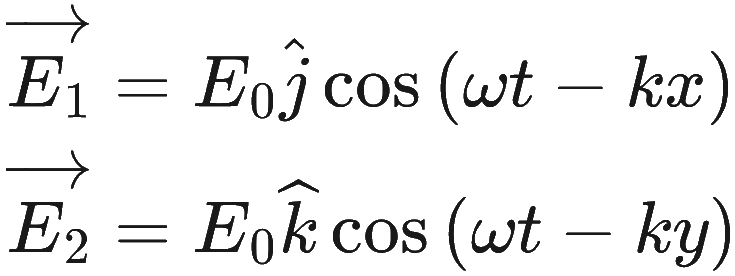 and