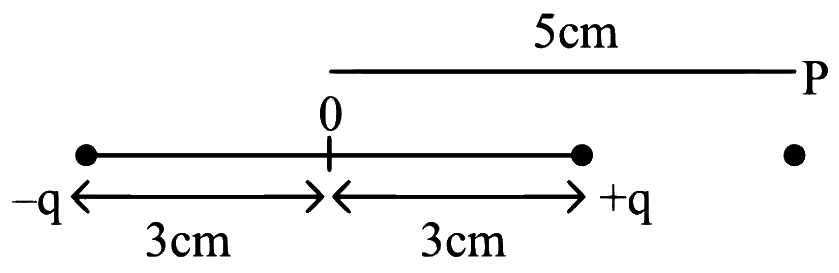
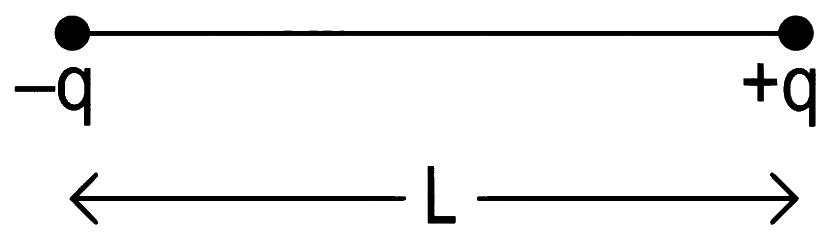
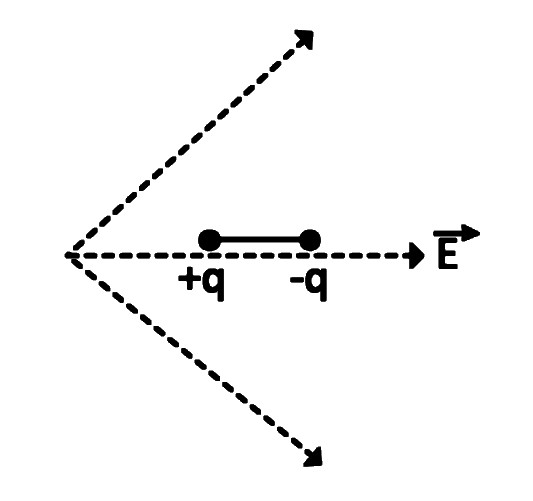
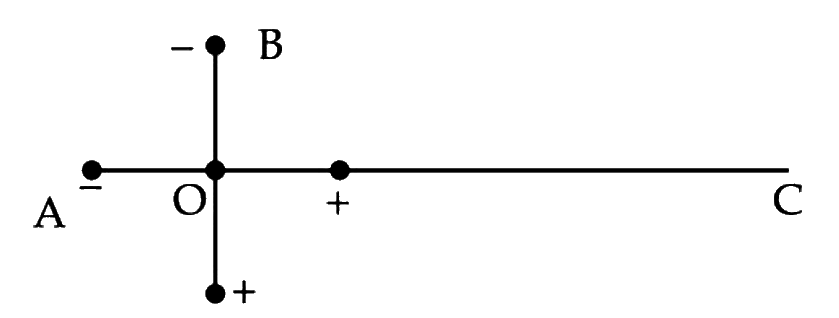
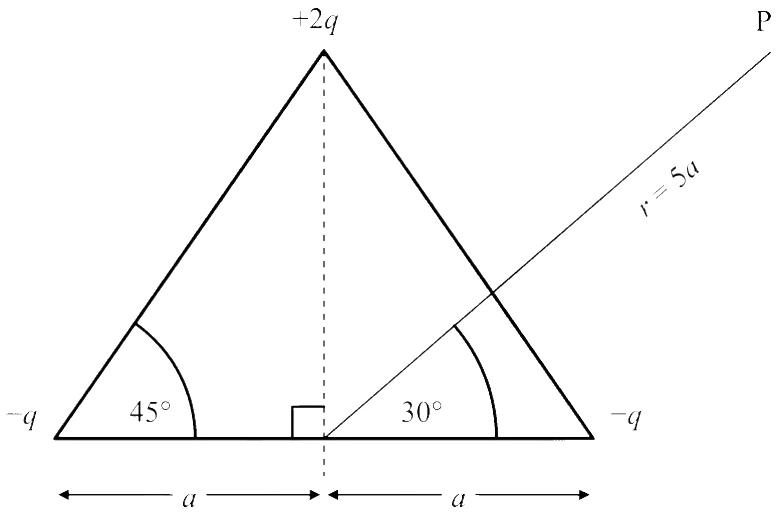
Three charges +2q,+3q and −4q are situated at (0,−3a),(2a,0) and (−2a,0) respectively in the xy plane. The resultant dipole moment about origin is ______.
A dipole of electric dipole moment P is placed in an electric field of strength E. The angle between P and E for which the potential energy of the electric dipole is maximum, is
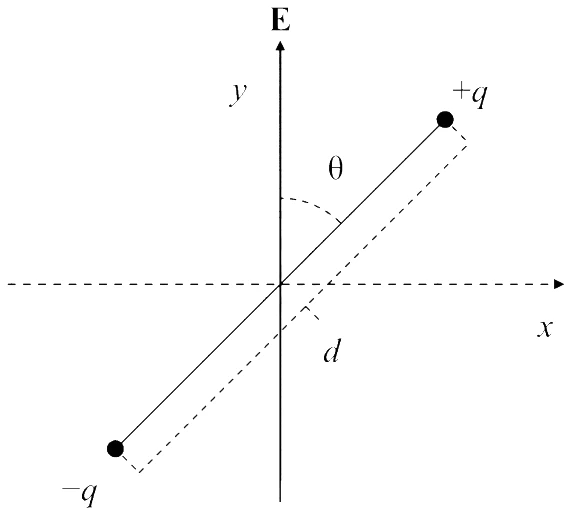
An electric dipole of length 3cm is placed with its axis making an angle of 60∘ with a uniform electric field of 5×10⁴N/C. It experiences a torque of 93 Nm. The magnitude of charge on the dipole is (sin60∘=23)
An electric dipole of length 0.5μm is placed with its axis making an angle of 30∘ with uniform electric field 104 V/m. If it experiences a torque of 5×10⁻⁹ Nm, the magnitude of the charge on the dipole is (sin30∘=0.5)
A rigid dipole undergoes a simple harmonic motion about its centre in the presence of an electric field E1=E0x^. If another electric field E2=2E0(y^+z^) is introduced to the system, what will be the percentage change in the frequency of the oscillation (approximate)?
Two electric dipoles of moment P and 8P are placed in opposite directions on a line at a distance of 24 cm. The electric field will be zero at the point between the dipoles whose distance from the dipole of moment P will be x1. When 8P is replaced by 27P keeping all other quantities the same, the distance x1 now becomes x2. The difference ∣x2−x1∣ is ( All the distances are measured from the centers of the dipole.)
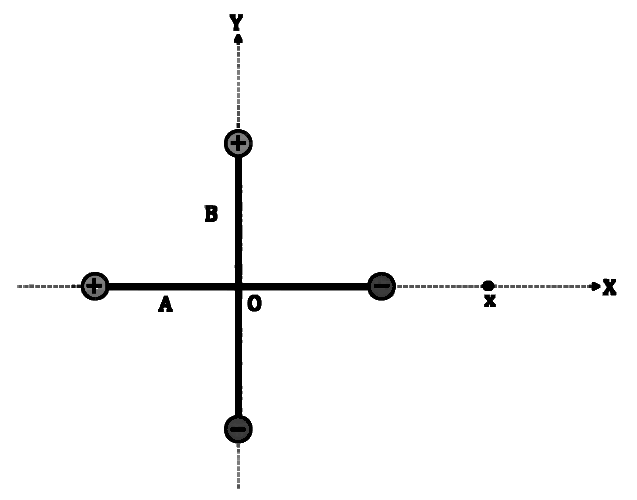
Two short electric dipoles A and B having dipole moment p1 and p2 respectively are placed with their axes mutually perpendicular as shown in the figure. The resultant electric field at a point x is making an angle of 60∘ with the line joining points O and x. The ratio of the dipole moments p2/p1 is _________.
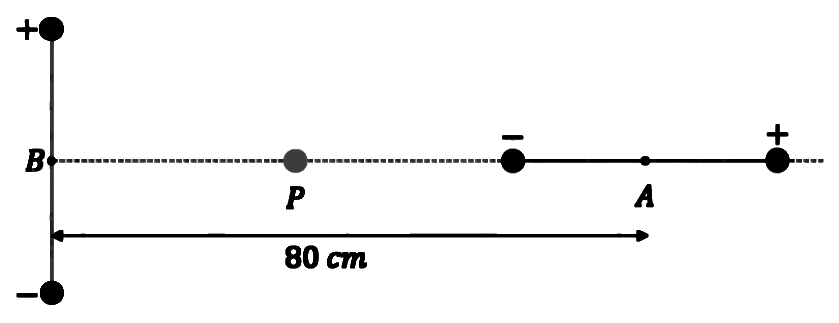
Two short dipoles (A,B),A having charges ±2μC and length 1 cm and B having charges ±4μC and length 1 cm are placed with their centres 80 cm apart as shown in the figure. The electric field at a point P, equi-distant from the centres of both dipoles is ______ N/C.
An electric dipole of length 2 cm is placed with its axis making an angle of 60∘ to a uniform electric field of 10+5 N/C. If it experiences a torque of 93 Nm, the magnitude of the charge on the dipole is (sin60∘=23)
An electric dipole having each charge of magnitude 2μC is placed in an electric field of intensity 8×10+4 N/C. If the maximum torque acting on the dipole is 4×10⁻³ N-m, the length of the dipole is
An electric dipole of dipole moment ' p ' is aligned parallel to a uniform electric field ' E '. The energy required to rotate the dipole by 90∘ is [sin0∘=0,cos0∘=1,sin90∘=1cos90∘=0]
An electric dipole with dipole moment 5×10⁻⁶ Cm is aligned with the direction of a uniform electric field of magnitude 4×10⁵ N/C. The dipole is then rotated through an angle of 60∘ with respect to the electric field. The change in the potential energy of the dipole is:
A dipole with two electric charges of 2 µC magnitude each, with separation distance 0.5 µm, is placed between the plates of a capacitor such that its axis is parallel to an electric field established between the plates when a potential difference of 5 V is applied. Separation between the plates is 0.5 mm. If the dipole is rotated by 30° from the axis, it tends to realign in the direction due to a torque. The value of torque is:
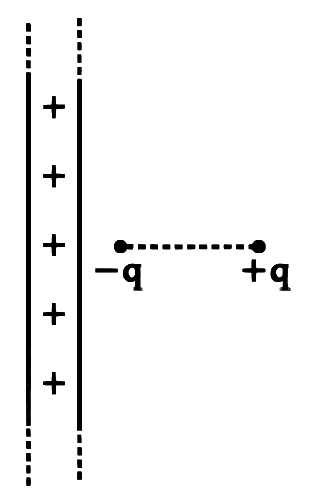
An electric dipole is placed at a distance of 2 cm from an infinite plane sheet having positive charge density σ0. Choose the correct option from the following.
Two point charges −4μC and 4μC, constituting an electric dipole, are placed at (−9,0,0) cm and (9,0,0) cm in a uniform electric field of strength 104 NC−1. The work done on the dipole in rotating it from the equilibrium through 180∘ is:
An electric dipole of dipole moment 6×10⁻⁶ Cm is placed in uniform electric field of magnitude 106 V/m. Initially, the dipole moment is parallel to electric field. The work that needs to be done on the dipole to make its dipole moment opposite to the field, will be _______ J.
Numerical answer type. Work it out, then open the answer.
Given below are two statements: one is labelled as Assertion (A) and the other is labelled as Reason (R).
Assertion (A): Net dipole moment of a polar linear isotropic dielectric substance is not zero even in the absence of an external electric field.
Reason (R): In absence of an external electric field, the different permanent dipoles of a polar dielectric substance are oriented in random directions.
In the light of the above statements, choose the most appropriate answer from the options given below:
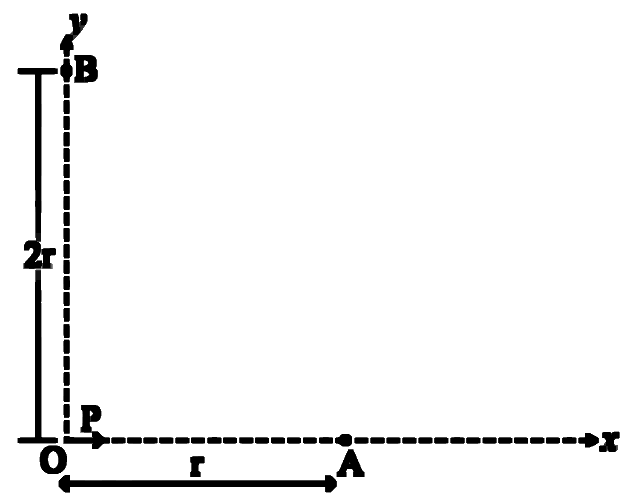
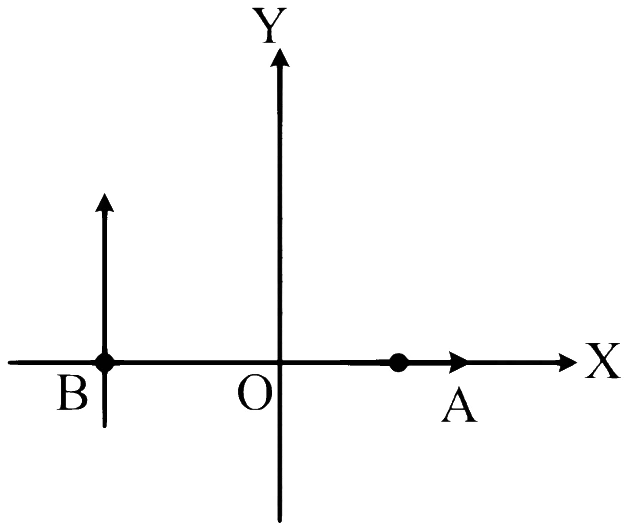
For a short dipole placed at origin O, the dipole moment P is along x-axis, as shown in the figure. If the electric potential and electric field at A are V0 and E0, respectively, then the correct combination of the electric potential and electric field, respectively, at point B on the y-axis is given by
Two small spherical balls of mass 10 g each with charges −2μC and 2μC, are attached to two ends of very light rigid rod of length 20 cm. The arrangement is now placed near an infinite nonconducting charge sheet with uniform charge density of 100μC/m2 such that length of rod makes an angle of 30∘ with electric field generated by charge sheet. Net torque acting on the rod is: (Take ε0:8.85×10⁻¹² C2/Nm2)
An electric dipole of mass m, charge q, and length l is placed in a uniform electric field E=E0i^. When the dipole is rotated slightly from its equilibrium position and released, the time period of its oscillations will be:
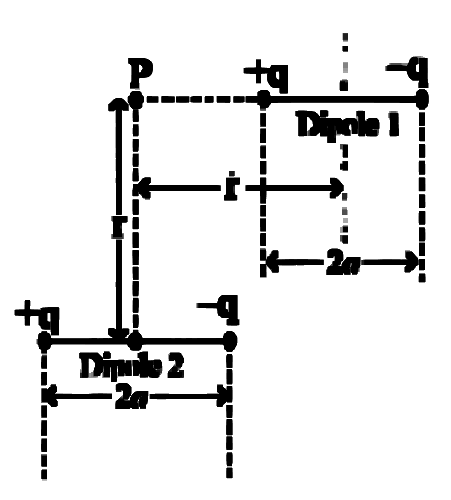
A point particle of charge Q is located at P along the axis of an electric dipole 1 at a distance r as shown in the figure. The point P is also on the equatorial plane of a second electric dipole 2 at a distance r. The dipoles are made of opposite charge q separated by a distance 2a. For the charge particle at P not to experience any net force, which of the following correctly describes the situation?
The electric potential at a point on the axis of an electric dipole is proportional to [r = distance between centre of the electric dipole and the point]
Given below are two statements: one is labelled as Assertion A and the other is labelled as Reason R.
Assertion A: The potential (V) at any axial point, at 2 m distance (r) from the centre of the dipole of dipole moment vector P of magnitude, 4×10⁻⁶ Cm, is ±9×10³ V.
(Take 4πϵ01=9×10⁹ SI units)
Reason R: V=±4πϵ0r22P, where r is the distance of any axial point, situated at 2 m from the centre of the dipole.
In the light of the above statements, choose the correct answer from the options given below:
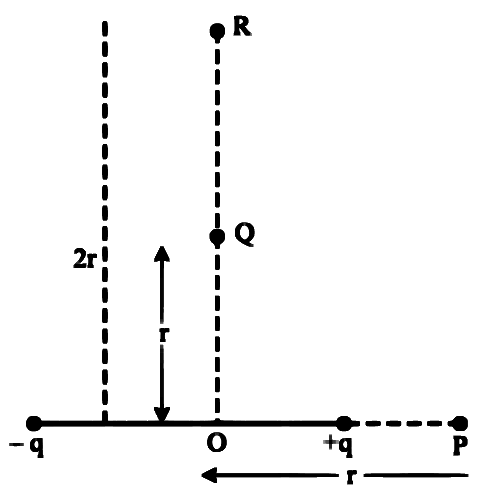
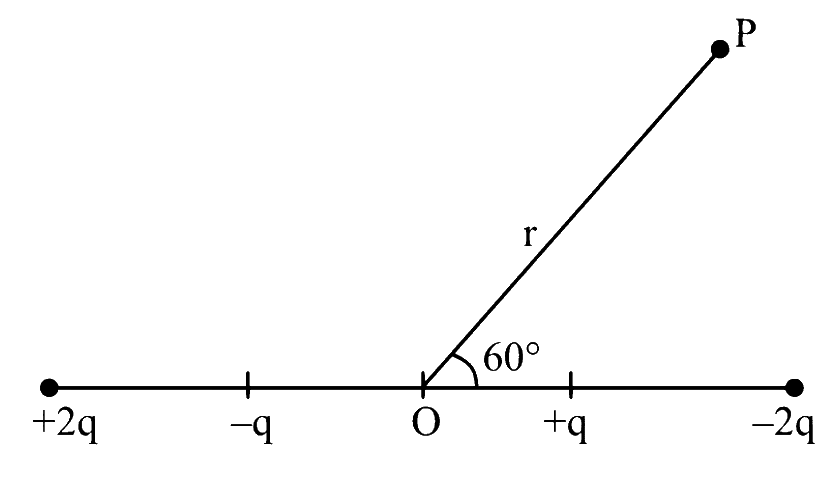
The distance between charges +q and −q is 2l and between +2q and −2q is 4l. The electrostatic potential at point P at a distance r from center O is −α[r2ql]×109 V, where the value of α is __________. (Use 4πε01=9×10⁹ Nm2C−2)
Numerical answer type. Work it out, then open the answer.
An electric dipole of momentpis lying along a uniform electric field E. The work done in rotating the dipole through 3πc is [sin30∘=cos60∘=0.5,cos30∘=sin60∘=3/2]
Two charges of −4μC and +4μC are placed at the points A(1,0,4) m and B(2,−1,5) m located in an electric field E=0.20i^ V/cm. The magnitude of the torque acting on the dipole is 8α×10−5 Nm, where α= _________.
Numerical answer type. Work it out, then open the answer.
If Ea and Eq represent the electric field intensity due to a short dipole at a point on its axial line and on the equatorial line at the same distance 'r' from the centre of the dipole, then
An electric dipole consisting of two opposite charges of 2×10⁻⁶ C separated by a distance of 3 cm placed in an electric field of 2×10⁵ N/C then the maximum torque acting on dipole is
An electric dipole is placed at an angle of 30∘ with an electric field of intensity 2×10⁵ NC−1. It experiences a torque equal to 4 N m. Calculate the magnitude of charge on the dipole, if the dipole length is 2 cm.
Two charges each of magnitude 0.01 C and separated by a distance of 0.4 mm constitute an electric dipole. If the dipole is placed in an uniform electric field 'E' of 10 dyne/C making 30∘ angle with E, the magnitude of torque acting on dipole is:
An electric dipole of dipole moment 6.0×10⁻⁶ Cm is placed in a uniform electric field of 1.5×10³ NC−1 in such a way that dipole moment is along electric field. The work done in rotating dipole by 180∘ in this field will be ___________ mJ.
Numerical answer type. Work it out, then open the answer.
If the magnitude of intensity of electric field at a distance 'r1 ' on an axial line and at a distance 'r2 ' on an equatorial line due to a given short dipole are equal, then r1:r2, is
The work done in rotating a dipole placed parallel to the electric field through 180∘ is W. So, the work done in rotating it through 60∘ is (cos0∘=1,cos60∘=21,cos180∘=−1)
Two electric dipoles of moment P and 27P are placed on a line with their centres 24 cm apart. Their dipole moments are in opposite direction. At which point the electric field will be zero between the dipoles from the centre of dipole of moment P?
A dipole comprises of two charged particles of identical magnitude q and opposite in nature. The mass 'm' of the positive charged particle is half of the mass of the negative charged particle. The two charges are separated by a distance 'l'. If the dipole is placed in a uniform electric field 'E'; in such a way that dipole axis makes a very small angle with the electric field, 'E'. The angular frequency of the oscillations of the dipole when released is given by:
Two electric dipoles of dipole moments 1.2×10⁻³⁰ Cm and 2.4×10⁻³⁰ Cm are placed in two different uniform electric fields of strengths 5×10⁴ NC−1 and 15×104 NC−1 respectively. The ratio of maximum torque experienced by the electric dipoles will be x1. The value of x is __________.
Numerical answer type. Work it out, then open the answer.
Given below two statements: One is labelled as Assertion (A) and other is labelled as Reason (R). Assertion (A): Non-polar materials do not have any permanent dipole moment. Reason (R): When a non-polar material is placed in an electric field, the centre of the positive charge distribution of it's individual atom or molecule coincides with the centre of the negative charge distribution.
In the light of above statements, choose the most appropriate answer from the options given below.
An electric dipole having dipole moment P=q×2ℓ is placed in a uniform electric field 'E'. The dipole moment is along the direction of the field. The force acting on it and its potential energy are respectively
Two ideal electric dipoles A and B, having their dipole moment p1 and p2 respectively are placed on a plane with their centres at O as shown in the figure. At point C on the axis of dipole A, the resultant electric field is making an angle of 37∘ with the axis. The ratio of the dipole moment of A and B, p2p1 is: (take sin37∘=53)
An electric dipole is placed on x-axis in proximity to a line charge of linear charge density 3.0 × 10 −6 C/m. Line charge is placed on z-axis and positive and negative charge of dipole is at a distance of 10 mm and 12 mm from the origin respectively. If total force of 4N is exerted on the dipole, find out the amount of positive or negative charge of the dipole.
A short electric dipole has a dipole moment of 16 × 10-9 Cm. The electric potential due to the dipole at a point at a distance of 0.6 m from the centre of the dipole, situated on a line making an angle of 60∘ with the dipole axis is:
Two identical electric point dipoles have dipole moments p1=pi^ and p2=−pi^ and are held on the x axis at distance 'a' from each other. When released, they move along the x-axis with the direction of their dipole moments remaining unchanged. If the mass of each dipole is 'm', their speed when they are infinitely far apart is:
A point dipole p=−p0x^ is kept at the origin. The potential and electric field due to this dipole on the y-axis at a distance d are, respectively: (Take V= 0 at infinity)
An electric field of 1000 V/m is applied to an electric dipole at angle of 45o. The value of electric dipole moment is 10–29 C.m. What is the potential energy of the electric dipole?
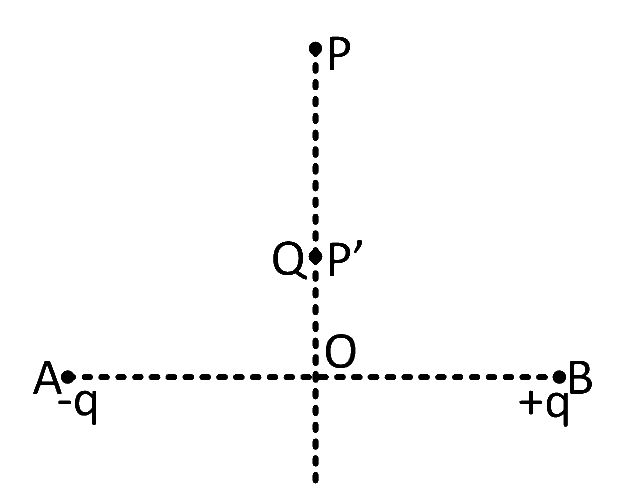
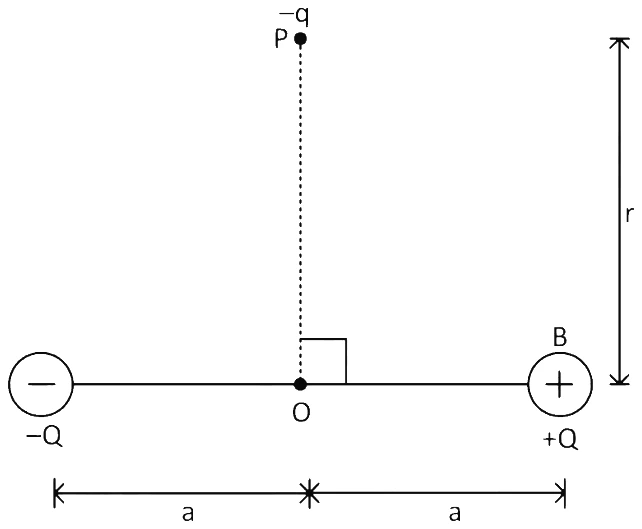
Charges –q and +q located at A and B, respectively, constitude an electric dipole. Distance AB = 2a, O is the mid point of the dipole and OP is perpendicular to AB. A charge Q is placed at P where OP = y and y >> 2a. The charge Q experiences an electrostatic force F. If Q is now moved along the equatorial line to P' such that OP' = (3y), the force on Q will be close to - (3y≫2a)
An electric dipole is formed by two equal and opposite charges q with separation d. The charges have same mass m. It is kept in a uniform electric field E. If it is slightly rotated from its equilibrium orientation, then its angular frequency ω is :-
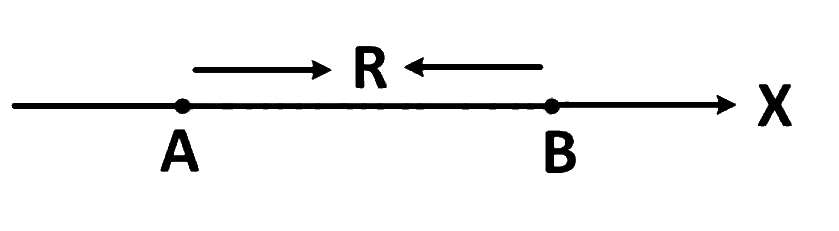
Two electric dipoles, A, B with respective dipole moments dA=−4qai^ and dB=−2qai^ are placed on the x-axis with a separation R, as shown in the figure. The distance from A at which both of them produce the same potential is -
An electric dipole has a fixed dipole moment p, which makes angle θ with respect to x-axis. When subjected to an electric field E1=Ei^, it experiences a torque T1=τk^. When subjected to another electric field E2=3E1j^ it experiences a torque T2=−T1. The angle θ is:
An electric dipole is placed at an angle of 30o with an electric field intensity 2 × 10⁵ N C−1. It experiences a torque equal to 4 N m. The charge on the dipole, if the dipole length is 2 cm, is
An electric dipole of moment p is placed in an electric field of intensity E. The dipole acquires a position such that the axis of the dipole makes an angle θ with the direction of the field. Assuming that the potential energy of the dipole to be zero when θ = 90o, the torque and the potential energy of the dipole will respectively be
An electric dipole has the magnitude of its charge as q and its dipole moment is p. It is placed in a uniform electric field E. If its dipole moment is along the direction of the field, the force on it and its potential energy are respectively
A point Q lies on the perpendicular bisector of an electrical dipole of dipole moment p. If the distance of Q from the dipole is r (much larger than the size of the dipole) then electric field at Q is proportional to
An electric dipole of moment p is placed in the position of stable equilibrium in uniform electric field of intensity E. This is rotated through an angle θ from the initial position. The potential energy of the electric dipole in the final position is
Consider an electric dipole comprising two charges +q and −q each with mass m, separated by a fixed distance d and initially at rest with its dipole moment pointing along i^. A uniform electric field Ej^ is turned on at time t=0 and it is turned off at t=tf, when the dipole moment makes an angle θf with i^. Neglecting any sources of energy loss, correct option(s) is/are :
More than one option can be correct. Tap every correct option, then tap Check.
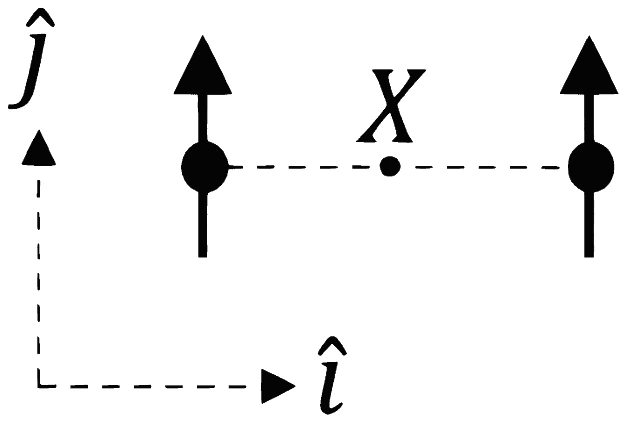
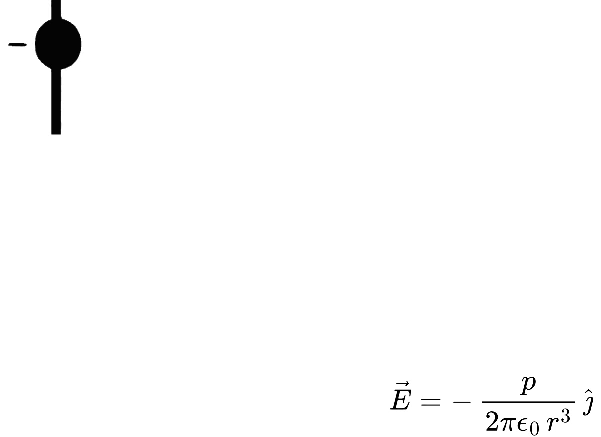
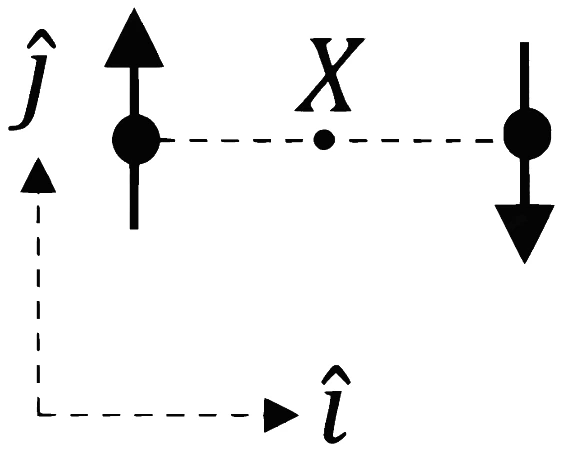
List-I shows four configurations, each consisting of a pair of ideal electric dipoles. Each dipole has a dipole moment of magnitude p, oriented as marked by arrows in the figures. In all the configurations the dipoles are fixed such that they are at a distance 2r apart along the x direction. The midpoint of the line joining the two dipoles is X. The possible resultant electric fields E at X are given in List-II. Choose the option that describes the correct match between the entries in List-I to those in List-II.
List-I
List-II
(P) Both dipoles pointing along +j^ (parallel, side by side)
(1) E=0
(Q) Left dipole along +j^, right dipole along −j^
(2) E=−2πϵ0r3pj^
(R) Left dipole along +j^, right dipole along +i^
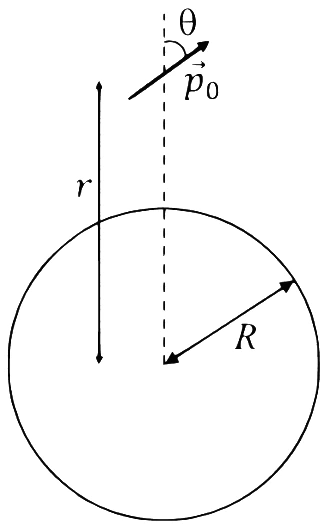
A small electric dipole p0, having a moment of inertia I about its center, is kept at a distance r from the center of a spherical shell of radius R. The surface charge density σ is uniformly distributed on the spherical shell. The dipole is initially oriented at a small angle θ as shown in the figure. While staying at a distance r, the dipole is free to rotate about its center.
If released from rest, then which of the following statement(s) is(are) correct?
[ε0 is the permittivity of free space.]
More than one option can be correct. Tap every correct option, then tap Check.
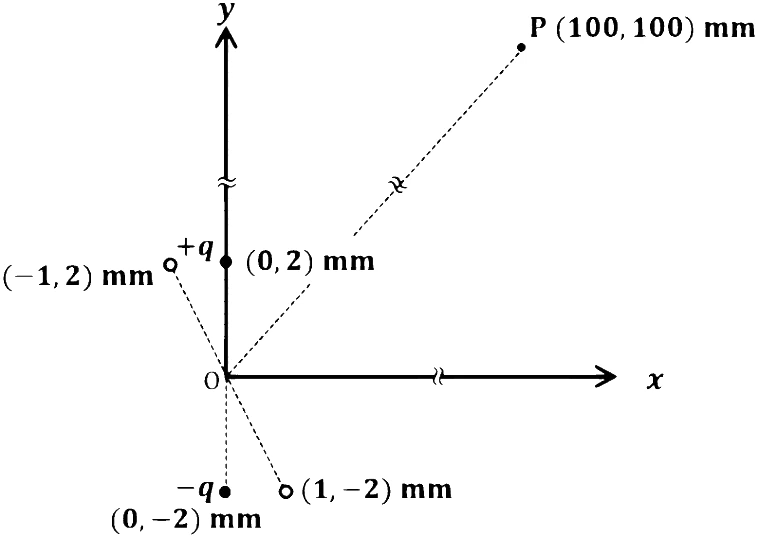
An electric dipole is formed by two charges +q and −q located in xy-plane at (0,2)mm and (0,−2)mm, respectively, as shown in the figure. The electric potential at point P(100,100)mm due to the dipole is V0. The charges +q and −q are then moved to the points (−1,2)mm and (1,−2)mm, respectively. What is the value of electric potential at P due to the new dipole?
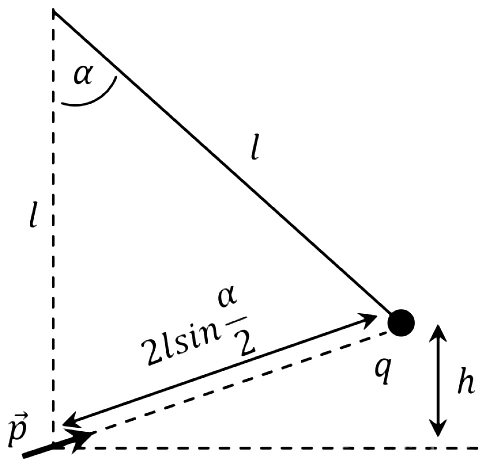
A point charge q of mass m is suspended vertically by a string of length l. A point dipole of dipole moment p is now brought towards q from infinity so that the charge moves away. The final equilibrium position of the system including the direction of the dipole, the angles and distances is shown in the figure below. If the work done in bringing the dipole to this position is N×(mgh), where g is the acceleration due to gravity, then the value of N is ________. (Note that for three coplanar forces keeping a point mass in equilibrium, sinθF is the same for all forces, where F is any one of the forces and θ is the angle between the other two forces)
Numerical answer type. Work it out, then open the answer.
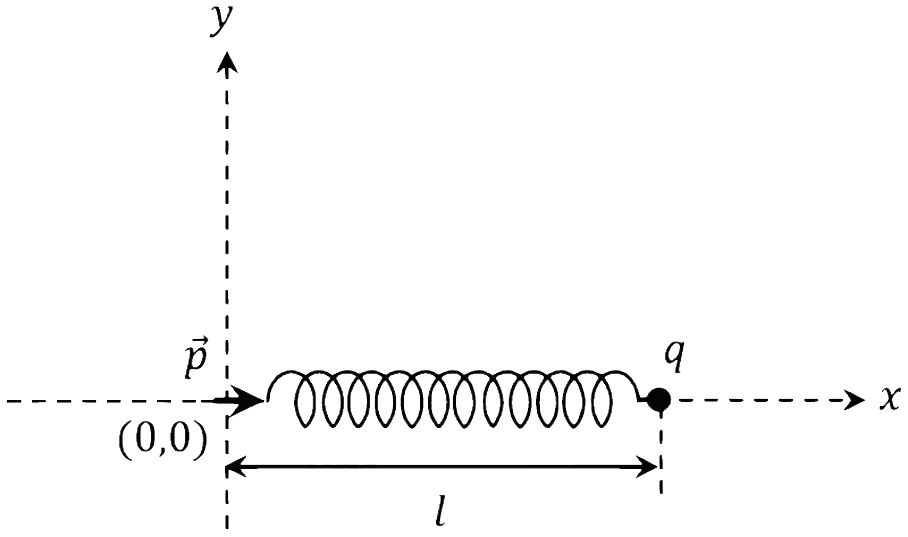
One end of a spring of negligible unstretched length and spring constant k is fixed at the origin (0,0). A point particle of mass m carrying a positive charge q is attached at its other end. The entire system is kept on a smooth horizontal surface. When a point dipole p pointing towards the charge q is fixed at the origin, the spring gets stretched to a length l and attains a new equilibrium position (see figure below). If the point mass is now displaced slightly by Δl≪l from its equilibrium position and released, it is found to oscillate at frequency δ1mk. The value of δ is ______.
Numerical answer type. Work it out, then open the answer.
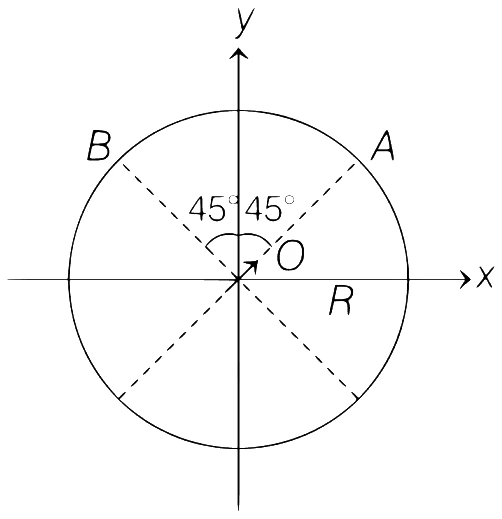
An electric dipole with dipole moment 2p0(i^+j^) is held fixed at the origin O in the presence of a uniform electric field of magnitude E0.
If the potential is constant on a circle of radius R centered at the origin as shown in figure, then the correct statement(s) is/are, (ϵ0 is the permittivity of the free space, R≫ dipole size)
More than one option can be correct. Tap every correct option, then tap Check.
Assertion : The electric field due to a dipole on its axis line at a distance r is E. Then, electric field due to the same dipole on the equatorial line and at the same distance will be E/2. Reason : Electric field due to dipole varies inversely as the square of the distance.
Let Ea be the electric field due to dipole in its axial plane at distance l and let Eeq be the field in the equatorial plane at a distance l′, then the relation between Ea and Eeq will be
Three point charges +q, −2q and +q are placed at points (x=0,y=a,z=0), (x=0,y=0,z=0) and (x=a,y=0,z=0), respectively. The magnitude and direction of the electric dipole moment vector of this charge assembly are
Three points charges +q, −2q and +q are placed at points (x=0,y=a,z=0), (x=0,y=0,z=0) and (x=a,y=0,z=0), respectively. The magnitude and direction of the electric dipole moment vector of this charge assembly are
The work done in turning an electric dipole of dipole moment p in a uniform electric field E from the position of stable equilibrium to unstable equilibrium is
Two point charges of +3μC and −3μC are placed at a certain distance apart from each other. Electric potential at a distance 60cm from the mid-point of dipole on axial line is 150V, then the value of dipole length is
Two point dipoles pk^ and 2pk^ are located at (0,0,0) and (1m,0,2m) respectively. The resultant electric field due to the two dipoles at the point (1m,0,0) is
Two points masses, m each carrying charges −q and +q are attached to the ends of a massless rigid non-conducting wire of length L. When this arrangement is placed in a uniform electric field, then it deflects through an angle θ. The minimum time needed by rod to align itself along the field is
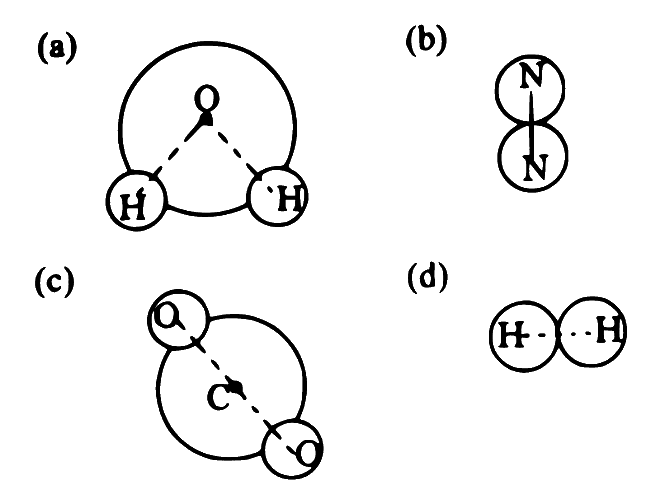
A neutral water molecule (H2O) in its vapour state has an electric dipole moment of magnitude 6.4×10⁻³⁰C m. How far apart are the molecules centres of positive and negative charges?
An electric dipole consists of two opposite charges of magnitude q=1×10⁻⁶C separated by 2.0cm. The dipole is placed in an external field of 1×10⁵N C−1. What maximum torque does the field exert on the dipole? How much work must an external agent do to turn the dipole end to end, starting from position of alignment (θ=0∘)?
A sample of HCl gas is placed in an electric field 3×10⁴N C−1. The dipole moment of each HCl molecule is 6×10⁻³⁰C m. The maximum torque that can act on a molecule is
Two point charges of equal magnitude 0.01C and opposite in sign are separated by 0.2mm, forming an electric dipole. The electric dipole moment of the dipole is:
In a uniform electric field 106N C−1 an electric dipole of length 4cm is placed with its axis making an angle 60∘ with the electric field. If the dipole experiences a torque of 83N m. Find the potential energy of the dipole.
Two electric dipoles of dipole moments 3.9×10⁻³⁰C m and 5.2×10⁻³⁰C m are placed in two different uniform electric fields of strengths 16×104N C−1 and 4×10⁴N C−1 respectively. What is the ratio of maximum torque experienced by the electric dipoles?
A neutral water molecule is placed in an electric field E=2.5×10⁴N C−1. The work done to rotate it by 180∘ is 5×10⁻²⁵J. Find the approximate separation of centre of charges.
A square shaped aluminium coin weighs 0.75g and its diagonal measures 14mm. It has equal amounts of positive and negative charges. Suppose those equal charges were concentrated in two charges (+Q and −Q) that are separated by a distance equal to the side of the coin, the dipole moment of the dipole is
An electric dipole is placed in a uniform electric field with the dipole axis making an angle θ with the direction of the electric field. The orientation of the dipole for stable equilibrium is
The potential energies associated with four orientations of an electric dipole in an electric field are (i) −5U0 (ii) −7U0 (iii) 3U0 (iv) 5U0 where U0 is positive. Rank the orientations according to the angle between the electric dipole moment p and electric field E, greatest first.
An electric dipole of dipole moment P is placed in the uniform electric field E. Then which of the following statements are correct? Statement-I: The torque on the dipole is P×E Statement-II: The potential energy of the dipole is −P⋅E Statement-III: The net force on the dipole is non-zero.
In the situation shown in the diagram, if q≪∣Q∣ and r≫a, the net force on the free charge −q and the net torque on it about O at the instant shown are respectively. (p=2aQ is the dipole moment)
An electric dipole with dipole moment 4×10⁻⁹C m is aligned at 30∘ with the direction of a uniform electric field of magnitude 5×10⁴N C−1. The magnitude of the torque acting on the dipole is
A dipole moment p and moment of inertia I is placed in a uniform electric field E. If it is displaced slightly from its stable equilibrium position, the period of oscillation of dipole is
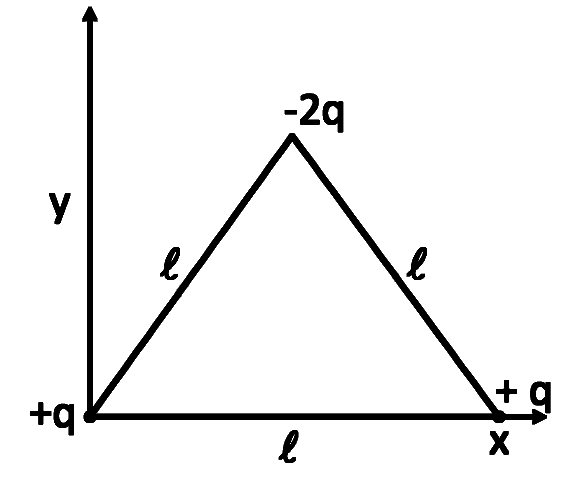
Three point charges of +2q, +2q and −4q are placed at the corners A, B and C of an equilateral triangle ABC of side x. The magnitude of the electric dipole moment of this system is
1μC, −1μC charges are placed at a distance of 5cm in forming a dipole. The amount of torque required to place this dipole perpendicular to an electric field of 3×10⁵N C−1 is given by
Two electric charges +3.2×10⁻¹⁹C and −3.2×10⁻¹⁹C are placed 2.4A˚ apart form an electric dipole. It is placed in uniform electric field of intensity 4×10⁵V/m. The work done to rotate the electric dipole from the equilibrium position by 180∘ is
An electric dipole with dipole moment 2×10⁻¹⁰C m is aligned at an angle 30∘ with the direction of uniform electric field of 104N C−1. The magnitude of the torque acting on the dipole is
A neutral ammonia NH3 in its vapour state has electric dipole moment of magnitude 5×10⁻³⁰C m. How far apart are the molecules' centres of positive and negative charge?
Two electric dipoles, each of dipole moment p are placed at points A(a,0) and B(−a,0) as shown in the figure. The work done in rotating both the dipoles through 90∘ in clockwise direction is (E = Electric field)
An electric dipole with dipole moment 5×10⁻⁷C m is in the electric field of 2×10⁴N C−1 at an angle of 60∘ with the direction of the electric field. The torque acting on the dipole is
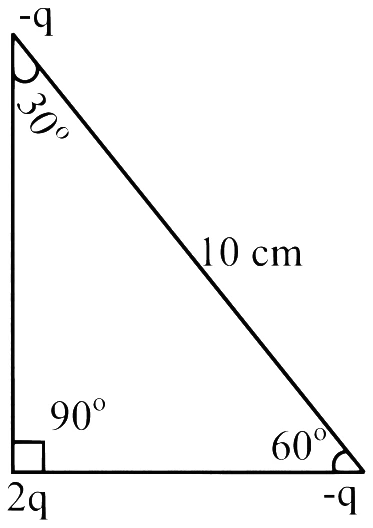
Three charges are arranged on the vertices of a right angle triangle as shown in the figure. The magnitude of dipole moment of the combination in the unit of C-cm is
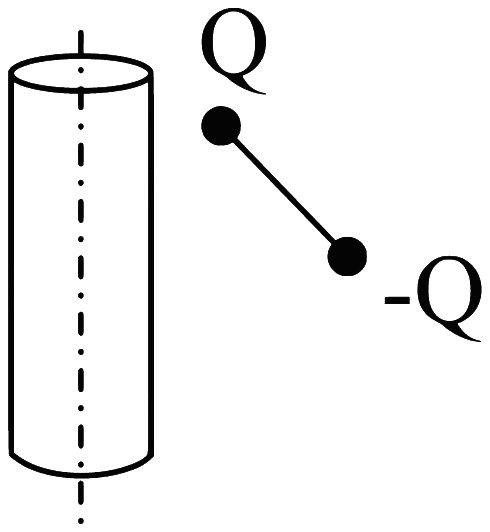
Consider a positively charged infinite cylinder with uniform volume charge density ρ>0. An electric dipole consisting of +Q and −Q charges attached to opposite ends of a massless rod is oriented as shown in the figure. At the instant as shown in the figure, the dipole will experience,
An electric dipole of dipole moment p is placed at the origin of the co-ordinate system along the z-axis. The amount of work required to move a charge q from the point (a,0,0) to the point (0,0,a) is,
An electric dipole having point charges +q and −q, separated by a fixed distance d is kept under the influence of a uniform electric field E, such that the axis of the dipole is making an angle θ=45∘ with the direction of E, as shown in the figure. If the electric dipole is allowed to rotate in the xy-plane with its centre being stationary, what is the magnitude of the net torque acting on the electric dipole?
Three point charges are arranged in the x−y plane as shown in the figure. Assuming that the potential at infinity is zero, the approximate potential at the point P in the figure is
An electric dipole of length 2cm is placed at an angle of 30∘ with an electric field 2×10⁵N/C. If the dipole experiences a torque of 8×10⁻³N m, the magnitude of either charge of the dipole, is

 Electrostatics · Lecture 3 · Electric Dipole & Torque on a Dipole1:01:46
 Electrostatics (Part 2) · Electric Dipole, Electric Flux & Gauss Law59:10All 14 Electrostatics videos →