A box of mass 15 kg is kept on the floor of a stationary trolley. The coefficient of static friction between the box and the trolley is 0.12. Keeping the box in stationary state over the trolley, the maximum acceleration with which the trolley can be moved horizontally in ms−2 is: (g=10 m/s2)
A block of mass 1 kg is kept on ice surface. When velocity of 4 m/s is given to it, it stops by friction in 5 second. The coefficient of friction is (acceleration due to gravity, g=10 m/s2)
A heavy box of mass 50 kg is moving on a horizontal surface. If co-efficient of kinetic friction between the box and horizontal surface is 0.3 then force of kinetic friction is:
A wooden block, initially at rest on the ground, is pushed by a force which increases linearly with time t. Which of the following curve best describes acceleration of the block with time:
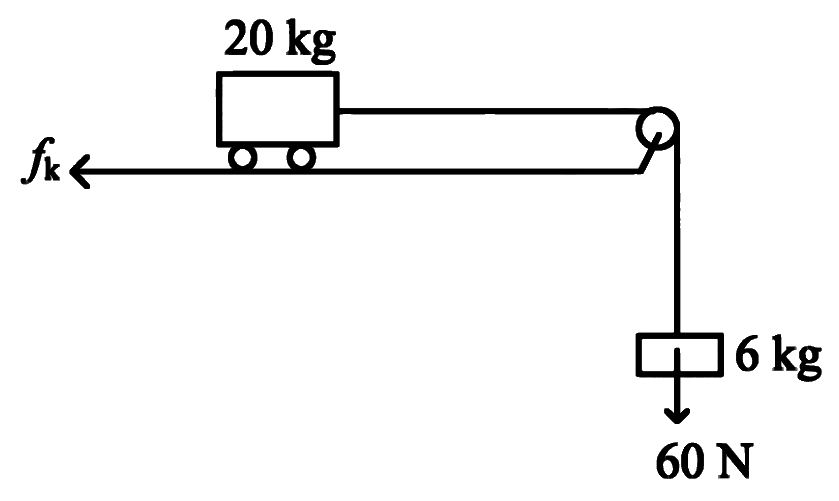
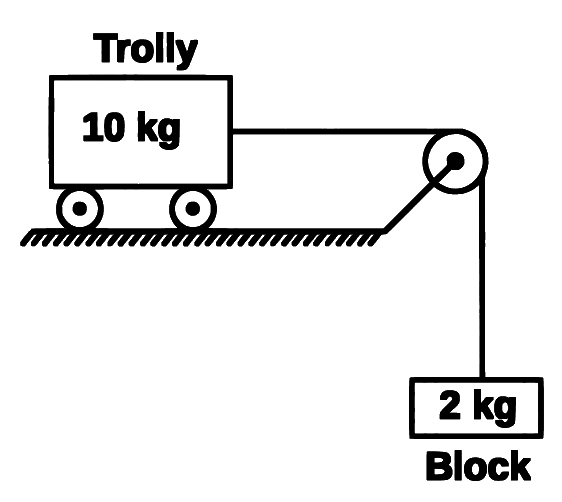
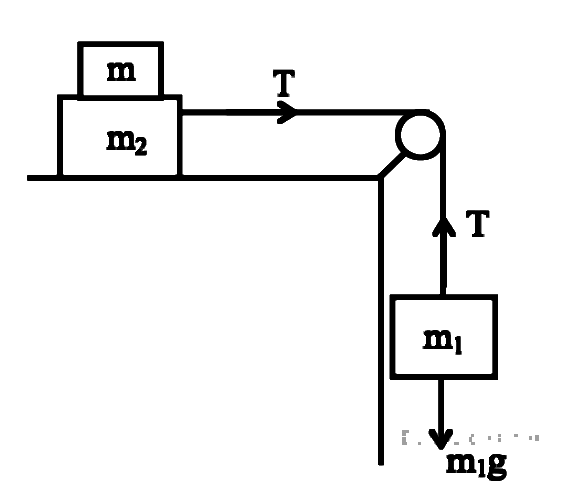
Consider a block and trolley system as shown in figure. If the coefficient of kinetic friction between the trolley and the surface is 0.04, the acceleration of the system in ms−2 is:
(Consider that the string is massless and unstretchable and the pulley is also massless and frictionless):
Calculate the maximum acceleration of a moving car so that a body lying on the floor of the car remains stationary. The coefficient of static friction between the body and the floor is 0.15 (g=10 m s−2).
A body of mass 10 kg is moving with an initial speed of 20 m/s. The body stops after 5 s due to friction between body and the floor. The value of the coefficient of friction is:
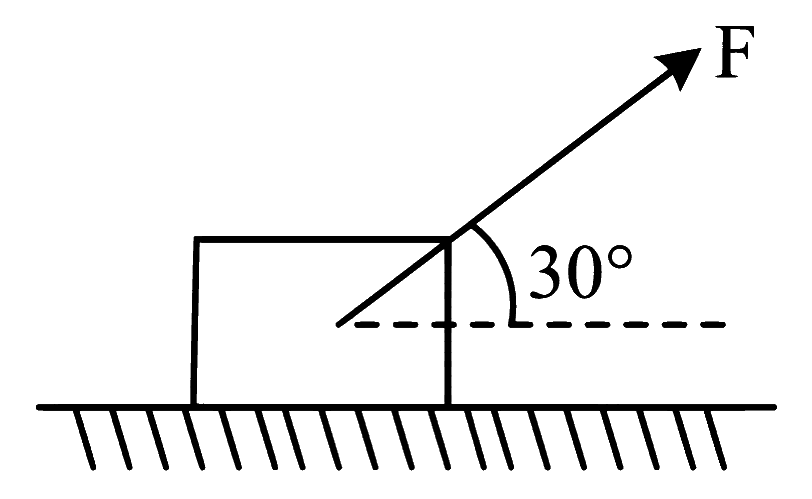
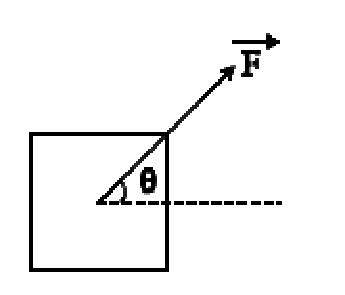
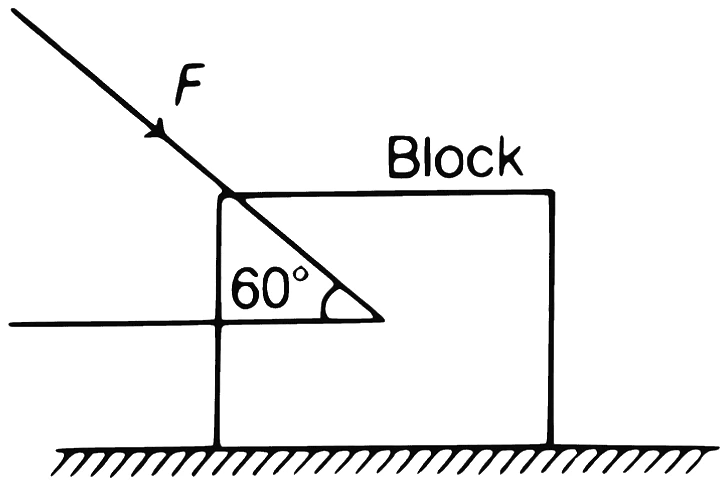
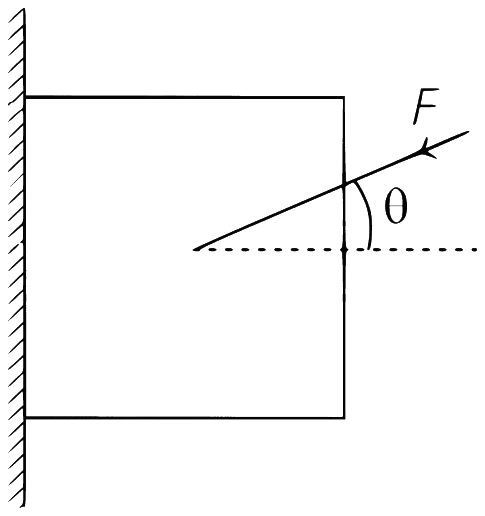
As shown in the figure a block of mass 10 kg lying on a horizontal surface is pulled by a force F acting at an angle 30∘, with horizontal. For μs=0.25, the block will just start to move for the value of F: [Given g=10 ms−2 ]
A block of mass 5 kg is placed at rest on a table of rough surface. Now, if a force of 30 N is applied in the direction parallel to surface of the table, the block slides through a distance of 50 m in an interval of time 10 s. Coefficient of kinetic friction is (given, g=10 ms−2):
A block of mass 10 kg starts sliding on a surface with an initial velocity of 9.8 ms−1. The coefficient of friction between the surface and block is 0.5. The distance covered by the block before coming to rest is:
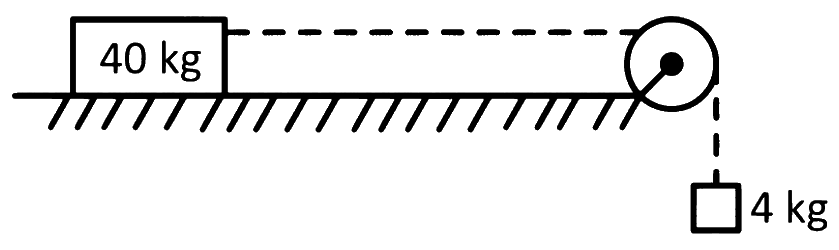
A block of mass 40 kg slides over a surface, when a mass of 4 kg is suspended through an inextensible massless string passing over frictionless pulley as shown below.
The coefficient of kinetic friction between the surface and block is 0.02. The acceleration of block is. (Given g = 10 ms−2.)
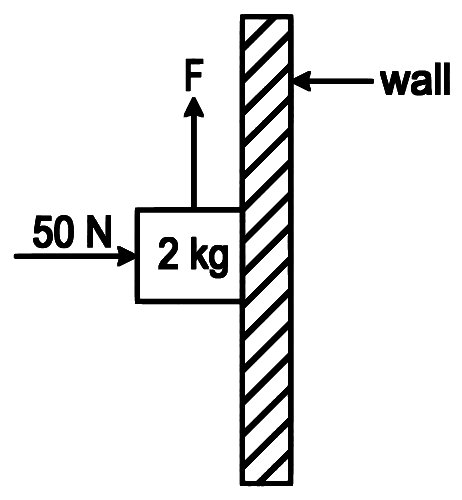
A 2 kg block is pushed against a vertical wall by applying a horizontal force of 50 N. The coefficient of static friction between the block and the wall is 0.5. A force F is also applied on the block vertically upward (as shown in figure). The maximum value of F applied, so that the block does not move upward, will be:
A bag is gently dropped on a conveyor belt moving at a speed of 2 m/s. The coefficient of friction between the conveyor belt and bag is 0.4. Initially, the bag slips on the belt before it stops due to friction. The distance travelled by the bag on the belt during slipping motion, is: [Take g=10 m/s2 ]
The coefficient of static friction between a wooden block of mass 0.5 kg and a vertical rough wall is 0.2. The magnitude of horizontal force that should be applied on the block to keep it adhere to the wall will be _________ N. [g = 10 ms−2]
Numerical answer type. Work it out, then open the answer.
A block of mass m slides along a floor while a force of magnitude F is applied to it at an angle θ as shown in figure. The coefficient of kinetic friction is μk. Then, the block's acceleration 'a' is given by: (g is acceleration due to gravity)
A body of mass 1 kg rests on a horizontal floor with which it has a coefficient of static friction 31. It is desired to make the body move by applying the minimum possible force F N. The value of F will be ____________. (Round off to the Nearest Integer) [Take g = 10 ms−2 ]
Numerical answer type. Work it out, then open the answer.
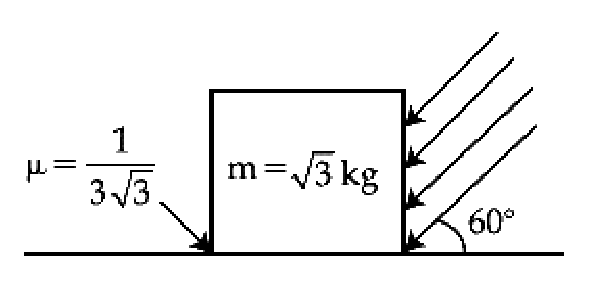
As shown in the figure, a block of mass 3 kg is kept on a horizontal rough surface of coefficient of friction 331. The critical force to be applied on the vertical surface as shown at an angle 60∘ with horizontal such that it does not move, will be 3x. The value of x will be _________. [g = 10 m/s2; sin60∘=23; cos60∘=21 ]
Numerical answer type. Work it out, then open the answer.
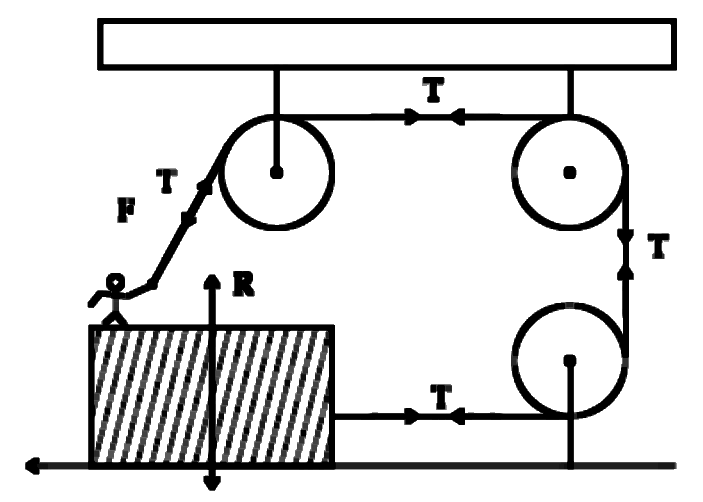
A boy of mass 4 kg is standing on a piece of wood having mass 5 kg. If the coefficient of friction between the wood and the floor is 0.5, the maximum force that the boy can exert on the rope so that the piece of wood does not move from its place is __________ N. (Round off to the Nearest Integer) [Take g = 10 ms-2 ]
Numerical answer type. Work it out, then open the answer.
A block of mass m is moving on rough horizontal surface with momentum p. The coefficient of friction between the block and surface is μ. The distance covered by block before it stops is [g= acceleration due to gravity]
Calculate the acceleration of the block and trolly system shown in the figure. The coefficient of kinetic friction between the trolly and the surface is 0.05. (g=10 m/s2, mass of the string is negligible and no other friction exists).
A body of mass m is kept on a rough horizontal surface (coefficient of friction = μ). A horizontal force is applied on the body, but it does not move. The resultant of normal reaction and the frictional force acting on the object is given by F, where F is,
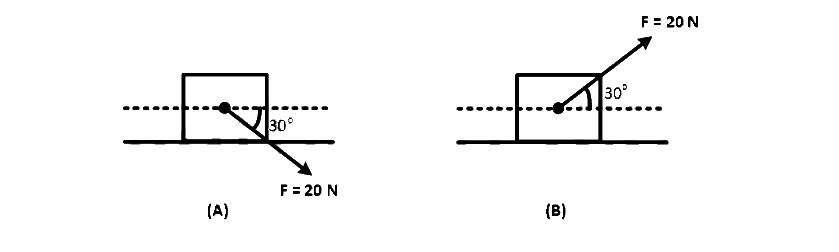
A block of mass 5 kg is (i) pushed in case (A) and (ii) pulled in case (B), by a force F = 20 N, making an angle of 30° with the horizontal, as shown in the figures. The coefficient of friction between the block and floor is μ = 0.2. The difference between the accelerations of the blocks, in case (B) and case (A) will be: (g = 10 ms–2)
Two masses m1 = 5 kg and m2 = 10 kg, connected by an inextensible string over a frictionless pulley, are moving as shown in the figure. The coefficient of friction of horizontal surface is 0.15. The minimum weight m that should be put on top of m2 to stop the motion is:
A block A of mass m1 rests on a horizontal table. A light string connected to it passes over a frictionless pully at the edge of table and from its other end another block B of mass m2 is suspended. The coefficient of kinetic friction between the block and the table is μk. When the block A is sliding on the table, the tension in the string is
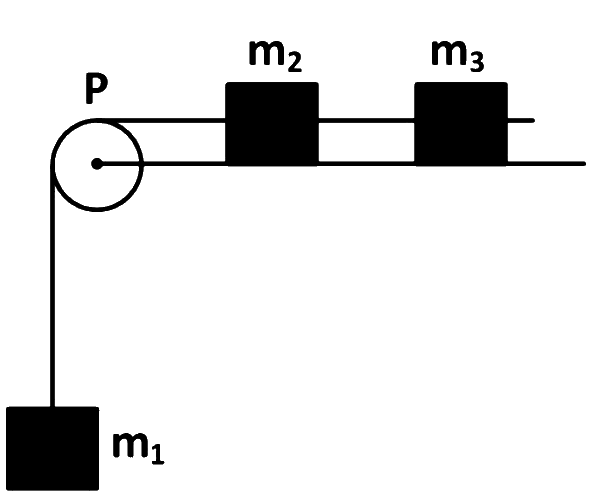
A system consists of three masses m1, m2 and m3 connected by a string passing over a pulley P. The mass m1 hangs freely and m2 and m3 are on a rough horizontal table (the coefficient of friction = μ). The pulley is frictionless and of negligible mass. The downward acceleration of mass m1 is (Assume m1 = m2 = m3 = m)
A heavy box is to be dragged along a rough horizontal floor. To do so, person A pushes it at an angle 30° from the horizontal and requires a minimum force FA, while person B pulls the box at an angle 60° from the horizontal and needs minimum force FB. If the coefficient of friction between the box and the floor is 53, the ratio FBFA is:
A block is placed on a rough horizontal plane. A time dependent horizontal force F=kt acts on the block, where k is a positive constant. The acceleration - time graph of the block is:
A conveyor belt is moving at a constant speed of 2 ms− 1. A box is gently dropped on it. The coefficient of friction between them is μ = 0.5. The distance that the box will move relativce to belt before coming to rest on it, taking g = 10 m s−2,, is
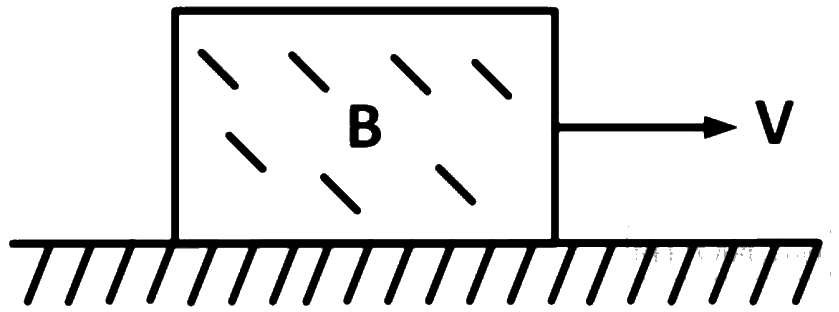
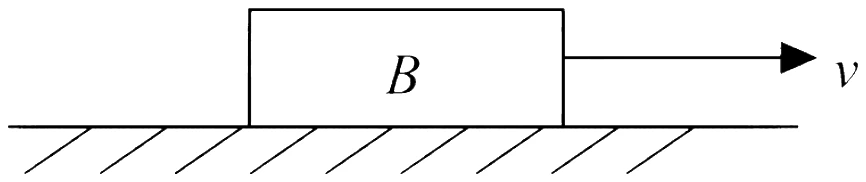
A block B is pushed momentarily along a horizontaly surface with an initial velocity V. If μ is the coefficient of sliding friction between B and the surface, block B will come to rest after a time
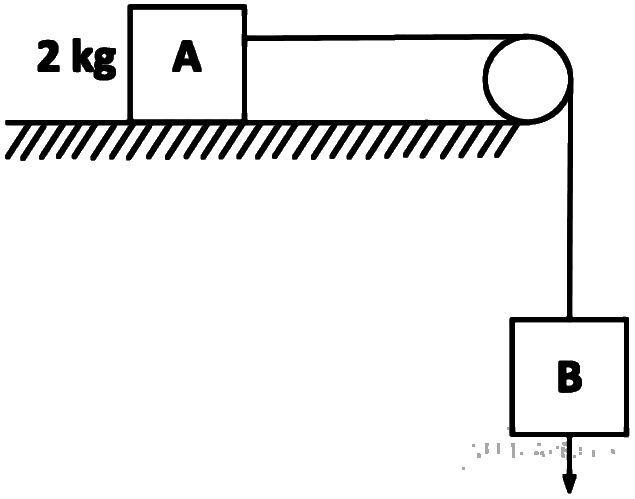
The coefficient of static friction, μs, between block A of mass 2 kg and the table as shown in the figure is 0.2. What would be the maximum mass value of block B so that the two blocks do not move? The string and the pulley are assumed to be smooth and massless. (g = 10 m/s2)
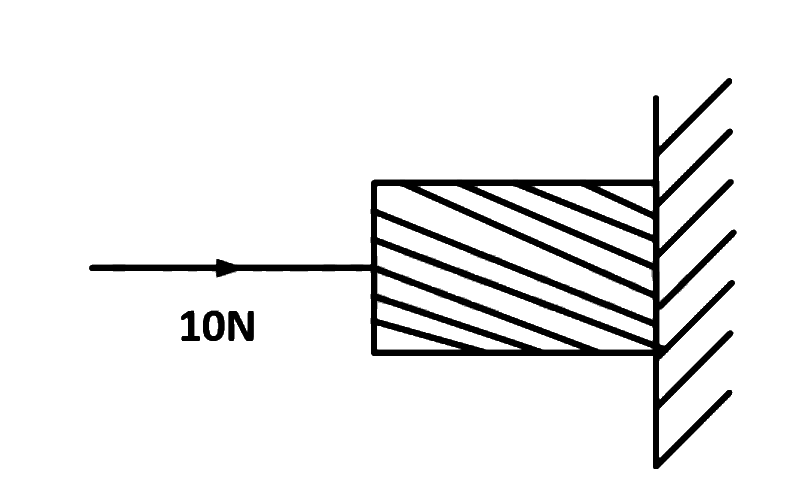
A horizontal force of 10 N is necessary to just hold a block stationary against a wall. The coefficient of friction between the block and the wall is 0.2. The weight of the block is
A block of mass 10 kg placed on rough horizontal surface having coefficient of friction μ = 0.5, if a horizontal force of 100 N acting on it then acceleration of the block will be
On the horizontal surface of a truck a block of mass 1 kg is placed (μ = 0.6) and truck is moving with acceleration 5 m/sec2 then the frictional force on the block will be
Consider a car moving along a straight horizontal road with a speed of 72 km/h. If the coefficient of static friction between the tyres and the road is 0.5, the shortest distance in which the car can be stopped is (taking g=10 m/s2)
Put a uniform metre scale horizontally on your extended index fingers with the left one at 0.00cm and the right one at 90.00cm. When you attempt to move both the fingers slowly towards the centre, initially only the left finger slips with respect to the scale and the right finger does not. After some distance, the left finger stops and the right one starts slipping. Then the right finger stops at a distance xR from the centre (50.00cm) of the scale and the left one starts slipping again. This happens because of the difference in the frictional forces on the two fingers. If the coefficients of static and dynamic friction between the fingers and the scale are 0.40 and 0.32, respectively, the value of xR (in cm) is ______.
Numerical answer type. Work it out, then open the answer.
STATEMENT 1: It is easier to pull a heavy object than to push it on a level ground. STATEMENT 2: The magnitude of frictional force depends on the nature of the two surfaces in contact.
A block of mass 0.1kg is held against a wall applying a horizontal force of 5N on the block. If the coefficient of friction between the block and the wall is 0.5, the magnitude of the frictional force acting on the block is:
A body of mass 40kg resting on a rough horizontal surface is subjected to a force P which is just enough to start the motion of the body. If μs=5, μk=0.4, g=10m s−2 and the force P is continuously applied on the body, then the acceleration of the body is
Assertion: Use of ball bearings between two moving parts of a machine is a common practice. Reason: Ball bearings reduce vibrations and provide good stability.
A body is moving along a rough horizontal surface with an initial velocity of 10m s−1. If the body comes to rest after travelling a distance of 12m, then the coefficient of sliding friction will be
A block of mass 2kg is pushed against a rough vertical wall with a force of 40N, coefficient of static friction being 0.5. Another horizontal force of 15N, is applied on the block in a direction parallel to the wall. If the block will move, then its direction would be
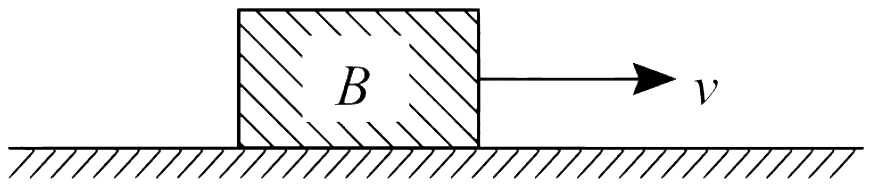
A block B is pushed momentarily along a horizontal surface with an initial velocity v. If μ is the coefficient of sliding friction between B and the surface, block B will come to rest after a time
A block B is pushed momentarily along a horizontal surface with an initial velocity v. If μ is the coefficient of sliding friction between B and the surface, block B will come to rest after a time
A plane requires for take off a speed of 72km h−1, the run on the ground being 50m. The mass of the plane is 10000kg and the coefficient of friction between the plane and the ground is 0.2. Assume that the plane accelerates uniformly during take off. The minimum force required by the engine of the plane for take off is
A marble block of mass 2kg lying on ice when given a velocity of 6m/s is stopped by friction in 10s. Then the coefficient of friction is (Take g=10m s−2)
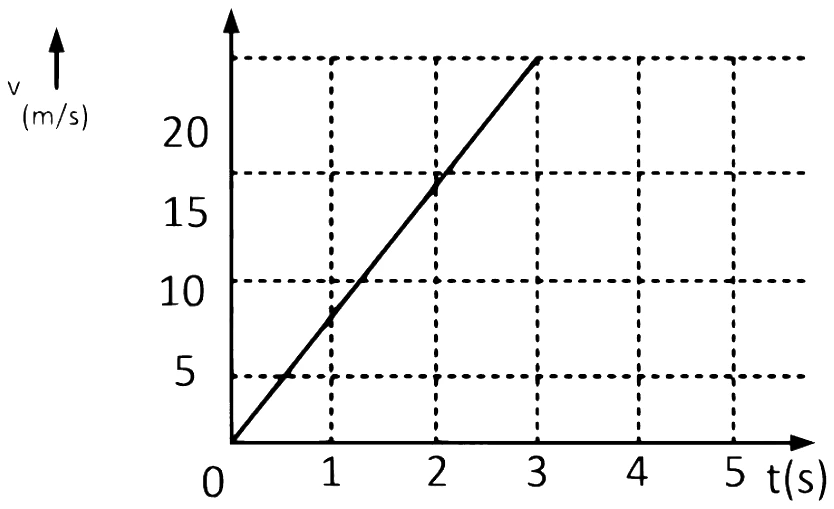
A block of certain mass is placed on a rough floor. The coefficients of static and kinetic friction between the block and the floor are 0.4 and 0.25 respectively. A constant horizontal force F=20N acts on it so that the velocity of the block varies with time according to the following graph. The mass of the block is nearly (Take g≃10m s−2)
A body of mass 10kg is kept on a horizontal surface. The coefficient of kinetic friction between the body and the surface is 0.5. A horizontal force of 60N is applied on the body. The resulting acceleration of the body is about
A 5kg block on horizontal surface is pulled by 15N. If the coefficient of friction between the block and surface is 0.2, then the acceleration of the block is ______ [g=10m s−2]
A block of mass 2kg placed on a rough horizontal surface is pulled with a force of 30N which makes an angle of sin−1(0.6) with the horizontal. If the coefficient of kinetic friction between the block and the surface is 0.4, then the acceleration of the block is (Acceleration due to gravity =10m s−2)
A block of mass 2kg is placed on a rough horizontal surface. If a horizontal force of 20N acting on the block produces an acceleration of 7m s−2 in it, then the coefficient of kinetic friction between the block and the surface is (Acceleration due to gravity =10m s−2)
Two blocks A and B of masses 2kg and 4kg respectively are kept on a rough horizontal surface. If same force of 20N is applied on each block, then the ratio of the accelerations of the blocks A and B is (Coefficient of kinetic friction between the surface and the blocks is 0.3 and acceleration due to gravity =10m s−2)
A conveyor belt is moving horizontally with a velocity of 2m s−1. If a body of mass 10kg is kept on it, then the distance travelled by the body before coming to rest is (The coefficient of kinetic friction between the belt and the body is 0.2 and acceleration due to gravity is 10m s−2)
As shown in the figure, a force F is applied on a block of mass 3kg placed on a rough horizontal surface. The maximum value of F for the block not to move is (Coefficient of static friction between the block and the surface is 231 and acceleration due to gravity =10m s−2)
A block of mass 5kg is placed on a rough horizontal surface having coefficient of friction 0.5. If a horizontal force of 60N is acting on it, then the acceleration of the block is (Acceleration due to gravity, g=10m s−2)
A block of mass 1.5kg kept on a rough horizontal surface is given a horizontal velocity of 10m s−1. If the block comes to rest after travelling a distance of 12.5m, the coefficient of kinetic friction between the surface and the block is (acceleration due to gravity =10m s−2)
An insect is crawling in a hemi-spherical bowl of radius R. If the coefficient of friction between the insect and bowl is μ, then the maximum height to which the insect can crawl the bowl is
A block of mass 5kg moving on a rough surface with a velocity of 4m s−1 is stopped by the friction in 2 seconds. Then, the coefficient of friction between the contact surfaces is
A body is travelling with 10m s−1 on a rough horizontal surface. Its velocity after 2s is 4m s−1. The coefficient of kinetic friction between the block and the plane is (acceleration due to gravity =10m s−2)
A block of mass 2kg is kept on a horizontal surface and is pulled with a horizontal force F. If the surface is smooth, the acceleration of the block is 8m s−2. If the surface is rough and the coefficient of kinetic friction between the block and the surface is 0.25, then the acceleration of the block is (Acceleration due to gravity =10m s−2)
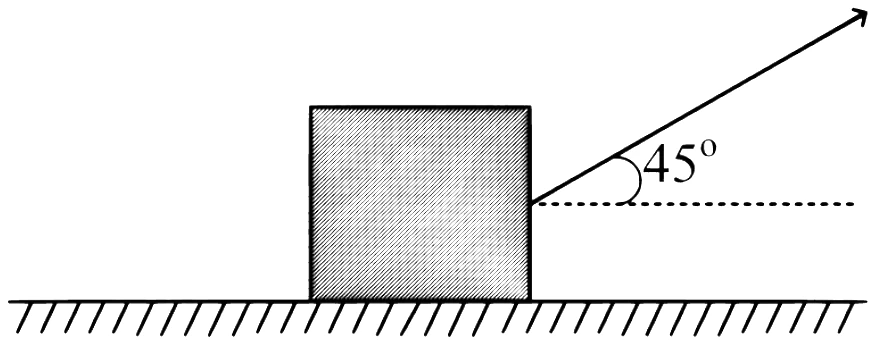
A block of mass 2kg is placed on a rough horizontal surface. A force F acting upwards at an angle of 45∘ with the horizontal causes the block to start motion. If the coefficient of static friction between the surface and the block is 0.25, the magnitude of the force F is (Acceleration due to gravity =10m s−2)
A horizontal force of 10N is applied on a block of mass 1.5kg which is initially at rest on a rough horizontal surface. The work done by the applied force in a time of 6s from the beginning of the motion is (Acceleration due to gravity =10m s−2; the coefficient of kinetic friction between the block and the surface is 0.2)
A truck of mass 8 ton is carrying a block of mass 2 ton. If a breaking force of 25kN is applied on the truck, then the frictional force acting on the block is (Coefficient of static friction between the block and the truck is 0.3)
A block is kept on a rough horizontal surface. The acceleration of the block increases from 6m s−2 to 11m s−2 when the horizontal force acting on it increases from 20N to 30N. The coefficient of kinetic friction between the block and the surface is (acceleration due to gravity =10m s−2)
A person initially at rest, starts walking towards east without slipping or skidding. What is the type of friction acting on the person from the ground and in which direction the frictional force acts?
A body of weight 50N is placed on a horizontal surface as shown in the figure. The minimum force required to move the body is 28.28N. The frictional force and the normal reaction are respectively
At time t=0, a force F=αt, where t is time in seconds, is applied to a body of mass 1kg, resting on a smooth horizontal plane. If the direction of the force makes an angle of 45∘ with the horizontal, then the velocity of the body at the moment of its breaking off the plane is
A motor car moving with velocity 7m/s stops at 10m distance when brakes are applied. What is the relation between the resistance force R and the weight w of the car? (take, value of g=9.8m/s2)
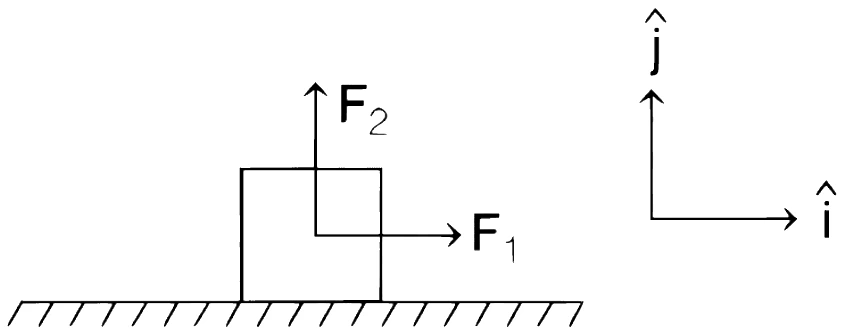
A block of mass m=2kg is initially at rest on a horizontal surface. A horizontal force F1=(6N)i^ and a vertical force F2=(10N)j^ are then applied to the block. The coefficients of static friction and kinetic friction for the block and the surfaces are 0.4 and 0.25, respectively. The magnitude of the frictional force acting on the block is (assume, g=10m/s2)
A block of mass 3kg is pressed against a vertical wall by applying a force F at an angle 30∘ to the horizontal as shown in the figure. As a result, the block is prevented from falling down. If the coefficient of static friction between the block and wall is 3, then the value of F is (use g=10m/s2)
A block of mass m rests on a horizontal table with a coefficient of static friction μ. What minimum force must be applied on the block to drag it on the table?
A 4.0kg box slides down a vertical wall with constant speed while a person pushes it up at an angle of 45∘ with the vertical. If the coefficient of friction between the block and the wall is 0.41 then the magnitude of the force applied by the person is close to
A uniform block of mass m resting on a rough horizontal plane just starts moving when pulled by a string with a force of magnitude mg making an angle of 45∘ with the horizontal. Then the block will move if it is