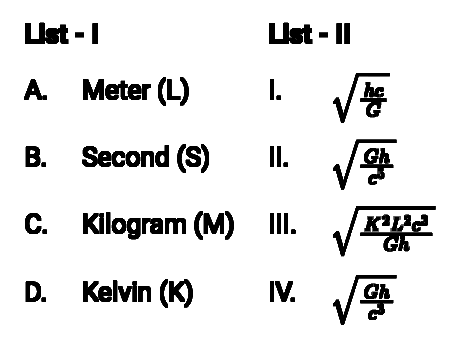
The potential energy of a particle changes with distance x from a fixed origin as V=x+BAx, where A and B are constants with appropriate dimensions. The dimensions of AB are ______
The speed of light in vacuum is taken as unity. If light takes 6 min 40 s to reach the Earth from the Sun, the distance between the Sun and the Earth in new unit is:
A new unit ( α) of length is chosen such that it is equal to the speed of light in vacuum. What is the distance between Venus and Earth in terms of α units if light takes 6 min. 40 s to cover this distance?
A ball of radius r and density ρ dropped through a viscous liquid of density σ and viscosity η attains its terminal velocity at time t, given by t=Aρarbηcσd, where A is a constant and a,b,c and d are integers. The value of a+db+c is ______.
Numerical answer type. Work it out, then open the answer.
In an electromagnetic system, the quantity representing the ratio of electric flux and magnetic flux has dimension of MPLQTRAS, where value of ' Q ' and ' R ' are
The equation for real gas is given by (P+V2a)(V−b)=RT, where P,V,T and R are the pressure, volume, temperature and gas constant, respectively. The dimension of ab−2 is equivalent to that of:
A balloon is made of a material of surface tension S and its inflation outlet (from where gas is filled in it) has small area A. It is filled with a gas of density ρ and takes a spherical shape of radius R. When the gas is allowed to flow freely out of it, its radius r changes from R to 0 (zero) in time T. If the speed v(r) of gas coming out of the balloon depends on r as ra and T∝SαAβργRδ then
Applying the principle of homogeneity of dimensions, determine which one is correct, where T is time period, G is gravitational constant, M is mass, r is radius of orbit.
Consider two physical quantities A and B related to each other as E=AtB−x2 where E,x and t have dimensions of energy, length and time respectively. The dimension of AB is
The equation of state of a real gas is given by (P+V2a)(V−b)=RT, where P,V and T are pressure, volume and temperature respectively and R is the universal gas constant. The dimensions of b2a is similar to that of:
In the equation [X+Y2a][Y−b]=RT,X is pressure, Y is volume, R is universal gas constant and T is temperature. The physical quantity equivalent to the ratio ba is:
If the velocity of light c, universal gravitational constant G and Planck's constant h are chosen as fundamental quantities. The dimensions of mass in the new system is:
(P+V2a)(V−b)=RT represents the equation of state of some gases. Where P is the pressure, V is the volume, T is the temperature and a,b,R are the constants. The physical quantity, which has dimensional formula as that of ab2, will be:
The equation of a circle is given by x2+y2=a2, where a is the radius. If the equation is modified to change the origin other than (0, 0), then find out the correct dimensions of A and B in a new equation: (x−At)2+(y−Bt)2=a2. The dimensions of t is given as [T−1].
The speed of a wave produced in water is given by v=λagbρc. Where λ,g and ρ are wavelength of wave, acceleration due to gravity and density of water respectively. The values of a,b and c respectively, are:
An expression of energy density is given by u=βαsin(ktαx), where α,β are constants, x is displacement, k is Boltzmann constant and t is the temperature. The dimensions of β will be:
In van der Waal equation [P+V2a] [V − b] = RT; P is pressure, V is volume, R is universal gas constant and T is temperature. The ratio of constants ba is dimensionally equal to:
Consider the efficiency of Carnot's engine is given by η=sinθαβlogekTβx, where α and β are constants. If T is temperature, k is Boltzmann constant, θ is angular displacement and x has the dimensions of length. Then, choose the incorrect option:
Velocity (v) and acceleration (a) in two systems of units 1 and 2 are related as v2=m2nv1 and a2=mna1 respectively. Here m and n are constants. The relations for distance and time in two systems respectively are:
An expression for a dimensionless quantity P is given by P=βαloge(βxkt); where α and β are constants, x is distance; k is Boltzmann constant and t is the temperature. Then the dimensions of α will be:
If E, L, M and G denote the quantities as energy, angular momentum, mass and constant of gravitation respectively, then the dimensions of P in the formula P = EL2M−5G−2 are:
S=α2βln[Jβ2μkR+3] where α and β are the constants. μ, J, k and R are no. of moles, mechanical equivalent of heat, Boltzmann constant and gas constant respectively.
In a typical combustion engine the workdone by a gas molecule is given by W=α2βekT−βx2, where x is the displacement, k is the Boltzmann constant and T is the temperature. If α and β are constants, dimensions of α will be:
The work done by a gas molecule in an isolated system is
given by, W=αβ2e−αkTx2, where x is the displacement, k is the Boltzmann constant and T is the temperature. α and β are constants. Then the dimensions of β will be:
Which of the following equations is dimensionally incorrect?
Where t = time, h = height, s = surface tension, θ = angle, ρ = density, a, r = radius, g = acceleration due to gravity, v = volume, p = pressure, W = work done, Γ = torque, ϵ = permittivity, E = electric field, J = current density, L = length.
The dimension of stopping potential V0 in photoelectric effect in units of Planck's constant 'h', speed of light 'c' and Gravitational constant 'G' and ampere A is:
A quantity x is given by (WL4IFv2) in terms of moment of inertia I, force F, velocity v, work W and Length L. The dimensional formula for x is same as that of:
A quantity f is given by f=Ghc5 where c is speed of light, G universal gravitational constant and h is the Planck's constant. Dimension of f is that of:
The force of interaction between two atoms is given by F = αβexp (−αkTx2); where x is the distance, k is the Boltzmann constant and T is temperature and α and β are two constants. The dimension of β is:
If surface tension (S), Moment of inertia (I) and Planck's constant (h), were to be taken as the fundamental units, the dimensional formula for linear momentum would be :-
The density of a material in SI units is 128 kg m–3. In certain units in which the unit of length is 25 cm and the unit of mass is 50 g, the numerical value of density of the material is -
The characteristic distance at which quantum gravitational effects are significant, the Planck length, can be determined from a suitable combination of the fundamental physical constants G, h and c. Which of the following correctly gives the Planck length?
Time (T), velocity (C) and angular momentum (h) are chosen as fundamentalquantities instead of mass, length and time. In terms of these, the dimensions of mass would be:
A physical quantity of the dimensions of length that can be formed out of c, G and 4πε0e2 is [c is velocity of light, G is the universal constant of gravitation and e is charge]
Q66JEE Main 2016 · 10 APR · SHIFT 1 (One or more correct)Medium
Applications of Dimensional Analysis
A, B, C and D are four different physical quantities having different dimensions. None of them is dimensionless. But we know that the equation AD = C ln (BD) holds true. Then which of the combination is not a meaningful quantity?
Planck's constant (h), speed of light in vacuum (c) and Newton's gravitional constant (G) are three fundamental constants. Which of the following combinations of these has the dimension of length?
If electronic charge e, electron mass m, speed of light in vacuum c and Planck's constant h are taken as fundamental quantities, the permeability of vacuum μ0 can be expressed in units of:
If the capacitance of a nanocapacitor is measured in terms of a unit 'u' made by combining the electronic charge 'e', Bohr radius 'a0 ', Planck's constant 'h' and speed of light 'c' then:
If dimensions of critical velocity vc of a liquid flowing through a tube are expressed as [ηxρyrz] where η,ρ and r are the coefficient of viscosity of liquid, density of liquid and radius of the tube respectively, then the values of x, y and z are given by
A beaker contains a fluid of density ρ kg / m3, specific heat S J/kgoC and viscosity η. The beaker is filled up to height h. To estimate the rate of heat transfer per unit area ( Q˙/A) by convection when beaker is put on a hot plate, a student proposes that it should depend on η⋅(hSΔθ) and (ρg1) when Δθ (inoC) is the difference in the temperature between the bottom and top of the fluid. In that situation the correct option for (Q˙/A) is:
From the following, the quantity (constructed from the basic constants of nature), that has the dimensions, as well as correct order of magnitude, vis-a-vis typical atomic size, is:
A metal sample carrying a current along X-axis with density Jx is subjected to a magnetic field Bz (along z-axis). The electric field Ey developed along Y-axis is directly proportional to Jx as well as Bz. The constant of proportionality has SI unit.
If the time period t of the oscillation of a drop of liquid of density d, radius r, vibrating under surface tension s is given by the formula t=r2bscda/2. It is observed that the time period is directly proportional to sd. The value of b should therefore be:
The density of a material in CGS system of units is 4 g cm−3. In a system of units in which unit of length is 10 cm and unit of mass is 100 g, the value of density of material will be
An equation is given here (P+V2a)=bVθ where P = Pressure, V = Volume and θ = Absolute temperature. If a and b are constants, the dimensions of a will be
Turpentine oil is flowing through a tube of length l and radius r. The pressure difference between the two ends of the tube is P. The viscosity of oil is given by η=4vlP(r2−x2) where v is the velocity of oil at a distance x from the axis of the tube. The dimensions of η are
The frequency of vibration f of a mass m suspended from a spring of spring constant k is given by a relation f=amxky, where a is a dimensionless constant. The values of x and y are
According to Newton, the viscous force acting between liquid layers of area A and velocity gradient Δv/ΔZ is given by F=−ηAΔZΔv, where η is constant called coefficient of viscosity. The dimensional formula of η is
In a new system of units, the units of mass, length, time and current are 5kg, 5m, 5s and 5A, respectively. If μ0 and ϵ0 are the permeability and permittivity of free space, respectively, then in this new system of units, the magnitude of one SI unit of μ0/ϵ0 is:
Numerical answer type. Work it out, then open the answer.
A dimensionless quantity is constructed in terms of electronic charge e, permittivity of free space ε0, Planck's constant h, and speed of light c. If the dimensionless quantity is written as eαε0βhγcδ and n is a non-zero integer, then (α,β,γ,δ) is given by :
Young's modulus of elasticity Y is expressed in terms of three derived quantities, namely, the gravitational constant G, Planck's constant h and the speed of light c, as Y=cαhβGγ. Which of the following is the correct option?
In a particular system of units, a physical quantity can be expressed in terms of the electric charge e, electron mass me, Planck's constant h, and Coulomb's constant k=4πϵ01, where ϵ0 is the permittivity of vacuum. In terms of these physical constants, the dimension of the magnetic field is [B]=[e]α[me]β[h]γ[k]δ. The value of α+β+γ+δ is ______.
Numerical answer type. Work it out, then open the answer.
Sometimes it is convenient to construct a system of units so that all quantities can be expressed in terms of only one physical quantity. In one such system, dimensions of different quantities are given in terms of a quantity X as follows: [position] =[Xα]; [speed] =[Xβ]; [acceleration] =[Xp]; [linear momentum] =[Xq]; [force] =[Xr]. Then
More than one option can be correct. Tap every correct option, then tap Check.
Let us consider a system of units in which mass and angular momentum are dimensionless. If length has dimension of L, which of the following statement(s) is/are correct?
More than one option can be correct. Tap every correct option, then tap Check.
A length-scale (l) depends on the permittivity (ε) of a dielectric material, Boltzmann constant (kB), the absolute temperature (T), the number per unit volume (n) of certain charged particles, and the charge (q) carried by each of the particles. Which of the following expression(s) for l is(are) dimensionally correct?
More than one option can be correct. Tap every correct option, then tap Check.
Planck's constant h, speed of light c and gravitational constant G are used to form a unit of length L and a unit of mass M. Then the correct option(s) is(are)
More than one option can be correct. Tap every correct option, then tap Check.
To find the distance d over which a signal can be seen clearly in foggy conditions, a railways engineer uses dimensional analysis and assumes that the distance depends on the mass density ρ of the fog, intensity (power/area) S of the light from the signal and its frequency f. The engineer finds that d is proportional to S1/n. The value of n is
Numerical answer type. Work it out, then open the answer.
A dense collection of equal number of electrons and positive ions is called neutral plasma. Certain solids containing fixed positive ions surrounded by free electrons can be treated as neutral plasma. Let N be the number density of free electrons, each of mass m. When the electrons are subjected to an electric field, they are displaced relatively away from the heavy positive ions. If the electric field becomes zero, the electrons begin to oscillate about the positive ions with a natural angular frequency ωp which is called the plasma frequency. To sustain the oscillations, a time varying electric field needs to be applied that has an angular frequency ω, where a part of the energy is absorbed and a part of it is reflected. As ω approaches ωp all the free electrons are set to resonance together and all the energy is reflected. This is the explanation of high reflectivity of metals.
Taking the electronic charge as e and the permittivity as ε0, use dimensional analysis to determine the correct expression for ωp.
Pressure depends on distance as P=βαexp(−kθαz), where α, β are constants, z is distance, k is Boltzmann's constant and θ is temperature. The dimensions of β are
The force F is given by the expression F=Acos(Bx)+Csin(Dt), where x is the displacement and t is the time. Then the dimension of BD is the same as that of
The speed of light (c), gravitational constant (G) and Planck's constant (h) are taken as fundamental units in a system. The dimensions of time in this new system should be
The speed (v) of ripples on the surface of water depends on surface tension (σ), density (ρ) and wavelength (λ). The square of the speed (v) is proportional to
When a wave traverses a medium the displacement of a particle located at x at a time t is given by y=asin(bt−cx). Where a, b and c are constants of the wave. Which of the following is a quantity with dimensions?
In the equation (p+V2a)(V−b)=RT, where p is pressure, V is volume, T is temperature, R is universal gas constant, a and b are constants. The dimensions of a are
If speed of light in vacuum is 3×10⁸m s−1, acceleration due to gravity is 10m s−2 and mass of electron is 9.1×10⁻³¹kg are taken as fundamental physical quantities, then the unit of time in this system is
The speed of ripples (v) on water surface depends on surface tension (σ), density (ρ) and wavelength (λ). Then, the square of speed (v) is proportional to
The force acting on a particle in terms of its distance x from a fixed point is given by F=B+x1.5A. If the dimensional formula of AB is [MaLbTc], then the value of a+b+c is
The efficiency of an engine is given by η=sinθαβ⋅logekTβx, where α and β are constants. If T is the absolute temperature, k is Boltzmann constant, θ is angular displacement and x is distance, then the incorrect statement is
Velocities (v) and accelerations (a) in two systems of units 1 and 2 are related as v2=m2nv1 and a2=mna1 respectively. Here m and n are constants. Dimensionally relations between distances (s1 and s2) and times (t1 and t2) in the two systems are respectively
If the velocity of light c, the gravitational constant G and Planck's constant h are chosen as the fundamental units, the dimension of density in the new system is
If E and E0 denote energies at time t and t0 respectively, and L and L0 distance from same point at t and t0 respectively, then which of the following equations can be declared to be incorrect on dimensional grounds?
Due to an explosion underneath water, a bubble started oscillating. If this oscillation has time period T, which is proportional to pαSβEγ, where p is static pressure, S is density of water and E is total energy of explosion. Determine α,β and γ.
If the dimensions of length are expressed as GxCyhz, where G, C and h are the universal gravitational constant, speed of light and Planck's constant respectively, then
More than one option can be correct. Tap every correct option, then tap Check.
The power (P) radiated from an accelerated charged particle is given by P∝cn(qa)m, where q is the charge, a is the acceleration of the particle and c is the speed of light in vacuum. From dimensional analysis, the values of m and n respectively are
A modified gravitational potential is given by V=−rGM+r2A. If the constant A is expressed in terms of the gravitational constant (G), mass (M) and velocity of light (c), then from dimensional analysis, A is
The entropy (S) of a black hole can be written as S=βkBA, where kB is the Boltzmann constant and A is the area of the black hole. The β has dimension of
From dimensional analysis, the Rydberg constant can be expressed in terms of electric charge (e), mass (m) and Planck constant (h) as [consider 4πε01≡1 unit]
The frequency ν of the radiation emitted by an atom when an electron jumps from one orbit to another is given by ν=kδE, where k is a constant and δE is the change in energy level due to the transition. Then, the dimension of k is
A spherical liquid drop is placed on a horizontal plane. A small disturbance causes the volume of the drop to oscillate. The time period of oscillation (T) of the liquid drop depends on the radius (r) of the drop, density (ρ) and surface tension (S) of the liquid. Which among the following will be a possible expression for T (where k is a dimensionless constant)?
The acceleration of a point particle is given by the equation dt2d2x=α∣x∣7x+βdtdx where x denotes position and t denotes time. Which of the following relations show the correct dimensions for α and β?
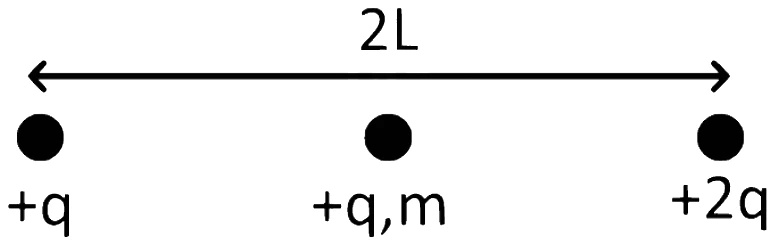
Two fixed point particles, each of charge +q, are separated by a distance 2L. Another point charge +q of mass m is oscillating about its equilibrium position as indicated in the figure. The time period of oscillation is given by T=2π3/2αm/q. Given that ϵ0 is the permittivity of free space, which of the following options is the dimensionally correct expression for α in SI units?
The fundamental constants are given to be permittivity constant (ϵ0), Planck's constant (h), velocity of light (c), Newton's constant (G) and Boltzmann's constant (kB). Which of the following quantities constructed out of the above constants has the dimensions of an electric charge?
Planck's constant h=6.63×10⁻³⁴J s Speed of light in vacuum c=3.00×10⁸m s−1 Mass of the electron me=9.11×10⁻³¹kg Magnitude of the electron charge e=1.60×10⁻¹⁹C
The critical electric field required to produce electron-positron pairs depends on the physical constants h, c, me and e. Use dimensional analysis and assume that the dimensionless coefficient is of order one. The magnitude of the critical electric field, in SI units, is of the order
The energy of a one-dimensional system is given by E=∫dx[(dxdϕ(x))2+ceaϕ(x)+bϕ4(x)] where a, b and c are some non-zero constants. The dimension of the quantity b/a is given by
Certain theoretical calculations using quantum and relativistic concepts show that an accelerating observer (with constant linear acceleration) measures a temperature even in empty space. Using dimensional analysis, one can express this temperature in terms of the Boltzmann constant kB, acceleration a and the fundamental constants of special relativity c and of quantum mechanics h. If the temperatures measured by two observers are in the ratio T1/T2=9, then the ratio of their accelerations a1/a2 is equal to
An explosion releasing energy E occurs in a medium of density ρ. This results in a spherical blast wave of radius r. One can express the radius of the blast wave at time t after the explosion in the form r=ktαEβργ where k is a dimensionless constant. Then the radial speed of the blast wave can be written as v∝tn. The value of n is
One can express power in terms of the fundamental constants {G,c,h} using dimensional analysis. Assuming that the associated dimensionless constant is unity, the magnitude of the power so obtained is
In order to measure physical quantities in the sub-atomic world, the quantum theory often employs energy [E], angular momentum [J] and velocity [c] as fundamental dimensions instead of the usual mass, length and time. Then, the dimension of pressure in this theory is
A spherical dewdrop, when deformed slightly, oscillates about its equilibrium shape. The physically relevant variables to describe the frequency of this oscillation f are its mass M, radius R and a third variable Q, where Q could be either the universal gravitational constant G or the surface tension S. One must decide the relevant variable Q and employ dimensional analysis to express f as f=kMxRyQz, where k is a dimensionless constant. Then
The scattering of an electromagnetic wave by a charged particle of charge e and mass m is described in terms of the ‘Thomson Cross Section’ σT, which has the dimension of area. On the basis of dimensional analysis, the possible formula for σT is [The symbols have the usual meanings.]