
Terminal Velocity
A spherical object is falling under gravity through a viscous fluid. The sphere attains the terminal velocity when
Show answer and solution
Answer: (d)
Loading the solution…
Home›Practice Hub›Chapters›Viscosity›Terminal Velocity
Viscosity PYQs · MHT CET · JEE Main · NEET
 Mechanical Properties of Fluids · Lecture 3 · Viscosity & Terminal Velocity1:26:32All 5 Viscosity videos →
Terminal Velocity
A spherical object is falling under gravity through a viscous fluid. The sphere attains the terminal velocity when
Answer: (d)
Terminal Velocity
The terminal velocity of a metallic ball of radius 6 mm in a viscous fluid is . The terminal velocity of another ball of same material and having radius 3 mm in the same fluid will be .
Numerical answer type. Work it out, then open the answer.
Answer: 5
Terminal Velocity
small drops of water having same size fall through air with constant velocity cm/s. They coalesce to form a big drop. The terminal velocity of the big drop is
Answer: (c)
Terminal Velocity
Sixty four rain drops of radius 1 mm each falling down with a terminal velocity of coalesce to form a bigger drop. The terminal velocity of bigger drop is
.
Numerical answer type. Work it out, then open the answer.
Answer: 160
Terminal Velocity
A small metal sphere is falling through a viscous liquid. The variation of velocity () with time () is shown correctly in graph
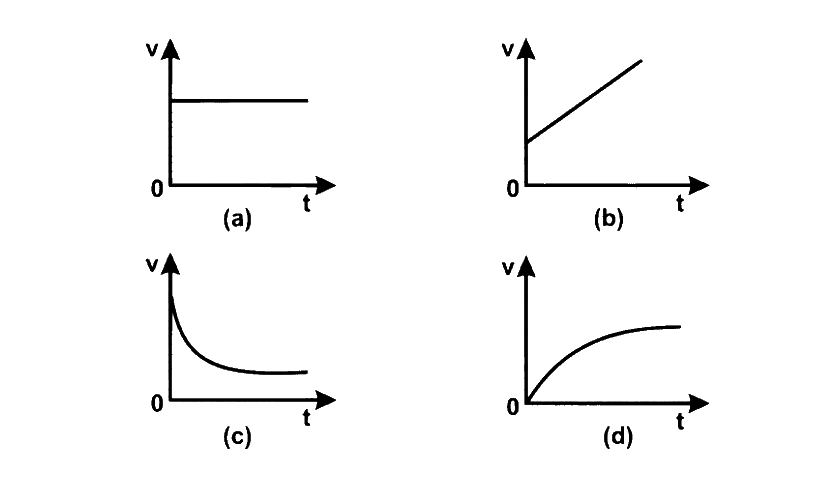
Answer: (c)
Terminal Velocity
If terminal speed of a sphere of gold (density = kg/m) is m/s in viscous liquid (density = kg/m ), find the terminal speed of a sphere of silver (density = kg/m) of the same size in the same liquid.
Answer: (c)
Terminal Velocity
Two spherical rain drops reach the surface of the earth with terminal velocities having ratio . The ratio of their surface area is
Answer: (c)
Terminal Velocity
Two solid spheres of same material but of mass M and 8M fall simultaneously on a viscous liquid and their terminal velocities are V and nV, then the value of n is
Answer: (c)
Terminal Velocity
A spherical liquid drop of radius acquires the terminal velocity when falls through a gas of viscosity . Now the drop is broken into 64 identical droplets and each droplet acquires terminal velocity falling through the same gas. The ratio of terminal velocities is ______.
Answer: (d)
Terminal Velocity
A small metallic sphere of diameter 2 mm and density is dropped in glycerine having viscosity 10 Poise and density respectively. The terminal velocity attained by the sphere is .
and
Answer: (d)
Terminal Velocity
A tiny water droplet falls through the air at a uniform terminal speed of cm/s. If such identical droplets coalesce to form a single larger drop, what will be the new terminal velocity of the resulting drop, assuming the air remains the same?
Answer: (d)
Terminal Velocity
'' identical small drops of water are falling down vertically through a medium each with a terminal velocity ''. If they combine to form a single drop, then its terminal velocity is . The value of is
Answer: (b)
Terminal Velocity
Two rain drops of same radius '' falling with same terminal velocity '' merge and form bigger drop of radius ''. The terminal velocity of big drop is
Answer: (a)
Terminal Velocity
If an air bubble of diameter 2 mm rises steadily through a liquid of density 2000 kg/m3 at a rate of 0.5 cm/s, then the coefficient of viscosity of liquid is ______ Poise. (Take g = 10 m/s2)
Answer: (b)
Terminal Velocity
In the measurement of viscosity of liquids using terminal velocity experiment, spherical balls of same radius but having different densities are used. The variation of the terminal velocity ( ) with the ratio of density of spherical ball ( ) to density of the liquid ( ), is best represented by:
Answer: (b)
Terminal Velocity
125 small water drops of same size fall through air with constant velocity . They coalesce to form a big drop. The terminal velocity of the big drop is
Answer: (b)
Terminal Velocity
Two raindrops reach the earth with different terminal velocities having the ratio . The ratio of their volumes is
Answer: (d)
Terminal Velocity
A solid steel ball of diameter 3.6 mm acquired terminal velocity while falling under gravity through an oil of density . Take density of steel as and g as . The viscosity of the oil in SI unit is
Answer: (d)
Terminal Velocity
' ' small water drops of same size (radius ) fall through air with constant velocity V. They coalesce to form a big drop of radius R. The terminal velocity of the big drop is
Answer: (a)
Terminal Velocity
In the experiment for measurement of viscosity ' ' of given liquid with a ball having radius , consider following statements.
A. Graph between terminal velocity V and R will be a parabola.
B. The terminal velocities of different diameter balls are constant for a given liquid. C. Measurement of terminal velocity is dependent on the temperature.
D. This experiment can be utilized to assess the density of a given liquid.
E. If balls are dropped with some initial speed, the value of will change.
Choose the correct answer from the options given below:
Answer: (c)
Terminal Velocity
Two identical drops of water are falling through air with steady velocity ' V '. If the two drops come together to form a single drop. The new velocity of the single drop is
Answer: (c)
Terminal Velocity
A steel ball of radius 6 mm has a terminal speed of in a viscous liquid. What will be the terminal speed of a steel ball of radius 3 mm in the same liquid?
Answer: (d)
Terminal Velocity
Two rain drops of same radius are falling through air each with a steady speed of . If the drops coalesce, the new steady velocity of big drop will be
Answer: (d)
Terminal Velocity
A small steel ball is dropped into a long cylinder containing glycerine. Which one of the following is the correct representation of the velocity time graph for the transit of the ball?
Answer: (b)
Terminal Velocity
A lead sphere of mass ' ' falls in viscous liquid with terminal velocity . Another lead sphere of mass ' 8 m ' but of same material will fall through the same liquid with terminal velocity
Answer: (c)
Terminal Velocity
Two metal spheres are falling through a liquid of density with the same uniform speed. The density of material of first sphere and second sphere is and respectively. The ratio of the radius of first sphere to that of second sphere is
Answer: (b)
Terminal Velocity
A metal sphere of radius R, density moves with terminal velocity through a liquid of density . Another sphere of same radius but density moves through same liquid. Its terminal velocity is . The ratio is
Answer: (d)
Terminal Velocity
A spherical ball of radius and density falls freely under gravity through a distance before entering a tank of water. If after entering in water the velocity of the ball does not change, then the value of is approximately:
(The coefficient of viscosity of water is )
Answer: (a)
Terminal Velocity
A small spherical ball of radius , falling through a viscous medium of negligible density has terminal velocity ''. Another ball of the same mass but of radius , falling through the same viscous medium will have terminal velocity:
Answer: (d)
Terminal Velocity
Small water droplets of radius are formed in the upper atmosphere and falling with a terminal velocity of . Due to condensation, if 8 such droplets are coalesced and formed a larger drop, the new terminal velocity will be ________ .
Numerical answer type. Work it out, then open the answer.
Answer: 40
Terminal Velocity
A metal ball of radius and density falls freely under gravity through a distance ' h ' and enters a tank of water. Considering that the metal ball has constant velocity, the value of is [coefficient of viscosity of water density of water
Answer: (a)
Terminal Velocity
A spherical metal ball of radius '' falls through viscous liquid with velocity ''. Another metal ball of same material but of radius falls through same liquid, then its terminal velocity will be
Answer: (d)
Terminal Velocity
Eight equal drops of water are falling through air with a steady speed of . If the drops coalesce, the new velocity is:-
Answer: (a)
Terminal Velocity
An air bubble of diameter rises steadily through a of density at the rate of . The co-efficient of viscosity of the (neglect density of air) is ___________ Pas (given, ).
Numerical answer type. Work it out, then open the answer.
Answer: 10
Terminal Velocity
Given below are two statements: one is labelled as Assertion and the other is labelled as Reason
Assertion A: A spherical body of radius having a particular density is falling through a liquid of constant density. The percentage error in the calculation of its terminal velocity is . Reason R: The terminal velocity of the spherical body falling through the liquid is inversely proportional to its radius.
In the light of the above statements, choose the correct answer from the options given below
Answer: (b)
Terminal Velocity
The terminal velocity (vt) of the spherical rain drop depends on the radius (r) of the spherical rain drop as:
Answer: (c)
Terminal Velocity
A spherical ball is dropped in a long column of a highly viscous liquid. The curve in the graph shown, which represents the speed of the ball (v) as a function of time (t) is
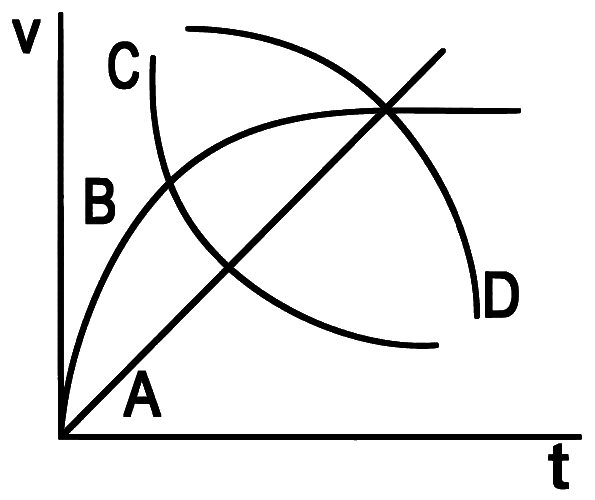
Answer: (b)
Terminal Velocity
A water drop of radius 1 m falls in a situation where the effect of buoyant force is negligible. Co- efficient of viscosity of air is 1.8 105 Nsm and its density is negligible as compared to that of water 106 gm. Terminal velocity of the water drop is:
(Take acceleration due to gravity = 10 ms)
Answer: (d)
Terminal Velocity
When a ball is dropped into a lake from a height 4.9 m above the water level, it hits the water with a velocity v and then sinks to the bottom with the constant velocity v. It reaches the bottom of the lake 4.0 s after it is dropped. The approximate depth of the lake is:
Answer: (b)
Terminal Velocity
An air bubble of negligible weight having radius r rises steadily through a of density at speed v. The coefficient of viscosity of the is given by:
Answer: (b)
Terminal Velocity
The diameter of an air bubble which was initially , rises steadily through a of density at the rate of . The coefficient of viscosity of the is _________ poise (in nearest integer). (the density of air is negligible).
Numerical answer type. Work it out, then open the answer.
Answer: 11
Terminal Velocity
A small spherical ball of radius 0.1 mm and density 104 kg m falls freely under gravity through a distance h before entering a tank of water. If, after entering the water the velocity of ball does not change and it continue to fall with same constant velocity inside water, then the value of h will be ___________ m.
(Given g = 10 ms, viscosity of water = 1.0 105 N-sm).
Numerical answer type. Work it out, then open the answer.
Answer: 20
Terminal Velocity
The speed of a ball of radius in a viscous liquid is . What will be the speed of a ball of radius in same liquid?
Answer: (c)
Terminal Velocity
If the terminal speed of a sphere A [density ] is , in a viscous liquid [density ], the terminal speed of sphere B [density ] of the same size in the same liquid is
Answer: (b)
Terminal Velocity
'n' small drops of same size fall through air with constant velocity . They coalesce to form a big drop. The terminal velocity of the big drop is
Answer: (b)
Terminal Velocity
Two spherical rain drops reach the surface of the earth with terminal velocities having ratio . The ratio of their surface area is
Answer: (c)
Terminal Velocity
In an experiment to verify Stokes law, a small spherical ball of radius r and density falls under gravity through a distance h in air before entering a tank of water. If the terminal velocity of the ball inside water is same as its velocity just before entering the water surface, then the value of h is proportional to:
(ignore viscosity of air)
Answer: (b)
Terminal Velocity
Eight identical drops of water falling through air with uniform velocity of combine to form a single drop of big size, then terminal velocity of the big drop will be
Answer: (d)
Terminal Velocity
A metal sphere of radius ' ' and density ' ' is dropped in a liquid of density ' ' moves with terminal velocity ' '. Another metal sphere of same radius and density ' ' is dropped in the same liquid, its terminal velocity will be
Answer: (c)
Terminal Velocity
Two small spherical metal balls, having equal masses, are made from materials of densities and () and have radii of 1 mm and 2 mm, respectively. They are made to fall vertically (from rest) in a viscous medium whose coefficient of viscosity equals and whose density is . The ratio of their terminal velocities would be,
Answer: (a)
Terminal Velocity
A solid sphere, of radius R acquires a terminal velocity v1 when falling (due to gravity) through a viscous fluid having a coefficient of viscosity. The sphere is broken into 27 identical solid spheres. If each of these spheres acquires a terminal velocity, v2, when falling through the same fluid, the ratio (v1/v2) equals:
Answer: (d)
Terminal Velocity
Which of the following option correctly describes the variation of the speed v and acceleration ‘a’ of a point mass falling vertically in a viscous medium that applies a force F = − kv, where ‘k’ is a constant, on the body? (Graphs are schematic and not drawn to scale)
Answer: (b)
Terminal Velocity
In an experiment, a small steel ball falls through a liquid at a constant speed of 10 cm/s. If the steel ball is pulled upward with a force equal to twice its effective weight, how fast will it move upward?
Answer: (c)
Terminal Velocity
If the terminal speed of a sphere of gold (density ) is in a viscous liquid (density , find the terminal speed of a sphere of silver (density ) of the same size in the same liquid
Answer: (c)
Terminal Velocity
The figure given below shows the direction of the two forces and acting on a skydiver:
Which one among the following statements is correct about the two forces?
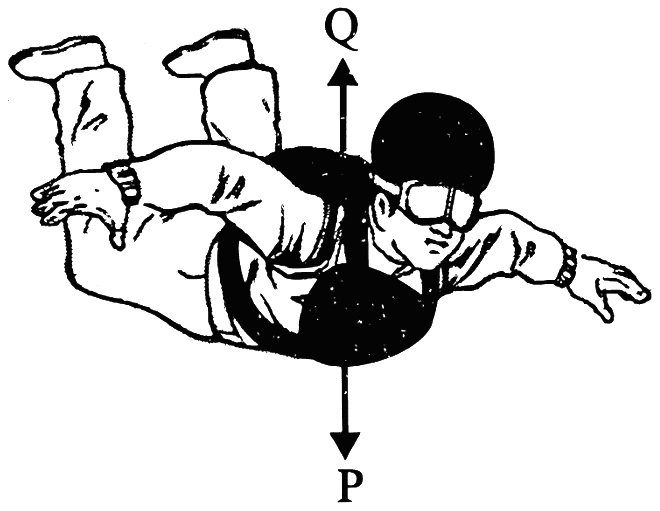
Answer: (a)
Step-by-step solution coming soon.
Terminal Velocity
Consider two solid spheres P and Q each of density and diameters and , respectively. Sphere P is dropped into a liquid of density and viscosity poiseulles. Sphere Q is dropped into a liquid of density and viscosity poiseulles. The ratio of the terminal velocities of P and Q is
Numerical answer type. Work it out, then open the answer.
Answer: 3
Step-by-step solution coming soon.
Terminal Velocity
Two spheres and of equal radii have densities and , respectively. The spheres are connected by a massless string and placed in liquids and of densities and and viscosities and , respectively. They float in equilibrium with the sphere in and sphere in and the string being taut (see figure). If sphere alone in has terminal velocity and alone in has terminal velocity , then
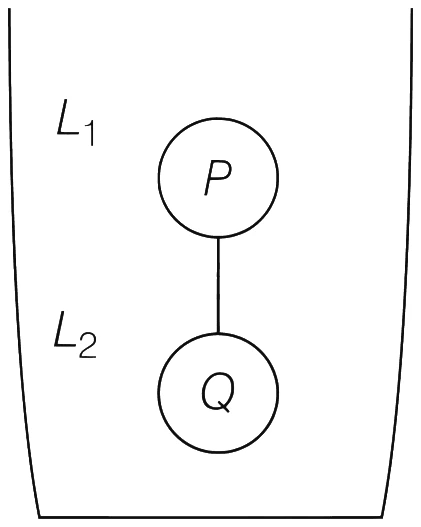
More than one option can be correct. Tap every correct option, then tap Check.
Answer: (a), (d)
Step-by-step solution coming soon.
Terminal Velocity
A spherical ball is dropped in a long column of viscous liquid. Which of the following graphs represent the variation of
(i) gravitational force with time
(ii) viscous force with time
(iii) net force acting on the ball with time?
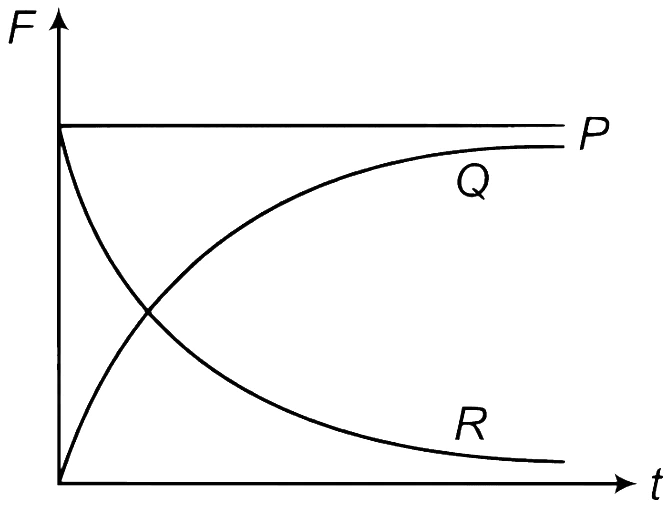
Answer: (c)
Step-by-step solution coming soon.
Terminal Velocity
If the terminal speed of a sphere of gold (density ) is in viscous liquid (density ), find the terminal speed of a sphere of silver (density ) of the same size in the same liquid.
Answer: (c)
Step-by-step solution coming soon.
Terminal Velocity
A sphere of mass and radius is falling in a viscous fluid. The terminal velocity attained by the falling object will be proportional to :
Answer: (a)
Step-by-step solution coming soon.
Terminal Velocity
If ratio of terminal velocity of two drops falling in air is , then what is the ratio of their surface area?
Answer: (b)
Step-by-step solution coming soon.
Terminal Velocity
A small spherical drop falls from rest in viscous liquid. Due to friction, heat is produced. The correct relation between the rate of production of heat and the radius of the spherical drop at terminal velocity will be
Answer: (d)
Step-by-step solution coming soon.
Terminal Velocity
spherical rain drops of equal size are falling vertically through air with a terminal velocity . If these drops coalesce to form a big spherical drop, then terminal velocity of big drop is
Answer: (c)
Step-by-step solution coming soon.
Terminal Velocity
If the terminal speed of a sphere of gold (density ) is in a viscous liquid (density ), find the terminal speed of a sphere of silver (density ) of the same size in the same liquid
Answer: (c)
Step-by-step solution coming soon.
Terminal Velocity
A lead shot of diameter falls through a long column of glycerine. The variation of the velocity with distance covered () is correctly represented by
Answer: (a)
Step-by-step solution coming soon.
Terminal Velocity
Eight spherical rain drops of the same mass and radius are falling down with a terminal speed of . If they coalesce to form one big drop, what will be the terminal speed of bigger drop? (Neglect the buoyancy of the air)
Answer: (c)
Step-by-step solution coming soon.
Terminal Velocity
rain drops of the same radius are falling through air with a steady velocity of . If the drops coalesce, the terminal velocity would be
Answer: (b)
Step-by-step solution coming soon.
Terminal Velocity
While determining the coefficient of viscosity of the given liquid, a spherical steel ball sinks by a distance . The radius of the ball . The time taken by the ball to sink in three trials are tabulated as follows.\n\n| Trial No. | Time taken by the ball to fall by (in second) |\n|---|---|\n| 1. | 2.75 |\n| 2. | 2.65 |\n| 3. | 2.70 |
The difference between the densities of the steel ball and the liquid is . If , then the coefficient of viscosity of the given liquid at room temperature is
Answer: (a)
Step-by-step solution coming soon.
Terminal Velocity
A bubble rises in a viscous liquid. If radius of bubble doubles, terminal velocity becomes
Answer: (b)
Step-by-step solution coming soon.
Terminal Velocity
A small sphere of radius is dropped in a viscous liquid. When it is moving with terminal velocity in the liquid, the relation between the rate of heat produced and is
Answer: (b)
Step-by-step solution coming soon.
Terminal Velocity
A spherical ball of radius and of density falls freely under gravity through a distance before entering a tank of water. After entering water if the velocity of the ball does not change, then is (The coefficient of viscosity of water )
Answer: (c)
Step-by-step solution coming soon.
Terminal Velocity
A spherical rain drop of mass falls vertically through air with a terminal velocity of . If such identical rain drops combine to form a bigger spherical drop, then the terminal velocity of the bigger drop if it falls vertically through air is
Answer: (d)
Step-by-step solution coming soon.
Terminal Velocity
If the terminal velocity of a metal sphere of mass falling through a liquid is , then the terminal velocity of another sphere of mass made of the same metal falling through same liquid is
Answer: (c)
Step-by-step solution coming soon.
Terminal Velocity
A solid metal sphere released in a vertical liquid column has attained terminal velocity in the downward direction. The magnitudes of viscous force, buoyant force and gravitational force acting on it are , and respectively. Then, the correct relation between them is
Answer: (b)
Step-by-step solution coming soon.
Terminal Velocity
What is the terminal velocity of a rain drop of radius ?
[Note that the coefficient of viscosity of air is , density of water is . Use, and density of air can be neglected in comparision with density of water]
Answer: (a)
Step-by-step solution coming soon.
Terminal Velocity
Two solid spheres and of same uniform density fall from rest under gravity in a viscous medium and after sometime, reach terminal velocities and , respectively. If ratio of masses , then will be equal to
Answer: (b)
Step-by-step solution coming soon.
Terminal Velocity
Which of the following diagrams correctly shows the relation between the terminal velocity of a spherical body falling in a liquid and viscosity of the liquid?
Answer: (c)
Step-by-step solution coming soon.
Terminal Velocity
A small spherical body of radius and density moves with the terminal velocity in a fluid of coefficient of viscosity and density . What will be the net force on the body?
Answer: (c)
Step-by-step solution coming soon.
Terminal Velocity
What will be the approximate terminal velocity of a rain drop of diameter , when density of rain water and coefficient of viscosity of air (Neglect buoyancy of air)
Answer: (b)
Step-by-step solution coming soon.
Terminal Velocity
A gas bubble of diameter rises through a liquid of density with a fixed speed of . Neglect the density of the gas. The coefficient of viscosity of the liquid is
Answer: (d)
Step-by-step solution coming soon.
Terminal Velocity
Two identical drops of water are falling through air with a terminal velocity . If the drops merge during the fall, then the terminal velocity of the combined drop is
Answer: (c)
Step-by-step solution coming soon.
Terminal Velocity
A sphere of mass and radius is released from rest in a stationary viscous medium kept in a long vertical tube. In addition to the gravitational force of magnitude , the sphere experiences a retarding force of magnitude , where is the speed of the sphere and is a constant given by Stokes' law for viscosity, ( is the coefficient of viscosity of the medium). Assume that the buoyant force is negligible and that the sphere is of uniform density. Which of the following statement(s) about the sphere is/are correct?
More than one option can be correct. Tap every correct option, then tap Check.
Answer: (b), (c)
Step-by-step solution coming soon.
No questions match these filters.