A cricket ball of mass 120 g is moving with a velocity of 8 m/s and is hit by a bat so that the ball gets turned back with a velocity of 12 m/s. If the duration of contact between the ball and bat is 0.02 s, the impulse (in Ns) given to the ball by the bat is
100 balls each of mass m moving with speed v simultaneously strike a wall normally and reflected back with same speed, in time t s. The total magnitude of force exerted by the balls on the wall is
A machine gun fires a bullet of mass 40g with a speed of 600 ms−1. The person holding the gun can bare maximum force of 168N on it. The number of bullets that can be fired from the gun per second is
A bullet is fired from a gun. The force on the bullet is F=(600−2×10⁵t) N where t is in second. The force on the bullet becomes zero as soon as it leaves the barrel. The average impulse imparted to the bullet is
A machine gun fires a bullet of mass 35 gram with a speed of 600 m/s. The person holding the gun can extract a maximum force of 147 N on it. The number of bullets that can be fired from the gun per second is
A conveyor belt is moving with constant velocity (V). Sand is being dropped on the belt at the rate of M kg/s. The force necessary to keep the belt moving with a constant velocity V m/s will be
A ball is dropped on the floor from a height of 20 m. It rebounds to a height of 5 m. Ball remains in contact with floor for 1 s. The average acceleration during contact is (acceleration due to gravity =10 m/s2)
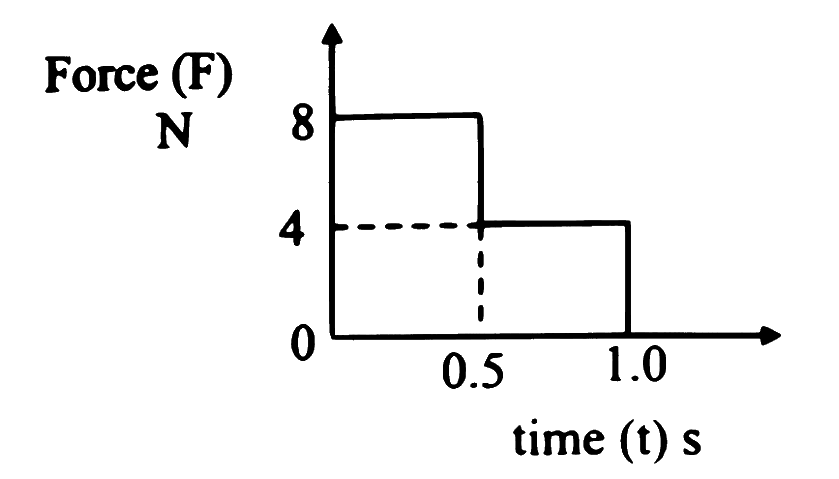
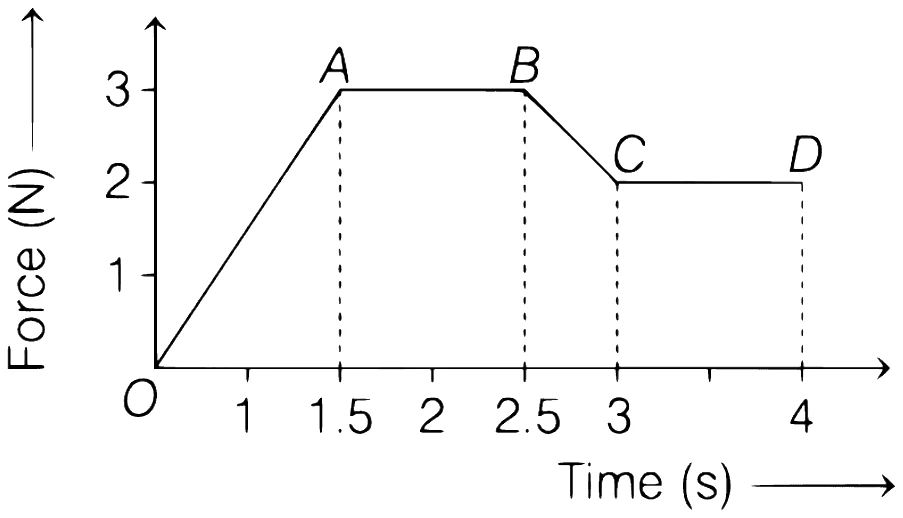
Force is applied to a body of mass 3 kg at rest on a frictionless horizontal surface as shown in the force against time (F-t) graph. The speed of the body after 1 s is
A player caught a cricket ball of mass 150 g moving at a speed of 20 m/s. If the catching process is completed in 0.1 s, the magnitude of force exerted by the ball on the hand of the player is:
A cricket player catches a ball of mass 120 g moving with 25 m/s speed. If the catching process is completed in 0.1 s then the magnitude of force exerted by the ball on the hand of player will be (in SI unit):
A machine gun fires bullets of mass 30 g with velocity of 1000 m/s. The man holding the gun can exert a maximum force of 300 N on it. How many bullets can he fire per second at most?
A football player is moving southward and suddenly turns eastward with the same speed to avoid an opponent. The force that acts on the player while turning is:
Water is flowing at a speed of 1.5 ms−1 through a horizontal tube of cross-sectional area 10−2 m2 and you are trying to stop the flow by your palm. Assuming that the water stops immediately after hitting the palm, the minimum force that you must exert should be (density of water = 103 kgm−3).
A 1 kg stationary bomb is exploded in three parts having mass 1: 1: 3 respectively. Parts having same mass move in perpendicular direction with velocity 30 m/s, then the velocity of bigger part will be
A 5000 kg rocket is set for vertical firing. The exhaust speed is 800 m s−1. To give an initial upward acceleration of 20 m/s2, the amount of gas ejected per second to supply the needed thrust will be (g=10 m s−2)
In a rocket, fuel burns at the rate of 1 kg/s. This fuel is ejected from the rocket with a velocity of 60 km/s. This exerts a force on the rocket equal to
A satellite in force free space sweeps stationary interplanetary dust at a rate of dM/dt=αv, where M is mass and v is the speed of satellite and α is a constant. The acceleration of satellite is
A 600 kg rocket is set for a vertical fring. If the exhaust speed is 1000 m s−1, the mass of the gas ejected per second to supply the thrust needed to overcome the weight of rocket is
A body of mass 5 kg explodes at rest into three fragments with masses in the ratio 1:1:3. The fragments with equal masses fly in mutually perpendicular directions with speeds of 21 m/s. The velocity of heaviest fragment in m/s will be
In a carrom game, a striker of mass 15g hits a coin of mass 5g head on and the coin moves with a speed of 0.36m s−1. If the time of contact between the striker and the coin is 3 milliseconds, then what is the average force applied by the striker on the coin?
A car weighs 1000kg. It is moving with a uniform velocity of 72km h−1 towards a straight road. The driver suddenly presses the brakes. The car stops in 0.2s. The retarding force applied on the car to stop it is
A ball of 0.1kg mass is dropped on a hard floor from a height of 0.45m and rises to a height of 0.2m. If it was in touch with the floor for 0.1s, the net force it applied on the floor while bouncing is: (take the gravitational acceleration g=10m s−2)
Sand falls vertically on a conveyor belt at a work rate of 0.1kg s−1. In order to keep the belt moving at a uniform speed of 2m s−1, the force required to be applied on the belt is:
A railway wagon (open at the top) of mass M1 is moving with speed v1 along a straight track. As a result of rain, after some time it gets partially filled with water so that the mass of the wagon becomes M2 and speed becomes v2. Taking the rain to be falling vertically and the water stationary inside the wagon, the relation between the two speeds v1 and v2 is:
A boy of mass 52kg jumps with a horizontal velocity of 2m s−1 onto a stationary cart of mass 3kg. The cart is fixed with frictionless wheels. Which one of the following would be the speed of the cart?
A force F is applied on a body (which moves on a straight line) for a duration of 3s. The momentum of the body changes from 10g cm/s to 40g cm/s. The magnitude of the force F is
Momentum of a body is 1. a vector quantity. 2. a conserved quantity in an isolated system. 3. same as force in linear motion. Select the correct answer using the code given below:
A projectile is thrown from a point O on the ground at an angle 45∘ from the vertical and with a speed 52m s−1. The projectile at the highest point of its trajectory splits into two equal parts. One part falls vertically down to the ground, 0.5s after the splitting. The other part, t seconds after splitting, falls to the ground at a distance x meters from the point O. The acceleration due to gravity g=10m s−2. The value of t is
Numerical answer type. Work it out, then open the answer.
A projectile is thrown from a point O on the ground at an angle 45∘ from the vertical and with a speed 52m s−1. The projectile at the highest point of its trajectory splits into two equal parts. One part falls vertically down to the ground, 0.5s after the splitting. The other part, t seconds after splitting, falls to the ground at a distance x metres from the point O. The acceleration due to gravity g=10m s−2. The value of x is ______.
Numerical answer type. Work it out, then open the answer.
A pendulum consists of a bob of mass m=0.1kg and a massless inextensible string of length L=1.0m. It is suspended from a fixed point at height H=0.9m above a frictionless horizontal floor. Initially, the bob of the pendulum is lying on the floor at rest vertically below the point of suspension. A horizontal impulse P=0.2kg m s−1 is imparted to the bob at some instant. After the bob slides for some distance, the string becomes taut and the bob lifts off the floor. The magnitude of the angular momentum of the pendulum about the point of suspension just before the bob lifts off is Jkg m2s−1. The kinetic energy of the pendulum just after the lift-off is K Joules. The value of J is ______.
Numerical answer type. Work it out, then open the answer.
A pendulum consists of a bob of mass m=0.1kg and a massless inextensible string of length L=1.0m. It is suspended from a fixed point at height H=0.9m above a frictionless horizontal floor. Initially, the bob of the pendulum is lying on the floor at rest vertically below the point of suspension. A horizontal impulse P=0.2kg m s−1 is imparted to the bob at some instant. After the bob slides for some distance, the string becomes taut and the bob lifts off the floor. The magnitude of the angular momentum of the pendulum about the point of suspension just before the bob lifts off is Jkg m2s−1. The kinetic energy of the pendulum just after the lift-off is K Joules. The value of K is ______.
Numerical answer type. Work it out, then open the answer.
Assertion: A glass ball dropped on a concrete floor can easily get broken compared with when it is dropped on a wooden floor. Reason: On a concrete floor the glass ball will take less time to come to rest.
A gun applies a force F on a bullet given by F=(100−0.5×10⁵t)N. The bullet emerges with speed 400m s−1. Find the impulse exerted until the force on the bullet becomes zero.
A stone weighing 1kg and sliding on ice with a velocity of 2m s−1 is stopped by friction in 10s. The force of friction (assuming it to be constant) will be
The initial speed of a body of mass 2.0kg is 5m s−1. A force acts for 4s in the direction of motion of the body, as shown in force-time graph. The impulse of force is
A disc of mass 10g is kept floating horizontally by throwing 10 marbles per second against it from below. If the mass of each marble is 5g, what will be the velocity with which the marbles are striking the disc? Assume that the marble strikes the disc normally and rebounds downwards with the same speed.
A machine gun has a mass 5kg. It fires 50 gram bullets at the rate of 30 bullets per minute at a speed of 400m s−1. What force is required to keep the gun in position?
A machine gun fires a bullet of mass m with a velocity of 1000m min−1. The man holding the gun can exert a force of 200N on the gun. The product of mass of each bullet and the number of bullets fired in one sec is
A stone is dropped from a height h. It hits the ground with a certain momentum p. If the same stone is dropped from a different height h′ such that percentage change in momentum is 41.4%, then the height from which the stone is dropped is h′=xh, where x is:
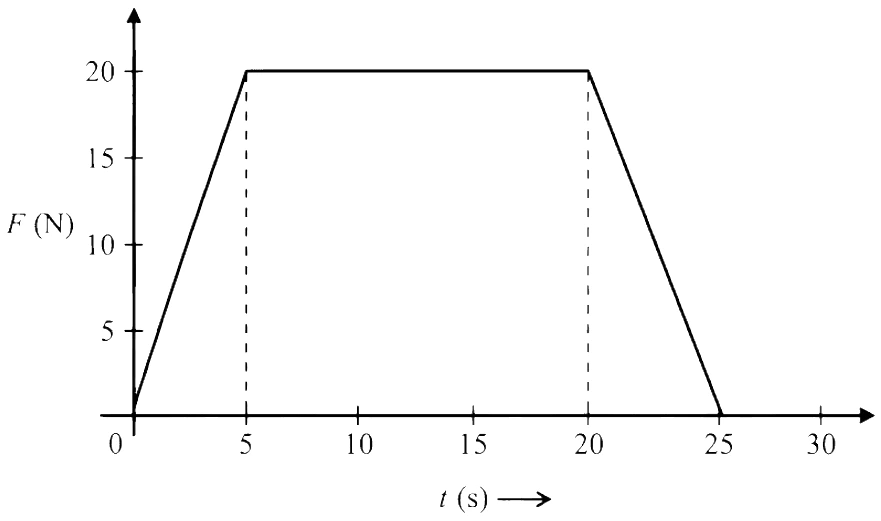
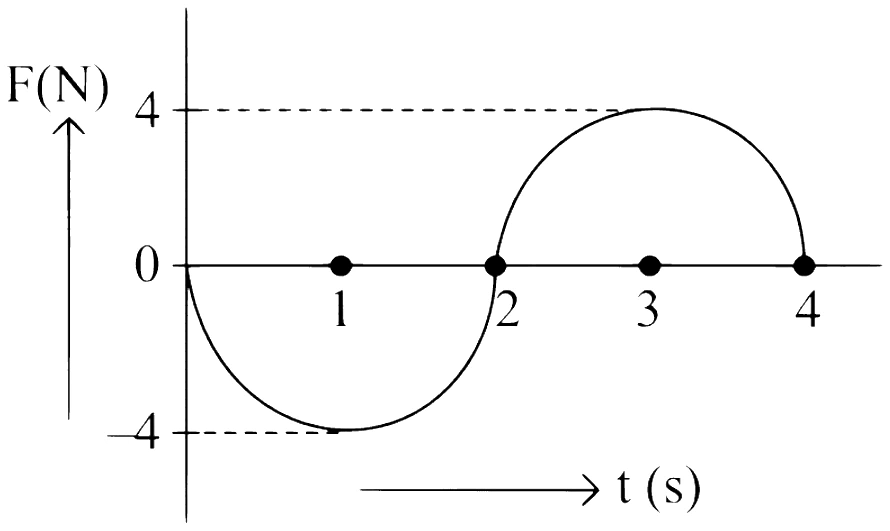
A body initially at rest undergoes rectilinear motion. The force-time (F-t) graph for the motion of the body is given below. Find the linear momentum gained by the body in 2s.
A stream of water flowing horizontally with a speed of 15m s−1 gushes out of a tube of cross-sectional area 10−2m2 and hits a vertical wall nearby. Assuming water does not rebound, the force exerted on the wall by the impact of water is
A bullet fired from a gun is given a force (600−2×10⁵t) newton, where t is in second. Force on the bullet becomes zero when it leaves the barrel. The average impulse imparted to the bullet is
Two balls each of mass 250g moving in opposite directions each with a speed 16m s−1 collide and rebound with the same speeds. The impulse imparted to one ball due to the other is
Water flowing through a pipe of area of cross-section 2×10⁻³m2 hits a vertical wall horizontally with a velocity of 12m s−1. If the water does not rebound after hitting the wall, then the force acting on the wall due to water is
A disc of mass 0.2kg is kept floating in air without falling by vertically firing bullets each of mass 0.05kg on the disc at the rate of 10 bullets per every second. If the bullets rebound with the same speed, then the speed of each bullet is (Acceleration due to gravity =10m s−2)
A block of metal 4kg is in rest on a frictionless surface. It was targeted by a jet releasing water of 2kg s−1 at a speed of 10m s−1. The acceleration of the block is
A block of metal 2kg is in rest on a smooth plane. It is striked by a jet releasing water of 1kg s−1 at a speed of 5m/s, then the acceleration of the block is
A soccer ball of mass 250g is moving horizontally to the left with a speed 22m s−1. This ball is kicked towards right with a velocity 30m s−1 at an angle 53∘ with the horizontal in upward direction. Assuming that it took 0.01s for the collision to take place, the average force acting is (cos53∘=53, sin53∘=54)
A 100kg cannon fires a ball of 1kg horizontally from a cliff of height 500m. It falls on the ground at a distance of 400m from the bottom of the cliff. The recoil velocity of the gun is (Acceleration due to gravity =10m s−2)
A ball of mass 0.5kg moving horizontally at 10m s−1 strikes a vertical wall and rebounds with speed v. The magnitude of the change in linear momentum is found to be 8.0kg m s−1. The magnitude of v is
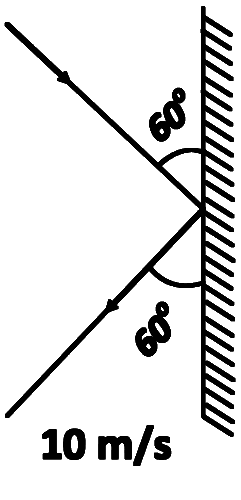
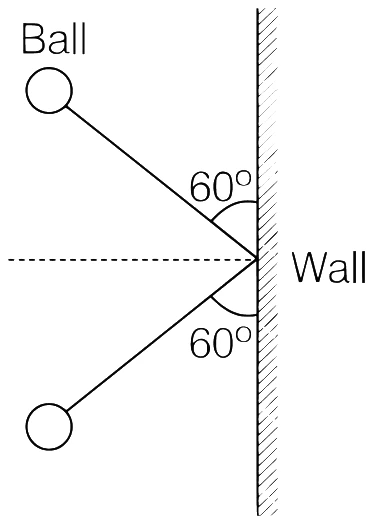
A ball of mass 3kg, moving with a speed of 100m s−1, strikes a wall at an angle 60∘ (as shown in figure). The ball rebounds at the same speed and remains in contact with the wall for 0.2s, the force exerted by the ball on the wall is
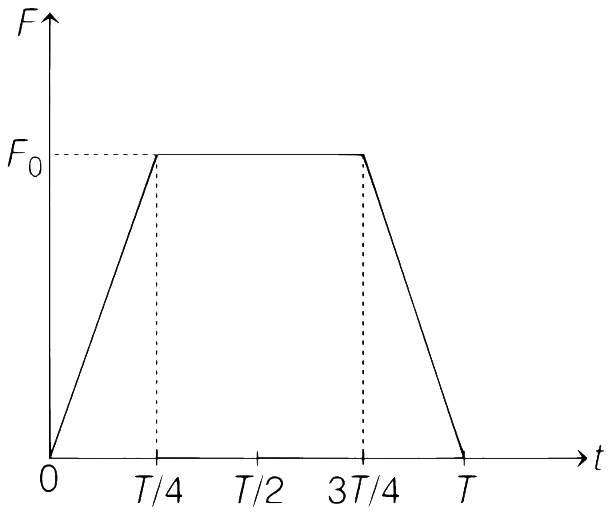
A particle of mass m, moving with a velocity v makes an elastic collision in one dimension with a stationary particle of mass m. During the collision, they remain in contact with each other for an extremely small time T. Their force of contact, with time is shown in the figure. Then, F0 is
A block of mass 5kg is kept on a smooth horizontal surface. A horizontal stream of water coming out of a pipe of area of cross-section 5cm2 hits the block with a velocity of 5m s−1 and rebounds back with the same velocity. The initial acceleration of the block is (density of water is 1g cm−3)
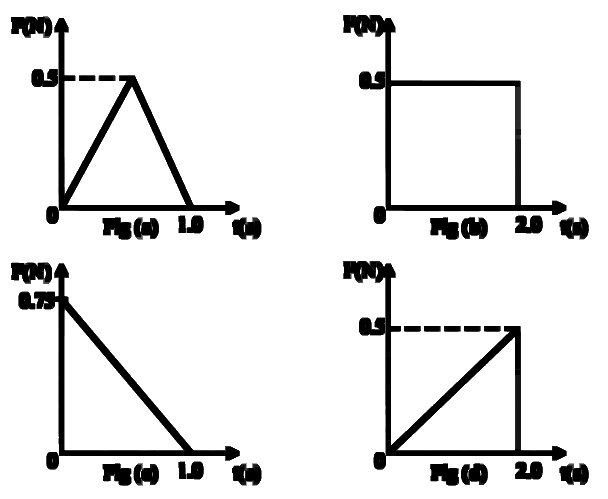
A time varying force acts on a ball of mass 100g for 2ms. The force versus time curve is shown below. If the initial speed of the ball is 10m/s, then the speed of ball after 2ms is
A golf ball of mass 50gm placed on a tee, is struck by a golf-club. The speed of the golf ball as it leaves the tee is 100m/s, the time of contact on the ball is 0.02s. If the force decreases to zero linearly with time, then the force at the beginning of the contact is
A shell of mass 10kg is moving with a velocity of 10m s−1 when it blasts and forms two parts of mass 9kg and 1kg respectively. If the 1st mass is stationary, the velocity of the 2nd is
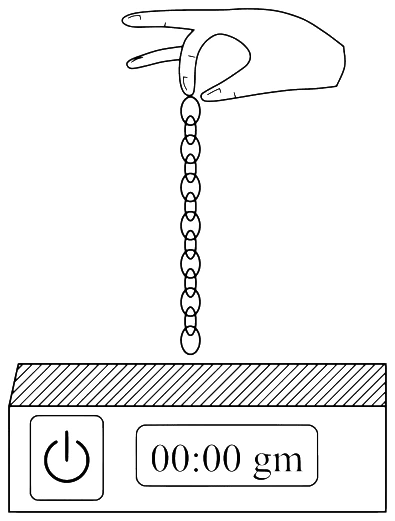
A jeweler is holding a gold chain of uniform mass per unit length hanging vertically just above a weighing scale as shown in the figure. He offers to charge the customer for half of the maximum reading of the scale, after he releases the chain. What percentage more than the actual price does the customer pay if he agrees to the offer?
The force acting on a particle is given by αβ×p where α is a constant, β is a constant vector of magnitude β and p is the linear momentum of the particle. Then
More than one option can be correct. Tap every correct option, then tap Check.