Physics Circle home Student Login

Home›Practice Hub›Chapters›Laws of Motion›Inertia, First & Second Laws

Laws of Motion PYQs · MHT CET · JEE Main · NEET

Inertia, First & Second Laws

Read the theory for this topic →

Questions
98
MHT CET
4
JEE Main
31
NEET
9
Other exams
54
0 of 98 attempted

Q1NEET 2026Easy

Inertia, First & Second Laws

The magnitude and direction of the acceleration produced in a body of mass 5 kg when two mutually perpendicular forces 8 N and 6 N act on it, are respectively:

Show answer and solution

Answer: (d)

Loading the solution…
Report a mistakeOpen question page
Q2JEE Main 2026 · 4 APR · SHIFT 2Medium

Inertia, First & Second Laws

At t=0t = 0, a body of mass 100 g starts moving under the influence of a force (5i^+10j^) N(5\hat{i} + 10\hat{j})\text{ N} After 2 s its position is (2xi^+5yj^) m(2x\hat{i} + 5y\hat{j})\text{ m}. The ratio x:yx : y is ______.

Show answer and solution

Answer: (d)

Loading the solution…
Report a mistakeOpen question page
Q3JEE Main 2026 · 21 JAN · SHIFT 1Medium

Inertia, First & Second Laws

A 4 kg mass moves under the influence of a force F⃗=(4t3i^−3tj^) N\vec{F} = \left(4t^3\hat{i} - 3t\hat{j}\right)\text{ N} where tt is the time in second. If mass starts from origin at t=0t = 0, the velocity and position after t=2 st = 2\text{ s} will be:

Show answer and solution

Answer: (c)

Loading the solution…
Report a mistakeOpen question page
Q4JEE Main 2026 · 28 JAN · SHIFT 1Difficult

Inertia, First & Second Laws

A particle of mass mm falls from rest through a resistive medium having resistive force, F=−kvF = -kv, where vv is the velocity of the particle and kk is a constant. Which of the following graphs represents velocity (v)(v) versus time (t)(t)?

Show answer and solution

Answer: (d)

Loading the solution…
Report a mistakeOpen question page
Q5MHT CET 2025 · 22 APR · SHIFT 2Easy

Inertia, First & Second Laws

A constant force acts on two different masses independently and produces accelerations A1A_1 and A2A_2. When the same force acts on their combined mass, the acceleration produced is

Show answer and solution

Answer: (c)

Loading the solution…
Report a mistakeOpen question page
Q6JEE Main 2025 · 23 JAN · SHIFT 2Easy

Inertia, First & Second Laws

A massless spring gets elongated by amount x1x_1 under a tension of 5 N. Its elongation is x2x_2 under the tension of 7 N. For the elongation of (5x1−2x2)(5x_1 - 2x_2), the tension in the spring will be,

Show answer and solution

Answer: (c)

Loading the solution…
Report a mistakeOpen question page
Q7JEE Main 2025 · 7 APR · SHIFT 2Medium

Inertia, First & Second Laws

An object with mass 500 g moves along x-axis with speed v=4xv = 4\sqrt{x} m/s. The force acting on the object is:

Show answer and solution

Answer: (b)

Loading the solution…
Report a mistakeOpen question page
Q8JEE Main 2025 · 8 APR · SHIFT 2Medium

Inertia, First & Second Laws

A body of mass 2 kg moving with velocity of v⃗in=3i^+4j^\vec{v}_{in} = 3\hat{i} + 4\hat{j} ms−1^{-1} enters into a constant force field of 6N directed along positive z-axis. If the body remains in the field for a period of 53\frac{5}{3} seconds, then velocity of the body when it emerges from force field is.

Show answer and solution

Answer: (d)

Loading the solution…
Report a mistakeOpen question page
Q9JEE Main 2025 · 3 APR · SHIFT 2Medium

Inertia, First & Second Laws

A block of mass 1 kg, moving along xx with speed vi=10 m/sv_i = 10\text{ m/s} enters a rough region ranging from x=0.1 mx = 0.1\text{ m} to x=1.9 mx = 1.9\text{ m}. The retarding force acting on the block in this range is Fr=−kx NF_r = -kx\text{ N}, with k =10 N/m= 10\text{ N/m}. Then the final speed of the block as it crosses rough region is.

Show answer and solution

Answer: (c)

Loading the solution…
Report a mistakeOpen question page
Q10MHT CET 2024 · 10 MAY · SHIFT 2Easy

Inertia, First & Second Laws

Which one of the following is 'NOT' a contact force?

Show answer and solution

Answer: (c)

Loading the solution…
Report a mistakeOpen question page
Q11JEE Main 2024 · 1 FEB · SHIFT 2Easy

Inertia, First & Second Laws

A body of mass 4 kg4\text{ kg} experiences two forces F⃗1=5i^+8j^+7k^\vec{F}_1 = 5\hat{i} + 8\hat{j} + 7\hat{k} and F⃗2=3i^−4j^−3k^\vec{F}_2 = 3\hat{i} - 4\hat{j} - 3\hat{k}. The acceleration acting on the body is:

Show answer and solution

Answer: (a)

Loading the solution…
Report a mistakeOpen question page
Q12JEE Main 2024 · 5 APR · SHIFT 2Medium

Inertia, First & Second Laws

A particle moves in x-yx\text{-}y plane under the influence of a force F⃗\vec{F} such that its linear momentum is p⃗(t)=i^cos⁡(kt)−j^sin⁡(kt)\vec{p}(t) = \hat{i}\cos(kt) - \hat{j}\sin(kt). If kk is constant, the angle between F⃗\vec{F} andp⃗\vec{p} will be:

Show answer and solution

Answer: (a)

Loading the solution…
Report a mistakeOpen question page
Q13JEE Main 2023 · 15 APR · SHIFT 1Easy

Inertia, First & Second Laws

The position vector of a particle related to time tt is given by

r⃗=(10ti^+15t2j^+7k^) m\vec{r} = \left(10t\hat{i} + 15t^2\hat{j} + 7\hat{k}\right)\text{ m}

The direction of net force experienced by the particle is:

Show answer and solution

Answer: (b)

Loading the solution…
Report a mistakeOpen question page
Q14NEET 2023Medium

Inertia, First & Second Laws

A bullet from a gun is fired on a rectangular wooden block with velocity uu. When bullet travels 24 cm24\text{ cm} through the block along its length horizontally, velocity of bullet becomes u3\frac{u}{3}. Then it further penetrates into the block in the same direction before coming to rest exactly at the other end of the block. The total length of the block is:

Show answer and solution

Answer: (d)

Loading the solution…
Report a mistakeOpen question page
Q15JEE Main 2023 · 29 JAN · SHIFT 2Medium

Inertia, First & Second Laws

A force acts for 20 s on a body of mass 20 kg, starting from rest, after which the force ceases and then body describes 50 m in the next 10 s. The value of force will be:

Show answer and solution

Answer: (c)

Loading the solution…
Report a mistakeOpen question page
Q16JEE Main 2023 · 11 APR · SHIFT 2Medium

Inertia, First & Second Laws

A body of mass 500 g500\text{ g} moves along xx-axis such that its velocity varies with displacement xx according to the relation v=10x m/sv = 10\sqrt{x}\text{ m/s} the force acting on the body is:-

Show answer and solution

Answer: (c)

Loading the solution…
Report a mistakeOpen question page
Q17JEE Main 2023 · 8 APR · SHIFT 1Medium

Inertia, First & Second Laws

At any instant the velocity of a particle of mass 500 g500\text{ g} is (2ti^+3t2j^) m s−1\left(2t\hat{i} + 3t^2\hat{j}\right)\text{ m s}^{-1}. If the force acting on the particle at t=1 st = 1\text{ s} is (i^+xj^) N(\hat{i} + x\hat{j})\text{ N}. Then the value of xx will be:

Show answer and solution

Answer: (d)

Loading the solution…
Report a mistakeOpen question page
Q18JEE Main 2022 · 25 JUN · SHIFT 1Medium

Inertia, First & Second Laws

A force on an object of mass 100 g is (10i^+5j^)\left(10\hat{i} + 5\hat{j}\right) N. The position of that object at t = 2 s is (ai^+bj^)\left(a\hat{i} + b\hat{j}\right) m after starting from rest. The value of ab\frac{a}{b} will be ___________.

Numerical answer type. Work it out, then open the answer.

Show answer and solution

Answer: 2

Loading the solution…
Report a mistakeOpen question page
Q19JEE Main 2022 · 24 JUN · SHIFT 2Difficult

Inertia, First & Second Laws

An object of mass 5 kg is thrown vertically upwards from the ground. The air resistance produces a constant retarding force of 10 N throughout the motion. The ratio of time of ascent to the time of descent will be equal to: [Use g = 10 ms−2{}^{-2}].

Show answer and solution

Answer: (b)

Loading the solution…
Report a mistakeOpen question page
Q20JEE Main 2021 · 18 MAR · SHIFT 1Easy

Inertia, First & Second Laws

A bullet of mass 0.1 kg is fired on a wooden block to pierce through it, but it stops after moving a distance of 50 cm into it. If the velocity of bullet before hitting the wood is 10 m/s and it slows down with uniform deceleration, then the magnitude of effective retarding force on the bullet is 'x' N. The value of 'x' to the nearest integer is __________.

Numerical answer type. Work it out, then open the answer.

Show answer and solution

Answer: 10

Loading the solution…
Report a mistakeOpen question page
Q21JEE Main 2021 · 1 SEP · SHIFT 2Medium

Inertia, First & Second Laws

An object of mass 'm' is being moved with a constant velocity under the action of an applied force of 2N along a frictionless surface with following surface profile.

Figure

The correct applied force vs distance graph will be:

Show answer and solution

Answer: (c)

Loading the solution…
Report a mistakeOpen question page
Q22JEE Main 2021 · 25 JUL · SHIFT 2Medium

Inertia, First & Second Laws

A force F⃗=(40i^+10j^) N\vec{F} = (40\hat{i} + 10\hat{j})\text{ N} acts on a body of mass 5 kg. If the body starts from rest, its position vectorr⃗\vec{r}at time t = 10 s, will be:

Show answer and solution

Answer: (c)

Loading the solution…
Report a mistakeOpen question page
Q23JEE Main 2021 · 16 MAR · SHIFT 2Medium

Inertia, First & Second Laws

A body of mass 2 kg moves under a force of (2i^+3j^+5k^)\left(2\hat{i} + 3\hat{j} + 5\hat{k}\right) N. It starts from rest and was at the origin initially. After 4s, its new coordinates are (8, b, 20). The value of b is _____________. (Round off to the Nearest Integer)

Numerical answer type. Work it out, then open the answer.

Show answer and solution

Answer: 12

Loading the solution…
Report a mistakeOpen question page
Q24JEE Main 2021 · 26 FEB · SHIFT 1Medium

Inertia, First & Second Laws

A boy pushes a box of mass 2 kg with a force F⃗=(20i^+10j^) N\vec{F} = \left(20\hat{i} + 10\hat{j}\right)\text{ N} on a frictionless surface. If the box was initially at rest, then ___________ m is displacement along the x-axis after 10s.

Numerical answer type. Work it out, then open the answer.

Show answer and solution

Answer: 500

Loading the solution…
Report a mistakeOpen question page
Q25JEE Main 2021 · 24 FEB · SHIFT 2Difficult

Inertia, First & Second Laws

A particle is projected with velocity v0 along x-axis. A damping force is acting on the particle which is proportional to the square of the distance from the origin i.e. ma = −α-\alphax2. The distance at which the particle stops:

Show answer and solution

Answer: (a)

Loading the solution…
Report a mistakeOpen question page
Q26MHT CET 2020 · 16 OCT · SHIFT 1Easy

Inertia, First & Second Laws

A body of mass 2 kg2\text{ kg} is acted upon by two forces each of magnitude 1 N1\text{ N} and inclined at 60∘60^\circ with each other. The acceleration of the body in m/s\text{m/s} is [cos⁡60∘=0.5\cos 60^\circ = 0.5]

Show answer and solution

Answer: (a)

Loading the solution…
Report a mistakeOpen question page
Q27JEE Main 2020 · 6 SEP · SHIFT 2Difficult

Inertia, First & Second Laws

A particle moving in the xy plane experiences a velocity dependent force

F⃗=k(vyi^+vxj^)\vec{F} = k\left(v_y\hat{i} + v_x\hat{j}\right), where vx and vy are the

x and y components of its velocityv⃗\vec{v}. Ifa⃗\vec{a}is the

acceleration of the particle, then

which of the following statements is true for the particle?

Show answer and solution

Answer: (b)

Loading the solution…
Report a mistakeOpen question page
Q28JEE Main 2020 · 4 SEP · SHIFT 2Difficult

Inertia, First & Second Laws

A small ball of mass m is thrown upward with velocity u from the ground. The ball experiences a resistive force mkv2 where v is its speed. The maximum height attained by the ball is:

Show answer and solution

Answer: (c)

Loading the solution…
Report a mistakeOpen question page
Q29MHT CET 2019 · 2 MAY · SHIFT 2Easy

Inertia, First & Second Laws

An aircraft is moving with uniform velocity 150 m/s150\text{ m/s} in the space. If all the forces acting on it are balanced, then it will

Show answer and solution

Answer: (a)

Loading the solution…
Report a mistakeOpen question page
Q30JEE Main 2019 · 10 APR · SHIFT 2Medium

Inertia, First & Second Laws

A bullet of mass 20 g has an initial speed of 1 ms–1, just before it starts penetrating a mud wall of thickness 20 cm. If the wall offers a mean resistance of 2.5 × 10⁻² N, the speed of the bullet after emerging from the other side of the wall is close to:

Show answer and solution

Answer: (c)

Loading the solution…
Report a mistakeOpen question page
Q31JEE Main 2019 · 12 APR · SHIFT 2Medium

Inertia, First & Second Laws

A spring whose unstretched length is l has a force constant k. The spring is cut into two pieces of unstretched lengths l1 and l2 where, l1 = nl2 and n is an integer. The ratio k1/k2 of the corresponding force constant, k1 and k2 will be:

Show answer and solution

Answer: (b)

Loading the solution…
Report a mistakeOpen question page
Q32JEE Main 2019 · 10 APR · SHIFT 1Difficult

Inertia, First & Second Laws

A ball is thrown upward with an initial velocity V0 from the surface of the earth. The motion of the ball is affected by a drag force equal to mγ\gammau2 (where m is mass of the ball, u is its instantaneous velocity and γ\gamma is a constant). Time taken by the ball to rise to its zenith is:

Show answer and solution

Answer: (a)

Loading the solution…
Report a mistakeOpen question page
Q33JEE Main 2017Difficult

Inertia, First & Second Laws

A body of mass m = 10–2 kg is moving in a medium and experiences a frictional force F = –kv2. Its initial speed is v0 = 10 ms–1. If, after 10 s, its energy is 18mv02\frac{1}{8}mv_0^2, the value of k will be:

Show answer and solution

Answer: (d)

Loading the solution…
Report a mistakeOpen question page
Q34JEE Main 2016 · 10 APR · SHIFT 1Difficult

Inertia, First & Second Laws

A particle of mass m is acted upon by a force F given by the empirical law F = Rt2v(t)\frac{R}{t^2}v(t) If this law is to be tested experimentally by observing the motion starting from rest, the best way is to plot:

Show answer and solution

Answer: (d)

Loading the solution…
Report a mistakeOpen question page
Q35JEE Main 2014 · 11 APR · SHIFT 1Easy

Inertia, First & Second Laws

A Body of mass 5 kg under the action of constant force F⃗\vec{F}= Fx i^\hat{i} + Fy j^\hat{j} has velocity at t = 0 s as v⃗\vec{v}= (6i^−\hat{i} - 2j^\hat{j}) m/s and at t = 10 s as v⃗\vec{v}= + 6j^\hat{j} m/s. The force F⃗\vec{F}is:

Show answer and solution

Answer: (a)

Loading the solution…
Report a mistakeOpen question page
Q36NEET 2012 · AIPMT · MAINSEasy

Inertia, First & Second Laws

A stone is dropped from a height h. It hits the ground with a certain momentum P. If the same stone is dropped from a height 100% more than the previous height, the momentum when it hits the ground will change by

Show answer and solution

Answer: (b)

Loading the solution…
Report a mistakeOpen question page
Q37JEE Main 2012 · AIEEEMedium

Inertia, First & Second Laws

A particle of mass mm is at rest at the origin at time t=0t = 0 It is subjected to a force F(t)=F0e−btF(t) = F_0e^{-bt} in the xx direction. Its speed v(t)v(t) is depicted by which of the following curves?

Show answer and solution

Answer: (b)

Loading the solution…
Report a mistakeOpen question page
Q38NEET 2009 · AIPMTEasy

Inertia, First & Second Laws

A body, under the action of a force F⃗=6i^−8j^+10k^,\vec{F} = 6\hat{i} - 8\hat{j} + 10\hat{k}, acquires an accelerations of 1 m/s2. The mass of this body must be

Show answer and solution

Answer: (c)

Loading the solution…
Report a mistakeOpen question page
Q39JEE Main 2005 · AIEEEEasy

Inertia, First & Second Laws

A particle of mass 0.3 kg subjected to a force F=−kxF = -kx with k=15 N/mk = 15\text{ N/m}. What will be its initial acceleration if it is released from a point 20 cm away from the origin?

Show answer and solution

Answer: (c)

Loading the solution…
Report a mistakeOpen question page
Q40NEET 2002 · AIPMTMedium

Inertia, First & Second Laws

An object of mass 3 kg is at rest. Now a force of F⃗\vec{F}= 6t2 i^\hat{i} + 4t j^\hat{j} is applied on the object then velocity of object at t = 3 sec. is

Show answer and solution

Answer: (b)

Loading the solution…
Report a mistakeOpen question page
Q41NEET 1997 · AIPMTEasy

Inertia, First & Second Laws

A force of 6 N6\text{ N} acts on a body at rest and of mass 1 kg1\text{ kg}. During this time, the body attains a velocity of 30 m/s30\text{ m/s}. The time for which the force acts on the body is

Show answer and solution

Answer: (b)

Loading the solution…
Report a mistakeOpen question page
Q42NEET 1996 · AIPMTEasy

Inertia, First & Second Laws

A 10 N10\text{ N} force is applied on a body produce in it an acceleration of 1 m/s21\text{ m/s}^2. The mass of the body is

Show answer and solution

Answer: (c)

Loading the solution…
Report a mistakeOpen question page
Q43NEET 1996 · AIPMTEasy

Inertia, First & Second Laws

A force vector applied on a mass is represented as F⃗=6i^−8j^+10k^\vec{F} = 6\hat{i} - 8\hat{j} + 10\hat{k} and accelerates with 1 m/s21\text{ m/s}^2. What will be the mass of the body?

Show answer and solution

Answer: (c)

Loading the solution…
Report a mistakeOpen question page
Q44NEET 1991 · AIPMTEasy

Inertia, First & Second Laws

Physical independence of force is a consequence of

Show answer and solution

Answer: (c)

Loading the solution…
Report a mistakeOpen question page
Q45NDA 2026Easy

Inertia, First & Second Laws

Consider the following statements:
I. The weight of an object is the same everywhere on the surface of the Earth, but its inertial mass could be different.
II. The inertial mass and gravitational mass of an object are proportional and the proportionality constant is the same everywhere.
III. The inertial mass and weight of an object are the same at different places on Earth.
Which of the statements given above is/are correct?

Show answer

Answer: (b)

Step-by-step solution coming soon.

Report a mistake
Q46NDA 2026Easy

Inertia, First & Second Laws

What is the upward force acting on a skydiver of mass 60 kg60\,\text{kg} who is falling at a uniform speed of 2 m s−12\,\text{m s}^{-1}?

Show answer

Answer: (c)

Step-by-step solution coming soon.

Report a mistake
Q47NDA 2025Easy

Inertia, First & Second Laws

Which one of the following statements for second law of motion is NOT correct?

Show answer

Answer: (d)

Step-by-step solution coming soon.

Report a mistake
Q48NDA 2023Easy

Inertia, First & Second Laws

The motion of a particle of mass mm is described by the relation y=ut−12gt2y = ut - \dfrac{1}{2}gt^2, where uu is the initial velocity of the particle. The force acting on the particle is

Show answer

Answer: (d)

Step-by-step solution coming soon.

Report a mistake
Q49NDA 2022Easy

Inertia, First & Second Laws

A 5 N5\,\text{N} force is defined when a mass of 10 kg10\,\text{kg} is accelerated with

Show answer

Answer: (b)

Step-by-step solution coming soon.

Report a mistake
Q50NDA 2021Easy

Inertia, First & Second Laws

Weight and mass of an object are defined with Newton's laws of motion. Which among the following is true?

Show answer

Answer: (b)

Step-by-step solution coming soon.

Report a mistake
Q51NDA 2021Easy

Inertia, First & Second Laws

The statement "friction force is a contact force while magnetic force is a non-contact force" is

Show answer

Answer: (a)

Step-by-step solution coming soon.

Report a mistake
Q52NDA 2018Easy

Inertia, First & Second Laws

Which one of the following has maximum inertia?

Show answer

Answer: (d)

Step-by-step solution coming soon.

Report a mistake
Q53NDA 2016Easy

Inertia, First & Second Laws

When a force of 1 newton1\,\text{newton} acts on a mass of 1 kg1\,\text{kg} which is able to move freely, the object moves in the direction of force with a/an

Show answer

Answer: (b)

Step-by-step solution coming soon.

Report a mistake
Q54NDA 2016Easy

Inertia, First & Second Laws

Mass of a particular amount of substance
1. is the amount of matter present in it.
2. does not vary from place to place.
3. changes with change in gravitational force.
Select the correct answer using the code given below:

Show answer

Answer: (b)

Step-by-step solution coming soon.

Report a mistake
Q55NDA 2014Easy

Inertia, First & Second Laws

A passenger in a moving train tosses a coin upward which falls behind him. It implies that the motion of the train is

Show answer

Answer: (a)

Step-by-step solution coming soon.

Report a mistake
Q56NDA 2014Medium

Inertia, First & Second Laws

A force applied on a body is represented as F⃗=6i^−8j^+10k^\vec{F} = 6\hat{i} - 8\hat{j} + 10\hat{k} and accelerates it at 1 m s−21\,\text{m s}^{-2}. The mass of the body is

Show answer

Answer: (b)

Step-by-step solution coming soon.

Report a mistake
Q57NDA 2013Easy

Inertia, First & Second Laws

A car is moving with a uniform speed. However its momentum is changing. Then the car

Show answer

Answer: (a)

Step-by-step solution coming soon.

Report a mistake
Q58NDA 2013Easy

Inertia, First & Second Laws

An object is undergoing a non-accelerated motion. Its rate of change in momentum is

Show answer

Answer: (b)

Step-by-step solution coming soon.

Report a mistake
Q59NDA 2011Easy

Inertia, First & Second Laws

When a moving bus suddenly applies brakes, the passengers sitting in it fall in the forward direction. This can be explained by:

Show answer

Answer: (b)

Step-by-step solution coming soon.

Report a mistake
Q60NDA 2010Easy

Inertia, First & Second Laws

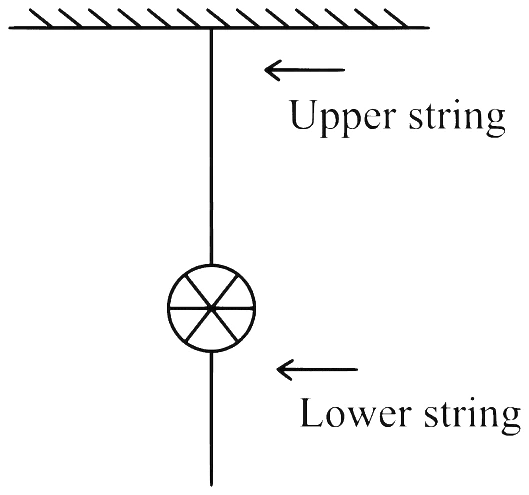
A heavy ball is suspended as shown in the figure. A quick jerk on the lower string will break that string but a slow pull on the lower string will break the upper string. The first result occurs because:

Heavy ball hanging from a ceiling by an upper string with a lower string attached below it
Show answer

Answer: (d)

Step-by-step solution coming soon.

Report a mistake
Q61NDA 2009Easy

Inertia, First & Second Laws

Consider the following statements about Astra:
1. This anti-aircraft missile is procured by India from Russia.
2. It is a single-stage, smokeless, solid-propelled missile.
3. It may be launched from different altitudes.
Which of the statements given above are correct?

Show answer

Answer: (b)

Step-by-step solution coming soon.

Report a mistake
Q62NDA 2009Easy

Inertia, First & Second Laws

The weight of a body is 9.8 N9.8\,\text{N} at the place where g=9.8 m s−2g = 9.8\,\text{m s}^{-2}. Its mass is

Show answer

Answer: (d)

Step-by-step solution coming soon.

Report a mistake
Q63JEE Advanced 2025Difficult

Inertia, First & Second Laws

A projectile of mass 200 g200\,\text{g} is launched in a viscous medium at an angle 60∘60^\circ with the horizontal, with an initial velocity of 270 m s−1270\,\text{m s}^{-1}. It experiences a viscous drag force F⃗=−cv⃗\vec{F} = -c\vec{v} where the drag coefficient c=0.1 kg s−1c = 0.1\,\text{kg s}^{-1} and v⃗\vec{v} is the instantaneous velocity of the projectile. The projectile hits a vertical wall after 2 s2\,\text{s}. Taking e=2.7e = 2.7, the horizontal distance of the wall from the point of projection (in m) is

Numerical answer type. Work it out, then open the answer.

Show answer

Answer: 167 to 171

Step-by-step solution coming soon.

Report a mistake
Q64JEE Advanced 2023Medium

Inertia, First & Second Laws

A particle of mass mm is moving in the xyxy-plane such that its velocity at a point (x,y)(x, y) is given as v⃗=α(yx^+2xy^)\vec{v} = \alpha(y\hat{x} + 2x\hat{y}), where α\alpha is a non-zero constant. What is the force F⃗\vec{F} acting on the particle?

Show answer

Answer: (a)

Step-by-step solution coming soon.

Report a mistake
Q65JEE Advanced 2018Medium

Inertia, First & Second Laws

A solid horizontal surface is covered with a thin layer of oil. A rectangular block of mass m=0.4 kgm = 0.4\,\text{kg} is at rest on this surface. An impulse of 1.0 N s1.0\,\text{N s} is applied to the block at time t=0t = 0 so that it starts moving along the xx-axis with a velocity v(t)=v0e−t/τv(t) = v_0 e^{-t/\tau}, where v0v_0 is a constant and τ=4 s\tau = 4\,\text{s}. The displacement of the block, in metres, at t=τt = \tau is ______. Take e−1=0.37e^{-1} = 0.37.

Numerical answer type. Work it out, then open the answer.

Show answer

Answer: 6.30

Step-by-step solution coming soon.

Report a mistake
Q66JEE Advanced 2007Easy

Inertia, First & Second Laws

STATEMENT 1
A cloth covers a table. Some dishes are kept on it. The cloth can be pulled out without dislodging the dishes from the table.
STATEMENT 2
For every action there is an equal and opposite reaction.

Show answer

Answer: (b)

Step-by-step solution coming soon.

Report a mistake
Q67JEE Advanced 2007Medium

Inertia, First & Second Laws

A particle moves in the XX-YY plane under the influence of a force such that its linear momentum is p⃗(t)=A[i^cos⁡(kt)−j^sin⁡(kt)]\vec{p}(t) = A\left[\hat{i}\cos(kt) - \hat{j}\sin(kt)\right], where AA and kk are constants. The angle between the force and the momentum is

Show answer

Answer: (d)

Step-by-step solution coming soon.

Report a mistake
Q68JEE Advanced 1980Easy

Inertia, First & Second Laws

A ship of mass 3×10⁷ kg3 \times 10^{7}\,\text{kg} initially at rest, is pulled by a force of 5×10⁴ N5 \times 10^{4}\,\text{N} through a distance of 3 m3\,\text{m}. Assuming that the resistance due to water is negligible, the speed of the ship is

Show answer

Answer: (c)

Step-by-step solution coming soon.

Report a mistake
Q69AIIMS 2018Medium

Inertia, First & Second Laws

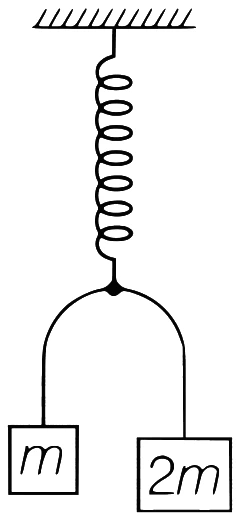
In the figure, blocks A and B of masses 2m2m and mm are connected with a string and the system is hanged vertically with the help of a spring. The spring has negligible mass. Find the magnitudes of accelerations of masses 2m2m and mm just after the instant when the string is cut.

Spring hangs from ceiling; a string loop from its lower end carries masses m and 2m on two sides
Show answer

Answer: (c)

Step-by-step solution coming soon.

Report a mistake
Q70AIIMS 2013Easy

Inertia, First & Second Laws

Assertion: A body can be at rest even when it is under the action of any number of external forces.
Reason: Vector sum of all the external forces is zero.

Show answer

Answer: (a)

Step-by-step solution coming soon.

Report a mistake
Q71AIIMS 2012Easy

Inertia, First & Second Laws

Assertion: A table cloth can be pulled from a table without dislodging the dishes.
Reason: To every action there is an equal and opposite reaction.

Show answer

Answer: (b)

Step-by-step solution coming soon.

Report a mistake
Q72AIIMS 2010Easy

Inertia, First & Second Laws

Assertion: A table cloth can be pulled from a table without dislodging the dishes.
Reason: To every action there is an equal and opposite reaction.

Show answer

Answer: (b)

Step-by-step solution coming soon.

Report a mistake
Q73AIIMS 2009Easy

Inertia, First & Second Laws

Assertion: A cloth covers a table. Some dishes are kept on it. The cloth can be pulled out without dislodging the dishes from the table.
Reason: For every action there is an equal and opposite reaction.

Show answer

Answer: (b)

Step-by-step solution coming soon.

Report a mistake
Q74JIPMER 2012Easy

Inertia, First & Second Laws

The engine of a jet aircraft applies a thrust force of 105 N10^5\,\text{N} during take off and causes the plane to attain a velocity of 1 km s−11\,\text{km s}^{-1} in 10 s10\,\text{s}. The mass of the plane is

Show answer

Answer: (b)

Step-by-step solution coming soon.

Report a mistake
Q75JIPMER 2004Easy

Inertia, First & Second Laws

The spring extends by xx on loading, then energy stored by the spring is (if TT is the tension in spring and kk is spring constant)

Show answer

Answer: (a)

Step-by-step solution coming soon.

Report a mistake
Q76COMEDK 2024Easy

Inertia, First & Second Laws

A man standing in a truck moving with constant velocity throws a ball vertically into air, ball falls

Show answer

Answer: (d)

Step-by-step solution coming soon.

Report a mistake
Q77COMEDK 2023Medium

Inertia, First & Second Laws

A spring of force constant kk is cut into lengths of ratio 1:3:41:3:4. They are connected in series and the new force constant is k′k'. Then they are connected in parallel and force constant is k′′k''. Then k′:k′′k' : k'' is

Show answer

Answer: (b)

Step-by-step solution coming soon.

Report a mistake
Q78COMEDK 2021Easy

Inertia, First & Second Laws

The motion of a particle of mass mm is described by y=ut+gt2y = ut + gt^2. The force acting on the particle will be

Show answer

Answer: (d)

Step-by-step solution coming soon.

Report a mistake
Q79COMEDK 2020Easy

Inertia, First & Second Laws

A body under the action of a force F⃗=6i^−8j^+10k^\vec{F} = 6\hat{i} - 8\hat{j} + 10\hat{k}, acquires an acceleration of 1 m s−21\,\text{m s}^{-2}. The mass of this body must be

Show answer

Answer: (c)

Step-by-step solution coming soon.

Report a mistake
Q80KCET 2019Medium

Inertia, First & Second Laws

An object with mass 5 kg5\,\text{kg} is acted upon by a force, F=(−3i^−4j^) N\mathbf{F} = (-3\hat{i} - 4\hat{j})\,\text{N}. If its initial velocity at t=0t = 0 is v=(3i^+12j^) m/s\mathbf{v} = (3\hat{i} + 12\hat{j})\,\text{m/s}, the time at which it will just have a velocity along yy-axis is -

Show answer

Answer: (a)

Step-by-step solution coming soon.

Report a mistake
Q81AP EAPCET 2026Easy

Inertia, First & Second Laws

A block of mass 5 kg5\,\text{kg} is sliding with constant velocity of 6 m s−16\,\text{m s}^{-1} on a frictionless horizontal surface. The force exerted on the horizontal surface is

Show answer

Answer: (d)

Step-by-step solution coming soon.

Report a mistake
Q82AP EAPCET 2026Medium

Inertia, First & Second Laws

A body of mass 5 kg5\,\text{kg} at rest is acted upon by two forces 30 N30\,\text{N} and FF. If the angle between the forces is 60∘60^\circ and the distance travelled by the body in a time of 2 s2\,\text{s} under the action of these forces is 28 m28\,\text{m}, then F=F =

Show answer

Answer: (c)

Step-by-step solution coming soon.

Report a mistake
Q83AP EAPCET 2025Easy

Inertia, First & Second Laws

Two bodies AA and BB of masses 1.5 kg1.5\,\text{kg} and 3 kg3\,\text{kg} are moving with velocities 20 m s−120\,\text{m s}^{-1} and 15 m s−115\,\text{m s}^{-1} respectively. If the same retarding force is applied on the two bodies, then the ratio of the distances travelled by the bodies AA and BB before they come to rest is

Show answer

Answer: (b)

Step-by-step solution coming soon.

Report a mistake
Q84AP EAPCET 2024Medium

Inertia, First & Second Laws

Two objects having masses 1:41:4 ratio are at rest. When both of them are subjected to same force separately, they achieved same kinetic energy during times t1t_1 and t2t_2 respectively. Then, ratio of t2t1\dfrac{t_2}{t_1} is

Show answer

Answer: (b)

Step-by-step solution coming soon.

Report a mistake
Q85AP EAPCET 2023Easy

Inertia, First & Second Laws

The magnitude of the external force acting on moving bodies can be known directly by

Show answer

Answer: (c)

Step-by-step solution coming soon.

Report a mistake
Q86AP EAPCET 2023Easy

Inertia, First & Second Laws

"The uniform motion is possible when no frictional forces oppose" is the concept of

Show answer

Answer: (d)

Step-by-step solution coming soon.

Report a mistake
Q87AP EAPCET 2023Easy

Inertia, First & Second Laws

A car of mass 1500 kg1500\,\text{kg} is moving with 20 m s−120\,\text{m s}^{-1} velocity. If the brakes are applied, it comes to rest in 5 s5\,\text{s}, then the retarding force is

Show answer

Answer: (b)

Step-by-step solution coming soon.

Report a mistake
Q88TS EAMCET 2026Easy

Inertia, First & Second Laws

When a force of 8 N8\,\text{N} is applied on a body, its velocity changes from 8 m s−18\,\text{m s}^{-1} to 16 m s−116\,\text{m s}^{-1} in a time of 4 s4\,\text{s}. The force required to change the velocity of the same body from 16 m s−116\,\text{m s}^{-1} to 20 m s−120\,\text{m s}^{-1} in a time of 2 s2\,\text{s} is

Show answer

Answer: (c)

Step-by-step solution coming soon.

Report a mistake
Q89TS EAMCET 2026Medium

Inertia, First & Second Laws

A body of mass MM is suspended from the lower end of an aeroplane accelerating horizontally. If the rope used to hang the body can withstand a maximum tension TT, then the maximum acceleration of the aeroplane is (gg = acceleration due to gravity and neglect the mass of the rope)

Show answer

Answer: (a)

Step-by-step solution coming soon.

Report a mistake
Q90TS EAMCET 2025Easy

Inertia, First & Second Laws

A force separately produces accelerations of 18 m s−218\,\text{m s}^{-2}, 9 m s−29\,\text{m s}^{-2} and 6 m s−26\,\text{m s}^{-2} in three bodies of masses PP, QQ and RR respectively. If the same force is applied on a body of mass P+Q+RP+Q+R, then the acceleration of that body is

Show answer

Answer: (a)

Step-by-step solution coming soon.

Report a mistake
Q91TS EAMCET 2023Easy

Inertia, First & Second Laws

A body of mass 6 kg6\,\text{kg} is moving with a uniform velocity 4 m s−14\,\text{m s}^{-1}. Its velocity changes to 6 m s−16\,\text{m s}^{-1} when a force of 12 N12\,\text{N} acts on it. Then its displacement is

Show answer

Answer: (b)

Step-by-step solution coming soon.

Report a mistake
Q92TS EAMCET 2020Medium

Inertia, First & Second Laws

The velocity of an object of mass 2 kg2\,\text{kg} is given by v=(8t i^+3t2 j^) m/s\mathbf{v}=\left(8t\,\hat{\mathbf{i}}+3t^2\,\hat{\mathbf{j}}\right)\,\text{m/s}, where tt is time in seconds. What will be the direction of net force on the object relative to the positive direction of XX-axis, at the instant when its magnitude is 20 N20\,\text{N}?

Show answer

Answer: (d)

Step-by-step solution coming soon.

Report a mistake
Q93WB JEE 2025Medium

Inertia, First & Second Laws

A force F⃗=ai^+bj^+ck^\vec{F} = a\hat{i} + b\hat{j} + c\hat{k} is acting on a body of mass mm. The body was initially at rest at the origin. The co-ordinates of the body after time tt will be

Show answer

Answer: (a)

Step-by-step solution coming soon.

Report a mistake
Q94WB JEE 2022Medium

Inertia, First & Second Laws

If a string suspended from the ceiling is given a downward force F1F_1, its length becomes L1L_1. Its length is L2L_2, if the downward force is F2F_2. What is its actual length?

Show answer

Answer: (d)

Step-by-step solution coming soon.

Report a mistake
Q95WB JEE 2018Medium

Inertia, First & Second Laws

The velocity (vv) of a particle (under a force FF) depends on its distance (xx) from the origin (with x>0x > 0) as v∝1xv \propto \dfrac{1}{\sqrt{x}}. Find how the magnitude of the force (FF) on the particle depends on xx?

Show answer

Answer: (c)

Step-by-step solution coming soon.

Report a mistake
Q96WB JEE 2017Medium

Inertia, First & Second Laws

A block of mass 1 kg1\,\text{kg} starts from rest at x=0x = 0 and moves along the X-axis under the action of a force F=ktF = kt, where tt is time and k=1 N s−1k = 1\,\text{N s}^{-1}. The distance the block will travel in 66 seconds is

Show answer

Answer: (a)

Step-by-step solution coming soon.

Report a mistake
Q97WB JEE 2008Medium

Inertia, First & Second Laws

A bullet emerges from a barrel of length 1.2 m1.2\,\text{m} with a speed of 640 m s−1640\,\text{m s}^{-1}. Assuming constant acceleration, the approximate time that it spends in the barrel after the gun is fired is

Show answer

Answer: (a)

Step-by-step solution coming soon.

Report a mistake
Q98NEST 2022Difficult

Inertia, First & Second Laws

A body of mass m=10.0 kgm = 10.0\,\text{kg}, initially at rest, moves along a line under the action of constant force F=10.0 NF = 10.0\,\text{N}. The drag force experienced by the body is given by −Cv2-Cv^2 where vv is the instantaneous speed and C=10.0 kg m−1C = 10.0\,\text{kg m}^{-1}. The time (in seconds) required for the body to achieve half of the terminal speed is closest to

Show answer

Answer: (b)

Step-by-step solution coming soon.

Report a mistake