
Electrical Power & Heating Effect
A room heater is rated . If the supply voltage drops to 200 V, what will be the power consumed (approximately)?
Show answer and solution
Answer: (c)
Loading the solution…
Home›Practice Hub›Chapters›Current Electricity›Electrical Power & Heating Effect
Current Electricity PYQs · MHT CET · JEE Main · NEET
Electrical Power & Heating Effect
A room heater is rated . If the supply voltage drops to 200 V, what will be the power consumed (approximately)?
Answer: (c)
Electrical Power & Heating Effect
An electric power line having total resistance of , delivers 1 kW of power at 250 V. The percentage efficiency of transmission line is ______.
Answer: (a)
Electrical Power & Heating Effect
Refer to the circuit diagram given below. The heat generated across the resistance in 100 second is . The value of is ______. (Nearest integer)
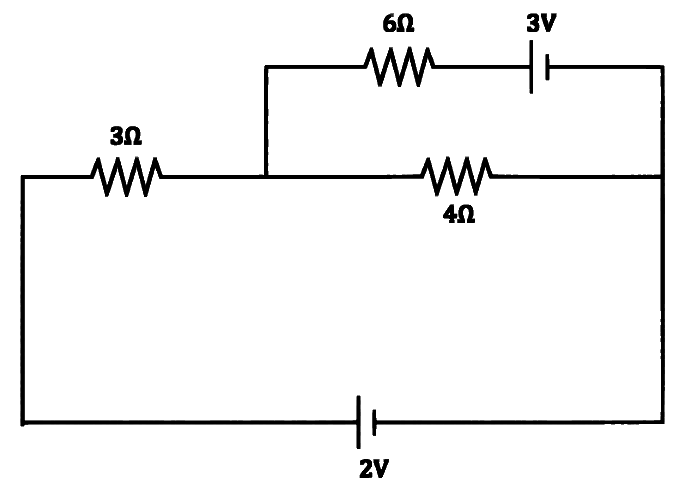
Numerical answer type. Work it out, then open the answer.
Answer: 3477
Electrical Power & Heating Effect
The heat generated in 1 minute between points and in the given circuit, when a battery of 9 V with internal resistance of is connected across these points is ______ J.
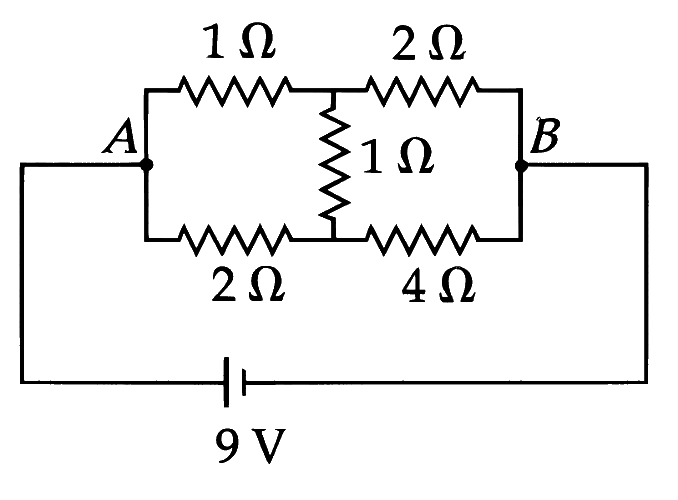
Numerical answer type. Work it out, then open the answer.
Answer: 1080
Electrical Power & Heating Effect
Two resistors of 200 and 400 are connected in series with a battery of 100 V. A bulb rated at 200 V, 100 W is connected across the 400 resistance. The potential drop across the bulb is ________ V.
Answer: (b)
Electrical Power & Heating Effect
A motor operating on 100 V draws a current of 1 A. If the efficiency of the motor is , then the loss of power in units of is
Answer: (b)
Electrical Power & Heating Effect
The battery of a mobile phone is rated as . How much energy is stored in it when fully charged?
Answer: (a)
Electrical Power & Heating Effect
There are ' ' number of identical electric bulbs, each is designed to draw a power independently from the mains supply. They are now joined in series across the mains supply. The total power drawn by the combination is:
Answer: (d)
Electrical Power & Heating Effect
The current flowing in a coil is 3 A and the power consumed is 108 W. If the a.c. source is of , the resistance in the circuit is
Answer: (c)
Electrical Power & Heating Effect
An electric bulb rated is connected across a supply. The power dissipation of the bulb is:
Answer: (c)
Electrical Power & Heating Effect
In the following circuit, a power of 50 watt is absorbed in the section AB of the circuit. The value of resistance ' ' is
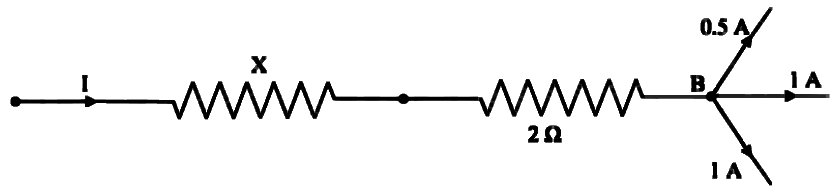
Answer: (c)
Electrical Power & Heating Effect
In the following circuit, the battery has an emf of and an internal resistance of . The power consumption in the entire circuit is _________ W.
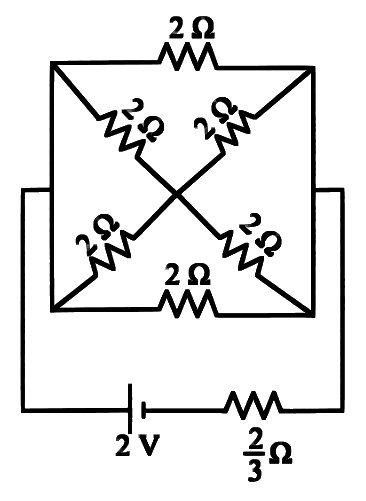
Numerical answer type. Work it out, then open the answer.
Answer: 3
Electrical Power & Heating Effect
The ratio of heat dissipated per second through the resistance and in the circuit given below is:
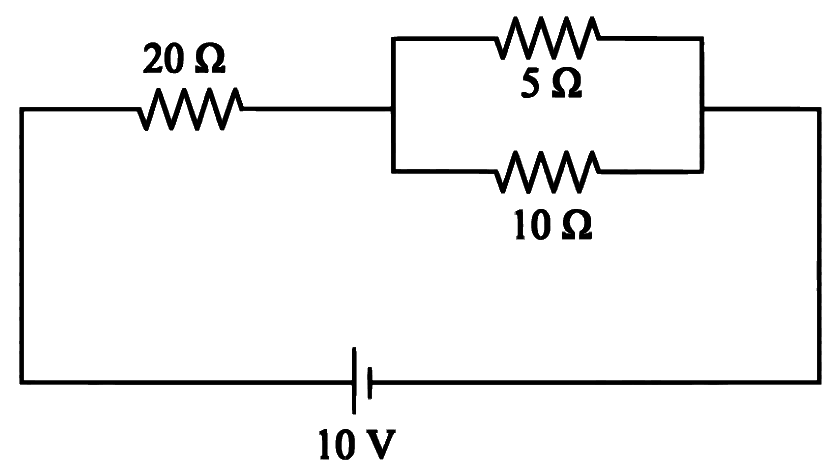
Answer: (b)
Electrical Power & Heating Effect
When a potential difference is applied across a wire of resistance , it dissipates energy at a rate . If the wire is cut into two halves and these halves are connected mutually parallel across the same supply, the energy dissipation rate will become:
Answer: (b)
Electrical Power & Heating Effect
Two heaters and have power rating of and , respectively. Those two are first connected in series and then in parallel to a fixed power source. The ratio of power outputs for these two cases is:
Answer: (b)
Electrical Power & Heating Effect
Water boils in an electric kettle in 20 minutes after being switched on. Using the same main supply, the length of the heating element should be _________ to __________ times of its initial length if the water is to be boiled in 15 minutes.
Answer: (c)
Electrical Power & Heating Effect
By what percentage will the illumination of the lamp decrease if the current drops by 20%?
Answer: (b)
Electrical Power & Heating Effect
A heater is designed to operate with a power of in a line. It is connected in combination with a resistance of and a resistance , to a mains as shown in figure. For the heater to operate at , the value of should be _______ .
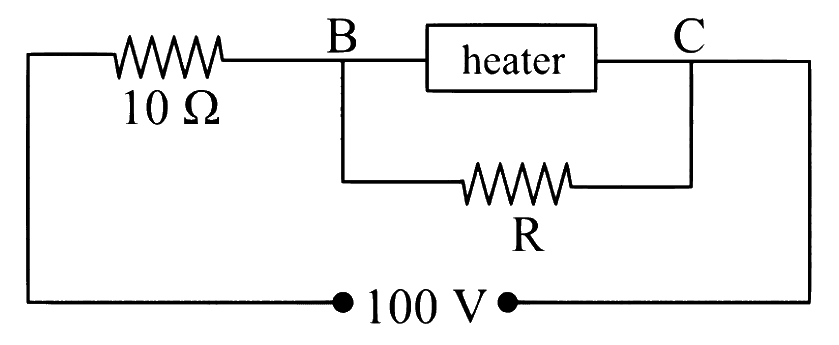
Numerical answer type. Work it out, then open the answer.
Answer: 5
Electrical Power & Heating Effect
The amount of thermal energy is developed by a resistor in when a current of is passed through it. If the current is increased to , the thermal energy developed by the resistor in will be:
Answer: (b)
Electrical Power & Heating Effect
Ratio of thermal energy released in two resistors R and 3R connected in parallel in an electric circuit is:
Answer: (d)
Electrical Power & Heating Effect
Two identical heater filaments are connected first in parallel and then in series. At the same applied voltage, the ratio of heat produced in same time for parallel to series will be:
Answer: (a)
Electrical Power & Heating Effect
Different combination of 3 resistors of equal resistance are shown in the figures. The increasing order for power dissipation is:
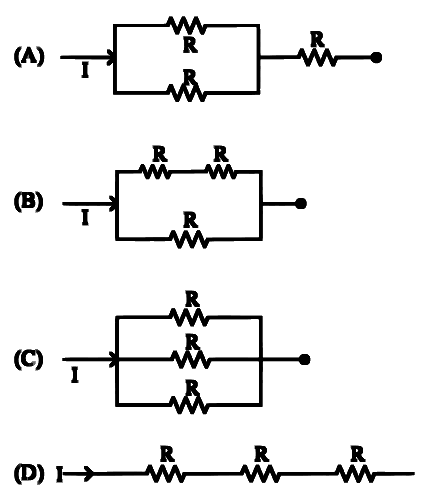
Answer: (b)
Electrical Power & Heating Effect
A potential is applied across a uniform wire of resistance . The power dissipation is . The wire is then cut into two equal halves and a potential of is applied across the length of each half. The total power dissipation across two wires is . The ratio is . The value of is ___________.
Numerical answer type. Work it out, then open the answer.
Answer: 16
Electrical Power & Heating Effect
Two resistors of resistance, 100 and 200 are connected in parallel in an electrical circuit. The ratio of the thermal energy developed in 100 to that in 200 in a given time is
Answer: (b)
Electrical Power & Heating Effect
A resistor develops 300 J of thermal energy in 15 s, when a current of 2 A is passed through it. If the current increases to 3 A, the energy developed in 10 s is ____________ J.
Numerical answer type. Work it out, then open the answer.
Answer: 450
Electrical Power & Heating Effect
An electrical bulb rated 220 V, 100 W, is connected in series with another bulb rated 220 V, 60 W. If the voltage across combination is 220 V, the power consumed by the 100 W bulb will be about _______ W.
Numerical answer type. Work it out, then open the answer.
Answer: 14
Electrical Power & Heating Effect
Two coils require 20 minutes and 60 minutes respectively to produce same amount of heat energy when connected separately to the same source. If they are connected in parallel arrangement to the same source; the time required to produce same amount of heat by the combination of coils, will be ___________ min.
Numerical answer type. Work it out, then open the answer.
Answer: 15
Electrical Power & Heating Effect
A resistor develops 500 J of thermal energy in 20 s when a current of 1.5A is passed through it. If the current is increased from 1.5A to 3A, what will be the energy developed in 20 s.
Answer: (b)
Electrical Power & Heating Effect
A uniform heating wire of resistance 36 is connected across a potential difference of 240 V. The wire is then cut into half and potential difference of 240V is applied across each half separately. The ratio of power dissipation in first case to the total power dissipation in the second case would be 1: x, where x is ____________
Numerical answer type. Work it out, then open the answer.
Answer: 4
Electrical Power & Heating Effect
A resistor dissipates 192 J of energy in 1s when a current of 4A is passed through it. Now, when the current is doubled, the amount of thermal energy dissipated in 5s in _________ J.
Numerical answer type. Work it out, then open the answer.
Answer: 3840
Electrical Power & Heating Effect
The energy dissipated by a resistor is 10 mJ in 1 s when an electric current of 2 mA flows through it. The resistance is ___________. (Round off to the Nearest Integer)
Numerical answer type. Work it out, then open the answer.
Answer: 2500
Electrical Power & Heating Effect
In an electrical circuit, a battery is connected to pass 20C of charge through it in a certain given time. The potential difference between two plates of the battery is maintained at 15V. The workdone by the battery is __________J.
Numerical answer type. Work it out, then open the answer.
Answer: 300
Electrical Power & Heating Effect
In the given figure, the emf of the cell is 2.2 V and if internal resistance is 0.6. Calculate the power dissipated in the whole circuit:
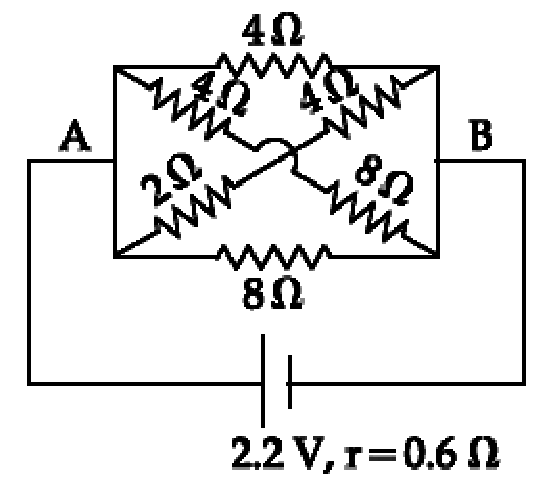
Answer: (c)
Electrical Power & Heating Effect
An electric bulb of 500 watt at 100 volt is used in a circuit having a 200 V supply. Calculate the resistance R to be connected in series with the bulb so that the power delivered by the bulb is 500 W.
Answer: (a)
Electrical Power & Heating Effect
An electric bulb rated as 200 W at 100 V is used in a circuit having 200 V supply. The resistance 'R' that must be put in series with the bulb so that the bulb delivers the same power is _____________ .
Numerical answer type. Work it out, then open the answer.
Answer: 50
Electrical Power & Heating Effect
If a current flowing in a coil is reduced to half of its initial value, the relation between the new energy and the original energy stored in the coil will be
Answer: (a)
Electrical Power & Heating Effect
Due to cold weather a 1 m water pipe of cross-sectional area 1 cm2 is filled with ice at C. Resistive heating is used to melt the ice. Current of 0.5A is passed through 4 k resistance. Assuming that all the heat produced is used for melting, what is the minimum time required? (Given latent heat of fusion for water/ice = 3.33 105 J kg, specific heat of ice = 2 103 J kg and density of ice = 103 kg/m3)
Answer: (b)
Electrical Power & Heating Effect
An electrical power line, having a total resistance of 2 , delivers 1 kW at 220 V. The efficiency of the transmission line is approximately:
Answer: (b)
Electrical Power & Heating Effect
In a building there are 15 bulbs of 45 W, 15 bulbs of 100 W, 15 small fans of 10 W and 2 heaters of 1 kW. The voltage of electric main is 220 V. The minimum fuse capacity (rated value) of the building will be:
Answer: (b)
Electrical Power & Heating Effect
Two equal resistances when connected in series to a battery, consume electric power of 60 W. If these resistances are now connected in parallel combination to the same battery, the electric power consumed will be:
Answer: (a)
Electrical Power & Heating Effect
Which of the following acts as a circuit protection device?
Answer: (d)
Electrical Power & Heating Effect
A current of 2 mA was passed through an unknown resistor which dissipated a power of 4.4 W. Dissipated power when an ideal power supply of 11 V is connected across it is -
Answer: (a)
Electrical Power & Heating Effect
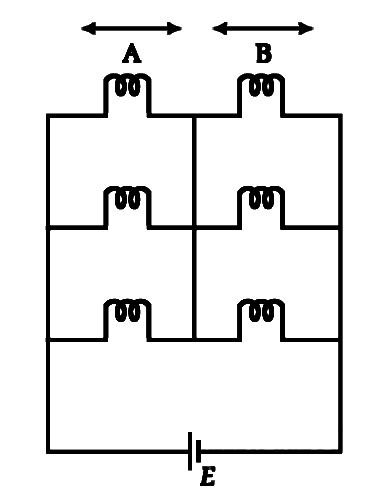
Six similar bulbs are connected as shown in the figure with a DC source of emf E, and zero internal resistance.
The ratio of power consumption by the bulbs when (i) all are glowing and (ii) in the situation when two from section A and one from section B are glowing, will be:
Answer: (b)
Electrical Power & Heating Effect
Two electric bulbs, rated at (25 W, 220 V) and (100 W, 220 V), are connected in series across a 220 V voltage source. If the 25 W and 100 W bulbs draw powers P1 and P2 respectively, then:
Answer: (b)
Electrical Power & Heating Effect
A constant voltages is applied between two ends of a metallic wire. If the length is halved and the radius of the wire is doubled, the rate of heat developed in the wire will be:
Answer: (d)
Electrical Power & Heating Effect
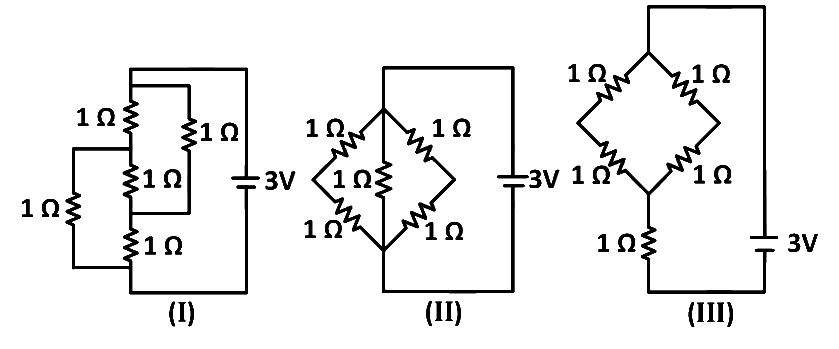
The figure shows three circuits I, II and III which are connected to a 3V battery. If the powers dissipated by the configurations I, II and III are P1, P2 and P3 respectively, then:
Answer: (c)
Electrical Power & Heating Effect
A filament bulb (500 W, 100 V) is to be used in a 230 V main supply. When a resistance R is connected in series, it works perfectly and the bulb consumes 500 W. The value of R is
Answer: (c)
Electrical Power & Heating Effect
The charge flowing through a resistance R varies with time t as Q = at bt2, where and are positive constants. The total heat produced in R is
Answer: (c)
Electrical Power & Heating Effect
Two cities are 150 km apart. Electric power is sent from one city to another city through copper wires. The fall of potential per km is 8 volt and the average resistance per km is 0.5 . The power loss in the wire is
Answer: (b)
Electrical Power & Heating Effect
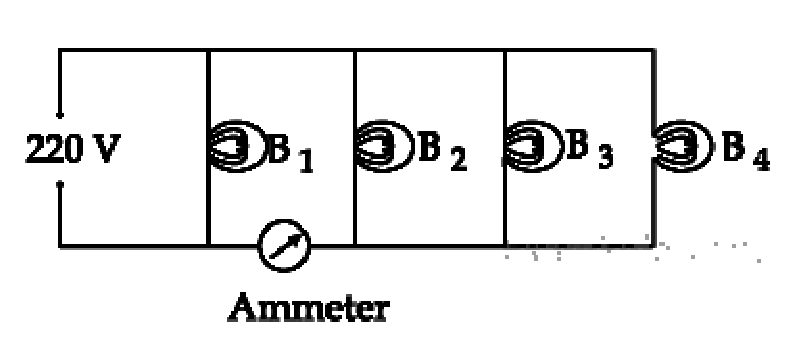
Four bulbs B1, B2, B3 and B4 of 100 W each are connected to 220 V main as shown in the figure. The reading in an ideal ammeter will be:
Answer: (c)
Electrical Power & Heating Effect
In a large building, there are bulbs of bulbs of fans of and heater of The voltage of electric mains is The minimum capacity of the main fuse of the building will be:
Answer: (c)
Electrical Power & Heating Effect
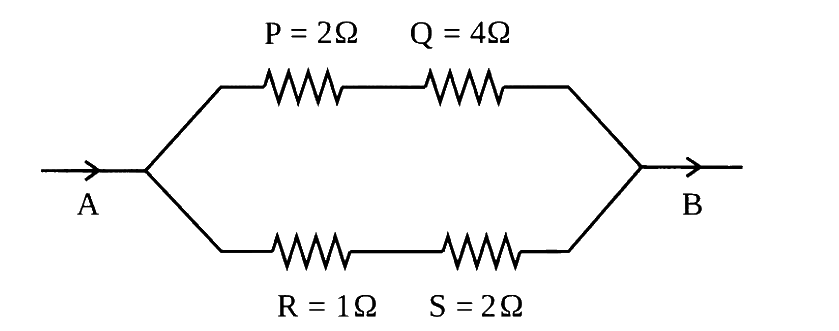
Which of the four resistances P, Q, R and S generate the greatest amount of heat when a current flows from A to B?
Answer: (b)
Electrical Power & Heating Effect
Ten identical cells connected in series are needed to heat a wire of length one meter and radius 'r' by 10oC in time 't'. How many cells will be required to heat the wire of length two meter of the same radius by the same temperature in time 't'?
Answer: (a)
Electrical Power & Heating Effect
The supply voltage to room is The resistance of the lead wires is . A bulb is already switched on. What is the decrease of voltage across the bulb, when a heater is switched on in parallel to the bulb?
Answer: (d)
Electrical Power & Heating Effect
If voltage across a bulb rated 220 volt-100 watt drops by 2.5% of its rated value, the percentage of the rated value by which the power would decrease is
Answer: (c)
Electrical Power & Heating Effect
The power dissipated in the circuit shown in the figure is 30 watts. The value of R is
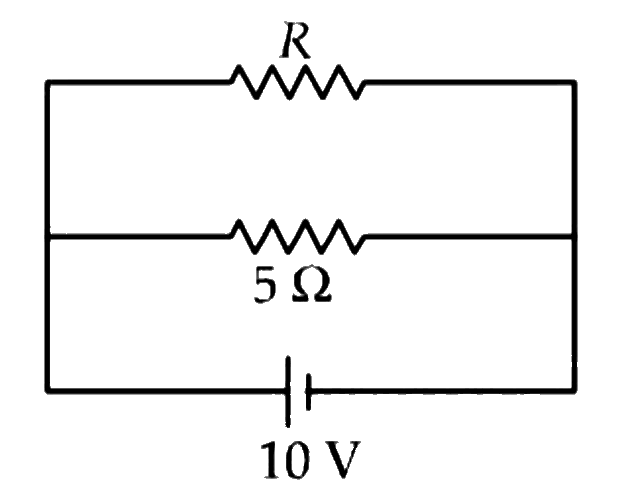
Answer: (c)
Electrical Power & Heating Effect
Two electric bulbs marked and are connected in series to a supply. Which of the bulbs will fuse?
Answer: (c)
Electrical Power & Heating Effect
If power dissipated in the 9 resistor in the circuit shown is 36 watt, the potential difference across the 2 resistor is
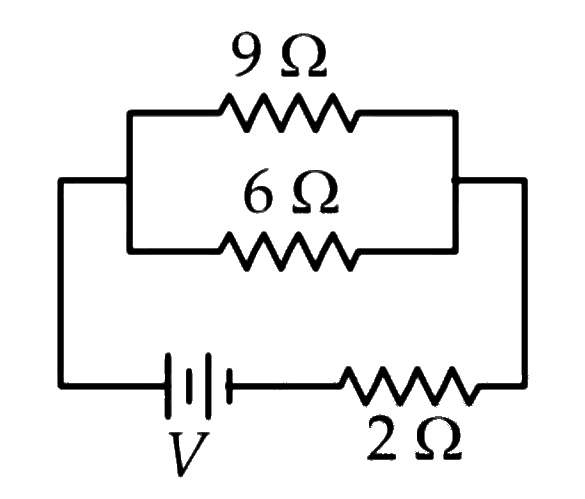
Answer: (c)
Electrical Power & Heating Effect
A thermocouple of negligible resistance produces an e.m.f. of 40 µV/ºC in the linear range of temperature. A galvanometer of resistance 10 ohm whose sensitivity is 1 µA/division, is employed with the thermocouple. The smallest value of temperature difference that can be detected by the system will be
Answer: (d)
Electrical Power & Heating Effect
The thermo e.m.f. in volts of a certain thermo-couple is found to vary with temperature difference in °C between the two junctions according to the relation
The neutral temperature for the thermo-couple will be
Answer: (c)
Electrical Power & Heating Effect
In producing chlorine by electrolysis power at is being consumed. How much chlorine per minute is liberated (E.C.E. of chlorine is )
Answer: (d)
Electrical Power & Heating Effect
A current of 3 amp. flows through the 2 resistor shown in the circuit. The power dissipated in the 5 resistor is
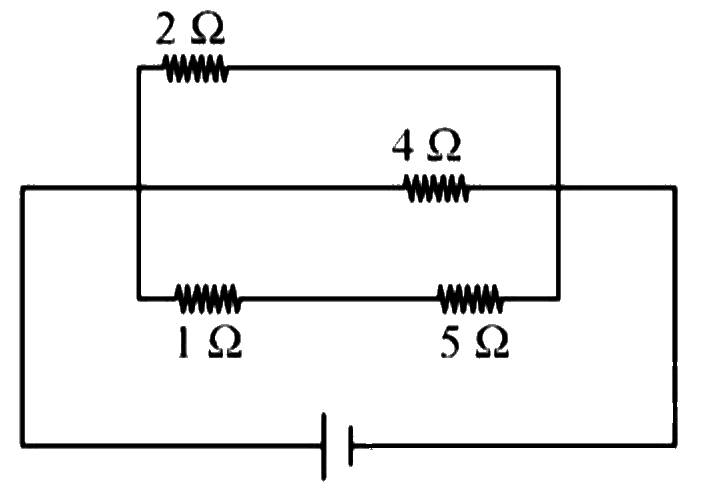
Answer: (b)
Electrical Power & Heating Effect
An electric kettle takes 4 A current at 220 V. How much time will it take to boil 1 kg of water from temperature 20oC? The temperature of boiling water is 100oC
Answer: (c)
Electrical Power & Heating Effect
A steady current of 1.5 amp flows through a copper voltameter for 10 minutes. If the electrochemical equivalent of copper is , the mass of copper deposited on the electrode will be
Answer: (c)
Electrical Power & Heating Effect
If the cold junction of a thermocouple is kept at and the hot junction is kept at , then the relation between neutral temperature and temperature of inversion is
Answer: (d)
Electrical Power & Heating Effect
The total power dissipated in watt in the circuit shown here is
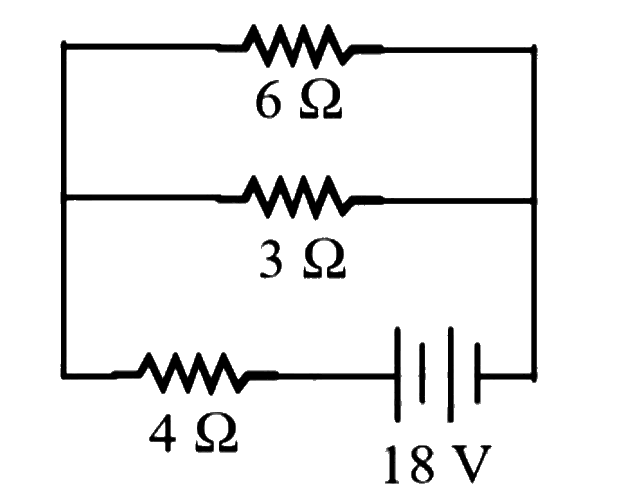
Answer: (b)
Electrical Power & Heating Effect
An electric bulb is rated volt - watt. The power consumed by it when operated on volt will be
Answer: (c)
Electrical Power & Heating Effect
A thermocouple is made from two metals, Antimony and Bismuth. If one junction of the couple is kept hot and the other is kept cold, then, an electric current will
Answer: (d)
Electrical Power & Heating Effect
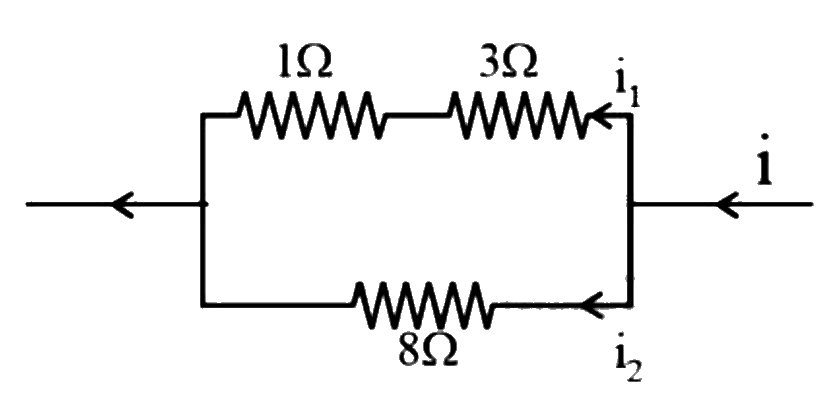
Power dissipated across the 8 resistor in the circuit shown here is 2 watt. The power dissipated in watt units across the 3 resistor is
Answer: (a)
Electrical Power & Heating Effect
In producing chlorine through electrolysis power at is being consumed. How much chlorine per min is liberated? ECE of chlorine is
Answer: (a)
Electrical Power & Heating Effect
A 5-ampere fuse wire can withstand a maximum power of 1 watt in the circuit. The resistance of the fuse wire is
Answer: (a)
Electrical Power & Heating Effect
A heater coil is cut into two equal parts and only one part is now used in the heater. The heat generated will now be
Answer: (b)
Electrical Power & Heating Effect
The temperature of inversion of a thermocouple is and the neutral temperature is . What is the temperature of cold junction?
Answer: (c)
Electrical Power & Heating Effect
The resistance of hot tungsten filament is about times the cold resistance. What will be resistance of and lamp when not in use?
Answer: (b)
Electrical Power & Heating Effect
Two voltmeters, one of copper and another of silver, are joined in parallel. When a total charge flows through the voltmeters, equal amount of metals are deposited. If the electrochemical equivalents of copper and silver are and respectively the charge which flows through the silver voltmeter is
Answer: (a)
Electrical Power & Heating Effect
when three identical bulbs of 60 watt, 200 volt rating are connected in series to a 200 volt supply, the power drawn by them will be
Answer: (d)
Electrical Power & Heating Effect
In India electricity is supplied for domestic use at 220 V. It is supplied at 110 V in USA. If the resistance of a 60 W bulb for use in India is R, the resistance of a 60 W bulb for use in USA will be
Answer: (c)
Electrical Power & Heating Effect
The electrochemical equivalent of a metal is per Coulomb. The mass of the metal liberated at the cathode when a current is passed for seconds will be
Answer: (c)
Electrical Power & Heating Effect
A battery is charged at a potential of 15 V for 8 h when the current flowing is 10 A. The battery on discharge supplies a current of 5 A for 15 h. The mean terminal voltage during discharge is 14 V. The "watt-hour" efficiency of the battery is
Answer: (d)
Electrical Power & Heating Effect
The thermo of a thermocouple varies with temperature of the hot junction as in volts where the ratio is If the cold junction is kept at then the neutral temperature is
Answer: (d)
Electrical Power & Heating Effect
Two 220 volt, 100 watt bulbs are connected first in series and then in parallel. Each time the combination is connected to a 220 volt a.c. supply line. The power drawn by the combination in each case respectively will be
Answer: (d)
Electrical Power & Heating Effect
Fuse wire is a wire of
Answer: (b)
Electrical Power & Heating Effect
A volt, watt bulb is connected across a mains supply. The power consumed will be
Answer: (c)
Electrical Power & Heating Effect
An electric kettle has two heating coils. When one of the coils is connected to an a.c. source, the water in the kettle boils in 10 minutes. When the other coil is used the water boils in 40 minutes. If both the coils are connected in parallel, the time taken by the same quantity of water to boil will be
Answer: (a)
Electrical Power & Heating Effect
The thermo of a thermo -couple is at room temperature. A galvanometer of resistance, capable of detecting current as low as is connected with the thermo couple. The smallest temperature difference that can be detected by this system is
Answer: (a)
Electrical Power & Heating Effect
The negative pole of a Daniell cell, sending a constant current through a circuit, decreases in mass by in minutes. If the electrochemical equivalents of and are and respectively, the increase in the mass of the positive pole in this time is
Answer: (c)
Electrical Power & Heating Effect
A wire when connected to mains supply has power dissipation Now the wire is cut into two equal pieces which are connected in parallel to the same supply. Power dissipation in this case is Then is
Answer: (b)
Electrical Power & Heating Effect
The mass of product liberated on anode in an electrochemical cell depends on (where is the time period for which the current is passed).
Answer: (b)
Electrical Power & Heating Effect
If is the inversion temperature, is the neutral temperature, is the temperature of the cold junction, then
Answer: (c)
Electrical Power & Heating Effect
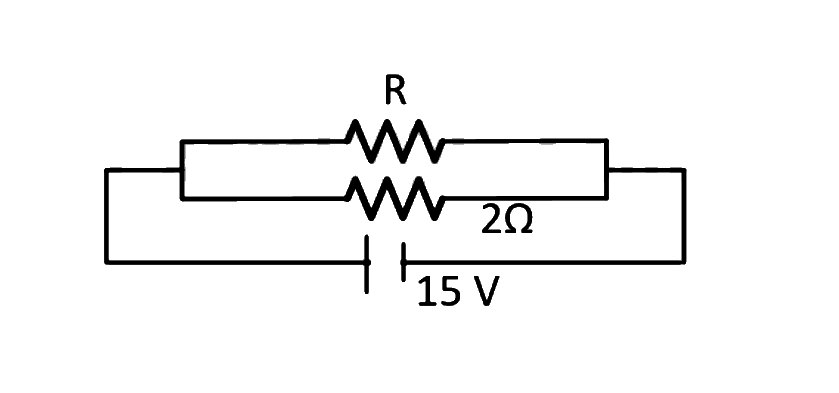
If in the circuit, power dissipation is then is
Answer: (b)
Electrical Power & Heating Effect
Two bulbs of (40 W, 200 V), and (100 W, 200 V). Then correct relation for their resistances
Answer: (b)
Electrical Power & Heating Effect
In electrolysis the mass deposited on an electrode is directly proportional to
Answer: (a)
Electrical Power & Heating Effect
Three equal resistors connected in series across a source of emf together dissipate watt of power. What will be the power dissipated in watt if the same resistors are connected in parallel across the same source of emf?
Answer: (d)
Electrical Power & Heating Effect
A rise in temperature is observed in a conductor by passing a current. When the current is doubled the rise in temperature will be approximately
Answer: (c)
Electrical Power & Heating Effect
If nearly liberate equivalent of aluminium, then the amount of aluminium (equivalent weight 9) deposited through electrolysis in by a current of amp will be
Answer: (c)
Electrical Power & Heating Effect
One kilowatt hour is equal to
Answer: (c)
Electrical Power & Heating Effect
A (100 W, 200 V) bulb is connected to a 160 volts supply. The power consumption would be
Answer: (c)
Electrical Power & Heating Effect
If two bulbs, whose resistances are in the ratio of are connected in series, the power dissipated in them has the ratio of
Answer: (d)
Electrical Power & Heating Effect
A heating coil is labelled 100 W, 220 V. The coil is cut in half and the two pieces are joined in parallel to the same source. The energy now liberated per second is
Answer: (b)
Electrical Power & Heating Effect
An electric bulb is rated 60 W, 220 V. The resistance of its filament is
Answer: (d)
Electrical Power & Heating Effect
A current of , passing through a conductor produces of heat in 10 seconds. The resistance of the conductor in ohm is
Answer: (b)
Electrical Power & Heating Effect
40 electric bulbs are connected in series across a supply. After one bulb is fused the remaining 39 are connected again in series across the same supply. The illumination will be
Answer: (b)
Electrical Power & Heating Effect
Two conducting wires of the same material and of equal lengths and equal diameters are first connected in parallel and then in series in a circuit across the same potential difference. The ratio of heat produced in parallel and series combinations is
Answer: (b)
Step-by-step solution coming soon.
Electrical Power & Heating Effect
In which one among the following situations, the bulb would glow the most? (Consider all batteries are the same)
Answer: (d)
Step-by-step solution coming soon.
Electrical Power & Heating Effect
An incandescent electric bulb converts of its power consumption into light, and the remaining power is dissipated as heat. The bulb's filament has a resistance of and current flows through it. If the bulb remains ON for and the rate of electricity charge is Rs. /unit, then which among the following is the correct amount for the money spent on producing light?
Answer: (d)
Step-by-step solution coming soon.
Electrical Power & Heating Effect
The heating element in an electric iron is usually made of
Answer: (c)
Step-by-step solution coming soon.
Electrical Power & Heating Effect
An electric bulb is rated as and . When it is operated on , the power rating would be:
Answer: (d)
Step-by-step solution coming soon.
Electrical Power & Heating Effect
The commercial unit of electrical energy is kilowatt-hour (kWh), which is equal to
Answer: (a)
Step-by-step solution coming soon.
Electrical Power & Heating Effect
An electric bulb is connected to generator. The current drawn is . What is the power of the bulb?
Answer: (a)
Step-by-step solution coming soon.
Electrical Power & Heating Effect
Which one of the following terms cannot represent electrical power in a circuit?
Answer: (b)
Step-by-step solution coming soon.
Electrical Power & Heating Effect
Which one of the following metals is most commonly used for making filament of incandescent electric bulbs?
Answer: (d)
Step-by-step solution coming soon.
Electrical Power & Heating Effect
What is the current required to light a incandescent bulb in a domestic supply of ?
Answer: (b)
Step-by-step solution coming soon.
Electrical Power & Heating Effect
Which one of the following formulas does not represent electrical power?
Answer: (b)
Step-by-step solution coming soon.
Electrical Power & Heating Effect
The cost of energy to operate an industrial refrigerator that consumes power working hours per day for days will be
(Given that the charge per kW.h of energy = ₹ 4)
Answer: (b)
Step-by-step solution coming soon.
Electrical Power & Heating Effect
In an incandescent electric bulb, the filament of the bulb is made up of which metal?
Answer: (c)
Step-by-step solution coming soon.
Electrical Power & Heating Effect
Water is heated with a coil of resistance R connected to domestic supply. The rise of temperature of water will depend on 1. Supply voltage. 2. Current passing through the coil. 3. Time for which voltage is supplied. Select the correct answer from among the following:
Answer: (a)
Step-by-step solution coming soon.
Electrical Power & Heating Effect
A fuse wire must be
Answer: (a)
Step-by-step solution coming soon.
Electrical Power & Heating Effect
Two metallic wires A and B are made using copper. The radius of wire A is while its length is . A dc voltage is applied across the wire A, causing power dissipation . The radius of wire B is and its length is and the same dc voltage is applied across it causing power dissipation . Which one of the following is the correct relationship between and ?
Answer: (b)
Step-by-step solution coming soon.
Electrical Power & Heating Effect
The connecting cable of electrical appliances like electric iron, water heater or room heater contains three insulated copper wires of three different colours: red, green and black. Which one of the following is the correct colour code?
Answer: (c)
Step-by-step solution coming soon.
Electrical Power & Heating Effect
Which one of the following is the value of of energy converted into joules?
Answer: (b)
Step-by-step solution coming soon.
Electrical Power & Heating Effect
The property of electric current which is applicable in the fuse wire is
Answer: (c)
Step-by-step solution coming soon.
Electrical Power & Heating Effect
Which of the following items is used in the household wirings to prevent accidental fire in case of short circuit?
Answer: (d)
Step-by-step solution coming soon.
Electrical Power & Heating Effect
One kilowatt hour is equal to
Answer: (b)
Step-by-step solution coming soon.
Electrical Power & Heating Effect
A given conductor carrying a current of produces an amount of heat equal to . If the current through the conductor is doubled, the amount of heat produced will be
Answer: (c)
Step-by-step solution coming soon.
Electrical Power & Heating Effect
We use CFL to save electrical energy and to provide sufficient light. The full form of CFL is
Answer: (d)
Step-by-step solution coming soon.
Electrical Power & Heating Effect
A fuse is used in an electric circuit to
Answer: (a)
Step-by-step solution coming soon.
Electrical Power & Heating Effect
An electric heater is rated . If electric power costs ₹ 2 per kilo-watt-hour, then the cost of power for hours running of the heater is
Answer: (a)
Step-by-step solution coming soon.
Electrical Power & Heating Effect
A current flows through a potential difference in an electrical circuit containing a resistance . The product of and , i.e., may be understood as
Answer: (c)
Step-by-step solution coming soon.
Electrical Power & Heating Effect
Metal used to make wires for safety fuses must have
Answer: (b)
Step-by-step solution coming soon.
Electrical Power & Heating Effect
Which one among the following is the correct order of power consumption for light of equal intensity?
Answer: (b)
Step-by-step solution coming soon.
Electrical Power & Heating Effect
When an electrical safety fuse is rated (marked) as , it means it
Answer: (d)
Step-by-step solution coming soon.
Electrical Power & Heating Effect
The main power supply in India is at , whereas that in the US is at . Which one among the following statements in this regard is correct?
Answer: (a)
Step-by-step solution coming soon.
Electrical Power & Heating Effect
Kilowatt-hour is the unit of
Answer: (c)
Step-by-step solution coming soon.
Electrical Power & Heating Effect
An electric lamp of is used for hours per day. The 'units' of energy consumed in one day by the lamp is
Answer: (a)
Step-by-step solution coming soon.
Electrical Power & Heating Effect
The material used for electric fuse is an alloy of tin and lead. This alloy should have:
Answer: (a)
Step-by-step solution coming soon.
Electrical Power & Heating Effect
If a heater coil is cut into two equal parts and only one part is used in the heater, the heat generated will be :
Answer: (a)
Step-by-step solution coming soon.
Electrical Power & Heating Effect
How many sixty watt () bulbs may be safely used in a supply with fuse?
Answer: (d)
Step-by-step solution coming soon.
Electrical Power & Heating Effect
An electric iron of resistance takes a current of . The heat developed in joules in is
Answer: (c)
Step-by-step solution coming soon.
Electrical Power & Heating Effect
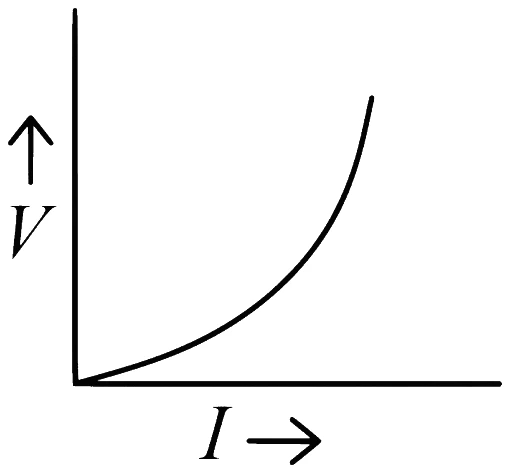
A current in a lamp varies with voltage as shown in the figure given above. Which one of the following is the variation of power with current ?
Answer: (b)
Step-by-step solution coming soon.
Electrical Power & Heating Effect
A house, served by a supply line, is protected by a fuse. What is the maximum number of bulbs that can be turned on in parallel?
Answer: (c)
Step-by-step solution coming soon.
Electrical Power & Heating Effect
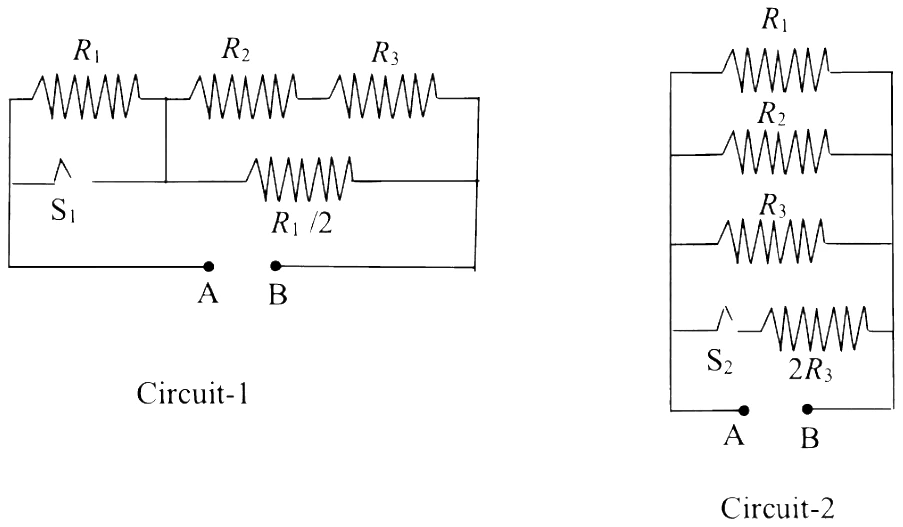
In Circuit-1 and Circuit-2 shown in the figures, , and . and are the power dissipations in Circuit-1 and Circuit-2 when the switches and are in open conditions, respectively. and are the power dissipations in Circuit-1 and Circuit-2 when the switches and are in closed conditions, respectively. Which of the following statement(s) is(are) correct?
More than one option can be correct. Tap every correct option, then tap Check.
Answer: (a), (b), (c)
Step-by-step solution coming soon.
Electrical Power & Heating Effect
An incandescent bulb has a thin filament of tungsten that is heated to high temperature by passing an electric current. The hot filament emits black-body radiation. The filament is observed to break up at random locations after a sufficiently long time of operation due to non-uniform evaporation of tungsten from the filament. If the bulb is powered at constant voltage, which of the following statement(s) is (are) true?
More than one option can be correct. Tap every correct option, then tap Check.
Answer: (c), (d)
Step-by-step solution coming soon.
Electrical Power & Heating Effect
A thermal power plant produces electric power of at , which is to be transported to a place away from the power plant for consumers' usage. It can be transported either directly with a cable of large current carrying capacity or by using a combination of step-up and step-down transformers at the two ends. The drawback of the direct transmission is the large energy dissipation. In the method using transformers, the dissipation is much smaller. In this method, a step-up transformer is used at the plant side so that the current is reduced to a smaller value. At the consumers' end, a step-down transformer is used to supply power to the consumers at the specified lower voltage. It is reasonable to assume that the power cable is purely resistive and the transformers are ideal with power factor unity. All the currents and voltages mentioned are rms values.
If the direct transmission method with a cable of resistance is used, the power dissipation (in %) during transmission is
Answer: (b)
Step-by-step solution coming soon.
Electrical Power & Heating Effect
Incandescent bulbs are designed by keeping in mind that the resistance of their filament increases with the increase in temperature. If at room temperature, , and bulbs have filament resistances , and respectively, the relation between these resistances is
Answer: (d)
Step-by-step solution coming soon.
Electrical Power & Heating Effect
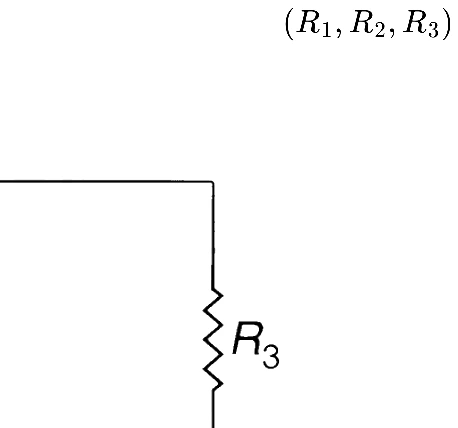
Figure shows three resistor configurations , and connected to battery. If the power dissipated by the configuration , and is , and , respectively, then
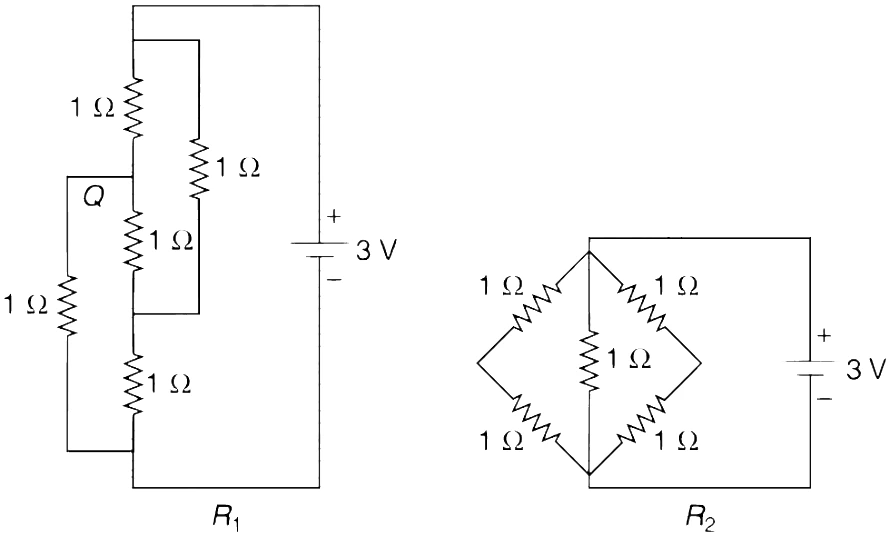
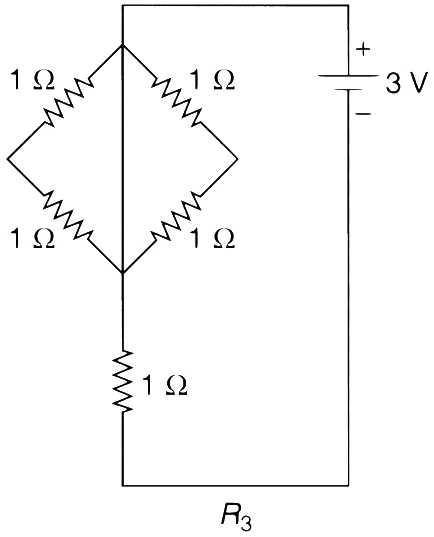
Answer: (c)
Step-by-step solution coming soon.
Electrical Power & Heating Effect
Assertion : Bulb generally get fused when they are switched on or off.
Reason : When we switch on or off, a circuit current changes in it rapidly.
Answer: (a)
Step-by-step solution coming soon.
Electrical Power & Heating Effect
The thermo emf (in volts) of a certain thermocouple is found to vary with (in ) according to equation , where is temperature of the hot junction, the cold junction being kept at . Then, the neutral temperature of the thermocouple is
Answer: (d)
Step-by-step solution coming soon.
Electrical Power & Heating Effect
The thermo emf of a thermocouple varies with the temperature of the hot junction as volt where the ratio is . If the cold junction is kept at , then the neutral temperature is
Answer: (d)
Step-by-step solution coming soon.
Electrical Power & Heating Effect
Assertion : A thermoelectric refrigerator is based on the Peltier effect.
Reason : A thermocouple may be used as a radiation detector.
Answer: (b)
Step-by-step solution coming soon.
Electrical Power & Heating Effect
When a copper voltmeter is connected with a battery of emf , of copper is deposited in . If the same voltmeter is connected across a battery then the mass of copper deposited in would be
Answer: (b)
Step-by-step solution coming soon.
Electrical Power & Heating Effect
If two bulbs of wattages and respectively each rated by are connected in series with the supply of , which bulb will fuse?
Answer: (b)
Step-by-step solution coming soon.
Electrical Power & Heating Effect
If nearly charge liberates equivalent of aluminium then the amount of aluminium (equivalent weight ) deposited through electrolysis in by a current of will be
Answer: (c)
Step-by-step solution coming soon.
Electrical Power & Heating Effect
Two electric bulbs rated and are glowing at full power, when used in parallel with a battery of emf and internal resistance . The maximum number of bulbs that can be connected in the circuit when glowing at full power, is
Answer: (b)
Step-by-step solution coming soon.
Electrical Power & Heating Effect
In each of the following questions a statement of Assertion is given followed by a corresponding statement of Reason just below it. Of the statements mark the correct answer is
Assertion : An electric bulb becomes dim, when an electric heater in parallel circuit is switched on.
Reason : Dimness decreases after sometime.
Answer: (b)
Step-by-step solution coming soon.
Electrical Power & Heating Effect
If the cold junction of a thermo-couple is kept at and the hot junction is kept at , then the relation between neutral temperature and temperature of inversion is
Answer: (a)
Step-by-step solution coming soon.
Electrical Power & Heating Effect
The voltage of clouds is with respect to ground. In a lightning strike lasting , a charge of is delivered to the ground. The power of lightning strike is :
Answer: (a)
Step-by-step solution coming soon.
Electrical Power & Heating Effect
For ensuring dissipation of same energy in all three resistors () connected as shown in figure, their values must be related as :
Answer: (c)
Step-by-step solution coming soon.
Electrical Power & Heating Effect
In the given circuit, if power rating of heater is at , find the resistance in figure so that heater produces power of .
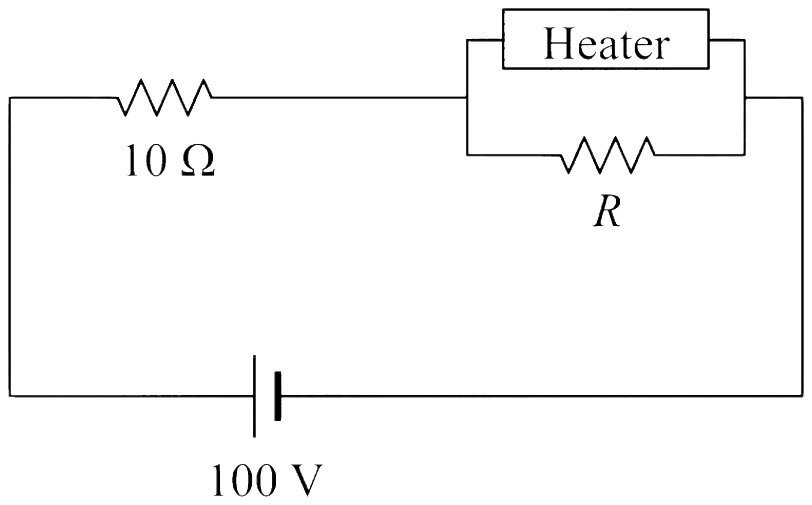
Answer: (a)
Step-by-step solution coming soon.
Electrical Power & Heating Effect
You are given resistance wire of length and a battery of negligible resistance. In which of the following cases is largest amount of heat generated?
Answer: (c)
Step-by-step solution coming soon.
Electrical Power & Heating Effect
lamps each of resistance , are fed by a machine of resistance . If light emitted by any lamp is proportional to the square of the heat produced, prove that the most efficient way of arranging them is to place them in parallel arcs, each containing lamps, where is the integer nearest to
Answer: (b)
Step-by-step solution coming soon.
Electrical Power & Heating Effect
The temperature of the cold junction of thermocouple is and the temperature of hot junction is . The emf is . The inversion temperature is
Answer: (d)
Step-by-step solution coming soon.
Electrical Power & Heating Effect
A amp fuse wire can withstand a maximum power of in circuit. The resistance of the fuse wire is
Answer: (d)
Step-by-step solution coming soon.
Electrical Power & Heating Effect
The internal resistance of a primary cell is . It generates a current of in an external resistance of . The rate at which chemical energy is consumed in providing current is
Answer: (a)
Step-by-step solution coming soon.
Electrical Power & Heating Effect
A current of is passed through a solution of . How many ions are liberated in one minute? (Electronic charge )
Answer: (a)
Step-by-step solution coming soon.
Electrical Power & Heating Effect
The thermo emf of a hypothetical thermocouple varies with the temperature of hot junction as in volts, where the ratio is . If the cold junction is kept at , then the neutral temperature is
Answer: (d)
Step-by-step solution coming soon.
Electrical Power & Heating Effect
A steady current of flows through a copper voltameter for . If the electrochemical equivalent of copper is , the mass of copper deposited on the electrode will be
Answer: (d)
Step-by-step solution coming soon.
Electrical Power & Heating Effect
The temperature of inversion of a thermocouple is and the neutral temperature is , what is the temperature of cold junction?
Answer: (c)
Step-by-step solution coming soon.
Electrical Power & Heating Effect
A fuse wire can withstand a maximum power of in circuit. The resistance of the fuse wire is
Answer: (d)
Step-by-step solution coming soon.
Electrical Power & Heating Effect
When a certain current is passed in the circuit as shown in figure, of heat is produced in resistance. How much heat is produced in resistance?
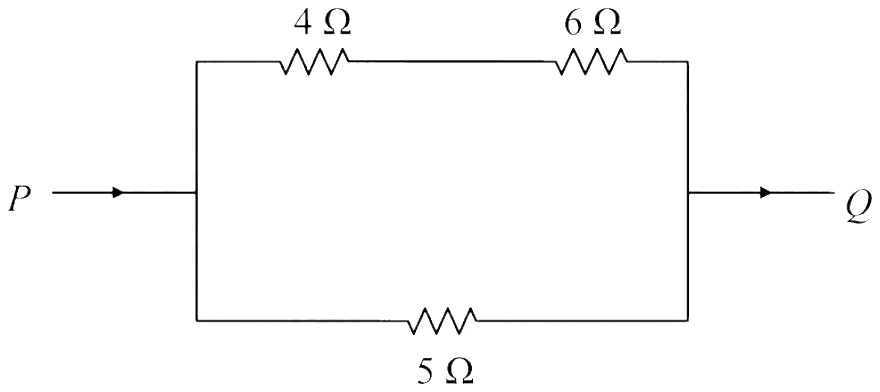
Answer: (b)
Step-by-step solution coming soon.
Electrical Power & Heating Effect
Two equal resistances are joined with voltage source in (i) series (ii) parallel, the ratio of electrical power consumed in two cases will be
Answer: (a)
Step-by-step solution coming soon.
Electrical Power & Heating Effect
The power dissipated in the circuit shown in the figure is . The value of is.
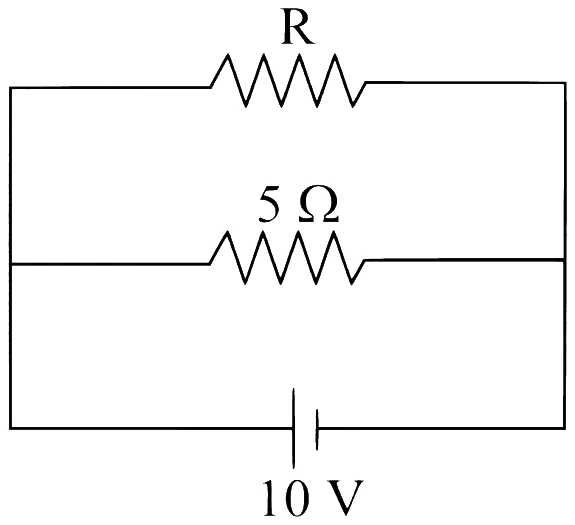
Answer: (c)
Step-by-step solution coming soon.
Electrical Power & Heating Effect
Three electric bulbs of , and are shown in figure. The resultant power of the combination, if rated voltage is applied across the combination is
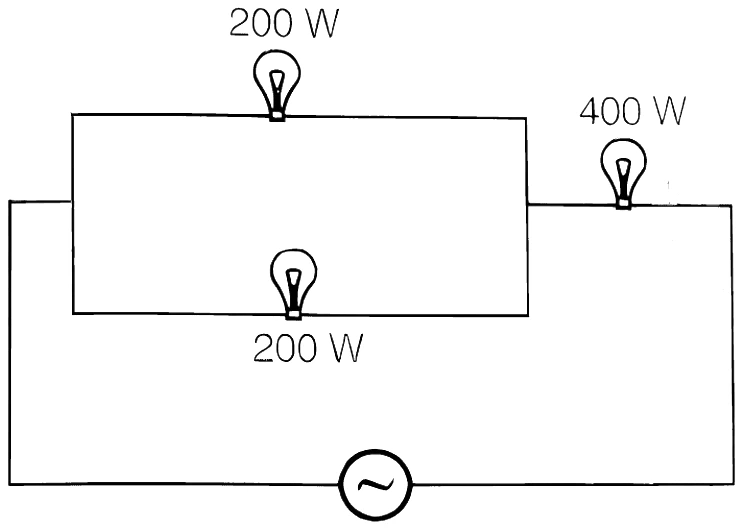
Answer: (c)
Step-by-step solution coming soon.
Electrical Power & Heating Effect
The maximum power rating of a resistor is . Then, it cannot be used with DC source because the
Answer: (c)
Step-by-step solution coming soon.
Electrical Power & Heating Effect
A constant voltage is applied between the two ends of a uniform metallic wire. Some heat is developed in it. The heat developed is halved if
Answer: (a)
Step-by-step solution coming soon.
Electrical Power & Heating Effect
The power dissipated in the circuit shown in the figure is . The value of is
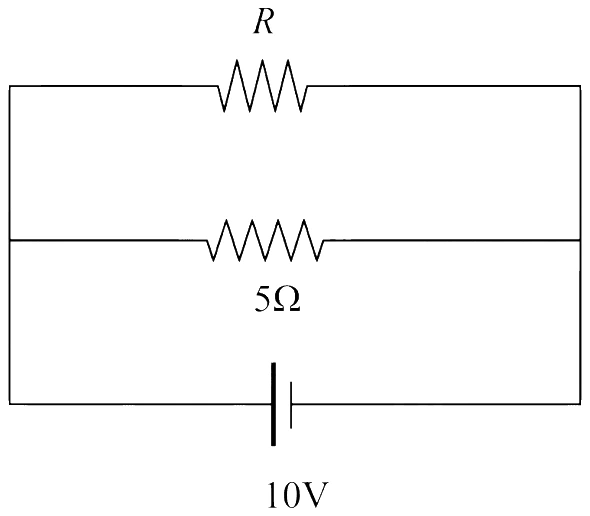
Answer: (c)
Step-by-step solution coming soon.
Electrical Power & Heating Effect
A - lamp is operated on a DC line. A resistor is connected in series with the lamp in order to glow it properly. The value of resistance is
Answer: (b)
Step-by-step solution coming soon.
Electrical Power & Heating Effect
Which has more luminous efficiency?
Answer: (b)
Step-by-step solution coming soon.
Electrical Power & Heating Effect
A battery is charged at a potential of in when the current flowing is . The battery on discharge supplies a current of for . The mean terminal voltage during discharge is . The watt-hour efficiency of battery is
Answer: (c)
Step-by-step solution coming soon.
Electrical Power & Heating Effect
In solution when electric current equal to faraday is passed, the gm equivalent deposited on the cathode is
Answer: (d)
Step-by-step solution coming soon.
Electrical Power & Heating Effect
Pick out the wrong statement.
Answer: (b)
Step-by-step solution coming soon.
Electrical Power & Heating Effect
An electric bulb of is connected to a supply of electricity of . Resistance of the filament is
Answer: (a)
Step-by-step solution coming soon.
Electrical Power & Heating Effect
The electrochemical equivalent of magnesium is . A current of is passed in a suitable solution for . The mass of magnesium deposited will be
Answer: (d)
Step-by-step solution coming soon.
Electrical Power & Heating Effect
In producing chlorine through electrolysis power at is being consumed. How much chlorine per minute is liberated? (ECE of chlorine is )
Answer: (c)
Step-by-step solution coming soon.
Electrical Power & Heating Effect
An electric kettle takes current at . How much time will it take to boil of water from temperature ? The temperature of boiling water is .
Answer: (c)
Step-by-step solution coming soon.
Electrical Power & Heating Effect
The ratio of the amounts of heat developed in the four arms of a balance Wheatstone bridge, when the arms have resistances , , and respectively is
Answer: (b)
Step-by-step solution coming soon.
Electrical Power & Heating Effect
There are a bulb and a bulb connected in series across a line. Which electric bulb will glow more brightly?
Answer: (a)
Step-by-step solution coming soon.
Electrical Power & Heating Effect
If the total emf in a thermocouple is a parabolic function expressed as , which of the following relations does not hold good
Answer: (d)
Step-by-step solution coming soon.
Electrical Power & Heating Effect
The electrolyte used in Leclanché cell is
Answer: (b)
Step-by-step solution coming soon.
Electrical Power & Heating Effect
An electric coil is rated , . It is cut into two equal parts and connected in parallel to the same source of . Calculate the percentage increase in energy produced per second.
Answer: (d)
Step-by-step solution coming soon.
Electrical Power & Heating Effect
If the voltage across a bulb rated , drops by of its rated value, the percentage of the rated value by which the power would decrease is
Answer: (a)
Step-by-step solution coming soon.
Electrical Power & Heating Effect
The power dissipated across the resistor in the circuit is watts. The power dissipated in watt units across the resistor is:
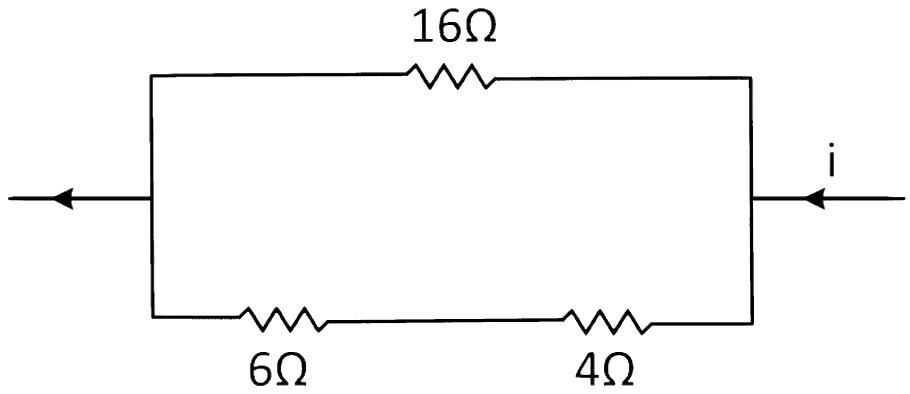
Answer: (c)
Step-by-step solution coming soon.
Electrical Power & Heating Effect
Across the source of internal resistance , how many lamps of , can be connected in parallel so that all the lamps may glow with full brightness?
Answer: (b)
Step-by-step solution coming soon.
Electrical Power & Heating Effect
Three bulbs of , and are arranged in series with a source. The maximum light is obtained from
Answer: (a)
Step-by-step solution coming soon.
Electrical Power & Heating Effect
A heating unit is designed to operate on a line. If line voltage drops to , the percentage drop in heat output will be:
Answer: (c)
Step-by-step solution coming soon.
Electrical Power & Heating Effect
An electric bulb of , is to be connected to source. What resistance should be connected in series with the bulb, so that the bulb glows properly?
Answer: (c)
Step-by-step solution coming soon.
Electrical Power & Heating Effect
A wire of resistance is connected across a cell of emf () and internal resistance (). The current through the circuit is . In time , the work done by the battery to establish the current is
Answer: (a)
Step-by-step solution coming soon.
Electrical Power & Heating Effect
If voltage across a bulb rated , drops by of its rated value, then the percentage of the rated value by which the power would decrease is
Answer: (b)
Step-by-step solution coming soon.
Electrical Power & Heating Effect
Consider an electrical conductor connected across a potential difference . Let be a small charge moving through it in time . If is the electric current through it,
I. the kinetic energy of the charge increases by .
II. the electric potential energy of the charge decreases by .
III. the thermal energy of the conductor increases by .
Choose the correct option.
Answer: (d)
Step-by-step solution coming soon.
Electrical Power & Heating Effect
The power dissipated in the resistance in the following circuit is
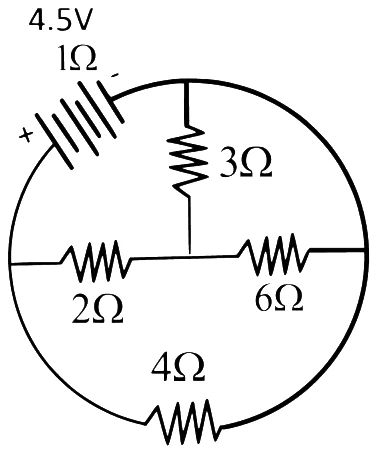
Answer: (b)
Step-by-step solution coming soon.
Electrical Power & Heating Effect
In the circuit given below, each of three resistors of can have a maximum power of (otherwise, it will melt). The maximum power the whole circuit can take is
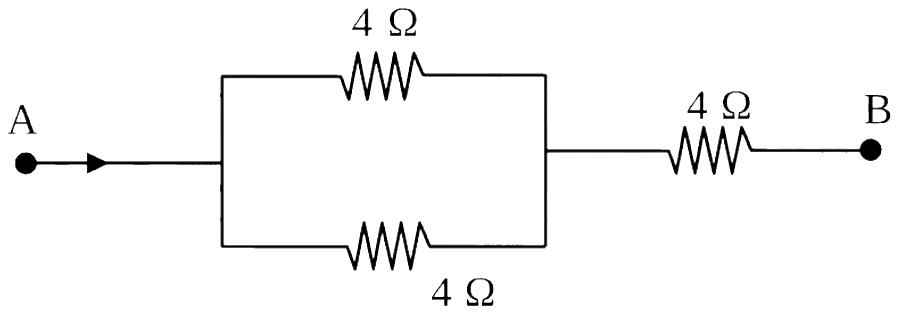
Answer: (a)
Step-by-step solution coming soon.
Electrical Power & Heating Effect
The power dissipated by a uniform wire of resistance when a potential difference of is applied across its ends is
Answer: (b)
Step-by-step solution coming soon.
Electrical Power & Heating Effect
In the circuit given below, if the bulb is to glow with maximum intensity, the value of is (neglect internal resistance of the cell)
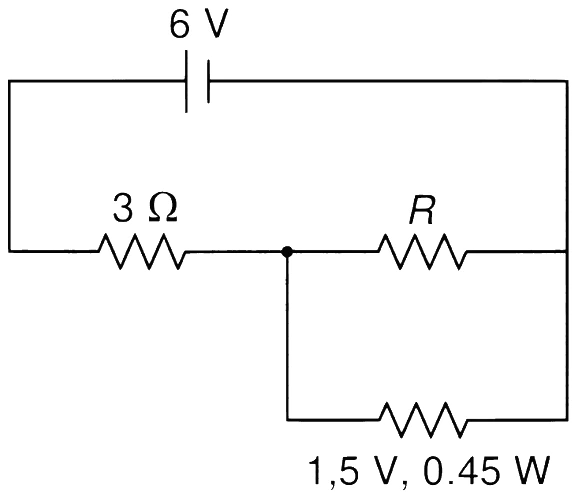
Answer: (a)
Step-by-step solution coming soon.
Electrical Power & Heating Effect
The power of an electric motor is when connected to a supply. When the motor is operated at , the current drawn by it is
Answer: (d)
Step-by-step solution coming soon.
Electrical Power & Heating Effect
The time required to raise the temperature of litre of water from to by a heater operated under having resistance of is [specific heat capacity of water is ] [density of water ]
Answer: (c)
Step-by-step solution coming soon.
Electrical Power & Heating Effect
A cylindrical resistor of radius and length is made of material that has a resistivity of . If the energy is dissipated at rate in the resistor, then the current density is
Answer: (b)
Step-by-step solution coming soon.
Electrical Power & Heating Effect
Consider a fuse wire of length and radius . The time of heating () for passing the maximum current will depend on
Answer: (c)
Step-by-step solution coming soon.
Electrical Power & Heating Effect
An amount of charge passes through a coil of resistance . If the current in the coil decreases to zero at a uniform rate during time , then the amount of heat generated in the coil will be
Answer: (a)
Step-by-step solution coming soon.
Electrical Power & Heating Effect
A capacitor of capacitance is connected in series with a resistance and DC source of emf through a key. The capacitor starts charging when the key is closed. By the time the capacitor has been fully charged, what amount of energy is dissipated in the resistance ?
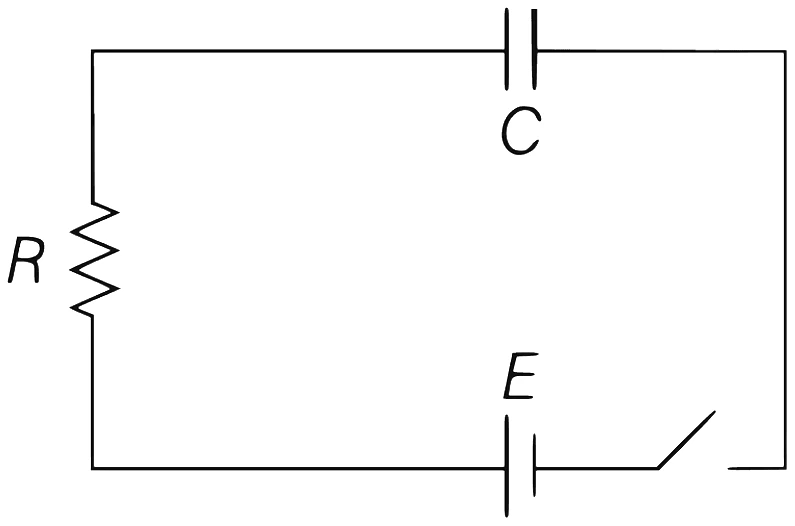
Answer: (a)
Step-by-step solution coming soon.
Electrical Power & Heating Effect
Consider the circuit shown in the figure. The value of the resistance for which the thermal power generated in it is practically independent of small variation of its resistance is
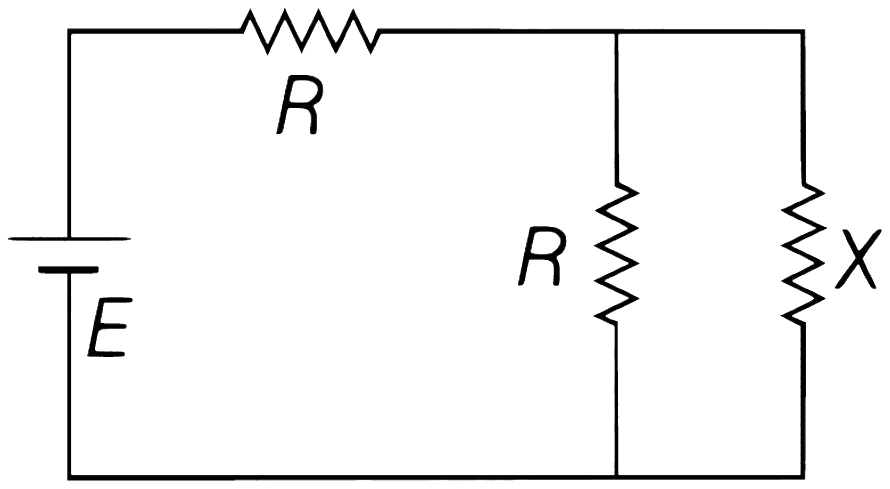
Answer: (c)
Step-by-step solution coming soon.
Electrical Power & Heating Effect
A current flows through a cylindrical cable of length and uniform cross-sectional area . The power dissipated due to the current is . The cable is cut into two equal halves. If the cross-sectional area and the current flowing through the two halves remain unchanged and the power dissipated in each half is , which of these options is correct?
Answer: (d)
Step-by-step solution coming soon.
Electrical Power & Heating Effect
A metal wire has radius and carries a constant current . It is thermally insulated and its resistivity is temperature independent. The coefficient of thermal expansion is negligible. The rise in temperature of the wire per unit time is found to be proportional to . Here is
Answer: (c)
Step-by-step solution coming soon.
Electrical Power & Heating Effect
A current is passing flowing through a thin copper slab placed on a diamond slab. The bottom surface of the diamond slab is maintained at and the remaining arrangment is thermally insulated from the surroundings. Note that diamond is an excellent thermal conductor but a poor electrical conductor. Then, the correct option(s) is(are)
More than one option can be correct. Tap every correct option, then tap Check.
Answer: (a), (c), (d)
Step-by-step solution coming soon.
Electrical Power & Heating Effect
A current of flows in a conductor of for 1 minute. The heat produced in the conductor will be
Answer: (b)
Step-by-step solution coming soon.
Electrical Power & Heating Effect
The electric power consumed by a bulb when operated at is
Answer: (a)
Step-by-step solution coming soon.
Electrical Power & Heating Effect
Case Study: An experiment was set up with the circuit diagram shown in the figure. Given that , , and .
The power dissipated in is -
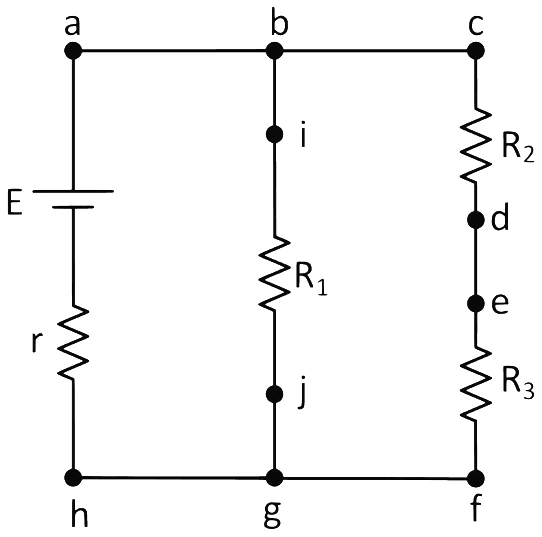
Answer: (b)
Step-by-step solution coming soon.
No questions match these filters.