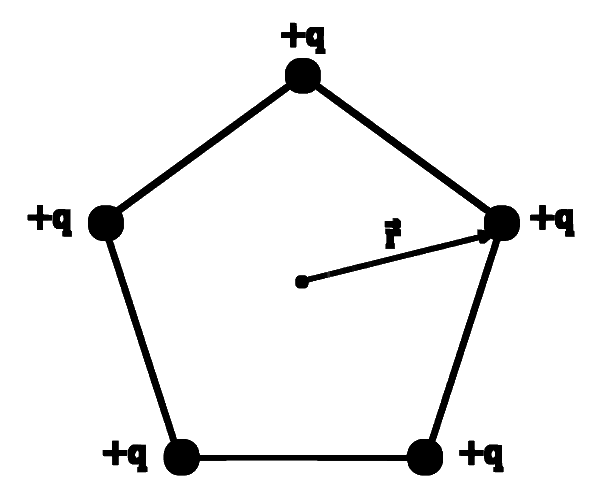
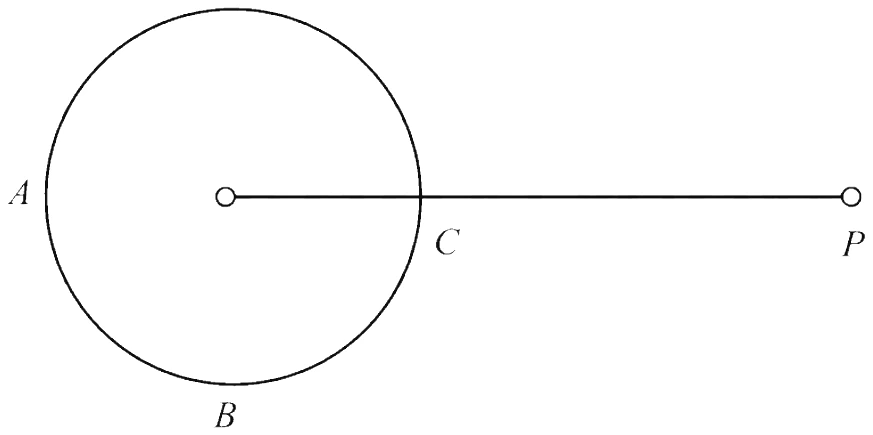
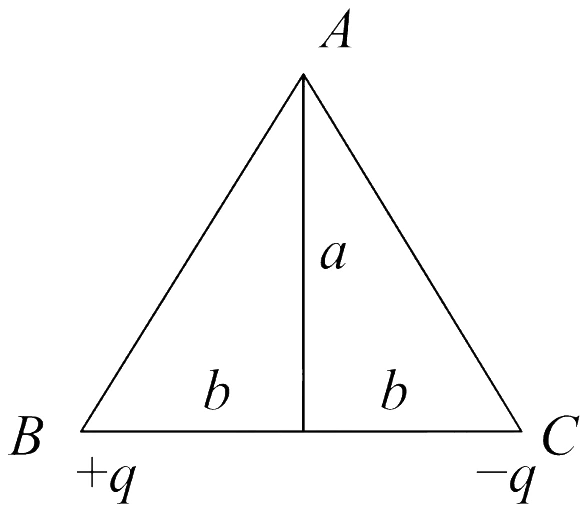
Five positive charges each having charge q are placed at the vertices of a pentagon as shown in the figure. The electric potential (V) and the electric field (E) at the center O of the pentagon due to these five positive charges are:
Three small identical bubbles of water having same charge on each coalesce to form a bigger bubble. Then the ratio of the potentials on one initial bubble and that on the resultant bigger bubble is:
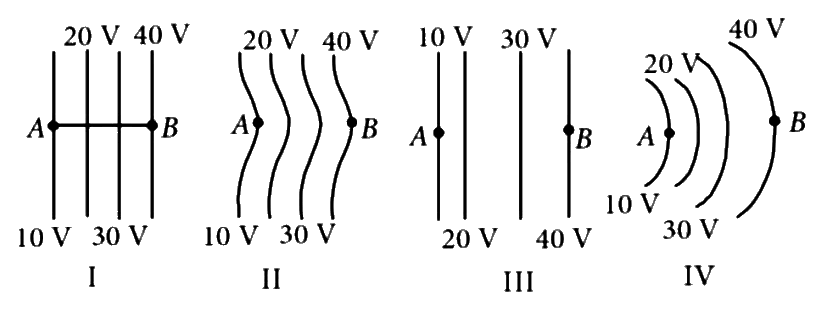
a. Work done to move a charge on an equipotential surface is not zero.
b. Equipotential surfaces are the surfaces where the potential is constant.
c. Equipotential surfaces for a uniform electric field are parallel and equidistant from each other. d. Electric field is always perpendicular to an equipotential surface.
Four electric charges +q,+q,−q, and −q are placed in order at the corners of a square of side '2r'. The electric potential at a point midway between the two negative charges is
A semicircular arc of radius 'R' is charged uniformly and has charge per unit length as λ. The electric potential V at the centre of curvature is [ε0 = permittivity of vacuum]
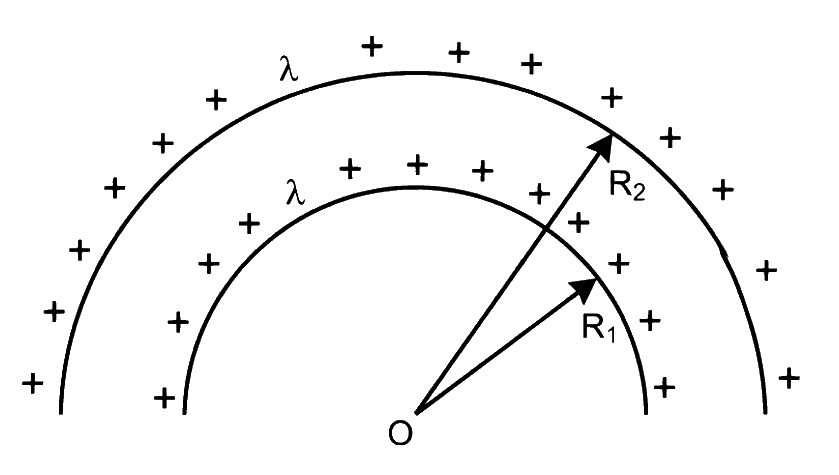
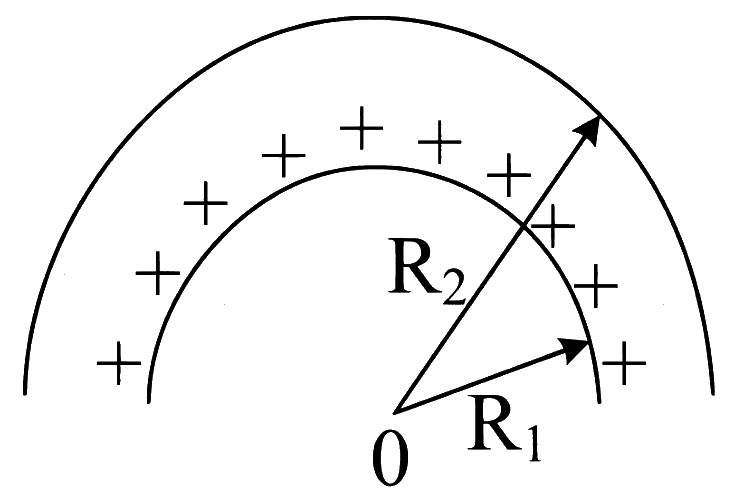
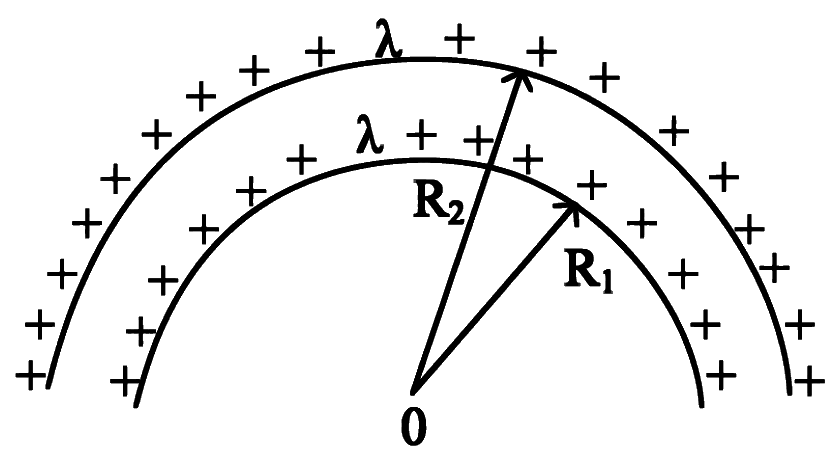
The electric potential at the center of two concentric half rings of radii R1 and R2, having same linear charge density λ is (ϵ0 = permittivity of free space)
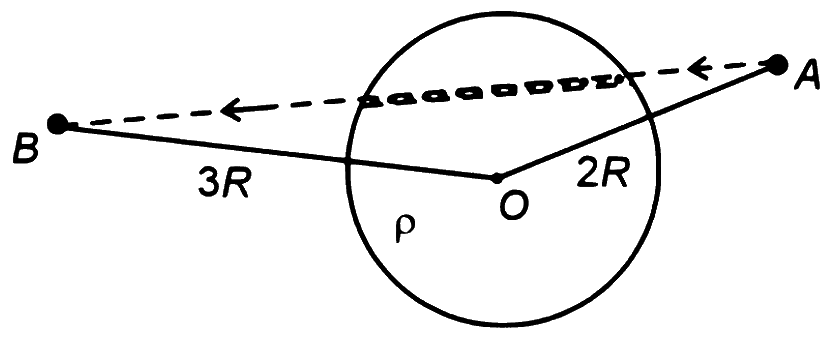
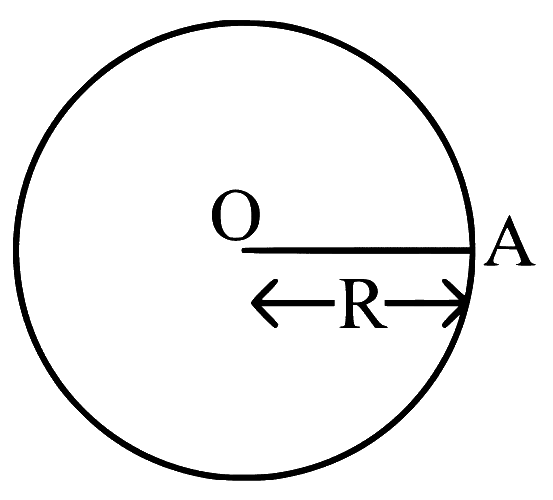
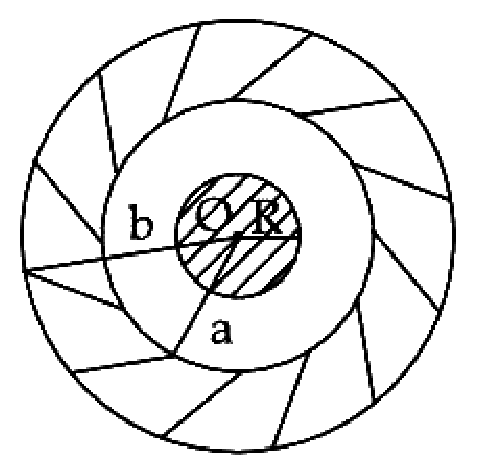
A unit positive point charge is taken slowly through an infinitesimally thin tube that is inside a charged dielectric sphere of radius R, having uniform positive charge density ρ, as shown in the figure. The initial and final positions of the charge are marked by A and B at distance 2R and 3R respectively, from the centre of the sphere. In this process, the magnitude of the total work done on the point charge is nε0ρR2. The value of n is: ( ε0 is the permittivity of vacuum)
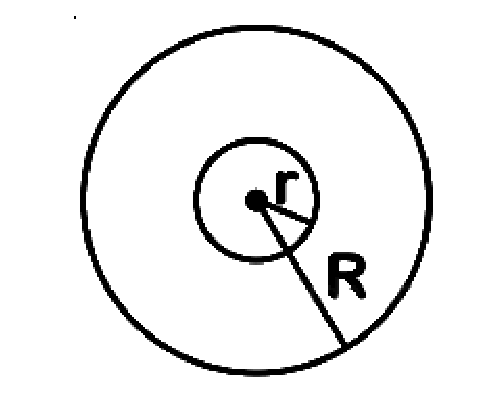
Two concentric spheres kept in air have radii R and r. They have similar charge and equal surface charge density σ. The electric potential at their common centre is (ϵ0 = permittivity of free space)
A large insulated sphere of radius r, charged with Q C is placed in contact with a small insulated uncharged sphere of radius r1 and is then separated. The charge on the smaller sphere will now be
Two isolated metallic spheres of radii R and 2R are charged such that both have the same charge density σ. The spheres are then connected by a thin conducting wire. If the new charge density of the larger sphere is σ1. The ratio σ1 to σ is
Two metal sphere of radius R and 3R have same surface charge density σ. If they are brought in contact and then separated, the surface charge density on smaller and bigger sphere becomes σ1 and σ2, respectively. The ratio σ2σ1 is.
Two charged conducting spheres S1 and S2 of radii 8 cm and 18 cm are connected to each other by a wire. After equilibrium is established, the ratio of electric fields on S1 and S2 spheres are ES1 and ES2 respectively. The value of ES2ES1 is ________.
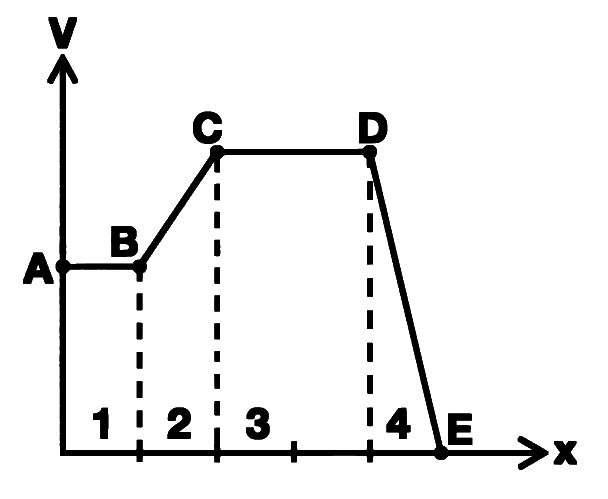
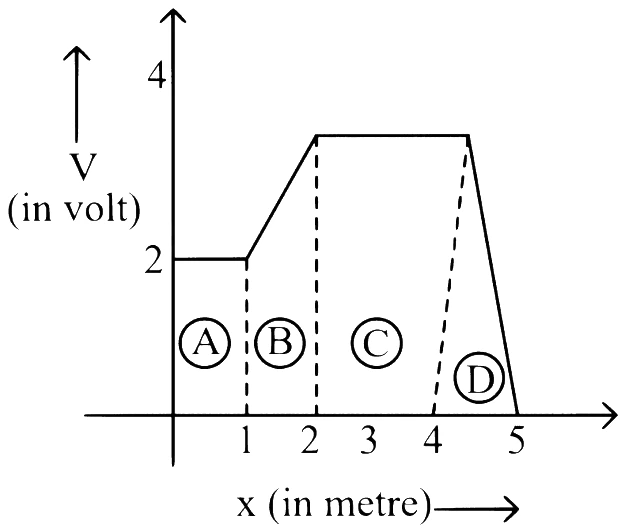
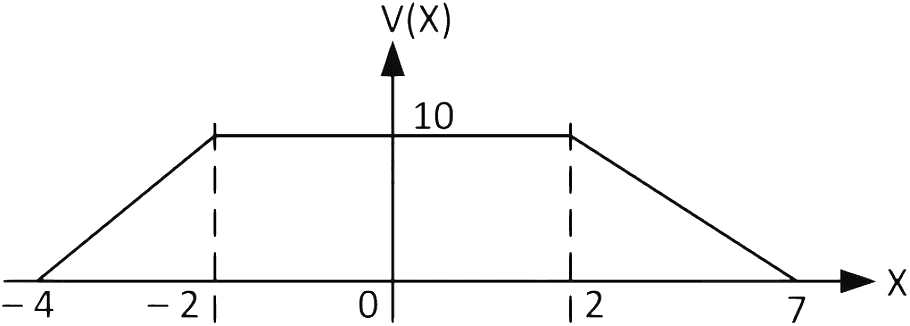
Following figure indicates the electric potential V as a function through 4 regions on x-axis. Which of the following is correct for the electric field E in these regions?
Electric field in a region is given by E=Axi^+Byj^, where A=10 V/m2 and B=5 V/m2. If the electric potential at a point (10,20) is 500 V, then the electric potential at origin is ______ V.
Three concentric metallic spherical shells of radii R,3R and 9R are given charges Q1,Q2 and Q3, respectively. It is found that surface charge densities on the outer surfaces of the shells are equal. Then the ratio of charges given to shells Q1:Q2:Q3, is (Neglect the induction effects)
There are three concentric conducting spherical shells A,B and C of radii a,b and c respectively ( c>b>a) and they are charged with charge q1,q2 and q3 respectively. The potentials of the spheres A,B and C respectively, are:
The electrostatic potential in a charged spherical region of radius r varies as V=ar3+b, where a and b are constants. The total charge in the sphere of unit radius is α×πaϵ0. The value of α is ______. (permittivity of vacuum is ϵ0)
A conducting sphere of radius ' R ' is given a charge ' Q ' uniformly. The electric field and the electric potential at the centre of the sphere are respectively [ ε0= permittivity of free space]
The electrostatic potential on the surface of uniformly charged spherical shell of radius R=10 cm is 120 V. The potential at the centre of shell, at a distance r=5 cm from centre, and at a distance r=15 cm from the centre of the shell respectively, are:
Assuming the drops to be spherical, 27 identical drops of mercury are charged simultaneously to the same potential of 20 volt. If all the charged drops are made to combine to form one big drop, then potential of big drop will be
' n ' identical small spherical drops of water, each of radius ' r ' and charged to the same potential ' v ' are combined to form a big drop. The potential of a big drop is
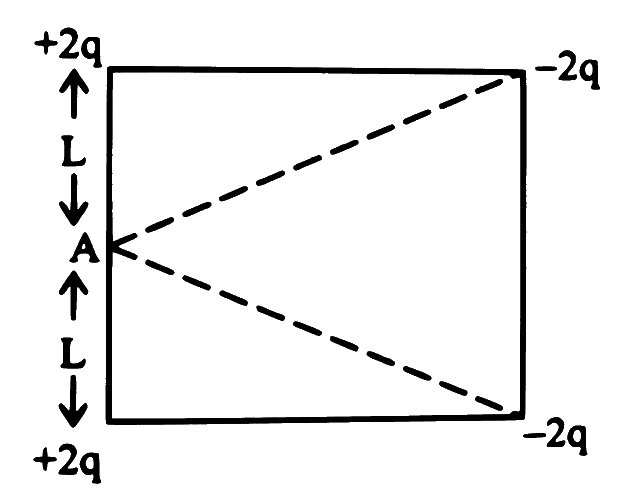
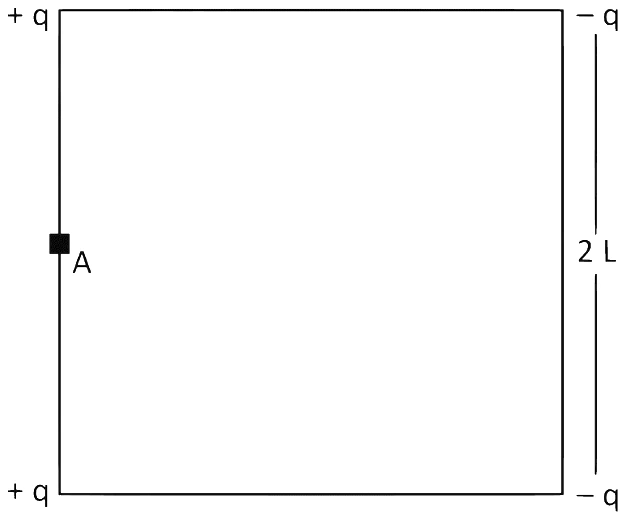
The electric charges ' +2q ', ' +2q ', ' −2q ' and ' −2q ' are placed at the corners of square of side ' 2 L ' as shown in figure. The electric potential at point 'A', midway between the two charges ' +2q ' and ' +2q ' is
Two metal spheres of radius R and 3R have same surface charge density σ. If they are brought in contact and then separated, the surface charge density on smaller and bigger sphere becomes σ1 and σ2, respectively. The ratio σ2σ1 is
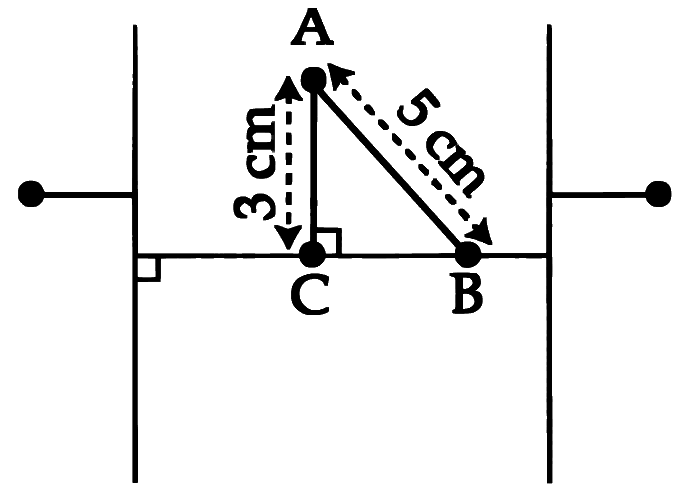
Two large plane parallel conducting plates are kept 10 cm apart as shown in figure. The potential difference between them is V. The potential difference between the points A and B (shown in the figure) is:
Three infinitely long wires with linear charge density λ are placed along the x-axis,y-axis and z- axis respectively. Which of the following denotes an equipotential surface?
Three concentric charged metallic spherical sheets A,B and C have radii a,b,c potentials VA,VB,VC and charge densities +σ,−σ and +σ respectively. The value of potential VA is ( ε0= permittivity of free space)
Four point charges each +q is placed on the circumference of a circle of diameter 2 d in such a way that they form a square. The potential at the centre is proportional to
An electric charge 10−6μC is placed at origin (0,0) m of X−Y co-ordinate system. Two points P and Q are situated at (3,3) m and (6,0) m respectively. The potential difference between the points P and Q will be:
Two charged conducting spheres of radii a and b are connected to each other by a conducting wire. The ratio of charges of the two spheres respectively is:
Given below are two statements: one is labelled as Assertion (A) and the other is labelled as Reason (R).
Assertion (A): Work done by electric field on moving a positive charge on an equipotential surface is always zero.
Reason (R): Electric lines of forces are always perpendicular to equipotential surfaces. In the light of the above statements, choose the most appropriate answer from the options given below:
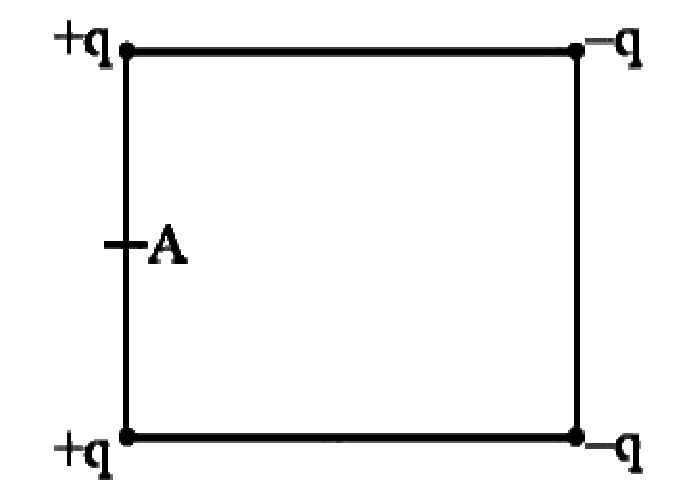
Four electric charges +q,+q,−q and -q are placed in order at the corners of a square of side 2 L. The electric potential at point midway between the two positive charges is
The electric potential at the centre of two concentric half rings of radii R1 and R2, having same linear charge density ' λ ' is (ε0= permittivity of free space)
A metallic sphere ' A ' isolated from ground is charged to +50μC. This sphere is brought in contact with other isolated metallic sphere ' B ' of half the radius of sphere ' A '. Then the charge on the two isolated spheres A \& B are in the ratio
The electrostatic potential inside a charged spherical ball is given by V=ar2+b where ' r ' is the distance from its centre and ' a ' and ' b ' are constants. The volume charge density of the ball is [ ε0= permittivity of free space ]
If a conducting sphere of radius R is charged. Then the electric field at a distance r(r>R) from the centre of the sphere would be, (V= potential on the surface of the sphere)
For a uniformly charged thin spherical shell, the electric potential (V) radially away from the centre (O) of shell can be graphically represented as -
Which of the following correctly represents the variation of electric potential (V) of a charged spherical conductor of radius (R) with radial distance (r) from the center?
When a charge of 3 C is placed in uniform electric field, it experiences a force of 3000 N. Within this field, potential difference between two points separated by a distance of 1 cm is
For a charged spherical ball, electrostatic potential inside the ball varies with r as V=2ar2+b. Here, a and b are constant and r is the distance from the center. The volume charge density inside the ball is −λaε. The value of λ is ____________.
ε = permittivity of the medium
Numerical answer type. Work it out, then open the answer.
A charged spherical conductor of radius 'R' is connected momentarily to another uncharged spherical conductor of radius 'r' by means of a thin conducting wire, then the ratio of the surface charge density of the first to the second conductor is
Two isolated metallic solid spheres of radii R and 2R are charged such that both have same charge density σ. The spheres are then connected by a thin conducting wire. If the new charge density of the bigger sphere is σ′. The ratio σσ′ is:
Assume that an electric field E=30x2i^ exists in space. If 'V0' is the potential at the origin and 'VA' is the potential at x=2 m, then the potential difference (VA−V0) is
Three concentric spherical metallic shells X, Y and Z of radius a, b and c respectively [a < b < c] have surface charge densities σ,−σ and σ respectively. The shells X and Z are at same potential. If the radii of X & Y are 2 cm and 3 cm, respectively. The radius of shell Z is _________ cm.
Numerical answer type. Work it out, then open the answer.
Two uniformly charged spherical conductors A and B of radii 5 mm and 10 mm are separated by a distance of 2 cm. If the spheres are connected by a conducting wire, then in equilibrium condition, the ratio of the magnitudes of the electric fields at the surface of the sphere A and B will be:
Sixty four conducting drops each of radius 0.02 m and each carrying a charge of 5 μC are combined to form a bigger drop. The ratio of surface charge density of bigger drop to the smaller drop will be:
512 identical drops of mercury are charged to a potential of 2V each. The drops are joined to form a single drop. The potential of this drop is ________ V.
Numerical answer type. Work it out, then open the answer.
Four electric charges +q,+q,−q and −q are placed in order at the corners of a square of side 2L. The electric potential at point midway between the two positive charges is
A uniformly charged half ring of a radius ' R ' has linear charge density 'σ'. The electric potential at the centre of the half ring is ( ϵ0= permittivity of free space)
The two thin coaxial rings, each of radius 'a' and having charges +Q and −Q respectively are separated by a distance of 's'. The potential difference between the centres of the two rings is:
Two charged metallic spheres are joined by a very thin metal wire. If the radius of the larger sphere is four times that of the smaller sphere, the electric field near the larger sphere is
Two spherical conductors of radii 4 cm and 5 cm are charged to the same potential. If 'σ1' and 'σ2' be the respective values of the surface density of charge on the two conductors then the ratio σ1:σ2 is
A solid metal sphere of radius R having charge q is enclosed inside the concentric spherical shell of inner radius a and outer radius b as shown in the figure. The approximate variation of electric field E as a function of distance r from centre O is given by
A charged spherical conductor has radius 'r'. The potential difference between its surface and 3 point at a distance '3r' from the centre is 'v' The electric intensity at a distance '3r' from the centre of the conductor is
A hollow metal sphere has a radius 'r'. The potential difference between a point on its surface and at a point at a distance '3r' from its centre is 'V'. The electric intensity at the distance '3r' from the centre of the sphere will be:
A hollow charged metal sphere has radius 'R'. If the potential difference between its surface and a point at a distance '5 R' from the centre is V, then magnitude of electric field Intensity at a distance '5R' from the centre of sphere is
The variation of electrostatic potential with radial distance r from the centre of a positively charged metallic thin shell of radius R is given by the graph
In a certain region of space with volume 0.2 m3, the electric potential is found to be 5 V throughout. The magnitude of electric field in this region is:
Concentric metallic hollow spheres of radii R and 4R hold charges Q1 and Q2 respectively. Given that surface charge densities of the concentric spheres are equal, the potential difference V(R) – V(4R) is:
Two isolated conducting spheres S1 and S2 of radius 32R and 31R have 12 μC and –3 μC charges, respectively, and are at a large distance from each other. They are now connected by a conducting wire. A long time after this is done the charges on S1 and S2 are respectively:
A charge Q is distributed over two concentric conducting thin spherical shells radii r and R (R > r). If the surface charge densities on the two shells are equal, the electric potential at the common centre is:
Consider two charged metallic spheres S1 and S2 of radii R1 and R2, respectively. The electric fields E1 (on S1) and E2 (on S2) on their surfaces are such that E1/E2 = R1/R2. Then the ratio V1 (on S1) / V2 (on S2) of the electrostatic potentials on each sphere is:
A solid conducting sphere, having a charge Q, is surrounded by an uncharged conducting hollow spherical shell. Let the potential difference between the surface of the solid sphere and that of the outer surface of the hollow shell be V. If the shell is now given a charge of –4 Q, the new potential difference between the same two surfaces is:
Two metal spheres, one of radius R and the other of radius 2R respectively have the same surface charge density σ. They are brought in contact and separated. What will be the new surface charge densities on them?
A charge Q is distributed over three concentric spherical shells of radii a, b, c (a < b < c) such that their surface charge densities are equal to one another. The total potential at a point at distance r from their common centre, where r < a, would be -
The electric field in a region is given by E=(Ax+B)i^, where E is in NC–1 and x is in metres. The values of constants are A = 20 SI unit and B = 10 SI unit. If the potential at x = 1 is V1 and that at x = –5 is V2, then V1 – V2 is :-
Three concentric metal shells A, B and C of respective radii a, b and c (a < b < c) have surface charge densities +σ,−σ and +σ respectively. The potential of shell B is:
There is a uniform electrostatic field in a region. The potential at various points on a small sphere centred at P, in the region, is found to vary between the limits 589.0 V to 589.8 V. What is the potential at a point on the sphere whose radius vector makes an angle of 60o with the direction of the field?
The potential (in volts) of a charge distribution is given by.
V(z) = 30 − 5z2 for ∣z∣≤ 1 m.
V(z) = 35 − 10 ∣z∣ for ∣z∣≥1 m.
V(z) does not depend on x and y. If this potential is generated by a constant charge per unit volume ρ0 (in units of ε0) which is spread over a certain region, then choose the correct statement.
Within a spherical charge distribution of charge density ρ(r), N equipotential surfaces of potential V0, V0 + ΔV, V0 + 2ΔV, .......... V0 + NΔV (Δ V > 0), are drawn and have increasing radii r0, r1, r2,..........rN, respectively. If the difference in the radii of the surfaces is constant for all values of V0 and ΔV then:
Q105JEE Main 2015 · (One or more correct)Difficult
Electric Potential & Equipotentials
A uniformly charged solid sphere of radius R has potential V0 (measured with respect to ∞) on its surface. For this sphere the equipotential surfaces with potentials 23V0,45V0,43V0 and 4V0 have radius R1,R2,R3 and R4 respectively. Then
In a region, the potential is represented by V(x, y, z) = 6x − 8xy − 8y + 6yz, where V is in volts and x, y, z are in metres. The electric force experienced by a charge of 2 coulomb situated at point (1, 1, 1) is
Assume that an electric field E=30x2i^ exists in space. Then the potential difference VA−VO, where VO is the potential at the origin and VA the potential at x=2 m is:
A point charge of magnitude +1μC is fixed at (0, 0, 0). An isolated uncharged spherical conductor, is fixed with its center at (4, 0, 0). The potential and the induced electric field at the centre of the sphere is:
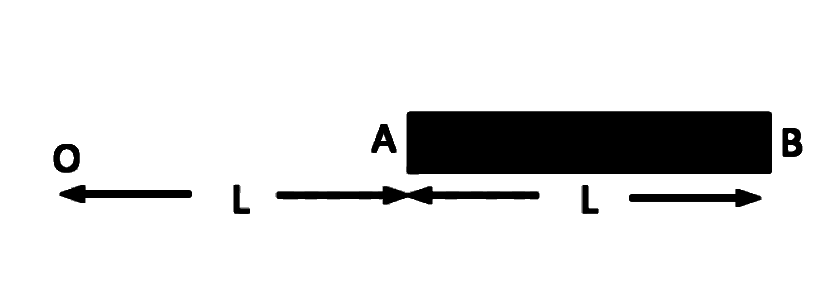
A charge Q is uniformly distributed over a long rod AB of length L as shown in the figure. The electric potential at the point O lying at distance L from the end A is
Four point charges −Q, −q, 2q and 2Q are placed, one at each corner of the square. The relation between Q and q for which the potential at the centre of the square is zero is
Two metallic spheres of radii 1 cm and 3 cm are given charges of−1× 10⁻² C and 5 × 10⁻² C, respectively. If these are connected by a conducting wire, the final charge on the bigger sphere is
The electric potential V at any point (x, y, z), all in metres in space is given by V = 4x2 volt. The electric field at the point (1, 0, 2) in volt/meter, is
Four electric charges +q, +q, − q and − q are placed at the corners of a square of side 2L (see figure). The electric potential at point A, midway between the two charges + q and +q, is
The electrostatic potential inside a charged spherical ball is given by ϕ=ar2+b where r is the distance from the center and a,b are constants. Then the charge density inside the ball is:
Three concentric spherical shells have radii a, b and c (a < b < c) and have surface charge densities σ,−σ and σ respectively. If VA, VB and VC denote the potentials of the three shells, then, for c = a + b, we have
An electric charge 10−3μC is placed at the origin (0,0) of X−Y co-ordinate system. Two points A and B are situated at (2,2) and (2,0) respectively. The potential difference between the points A and B will be
Two spherical conductors A and B of radii 1 mm and 2 mm are separated by a distance of 5 cm and are uniformly charged. If the spheres are connected by a conducting wire then in equilibrium condition, the ratio of the magnitude of the electric fields at the surfaces of spheres A and B is
Two thin wire rings each having a radius R are placed at a distance d apart with their axes coinciding. The charges on the two rings are +q and −q. The potential difference between the centres of the two rings is
A thin spherical conducting shell of radius R has a charge q. Another charge Q is placed at the center of the shell. The electrostatic potential at a point P at a distance 2R from the center of the shell is
Two metallic spheres of radii 1 cm and 2 cm are given charges 10−2 C and 5×10⁻² C respectively. If they are connected by a conducting wire, the final charge on the smaller sphere is
The electrostatic potential doesn't depend on which of the following? 1. It depends on the charge 2. It depends on the endpoints of the path through work done 3. It depends on the path taken for the work done 4. It depends on the amount of work done
Potential at a point due to a point charge is V. The charge is doubled and also the distance of the point from the charge is doubled. The new potential is
Two charges Q1=q and Q2=mq are placed at the points P1(a,b) and P2(ma,mb), respectively, in the XY plane, where a,b=0 and m=0,1. If V1 is the potential at a point in the XY plane due to charge Q1 and V2 is the potential at that point due to charge Q2. Correct statement(s) for the points at which ∣V1∣=∣V2∣ is/are :
More than one option can be correct. Tap every correct option, then tap Check.
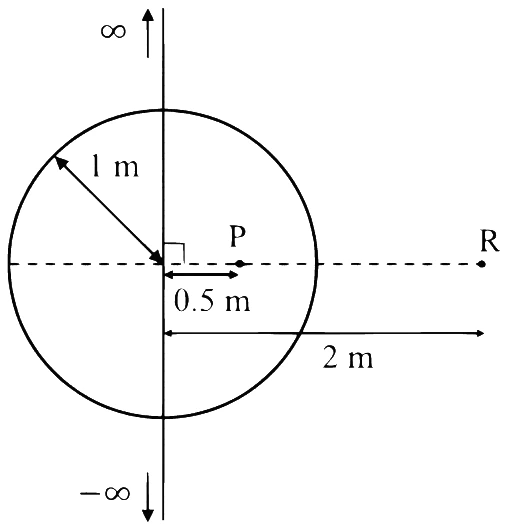
An infinitely long thin wire, having a uniform charge density per unit length of 5nC m−1, is passing through a spherical shell of radius 1m, as shown in the figure. A 10nC charge is distributed uniformly over the spherical shell. If the configuration of the charges remains static, the magnitude of the potential difference between points P and R, in Volt, is ________. [Given: In SI units 4πϵ01=9×10⁹, ln2=0.7. Ignore the area pierced by the wire.]
Numerical answer type. Work it out, then open the answer.
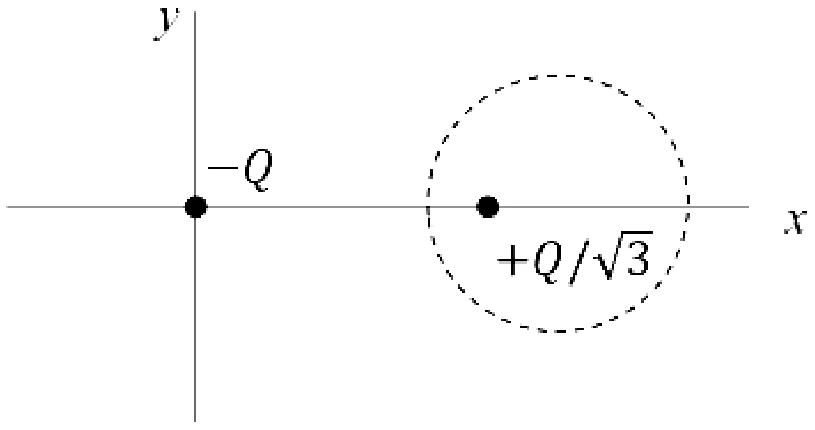
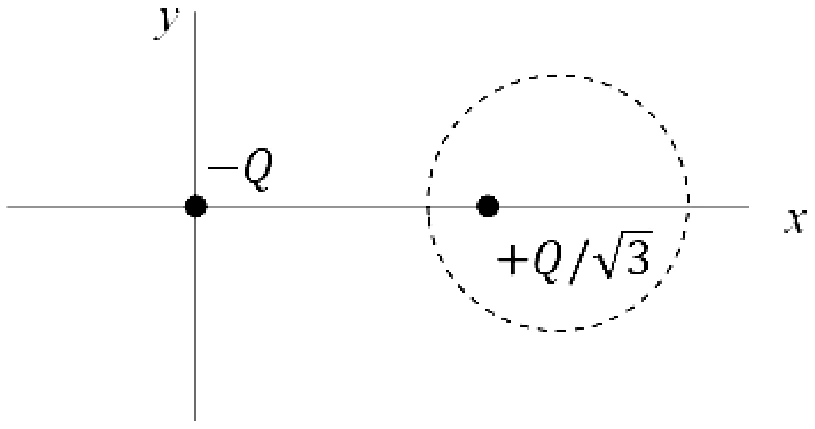
Two point charges −Q and +Q/3 are placed in the xy-plane at the origin (0,0) and a point (2,0), respectively, as shown in the figure. This results in an equipotential circle of radius R and potential V=0 in the xy-plane with its center at (b,0). All lengths are measured in meters.
The value of R is ________ meter.
Numerical answer type. Work it out, then open the answer.
Two point charges −Q and +Q/3 are placed in the xy-plane at the origin (0,0) and a point (2,0), respectively, as shown in the figure. This results in an equipotential circle of radius R and potential V=0 in the xy-plane with its center at (b,0). All lengths are measured in meters.
The value of b is ________ meter.
Numerical answer type. Work it out, then open the answer.
A thin spherical insulating shell of radius R carries a uniformly distributed charge such that the potential at its surface is V0. A hole with a small area α4πR2(α≪1) is made on the shell without affecting the rest of the shell. Which one of the following statements is correct?
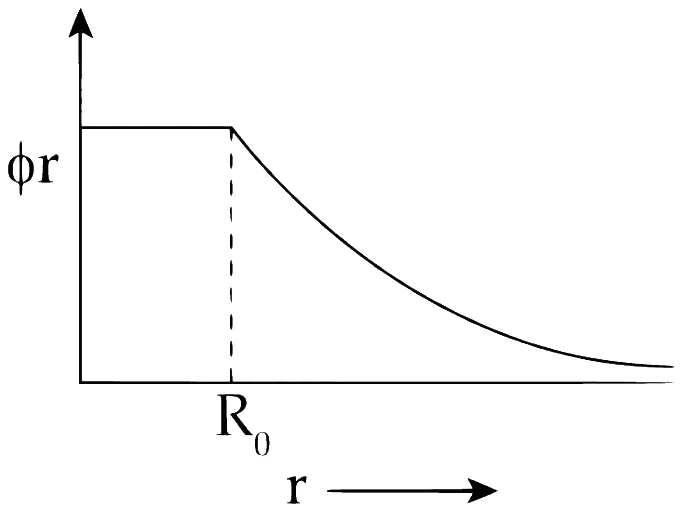
Consider a thin spherical shell of radius R with center at the origin, carrying uniform positive surface charge density. The variation of the magnitude of the electric field ∣E(r)∣ and the electric potential V(r) with the distance r from the center, best represented by which graph?
A spherical metal shell A of radius RA and a solid metal sphere B of radius RB(<RA) are kept far apart and each is given charge ′+Q′. Now they are connected by a thin metal wire. Then
More than one option can be correct. Tap every correct option, then tap Check.
Three concentric metallic spherical shells of radii R,2R,3R are given charges Q1,Q2,Q3, respectively. It is found that the surface charge densities on the outer surfaces of the shells are equal. Then, the ratio of the charges given to the shells, Q1:Q2:Q3, is
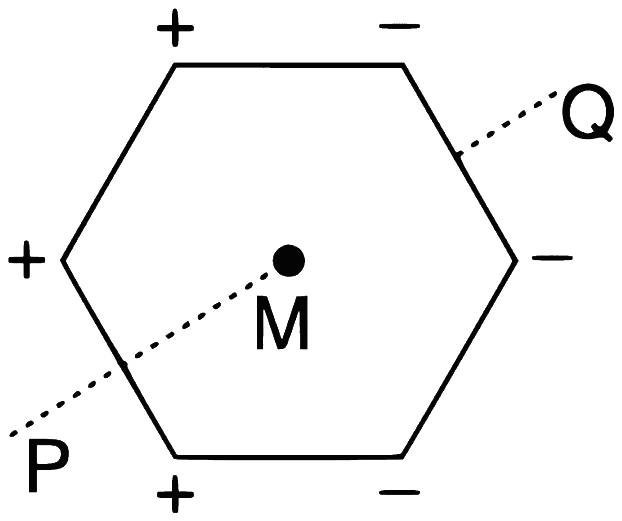
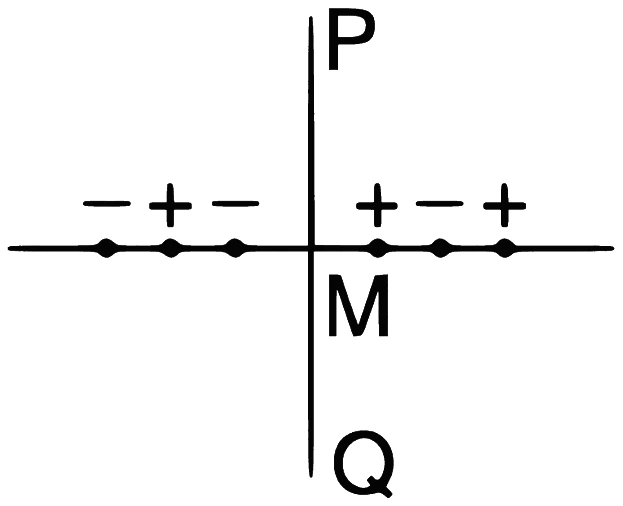
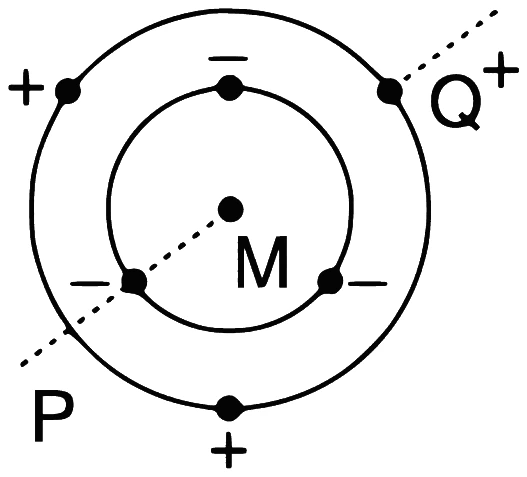
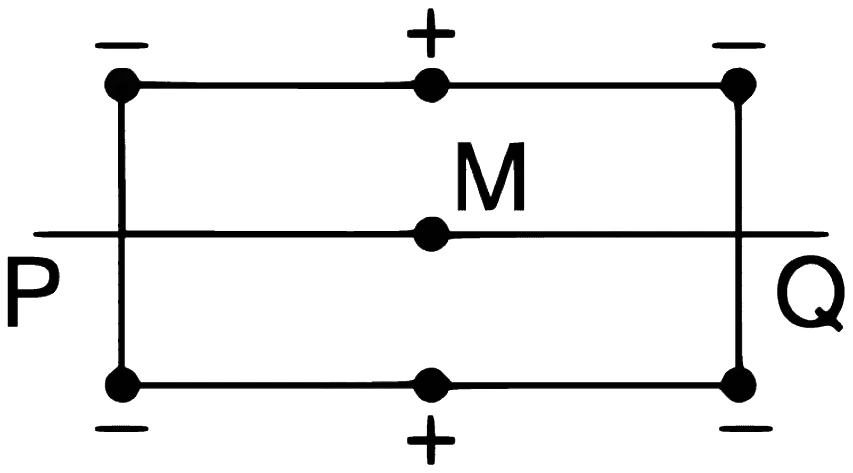
Six point charges, each of the same magnitude q, are arranged in different manners as shown in Column II. In each case, a point M and a line PQ passing through M are shown. Let E be the electric field and V be the electric potential at M (potential at infinity is zero) due to the given charge distribution when it is at rest. Now, the whole system is set into rotation with a constant angular velocity about the line PQ. Let B be the magnetic field at M and μ be the magnetic moment of the system in this condition. Assume each rotating charge to be equivalent to a steady current.
Column I
Column II
(A) E=0
(P) Charges are at the corners of a regular hexagon. M is at the centre of the hexagon. PQ is perpendicular to the plane of the hexagon.
(B) V=0
(Q) Charges are on a line perpendicular to PQ at equal intervals. M is the midpoint between the two innermost charges.
(C) B=0
(R) Charges are placed on two coplanar insulating rings at equal intervals. M is the common centre of the rings. PQ is perpendicular to the plane of the rings.
(D) μ=0
(S) Charges are placed at the corners of a rectangle of sides a and 2a and at the mid points of the longer sides. M is at the centre of the rectangle. PQ is parallel to the longer sides.
(T) Charges are placed on two coplanar, identical insulating rings at equal intervals. M is the midpoint between the centres of the rings. PQ is perpendicular to the line joining the centres and coplanar to the rings.
STATEMENT 1: For practical purposes, the earth is used as a reference at zero potential in electrical circuits. and STATEMENT 2: The electrical potential of a sphere of radius R with charge Q uniformly distributed on the surface is given by 4πε0RQ
Positive and negative point charges of equal magnitude are kept at (0,0,2a) and (0,0,2−a), respectively. The work done by the electric field when another positive point charge is moved from (−a,0,0) to (0,a,0) is
A conducting liquid bubble of radius a and thickness t(t≪a) is charged to potential V. If the bubble collapses to a droplet, find the potential on the droplet.
Assertion : Conductors having equal positive charge and volume, must also have same potential. Reason : Potential depends only on charge and volume of conductor.
A charged spherical conductor of radius a and charge q, is surrounded by another charged concentric sphere of radius b (b>a). The potential difference between conductors is V. When the spherical conductor of radius b is discharged completely, then the potential difference between conductor will be
Assertion : Electrons move from a region of higher potential to a region of lower potential. Reason : An electron has less potential energy at a point where potential is higher and vice-versa.
Assertion : A and B are two conducting spheres of same radius. A being solid and B hollow. Both are charged to the same potential. Then, charge on A = charge on B. Reason : Potentials on both are same.
A non-conducting ring of radius 0.5m carries a total charge of 1.11×10⁻¹⁰C distributed non-uniformly on its circumference producing on its circumference electric field E, everywhere in space. The value of the line integral ∫l=∞l=0(−E⋅dl) (l=0 being centre of ring) in volts is
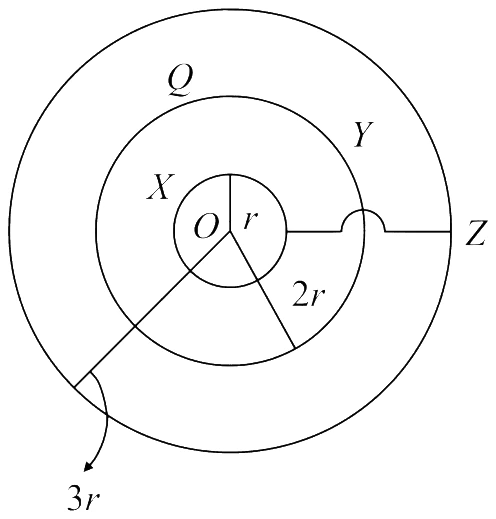
The concentric, conducting spherical shells X, Y and Z with radii r, 2r and 3r, respectively. X and Z are connected by a conducting wire and Y is uniformly charged to charge Q as shown in figure. Charges on shells X and Z will be
Two charges of +10μC and +20μC are separated by a distance 2cm. The net potential (electric) due to the pair at the middle point of the line joining the two charges, is
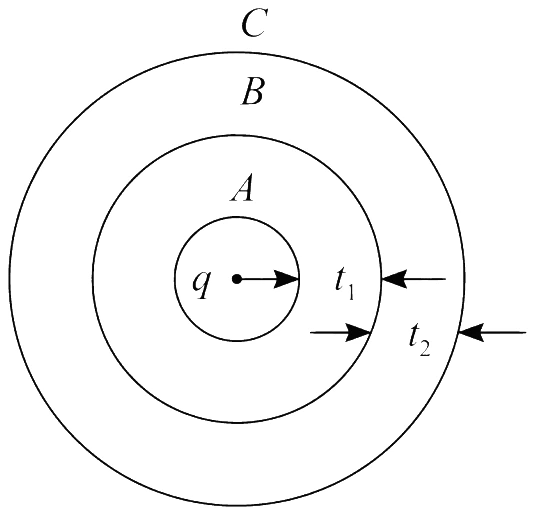
Figure shows three spherical and equipotential surfaces A, B and C round a point charge q. The potential difference VA−VB=VB−VC. If t1 and t2 be the distances between them, then
Which one of the following graphs represents the variation of electric potential with distance r from the centre of a non-conducting charged sphere of radius R?
Electric field in the region is given by E=(M/x4)i^, then the correct expression for the potential in the region is (assume potential at infinity is zero)
Four point charges −Q, −q, 2q and 2Q are placed, one at each corner of the square. The relation between Q and q for which the potential at the centre of the square is zero is
If 1000 droplets each of potential 1V and radius r are mixed to form a big drop. Then, the potential of the drop as compared to small droplets, will be
A hollow conducting sphere is placed in an electric field produced by a point charge placed at P as shown in figure. Let VA, VB, VC be the potentials at points A, B and C respectively. Then
The potential of the electric field produced by point charge at any point (x,y,z) is given by V=3x2+5, where x, y are in metres and V is in volts. The intensity of the electric field at (−2,1,0) is
An arc of radius r carries charge. The linear density of charge is λ and the arc subtends an angle 3π at the centre. What is electric potential at the centre?
ABCD is a rectangle. At corners B, C and D of the rectangle are placed charges +10×10−12C, −20×10−12C and 10×10−12C respectively. Calculate the potential at the fourth corner. The side AB=4cm and BC=3cm
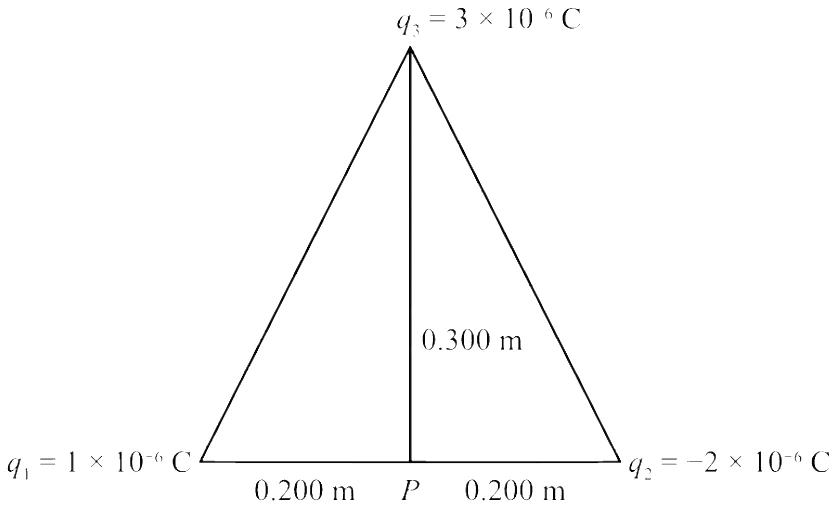
Figure shows a triangular array of three point charges. The electric potential V of these source charges at the midpoint P of the base of the triangle is [4πϵ01=9×10⁹N m2C−2]
Two conducting spherical shells A and B of radii 4cm and 6cm respectively are placed with their centres 17cm apart in air. Initially, sphere A was given a −20nC charge while sphere B was uncharged. The spheres are then connected by a long thin conducting wire and allowed to reach electrostatic equilibrium. Assuming no charge is lost to the surroundings, the final charge on sphere A and the ratio of magnitude of electric field intensity at the surface of sphere B to that of sphere A is given by;
When a metallic spherical shell of radius 20cm is charged, the potential on its surface is found to be 5V. The potential at a point 10cm from the centre of the spherical shell is :
Point charges −3Q, −q, 2q and 2Q are placed, one at each corner of a square. The relation between Q and q for which the potential at the centre of the square is zero is
A uniformly charged solid sphere of radius R has potential V0 (measured with respect to infinity) on its surface. For this sphere the equipotential surfaces with potentials 23V0, 1V0, 43V0 and 4V0 have radius R1, R2, R3 and R4 respectively, then
Two metal spheres, one of radius 2R and the other of radius 2R, have the same surface charge density. They are brought in contact and separated. The ratio of their new surface charge densities is
Two point charges 20μC and −10μC are separated by a distance of 1m in air. At what point on the line joining the two charges, the electric potential is zero?
PQRS is a square of side 1m. A charge of 100μC is placed at the centre of the square. Then the work done to take a 3μC charge from the corner P to the corner R is
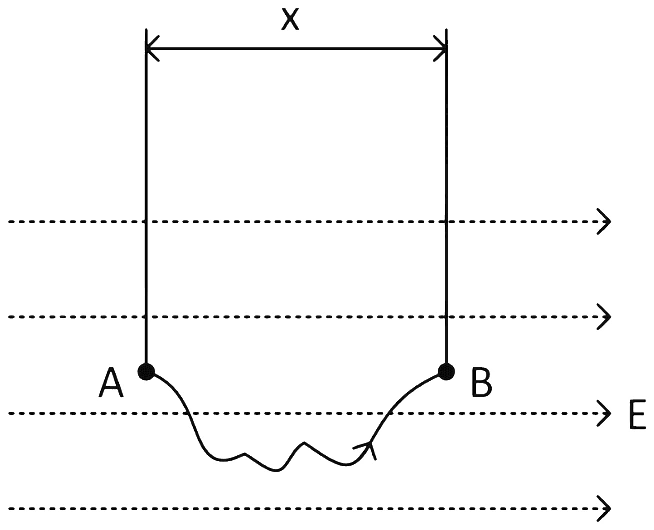
A uniform electric field vector E exists along horizontal direction as shown. The electric potential at A is VA. A small point charge q is slowly taken from A to B along the curved path as shown. The potential energy of the charge when it is at point B is
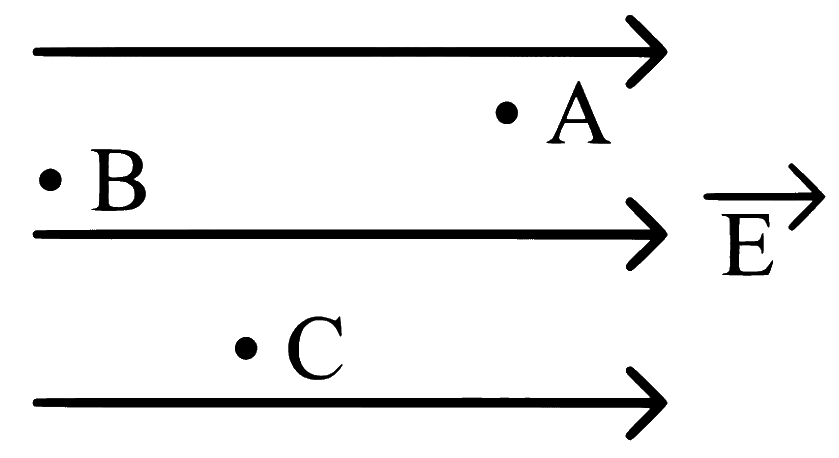
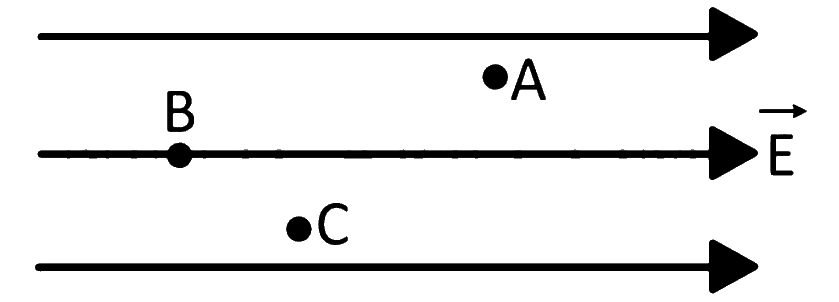
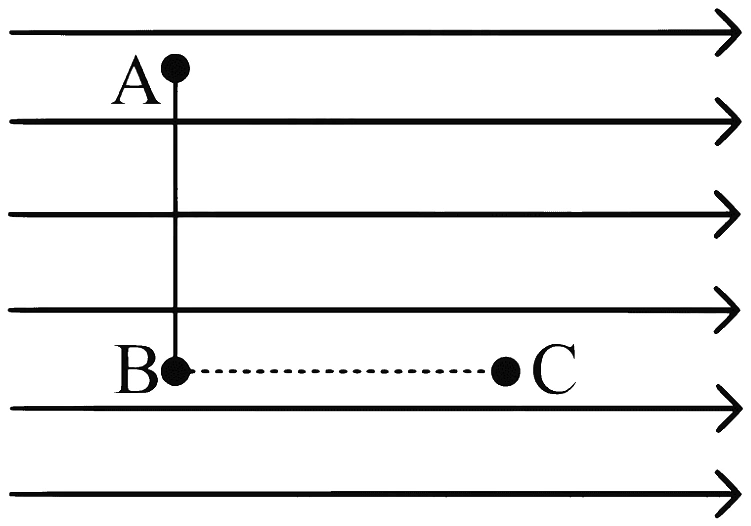
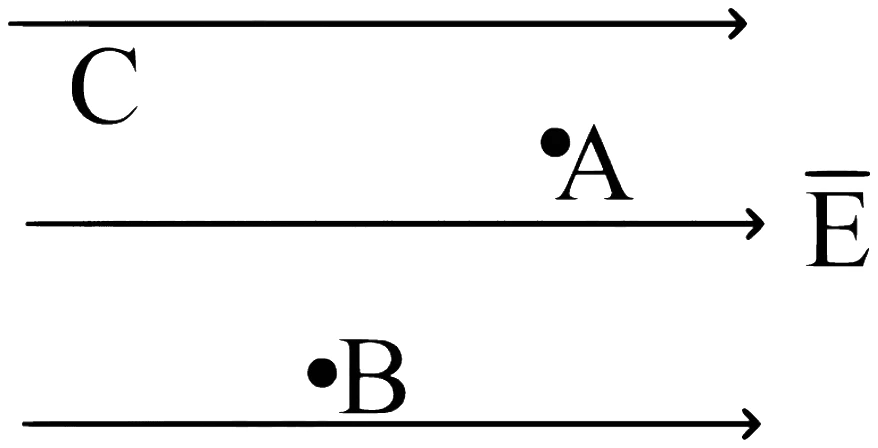
Figure shows three points A, B and C in a region of uniform electric field E. The line AB is perpendicular and BC is parallel to the field lines. Then, which of the following holds good? (VA, VB and VC represent the electric potential at points A, B and C, respectively)
The figure gives the electric potential V as a function of distance through four regions on x-axis. Which of the following is true for the magnitude of the electric field E in these regions?
Two point charges, +2μC and −2μC, are fixed respectively at points A and B, separated by 4m in air. A point P is located such that it is 3m from +2μC and 5m from −2μC. What is the electric potential at point P? Take k=9×10⁹N m2C−2
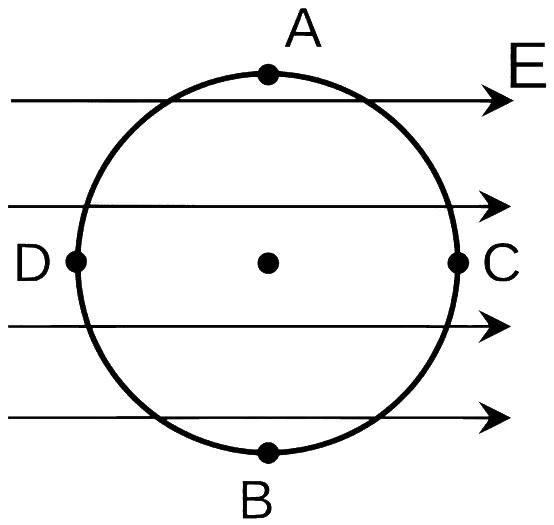
A circle of radius r is drawn in a uniform electric field E as shown in figure. If VA, VB, VC & VD are the potentials at A, B, C & D respectively. Then
A conducting sphere of radius 4cm is charged such that it has a potential of 5V on its surface. Then the potential at a point which is at a depth of 1cm from its surface is
Two point charges −2Q and Q are located at (−3a,0) and (3a,0) in the X-Y plane. The locus of all points in the X-Y plane where electric potential is zero to these charges is
A charge 'Q' is distributed on concentric hollow spheres of radii r and R, (R>r) such that their surface charge densities are same. The potential at their centre is
An electric charge 10−3μC is placed at the origin of xy-plane. The potential difference between point A and B located at (2m,2m) and (2m,0m) respectively is
If four charges +12nC, −20nC, +32nC and −15nC are arranged at the four vertices of a square of side 2m, then the net electric potential at the centre of the square due to these four charges is
Two charged conducting spheres of radii 5cm and 10cm have equal surface charge densities. If the electric field on the surface of the smaller sphere is E, then the electric field on the surface of the larger sphere is
As shown in the figure, if the values of the electric potential at three points A, B and C in a uniform electric field (E) are VA, VB and VC respectively, then
If 27 charged water droplets, each of radius 10−3m and charge 10−12C coalesce to form a single big spherical drop, then the potential of the big drop is
In space the electric potential varies as V=20∣r∣ volt, where r=xi^+yj^+zk^ is the position vector. Then, electric field in (N C−1) at the point (4m,3m,−5m) is
125 identical charged small spheres coalesce to form a big charged sphere. If the electric potential on each small sphere is 60mV, then the electric potential on the bigger sphere formed is
If four charges q1=+1×10⁻⁸C, q2=−2×10⁻⁸C, q3=+3×10⁻⁸C and q4=+2×10⁻⁸C are kept at the four corners of a square of side 1m, then the electric potential at the centre of the square is
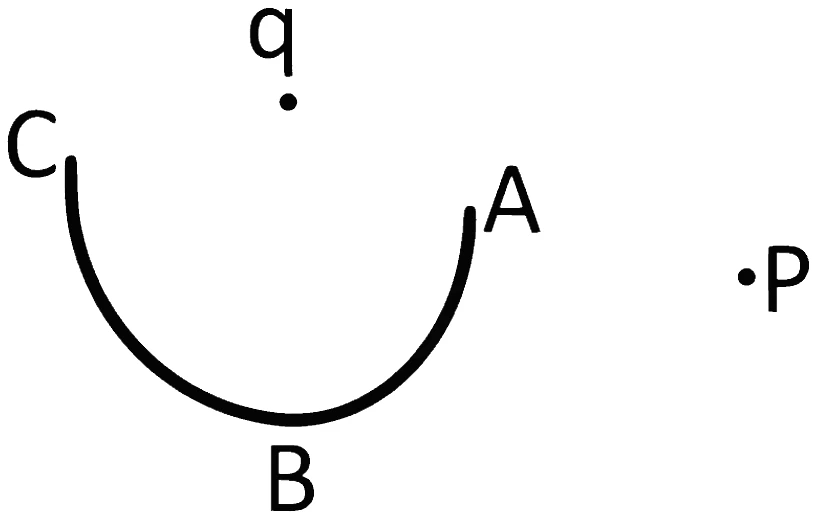
In the following diagram, the work done in moving a point charge from point P to points A, B and C are WA, WB and WC respectively. Then (A, B, C are points on a semi-circle and point charge q is at the centre of the semi-circle)
Two spheres A and B of radii 4cm and 6cm are given charges of 80μC and 40μC respectively. If they are connected by a fine wire, the amount of charge flowing from one to the other is
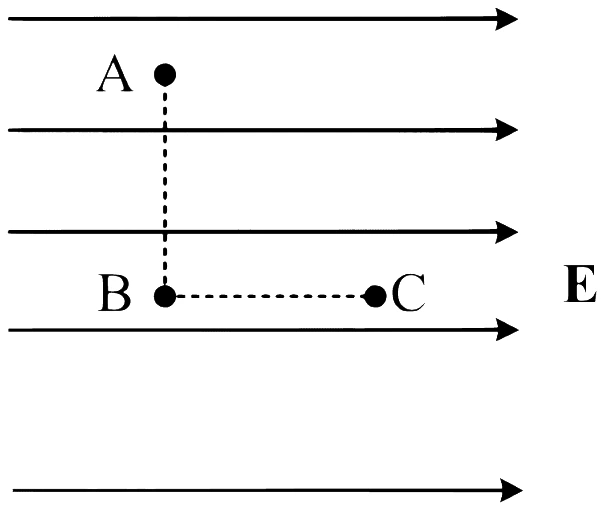
The figure shows three points A, B and C in a uniform electric field (E). The line AB is perpendicular to BC and BC is parallel to E. If VA, VB and VC are the potentials at A, B and C respectively, then the correct option is
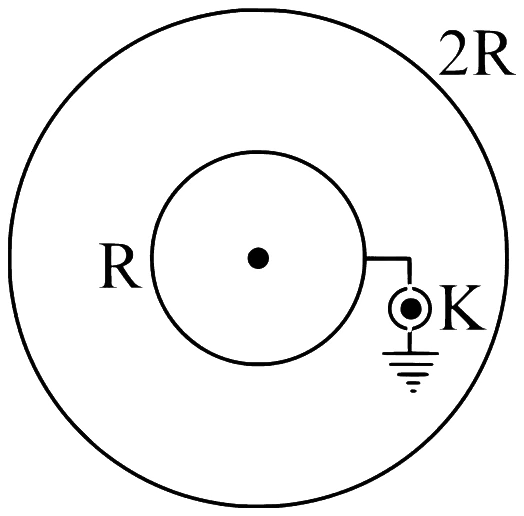
Two thin conducting concentric shells of radii R and 2R are shown in the figure. The outer shell carries a charge +Q and the inner shell is neutral. Then the correct statement/s is (a) When the switch is closed, the potential on the inner shell becomes zero (b) With the switch closed, the charge on the inner sphere is −2Q
Assertion (A): In a region of constant potential, the electric field is zero and there can be no charge inside the region. Reason (R): According to Gauss law, charge inside the region should be zero if electric field is zero.
The electric field in a region of space is given as E=(5N C−1)xi^. Consider point A on the Y-axis at y=5m and point B on the X-axis at x=2m. If the potentials at points A and B are VA and VB respectively, then (VB−VA) is
The spheres A, B and C have radii R, R and 2R respectively. Initially A has a charge −Q, B is neutral and C is positively charged with a surface charge density equal to that of A. If the three spheres are placed in contact with each other and later separated, then the charges on the three spheres A, B and C respectively are
Two metallic spherical shells A and B of radii 3cm and 4cm are given electric charges 20μC and 40μC respectively. If the shells are arranged concentrically, then the ratio of the surface charge densities on the outer surfaces of the shells A and B is
If the electric potential at a point on the surface of a hollow conducting sphere of radius R is V, then the electric potential at a point which is at distance R/3 from the centre of the sphere is
Two metal spheres have their radii in the ratio of 4:7. They are put in contact and a charge 8.8×10⁻⁷C is given to the system. Then they are separated, so that each can exert no influence on the other. The potential due to the smaller sphere at 60m from it in V is
A sphere-1 with radius R has charge q. Sphere-2 with radius 3R is far from sphere-1 and is initially uncharged. If the two spheres are now connected with a thin conducting wire, then the ratio σ2σ1 of the surface charge densities is
There are two thin wire rings, each of radius R, whose axes coincide. The charges of the rings are q and −q. The magnitude of potential difference between the centres of the rings separated by a distance 3R is
An electron is released from a distance of 4m from a stationary point charge 20nC. What will be the speed of the electron, when it is 2m away from the point charge? (Charge of electron =1.6×10⁻¹⁹C, mass of electron =9×10⁻³¹kg, 4πε01=9×10⁹ SI unit)
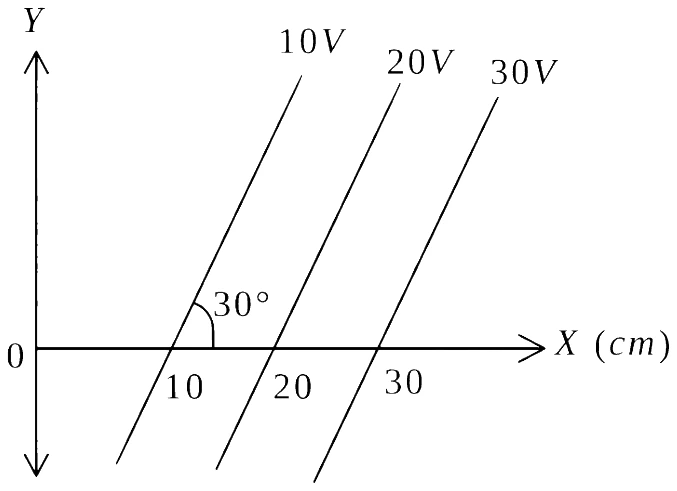
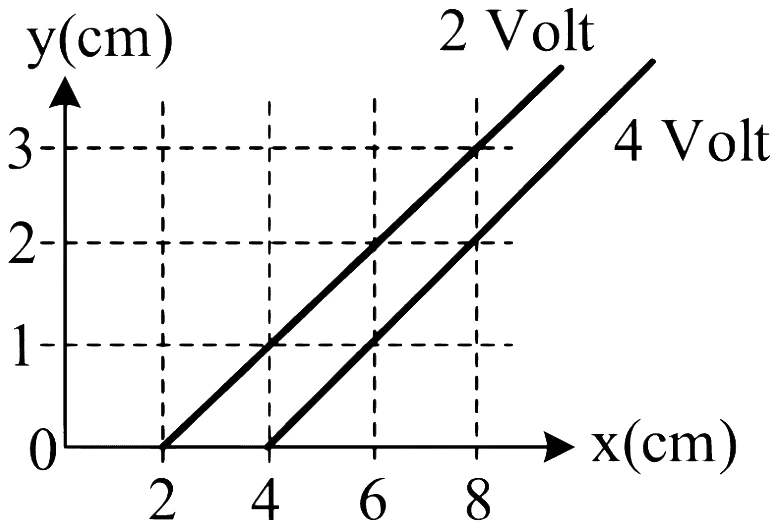
The figure represents two equipotential lines in x-y plane for an electric field. The x-component Ex of the electric field in space between these equipotential lines is,
Consider two concentric conducting spheres of radii R and 2R respectively. The inner sphere is given a charge +Q. The other sphere is grounded. The potential at r=23R is
A metal sphere of radius R carrying charge q is surrounded by a thick concentric metal shell of inner and outer radii a and b, respectively. The net charge on the shell is zero. The potential at the centre of the sphere, when the outer surface of the shell is grounded will be
A point charge −q is carried from a point A to another point B on the axis of a charged ring of radius r carrying a charge +q. If the point A is at a distance 34r from the centre of the ring and the point B is 43r from the centre but on the opposite side, what is the net work that need to be done for this?
Two positive charges Q and 4Q are placed at points A and B respectively, where B is at a distance d units to the right of A. The total electric potential due to these charges is minimum at P on the line through A and B. What is (are) the distance(s) of P from A?
More than one option can be correct. Tap every correct option, then tap Check.
4 point charges each +q are placed on the circumference of a circle of diameter 2d in such a way that they form a square. The potential at the centre is
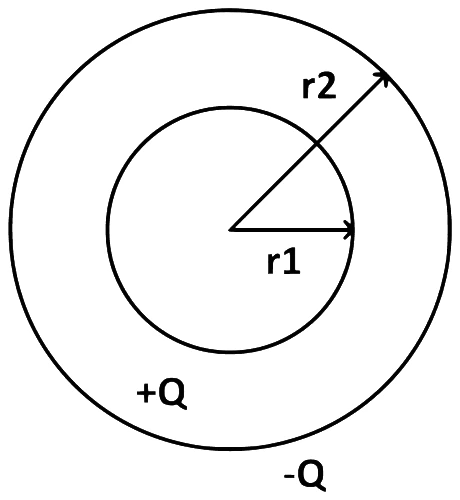
Two uniformly charged concentric thin spherical shells of radii r1 and r2 have charges +Q and −Q, respectively. How does the electrostatic potential vary with distance from the centre of the shells?
The electrostatic potential in the region between two long coaxial cylinders of radii a and b is given by ϕ=αln(r/a)+β, where α and β are constants. Here, α>0 and r denotes radial distance from the axis, a<r<b.
More than one option can be correct. Tap every correct option, then tap Check.
Two point charges q and −2q are located at (a,0,0) and (0,0,0) respectively. Assume that the potential V is vanishing at infinity. The correct statement about the V=0 surface (at finite distance) is:
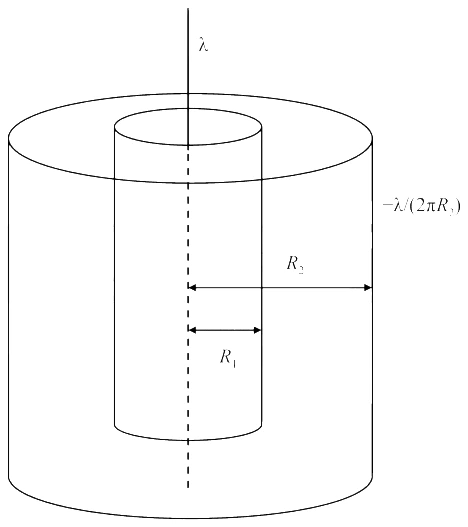
A long wire with a uniform linear charge density λ is placed along the common axis of two long coaxial thin cylindrical shells of radii R1 and R2 (see figure). The outer shell carries a uniform surface charge density −λ/2πR2. Take the zero of the potential at infinity along the radial direction. The potential at a distance r from the axis where R1<r<R2 is
A charge +q is distributed over a thin ring of radius r with line charge density λ=qsin2θ/(πr). Note that the ring is in the x-y plane and θ is the angle made by r with the x-axis. The work done by the electric force in displacing a point charge +Q from the center of the ring to infinity is
A spherical mercury droplet of radius r=0.001m has a charge q=200μC. Twenty seven such droplets are combined to make one large spherical drop. The ratio of the surface potential of the larger drop to that of each droplet is
Four charges −q, −q, +q and +q are placed at the corners of a square of side 2L as shown in figure. The electric potential at point A midway between the two charges +q and +q is

 Electrostatics Part 3 · Electric potential and Electric field1:14:55All 14 Electrostatics videos →