
Law of Radioactive Decay
A radioactive sample has half-life of years. The percentage of fraction decayed in years will be
Show answer and solution
Answer: (c)
Loading the solution…
Home›Practice Hub›Chapters›Nuclear Physics›Law of Radioactive Decay
Nuclear Physics PYQs · MHT CET · JEE Main · NEET
Law of Radioactive Decay
A radioactive sample has half-life of years. The percentage of fraction decayed in years will be
Answer: (c)
Law of Radioactive Decay
Activity of a radioactive sample decreases to of its original value in days. Then in days its activity will become
Answer: (a)
Law of Radioactive Decay
Activity of a radioactive sample decreases to of its original value in 4 days. Then in 16 days its activity will become times the original value. The value of is
Answer: (c)
Law of Radioactive Decay
A radioactive element has rate of disintegration disintegrations per minute at a particular instant. After four minutes, it becomes disintegrations per minute. The decay constant per minute is
Answer: (c)
Law of Radioactive Decay
Two different radioactive elements with half lives and have undecayed atoms and respectively, present at a given instant. The ratio of their activities at this instant is
Answer: (b)
Law of Radioactive Decay
Initially atoms are present in a radioactive sample. The half-life of the sample is 1 hour. The number of atoms that will decay in the time interval hour to hour, is
Answer: (c)
Law of Radioactive Decay
th The half-life of the isotope is 15 hr. How much time does it take for of a sample of this isotope to decay?
Answer: (a)
Law of Radioactive Decay
The activity of a radioactive sample is measured as counts per minute at time and counts per minute at time minute. The time (in minute) in which the activity reduces to half the value, is
Answer: (b)
Law of Radioactive Decay
A radioactive sample having activity has twice the number of nuclei as another sample of of activity . If then the ratio of half life of to the half life of is
Answer: (a)
Law of Radioactive Decay
Two radioactive substances and have decay constant and respectively. At , they have the same number of nuclei. The ratio of number of nuclei of to those of will be after a time interval
Answer: (d)
Law of Radioactive Decay
Two samples A and B contain equal amount of radioactive substances. If of sample A and of sample B, remain after 9 hours, then the ratio of half life period of B to that of A is
Answer: (c)
Law of Radioactive Decay
In an alpha decay, the daughter nucleus produced is itself unstable and undergoes further decay. If the number of parent and daughter nuclei at time are and respectively and their decay constants are and respectively. What condition needs to be satisfied in order for to remain constant?
Answer: (d)
Law of Radioactive Decay
A radioactive nucleus X with a half-life , decays into a nucleus Y. At , there is no nucleus Y. After some time '', the ratio of the number of Y to that of X is . Then, '' is
Answer: (b)
Law of Radioactive Decay
A radioactive element having half-life 30 min. is undergoing beta decay. The fraction of radioactive element remains undecayed after 90 min. will be
Answer: (c)
Law of Radioactive Decay
A radio active element has rate of disintegration 8000 disintegrations per minute at a particular instant. After four minutes it becomes 2000 disintegrations per minute. The decay constant per minute is
Answer: (c)
Law of Radioactive Decay
A radioactive element has rate of disintegration 9000 disintegration per minute at a particular instant. After two minutes it becomes 3000 disintegration per minute. The decay constant per minute is
Answer: (a)
Law of Radioactive Decay
The activity of radioactive sample is measured as counts per minute at time , and counts per minute at time minute, The activity reduces to half its value in time (in minute)
Answer: (b)
Law of Radioactive Decay
Two radioactive materials and having decay constant ' ' and ' ' respectively, initially have same number of nuclei. The time taken to have the ratio of number of nuclei of material B to that of A as ' e ' is
Answer: (b)
Law of Radioactive Decay
A radioactive nucleus has 3 times the decay constant as compared to the decay constant of another radioactive nucleus . If initial number of both nuclei are the same, what is the ratio of number of nuclei of to the number of nuclei of , after one half-life of ?
Answer: (a)
Law of Radioactive Decay
A radioactive material first decays into and then decays to non-radioactive material . Which of the following figure represents time dependent mass of and ?
Answer: (b)
Law of Radioactive Decay
A radioactive substance has half-life of 60 minutes. During 3 hours, the amount of substance decayed would be
Answer: (d)
Law of Radioactive Decay
Two radioactive substances A and B have decay constants ' ' and ' ' respectively. At , they have the same number of nuclei. The ratio of number of nuclei of to those of will be after a time interval
Answer: (d)
Law of Radioactive Decay
Half-lives of two radioactive elements A and B are 30 minute and 60 minute respectively. Initially the samples have equal number of nuclei. After 120 minute the ratio of decayed numbers of nuclei of to that of will be
Answer: (c)
Law of Radioactive Decay
If 'T' is the half life of a radioactive substance then its instantaneous rate of change of activity is proportional to
Answer: (b)
Law of Radioactive Decay
Half life of radio-active element is 1600 years. The fraction of sample remains undecayed after 6400 years will be
Answer: (a)
Law of Radioactive Decay
A radioactive sample has half-life of 5 years. The percentage of fraction decayed in 10 years will be
Answer: (c)
Law of Radioactive Decay
The half life of a radioactive substance is 20 minutes. In how much time, the activity of substance drops to th of its initial value?
Answer: (c)
Law of Radioactive Decay
The half-life of a radioactive nucleus is 5 years. The fraction of the original sample that would decay in 15 years is:
Answer: (c)
Law of Radioactive Decay
The half life of a radioactive substance is T. The time taken, for disintegrating th part of its original mass will be:
Answer: (b)
Law of Radioactive Decay
A radio active material is reduced to of its original amount in 3 days. If of the material is left after 5 days the initial amount of the material is
Answer: (b)
Law of Radioactive Decay
If a radioactive element having half-life of is undergoing beta decay, the fraction of radioactive element remains undecayed after . will be
Answer: (c)
Law of Radioactive Decay
In a radioactive disintegration, the ratio of initial number of atoms to the number of atoms present at time is [ decay constant]
Answer: (b)
Law of Radioactive Decay
Two different radioactive elements with half lives ' ' and '' have undecayed atoms ' ' and ' ' respectively present at a given instant. The ratio of their activities at that instant is
Answer: (c)
Law of Radioactive Decay
The decay constant for a radioactive nuclide is 1.5 10 s. Atomic weight of the substance is 60 g mole, (). The activity of 1.0 g of the substance is ___________ 10 Bq.
Numerical answer type. Work it out, then open the answer.
Answer: 15
Law of Radioactive Decay
Two radioactive elements A and B initially have same number of atoms. The half life of A is same as the average life of B. If and are decay constants of A and B respectively, then choose the correct relation from the given options.
Answer: (a)
Law of Radioactive Decay
A radioactive nucleus decays by two different processes. The half life of the first process is 5 minutes and that of the second process is . The effective half-life of the nucleus is calculated to be . The value of is __________.
Numerical answer type. Work it out, then open the answer.
Answer: 300
Law of Radioactive Decay
Substance A has atomic mass number 16 and half life of 1 day. Another substance B has atomic mass number 32 and half life of day. If both A and B simultaneously start undergo radio activity at the same time with initial mass 320 g each, how many total atoms of A and B combined would be left after 2 days.
Answer: (b)
Law of Radioactive Decay
Given below are two statements
Statement I: The law of radioactive decay states that the number of nuclei undergoing the decay per unit time is inversely proportional to the total number of nuclei in the sample. Statement II: The half-life of a radionuclide is the sum of the life time of all nuclei, divided by the initial concentration of the nuclei at time t = 0.
In the light of the above statements, choose the most appropriate answer from the options given below:
Answer: (c)
Law of Radioactive Decay
A radioactive sample decays times its original quantity in 15 minutes. The half-life of the sample is
Answer: (a)
Law of Radioactive Decay
The half life period of a radioactive substance is 60 days. The time taken for th of its original mass to disintegrate will be:
Answer: (c)
Law of Radioactive Decay
Following statements related to radioactivity are given below:
(A) Radioactivity is a random and spontaneous process and is dependent on physical and chemical conditions.
(B) The number of un-decayed nuclei in the radioactive sample decays exponentially with time. (C) Slope of the graph of loge (no. of undecayed nuclei) Vs. time represents the reciprocal of mean life time ().
(D) Product of decay constant () and half-life time (T1/2) is not constant.
Choose the most appropriate answer from the options given below:
Answer: (c)
Law of Radioactive Decay
The half life of a radioactive substance is 5 years. After x years a given sample of the radioactive substance gets reduced to 6.25% of its initial value. The value of x is ____________.
Numerical answer type. Work it out, then open the answer.
Answer: 20
Law of Radioactive Decay
The activity of a radioactive material is curie. Its half life is 5 days. The activity will become curie after:
Answer: (d)
Law of Radioactive Decay
What is the half-life period of a radioactive material if its activity drops to th of its initial value in 30 years?
Answer: (c)
Law of Radioactive Decay
The activity of a radioactive material is 2.56 103 Ci. If the half life of the material is 5 days, after how many days the activity will become 2 105 Ci?
Answer: (b)
Law of Radioactive Decay
A radioactive nucleus can decay by two different processes. Half-life for the first process is 3.0 hours while it is 4.5 hours for the second process. The effective half-life of the nucleus will be:
Answer: (d)
Law of Radioactive Decay
A freshly prepared radioactive source of half life 2 hours 30 minutes emits radiation which is 64 times the permissible safe level. The minimum time, after which it would be possible to work safely with source, will be _________ hours.
Numerical answer type. Work it out, then open the answer.
Answer: 15
Law of Radioactive Decay
The disintegration rate of a certain radioactive sample at any instant is 4250 disintegrations per minute. 10 minutes later, the rate becomes 2250 disintegrations per minute. The approximate decay constant is:
Take
Answer: (c)
Law of Radioactive Decay
At any instant, two elements X1 and X2 have same number of radioactive atoms. If the decay constant of X1 and X2 are 10 and respectively, then the time when the ratio of their atoms becomes respectively will be:
Answer: (c)
Law of Radioactive Decay
Two radioactive materials A and B have decay constants and respectively. If initially they have the same number of nuclei, then the ratio of the number of nuclei of B to that of A will be "e" after a time . The value of a is _________.
Numerical answer type. Work it out, then open the answer.
Answer: 9
Law of Radioactive Decay
A sample contains 102 kg each of two substances A and B with half lives 4 s and 8 s respectively. The ratio of their atomic weights is 1: 2. The ratio of the amounts of A and B after 16 s is . The value of x is ___________.
Numerical answer type. Work it out, then open the answer.
Answer: 25
Law of Radioactive Decay
A sample of radioactive element contains active nuclei. The halt-life of the element is 15 days. The number of nuclei decayed after 60 days is
Answer: (a)
Law of Radioactive Decay
The nuclear activity of a radioactive element becomes of its initial value in 30 years. The half- life of radioactive element is _____________ years.
Numerical answer type. Work it out, then open the answer.
Answer: 10
Law of Radioactive Decay
A radioactive substance decays to of its initial activity in 80 days. The half life of the radioactive substance expressed in days is ____________.
Numerical answer type. Work it out, then open the answer.
Answer: 20
Law of Radioactive Decay
A radioactive sample disintegrates via two independent decay processes having half lives and respectively. The effective half-life T1/2 of the nuclei is:
Answer: (c)
Law of Radioactive Decay
The half life of a radioactive substance is 30 minute. The time taken between 40% decay and 85% decay of the same radioactive substance is
Answer: (c)
Law of Radioactive Decay
The half life of a radioactive nuclide is 100 hours. The fraction of original activity that will remain after 150 hours would be:
Answer: (c)
Law of Radioactive Decay
There are 1010 radioactive nuclei in a given radioactive element, its half-life time is 1 minute. How many nuclei will remain after 30 seconds?
Answer: (b)
Law of Radioactive Decay
If 'f' denotes the ratio of the number of nuclei decayed (Nd) to the number of nuclei at t = 0 (N0) then for a collection of radioactive nuclei, the rate of change of 'f' with respect to time is given as: [ is the radioactive decay constant]
Answer: (c)
Law of Radioactive Decay
Some nuclei of a radioactive material are undergoing radioactive decay. The time gap between the instances when a quarter of the nuclei have decayed and when half of the nuclei have decayed is given as:
(where is the decay constant)
Answer: (d)
Law of Radioactive Decay
Calculate the time interval between 33% decay and 67% decay if half-life of a substance is 20 minutes.
Answer: (d)
Law of Radioactive Decay
The half life period of radioactive element x is same as the mean life time of another radioactive element y. Initially they have the same number of atoms. Then:
Answer: (b)
Law of Radioactive Decay
A radioactive sample is undergoing decay. At any time t1, its activity is A and another time t2, the activity is . What is the average life time for the sample?
Answer: (d)
Law of Radioactive Decay
The half-life of is 3 days. If atomic weight of is 198 g/mol then the activity of 2 mg of is [in disintegration/second]:
Answer: (d)
Law of Radioactive Decay
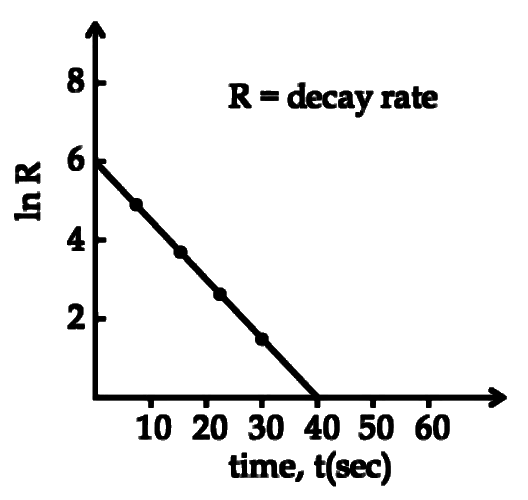
For a certain radioactive process the graph between In R and t(sec) is obtained as shown in the figure. Then the value of half life for the unknown radioactive material is approximately:
Answer: (d)
Law of Radioactive Decay
The half-life of Au198 is 2.7 days. The activity of 1.50 mg of Au198 if its atomic weight is 198 g mol is, (Na = 6 1023/mol).
Answer: (b)
Law of Radioactive Decay
Two radioactive materials and have decay constants '' and '' respectively. Initially, they have the same number of nuclei. After time '', the ratio of number of nuclei of to that of is . Then is equal to
Answer: (d)
Law of Radioactive Decay
Two radioactive substances X and Y originally have N1 and N2 nuclei respectively. Half life of X is half of the half life of Y. After three half lives of Y, number of nuclei of both are equal. The ratio will be equal to:
Answer: (d)
Law of Radioactive Decay
A sample of a radioactive nucleus A disintegrates to another radioactive nucleus B, which in turn disintegrates to some other stable nucleus C. Plot of a graph showing the variation of number of atoms of nucleus B versus time is:
(Assume that at t = 0, there are no B atoms in the sample)
Answer: (d)
Law of Radioactive Decay
A radioactive sample has an average life of 30 ms and is decaying. A capacitor of capacitance 200 F is first charged and later connected with resistor 'R'. If the ratio of charge on capacitor to the activity of radioactive sample is fixed with respect to time then the value of 'R' should be _____________ .
Numerical answer type. Work it out, then open the answer.
Answer: 150
Law of Radioactive Decay
At time t = 0, a material is composed of two radioactive atoms A and B, where NA(0) = 2NB(0). The decay constant of both kind of radioactive atoms is . However, A disintegrates to B and B disintegrates to C. Which of the following figures represents the evolution of NB(t) / NB(0) with respect to time t?
[NA (0) = No. of A atoms at t = 0
NB (0) = No. of B atoms at t = 0]
Answer: (c)
Law of Radioactive Decay
A radioactive material decays by simultaneous emissions of two particles with half lives of 1400 years and 700 years respectively. What will be the time after which one third of the material remains? (Take ln 3 = 1.1)
Answer: (a)
Law of Radioactive Decay
A radioactive nucleus decays by two different processes. The half life for the first process is 10 s and that for the second is 100 s. The effective half life of the nucleus is close to:
Answer: (b)
Law of Radioactive Decay
In a radioactive material, fraction of active material remaining after time t is 9/16. The fraction that was remaining after t/2 is
Answer: (a)
Law of Radioactive Decay
The half life of a radioactive sample undergoing -decay is . If the number of nuclei in the sample is , the activity of the sample is nearly
Answer: (b)
Law of Radioactive Decay
The activity of a radioactive sample falls from 700 s–1 to 500 s–1 in 30 minutes. Its half life is close to:
Answer: (a)
Law of Radioactive Decay
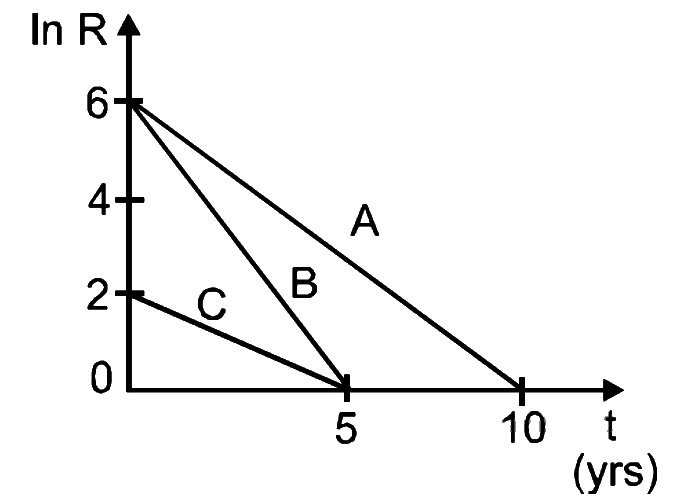
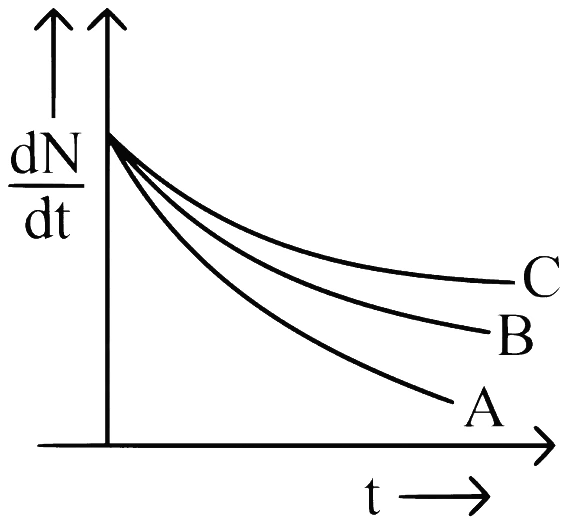
Activities of three radioactive substances A, B and C are represented by the curves A, B and C, in the figure. Then their half-lives
: : are in the ratio:
Answer: (d)
Law of Radioactive Decay
The rate of radioactive disintegration at an instant for a radioactive sample of half life is . The number of radioactive atoms in that sample at that instant is,
Answer: (a)
Law of Radioactive Decay
Using a nuclear counter the count rate of emitted particles from a radioactive source is measured. At t = 0 it was 1600 counts per second and t = 8 seconds it was 100 counts per second. The count rate observed, as counts per second, at t = 6 seconds is close to -
Answer: (a)
Law of Radioactive Decay
Half lives of two radioactive nuclei A and B are 10 minutes and 20 minutes, respectively, If initially a sample has equal number of nuclei, then after 60 minutes, the ratio of decayed numbers of nuclei A and B will be:
Answer: (a)
Law of Radioactive Decay
Two radioactive substances A and B have decay constants 5 and respectively. At t = 0, a sample has the same number of the two nuclei. The time taken for the ratio of the number of nuclei to become will be:
Answer: (c)
Law of Radioactive Decay
Two radioactive materials A and B have decay constants 10 and , respectively. It initially they have the same number of nuclei, then the ratio of the number of nuclei of A to that of B will be 1/e after a time:
Answer: (a)
Law of Radioactive Decay
A sample of radioactive material A, that has an activity of 10 mCi(1 Ci = 3.7 1010 decays/s), has twice the number of nuclei as another sample of a different radioactive materail B which has an activity of 20 mCi. The correct choices for half-lives of A and B would then be respectively:
Answer: (c)
Law of Radioactive Decay
At a given instant, say t = 0, two radioactive substance A and B have equal activities. the ratio of their activities after time t itself decays with time t as et. If the half-life of A is ln2, the half-life of B is:
Answer: (c)
Law of Radioactive Decay
For a radioactive material, half-life is 10 minutes. If initially there are 600 number of nuclei, the time taken (in minutes) for the disintegration of 450 nuclei is
Answer: (a)
Law of Radioactive Decay
At some instant, a radioactive sample S1 having an activity 5 Ci has twice the number of nuclei as another sample S2 which has an activity of 10 Ci. The half lives of S1 and S2 are:
Answer: (a)
Law of Radioactive Decay
A containing active cobalt having activity of and decay constant is injected in an animal's body. If of blood is drawn from the animal's body after hrs of injection, the activity found was decays per minute What is the volume of blood that is flowing in the body? decays per second and at hrs
Answer: (d)
Law of Radioactive Decay
Radioactive material 'A' has decay constant '8 ' and material 'B' has decay constant ''. Initially they have same number of nuclei. After what time, the ratio of number of nuclei of material 'B' to that 'A' will be e?
Answer: (a)
Law of Radioactive Decay
A radioactive nucleus A with a half life T, decays into a nucleus B. At t = 0, there is no nucleus B. At sometime t, the ratio of the number of B to that of A is 0.3. Then, t is given by:
Answer: (d)
Law of Radioactive Decay
The half-life of a radioactive substance is 30 minutes. The time (in minutes) taken between 40% decay and 85% decay of the same radioactive substance is
Answer: (d)
Law of Radioactive Decay
Half-lives of two radioactive elements and are minutes and minutes, respectively. Initially, the samples have equal number of nuclei. After minutes, the ratio of decayed number of and nuclei will be:
Answer: (b)
Law of Radioactive Decay
Let N be the number of particles emitted by 1 gram of Na24 radioactive nuclei (half life = 15 hrs) in 7.5 hours, N is close to (Avogadro number = 6.023 1023 / g. mole):
Answer: (b)
Law of Radioactive Decay
A radioactive X with a half life 1.4 109 years decays to Y which is stable. A sample of the rock from a cave was found to contain X and Y in the ratio 1: 7. The age of the rock is
Answer: (c)
Law of Radioactive Decay
A piece of wood from a recently cut tree shows 20 decays per minute. A wooden piece of same size placed in a museum (obtained from a tree cut many years back) shows 2 decays per minute. If half life of C14 is 5730 years, then age of the wooden piece placed in the museum is approximately:
Answer: (c)
Law of Radioactive Decay
A piece of bone of an animal from a ruin is found to have 14C activity of 12 disintegrations per minute per gm of its carbon content. The 14C activity of a living animal is 16 disintegrations per minute per gm. How long ago nearly did the animal die? (Given half life of 14C is t1/2 = 5760 years)
Answer: (b)
Law of Radioactive Decay
A radioactive nuclei with decay constant 0.5/s is being produced at a constant rate of 100 nuclei/s. If at t = 0 there were no nuclei, the time when there are 50 nuclei is:
Answer: (b)
Law of Radioactive Decay
The half life of a radioactive isotope 'X' is 20 years. It decays to another element 'Y' which is stable. The two elements 'X' and 'Y' were found to be in the ratio 1: 7 in a sample of a given rock. The age of the rock is estimated to be
Answer: (d)
Law of Radioactive Decay
The half-life of a radioactive element A is the same as the mean-life of another radioactive element B. Initially both substances have the same number of atoms, then:
Answer: (d)
Law of Radioactive Decay
The half life of a radioactive nucleus is 50 days. The time invertal (t2 t1) between the time t2 when of it has decayed and the time t1 when of it had decayed is
Answer: (b)
Law of Radioactive Decay
A mixture consists of two radioactive materials A1 and A2 with half lives of 20 s and 10 s respectively. Initially the mixture has 40 g of A1 and 160 g of A2. The amount of the two in the mixture will become equal after
Answer: (d)
Law of Radioactive Decay
The half life of a radioactive isotope X is 50 years. It decays to another element Y which is stable. The two elements X and Y were found to be in the ratio of 1: 15 in a sample of a given rock. The age of the rock was estimated to be
Answer: (b)
Law of Radioactive Decay
The half life of a radioactive substance is minutes. The approximate time interval between the time when of it had decayed and time when of it had decayed is:
Answer: (b)
Law of Radioactive Decay
Two radioactive nuclei P and Q, in a given sample decay into a stable nucleus R. At time t = 0. number of P species are 4 N0 and that of Q are N0. Half -life of P (for conversion to R) is 1 minute where as that of Q is 2 minutes. Initially there are no nuclei of R present in the sample. When number of nuclei of P and Q are equal, the number of nuclei of R present in the sample would be
Answer: (c)
Law of Radioactive Decay
The decay constant of a radio isotope is . If A1 and A2 are its activities at times t1 and t2 respectively, the number of nuclei which have decayed during the time (t1 t2)
Answer: (c)
Law of Radioactive Decay
The activity of a radioactive sample is measured as N0 counts per minute at t = 0 and N0/e counts per minute at t = 5 minutes. The time (in minutes) at which the activity reduces to half its value is
Answer: (d)
Law of Radioactive Decay
Two radioactive materials X1 and X2 have decay constants and respectively. If initially they have the same number of nuclei, then the ratio of the number of nuclei of X1 to that X2 will be 1/e after a time
Answer: (a)
Law of Radioactive Decay
Two radioactive substances A and B have decay constants 5 and respectively. At t = 0 they have the same number of nuclei. The ratio of number of nuclei of A to those of B will be (1/e)2 after a time interval
Answer: (c)
Law of Radioactive Decay
The half-life period of a radioactive element is same as the mean life time of another radioactive element Initially they have the same number of atoms. Then
Answer: (c)
Law of Radioactive Decay
In a radioactive material the activity at time t1 is R1 and at a later time t2, it is R2. If the decay constant of the material is , then
Answer: (b)
Law of Radioactive Decay
The is the correct unit used to report the measurement of
Answer: (c)
Law of Radioactive Decay
Starting with a sample of pure of it decays into in minutes. The corresponding half life is
Answer: (d)
Law of Radioactive Decay
The half life of radian is about 1600 years. Of 100 g of radium existing now, 25 g will remain unchanged after
Answer: (d)
Law of Radioactive Decay
A sample of radioactive element has a mass of 10 g at an instant t = 0. The approximate mass of this element in the sample after two mean lives is
Answer: (a)
Law of Radioactive Decay
A radioactive sample at any instant has its disintegration rate disintegrations per minute. After minutes, the rate is disintegrations per minute. Then, the decay constant (per minute) is
Answer: (a)
Law of Radioactive Decay
A sample of radioactive element containing 4 1016 active nuclei. Half life of element is 10 days, then number of decayed nuclei after 30 days
Answer: (c)
Law of Radioactive Decay
If is the original mass of the substance of half-life period years, then the amount of substance left after years is
Answer: (a)
Law of Radioactive Decay
Half life of a radioactive element is 12.5 hour and its quantity is 256 g. After how much time its quantity will remain 1 g?
Answer: (b)
Law of Radioactive Decay
Half-life period of a radioactive substance is . After activity is , what was the initial activity?
Answer: (d)
Law of Radioactive Decay
The half-life of a radioactive material is . If the initial amount is , then after , it will remain
Answer: (a)
Law of Radioactive Decay
The relation between and T1/2 as (T1/2 half life)
Answer: (a)
Law of Radioactive Decay
Half-lives of two radioactive substances and are respectively and . Initially the samples of and have equal number of nuclei. After the ratio of remaining number of and nuclei is
Answer: (c)
Law of Radioactive Decay
The count rate of a Geiger Muller counter for the radiation of a radioactive material of half-life of 30 minutes decreases to 5 after 2 hours. The initial count rate was
Answer: (a)
Law of Radioactive Decay
The half life of radium is 1600 years. The fraction of a sample of radium that would remain after 6400 years
Answer: (d)
Law of Radioactive Decay
A radioactive element has half life period 800 years. After 6400 years what amount will remain?
Answer: (d)
Law of Radioactive Decay
Curie is a unit of
Answer: (c)
Law of Radioactive Decay
A radioactive sample with a half life of 1 month has the label: 'Activity = 2 micro curies on 1 - 8 - 1991'. What would be its activity two months earlier?
Answer: (d)
Law of Radioactive Decay
A nuclear reactor starts producing a radioactive nuclide from , at a constant rate of per second. Each decay of produces energy , which is utilized to heat a liquid of mass and specific heat . Assuming no heat loss from the liquid and taking as the decay constant of , the rate of increase in the temperature of the liquid is :
Answer: (a)
Step-by-step solution coming soon.
Law of Radioactive Decay
In a radioactive decay process, the activity is defined as , where is the number of radioactive nuclei at time . Two radioactive sources, and have same activity at time . At a later time, the activities of and are and , respectively. When and have just completed their and half-lives, respectively, the ratio is ________.
Numerical answer type. Work it out, then open the answer.
Answer: 16
Step-by-step solution coming soon.
Law of Radioactive Decay
A heavy nucleus Q of half-life minutes undergoes alpha-decay with probability of and beta-decay with probability of . Initially, the number of Q nuclei is . The number of alpha-decays of Q in the first one hour is
Answer: (d)
Step-by-step solution coming soon.
Law of Radioactive Decay
In a radioactive sample, nuclei either decay into stable nuclei with decay constant per year or into stable nuclei with decay constant per year. Given that in this sample all the stable and nuclei are produced by the nuclei only. In time years, if the ratio of the sum of stable and nuclei to the radioactive nuclei is , the value of will be
[Given: ]
Answer: (a)
Step-by-step solution coming soon.
Law of Radioactive Decay
is an isotope of Iodine that decays to an isotope of Xenon with a half-life of days. A small amount of serum labelled with is injected into the blood of a person. The activity of the amount of injected was Becquerel (). It is known that the injected serum will get distributed uniformly in the blood stream in less than half an hour. After hours, of blood is drawn from person's body, and gives an activity of . The total volume of blood in the person's body, in liters is approximately (you may use for and ).
Numerical answer type. Work it out, then open the answer.
Answer: 5
Step-by-step solution coming soon.
Law of Radioactive Decay
An accident in a nuclear laboratory resulted in deposition of a certain amount of radioactive material of half-life days inside the laboratory. Tests revealed that the radiation was times more than the permissible level required for safe operation of the laboratory. What is the minimum number of days after which the laboratory can be considered safe for use?
Answer: (c)
Step-by-step solution coming soon.
Law of Radioactive Decay
A nuclear power plant supplying electrical power to a village uses a radioactive material of half life years as the fuel.
The amount of fuel at the beginning is such that the total power requirement of the village is of the electrical power available from the plant at that time. If the plant is able to meet the total power needs of the village for a maximum period of years, then the value of is
Numerical answer type. Work it out, then open the answer.
Answer: 3
Step-by-step solution coming soon.
Law of Radioactive Decay
For a radioactive material, its activity and rate of change of its activity are defined as and , where is the number of nuclei at time . Two radioactive source (mean life ) and (mean life ) have the same activity at . Their rate of change of activities at are and , respectively. If , then the value of is
Numerical answer type. Work it out, then open the answer.
Answer: 2
Step-by-step solution coming soon.
Law of Radioactive Decay
A freshly prepared sample of a radioisotope of half-life has activity disintegrations per second. Given that , the fraction of the initial number of nuclei (expressed in nearest integer percentage) that will decay in the first after preparation of the sample is ________.
Numerical answer type. Work it out, then open the answer.
Answer: 4
Step-by-step solution coming soon.
Law of Radioactive Decay
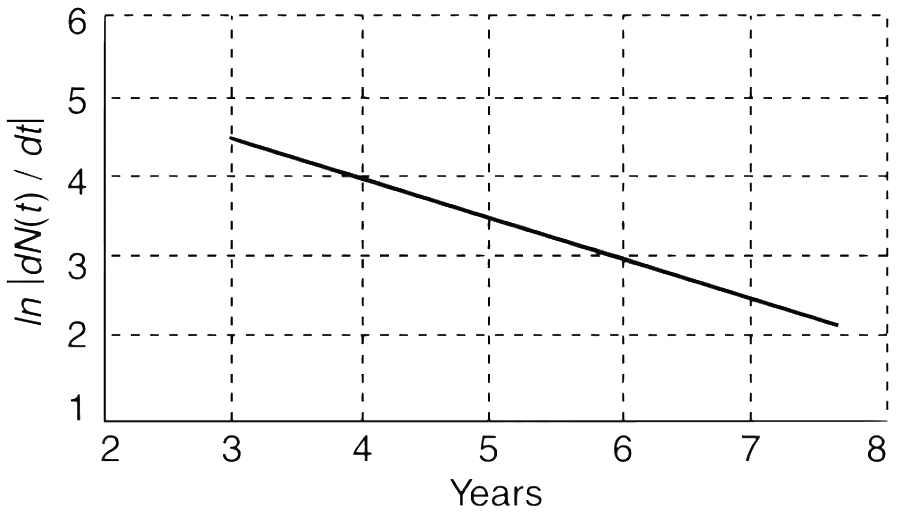
To determine the half-life of a radioactive element, a student plots a graph of versus . Here, is the rate of radioactive decay at time . If the number of radioactive nuclei of this element decreases by a factor of after years, the value of is ________.
Numerical answer type. Work it out, then open the answer.
Answer: 8
Step-by-step solution coming soon.
Law of Radioactive Decay
A radioactive sample having activity of has twice the number of nuclei as another sample which has an activity of . The half lives of and can be :
Answer: (a)
Step-by-step solution coming soon.
Law of Radioactive Decay
If the half life of an element is , then what percent of it will decay in the 10th to 11th ? Initial activity
Answer: (a)
Step-by-step solution coming soon.
Law of Radioactive Decay
The half-life of a radioactive substance is . The approximate time interval between the time , when of it has decayed and time when of it had decayed is
Answer: (b)
Step-by-step solution coming soon.
Law of Radioactive Decay
A freshly prepared radioactive source of half-life emits radiation of intensity which is times the permissible safe level. Calculate the minimum time after which it would be possible to work safely with this source.
Answer: (a)
Step-by-step solution coming soon.
Law of Radioactive Decay
curie is
Answer: (d)
Step-by-step solution coming soon.
Law of Radioactive Decay
The half-life of a radioactive substance is days. This means that
Answer: (d)
Step-by-step solution coming soon.
Law of Radioactive Decay
The half-life of radioactive element is . The fraction of sample that would remain after is
Answer: (d)
Step-by-step solution coming soon.
Law of Radioactive Decay
Starting with a sample of pure , of it decays into Zn in . The corresponding half-life is
Answer: (c)
Step-by-step solution coming soon.
Law of Radioactive Decay
A radioactive material decays by simultaneous emission of two particles with respective half lives and . The time (in years) after which one-fourth of the material remains is
Answer: (a)
Step-by-step solution coming soon.
Law of Radioactive Decay
Two radioactive substances and have decay constants and respectively. At they have the same number of nuclei. The ratio of number of nuclei of to those of will be after a time interval
Answer: (d)
Step-by-step solution coming soon.
Law of Radioactive Decay
Mass spectrometric analysis of potassium and argon atoms in a Moon rock sample shows that the ratio of the number of (stable) atoms present to the number of (radioactive) atoms is . Assume that all the argon atoms were produced by the decay of potassium atoms, with a half-life of . How old is the rock?
Answer: (c)
Step-by-step solution coming soon.
Law of Radioactive Decay
The fossil bone has a ratio, which is of that in a living animal bone. If the half-life of is years, then the age of the fossil bone is :
Answer: (c)
Step-by-step solution coming soon.
Law of Radioactive Decay
A radioactive material has half-life of 10 days. What fraction of the material would remain after 30 days ?
Answer: (c)
Step-by-step solution coming soon.
Law of Radioactive Decay
Carbon dating is best suited for determining the age of fossils if their age in years is of the order of :
Answer: (b)
Step-by-step solution coming soon.
Law of Radioactive Decay
Ba-122 has half life of . Experiment has to be done using Ba-122 and it takes to set up the experiment. If initially of Ba-122 was taken, how much Ba was left when experiment was started?
Answer: (a)
Step-by-step solution coming soon.
Law of Radioactive Decay
The half-life period of a radioactive element is same as the mean life of another radioactive element . Initially, both of them have the same numbers of atoms then,
Answer: (c)
Step-by-step solution coming soon.
Law of Radioactive Decay
Radioactive decay will occur as follows:
, half life
, half life
, half life
If a certain mass of radon (Rn ) is allowed to decay in a certain container; then after 5 minutes the element with the greater mass will be
Answer: (c)
Step-by-step solution coming soon.
Law of Radioactive Decay
A block having of element is placed in a room. This element is a radioactive element with half-life of . After how many years will there be just of the element in the box?
Answer: (b)
Step-by-step solution coming soon.
Law of Radioactive Decay
A target is bombarded with a proton beam current of for one hour to produce of activity disintegrations per second. Assuming that one radioactive nucleus is produced by bombarding protons, its half-life is
Answer: (a)
Step-by-step solution coming soon.
Law of Radioactive Decay
The half-life of is days. The average life is
Answer: (c)
Step-by-step solution coming soon.
Law of Radioactive Decay
Remaining quantity (in %) of radioactive element after 5 half lives is
Answer: (b)
Step-by-step solution coming soon.
Law of Radioactive Decay
The half-life of radio isotope is . If initial mass of the isotope was , then mass remaining after will be
Answer: (c)
Step-by-step solution coming soon.
Law of Radioactive Decay
Activity of a radioactive sample decreases to of its original value in days. Then, in days its activity will become
Answer: (a)
Step-by-step solution coming soon.
Law of Radioactive Decay
The half-life of a radio-isotope is . If initial mass of the isotope was , then mass remaining after will be
Answer: (c)
Step-by-step solution coming soon.
Law of Radioactive Decay
Two radioactive substances and have decay constants and respectively. At they have the same number of nuclei. The ratio of number of nuclei of to those of will be after a time interval
Answer: (d)
Step-by-step solution coming soon.
Law of Radioactive Decay
Half-lives of two radioactive substances and are respectively and . Initially the samples of and have equal number of nuclei. After the ratio of remaining number of and nuclei is
Answer: (c)
Step-by-step solution coming soon.
Law of Radioactive Decay
The half life of a radioactive substance is days. How much of of this radioactive substance will remain after days?
Answer: (d)
Step-by-step solution coming soon.
Law of Radioactive Decay
After two hours one-eighth of the starting amount of a certain radioactive isotope remained undecayed. The half-life of the isotope is
Answer: (b)
Step-by-step solution coming soon.
Law of Radioactive Decay
In a radioactive material the activity at time is and at a later time it is . If the decay constant of the material is , then
Answer: (a)
Step-by-step solution coming soon.
Law of Radioactive Decay
A radioactive sample at any instant has its disintegration rate disintegrations per min. After min, the rate is disintegrations per min. Then, the disintegration constant (per min) is
Answer: (a)
Step-by-step solution coming soon.
Law of Radioactive Decay
The activity of a radioactive sample is measured as counts per minute at and counts per minute at . The time (in minutes) at which the activity reduces to half its value is
Answer: (d)
Step-by-step solution coming soon.
Law of Radioactive Decay
A radioactive element converts into another stable element . Half-life of is . Initially only is present. After time , the ratio of atoms of and is found to be , then in hours is
Answer: (c)
Step-by-step solution coming soon.
Law of Radioactive Decay
The half-life period of a radioactive element is same as the mean life time of another radioactive element . Initially, both of them have the same number of atoms. Then,
Answer: (c)
Step-by-step solution coming soon.
Law of Radioactive Decay
Polonium has a half-life of days. If we take of polonium initially then the amount of it that remains after days is
Answer: (b)
Step-by-step solution coming soon.
Law of Radioactive Decay
The half-life period and the mean life period of a radioactive element are denoted respectively by and . Then
Answer: (c)
Step-by-step solution coming soon.
Law of Radioactive Decay
Radioactive element decays to form a stable nuclide, then the rate of decay of reactant is shown by
Answer: (c)
Step-by-step solution coming soon.
Law of Radioactive Decay
The activity of a radioactive sample is measured as counts per minute at and as counts per minute at minutes. The decay constant is approximately
Answer: (c)
Step-by-step solution coming soon.
Law of Radioactive Decay
The half life of radioactive Radon is days. The time at the end of which th of the radon sample will remain undecayed is (given )
Answer: (b)
Step-by-step solution coming soon.
Law of Radioactive Decay
The half life for -decay of uranium is . If a rock contains of original atoms, then its age is [take , ]
Answer: (b)
Step-by-step solution coming soon.
Law of Radioactive Decay
The activity of a radioactive sample is measured as counts per minute at and counts per minute at . The time (in minute) at which the activity reduces to half its value is
Answer: (d)
Step-by-step solution coming soon.
Law of Radioactive Decay
A radioactive substance contains nuclei and its half-life period is days. The number of nuclei present at the end of days is
Answer: (a)
Step-by-step solution coming soon.
Law of Radioactive Decay
What is the age of an ancient wooden piece if it is known that the specific activity of nuclide in its amounts is of that in freshly grown trees? Given the half-life of nuclide is .
Answer: (d)
Step-by-step solution coming soon.
Law of Radioactive Decay
Two radioactive materials and have decay constants and respectively. If initially they have the same number of nuclei, then the ratio of the number of nuclei of to that of will be after a time
Answer: (d)
Step-by-step solution coming soon.
Law of Radioactive Decay
The radioactivity of a certain material drops to of the initial value in hours. The half life of this radionuclide is
Answer: (c)
Step-by-step solution coming soon.
Law of Radioactive Decay
An observer A sees an asteroid with a radioactive element moving by at a speed and measures the radioactivity decay time to be . Another observer B is moving with the asteroid and measures its decay time as . Then and are related as below
Answer: (a)
Step-by-step solution coming soon.
Law of Radioactive Decay
The half life of a radioactive element is days. The fraction left after days will be
Answer: (d)
Step-by-step solution coming soon.
Law of Radioactive Decay
Radio carbon dating is done by estimating in specimen
Answer: (c)
Step-by-step solution coming soon.
Law of Radioactive Decay
The half life period of Radium is 3 minute. Its mean life time is
Answer: (b)
Step-by-step solution coming soon.
Law of Radioactive Decay
Ba-122 has half-life of min. Experiment has to be done using Ba-122 and it takes min to set up the experiment. If initially of Ba-122 was taken, how much Ba was left when experiment was started?
Answer: (a)
Step-by-step solution coming soon.
Law of Radioactive Decay
Two radioactive materials and have decay constant and , respectively. If initially they have the same number of nuclei, then the ratio of the number of nuclei of to will be after a time
Answer: (a)
Step-by-step solution coming soon.
Law of Radioactive Decay
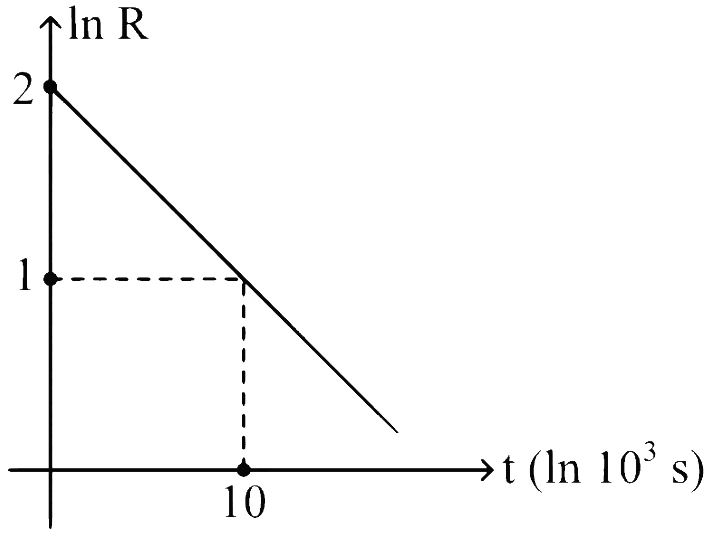
The natural logarithm of the activity of a radioactive sample varies with time as shown. At , there are undecayed nuclei. Then, is equal to [Take ]
Answer: (c)
Step-by-step solution coming soon.
Law of Radioactive Decay
A radioactive sample has half-life of years. The time required for the activity of the sample to reduce to th of its initial value is about
Answer: (b)
Step-by-step solution coming soon.
Law of Radioactive Decay
A radio-active elements has half-life of 15 years. What is the fraction that will decay in 30 years?
Answer: (c)
Step-by-step solution coming soon.
Law of Radioactive Decay
Which one of the following nuclei has shorter mean life?
Answer: (a)
Step-by-step solution coming soon.
Law of Radioactive Decay
The half-life of tritium is years. What mass of tritium of initial mass will remain undecayed after years?
Answer: (d)
Step-by-step solution coming soon.
Law of Radioactive Decay
The radioactivity of a certain radioactive element drops to of its initial value in . Its half-life is
Answer: (c)
Step-by-step solution coming soon.
Law of Radioactive Decay
The half-life of a certain radio isotope is minutes. The number of radioactive nuclei at a given instant of time is . Then the number of radioactive nuclei left minutes later would be
Answer: (c)
Step-by-step solution coming soon.
Law of Radioactive Decay
The activities of a sample of radioactive material are and at times and respectively . If its mean life time is , then
Answer: (b)
Step-by-step solution coming soon.
Law of Radioactive Decay
If the half-life of a radioactive material is 10 years, then the percentage of the material decayed in 30 years is
Answer: (a)
Step-by-step solution coming soon.
Law of Radioactive Decay
If the half-life of a radioactive element is hours, then the time taken to disintegrate of the substance into is (in hours)
Answer: (d)
Step-by-step solution coming soon.
Law of Radioactive Decay
The half life of a radioactive substance is minutes. If and are the number of atoms decayed in and minutes respectively, then
Answer: (c)
Step-by-step solution coming soon.
Law of Radioactive Decay
If the time taken for a radioactive substance to decay to is minutes, then the half life of the substance in minutes is
Answer: (d)
Step-by-step solution coming soon.
Law of Radioactive Decay
An element of a half-life of years decays to form another stable element . A sample is taken from a rock that contains both and in the ratio . If at the time of formation of the rock was not present in the sample, then the age of the rock in years is
Answer: (a)
Step-by-step solution coming soon.
Law of Radioactive Decay
The half-life period of a radioactive element is years. It decays into another stable element . An archaeologist found a sample in which and are in ratio. The age of the sample is
Answer: (a)
Step-by-step solution coming soon.
Law of Radioactive Decay
One mole of radium has an activity of kilo curie. Its decay constant is (Avogadro number )
Answer: (a)
Step-by-step solution coming soon.
Law of Radioactive Decay
A mixture consists of two radioactive materials and with half lives of and respectively. Initially, the mixture has of and of . The amount of the two in the mixture will become equal after
Answer: (d)
Step-by-step solution coming soon.
Law of Radioactive Decay
The relation between the mean-life time and the half-life time of a radioactive substance is
Answer: (a)
Step-by-step solution coming soon.
Law of Radioactive Decay
An ancient discovery found a sample where of the original carbon () remains. Then the age of the sample is ( years, , )
Answer: (b)
Step-by-step solution coming soon.
Law of Radioactive Decay
If the mean life of a radioactive substance is minutes, then the ratio of the number of atoms remaining undecayed and the number of atoms decayed of the substance at a time of minutes is
Answer: (c)
Step-by-step solution coming soon.
Law of Radioactive Decay
If the activities of a radioactive substance at times and are and respectively, then the activity of the substance at a time is
Answer: (d)
Step-by-step solution coming soon.
Law of Radioactive Decay
The number of disintegrations per year of sample of is
(Mean life of is years and Avogadro's number )
Answer: (c)
Step-by-step solution coming soon.
Law of Radioactive Decay
If a radioactive substance decays by and in and minutes respectively, then the time taken for the substance to decay by (in minutes) is
Answer: (b)
Step-by-step solution coming soon.
Law of Radioactive Decay
If a radioactive substance decays in every hours, then the percentage of the radioactive substance that remains after days is
Answer: (d)
Step-by-step solution coming soon.
Law of Radioactive Decay
A radioactive material of half-life hours emits radiation that is times the safe maximum level. The time (in hours) after which the material can be handled safely is
Answer: (d)
Step-by-step solution coming soon.
Law of Radioactive Decay
If of atoms of a radioactive element decay in days, then the fraction of atoms of the element that decay in days is
Answer: (d)
Step-by-step solution coming soon.
Law of Radioactive Decay
Two radioactive substances and have same number of initial nuclei. If the half lives of and are days and days respectively, then the ratio of the number of nuclei remaining in and after days is
Answer: (a)
Step-by-step solution coming soon.
Law of Radioactive Decay
If of a radioactive substance decays in days, then the half life of the substance is (in days)
Answer: (d)
Step-by-step solution coming soon.
Law of Radioactive Decay
Half-life periods of two nuclei and are and respectively. Initially and have same number of nuclei. After a time of , the ratio of the remaining number of nuclei of and is
Answer: (b)
Step-by-step solution coming soon.
Law of Radioactive Decay
The half lives of two radioactive material and are respectively and . If the ratio of the initial masses of the materials and is . Then, the time after which the ratio of the masses of the materials and becomes is
Answer: (a)
Step-by-step solution coming soon.
Law of Radioactive Decay
The half-life of a radioactive substance is . The time gap between decay and decay of the radioactive substance is
Answer: (d)
Step-by-step solution coming soon.
Law of Radioactive Decay
Half-life of a radioactive substance is two times the half-life of another radioactive substance . Initially the number of nuclei of and are and respectively. After three half-lives of , the number of nuclei of both are equal. Then is
Answer: (d)
Step-by-step solution coming soon.
Law of Radioactive Decay
The half-life period of element is same as the mean life time of element . Assume initially and have same number of atoms. Then
Answer: (c)
Step-by-step solution coming soon.
Law of Radioactive Decay
The half-life of a radioactive isotope is . How long will it take to get reduced to of its initial amount?
Answer: (b)
Step-by-step solution coming soon.
Law of Radioactive Decay
Half-life of radioactive sample is . If a newly prepared radioactive sample shows 4 times the allowed and safe value of radio activity, the minimum time after which one can work safely with the source is
Answer: (a)
Step-by-step solution coming soon.
Law of Radioactive Decay
The half-life of a radioactive sample is . If the initial mass of the sample is , then the time required to reduce the sample to is
Answer: (a)
Step-by-step solution coming soon.
Law of Radioactive Decay
A radioactive element which can decay by two processes, has half-life for first process and half-life for second process. Let be the effective average-life of this element. Which of the following is correct?
Answer: (c)
Step-by-step solution coming soon.
Law of Radioactive Decay
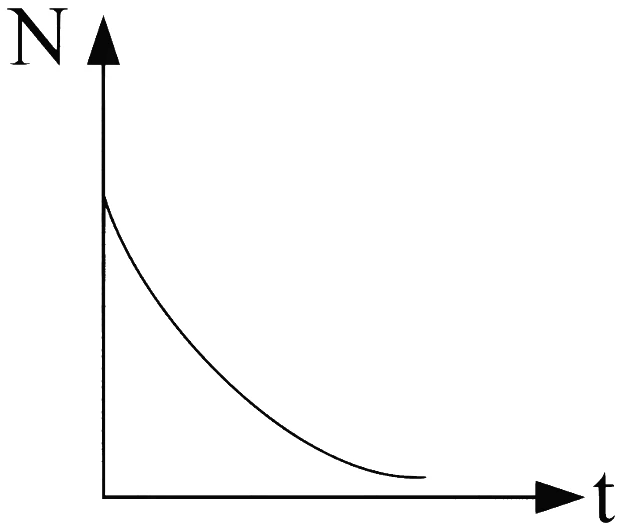
The number of undecayed nuclei in a sample of radioactive material as a function of time is shown in the figure. Which of the following graphs correctly show the relationship between and the activity ?
Answer: (a)
Step-by-step solution coming soon.
Law of Radioactive Decay
A parent nucleus undergoes -decay with a half-life of yrs. The daughter nucleus undergoes -decay with a half-life of months. In a particular sample, it is found that the rate of emission of -particles is nearly constant (over several months) at . What will be the number of -particles emitted in an hour?
Answer: (b)
Step-by-step solution coming soon.
Law of Radioactive Decay
If the half-life of a radioactive nucleus is days, nearly what fraction of the initial number of nuclei will decay on the third day? (Given, )
Answer: (d)
Step-by-step solution coming soon.
Law of Radioactive Decay
Radon-222 has a half-life of days. If one starts with of radon-222 left after days will be
Answer: (a)
Step-by-step solution coming soon.
Law of Radioactive Decay
What is the probability that a radioactive nucleus will not have decayed after a time equal to twice its half-life?
Answer: (d)
Step-by-step solution coming soon.
Law of Radioactive Decay
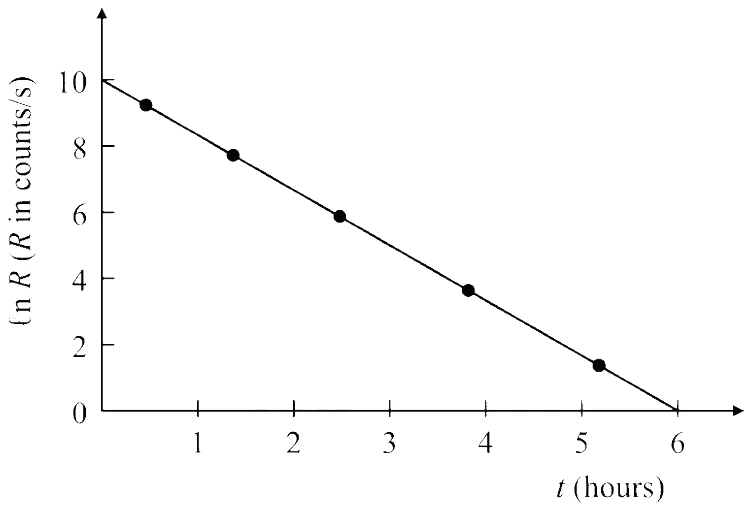
From the given plot of the decay rate versus time of some radioactive nuclei, the half life of the nuclei in hours can be estimated to be
Answer: (c)
Step-by-step solution coming soon.
Law of Radioactive Decay
Two radioactive samples and have the same number of atoms initially . The half life of is half the mean life of . Then the ratio when is close to
Answer: (c)
Step-by-step solution coming soon.
Law of Radioactive Decay
Two radioactive samples and have the same number of atoms initially . The half life of is half the mean life of . Then is seven times when is closest to
Answer: (d)
Step-by-step solution coming soon.
Law of Radioactive Decay
The number of radioactive nuclei in a sample is halved every 69 sec. Then, on an average the number of nuclei decaying per second is approximately
Answer: (c)
Step-by-step solution coming soon.
Law of Radioactive Decay
A detector records 200 events from the decay of a radioactive sample in the first . It records 74 events in the next . The half life of the sample is
Answer: (c)
Step-by-step solution coming soon.
Law of Radioactive Decay
A scientist found a specimen in which the decay constant of nuclei X and nuclei Y are and respectively. At the number of X and Y nuclei were the same. The ratio of number of X nuclei to that of Y nuclei will reduce to after a time interval of
Answer: (c)
Step-by-step solution coming soon.
Law of Radioactive Decay
The photon flux of a one curie gamma ray source incident on a human tissue of cross-sectional area decreases exponentially with tissue depth
where is the attenuation constant and is the flux. Let be the average energy of the incident gamma ray photon and be the surface mass density of the tissue. Select the correct statement(s): (One curie is disintegrations per second)
More than one option can be correct. Tap every correct option, then tap Check.
Answer: (c), (d)
Step-by-step solution coming soon.
Law of Radioactive Decay
A radioactive dye of 4 grams is injected into the bloodstream of a patient. The half life of the dye is 6 hours. At the same time the dye is filtered and removed by the body with a half life of 12 hours. One gram of the radioactive dye will be found in the blood after
Answer: (a)
Step-by-step solution coming soon.
Law of Radioactive Decay
has a half life of 5730 years and its abundance in the atmosphere is 1 in carbon atoms. A fresh sample of 0.001 mole of collected from the atmosphere records a decay of 1700 atoms over a week. A large piece of old wood is burnt and 0.001 mole of collected from it records a decay of 430 atoms over a week. Then the age of the wood is close to
Answer: (b)
Step-by-step solution coming soon.
Law of Radioactive Decay
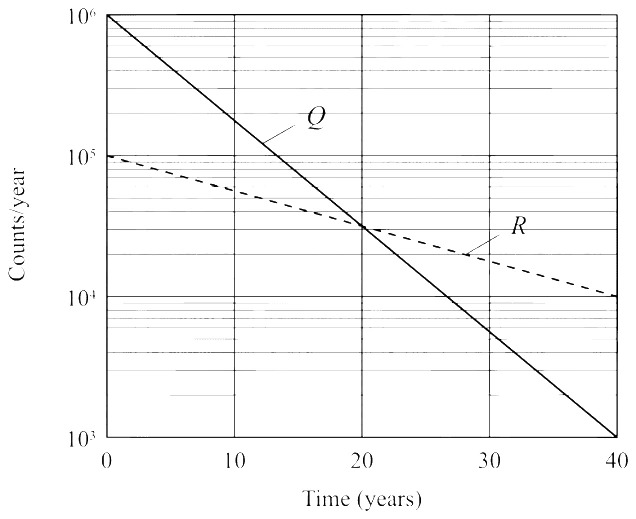
The activity of two radioactive nuclei and is plotted on a semi-log graph. The half-life and decay constant of and are and respectively. The plot implies that (the symbol "" means "approximately equal to")
Answer: (d)
Step-by-step solution coming soon.
Law of Radioactive Decay
Consider the sequential radioactive decay process: , with decay constants and such that . At time the number of the species is and the numbers and of species and respectively, are zero. Then
More than one option can be correct. Tap every correct option, then tap Check.
Answer: (a), (b), (c)
Step-by-step solution coming soon.
Law of Radioactive Decay
and are two radioactive substances. The half-life of is same as the average life of . The decay constant of is per day. (assume )
More than one option can be correct. Tap every correct option, then tap Check.
Answer: (b), (c)
Step-by-step solution coming soon.
Law of Radioactive Decay
A radioactive source, having a half-life of five minutes, was found to have a counting rate of 12000 counts/sec at a certain point in time. Fifteen minutes after this observation, the counting rate is
Answer: (a)
Step-by-step solution coming soon.
Law of Radioactive Decay
A sample of radioactive nuclei of a certain element can decay by both -emission and -emission. The half-life for -emission is 24 minutes and that for -emission is 36 minutes. The half-life for the sample is nearly
Answer: (b)
Step-by-step solution coming soon.
No questions match these filters.