

Rolling Motion
A solid sphere rolls without slipping on an inclied plane at an angle . The ratio of total kinetic energy to its rotational kinetic energy is
Show answer and solution
Answer: (b)
Loading the solution…
Home›Practice Hub›Chapters›Rotational Motion›Rolling Motion
Rotational Motion PYQs · MHT CET · JEE Main · NEET
Rolling Motion
A solid sphere rolls without slipping on an inclied plane at an angle . The ratio of total kinetic energy to its rotational kinetic energy is
Answer: (b)
Rolling Motion
A solid sphere of mass kg rolls without slipping on a plane surface. Its kinetic energy is J. The speed of the center of mass of the sphere in cm s is
Answer: (b)
Rolling Motion
A circular ring and a solid sphere having same radius roll down on an inclined plane from rest without slipping. The ratio of their velocities when reached at the bottom of the plane where the value of is
Answer: (b)
Rolling Motion
A solid sphere rolls down from the top of an inclined plane. On reaching the bottom of the plane, its velocity is ''. When the same sphere slides down from the top of the same plane of same height, its velocity on reaching the bottom is ''. The ratio is (neglect friction)
Answer: (d)
Rolling Motion
A solid cylinder and a solid sphere having the same mass and radius roll down on the same smooth inclined plane. The ratio of the acceleration of the cylinder to that of the sphere is
Answer: (a)
Rolling Motion
A body slides down a smooth inclined plane of inclination and reaches the bottom with velocity 'V'. If the same body is a ring which rolls down the same inclined plane then linear velocity at the bottom of the plane is
Answer: (a)
Rolling Motion
An object of uniform density rolls up the curved path with the initial velocity as shown in the figure. If the maximum height attained by an object is ( acceleration due to gravity), the object is a ______.
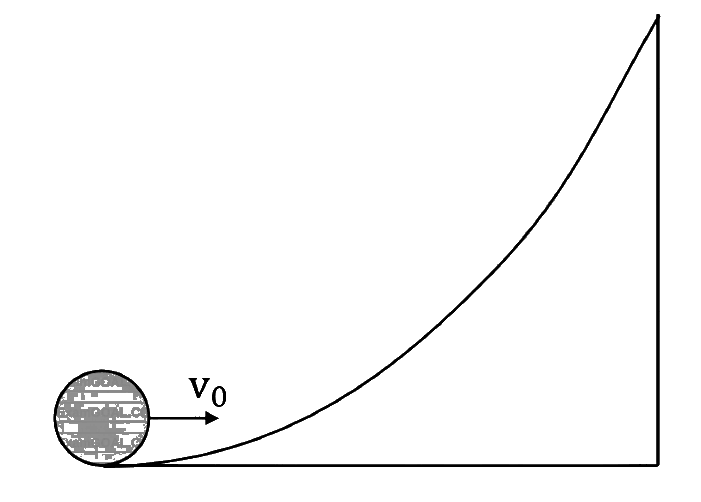
Answer: (d)
Rolling Motion
A solid sphere of mass and a spherical shell of mass , both having same radius, are placed on a rough surface. When a force of same magnitude is applied tangentially at the highest points of and , they start rolling without slipping with an acceleration of and , respectively. The ratio of and is ______.
Answer: (a)
Rolling Motion
A solid cylinder having radius and length is slipping on a rough horizontal plane. At time the cylinder has a translational velocity , perpendicular to its axis and a rotational velocity about the centre. The time taken by the cylinder to start rolling is ______ seconds. (coefficient of kinetic friction and )
Answer: (b)
Rolling Motion
A solid sphere is rolling without slipping on a horizontal plane. The ratio of the linear kinetic energy of the centre of mass of the sphere and rotational kinetic energy is:
Answer: (c)
Rolling Motion
A solid sphere at rests rolls down an inclined plane of vertical height without sliding. Its speed on reaching the bottom of plane is ( acceleration due to gravity)
Answer: (b)
Rolling Motion
A disc of mass ' ' and radius ' ' rolls down an inclined plane of height ' '. When it reaches the bottom of the plane, its rotational kinetic energy is ( acceleration due to gravity)
Answer: (a)
Rolling Motion
An inclined plane makes an angle with the horizontal. A solid sphere rolling down an inclined plane from rest without slipping has linear acceleration ( acceleration due gravity) ( )
Answer: (b)
Rolling Motion
A wheel is rolling on a plane surface. The speed of a particle on the highest point of the rim is . The speed of the particle on the rim of the wheel at the same level as the centre of wheel, will be:
Answer: (a)
Rolling Motion
A body slides down a smooth inclined plane of inclination and reaches the bottom with velocity V. If the same body is a ring which rolls down the same inclined plane then linear velocity at the bottom of plane is
Answer: (a)
Rolling Motion
A solid sphere and a hollow sphere of the same mass and of same radius are rolled on an inclined plane. Let the time taken to reach the bottom by the solid sphere and the hollow sphere be and , respectively, then
Answer: (a)
Rolling Motion
A solid sphere of mass ' ' and radius ' ' is allowed to roll without slipping from the highest point of an inclined plane of length ' ' and makes an angle with the horizontal. The speed of the particle at the bottom of the plane is . If the angle of inclination is increased to while keeping constant. Then the new speed of the sphere at the bottom of the plane is . The ratio is
Answer: (c)
Rolling Motion
A circular ring and a solid sphere having same radius roll down on an inclined plane from rest without slipping. The ratio of their velocities when reached at the bottom of the plane is where ________.
Numerical answer type. Work it out, then open the answer.
Answer: 4
Rolling Motion
A solid sphere rolling without friction on a horizontal surface with a constant speed of , rolls up on an inclined ramp which is inclined at . The maximum distance travelled by the sphere on the inclined ramp is (acceleration due to gravity )
Answer: (a)
Rolling Motion
A force of 49 N acts tangentially at the highest point of a sphere (solid) of mass 20 kg, kept on a rough horizontal plane. If the sphere rolls without slipping, then the acceleration of the center of the sphere is
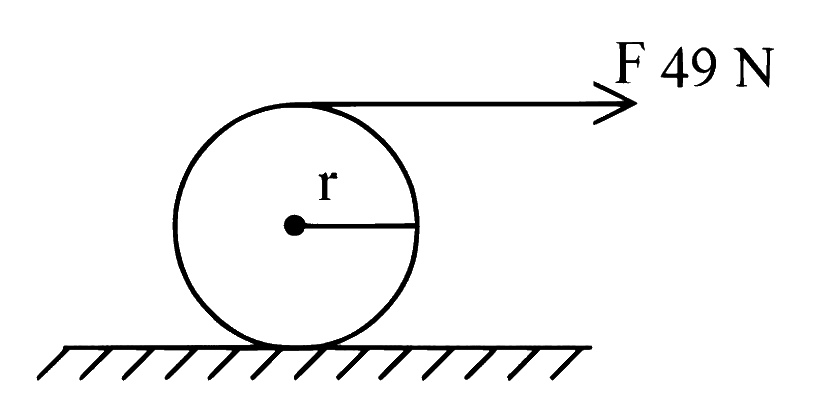
Answer: (b)
Rolling Motion
A uniform solid cylinder of mass ' m ' and radius ' r ' rolls along an inclined rough plane of inclination . If it starts to roll from rest from the top of the plane then the linear acceleration of the cylinder's axis will be
Answer: (d)
Rolling Motion
A wheel of a bullock cart is rolling on a level road as shown in the figure below. If its linear speed is in the direction shown, which one of the following options is correct ( and are any highest and lowest points on the wheel, respectively)?
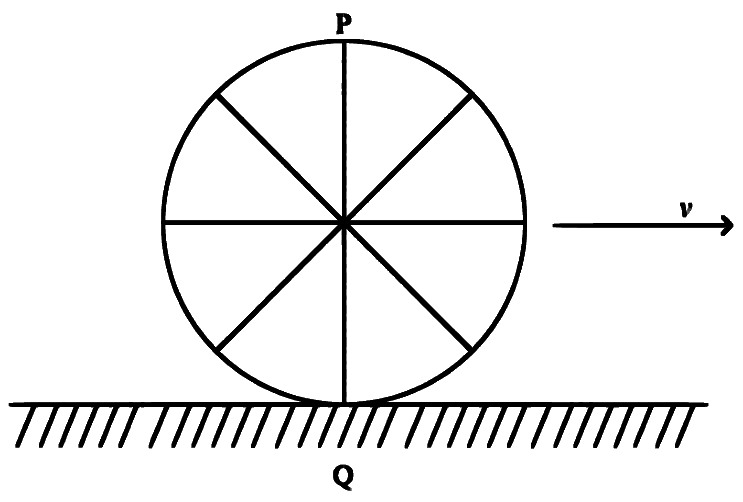
Answer: (b)
Rolling Motion
A hollow sphere is rolling on a plane surface about its axis of symmetry. The ratio of rotational kinetic energy to its total kinetic energy is . The value of is _________.
Numerical answer type. Work it out, then open the answer.
Answer: 2
Rolling Motion
An inclined plane makes an angle with horizontal. A solid sphere rolls down from the top of the inclined plane from rest without slipping has a linear acceleration along the plane equal to (where is acceleration due to gravity) (given )
Answer: (a)
Rolling Motion
A solid cylinder of mass ' ' and radius ' ' rolls down an inclined plane of height ' '. When it reaches the foot of the plane, its rotational kinetic energy is ( acceleration due to gravity)
Answer: (a)
Rolling Motion
An inclined plane makes an angle of with the horizontal. A solid sphere rolling down this inclined plane from rest without slipping has a linear acceleration ( acceleration due to gravity, )
Answer: (b)
Rolling Motion
A cylinder is rolling down on an inclined plane of inclination . Its acceleration during rolling down will be , where ________ (use ).
Numerical answer type. Work it out, then open the answer.
Answer: 10
Rolling Motion
A ring and a disc roll on horizontal surface without slipping with same linear velocity. If both have same mass and total kinetic energy of the ring is 6 J then total kinetic energy of the disc is
Answer: (d)
Rolling Motion
A body of mass slides down an incline and reaches the bottom with a velocity V. If the same mass were in the form of a disc which rolls down this incline, the velocity of the disc at bottom would have been
Answer: (d)
Rolling Motion
A circular disc reaches from top to bottom of an inclined plane of length . When it slips down the plane, it takes . When it rolls down the plane then it takes , where is _________.
Numerical answer type. Work it out, then open the answer.
Answer: 3
Rolling Motion
A ring and a solid sphere roll down the same inclined plane without slipping. They start from rest. The radii of both bodies are identical and the ratio of their kinetic energies is , where is _________.
Numerical answer type. Work it out, then open the answer.
Answer: 7
Rolling Motion
A disc of radius and mass is rolling horizontally without slipping with speed . It then moves up an inclined smooth surface as shown in figure. The maximum height that the disc can go up the incline is:
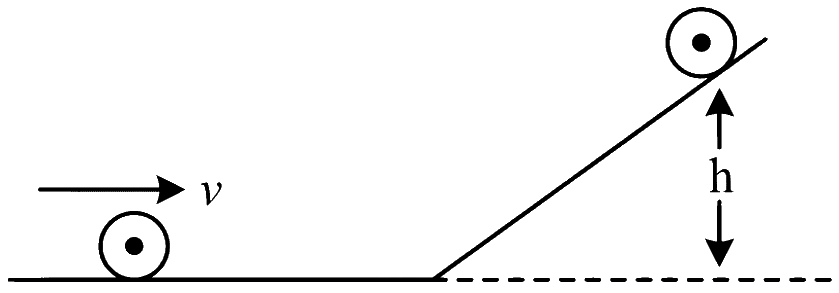
Answer: (a)
Rolling Motion
A solid sphere and a hollow cylinder roll up without slipping on same inclined plane with same initial speed . The sphere and the cylinder reach upto maximum heights and respectively, above the initial level. The ratio is . The value of is __________.
Numerical answer type. Work it out, then open the answer.
Answer: 7
Rolling Motion
A solid circular disc of mass rolls along a horizontal floor so that its center of mass has a speed of . The absolute value of work done on the disc to stop it is ________ J.
Numerical answer type. Work it out, then open the answer.
Answer: 6
Rolling Motion
The rotational kinetic energy and translational kinetic energy of a rolling body are same, the body is
Answer: (d)
Rolling Motion
A solid sphere rolls without slipping on an inclined plane at an angle . The ratio of total kinetic energy to its rotational kinetic energy is
Answer: (a)
Rolling Motion
For a rolling spherical shell, the ratio of rotational kinetic energy and total kinetic energy is . The value of is ___________.
Numerical answer type. Work it out, then open the answer.
Answer: 2
Rolling Motion
A solid sphere of mass 2 kg is making pure rolling on a horizontal surface with kinetic energy 2240 J. The velocity of centre of mass of the sphere will be _______ ms.
Numerical answer type. Work it out, then open the answer.
Answer: 40
Rolling Motion
A solid sphere and a solid cylinder of same mass and radius are rolling on a horizontal surface without slipping. The ratio of their radii of gyration respectively sph cyl is . The value of is ____________.
Numerical answer type. Work it out, then open the answer.
Answer: 5
Rolling Motion
A solid sphere is rolling on a horizontal plane without slipping. If the ratio of angular momentum about axis of rotation of the sphere to the total energy of moving sphere is then, the value of its angular speed will be ____________ .
Numerical answer type. Work it out, then open the answer.
Answer: 4
Rolling Motion
A solid sphere of mass rolls without slipping on a plane surface. Its kinetic energy is . The speed of the centre of mass of the sphere is __________
Numerical answer type. Work it out, then open the answer.
Answer: 10
Rolling Motion
A solid cylinder and a solid sphere having same mass and same radius roll down on the same inclined plane. The ratio of the acceleration of the cylinder '' to that of sphere '' is
Answer: (d)
Rolling Motion
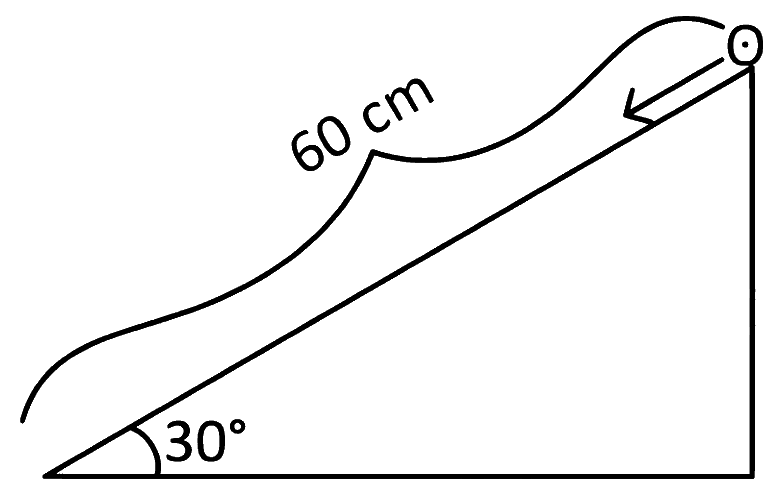
A solid cylinder is released from rest from the top of an inclined plane of inclination and length . If the cylinder rolls without slipping, its speed upon reaching the bottom of the inclined plane is __________ . (Given )
Numerical answer type. Work it out, then open the answer.
Answer: 2
Rolling Motion
A solid cylinder of mass is rolling on a horizontal surface with velocity . It collides with a horizontal spring whose one end is fixed to rigid support. The force constant of material of spring is . The maximum compression produced in the spring will be (assume collision between cylinder & spring be elastic)
Answer: (d)
Rolling Motion
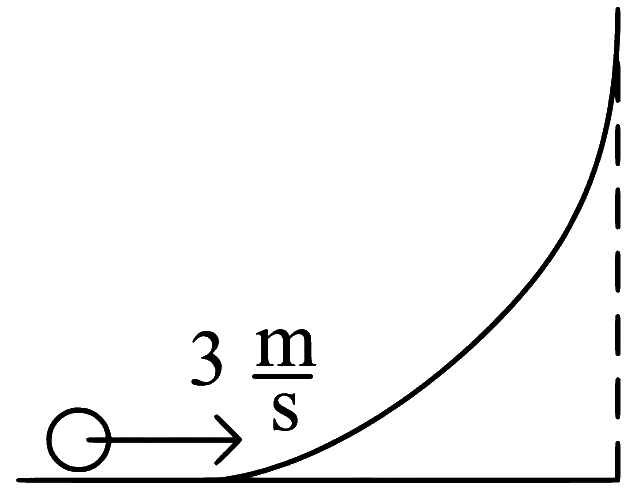
A hollow spherical ball of uniform density rolls up a curved surface with an initial velocity (as shown in figure). Maximum height with respect to the initial position covered by it will be __________ cm. (Take )
Numerical answer type. Work it out, then open the answer.
Answer: 75
Rolling Motion
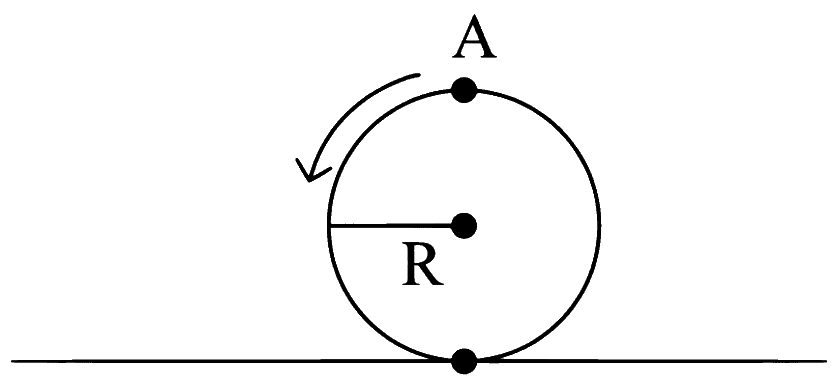
A disc is rolling without slipping on a surface. The radius of the disc is . At , the top most point on the disc is as shown in figure. When the disc completes half of its rotation, the displacement of point A from its initial position is
Answer: (c)
Rolling Motion
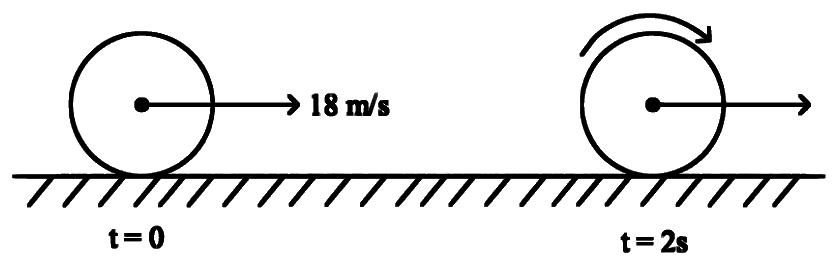
A uniform disc of mass and radius is projected with velocity at s on a rough horizontal surface. It starts off with a purely sliding motion at . After it acquires a purely rolling motion (see figure). The total kinetic energy of the disc after will be __________ (given, coefficient of friction is and ).
Numerical answer type. Work it out, then open the answer.
Answer: 54
Rolling Motion
A solid spherical ball is rolling on a frictionless horizontal plane surface about its axis of symmetry. The ratio of rotational kinetic energy of the ball to its total kinetic energy is
Answer: (b)
Rolling Motion
A solid cylinder and a solid sphere, having same mass and radius , roll down the same inclined plane from top without slipping. They start from rest. The ratio of velocity of the solid cylinder to that of the solid sphere, with which they reach the ground, will be:
Answer: (d)
Rolling Motion
A solid cylinder is suspended symmetrically through two massless strings, as shown in the figure. The distance from the initial rest position, the cylinder should be unbinding the strings to achieve a speed of , is ____________ cm. (take g = )
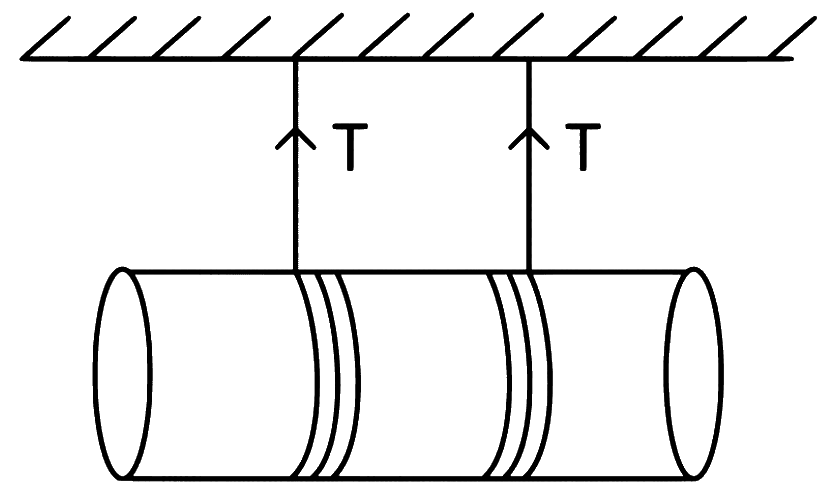
Numerical answer type. Work it out, then open the answer.
Answer: 120
Rolling Motion
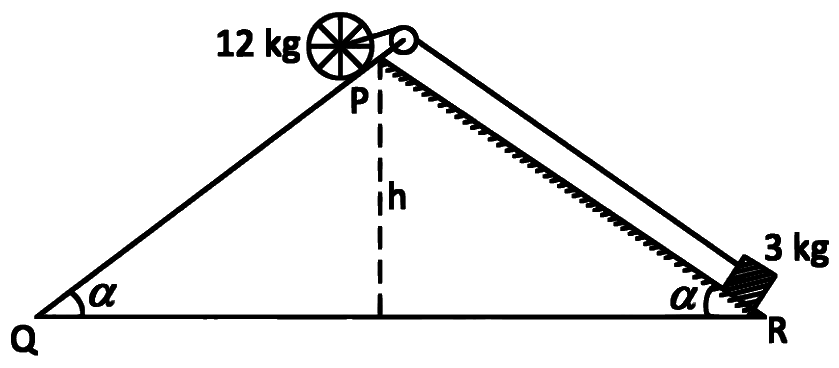
A rolling wheel of 12 kg is on an inclined plane at position P and connected to a mass of 3 kg through a string of fixed length and pulley as shown in figure. Consider PR as friction free surface. The velocity of centre of mass of the wheel when it reaches at the bottom Q of the inclined plane PQ will be m/s. The value of x is ___________.
Numerical answer type. Work it out, then open the answer.
Answer: 3
Rolling Motion
A body rolls down an inclined plane without slipping. The kinetic energy of rotation is 50% of its translational kinetic energy. The body is:
Answer: (b)
Rolling Motion
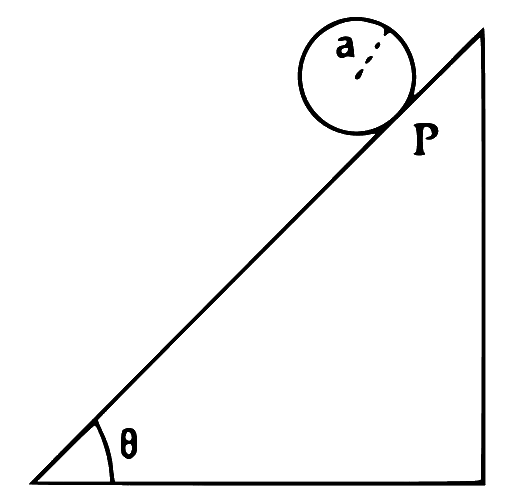
A solid disc of radius 'a' and mass 'm' rolls down without slipping on an inclined plane making an angle with the horizontal. The acceleration of the disc will be g sin where b is ____________. (Round off to the Nearest Integer) (g = acceleration due to gravity, = angle as shown in figure)
Numerical answer type. Work it out, then open the answer.
Answer: 3
Rolling Motion
The centre of a wheel rolling on a plane surface moves with a speed v0. A particle on the rim of the wheel at the same level as the centre will be moving at a speed . Then the value of x is _____________.
Numerical answer type. Work it out, then open the answer.
Answer: 02
Rolling Motion
Consider a situation in which a ring, a solid cylinder and a solid sphere roll down on the same inclined plane without slipping. Assume that they start rolling from rest and having identical diameter.
The correct statement for this situation is
Answer: (c)
Rolling Motion
Two bodies, a ring and a solid cylinder of same material are rolling down without slipping an inclined plane. The radii of the bodies are same. The ratio of velocity of the centre of mass at the bottom of the inclined plane of the ring to that of the cylinder is . Then, the value of x is _____________.
Numerical answer type. Work it out, then open the answer.
Answer: 3
Rolling Motion
A circular disc reaches from top to bottom of an inclined plane of length 'L'. When it slips down the plane, it makes time 't1'. When it rolls down the plane, it takes time t2. The value of is . The value of x will be _______________.
Numerical answer type. Work it out, then open the answer.
Answer: 2
Rolling Motion
The following bodies,
(1) a ring
(2) a disc
(3) a solid cylinder
(4) a solid sphere,
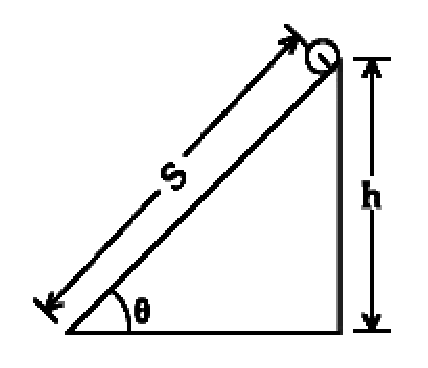
of same mass 'm' and radius 'R' are allowed to roll down without slipping simultaneously from the top of the inclined plane. The body which will reach first at the bottom of the inclined plane is ___________. [Mark the body as per their respective numbering given in the question]
Numerical answer type. Work it out, then open the answer.
Answer: 4
Rolling Motion
A sphere of mass 2 kg and radius 0.5 m is rolling with an initial speed of 1 ms-1 goes up an inclined plane which makes an angle of 30 with the horizontal plane, without slipping. How long will the sphere take to return to the starting point A?
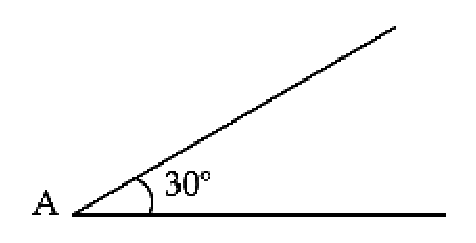
Answer: (d)
Rolling Motion
A sphere of radius 'a' and mass 'm' rolls along a horizontal plane with constant speed v0. It encounters an inclined plane at angle and climbs upward. Assuming that it rolls without slipping, how far up the sphere will travel?
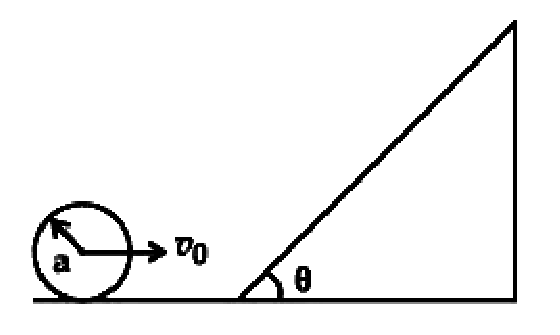
Answer: (b)
Rolling Motion
A solid cylinder of mass m is wrapped with an inextensible light string and, is placed on a rough inclined plane as shown in the figure. The frictional force acting between the cylinder and the inclined plane is:
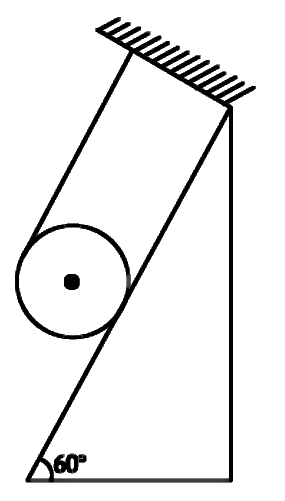
[The coefficient of static friction, s is 0.4]
Answer: (d)
Rolling Motion
A uniform sphere of mass 500 g rolls without slipping on a plane horizontal surface with its centre moving at a speed of 5.00 cm/s. Its kinetic energy is:
Answer: (c)
Rolling Motion
A solid cylinder of radius and mass rolls down an inclined plane of height . When it reaches the bottom of the plane, then its rotational kinetic energy is ( acceleration due to gravity)
Answer: (d)
Rolling Motion
A body slides down a smooth inclined plane having angle and reaches the bottom with velocity . If a body is a sphere, then its linear velocity at the bottom of the plane is
Answer: (b)
Rolling Motion
A disc of radius 2 m and mass 100 kg rolls on a horizontal floor. Its centre of mass has speed of 20 cm/s. How much work is needed to stop it?
Answer: (c)
Rolling Motion
A solid sphere rolls down from top of inclined plane, 7 m high, without slipping. Its linear speed at the foot of plane is
Answer: (d)
Rolling Motion
A solid cylinder of mass 2 kg and radius 50 cm rolls up an inclined plane of angle of inclination . The centre of mass of the cylinder has speed of 4 m/s. The distance travelled by the cylinder on the inclined surface will be, [take ]
Answer: (a)
Rolling Motion
The following bodies are made to roll up (without slipping) the same inclined plane from a horizontal plane.: (i) a ring of radius R, (ii) a solid cylinder of radius R/2 and (iii) a solid sphere of radius R/4. If in each case, the speed of the centre of mass at the bottom of the incline is same, the ratio of the maximum heights they climb is:
Answer: (a)
Rolling Motion
A solid sphere and solid cylinder of identical radii approach an incline with the same linear velocity (see figure). Both roll without slipping all throughout. The two climb maximum heights hsph and hcyl on the incline. The ratio hsph/hcyl is given by :-
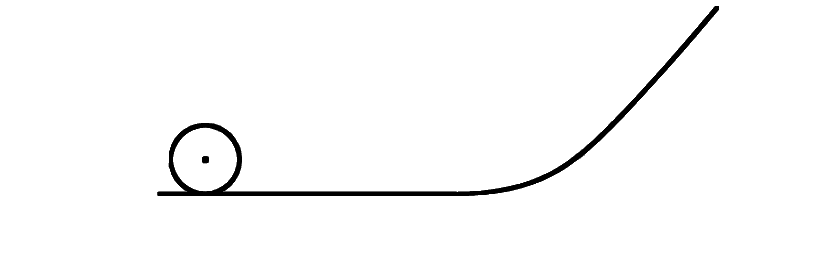
Answer: (b)
Rolling Motion
A particle of mass 20 g is released with an initial velocity 5 m/s along the curve from the point A, as shown in the figure. The point A is at height h from point B. The particle slides along the frictionless surface. When the particle reaches point B, its angular momentum about O will be: (Take g = 10 m/s2)
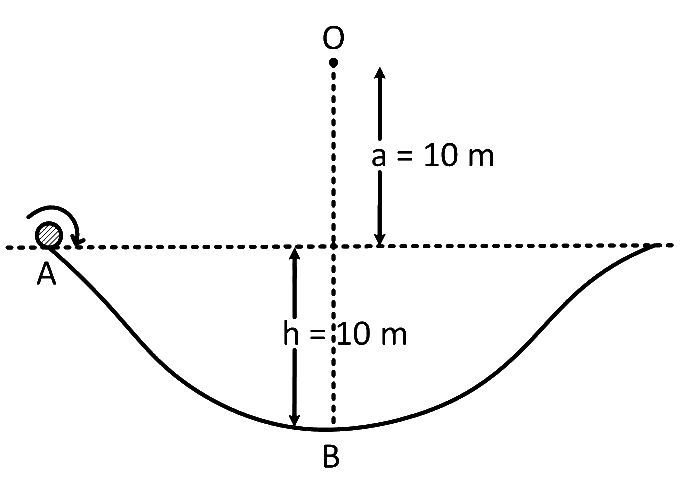
Answer: (a)
Rolling Motion
A string is wound around a hollow cylinder of mass 5 kg and radius 0.5m. If the string is now pulled with a horizontal force of 40 N, and the cylinder is rolling without slipping on a horizontal surface (see figure), then the angular acceleration of the cylinder will be (Neglect the mass and thickness of the string):
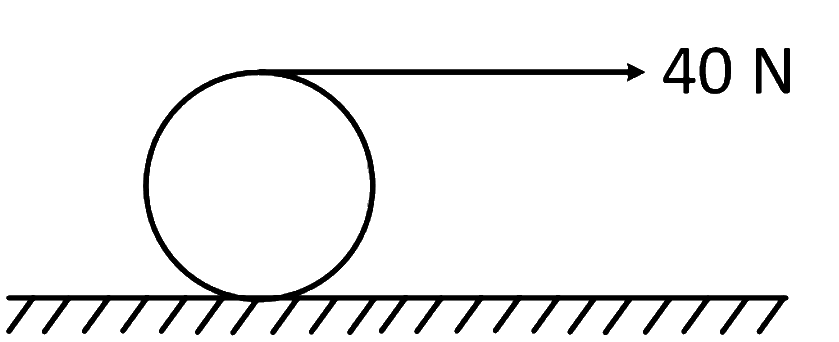
Answer: (a)
Rolling Motion
A homogeneous solid cylindrical roller of radius R and mass M is pulled on a cricket pitch by a horizontal force. Assuming rolling without slipping, angular acceleration of the cylinder is -
Answer: (b)
Rolling Motion
A solid sphere is in rolling motion. In rolling motion a body possesses translational kinetic energy (Kt) as well as rotational kinetic energy (Kr) simultaneously. The ratio Kt: (Kt + Kr) for the sphere is
Answer: (b)
Rolling Motion
A disc and a sphere of same radius but different masses roll off on two inclined planes of the same altitude and length. Which one of the two objects gets to the bottom of the plane first?
Answer: (d)
Rolling Motion
A uniform solid cylindrical roller of mass 'm' is being pulled on a horizontal surface with force F parallel to the surface and applied at its centre. If the acceleration of the cylinder is 'a' and it is rolling without slipping then the value of 'F' is:
Answer: (c)
Rolling Motion
The ratio of the accelerations for a solid sphere (mass m and radius R) rolling down an incline of angle without slipping and slipping down the incline without rolling is
Answer: (a)
Rolling Motion
A cylinder of mass Mc and sphere of mass Ms are placed at points A and B of two inclines, respectively. (See Figure). If they roll on the incline without slipping such that their accelerations are the same, then the ratio is:
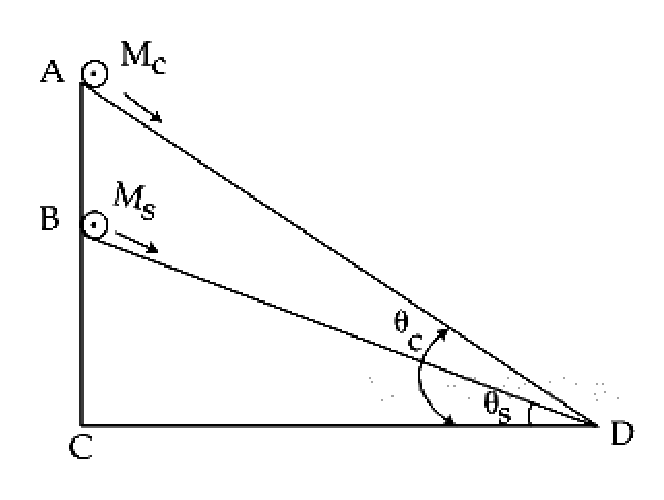
Answer: (d)
Rolling Motion
Consider a cylinder of mass M resting on a rough horizontal rug that is pulled out from under it with acceleration 'a' perpendicular to the axis of the cylinder. What is Ffriction at point P? It is assumed that the cylinder does not slip.
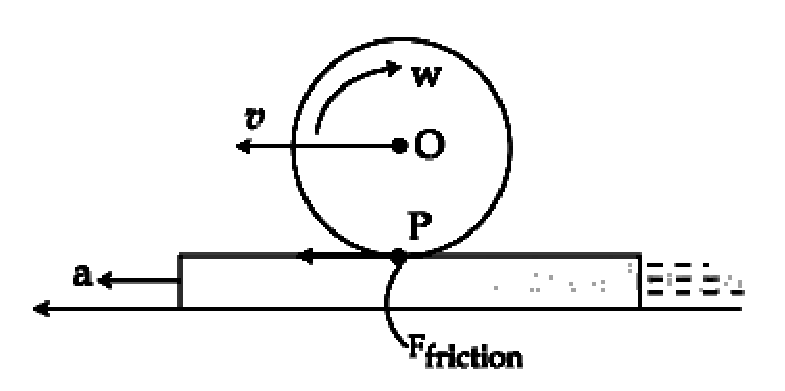
Answer: (d)
Rolling Motion
A small object of uniform density rolls up a curved surface with an initial velocity 'v'. It reaches upto a maximum height of with respect to the initial position. The object is
Answer: (b)
Rolling Motion
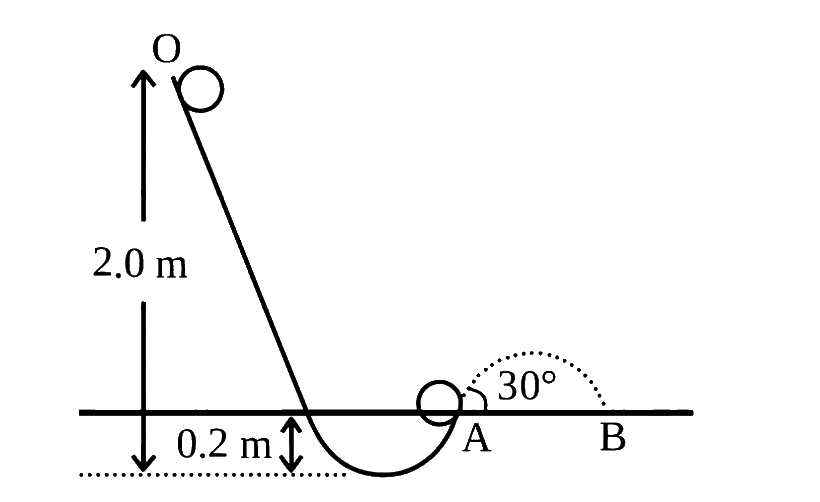
A tennis ball (treated as hollow spherical shell) starting from O rolls down a hill. At point A, the ball becomes air borne leaving at an angle of 30° with the horizontal. The ball strikes the ground at B. What is the value of the distance AB? (Moment of inertia of a spherical shell of mass m and radius R about its diameter = )
Answer: (a)
Rolling Motion
A hoop of radius and mass rotating with an angular velocity is placed on a rough horizontal surface. The initial velocity of the center of the hoop is zero. What will be the velocity of the center of the hoop when it ceases to slip?
Answer: (c)
Rolling Motion
A solid cylinder and a hollow cylinder, both of the same mass and same external diameter are released from the same height at the same time on an inclined plane. Both roll down without slipping. Which one will reach the bottom first?
Answer: (d)
Rolling Motion
A round uniform body of radius mass and moment of inertia rolls down (without slipping) an inclined plane making an angle with the horizontal. Then its acceleration is
Answer: (b)
Rolling Motion
A drum of radius R and mass M, rolls down without slipping along an inclined plane of angle . The frictional force
Answer: (d)
Rolling Motion
An annular ring with inner and outer radii and is rolling without slipping with a uniform angular speed. The ratio of the forces experienced by the two particles situated on the inner and outer parts of the ring, is
Answer: (c)
Rolling Motion
A solid cylinder of mass M and radius R rolls without slipping down an inclined plane of length L and height h. What is the speed of its centre of mass when the cylinder reaches its bottom?
Answer: (c)
Rolling Motion
A ball rolls without slipping. The radius of gyration of the ball about an axis passing through its centre of mass is K. If radius of the ball be R. then the fraction of total energy associated with its rotational energy will be
Answer: (c)
Rolling Motion
A solid sphere, a hollow sphere and a ring are released from top of an inclined plane (frictionless) so that they slide down the plane. Then maximum acceleration down the plane is for (no rolling)
Answer: (d)
Rolling Motion
A point P consider at contact point of a wheel on ground which rolls on ground without slipping then value of displacement of point P when wheel completes half of rotation (if radius of wheel is 1 m)
Answer: (b)
Rolling Motion
A solid sphere of radius R is placed on smooth horizontal surface. A horizontal force F is applied at height h from the lowest point. For the maximum acceleration of centre of mass, which is correct?
Answer: (d)
Rolling Motion
A solid spherical ball rolls on a table. Ratio of its rotational kinetic energy to total kinetic energy is
Answer: (d)
Rolling Motion
A solid sphere, disc and solid cylinder all of the same mass and made of the same material are allowed to roll down (from rest) on the inclined plane, then
Answer: (a)
Rolling Motion
The speed of a homogenous solid sphere after rolling down an inclined plane of vertical height form rest without sliding is
Answer: (a)
Rolling Motion
If a sphere is rolling, the ratio of the translational energy to total kinetic energy is given by
Answer: (d)
Rolling Motion
A solid cylinder of mass and radius rolls without slipping down an inclined plane of length and height . What is the speed of its centre of mass when the cylinder reaches its bottom?
Answer: (c)
Rolling Motion
A solid homogenous sphere of mass and radius is moving on a rough horizontal surface, partly rolling and partly sliding. During this kind of motion of this sphere
Answer: (b)
Rolling Motion
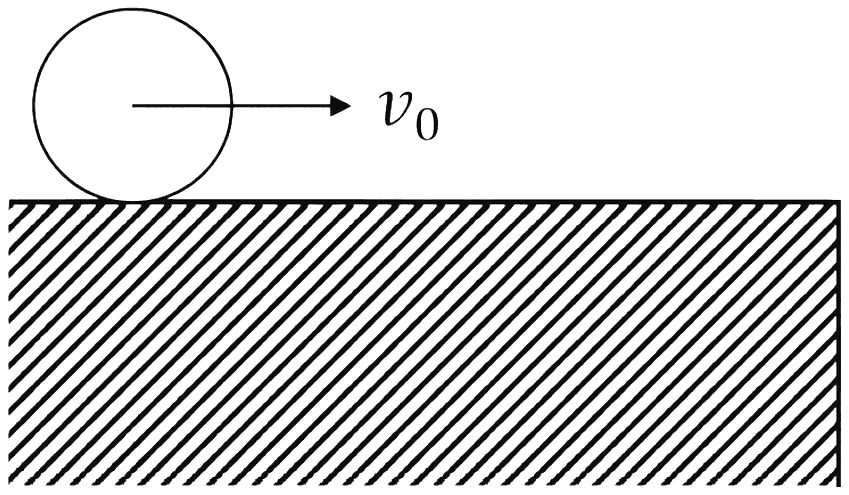
A solid cylinder of radius rolls without slipping with a center of mass speed on a horizontal surface with a vertical edge, as shown in the figure. Here, is the acceleration due to gravity. At the moment when the cylinder loses contact with the surface due to rotation around the corner, the speed of its center of mass is:
Answer: (b)
Step-by-step solution coming soon.
Rolling Motion
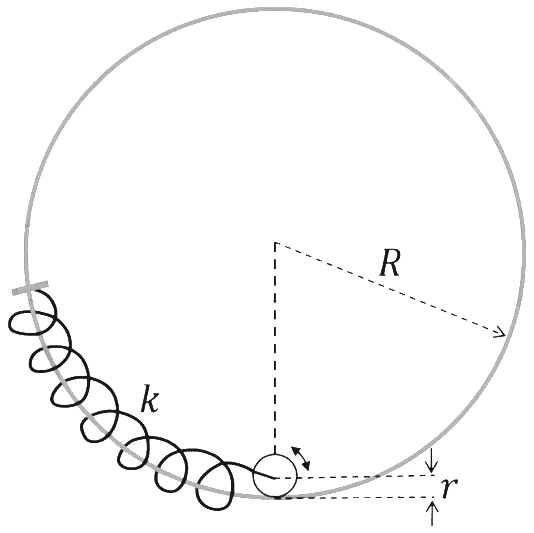
The center of a disk of radius and mass is attached to a spring of spring constant , inside a ring of radius as shown in the figure. The other end of the spring is attached on the periphery of the ring. Both the ring and the disk are in the same vertical plane. The disk can only roll along the inside periphery of the ring, without slipping. The spring can only be stretched or compressed along the periphery of the ring, following the Hooke's law. In equilibrium, the disk is at the bottom of the ring. Assuming small displacement of the disc, the time period of oscillation of center of mass of the disk is written as . The correct expression for is ( is the acceleration due to gravity):
Answer: (a)
Step-by-step solution coming soon.
Rolling Motion
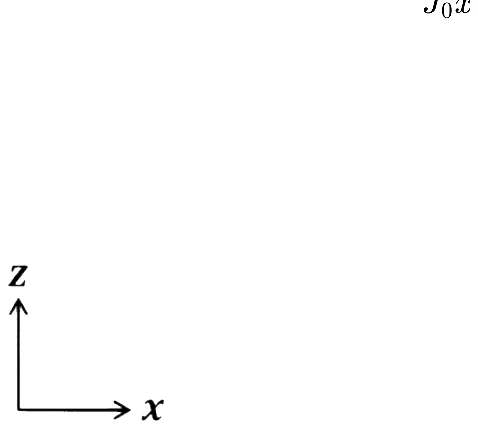
An annular disk of mass , inner radius and outer radius is placed on a horizontal surface with coefficient of friction , as shown in the figure. At some time, an impulse is applied at a height above the center of the disk. If then the disk rolls without slipping along the -axis. Which of the following statement(s) is(are) correct?
More than one option can be correct. Tap every correct option, then tap Check.
Answer: (a), (b), (c), (d)
Step-by-step solution coming soon.
Rolling Motion
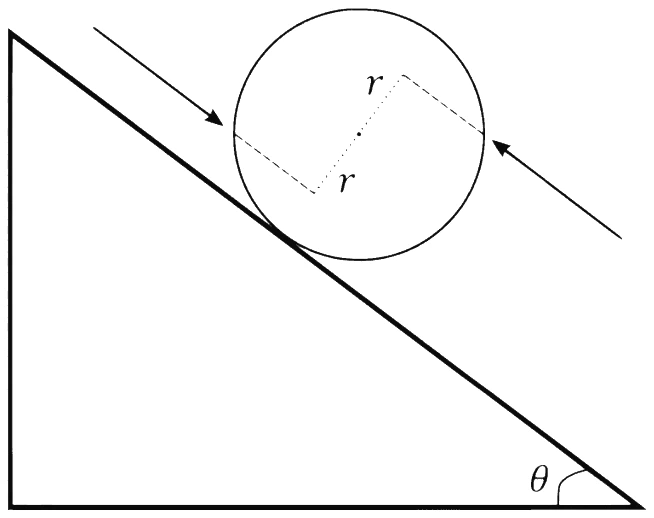
A solid sphere of mass and radius rolls without slipping on a fixed inclined plane with an angle of inclination from the horizontal. Two forces of magnitude each, parallel to the incline, act on the sphere, both at distance from the center of the sphere, as shown in the figure. The acceleration of the sphere down the plane is ______ . (Take )
Numerical answer type. Work it out, then open the answer.
Answer: 2.80 to 2.92
Step-by-step solution coming soon.
Rolling Motion
At time , a disk of radius starts to roll without slipping on a horizontal plane with an angular acceleration of . A small stone is stuck to the disk. At , it is at the contact point of the disk and the plane. Later, at time , the stone detaches itself and flies off tangentially from the disk. The maximum height (in m) reached by the stone measured from the plane is . The value of is [Take .]
Numerical answer type. Work it out, then open the answer.
Answer: 0.48 to 0.56
Step-by-step solution coming soon.
Rolling Motion
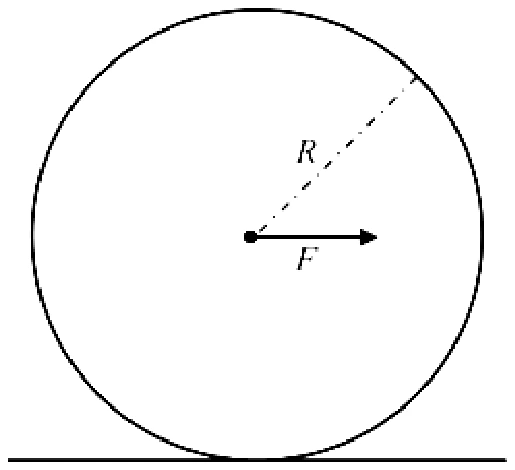
A horizontal force is applied at the center of mass of a cylindrical object of mass and radius , perpendicular to its axis as shown in the figure. The coefficient of friction between the object and the ground is . The center of mass of the object has an acceleration . The acceleration due to gravity is . Given that the object rolls without slipping, which of the following statement(s) is(are) correct?
More than one option can be correct. Tap every correct option, then tap Check.
Answer: (b), (d)
Step-by-step solution coming soon.
Rolling Motion
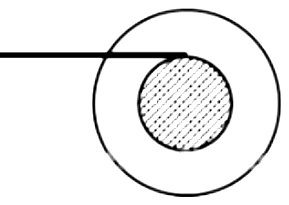
A small roller of diameter has an axle of diameter (see figure below on the left). It is on a horizontal floor and a meter scale is positioned horizontally on its axle with one edge of the scale on top of the axle (see figure on the right). The scale is now pushed slowly on the axle so that it moves without slipping on the axle, and the roller starts rolling without slipping. After the roller has moved , the position of the scale will look like (figures are schematic and not drawn to scale)
Answer: (c)
Step-by-step solution coming soon.
Rolling Motion
A ring and disc are initially at rest, side by side, at the top of an inclined plane which makes an angle with the horizontal. They start to roll without slipping at the same instant of time along the shortest path. If the time difference between their reaching the ground is , then the height of the top of the inclined plane, in metres is ______. Take .
Numerical answer type. Work it out, then open the answer.
Answer: 0.75
Step-by-step solution coming soon.
Rolling Motion
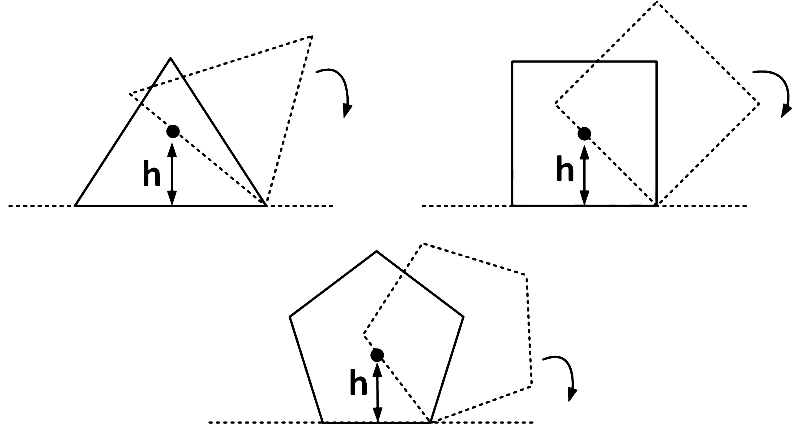
Consider regular polygons with number of sides as shown in the figure. The center of mass of all the polygons is at height from the ground. They roll on a horizontal surface about the leading vertex without slipping and sliding as depicted. The maximum increase in height of the locus of the center of mass for each polygon is . Then depends on and as
Answer: (b)
Step-by-step solution coming soon.
Rolling Motion
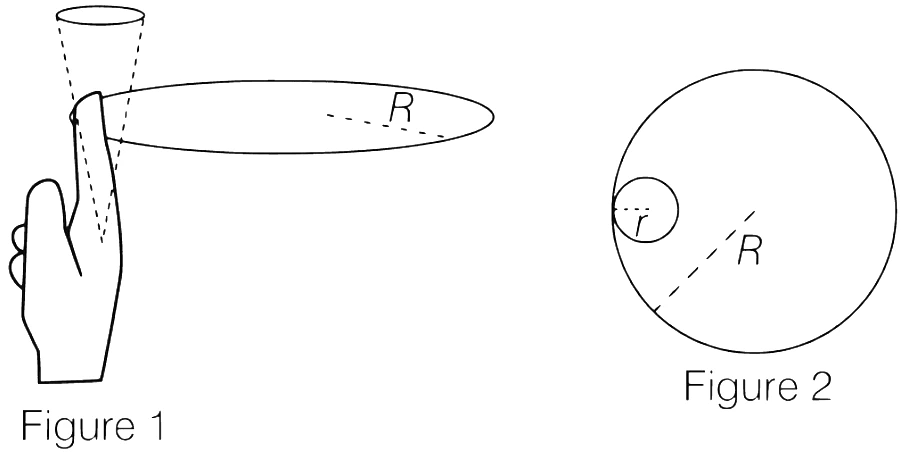
One twirls a circular ring (of mass and radius ) near the tip of one's finger as shown in Figure 1. In the process the finger never loses contact with the inner rim of the ring. The finger traces out the surface of a cone, shown by the dotted line. The radius of the path traced out by the point where the ring and the finger is in contact is . The finger rotates with an angular velocity . The rotating ring rolls without slipping on the outside of a smaller circle described by the point where the ring and the finger is in contact (Figure 2). The coefficient of friction between the ring and the finger is and the acceleration due to gravity is .
The total kinetic energy of the ring is
Answer: (d)
Step-by-step solution coming soon.
Rolling Motion
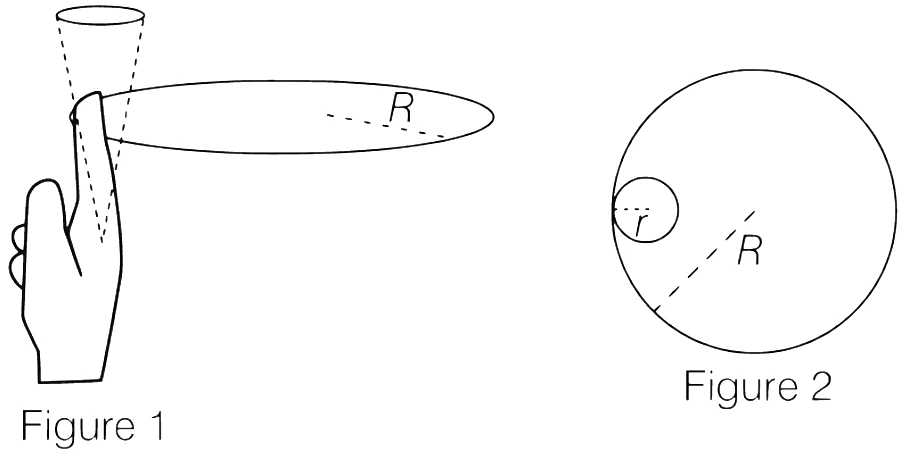
One twirls a circular ring (of mass and radius ) near the tip of one's finger as shown in Figure 1. In the process the finger never loses contact with the inner rim of the ring. The finger traces out the surface of a cone, shown by the dotted line. The radius of the path traced out by the point where the ring and the finger is in contact is . The finger rotates with an angular velocity . The rotating ring rolls without slipping on the outside of a smaller circle described by the point where the ring and the finger is in contact (Figure 2). The coefficient of friction between the ring and the finger is and the acceleration due to gravity is .
The minimum value of below which the ring will drop down is
Answer: (c)
Step-by-step solution coming soon.
Rolling Motion
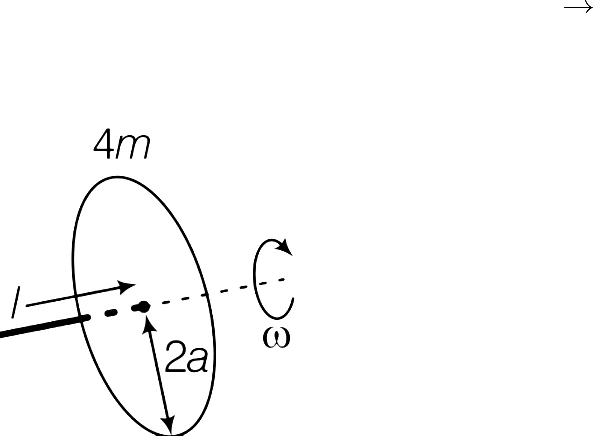
Two thin circular discs of mass and , having radii of and , respectively, are rigidly fixed by a massless, rigid rod of length through their centers. This assembly is laid on a firm and flat surface, and set rolling without slipping on the surface so that the angular speed about the axis of the rod is . The angular momentum of the entire assembly about the point is (see the figure). Which of the following statement(s) is(are) true?
More than one option can be correct. Tap every correct option, then tap Check.
Answer: (a), (c)
Step-by-step solution coming soon.
Rolling Motion
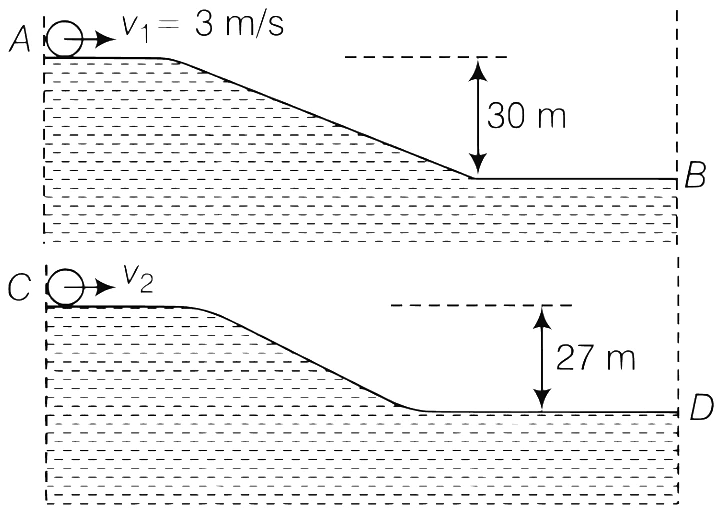
Two identical uniform discs roll without slipping on two different surfaces and (see figure) starting at and with linear speeds and , respectively, and always remain in contact with the surfaces. If they reach and with the same linear speed and , then in m/s is ()
Numerical answer type. Work it out, then open the answer.
Answer: 7
Step-by-step solution coming soon.
Rolling Motion
Two solid cylinders and of same mass and same radius start rolling down a fixed inclined plane from the same height at the same time. Cylinder has most of its mass concentrated near its surface, while has most of its mass concentrated near the axis. Which statement(s) is(are) correct?
More than one option can be correct. Tap every correct option, then tap Check.
Answer: (d)
Step-by-step solution coming soon.
Rolling Motion
The figure shows a system consisting of (i) a ring of outer radius rolling clockwise without slipping on a horizontal surface with angular speed and (ii) an inner disc of radius rotating anti-clockwise with angular speed . The ring and disc are separated by frictionless ball bearings. The point on the inner disc is at a distance from the origin, where makes an angle of with the horizontal. Then with respect to the horizontal surface,
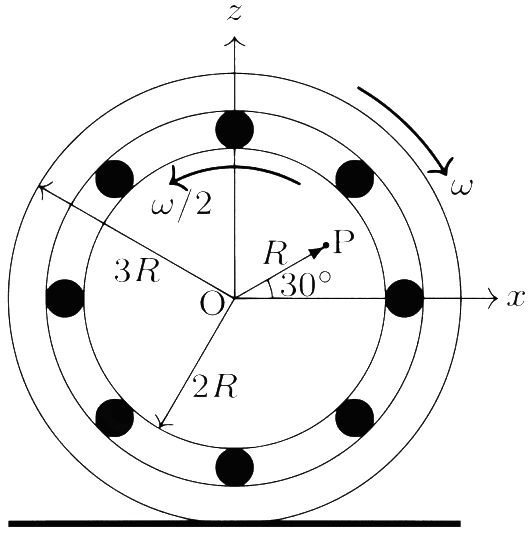
More than one option can be correct. Tap every correct option, then tap Check.
Answer: (a), (b)
Step-by-step solution coming soon.
Rolling Motion
A boy is pushing a ring of mass and radius with a stick as shown in the figure. The stick applies a force of on the ring and rolls it without slipping with an acceleration of . The coefficient of friction between the ground and the ring is large enough that rolling always occurs and the coefficient of friction between the stick and the ring is . The value of is
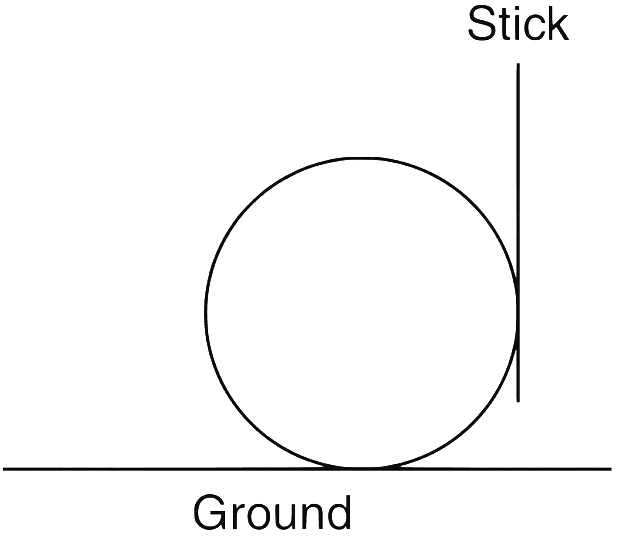
Numerical answer type. Work it out, then open the answer.
Answer: 4
Step-by-step solution coming soon.
Rolling Motion
A sphere is rolling without slipping on a fixed horizontal plane surface. In the figure, is the point of contact, is the centre of the sphere and is its topmost point. Then,
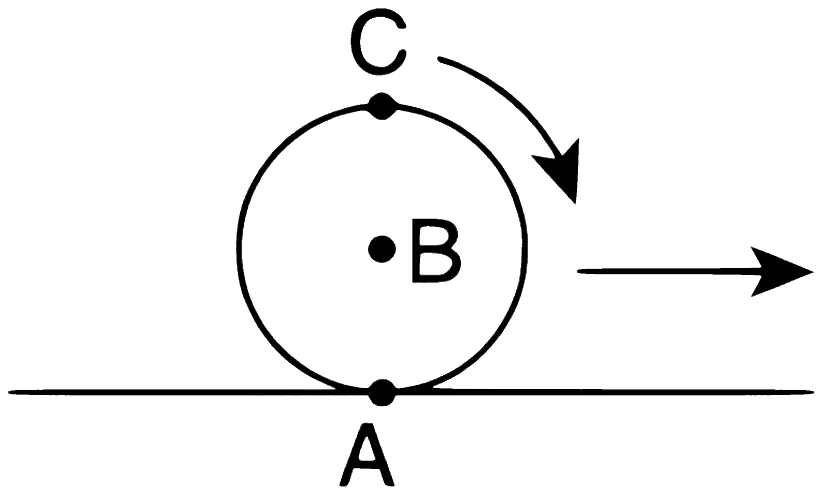
More than one option can be correct. Tap every correct option, then tap Check.
Answer: (b), (c)
Step-by-step solution coming soon.
Rolling Motion
STATEMENT-1: Two cylinders, one hollow (metal) and the other solid (wood) with the same mass and identical dimensions are simultaneously allowed to roll without slipping down an inclined plane from the same height. The hollow cylinder will reach the bottom of the inclined plane first.
and
STATEMENT-2: By the principle of conservation of energy, the total kinetic energies of both the cylinders are identical when they reach the bottom of the incline.
Answer: (d)
Step-by-step solution coming soon.
Rolling Motion
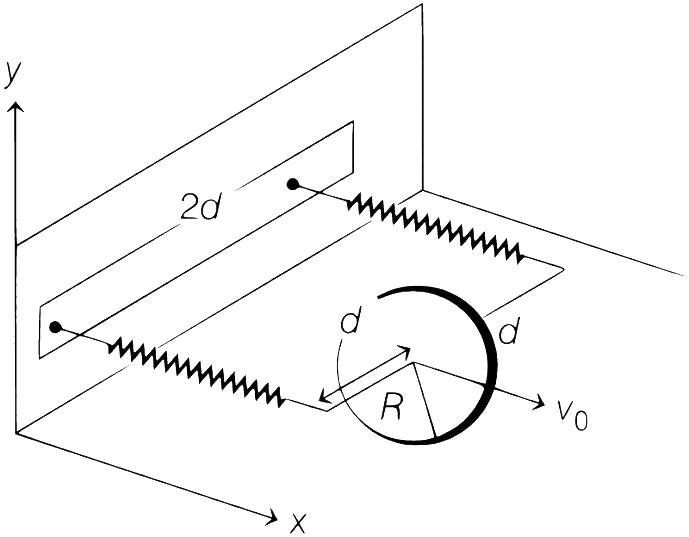
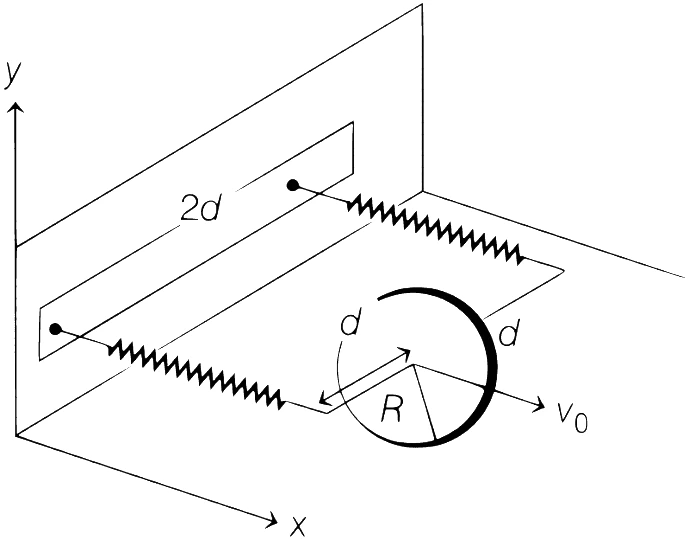
A uniform thin cylindrical disk of mass and radius is attached to two identical massless springs of spring constant which are fixed to the wall as shown in the figure. The springs are attached to the axle of the disk symmetrically on either side at a distance from its centre. The axle is massless and both the springs and the axle are in a horizontal plane. The unstretched length of each spring is . The disk is initially at its equilibrium position with its centre of mass (CM) at a distance from the wall. The disk rolls without slipping with velocity . The coefficient of friction is .
The net external force acting on the disk when its centre of mass is at displacement with respect to its equilibrium position is
Answer: (d)
Step-by-step solution coming soon.
Rolling Motion
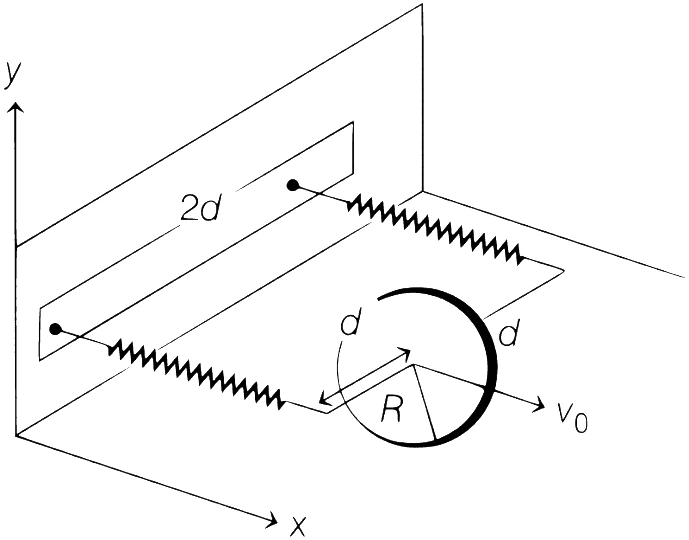
A uniform thin cylindrical disk of mass and radius is attached to two identical massless springs of spring constant which are fixed to the wall as shown in the figure. The springs are attached to the axle of the disk symmetrically on either side at a distance from its centre. The axle is massless and both the springs and the axle are in a horizontal plane. The unstretched length of each spring is . The disk is initially at its equilibrium position with its centre of mass (CM) at a distance from the wall. The disk rolls without slipping with velocity . The coefficient of friction is .
The centre of mass of the disk undergoes simple harmonic motion with angular frequency equal to
Answer: (d)
Step-by-step solution coming soon.
Rolling Motion
A uniform thin cylindrical disk of mass and radius is attached to two identical massless springs of spring constant which are fixed to the wall as shown in the figure. The springs are attached to the axle of the disk symmetrically on either side at a distance from its centre. The axle is massless and both the springs and the axle are in a horizontal plane. The unstretched length of each spring is . The disk is initially at its equilibrium position with its centre of mass (CM) at a distance from the wall. The disk rolls without slipping with velocity . The coefficient of friction is .
The maximum value of for which the disk will roll without slipping is
Answer: (c)
Step-by-step solution coming soon.
Rolling Motion
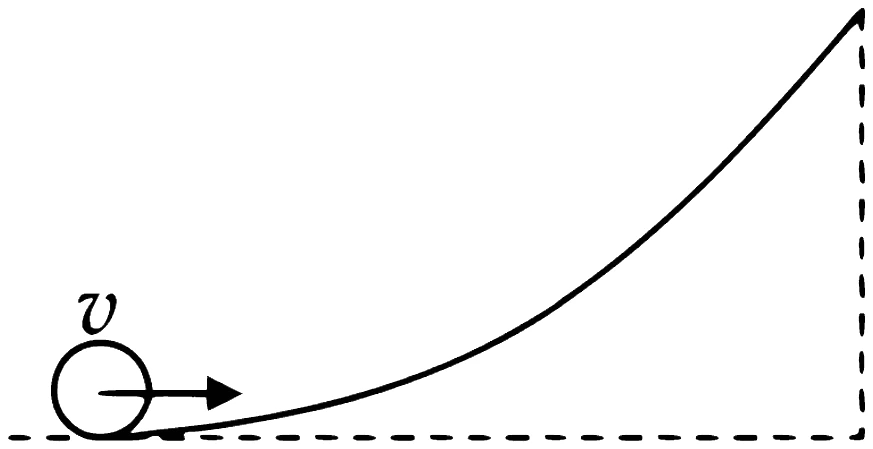
A small object of uniform density rolls up a curved surface with an initial velocity . It reaches up to a maximum height of with respect to the initial position. The object is
Answer: (d)
Step-by-step solution coming soon.
Rolling Motion
A solid cylinder of mass and radius is rolling on a rough inclined plane of inclination . The coefficient of friction between the cylinder and incline is . Then
More than one option can be correct. Tap every correct option, then tap Check.
Answer: (c), (d)
Step-by-step solution coming soon.
Rolling Motion
A cylinder of mass and radius rolls down on an inclined plane of inclination . Calculate the linear acceleration of the axis of the cylinder.
Answer: (a)
Step-by-step solution coming soon.
Rolling Motion
Assertion : The total kinetic energy of a rolling solid sphere is the sum of translational and rotational kinetic energies.
Reason : For all solid bodies, total kinetic energy is always twice of translational kinetic energy.
Answer: (c)
Step-by-step solution coming soon.
Rolling Motion
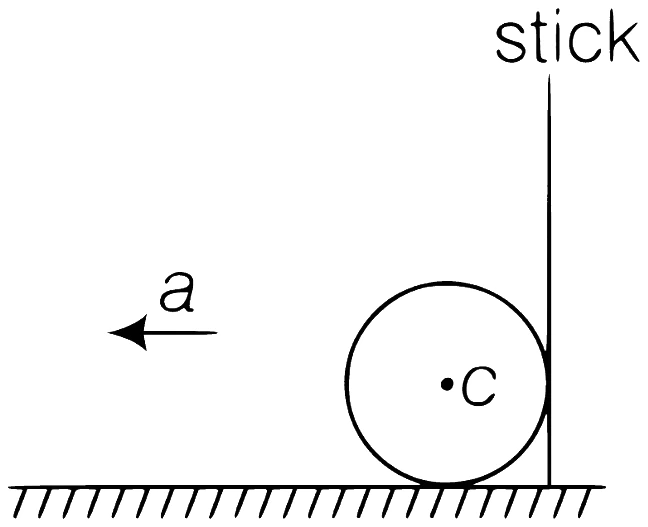
A boy is pushing a ring of mass and radius with a stick as shown in figure. The stick applies a force of on the ring and rolls it without slipping with an acceleration of . The coefficient of friction between the ground and the ring is large enough that rolling always occurs and the coefficient of friction between the stick and the ring is . The value of is
Answer: (a)
Step-by-step solution coming soon.
Rolling Motion
A uniform sphere of mass rolls without slipping on a plane surface so that its centre moves at a speed of .
The total kinetic energy of rolling sphere would be (in J)
Answer: (a)
Step-by-step solution coming soon.
Rolling Motion
A uniform disc is acted by two equal forces of magnitude . One of them, acts tangentially to the disc, while other one is acting at the central point of the disc. The friction between disc surface and ground surface is . If be the radius of the disc, then the value of would be (in N)
Answer: (a)
Step-by-step solution coming soon.
Rolling Motion
Assertion : In case of pure rolling, the force of friction becomes zero.
Reason : The speed at the point of contact is zero.
Answer: (a)
Step-by-step solution coming soon.
Rolling Motion
A solid sphere rolls without slipping on the roof. The ratio of its rotational kinetic energy and its total kinetic energy is
Answer: (c)
Step-by-step solution coming soon.
Rolling Motion
A thin hollow sphere of mass is completely filled with a liquid of mass . When the sphere rolls with a velocity , kinetic energy of the system is (neglect friction)
Answer: (c)
Step-by-step solution coming soon.
Rolling Motion
Assertion : When a body accelerates down an incline rolling purely. Static friction force acts on the body.
Reason : Point of contact of the body with incline remains at rest.
Answer: (a)
Step-by-step solution coming soon.
Rolling Motion
In each of the following questions a statement of Assertion is given followed by a corresponding statement of Reason just below it. Of the statements mark the correct answer is
Assertion : The velocity of a body at the bottom of an inclined plane of given height is more when it slides down the plane, compared to, when it rolling down the same plane.
Reason : In rolling down a body acquires both, kinetic energy of translation and rotation.
Answer: (a)
Step-by-step solution coming soon.
Rolling Motion
A solid sphere is rolling on a frictionless surface, shown in figure with a translational velocity . If it is to climb the inclined surface then should be :

Answer: (b)
Step-by-step solution coming soon.
Rolling Motion
A cylinder rolls up an inclined plane, reaches some height and then rolls down (without slipping throughout these motions). The directions of the frictional force acting on the cylinder are
Answer: (b)
Step-by-step solution coming soon.
Rolling Motion
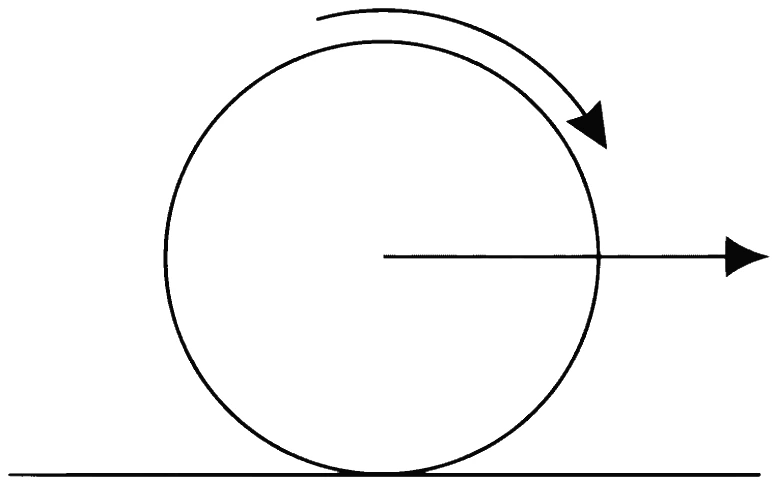
A bicycle wheel rolls without slipping on a horizontal floor. Which one of the following is true about the motion of points on the rim of the wheel, relative to the axis at the wheel's centre?
Answer: (c)
Step-by-step solution coming soon.
Rolling Motion
A solid sphere of mass and radius rolls down an inclined plane of height without slipping. The speed of its centre of mass when it reaches the bottom is
Answer: (c)
Step-by-step solution coming soon.
Rolling Motion
A ball of radius rolls without slipping. Find the fraction of total energy associated with its rotational energy, if the radius of gyration of the ball about an axis passing through its centre of mass is .
Answer: (a)
Step-by-step solution coming soon.
Rolling Motion
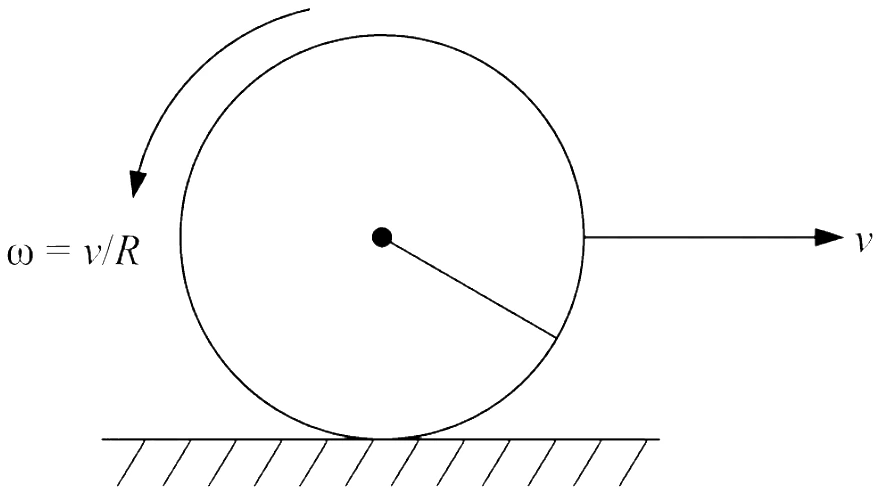
A solid sphere is set into motion on a rough horizontal surface with a linear speed in the forward direction and an angular speed in the anticlockwise direction as shown in figure. Find the linear speed of the sphere when it stops rotating.
Answer: (a)
Step-by-step solution coming soon.
Rolling Motion
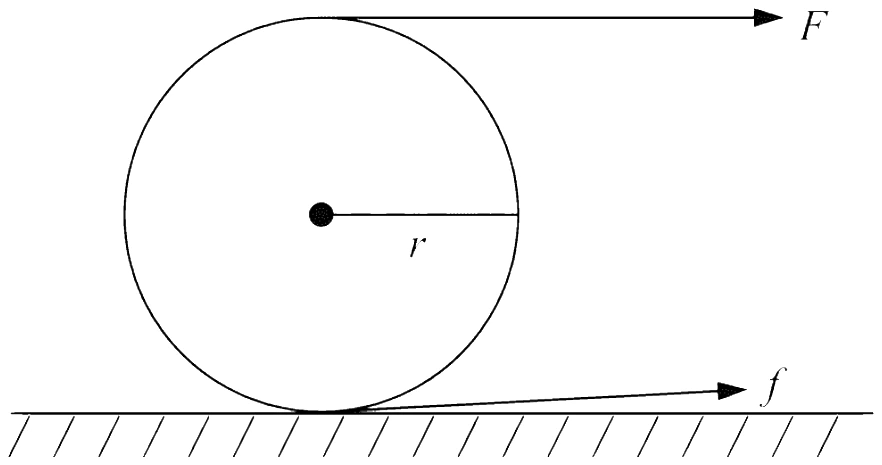
A tangential force acting on the top of a sphere of mass kept on a rough horizontal plane as shown in figure. If the sphere rolls without slipping, then the acceleration with which the centre of the sphere moves is
Answer: (a)
Step-by-step solution coming soon.
Rolling Motion
A drum of radius and mass rolls down without slipping along an inclined plane of angle . The frictional force
Answer: (a)
Step-by-step solution coming soon.
Rolling Motion
If a spherical ball rolls on a table without slipping, the fraction of its total energy associated with rotational energy is:
Answer: (b)
Step-by-step solution coming soon.
Rolling Motion
A solid cylinder starts rolling down an inclined plane from a height . The velocity of its centre of mass when it reaches the bottom of the incline is
Answer: (b)
Step-by-step solution coming soon.
Rolling Motion
A solid sphere having mass and radius moves down a plane inclined at an angle . Find the ratio between its acceleration when it rolls without slipping and its acceleration when it slides down the same plane without any rotation.
Answer: (a)
Step-by-step solution coming soon.
Rolling Motion
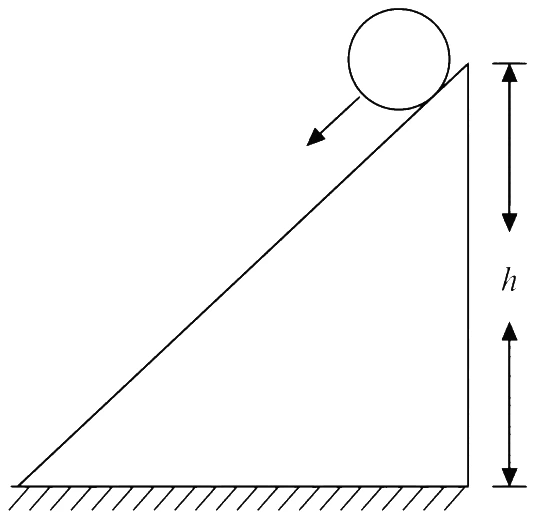
A solid cylinder of mass and radius rolls down inclined plane without slipping. The speed of its C.M. when it reaches the bottom is
Answer: (b)
Step-by-step solution coming soon.
Rolling Motion
The centre of a wheel rolling on a plane surface moves with a speed . A particle on the rim of the wheel at the same level as the centre will be moving at speed
Answer: (d)
Step-by-step solution coming soon.
Rolling Motion
In figure and represent the total energy and speed of centre of mass of an object of mass in pure rolling. The object is
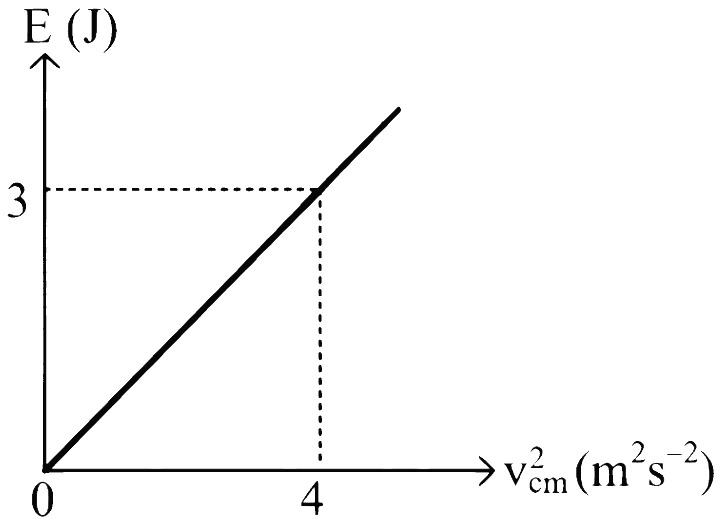
Answer: (c)
Step-by-step solution coming soon.
Rolling Motion
A solid cylinder rolls down an incline without slipping. Its acceleration depends on:
Answer: (d)
Step-by-step solution coming soon.
Rolling Motion
A hollow sphere rolls on an inclined plane of height without slipping. If it starts from rest, its speed at the bottom is
Answer: (c)
Step-by-step solution coming soon.
Rolling Motion
A ring of mass and radius is rolling without slipping on a horizontal floor. If the translational kinetic energy of the ring is , then its rotational kinetic energy is
Answer: (c)
Step-by-step solution coming soon.
Rolling Motion
The rotational kinetic energy of a solid sphere of mass and radius rolling down an inclined plane of height is (nearer to)
Answer: (d)
Step-by-step solution coming soon.
Rolling Motion
The acceleration of a uniform disc rolling down an inclined plane of length is times the acceleration due to gravity. If a solid sphere is rolling down from the top of the same inclined plane, then the velocity with which it reaches the bottom of the plane is
Answer: (c)
Step-by-step solution coming soon.
Rolling Motion
If a solid sphere is rolling without slipping on a horizontal plane, then the ratio of its rotational and total kinetic energies is
Answer: (b)
Step-by-step solution coming soon.
Rolling Motion
A thin uniform circular disc rolls with a constant velocity without slipping on a horizontal surface. Its total kinetic energy is
Answer: (a)
Step-by-step solution coming soon.
Rolling Motion
A thin circular ring and a circular disc of equal mass are rolling without sliding. If their linear velocities are equal and the total kinetic energy of the disc is , then the total kinetic energy of the ring is
Answer: (c)
Step-by-step solution coming soon.
Rolling Motion
A solid sphere of mass and radius is on an inclined plane. If the acceleration of the sphere when it rolls down without sliding is , then the acceleration of the sphere when it slides down without rolling is
Answer: (d)
Step-by-step solution coming soon.
Rolling Motion
One ring, one solid sphere and one solid cylinder are rolling down the same inclined plane starting from rest. The radii of all three are equal. The object that reaches the bottom with the maximum velocity is
Answer: (b)
Step-by-step solution coming soon.
Rolling Motion
A solid cylinder rolls down an inclined plane of height and inclination . The speed of the cylinder at the bottom is
Answer: (d)
Step-by-step solution coming soon.
Rolling Motion
A solid cylinder rolls down an inclined plane without slipping. If the translational kinetic energy of the cylinder is , the total kinetic energy of the cylinder is
Answer: (c)
Step-by-step solution coming soon.
Rolling Motion
A ring and a disc of the same mass and the same diameter are rolling without slipping. Their linear velocities are the same. Then the ratio of their kinetic energies is
Answer: (b)
Step-by-step solution coming soon.
Rolling Motion
The masses of a solid cylinder and a hollow cylinder are and respectively. Both the solid and hollow cylinders start from rest from the top of an inclined plane and roll down without slipping. If both cylinders have equal radius and the acceleration of the solid cylinder is , the acceleration of the hollow cylinder is
Answer: (d)
Step-by-step solution coming soon.
Rolling Motion
A solid cylinder of radius is at rest at a height on an inclined plane. If it rolls down then its velocity on reaching the ground is
Answer: (d)
Step-by-step solution coming soon.
Rolling Motion
A sphere and a hollow cylinder roll down, without slipping, two separate inclined planes A and B, respectively. They cover same distance in a given duration. If the angle of inclination of plane A is , then the angle of inclination of plane B must be (approximately)
Answer: (c)
Step-by-step solution coming soon.
Rolling Motion
A sphere of mass is attached to a spring of spring constant and is held in unstretched position over an inclined plane as shown in the figure. After letting the sphere go, find the maximum length by which the spring extends, given the sphere only rolls.
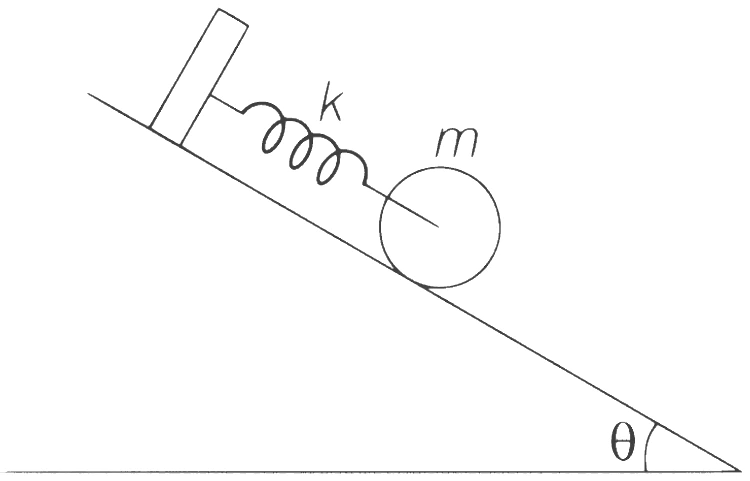
Answer: (a)
Step-by-step solution coming soon.
Rolling Motion
If a solid sphere of mass is rolling without slipping on a surface with a velocity of , then the total kinetic energy of the sphere is
Answer: (b)
Step-by-step solution coming soon.
Rolling Motion
If the kinetic energy of a solid sphere when it rolls without slipping is , then its kinetic energy when it slips without rolling with the same velocity is
Answer: (b)
Step-by-step solution coming soon.
Rolling Motion
A solid sphere rolls down without slipping on an inclined plane of angle of inclination . If the angle of inclination of the plane is increased to , then the percentage increase in the acceleration of the sphere is nearly
Answer: (b)
Step-by-step solution coming soon.
Rolling Motion
A solid sphere of mass and radius is rolling without slipping on a horizontal surface. The ratio of the rotational and translational kinetic energies of the sphere is
Answer: (b)
Step-by-step solution coming soon.
Rolling Motion
A solid sphere and a thin uniform circular disc of the same radius are rolling down an inclined plane without slipping. If the acceleration of the sphere is , then the acceleration of the disc is
Answer: (b)
Step-by-step solution coming soon.
Rolling Motion
A solid sphere rolls down without slipping from the top of an inclined plane of height and angle of inclination . The velocity of the sphere, when it reaches the bottom of the plane is (Acceleration due to gravity )
Answer: (a)
Step-by-step solution coming soon.
Rolling Motion
A body of mass and radius rolling horizontally with a velocity rolls up an inclined plane to a vertical height . The body is
Answer: (c)
Step-by-step solution coming soon.
Rolling Motion
A hollow cylinder and a solid cylinder initially at rest at the top of an inclined plane are rolling down without slipping. If the time taken by the hollow cylinder to reach the bottom of the inclined plane is , the time taken by the solid cylinder to reach the bottom of the inclined plane is
Answer: (d)
Step-by-step solution coming soon.
Rolling Motion
A body is rolling without slipping on a horizontal plane. If the rotational kinetic energy of the body is of its total kinetic energy, then the body is
Answer: (d)
Step-by-step solution coming soon.
Rolling Motion
Moon revolves around the earth in an orbit of radius with time period of revolution . It also rotates about its own axis with a time period . If mass of the moon is and its radius is , the total kinetic energy of the moon is
Answer: (a)
Step-by-step solution coming soon.
Rolling Motion
A solid cylinder of mass and radius rolls down on an inclined plane of height without slipping. The speed of its centre of mass, when the cylinder reaches the bottom is [use ]
Answer: (b)
Step-by-step solution coming soon.
Rolling Motion
A solid spherical ball is rolled up an inclined plane of angle of inclination with an initial speed of at the bottom of the inclination. How far will the ball go up the plane? (Use )
Answer: (c)
Step-by-step solution coming soon.
Rolling Motion
A solid sphere of mass rolls on a smooth horizontal surface at . It then rolls up a smooth inclined plane of inclination with the horizontal. The height attained by the sphere before it stops is [take ]
Answer: (c)
Step-by-step solution coming soon.
Rolling Motion
A solid cylinder is released from rest from the top of an inclined plane of inclination and length . If the cylinder rolls without slipping, then the speed when it reaches the bottom is
Answer: (b)
Step-by-step solution coming soon.
Rolling Motion
A solid sphere and a solid cylinder, each of mass and radius are rolling with a linear speed on a flat surface without slipping. Let be the magnitude of the angular momentum of the sphere with respect to a fixed point along the path of the sphere. Likewise be the magnitude of angular momentum of the cylinder with respect to the same fixed point along its path. The ratio is
Answer: (a)
Step-by-step solution coming soon.
Rolling Motion
A small sphere of mass and radius slides down the smooth surface of a large hemispherical bowl of radius . If the sphere starts sliding from rest, the total kinetic energy of the sphere at the lowest point of the bowl will be [given, moment of inertia of sphere ]
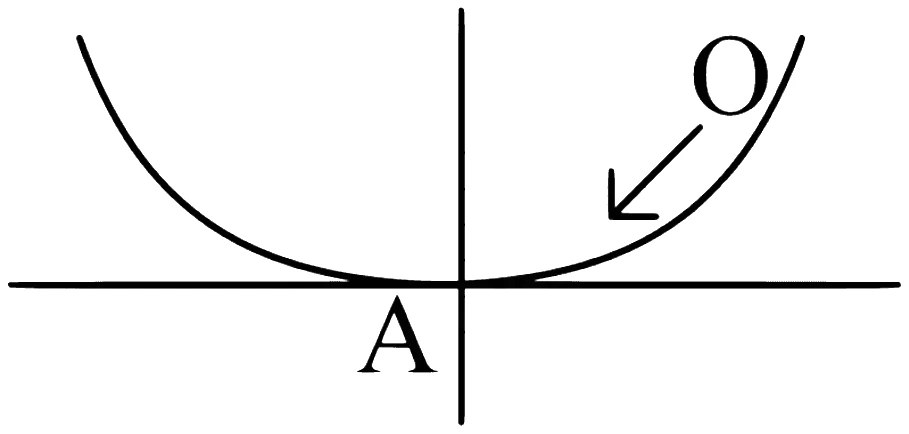
Answer: (a)
Step-by-step solution coming soon.
Rolling Motion
A sphere is given an initial push so that it starts rolling (without slipping) up an inclined plane. During its climb
Answer: (a)
Step-by-step solution coming soon.
Rolling Motion
A wheel of radius is rolling without slipping on a stationary flat surface with a translational speed of . The positions of points , and on the rim of the wheel at time are shown in the figure. The point covers a distance of before it comes in contact with the surface. Assuming that the reference frame is fixed on the flat surface, select the correct statement(s).
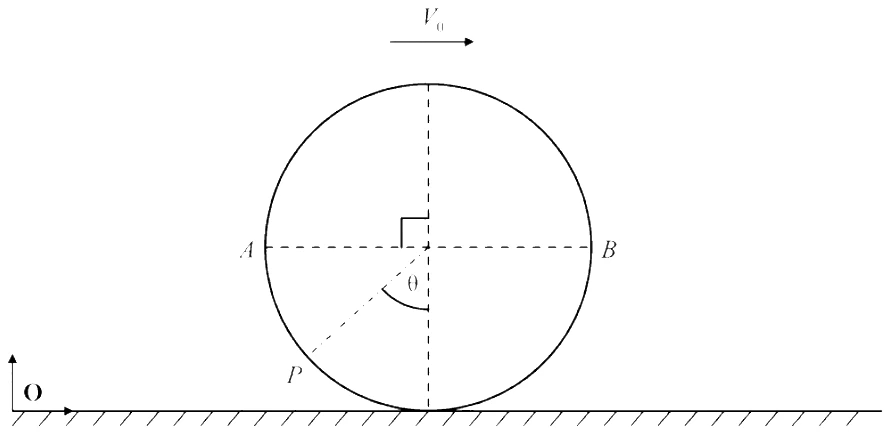
More than one option can be correct. Tap every correct option, then tap Check.
Answer: (a), (c)
Step-by-step solution coming soon.
Rolling Motion
Three objects, a hollow cylinder, a solid cylinder and a solid sphere, are released from the top of an inclined plane. The objects, having equal masses and radii, roll without slipping while coming down the plane. Arrange these objects in the descending order of time required to reach the bottom of the plane (slowest to fastest).
Answer: (b)
Step-by-step solution coming soon.
Rolling Motion
A solid cylinder of mass , length and radius is placed on two horizontal parallel rails of separation . The cylinder carries a constant current . A uniform magnetic field , directed vertically upwards, is switched on. After travelling a distance , its speed is (assume rolling without slipping)
Answer: (b)
Step-by-step solution coming soon.
Rolling Motion
A thin ring, a disk and an annular cylinder, of the same mass , are released from a point from the ground up an inclined plane of inclination. The ring and the disk have the same radius . For the annular cylinder, the outer radius is and the inner radius is . The times taken by the ring, disk and annular cylinder, respectively, to reach the ground are in the ratio,
Answer: (a)
Step-by-step solution coming soon.
Rolling Motion
A solid sphere and a solid cylinder, both of mass and radius , are released from rest at the same height on an inclined plane. Both roll down the plane without slipping. Which of the following statements is/are true?
More than one option can be correct. Tap every correct option, then tap Check.
Answer: (b), (c)
Step-by-step solution coming soon.
No questions match these filters.