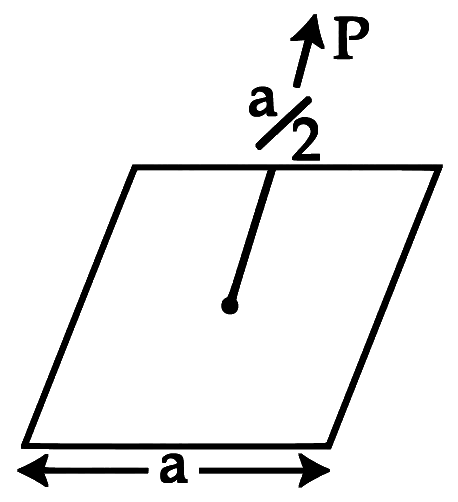
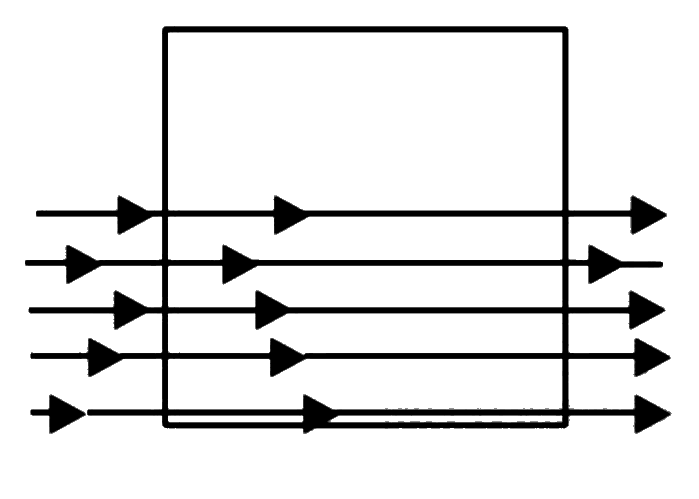
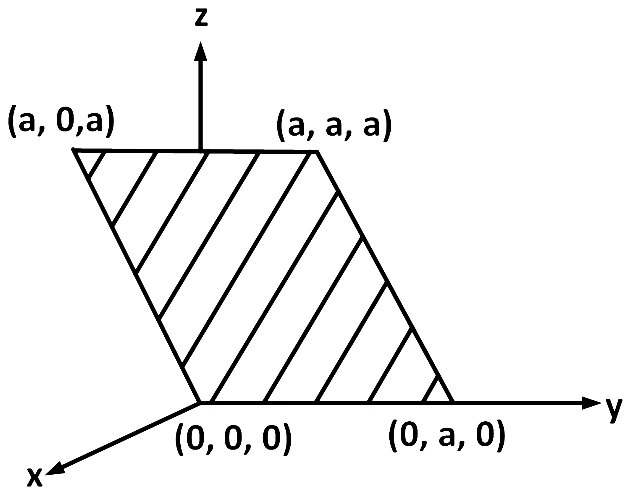
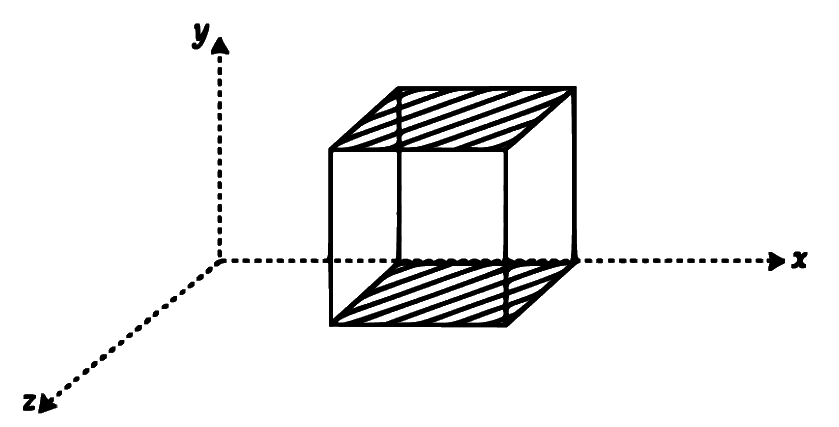
The electric field in the region is E=ai^+bj^ where 'a' and 'b' are constants. The net electric flux passing through a square area of side 'l' parallel to Y-Z plane is
The electric flux entering and leaving an enclosed surface are Φ1 and Φ2 respectively. The electric charge inside the surface will be (ε0 = permittivity of vacuum)
Two point charges 8μC and −2μC are located at x=2 cm and x=4 cm, respectively on the x-axis. The ratio of electric flux due to these charges through two spheres of radii 3 cm and 5 cm with their centers at the origin is ________.
The electric field intensity at a point near and outside the surface of a charged conductor of any shape is E1. The electric field intensity due to a uniformly charged infinite thin plane sheet having the same surface charge density is E2. The relation between E1 and E2 is
A. Inside a conductor, the electrostatic field is zero.
B. Electric field at the surface of a charged conductor does not depend on its surface charge density.
C. The interior of a charged conductor can have no excess charge in the static situation. D. At the surface of a charged conductor, the electrostatic field must be normal to the surface at every point.
E. The electrostatic potential is zero everywhere inside a charged conductor.
Choose the correct answer from the options given below:
Given below are two statements: one is labelled as Assertion A and the other is labelled as Reason R
Assertion A: In electrostatics, a conductor does not store any net charge inside. Reason R: Inside the capacitor (with no dielectric medium), the free charge carriers, if placed between the plates of capacitor, experience force and drift.
Choose the correct answer from the options given below
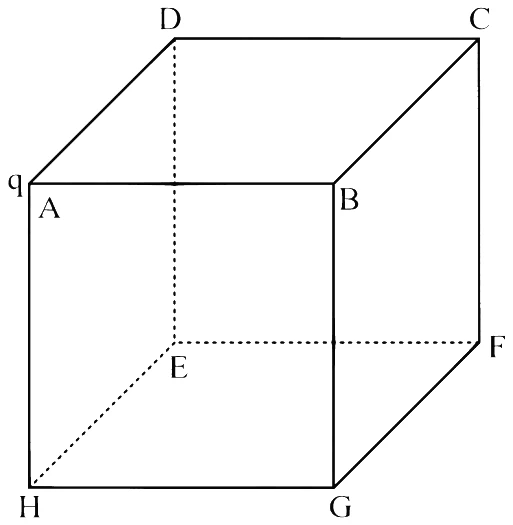
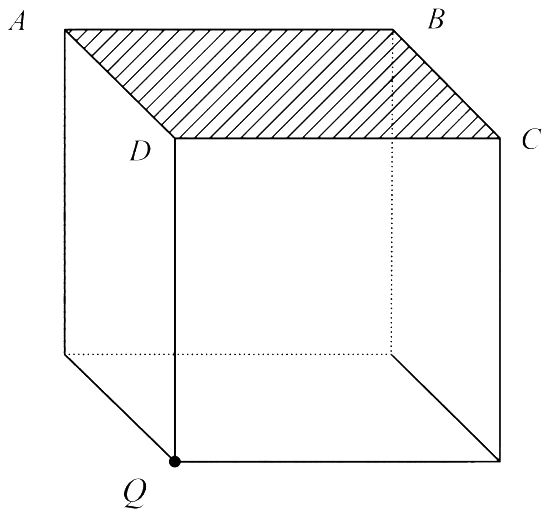
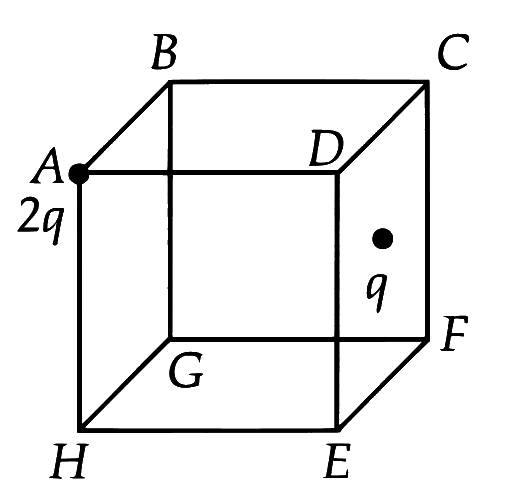
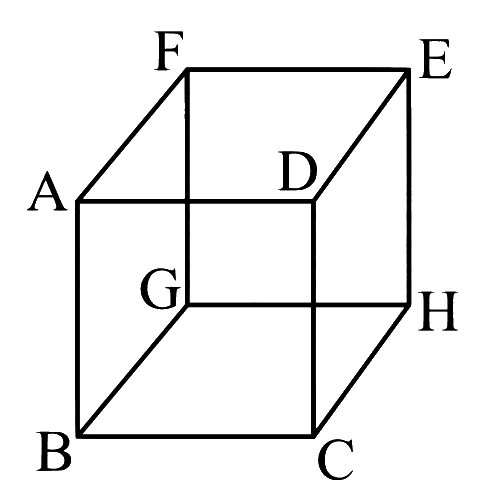
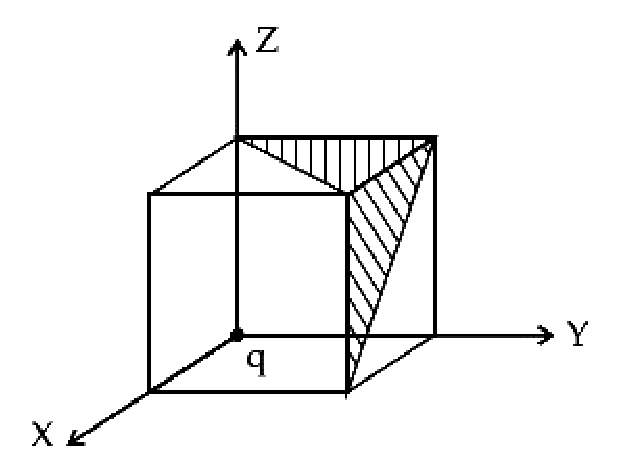
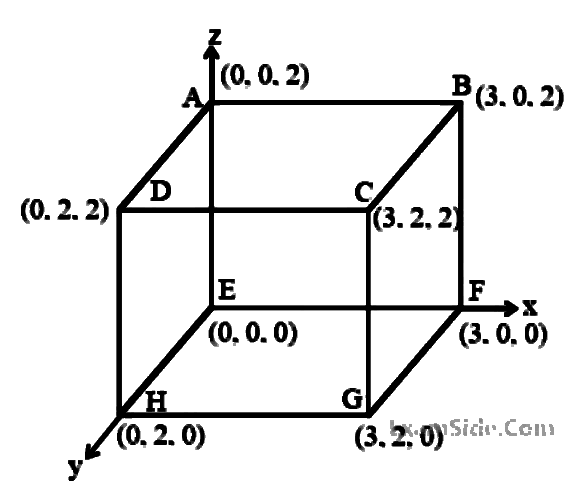
Two point charges 2q and q are placed at vertex A and centre of face CDEF of the cube as shown in figure. The electric flux passing through the cube is:
A spherical conductor of diameter 3 mm is kept in a uniform electric field of intensity 4×10⁷ N/C. The maximum charge on the conductor is (4πϵ01=9×10⁹ SI units)
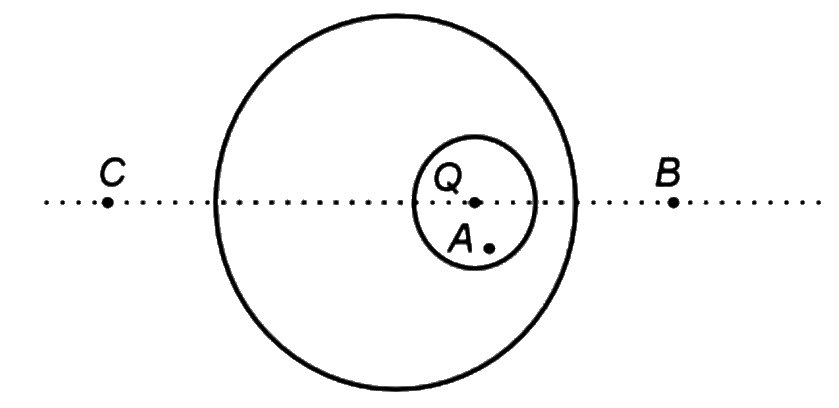
A point charge Q is placed inside a cavity within a solid isolated conducting sphere. Consider points A,B and C as shown in the figure, where the magnitudes of the electric fields are EA,EB,EC, respectively. The points B and C are at the same distance from the center of the solid sphere. The correct option is:
The electric field in a region is given by E=(2i^+4j^+6k^)×103 N/C. The flux of the field through a rectangular surface parallel to x−z plane is 6.0 N m2C−1. The area of the surface is _____________ cm2.
Numerical answer type. Work it out, then open the answer.
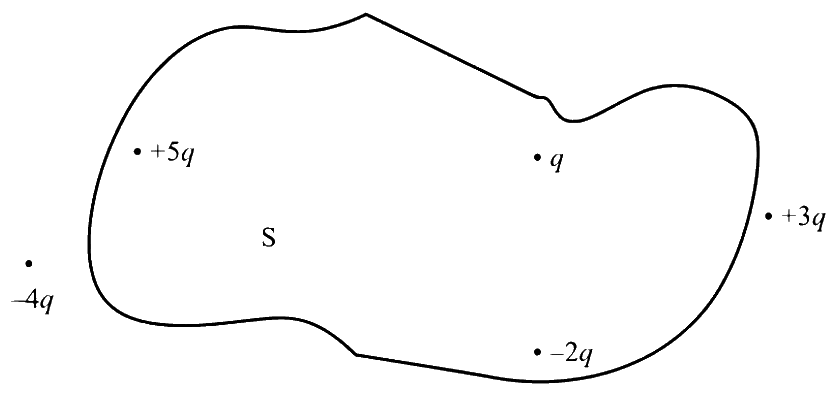
Four charges 2μC,−3μC,4μC,−4μC and −1μC are enclosed by the Gaussian surface of radius 2 m. Net outward flux through the Gaussian surface is (in μV-m) [ ε0= permittivity of free space]
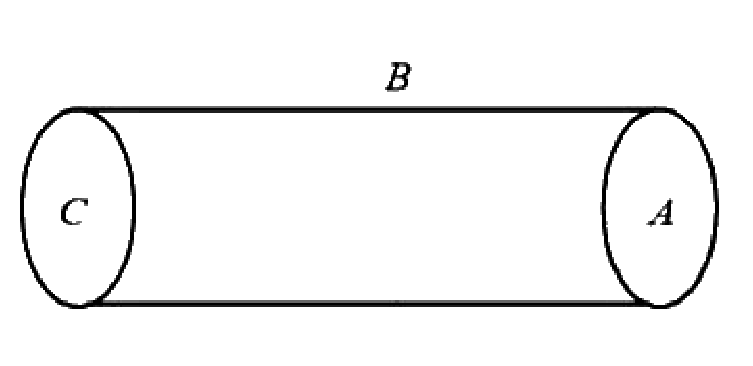
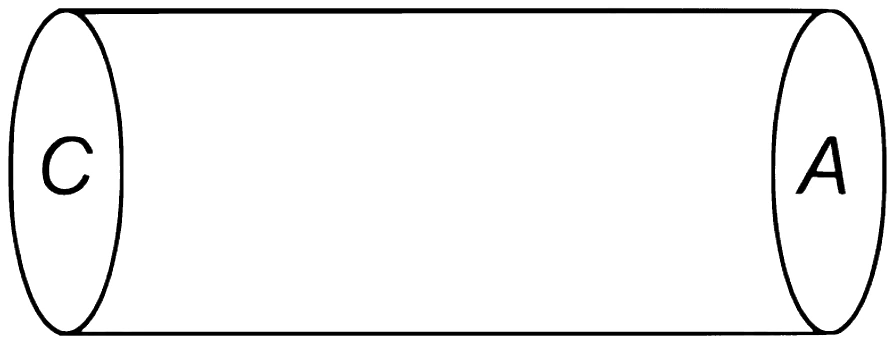
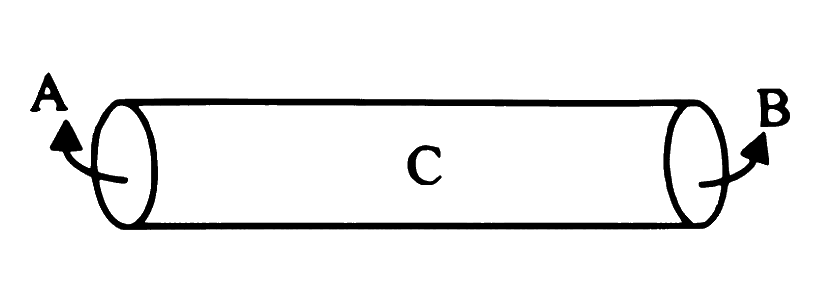
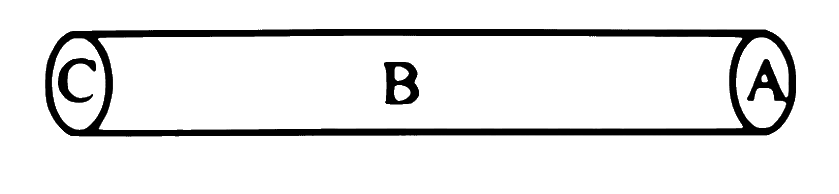
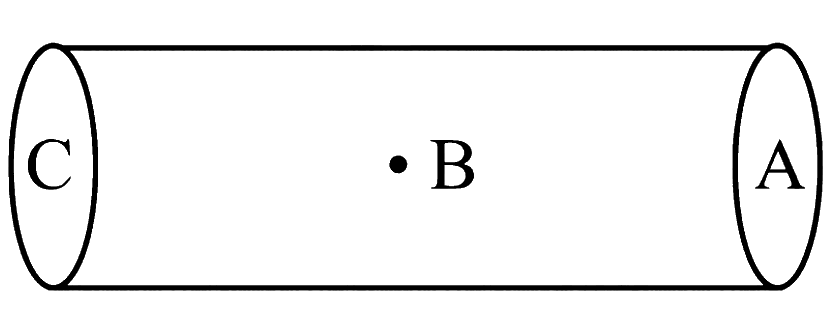
A hollow cylinder has a charge ' q ' coulomb within it. If ' ϕ ' is the electric flux in unit of V-m associated with the curved surface C, the flux linked with the plane surface ' A ' in unit of V-m will be [ ε0= permittivity of free space]0
A hollow cylinder has a charge of ' q ' C within it. If ϕ is the electric flux associated with the curved surface B, the flux linked with the plane surface A will be
A point charge causes an electric flux of −2×10⁴ N m2C−1 to pass through a spherical Gaussian surface of 8.0 cm radius, centred on the charge. The value of the point charge is: (Given ϵ0=8.85×10⁻¹² C2N−1m−2)
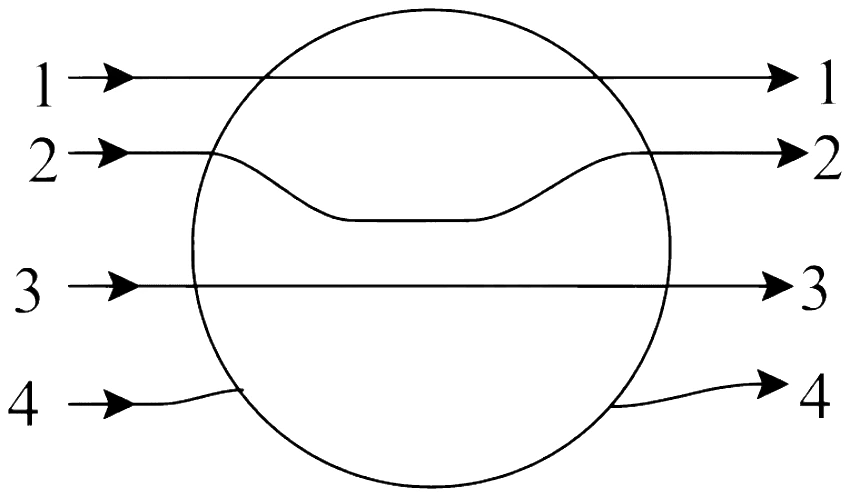
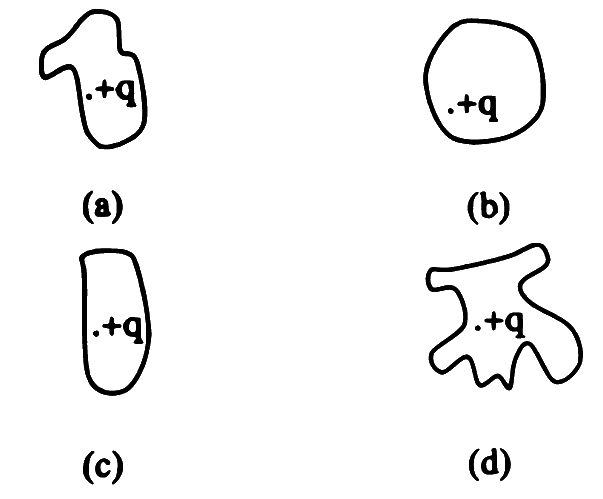
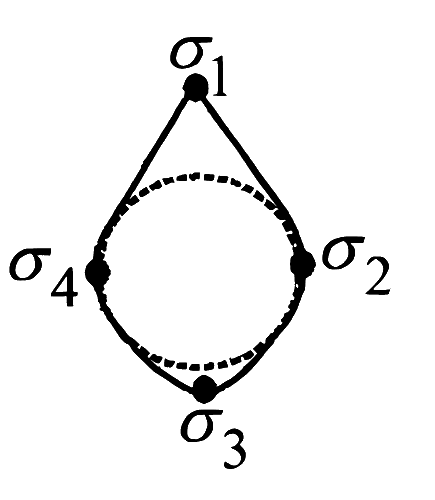
Electric charge is transferred to an irregular metallic disk as shown in the figure. If σ1,σ2,σ3 and σ4 are charge densities at given points then, choose the correct answer from the options given below:
Given below are two statements: one is labelled as Assertion (A) and the other is labelled as Reason (R).
Assertion (A): The outer body of an aircraft is made of metal which protects persons sitting inside from lightning strikes.
Reason (R): The electric field inside the cavity enclosed by a conductor is zero. In the light of the above statements, choose the most−appropriate answer from the options given below:
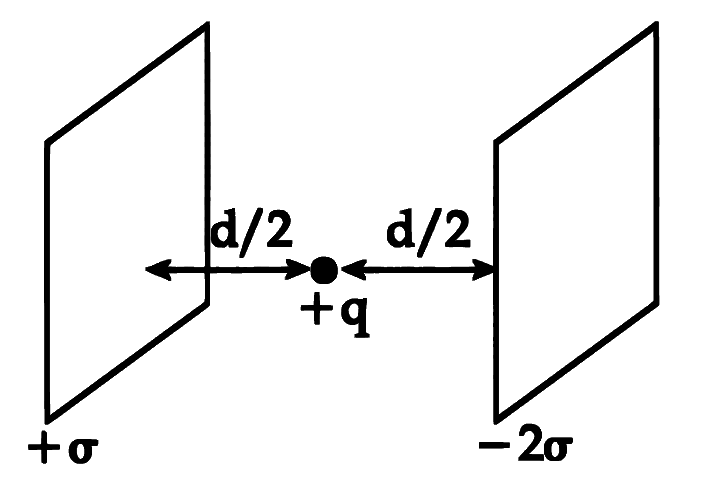
Consider two infinitely large plane parallel conducting plates as shown below. The plates are uniformly charged with a surface charge density +σ and −2σ. The force experienced by a point charge +q placed at the mid point between two plates will be:
A uniformly charged conducting sphere of diameter 3.5 cm has a surface charge density of 20μC m−2. The total electric flux leaving the surface of the sphere is nearly [permittivity of free space, ε0=8.85×10⁻¹² SI unit]
An infinitely long wire has uniform linear charge density λ=2 nC/m. The net flux through a Gaussian cube of side length 3 cm, if the wire passes through any two corners of the cube, that are maximally displaced from each other, would be x Nm2C−1, where x is:
[Neglect any edge effects and use 4πϵ01=9×10⁹ SI units]
A line charge of length 2a is kept at the center of an edge BC of a cube ABCDEFGH having edge length ' a ' as shown in the figure. If the density of line charge is λ C per unit length, then the total electric flux through all the faces of the cube will be ___________. (Take, ϵ0 as the free space permittivity)
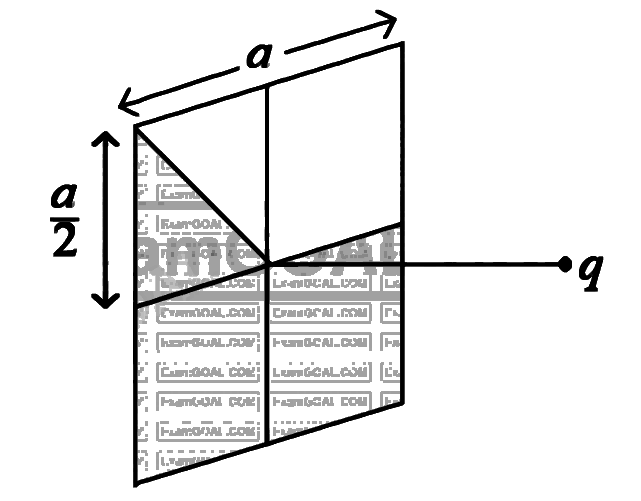
A square loop of sides a=1 m is held normally in front of a point charge q=1 C at a distance 2a. The flux of the electric field through the shaded region is p5×ε01CNm2, where the value of p is ________.
Numerical answer type. Work it out, then open the answer.
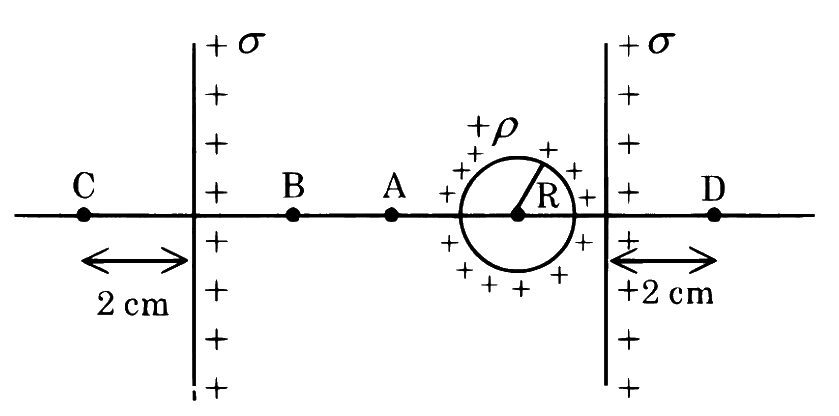
Two infinite identical charged sheets and a charged spherical body of charge density ' ρ ' are arranged as shown in figure. Then the correct relation between the electrical fields at A,B,C and D points is:
An electric field, E=62i^+6j^+8k^ passes through the surface of 4 m2 area having unit vector n^=(62i^+j^+k^). The electric flux for that surface is _________ V m.
Numerical answer type. Work it out, then open the answer.
A hollow cylinder has charge ' q ' C within it. If ' ϕ ' is the electric flux associated with the curved surface B, the flux linked with the plane surface A will be:
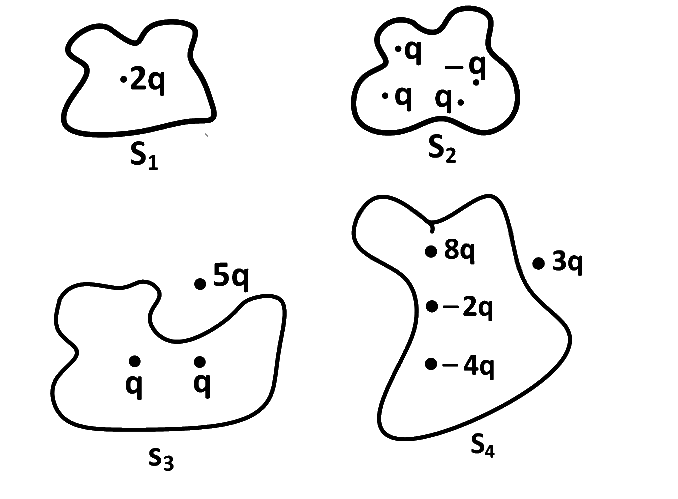
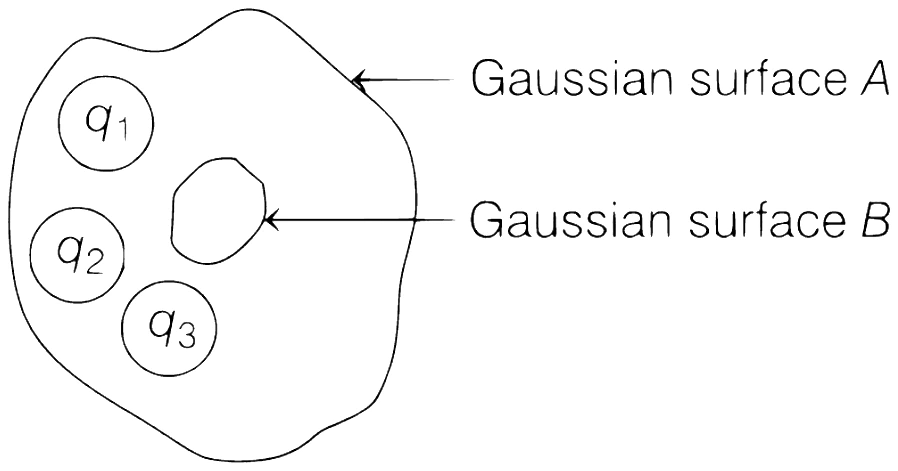
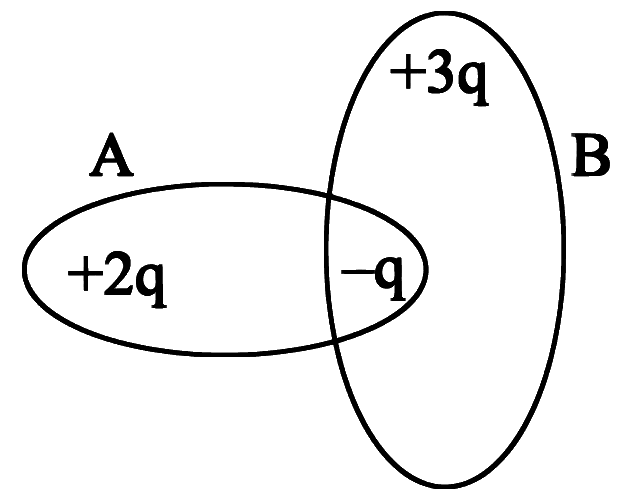
Two surfaces A and B are enclosing the charges as shown below. The total normal electric induction (T.N.E.I) through the surfaces A and B are respectively.
A spherical rubber balloon carries a charge, uniformly distributed over the surface. As the balloon is blown up and increases in size, the total electric flux coming out of the surface
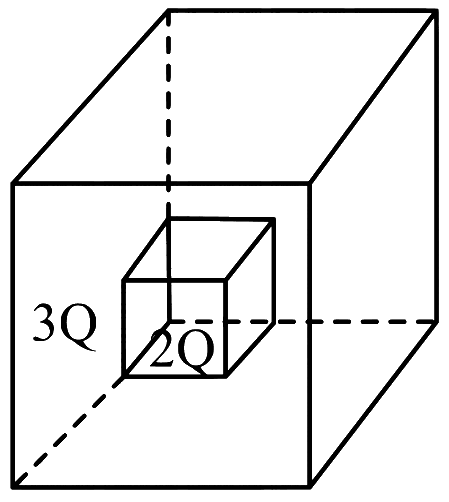
C1 and C2 are two hollow concentric cubes enclosing charges 2Q and 3Q respectively as shown in figure. The ratio of electric flux passing through C1 and C2 is:
Two charges of 5Q and −2Q are situated at the points (3a,0) and (−5a,0) respectively. The electric flux through a sphere of radius '4a' having center at origin is:
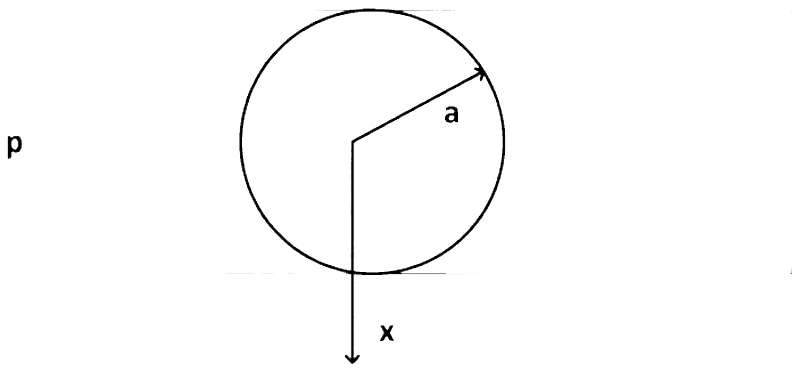
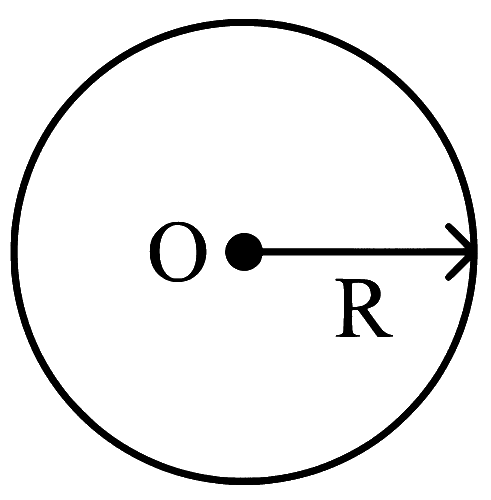
σ is the uniform surface charge density of a thin spherical shell of radius R. The electric field at any point on the surface of the spherical shell is:
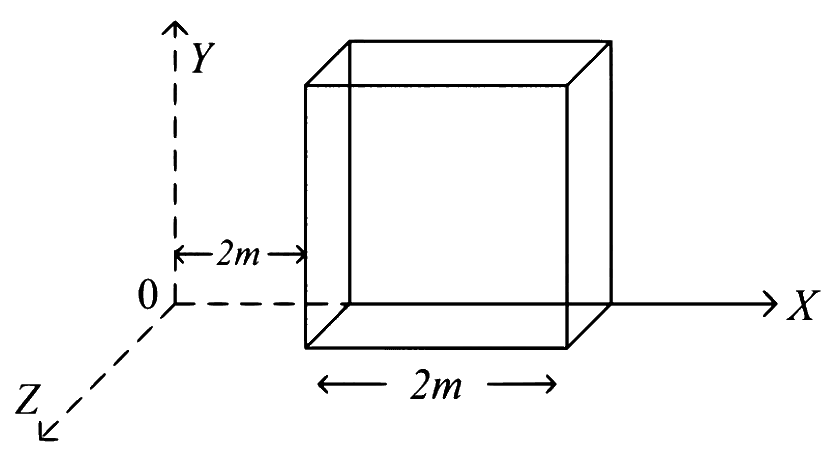
An electric field E=(2xi^) NC−1 exists in space. A cube of side 2 m is placed in the space as per figure given below. The electric flux through the cube is ______ Nm2/C.
Numerical answer type. Work it out, then open the answer.
A uniformly charged conducting sphere of diameter 14 cm has surface charge density of 40μC m−2. The total electric flux leaving the surface of the sphere is nearly (Permittivity of free space =8.85×10⁻¹² SI unit)
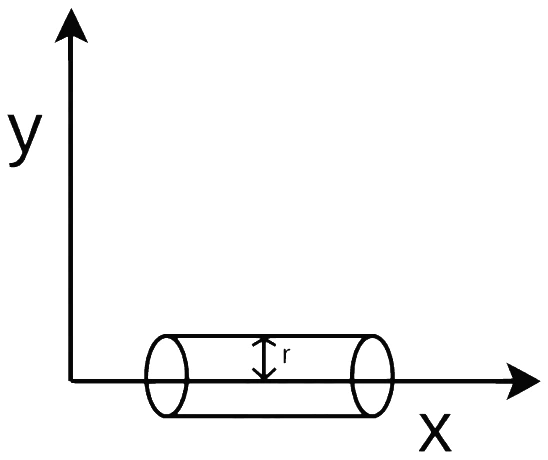
Consider a long uniformly charged cylinder having constant volume charge density ' λ ' and radius ' R '. A Gaussian surface is in the form of a cylinder of radius ' r ' such that vertical axis of both the cylinders coincide. For a point inside the cylinder (r<R), electric field is directly proportional to
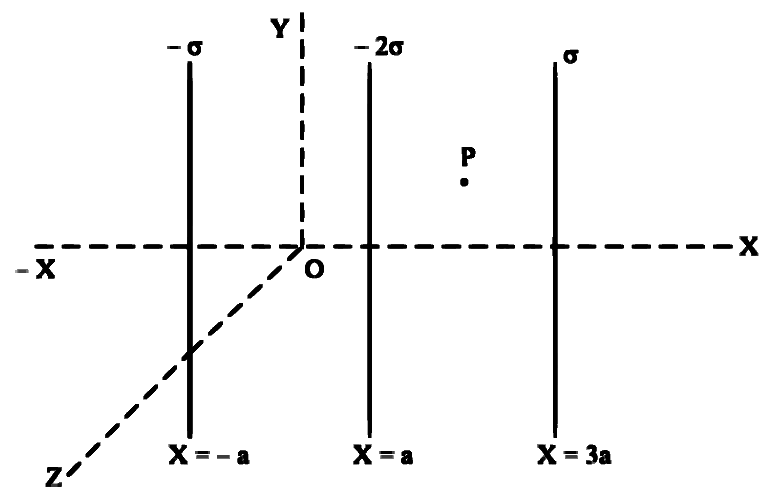
Three infinitely long charged thin sheets are placed as shown in figure. The magnitude of electric field at the point P is ϵ0xσ. The value of x is _________ (all quantities are measured in SI units).
Numerical answer type. Work it out, then open the answer.
An infinite plane sheet of charge having uniform surface charge density +σs C/m2 is placed on x-y plane. Another infinitely long line charge having uniform linear charge density +λe C/m is placed at z=4 m plane and parallel to y-axis. If the magnitude values ∣σs∣=2∣λe∣ then at point (0,0,2), the ratio of magnitudes of electric field values due to sheet charge to that of line charge is πn:1. The value of n is _________.
Numerical answer type. Work it out, then open the answer.
A charge 17.7×10⁻⁴ C is distributed uniformly over a large sheet of area 200 m2. The electric field intensity at a distance 20 cm from it in air will be [ε0=8.85×10⁻¹² C2/N m2]
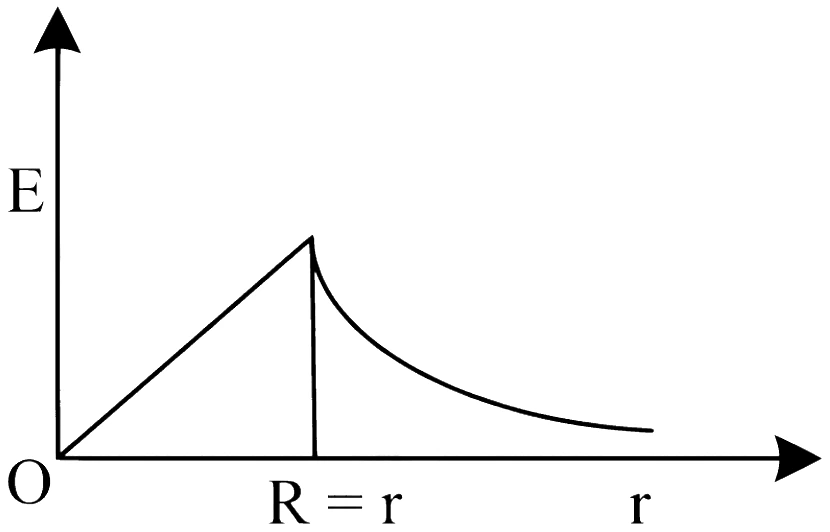
Graphical variation of electric field due to a uniformly charged insulating solid sphere of radius R, with distance r from the centre O is represented by:
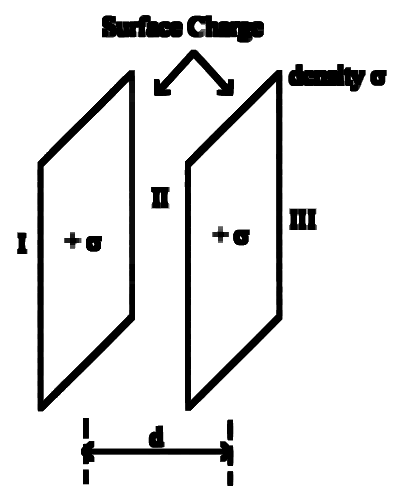
Let σ be the uniform surface charge density of two infinite thin plane sheets shown in figure. Then the electric fields in three different regions EI,EII and EIII are:
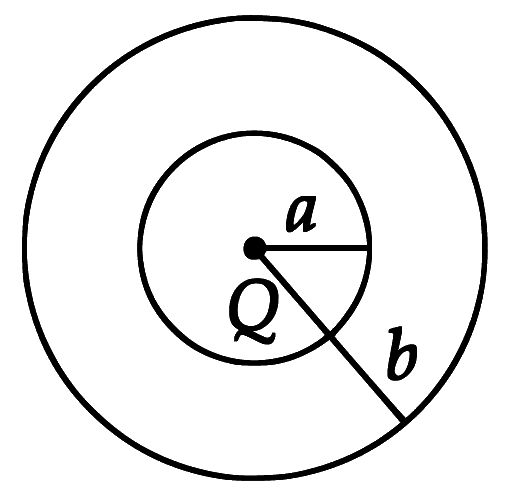
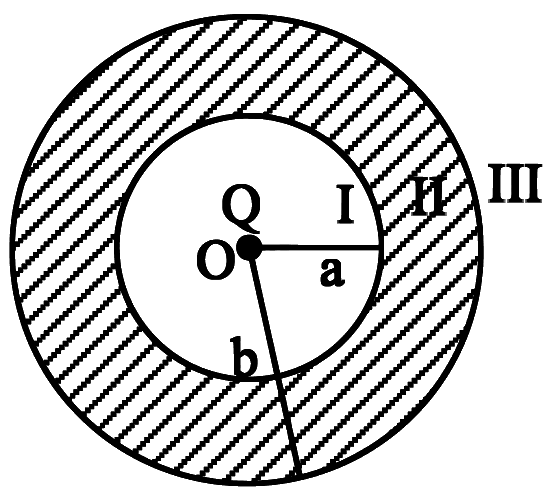
As shown in the figure, a point charge Q is placed at the centre of conducting spherical shell of inner radius a and outer radius b. The electric field due to charge Q in three different regions I, II and III is given by:
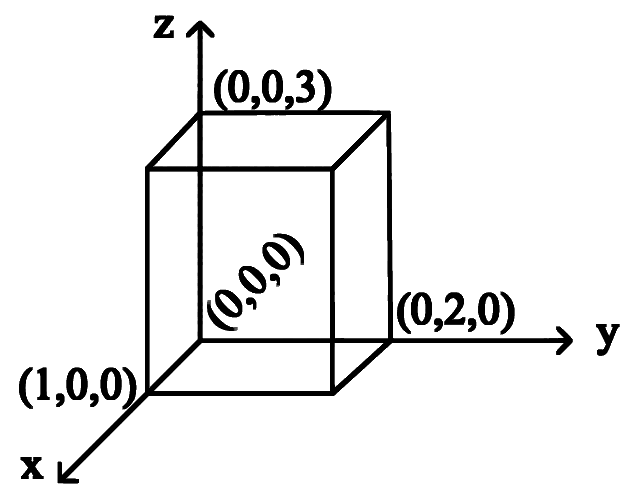
A cubical volume is bounded by the surfaces x=0,x=a,y=0,y=a,z=0,z=a. The electric field in the region is given by E=E0xi^. Where E0=4×10⁴ NC−1 m−1. If a=2 cm, the charge contained in the cubical volume is Q×10−14 C. The value of Q is ________________. (Take ϵ0=9×10⁻¹² C2/Nm2)
Numerical answer type. Work it out, then open the answer.
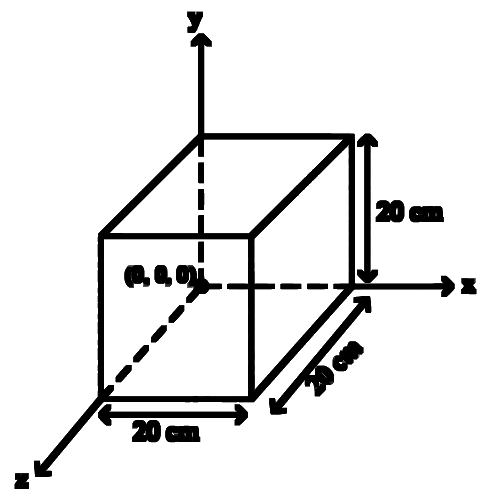
Expression for an electric field is given by E=4000x2i^mV. The electric flux through the cube of side 20 cm when placed in electric field (as shown in the figure) is __________ V cm.
Numerical answer type. Work it out, then open the answer.
In a cuboid of dimension 2L×2L×L, a charge q is placed at the center of the surface 'S' having area of 4L2. The flux through the opposite surface to 'S' is given by
A thin infinite sheet charge and an infinite line charge of respective charge densities +σ and +λ are placed parallel at 5 m distance from each other. Points 'P' and 'Q' are at π3 m and π4 m perpendicular distances from line charge towards sheet charge, respectively. 'EP ' and 'EQ' are the magnitudes of resultant electric field intensities at point 'P' and 'Q', respectively. If EQEP=a4 for 2∣σ∣=∣λ∣, then the value of a is ___________.
Numerical answer type. Work it out, then open the answer.
A conducting sphere of radius 0.1 m has uniform charge density 1.8μC/m2 on its surface. The electric field in free space at radial distance 0.2 m from a point on the surface is ( ε0= permittivity of free space)
A solid metallic sphere has a charge +3Q. Concentric with this sphere is a conducting spherical shell having charge −Q. The radius of the sphere is 'A' and that of the spherical shell is 'B'. (B>A). The electric field at a distance 'R' (A<R<B) from the centre is ( ε0= permittivity of vacuum)
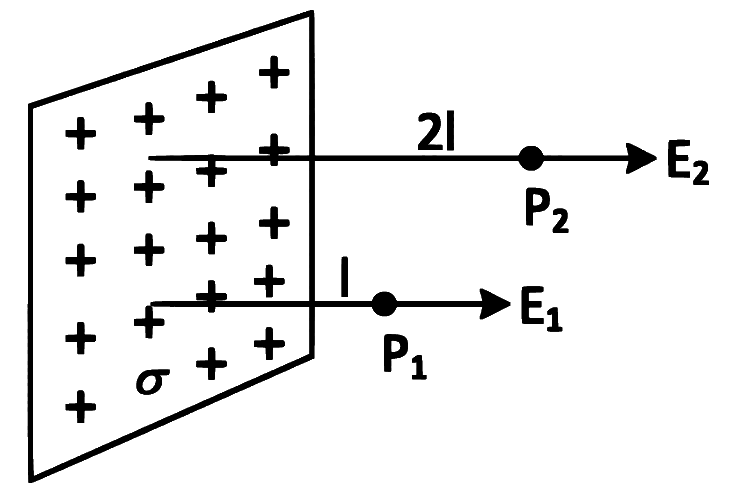
In the figure, a very large plane sheet of positive charge is shown. P1 and P2 are two points at distance l and 2l from the charge distribution. If σ is the surface charge density, then the magnitude of electric fields E1 and E2 at P1 and P2 respectively are:
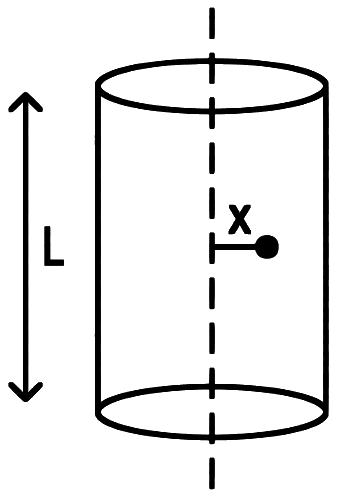
A long cylindrical volume contains a uniformly distributed charge of density ρ C m−3. The electric field inside the cylindrical volume at a distance x=ρ2ε0 m from its axis is ________ V m−1.
Numerical answer type. Work it out, then open the answer.
Statement I: Electric potential is constant within and at the surface of each conductor. Statement II: Electric field just outside a charged conductor is perpendicular to the surface of the conductor at every point.
In the light of the above statements, choose the most appropriate answer from the options given below.
The volume charge density of a sphere of radius 6 m is 2μC cm−3. The number of lines of force per unit surface area coming out from the surface of the sphere is _______________ ×1010 NC−1. [Given: Permittivity of vacuum ϵ0=8.85×10⁻¹² C2 N−1-m−2 ]
Numerical answer type. Work it out, then open the answer.
The electric field in a region is given by E=52E0i^+53E0j^ with E0=4.0×10³CN. The flux of this field through a rectangular surface area 0.4 m2 parallel to the Y-Z plane is __________ Nm2C−1.
Numerical answer type. Work it out, then open the answer.
The electric field in a region is given by E=(53E0i^+54E0j^)CN. The ratio of flux of reported field through the rectangular surface of area 0.2 m2 (parallel to y − z plane) to that of the surface of area 0.3 m2 (parallel to x − z plane) is a: b, where a = __________ [Here i^j^ and k^ are unit vectors along x, y and z-axes respectively.]
Numerical answer type. Work it out, then open the answer.
Statement I: An electric dipole is placed at the center of a hollow sphere. The flux of the electric field through the sphere is zero but the electric field is not zero anywhere in the sphere. Statement II: If R is the radius of a solid metallic sphere and Q be the total charge on it. The electric field at any point on the spherical surface of radius r (< R) is zero but the electric flux passing through this closed spherical surface of radius r is not zero.
In the light of the above statements, choose the correct answer from the options given below:
The electric field intensity on the surface of a charged solid sphere of radius 'r' and volume charge density 'ρ' is given by (ϵ0= permittivity of free space)
A cube is placed inside an electric field, E=150y2j^. The side of the cube is 0.5 m and is placed in the field as shown in the given figure. The charge inside the cube is:
(1) The electric lines of force entering into a Gaussian surface provide negative flux. (2) A charge 'q' is placed at the centre of a cube. The flux through all the faces will be the same. (3) In a uniform electric field net flux through a closed Gaussian surface containing no net charge, is zero.
(4) When electric field is parallel to a Gaussian surface, it provides a finite non-zero flux. Choose the most appropriate answer from the options given below
The total charge enclosed in an incremental volume of 2 × 10⁻⁹ m3 located at the origin is ___________ nC, if electric flux density of its field is found as
D = e−x sin y i^− e−x cos y j^ + 2z k^ C/m2
Numerical answer type. Work it out, then open the answer.
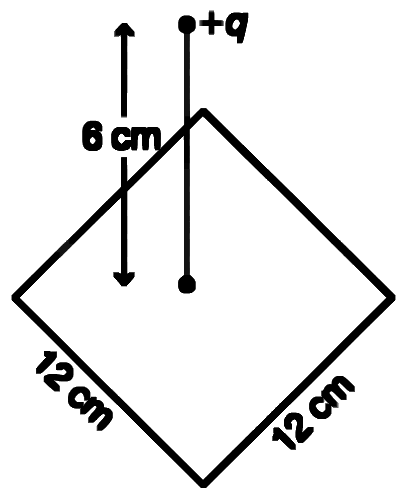
A point charge of +12μC is at a distance 6 cm vertically above the centre of a square of side 12 cm as shown in figure. The magnitude of the electric flux through the square will be __________ × 103 Nm2/C.
Numerical answer type. Work it out, then open the answer.
Find out the surface charge density at the intersection of point x = 3 m plane and x-axis, in the region of uniform line charge of 8 nC/m lying along the z-axis in free space.
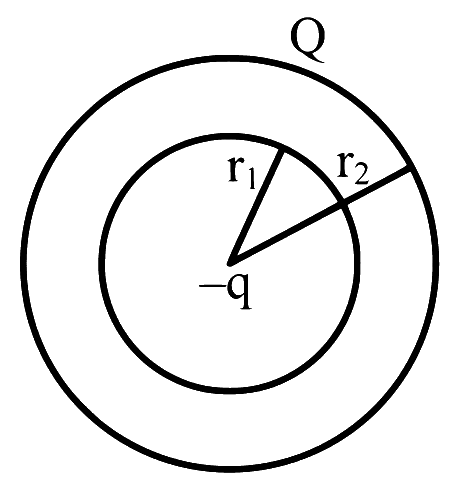
A spherical conducting shell of inner radius 'r 1' and outer radius 'r2 ' has a charge 'Q'. A charge −q is placed at the centre of the shell. The surface charge density on the inner and outer surface of the shell will be
A spherical rubber balloon carries a charge, uniformly distributed over the surface. As the balloon is blown up and increases in size, the total electric flux coming out of the surface
In finding the electric field using Gauss Law the formula E=ε0∣A∣qenc is applicable. In the formula ε0 is permittivity of free space, A is the area of Gaussian surface and qenc is charge enclosed by the Gaussian surface. The equation can be used in which of the following situation?
Consider the force F on a charge 'q' due to a uniformly charged spherical shell of radius R carrying charge Q distributed uniformly over it. Which one of the following statements is true for F, if 'q' is placed at distance r from the centre of the shell?
A spherical conductor of radius 10 cm has a charge of 3.2 × 10⁻⁷ C distributed uniformly. What is the magnitude of electric field at a point 15 cm from the centre of the sphere?
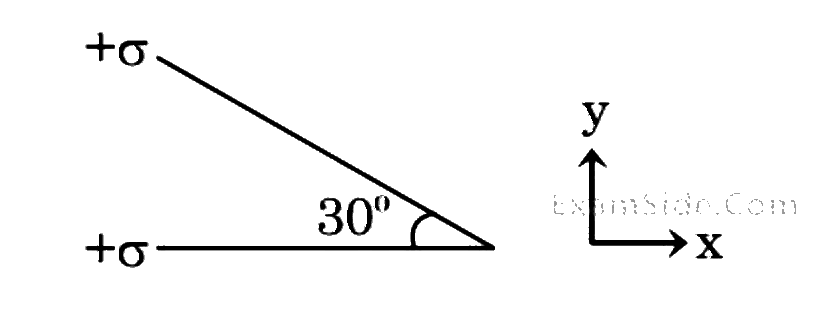
Two infinite planes each with uniform surface charge density σ are kept in such a way that the angle between them is 30o. The electric field in the region shown between them is given by:
Surface density of charge on a charged conducting sphere of radius R in terms of electric field intensity E at a distance r in free space is (r>R,ε0= permittivity of free space)
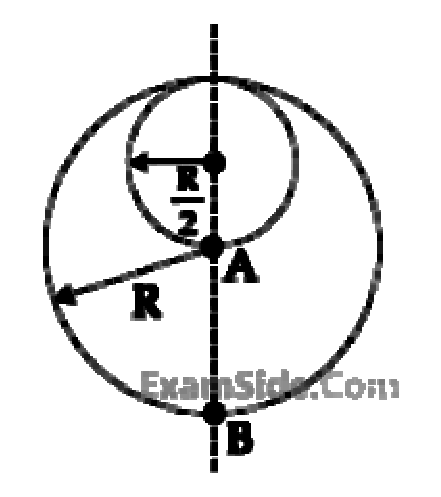
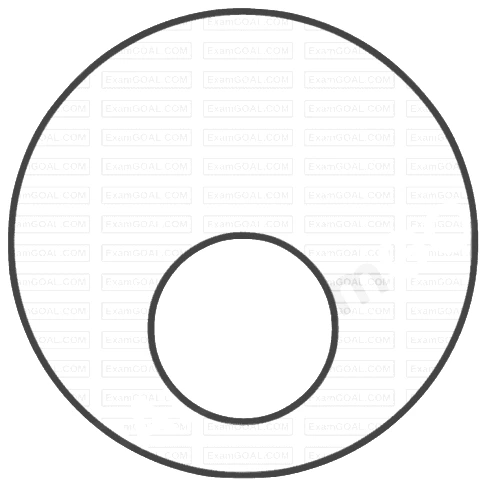
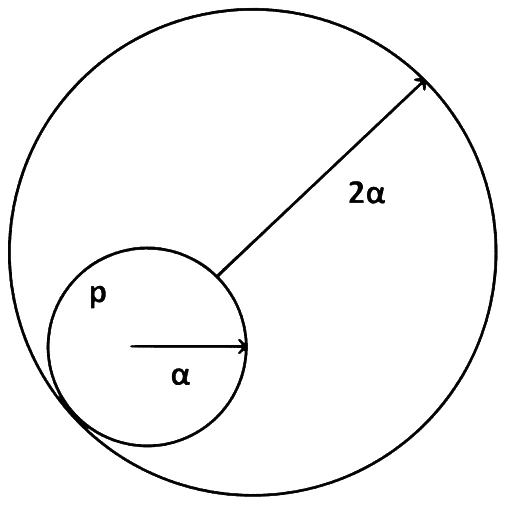
Consider a sphere of radius R which carries a uniform charge density ρ. If a sphere of radius 2R is carved out of it, as shown, the ratio of magnitude of electric field EA and EB, respectively, at points A and B due to the remaining portion is:
Two parallel infinite line charges with linear charge densities +λ C/m and -λ C/m are placed at a distance of 2R in free space. What is the electric field mid-way between the two line charges?
A charged conductor produces an electric field of intensity 103 V/m just outside its surface in vacuum. Then, it produces the electric field of intensity E just outside its surface, when it is placed in a medium of dielectric constant 4. The value of E will be
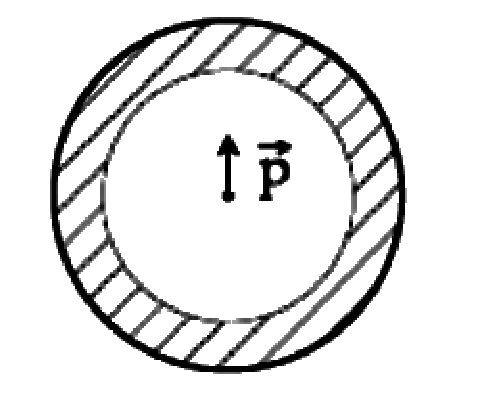
Shown in the figure is a shell made of a conductor. It has inner radius a and outer radius b, and carries charge Q. At its centre is a dipole Pas shown. In this case:
Let a total charge 2Q be distributed in a sphere of radius R, with the charge density given by ρ(r) = kr, where r is the distance from the centre. Two charges A and B, of –Q each, are placed on diametrically opposite points, at equal distance, a from the centre. If A and B do not experience any force, then:
Charge is distributed within a sphere of radius R with a volume charge density ρ(r)=r2Ae−a2r, where A and a are constants. If Q is the total charge of this charge distribution, the radius R is:
The region between two concentric spheres of radii a and b, respectively (see figure), has volume charge density ρ=rA, where A is a constant and r is the distance from the center. At the center of the spheres is a point charge Q. The value of A such that the electric field in the region between the spheres will be constant, is:
The electric field in a certain region is acting radially outward and is given by E = Ar. A charge contained in a sphere of radius 'a' centred at the origin of the field, will be given by
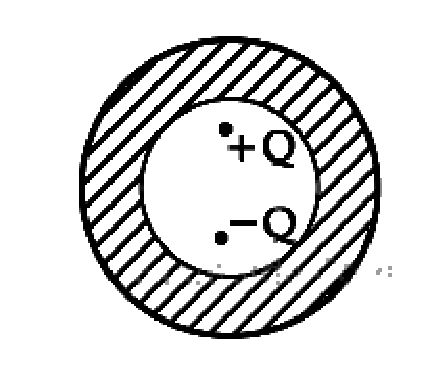
Shown in the figure are two point charges + Q and − Q inside the cavity of a spherical shell. The charges are kept near the surface of the cavity on opposite sides of the centre of the shell. If σ1 is the surface charge on the inner surface and Q1 net charge on it and σ2 the surface charge on the outer surface and Q2 net charge on it then:
The electric field in a region of space is given by, E=E0i^ + 2E0j^ where E0 = 100 N/C. The flux of this field through a circular surface of a radius 0.02 m parallel to the Y-Z plane is nearly:
The magnitude of the average electric field normally present in the atmosphere just above the surface of the Earth is about 150 N/C, directed inward towards the center of the Earth. This gives the total net surface charge carried by the Earth to be:
In a uniformly charged sphere of total charge Q and radius R, the electric field E is plotted as a function of distance from the center. The graph which would correspond to the above will be:
This question has statement- 1 and statement- 2. Of the four choices given after the statements, choose the one that best describes the two statements.
An insulating solid sphere of radius R has a uniformly positive charge density ρ. As a result of this uniform charge distribution there is a finite value of electric potential at the center of the sphere, at the surface of the sphere and also at a point outside the sphere. The electric potential at infinity is zero.
Statement- 1: When a charge q is taken from the centre to the surface of the sphere its potential energy changes by 3ε0qρ
Statement- 2: The electric field at a distance r(r<R) from the center of the sphere is 3ε0ρr
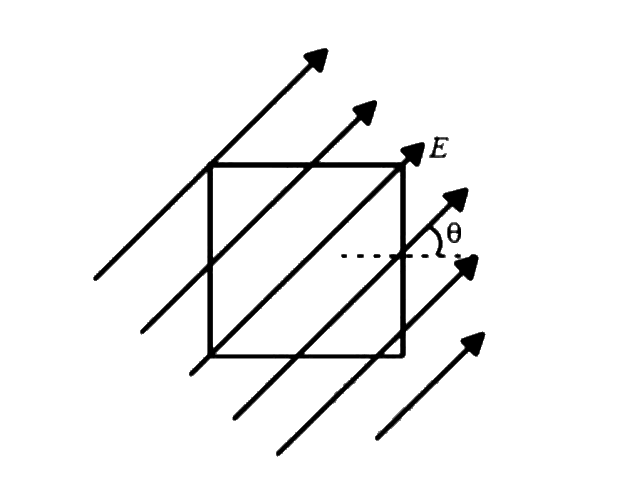
A square surface of side L meter in the plane of the paper is placed in a uniform electric field E(volt/m) acting along the same plane at an angle θ with the horizontal side of the square as shown in figurre.
The electric flux linked to the surface, in units of volt m is
The electric field at a distance 23R from the centre of a charged conducting spherical shell of radius R is E. The electric field at a distance 2R from the centre of the sphere is
Let there be a spherically symmetric charge distribution with charge density varying as ρ(r)=ρ0(45−Rr) upto r=R, and ρ(r)=0 for r>R, where r is the distance from the origin. The electric field at a distance r(r<R) from the origin is given by
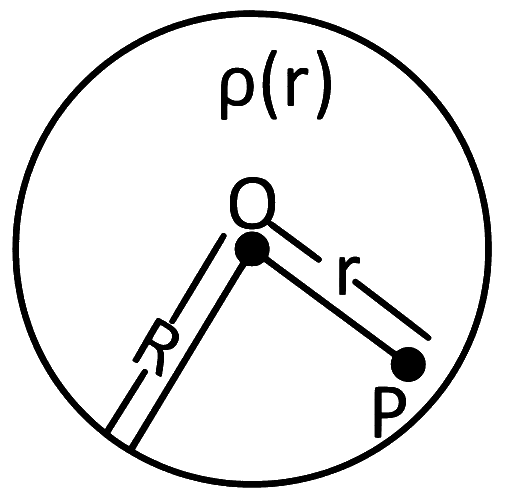
Let ρ(r)=πR4Qr be the charge density distribution for a solid sphere of radius R and total charge Q. For a point p inside the sphere at distance r1 from the center of the sphere, the magnitude of electric field is:
A thin spherical shell of radius R has charge Q spread uniformly over its surface. Which of the following graphs most closely represents the electric field E(r) produced by the shell in the range 0≤r<∞, where r is the distance from the center of the shell?
A hollow cylinder has a charge q coulomb within it. If ϕ is the electric flux in units of volt-metre associated with the curved surface B, the flux linked with the plane surface A in units of V-m will be
A square surface of side L metres is in the plane of the paper. A uniform electric field E(volt/m), also in the plane of the paper is limited only to the lower half of the square surface (see figure). The electric flux in SI inits associated with the surface is
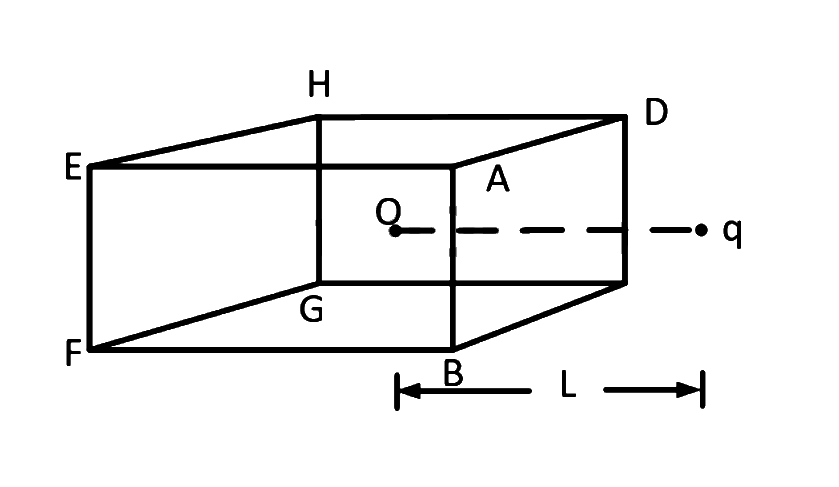
A charged particle q is placed at the centre O of cube of length L(ABCDEFGH). Another same charge q is placed at a distance L from O. Then the electric flux through ABCD is
A hollow insulated conducting sphere is given a positive charge of 10μC. What will be the electric field at the centre of the sphere if its radius is 2 m?
Why are the tyres of aircrafts made of conducting rubber? 1. So that the charge accumulated on the aircraft in flight, by rubbing the air, can easily be transferred to ground on landing. 2. So that the charge accumulated due to the operation of various electronic equipments in the aircraft in flight can easily be transferred to ground on landing.
Select the correct answer using the code given below.
A positive charge +q is placed at the centre of a hollow metallic sphere of inner radius a and outer radius b. The electric field at a distance r from the centre is denoted by E. In this regard, which one of the following statements is correct?
Lightning conductors are used to protect building from lightning strikes. Which of the following statements is / are true about lightning conductors? 1. Lightning conductors create an electric field at its top so that lightning strikes it preferentially 2. Lightning conductors reduce the effect of the strike by uniformly distributing the charge (current) over the surface of the building 3. Lightning conductors take all charge (current) to deep down in the earth 4. Lightning conductors must be installed at a place taller than the building Select the correct answer using the code given below:
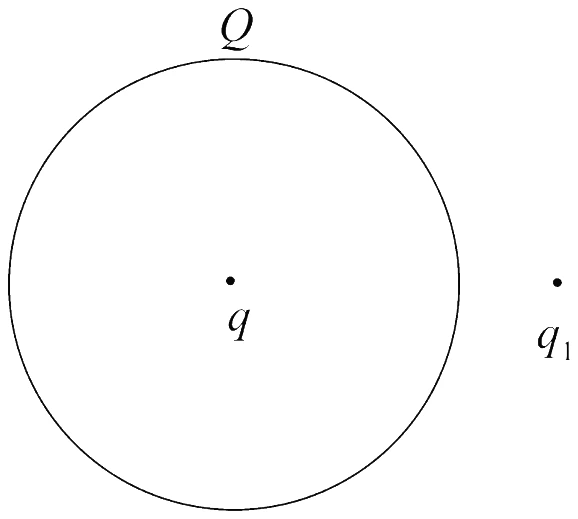
A positive point charge of 10−8C is kept at a distance of 20cm from the center of a neutral conducting sphere of radius 10cm. The sphere is then grounded and the charge on the sphere is measured. The grounding is then removed and subsequently the point charge is moved by a distance of 10cm further away from the center of the sphere along the radial direction. Taking 4πϵ01=9×10⁹N m2/C2 (where ϵ0 is the permittivity of free space), which of the following statements is/are correct:
More than one option can be correct. Tap every correct option, then tap Check.
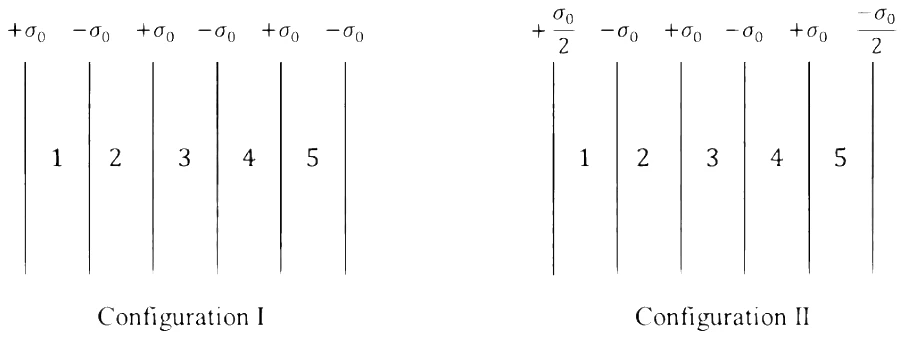
Six infinitely large and thin non-conducting sheets are fixed in configurations I and II. As shown in the figure, the sheets carry uniform surface charge densities which are indicated in terms of σ0. The separation between any two consecutive sheets is 1μm. The various regions between the sheets are denoted as 1, 2, 3, 4 and 5. If σ0=9μC/m2, then which of the following statements is/are correct:
(Take permittivity of free space ϵ0=9×10⁻¹²F/m)
More than one option can be correct. Tap every correct option, then tap Check.
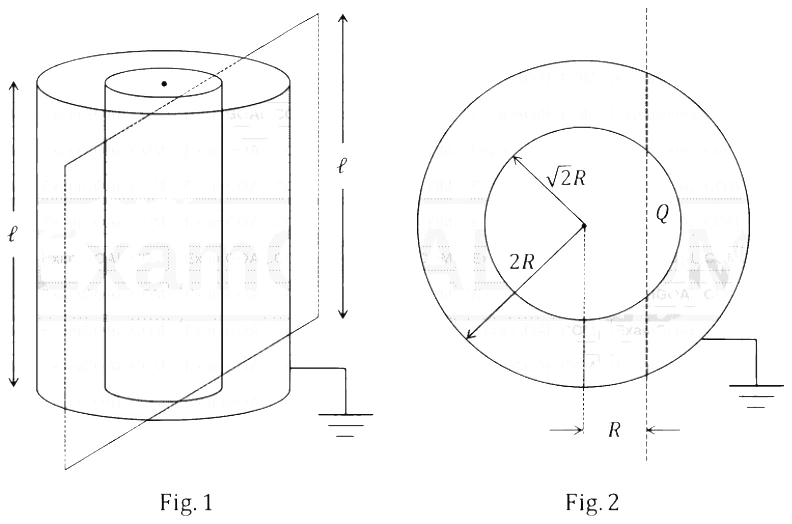
Two co-axial conducting cylinders of same length ℓ with radii 2R and 2R are kept, as shown in Fig. 1. The charge on the inner cylinder is Q and the outer cylinder is grounded. The annular region between the cylinders is filled with a material of dielectric constant κ=5. Consider an imaginary plane of the same length ℓ at a distance R from the common axis of the cylinders. This plane is parallel to the axis of the cylinders. The cross-sectional view of this arrangement is shown in Fig. 2. Ignoring edge effects, the flux of the electric field through the plane is (ϵ0 is the permittivity of free space):
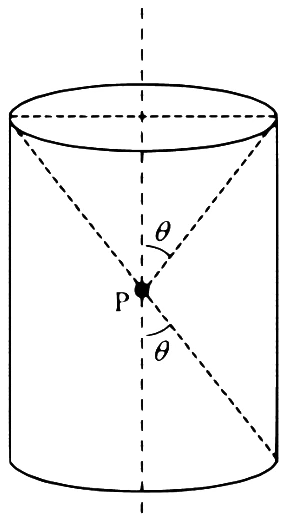
A charge is kept at the central point P of a cylindrical region. The two edges subtend a half-angle θ at P, as shown in the figure. When θ=30∘, then the electric flux through the curved surface of the cylinder is Φ. If θ=60∘, then the electric flux through the curved surface becomes Φ/n, where the value of n is ____.
Numerical answer type. Work it out, then open the answer.
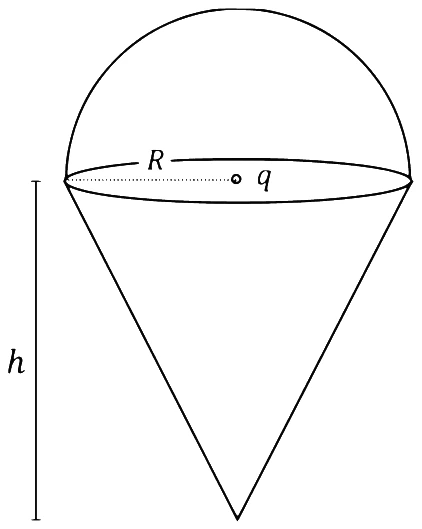
A charge q is surrounded by a closed surface consisting of an inverted cone of height h and base radius R, and a hemisphere of radius R as shown in the figure. The electric flux through the conical surface is 6ϵ0nq (in SI units). The value of n is ______.
Numerical answer type. Work it out, then open the answer.
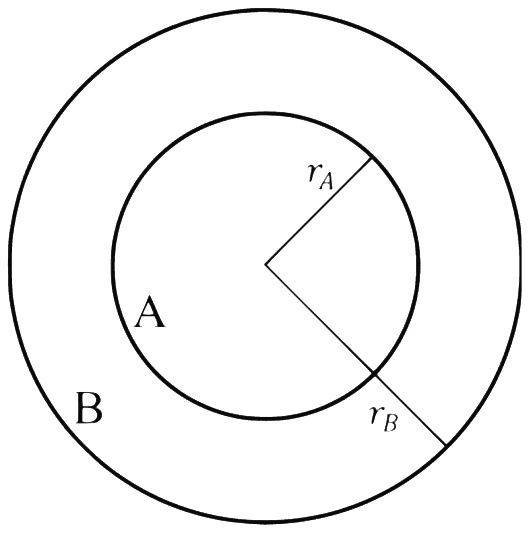
In the figure, the inner (shaded) region A represents a sphere of radius rA=1, within which the electrostatic charge density varies with the radial distance r from the center as ρA=kr, where k is positive. In the spherical shell B of outer radius rB, the electrostatic charge density varies as ρB=r2k. Assume that dimensions are taken care of. All physical quantities are in their SI units.
Which of the following statement(s) is(are) correct?
More than one option can be correct. Tap every correct option, then tap Check.
A circular disc of radius R carries surface charge density σ(r)=σ0(1−Rr), where σ0 is a constant and r is the distance from the center of the disc. Electric flux through a large spherical surface that encloses the charged disc completely is ϕ0. Electric flux through another spherical surface of radius 4R and concentric with the disc is ϕ. Then the ratio ϕϕ0 is ________.
Numerical answer type. Work it out, then open the answer.
A charged shell of radius R carries a total charge Q. Given ϕ as the flux of electric field through a closed cylindrical surface of height h, radius r and with its center same as that of the shell. Here, center of the cylinder is a point on the axis of the cylinder which is equidistant from its top and bottom surfaces. Which of the following option(s) is/are correct?
[ϵ0 is the permittivity of free space]
More than one option can be correct. Tap every correct option, then tap Check.
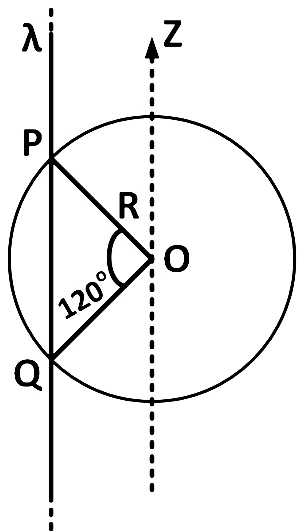
An infinitely long thin non-conducting wire is parallel to the z-axis and carries a uniform line charge density λ. It pierces a thin non-conducting spherical shell of radius R in such a way that the arc PQ subtends an angle 120∘ at the center O of the spherical shell, as shown in the figure. The permittivity of free space is ϵ0. Which of the following statement is (are) true?
More than one option can be correct. Tap every correct option, then tap Check.
The electric field E is measured at a point P(0,0,d) generated due to various charge distributions and the dependence of E on d is found to be different for different charge distributions. List-I contains different relations between E and d. List-II describes different electric charge distributions, along with their locations. Match the functions in List-I with the related charge distributions in List-II.
List-I
List-II
P. E is independent of d
1. A point charge Q at the origin
Q. E∝1/d
2. A small dipole with point charges Q at (0,0,l) and −Q at (0,0,−l). Take 2l≪d
R. E∝1/d2
3. An infinite line charge coincident with the x-axis, with uniform linear charge density λ
S. E∝1/d3
4. Two infinite wires carrying uniform linear charge density parallel to the x-axis. The one along (y=0,z=l) has a charge density +λ and the one along (y=0,z=−l) has a charge density −λ. Take 2l≪d
5. Infinite plane charge coincident with the xy-plane with uniform surface charge density
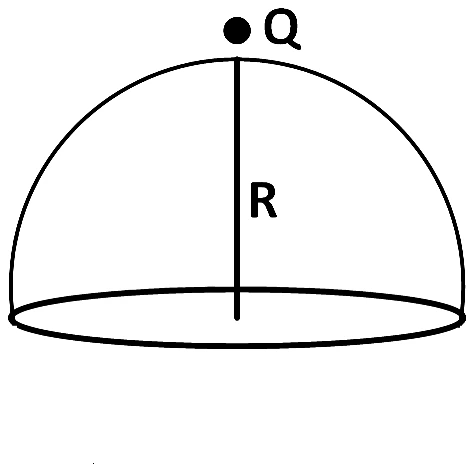
A point charge +Q is placed just outside an imaginary hemispherical surface of radius R as shown in the figure. Which of the following statements is/are correct?
More than one option can be correct. Tap every correct option, then tap Check.
Consider a uniform spherical charge distribution of radius R1 centred at the origin O. In this distribution, a spherical cavity of radius R2, centred at P with distance OP=a=R1−R2 (see figure). If the electric field inside the cavity at position r is E(r), then the correct statement(s) is (are)
More than one option can be correct. Tap every correct option, then tap Check.
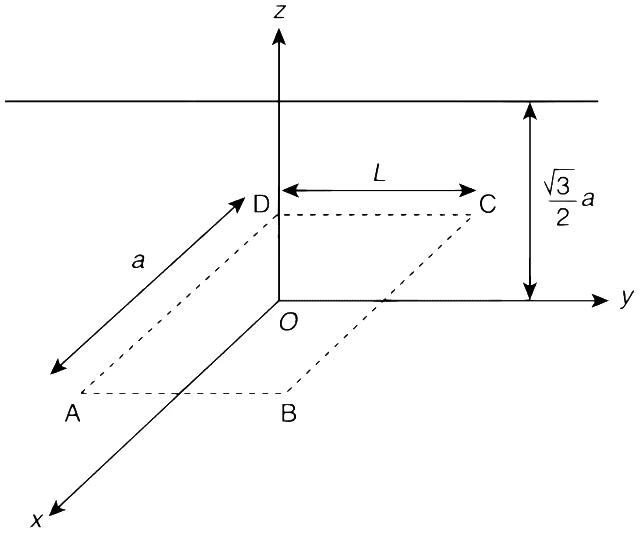
An infinitely long uniform line charge distribution of charge per unit length λ lies parallel to the y-axis in the y-z plane at z=23a (see figure). If the magnitude of the flux of the electric field through the rectangular surface ABCD lying in the x-y plane with its centre at the origin is nε0λL (ε0 = permittivity of free space), then the value of n is ________.
Numerical answer type. Work it out, then open the answer.
Let E1(r), E2(r) and E3(r) be the respective electric field at a distance r from a point charge Q, an infinitely long wire with constant linear charge density λ, and an infinite plane with uniform surface charge density σ. If E1(r0)=E2(r0)=E3(r0) at a given distance r0, then
More than one option can be correct. Tap every correct option, then tap Check.
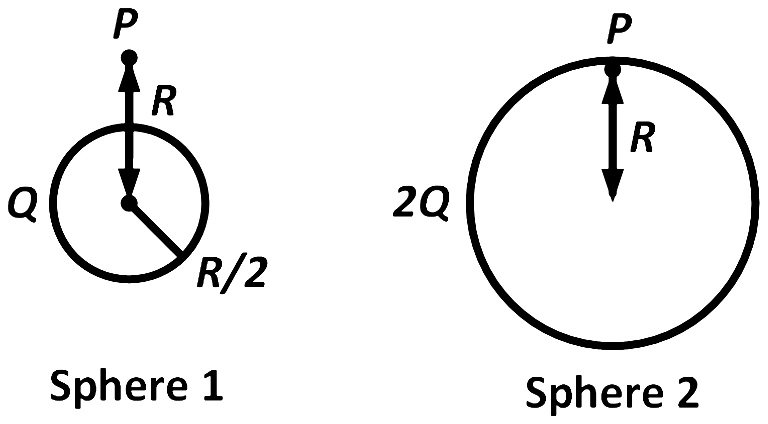
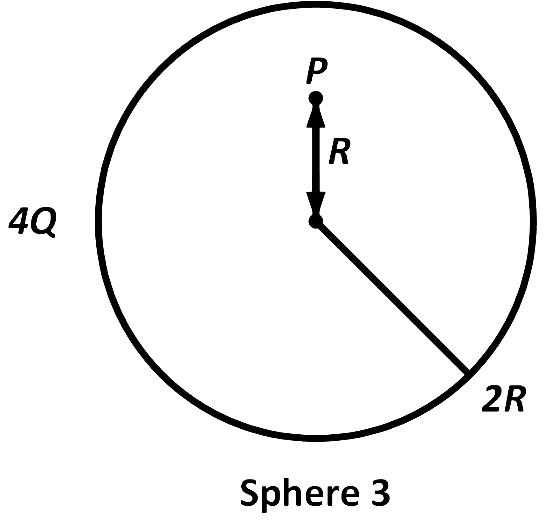
Charges Q, 2Q and 4Q are uniformly distributed in three dielectric solid spheres 1, 2 and 3 of radii R/2, R and 2R respectively, as shown in figure. If magnitude of the electric fields at point P at a distance R from the center of sphere 1, 2 and 3 are E1, E2 and E3 respectively, then
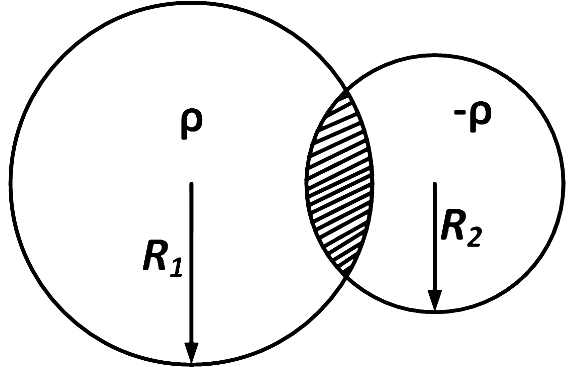
Two non-conducting spheres of radii R1 and R2 and carrying uniform volume charge densities +ρ and −ρ, respectively, are placed such that they partially overlap, as shown in the figure. At all points in the overlapping region
More than one option can be correct. Tap every correct option, then tap Check.
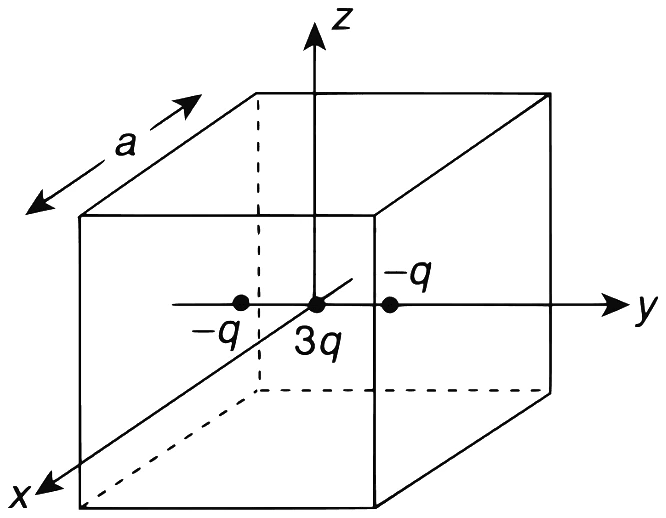
A cubical region of side a has its center at the origin. It encloses three fixed point charges, −q at (0,−a/4,0), +3q at (0,0,0) and −q at (0,+a/4,0). Choose the correct option(s)
More than one option can be correct. Tap every correct option, then tap Check.
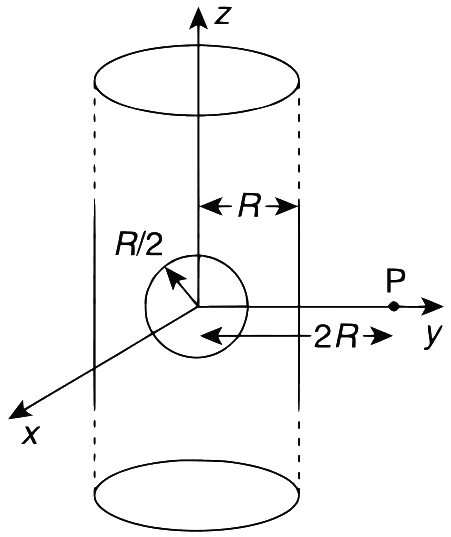
An infinitely long solid cylinder of radius R has a uniform volume charge density ρ. It has a spherical cavity of radius R/2 with its centre on the axis of the cylinder, as shown in the figure. The magnitude of the electric field at the point P, which is at a distance 2R from the axis of the cylinder, is given by the expression 16kε023ρR. The value of k is ________.
Numerical answer type. Work it out, then open the answer.
A disk of radius 4a having a uniformly distributed charge 6C is placed in the xy-plane with its centre at (−a/2,0,0). A rod of length a carrying a uniformly distributed charge 8C is placed on the x-axis from x=a/4 to x=5a/4. Two point charges −7C and 3C are placed at (a/4,−a/4,0) and (−3a/4,3a/4,0), respectively. Consider a cubical surface formed by six surfaces x=±a/2,y=±a/2,z=±a/2. The electric flux through this cubical surface is
A solid sphere of radius R has a charge Q distributed in its volume with a charge density ρ=Kra, where K and a are constants and r is the distance from its centre. If the electric field at r=R/2 is 1/8 times than at r=R, find the value of a.
Numerical answer type. Work it out, then open the answer.
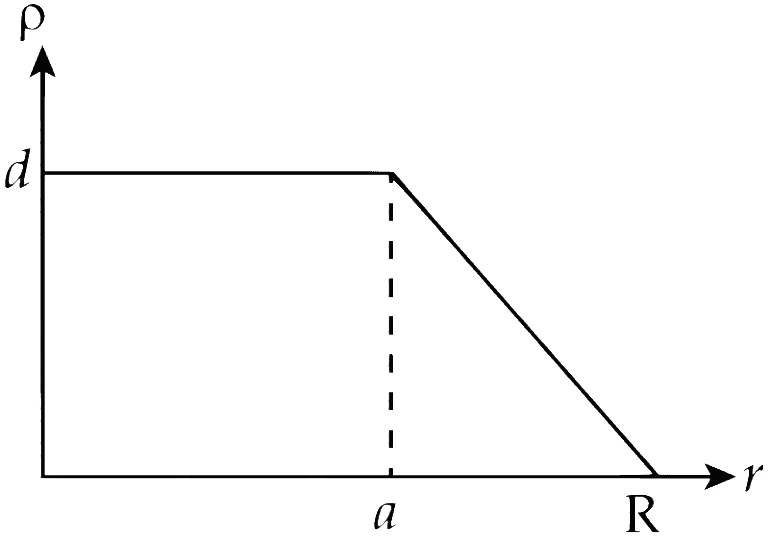
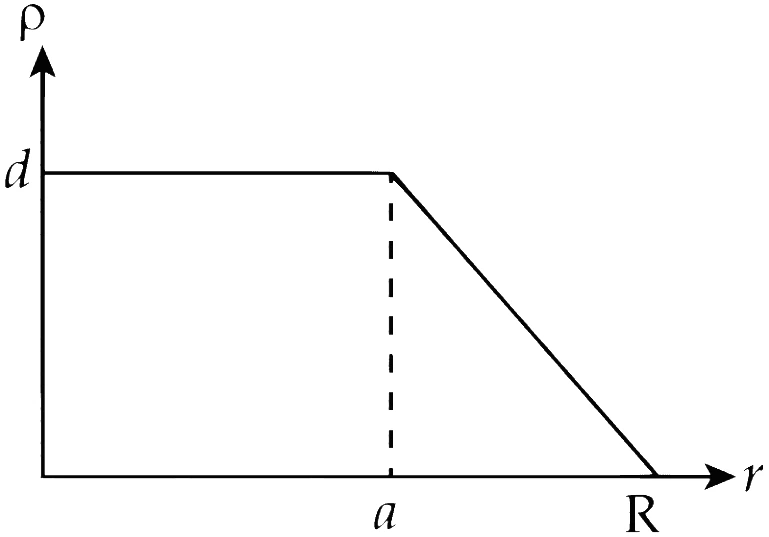
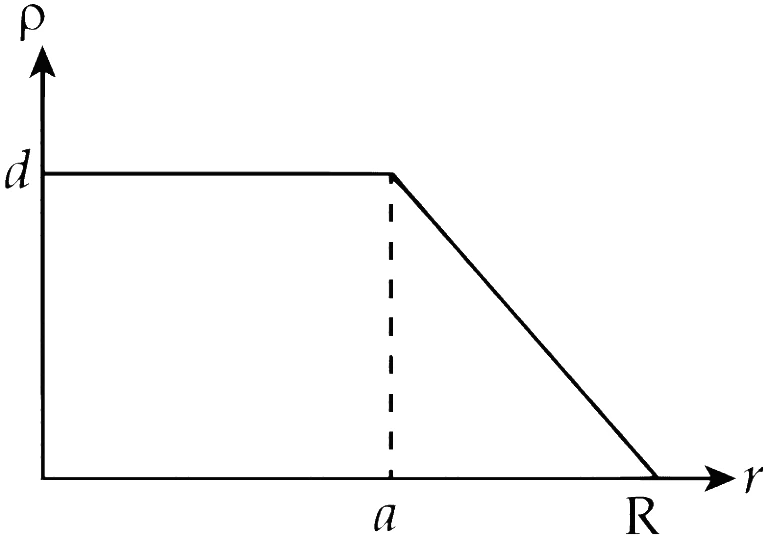
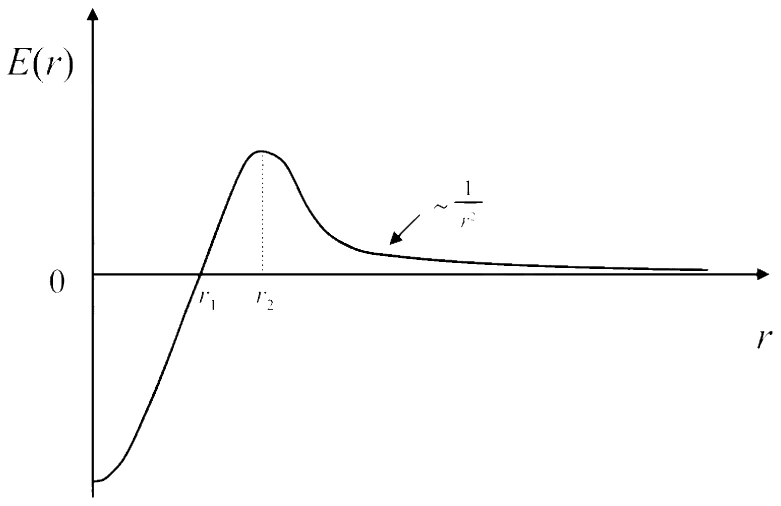
The nuclear charge (Ze) is non-uniformly distributed within a nucleus of radius R. The charge density ρ(r) [charge per unit volume] is dependent only on the radial distance r from the centre of the nucleus as shown in figure. The electric field is only along the radial direction.
The nuclear charge (Ze) is non-uniformly distributed within a nucleus of radius R. The charge density ρ(r) [charge per unit volume] is dependent only on the radial distance r from the centre of the nucleus as shown in figure. The electric field is only along the radial direction.
The electric field within the nucleus is generally observed to be linearly dependent on r. This implies
The nuclear charge (Ze) is non-uniformly distributed within a nucleus of radius R. The charge density ρ(r) [charge per unit volume] is dependent only on the radial distance r from the centre of the nucleus as shown in figure. The electric field is only along the radial direction.
For a=0, the value of d (maximum value of ρ as shown in the figure) is
A long, hollow conducting cylinder is kept coaxially inside another long, hollow conducting cylinder of larger radius. Both the cylinders are initially electrically neutral.
A spherical portion has been removed from a solid sphere having a charge distributed uniformly in its volume as shown in the figure. The electric field inside the emptied space is
Assertion : If a point charge q is placed in front of an infinite grounded conducting plane surface, the point charge will experience a force. Reason : This force is due to the induced charge on the conducting surface which is at zero potential.
Assertion : A charge q is placed on a height h/4 above the centre of a square of side b. The flux associated with the square is independent of side length. Reason : Gauss's law is independent of size of the Gaussian surface.
Assertion : A metallic shield in the form of a hollow shell may be build to block an electric field. Reason : In a hollow spherical shield, the electric field inside it is zero at every point.
A small uncharged metallic sphere is positioned exactly at a point midway between two equal and opposite point charges. If the sphere is slightly displaced towards the positive charge and released then
A hollow cylinder has a charge qC within it. If ϕ is the electric flux in unit of voltmeter associated with the curved surface B, the flux linked with the plane surface A in unit of voltmeter will be
Assertion : The lightning conductor at the top of high building has sharp pointed ends. Reason : The surface density of charge at sharp points is very high resulting in setting up of electric wind.
Two parallel large thin metal sheets have equal surface charge densities (σ=26.4×10⁻¹²C m−2) of opposite signs. The electric field between these sheets is :
Two infinitely long parallel conducting plates having surface charge densities +σ and −σ respectively, are separated by a small distance. The medium between the plates is vacuum. If ε0 is the dielectric permittivity of vacuum, then the electric field in the region between the plates is :
Two concentric conducting thin spherical shells A and B having radii rA and rB (rB>rA) are charged to QA and −QB (∣QB∣>∣QA∣). The electrical field along a line (passing through the centre) is :
The electric field due to a uniformly charged non-conducting sphere of radius R as a function of the distance from its centre if represented graphically by :
A cylinder of radius R and length L is placed in a uniform electric field E parallel to the cylinder axis. The total flux for the surface of the cylinder is given by
Electric field at point 20cm away from the centre of dielectric sphere is 100V m−1, radius of sphere is 10cm, then the value of electric field at a distance 3cm from the centre is
A hollow insulated conduction sphere is given a positive charge of 10μC. What will be the electric field at the centre of the sphere if its radius is 2 metres?
A solid sphere of radius R carries a uniform volume charge density ρ. The magnitude of electric field inside the sphere at a distance r from the centre is
A thin metallic spherical shell contains a charge Q on it. A point charge q is placed at the centre of the shell and another charge q1 is placed outside it as shown in the figure. All the three charges are positive. The force on the charge at the centre is
A solid spherical conductor of radius R has a spherical cavity of radius a (a<R) at its centre. A charge +Q is kept at the centre. The charge at the inner surface, outer surface and at a position r (a<r<R) are respectively
A solid sphere of radius R1 and volume charge density ρ=rρ0 is enclosed by a hollow sphere of radius R2 with negative surface charge density σ, such that the total charge in the system is zero. ρ0 is a positive constant and r is the distance from the centre of the sphere. The ratio R1R2 is
A charge of 5μC is placed at the centre of a spherical shell S1 of radius 10cm. Now this system is enclosed inside another spherical shell S2 of radius 20cm. The ratio of the electrical flux through the surface S2 to S1 is:
A uniform electric field E=3i^+6j^+k^ passes through a closed cuboidal surface. One face of the cuboid has an area 4m2 and an outward unit normal given by 172i^+2j^+3k^. If the electric flux through the remaining 5 faces is zero, the charge enclosed by the cuboid is:
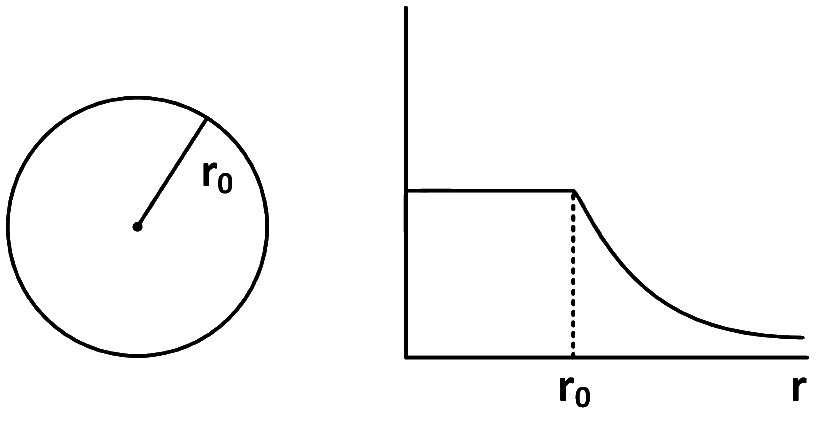
The electric field versus distance graph is shown as given. Select the correct statement from the following. E - electric field R - radius r - distance from the centre
A uniformly charged conducting sphere of 0.2m diameter has a surface charge density of 70μC m−2. The electric flux leaving the surface of the sphere is:
The electric flux from a cube of side 1m is Φ. When the side of the cube is made 3m and the charge enclosed by the cube is made one third of the original value, then the flux from the bigger cube will be:
Which of the following diagrams represents the variation of the electric field with distance r from the centre of a uniformly charged non-conducting sphere of radius R?
Consider a thin spherical shell of radius R consisting of uniform surface charge density s. The electric field at a point of distance x from its centre and outside the shell is
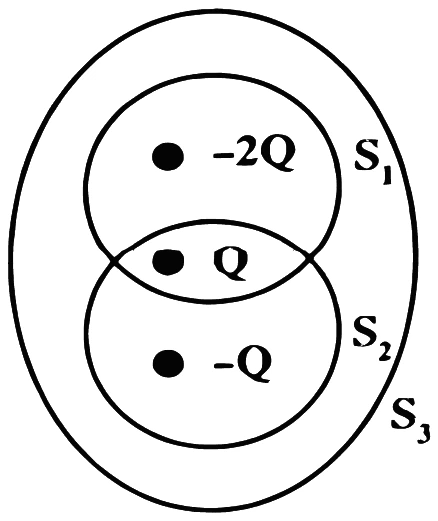
Consider three point charges −2Q, Q and −Q and three surfaces S1, S2 and S3 as shown in the figure. Match the entries of List-I with that of List-II.
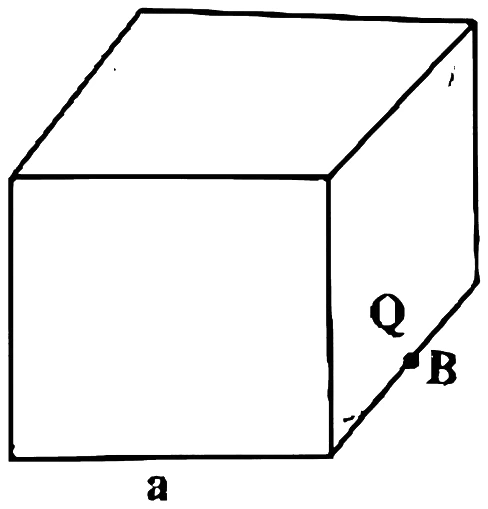
What will be the total electric flux through the faces of the cube with side length a if a charge Q is placed at B, the midpoint of an edge of the cube (see figure)?
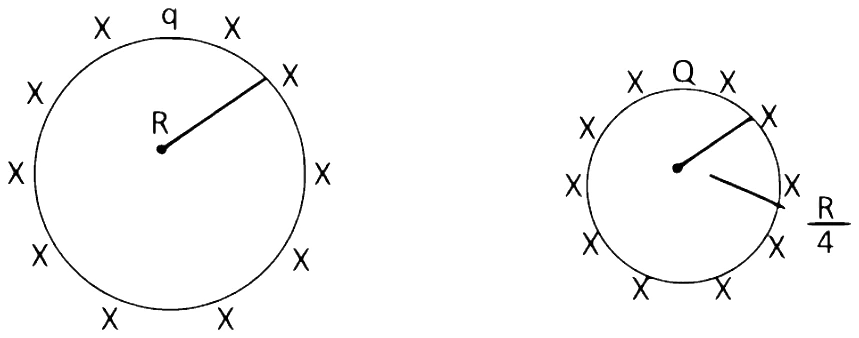
A metallic sphere of radius R carrying a charge q is kept at a certain distance from another metallic sphere of radius R/4 carrying a charge Q. What is the electric flux at any point inside the metallic sphere of radius R due to the sphere of radius R/4?
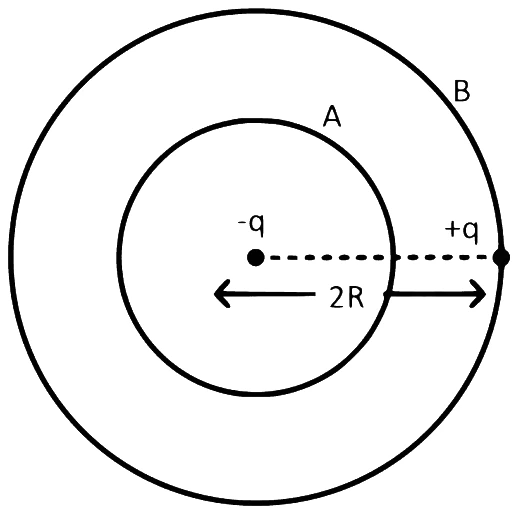
You are given a dipole of charge +q and −q separated by a distance 2R. A sphere 'A' of radius R passes through the centre of the dipole as shown below and another sphere 'B' of radius 2R passes through the charge +q. Then the electric flux through the sphere A is
Charges are uniformly spread on the surface of a conducting sphere. The electric field from the centre of the sphere to a point outside the sphere varies with distance r from the centre as
A uniform electric field E=3×10⁵N C−1 is acting along the positive Y-axis. The electric flux through a rectangle of area 10cm×30cm whose plane is parallel to the ZX-plane is
The total electric flux through a closed spherical surface of radius r enclosing an electric dipole of dipole moment 2aq is (Given ε0 = permittivity of free space)
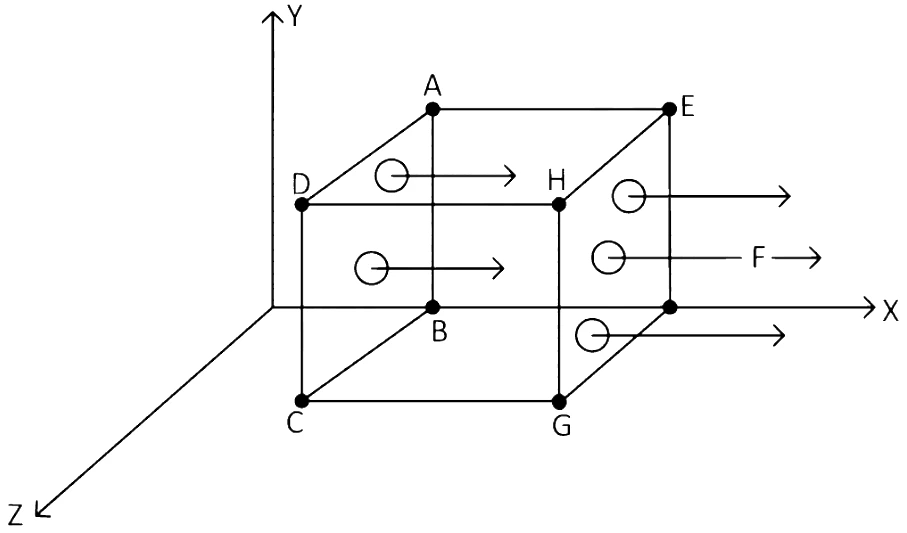
A cubical Gaussian surface has side of length a=10cm. Electric field lines are parallel to X-axis as shown in figure. The magnitudes of electric fields through surfaces ABCD and EFGH are 6kN C−1 and 9kN C−1 respectively. Then, the total charge enclosed by the cube is [Take, ε0=9×10⁻¹²F m−1]
4×10¹⁰ electrons are removed from a neutral metal sphere of diameter 20cm placed in air. The magnitude of the electric field (in N C−1) at a distance of 20cm from its centre is
A cylinder of radius 50cm and length 2m is placed along x-axis as shown in the figure. If electric field is 70i^ along its axis, the electric flux through the left face of the cylinder is
A spherical rubber balloon has the electric charges uniformly distributed over its surface. If the balloon is inflated further, the electric intensity E on the surface
Two large circular metal plates each of radius 50cm carrying equal and unlike charges are parallel to each other. If the electric field between the plates is 720N C−1, then the magnitude of charge on any one plate is
The net electric flux due to a uniform electric field of 3×10³i^N C−1 through a cube of side 20cm oriented such that its faces are parallel to the coordinate planes is
A large number of positive charges each of magnitude q are placed along the X-axis at the origin and at every 1cm distance in both the directions. The electric flux through a spherical surface of radius 2.5cm centred at the origin is
Statement (A): Inside a charged hollow metal sphere, E=0, V=0 (where E = electric field, V = electric potential). Statement (B): The work done in moving a positive charge on an equipotential surface is zero. Statement (C): When two like charges are brought closer, their mutual electrostatic potential energy will increase.
A long charged cylinder of linear charge density λ is surrounded by a hollow coaxial conducting cylinder. The magnitude of electric field in the space between the two cylinders at a distance R from the common axis of the cylinders is
The electric field due to an infinitely long thin straight wire with uniform linear charge density of 2.5×10⁻⁷C m−1 at a radial distance of x from the wire is 7.5×10⁴N C−1. Then, x=
A thin spherical shell of radius R and surface charge density σ is placed in a cube of side 5R with their centers coinciding. The electric flux through one face of the cube is (ε0 = Permittivity of free space)
A hollow spherical shell of radius r has a uniform charge density σ. It is kept in a cube of edge 3r such that the centres of the cube and the shell coincide. Then the electric flux coming out of one face of a cube is (ε0 = permittivity of free space)
In a uniformly charged sphere of total charge Q and radius R, the electric field E is plotted as function of distance from the centre of the sphere. The graph which would correspond to the above description will be
The electric flux from a cube of edge l is ϕ in an enclosed charge. If the edge of the cube is made 32l and the charge enclosed in the cube is doubled, then the electric flux value will be
An infinite non-conducting sheet has a surface charge density 2×10⁻⁷C m−2 on one side. The distance between two equipotential surfaces whose potential differ by 90V is (assume, 4πε01=9×10⁹N m2C−2)
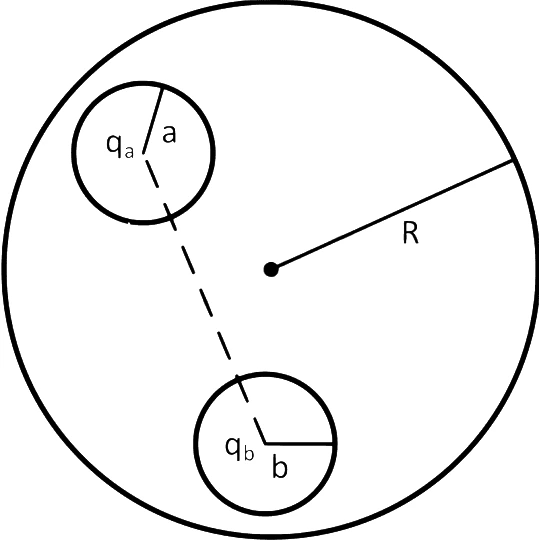
A neutral conducting solid sphere of radius R has two spherical cavities of radius a and b as shown in the figure. Centre to centre distance between two cavities is c. qa and qb charges are placed at the centres of cavities respectively. The force between qa and qb is
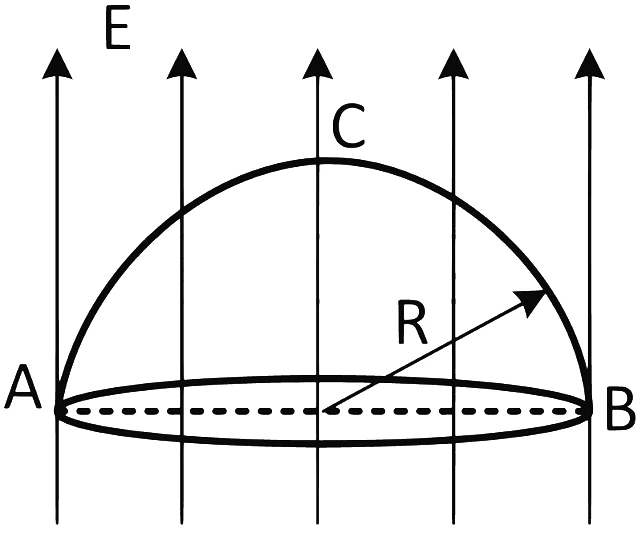
A hemisphere of radius R is placed in a uniform electric field E so that its axis is parallel to the field. Which of the following statement(s) is/are true?
More than one option can be correct. Tap every correct option, then tap Check.
Three infinite plane sheets carrying uniform charge densities −σ, 2σ, 4σ are placed parallel to XZ-plane at Y=a,3a,4a respectively. The electric field at the point (0,2a,0) is
A very long charged solid cylinder of radius a contains a uniform charge density ρ. Dielectric constant of the material of the cylinder is K. What will be the magnitude of electric field at a radial distance x (x<a) from the axis of the cylinder?
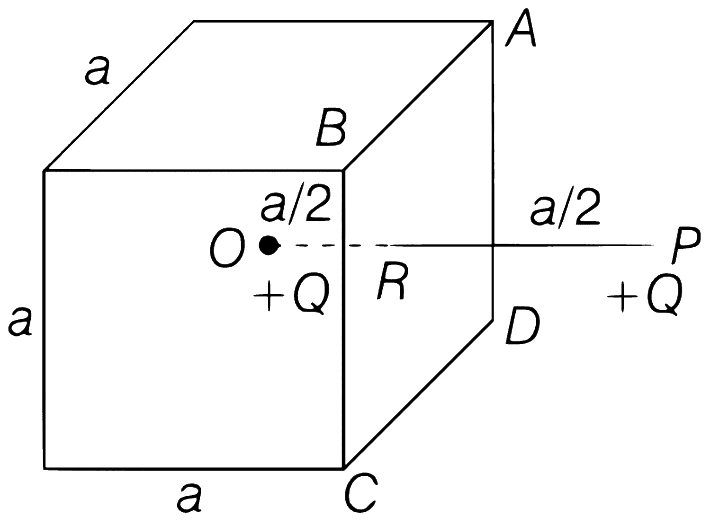
Consider a region in free space bounded by the surfaces of an imaginary cube having sides of length a as shown in the figure. A charge +Q is placed at the centre O of the cube. P is such a point outside the cube that the line OP perpendicularly intersects the surface ABCD at R and also OR=RP=a/2. A charge +Q is placed at point P also. What is the total electric flux through the five faces of the cube other than ABCD?
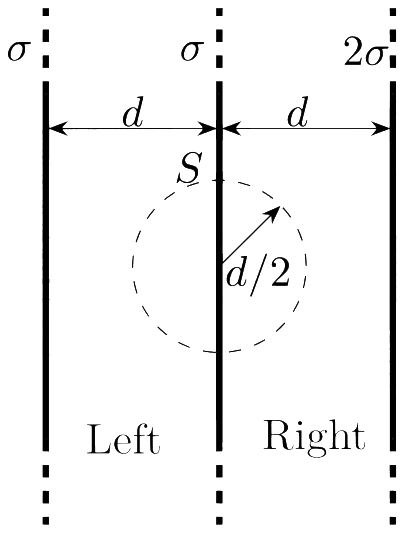
Three infinite plane sheets which have uniform positive surface charge densities σ, σ and 2σ are arranged parallel to each other with a separation of d as shown in the figure. A spherical Gaussian surface S of radius d/2 has its centre on the middle sheet. Which of the following statements regarding the electric flux ΦL through the left hemisphere and the electric flux ΦR through the right hemisphere of the Gaussian surface is correct?
A conducting sphere of radius a initially contains a uniform volume charge density ρ. What is the electric flux Φ through a spherical surface of radius 2a centred at a point on the surface of the charged sphere (see figure) at a later time t? (ϵ0 is the permittivity of free space.)
Consider a very long cylinder of radius a having a uniform positive charge density ρ. A sphere of radius a has been carved out (see figure), leaving no charge in that region. The distance radially outward to the cylinder, as measured from the centre of the sphere, is x. At what value of x will the electric field be maximum?
The charge distribution inside a sphere of radius R=2a/b is given by the volume charge density ρ=ar2−br3, where a and b are constants and r is the radial distance from the centre of the sphere. At what distance from the centre of the sphere will the electric field go to zero?
A point electric charge Q is placed at a corner of a cube as shown in the figure. What is the electric flux passing through the shaded surface ABCD of the cube? (ϵ0 is the permittivity of free space)
An infinitely long straight wire with uniform line charge density λ lies at a perpendicular distance d from a point O. The total electric flux through the surface of a sphere of radius R>d centred at O, is
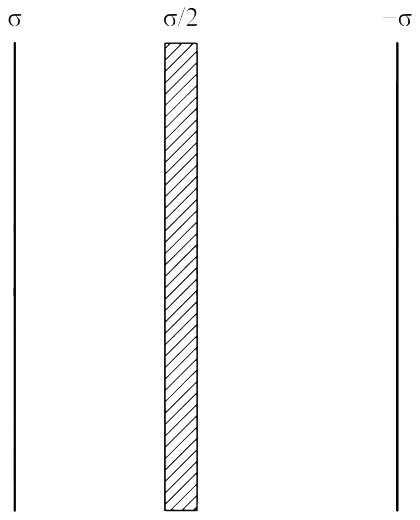
A large conducting slab having uniform surface charge density is placed between a parallel plate capacitor as shown in the figure. The net surface charge density on the slab after its placement in between the capacitor plates is +σ/2. The surface charge density on capacitor plates are ±σ. Assuming equal cross-sectional area of capacitor plates and the slab, the induced surface charge density on the conducting slab surface facing the positive terminal of the capacitor is
The potential for a point charge +q placed at a distance d from a grounded infinite conducting plate is V(x,y,z)=kq(x2+y2+(z−d)21−x2+y2+(z+d)21) Here k=1/4πϵ0 is a constant. The maximum value of induced charge density on the conducting plate is
The electric field due to an extended charge distribution spread over all space is given by E=4πϵ0r2q(1+λr)e−r/λr^ Here λ and q are positive constants and the electrostatic potential is taken to be zero at infinity. Select the correct statement(s).
More than one option can be correct. Tap every correct option, then tap Check.
Consider two semi-infinite flat plates lying parallel to the xy-plane at z=+d and z=−d, carrying uniform surface charge densities +σ and −σ, respectively. The plates extend from x=0 to x=−∞ and from y=−∞ to y=+∞. The direction of the electric field at a point whose coordinates are (0,0,2d) is along
A sphere, a cylinder and a very thin disk are made out of the same material. Each one of them carry the same amount of charge Q, spread uniformly over their surfaces. The radius of the cylinder is identical to its height. The radii of sphere, cylinder and disk are in the ratio 1:2:3. I, II and III are points in space, very close to the sphere, curved surface of the cylinder (away from the edges) and centre of flat surface of the disk, respectively. Then magnitudes of electric fields at the points I, II and III are approximately in the ratio
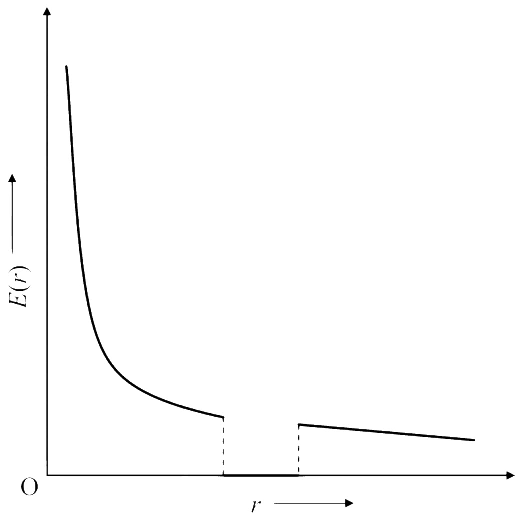
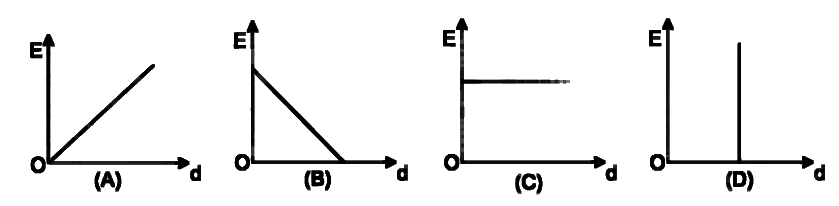
The variation of the magnitude of the electric field with radial distance r due to a given configuration is depicted in the accompanying figure. The configuration could be
A positive point charge q is placed near a three dimensional isolated, neutral solid conductor with a cavity as shown. The possible electric lines of force are best depicted in:
A uniformly charged sphere, of total charge Q, is expanding uniformly about its center. The magnitude of the electric field E at a point r from the center of the sphere as a function of radius of the sphere varies as,
A non-conducting sphere of radius R has a positive charge Q uniformly distributed over its entire volume. A smaller, concentric, spherical volume of radius r (r<R) is scooped out of the sphere. The magnitude of the electric field E at a point inside the body at a distance x from the centre (r<x<R) is (K=1/(4πϵ0)= constant):
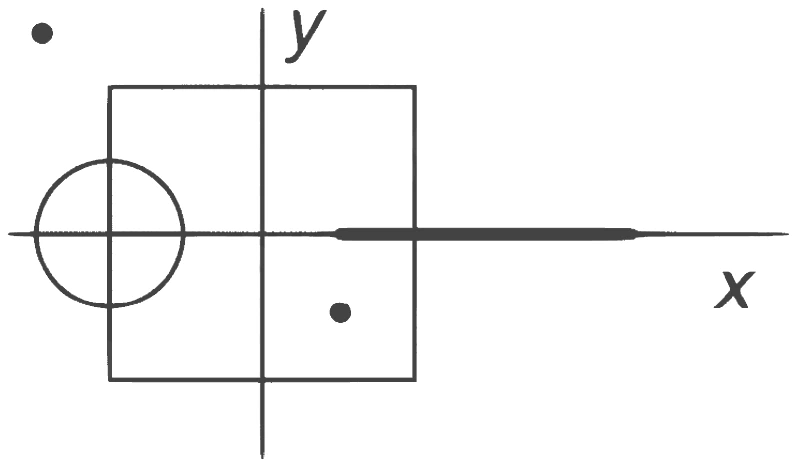
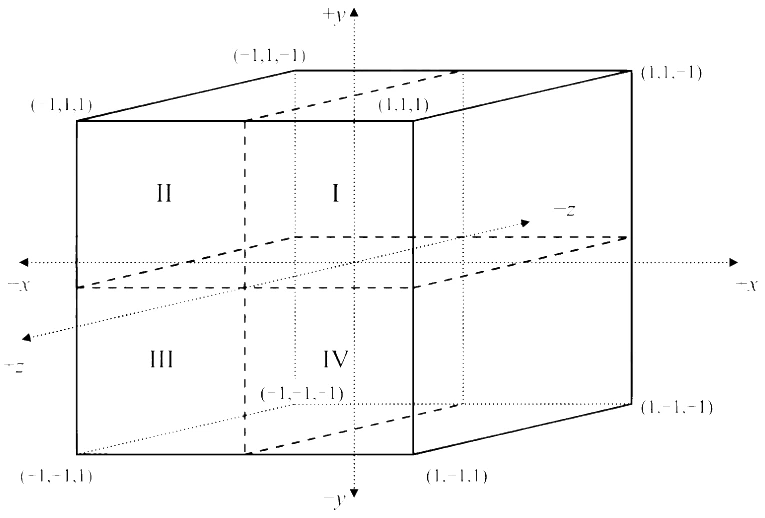
A cubical region (sides of 2 units) is bounded by the six surfaces: x=±1, y=±1, z=±1, which together constitute a closed surface S. It is found that the net electrostatic flux through S, ΦS=0. The volume of the cube is divided into 4 equal regions: (I) 0<x<1,0<y<1,−1<z<1, (II) −1<x<0,0<y<1,−1<z<1, (III) −1<x<0,−1<y<0,−1<z<1, and (IV) 0<x<1,−1<y<0,−1<z<1. It is found that ∣ΦI∣=∣ΦII∣. We can conclude that
More than one option can be correct. Tap every correct option, then tap Check.
The magnitude of electric field due to a point charge 2q, at distance r is E. Then the magnitude of electric field due to a uniformly charged thin spherical shell of radius R with total charge q at a distance 2r (r≫R) will be

 Electrostatics · Lecture 4 · Electric Flux & Gauss's Law59:46
 Electrostatics · Lecture 5 · Gauss's Theorem & Field of Charged Sphere50:09
 Electrostatics (Part 2) · Electric Dipole, Electric Flux & Gauss Law59:10All 14 Electrostatics videos →
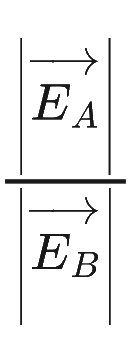 of magnitude of electric field and , respectively, at points A and B due to the remaining portion is: