A whistle sends out 256 waves in a second. If the whistle approaches the observer with velocity (31)rd of the velocity of sound in air. The number of waves per second observer will receive is
A whistle giving out 400 Hz approaches a stationary observer at a speed of 34 m/s. The frequency heard by the observer (in Hz) is nearly (speed of sound=340 m/s)
A train is moving towards a stationary observer with speed 34 m/s. A train sounds a whistle of frequency 450 Hz. If the speed of sound is 340 m/s, the frequency heard by the observer in Hz is
An observer moves towards a stationary source of sound with a velocity (51)th of the velocity of sound. The percentage increase in the apparent frequency is
A person observes two moving trains. 'A' reaching the station and 'B' leaving the station with equal speed of 30m/s. If both trains emit sounds with frequency 300 Hz, (speed of sound = 330 m/s) difference of frequencies heard by the person will be
A source of sound is moving towards a stationary observer with velocity 'VS' and then moves away with velocity 'VS'. Assume that medium through which the sound waves travel is at rest. If 'V' is the velocity of sound and 'n' is the frequency emitted by the source then the difference between the apparent frequencies heard by the observer is
When the observer moves towards a stationary source with velocity 'V1 ', the apparent frequency of the emitted note is 'F1 '. When the observer moves away from the source with velocity 'V1', the apparent frequency is 'F2'. If 'V' is the speed of sound in air and F1/F2=2, then V/V1=
Two sirens situated one km apart are producing sound of frequency 330 Hz. The observer starts moving from one siren to the other with a speed of 2 m/s. If the speed of sound is 330 m/s, What will be the beat frequency heard by the observer?
An observer moves towards a stationary source of sound with a velocity of one fifth of the velocity of sound. The percentage increase in the apparent frequency is
A person observes two moving trains. First reaching the station and another leaves the station with equal speed of 30 m/s. If both trains emit sounds of frequency 300 Hz, difference of frequencies heard by the person will be (speed of sound in air 330 m/s)
When the observer moves towards a stationary source with velocity V1, the apparent frequency of emitted note is F1. When observer moves away from the source with velocity V1, the apparent frequency is F2. If V is the velocity of sound in air and F1/F2=2 then V/V1 is equal to
When an observer moves towards a stationary source with velocity ' V1 ', the apparent frequency of emitted note is ' F1 '. When observer moves away from stationary source with velocity ' V1 ' the apparent frequency is ' F2 '. If ' v ' is velocity of sound in air and F2F1=2, then V1V is equal to
A source of sound emits sound wave of frequency ' f ' and moves towards an observer with a velocity 3V where V is the velocity of sound. If the observer moves away from the source with a velocity 5V the apparent frequency heard by him will be
If a source emitting waves of frequency ' F ' moves towards an observer with a velocity 3V and the observer moves away from the source with a velocity 4V, the apparent frequency as heard by the observer will be ( V= velocity of sound)
A vehicle starts from rest and accelerates along straight path at 2 m/s2. At the starting point of the vehicle, there is a stationary electric siren. How far has the vehicle nearly gone when the driver hears the siren at 94% of its value when the vehicle was at rest?
An observer moves towards a stationary source of sound with a velocity of one-fifth of the velocity of sound. The percentage increase in the apparent frequency is
A train sounding a whistle of frequency 510 Hz approaches a station at 72 km/hr. The frequency of the note heard by an observer on the platform as the train (1) approaches the station and then (2) recedes the station are respectively (in hertz) (velocity of sound in air =320 m/s)
When the listener moves towards stationary source with velocity ' V1 ', the apparent frequency of emitted note is ' F1 '. When observer moves away from the source with velocity ' V1 ', apparent frequency is ' F2 '. If V is the velocity of sound in air and F2F1=2 then V1V is
A source and listener are both moving towards each other with speed 10V. (where V is speed of sound) If the frequency of sound note emitted by the source is ' n ', then the frequency heard by the listener would be nearly
The pitch of a whistle of an engine appears to drop by 30% of original value when it passes a stationary observer. If the speed of sound in air is 350 ms−1, then the speed of engine in ms−1 is
The driver of a car travelling with a speed ' V1 ' m/s towards a wall sounds a siren of frequency ' n ' Hz. If the velocity of sound in air is V m/s, then the frequency of sound reflected from the wall and as heard by the driver, in Hz, is
The driver of a car travelling with a speed ' V1 ' m/s towards a wall sounds a siren of frequency ' n ' Hz. If the velocity of sound in air is ' V ' m/s, then the frequency of the sound reflected from the wall and as heard by the driver in Hz is
Q29JEE Main 2023 · 25 JAN · SHIFT 2EasyOld syllabus
Doppler Effect
A train blowing a whistle of frequency 320 Hz approaches an observer standing on the platform at a speed of 66 m/s. The frequency observed by the observer will be (given speed of sound = 330 ms −1) __________ Hz.
Numerical answer type. Work it out, then open the answer.
A passenger is sitting in a train which is moving fast. The engine of the train blows a whistle of frequency 'n'. If the apparent frequency of sound heard by the passenger is 'f' then
When both source and listener are approaching each other the observed frequency of sound is given by (VL and VS is the velocity of listener and source respectively, n0= radiated frequency)
Q32JEE Main 2023 · 11 APR · SHIFT 2EasyOld syllabus
Doppler Effect
A car P travelling at 20 ms−1 sounds its horn at a frequency of400 Hz. Another car Q is travelling behind the first car in the same direction with a velocity 40 ms−1. The frequency heard by the passenger of the car Q is approximately [Take, velocity of sound =360 ms−1 ]
Q33JEE Main 2023 · 8 APR · SHIFT 1EasyOld syllabus
Doppler Effect
The engine of a train moving with speed 10 ms−1 towards a platform sounds a whistle at frequency 400 Hz. The frequency heard by a passenger inside the train is: (neglect air speed. Speed of sound in air =330 ms−1)
Q34JEE Main 2023 · 29 JAN · SHIFT 1EasyOld syllabus
Doppler Effect
A person observes two moving trains, 'A' reaching the station and 'B' leaving the station with equal speed of 30 m/s. If both trains emit sounds with frequency 300 Hz, (Speed of sound: 330 m/s) approximate difference of frequencies heard by the person will be:
A car sounding a horn of frequency 1000 Hz passes a stationary observer. The ratio of frequencies of the horn noted by the observer before and after passing the car is 11:9. If the speed of sound is 'v', the speed of the car is
Consider the Doppler effect in two cases. In the first case, an observer moves towards a stationary source of sound with a speed of 50 m/s. In the second case, the observer is at rest and the source moves towards the observer with the same speed of 50 m/s. Then the frequency heard by the observer will be
Q37JEE Main 2023 · 6 APR · SHIFT 1MediumOld syllabus
Doppler Effect
A person driving car at a constant speed of 15 m/s is approaching a vertical wall. The person notices a change of 40 Hz in the frequency of his car's horn upon reflection from the wall. The frequency of horn is _______________ Hz.
(Given: Speed of sound: 330 m/s)
Numerical answer type. Work it out, then open the answer.
Q38JEE Main 2022 · 27 JUN · SHIFT 1EasyOld syllabus
Doppler Effect
An observer moves towards a stationary source of sound with a velocity equal to one-fifth of the velocity of sound. The percentage change in the frequency will be:
Q39JEE Main 2022 · 28 JUL · SHIFT 1EasyOld syllabus
Doppler Effect
The frequency of echo will be __________ Hz if the train blowing a whistle of frequency 320 Hz is moving with a velocity of 36 km/h towards a hill from which an echo is heard by the train driver. Velocity of sound in air is 330 m/s.
Numerical answer type. Work it out, then open the answer.
Q40JEE Main 2022 · 26 JUL · SHIFT 1MediumOld syllabus
Doppler Effect
When a car is approaching the observer, the frequency of horn is 100 Hz. After passing the observer, it is 50 Hz. If the observer moves with the car, the frequency will be 3x Hz where x= ________________.
Numerical answer type. Work it out, then open the answer.
Q41JEE Main 2022 · 30 JUN · SHIFT 1DifficultOld syllabus
Doppler Effect
An employee of a factory moving away from his workplace by a car listens to the siren of the factory. He drives the car at the speed of 72 kmh−1 in the direction of wind which is blowing at 72 kmh−1 speed. Frequency of siren is 720 Hz. The employee hears an apparent frequency of ____________ Hz.
(Assume speed of sound to be 340 ms−1)
Numerical answer type. Work it out, then open the answer.
Q42JEE Main 2022 · 25 JUL · SHIFT 1DifficultOld syllabus
Doppler Effect
An observer is riding on a bicycle and moving towards a hill at 18 kmh−1. He hears a sound from a source at some distance behind him directly as well as after its reflection from the hill. If the original frequency of the sound as emitted by source is 640 Hz and velocity of the sound in air is 320 m/s, the beat frequency between the two sounds heard by observer will be _____________ Hz.
Numerical answer type. Work it out, then open the answer.
Q43JEE Main 2021 · 27 AUG · SHIFT 1EasyOld syllabus
Doppler Effect
Two cars X and Y are approaching each other with velocities 36 km/h and 72 km/h respectively. The frequency of a whistle sound as emitted by a passenger in car X, heard by the passenger in car Y is 1320 Hz. If the velocity of sound in air is 340 m/s, the actual frequency of the whistle sound produced is .................. Hz.
Numerical answer type. Work it out, then open the answer.
Q44JEE Main 2021 · 26 AUG · SHIFT 1EasyOld syllabus
Doppler Effect
A source and a detector move away from each other in absence of wind with a speed of 20 m/s with respect to the ground. If the detector detects a frequency of 1800 Hz of the sound coming from the source, then the original frequency of source considering speed of sound in air 340 m/s will be ............... Hz.
Numerical answer type. Work it out, then open the answer.
Q45JEE Main 2021 · 20 JUL · SHIFT 1MediumOld syllabus
Doppler Effect
The frequency of a car horn encountered a change from 400 Hz to 500 Hz, when the car approaches a vertical wall. If the speed of sound is 330 m/s. Then the speed of car is ___________ km/h.
Numerical answer type. Work it out, then open the answer.
Q46JEE Main 2021 · 24 FEB · SHIFT 2MediumOld syllabus
Doppler Effect
Two cars are approaching each other at an equal speed of 7.2 km/hr. When they see each other, both blow horns having frequency of 676 Hz. The beat frequency heard by each driver will be ___________ Hz. [Velocity of sound in air is 340 m/s.]
Numerical answer type. Work it out, then open the answer.
An obstacle is moving towards the source with velocity v. The sound is reflected from the obstacle. If c is the speed of sound and λ is the wavelength, then the wavelength of the reflected wave λr is
Q48JEE Main 2020 · 5 SEP · SHIFT 2MediumOld syllabus
Doppler Effect
A driver in a car, approaching a vertical wall notices that the frequency of his car horn, has changed from 440 Hz to 480 Hz, when it gets reflected from the wall. If the speed of sound in air is 345 m/s, then the speed of the car is:
Q49JEE Main 2020 · 4 SEP · SHIFT 2MediumOld syllabus
Doppler Effect
The driver of a bus approaching a big wall notices that the frequency of his bus's horn changes from 420 Hz to 490 Hz when he hears it after it gets reflected from the wall. Find the speed of the bus if speed of the sound is 330 ms–1.
Q50JEE Main 2020 · 6 SEP · SHIFT 1DifficultOld syllabus
Doppler Effect
A sound source S is moving along a straight track with speed v, and is emitting, sound of frequency v0 (see figure). An observer is standing at a finite distance, at the point O, from the track. The time variation of frequency heard by the observer is best represented by:
(t0 represents the instant when the distance between the source and observer is minimum)
Q51JEE Main 2020 · 7 JAN · SHIFT 2DifficultOld syllabus
Doppler Effect
A stationary observer receives sound from two identical tuning forks, one of which approaches and the other one recedes with the same speed (much less than the speed of sound). The observer hears 2 beats/sec. The oscillation frequency of each tuning fork is v0 = 1400 Hz and the velocity of sound in air is 350 m/s. The speed of each tuning fork is close to:
Q52JEE Main 2019 · 9 APR · SHIFT 2EasyOld syllabus
Doppler Effect
Two cars A and B are moving away from each other in opposite directions. Both the cars are moving with a speed of 20 ms–1 with respect to the ground. If an observer in car A detects a frequency 2000 Hz of the sound coming from car B, what is the natural frequency of the sound source in car B?
Q53JEE Main 2019 · 10 APR · SHIFT 2MediumOld syllabus
Doppler Effect
A source of sound S is moving with a velocity of 50 m/s towards a stationary observer. The observer measures the frequency of the source as 1000 Hz. What will be the apparent frequency of the source when it is moving away from the observer after crossing him? (Take velocity of sound in air is 350 m/s)
Q54JEE Main 2019 · 10 JAN · SHIFT 1MediumOld syllabus
Doppler Effect
A train moves towards a stationary observer with speed 34 m/s. The train sounds a whistle and its frequency registered by the observer is ƒ1. If the speed of the train is reduced to 17 m/s, the frequency registered is ƒ2. If speed of sound is 340 m/s, then the ratio ƒ1/ƒ2 is -
Q55JEE Main 2019 · 10 APR · SHIFT 1MediumOld syllabus
Doppler Effect
A stationary source emits sound waves of frequency 500 Hz. Two observers moving along a line passing through the source detect sound to be of frequencies 480 Hz and 530 Hz. Their respective speeds are, in ms–1, (Given speed of sound = 300 m/s)
Q56JEE Main 2019 · 9 JAN · SHIFT 2MediumOld syllabus
Doppler Effect
A musician using an open flute of length 50 cm producess second harmonic sound waves. A person runs towards the musician from another end of hall at a speed of 10 km/h. If the wave speed is 330 m/s, the frequency heard by the running person shall be close to:
Q57JEE Main 2019 · 12 APR · SHIFT 1MediumOld syllabus
Doppler Effect
A submarine (A) travelling at 18 km/hr is being chased along the line of its velocity by another submarine (B) travelling at 27 km/hr. B sends a sonar signal of 500 Hz to detect A and receives a reflected sound of frequency v. The value of v is close to: (Speed of sound in water =1500 ms–1)
Q58JEE Main 2019 · 12 APR · SHIFT 2MediumOld syllabus
Doppler Effect
Two sources of sound S1 and S2 produce sound waves of same frequency 660 Hz. A listener is moving from source S1 towards S2 with a constant speed u m/s and he hears 10 beats/s. The velocity of sound is 330 m/s. Then, u equals:
Two cars moving in opposite directions approach each other with speed of 22 ms−1 and 16.5 m s−1 respectively. The driver of the first car blows a horn having a frequency 400 Hz. The frequency heard by the driver of the second car is (velocity of sound is 340 m s−1)
An observer is moving with half the speed of light towards a stationary microwave source emitting waves at frequency 10 GHz. What is the frequency of the microwave measured by the observer? (speed of light = 3 ×10⁸ ms–1)
Q61JEE Main 2016 · 9 APR · SHIFT 1MediumOld syllabus
Doppler Effect
Two engines pass each other moving in opposite directions with uniform speed of 30 m/s. One of them is blowing a whistle of frequency 540 Hz. Calculate the frequency heard by driver of second engine before they pass each other. Speed of sound is 330 m/sec:
A siren emitting a sound of frequency 800 Hz moves away from an observer towards a cliff at a speed of 15 m s−1. Then, the frequency of sound that the observer hears in the echo reflected from the cliff is
Q63JEE Main 2016 · 10 APR · SHIFT 1DifficultOld syllabus
Doppler Effect
A toy-car, blowing its horn, is moving with a steady speed of 5 m/s, away from a wall. An observer, towards whom the toy car is moving, is able to hear 5 beats per second. If the velocity of sound in air is 340 m/s, the frequency of the horn of the toy car is close to:
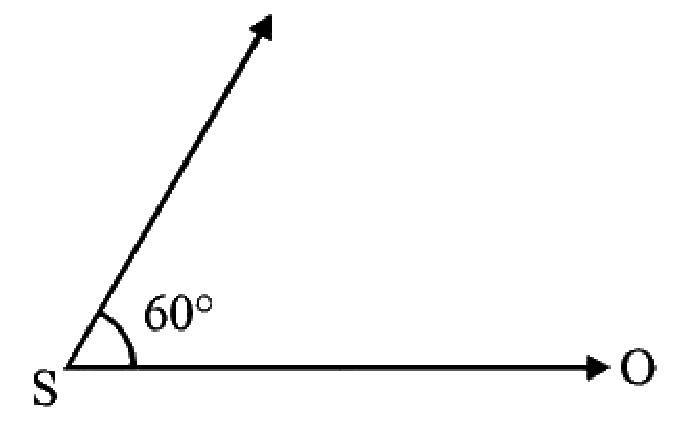
A source of sound S emitting waves of frequency 100 Hz and an observer O are located at some distance from each other. The source is moving with a speed of 19.4 m s−1 at an angle of 60° with the source observer line as shown in the figure. The observer is at rest. The apparent frequency observed by the observer (velocity of sound in air 330 m s−1), is
Q65JEE Main 2015 · 10 APR · SHIFT 1MediumOld syllabus
Doppler Effect
A bat moving at 10 ms−1 towards a wall sends a sound signal of 8000 Hz towards it. On reflection it hears a sound of frequency f. The value of f in Hz is close to (speed of sound = 320 ms−1)
Q66JEE Main 2015 · 11 APR · SHIFT 1DifficultOld syllabus
Doppler Effect
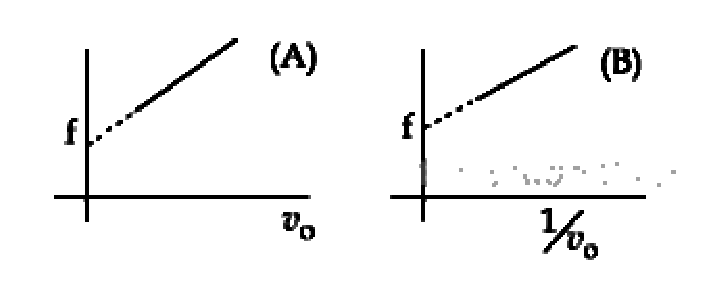
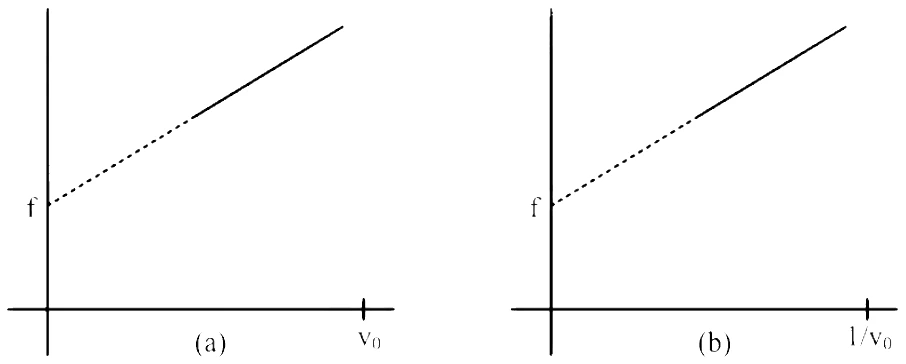
A source of sound emits sound waves at frequency f0. It is moving towards an observer with fixed speed vs (vs < v, where v is the speed of the sound in air). If the observer were to move towards the source with speed v0, one of the following two graphs (A and B) will give the correct variation of the frequency f heard by the observer as v0 is changed.
A train is moving on a straight track with speed 20 ms−1. It is blowing its whistle at the frequency of 1000 Hz. The percentage change in the frequency heard by a person standing near the track as the train passes him is (speed of sound =320 ms−1) close to:
Q68JEE Main 2014 · 11 APR · SHIFT 1EasyOld syllabus
Doppler Effect
Two factories are sounding their sirens at 800 Hz. A man goes from one factory to other at a speed of 2 m/s. The velocity of sound is 320 m/s. The number of beats heard by the person in one second will be:
A speeding motorcyclist sees traffic jam ahead him. He slows down to 36 km hour−1. He finds that traffic has eased and a car moving ahead of him at 18 km hour−1 is honking at a frequency of 1392 Hz. If the speed of sound is 343 m s−1, the frequency of the honk as heard by him will be
Q70JEE Main 2014 · 12 APR · SHIFT 1DifficultOld syllabus
Doppler Effect
A source of sound A emitting waves of frequency 1800 Hz is falling towards ground with a terminal speed v. The observer B on the ground directly beneath the source receives waves of frequency 2150 Hz, The source A receives waves, reflected from ground, of frequency nearly: (Speed of sound = 343 m/s)
Two sources P and Q produce notes of frequency 660 Hz. each. A listener moves from P to Q with a speed of 1 ms−1. If the speed of sound is 330 m/s, then the number of beats heard by the listener per second will be
Q72JEE Main 2013 · 22 APR · SHIFT 1MediumOld syllabus
Doppler Effect
A and B are two sources generating sound waves. A listener is situated at C. The frequency of the source at A is 500 Hz. A, now, moves towards C with a speed 4 m/s. The number of beats heard at C is 6. When A moves away from C with speed 4 m/s, the number of beats heard at C is 18. The speed of sound is 340 m/s. The frequency of the source at B is:
A train moving at a speed of 220 m s−1 towards a stationary object, emits a sound of frequency 1000 Hz. Some of the sound reaching the object gets reflected back to the train as echo. The frequency of the echo as detected by the driver of the train is
The driver of a car travelling with speed 30 m/s towards a hill sounds a horn of frequency 600 Hz. If the velocity of sound in air is 330 m/s, the frequency of reflected sound as heard by driver is
A motor cycle starts from rest and accelerates along a straight path at 2 m/s2. At the starting point of the motor cycle there is a stationary electric siren. How far has the motor cycle gone when the driver hears the frequency of the siren at 94% of its value when the motor cycle was at rest? (Speed of sound =330 ms−1)
A whistle producing sound waves of frequencies 9500 Hz and above is approaching a stationary person with speed v ms−1. The velocity of sound in air is 300 ms−1. If the person can hear frequencies upto a maximum of 10,000 Hz, the maximum value of v upto which he can hear whistle is
An observer moves towards a stationary source of sound, with a velocity one-fifth of the velocity of sound. What is the percentage increase in the apparent frequency?
A car is moving towards a high cliff. The driver sounds a horn of frequency f. The reflected sound heard by the driver has frequency 2f. If v is the velocity of sound, then the velocity of the car, in the same velocity units, will be
An observer moves towards a stationary source of sound with a speed 1/5th of the speed of sound. The wavelength and frequency of the source emitted are λ and f respectively. The apparent frequency and wavelength recorded by the observer are respectively
A whistle revolves in a circle with angular speed ω = 20 rad/s using a string of length 50 cm. If the frequency of sound from the whistle is 385 Hz, then what is the minimum frequency heard by an observer which is far away from the centre (velocity of sound = 340 m/s)
Two stationary sources each emitting waves of wavelength λ, an observer moves from one source to another with velocity u. Then number of beats heard by him
A vehicle, with a horn of frequency n is moving with a velocity of 30 m/s in a direction perpendicular to the straight line joining the observer and the vehicle. The observer perceives the sound to have a frequency n+n1. Then (if the sound velocity in air is 300 m/s)
Two trains move towards each other with the same speed. The speed of sound is 340 m/s. If the height of the tone of the whistle of one of them heard on the other changes to 9/8 times, then the speed of each train should be
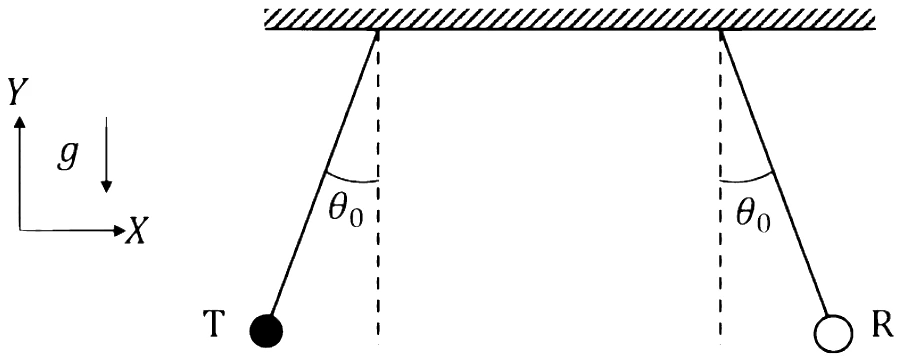
An audio transmitter (T) and a receiver (R) are hung vertically from two identical massless strings of length 8m with their pivots well separated along the X axis. They are pulled from the equilibrium position in opposite directions along the X axis by a small angular amplitude θ0=cos−1(0.9) and released simultaneously. If the natural frequency of the transmitter is 660Hz and the speed of sound in air is 330m s−1, the maximum variation in the frequency (in Hz) as measured by the receiver is _____. (Take g=10m s−2.)
Numerical answer type. Work it out, then open the answer.
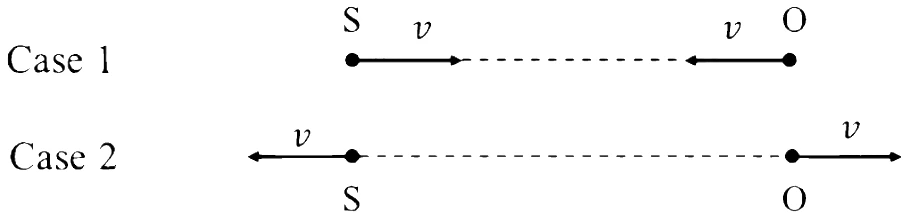
A source S of sound has frequency 240Hz. When the observer O and the source move towards each other at a speed v with respect to the ground (as shown in Case 1 in the figure), the observer measures the frequency of the sound to be 288Hz. However, when the observer and the source move away from each other at the same speed v with respect to the ground (as shown in Case 2 in the figure), the observer measures the frequency of sound to be nHz. The value of n is _____.
Numerical answer type. Work it out, then open the answer.
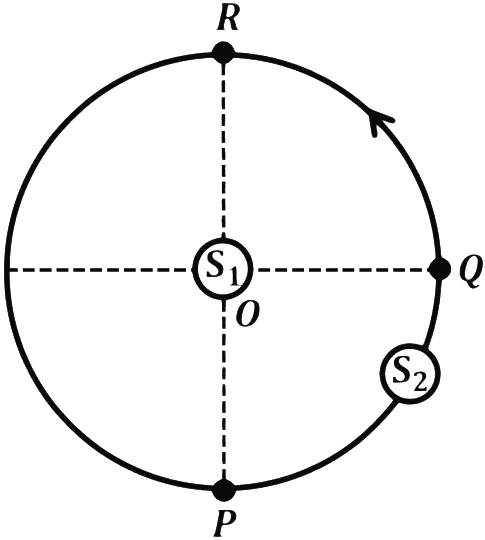
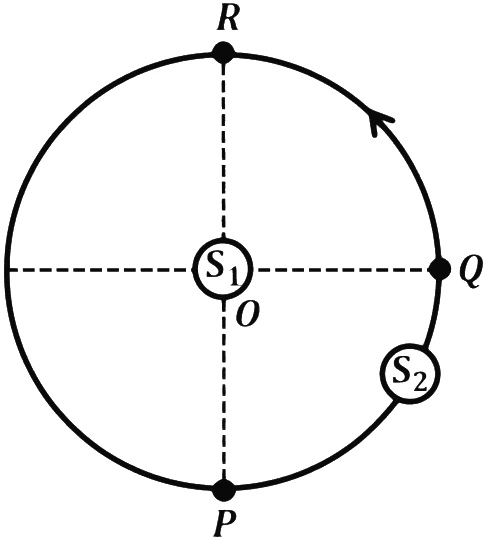
S1 and S2 are two identical sound sources of frequency 656Hz. The source S1 is located at O and S2 moves anti-clockwise with a uniform speed 42m s−1 on a circular path around O, as shown in the figure. There are three points P, Q and R on this path such that P and R are diametrically opposite while Q is equidistant from them. A sound detector is placed at point P. The source S1 can move along direction OP. [Given: The speed of sound in air is 324m s−1]
When only S2 is emitting sound and it is at Q, the frequency of sound measured by the detector in Hz is _____.
Numerical answer type. Work it out, then open the answer.
S1 and S2 are two identical sound sources of frequency 656Hz. The source S1 is located at O and S2 moves anti-clockwise with a uniform speed 42m s−1 on a circular path around O, as shown in the figure. There are three points P, Q and R on this path such that P and R are diametrically opposite while Q is equidistant from them. A sound detector is placed at point P. The source S1 can move along direction OP. [Given: The speed of sound in air is 324m s−1]
Consider both sources emitting sound. When S2 is at R and S1 approaches the detector with a speed 4m s−1, the beat frequency measured by the detector is _____ Hz.
Numerical answer type. Work it out, then open the answer.
A stationary tuning fork is in resonance with an air column in a pipe. If the tuning fork is moved with a speed of 2m s−1 in front of the open end of the pipe and parallel to it, the length of the pipe should be changed for the resonance to occur with the moving tuning fork. If the speed of sound in air is 320m s−1, the smallest value of the percentage change required in the length of the pipe is _____.
Numerical answer type. Work it out, then open the answer.
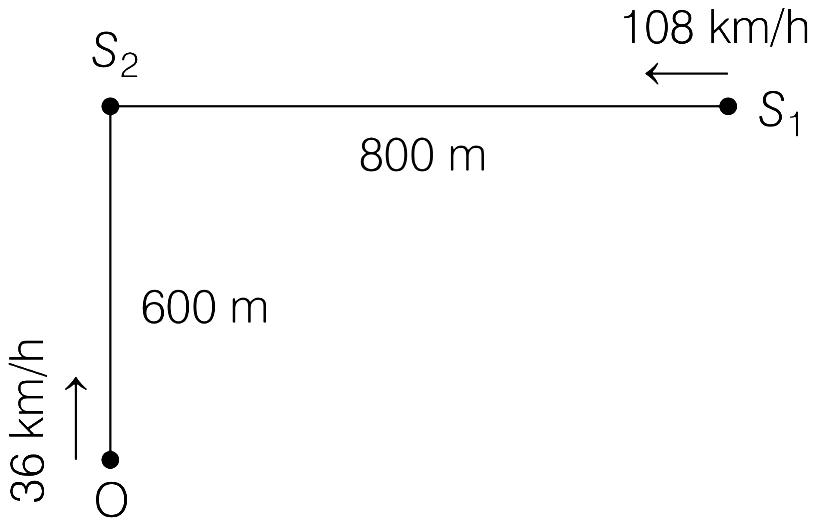
A train S1, moving with a uniform velocity of 108km h−1, approaches another train S2 standing on a platform. An observer O moves with a uniform velocity of 36km h−1 towards S2, as shown in the figure. Both the trains are blowing whistles of the same frequency 120Hz. When O is 600m away from S2 and the distance between S1 and S2 is 800m, the number of beats heard by O is _____. [Speed of sound =330m s−1]
Numerical answer type. Work it out, then open the answer.
Two men are walking along a horizontal straight line in the same direction. The man in front walks at a speed 1.0m s−1 and the man behind walks at a speed 2.0m s−1. A third man is standing at a height 12m above the same horizontal line such that all three men are in a vertical plane. The two walking men are blowing identical whistles which emit a sound of frequency 1430Hz. The speed of sound in air is 330m s−1. At the instant when the moving men are 10m apart, the stationary man is equidistant from them. The frequency of beats in Hz heard by the stationary man at this instant is _____.
Numerical answer type. Work it out, then open the answer.
A stationary source emits sound of frequency f0=492Hz. The sound is reflected by a large car approaching the source with a speed of 2m s−1. The reflected signal is received by the source and superposed with the original. What will be the beat frequency of the resulting signal in Hz? (Given that the speed of sound in air is 330m s−1 and the car reflects the sound at the frequency it has received.)
Numerical answer type. Work it out, then open the answer.
Two vehicles, each moving with speed u on the same horizontal straight road, are approaching each other. Wind blows along the road with velocity w. One of these vehicles blows a whistle of frequency f1. An observer in the other vehicle hears the frequency of the whistle to be f2. The speed of sound in still air is V. The correct statement(s) is(are)
More than one option can be correct. Tap every correct option, then tap Check.
A police car with a siren of frequency 8kHz is moving with uniform velocity 36km h−1 towards a tall building which reflects the sound waves. The speed of sound in air is 320m s−1. The frequency of the siren heard by the car driver is
A stationary source is emitting sound at a fixed frequency f0, which is reflected by two cars approaching the source. The difference between the frequencies of sound reflected from the cars is 1.2% of f0. What is the difference in the speeds of the cars (in km per hour) to the nearest integer? The cars are moving at constant speeds much smaller than the speed of sound which is 330m s−1.
Numerical answer type. Work it out, then open the answer.
Two trains A and B are moving with speeds 20m s−1 and 30m s−1 respectively in the same direction on the same straight track, with B ahead of A. The engines are at the front ends. The engine of train A blows a long whistle.
Assume that the sound of the whistle is composed of components varying in frequency from f1=800Hz to f2=1120Hz, as shown in the figure. The spread in the frequency (highest frequency − lowest frequency) is thus 320Hz. The speed of sound in still air is 340m s−1.
The distribution of the sound intensity of the whistle as observed by the passengers in train A is best represented by
Two trains A and B are moving with speeds 20m s−1 and 30m s−1 respectively in the same direction on the same straight track, with B ahead of A. The engines are at the front ends. The engine of train A blows a long whistle.
Assume that the sound of the whistle is composed of components varying in frequency from f1=800Hz to f2=1120Hz, as shown in the figure. The spread in the frequency (highest frequency − lowest frequency) is thus 320Hz. The speed of sound in still air is 340m s−1.
The spread of frequency as observed by the passengers in train B is
A whistling train approaches a junction. An observer standing at the junction observes the frequency to be 2.2kHz and 1.8kHz for the approaching and the receding train respectively. Find the speed of the train (speed of sound =300m s−1).
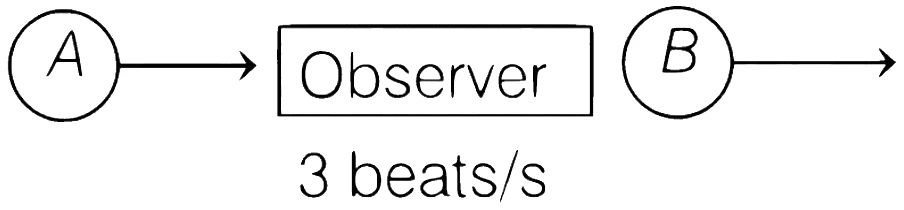
Two sources of sound S1 and S2 are moving towards and away from a stationary observer, respectively, with the same speed. The observer detects 3 beats per second. Find the speed of the sources (approximately). Given f1=f2=500Hz and speed of sound in air =330m s−1.
The driver of a car travelling with speed 30m s−1 towards a hill sounds a horn of frequency 600Hz. If the velocity of sound in air is 330m s−1, the frequency of the reflected sound as heard by the driver is
On the same path, the source and the observer are moving such that the distance between them increases with time. The speeds of source and observer are the same and equal to 10m s−1 with respect to the ground, while no wind is blowing. The apparent frequency received by the observer is 1950Hz. Then the original frequency must be (the speed of sound in the present medium is 340m s−1)
A source and an observer are moving towards each other with a speed equal to v/2, where v is the speed of sound. The source is emitting sound of frequency n. The frequency heard by the observer will be
A source of sound S is moving with a velocity of 50m s−1 towards a stationary observer. The observer measures the frequency of the source as 1000Hz. What will be the apparent frequency of the source when it is moving away from the observer after crossing him? The velocity of sound in the medium is 350m s−1.
A vehicle with a horn of frequency n is moving with a velocity of 30m s−1 in a direction perpendicular to the straight line joining the observer and the vehicle. The observer receives the sound with a frequency n+n1. Then (if the velocity of sound in air is 300m s−1)
A bat emitting an ultrasonic wave of frequency 4.5×10⁴Hz at a speed of 6m s−1 between two parallel walls (speed of sound =330m s−1). The two frequencies heard by the bat will be
More than one option can be correct. Tap every correct option, then tap Check.
A sound source producing waves of frequency 300Hz and wavelength 1m, observer is stationary, while source is going away with the velocity 30m/s, then apparent frequency heard by the observer is
An engine moving towards a wall with a velocity 50m/s emits a note of 1.2kHz. Speed of sound in air is 350m/s. The frequency of the note after reflection from the wall as heard by the driver of the engine is
An observer moves towards a stationary source of sound, with a velocity one-fifth of the velocity of sound. What is the percentage increase in the apparent frequency?
A person is observing two trains, one coming towards him and the other leaving with the same velocity 4m s−1. If their whistling frequencies are 240Hz each, then the number of beats per second heard by the person will be (if the velocity of sound is 320m s−1)
A siren emitting sound of frequency 500Hz is going away from a stationary listener with a speed of 50m s−1. The frequency of sound heard directly from the siren is
A submarine A travelling at 17m s−1 is being chased along the line of its velocity by another submarine B travelling at 34m s−1. B sends a sonar signal of 600Hz to detect A and receives a reflected sound of frequency ν. The value of ν is [Speed of sound in water =1500m s−1]
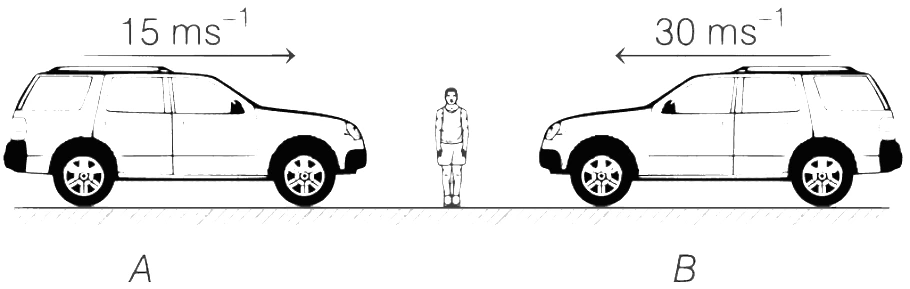
Two cars approach a stationary observer from opposite sides as shown in the figure. Car A moves at 15m s−1 and car B at 30m s−1. The observer hears no beats. If the frequency of the horn of the car B is 504Hz, then the frequency of the horn of the car A will be
Radar waves are sent towards a moving airplane and the reflected waves are received. When the airplane is moving towards the radar, the wavelength of the wave
With what velocity should an observer approach a stationary sound source, so that the apparent frequency of sound should appear double the actual frequency?
A car is moving towards a high cliff. The car driver sounds a horn of frequency f. The reflected sound heard by the driver has a frequency 2f. If v be the velocity of sound, then the velocity of the car in the same velocity units, will be
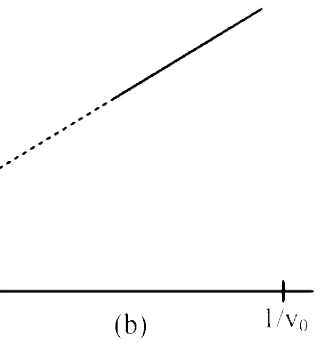
A source of sound emits sound waves at frequency f0. It is moving towards an observer with fixed speed vs (vs<v, where v is the speed of sound in air). If the observer were to move towards the source with speed v0, one of the two graphs (A and B) will give the correct variation of the frequency f heard by the observer as v0 is changed. Graph A plots f against v0 and graph B plots f against 1/v0. The variation of f with v0 is given correctly by
A galaxy is moving away from the Earth so that a spectral line at 600nm is observed at 601nm. Then the speed of the galaxy with respect to the Earth is
A motor-cyclist moving towards a huge cliff with a speed of 18km h−1 blows a horn of source frequency 325Hz. If the speed of sound in air is 330m s−1, the number of beats heard by him is
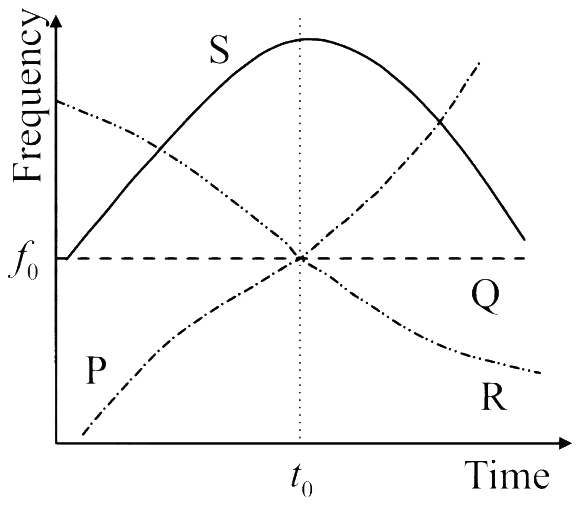
A train whistling at constant frequency n is moving towards a station at a constant speed v. The train goes past a stationary observer on the station. The frequency n of the sound as heard by the observer is plotted as a function of time t. Identify the correct curve.
A sound source of frequency 1000Hz approaches the observer with a speed 20m s−1. The observed frequency of sound is nearly (speed of sound in air =340m s−1)
An observer moves towards a stationary source of sound with a velocity one fourth of the velocity of sound. Then the percentage increase in the apparent frequency observed by the observer is
A person at rest hears an electric siren which is stationary. Now the person accelerates at 2m s−2 along a straight line path. The distance travelled by him when he hears the frequency of the siren as 94% of its initial value is (speed of sound in air =330m s−1)
When both the source of sound and the observer approach each other with a speed equal to 10% of the speed of sound, the percentage change in the frequency heard by the observer is nearly
A car sounding a horn of frequency 1000Hz passes a stationary observer. The ratio of the frequencies of the horn noted by the observer before and after passing of the car is 11:9. The speed of the car is (speed of sound v=340m s−1)
Two observers A and B are moving towards a stationary source of sound with speeds 0.8V0 and 0.6V0 respectively, where V0 is the speed of sound in air. The ratio of the frequencies of the sound heard by the observers A and B is
A source producing sound of frequency 990Hz and an observer are initially at rest. If both the source and observer start moving simultaneously towards each other with accelerations 2m s−2 and 4m s−2 respectively, then the frequency of sound heard by the observer at a time of t=5s is (Speed of sound in air =340m s−1)
If a source of sound initially at rest is moving away from a stationary observer with an acceleration of 11m s−2, then the time taken for the frequency of sound heard by the observer to become 10% less than the frequency of source is (Speed of sound in air =330m s−1)
A source of sound of frequency 660Hz and an observer are moving towards each other with speeds of 31kmph and 23kmph respectively. If the wind blows with a speed of 5kmph from observer towards the source, then the frequency of the sound heard by the observer is (Speed of sound in air =340m s−1)
Two stationary sources P and Q produce sounds of equal frequency of 170Hz. The velocity with which an observer has to move from source P towards source Q such that 8 beats are to be heard per second by the observer is (Speed of sound in air =340m s−1)
A car moving towards a cliff emits sound of frequency n. If the difference in frequencies of the horn and its echo heard by the driver of the car is 10% of n, then the speed of the car is nearly (Speed of sound in air is 336m s−1)
The frequency of sound heard by an observer moving towards a stationary source with a certain speed is n1, and if the observer moves away from the same source with the same speed, the frequency of sound heard by the observer is n2. If the speed of sound in air is 340m s−1 and n1:n2=71:65, then the speed of the observer is
A source at rest emits sound waves of frequency 102Hz. Two observers are moving away from the source of sound in opposite directions, each with a speed of 10% of the speed of sound. The ratio of the frequencies of sound heard by the observers is
A boy standing on a platform observes the frequency of a train horn as it passes by. The change in the frequency noticed as the train approaches and recedes from him with a velocity of 108km h−1 is (speed of sound in air =330m s−1)
A car travelling at a speed of 54km h−1 towards a wall sounds a horn of frequency 400Hz. The difference in the frequencies of two sounds, one received directly from the car and the other reflected from the wall, noticed by a person standing between the car and the wall, is (speed of sound in air is 335m s−1)
A source and an observer move away from each other with the same velocity of 10m s−1 with respect to the ground. If the observer finds the frequency of sound coming from the source as 1980Hz, then the actual frequency of the source is (speed of sound in air =340m s−1)
An observer moves towards a stationary source of sound with a speed of one fifth of the speed of sound. The apparent increase in the frequency heard by the observer is
An observer moves towards a stationary source of sound with a speed 51th that of sound. The frequency of the sound emitted by the source is f. The apparent frequency recorded by the observer is
A source emitting sound is tied to one end of a string of length 50cm and is rotated with an angular speed of 40rad s−1 in the horizontal plane. The ratio of the maximum and minimum frequencies of the sound heard by an observer standing at a distance of 10m from the fixed end of the string is (speed of sound in air =340m s−1)
Two trucks heading in opposite directions, each with speed 0.1u, approach each other. The speed of sound is u. The driver of the first truck sounds his horn of frequency 495Hz. Let v1 and v2 be the frequencies heard by the driver of the second truck when the trucks approach each other and when the trucks have passed each other, respectively. The magnitude of v1−v2 is
The frequency of the whistle of a train moving with a constant speed is observed by a stationary detector on the platform to be ν1. The frequency of the same whistle is detected to be ν2 inside another train moving on a parallel track, at a speed v towards the first train. If the speed of sound in air is taken to be vsound, what is the ratio v/vsound?
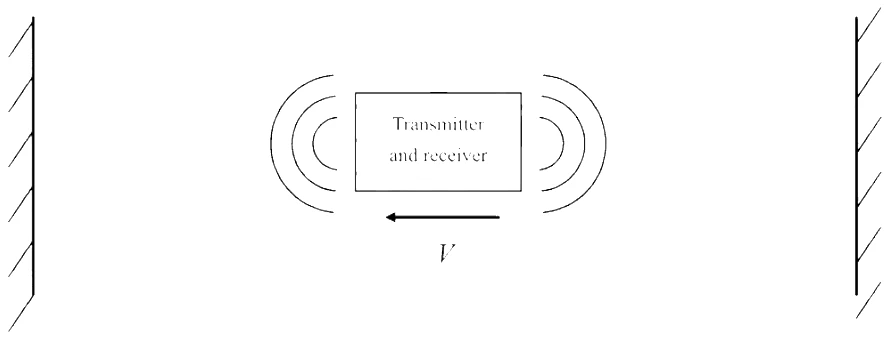
A device having a transmitter and a receiver on-board is moving with speed V between two walls as shown in the figure. The transmitter sends out signal of frequency fs and speed C towards both the walls whereas the receiver is designed to detect the frequencies of echoes from the walls. Assuming that the walls are sufficiently away from the device to allow for multiple reflections, the frequency which will NOT be detected by the device is
A small source of sound is in uniform circular motion of radius R and angular speed π/10rad⋅s−1. It emits continuous sound of fixed frequency f0. A detector placed at a distance 2R from the centre and in the plane of the circle records frequencies with maximum value 1200Hz and minimum value 800Hz. Take the speed of sound to be 330m⋅s−1. Select the correct statement(s).
More than one option can be correct. Tap every correct option, then tap Check.
A source of sound emitting at a frequency f is moving towards a wall with speed vb. If v is the speed of sound then the beat frequency heard by a stationary observer behind the source is
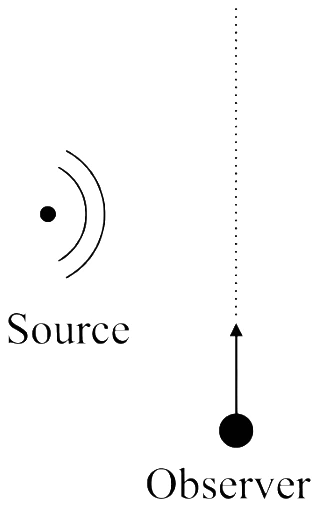
A point source generates sound at constant frequency f0. An observer is moving at a constant speed along the line as shown in the figure and the nearest distance of approach is at time t0. The frequency of sound as heard by the observer can be best depicted as
A machine gun mounted on a stationary vehicle fires bullets at a fixed target at the speed of 100m s−1. The sound waves produced by the firing travel at the speed of 330m s−1. The vehicle now moves toward the target with a speed of 20m s−1. Which of the following statements is/are true?
More than one option can be correct. Tap every correct option, then tap Check.