The length of mercury column in a mercury-in-glass thermometer is H1 mm at the ice point and H2 mm at the steam point. When the length is H mm, the temperature T is given in ∘C by (H1<H2)
The temperature of a metallic sphere of radius R is increased by a small amount ΔT. If the linear coefficient of thermal expansion of the metal is α, the approximate increase in the volume of the sphere is:
The coefficient of volume expansion of mercury is 18×10−5/∘C. A thermometer bulb has volume 10−6 m3 and cross-section of stem is 0.004 cm2. Assuming bulb is filled with mercury at 0∘C then the mercury column at 100∘C is
A celsius and a Fahrenheit thermometer are dipped in boiling water. The temperature of water is lowered until the Farenheit thermometer shows 140∘. What is the fall in temperature on the Celsius thermometer?
An iron tyre is to be fitted on to a wooden wheel 1.0 m in diameter. The diameter of the tyre is 6 mm smaller than that of the wheel. The tyre should be heated so that its temperature increases by a minimum of
(coefficient of volume expansion of iron = 3.6×10⁻⁵/∘C)
The temperature of a metal strip having coefficient of linear expansion α is increased from T1 to T2 resulting in increase of its length by ΔL1. The temperature is further increased from T2 to T3 such that the increase in its length is ΔL2.
Given T3+T1=2T2 and T2−T1=ΔT, the value of ΔL2 is ______.
An aluminium and steel rods having same lengths and cross-sections are joined to make total length of 120 cm at 30∘C. The coefficient of linear expansion of aluminium and steel are 24×10−6/∘C and 1.2×10⁻⁵/∘C, respectively. The length of this composite rod when its temperature is raised to 100∘C, is ______ cm.
A sheet of solid material having area A and coefficient of linear expansion α. The mass of sheet is m and specific heat capacity is s. If dQ is the amount of heat given to the sheet then change in its area is
A metal rod (A) of length 20 cm expands by 0.075 cm when its temperature changes from 0∘C to 100∘ C. Another metal rod (B) of different metal of same length expands by 0.045 cm for same temperature change. A third rod of same length is composed of 2 parts, one of metal A and another of metal B. For same temperature change, this rod expands by 0.060 cm. The portion made of metal A has the length
The temperature of a body on Kelvin scale is ' x ' K. When it is measured by a Fahrenheit thermometer, it is found to be ' x ' ∘F. The value of ' x ' is (nearly)
A centigrade and Fahrenheit thermometer are dipped in boiling water. The water temperature is lowered until the Fahrenheit temperature observed is 140∘F. At that time the temperature registered by the centigrade thermometer is
A thermometer bulb has volume 10−6 m3 and cross-section of the stem is 0.002 cm2. The bulb is filled with mercury at 0∘C. If the thermometer reads temperature as 100∘C, then the length of mercury column is (coefficient of cubical expansion of mercury =18×10−5/∘C)
The length of steel rod is 5 cm longer than the copper rod at all temperatures. The length of the steel and copper rod is respectively (Coefficient of linear expansion for steel and copper is respectively 1.1×10⁻⁵/∘C and 1.7×10⁻⁵/∘C)
The difference in length between two rods A and B is 60 cm at all temperatures. If αA=18×10−6/∘C and αB=27×10−6/∘C, then the length of rod A and rod B at 0∘C is respectively
Two rods of different materials have lengths ' l1 ' and ' l2 ' whose coefficient of linear expansions are ' α1 ' and ' α2 ' respectively. If the difference between the two lengths is independent of temperature then
Consider a rectangular sheet of solid material of length l=9 cm and width d=4 cm. The coefficient of linear expansion is α=3.1×10⁻⁵ K−1 at room temperature and one atmospheric pressure. The mass of sheet m=0.1 kg and the specific heat capacity Cv=900 J kg−1 K−1. If the amount of heat supplied to the material is 8.1×10² J then change in area of the rectangular sheet is:
A metal rod having coefficient of linear expansion 2×10⁻⁵/∘C is 0.75 m long at 45∘C. When the temperature rises to 65∘C, the increase in length of the rod will be
The resistances of the platinum wire of a platinum resistance thermometer at the ice point and steam point are 8Ω and 10Ω respectively. After inserting in a hot bath of temperature 400∘C, the resistance of platinum wire is:
At certain temperature, rod A and rod B of different materials have lengths LA and LB respectively. Their co-efficients of linear expansion are αA and αB respectively. It is observed that the difference between their lengths remain constant at all temperatures. The ratio LA/LB is given by
Rails of material of steel are laid with gaps to allow for thermal expansion. Each track is 10 m long, when laid at temperature 17∘C. The maximum temperature that can be reached is 45∘C. The gap to be kept between the two segments of railway track is
At certain temperature, rod A and rod B of different materials have lengths LA and LB respectively. Their coefficients of linear expansion are αA and αB respectively. It is observed that the difference between their lengths remains constant at all temperatures. The ratio LA:LB is given by
Railway track is made of steel segments separated by small gaps to allow for linear expansion. The segment of track is 10 m long when laid at temperature 17∘C. The maximum temperature that can be reached is 45∘C. Increase in length of the segment of railway track is ' x ' ×10−5 m. The value of ' x ' is (αsteel =1.2×10⁻⁵/∘C)
A sheet of steel is 40 cm long and 5 cm broad at 0∘C. The surface area of the sheet increases by 1.4 cm2 at 100∘C. Coefficient of linear expansion of steel is
Two rods, one of copper ( Cu) and the other of iron ( Fe) having initial lengths L1 and L2 respectively are connected together to form a single rod of length L1+L2. The coefficient of linear expansion of Cu and Fe are αc and αi respectively. If the length of each rod increases by the same amount when their temperatures are raised by t∘C, then ratio of L1+L2L1−L2 will be
Two rods, one of aluminium and the other of steel, having initial lengths ' L1 ' and ' L2 ' are connected together to form a single rod of length (L1+L2). The coefficients of linear expansion of aluminium and steel are ' α1 ' and ' α2 ' respectively. If the length of each rod increases by the same amount, when their temperatures are raised by t∘C, then the ratio L1+L2L1 will be
The volume of a metal block increases by 0.225% when its temperature is increased by 30∘C. Hence coefficient of linear expansion of the material of metal block is
On a temperature scale 'X', the boiling point of water is 65∘X and the freezing point is −15∘X. Assume that the X scale is linear. The equivalent temperature corresponding to −95∘X on the Fahrenheit scale would be:
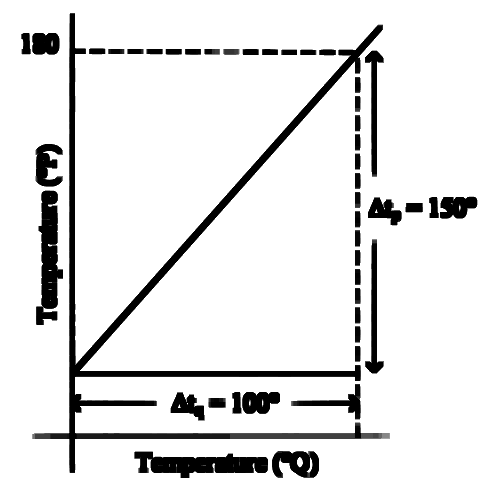
The graph between two temperature scales P and Q is shown in the figure. Between upper fixed point and lower fixed point there are 150 equal divisions of scale P and 100 divisions on scale Q. The relationship for conversion between the two scales is given by :-
A faulty thermometer reads 5∘C in melting ice and 95∘C in steam. The correct temperature on absolute scale will be __________ K when the faulty thermometer reads 41∘C.
Numerical answer type. Work it out, then open the answer.
Two uniform brass rods A and B of length 'l' and '2l' and their radii '2r' and 'r' respectively are heated to same temperature. The ratio of the increase in the volume of rod A to that of rod B is
A hole is drilled in a metal sheet. At 27∘C, the diameter of hole is 5 cm. When the sheet is heated to 177∘C, the change in the diameter of hole is d×10−3 cm. The value of d will be __________ if coefficient of linear expansion of the metal is 1.6×10⁻⁵/∘C.
Numerical answer type. Work it out, then open the answer.
A steel rod of length 1 m and cross sectional area 10−4 m2 is heated from 0∘C to 200∘C without being allowed to extend or bend. The compressive tension produced in the rod is ___________ ×104 N. (Given Young's modulus of steel =2×10¹¹ N m−2, coefficient of linear expansion =10−5 K−1)
Numerical answer type. Work it out, then open the answer.
The pressure of the gas in a constant volume gas thermometer is 100 cm of mercury when placed in melting ice at 1 atm. When the bulb is placed in a liquid, the pressure becomes 180 cm of mercury. Temperature of the liquid is:
At what temperature a gold ring of diameter 6.230 cm be heated so that it can be fitted on a wooden bangle of diameter 6.241 cm? Both the diameters have been measured at room temperature (27∘C).
(Given: coefficient of linear thermal expansion of gold αL = 1.4 × 10⁻⁵ K−1)
A solid metallic cube having total surface area 24 m2 is uniformly heated. If its temperature is increased by 10∘C, calculate the increase in volume of the cube. (Given α = 5.0 × 10 −4 ∘C−1).
A unit scale is to be prepared whose length does not change with temperature and remains 20 cm, using a bimetallic strip made of brass and iron each of different length. The length of both components would change in such a way that difference between their lengths remains constant. If length of brass is 40 cm, then length of iron will be __________ cm⋅(αiron =1.2×10⁻⁵ K−1 and αbrass =1.8×10⁻⁵ K−1).
Numerical answer type. Work it out, then open the answer.
On an imaginary linear scale of temperature (called 'W' scale) the freezing and boiling points of water are 39∘ W and 239∘ W respectively. The temperature on the new scale corresponding to 39 ∘C temperature on Celsius scale will be
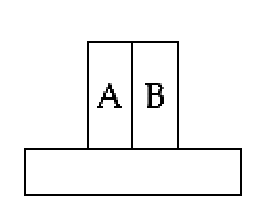
A bimetallic strip consists of metals A and B. It is mounted rigidly as shown. The metal A has higher coefficient of expansion compared to that of metal B. When the bimetallic strip is placed in a cold bath, it will:
Two rods of different metals have coefficients of linear expansion 'α1' and 'α2' respectvely. Their respective lengths are 'L1' and 'L2'. At all temperatures (L2−L1) is same. The correct relation is
Let 'W1' be the work done in blowing a soap bubble of radius 'r' from soap at room temperature. The soap is now heated and second soap bubble of radius '2r' is blown from the heated soap solution. If 'W2' is the work done in forming this bubble then
Each side of a box made of metal sheet in cubic shape is 'a' at room temperature 'T', the coefficient of linear expansion of the metal sheet is 'α'. The metal sheet is heated uniformly, by a small temperature ΔT, so that its new temperature is T + ΔT. Calculate the increase in the volume of the metal box.
The area of cross-section of a railway track is 0.01 m2. The temperature variation is 10∘C. Coefficient of linear expansion of material of track is 10−5/∘ C. The energy stored per meter in the track is ____________ J/m.
(Young's modulus of material of track is 1011 Nm−2)
Numerical answer type. Work it out, then open the answer.
A non-isotropic solid metal cube has coefficients of linear expansion as:
5 × 10⁻⁵/oC along the x-axis and 5 × 10⁻⁶/oC along the y and the z-axis. If the coefficient of volume expansion of the solid is C × 10-6/oC then the value of C is
Numerical answer type. Work it out, then open the answer.
Two different wires having lengths L1 and L2, and respective temperature coefficient of linear expansion α1 and α2, are joined end-to-end. Then the effective temperature coefficient of linear expansion is:
When the temperature of a metal wire is increased from 0oC to 10oC, its length increases by 0.02%. The percentage change in its mass density will be closest to:
A bakelite beaker has volume capacity of 500 cc at 30oC. When it is partially filled with Vm volume (at 30oC) of mercury, it is found that the unfilled volume of the beaker remains constant as temperature is varied. If γ(beaker) = 6 × 10⁻⁶oC–1 and γ(mercury) = 1.5 × 10⁻⁴oC–1, where γ is the coefficient of volume expansion, then Vm (in cc) is close to ____.
Numerical answer type. Work it out, then open the answer.
A thermometer graduated according to a linear scale reads a value x0 when in contact with boiling water, and x0/3 when in contact with ice. What is the temperature of an object inoC, if this thermometer in the contact with the object reads x0/2?
A copper rod of 88 cm and an aluminium rod of unknown length have their increase in length independent of increase in temperature. The length of aluminium rod is: (αCu = 1.7 × 10⁻⁵ K–1 and αAl = 2.2 × 10⁻⁵ K–1)
Two rods A and B of identical dimensions are at temperature 30°C. If A is heated upto 180oC and B upto ToC, then the new lengths are the same. If the ratio of the coefficients of linear expansion of A and B is 4: 3, then the value of T is
A rod, of length L at room temperature and uniform area of cross section A, is made of a metal having coefficient of linear expansion α/oC. It is observed that an external compressive force F, is applied on each of its ends, prevents any change in the length of the rod, when its temperature rises by ΔT K. Young's modulus, Y, for this metal is:
A clock pendulum having coefficient of linear expansion. α=9×10⁻⁷/∘C−1 has a period of 0.5 s at 20∘C. If the clock is used in a climate, where the temperature is 30∘C, how much time does the clock lose in each oscillation? ( g= constant)
At 40o C, a brass wire of 1 mm radius is hung from the ceiling. A small mass, M is hung from the free end of the wire. When the wire is cooled down from 40oC to 20oC it regains its original length of 0.2 m. The value of M is close to: (Coefficient of linear expansion and Young’s modulus of brass are 10–5 /oC and 1011 N/m 2, respectively; g= 10 ms–2)
A steel rail of length 5 m and area of cross section 40cm2 is prevented from expanding along its length while the temperature rises by 10oC. If coefficient of linear expansion and Young’s modulus of steel are 1.2×10⁻⁵ K−1 and 2×10¹¹ Nm−2 respectively, the force developed in the rail is approximately:
A compressive force, F is applied at the two ends of a long thin steel rod. It is heated, simultaneously, such that its temperature increases by ΔT. The net change in its length is zero. Let ℓ be the length of the rod, A its area of cross-section,Y its Young’s modulus, and α its coefficient of linear expansion. Then, F is equal to:
An external pressure P is applied on a cube at 0oC so that it is equally compressed from all sides. K is the bulk modulus of the material of the cube and α is its coefficient of linear expansion. Suppose we want to bring the cube to its original size by heating. The temperature should be raised by:
A simple pendulum made of a bob of mass m and a metallic wire of negligible mass has time period 2 s at T=0oC. If the temperature of the wire is increased and the corresponding change in its time period is plotted against its temperature, the resulting graph is a line of slope S. If the coefficient of linear expansion of metal is α then the value of S is:
A pendulum clock loses 12 s a day if the temperature is 40∘C and gains 4 s a day if the temperature is 20∘C. The temperature at which the clock will show correct time, and the co-efficient of linear expansion (α) of the metal of the pendulum shaft are respectively:
On a linear temperature scale Y, water freezes at −160∘ Y and boils at −50∘ Y. On this Y scale, a temperature of 340 K would be read as: (water freezes at 273 K and boils at 373 K)
The ratio of the coefficient of volume expansion of a glass container to that of a viscous liquid kept inside the container is 1: 4. What fraction of the inner volume of the container should the liquid occupy so that the volume of the remaining vacant space will be same at all temperatures?
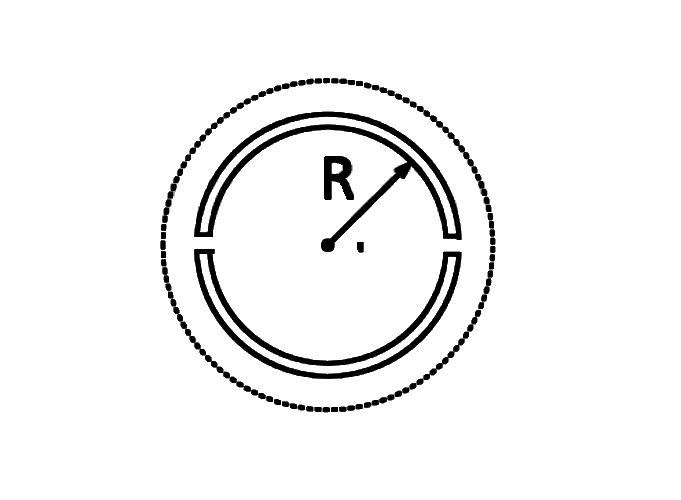
A wooden wheel of radius R is made of two semicircular part (see figure). The two parts are held together by a ring made of a metal strip of cross sectional area S and length L.L is slightly less than 2πR. To fit the ring on the wheel, it is heated so that its temperature rises by ΔT and it just steps over the wheel. As it cools down to surrounding temperature, it process the semicircular parts together. If the coefficient of linear expansion of the metal is α, and its Young's modulus is Y, the force that one part of the wheel applies on the other part is:
The coefficients of linear expansions of brass and steel are α1 and α2 respectively. When we take a brass rod of length l1 and a steel rod of length l2 at 0∘C, then the difference in their lengths (l2−l1) will remain the same at all temperatures if
A Centigrade and a Fahrenheit thermometer are dipped in boiling water. The water temperature is lowered until the Fahrenheit thermometer registers 140∘F. What is the fall in temperature as registered by the centigrade thermometer?
Consider the following statements: Statement-I: Marine animals remain alive in winter and move near the bottom of lakes despite frozen water on the surface. Statement-II: The density of water is maximum at 4∘C and water at the bottom of lakes remains warm in winter. Which one of the following is correct in respect of the above statements?
The coefficient of areal expansion of a material is 1.6×10⁻⁵K−1. Which one of the following gives the value of coefficient of volume expansion of this material?
A Kelvin thermometer and a Fahrenheit thermometer both give the same reading for a certain sample. What would be the corresponding reading in a Celsius thermometer?
A glass vessel is filled with water to the rim and a lid is fixed to it tightly. Then it is left inside a freezer for hours. What is expected to happen ?
Fahrenheit and Celsius are the two scales used for measuring temperature. If the numerical value of a temperature recorded in both the scales is found to be same, what is the temperature?
Thermometers A and B have ice points marked at 15∘ and 25∘ and steam points at 75∘ and 125∘ respectively. When thermometer A measures the temperature of a bath as 60∘, the reading of B for the same bath is
Steel wire of length 'L' at 40∘C is suspended from the ceiling and then a mass 'm' is hung from its free end. The wire is cooled down from 40∘C to 30∘C to regain its original length 'L'. The coefficient of linear thermal expansion of the steel is 10−5/∘C, Young's modulus of steel is 1011N/m2 and radius of the wire is 1mm. Assume that L≫ diameter of the wire. Then the value of 'm' in kg is nearly
Numerical answer type. Work it out, then open the answer.
A cylinder of mass 1kg is given heat of 20000J at atmospheric pressure. If initially temperature of cylinder is 20∘C, find (A) The final temperature of the cylinder; (B) The work done by the cylinder; (C) The change in internal energy of the cylinder. Given: The specific heat of cylinder =400J kg−1∘C−1 Coefficient of volume expansion =9×10⁻⁵∘C−1 Atmospheric pressure =105N/m2, Density of cylinder =9000kg/m3
The coefficient of cubical expansion of mercury is 0.00018/∘C and that of brass 0.00006/∘C. If a barometer having a brass scale were to read 74.5cm at 30∘C, find the true barometric height at 0∘C. The scale is supposed to be correct at 15∘C.
A non-conducting body floats in a liquid at 20∘C with 32 of its volume immersed in the liquid. When liquid temperature is increased to 100∘C, 43 of body's volume is immersed in the liquid. Then the coefficient of real expansion of the liquid is (neglecting the expansion of container of the liquid)
A clock with a metal pendulum beating seconds keeps correct time at 0∘C. If it loses 12.5s a day at 25∘C, the coefficient of linear expansion of metal pendulum is
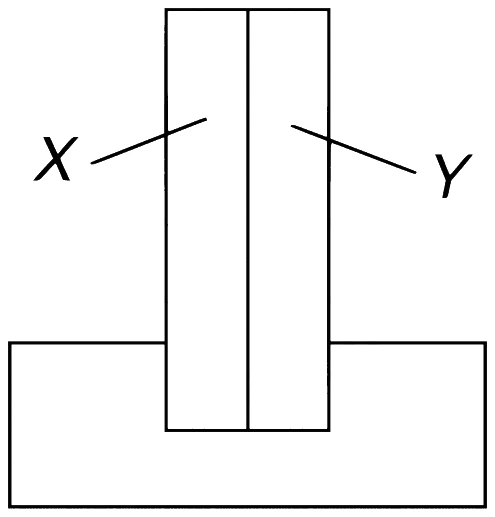
A bimetallic strip consists of metals X and Y. It is mounted rigidly at the base as shown. The metal X has a higher coefficient of expansion compared to that for metal Y. When bimetallic strip is placed in a cold bath :
A steel scale measures the length of a copper wire as 80.0cm, when both are at 20∘C, the calibration temperature for the scale. What would the scale read for the length of the rod when both are at 40∘C? Given: α for steel =11×10−6per∘C and α for Cu =17×10−6per∘C
A piece of metal weighs 45g in air and 25g in a liquid of density 1.5×10³kg m−3 kept at 30∘C. When the temperature of the liquid is raised to 40∘C, the metal piece weighs 27g. The density of liquid at 40∘C is 1.25×10³kg m−3. The coefficient of linear expansion of metal is
A clock pendulum made of invar has a period of 0.5s at 20∘C. If the clock is used in a climate where the temperature averages to 30∘C, how much time does the clock lose in each oscillation? (For invar, α=9×10⁻⁷/∘C, g=constant)
How much should the temperature of a metal ring of diameter 100cm be raised in order to fit it on a wooden disc of diameter 100.6cm? [coefficient of linear expansion of metal =12×10−6∘C−1]
If the temperature of a steel solid sphere of mass 4kg and radius 5cm is increased by 10∘C, then the increase in the moment of inertia of the sphere about its diameter is (Coefficient of linear expansion of steel =1.2×10⁻⁵K−1)
Two rods made of metals A and B, each of length 20cm expand by 0.075cm and 0.045cm respectively, when heated from 0∘C to 100∘C. A composite rod of same length is made with a portion of metal A and remaining with B expands by 0.060cm for same rise of temperature. Then the portion of composite rod made of A has initial length
A rod is found to be 0.05cm longer at 40∘C than it is at 10∘C. The length of the rod at 0∘C is (coefficient of linear expansion of the material of the rod =1.5×10⁻⁵∘C−1)
An iron sphere having diameter D and mass M is immersed in hot water so that the temperature of the sphere increases by δT. If α is the coefficient of linear expansion of the iron then the change in the surface area of the sphere is
A glass vessel of volume V0 is completely filled with a liquid and its temperature is raised by ΔT. What volume of the liquid will flow over, if the coefficient of linear expansion of glass is αg and coefficient of volume expansion of the liquid is γl ?
If two rods of length L and 2L, having coefficients of linear expansion α and 2α respectively are connected end-to-end, then find the average coefficient of linear expansion of the composite rod.
A cylinder has a piston at a temperature of 30∘C. There is all round clearance of 0.08mm between the piston and cylinder wall. If the internal diameter of the cylinder is 15cm, what is the temperature at which the piston will fit into the cylinder exactly? (αp=1.6×10⁻⁵/∘C and αc=1.2×10⁻⁵/∘C)
The percentage error in the measurement of length when a metal scale calibrated at 30∘C is used at −10∘C is (Coefficient of linear expansion of the metal =12×10−6∘C−1)
If the numerical value of the temperature of a body on Fahrenheit scale is 80 more than its numerical value on Celsius scale, then the temperature of the body is
An iron rod of mass 2kg and length 1.5m is supplied 18.4kJ of heat. If the specific heat capacity of iron is 460J kg−1K−1 and its coefficient of linear expansion is 1.2×10⁻⁵∘C−1, then the increase in the length of the rod is
The temperature of a body shown by a faulty Celsius thermometer is 49∘C and by a correct Fahrenheit thermometer is 122∘F. The correction to be applied to the faulty thermometer is
To increase the length of a metal rod by 0.4% the temperature of the rod is to be increased by (Coefficient of linear expansion of the metal =20×10−6∘C−1)
A metal metre scale that is accurate up to 0.5mm is made at a temperature of 25∘C. The range of temperatures within which it can be used is (Coefficient of linear expansion of the metal =10−5/∘C)
A pendulum clock loses 10.8s a day when the temperature is 38∘C and gains 10.8s a day when the temperature is 18∘C. The coefficient of linear expansion of the metal of the pendulum clock is
A blacksmith fixes a circular iron frame on the wooden wheel of a bullock cart. The diameter of the wooden wheel and the circular iron frame are 5.012m and 5m respectively at 27∘C. The temperature (in ∘C) to which the iron ring must be heated so as to fit the wooden wheel is (coefficient of linear expansion of iron =1.2×10⁻⁵∘C−1)
The length of a metal rod at 30∘C is 30cm. If its temperature is raised to 105∘C, its length is increased by 0.027cm. Then, the coefficient of linear expansion of the metal is
On a new temperature scale, the melting point of ice is 20∘X and the boiling point of water is 110∘X. A temperature of 40∘C would be indicated on this new scale as
Two rods of the same area of cross-section have lengths L and 2L and coefficients of linear expansion 2α and α respectively. If they are welded to form a composite rod of length 3L, then the coefficient of linear expansion of the composite rod is
Two metal rods A and B each of length 50cm and diameter 4.0mm are joined together at temperature 30∘C. What is the change in length of the combined rod at 230∘C? (Given, linear expansion coefficients of rods A and B are respectively 2.0×10⁻⁵/∘C and 1.0×10⁻⁵/∘C)
Assertion (A): The zeroth law of thermodynamics leads to the concept of temperature. Reason (R): The zeroth law states that two systems in thermal equilibrium with a third system are in thermal equilibrium with each other.
A hole of diameter 5cm is drilled in a metal sheet at 30∘C. The coefficient of linear expansion of the metal is 2×10⁻⁵K−1. The diameter of the hole when the temperature is raised to 230∘C is equal to
A circular copper ring at 30∘C has a hole with an area of 9.98cm2. It is made to slip onto a steel rod of cross-sectional area 10cm2, by raising the temperature of both ring and rod simultaneously by an amount ΔT. If the coefficients of linear expansion of copper and steel are 17×10−6/∘C and 11×10−6/∘C, then the minimum value of ΔT should be
Statement I: Gas thermometers are less sensitive than liquid thermometers. Statement II: The ratio of universal gas constant and Avogadro's number is called Boltzmann's constant. Statement III: The density of a given mass of a gas at constant pressure is inversely proportional to its absolute temperature. The correct option among the following is
Find the ratio of the length of a steel rod and a copper rod, if the steel rod is 4cm longer than the copper rod at any temperature. (The coefficients of linear expansion for steel and copper are 1.1×10⁻⁵/∘C and 1.7×10⁻⁵/∘C, respectively.)
A piece of metal has a weight of 49g in air and 39g in a liquid of density 1.2×10³kg m−3 kept at 32∘C. When the temperature of the liquid is raised to 42∘C, the metal piece has a weight of 40g. If the density of the liquid at 42∘C is 1.0×10³kg m−3, then the coefficient of linear expansion of the metal is
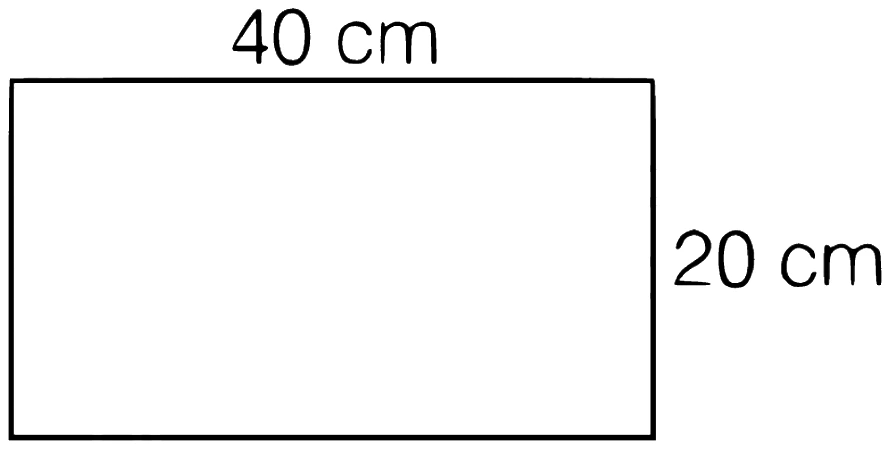
A sheet of steel at 20∘C has the size shown in the figure below. If the coefficient of linear expansion for steel is 10−5∘C−1, then what is the change in the area at 60∘C?
The apparent coefficient of expansion of a liquid, when heated in a copper vessel is C and when heated in silver vessel is S. If A is linear coefficient of expansion of copper, then linear coefficient of expansion of silver is
An iron ring of radius 2.1m is to be fitted on top of the rim of a wheel of radius 2.121m. The coefficient of volume expansion for iron is 3.6×10⁻⁵K−1. By approximately how much should the temperature of the iron ring be increased so that it fits the rim of the wheel?
A bimetallic strip of lead and nickel has a total thickness of 8cm (4cm each). The strip is straight at a temperature of 300K. The coefficient of linear expansion of lead is 29×10−6K−1 and that of nickel is 16×10−6K−1. If the strip is heated to 400K, then the radius of curvature of the strip is close to
Two metal rods made of steel and copper have coefficients of linear expansion 1.1×10⁻⁵K−1 and 1.7×10⁻⁵K−1 respectively. At room temperature (300K), the steel rod is 4cm longer than the copper rod. If the difference in their lengths remains same at all temperatures, then the lengths of the steel and copper rods respectively (at 300K) are
A hole of radius 2.12cm is drilled in a metal sheet maintained at 30∘C. The coefficient of linear expansion of the metal is 1.7×10⁻⁵K−1. The sheet is now heated to 230∘C. Then,