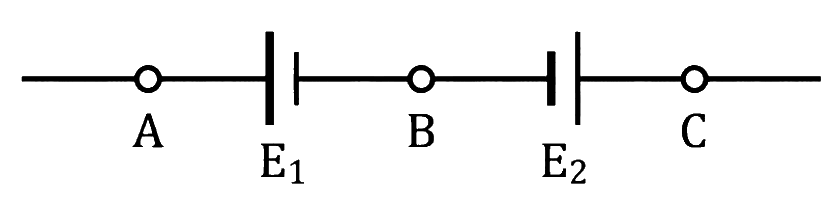
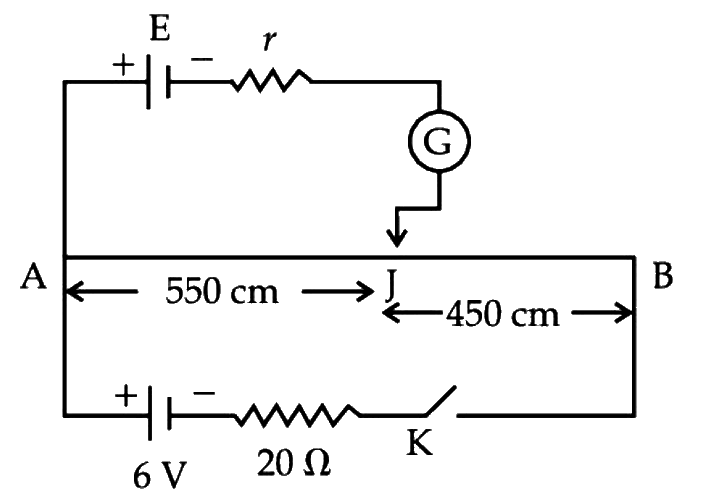
The potential gradient along the length of 1 metre wire of uniform cross section is 6 V/m. Let 'B' and 'C' be the two points at 40 cm and 60 cm marks respectively from one end. The potential difference between points B and C is
A current of 0.01 A passes through the potentiometer wire of resistivity 106Ω cm and area of cross- section 10−2 cm. The potential gradient is (in V/m)
A potentiometer wire is 4m long and potential difference of 3V is maintained between the ends. The e.m.f. of the cell which balances against a length of 100 cm of the potentiometer wire is
A potentiometer wire is 4m long and potential difference of 2V is maintained between the ends. The e.m.f. of the cell which balances against a length of 80 cm of the potentiometer wire is
A potentiometer wire is 4 m long and potential difference of 3V is maintained between the ends. The e.m.f. of the cell which balances against a length of 100 cm of the poteniometer wire is
In a potentiometer circuit when two cells of emf 1.6 V and 1.3 V are connected to assist each other, the balancing length is 290 cm. What will be the balancing length in cm when these two cells are connected in opposition?
In a potentiometer circuit when two cells of e.m.f. 1.5 volt and 1.2 volt are connected to assist each other, balancing length is 270 cm. What will be the balancing length in cm when these two cells are connected in opposition?
In an experiment to find emf of a cell using potentiometer, the length of null point for a cell of emf 1.5 V is found to be 60 cm. If this cell is replaced by another cell of emf E, the length of null point increases by 40 cm. The value of E is x/10 V.
In a potentiometer, the null point is obtained on 7th wire. What should we do to change the null point on 9th wire by keeping all other quantities same?
Potentiometer wire of length 1m is connected in series with 490Ω resistance and 2 V battery. If 0.2 mV/cm is the potential gradient then the resistance of the potentiometer wire is
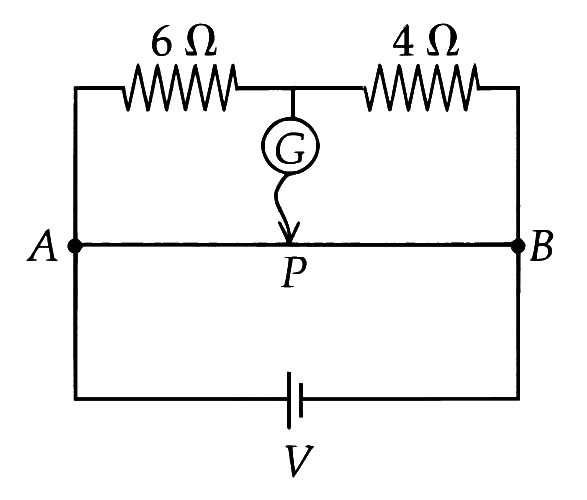
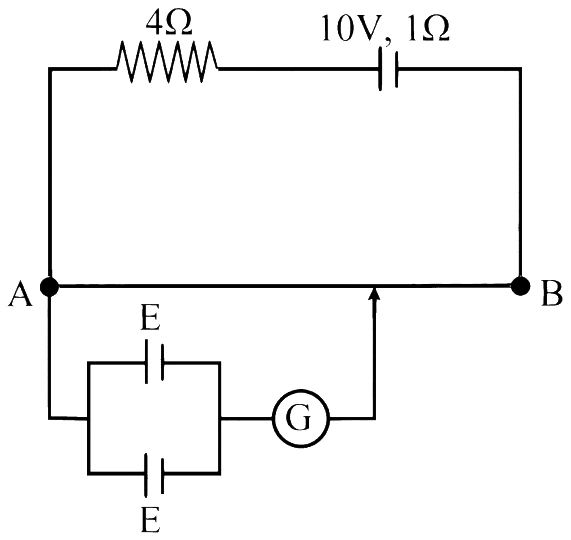
The total length of potentiometer wire AB is 50 cm in the arrangement as shown in the figure. If P is the point where the galvanometer shows zero reading then the length AP is ________ cm.
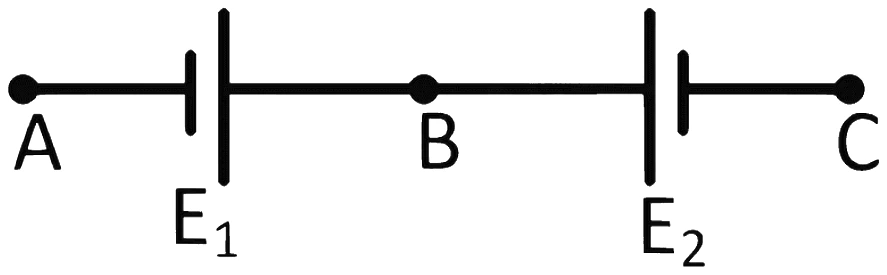
Two cells of e.m.f. E1 and E2 (E1>E2) are connected as shown in figure.
When a potentiometer is connected between points A and B the balancing length of potentiometer wire is 412 cm. When same potentiometer wire is connected between points A and C the balancing length is 103 cm. The ratio E1:E2 is
When cell of E.M.F. 'E1' is connected to potentiometer wire the balancing length is 'l1 '. Another cell of E.M.F. 'E2' (E1>E2) is connected along with E1 so as two cells oppose each other, the balancing length is 'l2'. The ratio E1:E2 is
To compare EMF of two cells using potentiometer the balancing lengths obtained are 200 cm and 150 cm. The least count of scale is 1 cm. The percentage error in the ratio of EMFs is ______
To determine the internal resistance of a cell by using a potentiometer, the null point is obtained at 1m when cell is shunted by 3Ω resistance and at 1.5m length when cell is shunted by 6Ω resistance. The internal resistance of the cell is
Figure shows a potentiometer wire AB having resistance of 5Ω and length 10 m. An e.m.f. is 0.4 V of battery, the balancing length AP is (internal resistance is negligible)
A potentiometer wire of length 4 m and resistance 5Ω is connected in series with a resistance of 992Ω and a cell of e.m.f. 4 V with internal resistance 3Ω. The length of 0.75 m on potentiometer wire balances the e.m.f. of
In the potentiometer, when the cell in the secondary circuit is shunted with 4Ω resistance, the balance is obtained at the length 120 cm of wire. Now when the same cell is shunted with 12Ω resistance, the balance is shifted to a length of 180 cm. The internal resistance of cell is Ω
A potentiometer wire has length L. For a given cell of e.m.f. E, the balancing length is 3L from the positive end of the wire. If the length of potentiometer wire is increased by 50% then for the same cell the balance point is obtained at length (from positive end)
In potentiometer experiment, null point is obtained at a particular point for a cell on potentiometer wire 'x' cm long. If length of potentiometer wire is increased by few cm without changing the cell, the balancing length will (Driving source is not changed)
A 2.5 V battery is connected to a potentiometer wire. A cell of e.m.f. 1.08 V is balanced by the voltage drop across 2.16 m of wire. The length of the potentiometer wire is
The potentiometer wire is 5 m long and potential difference of 4 V is maintained between the ends. The e.m.f. of the cell which balances against a length of 200 cm of the potentiometer wire is
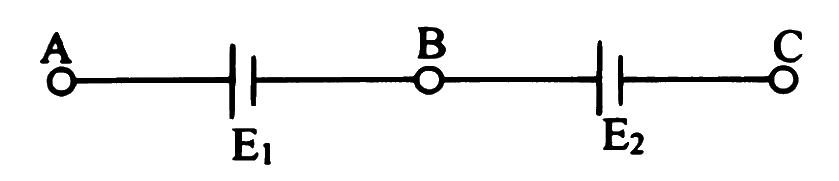
Two cells of e.m.f.s E1 and E2(E1>E2) are connected as shown in figure.
When the potentiometer is connected between A and B, the balancing length of the potentiometer wire is 3.60 m. On connecting the potentiometer between A and C, the balancing length is 0.90 m. The ratio E1/E2 is
When cell of e.m.f. ' E1 ' is connected to potentiometer wire, the balancing length is ' l1 '. Another cell of e.m.f. ' E2 ' (E1>E2) is connected so that two cells oppose each other, the balancing length is ' l2 '. The ratio E1:E2 is
A null point is obtained at 200 cm on potentiometer wire when cell in secondary circuit is shunted by 5Ω. When a resistance of 15Ω is used for shunting, null point moves to 300 cm. The internal resistance of the cell is
To determine the internal resistance of a cell with potentiometer, when the cell is shunted by a resistance of 5Ω the balancing length is 250 cm. When the cell is shunted by 20Ω, the balancing length of potentiometer wire is 400 cm. The internal resistance, of the cell is
The length of a potentiometer wire is ' L '. A cell of e.m.f. ' E ' is balanced at a length 4L from the positive end of the wire. If the length of the original wire is increased by 3L, then using the same cell null point is obtained at
The length of a potentiometer wire is ' L '. A cell of e.m.f. E is balanced at a length 5L from the positive end of the wire. If the length of the wire is increased by 2L, the same cell will give balance point at distance ' x '. The value of ' x ' is
A battery of 6 V is connected to the ends of uniform wire 3 m long and of resistance 100Ω. The difference of potential between two points 50 cm apart on the wire is
A potentiometer wire of length 1 m is connected in series with 495Ω resistance and 2 V battery. If 0.2 mV/cm is the potential gradient, then the resistance of the potentiometer wire is
In potentiometer experiment, cells of e.m.f. E1 and E2 are connected in series (E1>E2) the balancing length is 80 cm of the wire. If the polarity of E2 is reversed, the balancing length becomes 20 cm. The ratio E1/E2 is
When cell of E.M.F. ' E1 ' is connected to potentiometer wire, the balancing length is l1. Another cell of E.M.F. ' E2 ' (E1>E2) is connected so that two cells oppose each other, then the balancing length is l2. The ratio E1:E2 is
A cell balances against a length of 150 cm on a potentiometer wire when it is shunted by a resistance of 5Ω. But when it is shunted by a resistance of 10Ω, then balancing length increases by 25 cm. The balancing length when the cell is in an open circuit is
To measure the internal resistance of a battery, potentiometer is used. For R=10Ω, the balance point is observed at l=500 cm and for R=1Ω the balance point is observed at l=400 cm. The internal resistance of the battery is approximately:
Q38JEE Main 2023 · 1 FEB · SHIFT 1EasyOld syllabus
Potentiometer
In an experiment to find emf of a cell using potentiometer, the length of null point for a cell of emf 1.5 V is found to be 60 cm. If this cell is replaced by another cell of emf E, the length-of null point increases by 40 cm. The value of E is 10x V. The value of x is ____________.
Numerical answer type. Work it out, then open the answer.
In potentiometer experiment, the balancing length is 8 m when two cells E1 and E2 are joined in series. When two cells are connected in opposition the balancing length is 4 m. The ratio of the e.m.f. of the two cells (E2E1) is
In potentiometer experiments, two cells of e. m. f. 'E1' and 'E2' are connected in series (E1>E2), the balancing length is 64 cm of the wire. If the polarity of E2 is reversed, the balancing length becomes 32 cm. The ratio E1/E2 is
A 10 m long wire of resistance 20Ω is connected in series with a battery of emf 3 V (negligible internal resistance) and a resistance of 10Ω. The potential gradient along the wire is
A potentiometer wire of length 4 m and resistance 5Ω is connected in series with a resistance of 992Ω and a cell of e.m.f. 4 V with internal resistance 3Ω. The length of 0.75 m on potentiometer wire balances the e.m.f. of
The emf of a cell having internal resistance 1Ω is balanced against a length of 330 cm on a potentiometer wire. When an external resistance of 2Ω is connected across the cell, the balancing length will be:
Q45JEE Main 2023 · 29 JAN · SHIFT 2MediumOld syllabus
Potentiometer
A null point is found at 200 cm in potentiometer when cell in secondary circuit is shunted by 5Ω. When a resistance of 15Ω is used for shunting, null point moves to 300 cm. The internal resistance of the cell is ___________Ω.
Numerical answer type. Work it out, then open the answer.
A potentiometer wire has length of 5 m and resistance of 16Ω. The driving cell has an e.m.f. of 5 V and an internal resistance of 4Ω. When the two cells of e.m.f.s 1.3 V and 1.1 V are connected so as to assist each other and then oppose each other, the balancing lengths are respectively
Q47JEE Main 2022 · 25 JUL · SHIFT 2EasyOld syllabus
Potentiometer
In a potentiometer arrangement, a cell of emf 1.20 V gives a balance point at 36 cm length of wire. This cell is now replaced by another cell of emf 1.80 V. The difference in balancing length of potentiometer wire in above conditions will be ___________ cm.
Numerical answer type. Work it out, then open the answer.
Q48JEE Main 2022 · 24 JUN · SHIFT 1EasyOld syllabus
Potentiometer
In a potentiometer arrangement, a cell gives a balancing point at 75 cm length of wire. This cell is now replaced by another cell of unknown emf. If the ratio of the emf's of two cells respectively is 3: 2, the difference in the balancing length of the potentiometer wire in above two cases will be ___________ cm.
Numerical answer type. Work it out, then open the answer.
Q49JEE Main 2022 · 28 JUL · SHIFT 1MediumOld syllabus
Potentiometer
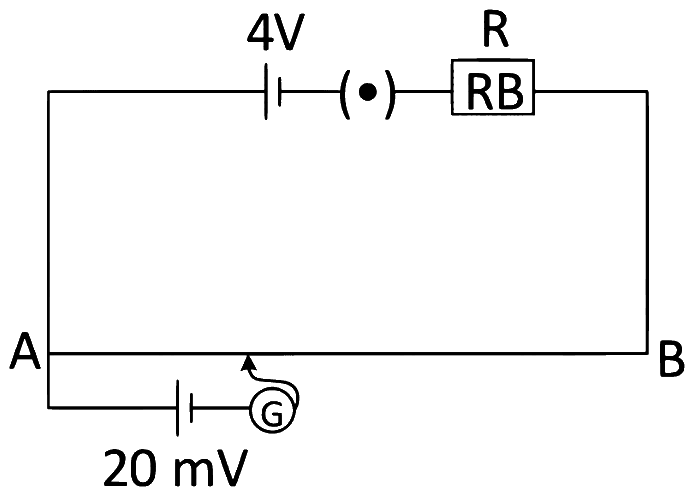
As shown in the figure, a potentiometer wire of resistance 20Ω and length 300 cm is connected with resistance box (R.B.) and a standard cell of emf 4 V. For a resistance 'R' of resistance box introduced into the circuit, the null point for a cell of 20 mV is found to be 60 cm. The value of 'R' is ___________ Ω.
Numerical answer type. Work it out, then open the answer.
Q50JEE Main 2022 · 26 JUL · SHIFT 2MediumOld syllabus
Potentiometer
A potentiometer wire of length 300 cm is connected in series with a resistance 780 Ω and a standard cell of emf 4 V. A constant current flows through potentiometer wire. The length of the null point for cell of emf 20 mV is found to be 60 cm. The resistance of the potentiometer wire is ____________ Ω.
Numerical answer type. Work it out, then open the answer.
Q51JEE Main 2022 · 24 JUN · SHIFT 2MediumOld syllabus
Potentiometer
A potentiometer wire of length 10 m and resistance 20 Ω is connected in series with a 25 V battery and an external resistance 30 Ω. A cell of emf E in secondary circuit is balanced by 250 cm long potentiometer wire. The value of E (in volt) is 10x. The value of x is __________.
Numerical answer type. Work it out, then open the answer.
Q52JEE Main 2022 · 30 JUN · SHIFT 1MediumOld syllabus
Potentiometer
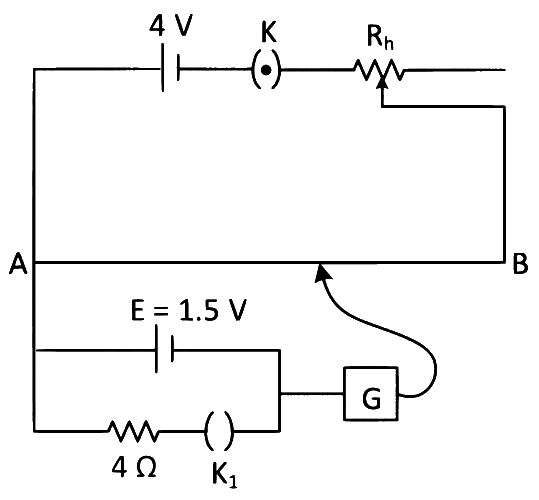
The circuit diagram of potentiometer used to measure the internal resistance of a cell (E) is shown in figure. The key 'K' is kept closed so as to send constant current through potentiometer wire. When key 'K1' is kept open the null point is found to be at 120 cm on the potentiometer wire. When the key 'K1' is closed the null point is shifted at 80 cm at the potentiometer wire. The internal resistance of the given cell is _____________ Ω.
Numerical answer type. Work it out, then open the answer.
Q53JEE Main 2022 · 27 JUN · SHIFT 1MediumOld syllabus
Potentiometer
A cell, shunted by a 8 Ω resistance, is balanced across a potentiometer wire of length 3 m. The balancing length is 2 m when the cell is shunted by 4 Ω resistance. The value of internal resistance of the cell will be ____________ Ω.
Numerical answer type. Work it out, then open the answer.
In a potentiometer circuit a cell of EMF 1.5 V gives balance point at 36 cm length of wire. If another cell of EMF 2.5 V replaces the first cell, then at what length of the wire, the balance point occurs?
In a potentiometer experiment, when three cells A,B and C are connected in series, the balancing length is found to be 420 cm. If cells A and B are connected in series the balancing length is 220 cm and for cells B and C connected in series the balancing length is 320 cm. The emf of cells A,B and C are respectively in the ratio of
In potentiometer experiment, cells of e.m.f. 'E1 ' and 'E2' are connected in series (E1>E2) the balancing length is 64 cm of the wire. If the polarity of E2 is reversed, the balancing length becomes 32 cm. The ratio E2E1 is
Q57JEE Main 2021 · 25 FEB · SHIFT 1MediumOld syllabus
Potentiometer
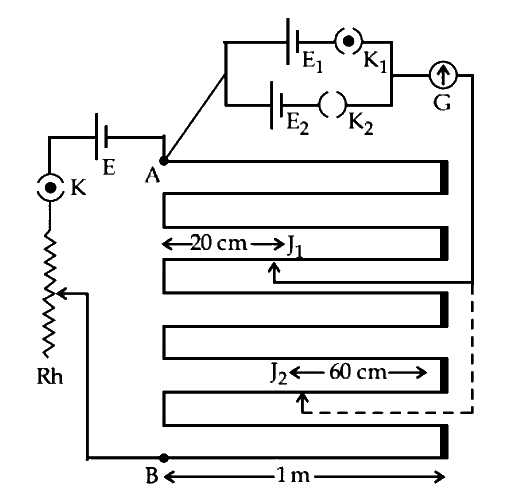
In the given circuit of potentiometer, the potential difference E across AB (10 m length) is larger than E1 and E2 as well. For key K1 (closed), the jockey is adjusted to touch the wire at point J1 so that there is no deflection in the galvanometer. Now the first battery (E1) is replaced by second battery (E2) for working by making K1 open and K2 closed. The galvanometer gives then null deflection at J2. The value of E2E1 is ba, where a = _________.
Numerical answer type. Work it out, then open the answer.
Q58JEE Main 2021 · 25 JUL · SHIFT 2MediumOld syllabus
Potentiometer
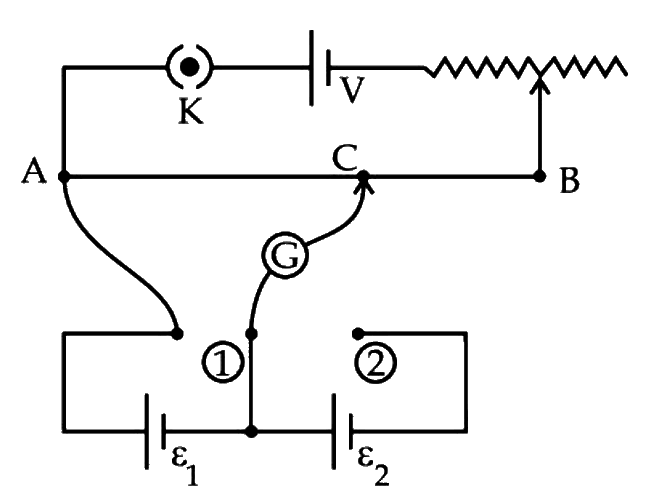
In the given potentiometer circuit arrangement, the balancing length AC is measured to be 250 cm. When the galvanometer connection is shifted from point (1) to point (2) in the given diagram, the balancing length becomes 400 cm. The ratio of the emf of two cells, ε2ε1 is:
To determine the internal resistance of a cell by using a potentiometer, the null point is at 1 m when shunted by 3Ω resistance and at a length 1.5 m, when cell is shunted by 6Ω resistance The internal resistance of the cell is
In a potentiometer experiment, the balancing length for a cell is 240 cm. On shunting the cell with a resistance of 2Ω, the balancing length becomes half the initial balancing length. The internal resistance of the cell is
Q61JEE Main 2021 · 25 JUL · SHIFT 1MediumOld syllabus
Potentiometer
In the given figure, there is a circuit of potentiometer of length AB = 10 m. The resistance per unit length is 0.1 Ω per cm. Across AB, a battery of emf E and internal resistance 'r' is connected. The maximum value of emf measured by this potentiometer is:
In potentiometer experiment, null point is obtained at a particular point for a cell on potentiometer wire 'x' cm long. If length of potentiometer wire is increased by few centimeter without changing the cell, the balancing length will [Driving source is not changed]
A 10 m long wire of resistance 20Ω is connected in series with a battery of emf 3 V and a resistance of 10Ω. The potential gradient along the wire in V/m is
A potentiometer wire is 4 m long and potential difference of 3 V is maintained between the ends. The emf of the cell, which balances against a length of 100 cm of the potentiometer wire is
Two cells having unknown emfs E1 and E2(E1>E2) are connected in potentiometer circuit, so as to assist each other. The null point obtained is at 490 cm from the higher potential end. When cell E2 is connected, so as to oppose cell E1, the null point is obtained at 90 cm from the same end. The ratio of the emfs of two cells (E2E1) is
Q67JEE Main 2020 · 2 SEP · SHIFT 2MediumOld syllabus
Potentiometer
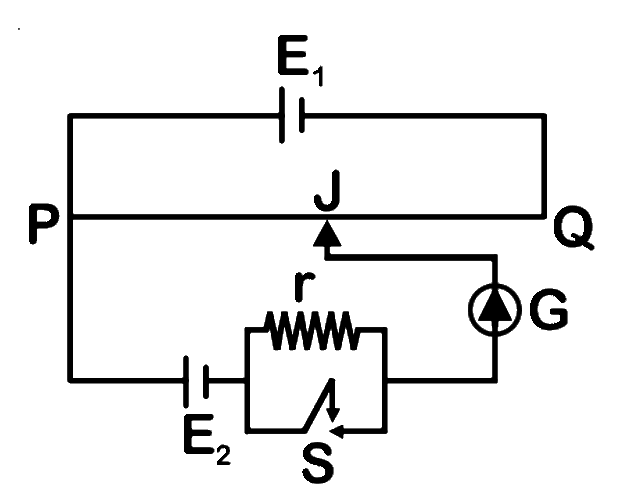
A potentiometer wire PQ of 1 m length is connected to a standard cell E1. Another cell E2 of emf 1.02 V is connected with a resistance ‘r’ and switch S (as shown in figure). With switch S open, the null position is obtained at a distance of 49 cm from Q. The potential gradient in the potentiometer wire is:
Q68JEE Main 2020 · 7 JAN · SHIFT 2MediumOld syllabus
Potentiometer
The balancing length for a cell is 560 cm in a potentiometer experiment. When an external resistance of 10 Ω is connected in parallel to the cell, the balancing length changes by 60 cm. If the internal resistance of the cell is 10NΩ, where N is an integer then value of N is .............
Numerical answer type. Work it out, then open the answer.
Q69JEE Main 2020 · 8 JAN · SHIFT 1MediumOld syllabus
Potentiometer
The length of a potentiometer wire is 1200 cm and it carries a current of 60 mA. For a cell of emf 5V and internal resistance of 20Ω, the null point on it is found to be a 1000 cm. The resistance of whole wire is:
Q70JEE Main 2019 · 12 JAN · SHIFT 1MediumOld syllabus
Potentiometer
An ideal battery of 4 V and resistance R are connected in series in the primary circuit of a potentiometer of length 1 m and resistance 5 Ω. The value of R, to give a potential difference of 5 mV across 10 cm of potentiometer wire, is:
A potentiometer wire has length L For given cell of emf E, the balancing length is 3L from the positive end of the wire. If the length of potentiometer wire is increased by 50%, then for the same cell, the balance point is obtained at length
Q72JEE Main 2019 · 11 JAN · SHIFT 1DifficultOld syllabus
Potentiometer
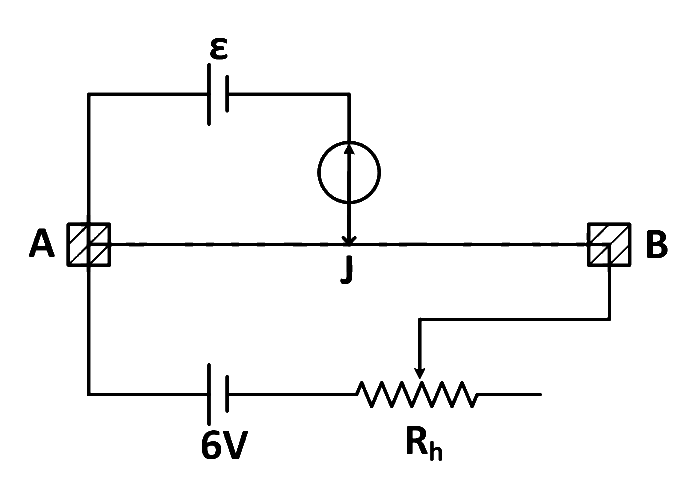
The resistance of the meter bridge AB in given figure is 4 Ω. With a cell of emf ε = 0.5 V and rheostat resistance Rh = 2 Ω the null point is obtained at some point J. When the cell is replaced by another one of emf ε=ε2 the same null point J is found for Rh = 6 Ω. The emf ε2 is:
Q73JEE Main 2019 · 10 JAN · SHIFT 1DifficultOld syllabus
Potentiometer
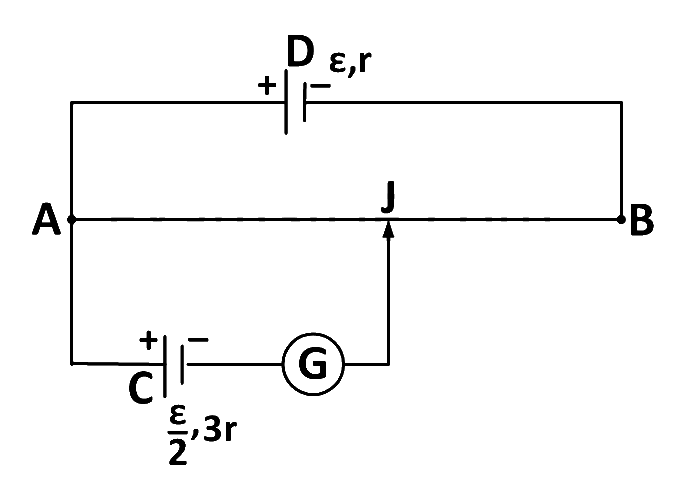
A potentiometer wire AB having length L and resistance 12 r is joined to a cell D of emf ε and internal resistance r. A cell C having emf ε/2 and internal resistance 3r is connected. The length AJ at which the galvanometer as shown in figure shows no deflection is –
Q74JEE Main 2019 · 8 APR · SHIFT 2DifficultOld syllabus
Potentiometer
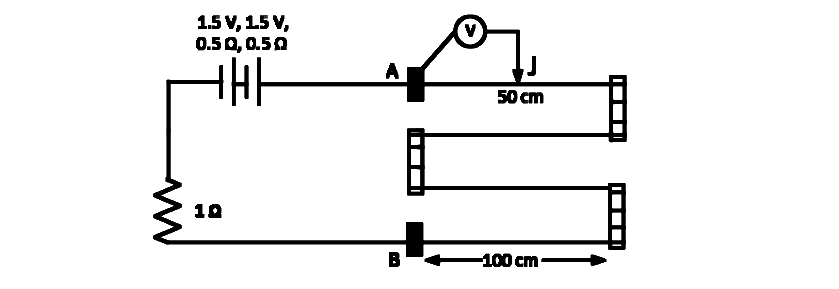
In the circuit shown, a four-wire potentiometer is made of a 400 cm long wire, which extends between A and B. The resistance per unit length of the potentiometer wire is r = 0.01 Ω/cm. If an ideal voltmeter is connected as shown with jockey J at 50 cm from end A, the expected reading of the voltmeter will be :-
In a potentiometer experiment, it is found that no current passes through the galvanometer when the terminals of the cell are connected across 52 cm of the potentiometer wire. If the cell is shunted by a resistance of 5 Ω, a balance is found when the cell is connected across 40 cm of the wire. Find the internal resistance of the cell.
Q77JEE Main 2017 · 8 APR · SHIFT 1MediumOld syllabus
Potentiometer
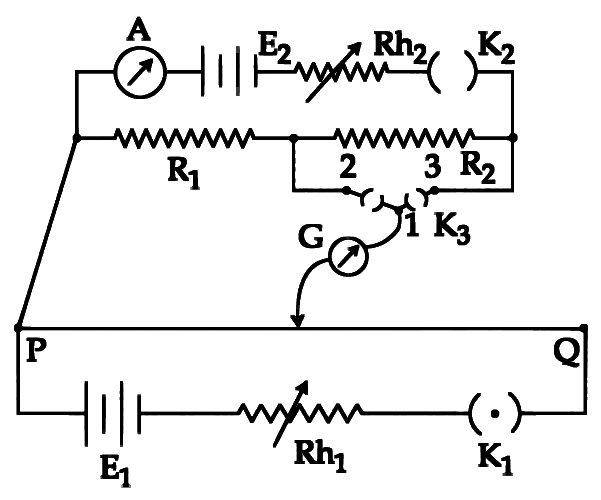
A potentiometer PQ is set up to compare two resistances as shown in the figure. The ammeter A in the circuit reads 1.0 A when two way key K3 is open. The balance point is at a length ℓ1 cm from P when two way key K3 is plugged in between 2 and 1, while the balance point is at a length ℓ2 cm from P when key K3 is plugged in between 3 and 1. The ratio of two resistances R2R1, is found to be:
A potentiometer wire is 100 cm long and a constant potential difference is maintained across it. Two cells are connected in series first to support one another and then in opposite direction. The balance points are obtained at 50 cm and 10 cm from the positive end of the wire in the two cases. The ratio of emf's is
A potentiometer wire of length L and a resistance r are connected in series with a battery of e.m.f. E0 and a resistance r1. An unknown e.m.f. E is balanced at a length l of the potentiometer wire. The e.m.f. E will be given by
A potentiometer wire has length 4 m and resistance 8 Ω. The resistance that must be connected in series with the wire and an accumulator of e.m.f. 2 V, so as to get a potential gradient 1 mV per cm on the wire is
A potentiometer circuit has been set up for finding the internal resistance of a given cell. The main battery, used across the potentiometer wire, has an emf of 2.0 V and a negligible internal resistance. The potentiometer wire itself is 4 m long. When the resistance R, connected across the given cell, has values of (i) infinity, (ii) 9.5 Ω
the balancing lengths on the potentiometer wire are found to be 3 m and 2.85 m, respectively. The value of internal resistance of the cell is
Q82JEE Main 2014 · 12 APR · SHIFT 1MediumOld syllabus
Potentiometer
In the experiment of calibration of voltmeter, a standard cell of e.m.f. 1.1 volt is balanced against 440 cm of potentiometer wire. The potential difference across the ends of resistance is found to balance against 220 cm of the wire. The corresponding reading of voltmeter is 0.5 volt. The error in the reading of voltmeter will be:
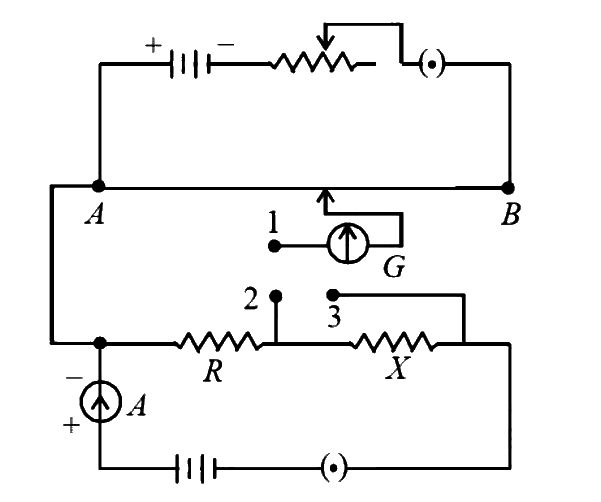
A potentiometer circuit is set up as shown. The potential gradient, across the potentiometer wire, is k volt/cm and the ammeter, present in the circuit, reads 1.0 A when two way key is switched off. The balance points, when the key between the terminals (i) 1 and 2 (ii) 1 and 3, is plugged in, are found to be at length l1 cm and l2 cm respectively. The magnitudes, of the resistors R and X, in ohms, are then, equal, respectively, to
A cell can be balanced against 110 cm and 100 cm of potentiometer wire, respectively with and without being short circuited through a resistance of 10 Ω. Its internal resistance is
In a potentiometer experiment the balancing with a cell is at length 240 cm. On shunting the cell with a resistance of 2Ω, the balancing length becomes 120 cm. The internal resistance of the cell is
A 6 volt battery is connected to the terminals of a three metre long wire of uniform thickness and resistance of 100 ohm. The difference of potential between two points on the wire separated by a distance of 50 cm will be
The length of a wire of a potentiometer is 100 cm, and the e.m.f. of its standard cell is E volt. It is employed to measure the e.m.f. of a battery whose internal resistance is 0.5Ω. If the balance point is obtained at l=30 cm from the positive end, the e.m.f. of the battery is
If specific resistance of a potentiometer wire is 10-7Ω m and current flow through it is 0.1 amp., cross-sectional area of wire is 10−6 m2 then potential gradient will be
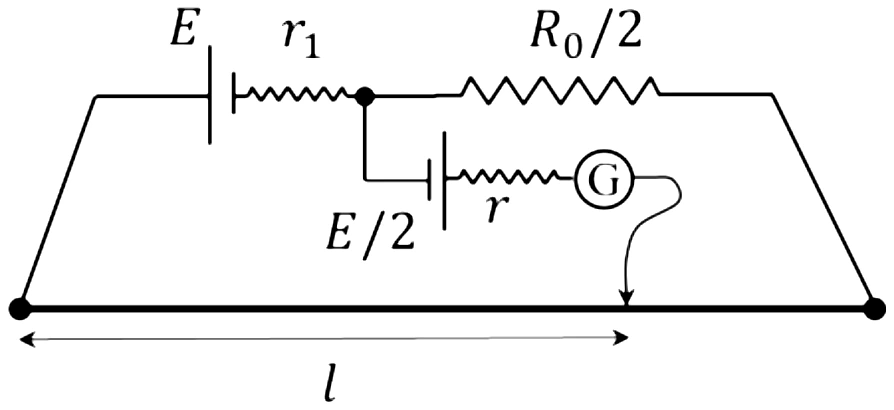
In order to measure the internal resistance r1 of a cell of emf E, a meter bridge of wire resistance R0=50Ω, a resistance R0/2, another cell of emf E/2 (internal resistance r) and a galvanometer G are used in a circuit, as shown in the figure. If the null point is found at l=72cm, then the value of r1= ____________ Ω.
Numerical answer type. Work it out, then open the answer.
Assertion : A potentiometer is preferred over that of a voltmeter for measurement of emf of a cell. Reason : Potentiometer does not draw any current from the cell.
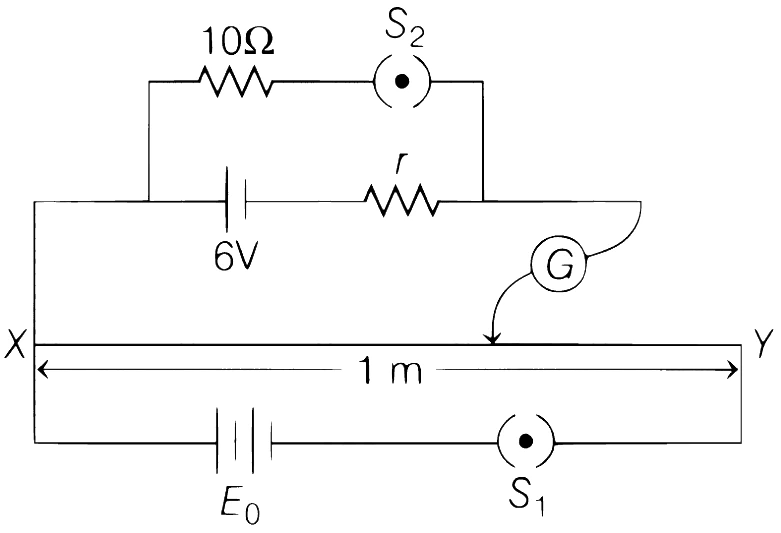
In the arrangement shown in figure, when the switch S2 is open, the galvanometer shows no deflection for l=50cm. When the switch S2 is closed, the galvanometer shows no deflection for l=0.416m. The internal resistance (r) of 6V cell is
A potentiometer wire, 10m long, has a resistance of 40Ω. It is connected in series with a resistance box and a 4V storage cell. If the potential gradient along the wire is 0.4mV cm−1, the resistance unplugged in the box is
A potentiometer wire, 10m long, has a resistance of 40Ω. It is connected in series with a resistance box and a 2V storage cell. If the potential gradient along the wire is 0.1mV cm−1, the resistance unplugged in the box is
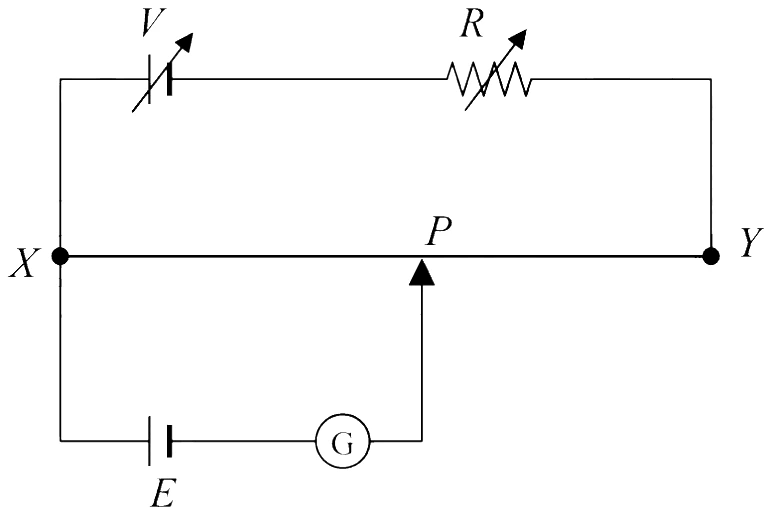
A potentiometer circuit shown in the figure is set up to measure emf of cell E. As the point P moves from X to Y, the galvanometer G shows deflection always in one direction, but the deflection decreases continuously until Y is reached. The balance point between X and Y may be obtained by
In a potentiometer experiment, the balancing length of a cell is 560cm. When an external resistance of 10Ω is connected in parallel to the cell, the balancing length changes by 60cm. The internal resistance of a cell is
The denial cell is balanced on 125cm length of a potentiometer. Now, the cell is short circuited by a resistance of 2Ω and the balance is obtained at 100cm. The internal resistance of the denial cell is
A 2V battery, a 15Ω resistor and a potentiometer of 100cm length, all are connected in series. If the resistance of potentiometer wire is 5Ω, then the potential gradient of the potentiometer wire, is
A potentiometer is connected across A and B and a balance is obtained at 64.0cm. When potentiometer lead to B is moved to C, a balance is found at 8.0cm. If the potentiometer is now connected across B and C, a balance will be found at
A cell in secondary circuit gives null deflection for 2.5m length of potentiometer having 10m length of wire. If the length of the potentiometer wire is increased by 1m without changing the cell in the primary, the position of the null point now is
To the potentiometer wire of length L and 10Ω resistance, a battery of emf 2.5V and a resistance R are connected in series. If a potential difference of 1V is balanced across L/2 length, the value of R in Ω will be
A potentiometer has a uniform wire of length 5m. A battery of emf 10V and negligible internal resistance is connected between its ends. A secondary cell connected to the circuit gives balancing length at 200cm. The emf of the secondary cell is
In a potentiometer experiment, the balancing point with a cell is at a length 240cm. On shunting the cell with a resistance of 2Ω, the balancing length becomes 120cm. The internal resistance of the cell is
A potentiometer wire is 10m long and has a resistance of 18Ω. It is connected to a battery of emf 5V and internal resistance 2Ω. Calculate the potential gradient along the wire.
The balancing length of a potentiometer is at 120cm. On shunting the cell with a resistance of 4Ω, the balancing point shifts to a length of 60cm. The internal resistance of the cell is
In a potentiometer experiment, the potentiometer wire of length 4m and resistance 20Ω is connected in series with an external resistor of resistance 979Ω and a cell of internal resistance 1Ω. If the emf of the cell is 1.2V, then the length of the wire between two points where the potential difference is 12mV is
In a potentiometer experiment, when two cells of emfs E1 and E2 (E2>E1) are connected in series, the balancing length is 160cm. If one of the cells is reversed, the balancing length decreases by 75%. If E1=1.2V, then E2=
In a potentiometer, the area of cross-section of the wire is 4cm2. The current flowing in the circuit is 1A and the potential gradient is 7.5V m−1. Then, the resistivity of the potentiometer wire is
A potentiometer wire of length 10m and resistance 9Ω is connected to a cell of emf E and internal resistance 1Ω. If V is the maximum potential difference that can be measured using the potentiometer, then the condition for the potentiometer to work is
The area of cross-section of a potentiometer wire is 6×10⁻⁷m2. The potential difference per unit length of the potentiometer wire when it is connected to a cell of negligible internal resistance and a resistor in series is 0.15V m−1. If the current through potentiometer wire is 0.3A, then the resistivity of the material of the potentiometer wire is
In a potentiometer experiment for the determination of the internal resistance of a cell, when an external resistance of R is connected parallel to the cell, the balancing length decreases by 10%. The internal resistance of the cell is
The length of a potentiometer wire is 2.5m and its resistance is 8Ω. A cell of negligible internal resistance and emf of 2.5V is connected in series with a resistance of 242Ω in the primary circuit. The potential difference between two points separated by a distance of 20cm on the potentiometer wire is
In a potentiometer experiment, a wire of length 10m and resistance 5Ω is connected to a cell of emf 2.2V. If the potential difference between two points separated by a distance of 660cm on potentiometer wire is 1.1V, then the internal resistance of the cell is
A uniform conducting wire AB of length 5m and resistance 5Ω is connected as shown in the circuit. If the balancing point is obtained at 3m from A, then the value of E is
A potentiometer balances at 44cm when a cell of internal resistance 1Ω is in the secondary circuit. To obtains the balancing point at 40cm, the resistance to be connected parallel to cell is
When a potentiometer is connected between the points A and B as shown in the circuit, balance point is obtained at 64cm. When it is connected between A and C, the balance point is 8cm. If the potentiometer is connected between B and C the balance point will be
Balancing point of a potentiometer shifts from a length of 60cm to 40cm by shunting the cell with a 4Ω resistance. What is the internal resistance of the cell?