From 18 m height above the ground a ball is dropped from rest. The height above the ground at which the magnitude of velocity equal to the magnitude of acceleration (in the same set of units) due to gravity is ______ m.
(Take g=10 m/s2 and neglect the air resistance)
Numerical answer type. Work it out, then open the answer.
A stone falls from the top of a tower of height 100 m and at the same time another stone is projected vertically upwards from the ground with a velocity 25 m/s. The two stones meet after
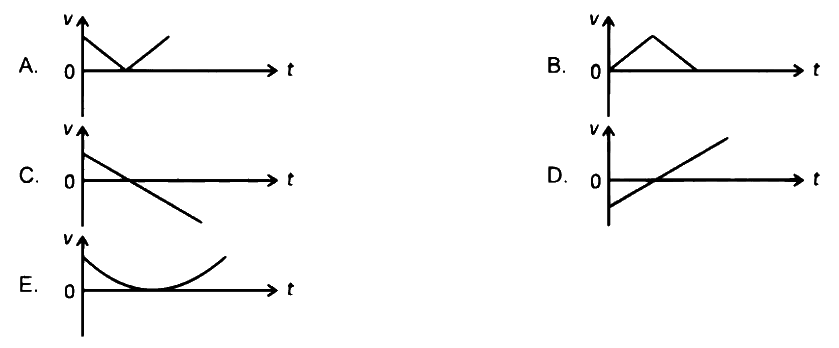
The following plots show variation of velocity (v) with time (t) of a ball thrown vertically upward, and falling back. Which of the following plots is/are correct?
A paratrooper jumps from an aeroplane and opens a parachute after 2 s of free fall and starts decelerating with 3 m/s2. At 10 m height from ground, while descending with the help of parachute, the speed of paratrooper is 5 m/s. The initial height of the airplane is ______ m.
A juggler throws balls into air. He throws one ball whenever the previous one is at its highest point. If he throws 4 balls in one second, the height from which each ball returns is nearly [acceleration due to gravity is 9.8 m/s2]
Water drops fall from a tap on the floor, 5 m below, at regular intervals of time, the first drop strikes the floor when the sixth drop begins to fall. The height at which the fourth drop will be from ground, at the instant when the first drop strikes the ground is ______ m.
A gas balloon is going up with a constant velocity of 10 m/s. When this balloon reached a height of 75 m, a stone is dropped from it and balloon keeps moving up with the same velocity. The height of the balloon when the stone hits the ground is ______ m. (Take g=10 m/s2)
A ball is released from height 'h' which makes perfectly elastic collision with ground. The frequency of periodic vibratory motion is (g=acceleration due to gravity)
A boy throws a ball vertically upwards from a bridge with velocity 5 m/s. It strikes water surface after 2 s. The height of the bridge is (Take g=10 m/s2)
A ball is released from the top of a tower of height Hm. It takes T second to reach the ground. The height of the ball from the ground after 4T second is
A body falling under gravity covers two points A and B separated by 80 m in 2 s. The distance of upper point A from the starting point is _________ m (use g=10 ms−2 ).
Numerical answer type. Work it out, then open the answer.
A body projected vertically upwards with a certain speed from the top of a tower reaches the ground in t1. If it is projected vertically downwards from the same point with the same speed, it reaches the ground in t2. Time required to reach the ground, if it is dropped from the top of the tower, is:
A ball is thrown vertically upward with an initial velocity of 150 m/s. The ratio of velocity after 3 s and 5 s is xx+1. The value of x is ___________.
A small steel ball is dropped from a height of 1.5 m into a glycerine jar. The ball reaches the bottom of the jar 1.5 s after it was dropped. If the retardation is 2.66 m/s2, the height of the glycerine in the jar is about (acceleration due to gravity g=9.8 m/s2)
A ball is projected vertically upwards from ground. It reaches a height 'h' in time t1, continues its motion and then takes a time t2 to reach ground. The height h in terms of g,t1 and t2 is (g= acceleration due to gravity)
A tennis ball is dropped on to the floor from a height of 9.8 m. It rebounds to a height 5.0 m. Ball comes in contact with the floor for 0.2s. The average acceleration during contact is ___________ ms −2.
(Given g = 10 ms −2)
Numerical answer type. Work it out, then open the answer.
An NCC parade is going at a uniform speed of 9 km/h under a mango tree on which a monkey is sitting at a height of 19.6 m. At any particular instant, the monkey drops a mango. A cadet will receive the mango whose distance from the tree at time of drop is: (Given g=9.8 m/s2)
A ball of mass 0.5 kg is dropped from the height of 10 m. The height, at which the magnitude of velocity becomes equal to the magnitude of acceleration due to gravity, is ________ m. [Use g = 10 m/s2]
Numerical answer type. Work it out, then open the answer.
From the top of a tower, a ball is thrown vertically upward which reaches the ground in 6 s. A second ball thrown vertically downward from the same position with the same speed reaches the ground in 1.5 s. A third ball released, from the rest from the same location, will reach the ground in ____________ s.
Numerical answer type. Work it out, then open the answer.
A ball is released from a height h. If t1 and t2 be the time required to complete first half and second half of the distance respectively. Then, choose the correct relation between t1 and t2.
A juggler throws balls vertically upwards with same initial velocity in air. When the first ball reaches its highest position, he throws the next ball. Assuming the juggler throws n balls per second, the maximum height the balls can reach is
A ball is thrown up vertically with a certain velocity so that, it reaches a maximum height h. Find the ratio of the times in which it is at height 3h while going up and coming down respectively.
A ball is thrown vertically upwards with a velocity of 19.6 ms−1 from the top of a tower. The ball strikes the ground after 6 s. The height from the ground up to which the ball can rise will be (5k) m. The value of k is __________. (use g=9.8 m/s2)
Numerical answer type. Work it out, then open the answer.
Two balls A and B are placed at the top of 180 m tall tower. Ball A is released from the top at t = 0 s. Ball B is thrown vertically down with an initial velocity 'u' at t = 2 s. After a certain time, both balls meet 100 m above the ground. Find the value of 'u' in ms−1. [use g = 10 ms−2]:
A ball is projected vertically upward with an initial velocity of 50 ms−1 at t = 0s. At t = 2s, another ball is projected vertically upward with same velocity. At t = __________ s, second ball will meet the first ball (g = 10 ms−2).
Numerical answer type. Work it out, then open the answer.
A bullet is shot vertically downwards with an initial velocity of 100 m/s from a certain height. Within 10 s, the bullet reaches the ground and instantaneously comes to rest due to the perfectly inelastic collision. The velocity-time curve for total time t=20 s will be:
A body at rest falls through a height 'h' with velocity 'V'. If it has to fall down further for its velocity to become three times, the distance travelled in that interval is
A student is throwing balls vertically upwards such that he throws the 2nd ball when the 1st ball reaches maximum height. If he throws balls at an interval of 3 second, the maximum height of the balls is (g=10s2m)
Water drops are falling from a nozzle of a shower onto the floor, from a height of 9.8 m. The drops fall at a regular interval of time. When the first drop strikes the floor, at that instant, the third drop begins to fall. Locate the position of second drop from the floor when the first drop strikes the floor.
A stone is dropped from the top of a building. When it crosses a point 5 m below the top, another stone starts to fall from a point 25 m below the top. Both stones reach the bottom of building simultaneously. The height of the building is:
Water droplets are coming from an open tap at a particular rate. The spacing between a droplet observed at 4th second after its fall to the next droplet is 34.3 m. At what rate the droplets are coming from the tap? (Take g = 9.8 m/s2)
A ball is thrown up with a certain velocity so that it reaches a height 'h'. Find the ratio of the two different times of the ball reaching 3h in both the directions.
Two spherical balls having equal masses with radius of 5 cm each are thrown upwards along the same vertical direction at an interval of 3s with the same initial velocity of 35 m/s, then these balls collide at a height of ............... m. (Take g = 10 m/s2)
Numerical answer type. Work it out, then open the answer.
A balloon was moving upwards with a uniform velocity of 10 m/s. An object of finite mass is dropped from the balloon when it was at a height of 75 m from the ground level. The height of the balloon from the ground when object strikes the ground was around:
A rubber ball is released from a height of 5 m above the floor. It bounces back repeatedly, always rising to 10081 of the height through which it falls. Find the average speed of the ball. (Take g = 10 ms−2)
A ball is thrown vertically downward with a velocity of 20 m/s from the top of a tower. It hits the ground after some time with a velocity of 80 m/s. The height of the tower is: (g = 10 m/s2)
A person sitting in the ground floor of a building notices through the window, of height 1.5 m, a ball dropped from the roof of the building crosses the window in 0.1 s. What is the velocity of the ball when it is at the topmost point of the window? (g=10 m/s2)
A ball is dropped from the top of a 100 m high tower on a planet. In the last 21 s before hitting the ground, it covers a distance of 19 m. Acceleration due to gravity (in ms–2) near the surface on that planet is _____.
Numerical answer type. Work it out, then open the answer.
A helicopter rises from rest on the ground vertically upwards with a constant acceleration g. A food packet is dropped from the helicopter when it is at a height h. The time taken by the packet to reach the ground is close to:
A Tennis ball is released from a height h and after freely falling on a wooden floor it rebounds and reaches height 2h. The velocity versus height of the ball during its motion may be represented graphically by:
(graph are drawn schematically and on not to scale)
A person standing on the floor of an elevator drops a coin. The coin reaches the floor in time t1 if the elevator is at rest and in time t2 if the elevator is moving uniformly. Then
Two stones are thrown up simultaneously from the edge of a cliff 240 m high with initial speed of 10 m/s and 40 m/s respectively. Which of the following graph best represents the time variation of relative position of the second stone with respect to the first?
(Assume stones do not rebound after hitting the ground and neglect air resistance, take g=10 m/s2)
(The figures are schematic and not drawn to scale)
From a tower of height H, a particle is thrown vertically upwards with a speed u. The time taken by the particle, to hit the ground, is n times that taken by it to reach the highest point of its path. The relation between H, u and n is:
A stone falls freely under gravity. It covers distances h1, h2 and h3 in the first 5 seconds, the next 5 seconds and the next 5 seconds respectively. The relation between h1, h2 and h3 is
A ball is dropped from a high rise platform at t = 0 starting from rest. After 6 seconds another ball is thrown downwards from the same platform with a speed v. The two balls meet at t = 18 s. What is the value of v?
Consider a rubber ball freely falling from a height h=4.9 m onto a horizontal elastic plate. Assume that the duration of collision is negligible and the collision with the plate is totally elastic. Then the velocity as a function of time and the height as a function of time will be:
Two bodies A (of mass 1 kg) and B (of mass 3 kg) are dropped from heights of 16 m and 25 m, respectively. The ratio of the time taken by them to reach the ground is
A parachutist after bailing out falls 50 m without friction. When parachute opens, it decelerates at 2 m/s2. He reaches the ground with a speed of 3 m/s. At what height, did he bail out?
A ball is released from the top of a tower of height h meters. It takes T seconds to reach the ground. What is the position of the ball in 3T seconds?
A man throws balls with the same speed vertically upwards one after the other at an interval of 2 seconds. What should be the speed of the throw so that more than two balls are in the sky at any time? (Given g = 9.8 m/s2)
From a building two balls A and B are thrown such that A is thrown upwards and B downwards ( both vertically with the same speed ). If vA and vB are their respective velocities on reaching the ground, then
A body dropped from a height h with initial velocity zero, strikes the ground with a velocity 3 m/s. Another body of same mass dropped from the same height h with an initial velocity of 4 m/s. The final velocity of second mass, with which it strikes the ground is
The water drop falls at regular intervals from a tap 5 m above the ground. The third drop is leaving the tap at instant the first drop touches the ground. How far above the ground is the second drop at that instant?
A tennis ball is thrown in the vertically upward direction and the ball attains a maximum height of 20m. The ball was thrown approximately with an upward velocity of
In a vacuum, a five-rupee coin, a feather of a sparrow bird and a mango are dropped simultaneously from the same height. The time taken by them to reach the bottom is t1, t2 and t3 respectively. In this situation, we will observe that
A bullet is fired vertically up from a 400m tall tower with a speed 80m s−1. If g is taken as 10m s−2, the time taken by the bullet to reach the ground will be
A body is thrown upward against the gravity g with initial velocity u. Which one among the following is the correct expression for its final velocity when it attains the maximum height?
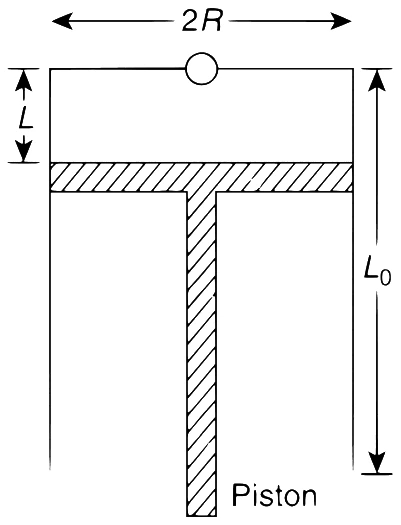
A fixed thermally conducting cylinder has a radius R and height L0. The cylinder is open at its bottom and has a small hole at its top. A piston of mass M is held at a distance L from the top surface, as shown in the figure. The atmospheric pressure is P0. While the piston is at a distance 2L from the top, the hole at the top is sealed. The piston is then released, to a position where it can stay in equilibrium. In this condition, the distance of the piston from the top is :
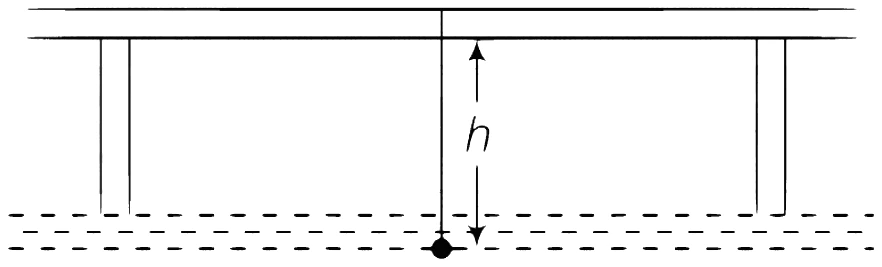
In an experiment to measure the height of a bridge by dropping a stone into water underneath, if the error in measurement of time is 0.2s at the end of 4s, then the error in estimation of height of the bridge will be (neglect the water resistance, i.e. thrust)
A ball is dropped from a bridge 122.5m above a river. After the ball has been falling for 2s, a second ball is thrown straight down after it. What must the initial velocity of the second ball be so that both hit the water at the same time?
A ball is dropped from a high rise platform, t=0 starting from rest. After 6s another ball is thrown downwards from the same platform with a speed v. The two balls meet at t=18s. What is the value of v?
A rocket is fired upward from the earth surface such that it creates an acceleration of 19.6m/s2. If after 5s, its engine is switched off, the maximum height of the rocket from the earth's surface would be
A balloon rises from rest with a constant acceleration g/8. A stone is released from it when it has risen to height h. The time taken by the stone to reach the ground is
A parachutist after bailing out falls 50m without friction. When parachute opens, it decelerates at 2m s−2. He reaches the ground with a speed of 3m s−1. At what height, did he bail out?
Two spheres of same size, one of mass 2kg and another of mass 4kg, are dropped simultaneously from the top of Qutab Minar (height =72m). When they are 1m above the ground, the two spheres have the same:
When a ball is thrown up vertically with velocity v0, it reaches a maximum height of h. If one wishes to triple the maximum height then the ball should be thrown with velocity:
A body is projected vertically upwards. The times corresponding to height h while ascending and while descending are t1 and t2, respectively. Then, the velocity of projection will be (take g as acceleration due to gravity)
A ball is thrown vertically upward. It has a speed of 10m s−1 when it has reached one-half of its maximum height. How high does the ball rise? (Take g=10m s−2)
A stone is thrown with an initial speed of 4.9m/s from a bridge in vertically upward direction. It falls down in water after 2s. The height of bridge is
Two balls of equal masses are thrown upwards along the same vertical direction at an interval of 2s, with the same initial velocity of 39.2m/s. The two balls will collide at a height of
A body is projected vertically upwards at time t=0 and it is seen at a height H at time t1 and t2 second during its flight. The maximum height attained is (g is acceleration due to gravity)
An object is dropped from a certain point A at a height h from the ground. During its journey straight downwards, the object passes points B and C such that the ratio of time taken t1 to cover AB and t2 to cover BC is 1:(2−1). What is the ratio of distances AB:BC?
A body is projected vertically upwards. The times corresponding to height h while ascending and while descending are t1 and t2, respectively. Then, the velocity of projection will be (take, g as acceleration due to gravity)
A body is projected vertically upwards. The times corresponding to height h, while ascending and while descending are t1 and t2, respectively. Then, the velocity of projection is (g is acceleration due to gravity)
Two stones begin to fall from rest from the same height, with the second stone starting to fall 'Δt' seconds after the first falls from rest. The distance of separation between the two stones becomes 'H', 't0' seconds after the first stone starts its motion. Then t0 is equal to
A balloon is rising vertically upwards with a velocity of 10m s−1. When the balloon is at a height of 40m from the ground, a stone is dropped from it. The time taken by the stone to reach the ground is (Acceleration due to gravity =10m s−2)
A body is falling freely under gravity from a height of 200m. The total displacement of the body during the second half-second, fourth half-second and sixth half-second of its motion is (acceleration due to gravity =10m s−2)
If a stone thrown vertically upwards from a bridge with an initial velocity of 5m s−1, strikes the water below the bridge in a time of 3s, then the height of the bridge above the water surface is (Acceleration due to gravity =10m s−2)
A ball projected vertically upwards with a velocity v passes through a point P in its upward journey in a time of x seconds. From there, the time in which the ball again passes through the same point P is
If the distance travelled by a freely falling body in the last but one second of its motion is 5m, then the last second is (Acceleration due to gravity =10m s−2)
If a ball projected vertically upwards with certain initial velocity from the ground crosses a point at a height of 25m twice in a time interval of 4s, then the initial velocity of the ball is (Acceleration due to gravity =10m s−2)
A diving board is at a height of h from the water surface. A swimmer standing on this board throws a stone vertically upward with a velocity 16m s−1. It reaches the water surface in a time of 5s. In the next 0.2s the diver can hear the sound from water surface. The speed of sound is (acceleration due to gravity g=10m s−2)
An object projected upwards from the foot of a tower. The object crosses the top of the tower twice with an interval of 8s and the object reaches foot after 16s. The height of the tower is (g=10m s−2)
Two bodies of masses m1 and m2 are dropped from two different heights h1 and h2 respectively. The ratio of the times taken by the two masses to touch the ground is (neglect air resistance)
Two balls P and Q are thrown vertically upwards simultaneously from the ground with velocities 20m s−1 and 35m s−1 respectively. The distance between the two balls when the velocity of the ball P becomes zero is (Acceleration due to gravity =10m s−2)
A body is allowed to fall freely from a height of 120m from the ground and at the same moment another ball is thrown vertically upwards from the ground such that it reaches a maximum height of 180m. The time taken for the two bodies to meet is (Acceleration due to gravity =10m s−2)
For a body thrown vertically upwards from the ground, if the time interval between the two instances when the body is at a height of 60m is 4s, then the maximum height reached by the body is (Acceleration due to gravity =10m s−2)
A body is thrown vertically upwards from the surface of the earth with a velocity of 60m s−1. The ratio of the displacements of the body during first, second and third seconds of its upward motion is (Acceleration due to gravity =10m s−2)
A body projected vertically up with an initial speed of 10m s−1 reaches the point of projection after sometime with a speed of 8m s−1. The maximum height reached by the body is (Acceleration due to gravity =10m s−2)
The initial and final velocities of a body projected vertically from the ground are 20m s−1 and 18m s−1 respectively. The maximum height reached by the body is (Acceleration due to gravity =10m s−2)
A person wearing a parachute jumps off a plane from a height of 2km from the ground and falls freely for 20m before his parachute opens. After his parachute opens if he continues to move uniformly with the velocity attained due to his freefall, the total time taken by the person to reach the ground is (Acceleration due to gravity =10m s−2)
Due to the presence of air resistance, if a body dropped from a height of 20m reaches the ground with a speed of 18m s−1, then the time taken by the body to reach the ground is nearly
A body is thrown vertically upwards with a velocity of 35m s−1 from the ground. The ratio of the speeds of the body at times 3s and 4s of its motion is (acceleration due to gravity =10m s−2)
A stone is thrown vertically up from the top end of a window of height 1.8m with a velocity of 8m s−1. The time taken by the stone to cross the window during its downward journey is (acceleration due to gravity =10m s−2)
A body is falling freely from the top of a tower of height 125m. The distance covered by the body during the last second of its motion is x% of the height of the tower. Then, x is (Acceleration due to gravity =10m s−2)
A ball is thrown straight upward from ground with a speed of 20m/s. The ball was caught on its way down at a point 5m above the ground. The time taken by the ball during entire trip is (assume, g=10m/s2)
From a tower of height H, a particle is thrown vertically upwards with a speed u. The time taken by the particle to hit the ground is n times that taken by it to reach the highest point of its path. The relation between H, u and n is
A person is dropping identical tennis balls from rest at a rate of 1 ball per second. When the 6th ball is about to be dropped, the 1st ball has just reached the ground. At this instant,
More than one option can be correct. Tap every correct option, then tap Check.
A hot-air balloon is rising vertically with a constant velocity of 10m/sec. An object is dropped from the balloon when it is 60m above the ground. The angle of elevation of the Sun is 45∘. When the falling object is 33.75m from the ground, the rate at which the shadow of the object is traveling along the ground is (take g=10m/sec2)