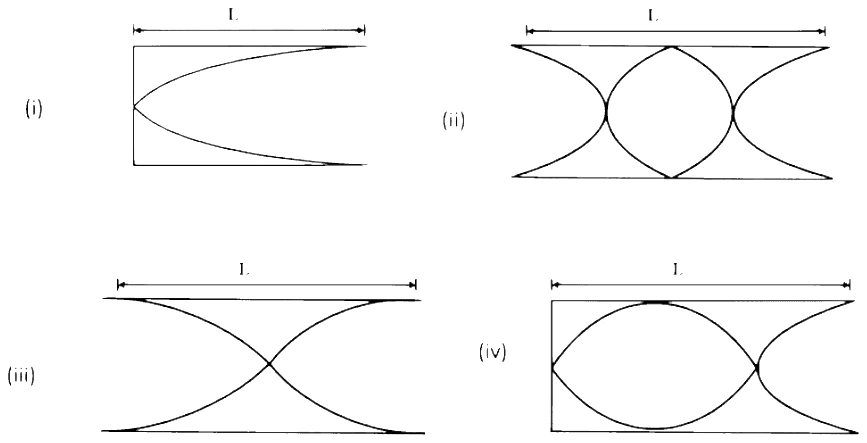
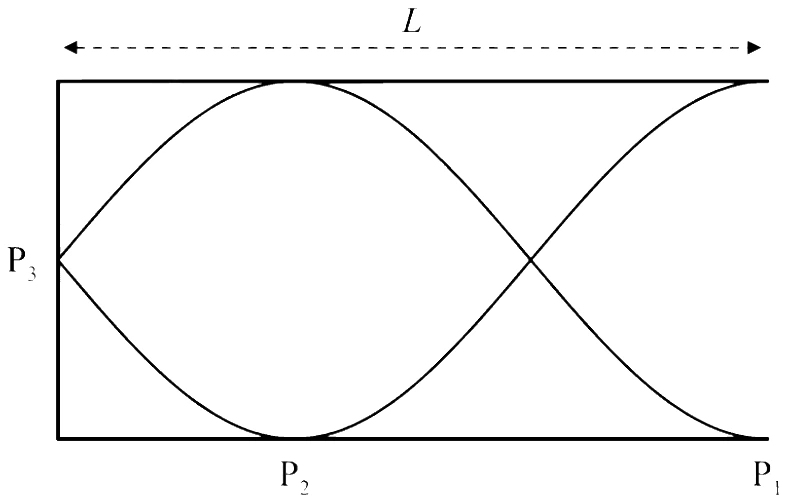
In a pipe closed at one end, air column is vibrating in the fourth overtone so the vibrating air column has 'x' nodes and 'y' antinodes. The values of x and y are respectively
An air column in a pipe which is closed at one end will be in resonance with a vibrating tuning fork of frequency 415 Hz for various vibrating air columns. Which one of the following lengths is not in resonance? (velocity of sound in air = 332 m/s) (Neglect end correction)
The fifth harmonic of a closed organ pipe is found to be in unison with the first harmonic of an open pipe. The ratio of lengths of closed pipe to that of the open pipe is 5/x. The value of x is ______
A pipe open at both ends has a frequency f in air. The pipe is dipped vertically in water, so that its (1/3) part of its length is in water. The fundamental frequency of the air column is now xf, the value of x is
In an organ pipe closed at one end produces a fundamental note of frequency 'ν'. The pipe is cut into two pipes of equal length. The fundamental frequencies produced in the two pipes are
A pipe open at both ends has a fundamental frequency 'f' in air. The pipe is dipped in water, so that 32rd length of pipe is in water, Now the fundamental frequency of the air column is
An organ pipe closed at one end has fundamental frequency of 1500 Hz. The maximum number of overtones generated by this pipe a normal person can hear is (neglect end connection)
In fundamental mode, the time required for the sound wave to reach upto the closed end of a pipe filled with air is t second. The frequency of vibration of air column is
A pipe open at both ends has length 1 m. The air column in a pipe cannot resonate for a frequency (Neglect end correction, speed of sound in air =340 m/s)
An organ pipe P1 closed at one end and vibrating in its first overtone and other pipe P2 open at both ends vibrating in its third overtone are in resonance with a given tuning fork. The ratio of length of P1 and P2 will be
A pipe closed at one end vibrating in the sixth overtone is in unison with the open pipe vibrating in its sixth overtone. The ratio lc:lo is {lc= vibrating length of pipe closed at one end, lo= vibrating length of pipe open at both ends}
The third overtone of a closed pipe of length 'Lc' has the same frequency as the third overtone of the open pipe of length 'L0'. Both the pipes have same diameters. The ratio Lc:L0 is equal to
When open pipe is closed from one end then third overtone of closed pipe is higher in frequency by 150Hz than second overtone of open pipe. The fundamental frequency of open end pipe will be (Neglect end correction)
When open pipe is closed from one end then second overtone of closed pipe is higher in frequency by 100 Hz than first overtone of open pipe. The fundamental frequency of open end pipe will be (Neglect end correction)
For sound waves, if the number of nodes for the 5th harmonic of an open-ended pipe is n and that for the 9th harmonic of the same pipe with one of its ends closed is m, the ratio mn is
The fundamental frequency of a closed pipe is 400 Hz. If 31rd pipe is filled with water then the frequency of 3rd harmonic of the pipe will be (Neglect end correction)
Two closed organ pipes A and B have the same length and A is wider than B. They resonate in the fundamental mode at frequencies nA and nB respectively, then
A tuning fork of frequency 'n' is held near the open end of a tube which is dipped in water and length of the tube is adjusted until resonance occurs. If the two shortest lengths that produce resonance are l1 and l2, the speed of sound in air is (neglect end correction)
In a resonance tube open at one end, the end correction is 1.1 cm. If the shortest length of resonating air column with a tuning fork is 18 cm, the next resonating length will be
n1 is the fundamental frequency of the pipe closed at one end and n2 is the fundamental frequency of the pipe open at both ends. If both are joined end to end, the fundamental frequency of closed pipe so formed is
A Pipe open at one end has length 0.8 m. At the open end of the tube a string 0.5 m long is vibrating in its first overtone and resonates with fundamental frequency of pipe. If tension in the string is 50 N, the mass of string is (Neglect end correction) (Speed of sound =320 m/s)
The fundamental frequency of an air column in a pipe closed at one end is 150 Hz. If the same pipe is open at both the end, the frequencies produced in Hz are
The fundamental frequencies of vibrations of air column in pipe open at both ends and in pipe closed at one end are ' n1 ' and ' n2 ' respectively, then
A pipe open at both ends produces a fundamental frequency n1. When the pipe is kept with 43th of its length in water, it produces a note of fundamental frequency n2. The ratio of n2n1 is
A pipe open at both ends has a fundamental frequency f in air. The pipe is now dipped vertically in a water drum to half of its length. The fundamental frequency of the air column is now equal to:
An organ pipe closed at one end has fundamental frequency of 1500 Hz. The maximum number of overtones generated by this pipe which a normal person can hear is (Normal man can hear the frequency up to 19.5 kHz, Neglect end correction)
In fundamental mode, the time required for the sound wave to reach up to closed end of a pipe filled with air is ' t ' second. The frequency of vibration of air column is (Neglect end correction)
In an organ pipe closed at one end; the sum of the frequencies of first three overtones is 3930 Hz. The frequency of the fundamental mode of organ pipe is
An air column is of length 17 cm. The ratio of frequencies of 5th overtone if the air column is closed at one end to that open at both ends is (velocity of sound in air =340 ms−1)
An open organ pipe is closed such that the third overtone of the closed pipe is found to be higher in frequency by 200 Hz than the second overtone of the original pipe. The fundamental frequency of the open pipe is (Neglect end correction)
The frequency of fourth overtone of a closed pipe is in unison with the fifth overtone of an open pipe. The ratio of length of closed pipe to that of open pipe is
The fundamental frequency of a closed pipe of length L is equal to the second overtone of a pipe open at both the ends of length (XL). The value of X is (Neglect end correction)
The fundamental frequency of a closed pipe is 400 Hz. If (31)rd length of the pipe is filled with water, the frequency of the 2nd harmonic of the pipe will be (Neglect end correction)
The frequency of a stretched uniform wire of length L under tension is in resonance with the fundamental frequency of a closed pipe of same length. If the tension in the wire is increased by 8 N, it is in resonance with the first overtone of the same closed pipe. The initial tension in the wire is
Two pipes of lengths L1 and L2, open at both ends are joined in series. If ' f1 ' and ' f2 ' are the fundamental frequencies of two pipes, then the fundamental frequency of series combination will be (neglect end correction)
A pipe open at both ends of length 1.5 m is dipped in water at one end such that 2nd overtone of vibrating air column is resonating with a tuning fork of frequency 330 Hz. The length of the pipe immersed in water is (Speed of sound in air =330 m/s) (Neglect end correction)
A closed organ and an open organ tube are filled by two different gases having same bulk modulus but different densities ρ1 and ρ2, respectively. The frequency of 9th harmonic of closed tube is identical with 4th harmonic of open tube. If the length of the closed tube is 10 cm and the density ratio of the gases is ρ1:ρ2=1:16, then the length of the open tube is:
A pipe 60 cm long and open at both the ends produces harmonics. Which harmonic mode of pipe resonates a 2.2 KHz source? (Speed of sound in air =330 m/s)( Neglect end correction)
The pipe open at both ends and pipe closed at one end have same length and both are vibrating in fundamental mode. Air column vibrating in open pipe has resonance frequency n1 and air column vibrating in closed pipe has resonance frequency n2, then
The fundamental frequency of a closed organ pipe is equal to the first overtone frequency of an open organ pipe. If length of the open pipe is 60 cm, the length of the closed pipe will be:
The fundamental frequency of an air column in a pipe open at both ends is ' f1 '. Now 80% of its length is immersed in water, the fundamental frequency of the air column becomes f2. The ratio of f1:f2 is
If ' l ' is the length of pipe, ' r ' is the internal radius of the pipe and ' v ' is the velocity of sound in air then fundamental frequency of open pipe is
Two open organ pipes of lengths 60 cm and 90 cm resonate at 6th and 5th harmonics respectively. The difference of frequencies for the given modes is _________ Hz. (Velocity of sound in air =333 m/s)
Numerical answer type. Work it out, then open the answer.
The frequency of the third overtone of a pipe of length ' Lc ', closed at one end is same as the frequency of the sixth overtone of a pipe of length ' L0 ', open at both ends. Then the ratio Lc:L0 is
A resonance tube closed at one end is of height 1.5 m. A tuning fork of frequency 340 Hz is vibrating above the tube. Water is poured in the tube gradually. The minimum height of water column for which resonance is obtained is (Neglect end correction, speed of sound in air =340 m/s)
A tuning fork of frequency 340 Hz is vibrated just above a tube of 120 cm height. Water is slowly poured in the tube. What is the minimum height of water necessary for resonance?
In a closed organ pipe, the frequency of fundamental note is 30 Hz. A certain amount of water is now poured in the organ pipe so that the fundamental frequency is increased to 110 Hz. If the organ pipe has a cross-sectional area of 2 cm2, the amount of water poured in the organ tube is __________ g. (Take speed of sound in air is 330 m/s)
Numerical answer type. Work it out, then open the answer.
If 'l' is the length of the open pipe, 'r' is the internal radius of the pipe and 'V ' is the velocity of sound in air then fundamental frequency of open pipe is
For a certain organ pipe, the first three resonance frequencies are in the ratio of 1:3:5 respectively. If the frequency of fifth harmonic is 405 Hz and the speed of sound in air is 324 ms−1 the length of the organ pipe is _________ m.
Numerical answer type. Work it out, then open the answer.
The fundamental frequency of air column in pipe 'A' closed at one end is in unison with second overtone of an air column in pipe 'B' open at both ends. The ratio of length of air column in pipe 'A' to that of air column in pipe 'B' is
The 4th overtone of a closed organ pipe is same as that of 3rd overtone of an open pipe. The ratio of the length of the closed pipe to the length of the open pipe is:
An open organ pipe having fundamental frequency (n) is in unison with a vibrating string. If the tube is dipped in water so that 75% of the length of the tube is inside the water then the ratio of fundamental frequency of the air column of dipped tube with that of string will be (Neglect end corrections)
A closed organ pipe of length 'L1' and an open organ pipe contain diatomic gases of densities 'ρ1 ' and 'ρ2' respectively. The compressibilities of the gases are same in both pipes, which are vibrating in their first overtone with same frequency. The length of the open organ pipe is (Neglect end correction)
The first overtone frequency of an open organ pipe is equal to the fundamental frequency of a closed organ pipe. If the length of the closed organ pipe is 20 cm, the length of the open organ pipe is _____________ cm.
Numerical answer type. Work it out, then open the answer.
In an experiment to determine the velocity of sound in air at room temperature using a resonance tube, the first resonance is observed when the air column has a length of 20.0 cm for a tuning fork of frequency 400 Hz is used. The velocity of the sound at room temperature is 336 ms−1. The third resonance is observed when the air column has a length of _____________ cm.
Numerical answer type. Work it out, then open the answer.
A tuning fork of frequency 340 Hz resonates in the fundamental mode with an air column of length 125 cm in a cylindrical tube closed at one end. When water is slowly poured in it, the minimum height of water required for observing resonance once again is ___________ cm.
(Velocity of sound in air is 340 ms−1)
Numerical answer type. Work it out, then open the answer.
A hollow pipe of length 0.8 m is closed at one end. At its open end, a 0.5 m long uniform string is vibrating in its second harmonic and it resonates with the fundamental frequency of pipe. If the tension in the string is 50 N and speed of sound in air is 320 m/s, the mass of the string is
An air column in a pipe, which is closed at one end will be in resonance with a vibrating tuning fork of frequency 264 Hz for various lengths. Which one of the following lengths is not possible? (V = 330 m/s)
A tuning fork is vibrating at 250 Hz. The length of the shortest closed organ pipe that will resonate with the tuning fork will be __________ cm. (Take speed of sound in air as 340 ms−1)
Numerical answer type. Work it out, then open the answer.
When an air column in a pipe open at both ends vibrates such that four antinodes and three nodes are formed, then the corresponding mode of vibration is
A cylindrical tube open at both ends has fundamental frequency 'n' in air. The tube is dipped vertically in water so that one-fourth of it is in water. The fundamental frequency of the air column becomes
In fundamental mode, the time required for the sound wave to reach upto the closed end of pipe filled with air is t second. The frequency of vibration of air column is
Two consecutive harmonics of an air column in a pipe closed at one end are of frequencies 150 Hz and 250 Hz. The fundamental frequency of an air column is
The fundamental frequency of an air column in pipe 'A' closed at one end coincides with second overtone of pipe 'B' open at both ends. The ratio of length of pipe 'A' to that of pipe 'B' is
A tuning fork of frequency 'n' is held near the open end of tube which is closed at the other end and the lengths are adjusted until resonance occurs. The first resonance occurs at length L1 and immediate next resonance occurs at length L2. The speed of sound in air is
A glass tube of 1 m length is filled with water. The water can be drained out slowly from the bottom of the tube. If vibrating tuning fork of frequency 500 Hz is brought at the upper end of the tube then total number of resonances obtained are [Velocity of sound in air is 320 ms−1 ]
A student is performing the experiment of resonance column. The diameter of the column tube is 6 cm. The frequency of the tuning fork is 504 Hz. Speed of the sound at the given temperature is 336 m/s. The zero of the metre scale coincides with the top end of the resonance column tube. The reading of the water level in the column when the first resonance occurs is:
A closed organ pipe of length L and an open organ pipe contain gases of densities ρ1 and ρ2 respectively. The compressibility of gases are equal in both the pipes. Both the pipes are vibrating in their first overtone with same frequency. The length of the open pipe is 3xLρ2ρ1 where x is ___________. (Round off to the Nearest Integer)
Numerical answer type. Work it out, then open the answer.
A pipe open at both ends of length 1.5 m is dipped in water such that the second overtone of vibrating air column is resonating with a tuning fork of frequency 330 Hz. If speed of sound in air is 330 m/s then the length of the pipe immersed in water is (Neglect and correction)
A pipe closed at one end has length 0.8 m. At its open end 0.5 m long uniform string is vibrating in its 2nd harmonic and it resonates with the fundamental frequency of the pipe. If the tension in the wire is 50 N and the speed of sound is 320 m/s, the mass of the string is
A closed organ pipe of length 'Lc' and an open organ pipe of length 'Lo' contain different gases of densities 'ρ1' and 'ρ2' respectively. The compressibility of the gases is the same in both the pipes. The gases are vibrating in their first overtone with the same frequency. What is the length of open organ pipe?
In a resonance tube experiment when the tube is filled with water up to a height of 17.0 cm from bottom, it resonates with a given tuning fork. When the water level is raised the next resonance with the same tuning fork occurs at a height of 24.5 cm. If the velocity of sound in air is 330 m/s, the tuning fork frequency is:
A one metre long (both ends open) organ pipe is kept in a gas that has double the density of air at STP. Assuming the speed of sound in air at STP is 300 m/s, the frequency difference between the fundamental and second harmonic of this pipe is ________ Hz.
Numerical answer type. Work it out, then open the answer.
An open organ pipe and a closed organ pipe have the frequency of their first overtone identical. The ratio of length of open pipe to that of closed pipe is
When open pipe is closed from one end third overtone of closed pipe is higher in frequency by 150 Hz, then second overtone of open pipe. The fundamental frequency of open end pipe will be
The fundamental frequency of a closed pipe is 400 Hz. If 31 rd pipe is filled with water, then the frequency of 2nd harmonic of the pipe will be (neglect and correction)
Q99JEE Main 2019 · 10 JAN · SHIFT 2EasyOld syllabus
Organ Pipes & Resonance Tube
A closed organ pipe has a fundamental frequency of 1.5 kHz. The number of overtones that can be distinctly heard by a person with this organ pipe will be (Assume that the highest frequency a person can hear is 20,000 Hz)
In a fundamental mode,the time required for the sound wave to reach upto the closed end of a pipe filled with air is ' t ' second. The frequency of vibration of air column is
A tuning fork with frequency 800 Hz produces resonance in a resonance column tube with upper end open and lower end closed by water surface. Successive resonance are observed at lengths 9.75 cm, 31.25 cm and 52.75 cm. The speed of sound in air is,
A tuning fork of frequency 480 Hz is used in an experiment for measuring speed of sound (v) in air by resonance tube method. Resonance is observed to occur at two successive lengths of the air column, l1 = 30 cm and l2 = 70 cm. Then, v is equal to -
Two open pipes of different lengths and same diameter in which the air column vibrates with fundamental frequencies ' n1 ', and ' n2 ' respectively. When both pipes are joined to form a single pipe, its fundamental frequency will be
A resonance tube is old and has jagged end. It is still used in the laboratory to determine velocity of sound in air. A tuning fork of frequency 512 Hz produces first resonance when the tube is filled with water to a mark 11 cm below a reference mark, near the open end of the tube. The experiment is repeated with another fork of frequency 256 Hz which produces first resonance when water reaches a mark 27 cm below the reference mark. The velocity of sound in air, obtained in the experiment, is close to:
The end correction of a resonance column is 1 cm. If the shortest length resonating with the tuning fork is 10 cm, the next resonating length should be:
The fundamental frequency in an open organ pipe is equal to the third harmonic of a closed organ pipe. If the length of the closed organ pipe is 20 cm, the length of the open organ pipe is
A tuning fork is used to produce resonance in a glass tube. The length of the air column in this tube can be adjusted by a variable piston. At room temperature of 27°C two successive resonances are produced at 20 cm and 73 cm of column length. If the frequency of the tuning fork is 320 Hz, the velocity of sound in air at 27°C is
A pipe open at both ends has a fundamental frequency f in air. The pipe is dipped vertically in water so that half of it is in water. The fundamental frequency of the air column is now:
An air column, closed at one end open at the other, resonates with a tuning fork when the smallest length of the column is 50 cm. The next larger length of the column resonating with the same tuning fork is
The second overtone of an open organ pipe has the same frequency as the first overtone of a closed pipe L metre long. The length of the open pipe will be
The fundamental frequency of a closed organ pipe of length 20 cm is equal to the second overtone of an organ pipe open at both the ends. The length of organ pipe open at both the ends is
The number of possible natural oscillations of air column in a pipe closed at one end length 85 cm whose frequencies lie below 1250 Hz are (Velocity of sound = 340 m s−1)
A pipe of length 85 cm is closed from one end. Find the number of possible natural oscillations of air column in the pipe whose frequencies lie below 1250 Hz. The velocity of sound in air is 340 m/s.
A cylindrical tube, open at both ends, has a fundamental frequency, f, in air. The tube is dipped vertically in water so that half of it is in water. The fundamental frequency of the air-column is now:
While measuring the speed of sound by performing a resonance column experiment, a student gets the first resonance condition at a column length of 18 cm during winter. Repeating the same experiment during summer, she measures the column length to be x cm for the second resonance. Then
A cylindrical tube, open at both ends has fundamental frequency f in air. The tube is dipped vertically in water, so that half of it is in water. The fundamental frequency of air column is now
A source, approaching with speed u towards the open end of a stationary pipe of length L, is emitting a sound of frequency fs. The farther end of the pipe is closed. The speed of sound in air is v and f0 is the fundamental frequency of the pipe. For which of the following combination(s) of u and fs will the sound reaching the pipe lead to a resonance?
More than one option can be correct. Tap every correct option, then tap Check.
In an experiment to measure the speed of sound by a resonating air column, a tuning fork of frequency 500Hz is used. The length of the air column is varied by changing the level of water in the resonance tube. Two successive resonances are heard at air columns of length 50.7cm and 83.9cm. Which of the following statements is (are) true?
More than one option can be correct. Tap every correct option, then tap Check.
A student is performing an experiment using a resonance column and a tuning fork of frequency 244s−1. He is told that the air in the tube has been replaced by another gas (assume that the column remains filled with the gas). If the minimum height at which resonance occurs is (0.350±0.005)m, the gas in the tube is
(Useful information: 167RT=640J1/2mol−1/2; 140RT=590J1/2mol−1/2. The molar mass M in grams is given in the options. Take the values of 10/M for each gas as given there.)
More than one option can be correct. Tap every correct option, then tap Check.
A student is performing the experiment of resonance column. The diameter of the column tube is 4cm. The frequency of the tuning fork is 512Hz. The air temperature is 38∘C at which the speed of sound is 336m s−1. The zero of the meter scale coincides with the top end of the resonance column tube. When the first resonance occurs, the reading of the water level in the column is
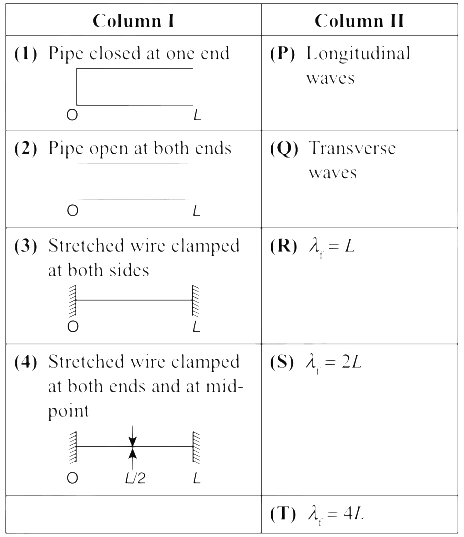
Column I shows four systems, each of the same length L, for producing standing waves. The lowest possible natural frequency of a system is called its fundamental frequency, whose wavelength is denoted as λf. Match each system with statements given in Column II describing the nature and wavelength of the standing waves.
Column I
Column II
(A) Pipe closed at one end
(P) Longitudinal waves
(B) Pipe open at both ends
(Q) Transverse waves
(C) Stretched wire clamped at both sides
(R) λf=L
(D) Stretched wire clamped at both ends and at mid-point
A hollow pipe of length 0.8m is closed at one end. At its open end a 0.5m long uniform string is vibrating in its second harmonic and it resonates with the fundamental frequency of the pipe. If the tension in the wire is 50N and the speed of sound is 320m s−1, the mass of the string is
A pipe of length 85cm is closed at one end. Find the number of possible natural oscillations of the air column in the pipe whose frequencies lie below 1250Hz. The velocity of sound in air is 340m s−1.
Assertion: The fundamental frequency of an open organ pipe increases as the temperature is increased. Reason: As the temperature increases, the velocity of sound increases more rapidly than the length of the pipe.
An organ pipe closed at one end has a fundamental frequency of 1500Hz. The maximum number of overtones generated by this pipe which a normal person can hear is
An organ pipe open on both ends in the nth harmonic is in resonance with a source of 1000Hz. The length of pipe is 16.6cm and speed of sound in air is 332m/s. Find the value of n.
The first overtone frequency of a closed organ pipe is equal to the second harmonic frequency of an open organ pipe. The ratio of their lengths (Lclosed:Lopen) is
The fundamental frequency of a closed organ pipe is same as the first overtone frequency of an open organ pipe. If the length of open organ pipe is 50cm, then the length of closed organ pipe is
The fundamental frequency of an open organ pipe is 600Hz. The first overtone of this pipe has same frequency as first overtone of a closed organ pipe. If speed of sound is 330m s−1, then the length of a closed organ pipe is
Resonance is produced between a tuning fork and a resonance column tube with upper end open and lower end closed by water surface. If the frequency of the tuning fork is 800Hz, and first two resonances are observed at lengths 9.75cm, 31.25cm, find the length at which the third resonance occurs. Also find the speed of sound.
The fundamental frequency of sound produced in an open pipe of length L1 is same as the frequency of the 3rd harmonic of the sound produced in the closed pipe of length L2. Then the ratio of L2L1 is:
An open pipe is in second harmonic with frequency f1. One end of the tube is closed and frequency is increased to f2 and it resonates again with nth harmonic. For what value of n, the ratio of f2f1 is 54?
The number of possible natural oscillations of air column in a pipe closed at one end of length 85cm whose frequencies lie below 1250Hz are (velocity of sound =340m s−1)
The first overtone frequency of a closed pipe of length l1 is equal to the second harmonic frequency of an open pipe of length l2. The ratio l2l1 is equal to
The frequency of the fifth harmonic of a closed organ pipe is equal to the frequency of the third harmonic of an open organ pipe. If the length of the open pipe is 72cm, then the length of the closed organ pipe is
The fundamental frequency of an open pipe is 100Hz. If the bottom end of the pipe is closed and 1/3rd of the pipe is filled with water, then the fundamental frequency of the pipe is
The length of an open pipe is half of the length of another closed pipe. When the two pipes are vibrated, four nodes are formed in both the cases. The ratio of the frequencies of the open and the closed pipes is
An air column in a tube of length 50cm, closed at one end is vibrating in its fifth harmonic. The phase difference between a particle at the open end and a particle at 42cm from the open end is
If the lengths of the open and closed pipes are in the ratio 2:3, then the ratio of the frequencies of the third harmonic of the open pipe and the fifth harmonic of the closed pipe is
Two closed pipes when sounded simultaneously in their fundamental modes produce 6 beats per second. If the length of the shorter pipe is 150cm, then the length of the longer pipe is (Speed of sound in air =336m s−1)
The difference between the fundamental frequencies of an open pipe and a closed pipe of the same length is 100Hz. The difference between the frequencies of the second harmonic of the open pipe and the third harmonic of the closed pipe is
If the seventh harmonic of a closed pipe is in unison with the fourth harmonic of an open organ pipe, then the ratio of the length of the closed pipe to that of the open pipe is
A cylindrical tube open at both ends has a fundamental frequency f in air. The tube is dipped vertically in water so that half of it is in water. The new fundamental frequency is
An organ pipe with both ends open has a length L=25cm. An extra hole is created at position L/2. The lowest frequency of sound produced is (assume the speed of sound =340m s−1)
For air at room temperature, the atmospheric pressure is 1.0×10⁵N m−2 and the density of air is 1.2kg m−3. For a tube of length 1.0m, closed at one end, the lowest frequency generated is 84Hz. The value of γ (ratio of two specific heats) for air is
A hollow cylinder with both sides open generates a frequency f in air. When the cylinder is vertically immersed into water by half its length, the frequency will be
Consider two pipes A and B of identical length. A has one end closed and one end open. B has both ends open. Each tube is immersed in a closed chamber of ideal gas having volume V. The chamber containing tube A is at temperature TA and the chamber containing tube B is at temperature TB. The sound frequencies corresponding to the nA-th harmonic in tube A and the nB-th harmonic in tube B are the same. What is the relation between the temperatures TA and TB?
A tube of length 0.5m open at both ends has a small hole in the middle. Air is blown through this hole. If the speed of sound in air is 330m⋅s−1, the first three harmonics in Hz are
A resonating tube of length l, open at one end, is partially filled with water. When placed in gaseous medium-X, a water column of height l/5 generates the third harmonic using a tuning fork with frequency ν. When placed in gaseous medium-Y, a water column of height l/3 generates the fifth harmonic using the same tuning fork. The ratio vX:vY of the velocity of sound in medium-X to medium-Y is
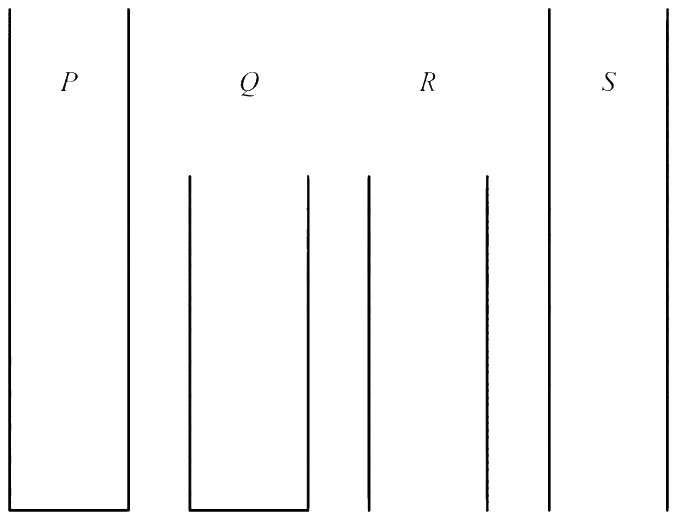
Consider the following four cylindrical tubes (P,Q,R,S) all of equal radii. The tubes Q and R are of length l. The tubes P and S are of length 1.5l. P and Q are closed at the bottom, R and S are open at both ends. If the fundamental frequencies are νP,νQ,νR and νS respectively, then the correct option is
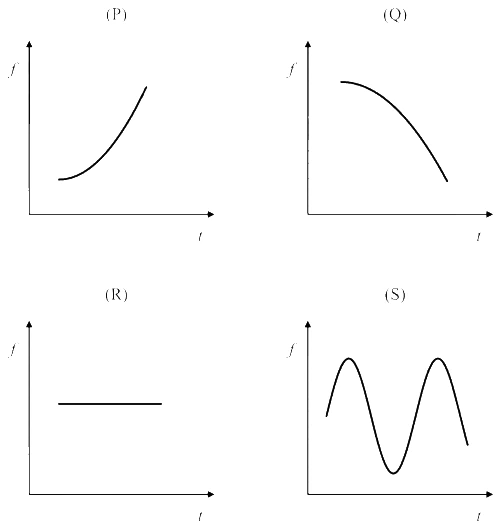
A slow steady stream of water is falling onto a tall cylindrical bucket. Let f(t) denote the dominant frequency of the sound of the fall onto the horizontal water surface in the bucket. The possible time dependences of this frequency are shown in the figures. The graph which best describes the variation of f with t qualitatively is
A tube of length 1m, closed at one end, resonates at a frequency of 249Hz. The speed of sound in air is 332m s−1. The total number of possible frequencies for resonance within the range 1kHz to 2kHz is